Question 512 Marks
The distance travelled by a body is proportional to the square of time. What type of motion this body has?
Answer
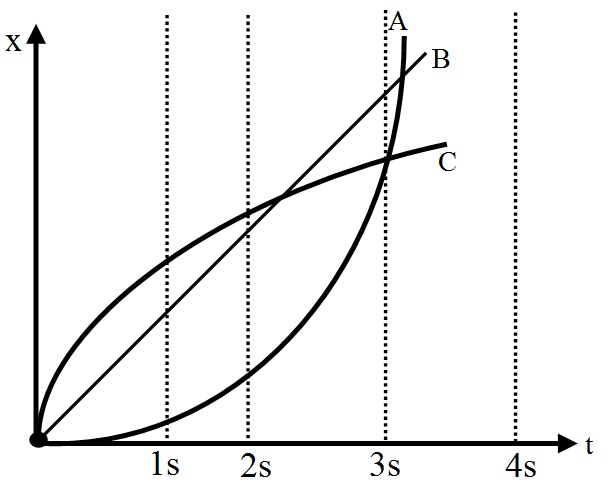
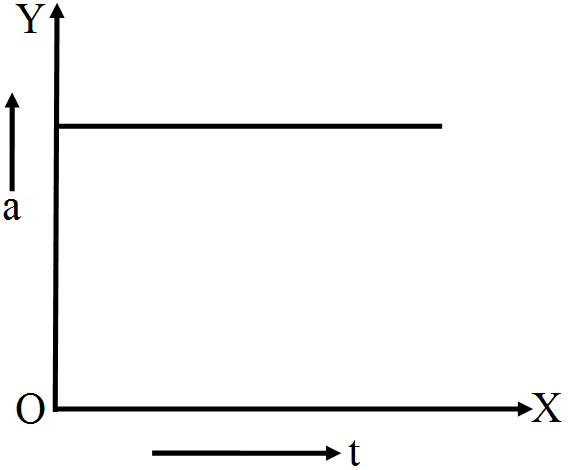
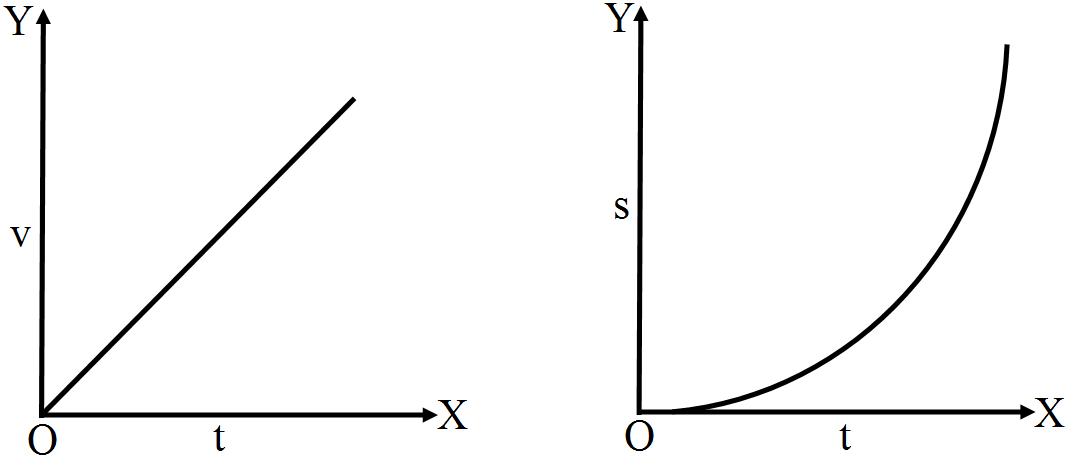
View full question & answer→Here, $\text{x}^2\propto \text{t}^2$ or $\text{x}=\text{kt}^2$ where , k is constant of proportinality. Now, $\text{v}=\frac{\text{dx}}{\text{dt}}=\frac{\text{d}}{\text{dt}}(\text{kt}^2)=2\text{kt}$ and, $\text{a}=\frac{\text{dv}}{\text{dt}}=\frac{\text{d}}{}\text{dt}(2\text{kt})=2\text{k}$ (constant) Thus, the body has uniform accelerated motion.
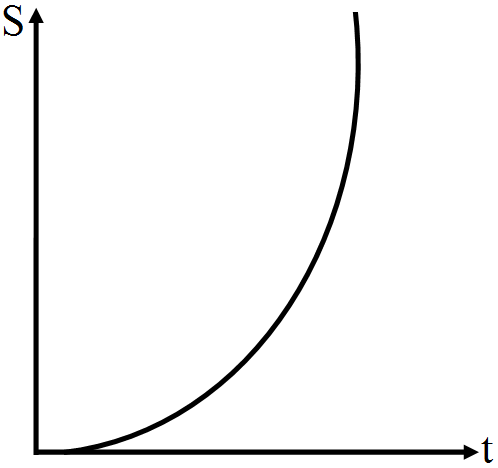 $\text{s}=\text{ut}+\frac{1}{2}\text{at}^2$ For u = 0; $\text{s}=\frac{1}{2}\text{at}^2$ $\text{s}\propto \text{t}^2$
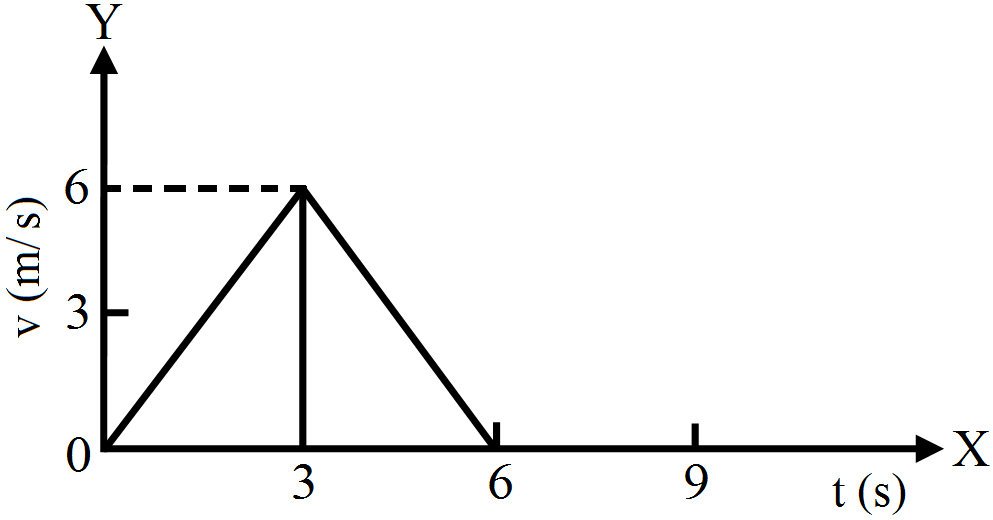
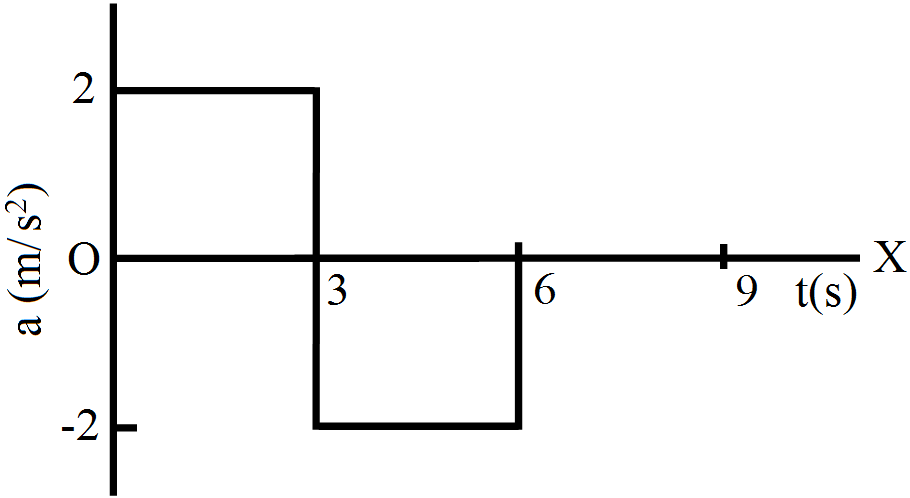 The area enclosed between a-t curve gives change in velocity for the corresponding interval. At t = 0, v = 0, hence final velocity at t = 3s will increase to 6m/s. In next 3s, the velocity will decrease to zero. Thus, the velocity-time graph is