Questions · Page 1 of 2

2 Marks Questions

🎯

Test yourself on this topic

50 questions · timed · auto-graded

Question 12 Marks
In which of the following examples of motion, can the body be considered approximately a point object: A spinning cricket ball that turns sharply on hitting the ground.
Answer
The size of a spinning cricket ball is comparable to the distance through which it turns sharply on hitting the ground. Hence, the cricket ball cannot be considered as a point object.
View full question & answer
Question 22 Marks
A player throws a ball upwards with an initial speed of $29.4 \mathrm{~m} \mathrm{~s}^{-1}$. What is the direction of acceleration during the upward motion of the ball?
Answer
Irrespective of the direction of the motion of the ball, acceleration (which is actually acceleration due to gravity) always acts in the downward direction towards the centre of the Earth.
View full question & answer
Question 32 Marks
Read statement below carefully and state with reasons and examples, if it is true or false; A particle in one-dimensional motion. With zero speed may have non-zero velocity.
Answer
False. Explanation: Speed is the magnitude of velocity. When speed is zero, the magnitude of velocity along with the velocity is zero.
View full question & answer
Question 42 Marks
In which of the following examples of motion, can the body be considered approximately a point object: A tumbling beaker that has slipped off the edge of a table.
Answer
The size of a beaker is comparable to the height of the table from which it slipped. Hence, the beaker cannot be considered as a point object.
View full question & answer
Question 52 Marks
Suggest a suitable physical situation for of the following graphs.
Answer
In the given v-tgraph, the sign of velocity changes and its magnitude decreases with a passage of time. A similar situation arises when a ball is dropped on the hard floor from a height. It strikes the floor with some velocity and upon rebound, its velocity decreases by a factor. This continues till the velocity of the ball eventually becomes zero.
View full question & answer
Question 62 Marks
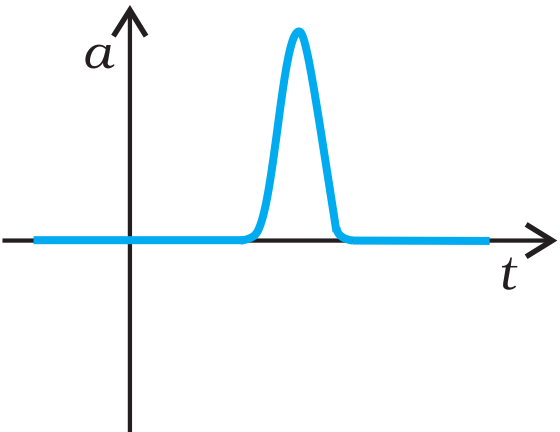
Suggest a suitable physical situation for of the following graphs.
Answer
The given a-t graph reveals that initially the body is moving with a certain uniform velocity. Its acceleration increases for a short interval of time, which again drops to zero. This indicates that the body again starts moving with the same constant velocity. A similar physical situation arises when a hammer moving with a uniform velocity strikes a nail.
View full question & answer
Question 72 Marks
A player throws a ball upwards with an initial speed of $29.4 \mathrm{~m} \mathrm{~s}^{-1}$. What are the velocity and acceleration of the ball at the highest point of its motion?
Answer
At maximum height, velocity of the ball becomes zero. Acceleration due to gravity at a given place is constant and acts on the ball at all points (including the highest point) with a constant value i.e., $9.8 \mathrm{~m} / \mathrm{s}^2$.
View full question & answer
Question 82 Marks
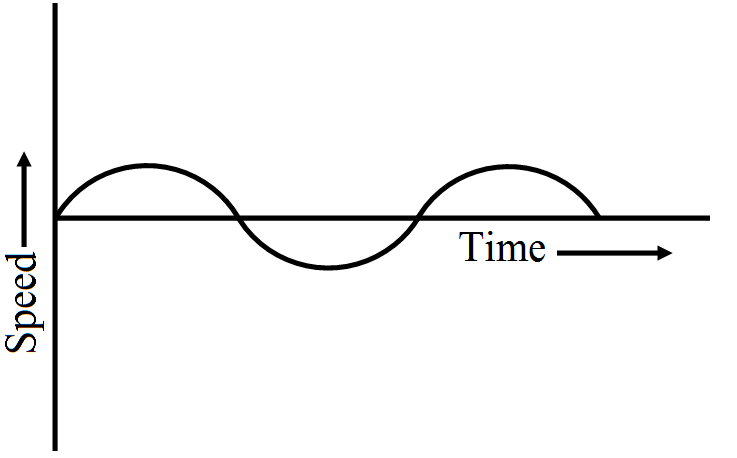
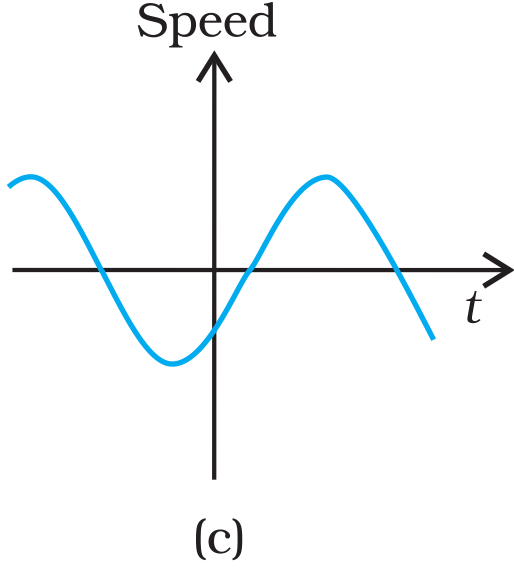
Look at the graphs carefully and state, with reasons, which of these cannot possibly represent one-dimensional motion of a particle.
Answer
Speed has negative values in the graph which is not possible. So, the given v-t graph, shown in (c), does not represent one-dimensional motion of the particle.
View full question & answer
Question 92 Marks
Read statement below carefully and state with reasons and examples, if it is true or false; A particle in one-dimensional motion. With zero speed at an instant may have non-zero acceleration at that instant.
Answer
True. Explanation: When an object is thrown vertically up in the air, its speed becomes zero at maximum height. However, it has acceleration equal to the acceleration due to gravity (g) that acts in the downward direction at that point.
View full question & answer
Question 102 Marks
In which of the following examples of motion, can the body be considered approximately a point object: A monkey sitting on top of a man cycling smoothly on a circular track.
Answer
The size of a monkey is very small as compared to the size of a circular track. Therefore, the monkey can be considered as a point sized object on the track.
View full question & answer
Question 112 Marks
A man walks on a straight road from his home to a market 2.5 km away with a speed of $5 \mathrm{~km}{ }^{\mathrm{h}-1}$. Finding the market closed, he instantly turns and walks back home with a speed of $7.5 \mathrm{~km} \mathrm{~h}^{-1}$. What is the Magnitude of average velocity, and.
Answer
Time taken by the man to reach the market from home, $\mathrm{t}_1=2.5 / 5=1 / 2 \mathrm{~h}=30 \mathrm{~min}$ Time taken by the man to reach home from the market, $\mathrm{t}_2=2.5 / 7.5=1 / 3 \mathrm{~h}=20 \mathrm{~min}$ Total time taken in the whole journey $=30+20=50 \mathrm{~min}$
View full question & answer
Question 122 Marks
Read statement below carefully and state with reasons and examples, if it is true or false; A particle in one-dimensional motion. With constant speed must have zero acceleration.
Answer
True. Explanation: A car moving on a straight highway with constant speed will have constant velocity. Since acceleration is defined as the rate of change of velocity, acceleration of the car is also zero.
View full question & answer
Question 132 Marks
In which of the following examples of motion, can the body be considered approximately a point object: A railway carriage moving without jerks between two stations.
Answer
The size of a carriage is very small as compared to the distance between two stations. Therefore, the carriage can be treated as a point sized object.
View full question & answer
Question 142 Marks
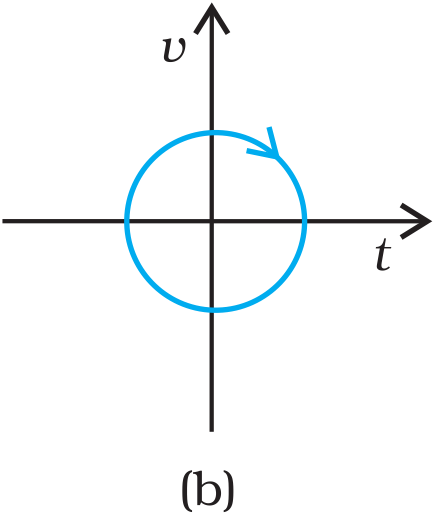
Look at the graphs carefully and state, with reasons, which of these cannot possibly represent one-dimensional motion of a particle.
Answer
If a vertical line is drawn from any point on axis representing t, we see that it cuts the graph at two points which means particle has two velocities at the same instant of time which is not possible. So, the given v-t graph, shown in (b), does not represent one-dimensional motion of the particle.
View full question & answer
Question 152 Marks
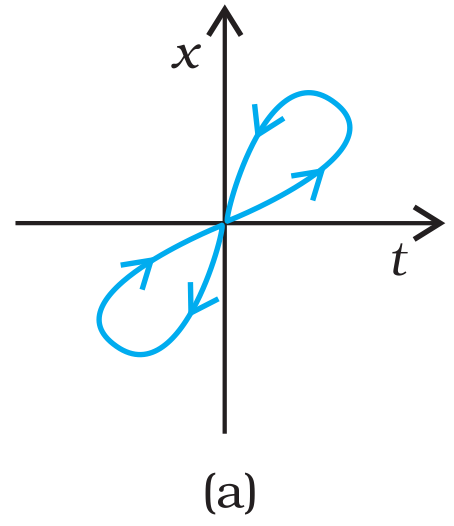
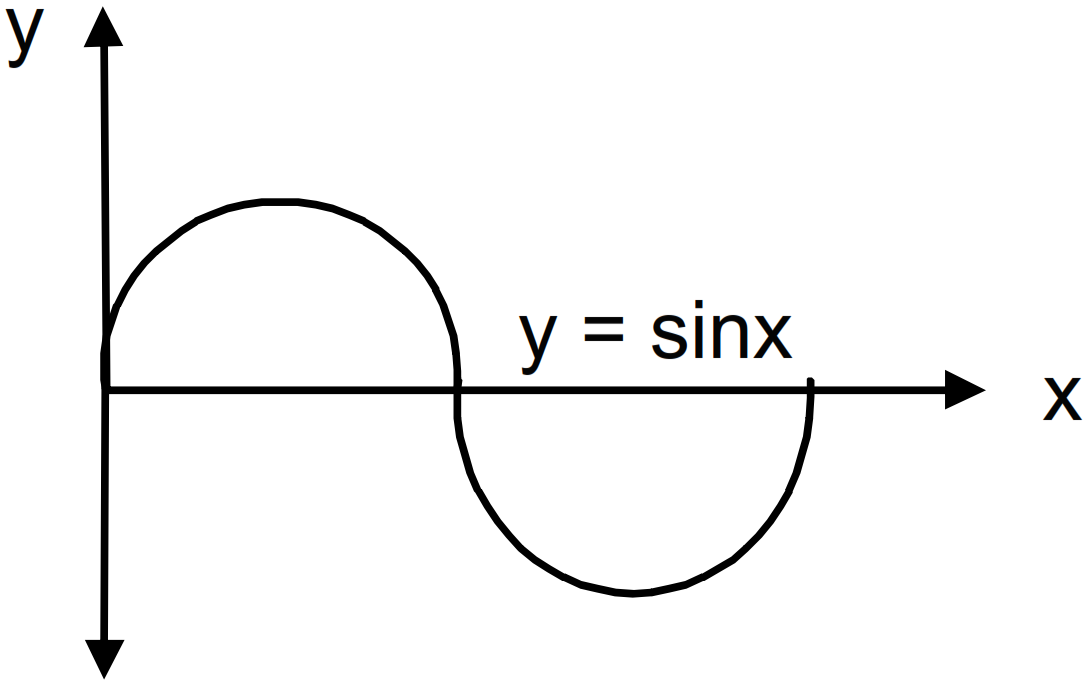
Look at the graphs carefully and state, with reasons, which of these cannot possibly represent one-dimensional motion of a particle.
Answer
If a vertical line is drawn from any point on axis representing t, we see that it cuts the graph at two points which means particle has two positions at the same instant of time which is not possible. So, the given x-t graph, shown in (a), does not represent one-dimensional motion of the particle.
View full question & answer
Question 162 Marks
Under what condition will the distance and displacement of a moving object will have the same magnitude?
Answer
Distance and displacement will have the same magnitude when the object moves along a straight line without change in its direction.
View full question & answer
Question 172 Marks
In which of the following examples of motion, can the body be considered approximately a point object: A spinning cricket ball that turns sharply on hitting the ground.
Answer
The size of a spinning cricket ball is comparable to the distance through which it turns sharply on hitting the ground. Hence, the cricket ball cannot be considered as a point object.
View full question & answer
Question 182 Marks
A player throws a ball upwards with an initial speed of $29.4 \mathrm{~m} \mathrm{~s}^{-1}$. What is the direction of acceleration during the upward motion of the ball?
Answer
Irrespective of the direction of the motion of the ball, acceleration (which is actually acceleration due to gravity) always acts in the downward direction towards the centre of the Earth.
View full question & answer
Question 192 Marks
Prove that $\vec{\text{v}}_\text{AB}=\vec{\text{v}}_\text{A}-\vec{\text{v}}_\text{B},$ where symbols have their usual meaning.
Answer
Consider two bodies A and B moving with velocities VA and vg. Let x ; and xz ; be their initial positions. Their position after time $t$ is given by, $x_{1 f}=x_{1 i}+v_{A t} x_{2 f}=x_{2 i}+v_B t$ Subtacting, $\left(x_{1 f}-x_{2 f}\right)=\left(x_{1 i}-x_{2 i}\right)+t\left(v_A-v_B\right)\left(x_{1 f}-x_{2 f}\right)-\left(x_{1 i}-x_{2 i}\right)=$
$t\left(v_A-v_B\right)$ The change in separation in time ' $t$ ' is $t\left(v_A-v_B\right) \cdot\left(v_A-v_B\right)$ is called relative velocity of $A$ with respect to $B$. It is nothig but the change in separation per unit time.
View full question & answer
Question 202 Marks
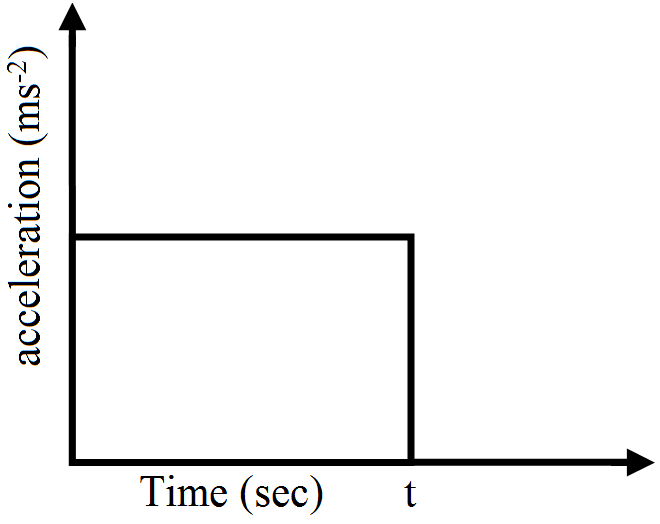
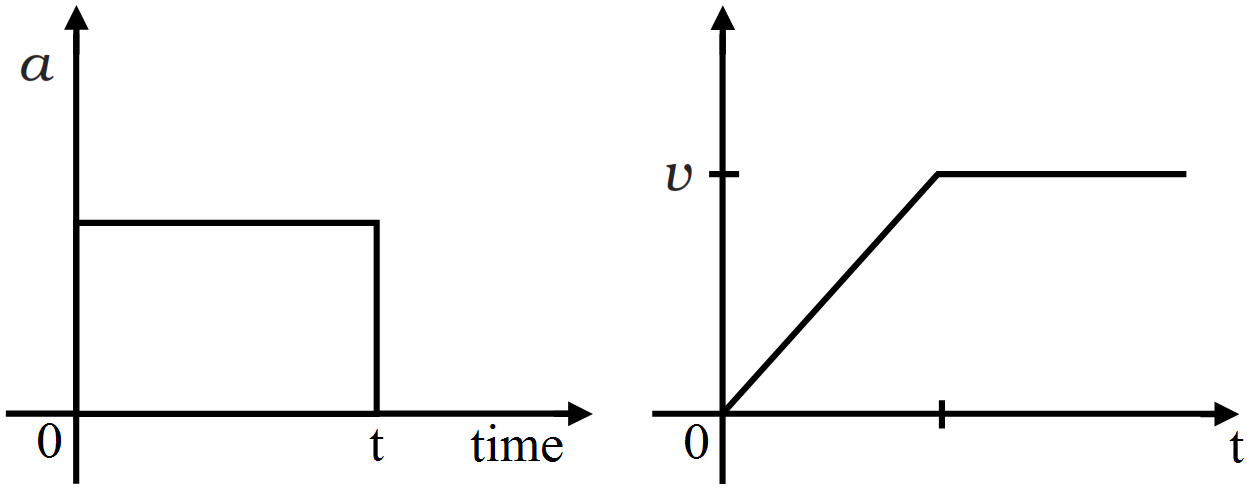
The acceleration-time graph for a body is shown in the figure below. Plot the corresponding velocity-time graph.
Answer
For time t, there is an acceleration a. $\therefore$ Velocity increases after time 't' acceleration is zero. Thus v-t graph will be shown as
View full question & answer
Question 212 Marks
From the given example, find if the motion is one or two or three$-$dimensional.
  1. A kite flying in the sky.
  2. A cricket ball hit by a player.
  3. Moon revolving around the earth.
  4. The motion of a stone in a circle.
Answer
  1. A flying kite in the sky comes under three$-$dimensional motion.
  2. A cricket ball hit by a player comes under two$-$dimensional motion.
  3. Moon revolving around the sun$-$earth comes under two$-$dimensional motion.
  4. The motion of the stone in circular motion comes under two$-$dimensional motion.
View full question & answer
Question 222 Marks
For what condition, an object could be considered as a point object? Describe in brief.
Answer
An object could be considered as a point object if it covers a distance much larger than its own size. e.g. If a bus of 5m in size move 100km, then the bus can be considered as a point object.
View full question & answer
Question 232 Marks
The position of an object is given by $x=2 t^2+3 t$. Find out that its motion is uniform and non-uniform.
Answer
As given, $x=2 t^2+3 t$ By differentiating x w.r.t. t, we get Velocity, $\text{v}=\frac{\text{dx}}{\text{dt}}=\frac{\text{d}}{\text{dt}}(2\text{t}^2+3\text{t})$ $\text{v}=(4\text{t}+3)$ As velocity is time dependent, it means that motion is non-uniform.
View full question & answer
Question 242 Marks
Two particles begin to fall freely from rest from the top of a tower within a gap of 1 s. How long after the first particle begins to fall, the two particles be 15m apart? (Given $\mathrm{g}=10 \mathrm{~ms}^{-2}$ )
Answer
Let the first particle takes time to reach a position co-ordinate 15m below the second particle. Obviously, the second body has fallen under gravity for a time (t-1) s only. Hence $15=\text{y}_1-\text{y}_2=\frac{1}{2}\text{gt}^2-\frac{1}{2}\text{g}(\text{t}-1)^2=\text{gt}-\frac{\text{g}}{2}$ $15=10\text{t}-5$ $\Rightarrow\text{t}=\frac{15+15}{10}=2\text{s}$
View full question & answer
Question 252 Marks
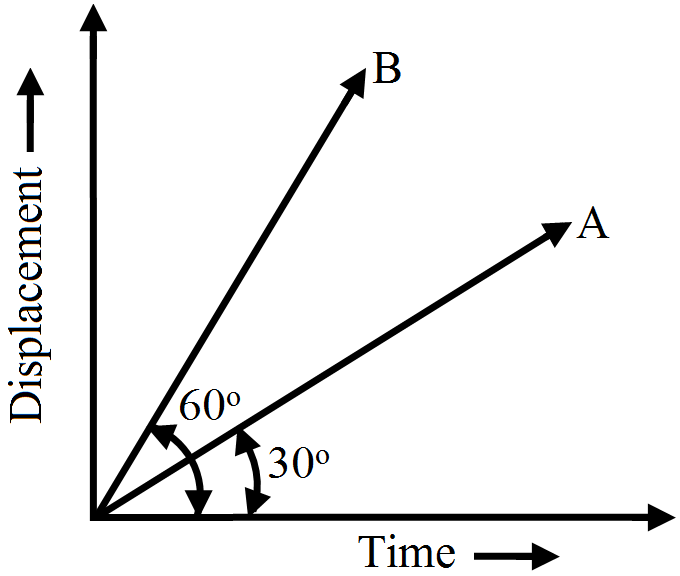
The two straight rays $OA$ and $OB$ on the same displacement $-$ time graph make angle $30^\circ$ and $60^\circ$ with time axis respectively as shown in figure.
  1. Which ray represents greater velocity?
  2. What is the ratio of two velocities represented by $OA$ and $OB?$
Answer
  1. $OB$, because the slope has greater angle.
  2. Ratio of two velocities
$\frac{\text{v}_\text{A}}{\text{v}_\text{B}}=\frac{\tan30^\circ}{\tan^\circ}$
$=\frac{\frac{1}{\sqrt{3}}}{\sqrt{3}}=\frac{1}{3}$
View full question & answer
Question 262 Marks
Give examples where:
  1. The velocity of a particle is zero but its acceleration is not zero.
  2. The velocity is opposite in direction to the acceleration.
  3. The velocity is perpendicular to the acceleration.
Answer
Particle thrown upwards:
  1. At highest point.
  2. While going up.
  3. At the highest point of projectile.
View full question & answer
Question 272 Marks
A body starts from rest and travels in straight line with a uniform acceleration of $5 \mathrm{~m} / \mathrm{s}^2$ for 5 seconds. What is the velocity and distance travelled in this time?
Answer
Velocity after 5 seconds $=\mathrm{v}=\mathrm{u}+\mathrm{at}=0+5 \times 5=25 \mathrm{~ms}^{-1}$ Distance travelled in 5 seconds $\mathrm{S}=\mathrm{ut}+\frac{1}{2} \mathrm{at}^2$ $=0+\frac{1}{2} \times 5 \times 5^2=62.5 \mathrm{~m}$.
View full question & answer
Question 282 Marks
In which of the following examples of motion, can the body be considered approximately a point object: A tumbling beaker that has slipped off the edge of a table.
Answer
The size of a beaker is comparable to the height of the table from which it slipped. Hence, the beaker cannot be considered as a point object.
View full question & answer
Question 292 Marks
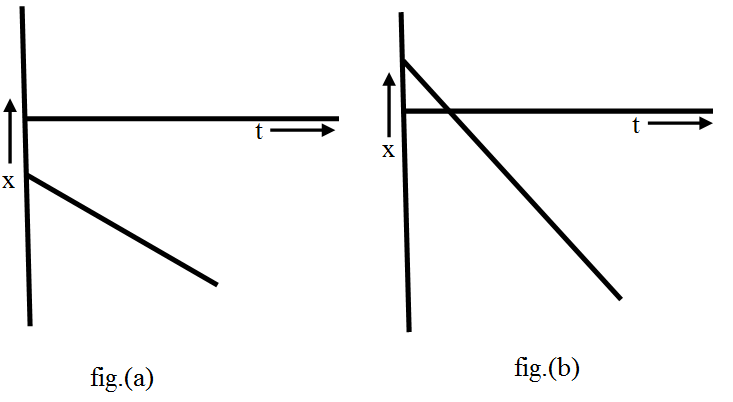
What is common between the two graphs shown in Figs. (a) and (b)?
Answer
Both represent negative velocity.
View full question & answer
Question 302 Marks
A ball is thrown vertically upward with a speed of 20m/s. Draw a graph showing the velocity of the ball as a function of time as it goes up and then comes back.
View full question & answer
Question 312 Marks
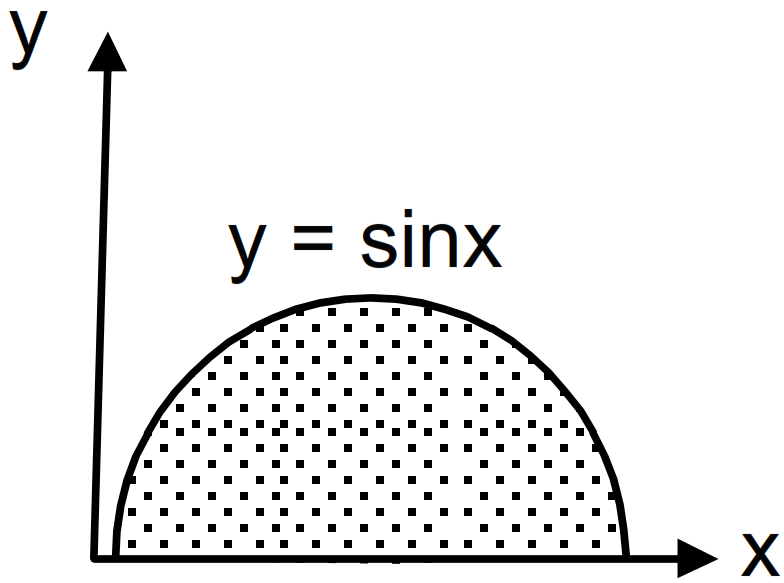
Find the area enclosed by the curve $\text{y}=\sin\text{x}$ and the X-axis between $\text{x}=0$ and $\text{x}=\pi.$
Answer
$\text{Area}=\int\limits^{\text{y}}_{0}\text{dy}=\int\limits^{\pi}_0\sin\text{x dx}=-[\cos\text{x}]^\pi_0=2$
View full question & answer
Question 322 Marks
Why does a person sitting in one train think that the other train is at rest, when both trains are moving on parallel tracks with the same speed and in the same direction?
Answer
This is because the relative velocity of the train in which the person is sitting w.r.t. the other train is zero. For example, let the velocity of A train = 60km/ hr due east Velocity of B train = 60km/ hr due east $\therefore$ Relative velocity of A train w.r.t. B train = 60 - 60 = 0
View full question & answer
Question 332 Marks
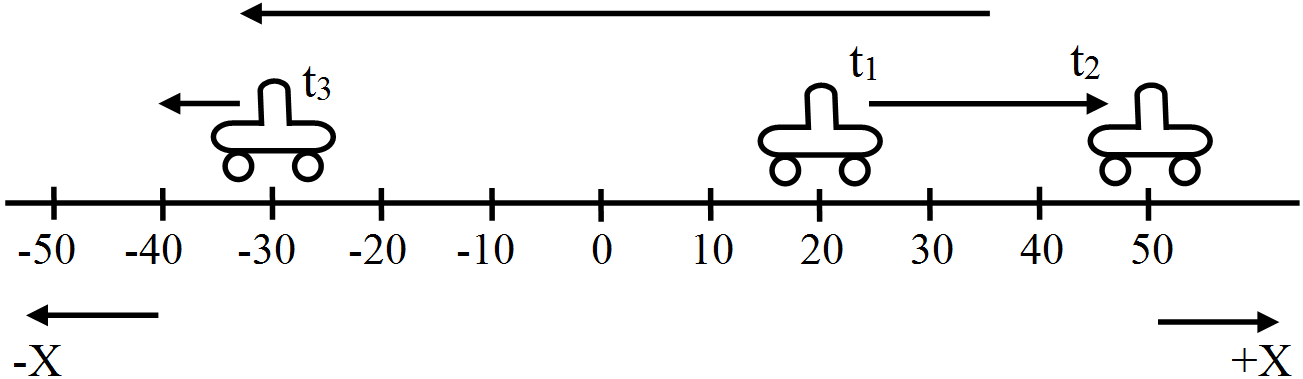
For the motion shown in the figure, find the displacement of car between the time intervals $t_1$ and $t_3$.
Answer
Car moving towards +x-axis. At time $t_1$ it is at +20m. It turns at +50m and starts moving towards - x-axis. At time $t_3$, it reached at -30m. The displacement of car in the interval $(\text{t}_3-\text{t}_1)=\Delta\text{t}$ is -30-(+20) = -50m (negative sign shows the direction of displacement is towards - x-axis).
View full question & answer
Question 342 Marks
An object moving on a straight line covers first half of the distance at speed $v$ and second half of the distance at speed $2v.$ Find:
  1. Aaverage speed.
  2. Mean speed.
Answer
Let total distance be $x.$
Distance of first half $=\frac{\text{x}}{2},$ Speed $= v$
Time taken $t_1=\frac{\frac{\text{x}}{2}}{\text{v}}=\frac{\text{x}}{2\text{v}}$
Distance of second half $=\frac{\text{x}}{2},$
Speed $= 2v$
Time taken $t_2$  $=\frac{\frac{\text{x}}{2}}{2\text{v}}=\frac{\text{x}}{4\text{v}}$
  1. Average speed $=\frac{\text{Total distance travelled}}{\text{Total time taken}}$
$=\frac{\text{x}}{\frac{\text{x}}{2\text{v}}+\frac{\text{x}}{4\text{v}}}=\frac{4\text{v}}{3}$
  1. Mean speed $=\frac{\text{v}+2\text{v}}{2}=\frac{3\text{v}}{2}$
View full question & answer
Question 362 Marks
A curve is represented by $\text{y}=\sin\text{x}.$ If x is changed from $\frac{\pi}{3}$ to $\frac{\pi}{3}+\frac{\pi}{100},$ find approximately the change in y.
Answer
$\text{y}=\sin\text{x}$ So, $\text{y}+\triangle\text{y}=\sin(\text{x}+\triangle\text{x})$ $\triangle\text{y}=\sin(\text{x}+\triangle\text{x})-\sin\text{x}$ $=\Big(\frac{\pi}{3}+\frac{\pi}{100}\Big)-\sin\frac{\pi}{3}=0.0157$
View full question & answer
Question 372 Marks
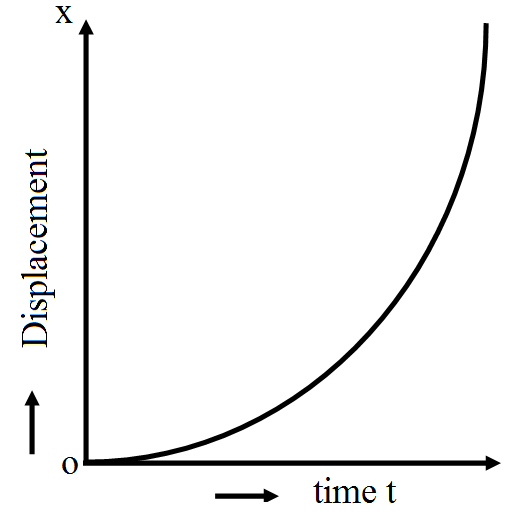
Draw displacement-time graph for a uniformly accelerated motion. What is its shape?
Answer
Displacement-time graph for a uniformly accelerated motion has been shown in adjoining Fig. The graph is parabolic in shape.
View full question & answer
Question 382 Marks
Can a particle have acceleration at an instant if its velocity is zero at that instant? Give example.
Answer
Yes, it is possible. In motion under gravity at the highest point of its motion velocity is zero but acceleration a = g in downward direction.
View full question & answer
Question 392 Marks
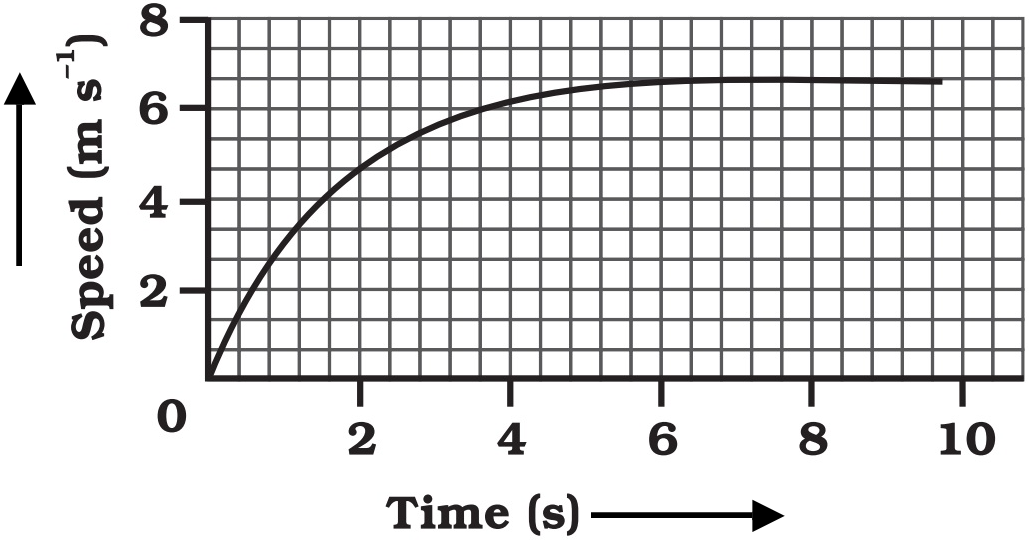
The speed$-$time graph for a car is shown in figure below.
  1. Find how far the car travels in the first $4s?$ Shade the area on the graph that represents the distance travelled by the car during the period.
  2. Which part of the graph represent uniform motion of the car?
Answer
  1. The shaded portion of the car represents the distance travelled by the car in the first four seconds.

The car travels with a non$-$uniform speed which is accelerated in nature.
  1. The straight line portion of the graph represents the uniform motion of the car i.e. from point $A$ to $B.$
View full question & answer
Question 402 Marks
The changes in a function y and the independent dy variable x are related as $\frac{\text{dy}}{\text{dx}}=\text{x}^2.$ Find y as a function of x.
Answer
The change in a function of y and the independent variable x are related as $\frac{\text{dy}}{\text{dx}}=\text{x}^2.$ $\Rightarrow\text{dy}=\text{x}^2\text{dx}$ Taking integration of both sides, $\int\text{dy}=\int\text{x}^2\text{dx}\Rightarrow\text{y}=\frac{\text{x}^3}{3}+\text{c}$ $\therefore$ y as a function of x is represented by $\text{y}=\frac{\text{x}^3}{3}+\text{c}.$
View full question & answer
Question 412 Marks
Can the relative velocity of two bodies be greater than the absolute velocity of either?
Answer
Yes. For example, when two bodies move in opposite direction then relative velocity of each is greater than the individual velocities.
View full question & answer
Question 422 Marks
The speed time graph for a car is shown in Fig.
  1. Find how far does the car travel in the first $4$ seconds. Shade the area on the graph that represents the distance travelled by the car during the period.
  2. Which part of the graph represents uniform motion of the car?
Answer
  1. Shaded part represents distance travelled in $4$ seconds.
Area of shaded part $=\frac{6\text{ms}^{-1}\times4\text{s}}{2}=12\text{m}$
  1. Straight part $AB$ represents a uniform motion of the car.
View full question & answer
Question 432 Marks
The displacement of a particle is given by $at^2$. What is dependency of acceleration on time?
Answer
Let x be the displacement. Then, $x = at^2 \therefore$ Velocity of the object, $\text{v}=\frac{\text{dx}}{\text{dt}}=2\text{at}$ Acceleration of the object, $\text{a}=\frac{\text{dv}}{\text{dt}}=2\text{a}$ It means that a is constant.
View full question & answer
Question 442 Marks
A player throws a ball upwards with an initial speed of $29.4 \mathrm{~m} \mathrm{~s}^{-1}$. What are the velocity and acceleration of the ball at the highest point of its motion?
Answer
At maximum height, velocity of the ball becomes zero. Acceleration due to gravity at a given place is constant and acts on the ball at all points (including the highest point) with a constant value i.e., $9.8 \mathrm{~m} / \mathrm{s}^2$.
View full question & answer
Question 452 Marks
If the displacement of a body is zero, is distance necessarily zero? Answer with one example.
Answer
No, because the distance covered by an object is the path length of the path covered by the object. The displacement of an object is given by the change in position between the initial position and final position. e.g. A boy starts from his home and moves towards market along a straight path. Then, he returns to home from the same path. Here, displacement is zero but distance is non-zero.
View full question & answer
Question 462 Marks
A bird is tossing (flying to and fro) between two cars moving towards each other on a straight road. One car has a speed of 18m/h while the other has the speed of 27km/h. The bird starts moving from first car towards the other and is moving with the speed of 36km/h and when the two cars were separted by 36km. What is the total distance covered by the bird? What is the total displacement of the bird?
Answer
Relative speed of cars = 27 + 18 = 45Km/hr Time to meet the two cars together (t) $\text{t}=\frac{\text{distance between cars}}{\text{relative speed of cars}}=\frac{36\text{km}}{(27+18)\text{km/hr}}$ $=\frac{36}{45}=\frac{4}{5}\Rightarrow\text{t}=\frac{4}{5}\text{hours}$ $\therefore$ Distance covered by the bird in $\frac{4}{5}\text{hours}=36\times\frac{4}{5}=28.8\text{km.}$
View full question & answer
Question 472 Marks
Draw a graph from the following data. Draw tangents at $x = 2, 4, 6$ and $8$. Find the slopes of these tangents. Verify that the curve drawn is $y = 2x^2$ and the slope of dy tangent is $\tan\theta=\frac{\text{dy}}{\text{dx}}=4\text{x}.$
x 1 2 3 4 5 6 7 8 9 10
y 2 8 18 32 50 72 98 128 162 200
Answer
The graph $y = 2x^2$ should be drawn by the student on a graph paper for exact results. To find slope at any point, draw a tangent at the point and extend the line to meet x-axis. Then find $\tan\theta$ as shown in the figure. It can be checked that, Slope $=\tan\theta=\frac{\text{dy}}{\text{dx}}=\frac{\text{d}}{\text{dx}}(2\text{x}^2)=4\text{x}$ Where x = the x-coordinate of the point where the slope is to be measured.
View full question & answer
Question 482 Marks
A bus starting from rest moves with a uniform acceleration of $0.1m/s^2$ for $2$ min. Find:
  1. The speed acquired.
  2. The distance travelled.
Answer
$u= 0, a = 0.1\ m/s$ and $t = 2$ min $120s$
  1. $v = u + at$
$= 0 + 0.1 \times 120$
$= 12m/s$
  1. $\text{s}=\text{ut}+\frac{1}{2}\text{at}^2$
$=0+\frac{1}{2}\times0.1\times(120)^2$
$=\frac{1}{2}\times0.1\times120\times120$
$=720\text{m}$
View full question & answer
Question 492 Marks
The electric current in a charging $R-C$ circuit is given by
$\text{i}=\text{i}_0\text{e}^{-\frac{\text{t}}{\text{RC}}}$
where $\text{i}_0, R$ and $C$ are constant parameters of the circuit and $t$ is time.
Find the rate of change of current at
  1. $t = 0.$
  2. $t = RC.$
  3. $t = 10RC.$
Answer
Given that, $\text{i}=\text{i}_0\text{e}^{-\frac{\text{t}}{\text{RC}}}$
$\therefore$ Rate of change of current $=\frac{\text{di}}{\text{dt}}=\frac{\text{d}}{\text{dt}}\text{i}_0\text{e}^{-\frac{\text{i}}{\text{RC}}}=\text{i}_0\frac{\text{d}}{\text{dt}}\text{e}^{-\frac{\text{t}}{\text{RC}}}=\frac{-\text{i}_0}{\text{RC}}\times\text{e}^{-\frac{\text{t}}{\text{RC}}}$
  1. When $\text{t}=0,\frac{\text{di}}{\text{dt}}=\frac{-\text{i}}{\text{RC}}$
  2. when $\text{t}=\text{RC},\frac{\text{di}}{\text{dt}}=\frac{-\text{i}}{\text{RCe}}$
  3. when $\text{t}=10\text{RC},\frac{\text{di}}{\text{dt}}=\frac{-\text{i}}{\text{RCe}^{10}}$
View full question & answer
Question 502 Marks
A cyclist covers first half of a length with a speed of 5m/s and the second half with a speed of 10m/s. What is the average speed of the cyclist?
Answer
Average Speed $=\frac{2\text{S}}{\frac{\text{S}}{5}+\frac{\text{S}}{10}}=\frac{2\times5\times10}{15}$ $=\frac{100}{15}\text{ms}^{-1}$
View full question & answer
2 Marks Questions - Physics STD 11 Science Questions - Vidyadip