MCQ 511 Mark
Which of the following is isoelectronic pair?
- A
$\text{ICl}_2,\ \text{ClO}_2$
- ✓
$\text{BrO}_2^-,\ \text{BrF}_2^+$
- C
$\text{ClO}_2,\ \text{BrF}$
- D
$\text{CN}^-,\ \text{O}_3$
AnswerCorrect option: B. $\text{BrO}_2^-,\ \text{BrF}_2^+$
Isoelectronic pair have same number of electrons.
- $\begin{cases}\text{ICl}_2=53+2\times17=87\\\text{ClO}_2=17+16=33\end{cases}$
- $\begin{cases}\text{BrO}_2^-=35+2\times8+1=52\\\text{BrF}_2^+=35+9\times2-1=52\end{cases}$
- $\begin{cases}\text{ClO}_2=17+16=33\\\text{BrF}=35+9=44\end{cases}$
- $\begin{cases}\text{CN}^-=6+7+1=14\\\text{O}_3=8\times3=24\end{cases}$
Hence, only $(b)$ is the correct choice. View full question & answer→MCQ 521 Mark
Fluorine is highly reactive because:
AnswerCorrect option: B. $F-F$ bond energy is low.
$F_2$ is highly reactive because of its low bond energy. Also, it has the highest electronegativity.
View full question & answer→MCQ 531 Mark
Which is called lazy gas?
AnswerArgon is lazy gas because during his experiments to remove all gases from air, Sir William Ramsay kept getting the same proportion of an inert gas left behind. He did a lot of experiments to make this gas react with most reactive substance like fluorine, potassium etc. but it did not react with anything. He named this gas argon from a Greek word 'Argos' which means lazy or inert or inactive.
View full question & answer→MCQ 541 Mark
The catalytic promoter used in Haber's process is:
- ✓
$Mo$
- B
$Ni$
- C
$Pt$
- D
$\ce{V_2O_5}$
Answer$Mo$ is used as catalytic promoter in Haber's process.
View full question & answer→MCQ 551 Mark
The bond energy of $N ≡ N$ per mole is:
- A
$180$ kcal
- ✓
$225$ kcal
- C
$350$ kcal
- D
$120$ kcal
AnswerCorrect option: B. $225$ kcal
The bond energy of $N_2$ per mole is $225$ kcal or $945KJ/ mol.$
View full question & answer→MCQ 561 Mark
Maximum covalency of nitrogen is $.......$
AnswerMaximum covalency of nitrogen is four as it cannot extend its valency beyond four $\left[\mathrm{NH}_4, \mathrm{R}_4 \mathrm{\sim N}\right]$ due to absence of vacant orbitals.
View full question & answer→MCQ 571 Mark
Which element is monoatomic gas at room temperature?
- ✓
$Ne$
- B
$F$
- C
$\mathrm{O}_2$
- D
$\mathrm{\sim N}_2$
Answer$Ne$ is noble gas so it will exists as monoatomic gas at room temperature.
All other gases exists in dimer form as $\mathrm{F}_2, \mathrm{~N}_2$ and $\mathrm{O}_2$
View full question & answer→MCQ 581 Mark
Nitrogen can exhibit which of the following oxidation states:
AnswerNitrogen forms oxides in which nitrogen exhibits each of its positive oxidation numbers from $+1$ to $+5.$
$\ce{N_2O}$ has nitrogen in the $+1$ oxidation state,$ NO$ has $+2$ and $\ce{NO_2}$ has $+4$ oxidation state.
View full question & answer→MCQ 591 Mark
The noble gas which has abnormal behaviour in its liquid state is $.......$
AnswerHelium has abnormal behavior in its liquid state due to its small size and nearly ideal behavior.
View full question & answer→MCQ 601 Mark
The inert gas which cannot be adsorbed over activated coconut charcoal?
AnswerDue to small size of helium, it can not be absorbed over activated coconut charcoal.
View full question & answer→MCQ 611 Mark
Affinity for hydrogen decreases in the group from fluorine to iodine. Which of the halogen acids should have highest bond dissociation enthalpy?
- ✓
$HF$
- B
$\text{HCl}$
- C
$\text{HBr}$
- D
$HI$
Answer$HF$ On moving top to bottom $\text{HCl}$ Size of halogen atom increases $\ce{HBr H-X}$ bond length increases $HI$ Bond dissociation enthalpy decreases.
View full question & answer→MCQ 621 Mark
Major minerals containing nitrogen are:
- A
$\text{DNA}$
- B
$\text{RNA}$
- ✓
$\ce{KNO_3, NaNO_3}$
- D
AnswerCorrect option: C. $\ce{KNO_3, NaNO_3}$
Nitrogen gas makes up about $78%$ of the atmosphere by volume. There are relatively major minerals containing nitrogen as nitrates are 'saltpetre' $(\ce{NaNO_3})$ and $\ce{KNO_3}$.
View full question & answer→MCQ 631 Mark
Which of the following has the highest density?
AnswerThe density of elements increases down the group. So, the density of xenon is the highest. The density of $Xe$ is the highest.
View full question & answer→MCQ 641 Mark
$.......$ bacteria are microbes that work in the absence of oxygen.
- ✓
- B
- C
Gram$-$positive.
- D
Gram$-$negative.
AnswerAnaerobic bacteria works in the absence of oxygen.
Example is yeast.
View full question & answer→MCQ 651 Mark
Which of the following substance is stored under water:
- ✓
- B
- C
- D
Both white phosphorous and red phosphorus.
AnswerWhite phosphorous is very reactive therefore it is stored under water.
View full question & answer→MCQ 661 Mark
The inert gas atom in which the total number of $d-$electrons is equal to the difference in numbers of total $p−$ and $s−$electrons, is:
View full question & answer→MCQ 671 Mark
Fluorine, chlorine, bromine, and iodine form a family of related elements, known as:
AnswerFluorine, chlorine, bromine, and iodine form a family of the related elements called “halogens” because they give salts when they react with metals.
View full question & answer→MCQ 681 Mark
To prepare $\ce{XeF_6}$ at $573K, 50 - 60\ atm$ pressure, the ratio of xenon and fluorine used is:
- A
$1 : 2$
- B
$1 : 5$
- ✓
$1 : 20$
- D
$10 : 1$
AnswerCorrect option: C. $1 : 20$
The ratio of xenon and fluorine is $1 : 20$ at $573K, 50 - 60\ atm$ pressure to prepare $\ce{XeF_6}.$
View full question & answer→MCQ 691 Mark
According to Coulson the high reactivity of fluorine than other halogens is because of its:
- A
- B
Lesser internuclear repulsions.
- ✓
Greater repulsions between non bonding electrons.
- D
AnswerCorrect option: C. Greater repulsions between non bonding electrons.
According to Coulson, since fluorine atoms are small it's intermolecular repulsion is appreciable. The large electron$-$electron repulsion between the lone pairs of electrons on the fluorine atom weakens the bond.
View full question & answer→MCQ 701 Mark
Which of the following electronic configuration corresponds to an inert gas?
AnswerCorrect option: B. $\ce{1 s^2 2 s^2 2 p^6}$
Noble gases have full$-$filled configuration i.e the subshell are completely filled.
They have the general electronic configuration as $\ce{ns^2np^6}$.
View full question & answer→MCQ 711 Mark
The valance electron present in group $17$ elements is:
AnswerGroup $17$ elements has outer configuration as $\ce{ns^2 np^5}$ so this group has $7$ valence electrons.
View full question & answer→MCQ 721 Mark
An alkaline gas, which produces dense white fumes when reacted with $\text{HCl}$ gas is $........$
AnswerAn alkaline gas which produces dense white fumes when reacted with $\text{HCl}$ gas is ammonia and fumes are of compound ammonium chloride.
View full question & answer→MCQ 731 Mark
$\ce{BrF_5}$ is a:
AnswerInter halogen compounds are the compounds in which one halogen combines with other halogen.
$\ce{BrF_5}$ is an inter halogen compound. In this compound, bromine combines with fluorine.
Pseudohalogens on the other hand are covalent dimers and contains two or more electronegative atoms out of which at least one is nitrogen.
View full question & answer→MCQ 741 Mark
In the preparation of compounds of $Xe,$ Bartlett had taken $\text{O}_2^+\text{Pt}\text{ F}_6^-$ as a base compound. This is because
- A
both $O_2$ and $Xe$ have same size.
- B
both $O_2$ and $Xe$ have same electron gain enthalpy.
- ✓
both $O_2$ and $Xe$ have almost same ionisation enthalpy.
- D
both $Xe$ and $O_2$ are gases.
AnswerCorrect option: C. both $O_2$ and $Xe$ have almost same ionisation enthalpy.
Neil Bartlett then observed the reaction of a noble gas. First, he prepared a red compound which is formulated as $\text{O}_2^+\text{Pt}\text{ F}_6^-$. He then realised that the first ionisation enthalpy of molecular oxygen $\ce{(1175 kJ mol^{-1})}$ was almost identical with that of xenon $\ce{(1170 kJ\ mol^{-1})}.$
View full question & answer→MCQ 751 Mark
For the inert gases, the value of coefficient of expansion is:
AnswerCorrect option: C. $1.66$
View full question & answer→MCQ 761 Mark
Which of the following is a noble gas?
AnswerHe is a noble gas with $2$ electrons in outer shell.
View full question & answer→MCQ 771 Mark
Industrially, ammonia is obtained by direct combination between nitrogen and hydrogen. The formation of ammonia is promoted at:
- A
$\text{1000 atm}$
- ✓
$\text{200 atm}$
- C
$\text{25 atm}$
- D
$\text{1 atm}$
AnswerCorrect option: B. $\text{200 atm}$
Ammonia is prepared industrially by Haber's process.
In this process, dinitrogen directly reacts with Dihydrogen in $1 : 3$ in presence of iron catalyst with promoters as oxides of potassium or aluminium. The physical conditions required for this process are $\text{200−300 atm}$ pressure and $400−450^\circ C$ temperature.
View full question & answer→MCQ 781 Mark
Fluorine does not show variable oxidation states because $......?$
AnswerCorrect option: B. Of absence of $d-$orbitals.
Fluorine cannot expand its octet due to absence of $d-$orbitals.
Therefore it cannot show variable oxidation states.
View full question & answer→MCQ 791 Mark
AnswerSea salt $\rightarrow $ like $\ce{Mgcl_2, MgBr_2}$ have halogens.
$\therefore$ Halogens are sea salt products.
View full question & answer→MCQ 801 Mark
Which is soluble in water:
- A
$\text{AgCl}$
- B
$\text{AgBr}$
- C
$\text{AgI}$
- ✓
$\text{AgF}$
AnswerCorrect option: D. $\text{AgF}$
Ionic compounds are soluble in water
In $\ce{AgF F^-}$ is small onion with high charge density so less polarisation and less covalent character in the whole group of Ag holdies.
$\text{AgF}$ is most Ionic in nature.
View full question & answer→MCQ 811 Mark
Which of the following is not the allotropic form of sulphur?
AnswerAllotropes are defined as chemical elements which exist in two or more different forms, in the same physical state.
or allotropes are defined as different structural modifications of an element, the atoms of the element are bonded together in a different manner.
At present, about $30$ well$-$characterized sulphur allotropes are known.
Commonly known allotropes of sulphur are:
Rhombic sulphur.
Monoclinic sulphur.
Plastic sulphur $($also known as gamma$-$sulphur$).$
Roll sulphur is not the allotropic form of sulphur.
View full question & answer→MCQ 821 Mark
Which of the following is the Metallic element in group$-15?$
AnswerDown the group metallic properties increases $Bi$ is the metallic element in group$-15$
View full question & answer→MCQ 831 Mark
Compounds formed when the noble gases get entrapped in the cavities of crystal lattices of certain organic and inorganic compounds are known as:
AnswerClathrates $($also known as cage compounds$)$ are compounds of noble gases in which they are trapped within cavities of crystal lattices of certain organic and inorganic substances.
View full question & answer→MCQ 841 Mark
During fractional evaporation of liquid air, nitrogen comes out as a fraction along with:
- A
$\text{Ar, Kr, Xe}$
- B
Only $Ar$
- ✓
$He$ and $Ne$
- D
$\text{Kr, Xe}$
AnswerCorrect option: C. $He$ and $Ne$
$He$ and $Ne$ are obtained during fractional evaporation of liquid air as their boiling point is less. due to weak interaction between molecules.
View full question & answer→MCQ 851 Mark
Phosphorus normally exhibits a covalency of:
- ✓
$+3$ and $+5$
- B
$+2$ and $+3$
- C
$+1$ and $+2$
- D
$+3$ and $+4$
AnswerCorrect option: A. $+3$ and $+5$
Phosphorous acid $\ce{H_3PO_3},$ metaphosphorous acid $\ce{HPO_2}$ has $+3$ oxidation state.
Pyrophosphoric acid $\ce{H_4P_2O_7}$, orthophosphoric acid $\ce{H_3PO_4}$ has $+5$ oxidation state.
View full question & answer→MCQ 861 Mark
Mono atomic element among the following is:
AnswerOxygen is diatomic gas.
Phosphorous is tetra atomic.
Sulphur is polyatomic.
Whereas being an inert gas, Krypton is monoatomic.
View full question & answer→MCQ 871 Mark
High reactivity of white phosphorus is due to:
- ✓
Unusual bonding that produces considerable strain.
- B
High solubility in water.
- C
- D
AnswerCorrect option: A. Unusual bonding that produces considerable strain.
View full question & answer→MCQ 881 Mark
Clathrates are $.......$
- A
- ✓
Inert gases $+$ organic or inorganic compounds.
- C
Halogen $+$ carbon black.
- D
Halogen $+$ transition elements.
AnswerCorrect option: B. Inert gases $+$ organic or inorganic compounds.
Clathrates compound are non$-$stoichiometric in nature.
They have a host molecule which could be a organic or inorganic compound while the guest molecule is inert gases.
View full question & answer→MCQ 891 Mark
Assuming that the seventh period is $32$ members long, what should be the atomic number of the noble gas following radon $(Rn)?$
AnswerThe atomic number of $Rn$ is $86.$
The atomic number of the noble gas following $Rn$ will be $86 + 32 = 118.$
The alkali metal following francium $(Fr)$ has $Z = 119,$
View full question & answer→MCQ 901 Mark
Which of the following statements is wrong?
- ✓
Single $N–N$ bond is stronger than the single $P–P$ bond.
- B
$\ce{PH_3}$ can act as a ligand in the formation of coordination compound with transition elements.
- C
$\ce{NO_2}$ is paramagnetic in nature.
- D
Covalency of nitrogen in $\ce{N_2O_5}$ is four.
AnswerCorrect option: A. Single $N–N$ bond is stronger than the single $P–P$ bond.
$N-N$ bond is weaker than the single $P-P$ bond. because of high interelectronic repulsion of the non$-$bonding electrons, owing to the small bond length.
View full question & answer→MCQ 911 Mark
Hot conc. $\mathrm{H}_2 \mathrm{SO}_4$ acts as moderately strong oxidising agent. It oxidises both metals and nonmetals. Which of the following element is oxidised by conc. $\mathrm{H}_2 \mathrm{SO}_4$ into two gaseous products?
AnswerHot concentrated sulphuric acid is a moderately strong oxidising agent. In this respect, it is intermediate between phosphoric and nitric acids. Both metals and non$-$metals are oxidised by concentrated sulphuric acid, which is reduced to $SO_2. C$ is oxidised into two gaseous products.
$\text{C}+2\text{H}_2\text{SO}_4(\text{conc.})\xrightarrow{\ \ \ \ \ \ \ \ \ }\text{CO}_2+2\text{SO}_2+2\text{H}_2\text{O}$
View full question & answer→MCQ 921 Mark
Which of the following statements are correct?
$A.$ Among halogens, radius ratio between iodine and fluorine is maximum.
$B.$ Leaving $F—F$ bond, all halogens have weaker $X—X$ bond than $X—X\ '$ bond in interhalogens.
$C.$ Among interhalogen compounds maximum number of atoms are present in iodine fluoride.
$D.$ Interhalogen compounds are more reactive than halogen compounds.
- A
$A ,B$ and $C$
- B
$A$ and $b$
- C
$A ,C$ and $D$
- ✓
$A ,B$ and $D$
AnswerCorrect option: D. $A ,B$ and $D$
- Among group $17$ elements radius ratio of iodine and fluorine is maximum because size of iodine is largest and fluorine is smallest in the group.
- The correct statement is inter halogen compounds are more reactive than halogens $($except fluorine$).$ This is because $X-X\ ’$ bond in interhalogens is weaker than $X-X$ bond in halogens except $F-F.$
- As the ratio between radii of $X$ and $X\ ’$ increase, the number of atoms per molecule also increases. Thus, iodine $(\text{VII})$ fluoride should have maximum number of atoms as the ratio of radii between $I$ and $F$ will be maximum.
- Interhalogen compounds are more reactive than halogens $($except fluorine$).$ This is because $X-X\ ’$ bond in interhalogens is weaker than $X-X\ ’$ bond in halogens.
View full question & answer→MCQ 931 Mark
An element $X$ of group $15$ exists as diatomic molecule and combines with hydrogen at $773K$ in presence of the catalyst to form a compound, ammonia which has a characteristic pungent smell. The element $X$ is:
AnswerAs it is is in group $15$ it will have $5$ electrons in outermost shell, i.e, nitrogen group family. As we know that nitrogen combines with hydrogen only in the presence of platinum catalyst. Hence the given element is nitrogen.
View full question & answer→MCQ 941 Mark
$\ce{PCl_5}$ molecule has:
- A
Three fold axis of symmetry.
- B
Two fold axis of symmetry.
- ✓
Both $A$ and $B.$
- D
AnswerCorrect option: C. Both $A$ and $B.$
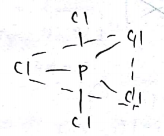
Considering the structure as shown in above image and hybridization of $\ce{PCl_5},$ we can say that it has both three fold axis of symmetry and two fold axis of symmetry.
View full question & answer→MCQ 951 Mark
Bond angle in $P_4$ molecule is:
- ✓
$60^\circ $
- B
$90^\circ $
- C
$120^\circ $
- D
$109^\circ 28\ ′$
AnswerCorrect option: A. $60^\circ $
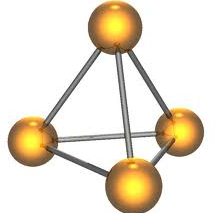
Each face of the tetrahedron are equilateral.
View full question & answer→MCQ 961 Mark
he greater reactivity of $F_2$ is due to:
- A
Lower electron affinity of $F.$
- ✓
Lower bond energy of $F - F$ bond.
- C
Higher electronegativity of $F.$
- D
Gaseous state of $F_2$.
AnswerCorrect option: B. Lower bond energy of $F - F$ bond.
The greater reactivity of $F_2$ is due to lower bond energy of $F - F$ bond and bond energy is lower because of charge repulsion between two $F$ atoms $($due to lower size of $F$ atom charge density is high and repulsion is very high so bond energy is low$)$ making its bond enthalpy lower..
View full question & answer→MCQ 971 Mark
Fluorine does not show positive oxidation states because:
AnswerCorrect option: A. It is most electronegative element.
Fluorine is the most electronegative element so it cannot show positive oxidation state.
View full question & answer→MCQ 981 Mark
On heating lead nitrate forms oxides of nitrogen and lead. The oxides formed are $......$
- A
$\ce{N_2O, PbO}$
- ✓
$\ce{NO_2, PbO}$
- C
$\text{NO, PbO}$
- D
$\ce{NO, PbO_2}$
AnswerCorrect option: B. $\ce{NO_2, PbO}$
$2\text{Pb}(\text{NO}_3)_2\ \xrightarrow{\ \ \ \ \ \ \ \ }\ 2\text{PbO}+4\text{NO}_2+\text{O}_2$
View full question & answer→MCQ 991 Mark
Nitrogen reacts with a metal $M$ to produce a compound $X.$ This compound $X,$ when dissolved in water forms pungent gas $Y$ which can be identified easily by the formation of white fumes in the presence of $\text{HCl}.$ Identify the compound $X.$
AnswerCalcium nitride dissolves in water to give ammonia gas.
Compound $X$ is $\ce{Ca3N_2}$.
$\mathrm{Ca}_3 \mathrm{\sim N}_2+6 \mathrm{H}_2 \mathrm{O} \rightarrow 3 \mathrm{Ca}(\mathrm{OH})_2+2 \mathrm{NH}_3$
View full question & answer→MCQ 1001 Mark
Which one of the following does not exist?
- A
XeOf$_4$
- ✓
NFe$_2$
- C
XeF$_2$
- D
XeF$_6$
AnswerCorrect option: B. NFe$_2$
(B) NeF$_2$
View full question & answer→