Questions · Page 2 of 2

3 Marks Question

Question 513 Marks
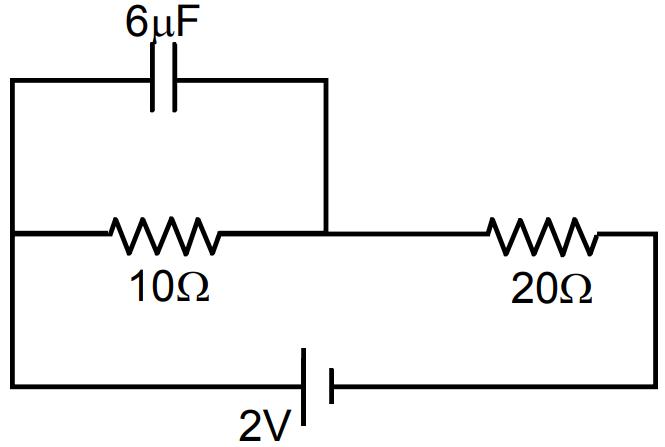
Find the charge on the capacitor shown in figure.
Answer
In steady stage condition no current flows through the capacitor. $\text{R}_\text{eff}=10+20=30\Omega$
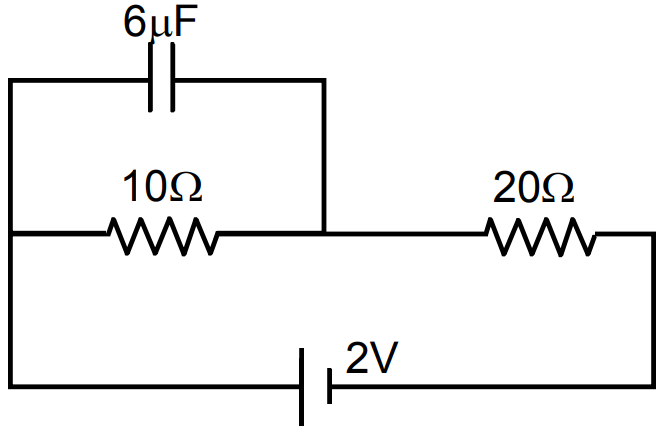
$\text{i}=\frac{2}{30}=\frac{1}{15}\text{A}$
Voltage drop across $10\Omega$ resistor = i × R$=\frac{1}{15}\times10=\frac{10}{15}=\frac{2}{3}\text{V}$
Charge stored on the capacitor (Q) = CV$=6\times10^{-6}\times\frac{2}{3}=4\times10^{-6}\text{C}=4\mu\text{C}.$
View full question & answer
Question 523 Marks
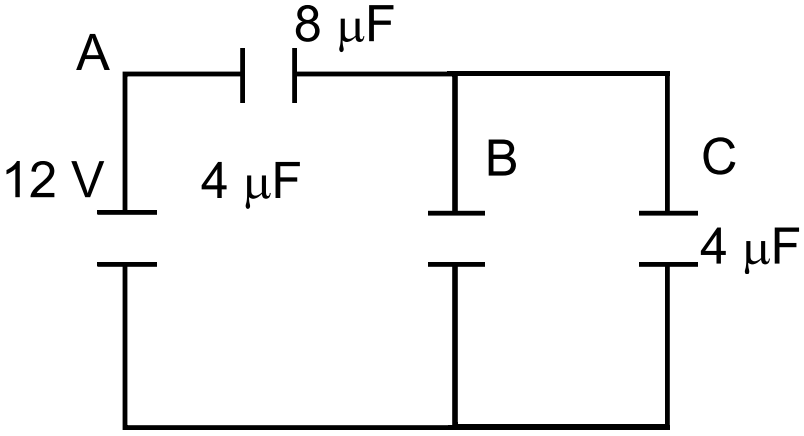
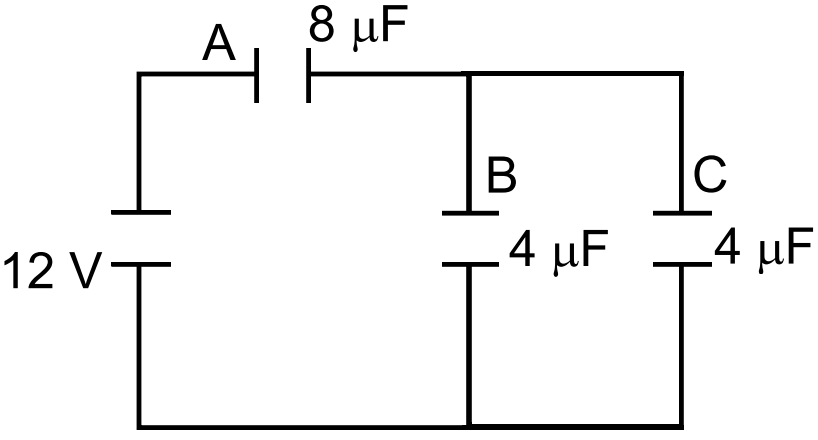
Find the charge appearing on each of the three capacitors shown in figure.
Answer

$\text{C}_1=8\mu\text{F},\ \text{C}_2=4\mu\text{F},\ \text{C}_3=4\mu\text{F}$
$\text{C}_{\text{eq}}=\frac{(\text{C}_2+\text{C}_3)\times\text{C}_1}{\text{C}_1+\text{C}_2+\text{C}_3}$
$=\frac{8\times8}{16}=4\mu\text{F}$
Since B & C are parallel & are in series with A.
So, $\text{q}_1=8\times6=48\mu\text{C}$
$\text{q}_2=4\times6=24\mu\text{C}$
$\text{q}_3=4\times6=24\text{C}\mu$
View full question & answer
Question 533 Marks
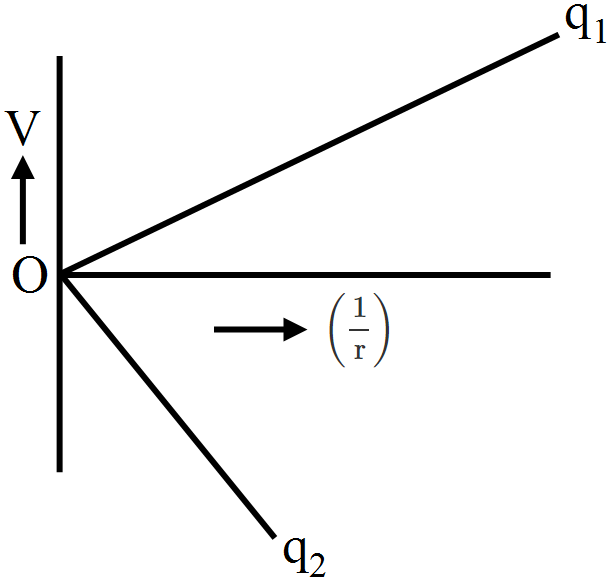
The two graphs are drawn below, show the variations of electrostatic potential (V) $\frac{1}{\text{r}}$ (r being the distance of field point from the point charge) for two point charges $q_1$ and $q_2.$​​​​​​​
  1. What are the signs of the two charges?
  2. Which of the two charges has the larger magnitude and why?
​​​​​​​​​​​​​​
Answer
  1. The potential due to positive charge is positive and due to negative charge, it is negative, so, is $q_1$ positive and $q_2$​​​​​​​ is negative.
$\text{V}=\frac{1}{4\pi\varepsilon_0}\frac{\text{q}}{\text{r}}$
  1. The graph between V and $\frac{1}{\text{r}}$ is a straight line passing through the origin with slope $\frac{\text{q}}{4\pi\varepsilon_0},$
As the magnitude of slope of the line due to charge $q_2$ is greater than that due to $q_1, q_2$ has larger magnitude.
View full question & answer
Question 543 Marks
A large conducting plane has a surface charge density $1.0\times10^{-4}\text{Cm}^{-2}.$ Find the electrostatic energy stored in a cubical volume of edge 1.0cm in front of the plane.
Answer
$\sigma=1\times10^{-4}\text{c/m}^2$$\text{a}=1\text{cm}=1\times10^{-2}\text{m}$
$\text{a}^3=10^{-6}\text{m}$
The energy stored in the plane $=\frac{1}{2}\frac{\sigma^2}{\in_0}=\frac{1}{2}\frac{(1\times10^{-4})^2}{8.85\times10^{-12}}$
$=\frac{10^4}{17.7}=564.97$
The necessary electro static energy stored in a cubical volume of edge 1cm infront of the plane $=\frac{1}{2}\frac{\sigma^2}{\in_0}\text{a}^3=265\times10^{-6}=5.65\times10^{-4}\text{J}$
View full question & answer
Question 553 Marks
The potential V due to a charge distribution at a point (x, y) is given by $V = -x^2 + 3y$
Calculate the electric field, in magnitude and direction, due to this charge configuration at the point (1, 1).
Answer
$\text{V}=-4\text{x}^2+3\text{y}$$\therefore\text{E}_{\text{x}}=-\frac{\partial\text{V}}{\partial\text{x}}=+8\text{x}\ \text{and}\ \text{E}_{\text{y}}=-\frac{\partial\text{V}}{\partial\text{y}}=-3$
$\therefore\ \text{Total}\ \vec{\text{E}}=8\text{x}\hat{\text{i}}-3\hat{\text{j}}$
$\therefore|\vec{\text{E}}|=\sqrt{(8)^2+(3)^2}=\sqrt{73}\frac{\text{N}}{\text{C}}$
Also angle $\theta,$ which $\vec{\text{E}}$ makes with x-axis, is given by,
$\tan\theta=\frac{\text{E}_{\text{y}}}{\text{E}_{\text{z}}}=-\frac{3}{8}=-0.375$
$\theta=\tan^{-1}(-0.375)$
View full question & answer
Question 563 Marks
Two charges 5nC and -2nC are placed at points (5cm, 0, 0) and (23cm, 0, 0) in a region of space where there is no other external field. Calculate the electrostatic potential energy of this charge system.
Answer
Given $q_1 = 5nC = 5 \times 10^{-9}C, q_2 = -2nC = -2 \times 10^{-9}C$, The charges are placed on X-axis. The distance between the charges, $x = x_2 –x_1 = (23 – 5)cm = 18cm = 0.18m$
$\therefore$ Electrostatic potential energy of charges,
$\text{U}=\frac{1}{4\pi\varepsilon_0}\frac{\text{q}_1\text{q}_2}{\text{x}}$
$\frac{9\times10^9\big(5\times10^{-9}\big)\big(-2\times10^{-9}\big)}{0.18}=5\times10-7\text{J}$
View full question & answer
Question 573 Marks
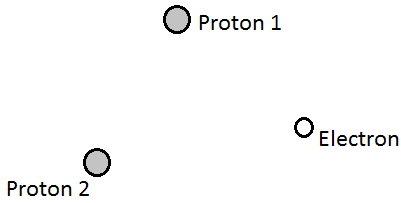
If one of the two electrons of a $H_2$ molecule is removed, we get a hydrogen molecular ion $\text{H}^+_2​.$ In the ground state of an $\text{H}^+_2​,$ the two protons are separated by roughly 1.5 Å, and the electron is roughly 1 Å from each proton. Determine the potential energy of the system. Specify your choice of the zero of potential energy.
Answer
The system of two protons and one electron is represented in the given figure.


Charge on proton $1, q_1 = 1.6 x 10^{-19} C$
Charge on proton $2, q_2= 1.6 x 10^{-19} C$
Charge on electron, $q_3 = -1.6 x 10-^{19} C$
Distance between protons $1$ and $2, d_1 = 1.5 x 10^{-10} m$
Distance between proton $1$ and electron, $d_2 = 1 x 10^{-10} m$
Distance between proton $2$ and electron, $d_3 = 1 x 10^{-10} m$
The potential energy at infinity is zero.
Potential energy of the system,$\text{V}=\frac{\text{q}_1\text{q}_2}{4\pi\in_0\text{d}_1}+\frac{\text{q}_2\text{q}_3}{4\pi\in_0\text{d}_1}$
View full question & answer
Question 583 Marks
In a hydrogen atom, the electron and proton are bound at a distance of about 0.53 $\mathring{\text{A}}$:
  1. Estimate the potential energy of the system in eV, taking the zero of the potential energy at infinite separation of the electron from proton.
  2. What is the minimum work required to free the electron, given that its kinetic energy in the orbit is half the magnitude of potential energy obtained in (a)?
  3. What are the answers to (a) and (b) above if the zero of potential energy is taken at 1.06 Å separation?
Answer
The distance between electron-proton of a hydrogen atom, d = 0.53 $\mathring{\text{A}}$
Charge on an electron, $q_1 = -1.6 x 10^{-19} C$
Charge on a proton, $q_2 = +1.6 x 10^{-19} C$
  1. Potential at infinity is zero.
Potential energy of the system, p-e = Potential energy at infinity - Potential energy at distance, d

$=0-\frac{\text{q}_1\text{q}_2}{4\pi\in_0\text{d}}$

Where,

$\in_0$ is the permittivity of free space

$\frac{1}{4\pi\in_0}=9\times10^9\text{Nm}^2\text{C}^{-2}$

$\therefore\text{Potential energy}=0-\frac{9\times10^9\times\big(1.6\times10^{-19}\big)^2}{0.53\times10^{-10}}=-43.7\times10^{-19}\text{J}$

Since $1.6x 10^{-19} J = 1\ eV,$

$\therefore\text{Potential energy}=-43.7\times10^{-19}=\frac{-43.7\times10^{-19}}{1.6\times10^{-19}}=-27.2\ \text{eV}$

Therefore, the potential energy of the system is -27.2 ev.
  1. Kinetic energy is half of the rnagnitude of potential energy.
Kinetic energy $=\frac{1}{2}\times(-27.2)=13.6\ \text{eV}$

Total energy $= 13.6 - 27.2 = 13.6\ eV$

Therefore, the rninimum work required to free the electron is 13.6 eV.
  1. When zero of potential energy is taken, $d_1= 1.06\ A$
$\therefore$ Potential energy of the system = Potential energy at $d_1 -$ Potential energy at d

$=\frac{\text{q}_1\text{q}_2}{4\pi\in_0\text{d}_1}-27.2\ \text{eV}$

$=\frac{9\times10^9\times(1.6\times10^{-19})^2}{1.06\times10^{-10}}-27.2\ \text{eV}$

$= 21.73 × 10^{-19}\ J - 27.2\ eV$

$= 13.58\ eV - 27.2\ eV$

$= -13.6\ eV$
View full question & answer
Question 593 Marks
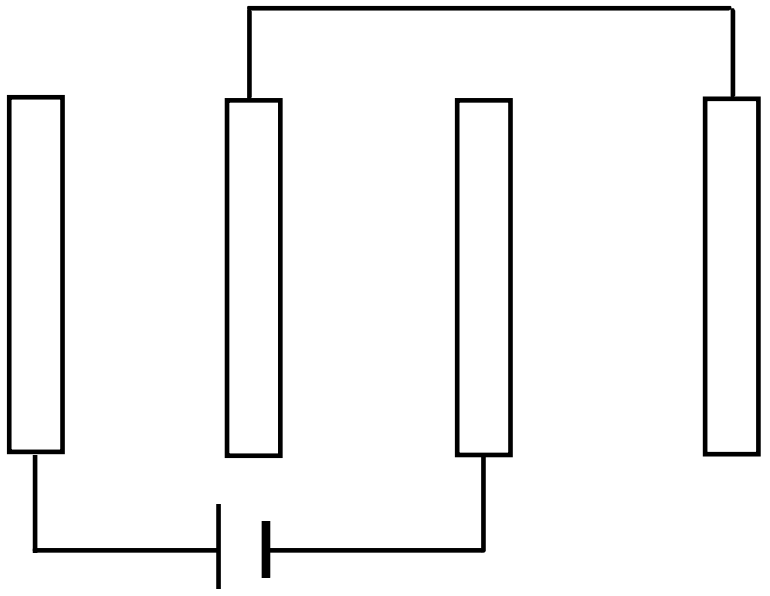
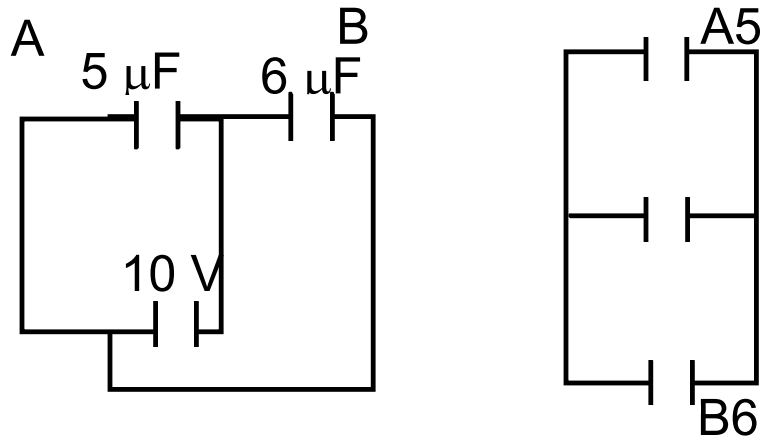
Each of the plates shown in figure has surface area $\Big(\frac{96}{\in_0}\Big)\times10^{-12}\text{Fm}$ on one side and the separation between the consecutive plates is 4.0mm. The emf of the battery connected is 10 volts. Find the magnitude of the charge supplied by the battery to each of the plates connected to it.
Answer


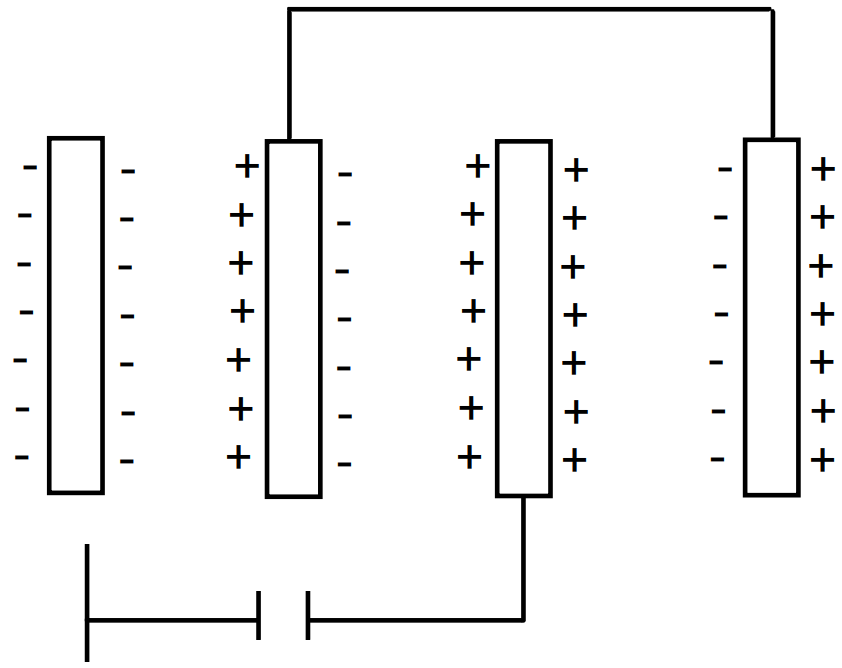
Here three capacitors are formed
And each of $\text{A}=\frac{96}{\in_0}\times10^{-12}\text{f.m.}$
$\text{d}=4\text{mm}=4\times10^{-3}\text{m}$
$\therefore$ Capacitance of a capacitor
$\text{C}=\frac{\in_0\text{A}}{\text{d}}=\frac{\in_0\frac{96\times10^{-12}}{\in_0}}{4\times10^{-3}}=24\times10^{-9}\text{F}$
$\therefore$ As three capacitor are arranged is series
So, $\text{C}_\text{eq}=\frac{\text{C}}{\text{q}}=\frac{24\times10^{-9}}{3}=8\times10^{-9}$
$\therefore$ The total charge to a capacitor $= 8 \times 10^{-9} \times 10 = 8 \times 10^{-8}c$
$\therefore$ The charge of a single Plate $= 2 \times 8 \times 10^{-8} = 16 \times 10^{-8} = 0.16 \times 10^{-6} = 0.16\mu\ c.$
View full question & answer
Question 603 Marks
“Gauss’s law in electrostatics is true for any closed surface, no matter what its shape or size is”. Justify this statement with the help of a suitable example.
Answer
According to Gauss theorem, the electric flux through a closed surface depends only on the net charge enclosed by the surface and not upon the shape or size of the surface.
For any closed arbitrary slope of the surface enclosing a charge the outward flux is the same as that due to a spherical Gaussian surface enclosing the same charge.
Justification: This is due to the fact that,
  1. Electric field is radial,
  2. The electric field $\text{E}\propto\frac{1}{\text{R}^2}$
View full question & answer
Question 613 Marks
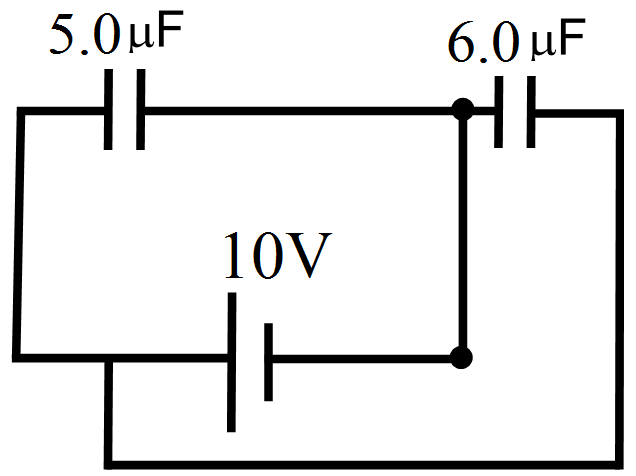
Find the charge supplied by the battery in the arrangement shown in figure.
Answer

$\text{V}=\text{10v}$
$\text{C}_{\text{eq}}=\text{C}_1+\text{C}_2$ $[\therefore$ They are parallel$]$
$=5+6=11\mu\text{F}$
$\text{q}=\text{CV}=11\times10=110\mu\text{C}$
View full question & answer
Question 623 Marks
When $1.0 \times 10^{12}$ electrons are transferred from one conductor to another, a potential difference of 10V appears between the conductors. Calculate the capacitance of the two-conductor system.
Answer
Given that Number of electron $= 1 \times 10^{12}$
Net charge $Q = 1 \times 10^{12} \times 1.6 \times 10^{-19} = 1.6 \times 10^{-7}C  $
$\therefore$ The net potential difference = 10L.
$\therefore$ Capacitance $\text{C}=\frac{\text{q}}{\text{v}}$
$=\frac{1.6\times10^{-7}}{10}=1.6\times10^{-8}\text{F}.$
View full question & answer
Question 633 Marks
Can two equipotential surfaces cut each other?
Answer
At the point of intersection, two normals can be drawn. Also, we know that electric field lines are perpendicular to the equipotential surface. This implies that at that point two different directions of the electric field are possible, which is not possible physically.
Hence, two equipotential surfaces cannot cut each other.
View full question & answer
Question 643 Marks
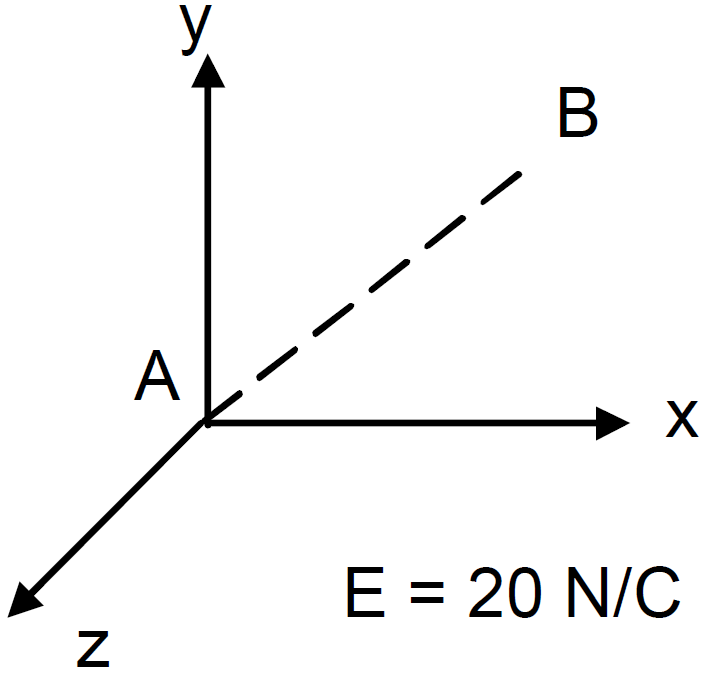
An electric field of $20NC^{-1}$ exists along the x-axis in space. Calculate the potential difference $V_B - V_A$ where the points A and B are given by,
  1. A = (0, 0); B = (4m, 2m)
  2. A = (4m, 2m); B = (6m, 5m)
  3. A = (0, 0); B = (6m, 5m)
Do you find any relation between the answers of parts (a), (b) and (c)?
Answer

  1. $\text{A}=(0,0);\ \text{B}=(4,2)$
$\Rightarrow\text{V}_\text{B}-\text{V}_\text{A}=\text{E}\times\text{d}$

$=20\times\sqrt{16}$

$=80\text{V}$
  1. $\text{A}=(4\text{m},2\text{m});\ \text{B}=(6\text{m},5\text{m})$
$\Rightarrow\text{V}_\text{B}-\text{V}_\text{A}=\text{E}\times\text{d}$

$=20\times\sqrt{(6-4)^2}$

$=20\times2$

$=40\text{V}$
  1. $\text{A}=(0,0);\ \text{B}=(6\text{m},5\text{m})$
$\Rightarrow\text{V}_\text{B}-\text{V}_\text{A}=\text{E}\times\text{d}$

$=20\times\sqrt{(6-0)^2}$

$=20\times6$

$=120\text{V}.$
View full question & answer
Question 653 Marks
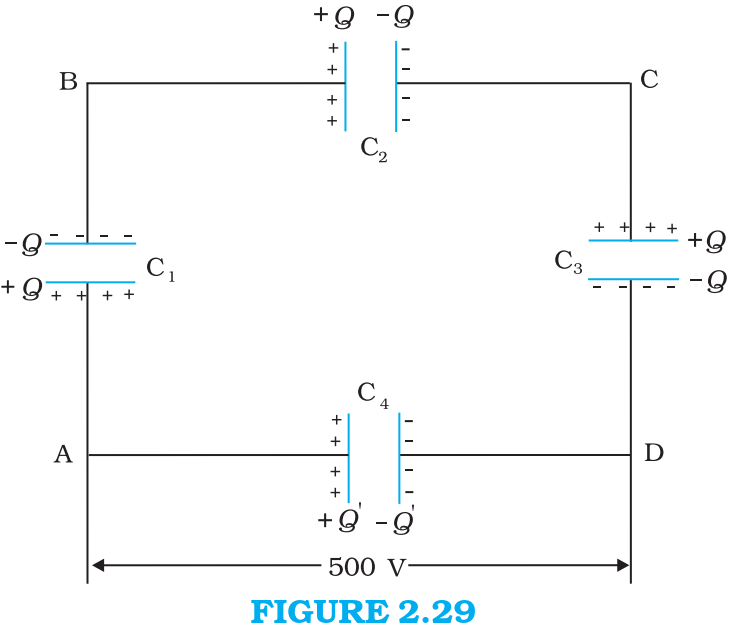
A network of four $10 \mu F$ capacitors is connected to a $500 V$ supply, as shown in Fig. $2.29.$ Determine $(a)$ the equivalent capacitance of the network and $(b)$ the charge on each capacitor. $($Note, the charge on a capacitor is the charge on the plate with higher potential, equal and opposite to the charge on the plate with lower potential.$)$
Image
Answer
$(a)$ In the given network, $C_1, C_2$ and $C_3$ are connected in series.
The effective capacitance $C ^{\prime}$ of these three capacitors is given by
$\frac{1}{C^{\prime}}=\frac{1}{C_1}+\frac{1}{C_2}+\frac{1}{C_3}$
For $C_1=C_2=C_3=10 \mu F , C^{\prime}=(10 / 3) \mu F$.
The network has $C^{\prime}$ and $C_4$ connected in parallel.
Thus, the equivalent capacitance $C$ of the network is
$C=C^{\prime}+C_4=\left(\frac{10}{3}+10\right) \mu F =13.3 \mu F$
$(b)$ Clearly, from the figure, the charge on each of the capacitors, $C_1$, $C_2$ and $C_3$ is the same, say $Q$.
Let the charge on $C_4$ be $Q^{\prime}$.
Now, since the potential difference across $AB$ is $Q / C_1$, across $BC$ is $Q / C_2$, across $CD$ is $Q / C_3$, we have
$\frac{Q}{C_1}+\frac{Q}{C_2}+\frac{Q}{C_3}=500 V \text {. }$
Also, $Q^{\prime} / C_4=500 V$.
This gives for the given value of the capacitances,
$Q=500 V \times \frac{10}{3} \mu F =1.7 \times 10^{-3} C \text { and }$
$Q^{\prime}=500 V \times 10 \mu F =5.0 \times 10^{-3} C$
View full question & answer
Question 663 Marks
(a) A comb run through one's dry hair attracts small bits of paper. Why?
What happens if the hair is wet or if it is a rainy day? (Remember, a paper does not conduct electricity.)
(b) Ordinary rubber is an insulator. But special rubber tyres of aircraft are made slightly conducting. Why is this necessary?
(c) Vehicles carrying inflammable materials usually have metallic ropes touching the ground during motion. Why?
(d) A bird perches on a bare high power line, and nothing happens to the bird. A man standing on the ground touches the same line and gets a fatal shock. Why?
Answer
(a) This is because the comb gets charged by friction. The molecules in the paper gets polarised by the charged comb, resulting in a net force of attraction. If the hair is wet, or if it is rainy day, friction between hair and the comb reduces. The comb does not get charged and thus it will not attract small bits of paper.
(b) To enable them to conduct charge (produced by friction) to the ground; as too much of static electricity accumulated may result in spark and result in fire.
(c) Reason similar to (b).
(d) Current passes only when there is difference in potential.
View full question & answer
Question 673 Marks
(a) Determine the electrostatic potential energy of a system consisting of two charges $7 \mu C$ and $-2 \mu C$ (and with no external field) placed at ( $-9 cm , 0,0)$ and $(9 cm , 0,0)$ respectively.
(b) How much work is required to separate the two charges infinitely away from each other?
(c) Suppose that the same system of charges is now placed in an external electric field $E=A\left(1 / r^2\right) ; A=9 \times 10^5 NC ^{-1} m ^2$. What would the electrostatic energy of the configuration be?
Answer
(a) $U=\frac{1}{4 \pi \varepsilon_0} \frac{q_1 q_2}{r}=9 \times 10^9 \times \frac{7 \times(-2) \times 10^{-12}}{0.18}=-0.7 J$.
(b) $W=U_2-U_1=0-U=0-(-0.7)=0.7 J$.
(c) The mutual interaction energy of the two charges remains unchanged. In addition, there is the energy of interaction of the two charges with the external electric field. We find,
$
q_1 V\left( r _1\right)+q_2 V\left( r _2\right)=A \frac{7 \mu C }{0.09 m }+A \frac{-2 \mu C }{0.09 m }
$
and the net electrostatic energy is
$
\begin{array}{r}
q_1 V\left( r _1\right)+q_2 V\left( r _2\right)+\frac{q_1 q_2}{4 \pi \varepsilon_0 r_{12}}=A \frac{7 \mu C }{0.09 m }+A \frac{-2 \mu C }{0.09 m }-0.7 J \\
=70-20-0.7=49.3 J
\end{array}
$
View full question & answer
Question 683 Marks
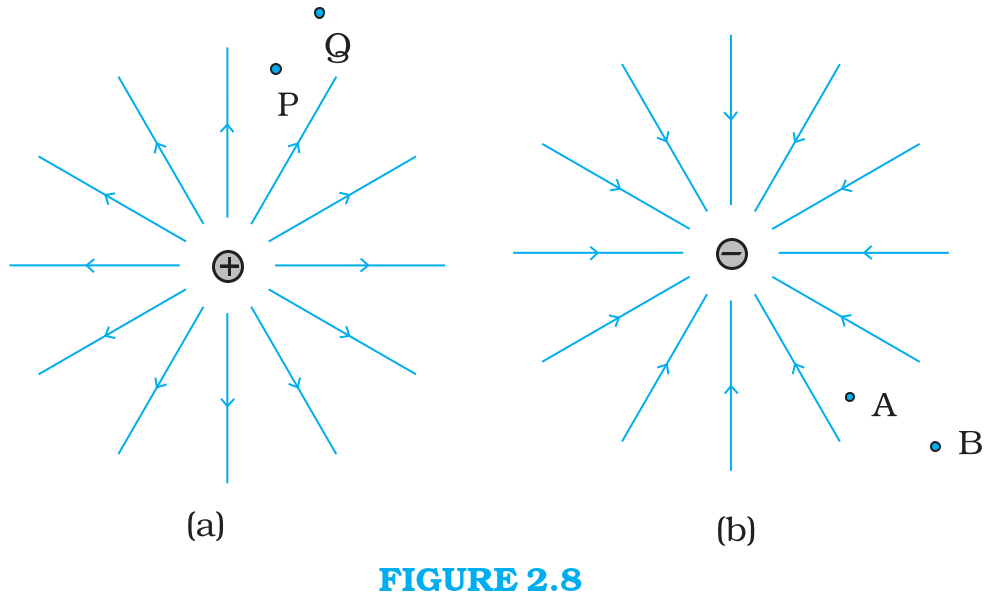
Figures 2.8 (a) and (b) show the field lines of a positive and negative point charge respectively.
Image
(a) Give the signs of the potential difference $V_{ P }-V_{ Q } ; V_{ B }-V_{ A }$.
(b) Give the sign of the potential energy difference of a small negative charge between the points $O$ and $P ; A$ and $B$.
(c) Give the sign of the work done by the field in moving a small positive charge from $Q$ to $P$.
(d) Give the sign of the work done by the external agency in moving a small negative charge from $B$ to $A$.
(e) Does the kinetic energy of a small negative charge increase or decrease in going from $B$ to $A$ ?
Answer
(a) As $V \propto \frac{1}{r}, V_P>V_Q$. Thus, $\left(V_P-V_Q\right)$ is positive. Also $V_B$ is less negative than $V_A$. Thus, $V_B>V_A$ or $\left(V_B-V_A\right)$ is positive.
(b) A small negative charge will be attracted towards positive charge. The negative charge moves from higher potential energy to lower potential energy. Therefore the sign of potential energy difference of a small negative charge between $G$ and $P$ is positive.
Similarly, (P.E. $)_{ A }>$ (P.E. $B _{ B }$ and hence sign of potential energy differences is positive.
(c) In moving a small positive charge from $Q$ to $P$, work has to be done by an external agency against the electric field. Therefore, work done by the field is negative.
(d) In moving a small negative charge from B to A work has to be done by the external agency. It is positive.
(e) Due to force of repulsion on the negative charge, velocity decreases and hence the kinetic energy decreases in going from B to A.
View full question & answer
Question 693 Marks
Two charges $3 \times 10^{-8} C$ and $-2 \times 10^{-8} C$ are located $15 cm$ apart. At what point on the line joining the two charges is the electric potential zero? Take the potential at infinity to be zero.
Answer
Let us take the origin $O$ at the location of the positive charge. The line joining the two charges is taken to be the $x$-axis; the negative charge is taken to be on the right side of the origin (Fig. 2.7).
Image
Let $P$ be the required point on the $x$-axis where the potential is zero. If $x$ is the $x$-coordinate of $P$, obviously $x$ must be positive. (There is no possibility of potentials due to the two charges adding up to zero for $x<0$.) If $x$ lies between $O$ and $A$, we have
$
\frac{1}{4 \pi \varepsilon_0}\left[\frac{3 \times 10^{-8}}{x \times 10^{-2}}-\frac{2 \times 10^{-8}}{(15-x) \times 10^{-2}}\right]=0
$
where $x$ is in $cm$. That is,
$
\frac{3}{x}-\frac{2}{15-x}=0
$
which gives $x=9 cm$.
If $x$ lies on the extended line OA, the required condition is
$
\frac{3}{x}-\frac{2}{x-15}=0
$
which gives
$
x=45 cm
$
Thus, electric potential is zero at $9 cm$ and $45 cm$ away from the positive charge on the side of the negative charge. Note that the formula for potential used in the calculation required choosing potential to be zero at infinity.
View full question & answer
Question 703 Marks
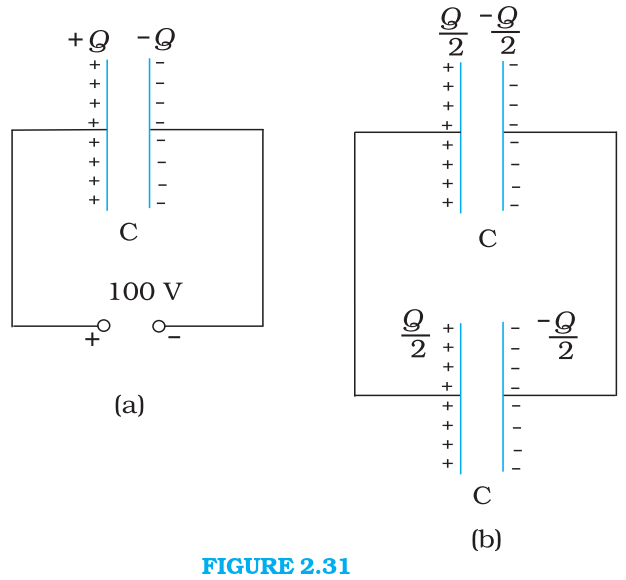
(a) A $900 pF$ capacitor is charged by $100 V$ battery [Fig. 2.31(a)]. How much electrostatic energy is stored by the capacitor? (b) The capacitor is disconnected from the battery and connected to another $900 pF$ capacitor [Fig. 2.31(b)]. What is the electrostatic energy stored by the system?
Image
Answer
(a) The charge on the capacitor is
$
\text { Q }=C V=900 \times 10^{-12} F \times 100 V =9 \times 10^{-8} C
$
The energy stored by the capacitor is
$
\begin{aligned}
& =(1 / 2) CV ^2=(1 / 2) Q V \\
= & (1 / 2) \times 9 \times 10^{-8} C \times 100 V =4.5 \times 10^{-6} J
\end{aligned}
$

(b) In the steady situation, the two capacitors have their positive plates at the same potential, and their negative plates at the same potential. Let the common potential difference be $V ^{\prime}$. The charge on each capacitor is then $Q^{\prime}=C V^{\prime}$. By charge conservation, $Q^{\prime}=Q / 2$. This implies $V^{\prime}=V / 2$. The total energy of the system is $=2 \times \frac{1}{2} Q^{\prime} V^{\prime}=\frac{1}{4} Q V=2.25 \times 10^{-6} J$
Thus in going from (a) to (b), though no charge is lost; the final energy is only half the initial energy. Where has the remaining energy gone?
There is a transient period before the system settles to the situation (b). During this period, a transient current flows from the first capacitor to the second. Energy is lost during this time in the form of heat and electromagnetic radiation.
View full question & answer
3 Marks Question - Page 2 - Physics STD 12 Science Questions - Vidyadip