MCQ 1011 Mark
A capacitor of capacitance $C$ is charged to a potential $V$. The flux of the electric field through a closed surface enclosing the capacitor is:
- A
$\frac{\text{CV}}{\in_0}$
- B
$\frac{\text{2CV}}{\in_0}$
- C
$\frac{\text{CV}}{2\in_0}$
- ✓
$\text{Zero}.$
AnswerCorrect option: D. $\text{Zero}.$
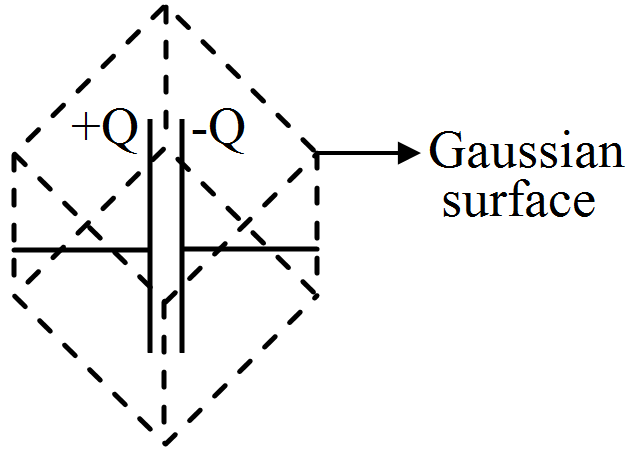
Since the net charge enclosed by the Gaussian surface is zero, the total flux of the electric field through the closed Gaussian surface enclosing the capacitor is zero.
$\phi=\oint\text{E.ds}=\frac{\text{q}}{\in_0}=0$
Here,
$\phi=$ Electric flux
$q =$ Total charge enclosed by the Gaussian surface.
View full question & answer→MCQ 1021 Mark
A charge q is placed at the center of a circle and $B, C$ are the points on the circle. Another charge $q$ is moved from $A$ to $B$ and from $A$ to $C$. Which of them is correct?
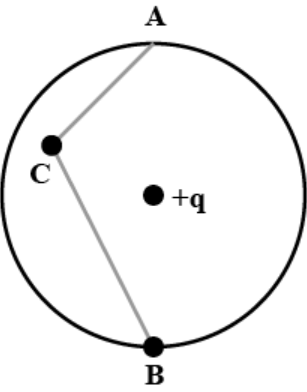
AnswerCorrect option: B. Work done in both cases are the same.
$B$ and $C$ points are situated on the circle, so they are on the equipotential surface. To bring a point charge from $A$ to $B$ and from $A$ to $C$ requires the same amount of work done as the initial and final points have the same potential energy in both the cases.
View full question & answer→MCQ 1031 Mark
The positive terminal of $12V$ battery is connected to the ground. Then the negative terminal will be at:
View full question & answer→MCQ 1041 Mark
The amount of energy that a unitary point electric charge would have, if located at any point in space, is defined its:
- A
Electric potential energy.
- ✓
- C
Electric potential difference.
- D
AnswerThe electric potential is the electric potential energy per unit charge.
View full question & answer→MCQ 1051 Mark
When the separation between two charges is increased the electric potential energy of the charges.
- A
- B
- C
- ✓
May increase or decrease.
AnswerCorrect option: D. May increase or decrease.
When the separation between two charges is increased, the electric potential Energy of charge may incease or decrease.
If Both charge are like charge then electric potential energy of charge decreases.
$\text{U}=\frac{\text{k}\text{q}_1\text{q}_2}{\text{r}}$
If Both charge are unlike charge then electric potential energy of charge increases.
$\text{U}=\frac{-\text{kq}_1\text{q}_2}{\text{r}}$
View full question & answer→MCQ 1061 Mark
Which of the following statement is not true?
AnswerCorrect option: C. Electrostatic force is non$-$conservative.
Work done by the electrostatic force is independent of the path followed by it, and it depends only on the initial and final positions. For example, work done in moving a unit positive charge in a closed loop of an electric field is zero. So,electrostatic force is a conservative force.
View full question & answer→MCQ 1071 Mark
A parallel plate capacitor is made of two dielectric blocks in series. One of the blocks has thickness $d_1$ and dielectric constant $k_1$ and the other has thickness $d_2$ and dielectric constant $k_2$ as shown in Fig.
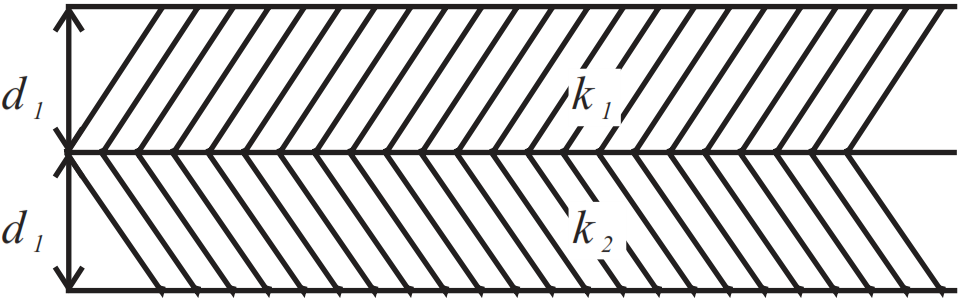
This arrangement can be thought as a dielectric slab of thickness $d (= d_1 + d_2)$ and effective dielectric constant $k$. The k is - A
$\frac{\text{k}_1\text{d}_1+\text{k}_2\text{d}_2}{\text{d}_1+\text{d}_2}$.
- B
$\frac{\text{k}_1\text{d}_1+\text{k}_2\text{d}_2}{\text{k}_1+\text{k}_2}$
- ✓
$\frac{\text{k}_1\text{k}_2(\text{d}_1+\text{d}_2)}{(\text{k}_1\text{d}_1+\text{k}_2\text{d}_2)}$
- D
$\frac{2\text{k}_1\text{k}_2}{\text{k}_1+\text{k}_2}$
AnswerCorrect option: C. $\frac{\text{k}_1\text{k}_2(\text{d}_1+\text{d}_2)}{(\text{k}_1\text{d}_1+\text{k}_2\text{d}_2)}$
Here the system can be considered as two capacitors $C_1$ and $C_2$ connected in series as shown in figure.
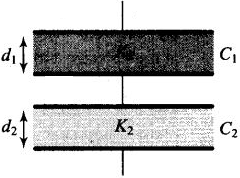
The capacitance of parallel plate capacitor filled with dielectric block has thickness $d_1$ and dielectric constant $k_2$ is given by
$\frac{1}{\text{C}_\text{eq}}=\frac{1}{\text{C}_1}+\frac{1}{\text{C}_2}\Rightarrow\ \text{C}_\text{eq}=\frac{\text{C}_1\text{C}_2}{\text{C}_1+\text{C}_2}$
$\text{C}_\text{eq}=\frac{\frac{\text{K}_1\in_0\text{A}}{\text{d}_1}}{\frac{\text{K}_1\in_0\text{A}}{\text{d}_1}}\frac{\frac{\text{K}_2\in_0\text{A}}{\text{d}_2}}{\frac{\text{K}_2\in_0\text{A}}{\text{d}_2}}=\frac{\text{K}_1\text{K}_2\in_0\text{A}}{\text{K}_1\text{d}_2+\text{K}_2\text{d}_1}\ ...(\text{i})$
We can write the equivalent capacitance as
$\text{C}=\frac{\text{K}\in_0\text{A}}{\text{d}_1+\text{d}_2}\ ...(\text{ii})$
On comparing $(i)$ and $(ii)$ we have
$\text{K}=\frac{\text{k}_1\text{k}_2(\text{d}_1+\text{d}_2)}{(\text{k}_1\text{d}_2+\text{k}_2\text{d}_1)}$. View full question & answer→MCQ 1081 Mark
Energy is stored in a capacitor in the form of:
MCQ 1091 Mark
"The work per unit of charge required to move a charge from a reference point to a specified point, measured in joules per coulomb or volts. The static electric field is the negative of the gradient of the electric potential." comments are given below, select the correct one:
- ✓
- B
- C
Comment on electric field is not correct
- D
Only comment on electric potential is not correct
AnswerThe given statement is correct. Volt or Joules per Coulomb are $SI$ unit of Potential $(V)$ i.e, work done per unit charge to move a charge from a reference point to a certain point.
And electric field $E$ is negative of the gradient of electric potential $(V)$ i.e,$\text{E}=\frac{\text{-dv}}{\text{dr}}$
View full question & answer→MCQ 1101 Mark
Dielectrics are $......$?
AnswerCorrect option: B. Non$-$conducting substances.
Dielectrics are non-conducting substances.
View full question & answer→MCQ 1111 Mark
View full question & answer→MCQ 1121 Mark
In a region of constant potential:
- A
The electric field is uniform.
- B
The electric field is zero.
- C
There can be no charge inside the region.
- ✓
AnswerWe know, the electric field intensity E and electric potential V are dV related as $\text{E}=-\frac{\text{dV}}{\text{dr}}$
or we can write $|\text{E}|=-\frac{\Delta\text{V}}{\Delta\text{r}}$
The electric field intensity E and electric potential V are related as E = 0 and for V = constant, $\frac{\text{dV}}{\text{dr}}=0$ this imply that electric field intensity E = 0.
If some charge is present inside the region then electric field cannot be zero at that region, for this V = constant is not valid.
View full question & answer→MCQ 1131 Mark
The dimensions of electric potential are:
- ✓
$[M1 L2 T-3 A-1]$
- B
$[M L-2 T3 A-1]$
- C
$[M L-3 T-3 A-2]$
- D
$[M L-3 T-2 A-1]$
AnswerCorrect option: A. $[M1 L2 T-3 A-1]$
View full question & answer→MCQ 1141 Mark
Two equal positive charges are kept at points $A$ and $B$. The electric potential at the points between $A$ and $B ($excluding these points$)$ is studied while moving from $A$ to $B$. The potential.
- ✓
- B
- C
Increases then decreases.
- D
Decreases then increases.
View full question & answer→MCQ 1151 Mark
From a supply of identical capacitors rated $8 \mu F, 250 V,$ the minimum number of capacitors required to form a composite $16 \mu F, 1000 V$ capacitor is:
AnswerThe required voltage is $1000v$ and the capacitors are parallel as $250v.$
So number of capacitors required will be $4$ i.e $250 \times 4 = 1000$ in series.
Now example of four capacitor in series will be equal $2\mu f ($micro farade$)$ but the equivalent capacitance required is given as $16\mu f$ so there must be $8$ series of parallel arrange capacitors each of capacitor $2$ micro farad hence total number of capacitor $= 4 \times 8 = 32$
View full question & answer→MCQ 1161 Mark
The electrostatic potential due to an electric dipole is directly proportional to:
- A
$\frac{1}{\text{r}}$
- ✓
$\frac{1}{\text{r}^2}$
- C
$\text{r}$
- D
$\text{r}^2$
AnswerCorrect option: B. $\frac{1}{\text{r}^2}$
View full question & answer→MCQ 1171 Mark
$\text{ECG}$ is a method of diagnosis used to check the functioning of heart, it is based on the principle that there is:
- A
A pattern of magnetic field associated with the functioning of heart.
- ✓
An electrical impulse associated with the functioning of organs and tissues of human body.
- C
A varying electrical field associated. with organs and tissues of human body.
- D
A varying magnetic field associated with organs and tissues of human body.
AnswerCorrect option: B. An electrical impulse associated with the functioning of organs and tissues of human body.
The heart generates by itself an electrical activity which is transmitted through all the organ and produces its contraction. The Electrocardiogram is no other than the graphical representation of this electrical activity.
View full question & answer→MCQ 1181 Mark
The electric potential is measured in:
MCQ 1191 Mark
The total capacitance of capacitors connected in parallel is given by _____?
- A
Product of the individual capacitors in parallel.
- ✓
Sum of all the individual capacitors in parallel.
- C
Sum of their reciprocals.
- D
Product of their reciprocals.
AnswerCorrect option: B. Sum of all the individual capacitors in parallel.
b. Sum of all the individual capacitors in parallel.
Explanation:
The equivalent capacitance of the capacitors connected in parallel is given by sum of their individual capacitances, that is if there are $n$ capacitors in parallel the total capacitance is given by, $C=C_1+C_2+C_3+C_4+\ldots . .+C_n$.
View full question & answer→MCQ 1201 Mark
What is the maximum energy that can be stored in a capacitor?
- A
Depends on the maximum area of the capacitor.
- B
Depends on the maximum resistance offered.
- ✓
Depends on the maximum electric field.
- D
Depends on the maximum current passing through the capacitor.
AnswerCorrect option: C. Depends on the maximum electric field.
The maximum energy that can be desirably stored in a capacitor is depends on the maximum electric field that the dielectric can withstand without breaking down. Therefore, capacitors of the same type have about the same maximum energy density, i.e. joules of energy per cubic meter.
View full question & answer→MCQ 1211 Mark
Identify the correct statement from below:
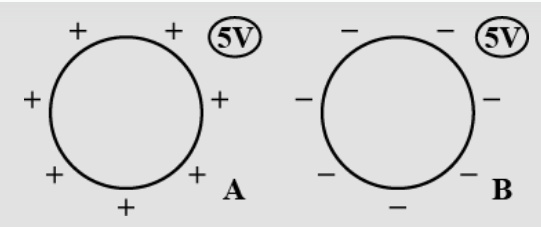
- ✓
A will be at higher potential.
- B
B will be at higher potential.
- C
Both will be at same potential.
- D
AnswerCorrect option: A. A will be at higher potential.
Point $A$ have positive charge.
More is the positive charge, more will be the potential. So, $A$ will be at higher potential.
View full question & answer→MCQ 1221 Mark
Two capacitors each having capacitance $C$ and breakdown voltage $V$ are joined in series. The capacitance and the breakdown voltage of the combination will be:
- A
$\text{2C}\ \text{and}\ \text{2V}$
- B
$\frac{\text{C}}{2}\ \text{and}\ \frac{\text{V}}{2}$
- C
$\text{2C}\ \text{and}\ \frac{\text{V}}{2}$
- ✓
$\frac{\text{C}}{2}\ \text{and}\ \text{2V}$
AnswerCorrect option: D. $\frac{\text{C}}{2}\ \text{and}\ \text{2V}$
d. $\frac{ C }{2}$ and $2 V$
Explanation:
Since the voltage gets added up when the capacitors are connected in series, the voltage of the combination is $2 V$ . Also, the capacitance of a series combination is given by
$\frac{1}{ C _{ net }}=\frac{1}{ C _1}+\frac{1}{ C _2}$
Here,
$C _{\text {net }}=\text { Net capacitance of the combination }$
$C _1= C _2= C$
$\therefore C _{\text {net }}=\frac{ C }{2}$
View full question & answer→MCQ 1231 Mark
The electrostatic potential on the surface of a charged conducting sphere is $100 V$ . Two statements are made in this regard $S_1$ at any point inside the sphere, electric intensity is zero. $S_2$ at any point inside the sphere, the electrostatic potential is $100 V$ . Which of the following is a correct statement?
- A
$S_1$ is true but $S_2$ is false.
- B
Both $S _1$ and $S _2$ are false.
- ✓
$S _1$ is true, $S _2$ is also true and $S _1$ is the cause of $S _2$
- D
$S_1$ is true, $S_2$ is also true, but the statements are independant.
AnswerCorrect option: C. $S _1$ is true, $S _2$ is also true and $S _1$ is the cause of $S _2$
c. $S_1$ is true, $S_2$ is also true and $S_1$ is the cause of $S_2$.
View full question & answer→MCQ 1241 Mark
An arrangement which consists of two conductors separated by a dielectric medium is called:
MCQ 1251 Mark
A capacitor is charged by a battery and then the battery is disconnected. A dielectric slab is introduced between the plates. The result is:
- A
P.d between the plates increases, charge on the plate decreases.
- ✓
P.d between the plates decreases, charge remains same.
- C
P.d increases, charge remain constant.
- D
P.d decreases, charge increases.
AnswerCorrect option: B. P.d between the plates decreases, charge remains same.
As dielectric slab does not affect charges:
$\text{V}=\frac{\text{Q}}{\text{C}}=\frac{\text{Qd}}{\text{K}\in_0\text{A}}$
View full question & answer→MCQ 1261 Mark
The interior of a conductor can have no excess $........$ in the static situation.
View full question & answer→MCQ 1271 Mark
What is the value of capacitance of a capacitor if it has a charge of $9C$ and voltage of $5V?$
- ✓
$1.8F$
- B
$45F$
- C
$4.5F$
- D
$8.1F$
AnswerCorrect option: A. $1.8F$
Since we know that capacitance$=\frac{\text{charge}}{\text{voltage}}$
Therefore capacitance$=\frac{9}{5}=1.8\text{f.}$
View full question & answer→MCQ 1281 Mark
Which of the following statements is/ are correct for equipotential surface ?
$i.$ The potential at all the points on an equipotential surface is same.
$ii.$ Equipotential surfaces never intersect each other.
$iii.$ Work done in moving a charge from one point to other on an equipotential surface is zero.
- A
$I$ only.
- B
$II$ only.
- C
$I$ and $II.$
- ✓
$I, II$ and $III.$
AnswerCorrect option: D. $I, II$ and $III.$
View full question & answer→MCQ 1291 Mark
How does the potential difference change with the effect of the dielectric when the battery remains connected across the capacitor?
AnswerAs the battery remains connected across the capacitor, so the potential difference remains constant at $V_o$ even after the introduction of the dielectric slab. In this way, dielectric has an effect on potential difference.
View full question & answer→MCQ 1301 Mark
A charge is brought from a point on the equatorial plane of a dipole to its mid-point. Which of the following quantities remains constant?
- A
- B
Force on the charge brought.
- C
Torque exerted by the charge on dipole.
- ✓
View full question & answer→MCQ 1311 Mark
When a thin mica sheet is placed between the plates of a condenser then the amount of charge, so compared to its previous value, on its plates will become:
AnswerAs no cell is connected to the capacitor, the charge will remain constant.
View full question & answer→MCQ 1321 Mark
In the circuit shown in Fig. initially key $K _1$ is closed and key $K _2$ is open. Then $K _1$ is opened and $K _2$ is closed (order is important). [Take $Q _1{ }^{\prime}$ and $Q _2{ }^{\prime}$ as charges on $C _1$ and $C _2$ and $V _1$ and $V _2$ as voltage respectively.] Then
- ✓
Charge on $C _1$ gets redistributed such that $V _1= V _2$.
- B
Charge on $C _1$ gets redistributed such that $Q _1{ }^{\prime}= Q _2{ }^{\prime}$.
- C
Charge on $C_1$ gets redistributed such that $C_1 V_1+C_2 V_2=$ Charge on $C_1$ gets
- D
redistributed such that $Q_1{ }^{\prime}+Q_2{ }^{\prime}=Q$. $C _1 E$
AnswerCorrect option: A. Charge on $C _1$ gets redistributed such that $V _1= V _2$.
a. Charge on $C _1$ gets redistributed such that $V _1= V _2$.
d. Charge on $C _1$ gets redistributed such that $Q ^{\prime}{ }^{\prime}+ Q _2{ }^{\prime}= Q$.
Initially key $K_1$ is closed and key $K_2$ is open, the capacitor $C_1$ is charged by battery and capacitor $C_2$ is still uncharged. Now $K_1$ is opened and $K_2$ is closed, the capacitors $C_1$ and $C_2$ both are connected in parallel. The charge stored by capacitor $C_1$, gets redistributed between $C_1$ and $C_2$ till their potentials become same, i.e., $V_2=V_1$.
By law of conservation of charge, the charge stored in capacitor $C x$ is equal to sum of charges on capacitors $C_1$ and $C_2$ when $K_1$ is opened and $K_2$ is closed, i.e., $Q_1^{\prime}+Q_2^{\prime}=Q$.
View full question & answer→MCQ 1331 Mark
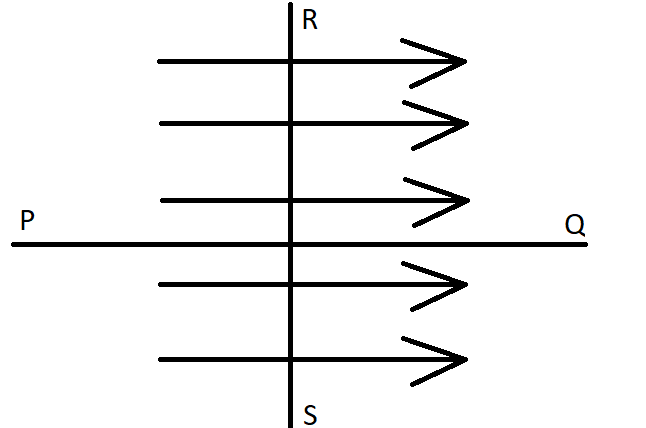
According to the diagram, the equipotential points are $......$. The arrows are the direction of the electric field.
- A
$P$ and $Q$
- B
$S$ and $Q$
- ✓
$S$ and $R$
- D
$P$ and $R$
AnswerCorrect option: C. $S$ and $R$
The equipotential surface is always perpendicular to the electric field lines. In the diagram, the electric field lines are horizontal and parallel to each other. Therefore, the equipotential lines must be vertical and the points that have equal potential should be on the vertical line. Therefore, $R$ and $S$ have equal potential.
View full question & answer→MCQ 1341 Mark
The capacity of the parallel plate capacitor increases when:
- A
Area of the plate is decreased.
- ✓
Area of the plate is increased.
- C
Distance between the plates increases.
- D
AnswerCorrect option: B. Area of the plate is increased.
View full question & answer→MCQ 1351 Mark
Some charge is being given to a conductor. Then its potential:
- A
is maximum somewhere between surface and centre.
- B
- C
- ✓
remains same throughout the conductor.
AnswerCorrect option: D. remains same throughout the conductor.
Given that some charge is given to a conductor then the whole charge is distributed over its surface only. Inside of conductor, electric field is zero whereas potential is same as on the surface. Hence, throughout the conductor, potential is same i.e, the whole conductor is equipotential.
View full question & answer→MCQ 1361 Mark
A parallel plate condenser is immersed in an oil of dielectric constant $2$. The field between the plates is:
- A
Increased, proportional to $2.$
- ✓
Decreased, proportional to $1/ 2.$
- C
Increased, proportional to $- 2.$
- D
Decreased, proportional to $-1/ 2.$
AnswerCorrect option: B. Decreased, proportional to $1/ 2.$
View full question & answer→MCQ 1371 Mark
Capacitiors are used in electrical circuits where appliances need more:
MCQ 1381 Mark
Three capacitors of capacitances $6\mu\text{F}$ each are available. The minimum and maximum capacitances, which may be obtained are:
- A
$6\mu\text{F},\ 18\mu\text{F}$
- B
$3\mu\text{F},\ 12\mu\text{F}$
- C
$2\mu\text{F},\ 12\mu\text{F}$
- ✓
$2\mu\text{F},\ 18\mu\text{F}$
AnswerCorrect option: D. $2\mu\text{F},\ 18\mu\text{F}$
The minimum capacitance can be obtained by connecting all capacitors in series. It can be calculated as follows:
$\frac{1}{\text{C}}=\frac{1}{6}+\frac{1}{6}+\frac{1}{6}=\frac{1}{2}$
$\Rightarrow\text{C}=2\mu\text{F}$
The maximum capacitance can be obtained by connecting all capacitors in parallel. It can be calculated as follows:
$\text{C}=6+6+6=18\mu\text{F}$
View full question & answer→MCQ 1391 Mark
There are two metallic spheres of same radii, but one is solid, and the other is hollow, then:
AnswerCorrect option: C. They can be charged equally $($maximum$).$
View full question & answer→MCQ 1401 Mark
The electric potential inside a conducting sphere:
- A
Increases from centre to surface.
- B
Decreases from centre to surface.
- ✓
Remains constant from centre to surface.
- D
Is zero at every point inside.
AnswerCorrect option: C. Remains constant from centre to surface.
View full question & answer→MCQ 1411 Mark
$1$ nano farad $=$
- A
$10-6.$
- ✓
$10-9.$
- C
$10-12.$
- D
$10-15.$
AnswerCorrect option: B. $10-9.$
View full question & answer→MCQ 1421 Mark
what is the potential difference between two points, if $2J$ of work must be done to move a $4 mC$ charge from one point to another is:
- A
$50 V$
- ✓
$500 V$
- C
$5 V$
- D
$5000 V$
AnswerCorrect option: B. $500 V$
The total work done $=$ energy transferred.
So, we might see the equation energy $=$ voltage $\times$ charge, $E = V \times Q,$ written as,
work $=$ voltage $\times$ charge, $W = V \times Q.$
In this case, the charge is $4 mC$, that is, $0.004 C$ and work done is $2J.$
View full question & answer→MCQ 1431 Mark
At the surface of a charged conductor electrostatic field must be $......$ to the surface at every point.
AnswerCorrect option: D. Both $a$ and $b.$
View full question & answer→MCQ 1441 Mark
Which of the following is an example of a molecule whose centre of mass of positive and negative charges does not coincide each other?
- ✓
$NH _3$
- B
$H _2$
- C
$CH _4$
- D
$CO _2$
AnswerCorrect option: A. $NH _3$
a. $NH _3$
Explanation:
$NH _3$ is a molecule in which the centre of mass of positive and negative charges does not collide with each other and is called a polar molecule. They have a permanent dipole moment. They have unsymmetrical shapes.
View full question & answer→MCQ 1451 Mark
An example of an equipotential surface in earth is:
- A
A line passing through the centre of the earth connecting two points along the diameter.
- B
A plane that passes through the circular section of the hemisphere of the earth.
- ✓
A spherical surface at a distance of 1km from the surface of the earth with its centre at centre of earth.
- D
A plane on the surface of the earth, which is a tangent to the earth.
AnswerCorrect option: C. A spherical surface at a distance of 1km from the surface of the earth with its centre at centre of earth.
The potential is seen to be a constant on a sphere at all points.
View full question & answer→MCQ 1461 Mark
For any charge configuration, equipotential surface through a point is $......$ to electric field at that point.
AnswerCorrect option: D. Both $a$ and $b$.
View full question & answer→MCQ 1471 Mark
Work done to bring a unit positive charge from infinity to a point in an electric field is known as $......$?
- ✓
- B
Electric field intensity.
- C
- D
The total energy of the point charge.
AnswerElectric potential is defined as the amount of work done to bring a unit positive charge from an infinite distance to a particular point of an electric field. The total energy of that point charge means the sum of kinetic energy and potential energy which is not the same as the potential energy if the particle is in motion.
View full question & answer→MCQ 1481 Mark
What type of surface is the surface of a conductor?
AnswerElectric field at any point is equal to the negative of the potential gradient. But inside a conductor, the electric field is zero. Hence, the electric potential is constant throughout the volume of a conductor and has the same value on its surface. Thus the surface of a conductor is equipotential.
View full question & answer→MCQ 1491 Mark
If the capacitors having capacitance $C_1$ and $C_2$ are connected in parallel then their effective capacitance is given by:
- A
$C = C _1- C _2$
- ✓
$C=C_1+C_2$
- C
$1 / C=1 / C_1+1 / C_2$
- D
$1 / C=1 / C_1-1 / C_2$
AnswerCorrect option: B. $C=C_1+C_2$
b. $C=C_1+C_2$
View full question & answer→MCQ 1501 Mark
Consider a uniform electric field in the $\hat{\text{Z}}$ direction. The potential is a constant:
- A
- B
For any $x$ for a given $ z.$
- C
For any $y$ for a given $z.$
- ✓
On the $x-y$ plane for a given $z.$
AnswerCorrect option: D. On the $x-y$ plane for a given $z.$
We know, the electric field intensity E and electric potential V are
$\text{E}=-\frac{\text{dV}}{\text{dr}}$
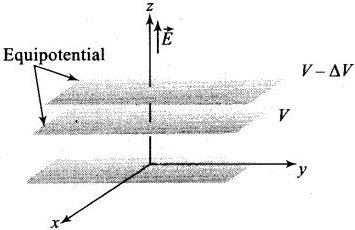
Electric potential decreases inf the direction of electric field. The direction of electric field is always perpendicular to one equipotential surface maintained at high electrostatic potential to other equipotential surface maintained at low electrostatic potential.
The electric field in $z-$direction suggest that equipotential surfaces are in $x-y$ plane. Therefore the potential is a constant for any $x$ for a given $z$, for any $y$ for a given $z$ and on the $x-y$ plane for a given $z.$ View full question & answer→