MCQ 1511 Mark
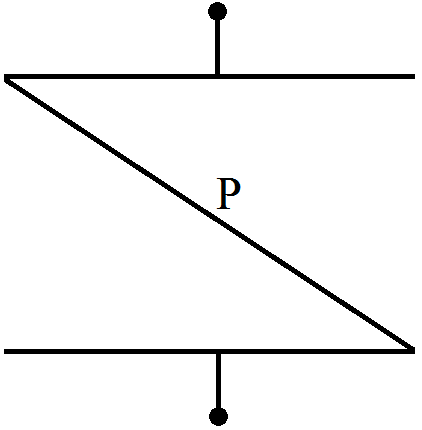
A slab $X$ is placed between the two parallel isolated charged plates as shown in the figure. If $E_p$ and $E_q$ denotes the intensity of electric field at $P$ and $Q$, then:
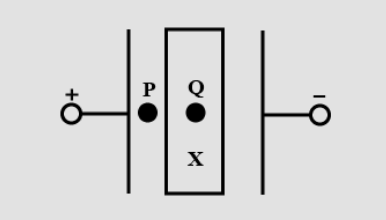
- A$E_p$ is reduced by the presence of $X$, if $X$ is metallic.
- B$E_q$ is increased by presence of $X$, if $X$ is dielectric.
- C$E _{ q }$ is in the opposite sense to $E _{ p ^{\prime}}$ if X is dielectric.
- ✓$E_q$ is zero, if $X$ is metallic.
Answer
View full question & answer→Correct option: D.
$E_q$ is zero, if $X$ is metallic.
d. $E_q$ is zero, if $X$ is metallic.
Explanation:
There is no effect of the metal on the external electric field(thus $A$ is incorrect) while the dielectric reduces the net electric field outside. The dielectric produces an electric field inside it due to the induced charges which is opposite to the external field. Thus $EQ$ is reduced and B and $C$ are also incorrect.(Note that $E_p$ is not the external field). Now as the electric field inside the conductor is zero, the field $E_p$ is zero if $X$ is a metallic.
Explanation:
There is no effect of the metal on the external electric field(thus $A$ is incorrect) while the dielectric reduces the net electric field outside. The dielectric produces an electric field inside it due to the induced charges which is opposite to the external field. Thus $EQ$ is reduced and B and $C$ are also incorrect.(Note that $E_p$ is not the external field). Now as the electric field inside the conductor is zero, the field $E_p$ is zero if $X$ is a metallic.