Questions · Page 4 of 8

M.C.Q (1 Marks)

MCQ 1511 Mark
Polarised glass is used in sun glasses because
  •  It reduces the light intensity to half an account of polarisation
  • B
     It is fashionable
  • C
     It has good colour
  • D
     It is cheaper
Answer
Correct option: A.
 It reduces the light intensity to half an account of polarisation
It reduces the light intensity to half an account of polarisation
View full question & answer
MCQ 1521 Mark
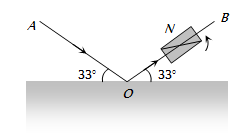
A beam of light AO is incident on a glass slab (μ = 1.54) in a direction as shown in figure. The reflected ray OB is passed through a Nicol prism on viewing through a Nicole prism, we find on rotating the prism that
  • A
    The intensity is reduced down to zero and remains zero
  • B
    The intensity reduces down some what and rises again
  • C
    There is no change in intensity
  • The intensity gradually reduces to zero and then again increases
Answer
Correct option: D.
The intensity gradually reduces to zero and then again increases
(d) The intensity gradually reduces to zero and then again increases
View full question & answer
MCQ 1531 Mark
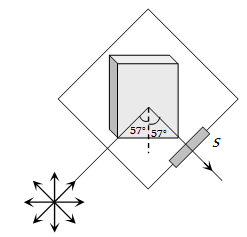
Figure represents a glass plate placed vertically on a horizontal table with a beam of unpolarised light falling on its surface at the polarising angle of $57^{\circ}$ with the normal. The electric vector in the reflected light on screen S will vibrate with respect to the plane of incidence in a
  • Vertical plane
  • B
    Horizontal plane
  • C
    Plane making an angle of $45^{\circ}$ with the vertical
  • D
    Plane making an angle of $57^{\circ}$ with the horizontal
Answer
Correct option: A.
Vertical plane
(a) Vertical plane
View full question & answer
MCQ 1541 Mark
Out of the following statements which is not correct
  •  When unpolarised light passes through a Nicol's prism, the emergent light is elliptically polarised 
  • B
    Nicol's prism works on the principle of double refraction and total internal reflection
  • C
    Nicol's prism can be used to produce and analyse polarised light
  • D
    Calcite and Quartz are both doubly refracting crystals
Answer
Correct option: A.
 When unpolarised light passes through a Nicol's prism, the emergent light is elliptically polarised 
When unpolarised light passes through a Nicol's prism, the emergent light is elliptically polarised
View full question & answer
MCQ 1551 Mark
Plane polarised light is passed through a polaroid. On viewing through the polaroid we find that when the polariod is given one complete rotation about the direction of the light, one of the following is observed
  • A
    The intensity of light gradually decreases to zero and remains at zero
  • B
    The intensity of light gradually increases to a maximum and remains at maximum
  • C
    There is no change in intensity
  •  The intensity of light is twice maximum and twice zero
Answer
Correct option: D.
 The intensity of light is twice maximum and twice zero
The intensity of light is twice maximum and twice zero
View full question & answer
MCQ 1561 Mark
A polaroid is placed at $45^\circ$ to an incoming light of intensity $I _0$. Now the intensity of light passing through polaroid after polarisation would be
  • A
    $I _0$
  • $I _0 / 2$
  • C
    $I _0 / 4$
  • D
    Zero
Answer
Correct option: B.
$I _0 / 2$
$I _0 / 2$
View full question & answer
MCQ 1571 Mark
Which of following can not be polarised
  • A
    Radio waves
  • B
    Ultraviolet rays
  • C
    Infrared rays
  • Ultrasonic waves
Answer
Correct option: D.
Ultrasonic waves
Ultrasonic waves
View full question & answer
MCQ 1581 Mark
The angle of incidence at which reflected light is totally polarized for reflection from air to glass (refraction index n) is (
  • A
    $\sin ^{-1}( n )$
  • B
    $\sin ^{-1}\left(\frac{1}{n}\right)$
  • C
    $\tan ^{-1}\left(\frac{1}{n}\right)$
  • $\tan ^{-1}( n )$
Answer
Correct option: D.
$\tan ^{-1}( n )$
$\tan ^{-1}( n )$
View full question & answer
MCQ 1591 Mark
Refractive index of material is equal to tangent of polarising angle. It is called
  •  Brewster’s law
  • B
     Lambert’s law
  • C
     Malus’s law
  • D
     Bragg’s law
Answer
Correct option: A.
 Brewster’s law
Brewster’s law
View full question & answer
MCQ 1601 Mark
When an unpolarized light of intensity $I _0$ is incident on a polarizing sheet, the intensity of the light which does not get transmitted is
  • A
    Zero
  • B
    $I _0$
  • $\frac{1}{2} I _0$
  • D
    $\frac{1}{4} I _0$
Answer
Correct option: C.
$\frac{1}{2} I _0$
$\frac{1}{2} I _0$
View full question & answer
MCQ 1611 Mark
Unpolarized light of intensity $32Wm^{-2}$ passes through three polarizers such that transmission axes of the first and second polarizer makes and angle $30^\circ$ with each other and the transmission axis of the last polarizer is crossed with that of the first. The intensity of final emerging light will be
  • A
    $32 \mathrm{Wm}^{-2} $
  • $3 \mathrm{Wm}^{-2} $
  • C
    $8 \mathrm{Wm}^{-2} $
     
  • D
    $4 \mathrm{Wm}^{-2}$
Answer
Correct option: B.
$3 \mathrm{Wm}^{-2} $
$3 \mathrm{Wm}^{-2}$
View full question & answer
MCQ 1621 Mark
Unpolarized light falls on two polarizing sheets placed one on top of the other. What must be the angle between the characteristic directions of the sheets if the intensity of the final transmitted light is one-third the maximum intensity of the first transmitted beam
  • A
     75°
  •  55°
  • C
     35°
  • D
    15°
Answer
Correct option: B.
 55°
55°
View full question & answer
MCQ 1631 Mark
Two Nicols are oriented with their principal planes making an angle of 60°. The percentage of incident unpolarized light which passes through the system is
 
  • A
    50%
  • B
    100%
  • 12.5%
  • D
    37.5%
Answer
Correct option: C.
12.5%
12.5%
View full question & answer
MCQ 1641 Mark
Consider the following statements A to B and identify the correct answer
A. Polarised light can be used to study the helical surface of nucleic acids.
B. Optics axis is a direction and not any particular line in the crystal
  •  A and B are correct
  • B
     A and B are wrong
  • C
    A is correct but B is wrong
  • D
    A is wrong but B is correct
Answer
Correct option: A.
 A and B are correct
A and B are correct
View full question & answer
MCQ 1651 Mark
When a plane polarised light is passed through an analyser and analyser is rotated through 90°, the intensity of the emerging light
  • A
     Varies between a maximum and minimum
  • B
    Becomes zero
  • C
     Does not vary
  • Varies between a maximum and zero
Answer
Correct option: D.
Varies between a maximum and zero
View full question & answer
MCQ 1661 Mark
Polarising angle for water is 53°4'. If light is incident at this angle on the surface of water and reflected, the angle of refraction is
  • A
    53°4'
  • B
    126°56'
  •  36°56'
  • D
     30°4'
Answer
Correct option: C.
 36°56'
36°56'
View full question & answer
MCQ 1671 Mark
Light passes successively through two polarimeters tubes each of length $0.29 m$ . The first tube contains dextro rotatory solution of concentration $60 \mathrm{kgm}^{-3}$ and specific rotation $0.01 \mathrm{rad} \mathrm{~m}^{2222222222222222222222} \mathrm{~kg}^{-1}$. The second tube contains laevo rotatory solution of concentration $30 \mathrm{~kg} / \mathrm{m}^3$ and specific rotation $0.02 \mathrm{radm}^2 \mathrm{~kg}^{-1}$. The net rotation produced is
  • A
    $15^\circ$
  • $0^\circ$
  • C
    $20^\circ$
  • D
    $10^\circ$
Answer
Correct option: B.
$0^\circ$
$0^\circ$
View full question & answer
MCQ 1681 Mark
When light is incident on a doubly refracting crystal, two refracted rays-ordinary ray (O-ray) and extra ordinary ray (E-ray) are produced. Then
  • A
     Both O-ray and E-ray are polarised perpendicular to the plane of incidence
  • B
    Both O-ray and E-ray are polarised in the plane of incidence
  • C
    E-ray is polarised perpendicular to the plane of incidence and O-ray in the plane of incidence
  •  E-ray is polarised in the plane of incidence and O-ray perpendicular to the plane of incidence
Answer
Correct option: D.
 E-ray is polarised in the plane of incidence and O-ray perpendicular to the plane of incidence
 E-ray is polarised in the plane of incidence and O-ray perpendicular to the plane of incidence
View full question & answer
MCQ 1691 Mark
A light has amplitude A and angle between analyser and polariser is 60°. Light is reflected by analyser has amplitude
  • A
    $A \sqrt{2}$
  • B
     $A / \sqrt{2}$
  • C
     $\sqrt{3} A / 2$
  •  $A / 2$
Answer
Correct option: D.
 $A / 2$
$A / 2$
View full question & answer
MCQ 1701 Mark
A calcite crystal is placed over a dot on a piece of paper and rotated, on seeing through the calcite one will be see
  • A
     One dot
  • B
     Two stationary dots
  • C
     Two rotating dots
  •  One dot rotating about the other
Answer
Correct option: D.
 One dot rotating about the other
One dot rotating about the other
View full question & answer
MCQ 1711 Mark
The transverse nature of light is shown by
  • A
    Interference of light
  • B
    Refraction of light
  • Polarisation of light
  • D
    Dispersion of light
Answer
Correct option: C.
Polarisation of light
View full question & answer
MCQ 1721 Mark
In order to see diffraction the thickness of the film is
  • A
     100 Å
  • 10,000 Å
  • C
    1 mm
  • D
    1 cm
Answer
Correct option: B.
10,000 Å
10,000 Å
View full question & answer
MCQ 1731 Mark
A beam of light of wavelength 600 nm from a distant source falls on a single slit 1 mm wide and the resulting diffraction pattern is observed on a screen 2 m away. The distance between the first dark fringes on either side of the central bright fringe is
  • A
    1.2 mm
  • B
     1.2 cm
  • C
    2.4 cm
  •  2.4 mm
Answer
Correct option: D.
 2.4 mm
 2.4 mm
View full question & answer
MCQ 1741 Mark
The angle of polarisation for any medium is $60^{\circ}$, what will be critical angle for this
  • A
    $\sin ^{-1} \sqrt{3}$
  • B
    $\tan ^{-1} \sqrt{3}$
  • C
    $\cos ^{-1} \sqrt{3}$
  • $\sin ^{-1} \frac{1}{\sqrt{3}}$
Answer
Correct option: D.
$\sin ^{-1} \frac{1}{\sqrt{3}}$
(d) $\sin ^{-1} \frac{1}{\sqrt{3}}$
View full question & answer
MCQ 1751 Mark
Through which character we can distinguish the light waves from sound waves
  • A
     Interference
  • B
     Refraction
  • Polarisation
  • D
     Reflection
Answer
Correct option: C.
Polarisation
Polarisation
View full question & answer
MCQ 1761 Mark
Light waves can be polarised as they are
  • Transverse
  • B
    Of high frequency
  • C
    Longitudinal
  • D
    Reflected
Answer
Correct option: A.
Transverse
Transverse
View full question & answer
MCQ 1771 Mark
A polariser is used to
  • A
     Reduce intensity of light
  • Produce polarised light
  • C
     Increase intensity of light
  • D
    Produce unpolarised light
Answer
Correct option: B.
Produce polarised light
View full question & answer
MCQ 1781 Mark
A single slit of width a is illuminated by violet light of wavelength 400 nm and the width of the diffraction pattern is measured as y. When half of the slit width is covered and illuminated by yellow light of wavelength 600 nm, the width of the diffraction pattern is
  • A
    The pattern vanishes and the width is zero
  • B
     y / 3
  •  3y
  • D
     None of these
Answer
Correct option: C.
 3y
 3y
View full question & answer
MCQ 1791 Mark
Light of wavelength l = 5000 Å falls normally on a narrow slit. A screen placed at a distance of 1 m from the slit and perpendicular to the direction of light. The first minima of the diffraction pattern is situated at 5 mm from the centre of central maximum. The width of the slit is
  • 0.1 mm
  • B
    1.0 mm
  • C
    0.5 mm
  • D
    0.2 mm
Answer
Correct option: A.
0.1 mm
0.1 mm
View full question & answer
MCQ 1801 Mark
To observe diffraction the size of an obstacle
  • Should be of the same order as wavelength
  • B
    Should be much larger than the wavelength
  • C
    Have no relation to wavelength
  • D
    Should be exactly $\frac{\lambda}{2}$
Answer
Correct option: A.
Should be of the same order as wavelength
(a) Should be of the same order as wavelength
View full question & answer
MCQ 1811 Mark
The condition for observing Fraunhofer diffraction from a single slit is that the light wavefront incident on the slit should be
  • A
    Spherical
  • B
    Cylindrical
  • Plane
  • D
    Elliptical
Answer
Correct option: C.
Plane
Plane
View full question & answer
MCQ 1821 Mark
A parallel beam of monochromatic light of wavelength $5000 \mathring A$ is incident normally on a single narrow slit of width $0.001 mm$. The light is focused by a convex lens on a screen placed on the focal plane. The first minimum will be formed for the angle of diffraction equal to
  • A
    $ 0^{\circ} $
  • B
    $ 15^{\circ} $
  • $ 30^{\circ} $
  • D
    $ 60^{\circ}$
Answer
Correct option: C.
$ 30^{\circ} $
$ 30^{\circ}$
View full question & answer
MCQ 1831 Mark
A light wave is incident normally over a slit of width $24 \times 10^{-5} \mathrm{~cm}$. The angular position of second dark fringe from the central maxima is $30^{\circ}$. What is the wavelength of light
  • 6000 Å
  • B
    5000 Å
  • C
    3000 Å
  • D
    1500 Å
Answer
Correct option: A.
6000 Å
(a) 6000 Å
View full question & answer
MCQ 1841 Mark
Diffraction and interference of light suggest
  • A
    Nature of light is electro-magnetic
  • Wave nature
  • C
    Nature is quantum
  • D
    Nature of light is transverse
Answer
Correct option: B.
Wave nature
 Wave nature
View full question & answer
MCQ 1851 Mark
A parallel monochromatic beam of light is incident normally on a narrow slit. A diffraction pattern is formed on a screen placed perpendicular to the direction of incident beam. At the first maximum of the diffraction pattern the phase difference between the rays coming from the edges of the slit is
  • A
     $0$
  • B
     $\frac{\pi}{2}$
  • C
     $\pi$
  •  $2 \pi$
Answer
Correct option: D.
 $2 \pi$
 $2 \pi$
View full question & answer
MCQ 1861 Mark
Direction of the first secondary maximum in the Fraunhofer diffraction pattern at a single slit is given by (a is the width of the slit)
  • A
    $a \sin \theta=\frac{\lambda}{2}$
  • B
    $a \cos \theta=\frac{3 \lambda}{2}$
  • C
     $a \sin \theta=\lambda$
  •  $a \sin \theta=\frac{3 \lambda}{2}$
Answer
Correct option: D.
 $a \sin \theta=\frac{3 \lambda}{2}$
 $a \sin \theta=\frac{3 \lambda}{2}$
View full question & answer
MCQ 1871 Mark
Diffraction effects are easier to notice in the case of sound waves than in the case of light waves because
  • A
     Sound waves are longitudinal
  • B
     Sound is perceived by the ear
  • C
     Sound waves are mechanical waves
  •  Sound waves are of longer wavelength
Answer
Correct option: D.
 Sound waves are of longer wavelength
Sound waves are of longer wavelength
View full question & answer
MCQ 1881 Mark
What will be the angle of diffracting for the first minimum due to Fraunhoffer diffraction with sources of light of wave length 550 nm and slit of width 0.55 mm
  • 0.001 rad
  • B
    0.01 rad
  • C
    1 rad
  • D
     0.1 rad
Answer
Correct option: A.
0.001 rad
0.001 rad
View full question & answer
MCQ 1891 Mark
A diffraction is obtained by using a beam of red light. What will happen if the red light is replaced by the blue light
  • Bands will narrower and crowd full together
  • B
    Bands become broader and further apart
  • C
    No change will take place
  • D
    Bands disappear
Answer
Correct option: A.
Bands will narrower and crowd full together
 Bands will narrower and crowd full together
View full question & answer
MCQ 1901 Mark
A slit of size $0.15 \ cm$ is placed at $2.1 m$ from a screen. On illuminated it by a light of wavelength $5 \times 10^{-5}\ cm.$ The width of central maxima will be
  • A
    $70 \ mm$
  • B
    $0.14 \ mm$
  • $1.4 \ mm$
  • D
    $0.14 \ cm$
Answer
Correct option: C.
$1.4 \ mm$
$1.4 \ mm$
View full question & answer
MCQ 1911 Mark
The penetration of light into the region of geometrical shadow is called
  • A
     Polarisation
  • B
    Interference
  •  Diffraction
  • D
     Refraction
Answer
Correct option: C.
 Diffraction
Diffraction
View full question & answer
MCQ 1921 Mark
The bending of beam of light around corners of obstacles is called
  • A
     Reflection
  •  Diffraction
  • C
    Refraction
  • D
     Interference
Answer
Correct option: B.
 Diffraction
Diffraction
View full question & answer
MCQ 1931 Mark
When light is incident on a diffraction grating the zero order principal maximum will be
 
  • A
    One of the component colours
  • B
     Absent
  • C
    Spectrum of the colours
  •  White
Answer
Correct option: D.
 White
 White
View full question & answer
MCQ 1941 Mark
The diffraction effect can be observed in
  • A
     Only sound waves
  • B
    Only light waves
  • C
    Only ultrasonic waves
  •  Sound as well as light waves
Answer
Correct option: D.
 Sound as well as light waves
Sound as well as light waves
View full question & answer
MCQ 1951 Mark
When a compact disc is illuminated by a source of white light. Coloured 'lanes' are observed. This is due to
  • A
     Dispersion
  •  Diffraction
  • C
     Interference
  • D
     Refraction
Answer
Correct option: B.
 Diffraction
Diffraction
View full question & answer
MCQ 1961 Mark
What will be the angular width of central maxima in Fraunhoffer diffraction when light of wavelength 6000$\mathrm {A^0}$ is used and slit width is $12 \times 10^{-5} \mathrm{~cm}$. 
  • A
    2 rad
  • B
    3 rad
  • 1 rad
  • D
    8 rad
Answer
Correct option: C.
1 rad
(c) 1 rad
View full question & answer
MCQ 1971 Mark
In a diffraction pattern by a wire, on increasing diameter of wire, fringe width
  •  Decreases
  • B
     Increases
  • C
     Remains unchanged
  • D
    Increasing or decreasing will depend on wavelength
Answer
Correct option: A.
 Decreases
Decreases
View full question & answer
MCQ 1981 Mark
The phenomenon of diffraction of light was discovered by
  • A
     Hygens
  • B
     Newton
  • C
     Fresnel
  •  Grimaldi
Answer
Correct option: D.
 Grimaldi
 Grimaldi
View full question & answer
MCQ 1991 Mark
Light of wavelength 589.3 nm is incident normally on the slit of width 0.1 mm. What will be the angular width of the central diffraction maximum at a distance of 1 m from the slit
  •  0.68°
  • B
     1.02°
  • C
     0.34°
  • D
     None of these
Answer
Correct option: A.
 0.68°
0.68°
View full question & answer
MCQ 2001 Mark
Conditions of diffraction is
  •  $\frac{a}{\lambda}=1$
  • B
     $\frac{a}{\lambda} \gg 1$
  • C
    $\frac{a}{\lambda} \ll 1$
  • D
    None of these
Answer
Correct option: A.
 $\frac{a}{\lambda}=1$
$\frac{a}{\lambda}=1$
View full question & answer
M.C.Q (1 Marks) - Page 4 - Physics STD 12 Science Questions - Vidyadip