Question 1015 Marks
Use a pair of compasses and construct the following angles: $45^\circ $
Answer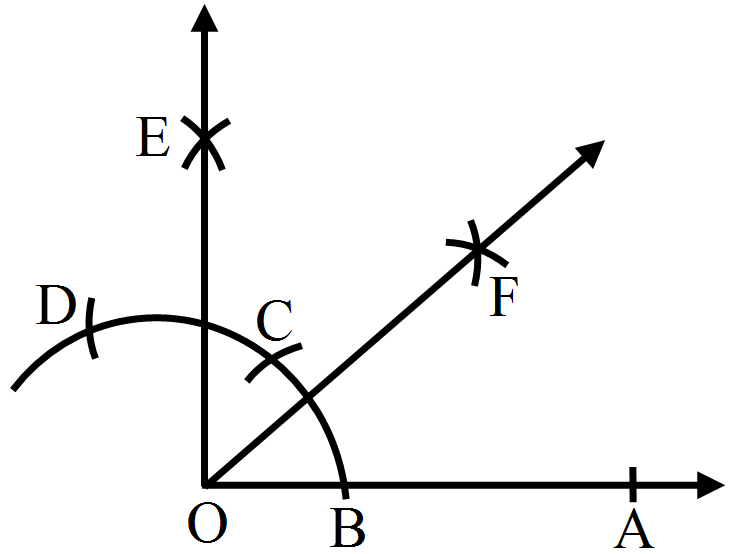
Steps of Construction:
$1.$Draw a ray $OA.$
$2.$With $O$ as centre and any su itable radius draw an arc above $OA$ to cut it at $B.$
$3.$With $B$ as centre and same radius cut the previous arc at $C$ and then with $C $ as centre and same radius cut the arc at $D.$
$4.$With $C$ as centre and radius more than half $CD,$ draw an arc.
$5.$With $D$ as centre and same radius draw another arc to cut the previous arc at $E.$
$6.$Join $OE.$ Then $\angle\text{AOE}=90^\circ.$
$7.$Draw the bisector $OF$ of angle $\angle\text{AOE}.$
Then, $\angle\text{AOF}=45^\circ$ is the required angle. View full question & answer→Question 1025 Marks
Use a pair of compasses and construct the following angles:$135^\circ $
Answer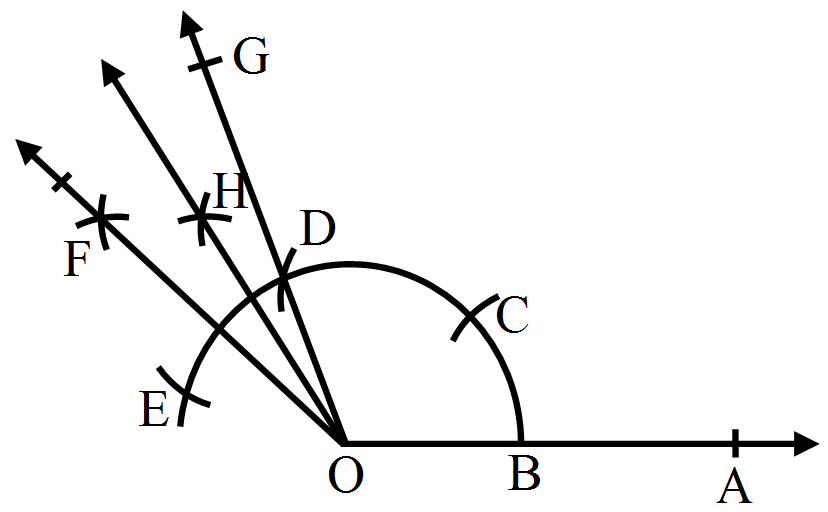
Steps of Construction:
$1.$Draw a ray $OA.$
$2.$With $O$ as centre and any suitable radius draw an arc above $OA,$ cutting it at $B.$
$3.$With $B$ as centre and same radius as before draw another arc to cut the previous arc at $C.$ With $C$ as centre and same radius draw the arc to cut it at $D.$ Again with $D$ as centre and same radius cut the arc at $E.$
$4.$Join $OD$ and produce it to $G.$ Then $\angle\text{AOG}=120^\circ.$
$5.$With $D$ as centre and radius more than half $DE$ draw an arc.
$6.$With $E$ as centre and same radius draw another arc to cut the previous arc at $F$ Join $OF.$
$7.$Draw the bisector $OH$ of $\angle\text{GOF}.$
Then, $\angle\text{AOH}=135^\circ$ is the required angle. View full question & answer→Question 1035 Marks
Draw a line $AB.$ Take a point $P$ outside it. Deaw a line passing through $P$ and perpendicular to $AB.$
Answer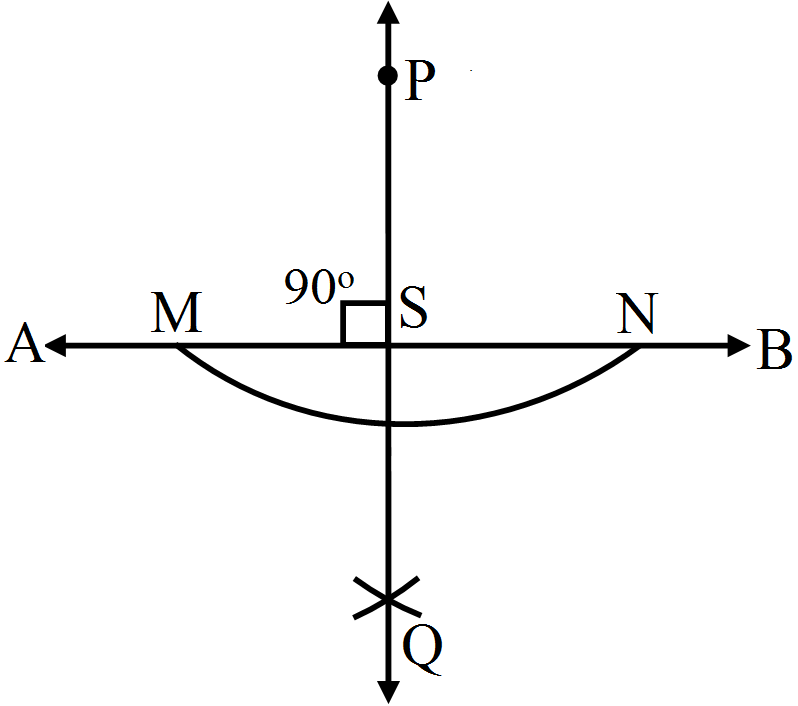
Steps for construction:
$1.$Draw a line $AB.$
$2.$Take a point $P$ outside $AB.$
$3.$With $P$ as the centre and a convenient radius, draw an arc intersecting $AB$ at $M$ and $N,$ respectively.
$4.$With $M$ as the centre and radius more than half of $MN,$ draw an arc.
$5.$With $N$ as the centre and the same radius, draw an arc cutting the previously drawn arc at $Q.$
$6.$Draw $PQ$ meeting $AB$ at $S.$
$PQ$ is the required line that passes through $P$ and is perpendicular to $AB.$ View full question & answer→Question 1045 Marks
Draw a pair of vertically opposite angles. Bisect each of the two angles. Verify that the bisecting rays are in the same line.
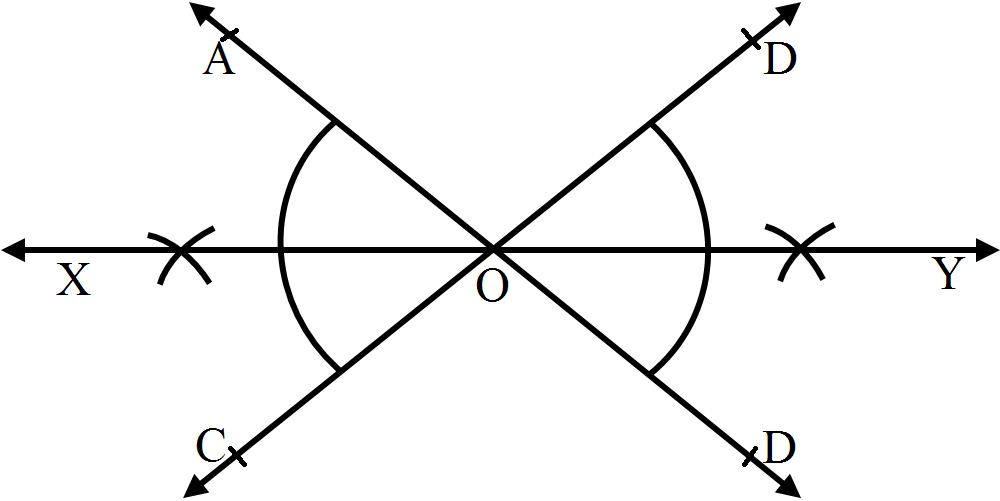
AnswerDraw two lines $AB$ and $CD$ intersecting each other at $O.$
We know that the vertically opposite angles are equal.
Therefore, $\angle\text{BOC}=\angle\text{AOD}$ and $\angle\text{AOC}=\angle\text{BOD}.$
We bisect angle $AOC$ and draw the bisecting ray as $OX.$
Similarly, we bisect angle $BOD$ and draw the bisecting ray as $OY.$
Now, $\angle\text{XOA}+\angle\text{AOD}+\angle\text{DOY}$
$=\frac{1}{2}\angle\text{AOC}+\angle\text{AOD}+\frac{1}{2}\angle\text{BOD}$
$=\frac{1}{2}\angle\text{BOD}+\angle\text{AOD}+\frac{1}{2}\angle\text{BOD}$
$[\text{As,}\angle\text{AOC}=\angle\text{BOD}]$
$=\angle\text{AOD}+\angle\text{BOD}$
Since, $AB$ is a line.
Therefore, $\angle\text{AOD}$ and $\angle\text{BOD}$ are supplementary angles and the sum of these two angles will be $180^\circ $.
Therefore, $\angle\text{XOA}+\angle\text{AOD}+\angle\text{DOY}=180^{\circ}$
We know that the angles on one side of a straight line will always add to $180^\circ .$
Also, the sum of the angles is $180^\circ .$
Therefore, $XY$ is a straight line.
Thus, $OX$ and $OY$ are in the same line.
View full question & answer→Question 1055 Marks
Draw a line $AB.$ Take a point $P$ on it. Draw a line passing through $P$ and perpendicular to $AB.$
Answer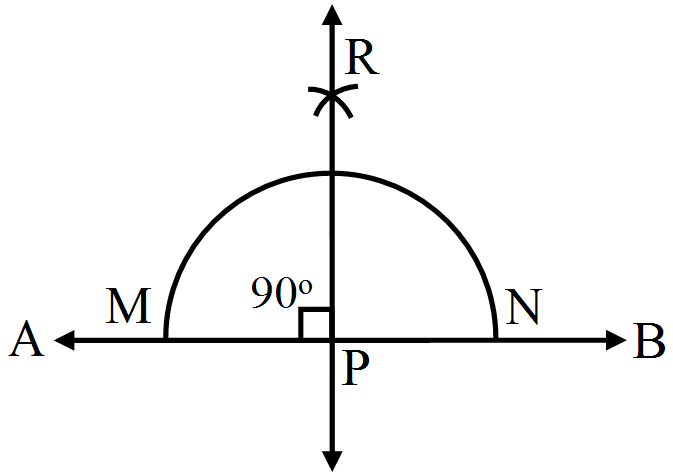
Steps for construction:
$1.$Draw a line $AB$.
$2.$Take a point $P$ on line $AB.$
$3.$With $P$ as the centre, draw an arc of any radius, which intersects line $AB$ at $M$ and $N,$ respectively.
$4.$With $M$ as the centre and radius more than half of $MN,$ draw an arc.
$5.$With $N$ as the centre and the same radius as in step $(4),$ draw an arc that cuts the previously drawn arc at $R.$
$6.$Draw $PR. PR$ is the required line, which is perpendicular to $AB.$ View full question & answer→Question 1065 Marks
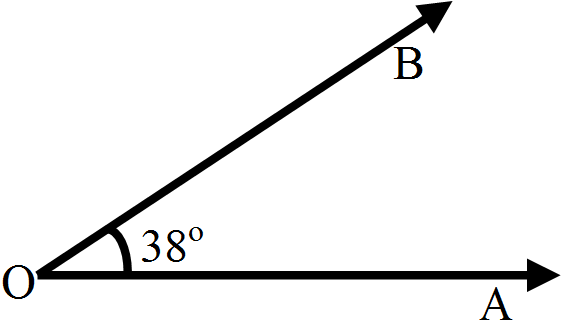
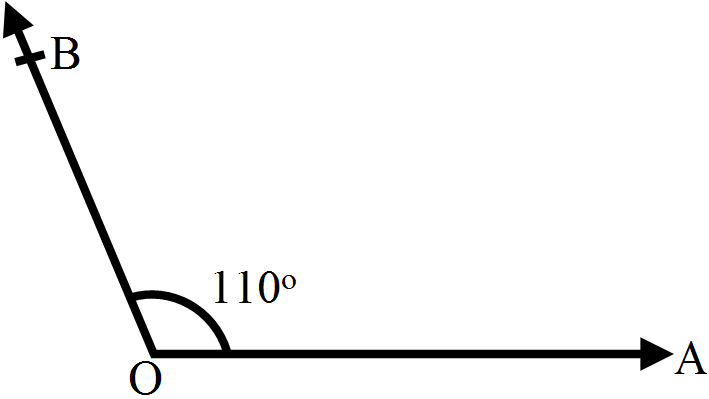
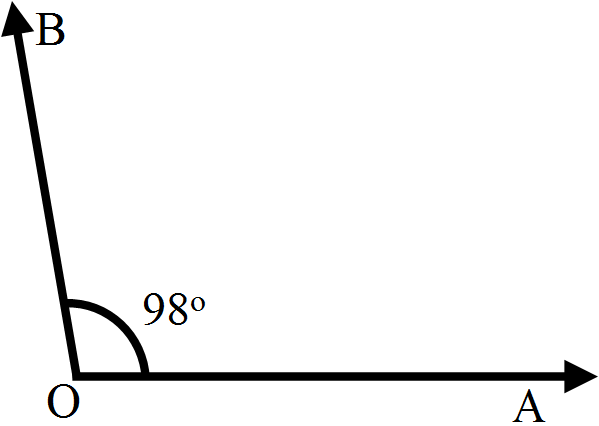
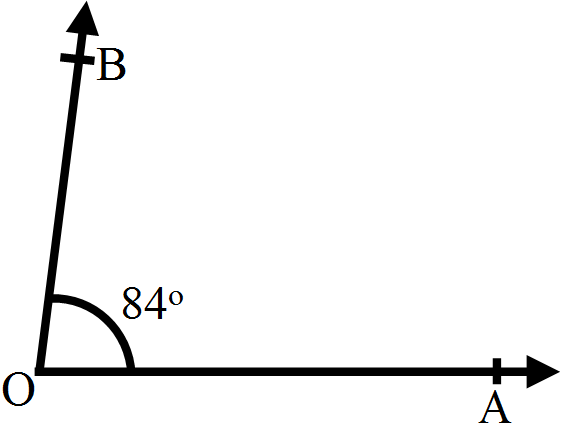
Construct the following angles with the help of a protractor: $45^\circ , 67^\circ , 38^\circ , 110^\circ , 179^\circ , 98^\circ , 84^\circ $
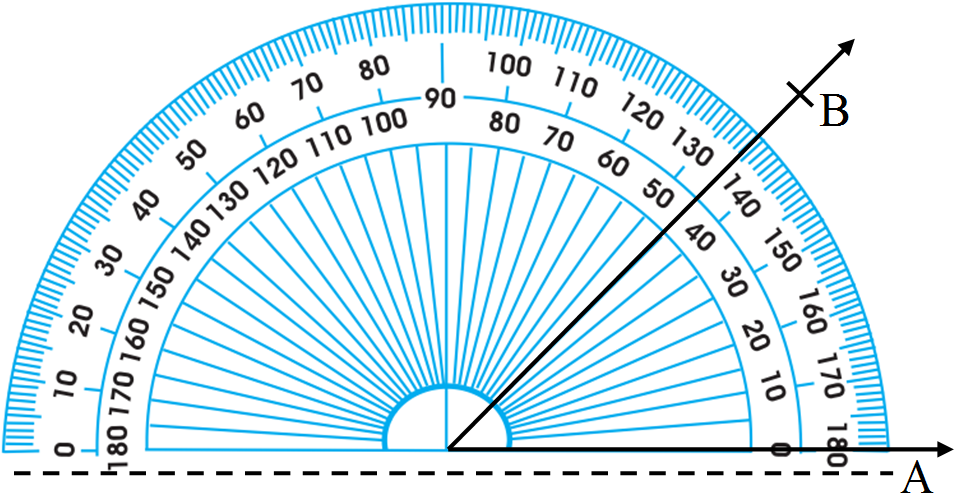
Answer$45^\circ $ We draw a ray $OA.$ We place the protractor on $OA$ such that its centre coincides with the point $O$ and the diameter of the protractor coincides with $OA.$ We mark a point $B$ against the mark of $45^\circ $ on the protractor. We remove the protractor and draw $OB.$
$\angle\text{AOB}$ is the required angle of $45^\circ .$
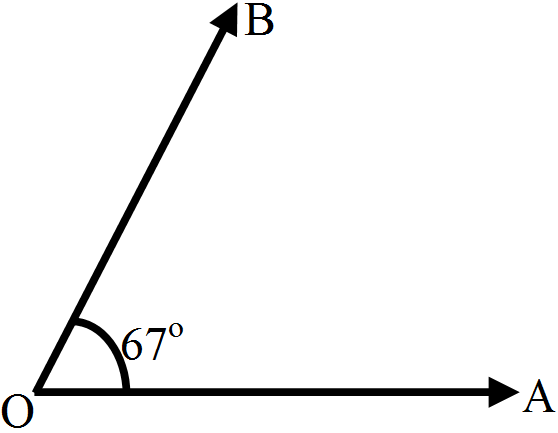
Similarly, we draw the angles $67^\circ, 38^\circ, 110^\circ, 179^\circ, 98^\circ$ and $84^\circ$.

View full question & answer→Question 1075 Marks
Draw a line segment of length $12.8\ cm.$ Using compasses, divide it into four equal parts. Verify by actual measurement.
View full question & answer→Question 1085 Marks
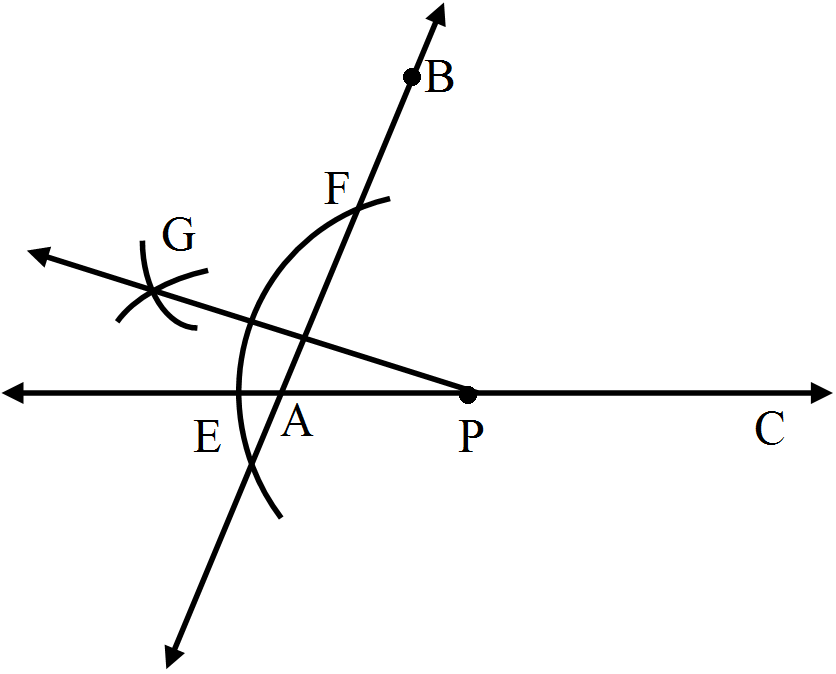
Using a protractor, draw $\angle\text{BAC}$ of measure $70^\circ .$ On side $AC,$ take a point $P,$ such that$ AP = 2\ cm.$ From $P$ draw a line perpendicular to $AB.$
AnswerDraw a line segment $AC$ on a line $L$
$i.\ $Take a protractor and place it on the segment $AC$ such that segment $AC$ coincides with the line of diameter of protractor and middle of this line coincides with point $A.$
$ii.\ $Counting from the right side, mark the point as $B$ at the point of $70^\circ $ of the protractor and draw $AB.$
$iii.\ $Now, measuring $2\ cm$ from $A$ on $AC,$ mark a point $P.$
$iv.\ $With $P$ as centre, draw an arc intersecting line $1 $ at points $E$ and $F.$
$v.\ $Using the same radius and $E$ and $F$ as centres, construct two arcs that intersect at point $G$ on the other side.
$vi.\ $Join $PG$.
View full question & answer→Question 1095 Marks
Draw $\angle\text{POQ}$ of measure $75^\circ $ and find its line of symmetry.
Answer
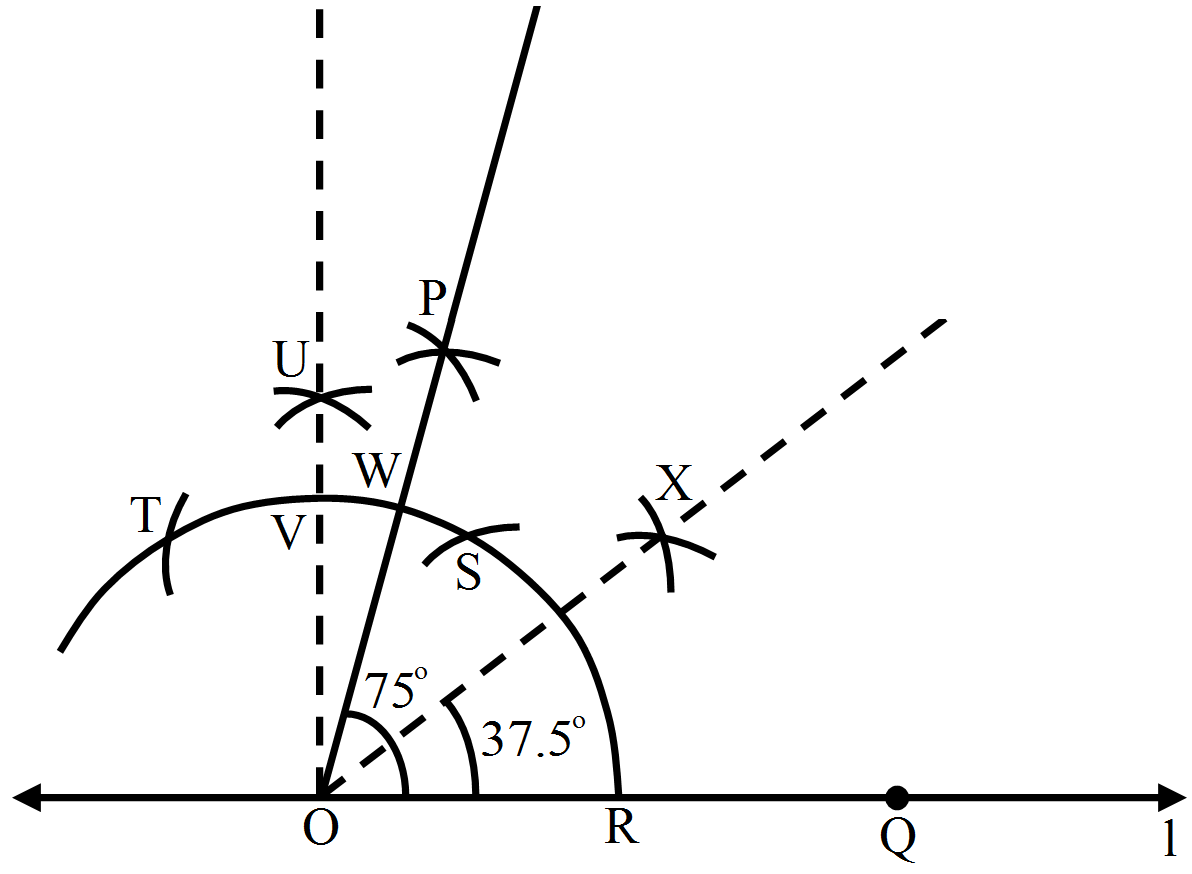
The below given steps will be followed to construct an angle of $75^\circ $ and its line of symmetry.
$1.$Draw a line $l$ and mark two points $O$ and $Q$ on it, as shown in the figure. Draw an arc of convenient radius, while taking point $O$ as centre. Let it intersect line $l$ at $R.$
$2.$Taking $R$ as centre and with the same radius as before, draw an arc intersecting the previously drawn arc at $S.$
$3.$Taking $S$ as centre and with the same radius as before, draw an arc intersecting the arc at $T ($see figure$).$
$4.$Taking $S$ and $T$ as centre, draw an arc of same radius to intersect each other at $U.$
$5.$Join $OU.$ Let it intersect the arc at $V.$ Now, taking $S$ and $V $ as centres, draw arcs with radius more than $\frac{1}{2}$$SV.$ Let those intersect each other at $P.$ Join $OP,$ which is the ray making $75^\circ $ with the line $l.$
$6.$Let this ray be intersecting our major arc at point $W.$ Now, taking $R$ and $W$ as centres, draw arcs with radius more than $\frac{1}{2}$RW in the interior of angle of $75^\circ .$ Let these be intersecting each other at $X.$ Join
$7. OX.$
$OX$ is the line of symmetry for $ÐPOQ = 75^\circ .$
View full question & answer→Question 1105 Marks
Use a pair of compasses and construct the following angles:$15^\circ $
Answer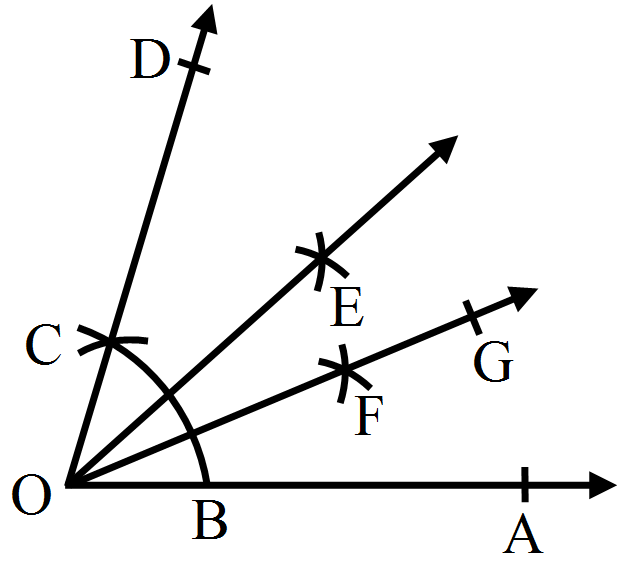
Steps of Construction:
$1.$Draw a ray $OA.$
$2.$With $O$ as centre and any suitable radius draw an arc above $OA,$ cutting it at $B.$
$3.$With $B$ as centre and same radius as before draw another arc to cut the previous arc at $C.$ Join $OC$ and prouce it to $D.$
$4.$Draw the bisector $OE $ of $\angle\text{AQD}.$ Then $\angle\text{AOE}=30^\circ.$
$5.$Draw the bisector $OF$ of $\angle\text{AOE}.$
Then, $\angle\text{AOF}=15^\circ$ is the required angle. View full question & answer→Question 1115 Marks
Use a pair of compasses and construct the following angles: $105^\circ $
Answer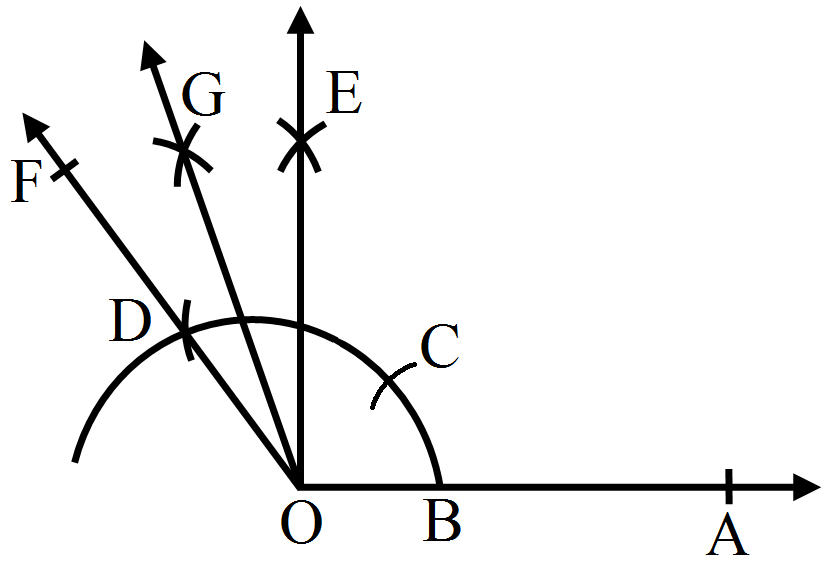
Steps of Construction:
$1.$Draw a ray $OA.$
$2.$With $O$ as centre and any suitable radius draw an arc cutting $OA$ at $B.$
$3.$With $B$ as centre and same radius cut the previous arc at $C$ and then with $C$ as centre and same radius cut the arc at $D.$
$4.$With $C $ as centre and radius more than half $CD$ draw an arc.
$5.$With $D$ as centre and same radius draw another arc to cut the previous arc at $E.$
$6.$Join $OE.$ Also join $OD$ and produce it to $F.$
$7.$Draw the bisector $OG$ of $\angle\text{EOF}.$
Thus, $\angle\text{AOG}=105^\circ$ is the required angle. View full question & answer→Question 1125 Marks
Draw a line segment $AB = 6\ cm.$ Take a point $C$ on $AB$ such that $AC = 2.5\ cm.$ Draw $CD$ perpendicular to $AB.$
Answer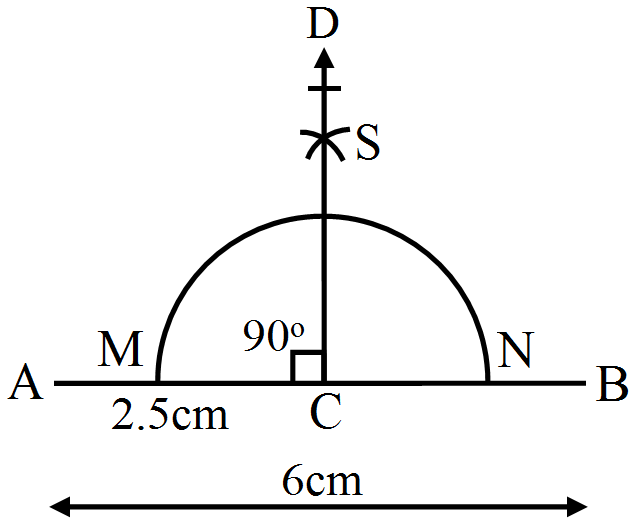
Steps of constructions:
$1.$Draw a line segment $AB,$ which is equal to $6\ cm.$
$2.$Take a point $C$ on $AB$ such that $AC$ is equal to $2.5\ cm$.
$3.$With $C$ as the centre, draw an arc cutting $AB$ at $M$ and $N.$
$4.$With $M$ as the centre and radius more than half of $MN,$ draw an arc.
$5.$With $N$ as the centre and the same radius as before, draw another arc cutting the perviously drawn arc at $S.$
$6.$Draw $SC$ and produce it to $D.$ View full question & answer→Question 1135 Marks
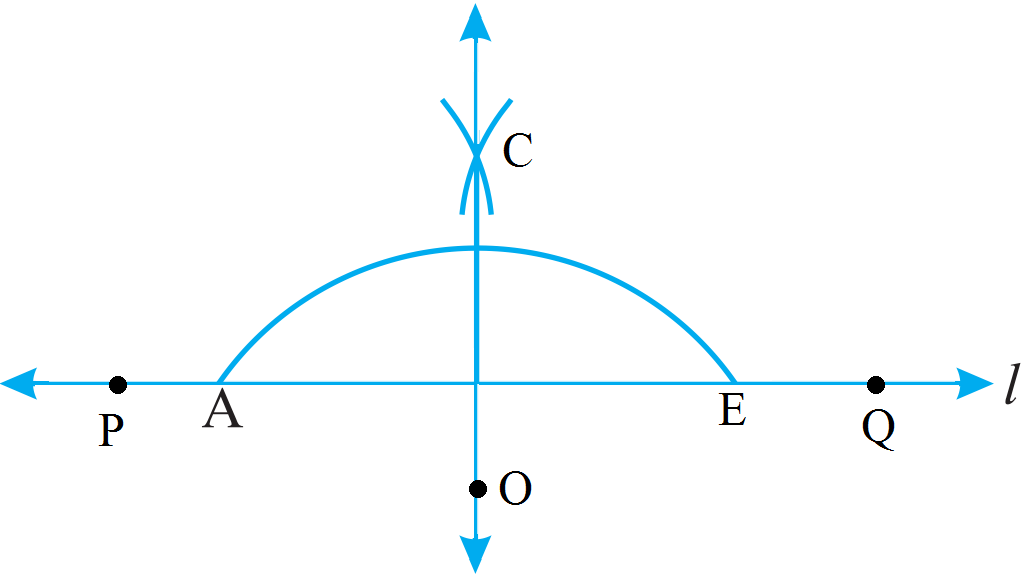
Draw a line segment $PQ$ of length $12\ cm.$ Mark a point $O$ outside this segment. Draw a line through $O$ perpendicular to $PQ.$
AnswerDraw a line $L$ and take a point $P$ on it. Using a ruler and a compass, mark a point $Q$ on the line $L,$ where $PQ = 12\ cm.$ Mark a point $Q$ outside $PQ.$ Now, with $O$ as centre, draw an arc of appropriate radius such that the arc cuts the line at points $A$ and $B.$ Taking $A$ and $B$ as centres, construct two arcs such that they intersect each other at $C.$ Join $OC. OC$ is the required line, which is perpendicular to $PQ.$
View full question & answer→Question 1145 Marks
Use a pair of compasses and construct the following angles: $150^\circ $
Answer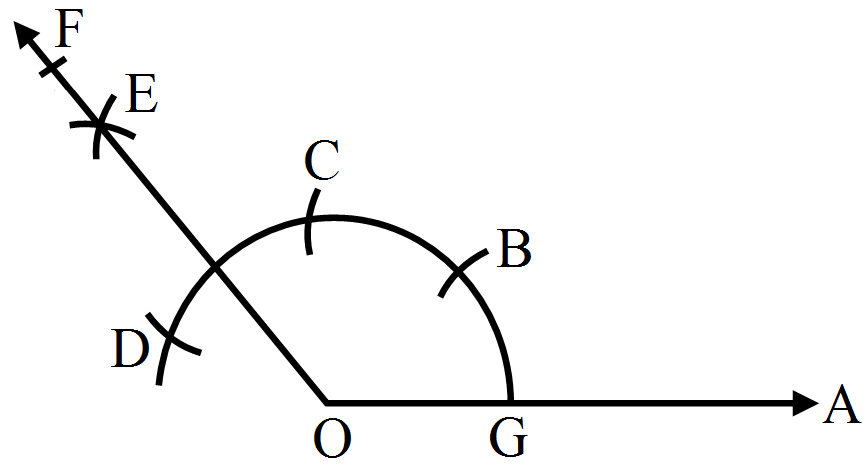
Steps of Construction:
$1.$Draw a ray $OA.$
$2.$With $O$ as centre and any suitable radius draw an arc cutting $OA$ at $G.$
$3.$With $G$ as centre and same radius cut the arc at $B$ and then $B$ as centre and same radius cut the arc at $C.$ Again, with $C$ as centre and same radius cut the arc at $D.$
$4.$With $C$ as centre and radius more than half $CD$ draw an arc.
$5.$With $D$ as centre and same radius draw another arc to cut the previous arc at $E.$
$6.$Join $OE$ and produce it to $F.$
Then, $\angle\text{AOF}=150^\circ.$ View full question & answer→Question 1155 Marks
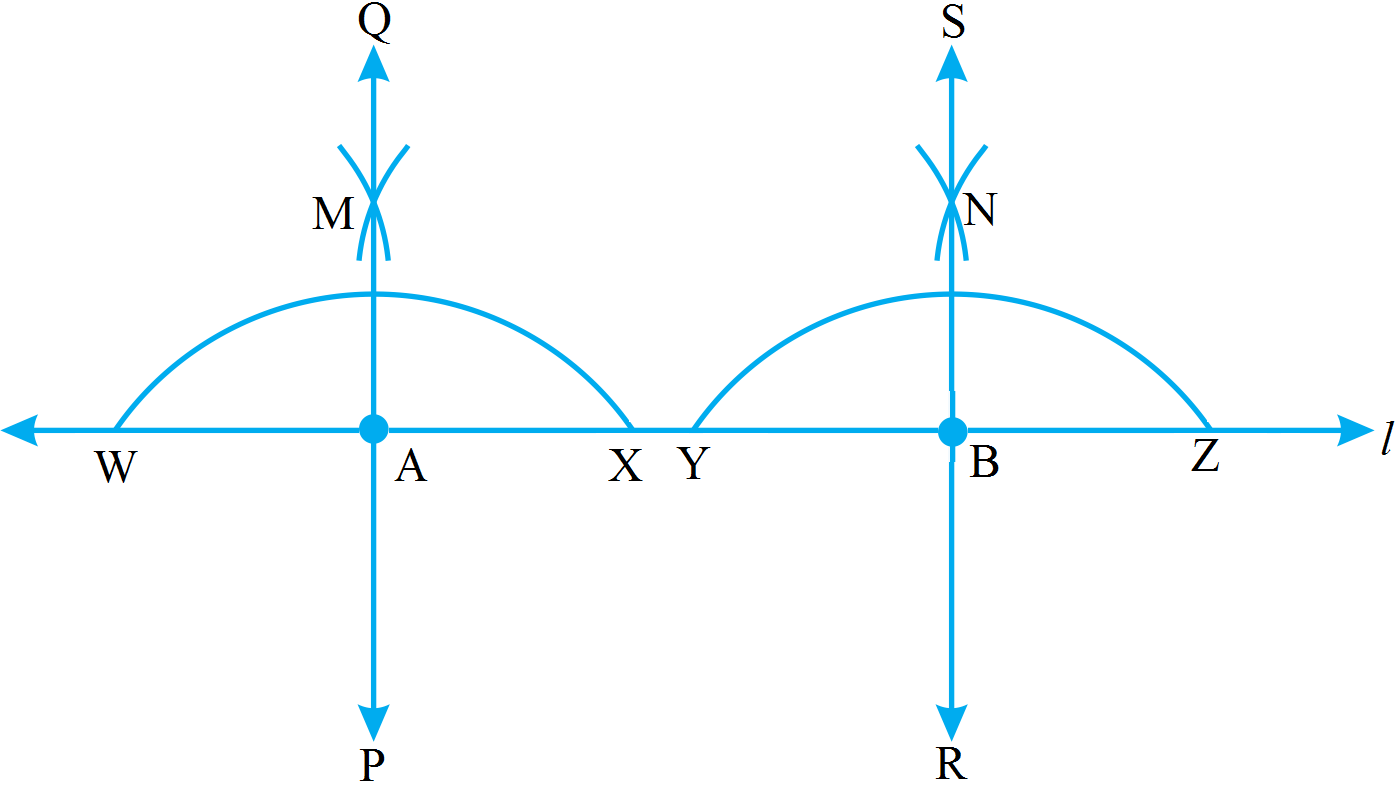
Draw a line segment $AB$ of length $8\ cm.$ At each end of this line segment, draw a line perpendicular to $AB.$ Are these two lines parallel?
Answer$i.\ $Take a convenient radius with $A$ as centre and draw an arc intersecting the line at points $W$ and $X.$
$ii.\ $With $W$ and $X$ as centres and radius greater than $AW,$ construct two arcs intersecting each other at $M.$
$iii.\ $Join $AM$ and extend it in both directions to $P$ and $Q.$
$iv.\ $Take a convenient radius with $B$ as centre and draw an arc intersecting the line at points $Y$ and $Z.$
$v.\ $With $Y$ and $Z$ as centres and a radius greater than $YB,$ construct two arcs intersecting each other at $N.$
$vi.\ $Join $BN$ and extend it in both directions to $S$ and $R.$
Let the lines perpendicular at $A$ and $B$ be $PQ$ and $RS$, respectively.
Since, $\angle\text{QAB}=90^{\circ}$ and $\angle\text{ABR}=90^{\circ}$
Therefore, $\angle\text{QAB}=\angle\text{ABR}.$
When two parallel lines are intersected by a third line, the two alternate interior angles are equal.
Since, $\angle\text{QAB}=\angle\text{ABR}$
Therefore, $PQ$ and $RS$ are parallel.
View full question & answer→Question 1165 Marks
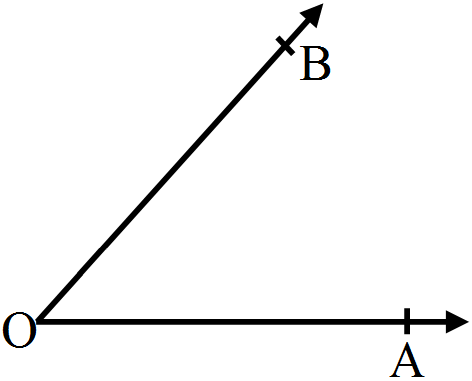
Draw an angle equal to $\triangle\text{AOB},$ given in the adjoining figure.
Answer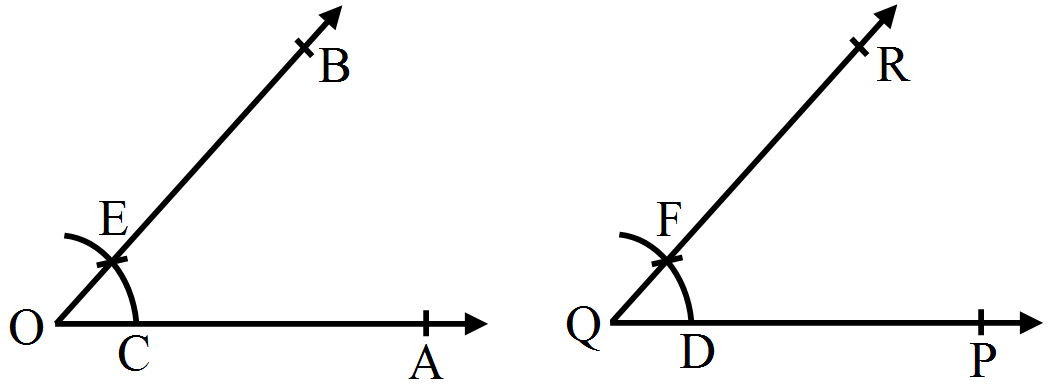
Here $\angle\text{AOB}$ is given.
Steps for construction:
$1.$Draw a ray $QP.$
$2.$With $O$ as the centre and any suitable radius, draw an arc cutting $OA$ and $OB$ at $C$ and $E,$ respectively.
$3.$With $Q$ as the centre and the same radius as in step $(2),$ draw an arc cutting $QP$ at $D.$
$4.$With $D$ as the centre and radius equal to $CE,$ cut the arc through $D$ at $F.$
$5.$Draw $QF$ and produce it to point $R.$
$\therefore\ \angle\text{PQR}=\angle\text{AOB}$ View full question & answer→Question 1175 Marks
Construct an angle of $120^\circ $ and bisect it.
Answer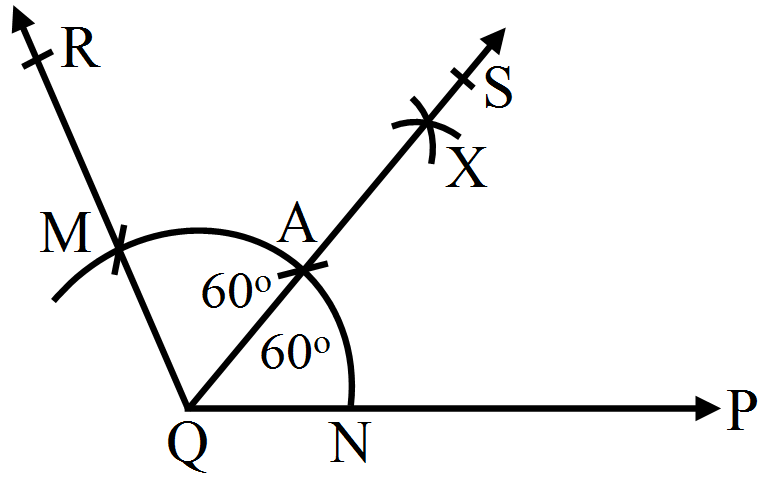
Steps of construction:
$1.$Draw a ray $QP.$
$2.$With $Q$ as the centre and any convenient radius, draw an arc cutting $QP$ at $N.$
$3.$With $N$ as the centre and the same radius, cut the arc at $A.$ Again, with $A$ as the centre and the same radius, cut the arc at $M.$
$4.$Draw $QM$ and produce it to $R.$
$\angle\text{PQR is 120}^\circ.$
$5.$With $M$ as the centre and radius more than half of $MN,$ draw an arc.
$6.$With $N$ as the centre and the same radius mentioned in step $(5),$ draw another arc, cutting the previously drawn arc at point $X.$
$7.$Draw $QX$ and produce it to point $S.$
Ray $QS$ is a bisector of $\angle\text{PQR}.$ Ray $QS$ is a bisector of $\angle\text{PQR}.$ View full question & answer→Question 1185 Marks
Using a protractor, draw an angle of measure $72^\circ .$ With this angle as given, draw angles of measure $36^\circ $ and $54^\circ .$
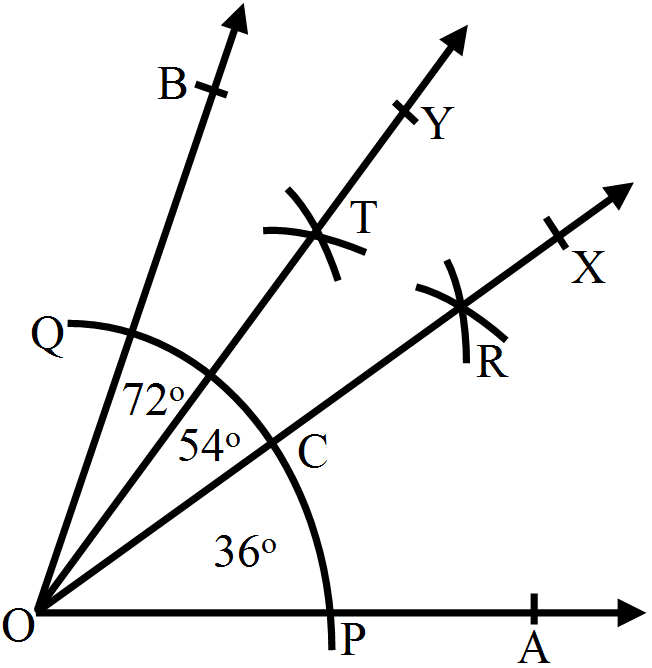
AnswerDraw a ray $OA.$ With the help of a protractor, draw an angle $\angle\text{AOB}$ of $72^\circ . $
With a convenient radius and centre at $O,$ draw an arc cutting sides $OA$ and $OB$ at $P$ and $Q,$ respectively.
With $P$ and $Q$ as centres and radius more than half of $PQ,$ draw two arcs cutting each other at $R.$
Join $O$ and $R$ and extend it to $X.$
$OR$ intersects arc $PQ$ at $C.$ With $C$ and $Q$ as centres and radius more than half of $CQ,$
draw two arcs cutting each other at $T. $
Join $O$ and $T$ and extend it to $Y.$
Now, $OX $ bisects $\angle\text{AOB}$
Therefore, $\angle\text{AOX}=\angle\text{BOX}=\frac{72}{2}=36^{\circ}$
Again, $OY$ bisects $\angle\text{BOX}$
Therefore, $\angle\text{XOY}=\angle\text{BOY}=\frac{36}{2}=18^{\circ}$
Therefore, $\angle\text{AOX}$ is the required angle of $36^\circ $ and $\angle\text{AOY}=\angle\text{AOX}+\angle\text{XOY}=36^{\circ}+18^{\circ}=54^{\circ}$
Therefore, $\angle\text{AOY}$ is the required angle of $54^\circ .$
View full question & answer→Question 1195 Marks
Use a pair of compasses and construct the following angles: $75^\circ $
Answer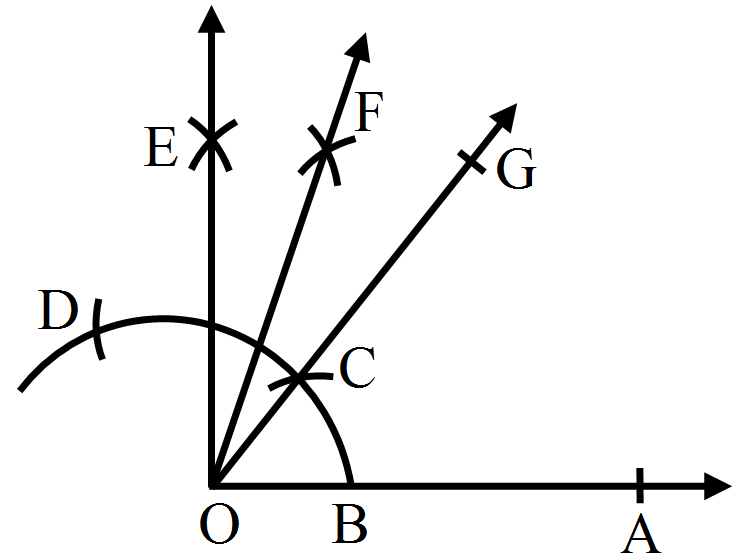
Steps of Construction:
$1.$Draw a ray $OA.$
$2.$With $O$ as centre and any suitable radius draw an arc cutting $OA$ at $B.$
$3.$With $B$ as centre and same radius* cut the previous arc at $C$ and then with $C$ as centre cut the arc at $D.$
$4.$With $C$ as centre and radius more than half $CD$ draw an arc.
$5.$With $D$ as centre and same radius draw another arc to cut the previous arc at $E.$
$6.$Join $OE.$ Also join $OC$ and produce it to $G.$
$7.$Draw the bisector $OF$ of $\angle\text{EOG}.$
Then, $\angle\text{AOF}=75^\circ$ is the required angle. View full question & answer→Question 1205 Marks
Use a pair of compasses and construct the following angles: $67\frac{1}{2}^\circ$
Answer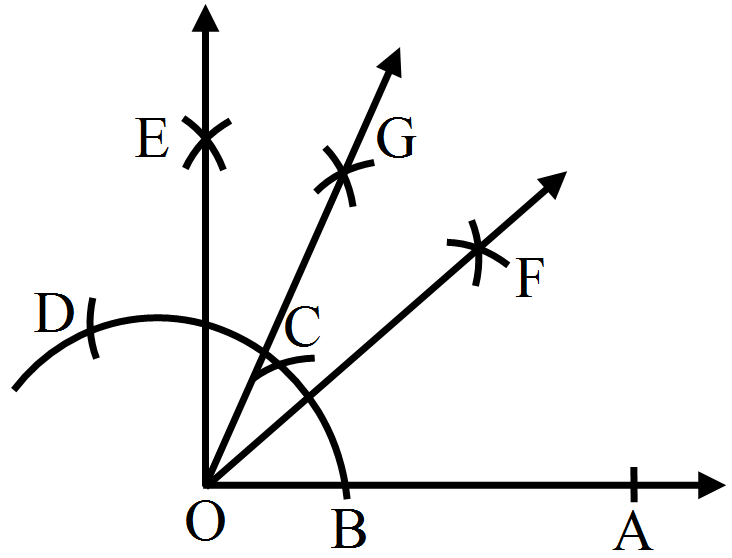
Steps of Construction:
$1.$Draw a ray $OA.$
$2.$With $O$ as centre and any suitable radius draw an arc above $OA$ to cut it $B.$
$3.$With $B$ as centre and same radius cut the previous arc at $C$ and then with $C$ as centre and same radius cut the arc at $D.$
$4.$With $C$ as centre and radius more than half $CD$ draw an arc.
$5.$With $D$ as centre and same radius draw another arc to cut the previous arc at $E.$
$6.$Join $OE.$ Then $\angle\text{AOE}=90^\circ.$
$7.$Draw the bisector $OF$ of $\angle\text{AOE}.$
$8.$Draw the bisector $OG$ of $\angle\text{EOF}.$
Then, $\angle\text{AOG}=67\frac{1}{2}^\circ$ is the required angle. View full question & answer→Question 1215 Marks
Using ruler and compasses only, draw an angle of measure $135^\circ .$
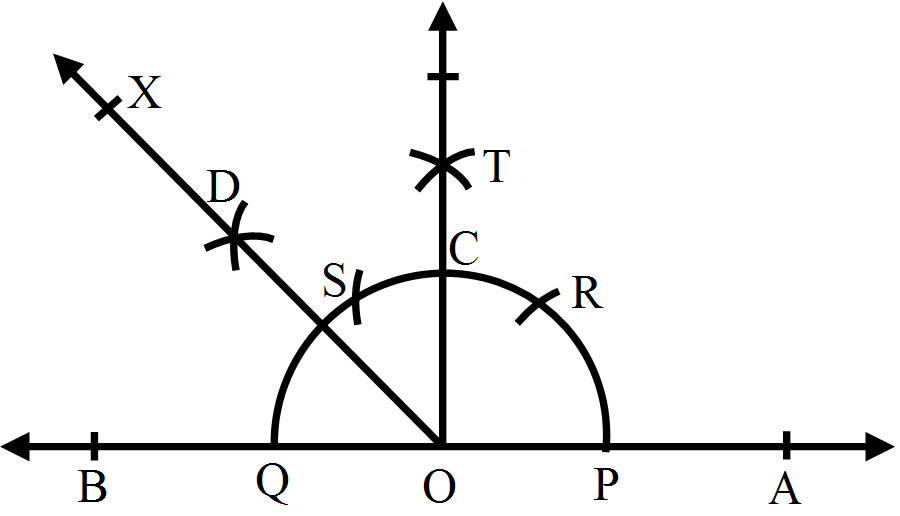
AnswerWe draw a line $AB$ and mark a point $O$ on it. With a convenient radius and centre at $O,$ draw an arc $PQ$ with the help of a compass intersecting the line $AB$ at $P$ and $Q.$ With the same radius and centre at $P,$ draw another arc intersecting the arc $PQ$ at $R.$ With the same radius and centre at $Q,$ draw one more arc intersecting the arc $PQ$ at $S,$ opposite to $P.$ Taking $S$ and $R$ as centres and radius more than half of $SR,$ draw two arcs intersecting each other at $T.$ Join $O$ and $T$ intersecting the arc $PQ$ at $C$. Taking $C$ and $Q$ as centres and radius more than half of $CQ,$ draw two arcs intersecting each other at $D.$ Join $O$ and $D$ and extend it to $X$ to form the ray $OX.$
$\angle\text{AOX}$ is the required angle of measure $135^\circ .$
View full question & answer→Question 1225 Marks
Draw $\angle\text{ABC}$ os measure $60^\circ $ such that $AB = 4.5\ cm$ and $BC = 5\ cm$ and $BC = 5\ cm.$ Through C draw a line parallel to $AB$ and through $B$ draw a line parallel to $AC.$ Intersecting each other at $D.$ Measure $BD$ and $CD.$
Answer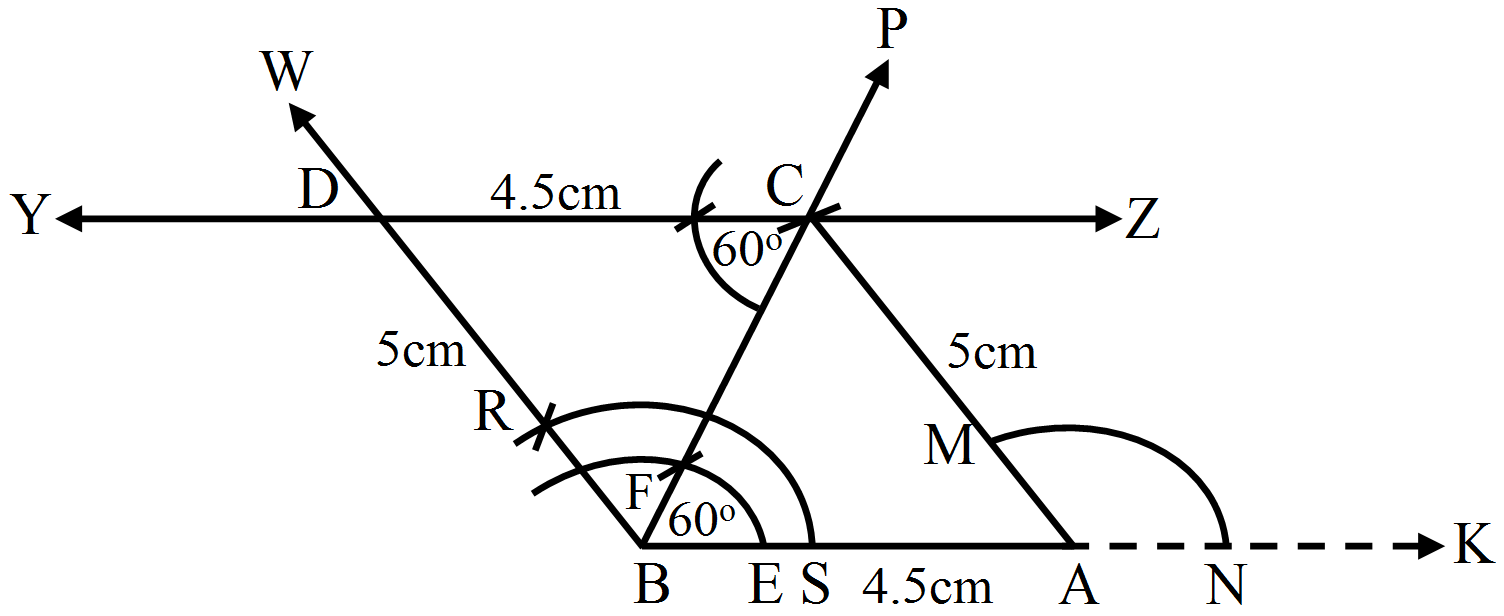
Steps for construction:
$1.$Draw a line $BX$ and take a point $A,$ such that $AB$ is equal to $4.5\ cm.$
$2.$Draw $\angle\text{ABP}=60^\circ$ with the help of protractor.
$3.$With $A$ as the centre and a radius of $5\ cm,$ draw an arc cutting $PB$ at $C.$
$4.$Draw $AC.$
$5.$Now, draw $\angle\text{BCY}=60^\circ$
$6.$Then, draw $\angle\text{ABW},$ such that $\angle\text{ABW}$ is equal to $\angle\text{CAX},$ which cut the ray $CY$ at $D.$
$7.$Draw $BD.$
When we measure $BD$ and $CD.$ We have, $BD = 5\ cm$ and $CD = 4.5\ cm.$ View full question & answer→Question 1235 Marks
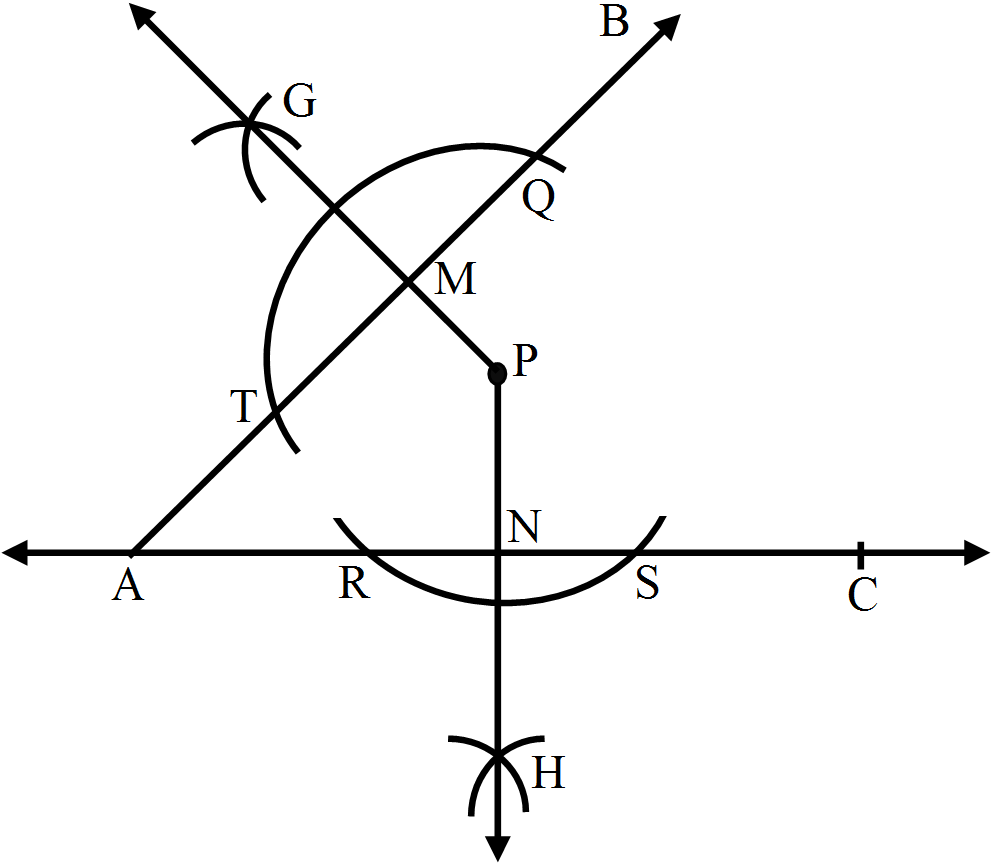
Using a protractor, draw $\angle\text{BAC}$ of measure $45^\circ .$ Take a point $P$ in the interior of $\angle\text{BAC}.$ From $P$ draw line segments $PM$ and $PN$ such that $\text{PM}\perp\text{AB}$ and $\text{PN}\perp\text{AC},$ Measure $\angle\text{MPN}.$
Answer$i.\ $Draw a line segment $A$ on the line $L .$
$ii.\ $Take a protractor and place it on the segment $AC$ such that $AC$ coincides with the line of the diameter of the protractor and the middle point of the line coincides with point $A$.
$iii.\ $Counting from the right side, mark a point as $B$ at the point of $45^\circ $ of protractor and draw a line segment $AB.$
$iv.\ $Take a convenient radius with $P$ as centre, construct an arc intersecting the line segments $AB$ at $T$ and $Q$ and $AC$ at $R$ and $S.$
$v.\ $Using the same radius and with $T$ and $Q$ as centres, construct two arcs intersecting at $G$ on the other side.
$vi.\ $Using the same radius and with $R$ and $S$ as centres, construct two arcs intersecting at $H$ on the other side.
$vii.\ $Join $PG$ and $PH$ which intersects $AB$ and $AC$ at $M$ and $N,$ respectively.
On measuring $\angle\text{MPN}$ using a protractor, we get it equal to $135^\circ .$
View full question & answer→Question 1245 Marks
Draw a reactangle whose two adjacent sides are $5.4\ cm$ and $3.5\ cm.$
Answer
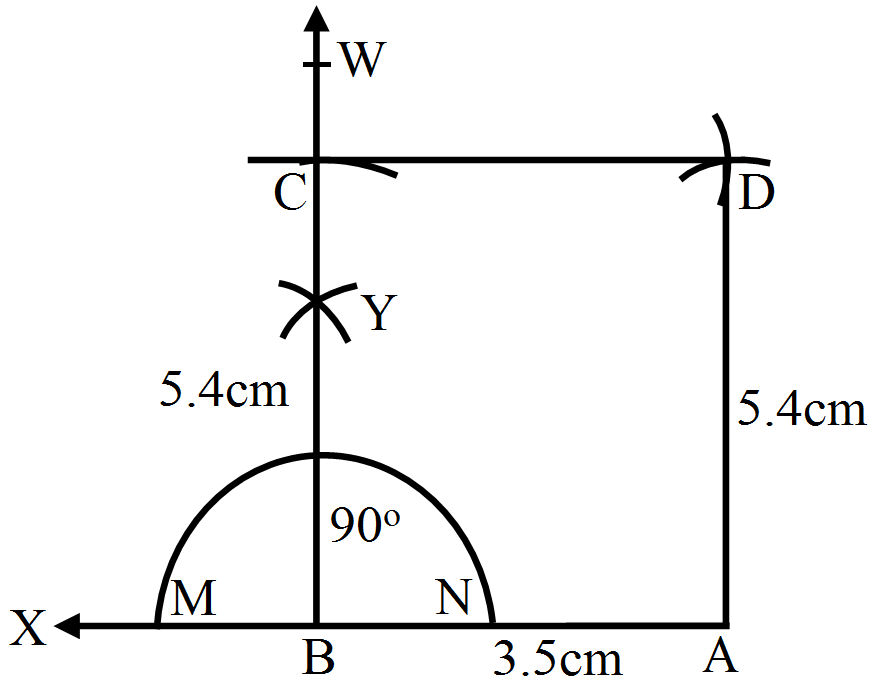
Steps of construction:
$1.$Draw a ray $AX.$
$2.$With $A$ as the centre, cut the ray $XA$ at $B,$ such that $AB$ is equal to $3.5\ cm.$
$3.$With $B$ as the centre and with any convenient radius, draw an arc cutting $AX$ at $M$ and $N.$
$4.$With $N$ as the centre and with radius more than half of $MN,$ draw an arc.
$5.$With $M$ as the centre and with the radius same as before, draw another arc to cut the previous arc at $Y.$
$6.$Draw $BY$ and produced it to $W.$
$7.$With $B$ as the centre and a radius of $5.4\ cm,$ cut ray $BW$ at point $C.$
$8.$With $C$ as the centre and a radius $3.5\ cm,$ draw an arc on the right side of $BC.$
$9.$With $A$ as the centre and a radius $5.4\ cm,$ draw an arc cutting the previous arc at $D.$
$10.$Join $CD$ and $AD.$
$\text{ABCD}$ is the required rectangle.
View full question & answer→Question 1255 Marks
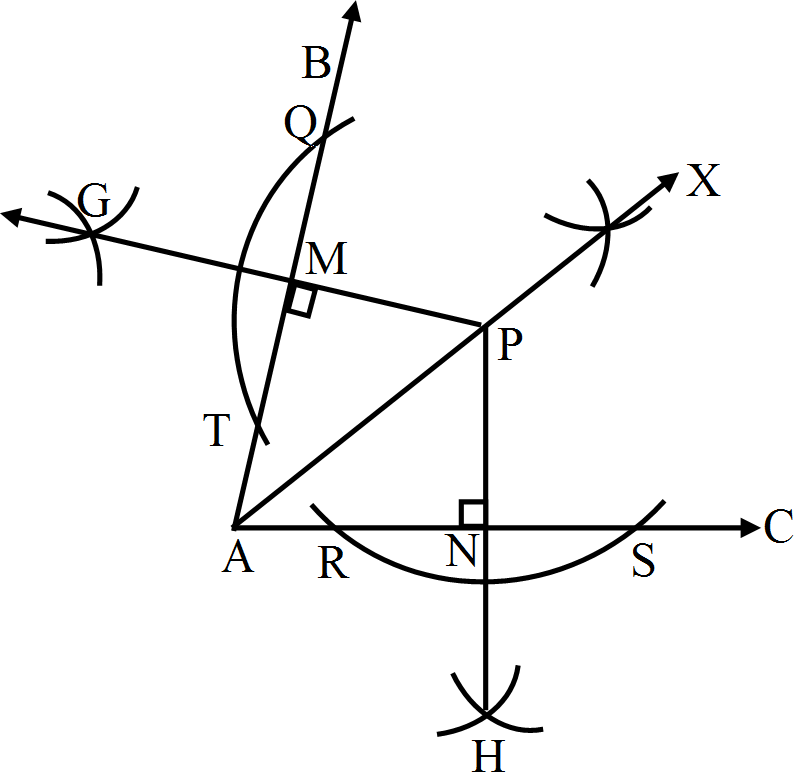
Draw an angle and label it as $\angle\text{BAC}.$ Draw its bisector ray $AX$ and take a point $P$ on it. From $P$ draw line segments $PM$ and $PN,$ such that $\text{PM}\perp\text{AB}$ and $\text{PN}\perp\text{AC},$ where $M$ and $N$ are respectively points on rays $AB$ and $AC.$ Measure $PM$ and $PN.$ Are the two lengths equal$?$
Answer$i.\ $Draw $\angle\text{BAC}$ on the line segment $AC.$
With a convenient radius and $A$ as centre, draw an arc from $AB$ and $AC$.
$ii.\ $The points where arc cuts $AB$ and $AC,$ take both points as centres and draw two small arcs intersecting at $X.$ Now, draw $AX.$
$iii.\ $Take a point $P$ on the ray $AX.$
$iv.\ $Take a convenient radius with $P$ as centre and construct an arc intersecting the line segments $AB$ at $T$ and $Q$ and $AC$ at $R$ and $S,$ respectively.
$v.\ $Using the same radius and with $T$ and $Q$ as centres, construct two arcs intersecting at $G$ on the other side.
$vi.\ $Using the same radius and with $R$ and $S$ as centres, construct two arcs intersecting at $H$ on the other side.
$vii.\ $Join $PG$ and $PH,$ which intersects $AB$ and $AC$ at $M$ and $N,$ respectively.
On measuring $PM$ and $PN$ using a ruler, we find that both are equal.
View full question & answer→Question 1265 Marks
Draw an angle of $45^\circ ,$ using a pair of compasses.
Answer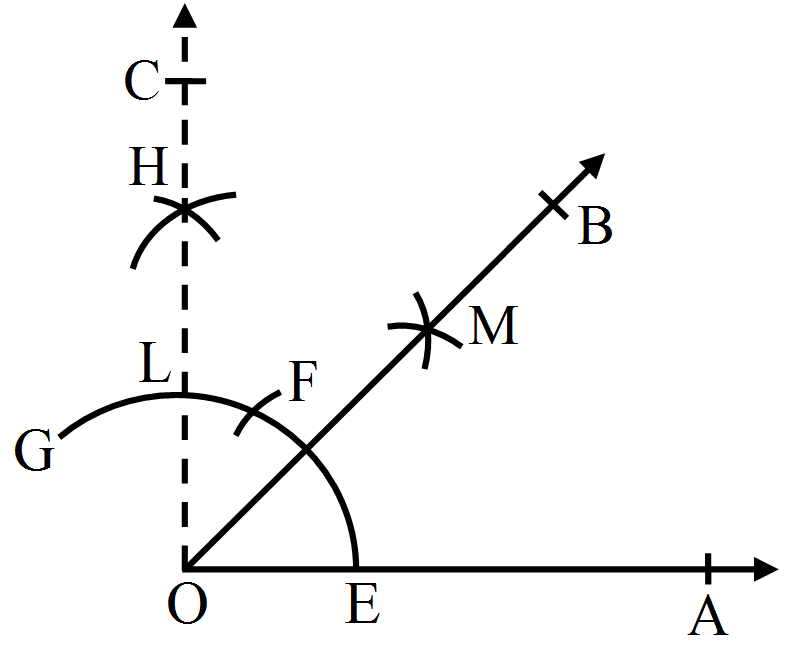
Steps of constructions:
$1.$Draw a ray $OA.$
$2.$With centre $O$ and a suitable radius draw an arc meeting $OA$ at $E.$
$3.$With centre $E$ and with same radius, cut the first arc firstly at $F$ and then from $F$ with same radius cut act at $G.$
$4.$With centres $F$ and $G,$ with suitable radius, draw arcs intersecting each other at $H.$
$5.$Join $OH$ intersecting the first arc at $L$ and produce it to $C.$
$6.$With centre $E$ and $L$ and with suitable radius draw arcs intersecting each other at $M.$
$7.$Join $OM$ and produce it to $B.$
Then, $\angle\text{AOB}=45^\circ$ View full question & answer→Question 1275 Marks
Draw a square, each of whose sides is $5\ cm.$ Use a pair of compasses and a ruler in your constribuction.
Answer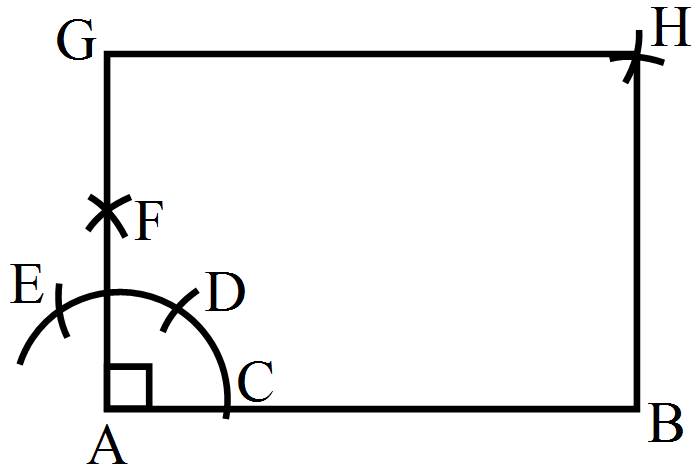
Steps of Construction:
$1.$With the help of a ruler draw a line segment $AB = 5\ cm.$
$2.$With $A$ as centre and any suitable radius draw an arc cutting $AB$ at $C.$
$3.$With $C $ as centre and same radius cut the previous arc at $D$ and then with $D$ as centre and same radius cut the arc at $E.$
$4.$With $D$ as centre and radius more than half $DE$ draw an arc.
$5.$With $E$ as centre and same radius draw another arc to cut the previous arc at $F.$
$6.$Join $AF$ and produce it to $G$ such that $AG = 5\ cm.$
$7.$With $G$ as centre and radius equal to $AB$ draw an arc. With $B$ as centre and same radius draw another arc to cut the previous arc at $H.$
$8.$Join $GH$ and $BH.$
Then, $\text{ABHG}$ is the required square. View full question & answer→Question 1285 Marks
Construct an angle of $90^\circ $ and bisect it.
Answer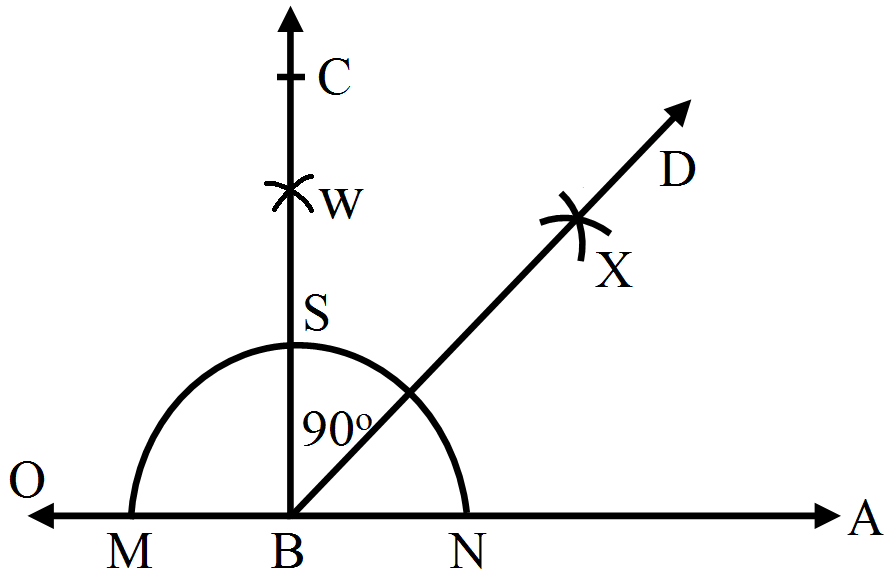
Construction steps:
$1.$Draw a line $OA.$
$2.$Take a point $B$ on $OA$. With $B$ as the centre and any convenient radius, draw an arc cutting $OA $ at $M$ and $N.$
$3.$With $N$ as the centre and radius more than half of $MN,$ draw an arc.
$4.$With $M$ as the centre and the same radius as before, draw another arc to cut the previous arc at $W.$
$5.$Draw $WB,$ meeting the arc at $S.$ Produce it to $C.$
$\angle\text{ABC}$ is the required angle of $90^\circ \angle\text{ABC}$ is the required angle of $90^\circ .$
$6.$With $S$ as the centre and radius more than half of $SN,$ draw an arc.
$7.$With $N$ as centre and the same radius as in step $(6),$ draw another arc, cutting the previously drawn arc at point $X.$
$8.$Draw $BX$ and produce it to point $D.$ Ray $BD$ is the angle bisctor of $\angle\text{ABC}.$ Ray $BD$ is the angle bisctor of $\angle\text{ABC}.$ Ray $BD$ is the angl bisctor of $\angle\text{ABC}.$ Ray $BD$ is the angle bisctor of $\angle\text{ABC}.$ View full question & answer→