Question 515 Marks
Draw an obtuse angle. Bisect it. Measure each of the angles so obtained.
AnswerObtuse angles are those angles which are greater than $90^\circ $ but less than $180^\circ .$
Draw an obtuse angle $\angle\text{BAC}.$
With an appropriate radius and centre at $A,$ draw an arc such that it intersects $AB$ and $AC$ at $P$ and Q, respectively.
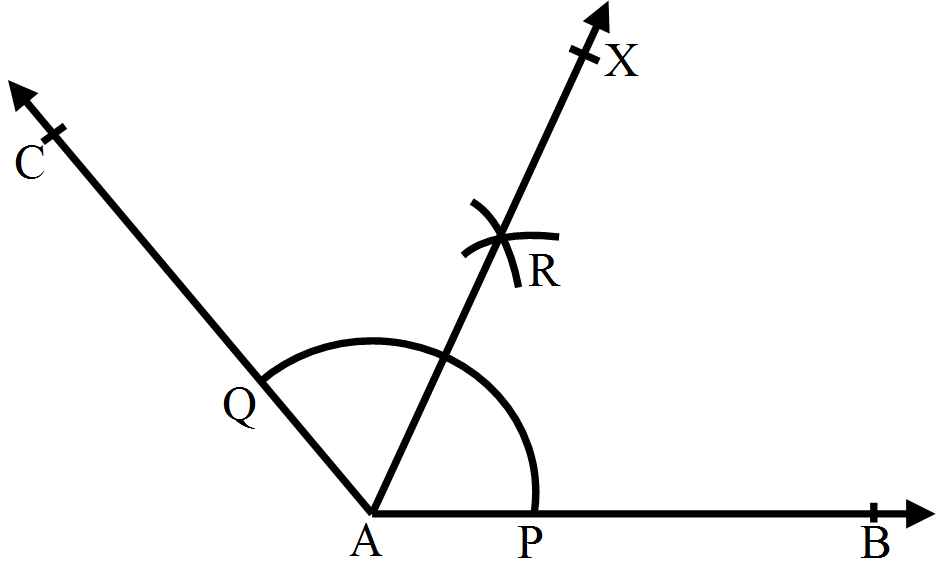
With centre $P$ and radius more than half of $PQ,$ draw an $ARC.$
With the same radius and centre at $Q,$ draw another arc intersecting the previous arc at $R.$
Join $A$ and $R$ and extend it to $X.$
The ray $AX$ is the required bisector of $\angle\text{BAC}.$
If we measure $\angle\text{BAR}$ and $\angle\text{CAR},$
we have $\angle\text{BAR}=\angle\text{CAR}=65^{\circ}$ View full question & answer→Question 525 Marks
Draw an angle of measure $45^\circ $ and bisect it.
Answer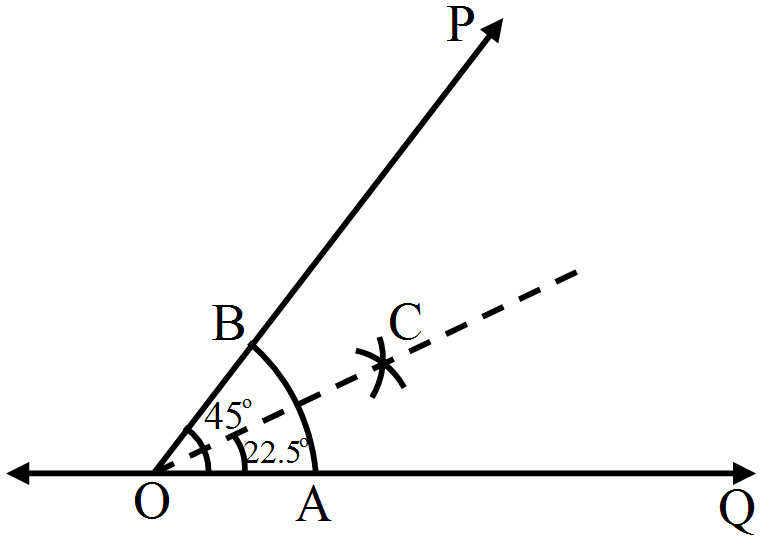
The below given steps will be followed to construct an angle of $45^\circ $ and its bisector.
$1.\angle\text{POQ}$ of $45^\circ $ measure can be formed on a line $l$ by using the protractor.
$2.$Draw an arc of a convenient radius, while taking point $O$ as centre. Let it intersect both rays of angle $45^\circ $ at point $A$ and $B$.
$3.$Taking $A$ and $B$ as centres, draw arcs of radius more than $\frac{1}{2}AB $ in the interior of angle of $45^\circ .$ Let those intersect each other at $C$. Join $OC.$
$OC$ is the required bisector of $45^\circ $ angle.
View full question & answer→Question 535 Marks
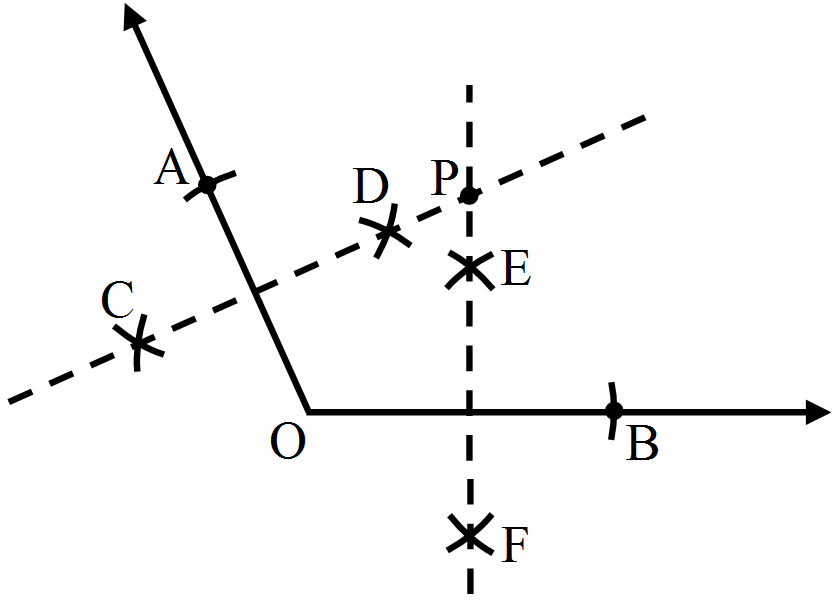
Draw any angle with vertex $O.$ Take a point $A$ on one of its arms and $B$ on another such that $OA = OB.$ Draw the perpendicular bisectors of $\overline{\text{OA}}$ and $\overline{\text{OB}}$. Let them meet at $P$. Is $PA = PB ?$
Answer
$1.$ Draw any angle whose vertex is $O.$
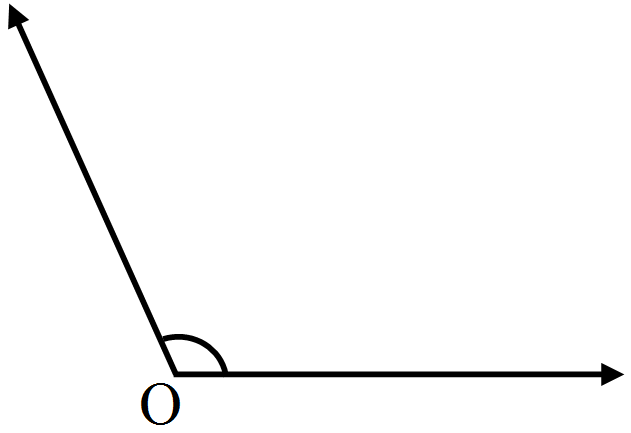
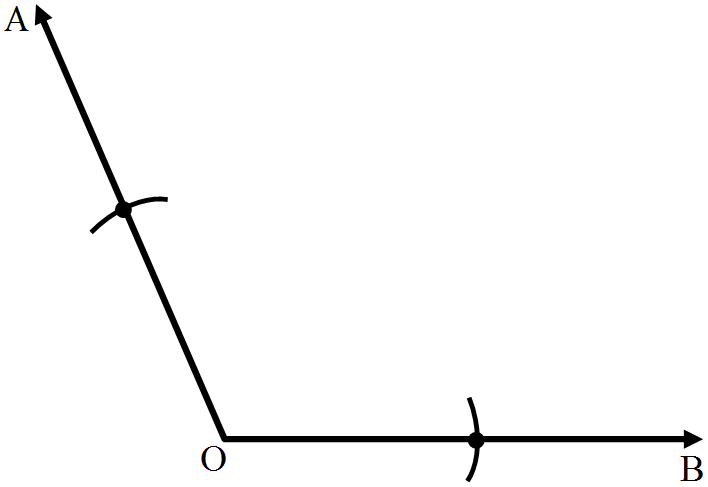
$2.$With a convenient radius, draw arcs on both rays of this angle while taking $O$ as centre. Let these points be $A$ and $B.$
$3.$Taking $O$ and $A$ as centres and with radius more than half of $OA,$ draw arcs on both sides of $OA.$ Let these be intersecting at $C$ and $D.$ Join $CD.$
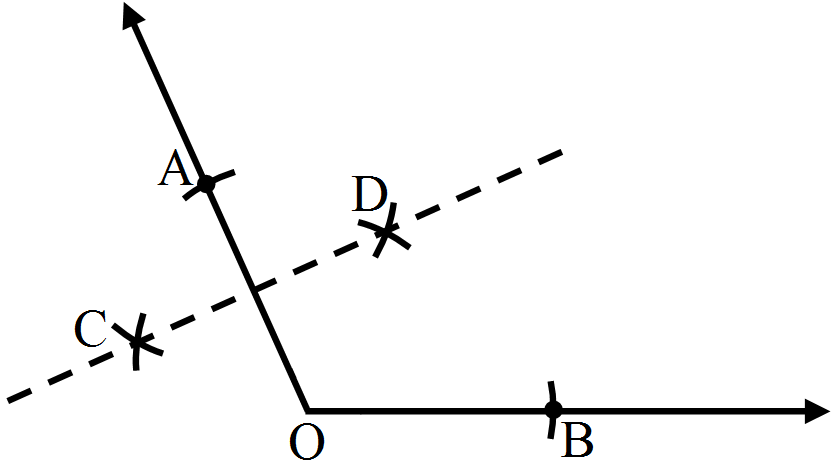
$4.$Similarly, we can find the perpendicular bisector $\overline{\text{EF}}$ of $\overline{\text{OB}}$. These perpendicular bisectors $\overline{\text{CD}}$ and $\overline{\text{EF}}$ will intersect each other at P.
Now, $PA$ and $PB$ can be measured. These are equal in length.
View full question & answer→Question 545 Marks
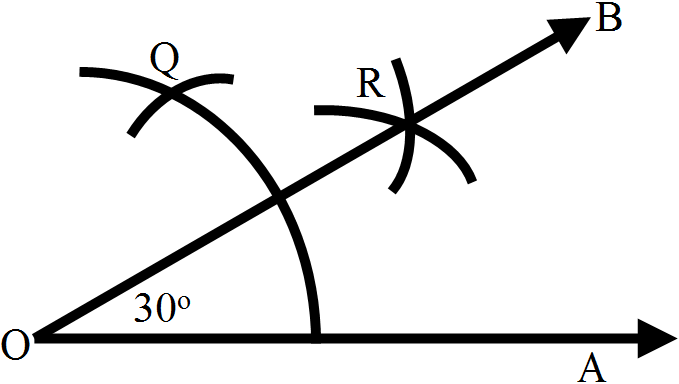
Construct the angle with the help of ruler and compasses only: $30^\circ $
AnswerDraw a ray $OA.$ With a convenient radius and centre at $O,$ draw an arc, which cuts $OA$ at $P.$ With the same radius and centre at $P,$ draw an arc cutting the previous arc at $P.$ Taking $P$ and $Q$ as centres and radius more than half of $PQ,$ draw two arcs, which cuts each other at $R.$ Draw $OR$ and extend it to $B.$
$\angle\text{AOB}$ is the required angle of $30^\circ .$
View full question & answer→Question 555 Marks
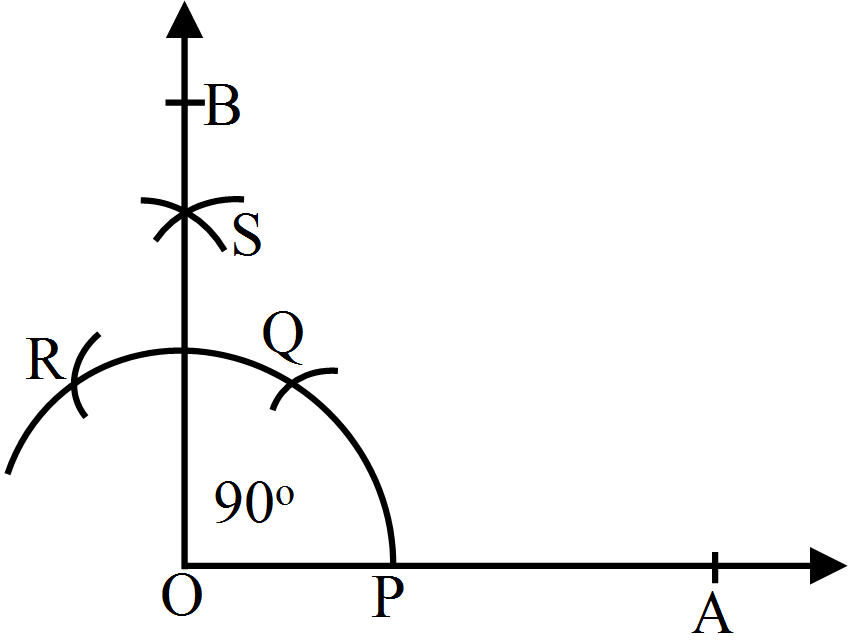
Construct the angle with the help of ruler and compasses only: $90^\circ $
AnswerDraw a ray $OA.$
With a convenient radius and centre at $O,$
draw an arc cutting the ray $OA$ at $P.$
With the same radius and centre at $P,$
draw another arc, which cuts the first arc at $Q.$
With the same radius and centre at $Q,$ draw another arc,
which cuts the first arc at $R.$
With $Q$ and $R$ as centres and radius more than half of $QR,$
which cuts each other at $S.$
Draw $OS$ and extend it to $B$ from the ray $OB.$
$\angle\text{AOB}$ is required angle of $90°.$
View full question & answer→Question 565 Marks
In which of the following figures:
$a.\ $Perpendicular bisector is shown?
$b.\ $Bisector is shown?
$c.\ $Only bisector is shown?
$d.\ $Only perpendicular is shown?
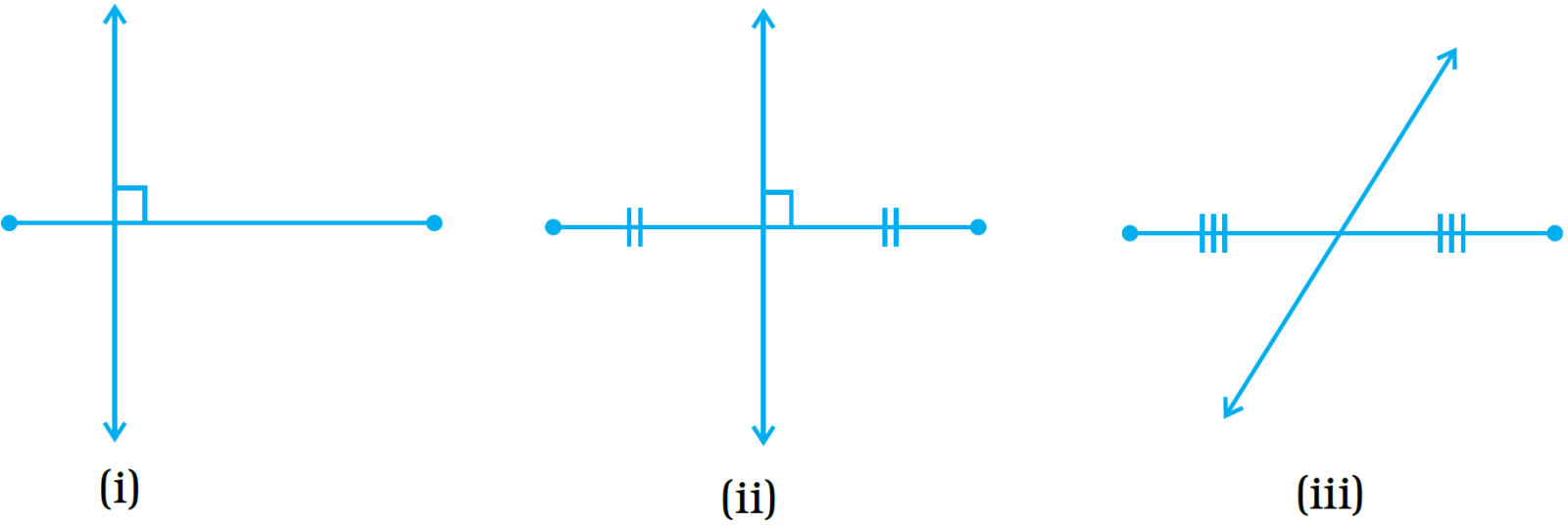
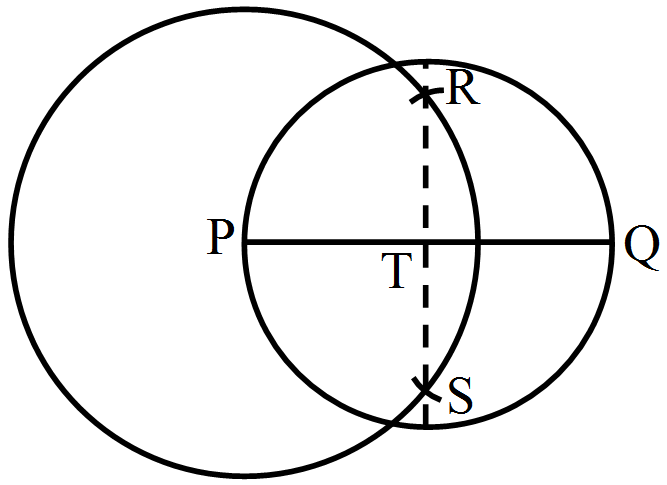
AnswerA bisector is a line which bisects a given line segment into two equal parts. If this bisector is perpendicular to the given line segment, then it is known as perpendicular bisector.
$a.\ $Figure $(ii)$ represents a perpendicular bisector.
$b.\ $Figures $(ii)$ and $(iii)$ represent bisectors.
$c.\ $Figure $(iii)$ represents only bisector.
$d.\ $Figure $(i)$ represents only perpendicular.
View full question & answer→Question 575 Marks
Construct $\overline{\text{AB}}$ of length $7.8\ cm.$ From this, cut off $\overline{\text{AC}}$ of length $4.7\ cm.$ Measure $\overline{\text{BC}}$.
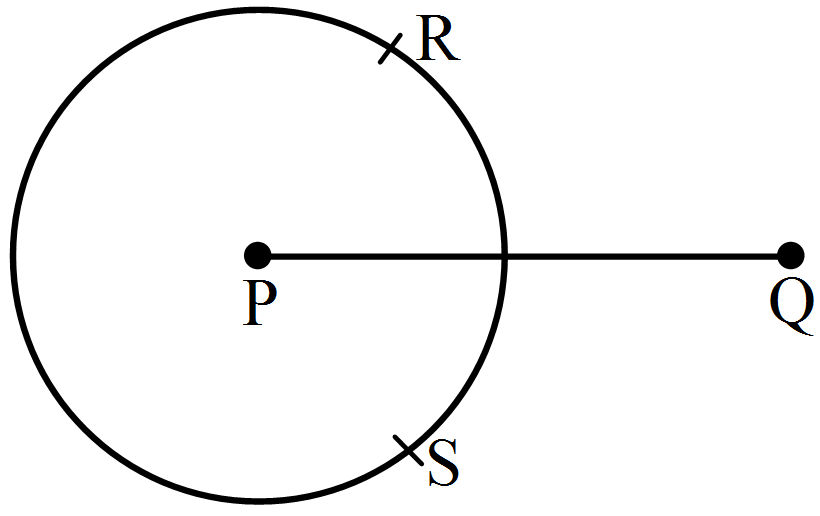
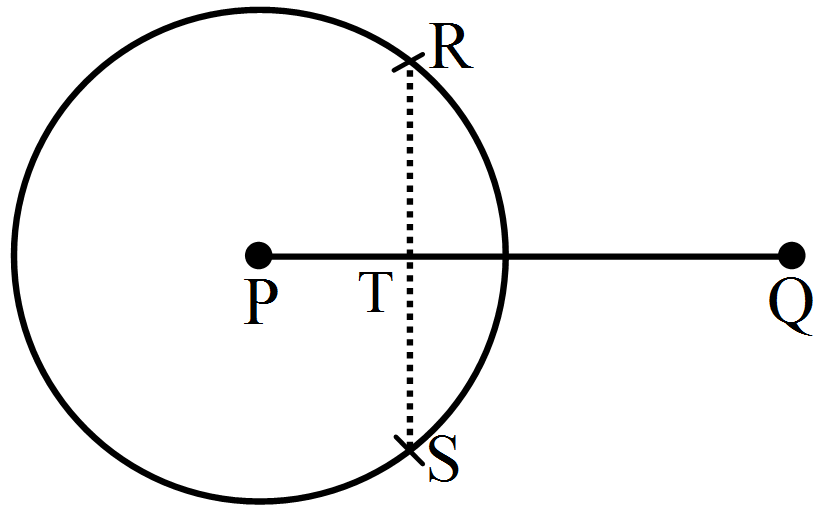
Answer
$1.$Draw a line $l$ and make a point $A$ on it.

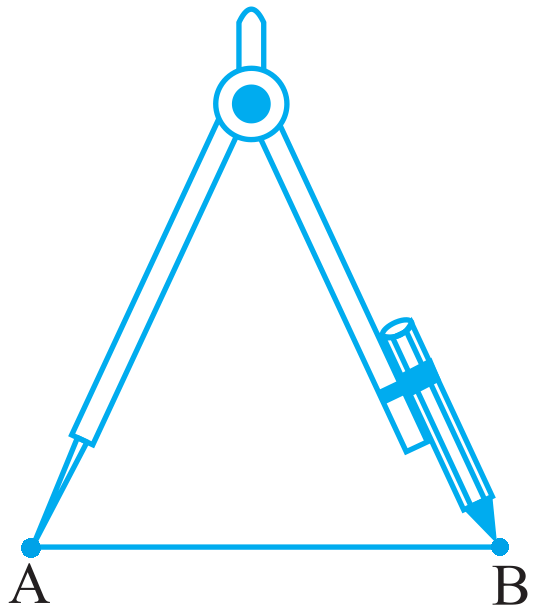
$2.$By adjusting the compasses up to $7.8\ cm,$ draw an arc to cut $l$ on $B,$ while putting the pointer of coompasses on point $A.$
$\overline{\text{AB}}$ is the line segment of $7.8\ cm.$

$3.$By adjusting the compasses up to $4.7\ cm,$ draw an arc to cut $l$ on $C, $ while putting the pointer of coompasses on point $A.$
$\overline{\text{AC}}$ is the line segment of $4.7\ cm.$

$4.$Now put the ruler along with this line such that $0$ mark of ruler will match with the point $C.$
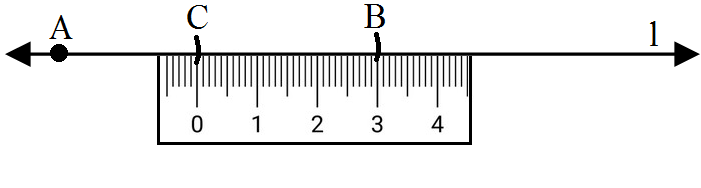
Read the position of point $B.$ It comes to $3.1\ cm$
$\overline{\text{BC}}$ is $3.1\ cm.$ View full question & answer→Question 585 Marks
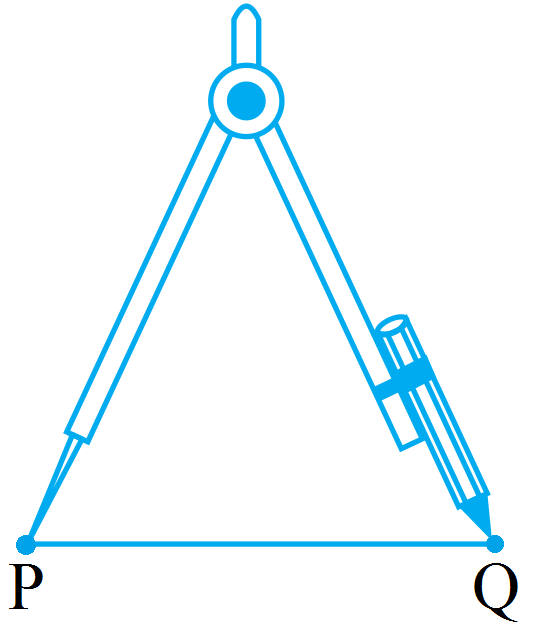
Draw any line segment $\overline{\text{PQ}}$. Without measuring $\overline{\text{PQ}}$, construct a copy of $\overline{\text{PQ}}$.
View full question & answer→Question 595 Marks
Construct with ruler and compasses, angles of measure: $90^\circ $
Answer
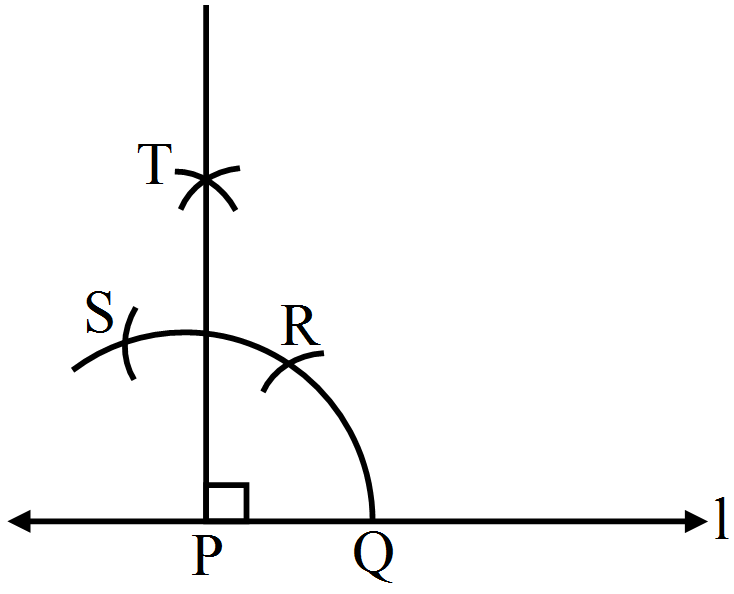
The below given steps will be followed to construct an angle of $90^\circ .$
$1.$Draw a line $l$ and mark a point $P$ on it. Now taking $P$ as centre and with a convenient radius, draw an arc of a circle which intersects line $l$ at $Q.$
$2.$Taking $Q$ as centre and with the same radius as before, draw an arc intersecting the previously drawn arc at $R.$
$3.$Taking $R$ as centre and with the same radius as before, draw an arc intersecting the arc at $S ($see figure$).$
$4.$Taking $R$ and $S$ as centre, draw an arc of same radius to intersect each other at $T.$
$5.$ Join $PT,$ which is the required ray making $90^\circ $ with line $l.$ View full question & answer→Question 605 Marks
Construct with ruler and compasses, angles of measure: $120^\circ $
Answer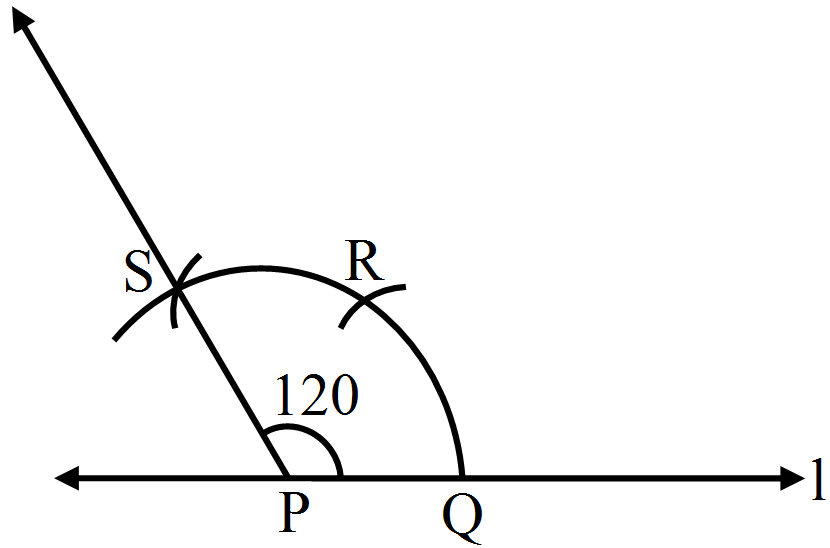
The below given steps will be followed to construct an angle of $120^\circ .$
$1.$Draw a line $l$ and mark a point $P$ on it. Now taking $P$ as centre and with a convenient radius, draw an arc of a circle which intersects line $l$ at $Q.$
$2.$Taking $Q$ as centre and with the same radius as before, draw an arc intersecting the previously drawn arc at $R.$
$3.$Taking $R$ as centre and with the same radius as before, draw an arc intersecting the arc at $S ($see figure$).$
$4.$Join $PS,$ which is the required ray making $120^\circ $ with line $l.$ View full question & answer→Question 615 Marks
Name the points and then the line segments in each of the following figures:
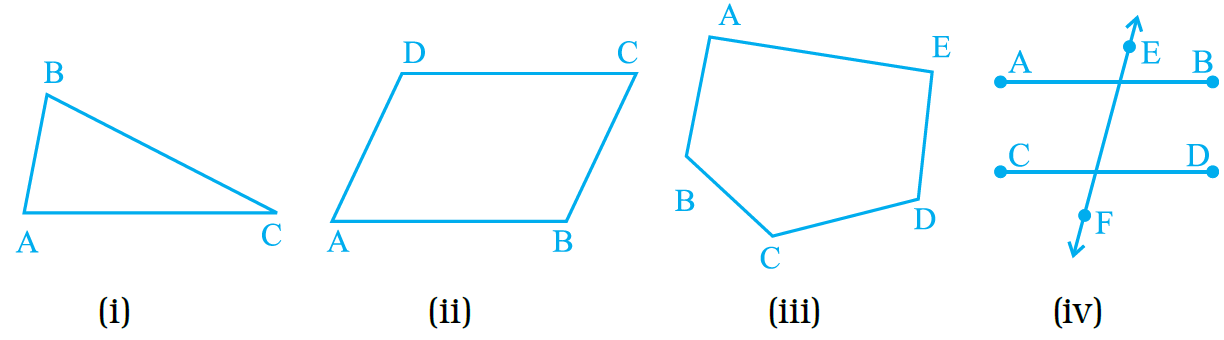
Answer$1.$Points: $\text{A, B}$ and $C$
Line segments: $\text{AB, BC}$ and $CA$
$2.$Points: $\text{A, B, C}$ and $D$
Line segments: $\text{AB, BC, CD}$ and $DA$
$3.$Points: $\text{A, B, C, D}$ and $E$
Line segments: $\text{AB, BC, CD, DE}$ and $EA$
$4.$Points: $\text{A, B, C, D, E}$ and $F$ Line segments: $\text{AB, CD}$ and $EF$
View full question & answer→Question 625 Marks
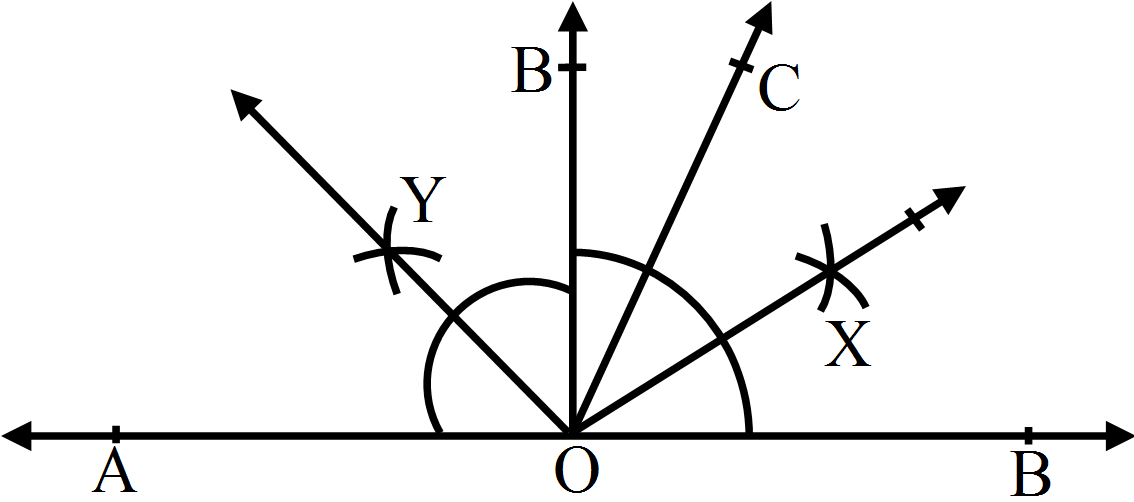
Draw a linear pair of angles. Bisect each of the two angles. Verify that the two bisecting rays are perpendicular to each other.
AnswerTwo angles, which are adjacent and supplementary, are called linear pair of angles.
Draw a line $AB$ and mark a point $O$ on it.
When we draw any angle $\angle\text{AOC},$
we also get another angle $\angle\text{BOC}.$
Bisect $\angle\text{AOC}$ by a compass and a ruler and get the ray $OX.$
Similarly, bisect $\angle\text{BOC}$ and get the ray $OY.$
Now, $\angle\text{XOY}=\angle\text{XOC}+\angle\text{COY}$
$=\frac{1}2{}\angle\text{AOC}+12\angle\text{BOC}$
$=\frac{1}{2}(\angle\text{AOC}+\angle\text{BOC})$
$=\frac{1}{2}\times180^{\circ}=90^{\circ}$ (As $\angle\text{AOC}$ and $\angle\text{BOC}$ are supplementary angles)
View full question & answer→Question 635 Marks
Can we have two acute angles whose sum is:
$a.\ $An acute angle? Why or why not?
$b.\ $A right angle? Why or why not?
$c.\ $An obtuse angle? Why or why not?
$d.\ $A straight angle? Why or why not?
$e.\ $A reflex angle? Why or why not?
Answer$a.\ $Yes, the sum of the two acute angles may be less than a right angle, e.g. $30^\circ $ and $45^\circ $ are acute angles and their sum $(i.e. 30^\circ + 45^\circ = 75^\circ )$ is also an acute angle.
$b.\ $Yes, the sum of two acute angles may be equal to a right angle, $e.g. 30^\circ + 60^\circ = 90^\circ .$
$c.\ $Yes, the sum of two acute angles may be more than a right angle, i.e. obtuse angle, $e.g. 60^\circ + 70^\circ = 130^\circ .$
$d.\ $No, the sum of two acute angles is always less than a straight angle, $i.e. 180^\circ .$
$e.\ $No, the sum of two acute angles is always less than $180^\circ .$ So, their sum cannot be a reflex angle.
View full question & answer→Question 645 Marks
Construct the angle with the help of ruler and compasses only:
$45^\circ $
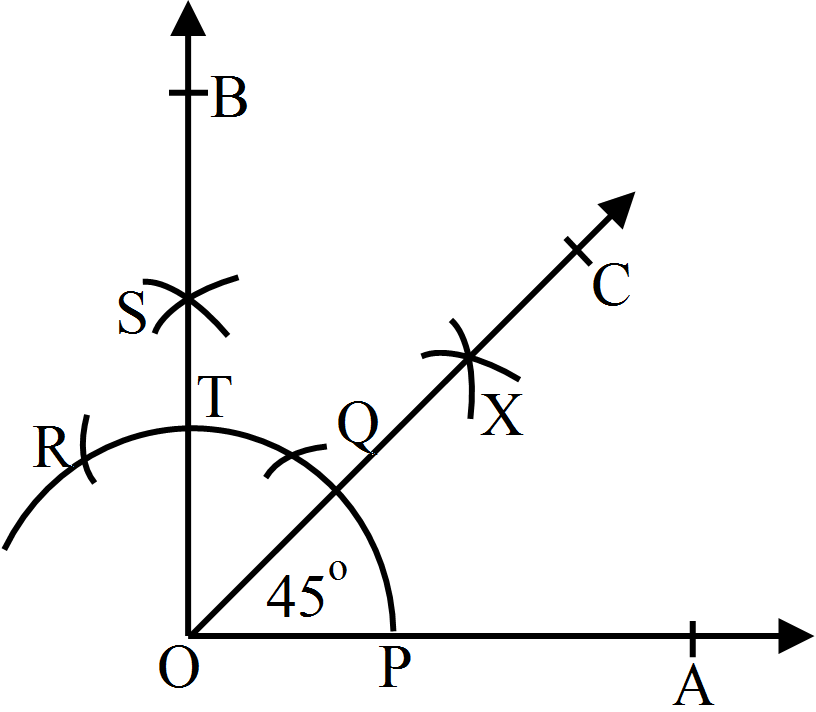
AnswerTo construct an angle of $45^\circ ,$ construct an angle of $90^\circ $ and bisect it.
Construct the angle $\angle\text{AOB}=90^{\circ},$ where rays $OA$ and $OB$ intersect the arc at points $P$ and $T$ as shown in figure.
With $P$ and $T$ as centres and radius more than half of $PT, $ draw two arcs, which cut each other at $X$
Draw $OX$ and extend it to $C$ to form the ray $OC.$
$\angle\text{AOC}$ is the required angle of $45^\circ .$
View full question & answer→Question 655 Marks
Draw an angle and label it as $\angle\text{BAC}.$ Construct another angle, equal to $\angle\text{BAC}.$
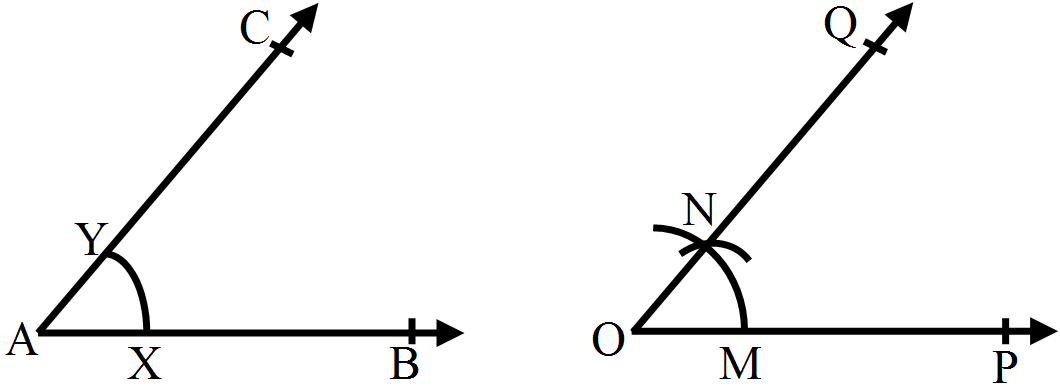
AnswerDraw an angle $\angle\text{BAC}$ also draw a ray $OP.$ With a suitable radius and $A$ as center, draw an arc intersecting $AB$ and $AC$ at $X$ and $Y,$ respectively. With the same radius and $O$ as center, draw an arc to intersect the arc $OP$ at $M.$ Measure $XY$ using the compass. With $M$ as centre and radius equal to $XY,$ draw an arc to intersect the arc drawn from $O$ at $N.$ Join $0$ and $N$ and extend it to $Q.$ $\angle\text{POQ}$ is the required angle.
View full question & answer→Question 665 Marks
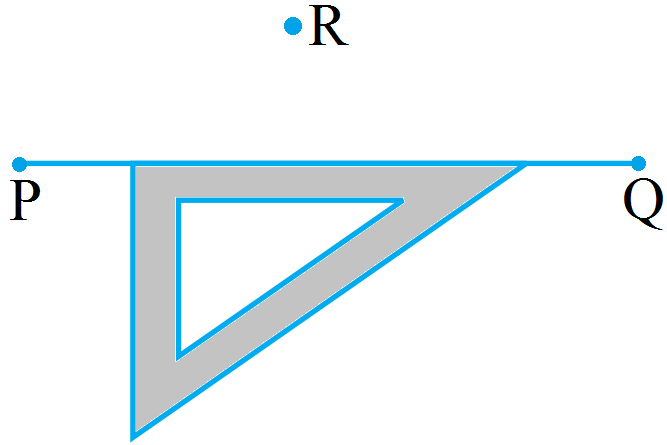
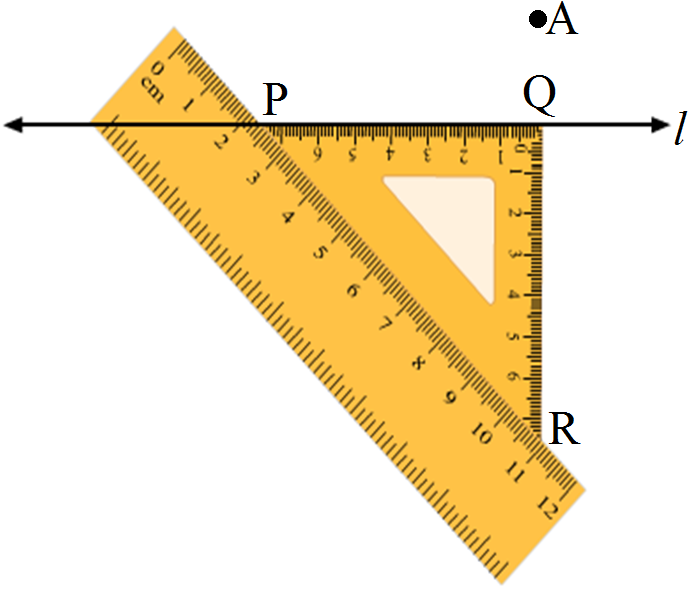
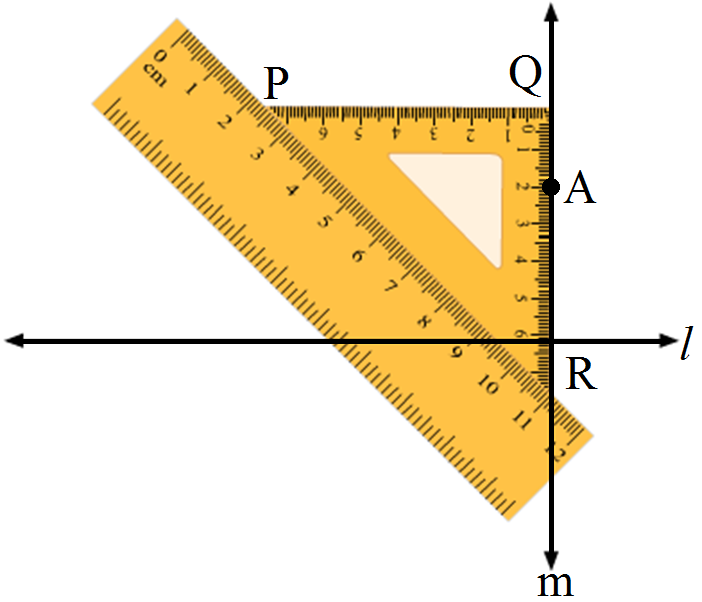
Draw a line $l.$ Take a point $A,$ not lying on $l$. Draw a line m such that $\text{m}\perp\text{l}$ and passing through A. Using ruler and a set-square.
AnswerWe draw a line $L$ and take a point $A$ outside it. Place a set square $PQR$ such that its one arm $PQ$ of the right angle is along the line $L.$ Without disturbing the position of set-square, place a ruler along its edge $PR.$ Now, without disturbing the position of the ruler, slide the set-square along the ruler until its arm $QR$ reaches point $A.$ Without disturbing the position of the set-square, draw a line $m.$ Line m is the required line perpendicular to line $L.$
View full question & answer→Question 675 Marks
Draw two acute angles and one obtuse angle without using a protractor. Estimate the measures of the angles. Measure them with the help of a protractor and see how much accurate is your estimate.
AnswerAngles are measured in degrees. The symbol for degrees is a little circle.The $\text{FULL CIRCLE}$ is $360^\circ (360$ degrees$).$
A half circle or a straight angle is $180^\circ .$
A quarter circle or a right angle is $90^\circ .$
Place the midpoint of the protractor on the VERTEX of the angle.
Line up one side of the angle with the zero line of the protractor $($where you see the number $0).$
Read the degrees where the other side crosses the number scale.
$i.\ $Measure the angles.
$ii.\ $Measure the angles. Label each angle as acute or obtuse.
$iii.\ $Tasha measured an acute angle, and got $146^\circ .$ The teacher pointed out that she had read the wrong set of numbers on the protractor.
What is the correct angle measure for the angle she measured?
Measure the following angles using your own protractor. If you need to, make the sides of the angles longer with a ruler.
$iv.\ $Draw four dots, and connect them so that you get a quadrilateral.
Measure all the angles of your quadrilateral. Then add the angle measures.
Did you get $360$ degrees, or close$?$ View full question & answer→Question 685 Marks
Draw a right angle and construct its bisector.
Answer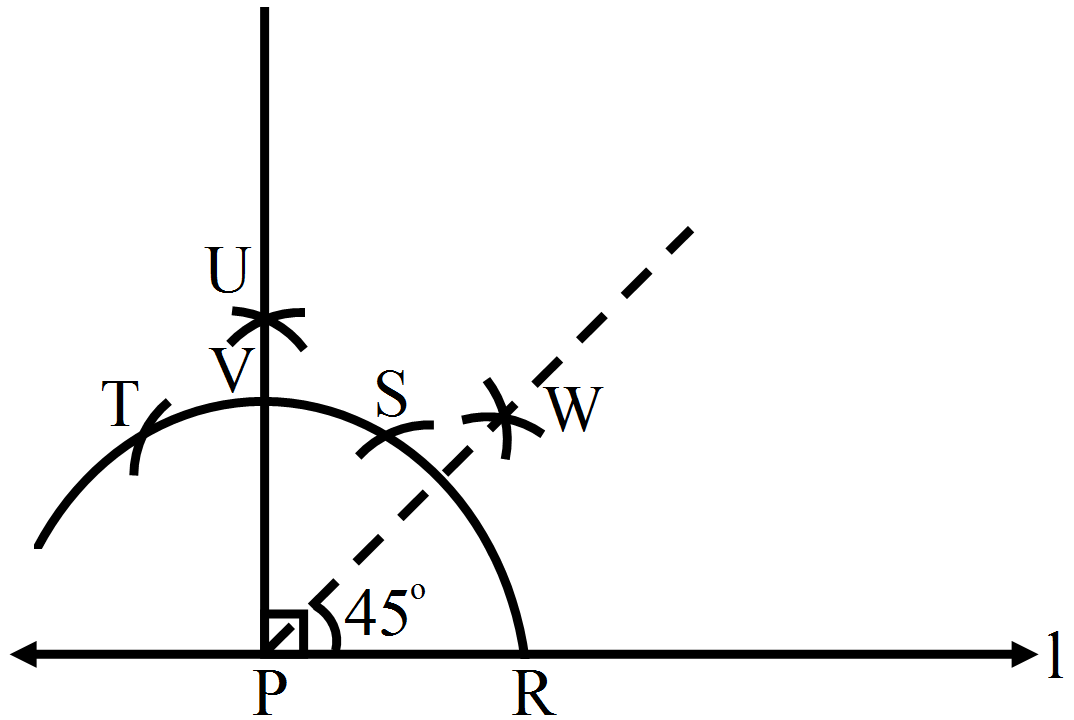
The below given steps will be followed to construct a right angle and its bisector.
$1.$Draw a line $l $ and mark a point $P$ on it. Draw an arc of convenient radius, while taking point $P$ as centre. Let it intersect line $l$ at $R.$
$2.$Taking $ R$ as centre and with the same radius as before, draw an arc intersecting the previously drawn arc at $S.$
$3.$Taking $S$ as centre and with the same radius as before, draw an arc intersecting the arc at $T ($see figure$).$
$4.$Taking $S$ and $T$ as centres, draw arcs of same radius to intersect each other at $U.$
$5.$Join $PU$. $PU$ is the required ray making $90^\circ $ with line $l.$ Let it intersect the major arc at point $V.$
$6.$Now, taking $R$ and $V$ as centres, draw arcs with radius more than $\frac{1}{2}RV$ to intersect each other at $W.$ Join $PW.$
$PW$ is the required bisector of this right angle. View full question & answer→Question 695 Marks
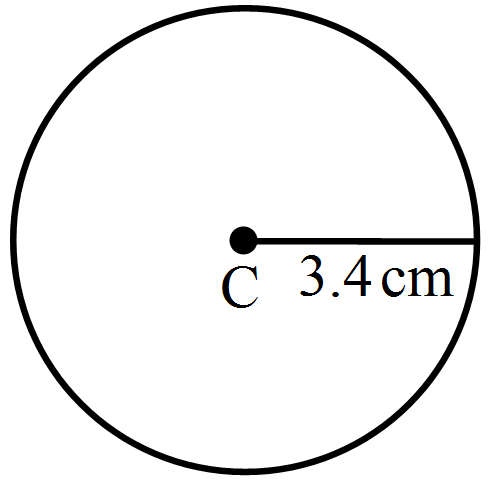
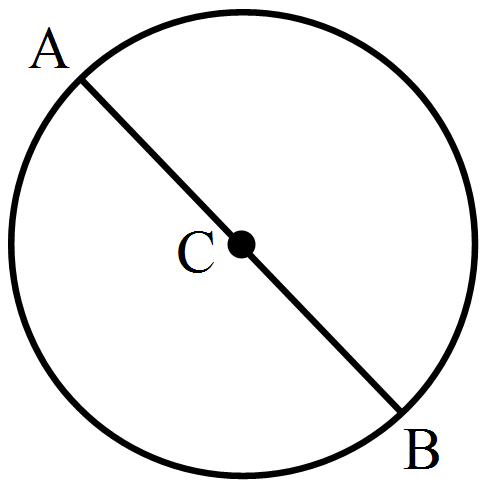
Draw a circle with centre $C$ and radius $3.4\ cm.$ Draw any chord $\overline{\text{AB}}$. Construct the perpendicular bisector of $\overline{\text{AB}}$ and examine if it passes through $C. $ if $\overline{\text{AB}}$ happens to be a diameter.
View full question & answer→Question 705 Marks
Using protractor, draw a right angle. Bisect it to get an angle of measure $45^\circ .$
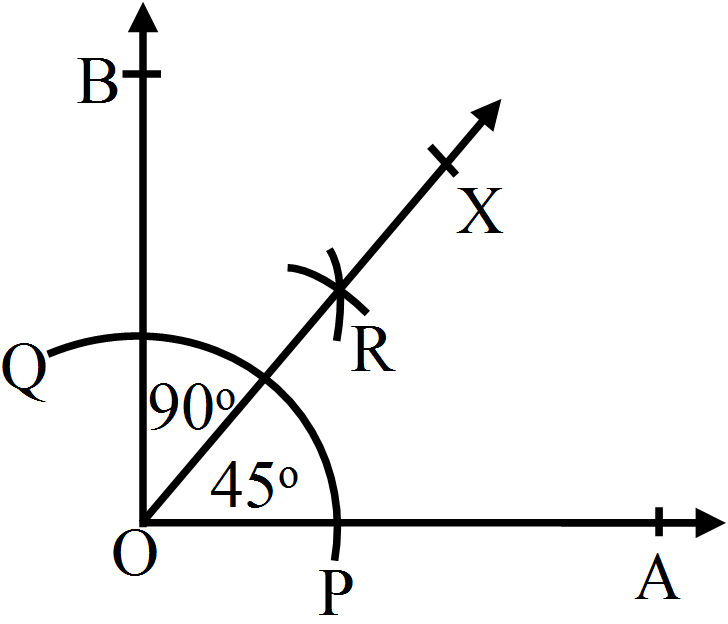
AnswerWe know that a right angle is of $90^\circ .$ Draw a ray $OA.$ With the help of a protractor, draw an $\angle\text{AOB}$ of $90^\circ .$ With centre at $O$ and a convenient radius, draw an arc cutting sides $OA$ and $OB$ at $P$ and $Q,$ respectively. With centre at $P$ and radius more than half of $PQ,$ draw an arc. With the same radius and centre at $Q,$ draw another arc intersecting the previous arc at $R.$ Join $O$ and $R$ and extend it to $X.$
$\angle\text{AOX}$ is the required angle of $45^\circ .$
$\angle\text{AOB}=90^{\circ}$
$\angle\text{AOX}=45^{\circ}$
View full question & answer→Question 715 Marks
Draw an angle of $50^\circ $ with the help of protractor. Draw a ray bisecting this angle.
Answer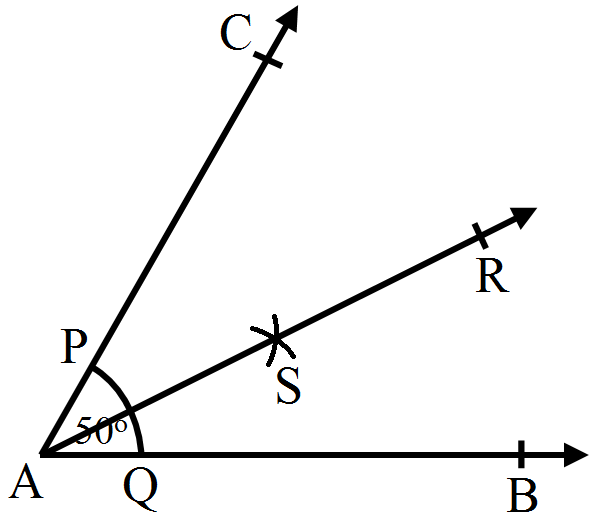
Steps for construction:
$1.$Draw $\angle\text{BAC}=50^\circ$ with the help of protractor.
$2.$With $A$ as the centre and any convenient radius, draw an arc cutting $AB$ and $AC$ at $Q$ and $P,$ respectively.
$3.$With $P$ as the centre and radius more than half of $PQ$, draw an arc.
$4.$With $Q$ as the centre and the same radius as before, draw another arc cutting the previously drawn arc at a point $S.$
$5.$Draw $SA$ and produce it to point $R.$
Then, ray $AR$ bisects $\angle\text{BAC}.$ View full question & answer→Question 725 Marks
Draw a line segment $PQ = 6.2\ cm$. Draw the perpendicular bisector of $PQ.$
Answer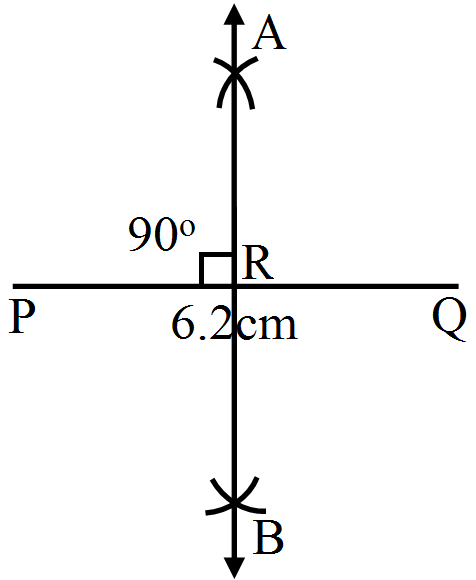
Steps for construction:
$1.$Draw a line segment $PQ,$ which is equal $6.2\ cm.$
$2.$With $P$ as the centre and radius more than half of $PQ,$ draw arcs, one on each side of $PQ.$
$3.$With $Q$ as the centre and the same radius as before, draw arcs cutting the perviously drawn arcs at $A$ and $B,$ respectively.
$4.$Draw $AB,$ meeting $PQ$ at $R.$ View full question & answer→Question 735 Marks
Draw a line segment $AB = 5.6\ cm.$ Draw the right bisector of $AB.$
Answer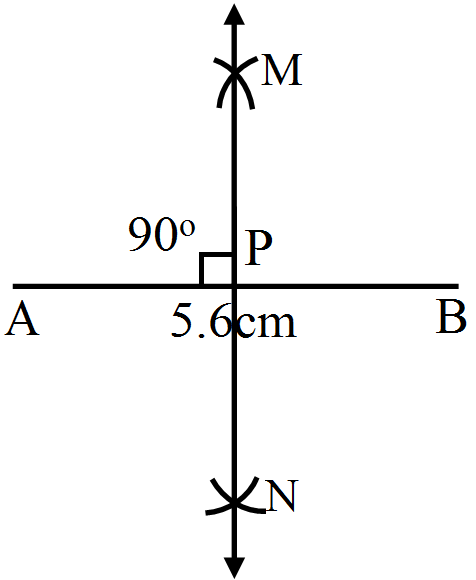
Steps for construction:
$1.$Draw a line segment $AB,$ which is equal to $5.6\ cm.$
$2.$With $A$ as the centre and radius more than half of $AB,$ draw arcs, one on each side of $AB.$
$3.$With $B$ as the centre and the same radius as before, draw arcs cutting the perviously drawn arcs at $M$ and $N,$ respectively.
$4.$Draw $MN,$ meeting $AB$ at $R.$ View full question & answer→Question 745 Marks
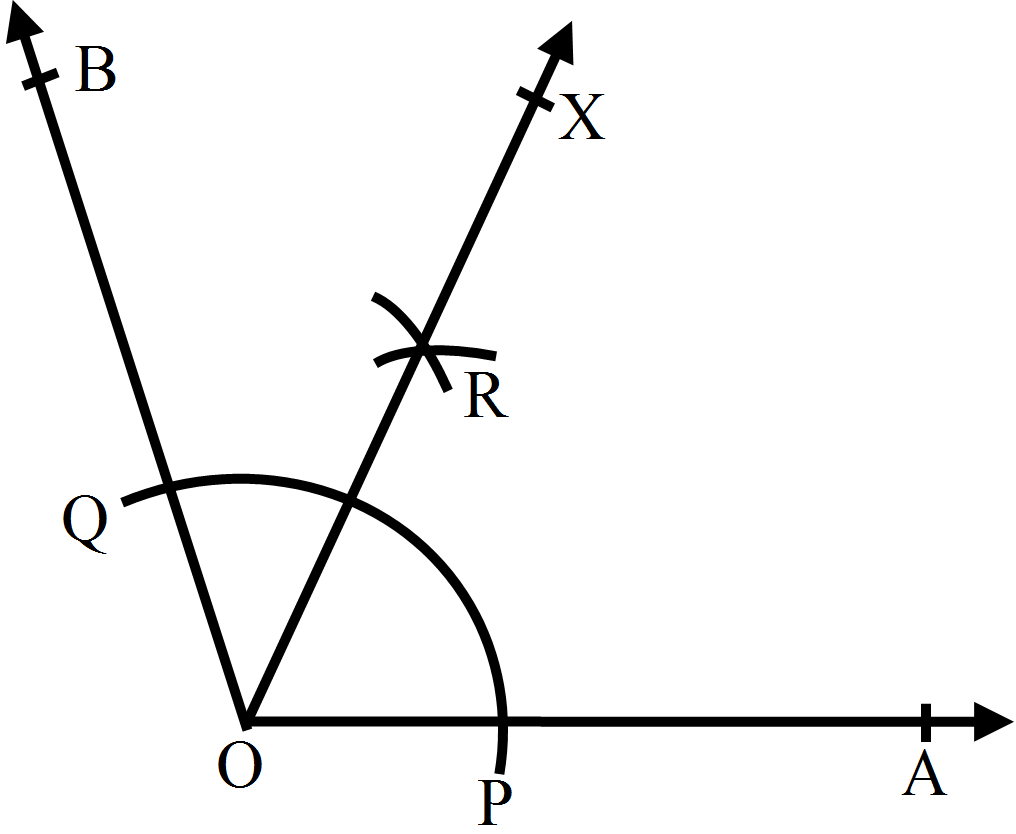
Using your protractor, draw an angle of measure $108^\circ .$ With this angle as given, draw an angle of $54^\circ .$
AnswerDraw a ray $OA.$ With the help of a protractor, construct an angle $\angle\text{AOB}$ of $108^\circ .$ Since, $\frac{108}{2}=54^{\circ}$ Therefore, $54^\circ $ is half of $108^\circ .$ To get the angle of $54^\circ ,$ we need to bisect the angle of $108^\circ .$ With centre at $O$ and a convenient radius, draw an arc cutting sides $OA$ and $OB$ at $ P$ and $Q,$ respectively. With centre at $P$ and radius more than half of $PQ,$ draw an arc. With the same radius and centre at $Q,$ draw another arc intersecting the previous arc at $R.$ Join $O$ and $R$ and extend it to $X. $
$\angle\text{AOX}$ is the required angle of $54^\circ .$
View full question & answer→Question 755 Marks
Draw a line segment $AB = 5.6\ cm.$ Draw the perpendicular bisector of $AB.$
Answer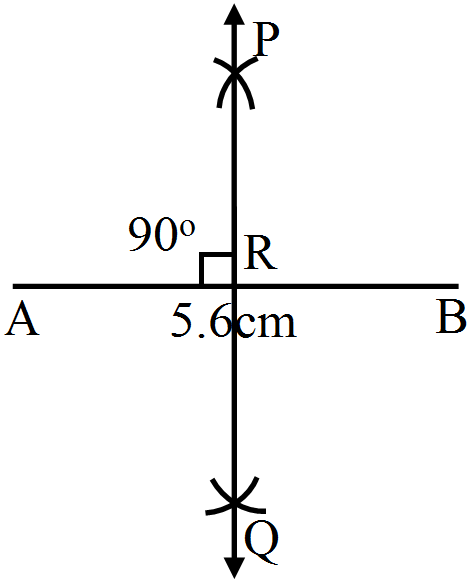
Steps for construction:
$1.$Draw a line segment $AB = 5.6\ cm.$
$2.$With $A$ as the centre and radius more than half of $AB,$ draw arcs, one on each side of $AB.$
$3.$With $B$ as the centre and the same radius as before, draw arcs cutting the perviously drawn arcs at $P$ and $Q,$ respectively.
$4.$Draw $PQ,$ meeting $AB$ at $R.$ View full question & answer→Question 765 Marks
Given some line segment $\overline{\text{AB}}$, whose length you do not know, construct $\overline{\text{PQ}}$ such that the length of $\overline{\text{PQ}}$ is twice that of $\overline{\text{AB}}$.
View full question & answer→Question 775 Marks
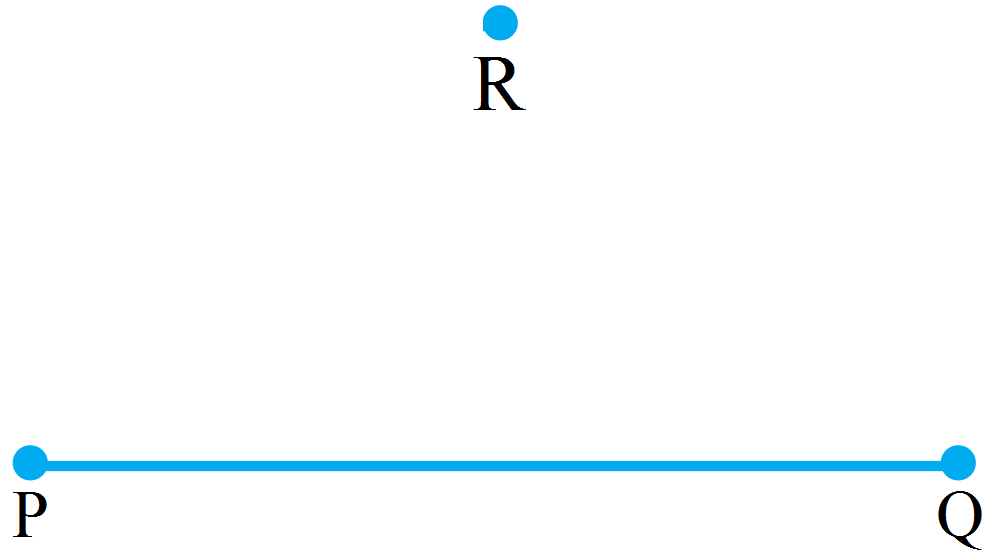
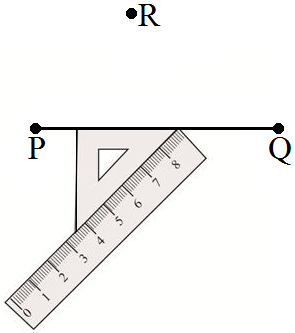
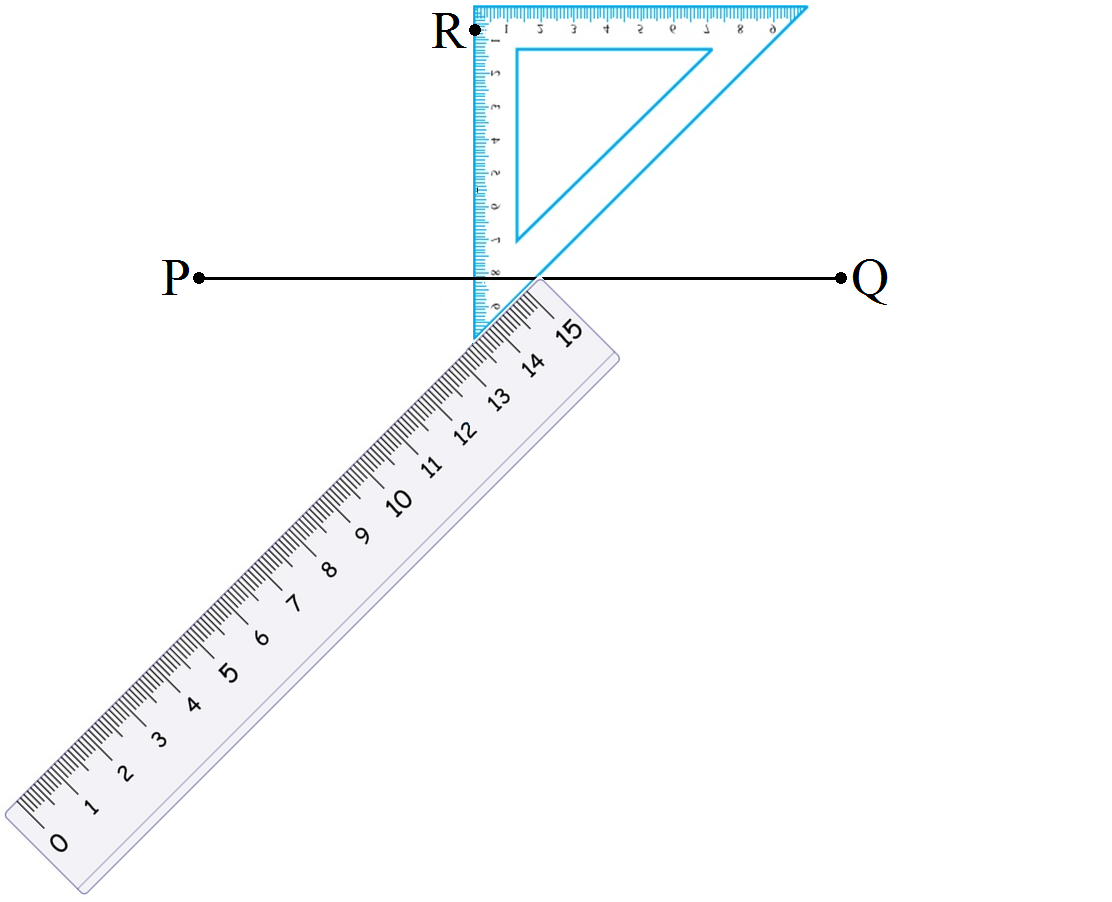
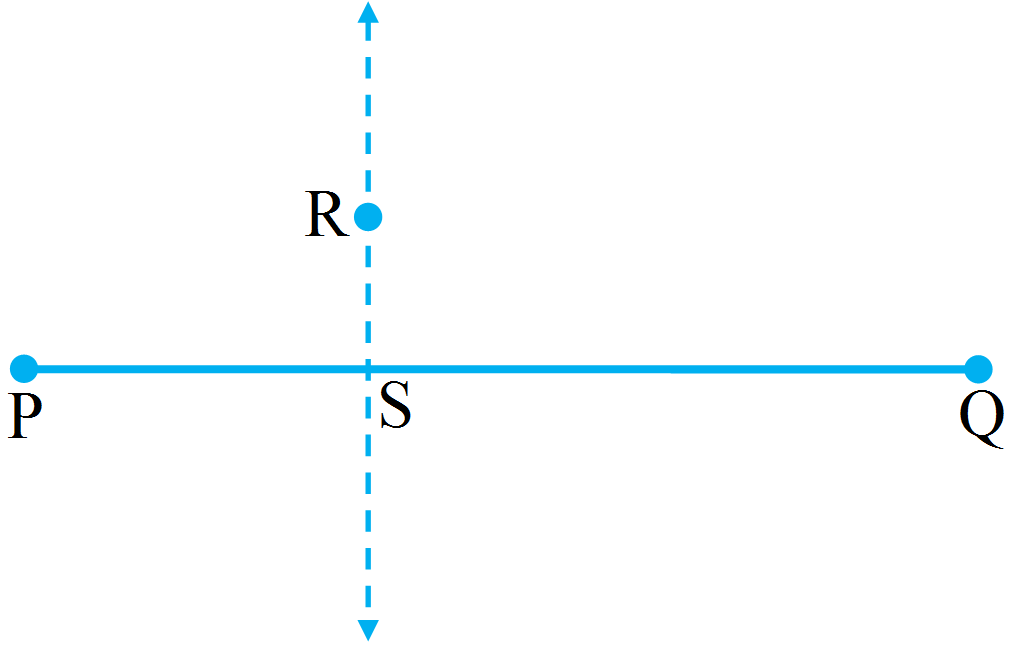
Draw any line segment $\overline{\text{PQ}}$. Take any point $R$ not on it. Through $R,$ draw a perpendicular to $\overline{\text{PQ}}. ($use ruler and set$-$square$)$
View full question & answer→Question 785 Marks
Draw an angle of $60^\circ ,$ using a pair of compasses. Bisect it to make an angle of $30^\circ .$
Answer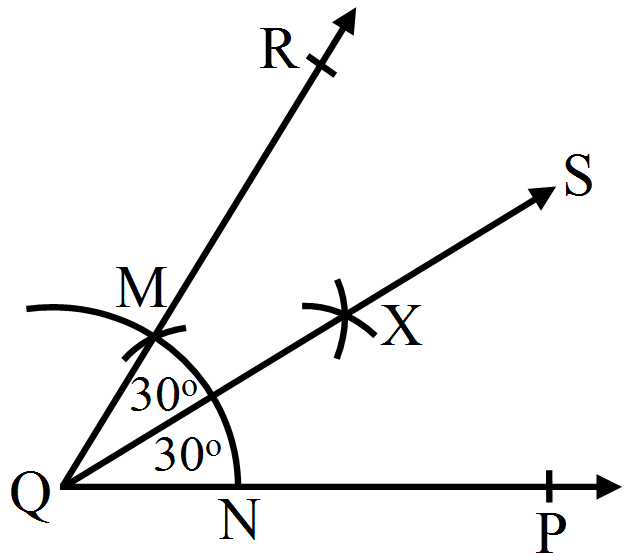
$1.$Draw a ray $QP.$
$2.$Wth $Q$ as the centre and any convenient radius,draw an arc cutting $QP$ at $N$.
$3.$With $N$ as the centre and radius same as before, draw another arc to cut the previous arc at $M.$
$4.$Draw $QM$ and produce it to $R.$
$\angle\text{PQR}$ is an angle of $60^\circ $. $\angle\text{PQR}$ is an angle of $60°$.
$5.$With $M$ as the centre and radius more than half of $MN$, draw an arc.
$6.$With $N$ as the centre and radius same as in step $(5),$ draw another arc, cutting the previously drawn arc at point $X.$
$7.$Draw $QX$ and produce it to point $S.$
Ray $QS$ is the bisector of $\angle\text{PQR}.$ View full question & answer→Question 795 Marks
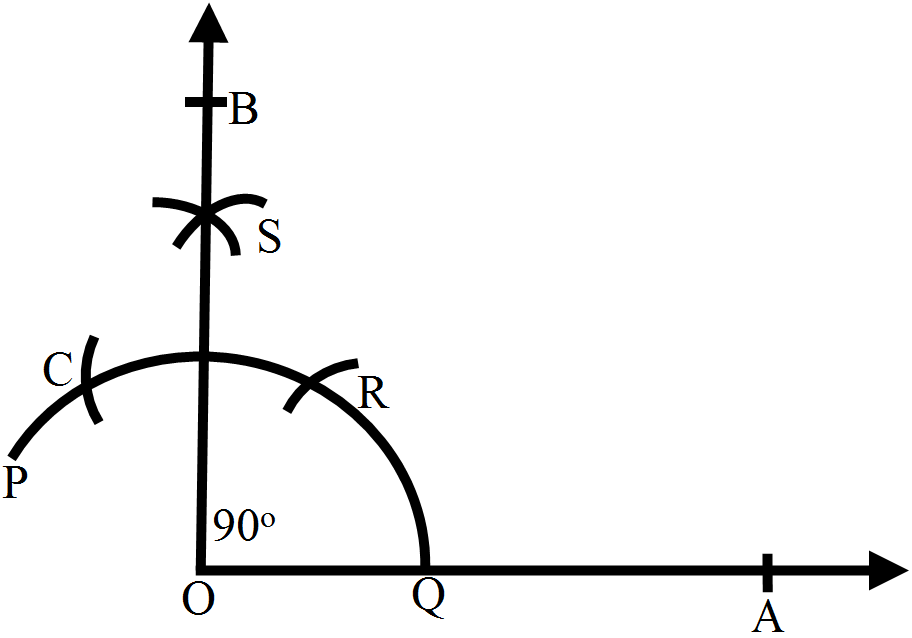
Using ruler and compasses only, draw a right angle.
AnswerDraw a ray $OA.$ With a convenient radius and centre at $O,$ draw an arc $PQ$ with the help of a compass intersecting the ray $OA$ at $P.$ With the same radius and centre at $P,$ draw another arc intersecting the arc $PQ$ at $R.$ With the same radius and centre at $R,$ draw an arc cutting the arc $PQ$ at $C,$ opposite $P.$ Taking $C$ and $R$ as the centre, draw two arcs of radius more than half of $CR$ that intersect each other at $S.$ Join $O$ and $S$ and extend the line to $B.$
$\angle\text{AOB}$ is the required angle of $90^\circ .$
View full question & answer→Question 805 Marks
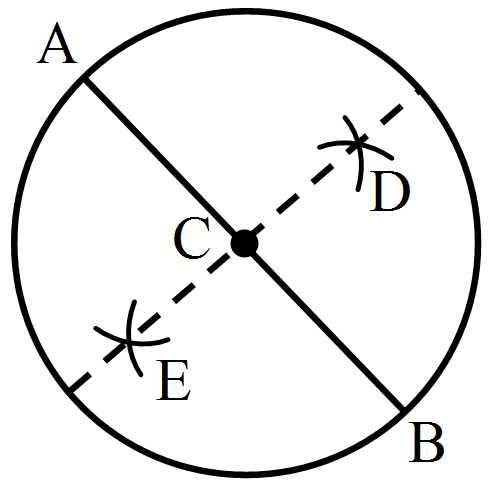
Draw a circle and any two of its diameters. If you join the ends of these diameters, what is the figure obtained? What figure is obtained if the diameters are perpendicular to each other? How do you check your answer?
AnswerWe may draw a circle of any convenient radius, also having its centre as $O.$ Let $AB$ and $CD$ are two diameters of this circle. When we join the ends of these diameters, a quadrilateral $ABCD$ is formed.
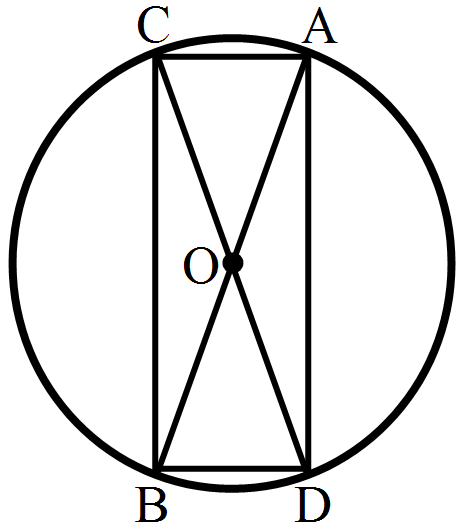
As we know that the diameters of a circle are equal in length, hence quadrilateral so formed will be having its diagonals of equal length. Also, $OA = OB = OC = OD =$ radius $r$ and if a quadrilateral has its diagonals of same length and bisecting each other. It will be a rectangle. Let $DE$ and $FG$ be two diameters of this circle such that these are perpendicular to each other. Now we may find that a quadrilateral is formed by joining the ends of these diameters. 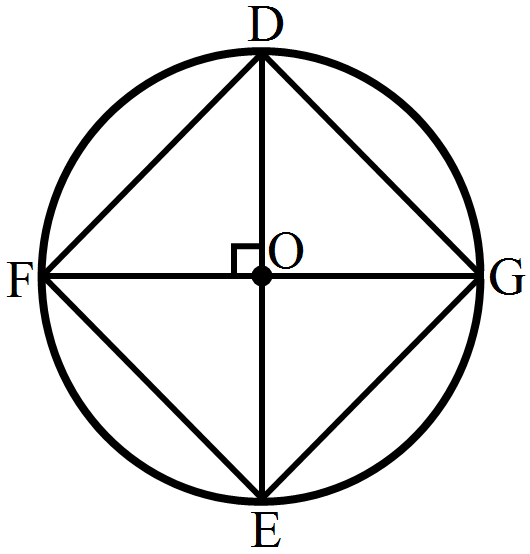
We may find that $OD = OE = OF = OG =$ radius r. In this quadrilateral $DFEG,$ diagonals are equal and perpendicular to each other. Also these are bisecting each other, so it ill be a square. We may measure the length of sides of quadrilaterals so formed to check our answer. View full question & answer→Question 815 Marks
Draw an angle of measure $153^\circ $ and divide it into four equal parts.
Answer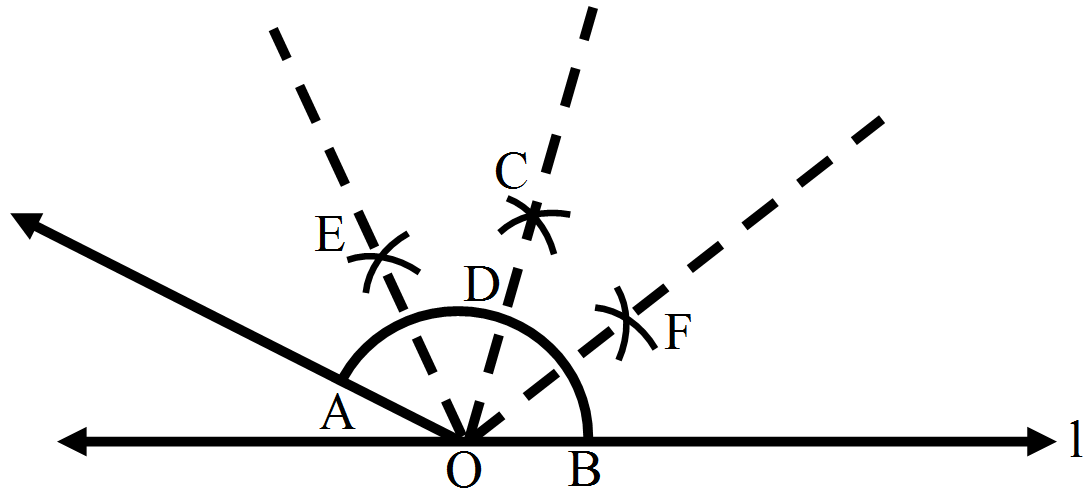
The below given steps will be followed to construct an angle of $153^\circ $ measure and its bisector.
$1.$Draw a line $l$ and mark a point $O$ on it. Place the centre of the protractor at point $O$ and the zero edge along line $l.$
$2.$Mark a point $A$ at $153^\circ .$ Join $OA.$
$OA$ is the required ray making $153^\circ $ with line $l.$
$3.$Draw an arc of convenient radius, while taking point $O$ as centre. Let it intersect both rays of angle $153^\circ $ at point $A$ and $B.$
$4.$Taking $A$ and $B$ as centres, draw arcs of radius more than $\frac{1}{2}$$AB$ in the interior of angle of $153^\circ .$ Let those intersect each other at $C.$ Join $OC.$
$5.$Let $OC$ intersect the major arc at point $D.$ Now, with radius more than $\frac{1}{2}$$AD,$ draw arcs while taking $A$ and $D$ as centres, and $D$ and $B$ as centres. Let these be intersecting each other at point $E$ and $F$ respectively. Join $OE, OF.$
$OF, OC, OE$ are the rays dividing $153^\circ $ angle in $4$ equal parts. View full question & answer→Question 825 Marks
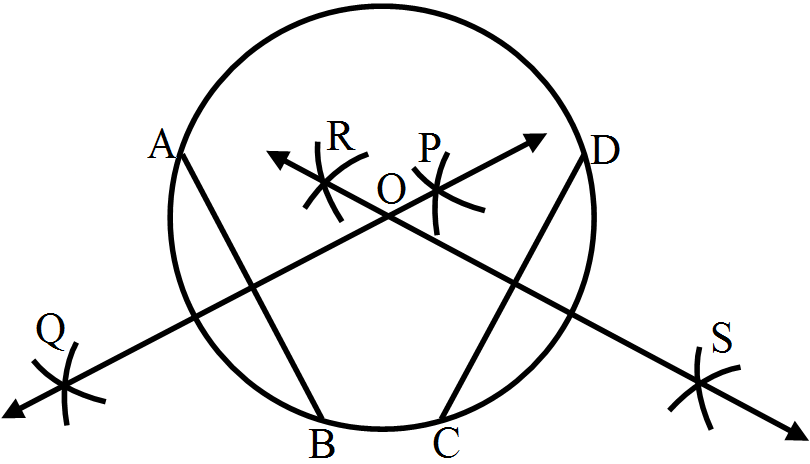
Draw a circle with centre at point $O.$ Draw its two chords $AB$ and $CD$ such that $AB$ is not parallel to $CD$. Draw the perpendicular bisectors of $AB$ and $CD.$ At what point do they intersect$?$
AnswerDraw a circle with centre at $0.$ We draw two chords $AB$ and $CD$ as shown in the figure.
$i.\ $With $A$ as centre and radius more than half of $AB,$ draw arcs on both sides of $AB$.
$ii.\ $With the same radius and $B$ as centre, draw arcs cutting the arcs of step $(i)$ at $P$ and $Q.$
$iii.\ $Join $P$ and $Q.$
$iv.\ $With $C$ as centre and radius more than half of $CD,$ draw arcs on both sides of $CD.$
$v.\ $With the same radius and $D$ as centre, draw arcs cutting the arcs of step $(iv)$ at $R$ and $S.$
$vi.$Join $R$ and $S.$
We draw the line segments of perpendicular bisector of $AB$ and $CD.$ We see that the perpendicular bisector of $AB$ and $CD$ meet at $0,$ the centre of the circle.
View full question & answer→Question 835 Marks
Using a pair of compasses construct the following angles: $60^\circ $
Answer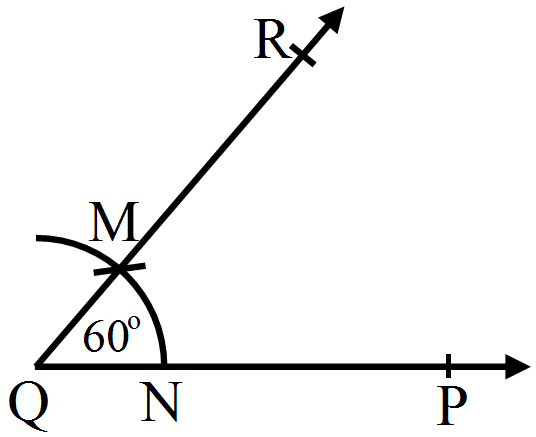
Steps of construction:
$1.$Draw a ray $QP.$
$2.$With $Q$ as the centre and any convenient radius, draw an arc cutting $QP$ at $N.$
$3.$With $N$ as the centre and the same radius as before, draw another arc to cut the previous arc at $M.$
$4.$Draw $QM$ and produce it to $R.$
$\angle\text{PQR}$ is the required angle of $60^\circ .$ View full question & answer→Question 845 Marks
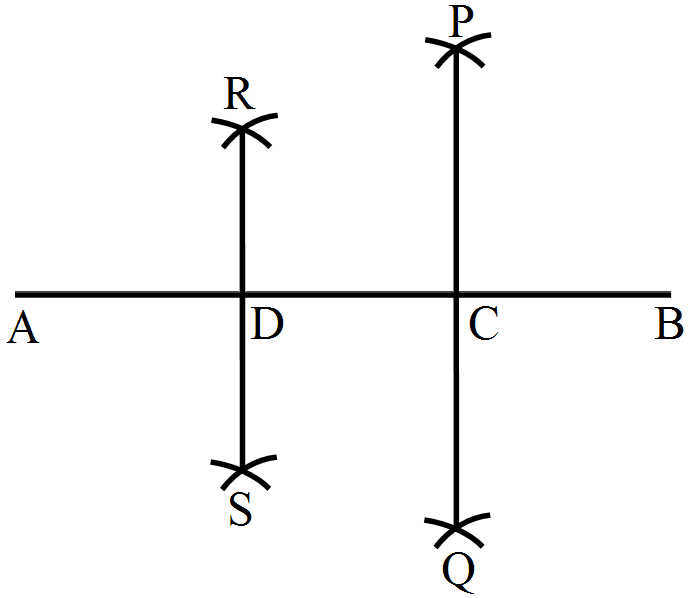
Draw a line segment of length $10\ cm$ and bisect it. Further bisect one of the equal parts and measure its length.
AnswerDraw a line segment $AB$ of length $10\ cm$ and bisect it.
$i.\ $With $A$ as centre and radius more than half of $AB,$ draw arcs on both sides of $AB.$
$ii.\ $With the same radius and $B$ as centre, draw arcs cutting the arcs of step $(i)$ at $P$ and $Q,$ respectively.
$iii.\ $Join $ P$ and $Q$. Line $PQ$ intersects line $AB$ at $C.$
$iv.\ $With $A$ as centre and radius more than half of $AC,$ draw arcs on both sides of $AB.$
$v.\ $With the same radius and $C$ as centre, draw arcs cutting the arcs of step $(iv)$ at R and $S, $ respectively.
$vi.\ $ Join $R$ and $S.$
Line $RS$ intersects $AC $ at $D$. If we measure $AD$ with the ruler, we have $AD = 2.5\ cm$
View full question & answer→Question 855 Marks
Draw a line segment $AB$ and bisect it. Bisect one of the equal parts to obtain a line segment of length $\frac{1}{2}(\text{AB}).$
AnswerDraw a line segment $AB.$
$i.\ $With $A$ as centre and radius more than half of $AB,$ draw arcs on both sides of $AB.$
$ii.\ $With the same radius and $B$ as centre, draw arcs cutting the arcs drawn in step $(i)$ at $P$ and $Q.$
$iii.\ $Join $P $ and $Q.$
$PQ$ intersects $AB$ at $C.$
$iv.\ $With $A$ as centre and radius more than half of $AC,$ draw arcs on both sides of $AC.$
$v.\ $ With the same radius and $C$ as centre, draw arcs cutting the arcs drawn in step $(iv)$ at $R$ and $S.$
$vi.\ $Join $R$ and $S. RS$ intersects $AB$ at $D.$
Now, $AC$ and $CB$ are equal. Both are $\frac{1}{2}(\text{AB}).$ Again, divide $AC$ at $D. $ So, $AD$ and $AC$ are of same length, i.e., $\frac{1}{4}\text{(AB)}.$
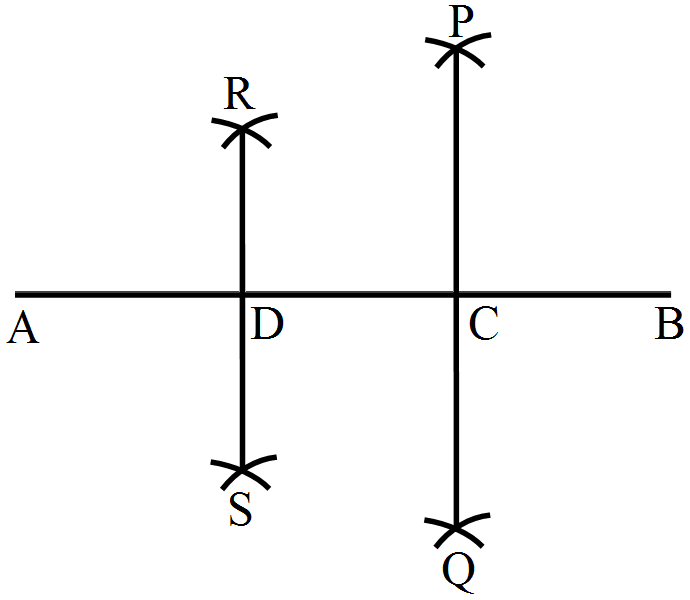
View full question & answer→Question 865 Marks
Construct $\angle\text{AOB}=85^\circ$ with the help of a protractor. Draw a ray $OX$ bisecting $\angle\text{AOB}.$
Answer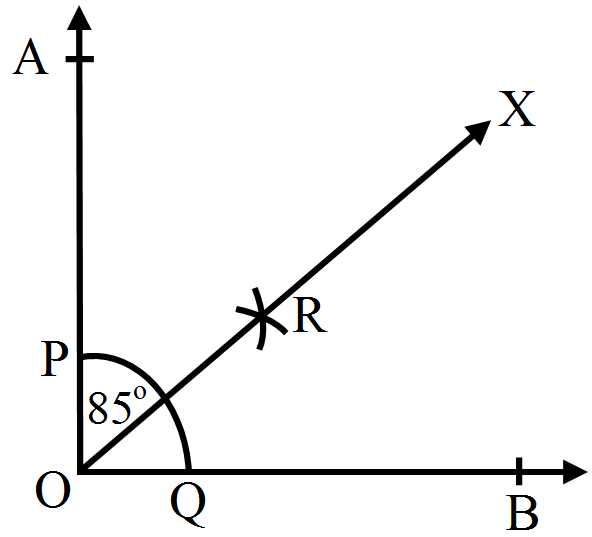
Steps for construction:
$1.$Draw $\angle\text{AOB}=85^\circ$ with the help of a protractor.
$2.$With $O$ as the centre and any convenient radius, draw an arc cutting $OA$ and $OB$ at $P $ and $Q, $ respectively.
$3.$With $P$ as the centre and radius more than half of $PQ,$ draw an arc.
$4.$With $Q$ as the centre and the same radius as before, draw another arc cutting the previously drawn arc at a point $R.$
$5.$Draw $RO$ and produce it to point $X.$
Then, ray $OX$ bisects $\angle\text{AOB}.$ View full question & answer→Question 875 Marks
Draw an angle of $70^\circ .$ Make a copy of it using only a straight edge and compasses.
Answer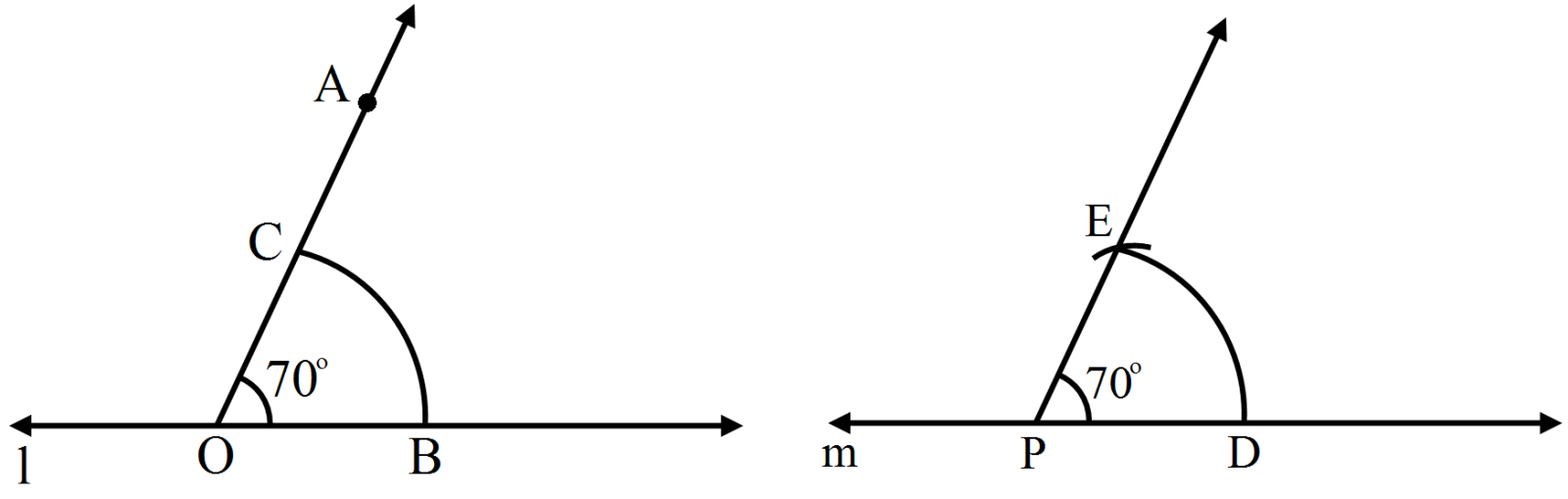
The below given steps will be followed to construct an angle of $70^\circ $ measure and its copy.
$1.$Draw a line $l$ and mark a point $O$ on it. Place the centre of the protractor at point $O$ and the zero edge along line $l.$
$2.$Mark a point $A$ at $70^\circ $. Join $OA. OA$ is the ray making $70^\circ $ with line l. Draw an arc of convenient radius in the interior of $70^\circ $ angle, while taking point $O$ as centre. Let it intersect both rays of angle $70^\circ $ at point $B$ and $C.$
$3.$Draw a line m and mark a point $P$ on it. With the same radius as used before, again draw an arc while taking point $P$ as centre. Let it cut the line m at point $D.$
$4.$Now, adjust the compasses up to the length of $BC.$ With this radius, draw an arc while taking $D$ as centre, which will intersect the previously drawn arc at point $E.$
$5.$Join $PE. PE$ is the required ray which makes the same angle $($i.e. $70^\circ )$ with line m. View full question & answer→Question 885 Marks
Draw a line $l$ and a point $X$ on it. Through $X,$ draw a line segment $\overline{\text{XY}}$ perpendicular to $l.$ Now draw a perpendicular to $\overline{\text{XY}}$ at $Y. ($use ruler and compasses$)$
Answer$1.$Draw a line $l$ and mark a point $X$ on it.

$2.$Taking $X$ as centre and with a convenient radius, draw an arc intersecting line l at two points $A$ and $B.$
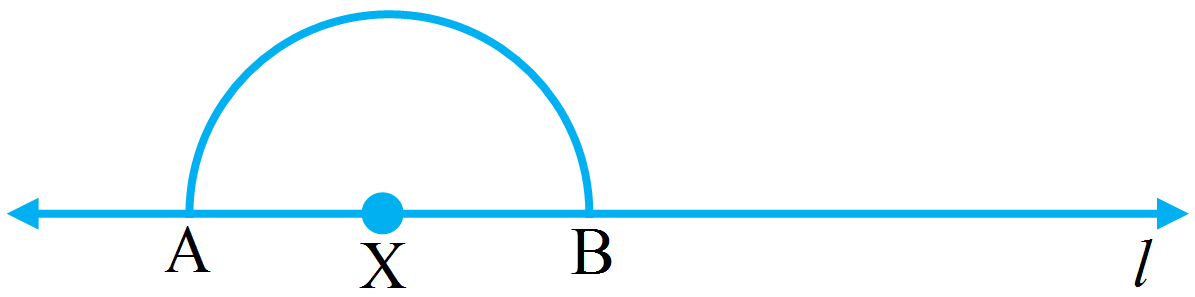
$3.$With $A$ and $B$ as centres and a radius more than $AX,$ construct two arcs intersecting each other at $Y.$
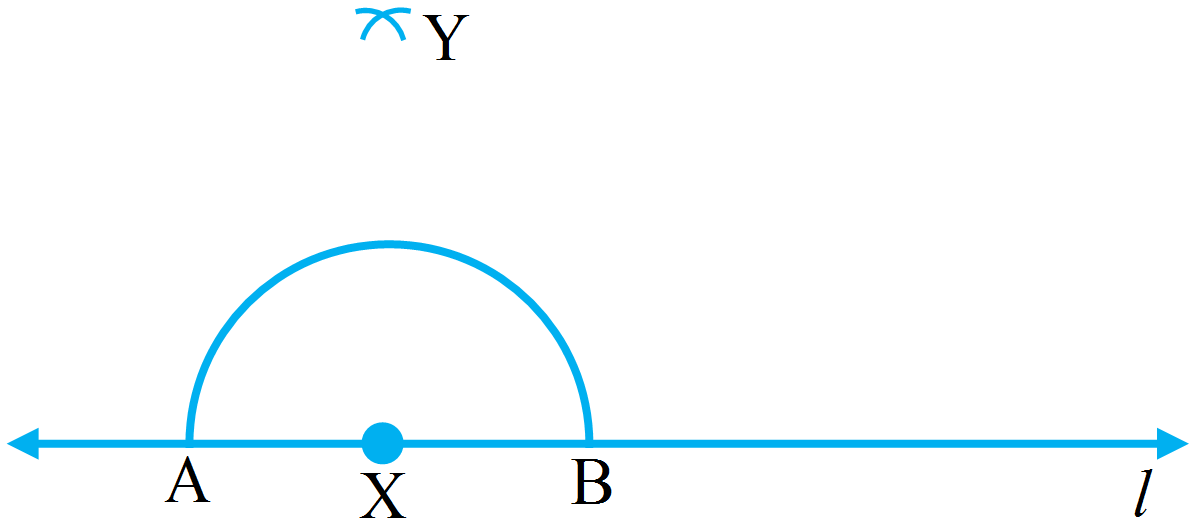
$4.$Join $XY.$ $\overline{\text{XY}}$ is perpendicular to $l.$
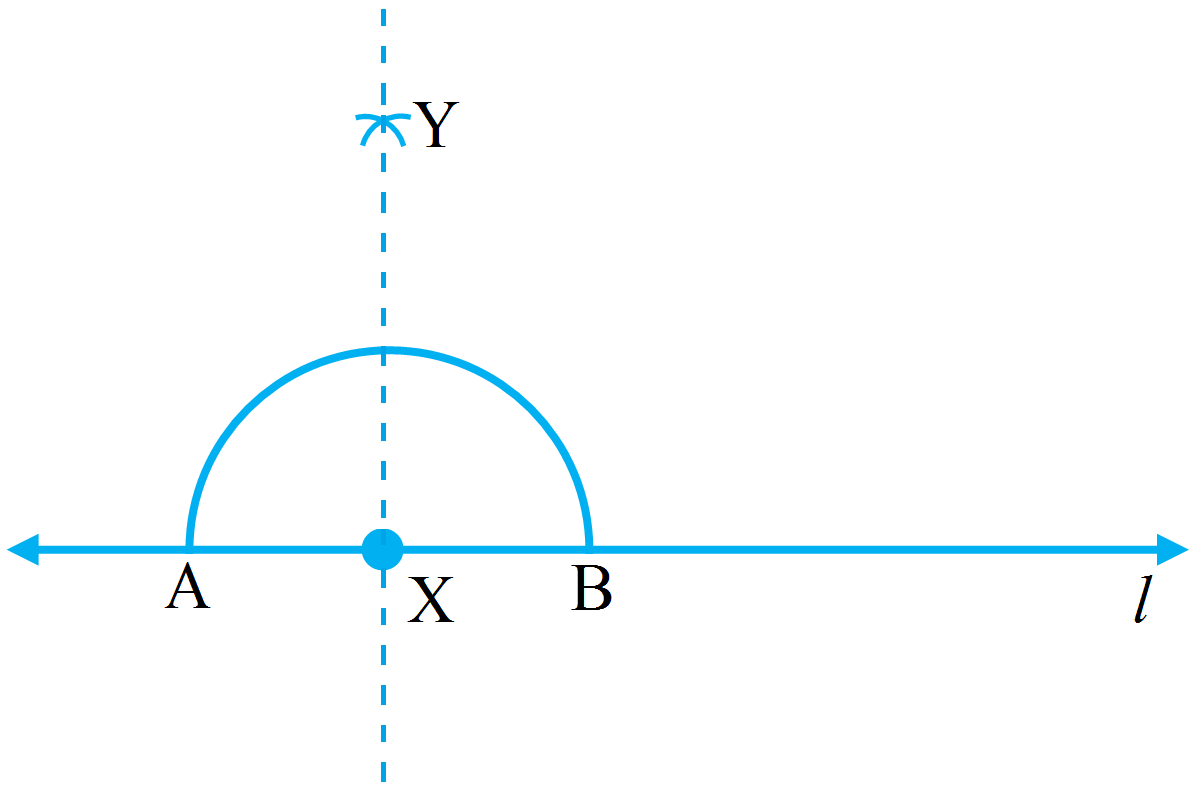
Similarly, a perpendicular to $\overline{\text{XY}}$ at the point $Y$ can be drawn. The line $\overline{\text{ZY}}$ is perpendicular to $\overline{\text{XY}}$ at $Y.$
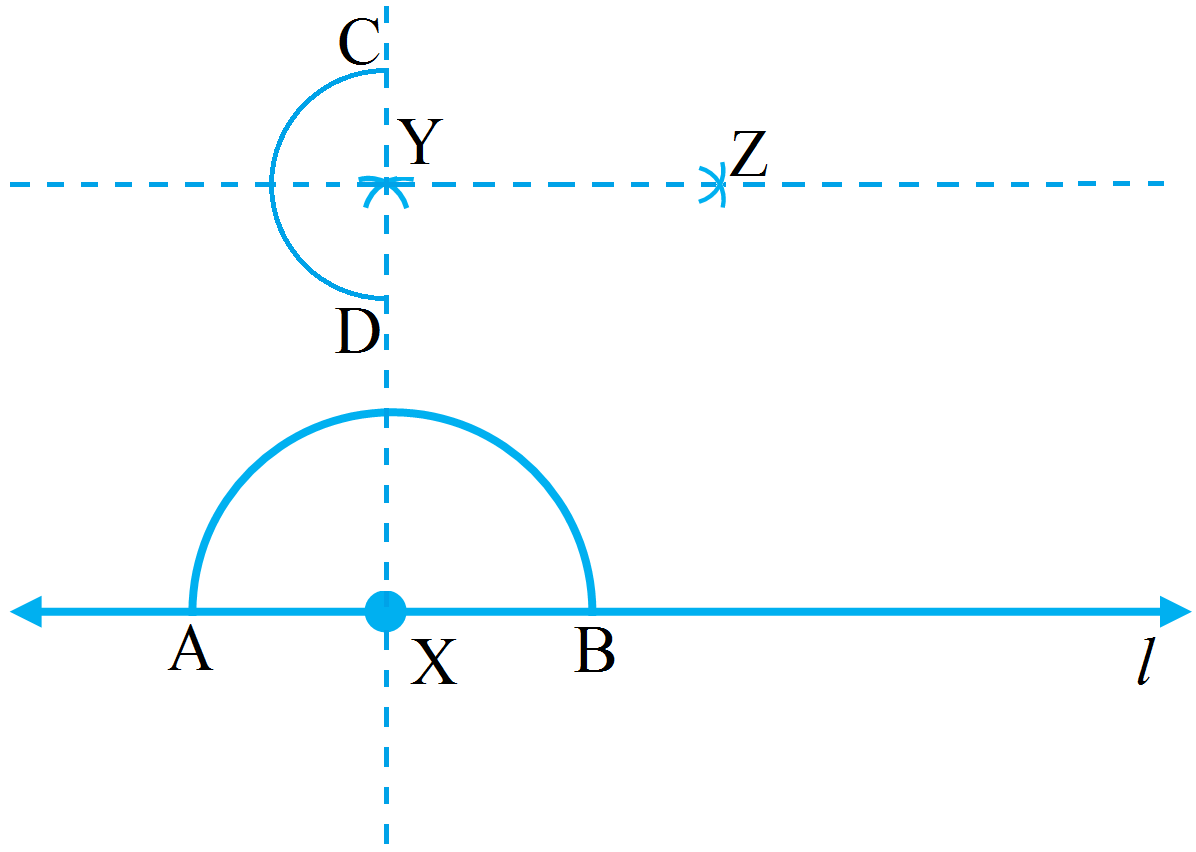
View full question & answer→Question 895 Marks
Draw an angle of $40^\circ .$ Copy its supplementary angle.
Answer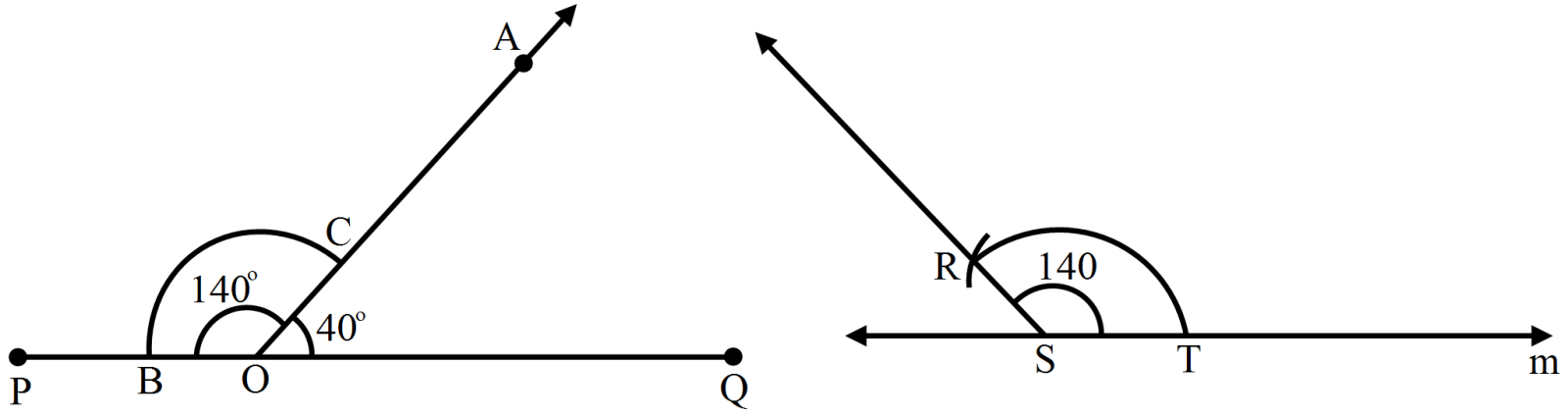
The below given steps will be followed to construct an angle of $40^\circ $ measure and the copy of its supplementary angle.
$1.$Draw a line segment $\overline{\text{PQ}}$ and mark a point $O$ on it. Place the centre of the protractor at point $O$ and the zero edge along line segment$\overline{\text{PQ}}$.
$2.$Mark a point $A $ at $40^\circ $. Join $OA. OA$ is the required ray making $40^\circ $ with $\overline{\text{PQ}}$. $Ð$
$POA$ is the supplementary angle of $40^\circ .$
$3.$Draw an arc of convenient radius in the interior of $Ð\ POA,$ while taking point $O$ as centre. Let it intersect both rays of $Ð\ POA$ at point $B$ and $C.$
$4.$Draw a line m and mark a point $S$ on it. With the same radius as used before, again draw an arc while taking point $S$ as centre. Let it cut the line m at point $T.$
$5.$Now, adjust the compasses up to the length of $BC.$ With this radius, draw an arc while taking $T$ as centre, which will intersect the previously drawn arc at point $R.$
$6.$Join $RS. RS$ is the required ray which makes the same angle with line $m,$ as the supplementary of $40^\circ $ is $140^\circ .$ View full question & answer→Question 905 Marks
Draw an angle of measure $147^\circ $ and construct its bisector.
Answer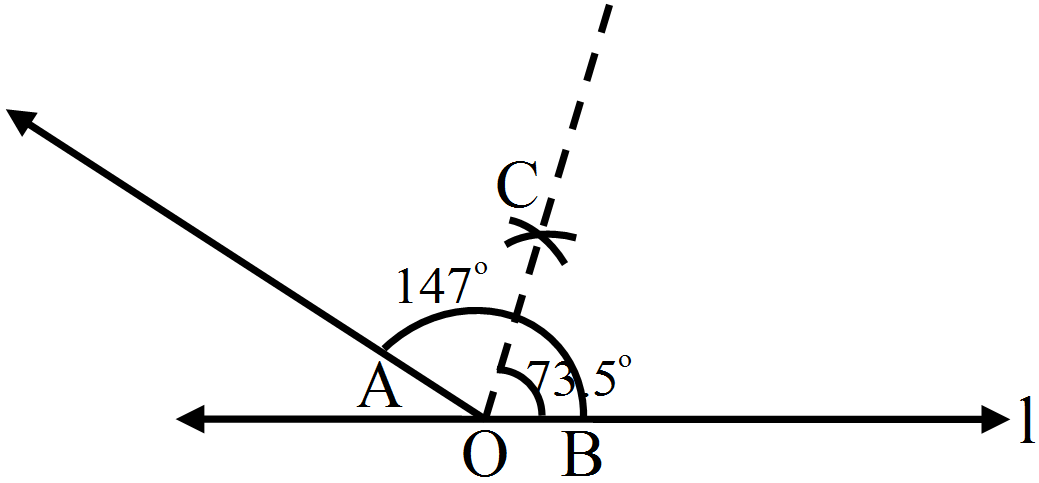
The below given steps will be followed to construct an angle of $147^\circ $ measure and its bisector.
$1.$Draw a line $l $ and mark a point $O$ on it. Place the centre of the protractor at point $O$ and the zero edge along line $l.$
$2.$Mark a point $A$ at $147^\circ .$ Join $OA. OA$ is the required ray making $147^\circ $ with line $l.$
$3.$Draw an arc of convenient radius, while taking point $O$ as centre. Let it intersect both rays of angle $147^\circ $ at point $A$ and $B.$
$4.$Taking $A$ and $B$ as centres, draw arcs of radius more than $\frac{1}{2}AB$ in the interior of angle of $147^\circ .$ Let those intersect each other at $C.$ Join $OC.$
$OC$ is the required bisector of $147^\circ $ angle. View full question & answer→Question 915 Marks
Draw a line $AB.$ Take a point $P$ outside it. Draw a line passing through $P$ and parallel to $AB.$
Answer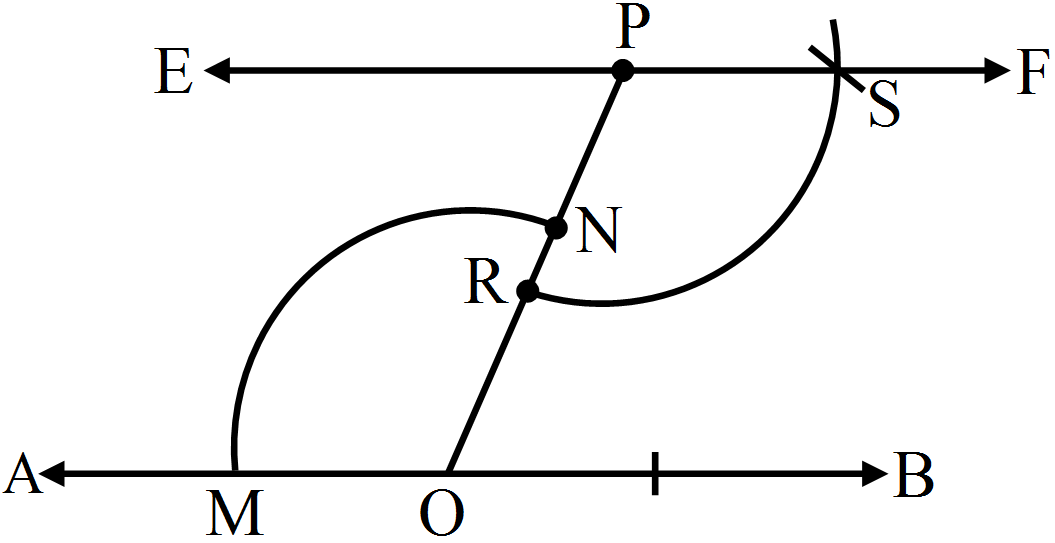
Steps for construction:
$1.$Draw a line $AB$.
$2.$Take a point $P$ outside $AB$ and another point $O$ on $AB.$
$3.$Draw $PO.$
$4.$Draw $\angle\text{FPO}$ such that $\angle\text{FPO}$ is equal to $AOP.$
$5.$Extend $FP$ to $E.$
Then, the line $EF$ passes through the point $P$ and $EF \| AB.$ View full question & answer→Question 925 Marks
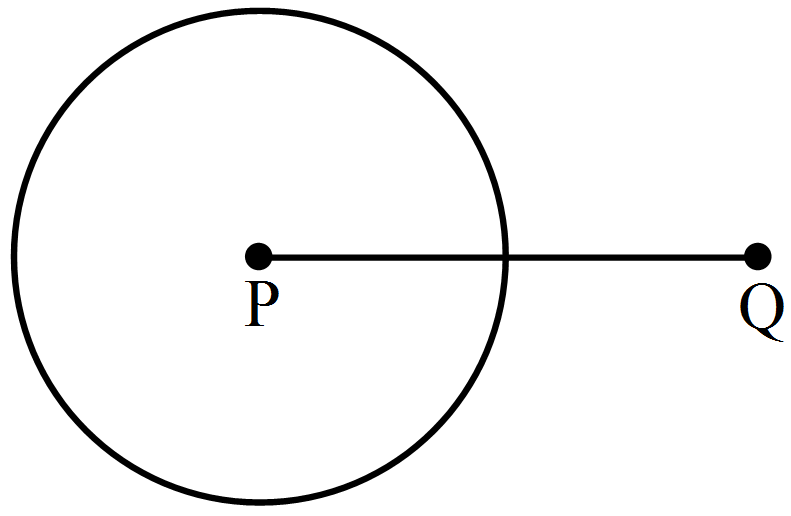
With $\overline{\text{PQ}}$ of length $6.1\ cm$ as diameter, draw a circle.
View full question & answer→Question 935 Marks
Draw a line $l.$ Take a point $A,$ not lying on $l.$ Draw a line $m$ such that $\text{m}\perp\text{l}$ and passing through $A.$ Using ruler and compasses.
AnswerWith $A$ as centre, draw an arc $PQ,$ which intersects line $L$ at points $P$ and $Q.$ Without disturbing the compass and taking $P$ and $Q$ as centres, we construct two arcs such that they intersect each other. The point where both arcs intersect is $B.$ Join points $A$ and $B$ and extend it in both directions. This is the required line.
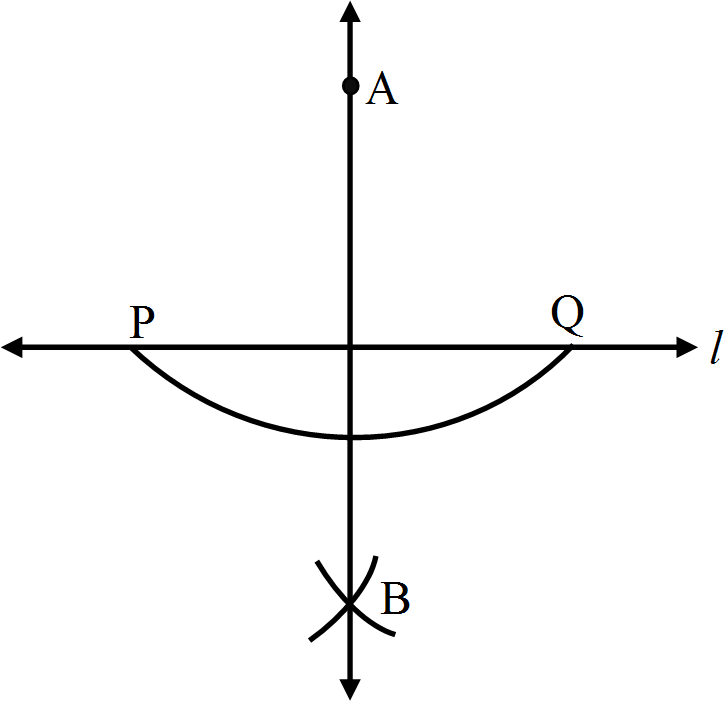
View full question & answer→Question 945 Marks
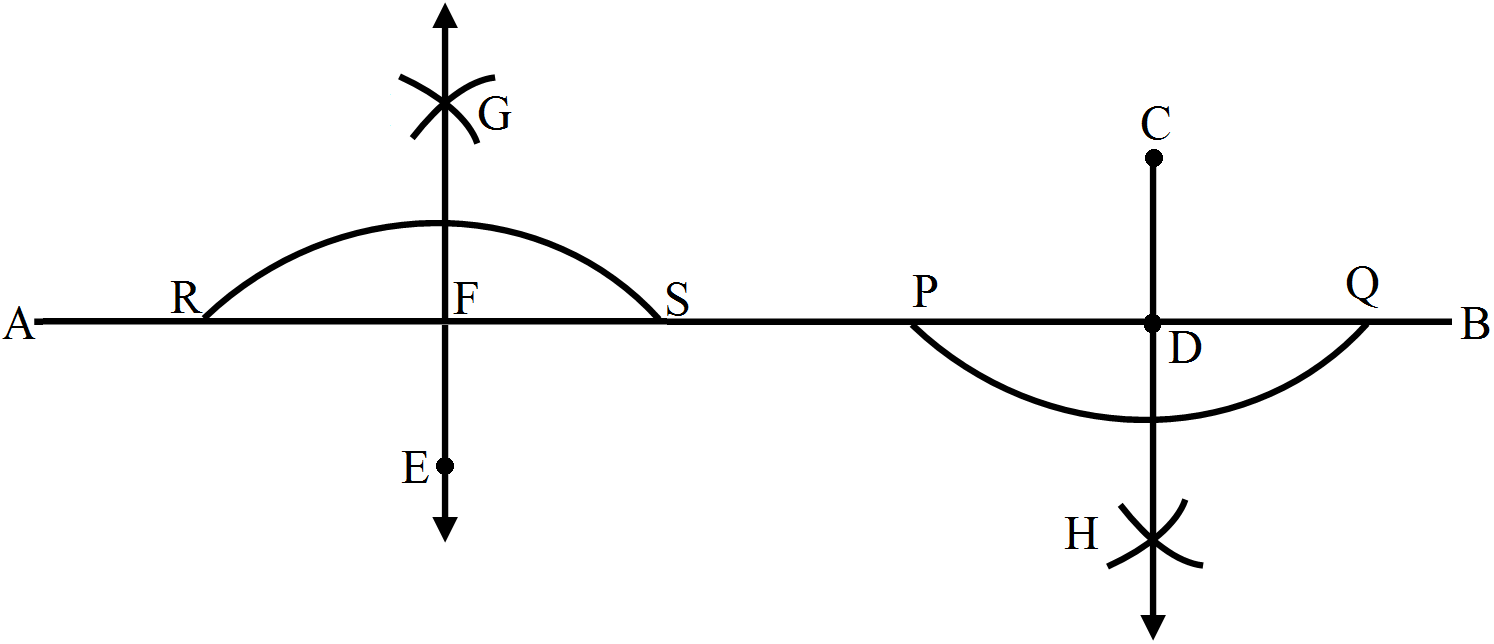
Draw a line $AB$ and take two points $C$ and $E$ on opposite sides of $AB.$ Through $C,$ draw $\text{CD}\perp\text{AB}$ and through $E$ draw $\text{EF}\perp\text{AB}.$ Using ruler and compassed.
AnswerDraw a line $AB$ and take two points $C$ and $E$ on its opposite sides.
With $C$ as centre, draw an arc $PQ,$ which intersects line $AB$ at $P$ and $Q.$
Taking $P$ and $Q$ as centres, construct two arcs, such that they intersect each other at $H.$
Join points $H $ and $C. HC$ crosses AB at $D.$
We have $\text{CD}\perp\text{AB}.$
Similarly, take $E$ as centre and draw an arc $RS.$
Taking $R$ and $S$ as centres, draw two arcs which intersect each other at $G.$
Join points $G$ and $E.$ $GE$ crosses $AB$ at $F.$
We have $\text{EF}\bot\text{AB}.$
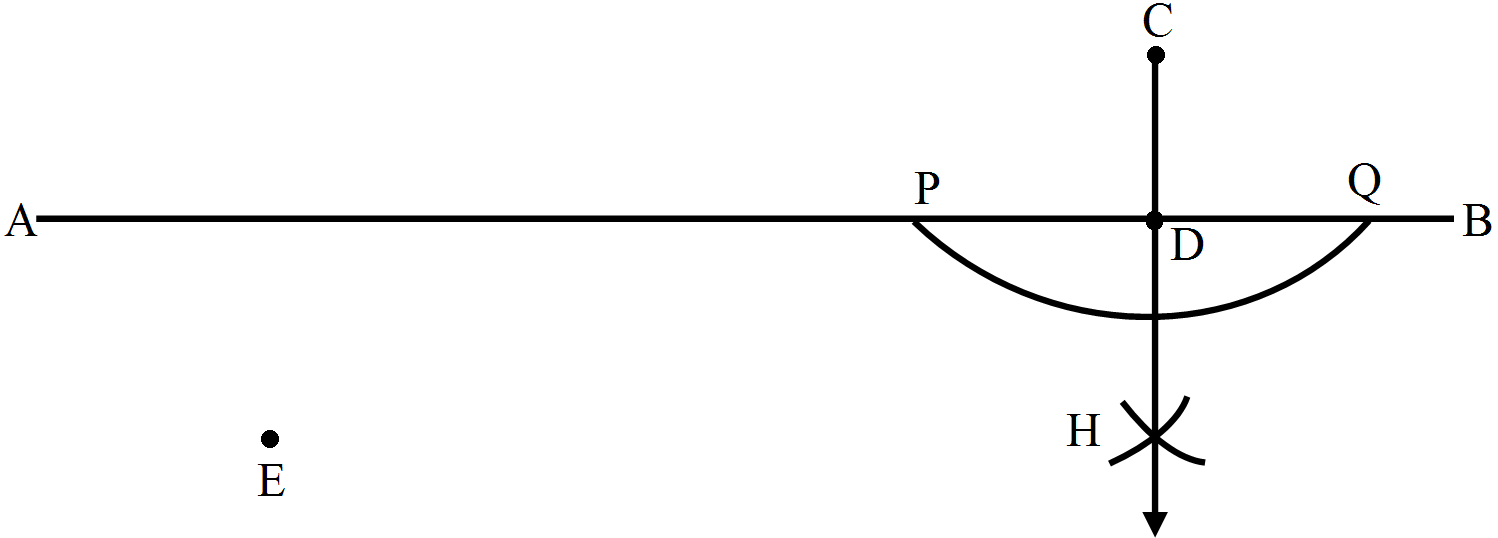
View full question & answer→Question 955 Marks
Draw the perpendicular bisector of a given line segment $AB$ of length $6\ cm.$
Answer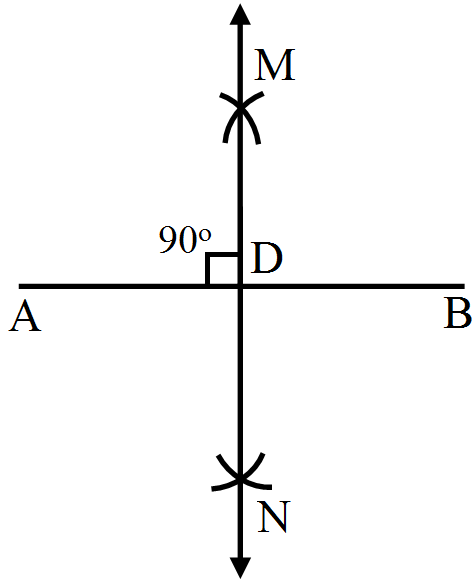
Steps for construction:
$1.$Draw a line segment $AB,$ which is equal to $6 \ cm.$
$2.$With $A$ as the centre and radius more than half of $AB,$ draw arcs, one on each side of $AB.$
$3.$With $B$ as the centre and radius same as before, draw arcs, cutting the perviously drawn arcs at $M$ and $N,$ respectively.
$4.$Draw $MN$ meeting $AB$ at $D.$
$MN$ is the required perpendicular bisector of $AB.$ View full question & answer→Question 965 Marks
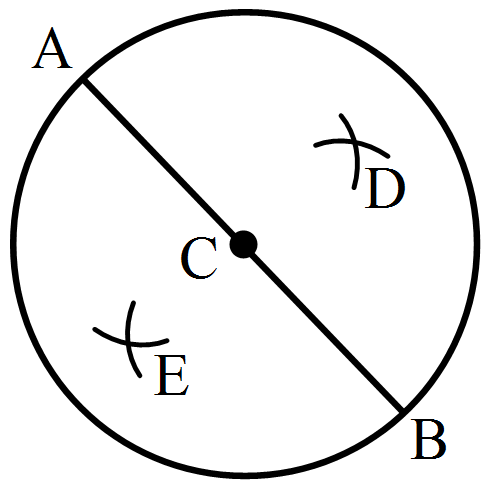
Draw a circle with centre $C$ and radius $3.4\ cm.$ Draw any chord $\overline{\text{AB}}$. Construct the perpendicular bisector of $\overline{\text{AB}}$ and examine if it passes through $C.$
Answer
$1.$Mark any point $C$ on the sheet.
$2.$By adjusting the compasses up to $3.4\ cm$ and by putting the pointer of the compasses at point $C,$ turn the compasses slowly to draw the circle. It is the required circle of $3.4\ cm$ radius.
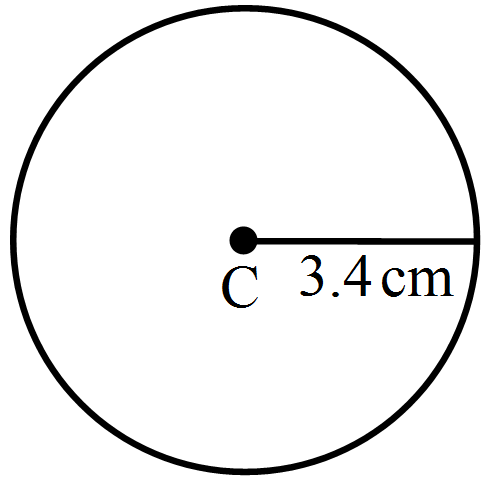
$3.$Now, mark any chord $\overline{\text{AB}}$ in the circle.
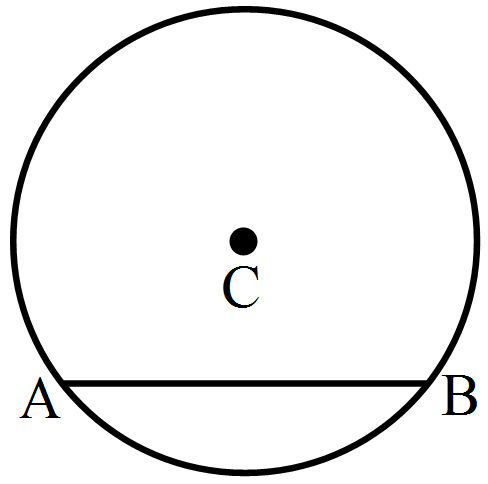
$4.$Taking $A$ and $B$ as centres, draw arcs on both sides of$\overline{\text{AB}}$. Let these intersect each other at $D$ and $E.$
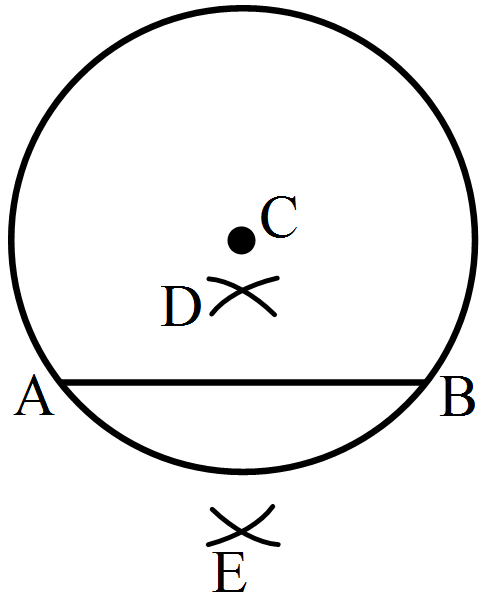
$5.$Join $DE,$ which is the perpendicular bisector of $AB.$
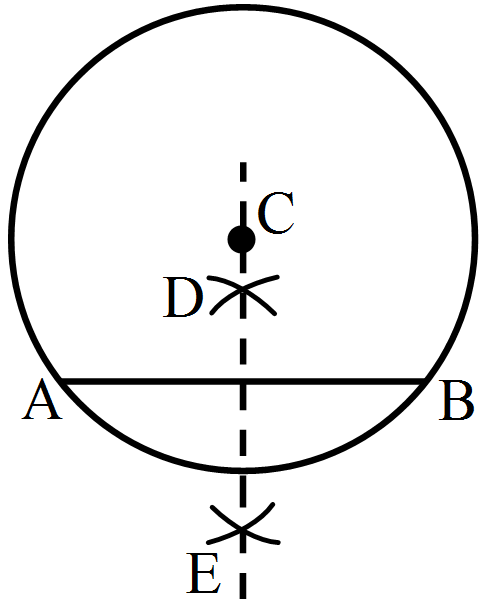
When $\overline{\text{DE}}$ is extended, it will pass through point $C.$
View full question & answer→Question 975 Marks
Draw a line segment $AB$ of length $10\ cm.$ Mark a point $P$ on $AB$ such that $ AP = 4\ cm.$ Draw a line through $P$ perpendicular to $AB.$
AnswerWe draw line $L$ and take a point $A$ on it. Using a ruler and a compass, we mark a point $B, 10\ cm$ from $A,$ on the line $L.$
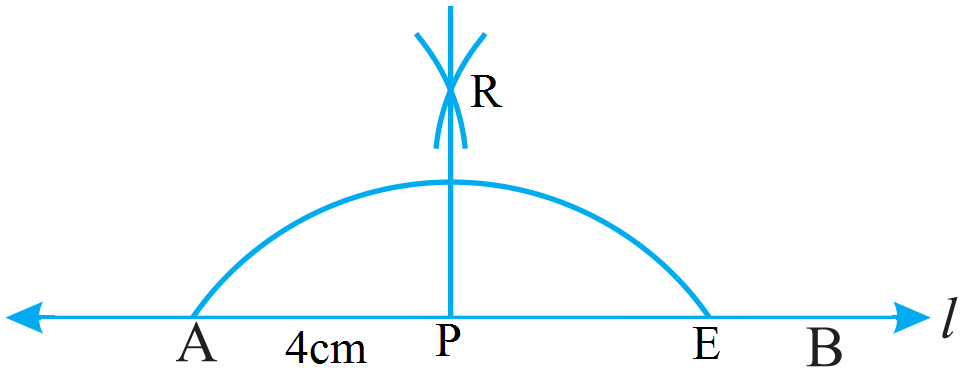
$AB$ is the required line segment of $10\ cm.$ Again, we mark a point $P,$ which is $4\ cm$ from $A,$ in the direction of $B.$ With $P$ as centre, take a radius of $4\ cm$ and construct an arc intersecting the line $L$ at two points $A$ and $E.$ With $A$ and $E$ as centres, take a radius of $6\ cm$ and construct two arcs intersecting each other at $R.$ We join $PR$ and extend it. $PR$ is the required line, which is perpendicular to $AB.$
View full question & answer→Question 985 Marks
Draw a line segment $AB$ and by ruler and compasses, obtain a line segment of length $\frac{3}{4}(\text{AB}).$
AnswerDraw a line segment $AB$ using the ruler.
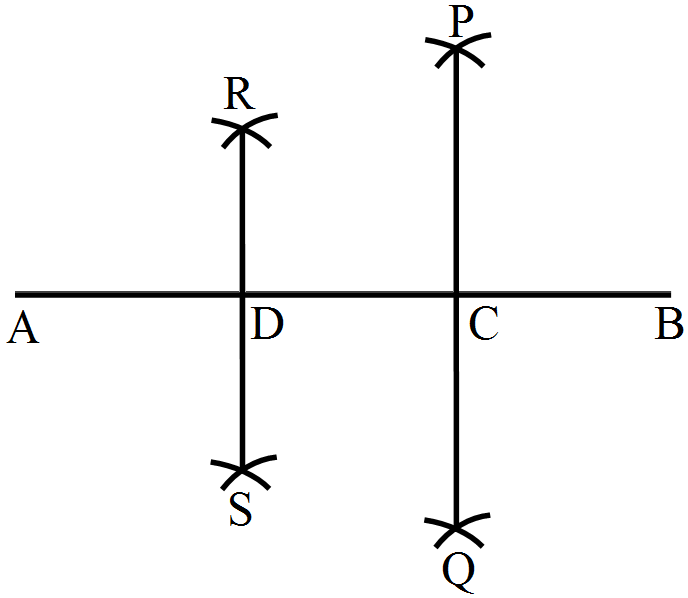
$i.\ $With $A$ as centre and radius more than half of $AB,$ draw arcs on both sides of $AB.$
$ii.\ $With the same radius and $B$ as centre, draw arcs cutting the arcs drawn in step $(i)$ at $P$ and $Q.$
$iii.\ $Join $P$ and $Q. PQ$ intersects $AB$ at $C.$
$iv.\ $With $A$ as centre and radius more than half of $AB,$ draw arcs on both sides of $AC.$
$v.\ $With the same radius and $C$ as centre, draw arcs cutting the arcs drawn in step $(iv)$ at $R$ and $S.$
$vi.\ $Join $R$ and $S. RS$ intersects $AB$ at $D.$
Bisect $AC$ again and mark the point of bisection as $D.$
So, we have: $AD =\frac{1}{4}\text{(AB)},$
$DC =\frac{1}{4}\text{(AB)}$ and
$CB =\frac{1}{2}\text{(AB)}$
Therefore, $DB =\frac{1}{4}(\text{AB})+\frac{1}{2}(\text{AB})=\frac{3}{4}(\text{AB})$
Thus, $DB$ is the required line segment of length $\frac{3}{4}(\text{AB}).$
View full question & answer→Question 995 Marks
Draw a line $AB$ and take two points $C$ and $E$ on opposite sides of $AB.$ Through $C,$ draw $\text{CD}\perp\text{AB}$ and through $E$ draw $\text{EF}\perp\text{AB}.$ ruler and set-squares.
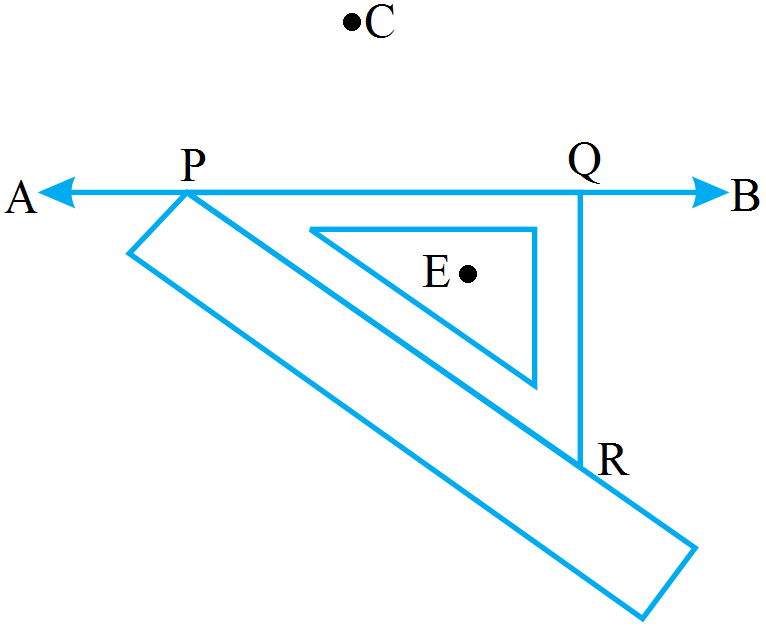
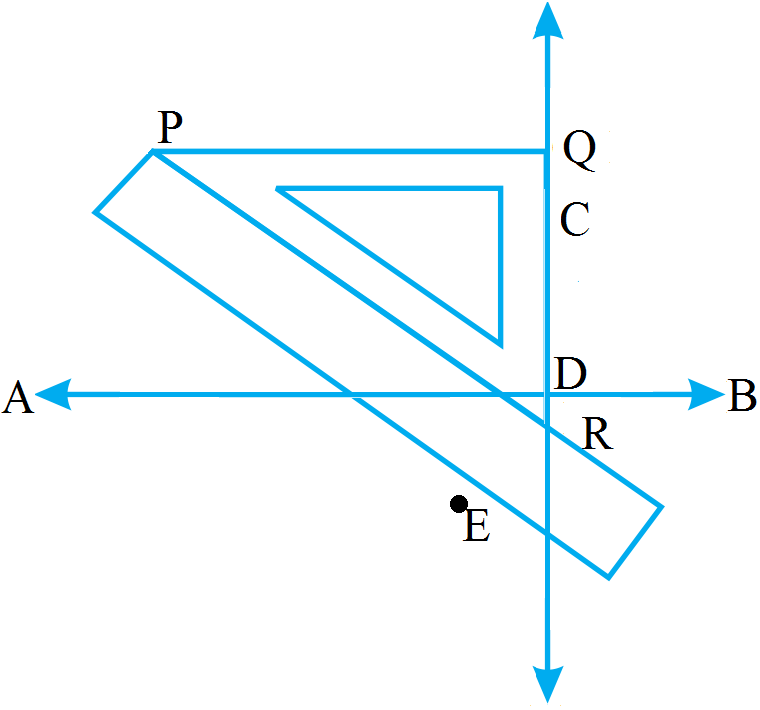
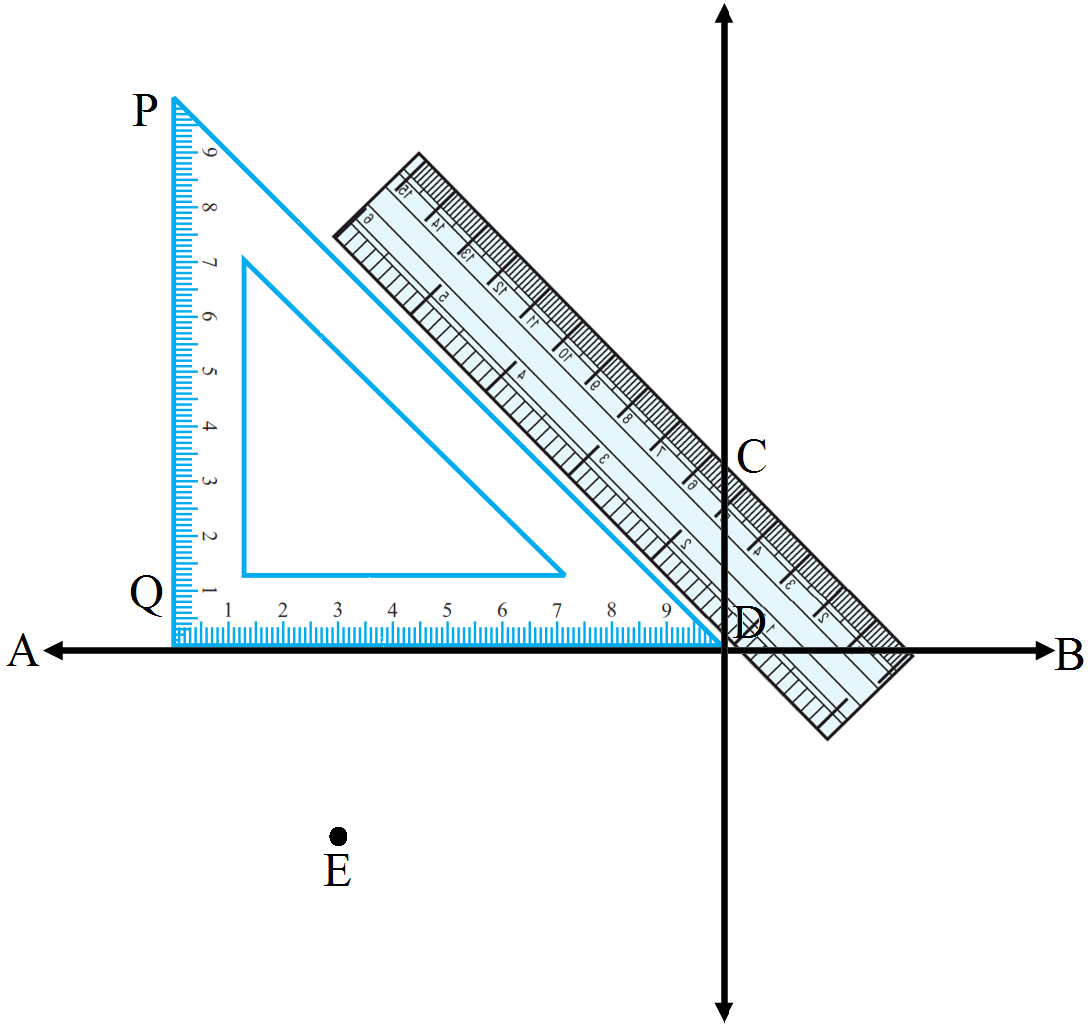
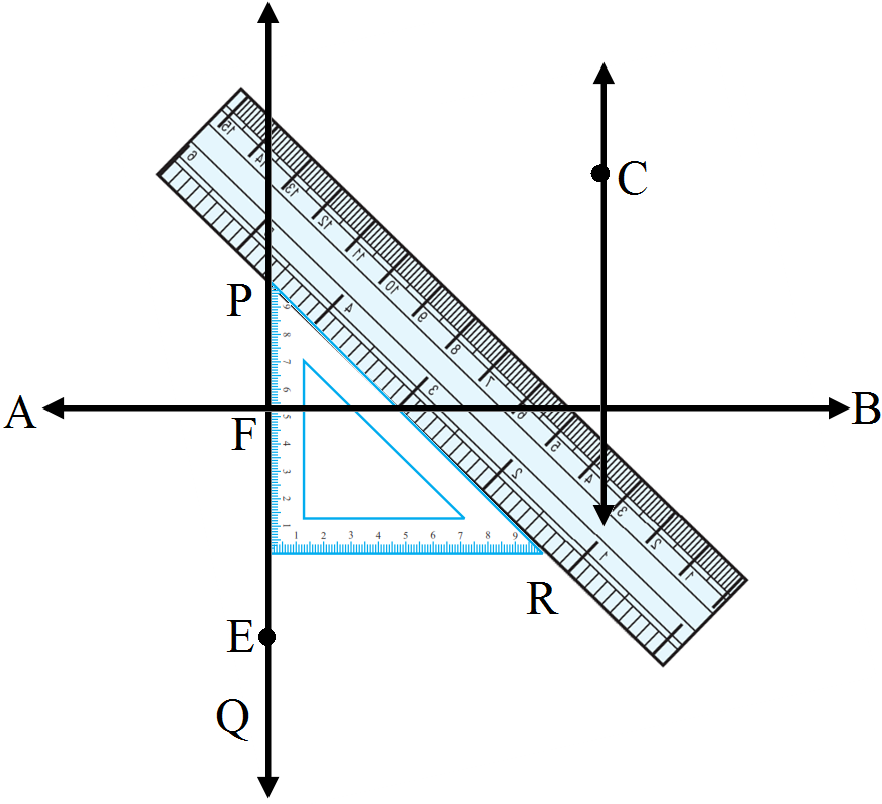
AnswerDraw a line $AB$ and take two points $C$ and $E$ on the opposite sides of the line $AB.$ On the side of $E,$ place a set-square $PQR,$ such that its one arm $PQ$ of the right angle is along the line $AB.$ Without disturbing the position of the set-square, place a ruler along its edge $PR.$ Now, without disturbing the position of the ruler, slide the set square along the ruler until the arm $QR$ reaches point $C.$ Without disturbing the position of the set-square, draw a line $CD$, where $D$ is a point on $AB. CD$ is the required line and $\text{CD}\perp\text{AB}.$ We repeat the same process starting with taking set-square on the side of $E,$ we draw a line $\text{EF}\perp\text{AB}.$
View full question & answer→Question 1005 Marks
Use a pair of compasses and construct the following angles: $22\frac{1}{2}^\circ$
Answer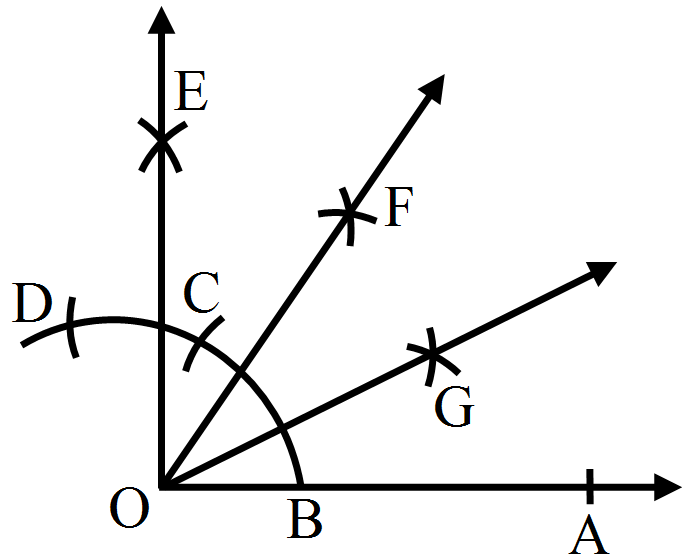
Steps of Construction:
$1.$Draw a ray $OA.$
$2.$With $O$ as centre and any suitable radius draw an arc above $OA,$ cutting it at $B.$
$3.$With $B$ as centre and same radius cut the previous arc at $C $ and then with $C$ as centre and same radius cut the arc at $D.$
$4.$With $C$ as centre and radius more than half $CD$ draw an arc.
$5.$With $D$ as centre and same radius draw another arc to cut the previous arc at $E.$
$6.$Join $OE.$ Then $\angle AOE = 90^\circ .$
$7.$Draw the bisector $OF$ of $\angle\text{AOE}.$
$8.$Draw the bisector $OG$ of $\angle\text{AOF}.$
Then, $\angle\text{AOG}=22\frac{1}{2}^\circ$ is the required angle. View full question & answer→