Questions

2 Marks Questions

Take a timed test

47 questions · self-marked practice — reveal the answer and mark yourself.
Question 32 Marks
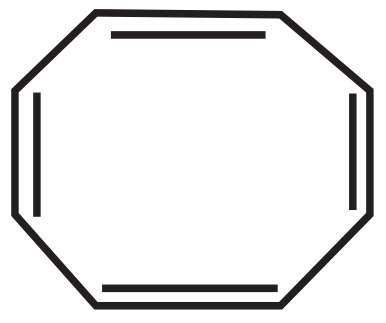
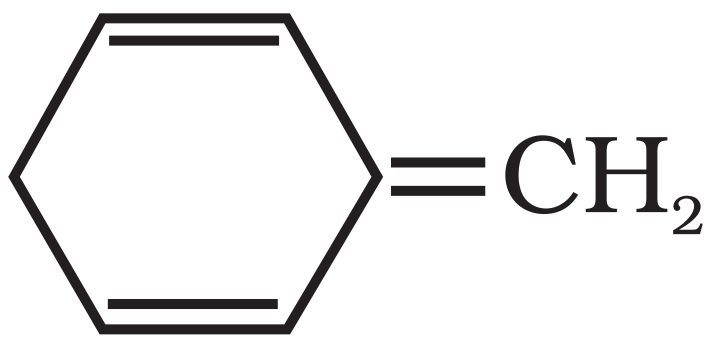
Explain why the following system are not aromatic?
Answer


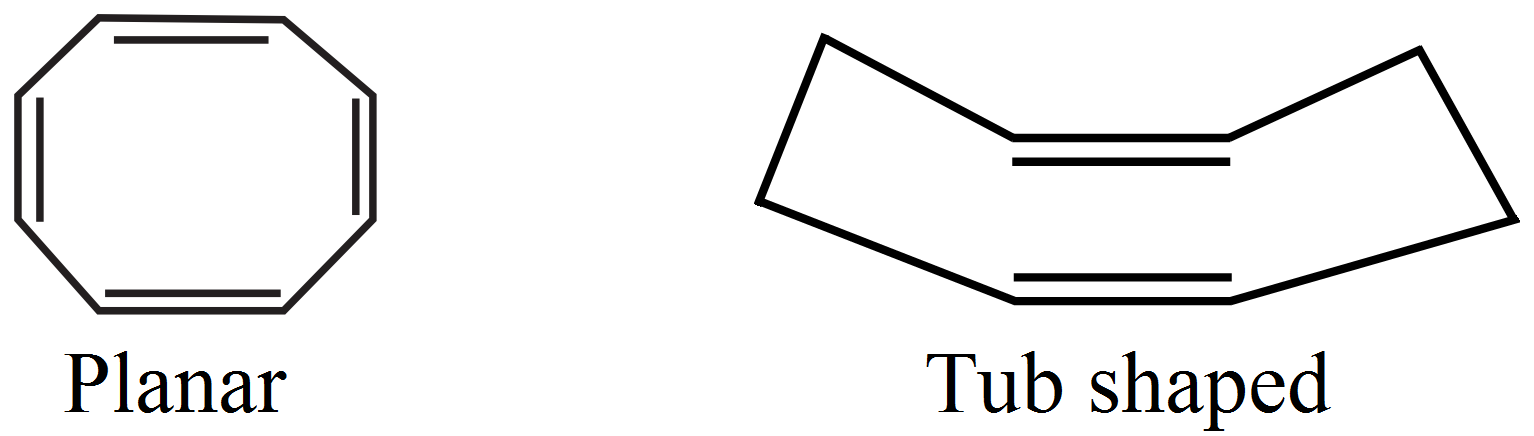
Cyclo-octatetraene is not planar but is tub shaped. It is, therefore, a non-planar system having 8 n-electrons.
Therefore, the molecule is not aromatic since it does not contain a planar cyclic cloud having (4n + 2) n-electrons.
View full question & answer
Question 42 Marks

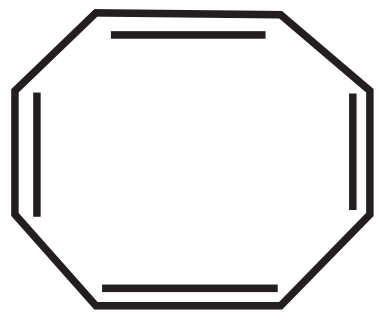
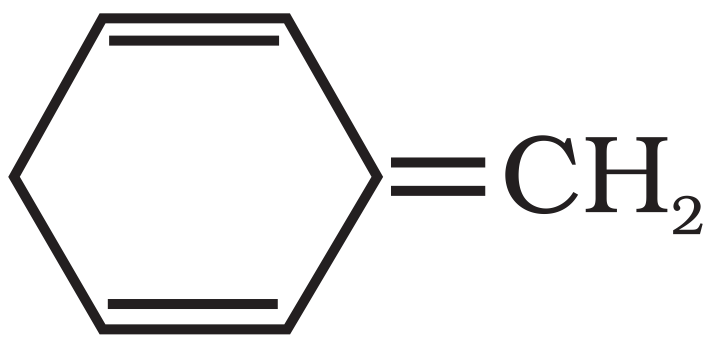
Explain why the following system are not aromatic?
Answer


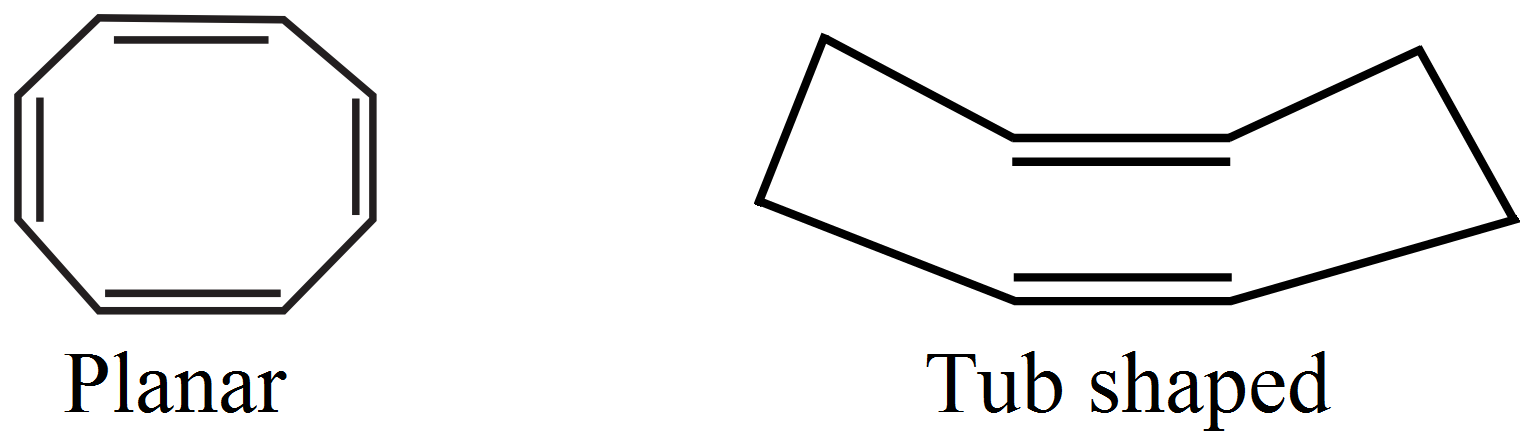
Cyclo-octatetraene is not planar but is tub shaped. It is, therefore, a non-planar system having 8 n-electrons.
Therefore, the molecule is not aromatic since it does not contain a planar cyclic cloud having (4n + 2) n-electrons.
View full question & answer
Question 52 Marks
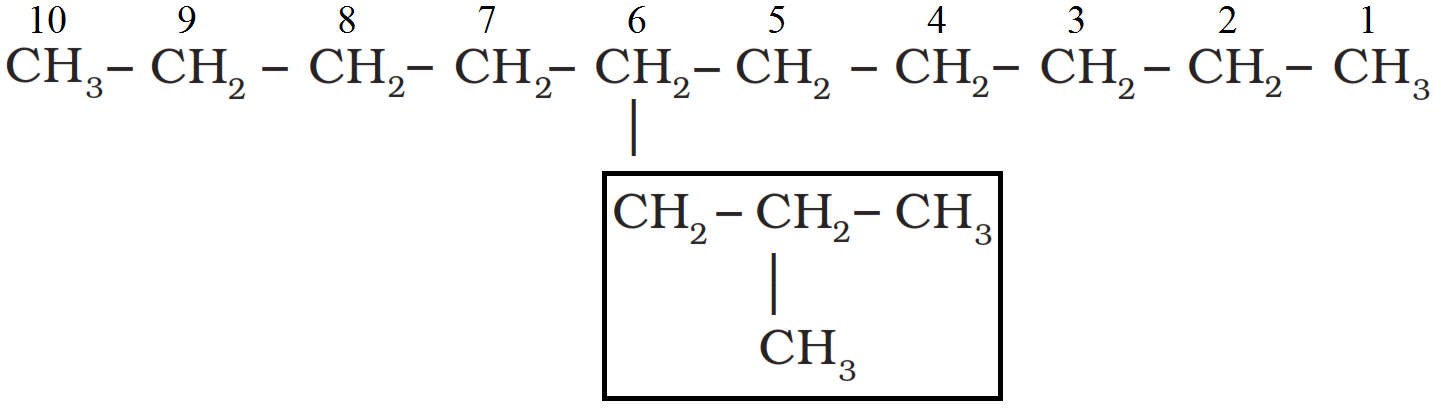
Write IUPAC names of the following compound: $\text{CH}_3(\text{CH}_2)_4\text{CH}(\text{CH}_2)_3\text{CH}_3\\\ \ \ \ \ \ \ \ \ \ \ \ \ \ \ \ \ \ \ \ \ |\\\ \ \ \ \ \ \ \ \ \ \ \ \ \ \ \ \ \ \ \text{CH}_2-\text{CH}(\text{CH}_3)_2$
Answer

$\text{CH}_3(\text{CH}_2)_4\text{CH}(\text{CH}_2)_3\text{CH}_3\\\ \ \ \ \ \ \ \ \ \ \ \ \ \ \ \ \ \ \ \ \ |\\\ \ \ \ \ \ \ \ \ \ \ \ \ \ \ \ \ \ \ \text{CH}_2-\text{CH}(\text{CH}_3)_2$ can be written as:

IUPAC name: 5-(2-Methtlpropyl)-decane.
View full question & answer
Question 72 Marks

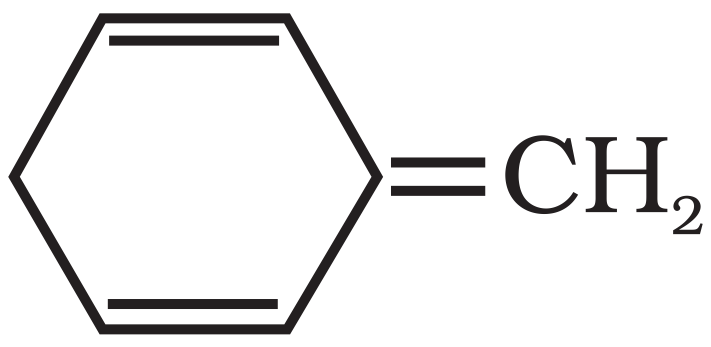
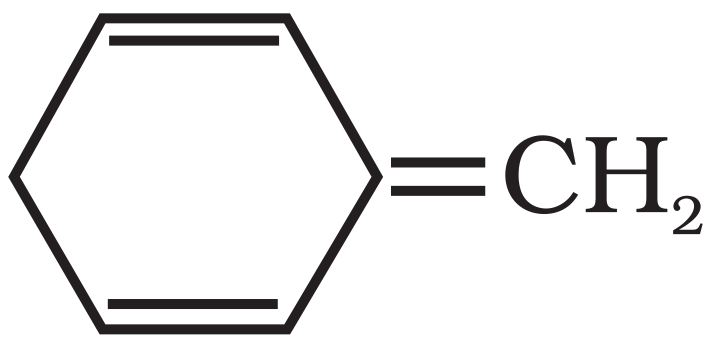
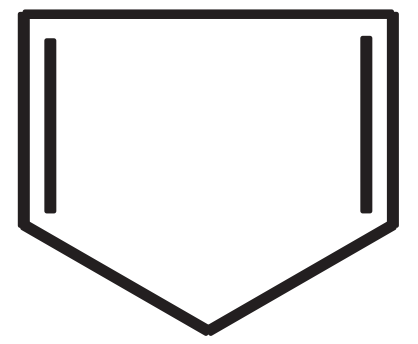
Explain why the following systems are not aromatic?
Answer


Due to the presence of a sp3-hybridized carbon, the system is not planar. It does contain six n-electrons but the system is not fully conjugated since all the six n-electrons do not form a single cyclic electron cloud which surrounds all the atoms of the ring. Therefore, it is not an aromatic compound.
View full question & answer
Question 82 Marks
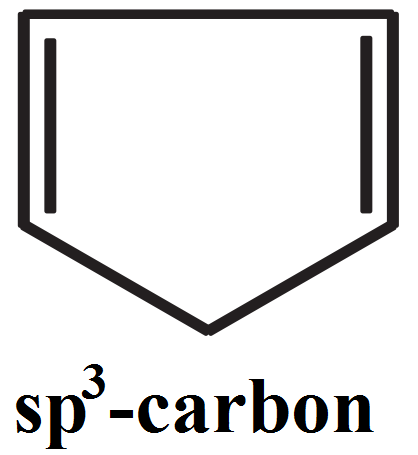
Explain why the following system are not aromatic?
Answer


Due to the presence of a $\mathrm{sp}^3$-carbon, the system is not planar. Further,it contains only four n-electrons, therefore, the system is not aromatic because it does not contain planar cyclic cloud having (4n + 2) n-electrons.
View full question & answer
Question 92 Marks
Name the organic products of the reaction of but-2-ene with each of the following reagents and write a balanced equation for each reaction.
  1. Hydrogen bromide.
  2. Bromine dissolved in tetrachloromethane.
Answer
  1. $\text{CH}_3-\text{CH}=\text{CH}-\text{CH}_3+\text{HBr}\rightarrow\\\text{CH}_3-\text{CH}-\text{CH}_2-\text{CH}_3\\ \ \ \ \ \ \ \ \ \ \ \ \ \ \ |\\ \ \ \ \ \ \ \ \ \ \ \ \ \ \text{Br}\\ \ \ \ \ \ _{2-\text{bromobutane}}$
  2. $\text{CH}_3-\text{CH}=\text{CH}-\text{CH}_3+\text{Br}_2\xrightarrow{\text{CCl}_4}\\\text{CH}_3-\text{CH}-\text{CH}-\text{CH}_3\\ \ \ \ \ \ \ \ \ \ \ \ \ \ |\ \ \ \ \ \ \ \ \ \ |\\ \ \ \ \ \ \ \ \ \ \ \ \ \text{Br} \ \ \ \ \ \ \ \text{Br}\\ \ \ \ \ \ \ \ _{2,3\text{ dibromobutane}}$
View full question & answer
Question 102 Marks
Hydrocarbon A (molecular formula is $\mathrm{C}_5 \mathrm{H}_8$ ) gave a white precipitate with ammoniacal silver nitrate. Oxidation of A with hot alkaline $\mathrm{KMnO}_4$ gave 2-methyl propanoic acid. What is the structural formula of A ?
View full question & answer
Question 112 Marks
An alkane $\mathrm{C}_8 \mathrm{H}_{18}$ is obtained as the only product on subjecting a primary alkyl halide to Wurtz reaction. On monobromination this alkane yields a single isomer of a tertiary bromide. Write the structure of alkane and the tertiary bromide.
Answer
The alkane on monobromination yields a single somer of tertiary bromide which means alkane must contain tertiary hydrogen. This is only possible if primary alkyl halide has a tertiary hydrogen. The alkane on monobromination yields a single somer of tertiary bromide which means alkane must contain tertiary hydrogen. This is only possible if primary alkyl halide has tertiary hydrogen.
The reaction scheme is shown below:
$\ \ \ \ \ \ \ \ \ \ \ \ \ \text{CH}_3\ \ \ \ \ \ \ \ \ \ \ \ \ \ \ \ \ \ \ \ \ \ \ \ \ \ \ \ \ \ \ \ \ \ \ \ \ \ \ \ \ \ \ \ \ \ \ \ \ \ \ \ \ \ \ \ \text{CH}_3\\ \ \ \ \ \ \ \ \ \ \ \ \ \ \ | \ \ \ \ \ \ \ \ \ \ \ \ \ \ \ \ \ \ \ \ \ \ \ \ \ \ \ \ \ \ \ \ \ \ \ \ \ \ \ \ \ \ \ \ \ \ \ \ \ \ \ \ \ \ \ \ \ \ \ \ \ \ \ |\\\text{CH}_3-\text{CH}-\text{CH}_3-\text{X}+2\text{Na}+\text{X}-\text{CH}_2-\text{CH}-\text{CH}_3\xrightarrow[\text{Wurtz reaction}]{\Delta,-2\text{NaX}}\\1-\text{halo-2-methylpropane}$
$ \ \ \ \ \ \ \ \ \ \ \ \ \ \text{CH}_3\ \ \ \ \ \ \ \ \ \ \ \ \ \ \ \ \ \ \ \ \ \ \ \ \ \ \ \ \ \text{CH}_3\ \ \ \ \ \ \ \ \ \ \ \ \ \ \ \ \ \ \ \ \ \ \ \ \ \ \ \ \ \ \ \ \ \ \ \text{CH}_3\ \ \ \ \ \ \ \ \ \ \ \ \ \ \ \ \ \ \ \ \ \ \ \ \ \ \text{CH}_3\\\ \ _6\ \ \ \ \ \ \ \ \ \ |\ _5\ \ \ \ \ \ \ \ _4\ \ \ \ \ \ \ \ \ \ \ _3 \ \ \ \ \ \ \ \ \ _2|\ \ \ \ \ \ \ \ \ _1\ \ \ \ \ \ \ \ \ \ \ \ \ \ \ \ \ \ \ \ \ \ \ \ \ \ \ \ \ \ |\ \ \ \ \ \ \ \ \ \ \ \ \ \ \ \ \ \ \ \ \ \ \ \ \ \ \ \ \ \ \ \ |\\\text{CH}_3-\text{CH}-\text{CH}_2-\text{CH}_2-\text{CH}-\text{CH}_3\xrightarrow[\text{-HBr}]{\text{Br}_2,\text{hv}}\text{CH}_3-\text{C}-\text{CH}_2-\text{CH}_2-\text{CH}-\text{CH}_3\\2,5-\text{dimethylhexane (alkane)}\ \ \ \ \ \ \ \ \ \ \ \ \ \ \ \ \ \ \ \ \ \ \ \ \ \ \ ^1\ \ \ \ \ \ \ \ \ \ |\ ^2\ \ \ \ \ ^3\ \ \ \ \ \ \ \ \ \ \ ^4\ \ \ \ \ \ \ \ \ \ ^5\ \ \ \ \ \ \ \ \ \ ^6\\\ \ \ \ \ \ \ \ \ \ \ \ \ \ \ \ \ \ \ \ \ \ \ \ \ \ \ \ \ \ \ \ \ \ \ \ \ \ \ \ \ \ \ \ \ \ \ \ \ \ \ \ \ \ \ \ \ \ \ \ \ \ \ \ \ \ \ \ \ \ \ \ \ \ \ \ \ \ \ \ \ \ \ \ \ \ \ \ \ \ \ \ \text{Br}\\ \ \ \ \ \ \ \ \ \ \ \ \ \ \ \ \ \ \ \ \ \ \ \ \ \ \ \ \ \ \ \ \ \ \ \ \ \ \ \ \ \ \ \ \ \ \ \ \ \ \ \ \ \ \ \ \ \ \ \ \ \ \ \ \ \ \ \ \ \ \ \ \ \ \ \ \ \ \ \ \ \ \ \ \ \ \ \ \ \ \ \ \ \ \ 2-\text{bromo-2,5-dimethylhexane}\\ \ \ \ \ \ \ \ \ \ \ \ \ \ \ \ \ \ \ \ \ \ \ \ \ \ \ \ \ \ \ \ \ \ \ \ \ \ \ \ \ \ \ \ \ \ \ \ \ \ \ \ \ \ \ \ \ \ \ \ \ \ \ \ \ \ \ \ \ \ \ \ \ \ \ \ \ \ \ \ \ \ \ \ \ \ \ \ \ \ \ \ \ \ \ (3^\circ\text{bromide})$
View full question & answer
Question 122 Marks
How will you convert:
  1. Propyne into propanone?
  2. Secondary butyl bromide into but-2-ene?
Answer
  1. $\text{HC}\equiv\text{C}-\text{CH}_3+\text{H}_2\text{O}\xrightarrow{\text{H}_2\text{SO}_4}\\ \ \ \ \ \ \ \ \ _\text{Propyne}\\\text{CH}_2=\text{C}-\text{CH}_3\rightleftharpoons\text{CH}_3-\text{C}-\text{CH}_3\\ \ \ \ \ \ \ \ \ \ \ \ \ \ \ | \ \ \ \ \ \ \ \ \ \ \ \ \ \ \ \ \ \ \ \ \ \ \ \ \ \ \ \ \ \ \ \ ||\\ \ \ \ \ \ \ \ \ \ \ \ \ \ \text{OH} \ \ \ \ \ \ \ \ \ \ \ \ \ \ \ \ \ \ \ \ \ \ \ \ \ \ \ \ \text{O}\\ \ \ \ \ \ \ \ \ \ \ \ \ \ \ \ \ \ \ \ \ \ \ \ \ \ \ \ \ \ \ \ _{\text{Acetone (or propanone)}}$
  2. $\text{CH}_3-\text{CH}-\text{CH}_2-\text{CH}_3+\text{KOH(alc.)}\\ \ \ \ \ \ \ \ \ \ \ \ \ \ |\\ \ \ \ \ \ \ \ \ \ \ \ \ \text{Br}\\ \ \ \ \ \ \ \ \ \ _{\text{Sec. butyl bromide}}\\\ \ \ \ \ \ \ \ \ \ _\text{(2-Bromobutane)}\\\text{CH}_3-\text{CH}=\text{CH}-\text{CH}_3+\text{KBr}+\text{H}_2\text{O}\\ \ \ \ \ \ \ \ \ \ \ \ \ \ \ _{\text{But-2-ene}}$
View full question & answer
Question 142 Marks
Write hydrocarbon radicals that can be formed as intermediates during monochlorination of 2-methylpropane? Which of them is more stable? Give reasons.
Answer
In general chlorination of alkanes proceed by free radical mechanism. 2-methylpropane has both primary (1°) and tertiary (3°) carbon atoms. It will form two free radicals intermediates upon chlorination.$\ \ \ \ 1^\circ\ \ \ \ \ \ \ \ \ \ \ \ \ \ \ \ \ \ 1^\circ\ \ \ \ \ \ \ \ \ \ \ \ \ \ \ \ \ \ \ \ \ \ \ \ \ \ \ \ \ \ \ \ \ \ \ \ \ \ \ \ \ \ \ \ \ \ \ \ \circ\ \ \ \ \ \ \ \ \ \ \ \ \ \ \ \ \ \ \ \ \circ\\\text{CH}_3-\text{CH}-\text{CH}_3\xrightarrow{\text{HOMOLYSIS}}\text{CH}_3-\text{CH}-\text{CH}_2+\text{CH}_3-\text{C}-\text{CH}_3\\\ \ \ \ \ \ \ \ \ \ \ \ \ \ |\ \ \ \ \ \ \ \ \ \ \ \ \ \ \ \ \ \ \ \ \ \ \ \ \ \ \ \ \ \ \ \ \ \ \ \ \ \ \ \ \ \ \ \ \ \ \ \ \ \ \ |\ \ \ \ \ \ \ \ \ \ \ \ \ \ \ \ \ \ \ \ \ \ \ \ \ \ \ \ \ \ \ \ \ \ \ |\\\ \ \ \ \ \ \ \ \ \ \ \ \text{CH}_3\ \ \ \ \ \ \ \ \ \ \ \ \ \ \ \ \ \ \ \ \ \ \ \ \ \ \ \ \ \ \ \ \ \ \ \ \ \ \ \ \ \ \ \ \ \text{CH}_3\ \ \ \ \ \ \ \ \ \ \ \ \ \ \ \ \ \ \ \ \ \ \ \ \ \ \ \ \text{CH}_3\\3^\circ\ \text{free radical is more stable}\ \ \ \ \ \ 1^\circ\text{free radical(I)}\ \ \ \ \ \ \ 3^\circ\text{free radical (II)}\\1^\circ\text{ free radical due to}\\\text{Hyperconjugation}$
View full question & answer
Question 152 Marks
Write the structures and names of products obtained in the reactions of sodium with a mixture of 1-iodo-2-methylpropane and 2-iodopropane.
View full question & answer
Question 162 Marks
What happens when:
  1. Bromoethane is treated with zinc and hydrochloric acid?
  2. Hydrogen is passed into 2-bromopropane in the presence of palladium?
Answer
  1. Ethane is formed.
$\text{CH}_3\text{CH}_2-\text{Br}+2[\text{H}]\xrightarrow[(\text{Reduction})]{\text{Zn/HCl}}\text{CH}_3\text{CH}_3+\text{HBr}\\ \ _{\text{Bromoethane}}$
  1. Propane is obtained.
​​​​​​​$\text{CH}_3-\text{CH}-\text{Br}+\text{H}_2\xrightarrow[(\text{Reduction})]{\text{Pd}}\text{CH}_3-\text{CH}_2+\text{Br}\\ \ \ \ \ \ \ \ \ \ \ \ \ \ |\ \ \ \ \ \ \ \ \ \ \ \ \ \ \ \ \ \ \ \ \ \ \ \ \ \ \ \ \ \ \ \ \ \ \ \ \ \ \ \ \ \ \ \ \ \ \ \ \ \ \ \ \ \ \ \ |\\ \ \ \ \ \ \ \ \ \ \ \ \ \text{CH}_3\ \ \ \ \ \ \ \ \ \ \ \ \ \ \ \ \ \ \ \ \ \ \ \ \ \ \ \ \ \ \ \ \ \ \ \ \ \ \ \ \ \ \ \ \ \ \ \ \ \ \text{CH}_3\\ \ \ \ \ \ \ \ \ \ \ \ \ \ \ \ \ \ \ \ \ \ \ \ \ \ \ \ \ \ \ \ \ \ \ \ \ \ \ \ \ \ \ \ \ \ \ \ \ \ \ \ \ \ \ \ \ \ \ \ \ \ \ \ \ \ \ \ \ \ _{\text{Propane}}$​​​​​​​
View full question & answer
Question 172 Marks

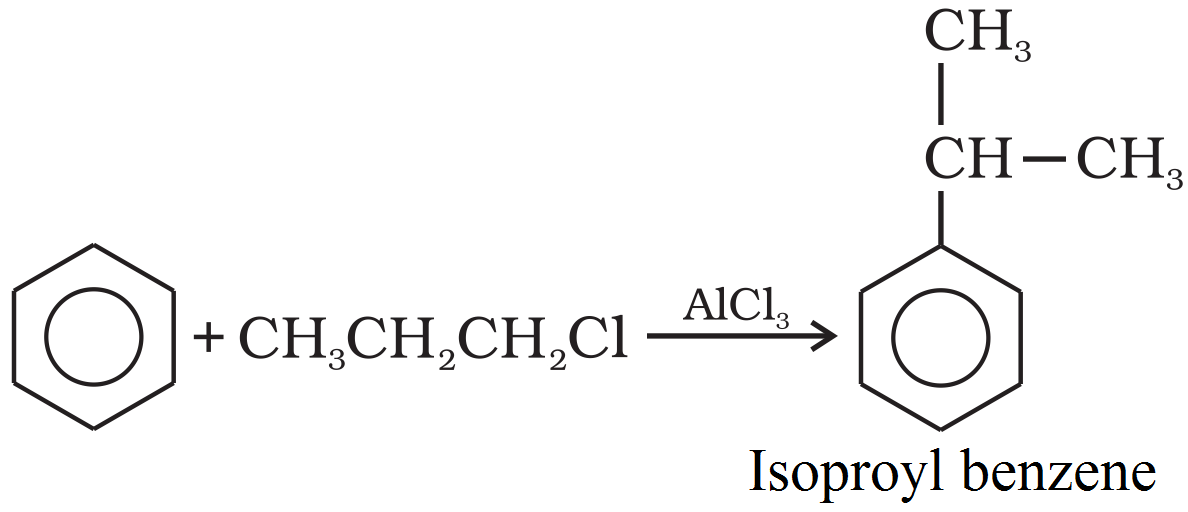
What will be the product obtained as a result of the following reaction and why?
Answer


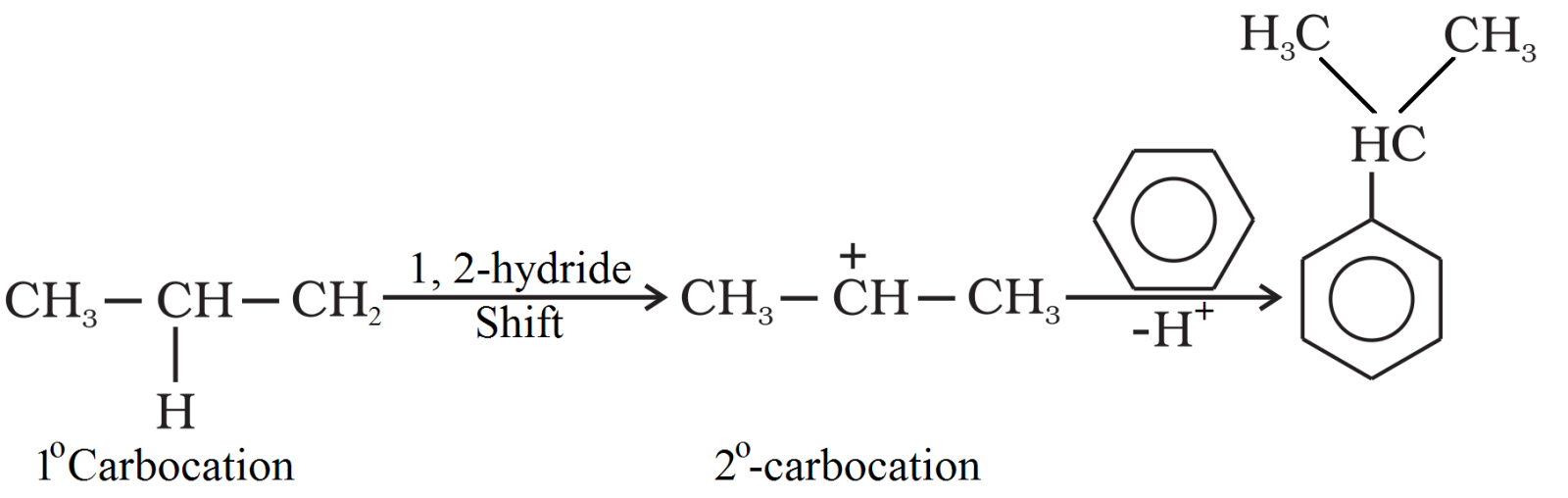
Propyl chloride forms $\text{CH}_3 – \text{CH}_2 – \text{CH}^+_2$ with anhydrous $\mathrm{AlCl}_3$ which is less stable. This rearranges to a more stable carbocation as:
View full question & answer
Question 182 Marks
List the following alkenes in decreasing order of reactivity towards electrophilic addition.
i. $\mathrm{ClCH}_2 \mathrm{CH}=\mathrm{CH}_2$
ii. $\left(\mathrm{CH}_3\right)_2 \mathrm{C}=\mathrm{CH}_2$
iii. $\mathrm{CH}_3 \mathrm{CH}=\mathrm{CH}_2$
iv. $\mathrm{CH}_2=\mathrm{CHCl}$
Explain your order.
Answer
Electron donating alkyl groups make the $\pi-\text{bond}$ more electron rich and more reactive. Conversely, electron withdrawing groups such as Cl make the $\pi-\text{bond}$ more electron deficient and less reactive. The order is
$\text{CH}_3-\text{C}=\text{CH}_2>\text{CH}_3-\text{CH}=\text{CH}_2\\ \ \ \ \ \ \ \ \ \ \ \ \ \ | \ \ \ \ \ \ \ \ \ \ \ \ \ \ \ \ \ \ \ \ \ \ \ _{(\text{one CH}_3\text{ group})}\\ \ \ \ \ \ \ \ \ \ \ \ \ \text{CH}_3\\ \ \ \ \ _{(\text{two CH}_3\text{ groups})}$
$>\text{Cl}-\text{CH}_2\text{CH}=\text{CH}_2>\text{CH}_2=\text{CH}-\text{Cl}\\_{(\text{one alkyl group with Cl-atom})} \ \ \ _{(\text{Cl is directly bonded to }}\\ \ \ \ \ \ \ \ \ \ \ \ \ \ \ \ \ \ \ \ \ \ \ \ \ \ \ \ \ \ \ \ \ \ \ \ \ \ \ \ \ \ \ _{\text{double bonded carbon})}$
View full question & answer
Question 192 Marks
Complete the following reactions.
  1. $\text{Iso-propyl bromide}\xrightarrow[\text{Heat}]{\text{Alc. KOH}}\text{A}\xrightarrow[\text{Peroxide}]{\text{HBr}}\text{B}$
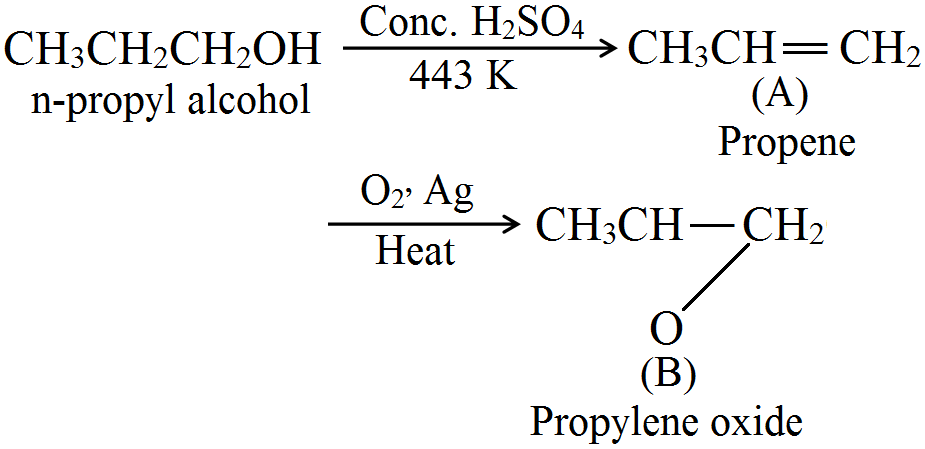
  2. $\text{n-propyl alcohol}\xrightarrow[443\text{K}]{\text{Conc. H}_2\text{SO}_4}\text{A}\xrightarrow[\text{Heat}]{\text{O}_2,\ \text{Ag}}\text{B}$
Answer
  1. $\text{CH}_3\text{CH}\text{CH}_3\xrightarrow[\text{Heat}]{\text{Alc. KOH}}\text{CH}_3\text{CH}=\text{CH}_2\\ \ \ \ \ \ \ \ \ | \ \ \ \ \ \ \ \ \ \ \ \ \ \ \ \ \ \ \ \ \ \ \ \ \ \ \ \ \ \ \ \ \ \ \ \ \ _{(\text{A})}\\ \ \ \ \ \ \ \ \text{Br} \ \ \ \ \ \ \ \ \ \ \ \ \ \ \ \ \ \ \ \ \ \ \ \ \ \ \ \ \ \ \ _{\text{Propene}}\\ _{\text{Iso-propyl bromide}}\\\xrightarrow[\text{Peroxide}]{\text{HBr}}\text{CH}_3\text{CH}_2\text{CH}_2\text{Br}\\ \ \ \ \ \ \ \ \ \ \ \ \ \ \ \ \ \ \ \ \ \ \ \ \ \ _\text{(B)}\\ \ \ \ \ \ \ \ \ \ \ \ \ \ \ \ \ \ _{1-\text{bromopropane}}$
  2.  
View full question & answer
Question 202 Marks
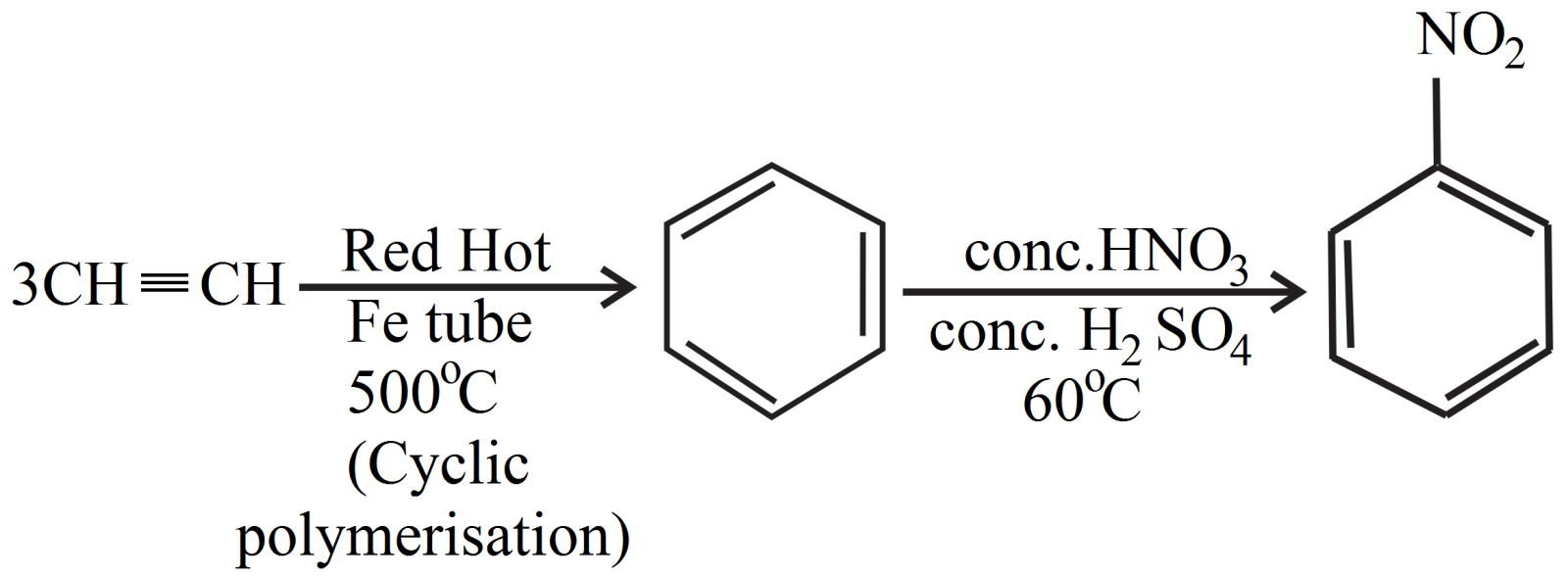
Suggest a route for the preparation of nitrobenzene starting from acetylene?
Answer

Acetylene when passed through red hot iron tube at 500°C undergoes cyclic polymerisation to give benzene which upon nitration gives nitrobenzene.
View full question & answer
Question 212 Marks
Rotation around carbon-carbon single bond of ethane is not completely free. Justify the statement.
Answer
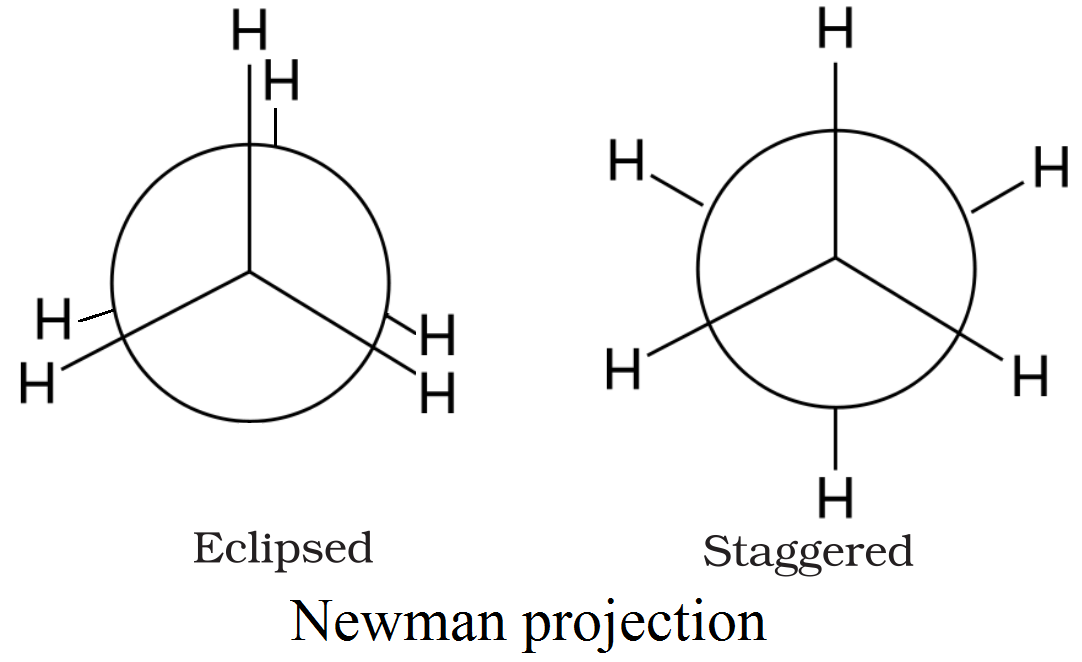
Rotation about C-C single bond is restricted due to repulsion between the electron clouds of CH bonds on adjacent carbon atoms. As a result of this repulsion, ethane exists in an infinite number of confirmations out of which two extreme conformations i.e staggered and eclipsed are important.

The staggered conformation is however, more stable than the eclipsed confirmation by about $12.55 \mathrm{kj} \mathrm{~mol}^{-1}$. This energy difference of $12.55 \mathrm{kj} \mathrm{~mol}^{-1}$ between the staggered and the eclipsed conformation is, in fact, the energy barrier to rotation about C-C single bond in ethane. However this energy barrier is not large enough to prevent rotation. Thus, the two conformations are readily interconvertible. As a result, it is not possible to seprate the two conformation of ethane. However at any given moment, most of the molecules would exist in the staggered conformation would exist in the staggered conformation due to its minimum energy and maximum stability.
View full question & answer
Question 222 Marks
What happens when 1, 2-Dibromo ethane reacts with excess of alc. KOH?
Answer
$\text{CH}_2\text{Br}\ \ \ \ \ \ \ \ \ \ \ \ \ \ \ \ \ \ \ \ \ \ \ \ \ \ \ \ \ \ \ \ \ \text{CH}\\ \ | \ \ \ \ \ \ \ \ \ \ +2\text{KOH(alc.)}\overrightarrow{ \ \ \ \ \ \ \ }\ |||+2\text{KBr}+2\text{H}_2\text{O}\\\text{CH}_2\text{Br}\ \ \ \ \ \ \ \ \ \ \ \ \ \ \ \ \ \ \ \ \ \ \ \ \ \ \ \ \ \ \ \ \ \text{CH}$
View full question & answer
Question 232 Marks
Nucleophiles and electrophiles are reaction intermediates having electron rich and electron deficient centres respectively. Hence, they tend to attack electron deficient and electron rich centres respectively. Classify the following species as electrophiles and nucleophiles.
  1. $\text{H}_3\text{CO}^-$
  2. $\ \ \ \ \ \ \ \ \ \ \ \ \ \text{O}\\\ \ \ \ \ \ \ \ \ \ \ \ \ ||\\\text{H}_3\text{C}-\text{C}-\text{O}^-$
  3. $\ \dot{}\\\text{Cl}$
  4. $\text{Cl}_2\text{C}:$
  5. $(\text{H}_3\text{C})_3\text{C}^+$
  6. $\text{Br}^-$
  7. $\text{H}_3\text{COH}$
  8. $\text{R}-\text{NH}-\text{R}$
Answer
Nucleophiles:
  1. $\text{H}_3\text{CO}^-$
  2. $\ \ \ \ \ \ \ \ \ \ \ \ \ \text{O}\\\ \ \ \ \ \ \ \ \ \ \ \ \ ||\\\text{H}_3\text{C}-\text{C}-\text{O}^-$
  1. $\text{Br}^-$
  1. $\text{H}_3\text{C}-\text{OH}$
  2. $\text{R}-\text{NH}-\text{R}$
Electrophiles:
  1. $\text{Cl}^\dot{}$
  2. $\text{Cl}_2\text{C}:$
  3. $(\text{H}_3\text{C})_3\text{C}^+$
View full question & answer
Question 242 Marks
Out of 2-methyl pentane and 2, 3-dimethyl pentane which has greater boiling point and why?
Answer
2-methyl pentane has higher boiling point because it has less branching, less surface area, less van der Waals' forces of attraction, hence lower boiling point.
View full question & answer
Question 252 Marks
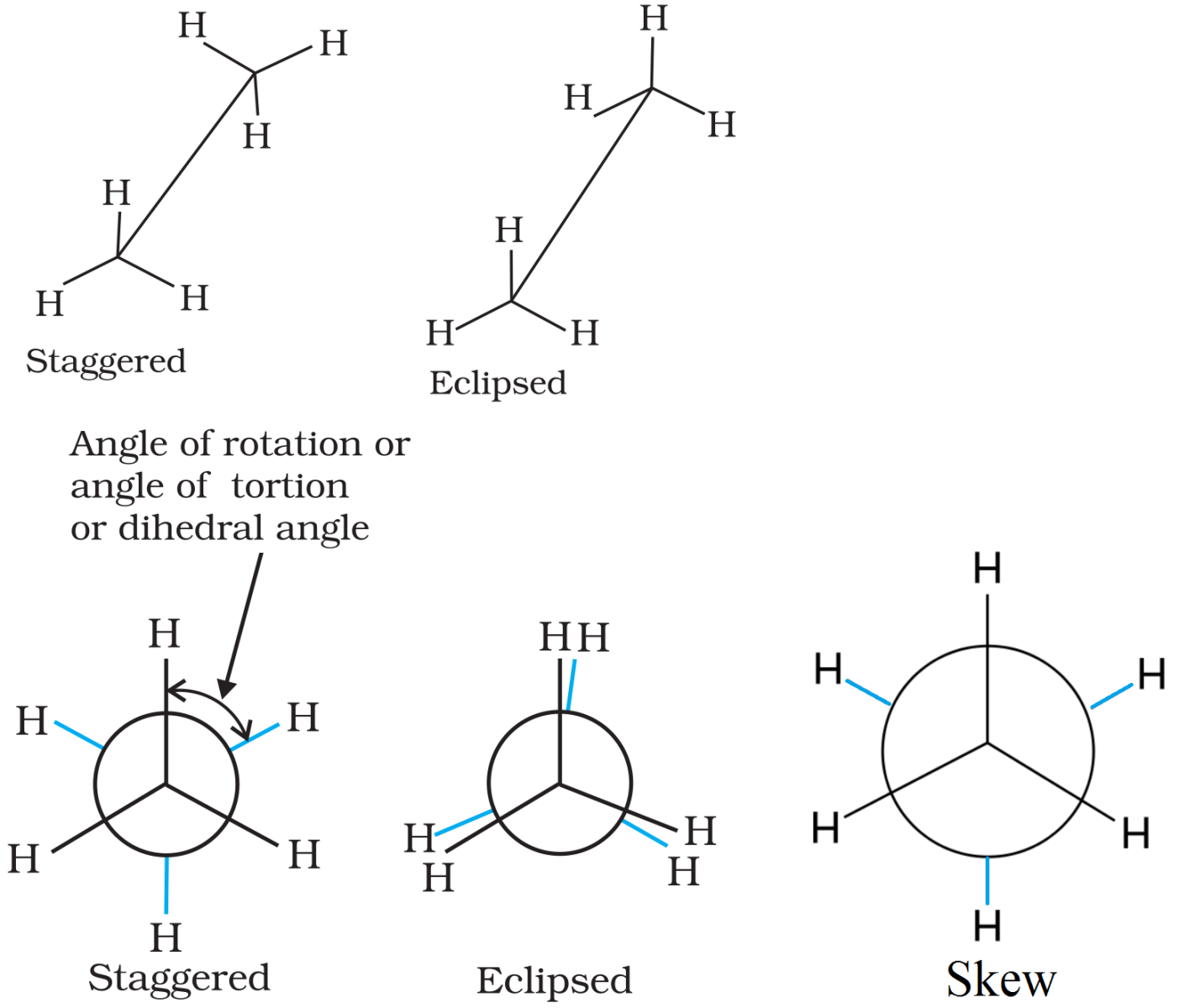
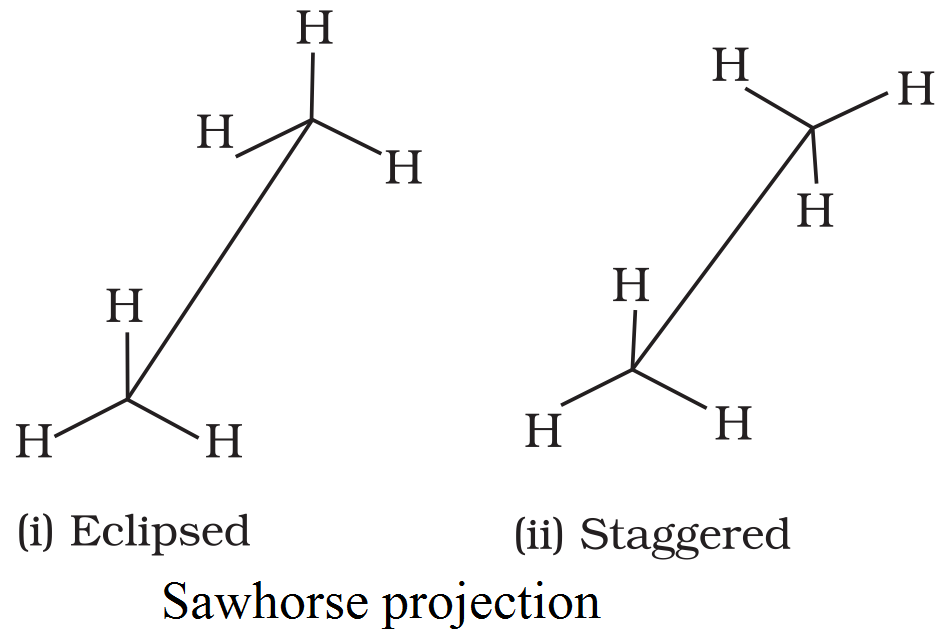
Draw Newman and Sawhorse projections for the eclipsed and staggered conformations of ethane. Which of these conformations is more stable and why?
Answer


In staggered form of ethane, the electron clouds of carbon-hydrogen bonds are as far apart as possible. Thus, there are minimum repulsive forces, minimum energy and maximum stability of the molecule. On the other hand, when the staggered form changes into the eclipsed form, the electron clouds of the carbon-hydrogen bonds come closer to each other resulting in increase in electron cloud repulsions. To check the increased repulsive forces, molecule will have to possess more energy and thus has lesser stability.
View full question & answer
Question 262 Marks
  1. Why is Wurtz reaction is carried out in dry ether?
  2. Why do alkene have higher boiling point than alkane?
Answer
  1. Sodium metal reacts with water, therefore, dry ether is used in Wurtz reaction. Alkyl halide are soluble in dry ether.
  2. Alkenes are more polar than alkanes therefore, have more van der Waals forces of attraction, hence higher boiling point.
View full question & answer
Question 272 Marks
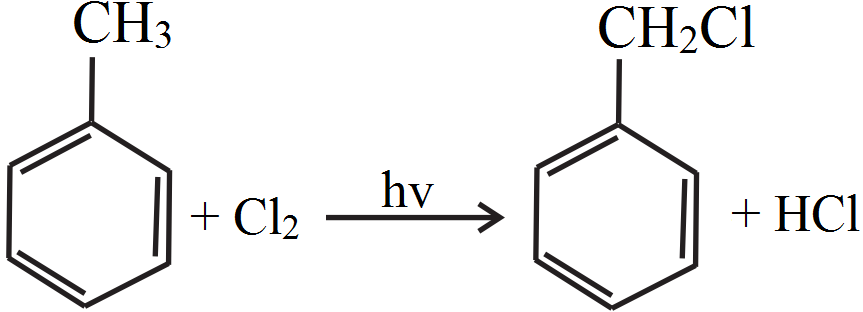
What product is obtained when Toluene is treated with one mole of $\text{Cl}_2$ in presence of sunlight.
Answer


It is free radical substitution reaction.
View full question & answer
Question 282 Marks
Write the reaction for the preparation of butane by (i) Wurtz reaction (ii) Kolbe's reaction.
Answer
  1. Ethyl bromide on reaction with sodium in the presence of dry ether yields butane.
$2\text{C}_2\text{H}_5\text{Br}+2\text{Na}\xrightarrow{\text{Dry ether}}\text{CH}_3\text{CH}_2\text{CH}_2\text{CH}_3+2\text{NaBr}\\ \ \ \ \ \ \ \ \ \ \ \ \ \ \ \ \ \ \ \ \ \ \ \ \ \ \ \ \ \ \ \ \ \ \ \ \ \ \ \ \ \ \ \ \ \ \ \ \ \ \ \ \ \ _{\text{Butane}}$
  1. An aqueous concentrated solution of sodium propanoate on electrolysis yields butane at anode.
​​​​​​​$2\text{CH}_3\text{CH}_2\text{COONa (aq)}+2\text{H}_2\text{O (l)}\xrightarrow{\text{Electrolysis}}\\\text{CH}_3\text{CH}_2\text{CH}_2\text{CH}_3+2\text{CO}_2+\text{H}_2+2\text{NaOH}$​​​​​​​
View full question & answer
Question 292 Marks
An alkene (molecular weight = 56) on reaction with trioxygen followed by $zinc/ CH_3COOH$ gave only ethanal. Identify the structure of the alkene.
Answer
First of all we will derive the molecular formula of alkene, $C_n H_{2 n ;} 12 n+2 n=56$ or $14 n=56$
$\therefore n=4$
Thus, the molecular formula of alkene is $\mathrm{C}_4 \mathrm{H}_8$.
As it is giving only ethanal on reaction with $\mathrm{O}_3$ followed by reduction, the alkene is symmetrical and its structure is,
$ \ \ \ \ \ \ \ \ \text{H} \ \ \ \ \ \ \ \ \ \ \ \ \ \ \ \ \ \ \ \ \ \text{H}\\ \ \ \ \ \ \ \ \ \ | \ \ \ \ \ \ \ \ \ \ \ \ \ \ \ \ \ \ \ \ \ \ \ |\\\text{H}-\text{C}-\text{C}=\text{C}-\text{C}-\text{H}\\ \ \ \ \ \ \ \ \ \ |\ \ \ \ \ \ | \ \ \ \ \ \ \ \ |\ \ \ \ \ \ |\\ \ \ \ \ \ \ \ \ \text{H} \ \ \ \ \text{H} \ \ \ \ \ \ \text{H} \ \ \ \ \ \text{H}\\ \ \ \ \ \ \ \ \ \ \ \ \ \ \ \ _{\text{But-2-ene}}$
View full question & answer
Question 302 Marks
A hydrocarbon containing two double bonds on reductive ozonolysis produces glyoxal, ethanal and propanone. Predict the structure of the hydrocarbon and also give its IUPAC name.
Answer
Step I: Write the structures of the products with their carbonyl group facing one another.
$\text{CH}_3\text{C}=\text{O}\\ \ \ \ \ \ \ \ \ |\\ \ \ \ \ \ \ \ \text{H}\\ \ \ \ _\text{Ethanal}$ $\text{O}=\text{C}-\text{C}=\text{O}\\ \ \ \ \ \ \ \ \ \ |\ \ \ \ \ \ \ |\\ \ \ \ \ \ \ \ \ \text{H} \ \ \ \ \ \text{H}\\ \ \ \ \ \ \ \ _\text{Glyoxal}$ $\text{O}=\text{C}-\text{CH}_3\\ \ \ \ \ \ \ \ \ \ |\\ \ \ \ \ \ \ \ \ \text{CH}_3\\ \ \ \ _{\text{Propanone}}$
Step II: Remove oxygen and put double bonds between the carbonyl carbons.
$\text{CH}_3-\text{C}=\text{C}-\text{C}=\text{C}-\text{CH}_3\\ \ \ \ \ \ \ \ \ \ \ \ \ \ | \ \ \ \ \ \ \ |\ \ \ \ \ \ \ | \ \ \ \ \ \ \ |\\ \ \ \ \ \ \ \ \ \ \ \ \ \text{H} \ \ \ \ \ \text{H} \ \ \ \ \ \text{H} \ \ \ \ \ \text{CH}_3$
Thus, the compound is 2-methyl-2, 4-hexadiene.
View full question & answer
Question 312 Marks
On converting benzene to toluene, state whether there will be a rise or fall in the melting point.
Answer
On converting benzene to toluene, there is a fall in the melting point although toluene has the higher molecular mass. This is because the planar molecules of benzene can pack more closely in the crystal lattice and the cohesive forces are strong, whereas the methyl group in toluene prevents such close packing.
View full question & answer
Question 332 Marks
Write equations for the preparation of
  1. $\text{HC}\equiv\text{CD}$
  2. $\text{DC}\equiv\text{CD}$
Answer
  1. $\text{HC}\equiv\text{CH}\xrightarrow{\text{NaNH}_2}\text{HC}\equiv\text{C}^-\text{Na}^+\xrightarrow{\text{D}_2\text{O}}\text{HC}\equiv\text{CD}$
  2. $\text{HC}\equiv\text{CH}\xrightarrow{2\text{Na}}\text{Na}^+\text{C}^{-}\equiv\text{C}^-\text{Na}^+\xrightarrow{\text{D}_2\text{O}}\text{DC}\equiv\text{CD}$
View full question & answer
Question 342 Marks
Give the structure of alkyl halide which when treated with sodium metal in presence of ether gives $\left(\mathrm{CH}_3\right)_2 \mathrm{CH}-\mathrm{CH}\left(\mathrm{CH}_3\right)_2$.
View full question & answer
Question 352 Marks
Suggest a route to prepare ethyl hydrogensulphate $(\text{CH}_3 – \text{CH}_2 – \text{OSO}_2 – \text{OH})$ starting from ethanol $(\text{C}_2\text{H}_5\text{OH})$.
Answer
Preparation of ethyl hydrogen sulphate $[\text{CH}_3\text{CH} - \text{OSO}_2 - \text{OH}]$ starting from ethanol.
Step 1: Protonation of alcohol and formation of carbocation,
$\text{H}_2\text{SO}_4\rightarrow\text{H}^++\ ^-\text{OSO}_2\text{OH}$
$\text{CH}_3-\text{CH}_2-\text{O}-\text{H}+\text{H}^+\rightarrow\text{CH}_3-\text{CH}_2-\ ^+\text{OH}_2$
$\text{CH}_3-\text{CH}_2-\ ^+\text{OH}_2\rightarrow\text{CH}_3-\ ^+\text{CH}_2+\text{H}_2\text{O}$
Step 2: Attack of nucleophile,
$\text{HO}-\text{SO}_2-\text{O}^-+\ ^+\text{CH}_2-\text{CH}_3\rightarrow\text{CH}_3-\text{CH}_2-\text{O}-\text{SO}_2-\text{OH}$
View full question & answer
Question 362 Marks
Explain why the following systems are not aromatic?
Answer


Due to the presence of a sp3-hybridized carbon, the system is not planar. It does contain six n-electrons but the system is not fully conjugated since all the six n-electrons do not form a single cyclic electron cloud which surrounds all the atoms of the ring. Therefore, it is not an aromatic compound.
View full question & answer
Question 382 Marks
Complete the following reactions:
  1. $(\text{CH}_3)_2\text{C}=\text{CH}-\text{CH}_3\xrightarrow[\text{heat}]{\text{KMnO}_4/\text{KOH}}$
  2. $(\text{CH}_3)_2\text{C}=\text{CH}-\text{CH}_3\xrightarrow{\text{cold KMnO}_4/\text{KOH}}$
Answer
  1. $\ \ \ \ \ \ \ \ \ \ \ \ \ \ \ \text{CH}_3\\ \ \ \ \ \ \ \ \ \ \ \ \ \ \ \ \ |\$\text{CH}_3)-\text{C}=\text{CH}-\text{CH}_3\xrightarrow[\text{heat}]{\text{KMnO}_4/\text{KOH}}\\ \ \ \ \ \ \ \ \ \ \ \ \ \ \text{O}\\ \ \ \ \ \ \ \ \ \ \ \ \ \ ||\\\\\text{CH}_3-\text{C}-\text{CH}_3+\text{CH}_3\text{COOH}$
  2. $\ \ \ \ \ \ \ \ \ \ \ \ \ \ \ \ \text{CH}_3\\ \ \ \ \ \ \ \ \ \ \ \ \ \ \ \ \ \ |\$\text{CH}_3)-\text{C}=\text{CH}-\text{CH}_3\xrightarrow{\text{cold KMnO}_4/\text{KOH}}\\ \ \ \ \ \ \ \ \ \ \ \ \ \ \text{CH}_3\\ \ \ \ \ \ \ \ \ \ \ \ \ \ |\\ \text{CH}_3-\text{C}-\text{CH}-\text{CH}_3\\ \ \ \ \ \ \ \ \ \ \ \ \ \ |\ \ \ \ \ \ \ |\\ \ \ \ \ \ \ \ \ \ \ \ \ \text{OH} \ \ \text{OH}$
View full question & answer
Question 392 Marks
Give the product when 1-methyl cyclohexene reacts with
(i) aq. acidified $\mathrm{KMnO}_4$
(ii) $\mathrm{O}_3$ followed by $\mathrm{Zn} / \mathrm{CH}_3 \mathrm{COOH}$
Answer
  1.  
  1.  
View full question & answer
Question 402 Marks
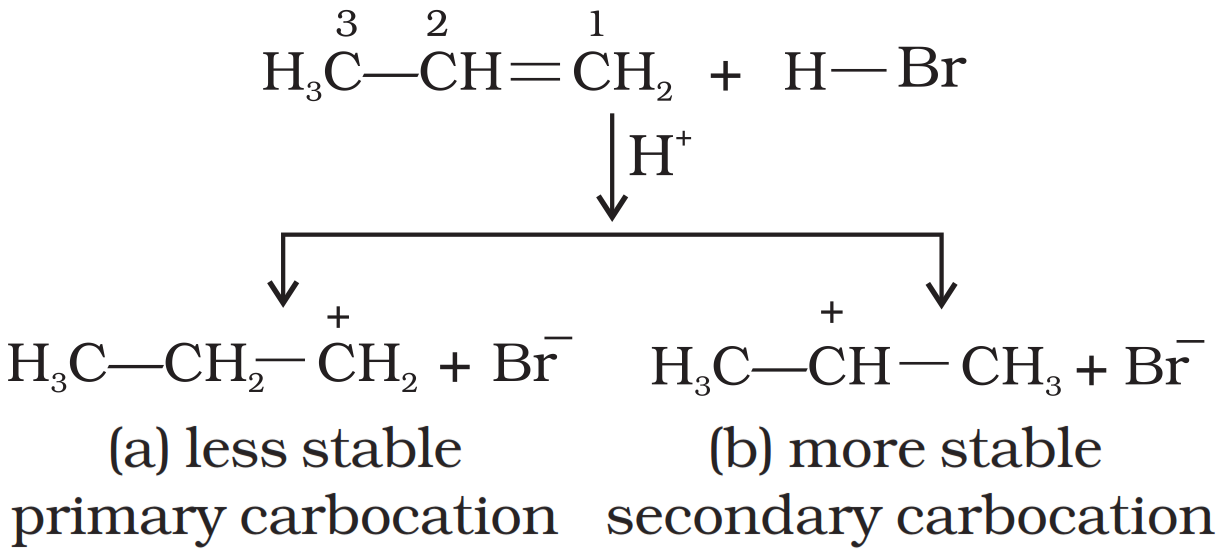
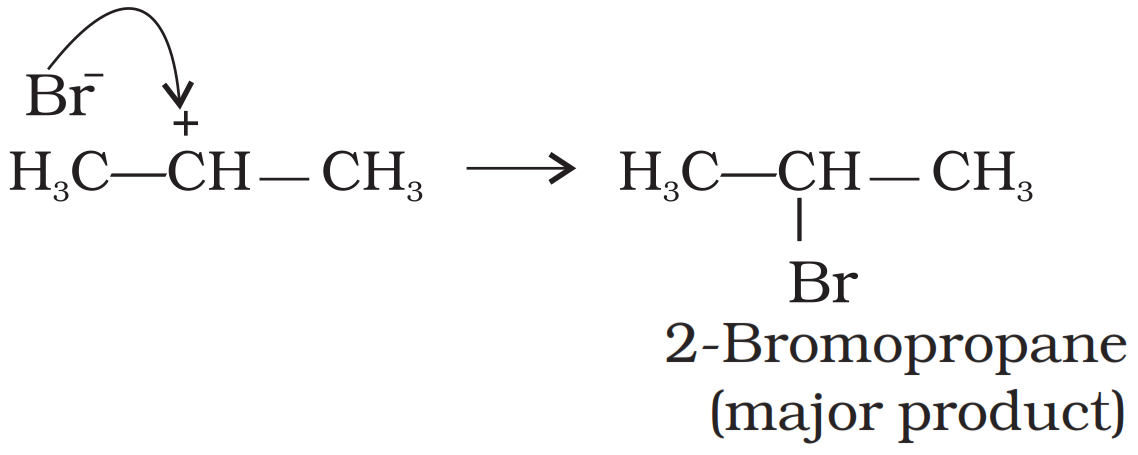
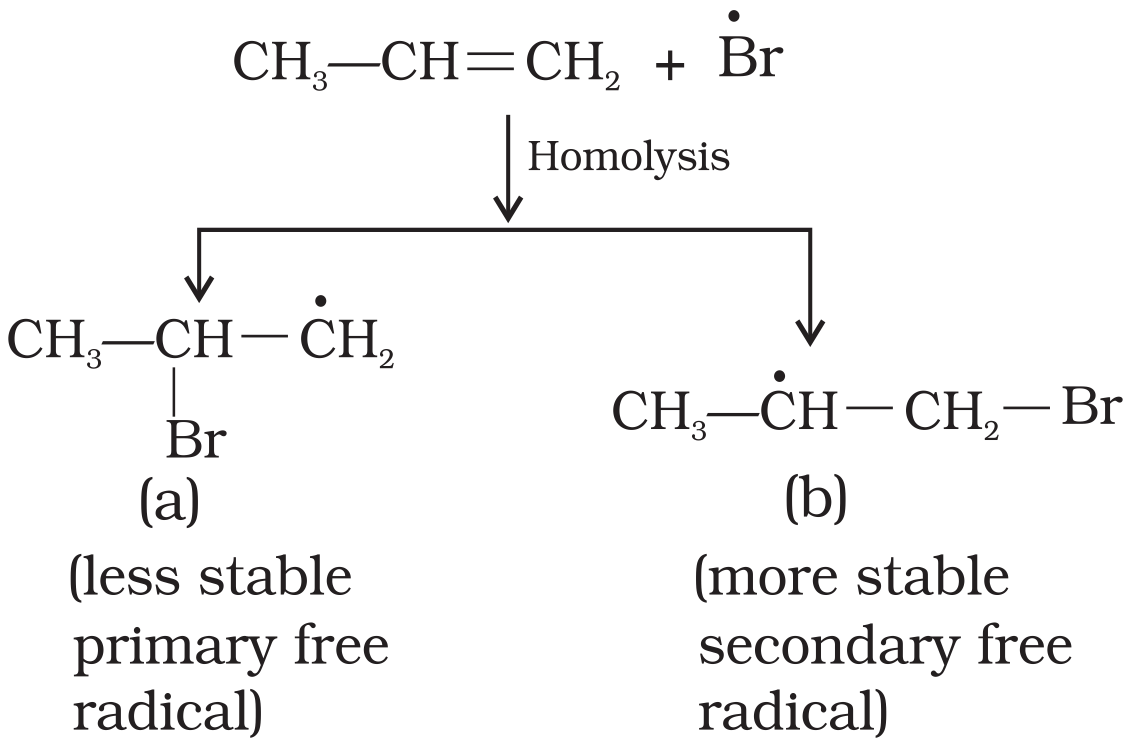
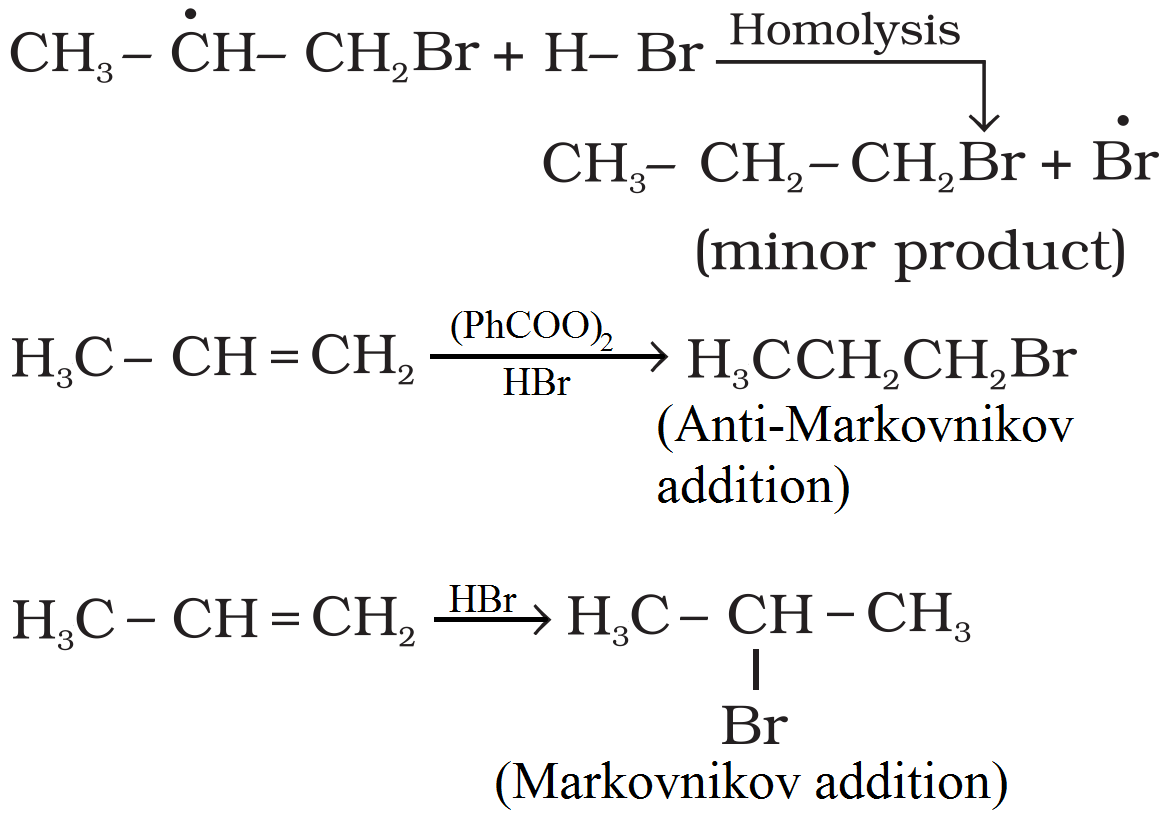
Predict the major product (s) of the following reactions and explain their formation. $\text{H}_3\text{C}-\text{CH}=\text{CH}_2\xrightarrow [\text{HBr}] {(\text{Ph-CO-O})_2}$ $\text{H}_3\text{C}-\text{CH}=\text{CH}_2\xrightarrow{\text{HBr}}$
Answer
Addition of HBr to unsymmetrical alkenes follows Markonikov rule. It states that negative part of the addendum (adding molecule) gets attached to that carbon atom which possesses lesser number of hydrogen atoms.
Mechanism: Hydrogen bromide provides an electrophile, $H^+$, which attacks the double bond to form carbocation as shown below:

The carbocation (b) is attacked by $Br^-$​​​​​​​ ion to from the product as follows:

Addition reaction of HBr to unsymmetrical alkenes in the presence of peroxide follows anti-Markovnikov rule.
Mechanism: Peroxide effect proceeds via free radical chain mechanism as given below:
  1.  
  1.  
  1.  
  1.  
View full question & answer
Question 412 Marks
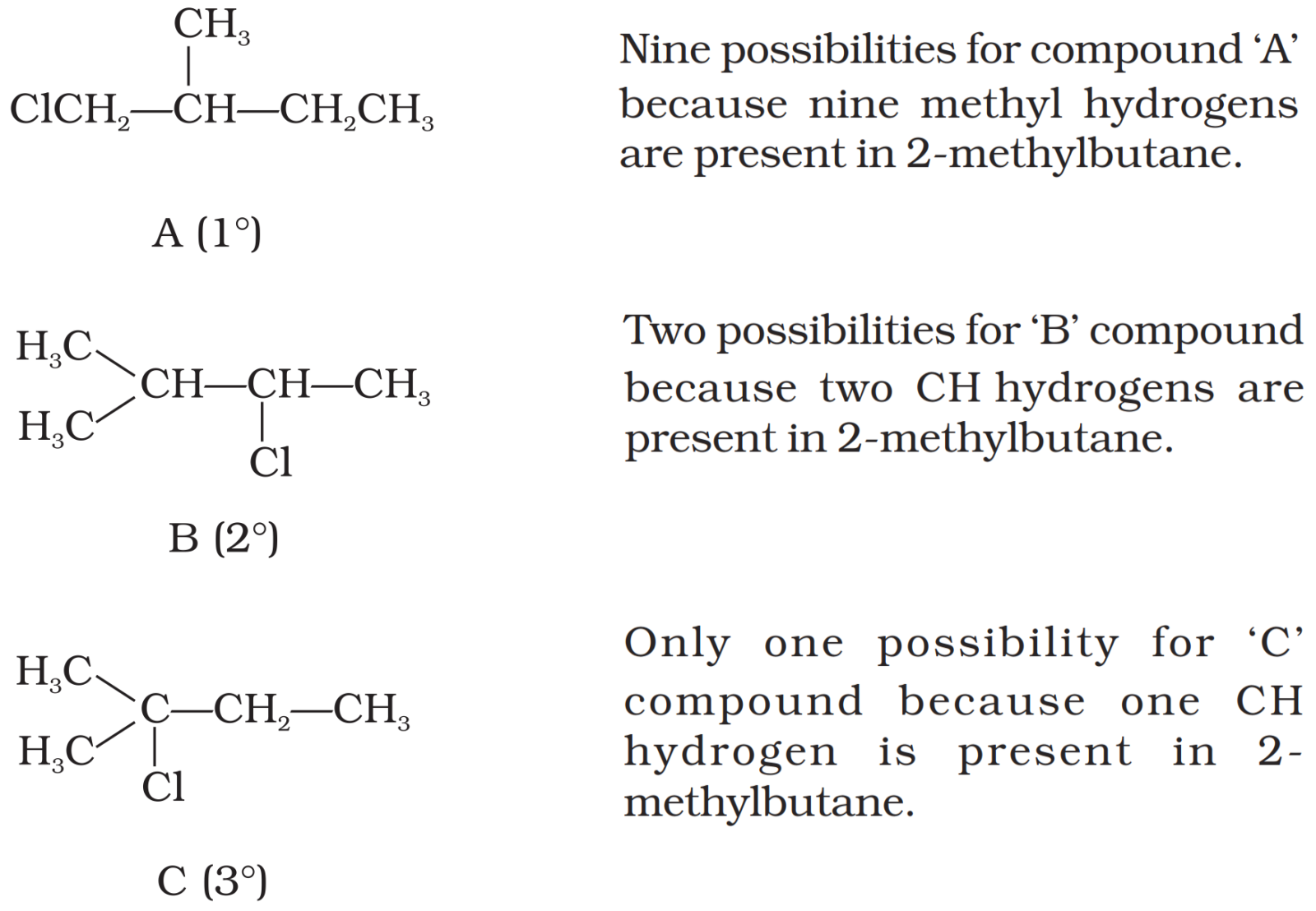
The relative reactivity of 1°, 2°, 3° hydrogen’s towards chlorination is 1 : 3.8 : 5. Calculate the percentages of all monochlorinated products obtained from 2-methylbutane.
Answer

Methyl butane is,
$\ \ \ \ \ \ \ \ \ \ \ \ \ \text{CH}_3\\\ \ \ \ \ \ \ \ \ \ \ \ \ \ |\\\text{CH}_3-\text{CH}-\text{CH}_2-\text{CH}_3$
Possible compounds are A, B and C given below:

Relative amounts of A, B and C compounds = number of hydrogen × relative reactivity
 
A (1°)
B (2°)
C (3°)
Relative amount:
9 × 1 = 9
2 × 3.8 = 7.6
1 × 5 = 5
Total Amount of monohaloginated = 9 + 7.6 + 5 = 21.6
Percentage of A $=\frac{9}{21.6}\times100=41.7\%$
Percentage of B $=\frac{7.6}{21.6}\times100=35.2\%$
Percentage of C $=\frac{5}{21.6}\times100=23.1\%$
View full question & answer
Question 422 Marks

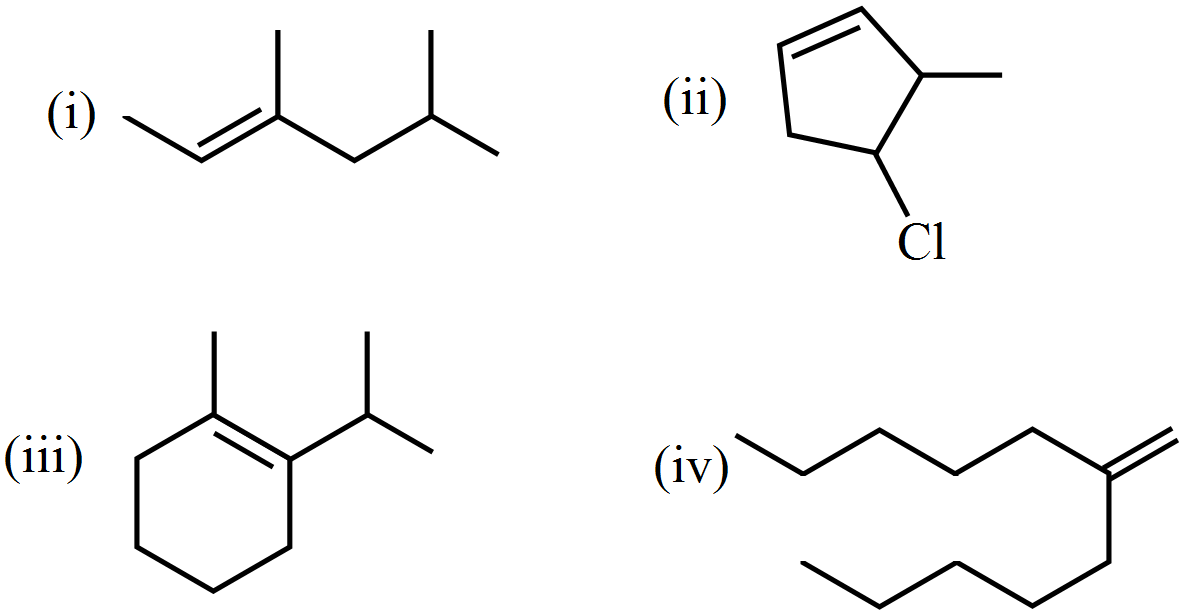
Give the IUPAC names of each of the following:
Answer
  1. 3, 5-dimethyl-2-hexene or 3, 5-dimethylhex-2-ene.
  2. 4-chloro-3-methylcyclopentene.
  3. 1-sec-butyl-2-methylcyclohexene or 1-methyl-2-(1-methylpropyl) cyclohexene.
  4. 2-pentyl-1-heptene or 2-pentylhept-1-ene.
View full question & answer
Question 432 Marks
Write the structures of products (A and B) of the following reactions:
  1. $\text{HC}\equiv\text{CH}\xrightarrow{\text{Na}}\text{A}\xrightarrow{\text{CH}_3\text{Br}}\text{B}$
  2. $\text{BrH}_2\text{C}-\text{CH}_2\text{Br}\xrightarrow[\text{KOH}]{\text{Alcoholic}}\text{A}\xrightarrow{\text{NaNH}_2}\text{B}$
Answer
  1. $\text{HC}\equiv\text{CH}\xrightarrow{\text{Na}}\text{HC}\equiv\text{CNa}\xrightarrow{\text{CH}_3\text{Br}}\text{HC}\equiv\text{C}-\text{CH}_3\\ \ \ \ \ \ \ \ \ \ \ \ \ \ \ \ \ \ \ \ \ \ \ \ \ \ \ \ \ \ \ \ \text{‘A’}\ \ \ \ \ \ \ \ \ \ \ \ \ \ \ \ \ \ \ \ \ \ \ \ \ \ \ \ \ \ \ \ \ \text{‘B’}\\ \ \ \ \ \ \ \ \ \ \ \ \ \ \ \ \ \ \ \ \ \ \ \ \ \ \ \ \ \ \ \ \ \ \ \ \ \ \ \ \ \ \ \ \ \ \ \ \ \ \ \ \ \ \ \ \ \ \ \ \ \ \ \ \ \ \text{Propyne}$
  2. $\text{BrH}_2\text{C}-\text{CH}_2\text{Br}\xrightarrow[\text{KOH}]{\text{Alcoholic}}\text{CH}_2=\text{CHBr}\xrightarrow{\text{NaNH}_2}\text{HC}\equiv\text{CH}\\ \ \ \ \ \ \ \ \ \ \ \ \ \ \ \ \ \ \ \ \ \ \ \ \ \ \ \ \ \ \ \ \ \ \ \ \ \ \ \ \ \ \ \ \ \ \ \ \ \ \ \ \ \ \text{​​‘A’} \ \ \ \ \ \ \ \ \ \ \ \ \ \ \ \ \ \ \ \ \ \ \ \ \ \ \ \ \ \ \text{​​‘B’}$
View full question & answer
Question 442 Marks
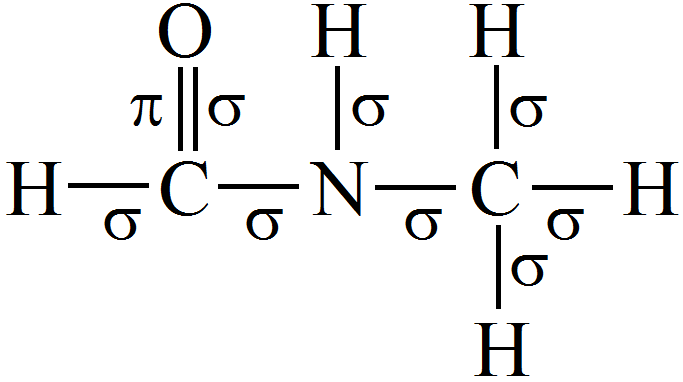
  1. Indicate the number of $\sigma$ and $\pi$ bonds in $\mathrm{HCONHCH}_3$.
  2. Convert Ethylene to Acetylene.
Answer
  1.  

Number of $\sigma-$bonds = 8
Number of $\pi-$bonds = 1
  1. $\text{CH}_2=\text{CH}_2+\text{Br}_2\xrightarrow{ \ \ \ \ }\text{CH}_2-\text{CH}_2+\text{KOH(alc)}\\\ \ \ \ \ \ _{\text{Ethylene}} \ \ \ \ \ \ \ \ \ \ \ \ \ \ \ \ \ \ \ \ \ \ \ | \ \ \ \ \ \ \ \ \ \ \ |\\ \ \ \ \ \ \ \ \ \ \ \ \ \ \ \ \ \ \ \ \ \ \ \ \ \ \ \ \ \ \ \ \ \ \ \ \ \ \ \ \ \text{Br} \ \ \ \ \ \ \ \text{Br}\\ \ \ \ \ \ \ \ \ \ \ \ \ \ \ \ \ \ \ \ \ \ \ \ \ \ \ \ \ \ \ \ \ \ \ \ _{1,\ 2-\text{Dibromo ethane}}\\\xrightarrow{\ \ \ \ \ \ }\text{CH}_2=\text{CHBr}\xrightarrow{\text{KOH alc.}}\text{HC}=\text{CH}\\ \ \ \ \ \ \ \ \ \ \ \ _{\text{Bromoethene}}\ \ \ \ \ \ \ \ \ \ \ \ \ \ \ \ \ \ \ \ \ \ \ _{\text{Acetylene}}$
View full question & answer
Question 452 Marks
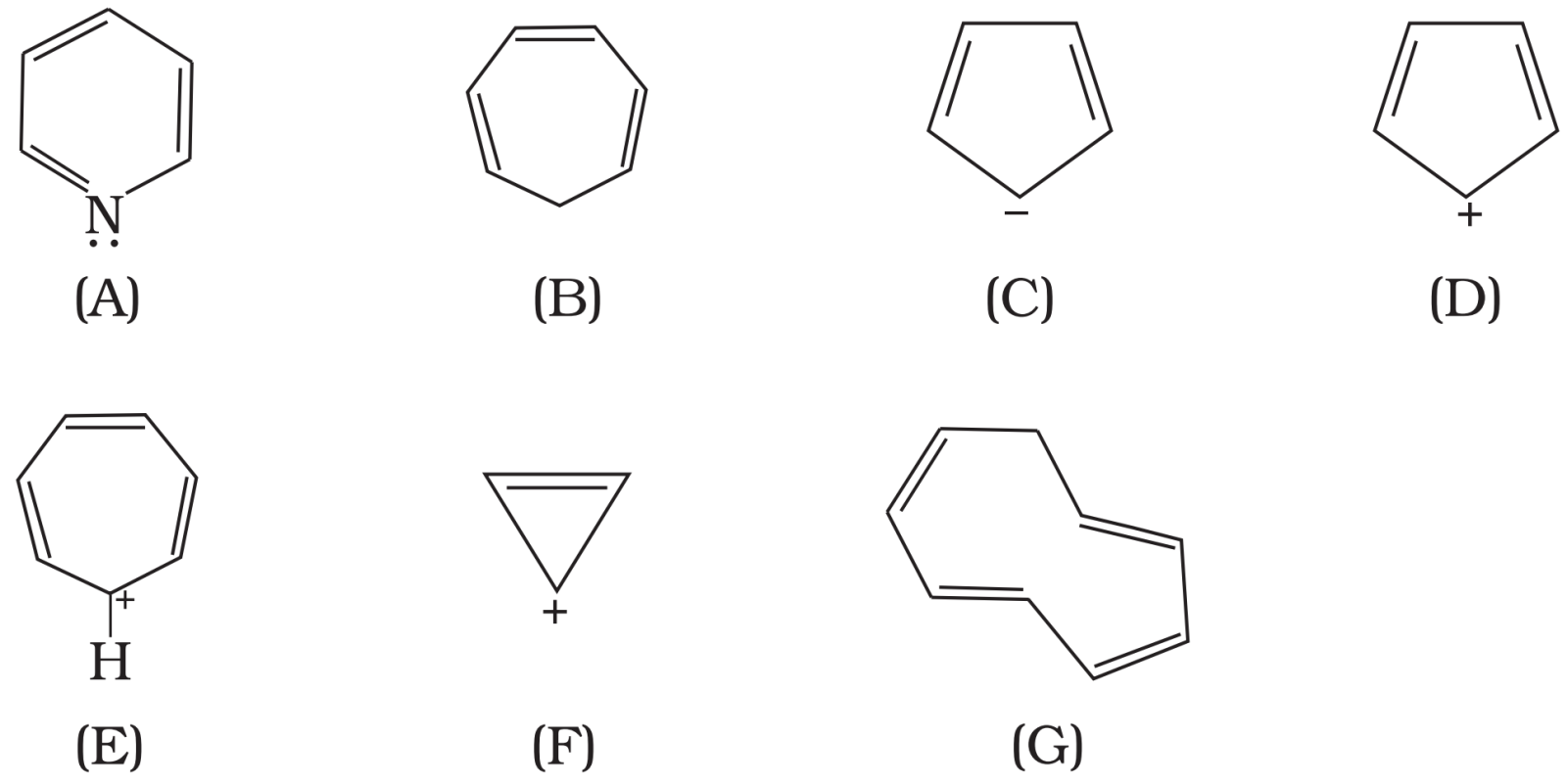
The ring systems having following characteristics are aromatic.
  1. Planar ring containing conjugated $\pi$ bonds.
  2. Complete delocalisation of the $\pi$−electrons in ring system i.e. each atom in the ring has unhybridised p-orbital, and
  3. Presence of (4n + 2)$\pi$−electrons in the ring where n is an integer (n = 0, 1, 2, ..........) [Huckel rule].
Using this information classify the following compounds as aromatic/ nonaromatic.
Answer
$\mathrm{A}=$ Planar ring, all atoms of the ring $\mathrm{sp}^2$ hybridised, has six delocalised $\pi$-electrons, follows Huckel rule. It is aromatic. $\mathrm{B}=$ Has six $\pi$-electrons, but the delocalisation stops at $\mathrm{sp}^3$ hybridised $\mathrm{CH}_2$ - carbon. Hence, not aromatic. C $=$ Six delocalised $\pi$-electrons ( $4 \pi$ electrons +2 unshared electrons on negatively charged carbon) in a planar ring, follows Huckel's rule. It is aromatic. $\mathrm{D}=$ Has only four delocalised $\pi$-electrons. It is non aromatic. $\mathrm{E}=$ Six delocalised $\pi$-electrons follows Huckel's rule. $\pi$-electrons are in $\mathrm{sp}^2$ hybridised orbitals, conjugation all over the ring because of positively charged carbon. The ring is planar hence is aromatic. F = Follows Huckel's rule, has $2 \pi$ electrons i.e. ( $4 \mathrm{n}+$ 2) $\pi$-electrons where $(n=0)$, delocalised $\pi$-electrons. It is aromatic. $G=8 \pi$ electrons, does not follow Huckel's rule i.e., $(4 n+2) \pi$-electrons rule. It is not aromatic.
View full question & answer
Question 462 Marks
An alkyl bromide (X) react with sodium metal dissolved in anhydrous ether to form 4, 5-diethyl octane. Identify 'X'.
Answer
$2\text{CH}_3-\text{CH}_2-\text{CH}_2-\text{CH}-\text{CH}_2-\text{CH}_3+2\text{Na}\xrightarrow[\text{Ether}]{\text{Anhydrous}}\\ \ \ \ \ \ \ \ \ \ \ \ \ \ \ \ \ \ \ \ \ \ \ \ \ \ \ \ \ \ \ \ \ \ \ \ \ \ \ \ \ |\\ \ \ \ \ \ \ \ \ \ \ \ \ \ \ \ \ \ \ \ \ \ \ \ \ \ \ \ \ \ \ \ \ \ \ \ \ \ \ \ \text{Cl}\\ \ \ \ \ \ \ \ \ \ \ \ \ \ \ \ \ \ \ \ \ \ \ \ \ \ \ \ \ \ _{3-\text{chloro hexane}}\\{\stackrel{{1}}{\ \ \ \hbox{ CH}_3}}-{\stackrel{{2}}{\ \ \ \hbox{ CH}_2}}-{\stackrel{{3}}{\ \ \ \hbox{ CH}_2}}-{\stackrel{{4}}{\ \ \ \hbox{ CH}}}-{\stackrel{{5}}{\ \ \ \hbox{ CH}}}-{\stackrel{{6}}{\ \ \ \hbox{ CH}}}_2-{\stackrel{{7}}{\ \ \ \hbox{ CH}}}_2-{\stackrel{{8}}{\ \ \ \hbox{ CH}}}_3\\ \ \ \ \ \ \ \ \ \ \ \ \ \ \ \ \ \ \ \ \ \ \ \ \ \ \ \ \ \ \ \ \ \ \ \ \ \ \ \ \ \ \ \ \ \ \ \ \ \ \ \ \ \ \ | \ \ \ \ \ \ \ \ \ \ \ \ \ \ |\\ \ \ \ \ \ \ \ \ \ \ \ \ \ \ \ \ \ \ \ \ \ \ \ \ \ \ \ \ \ \ \ \ \ \ \ \ \ \ \ \ \ \ \ \ \ \ \ \ \ \ \ \ \ \text{C}_2\text{H}_5\ \ \ \ \ \ \text{C}_2\text{H}_5\\ \ \ \ \ \ \ \ \ \ \ \ \ \ \ \ \ \ \ \ \ \ \ \ \ \ \ \ \ _{4,\ 5-\text{Diethyl octane}}$
View full question & answer