Questions

3 Marks Question

Take a timed test

42 questions · 1 auto-graded MCQ + 41 self-marked written.

Question 13 Marks
Why are lithium salts commonly hydrated and those of the other alkali ions usually anhydrous?
Answer
Lithium is the smallest in size among the alkali metals. Hence, $\mathrm{Li}^{+}$ion can polarize water molecules more easily than other alkali metals. As a result, water molecules get attached to lithium salts as water of crystallization. Hence, lithium salts such as trihydrated lithium chloride $\left(\mathrm{LiCl} .3 \mathrm{H}_2 \mathrm{O}\right)$ are commonly hydrated. As the size of the ions increases, their polarizing power decreases. Hence, other alkali metal ions usually form anhydrous salts.
View full question & answer
Question 23 Marks
Why is LiF almost insoluble in water whereas LiCl soluble not only in water but also in acetone?
Answer
Insolubility of LiF in water can be elucidated as follows:
The lithium ion has the highest energy of hydration as it is small in size in comparison to the other alkali metal ions and so it should be highly soluble. But the small $\mathrm{Li}^{+}$and F ions interact very strongly resulting in high lattice energy of LiF which is responsible for its insolubility whereas in LiCl due to the difference in atomic size between $\mathrm{Li}^{+}$and $\mathrm{Cl}^{-}$, they do not interact very strongly, the lattice energy is comparatively small and the magnitude of hydration enthalpy is quite large. Therefore, LiCl dissolves in water. As LiCl has more covalent character than LiF (Fajan's rule) thus, it is soluble in organic solvents like acetone.
View full question & answer
Question 33 Marks
Draw the structure of
(i) $\mathrm{BeCl}_2$​​​​​​​ (vapour)
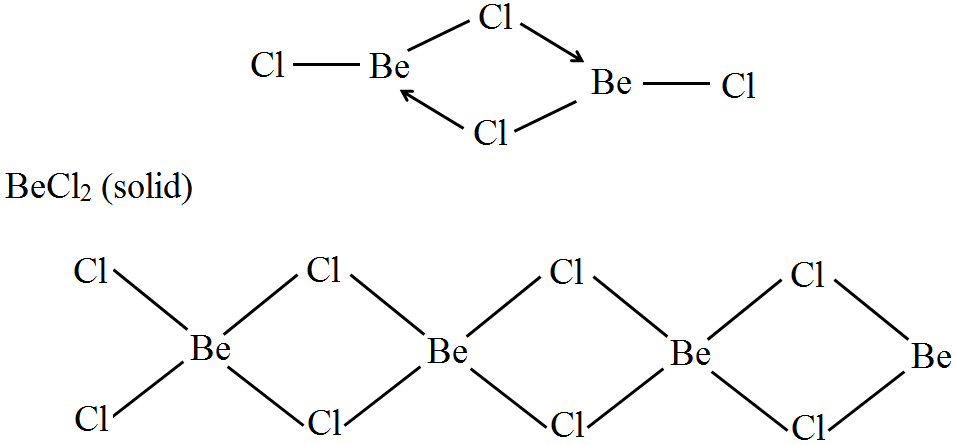
(ii) $\mathrm{BeCl}_2$ (solid).
Answer
$\mathrm{BeCl}_2$ (vapour)
In the vapour state, it exists as a chlorobridged dimer.
View full question & answer
Question 43 Marks
Beryllium and magnesium do not give colour to flame whereas other alkaline earth metals do so. Why?
Answer
When an alkaline earth metal is heated, the valence electrons get excited to a higher energy level. When this excited electron comes back to its lower energy level, it radiates energy, which belongs to the visible region. Hence, the colour is observed. In Be and Mg, the electrons are strongly bound. The energy required to excite these electrons is very high. Therefore, when the electron reverts back to its original position, the energy released does not fall in the visible region. Hence, no colour in the flame is seen.
View full question & answer
MCQ 53 Marks
Which one of the following alkali metals gives hydrated salts?
  • Li
  • B
    Na
  • C
    K
  • D
    Cs
Answer
Correct option: A.
Li
  1. Li
Explanation:
Smaller the size of an ion, the more highly is it hydrated. Among the given alkali metals, Li is the smallest in size. Also, it has the highest charge density and highest polarising power. Hence, it attracts water molecules more strongly than the other alkali metals. As a result, it forms hydrated salts such as $\mathrm{LiCl} .2 \mathrm{~H}_2 \mathrm{O}$. The other alkali metals are larger than Li and have weaker charge densities. Hence, they usually do not form hydrated salts.
View full question & answer
Question 63 Marks
Why is $\mathrm{Li}_2 \mathrm{CO}_3$ decomposed at a lower temperature whereas $\mathrm{Na}_2 \mathrm{CO}_3$ at higher temperature?
Answer
$\mathrm{Li}_2 \mathrm{CO}_3$ decomposes on heating because the $\mathrm{Li}^{+}$ion exerts a strong polarising action and distorts the electron cloud of the nearby oxygen atom of the large $\mathrm{CO}_3^{2-}$ ion. This results in the weakening of the $\mathrm{C}-\mathrm{O}$ bond and strengthening of the $\mathrm{Li}-\mathrm{O}$ bond. This ultimately facilitates the decomposition of $\mathrm{Li}_2 \mathrm{CO}_3$ into $\mathrm{Li}_2 \mathrm{O}$ and $\mathrm{CO}_2$. The lattice energy of $\mathrm{Li}_2 \mathrm{O}$ is higher than the lattice energy of $\mathrm{Li}_2 \mathrm{CO}_3$. This also favours decomposition of $\mathrm{Li}_2 \mathrm{CO}_3 . \mathrm{Na}^{+}$ion being bigger in size, the lattice energy of $\mathrm{Na}_2 \mathrm{O}$ is less stable than that of $\mathrm{Na}_2 \mathrm{CO}_3$. Therefore, $\mathrm{Na}_2 \mathrm{CO}_3$, does not decompose on heating.
View full question & answer
Question 73 Marks
State as to why:
Alkali metals are prepared by electrolysis of their fused chlorides?
Answer
It is not possible to prepare alkali metals by the chemical reduction of their oxides as they themselves are very strong reducing agents. They cannot be prepared by displacement reactions either (wherein one element is displaced by another). This is because these elements are highly electropositive. Neither can electrolysis of aqueous solutions be used to extract these elements. This is because the liberated metals react with water.
Hence, to overcome these difficulties, alkali metals are usually prepared by the electrolysis of their fused chlorides.
View full question & answer
Question 83 Marks
Compare the alkali metals and alkaline earth metals with respect to (i) Ionisation enthalpy (ii) Basicity of oxides and (iii) Solubility of hydroxides.
Answer
 
Alkali metals
 
Alkaline earth metals
(i)
Ionization enthalpy: These have lowest ionization enthalpies in respective periods. This is because of their large atomic sizes. Also, they lose their only valence electron easily as they attain stable noble gas configuration after losing it.
(i)
Ionization enthalpy: Alkaline earth metals have smaller atomic size and higher effective nuclear charge as compared to alkali metals. This causes their first ionization enthalpies to be higher than that of alkali metals. However, their second ionization enthalpy is less than the corresponding alkali metals. This is because alkali metals, after losing one electron, acquires noble gas configuration, which is very stable.
(ii)
Basicity of oxides: The oxides of alkali metals are very basic in nature. This happens due to the highly electropositive nature of alkali metals, which makes these oxides highly ionic. Hence, they readily dissociate in water to give hydroxide ions.
(ii)
Basicity of oxides: The oxides of alkaline earth metals are quite basic but not as basic as those of alkali metals. This is because alkaline earth metals are less electropositive than alkali metals.
(iii)
Solubility of hydroxides: The hydroxides of alkali metals are more soluble than those of alkaline earth metals.
(iii)
Solubility of hydroxides: The hydroxides of alkaline earth metals are less soluble than those of alkali metals. This is due to the high lattice energies of alkaline earth metals. Their higher charge densities (as compared to alkali metals) account for higher lattice energies.
View full question & answer
Question 93 Marks
i. Why $\mathrm{BeCO}_3$ kept in atmosphere of $\mathrm{CO}_2$ ?
ii. What happens $\mathrm{Li}_2 \mathrm{CO}_3$ is heated? Give chemical equation.
Answer
i. $\mathrm{BeCO}_3$ is unstable and decomposes to give BeO and $\mathrm{CO}_2$. In atmosphere of $\mathrm{CO}_2$, BeO will combine with $\mathrm{CO}_2$ to form $\mathrm{BeCO}_3$ again.
ii. $\mathrm{Li}_2 \mathrm{CO}_3 \xrightarrow{\Delta} \mathrm{Li}_2 \mathrm{O}+\mathrm{CO}_2$
$\mathrm{LiCO}_3$ is covalent therefore, decomposes to form $\mathrm{Li}_2 \mathrm{O}$ and $\mathrm{CO}_2$.
View full question & answer
Question 103 Marks
Why are $\mathrm{BeSO}_4$ and $\mathrm{MgSO}_4$ readily soluble in water while $\mathrm{CaSO}_4, \mathrm{SrSO}_4$ and $\mathrm{BaSO}_4$ are insoluble?
Answer
The hydration enthalpies of $\mathrm{BeSO}_4$ and $\mathrm{MgSO}_4$ are quite high because of small size of $\mathrm{Be}^{2+}$ and $\mathrm{Mg}^{2+}$ ions. These hydration enthalpy values are higher than their corresponding lattice enthalpies and therefore, $\mathrm{BeSO}_4$ and $\mathrm{MgSO}_4$ are highly soluble in water. However, hydration enthalpies of $\mathrm{CaSO}_4, \mathrm{SrSO}_4$ and $\mathrm{BaSO}_4$ are not very high as compared to their respective lattice enthalpies and hence these are insoluble in water.
View full question & answer
Question 113 Marks
Lithium resembles magnesium in some of its properties. Mention two such properties and give reasons for this resemblance.
Answer
Atomic radii : $\mathrm{Li}=152 \mathrm{pm}, \mathrm{Mg}=160 \mathrm{pm}$; ionic radii : $\mathrm{Li}^{+}=76 \mathrm{pm}, \mathrm{Mg}^{2+}=72 \mathrm{pm}$. The main points of simillarity is due to similar ionic radii, Two points of resemblance are:
  1. Lithium and magnesium react slowly with water. Their oxides and hydroxides are much less soluble and their hydroxides decompose on heating .
$2\text{LiOH}(\text{on heating})\xrightarrow{\ \ \ \ }\text{Li}_2\text{O}+\text{H}_2\text{O}$

$2\text{Mg(OH})_2(\text{on heating})\xrightarrow{\ \ \ \ }\text{Mg}_2\text{O}+2\text{H}_2\text{O}$
  1. Both form nitride, $Li_3N$ and $Mg_3N_2$, by direct combination with nitrogen.
$6\text{Li}+\text{N}_2\xrightarrow{\ \ \ }2\text{Li}_3\text{N}$

$3\text{Mg}+\text{N}_2\xrightarrow{\ \ \ \ }\text{Mg}_3\text{N}_2$
View full question & answer
Question 123 Marks
The alkali and alkaline earth metals characterized by their large atomic sizes, lower ionisation enthalpies, invariable +1 oxidaton state and solubility of their oxo salts. In the light of these features describe the nature of oxides, halides and oxo salts.
Answer
Nature of oxides: They forms basic oxides. Basic character of oxides increases down the group because electropositive character increases, solubility in water increases.
Nature of halide:
  • All of them form ionic halides except lithium which forms covalent halides.
  • All are soluble in water but lithium halides are more soluble in organic solvents.
Nature of oxo salts:
  • Carbonates are thermally stable and soluble in water except $\mathrm{Li}_2 \mathrm{CO}_3$.
  • Sulphates are soluble in water
  • Hydrogen carbonates are soluble in water
  • Nitrates are soluble in water.
View full question & answer
Question 133 Marks
Write the formula of Plaster of Paris and its main uses.
Answer
Plaster of Paris $(\text{CaSO}_4.\frac{1}{2}\text{H}_2\text{O})$
Uses:
  1. Making statues.
  2. Plastering of bones during fracture.
View full question & answer
Question 143 Marks
Give reasons:
  1. Beryllium halides are polymeric.
  2. $Be(OH)_2$ dissolves in NaOH but $Mg(OH)_2$ does not.
  3. MgO is used as refractory material.
Answer
  1. $BeCl_2$ is lewis acid, electron deficient, therefore, forms polymeric structure.
  2. $Be(OH)_2$​​​​​​​ is amphoteric therefore, dissolves in NaOH but $Mg(OH)_2​​​​​​​$​​​​​​​ is basic does not react with NaOH.
$\text{Be(OH)}_2+2\text{NaOH}\xrightarrow{\ \ \ \ \ \ \ \ }\text{Na}_2[\text{Be(OH)}_4]\\ \ \ \ \ \ \ \ \ \ \ \ \ \ \ \ \ \ \ \ \ \ \ \ \ \ \ \ \ \ \ \ \ \ \ \ \ \ \ \ \ \ \ \ \ \ \ \text{(Soluble)}$
  1. MgO has high melting point due to high lattice energy, therefore, used as refractory material.
View full question & answer
Question 153 Marks
  1. What is the biological importance of Na in our body?
  2. Mention two similarities in the behaviour of Be and Al to show that they have diagonal relationship.
Answer
  1. $\mathrm{Na}^+$ ions help in transmission of nerve signals, in regulating flow of water across cell membranes and in transport of sugars and amino acids into cells.
  2.  
  1. $\mathrm{BeCl}_2$ and $\mathrm{AlCl}_3$ are Lewis acids.
  2. BeO and $\mathrm{Al}_2 \mathrm{O}_3$ are amphoteric.
View full question & answer
Question 163 Marks
Among the alkali metals which has:
  1. Highest melting point.
  2. Most electropositive character.
  3. Lowest size of cation.
  4. Strongest reducing character.
  5. Weakest reducing agent.
Answer
  1. Lithium has highest melting point due to small size and strong metallic bond.
  2. Cs is most electropositive due to lowest ionization enthalpy.
  3. $\mathrm{Li}^+$ is smallest cation.
  4. 'Li' is best reducing agent.
  5. Na is weakest reducing agent.
  6. CsOH is strongest base.
View full question & answer
Question 173 Marks
  1. How is $BeCl_2$ prepared? Write chemical equation.
  2. How is $MgCl_2.6H_2O$ converted into anhydrous $MgCl_2$​​​​​​​​​​​​​​?
Answer
  1. $\text{BeO}+\text{C}+\text{Cl}_2\xrightarrow{\text{Heat}}\text{BeCl}_2+\text{CO}$
$BeCl_2$ is prepared by heated Beo with $Cl_2$​​​​​​​ and C. It is not prepared in aqueous solution because it will get hydrolysed.
  1. It is done with the help of HCl(g) which is dehydrating agent.
$\text{MgCl}_2.6\text{H}_2\text{O}\xrightarrow{\text{HCl}(g)}\text{MgCl}_2+6\text{H}_2\text{O}$
View full question & answer
Question 183 Marks
A white solid 'P', on strong heating, decomposes to give reddish brown gas 'R' and a residue 'Q' and a colourless gas. The residue 'R' is yellow when hot and white when cold. The solution of white solid 'P' in water gives white precipitate 'S' with conc. NaOH. The white form colourless solution. Identify 'P', 'Q', 'R', 'S' and write the chemical reactions involved.
Answer
' P ' is zinc nitrate. ' Q ' is zinc oxide ' R ' is $\mathrm{NO}_2$, ' S ' is $\mathrm{Zn}(\mathrm{OH})_2$,
$2\text{Zn}(\text{NO}_3)_2\xrightarrow{\ \ \ \ \ \ \Delta\ \ \ \ \ }2\text{ZnO}+4\text{NO}_2+\text{O}_2\\ \ \ \ '\text{P}'\ \ \ \ \ \ \ \ \ \ \ \ \ \ \ \ \ \ \ \ \ \ \ \ \ \ \ \ \ \ \ '\text{Q}'\ \ \ \ \ \ \ \ \ \ \ \ '\text{R}'$
Zno is yellow when not and white when cold.
$2\text{Zn}(\text{NO}_3)_2(\text{aq})+2\text{NaOH}(\text{aq)}\xrightarrow{ \ \ \ \ \ \ \ \ \ }\text{Zn(OH)}_2(\text{s)}+2\text{NaNO}_3\\ \ \ \ \ \ \ \ \ \ \ \ \ \ \ \ \ \ \ \ \ \ \ \ \ \ \ \ \ \ \ \ \ \ \ \ \ \ \ \ \ \ \ \ \ \ \ \ \ \ \ \ \ \ \ \ \ \ \ \ \ \ \ \ \ \ \ \ \ \ '\text{S}'$
$\text{Zn}(\text{OH})_2+2\text{NaOH}\xrightarrow{\ \ \ \ \ \ }\text{Na}_2\text{ZnO}_2+\text{H}_2\text{O}\\ \ \ \ \ \ \ \ \ \ \ \ \ \ \ \ \ \ \ \ \ \ \ \ \ \ \ \ \ \ \ \ \ \ \ \ \ \ \ \ \ \ \ \ \text{Sodium zincate}$
View full question & answer
Question 193 Marks
i. Differentiate between:
a. $BeSO _4$ and $BaSO _4$
b. $Be ( OH )_2$ and $Ba ( OH )_2$
ii. Explain diagonal relationship in the periodic table with the help of example.
Answer
i.
a. $BeSO _4$ is soluble in water whereas $BaSO _4$ is insoluble in water.
b. $Be ( OH )_2$ is amphoteric in nature and soluble in NaOH whereas $Ba ( OH )_2$ is strong base and soluble in water.
ii. Diagonal relationship: The resemblance of element of 2 nd period with diagonally situated element of 3 rd period is called diagonal relationship. It is due to similar charge/ radius ratio, i.e., same polarizing power, e.g., Li resembles with Mg .
View full question & answer
Question 203 Marks
a. Name two compounds of sodium used in textile industry.
b. Why is sulphur estimated as $\mathrm{BaSO}_4$ and not as $\mathrm{MgSO}_4$ ?
c. $\mathrm{BeCl}_2$ is covalent where as $\mathrm{CaCl}_2$ is ionic, why?
Answer
a. $\mathrm{Na}_2 \mathrm{CO}_3$ and NaOH are used in textile industries.
b. It is because $\mathrm{BaSO}_4$ is insoluble in water where as $\mathrm{MgSO}_4$ is soluble in water.
c. $\mathrm{Be}^{2+}$ is smaller than $\mathrm{Ca}^{2+}$, therefore, has high polarising power, more tendency to form covalent compounds.
View full question & answer
Question 213 Marks
What happens when:
  1. Mg is burnt in air?
  2. $\mathrm{Cl}_2(\mathrm{g})$ reacts with slaked lime?
Write chemical equations for the reactions involved.
Answer
  1. $2\text{Mg}+\text{O}_2\xrightarrow{\ \ \ \ \ \ \ }2\text{MgO}$
$3\text{Mg}+\text{N}_2\xrightarrow{\ \ \ \ \ \ \ }2\text{Mg}_3\text{N}_2$
  1. $2\text{Ca(OH)}_2+2\text{Cl}_2\xrightarrow{\ \ \ \ \ \ \ }2\text{Ca(OCl)}_2+\text{CaCl}_2+2\text{H}_2\text{O}$
View full question & answer
Question 223 Marks
a. Which out of the following can be used to those sodium metal and why $C _2 H _5 OH , C _6 H _6, H _2 O$
b. Why does tendency to form hydrates of halides of group decreases down the group.
c. A compound 'A' is used for recover ammonia from $NH _4 Cl$ in Solvay's process. Identify 'A' and write chemical equation for the reaction.
Answer
a. $C _6 H _6$ is used to store sodium metal because it does not react with Na metal. $H _2 O$ and $C _2 H _5 OH$ react with Na metal.
b. It is because size of bivalent cation increases, therefore, tendency to form hydrates decreases.
c. ' A ' is $Ca ( OH )_2$.
$\text{Ca(OH)}_2+2\text{NH}_4\text{Cl}\xrightarrow{ \ \ \text{heat}\ \ }\text{CaCl}_2+2\text{H}_2\text{O}+\text{NH}_3$
View full question & answer
Question 233 Marks
  1. Why do we add gypsum in final stages of preparation of cement?
  2. Why does Al dissolve both in acidic and basic.
Answer
  1. Gypsum is added to regulate its setting time. If it is not added, the cement mixed with water sets into hard mass very quickly. Therefore, gypsum is added to delay and regulate setting time of cement.
  2. Aluminium is amphoteric in nature, therefore, it can dissolve in both HCl and NaOH solutions.
$2\text{Al}+6\text{HCl}\xrightarrow{\ \ \ \ \ \ \\ \ \\ }2\text{AlCl}_3+3\text{H}_2$

$2\text{Al}+2\text{NaOH}+\text{H}_2\text{O}\xrightarrow{\ \ \ \ \ \ \\ \ \\ }2\text{NaAlO}_2+3\text{H}_2\\ \ \ \ \ \ \ \ \ \ \ \ \ \ \ \ \ \ \ \ \ \ \ \ \ \ \ \ \ \ \ \ \ \ \ \ \ \ \ \ \ \ \ \ \ \ \ \text{Sodium meta}\\ \ \ \ \ \ \ \ \ \ \ \ \ \ \ \ \ \ \ \ \ \ \ \ \ \ \ \ \ \ \ \ \ \ \ \ \ \ \ \ \ \ \ \ \ \ \ \ \text{aluminate}$
View full question & answer
Question 243 Marks
All compounds of alkali metals are easily soluble in water but lithium compounds are more soluble in organic solvents. Explain.
Answer
Because of the small size, high electronegativity and high ionization enthalpy, lithium compounds have considerable covalent character while compounds of other alkali metals are ionic in nature. As a result, compounds of lithium are more soluble in organic solvents while those of other alkali metals are more soluble in water.
View full question & answer
Question 253 Marks
Mention the various sources of sodium chloride and explain the preparation of sodium chloride from sea-water and salt mines.
Answer
NaCl occurs abundantly in nature. Its major sources are:
  1. Sea water which contains 2.7 to 2.9% NaCl.
  2. Water of inland lakes such as Sambhar Lake in Rajasthan.
  3. Salt-mines which contain rock salt are located in England, Australia, Himachal Pradesh.
Preparation:
  1. From sea water Sea water is filled in big tanks where it slowly evaporates, leaving behind solid salt. In cold countries, where temperatures are very low, pure water get freeze. Ice formed is removed and concentration of NaCl in solution increases. The concentrated sodium can be separated and evaporated to get NaCl.
  2. From salt-mines Salt mines are located deep under the surface of the earth. Holes are made into these mines with the help of drillers and broken pieces of salt rocks are taken out by suitable means.
View full question & answer
Question 263 Marks
A white solid X is a compound of alkali metal. A piece of red litmus paper turns white when it is dipped into a freshly made aqueous solution of the white solid. Identify the white solid X.
Answer
The substance is $\mathrm{Na}_2 \mathrm{O}_2$. When $\mathrm{Na}_2 \mathrm{O}_2$ is dissolved in water, it forms NaOH along with $\mathrm{H}_2 \mathrm{O}_2 . \mathrm{NaOH}$ is a strong base while $\mathrm{H}_2 \mathrm{O}_2$ is a weak acid.
$\text{Na}_2\text{O}_2+2\text{H}_2\text{O}\xrightarrow{ \ \ \ \ \ \ \ \ }2\text{NaOH}+\text{H}_2\text{O}_2$
$\mathrm{H}_2 \mathrm{O}_2$ turns colour of red litmus paper white due to its bleaching action (which is due to its oxidising character).
$\text{H}_2\text{O}\xrightarrow{ \ \ \ \ \ \ \ \ }\text{H}_2\text{O}+\text{[O]}$
$\text{Na}_2\text{O}+\text{H}_2\text{O}\xrightarrow{ \ \ \ \ \ \ \ \ }2\text{NaOH}$
NaOH solution turns colour of red litmus paper into blue due to its stronger alkaline character.
View full question & answer
Question 273 Marks
Among alkaline earth metals:
  1. Which has lowest density.
  2. Lowest melting point.
  3. Sulphate of which metal is used in X-ray tubes.
  4. Shous diagonal relationship.
  5. Best reducing agent in group 2.
  6. Gives crimson red colour to the flame.
Answer
  1. Calcium has lowest density.
  2. Magnesium has lowest melting point.
  3. Barium is best reducing agent in group 2.
  4. Be shows diagonal relation.
  5. Sulphate is used in X-ray tube.
  6. Sr gives crimson red colour to the flame.
View full question & answer
Question 283 Marks
What happens when:
  1. Magnesium is burnt in air.
  2. Quick lime is heated with silica?
Answer
  1. $2\text{Mg}\text{(s)}+\text{O}_2\text{(g)}\xrightarrow{\\ \ \\ \ \ \ \\ \ }2\text{MgO}\text{(s)}$
  2. $\text{CaO}\text{(s)}+\text{SiO}_2\text{(s)}\xrightarrow{\ \ \ \ \\\Delta\\ \ \\ \ \ \ \\ \ }\text{CaSiO}_3\text{(s)}\\ \text{Quick lime Silica}\ \ \ \ \ \ \ \ \ \ \ \ \ \text{Calcium silicate}$
View full question & answer
Question 293 Marks
Write chemical equations only, involved in the preparation of each of the following:
  1. Plaster of Paris.
  2. Quick lime.
  3. Slaked lime.
Also write any one use of each.
Answer
  1. Plaster of Paris $\Big(\text{CaSO}_4.\frac{1}{2}\text{H}_2\text{O}\Big)$
$\text{CaSO}_4.2\text{H}_2\text{O}\xrightarrow{373\text{K}}\text{CaSO}_4.\frac{1}{2}\text{H}_2\text{O}+\frac{3}{2}\text{H}_2\text{O}\\ \text{Gypsum}$

Use: Used for immobilising the affected bone during bone fracture or sprain.
  1. Quick lime (CaO)


Use: Primary material for manufacture of cement.
  1. Slaked lime $\left(\mathrm{Ca}(\mathrm{OH})_2\right.$
$\text{CaO}+\text{H}_2\text{O}\xrightarrow{\ \ \ \ \ \ \ \ \ \ \ \ \ }\text{Ca(OH)}_2$

Use: Used in whitewash.
View full question & answer
Question 303 Marks
What happens when
  1. Chlorine gas is passed through a cold and dilute solution of NaOH?
  2. Yellow phosphorus is heated with NaOH solution?
  3. Carbon dioxide is passed through ammonical brine solution?
  4. Sodium hydrogen carbonate is heated?
Answer
  1. Sodium hypochlorite and sodium chloride are obtained.
$\text{Cl}_2+2\text{NaOH}\xrightarrow{ \ \ \ \ \ \ \ \ }\text{NaCl}+\text{NaClO}+\text{H}_2\text{O}$
  1. Phosphine gas is obtained.
$\text{P}_4+3\text{NaOH}+3\text{H}_2\text{O}\xrightarrow{ \ \ \ \ \ \ \ \ \ }3\text{NaH}_2\text{PO}_2+\text{PH}_3$
  1. Sodium hydrogen carbonate is precipitated.
$\text{NH}_3+\text{H}_2\text{O}+\text{CO}_2+\text{NaCl}\xrightarrow{ \ \ \ \ \ \ \ \ }\text{NH}_4\text{Cl}+\text{NaHCO}_3\downarrow$
  1. Sodium ash is obtained.
$2\text{NaHCO}_3\xrightarrow{ \ \ \ \ \Delta \ \ \ \ \ }\text{Na}\text{Co}_3+\text{H}_2\text{O}+\text{CO}_2$
View full question & answer
Question 313 Marks
What is the structure of $\mathrm{BeCl}_2$ molecule in gaseous and solid state?
Answer
In solid state, it exits in polymeric chain structure in which each Be atom is surrounded by 4 Cl atoms. 2 Cl atoms through covalent bonds and other 2Cl atoms through coordinate bonds and give bridge structure.
View full question & answer
Question 323 Marks
  1. State as to why
  1. alkali metals are prepared by electrolysis of their fused chlorides?
  2. sodium is found to be more useful than potassium?
  1. Explain what happens when fused sodium metal reacts with ammonia?
Answer
  1.  
  1. Alkali metals are strong reducing agents, hence cannot be extracted by reduction of their oxides and other compounds.
  2. Being highly positive in nature it is not possible to displace them from their salt solutions by any other element.
  3. Alkali metals cannot be obtained by the electrolysis of the aqueous solution of their salts because $H_2$ is liberated at cathode instead of alkali metal. That's why alkali metals are prepared by electrolysis of their fused chloride.
$\text{NaCl}\xrightarrow{\text{Fusion}}\text{Na}^++\text{Cl}^-$

During electrolysis

At anode $2\text{Cl}^-\xrightarrow{\ \ \ \ \ \ \ }\text{Cl}_2+2\text{e}^-$

At cathode, $2\text{Na}^++2\text{e}^-\xrightarrow{\ \ \ \ \ \ \ }2\text{Na}$
  1. Sodium is highly reactive but less reactive than potassium, that's why it is found to be more useful than potassium.
Therefore, sodium is used:
  1. As a coolant in nuclear reactor.
  2. In the manufacture of tetraethyl lead, an anti-knock additive for petrol.
$4\text{C}_2\text{H}_5\text{Cl}+4\text{Na}-\text{Pb}\xrightarrow{ \ \ \ \ \\ \ \ \ \ \\}(\text{C}_2\text{H}_5)_4\text{Pb}+3\text{Pb}+4\text{NaCl}$
  1. In sodium vapour discharge lamps.
  2. As a laboratory reagent for organic analysis.
$\text{Na}+\text{NH}_3\xrightarrow{\ \ \ \ \ \ \ }\text{NaNH}_2+\text{H}_2$
View full question & answer
Question 333 Marks
  1. Name an alkaline earth metal which forms insoluble sulphate.
  2. Name an alkaline earth metal which forms insoluble oxalate.
  3. Name a alkali metal which has most negative $\text{E}^\circ_\text{value}$?
  4. Among Li, Na, Ca and Ba which forms strongest mono acidic base.
Answer
  1. Ba forms $BaSO_4$ which is insoluble.
  2. Ca forms $CaC_2O_4$ (Calcium oxalate) which is insoluble.
  3. Lithium has most negative $\text{E}^\circ=-3.03\text{V}$
  4. NaOH is strongest mono acidic base formed by Na.
View full question & answer
Question 343 Marks
Why do beryllium and magnesium not impart colour to the flame in the flame test?
Answer
Beryllium and magnesium do not give colour to flame because they (Be and Mg) have a small size and very high ionisation enthalpies. The enthalpy of the flame is not sufficient to excite their electrons to higher energy levels. Other alkaline earth metals impart colour to the flame because they have fairly low ionisation enthalpies, so electrons in their atoms can be easily excited by the enthalpy of the flame. The excited electrons on returning to their original positions lose enthalpy in the form of coloured light.
View full question & answer
Question 353 Marks
  1. How is $BeF_2$ prepared? Write chemical equation.
  2. What happens when $BeCl_2$​​​​​​​ is reduced with $LiAIH_4​​​​​​​$​​​​​​​? Give chemical equation.
  3. Which metals are used to remove air from vacuum tubes?
Answer
  1. $(\text{NH}_4)_2\text{BeF}_4\xrightarrow{\text{heat}}\text{BeF}_2+2\text{NH}_4\text{F}.$
  2. $2\text{BeCl}_2+\text{LiAlH}_4\xrightarrow{\ \ \ \ \ \ \ \ }2\text{BeH}_2+\text{LiCl}+\text{AlCl}_3$
  3. Ca and Ba metals react with $O_2$ and $N_2$​​​​​​​ easily, therefore, these are used to remove last traces of air from vacuum tubes.
View full question & answer
Question 363 Marks
a. Why is lattice energy of MgO more than NaCl ?
b. Which has higher hydration energy $\mathrm{Na}^{+}$or $\mathrm{Mg}^{2+}$ ?
Answer
a. It is because $\mathrm{Mg}^{2+}$ ion (divalent cation) attract strongly $\mathrm{O}^{2-}$ (divalent anion), lattice energy of MgO is more than NaCl (less force of attraction between $\mathrm{Na}^{+}$and $\mathrm{Cl}^{-}$)
b. $\mathrm{Mg}^{2+}$ has higher hydration energy than $\mathrm{Na}^{+}$due to smaller size and higher charge.
View full question & answer
Question 373 Marks
A compound of alkaline earth metals 'A' gives basic oxide 'B' as well as acidic oxide 'C'. The basic oxide is soluble in water and becomes milky when 'C' is passed through it. Identify 'A', 'B' and 'C'.
Answer
'A' is $\text{CaCO}_3\xrightarrow{\text{heat}}\text{CaO}\text{(s)}+\text{CO}_2\text{(g)}\\ \ \ \ \ \ \ \ \ \ \ \ \ \ \ \ \ \ \ \ \ \ \ \ \ \ \ \text{'B'}\ \ \ \ \ \ \ \ \ \text{'C'}$ 'A' is $\mathrm{CaCo}_3$
$\text{CaO}+\text{H}_2\text{O}\xrightarrow{\ \ \ \ \ \ \ }\text{Ca(OH)}_2$ 'B' is CaO
$\text{Ca(OH)}_2\text{(aq)}+\text{CO}_2\text{g}\xrightarrow{\ \ \ \ \ \ \ }\text{CaCO}_3\text{(s)}+\text{H}_2\text{O}$ 'C' is $\mathrm{Co}_2$
View full question & answer
Question 383 Marks
The stability of peroxide and superoxide of alkali metals increase as we go down the group. Explain giving reason.
Answer
The stability of peroxides and superoxides increases as the size of metal ion increases.
$\text{KO}_2<\text{RbO}_2<\text{CsO}_2.\text{Li}$ gives only monoxide, Na gives peroxide and K, Rb and Cs give
Superoxide also, Peroxide ion and superoxide ion combine with large size of alkali metals. Stability increases as the size of cation increases.
$\text{O}^{-2}<\text{O}_2^{-2}<\text{O}_2^-$
$\text{4Li}+\text{O}_2\xrightarrow{}2\text{Li}_2\text{O}(\text{oxide})$
$2\text{Na}+\text{O}_2\xrightarrow{}2\text{Na}_2\text{O}_2(\text{peroxide})$
$\text{M}+\text{O}_2\xrightarrow{}\text{MO}_2(\text{Superoxide})$
$(\text{m}=\text{k,Rb,Cs})$
View full question & answer
Question 393 Marks
Explain the following:
  1. A piece of Mg continues to burn in $SO_2$​​​​​​​.
  2. Al cannot be used for storing NaOH.
Answer
  1. Burning Mg decomposes $SO_2$ into S and $O_2$. Oxygen helps in burning Mg.
$2\text{Mg}+\text{SO}_2\xrightarrow{\ \ \ \ \\ \ \ }2\text{MgO}+\text{S}$
  1. Al reacts with NaOH to form sodium meta aluminate. Therefore, NaOH cannot be stored in aluminium container.
View full question & answer
Question 403 Marks
When a metal of group 1 was dissolved in liquid ammonia, the following observations were obtained:
  1. Blue solution was obtained initially.
  2. On concentrating the solution, blue colour changed to bronze colour.
How do you account for the blue colour of the solution? Give the name of the product formed on keeping the solution for some time.
Answer
Alkali metals dissolved in liquid ammonia and give blue solution because of ammoniated electrons. These electrons absorb energy in the visible region of light and impart blue colour to the solution.
$\text{M}+(\text{x + y})\text{NH}_3\xrightarrow{}[\text{M}(\text{NH}_3)\text{x}]^++[\text{e}(\text{NH}_3)\text{y}]^-$ Ammoniated electrons.
In concentrated solution, the blue colour changes to bronze colour due to the formation of clusters of metal ion, on standing, blue solution librates H2 gas with the formation of amide.
$\text{M}^+_{(\Delta\text{m})}+\text{e}^-+\text{NH}_3(\text{l})\xrightarrow{}\text{MNH}_{2(\Delta\text{m})}+\frac{1}{2}\text{H}_2(\text{g})$
View full question & answer
Question 413 Marks
Convert limestone to calcium carbide.
Answer
$\text{CaCO}_3\xrightarrow{\text{heat}}\text{CaO}+\text{CO}_2\\ \text{Limestone}$
$\text{CaO}+3\text{C}\xrightarrow{1000^\circ\text{C}}\text{CaC}_2+\text{CO}\\ \ \ \ \ \ \ \ \ \ \ \ \ \ \ \ \ \ \ \ \ \ \ \ \ \ \ \ \ \ \ \ \text{Calcium}\ \text{carbide}$
View full question & answer
Question 423 Marks
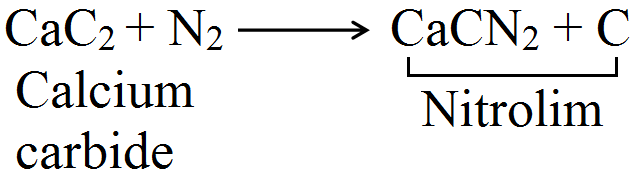
What is the mixture of $\mathrm{CaCN}_2$ and carbon called? How is it prepared? Give its uses.
Answer
It is called Nitrolim. It is prepared by heating $\mathrm{CaC}_2$ with $\mathrm{N}_2$ at high temperature.

It is used as fertilizer.
View full question & answer