MCQ 11 Mark
Choose the correct answers from the given four option:
If X and Y are two sets and X′ denotes the complement of X, then $\text{X}\cap(\text{X}\cup\text{Y})'$ is equal to.
- A
$\text{X}.$
- B
$\text{Y}.$
- C
$\phi.$
- D
$\text{X}\cap\text{Y}.$
Answer - $\phi.$
Solution:
Let $\text{x}\in\text{X}\cap(\text{X}\cup\text{Y})'$
$\Rightarrow \text{x}\in\text{X}\cap(\text{X}'\cup\text{Y})'$
$\Rightarrow \text{x}\in(\text{X}\cap\text{X})\cap(\text{X}\cap\text{Y}')$
$\Rightarrow \text{x}\in\phi\cap(\text{x}\cap\text{Y}')\ \big[\because \text{A}\cap\text{A}'=\phi\big]$
$\Rightarrow \text{x}\in\phi$
Hence, the correct option is (c).
View full question & answer→MCQ 21 Mark
In an examination, 34% of the candidates fail in Arithmetic and 42% in English. If 20% fail in Arithmetic and English, the percentage of those passing in both subjects is:
Answer - 44
Solution:
Let A denote students fail in Arithmetic, B denote students fail in English
n(A) = 34
n(B) = 42
n(A ∩ B) = 20
n(A ∪ B) = n(A) + n(B) − n(A ∩ B) = 34 + 42 − 20 = 56
n(A ∪ B)′ = 100 − n(A ∪ B) = 100 − 56 = 44
View full question & answer→MCQ 31 Mark
Which of the following statements is false:
- A
$\text{A} - \text{B = A}\cap\text{B}'$
- B
$\text{A} - \text{B = A} - \text{(A}\cap\text{B)}$
- C
$\text{A} - \text{B = A}-\text{B}'$
- D
$\text{A} - \text{B = (A}\cup\text{B)}-\text{B.}$
Answer - $\text{A}- \text{B = A} - \text{B}'.$
Solution:
It includes all those elements of A which do not belongs to complement of B which is equal to $\text{A}\cap\text{B}$ but not equal to A - B.
$\therefore$ (c) ic false.
View full question & answer→MCQ 41 Mark
Sets A and B have 3 and 6 elements respectively. What can be the minimum number of elements in A ∪ B ?
Answer - 6
Solution:
Let A be the left circle and B be the right circle.There are 3 elements in A and 6 elements in B.
The union of A and B contains elements that are in either circle.Thus,the union of A and B will be all of the elements in A along with all of the element B.
However, you have to subtract the elements that are in the overlapping area because you are counting twice.
If A and B don't overlap at all,then the union will ontain 9 elements.If A is completely inside B then the union will only contain 6 elements,which is the minimum no. of elements in the union of A and B.
let A = 1, 2, B = 2, 3
∴ A ∪ B = 1, 2, 3 which is 3 elements.
∴ A has 2 elements, B has 2 elements, and there is 1 element overlapping.
∴ 2 + 2 − 1 = 3! = 3 × 2 × 1 = 6
View full question & answer→MCQ 51 Mark
If A = {a, b, c},B = {c, d, e}, C{a, d, f}, then A × (B ∪ C) is:
Answer - none of these
Solution:
A × (B ∪ C) = {a, b, c} × {a, c, d, e, f}.
The above set will consist of 15 ordered pairs and not 3.
View full question & answer→MCQ 61 Mark
- A
$\cup-\text{A}$
- B
$\text{A}'$
- C
$\cup$
- D
$\text{A}$
Answer - $\text{A}$
Solution:
(A’)’ = A
View full question & answer→MCQ 71 Mark
In a class of 50 students, 10 did not opt for math, 15 did not opt for science and 2 did not opt for either. How many students of the class opted for both math and science.
Answer - 27
Solution:
Total students = 50
Students who did not opt for math = 10
Students who did not opt for Science = 15
Students who did not opt for either maths or science = 2
Total of 40 students in math and 13 did not opt for science but did for math = 40 - 13 = 27
So, students of the class opted for both math and science is 27
View full question & answer→MCQ 81 Mark
The set $\text{(A}\cup\text{B}')'\cup\text{B}\cap\text{C}$ is equal to:
Answer - $\text{A}'\cup\text{B}.$
Solution:
$\text{(A}\cup\text{B}')'\cup\text{(B}\cap\text{C})$
$=[\text{A}\cap\text{(B}')']\cup\text{(B}\cap\text{C})$ (De Morgen law)
$=\text{(A}'\cap\text{B})\cup\text{(B}\cap\text{C})$
$=\text{(A}'\cup\text{C})\cup\text{B}$ (Distributive law)
Disclimer: The question seems to be incorrect or there is some printing mistake in the question. The options given in the question does not match with the answer.
View full question & answer→MCQ 91 Mark
There are 19 hockey players in a club. On a particular day 14 were wearing the prescribed hockey shirts, while 11 were wearing the prescribed hockey pants. None of then was without hockey pant or hockey shirt. How many of them were in complete hockey uniform?
Answer - 6
Solution:
We can look at it in 2 ways
First by set theory
n(A ∩ B) = n(A) + n(B) − n(A ∪ B)
= 14 + 11 − 19 = 6
Qualitatively, we know that 14 people are wearing prescribed hockey shirts,which leaves us with 5 players who must be wearing hockey pants. So out of 11 players who are wearing hockey pants, 5 are not wearing hockey shirts while the other 6 are in complete uniform.
View full question & answer→MCQ 101 Mark
The equation $\text{x}+ \cos \text{x = a}$ has exactly one positive root. Complete set of values of 'a' is:
- A
$(0,1)$
- B
$(-\infty,1)$
- C
$(-1,1)$
- D
$(1,\infty)$
Answer - $(1,\infty)$
Solution:
Let $\text{f(x) = x} + \cos \text{x a}$
$\Rightarrow \text{f}'(\text{x})=1-\sin\geq0\forall\text{x}\in\text{R}.$
Thus f(x) is increasing in $(-\infty,\infty),$ as zero of f'(x) don't for an interval. f(0) = 1a
For a positive root, 1 - a < 0
⇒ a > 1
View full question & answer→MCQ 111 Mark
Two finite sets have m and n elements. The number of elements in the power set of first set is 48 more than the total number of elements in power set of the second set. Then, the values of m and n are:
Answer - 6, 4.
Solution:
ATQ:
2m - 1 = 48 + 2n - 1
⇒ 2m - 2n = 48
⇒ 2m - 2n = 26 - 24
By comparing we get:
m = 6 and n = 4.
View full question & answer→MCQ 121 Mark
Choose the correct answers from the given four option:
If sets A and B are defined as $\text{A}=\Big\{(\text{x},\text{y})|\text{y}=\frac{1}{\text{x}},0\neq\text{x}\in\text{R}\Big\}\ \text{B}=\{(\text{x},\text{y})|\text{y}=-\text{x},\text{x}\in\text{R}\},$ then
- A
$\text{A}\cap\text{B}=\text{A}$
- B
$\text{A}\cap\text{B}=\text{B}$
- C
$\text{A}\cap\text{B}=\phi$
- D
$\text{A}\cup\text{B}=\text{A}$
Answer - $\text{A}\cap\text{B}=\phi$
Solution:
Given that: $\text{A}=\Big\{(\text{x},\text{y}|\text{y}=\frac{1}{\text{x}},0\neq\text{x}\in\text{R}\Big\},$
and $\text{B}=\big\{(\text{x},\text{y}|\text{y}=\text{x},\text{x}\in\text{R}\big\}$
It is very clear that $\text{y}=\frac{1}{\text{x}}$ and y = -x
$\because \frac{1}{\text{x}}\neq -\text{x}$
$\therefore \text{A}\cap\text{B}=\phi$
Hence, the correct option is (c).
View full question & answer→MCQ 131 Mark
If ${\text{A}\cup\text{ B}^1}$then $\text{n}(\text{A }\cup\text{ B})=?$
- A
$\text{n(A)} + \text{n(B)} - \text{n}(\text{A}\cap\text{B})$
- B
$\text{n(A)} - \text{n(B)} + \text{n}(\text{A}\cap\text{B})$
- C
$\text{n(A)} - \text{n(B)} - \text{n}(\text{A}\cap\text{B})$
- D
$\text{n(A)} + \text{n(B)} + \text{n}(\text{A}\cap\text{B})$
Answer - $\text{n(A)} + \text{n(B)} - \text{n}(\text{A}\cap\text{B})$
View full question & answer→MCQ 141 Mark
Choose the correct answers from the given four option:
In a class of 60 students, 25 students play cricket and 20 students play tennis, and 10 students play both the games. Then, the number of students who play neither is.
Answer - 25
Solution:
Total number of students = 60
Number of students who play cricket = 25
Number of students who play tennis = 20
Number of students who play cricket and tennis both = 10
$\Rightarrow \text{n}(\text{C}\cap\text{T})=10$
$\therefore \text{n}(\text{C}\cap\text{T}) =\text{n(C)}+\text{n(T)}-\text{n}(\text{C}\cap\text{T})$
$=25+20-10=45-10=35$
$\therefore \text{n}(\text{C}'\cap\text{T}') = \text{n(U)}-\text{n}(\text{C}\cap\text{T})$
$=60-35=25$
Hence, the correct option is (b).
View full question & answer→MCQ 151 Mark
A market research group conducted a survey of 1000 consumers and reported that 720 consumers like product A and 420 consumers like product B.Then, the least number of consumers that must have liked both the products is:
Answer - 140
Solution:
Total consumers = 1000
Like product A = n(A) = 720
Like product B = n(B) 420
n (A ∩ B) (Both the products) = n(A) + n(B) − n(A ∪ B)
= 720 + 420 − 1000
= 140
View full question & answer→MCQ 161 Mark
Choose the correct answers from the given four option:
A survey shows that 63% of the people watch a News Channel whereas 76% watch another channel. If x% of the people watch both channel, then
- A
- B
- C
$39 \leq \text{x} \leq 63$
- D
Answer - $39 \leq \text{x} \leq 63$
Solution:
Let p% of the people watch a channel and q% of the people watch another channel
$\because \text{n}(\text{p}\cap\text{q})=\text{x}\% \text{ and n}(\text{p}\cup\text{q})\leq100$
So, $\text{n}(\text{p}\cap\text{q})\geq\text{n(p)}+\text{n(q)}-\text{n}(\text{p}\cap\text{q})$
$100\geq63+76-\text{x}$
$100\geq139-\text{x}\Rightarrow\text{x}\geq139-100\Rightarrow \text{x}\geq39$
Now n(p) = 63
$\therefore \text{n}(\text{p}\cap\text{q})\leq\text{n(p)}\Rightarrow \text{x}\geq63$
So $39\leq\text{x}\geq63.$ Hence, the correcr option is (c).
View full question & answer→MCQ 171 Mark
If A = {2, 4, 6, 8, 10}, B = {1, 3, 5, 7, 9}, then A - B =____________:
Answer - {2, 4, 6, 8, 10}
Solution:
A = {2, 4, 6, 8, 10}
B = {1, 3, 5, 7, 9}
A - B = {2, 4, 6, 8, 10} - {1, 3, 5, 7, 9} = {2, 4, 6, 8, 10}
View full question & answer→MCQ 181 Mark
IF R = {(2, 1), (4, 3), (4, 5)}, then range of the function is?
Answer - Range R = {1, 3, 5}
Solution:
Given R = {(2, 1), (4, 3), (4, 5)}
then Range (R) = {1, 3, 5}
View full question & answer→MCQ 191 Mark
In a city 20% of the population travels by car 50% travels by bus and 10% travels by both car and bus. Then, persons travelling by car or bus is:
Answer - 60%.
Solution:
Suppose C and B represents the population travels by car and bus respectively.
$\text{n(C}\cup\text{B) = n(C) + n(B)} -\text{n(B}\cap\text{C)}$
$=0.20+0.50-0.10$
$=0.6\text{ or }60\%.$
View full question & answer→MCQ 201 Mark
If A and B are two disjoint sets, then $\text{n(A}\cup\text{B)}$ is equal to:
Answer - $\text{n(A) + n(B)}.$
Solution:
Two sets are disjoint if they do not have a common element in them, i.e., $\text{A}\cap\text{B}=\phi.$
$\therefore\text{n(A}\cup\text{B) = n(A) + n(B)}.$
View full question & answer→MCQ 211 Mark
For any three sets A, B and C:
- A
$\text{A}\cap\text{(B} -\text{C)}=\text{(A}\cap\text{B)} - \text{(A}\cap\text{C)}$
- B
$\text{A}\cap\text{(B} -\text{C)}=\text{(A}\cap\text{B)}- \text{C}$
- C
$\text{A}\cup\text{(B} - \text{C)}=\text{(A}\cup\text{B)}\cap\text{(A}\cup\text{C}')$
- D
$\text{A}\cup\text{(B} - \text{C)}=\text{(A}\cup\text{B)}-\text{(A}\cup\text{C}).$
Answer -
$\text{A}\cap\text{(B}-\text{C)}=\text{(A}\cap\text{B)} - \text{(A}\cap\text{C)}$
-
$\text{A}\cap\text{(B - C)}=\text{(A}\cap\text{B)} - \text{C}$
-
$\text{A}\cup\text{(B} - \text{C)}=\text{(A}\cup\text{B)}\cap\text{(A}\cup\text{C}').$
Solution:
Let x be any arbitrary element of $\text{A}\cap\text{B}-\text{C.}$
Thus, we have,
$\text{x}\in\text{A}\cap\text{(B - C)}\Rightarrow\text{x}\in\text{A}$ and $\text{x}\in\text{B}-\text{C}$
$\Rightarrow\text{x}\in\text{A}$ and $\text{(x}\in\text{B and x}\not\in\text{C)}$
$\Rightarrow\text{x}\in\text{A and x}\in\text{B}$ and $\Rightarrow\text{X}\in\text{A and x}\not\in\text{C}$
$\Rightarrow\text{x(A}\cap\text{B)}$ and $\text{x}\not\in\text{(A}\cap\text{C)}$
$\Rightarrow\text{x}\in[\text{(A}\cap\text{B)}-\text{(A}\cap\text{C)}]$
$\Rightarrow\text{A}\cap\text{(B}-\text{C)}\subseteq\text{(A}\cap\text{B)} - \text{(A}\cap\text{C)}$
Similarly, $\text{(A}\cap\text{B)}-\text{(A} - \text{C)}\subseteq\text{(A}\cap\text{(B}-\text{C)}$
Hence, $\text{A}\cap\text{(B} - \text{C)}=\text{(A}\cap\text{B)} - \text{(A}\cap\text{C)}.$
View full question & answer→MCQ 221 Mark
Out of 800 boys in a school 224 played cricket, 240 played hockey and 236 played basketball. Of the total 64 played both basketball and hockey, 80 played cricket and basketball and 40 played cricket and hockey, 24 players all the three games. The number of boys who did not play any game is:
Answer - 260
Solution:
No. of players who played at least one game is:
By set theory
n(C ∪ H ∪ B) = n(C) + n(H) + n(B) − n(B ∩ H) − n(C ∩ B) − n(C ∩ H) + n(C ∩ H ∩ B)
= 224 + 240 + 236 − 64 − 80 − 40 + 24 = 540
View full question & answer→MCQ 231 Mark
The number of subsets of a set containing n elements is:
Answer -
2n.
Solution:
The total number of subsets of a finite set consisting of n elements is 2n.
View full question & answer→MCQ 241 Mark
The cardinality of the set P(P(P(f))) is.
MCQ 251 Mark
In a class of 80 children, 35% children can play only cricket, 45% children can play only table-tennis and the remaining children can play both the games. In all, how many children can play cricket?
Answer - 44
Solution:
Clearly 35% children can play cricket. Also 20% can play both.
So 55% children can play cricket
Total no. of kids = 0.55 × 80 = 44
View full question & answer→MCQ 261 Mark
The set of all those elements of A and B which are common to both is called:
Answer - Intersection of two sets
Solution:
The set of all those elements of A and B which are common to both is called A intersection B = A ∩ B.
View full question & answer→MCQ 271 Mark
Which of the following properties are associative law?
- A
$\text{A } \cup \text{ B}=\text{B } \cup \text{ A}$
- B
$\text{A } \cup \text{ C}=\text{C } \cup \text{ A}$
- C
$\text{A } \cup \text{ D}=\text{D } \cup \text{ A}$
- D
$(\text{A } \cup \text{ B})\cup\text{C}=\text{A} \cup (\text{B }\cup\text{ C})$
Answer - $(\text{A } \cup \text{ B})\cup\text{C}=\text{A} \cup (\text{B }\cup\text{ C})$
View full question & answer→MCQ 281 Mark
Which one is different from the others?
- Empty
- Void
- Zero
- Null
MCQ 291 Mark
Consider the following equations:
- $\text{A - B}=\text{A}-(\text{A }\cap \text{ B})$
- $\text{A}=({\text{A }\cap \text{ B}})\cup(\text{A }-\text{ B})$
- $\text{A}-(\text{B }\cup\text{ C})=(\text{A - B})\cup(\text{A - C})$
Which of these is/are correct?
View full question & answer→MCQ 301 Mark
In a class of 175 students the following data shows the number of students opting one or more subjects. Mathematics 100; Physics 70; Chemistry 40; Mathematics and Physics 30; Mathematics and Chemistry 28; Physics and Chemistry 23; Mathematics, Physics and Chemistry 18. How many students have offered Mathematics alone?
Answer - 60.
Solution:
Let M, P and C denote the sets of students who have opted for mathematics, physics, and chemistry, respectively.
Here,
$\text{n(M)}= 100, \text{ n( P)} = 70, \text{ n(C)} = 40$
Now,
$\text{n(M}\cap\text{P)}=30,\text{n(M}\cap\text{C)}=28,\\\text{n(P}\cap\text{C)}=23,\text{n(M}\cap\text{P}\cap\text{C)}=18$
Number of students who opted for only mathematics:
$\text{n(M}\cap\text{P}'\cap\text{C)}'=\{\text{M}\cap\text{(P}\cap\text{C})'\}$
$=\text{n(M)}-\text{n}\{\text{M}\cap\text{(P}\cap\text{C})\}$
$=\text{n(M)}-\text{n}\{\text{(M}\cap\text{P)}\cup\text{(M}\cap\text{C})\}$
$=\text{n(M)}-\{\text{n(M}\cap\text{P)}+\text{n(M}\cap\text{C})-\text{n(M}\cap\text{P}\cap\text{C}\}$
$=100-(30+28-18)$
$=60$
$\therefore$ the number of students who opted for mathematics alone is 60.
View full question & answer→MCQ 311 Mark
The solution set of 3x − 4 < 8 over the set of non-negative square numbers is:
Answer - {1}
Solution:
3x − 4 < 8
3x < 12
x < 4
Hence set of non-negative square numbers belonging to the above set is {1}.
View full question & answer→MCQ 321 Mark
Let n(A) = 28,n(A ∩ B) =8, n(A∪B) =52, then n(A ∩ B′):
Answer - 20
Solution:
Given n(A) = 28, n(A ∩ B) = 8.
We have A ∩ B′ = A - A ∩ B.
This give n(A ∩ B′) = n(A) -n(A ∩ B)
or, n(A ∩ B′) = 28 - 8 = 20.
View full question & answer→MCQ 331 Mark
Let A and B be two sets such that n(A) = 16, n(B) = 12, and n(A ∩ B) = 8.Then n(A∪B) equals:
Answer - 20
Solution:
n(A ∪ B) = n(A) + n(B) − n(A ∩ B) = 16 + 12 − 8 = 20
View full question & answer→MCQ 341 Mark
If A and B are finite sets, then which one of the following is the correct equation?
Answer - n (A - B) = n (A) - n $(\text{A }\cup \text{ B})$
View full question & answer→MCQ 351 Mark
Choose the correct answers from the given four option:
In a town of 840 persons, 450 persons read Hindi, 300 read English and 200 read both. Then the number of persons who read neither is,
Answer - 290
Solution:
Let H be the set of persons who read Hindi and E be the ser of persons who read English.
Then, n(U) = 840, n(H) = 450, n(E) 300, $\text{n}(\text{H}\cap\text{E})=200$
Number of persons who read neither $=\text{n}(\text{H}'\cap\text{F}')$
$=\text{n}(\text{H}\cup\text{E})'=\text{n(U)}-\text{n}(\text{H}\cup\text{E})$
$=840-\big[\text{n(H)}+\text{n(E)}-\text{n}(\text{H}\cap\text{E})\big]$
$=840-(450+300-200)=290$
View full question & answer→MCQ 361 Mark
If A and B are two sets such that n(A) = 17, n(B) = 23, n(A ∪ B) = 38, find n(A ∩ B):
Answer - 2
Solution:
We know,
n(A ∩ B) = n(A) + n(B) - n(A ∪ B)
n(A ∩ B) = 17 + 23 - 38 = 2
View full question & answer→MCQ 371 Mark
If A = {1, 2, 3, 4}, what is the number of subsets of A with at least three elements?
Answer - 5
Solution:
A subset containing 3 elements = {1, 2, 3};{1, 3, 4};{1, 2, 4} and {2, 3, 4}
A subset containing 4 elements ={1, 2, 3, 4}
$\therefore$ there are five subsets containing at least 3 elements.
View full question & answer→MCQ 381 Mark
Choose the correct answers from the given four option:
The set $(\text{A} \cap \text{B}')' \cup (\text{B} \cap \text{C})$ is equal to.
Answer - $\text{A}'\cup\text{B}$
Solution:
We konw that: $(\text{A}\cap\text{B})'=\text{A}'\cup\text{B}'$ [De Morgan's law]
$\therefore (\text{A}\cap\text{B}')'\cup(\text{B}\cap\text{C})=\big[\text{A}'\cup(\text{B}')\big]\cup(\text{B}\cap\text{C})$
$=(\text{A}'\cap\text{B})\cup(\text{B}\cap\text{C})\big[\because (\text{B}')'=\text{B}\big]$
$=\text{A}'\cup\text{B}$
Hence, the correct optiom is (b).
View full question & answer→MCQ 391 Mark
In a class 60% of the students were boys and 30% of them had I class. If 50% of the students in the class had I class, find the fraction of the girls in the class who did not have a I class:
- A
$\frac{1}{5}$
- B
$\frac{4}{5}$
- C
$\frac{1}{4}$
- D
$\frac{1}{3}$
View full question & answer→MCQ 401 Mark
{ (A, B) : A² + B² = 1} on the sets has the following relation.
Answer - Symmetric
Solution:
Given {(a, b) : a² + b² = 1} on the set S.
Now a² + b² = b² + a² = 1
So, the given relation is symmetric.
View full question & answer→MCQ 411 Mark
While preparing the progress reports of the students, the class teacher found that 70% of the students passed in Hindi, 80% passed in English and only 65% passed in both the subjects. Find out the percentage of students who failed in both the subjects.
Answer - 15%
Solution:
The sets E and H represent the students failing in the respective subjects.
n(H ∪ E) = 1− 0.65 = 0.35
By set theory
n(H ∩ E) = n(H) + n(E) − n(N ∪ E)
= 0.3 + 0.2 − 0.35 = 0.15
Hence 15% of students failed in both subjects.
View full question & answer→MCQ 421 Mark
Choose the correct answers from the given four option:
If X = {8n - 7n - 1 | n $\in$ N} and Y = {49n - 49 | n $\in$ N}. Then
- A
$\text{X} \subset \text{Y}$
- B
$\text{Y} \subset \text{X}$
- C
$\text{X} = \text{Y}$
- D
$\text{X} \cap \text{Y} = \phi$
Answer - $\text{X} \subset \text{Y}$
Solution:
X = {8n - 7n - 1| n $\in$ N} = {0, 49, 490, .....}
Y = {49n - 49 | n $\in$ N} = {0, 49, 147, ....., 490, .....}
Clearlut, every element of X is in Y but every element of Y is not in X.
$\therefore \text{X}\subset\text{Y}$
View full question & answer→MCQ 431 Mark
If n(A) = 115, n(B) = 326, n(A - B) = 47 then n(A ∪ B) is equal to:
Answer - 373
Solution:
n(A) = 115, n(B) = 326
n(A - B) = 47
n(A) = n(A - B) + n(A ∩ B)
n(A ∩ B) = n(A) -n(A - B)
$\therefore$ n(A ∩ B) = 115 - 47 = 68
$\therefore$ n(A ∪ B) = n(A) + n(B) -n(A ∩ B)
⇒ n(A ∪ B) = 115 + 326 - 68
⇒ n A ∪ B) = 373
View full question & answer→MCQ 441 Mark
Choose the correct answers from the given four option:
Let F1 be the set of parallelograms, F2 the set of rectangles, F3 the set of rhombuses, F4 the set of squares and F5 the set of trapeziums in a plane. Then F1 may be equal to,
- A
$\text{F}_2\cap\text{F}_3$
- B
$\text{F}_3\cap\text{F}_4$
- C
$\text{F}_2\cup\text{F}_5$
- D
$\text{F}_2\cup\text{F}_3\cup\text{F}_4\cup\text{F}_1$
Answer - $\text{F}_2\cup\text{F}_3\cup\text{F}_4\cup\text{F}_1$
Solution:
Every rectangel, rhombus, square in a plane is a parallelogram but every trapezium is not a parallelogram.
$\text{F}_1=\text{F}_2\cup\text{F}_3\cup\text{F}_4\cup\text{F}_1$
View full question & answer→MCQ 451 Mark
If A = {1, 2, 4}, B = {2, 4, 5} and C = {2, 5}, then (A − B) × (B − C) =
Answer - (1, 4)
Solution:
A = {1, 2, 4} and B = {2, 4, 5}
A − B = {1, 2, 4} − {2, 4, 5} = {1}
B={2,4,5} and C = {2, 5}
B − C = {2, 4, 5} − {2, 5} = {4}
(A − B) × (B − C) = {1} × {4} = (1, 4)
View full question & answer→MCQ 461 Mark
Let S = {2, 4, 6, 8,......20}. What is the maximum number of subsets does S have?
Answer - 1024
Solution:
Given, S = 2, 4, 6, 8....., 20.
There are a total of 10 elements.
Therefore we have 210 = 1024 subsets.
View full question & answer→MCQ 471 Mark
The total number of subsets of {1, 2, 6, 7} are?
Answer - 16
Solution:
We have to find the total number of subsets of {1, 2, 6, 7}.
We know that, for a set containing n elements, the total number of subsets is 2n.
Consider {1, 2, 6, 7}, wich has 4 elements.
∴ here n = 4
Hence total number of subsets is 24 = 16.
Thus the total number of subsets of {1, 2, 6, 7} is 16.
View full question & answer→MCQ 481 Mark
In a class, 20 opted for Physics, 17 for Maths, 5 for both and 10 for other subjects. The class contains how many students?
Answer - 42
Solution:
By set theory
n(P ∪ M) = n(P) + n(M) − n(P ∩ M)
= 20 + 17 − 5 = 32
So total no. of students
= 32 + 10 = 42
32 opted for at least one subject from Physics and maths while 10 opted for other.
View full question & answer→MCQ 491 Mark
Which of the following two sets are equal?
- A
- B
A = {1, 2} and B = {1, 2, 3}
- C
A = {1, 2, 3} and B = {2, 1, 3}
- D
A = {1, 2, 4} and B = {1, 2, 3}
Answer - A = {1, 2, 3} and B = {2, 1, 3}
Solution:
Two sets are equal if and only if they have the same elements.
So, A = {1, 2, 3} and B = {2, 1, 3} are equal sets.
View full question & answer→MCQ 501 Mark
Let S = {1, 2, 3,.....40} and let A be a subset of S such that no two elements in A have their sum divisible by 5 What is the maximum number of elements possible in A?
Answer - 17
Solution:
There are 20 maximum number of elements possible in A.
A = (1, 2, 5, 6, 7, 11, 12, 15, 16, 17 ,21, 22, 25, 26, 27, 31, 32, 35, 36, 37).
View full question & answer→MCQ 511 Mark
Two finite sets have m and n elements. The number of subsets of the first set is 112 more than that of the second. The values of m and n are respectively:
Answer - 7, 4.
Solution:
We know that if a set X contains k elements, then the number of subsets of X are 2k.
It is given that the number of subsets of a set containing m elements is 112 more than the number of subsets of set containing n elements.
$\therefore 2^\text{m}-2^\text{n}=112$
$\Rightarrow2^\text{n}(2^\text{m - n}-1)=2\times2\times2\times2\times7$
$\Rightarrow2^\text{n}(2^{\text{m}-\text{n}}-1)=2^4(2^3-1)$
$\Rightarrow\text{n}=4$ and $\text{m}-\text{n}=3$
$\therefore\text{ m}-4=3$
$\Rightarrow\text{m}=7$
Thus, the values of m and n are 7 and 4, respectively.
Hence, the correct answer is option (b).
View full question & answer→MCQ 521 Mark
Choose the correct answers from the given four option:
Suppose A1, A2, ..., A30 are thirty sets each having 5 elements and B1, B2, ..., Bn are n sets each with 3 elements, let $\bigcup\limits_{\text{i}=1}^{30}\text{A}_\text{i}=\bigcup\limits_{\text{j}=1}^\text{n}\text{B}_\text{j}=\text{S}$ and each element of S belongs to exactly 10 of the Ai ’s and exactly 9 of the B, 'S. then n is equal to.
Answer - 45
Solution:
Number of elements in $\text{A}_1\cup\text{A}_2\cup\text{A}_3\ ..... \cup \text{A}_{30}=30\times5=150$ (When repetition is not allowed)
But each element is repeated 10 times
$\therefore \text{n(S)}=\frac{30\times5}{10}=\frac{150}{10}=15\ .....\text{(i)}$
Number of elements in $\text{B}_1\cup\text{B}_2\cup\text{B}_3\ ...... \text{B}_\text{n}=3\text{n}$ (when repetitiom is not allowed)
But each element is repeated 09 times
$\therefore \text{n(S)}=\frac{3\text{n}}{9}=\frac{\text{n}}{3}\ .....\text{(ii)}$
From (i) and (ii) we get
$\frac{\text{n}}{3}=15\Rightarrow \text{n}=15\times3=45$
Hence, the corrrect option is (c).
View full question & answer→MCQ 531 Mark
Which of the following is correct for A - B?
- A
$\text{A } \cap \text{ B}$
- B
$\text{A }' \cap \text{ B}$
- C
$\text{A } \cap \text{ B}'$
- D
$\text{A }' \cap \text{ B}'$
Answer - $\text{A } \cap \text{ B}'$
View full question & answer→MCQ 541 Mark
Choose the correct answers from the given four option:
If A and B are two sets, then $\text{A} \cap (\text{A} \cup \text{B})$ equals.
- A
$\text{A}$
- B
$\text{B}$
- C
$\phi$
- D
$\text{A}\cap\text{B}$
Answer - $\text{A}$
Solution:
Given that: $\text{A}\cap(\text{A}\cup\text{B})$
Let $\text{x}\in\text{A}\cap(\text{A}\cup\text{B})$
$\Rightarrow \text{x}\in\text{A}$ and $\text{x}\in(\text{A}\cup\text{B})$
$\Rightarrow \text{x}\in\text{A}$ and $(\text{x}\in\text{A}\text{ or x}\in\text{B})$
$\Rightarrow (\text{x}\in\text{A and x}\in\text{A})$ or $(\text{x}\in\text{A and x}\in\text{B})$
$\Rightarrow \text{x}\in\text{A}$ or $\text{x}\in(\text{A}\cap\text{B})$
$\Rightarrow \text{x}\in\text{A}$
Hence, the correct option is (a).
View full question & answer→MCQ 551 Mark
If A = (6, 7, 8, 9), B = (4, 6, 8, 10) and C = {x : x $\in$ N : 2 < x ≤ 7} ; find: A - B
Answer - {7, 9}
Solution:
A − B = A − A ∩ B = {7, 9}
View full question & answer→MCQ 561 Mark
Let A and B have 3 and 6 elements respectively. What can be the minimum number of elements in A ∪ B?
Answer - 6
Solution:
n(A ∪ B) = n(A) + n(B) − n(A ∩ B)
Now A has 3 elements and B has 6 elements. If they are disjoint, then n(A ∩ B) = 0.
$\therefore$ n(A ∪ B) = 6 + 3 = 9
If A ⊂ B then A ∪ B = B
$\therefore$ (A ∪ B) = n(B) = 6
B cannot be a subset of A and hence the other possibility of A ∪ B = A is ruled out.
View full question & answer→MCQ 571 Mark
Let A = {1, 2, 3, 4, 5, 6}.How many subsets of A can be formed with just two elements, one even and one odd?
Answer - 9
Solution:
{1, 2}, {1, 4}, {1, 6}, {2, 3}, {2, 5}, {3, 4}, {3, 6}, {4, 5}, {5, 6}
View full question & answer→MCQ 581 Mark
If A and B are two non-empty sets, then $\text{B}\cap({\text{A }} \cup \text { B})\text{c},$ where Xc denotes the complement of X, is equal to:
View full question & answer→MCQ 591 Mark
If A = {2, 3, 4, 5, 7}, B = {7, 8, 9}, then find n(A ∪ B).
Answer - 7
Solution:
A = {2, 3, 4, 5, 7}
n(A) = 5
B = {7, 8, 9}
n(B) = 3
n(A ∩ B) = 1
$\therefore$ (A ∪ B) = n(A) + n(B) − n(A ∩ B)
(A ∪ B) = 5 + 3 − 1 = 7
View full question & answer→MCQ 601 Mark
If A = {1, 2, 3, 4}, then the number of subsets of A that contain the element 2 but not 3, is:
Answer - 4
Solution:
The subsets are be {1, 2, 4}, {1, 2}, {2, 4}, {2}
Number of subsets of A that contain the element 2 but not 3 is 4.
View full question & answer→MCQ 611 Mark
Let A and B be two sets in the same universal set. Then, A - B =
- A
$\text{A}\cap\text{B}$
- B
$\text{A}'\cap\text{B}$
- C
$\text{A}\cap\text{B}'$
- D
Answer - $\text{A}\cap\text{B}'.$
Solution:
A - B belongs to those elements of A that do not belong to B.
$\therefore\text{A} - \text{B = A}\cap\text{B}'.$
View full question & answer→MCQ 621 Mark
Let P be a set of squares, Q be set of parallelograms, R be a set of quadrilaterals and S be a set of rectangles. Consider the following:
- P Ì Q
- R Ì P
- P Ì S
- S Ì R
Which of the above are correct?
MCQ 631 Mark
If A and B are non empty sets and A' and B' represents their compliments respectively then:
Answer - A − B = B′ − A′
Solution:
Let U → Universal set
X → U - (A + B)
B′ = X + A
A′ = X + B
B′ - A′ = X + A - (X + B)
= X + A - X - B
B′ - A′ = A - B
View full question & answer→MCQ 641 Mark
Let A and B be two sets that $\text{n(A)} = 16, \text{ n(B)} = 14,\text{ n(A}\cup\text{B)}=25.$ Then, $\text{n(A}\cap\text{B)}$ is equal to:
Answer - 5.
Solution:
We know:
$\text{n(A}\cup\text{B) = n(A) + n(B)} - \text{n(A}\cap\text{B)}$
Now,
$\text{n(A}\cap\text{B) = n(A) + n(B)} -\text{n(A}\cup\text{B)}$
$=16+14-25$
$=5.$
View full question & answer→MCQ 651 Mark
If A = [5, 6, 7] and B = [7, 8, 9] then $\text{A } \cup \text{ B}$ is equal to.
Answer - [5, 6, 7, 8, 9]
Solution:
Given A = [5, 6, 7] and B = [7, 8, 9]
then $\text{A } \cup \text{ B}=[5, 6, 7, 8, 9]$
View full question & answer→MCQ 661 Mark
In a group of 15 women, 7 have nose studs, 8 have ear rings and 3 have neither. How many of these have both nose studs and ear rings?
Answer - 3
Solution:
Since 3 women have neither nose studs nor earrings
n(N∪E) = 15 − 3 = 12
By set theory
n(N∩E) = n(N) + n(E) − n(N∪E)
= 7 + 8 − 12 = 3
View full question & answer→MCQ 671 Mark
In a flight 50 people speak Hindi, 20 speak English and 10 speak both English and Hindi. The number of people who speak atleast one of the two languages is:
Answer - 60
Solution:
Let H = People who speak Hindi
E = People who speak English
According to the questions,
n(H) = 50, n(E) = 20, n(H ∩ E) = 10
Number of people who speak at least two language = n(H ∪ E)
= n(H) + n(E) − n(H ∩ E)
= 50 + 20 − 10 = 60
View full question & answer→MCQ 681 Mark
If S and T are two sets such that S has 21 elements, T has 32 elements and S ∩ T has 11 elements, then
find the number of elements in S ∪ T.
Answer - 42
Solution:
Given n(S) = 21, n(T) = 32, n(S ∩ T) = 11
Now n(S) + n(T) = n(S ∩ T) + n(S ∪ T)
⇒ n(S ∪ T) = 21 + 32 - 11 = 42.
View full question & answer→MCQ 691 Mark
If A = {1, 2, 3} B = {4, 5}, then find A - B.
Answer - {1, 2, 3}
Solution:
Given, A = {1, 2, 3} and B = {4, 5}.
Since A and B are two disjoint sets i.e. A ∩ B = ϕ then we've,
A − B
= {1, 2, 3}.
View full question & answer→MCQ 701 Mark
In a class of 120 students numbered 1 to 120, all even numbered students opt for Physics, whose numbers are divisible by 5 opt for Chemistry and those whose numbers are divisible by 7 opt for Math. How many opt for none of the three subjects?
Answer - 41
Solution:
The number of students who took at least one of the three subjects can be found by finding out $\text{A }\cup \text{ B}\cup \text{ C},$
where A is the set of those who took Physics, B the set of those who took Chemistry and C the set of those who opted for Math.
Now $\text{A }\cup \text{ B}\cup \text{ C}=\text{A + B + C}-(\text{A }\cap \text{ B}+\text{B } \cap \text{ C}+\text{C } \cap \text{ A})(\text{A } \cap\text{ B } \cap \text{ C})$
A is the set of those who opted for Physics $=\frac{120}{2}=60\text{ Students}$
B is the set of those who opted for Chemistry $=\frac{120}{5}=24$
C is the set of those who opted for Math $=\frac{120}{7}=17$
The 10th, 20th, 30th….. numbered students would have opted for both Physics and Chemistry.
Therefore $\text{A }\cap \text{ B}=\frac{120}{10}=12$
The 14th, 28th, 42nd…… Numbered students would have opted for Physics and Math.
Therefore, $\text{C }\cap \text{ A}=\frac{120}{14}=8$
The 35th, 70th…. numbered students would have opted for Chemistry and Math.
Therefore, $\text{B }\cap \text{ C}=\frac{120}{35}=3$
And the 70th numbered student would have opted for all three subjects.
Therefore, $\text{A }\cup \text{ B }\cup \text{ C}= 60 + 24 + 17 - (12 + 8 + 3) + 1 = 79$
Number of students who opted for none of the three subjects = 120 – 79 = 41
View full question & answer→MCQ 711 Mark
If A = {1, 2, 3, 4}, B = {2, 3, 5, 6} and C = {3, 4, 6,7}, then.
- A
$\text{A } – (\text{B} \cap \text{C}) = ({1, 3, 4})$
- B
$\text{A } – (\text{B} \cap \text{C}) = ({1, 2, 4})$
- C
$\text{A } – (\text{B} \cup \text{C}) = ({2, 3})$
- D
$\text{A } – (\text{B} \cup \text{C}) = (\text{f})$
Answer - $\text{A } – (\text{B} \cap \text{C}) = ({1, 2, 4})$
View full question & answer→MCQ 721 Mark
If A − B = ∅, then relation between A and B is:
- A
$\text{A }\phi\text{ B}$
- B
$\text{B}\cup\text{A}$
- C
$\text{A}\cap\text{B}$
- D
$\text{A} = \text{B}$
Answer - $\text{A}\cap\text{B}$
Solution:
If A and B are disjoint it would mean A is a null set. Otherwise A and B must be equal to A ∩ B AT LEAST.
View full question & answer→MCQ 731 Mark
If A and B are two sets, then $\text{A} \cap (\text{A} \cup \text{B})'$ equals.
View full question & answer→MCQ 741 Mark
If A = {1, 3, 5, B} and B = {2, 4}, then:
Answer - None of these.
Solution:
$(4\not\in\text{A) }(4\not\in\text{A})$
$\{4\}\not\subset\text{A}$
$\text{B}\not\subset\text{}A$
Thus, we can say that none of these options satisfy the given relation.
View full question & answer→MCQ 751 Mark
If A = (6, 7, 8, 9), B = (4, 6, 8, 10) and C = {x : x $\in$ N : 2 < x ≤ 7} ; find : B − B
Answer - ϕ
Solution:
Given: A = (6, 7, 8, 9), B = (4, 6, 8, 10) and C = {x : x $\in$ N : 2 < x ≤ 7}
B − B will always be a null set it will contain elements of B which are not in B i.e. no elements.
So, B − B = ϕ
View full question & answer→MCQ 761 Mark
Which of the following is set?
- A
The collection of months having names starting with J.
- B
The collection of smart boys in your class.
- C
The collection of most talented persons.
- D
The collection of sand grains in a Earth.
Answer - The collection of months having names starting with J.
Solution:
As the collection of months having names starting with J is well defined. So, it's a set. Rest are not well defined , hence are not set.
View full question & answer→MCQ 771 Mark
If A and B are two sets such that $\text{n(A)}=70, \text{ n(B)}=60, \text{ n(A}\cup\text{B)}=110,$ then $\text{n(A}\cap\text{B)}$ is equal to:
Answer - 20.
Solution:
We have:
$\text{n(A}\cap\text{B) = n(A) + n(B)} - \text{n(A}\cup\text{B)}$
$=70+60-110$
$=20.$
View full question & answer→MCQ 781 Mark
The smallest set A such that A ∪ {1, 2} = {1, 2, 3, 5, 9} is:
Answer - {3, 5, 9}
Solution:
A ∪ {1, 2} = {1, 2, 3, 5, 9}
Thus,
A = {1, 2, 3, 5, 9} − {1, 2}
View full question & answer→MCQ 791 Mark
For any set A, (A')' is equal to:
Answer - A.
Solution:
The complement of the complement of a set is the set itself.
View full question & answer→MCQ 801 Mark
Let U be the universal set containing 700 elements. If A, B are subsets of U such that $\text{n(A)}=200,\text{ n(B)}=300$ and $\text{n(A}\cap\text{B)}=100.$ Then, $\text{n(A}'\cap\text{B}')=$
Answer - 300.
Solution:
$\text{n(A}'\cap\text{B}')=\text{n(A}\cup\text{B}')$
$=\text{n(U)}-\text{n(A}\cup\text{B})$
$=700 - 200 + 300 - 100 = 300.$
View full question & answer→MCQ 811 Mark
If A and B are two given sets, then $\text{A}\cap\text{(A}\cap\text{B})^\text{c}$ is equal to:
Answer - $\text{A}\cap\text{B}^\text{c}.$
Solution:
A and B are two sets.
$\text{A}\cap\text{B}$ is the common region in both the sets.
$\text{A}\cap\text{B}^\text{c}$ is all the region in the universal set except $\text{A}\cap\text{B}.$
Now,
$\text{(A}\cap\text{A}\cap\text{B)}^\text{c}=\text{(A}\cap\text{B)}^\text{c}.$
View full question & answer→MCQ 821 Mark
How many elements has P(A), if A = f ?
MCQ 831 Mark
If A = {x : x is a multiple of 3} and B = {x : x is a multiple of 5}, then A - B is:
- A
$\text{A}\cap\text{B}$
- B
$\text{A}\cap\overline{\text{B}}$
- C
$\overline{\text{A}}\cap\overline{\text{B}}$
- D
$\overline{\text{A}\cap{\text{B}}}.$
Answer - $\text{A}\cap\overline{\text{B}}.$
Solution:
A = {x : x is a multiple of 3}
A = 3, 6, 9, 12, 15, 18, 21, 24, 27, 30, 33, 36, 39, 42, .....
B = {x : x is a multiple of 5}
B = 5, 10, 15, 20, 25, 30, 35, 40, 45, 50, ......
Now, we have:
A - B = 3, 6, 9, 12, 18, 21, 24, 27, 30, 33,36, 39, 42, ....
$=\text{A}\cap\overline{\text{B}}.$
View full question & answer→MCQ 841 Mark
A and B are two sets having 3 and 5 elements respectively and having 2 elements in common. Then the number of elements in A × B is:
Answer - 15
Solution:
Total ordered pairs =n(A) × n(B) = 3 × 5 = 15.
View full question & answer→MCQ 851 Mark
In a class of 50 students 35 opted for Mathematics and 37 opted for Biology How may have opted for only Mathematics? ( Assume that each student has to opt for at least one of the subjects)
Answer - 13
Solution:
Here n(M ∪ B) = 50, n(M) = 35, n(B) = 37
$\therefore$ n(M ∩ B) = n(M) + n(B) -n(M ∪ B)
= 35 + 37 - 50 = 22
⇒ 22 student have opted for both Mathematics and Biology.
Now the number of students who have opted for Mathematics only
= n(M) -n(M ∩ B)
= 35 - 22 = 13
View full question & answer→MCQ 861 Mark
View full question & answer→MCQ 871 Mark
Given A = {a, b, c, d, e, f, g, h} and B = {a, e, i, o, u} then B - A is equal to:
Answer - {i, o, u}
Solution:
The sets A = {a, b, c, d, e, f, g, h} and B = {a, e, i, o, u}, in order to find the difference between the two sets as B−A, we begin by writing all the elements of B and then take away every element of A which is also the element of B. Since B share the elements a, e with A, so B - A = {i, o, u}.
View full question & answer→MCQ 881 Mark
If n(A) denotes the number of elements in set A and if n(A) = 4,n(B) = 5 and n(A ∩ B) = 3 then n[(A × B) ∩ (B × A)]=
Answer - 9
Solution:
For (A × B) ∩ (B × A) we have to do the mapping of A × B or B × A between common elements.
no. of ways of mapping will be 3 × 3 = 9
n[(A × B) ∩ (B × A)] = 9
View full question & answer→MCQ 891 Mark
If out of 150 students who read at least one newspaper The Times of India, The Hindustan Times and The Hindu. There are 65 who read The Times of India, 41 who read The Hindu and 50 who read The Hindustan Times.What is the maximum possible number of students who read all the three newspaper?
Answer - 3
Solution:
a + b + c = 150
a + 2b + 3c = 156
Hence b + 2c = 6
To maximise c we take minimum value of b that is 0.
Hence c = 3
View full question & answer→MCQ 901 Mark
The symmetric difference of A = {1, 2, 3} and B = {3, 4, 5} is:
Answer - {1, 2, 4, 5}.
Solution:
Here,
$\text{A} = \{1, 2, 3\}$ and
$\text{B} = \{3, 4, 5\}$
The symmetric difference of A and B is given by:-
$\text{(A} - \text{B)}\cup\text{(B} -\text{A)}$
Now, are have:
$\text{(A} - \text{B)}= \{1, 2\}$
$\text{(B} - \text{A)}=\{4, 5\}$
$\text{(A}-\text{B)}\cup\text{(B}-\text{A)}=\{1, 2, 4, 5\}.$
View full question & answer→MCQ 911 Mark
In set-builder method the null set is represented by:
Answer - $\{\text{x : x}\not=\text{x}\}.$
View full question & answer→MCQ 921 Mark
n a class of 55 students, the number of students studying different subjects are 23 in Mathematics and 24 in Physics, 19 in Chemistry, 12 in Mathematics and Physics, 9 in Mathematics and Chemistry, 7 in Physics and Chemistry and 4 in all the three subjects, The number of students who have taken exactly one subject is:
MCQ 931 Mark
In an examination, 34% of the candidates fail in Arithmetic and 42% in English.If 20% fail in Arithmetic and English, the percentage of those passing in both subjects is:
Answer - 44
Solution:
n(A) = 34
n(B) = 42
n(A∩B) = 20
n(A∪B) = n(A) + n(B) − n(A∩B) = 34 + 42 − 20 = 56
n(A∪B)′ = 100 − n(A∪B) = 100 − 56 = 44
View full question & answer→MCQ 941 Mark
The sets Sx are defined to be (x, x + 1, x + 2, x + 3, x + 4) where x = 1, 2, 3,.....80. How many of these sets contain 6 or its multiple?
Answer - 66
Solution:
Since 5 consecutive no.s are chosen only one set in 6 consecutive sets will not have a multiple of 6. So till 78 sets there are
$78-\frac{78}{6}=78-13=65$ sets containing 6 or multiples of 6.
S79 does not contain any multiple of 6
Hence S80 must contain a multiple of 6.
Answer = 66 sets
View full question & answer→MCQ 951 Mark
The symmetric difference of A and B is not equal to:
- A
$\text{(A} - \text{B)}\cap\text{(B} -\text{A)}$
- B
$\text{(A} - \text{B)}\cup\text{(B}- \text{A)}$
- C
$\text{(A}\cup\text{B)}-\text{(B}\cap\text{A)}$
- D
$\{\text{(A}\cup\text{B)}-\text{A\}}\cup\{\text{(A}\cup\text{B)} - \text{B}\}.$
Answer - $\text{(A}- \text{B)}\cup\text{(B} - \text{A)}.$
Solution:
The symmetric difference of A and B is given by:-
$\text{(A} - \text{B)}\cup\text{(B}- \text{A)}.$
View full question & answer→MCQ 961 Mark
For any two sets A and $\text{B, A - B}\cup\text{B}=\text{A}=$
- A
$\text{(A - B)}\cup\text{A}$
- B
$\text{(B - A)}\cup\text{B}$
- C
$\text{(A}\cup\text{B)}-\text{(A}\cap\text{B)}$
- D
$\text{(A}\cup\text{B)}\cap\text{(A}\cap\text{B)}.$
Answer - $\text{(A}\cup\text{B)}-\text{(A}\cap\text{B)}.$
Solution:
$\text{(A}-\text{B)}\cup\text{(B}-\text{A)}=\text{(A}\cap\text{B}')\cup\text{(B}\cap\text{A}')$
$=[\text{A}\cup\text{(B}\cup\text{A}')]\cap[\text{B}'\cup\text{(B}\cap\text{A}')]$ [Using distribution law]
$=[\text{(A}\cup\text{B})\cap\text{(A}\cup\text{A}')]\cap[\text{(B}'\cup\text{B})\cap\text{(B}'\cup\text{A}')]$ [Using distribution law]
$=[\text{(A}\cup\text{B)}\cup\text{(U)}]\cap[\text{(U)}\cap\text{(B}'\cup\text{A}')]$ $[\text{A}\cup\text{A'= U = B}'\cup\text{B}]$
$=[\text{A}\cup\text{B}]\cap[\text{B}'\cup\text{A}']$ $\begin{bmatrix}\text{(A}\cup\text{B)}\cap\text{(U)}=\text{(A}\cup\text{B)}\\\text{ and (U)}\cap\text{(B}'\cup\text{A)}'=\text{(B}'\cup\text{A}')]\end{bmatrix}$
$=[\text{A}\cup\text{B}]\cap[\text{(A}\cap\text{B)}']$ $[\text{(A}\cap\text{B)}'=\text{B}'\cup\text{A}']$
$=[\text{A}\cup\text{B}]\cap[\text{(A}\cup\text{B)}-\text{(A}\cap\text{B)}]$
$=[\text{(A}\cup\text{B)}-\text{(A}\cap\text{B)}].$
View full question & answer→MCQ 971 Mark
View full question & answer→MCQ 981 Mark
- A
$\text{B}$
- B
$\frac{A}{B}$
- C
$\text{A}$
- D
$\frac{B}{A}$
Answer - $\text{A}$
Solution:
We are given that A is the subset of B
⇒ Every element of A is an element of B.
Therefore, the intersection elements of sets A and B are A ∩ B = A.
View full question & answer→MCQ 991 Mark
If A = {1, 2, 3, 4, 5, 6}, B = {2, 4, 6, 8}, then A - B will be:
Answer - {1, 3, 5}
Solution:
Given, A = {1, 2, 3, 4, 5, 6} and B = {2, 4, 6, 8}
A - B means A contains the element which is not present in B.
Thus, A − B = {1, 3, 5}
View full question & answer→MCQ 1001 Mark
For any two sets A and B, $\text{A}\cap\text{(A}\cup\text{B)}'$ is equal to:
- A
$\text{A}$
- B
$\text{B}$
- C
$\phi$
- D
$\text{A}\cap\text{B}.$
Answer - $\phi.$
Solution:
$\text{A}\cap\text{(A}\cup\text{B)}'$
$=\text{A}\cap\text{(A}'\cup\text{B}')$ (De Morgen Law)
$=\text{(A}\cap\text{A}')\cap\text{B}'$
$=\phi\cap\text{B}'$
$=\phi$
Hence, the correct answer is option (c).
View full question & answer→MCQ 1011 Mark
Choose the correct answers from the given four option:
Let S = set of points inside the square, T = the set of points inside the triangle and C = the set of points inside the circle. If the triangle and circle intersect each other and are contained in a square. Then
- A
$\text{S}\cap\text{T}\cap\text{C}=\phi$
- B
$\text{S}\cup\text{T}\cup\text{C}=\text{C}$
- C
$\text{S}\cup\text{T}\cup\text{C}=\text{S}$
- D
$\text{S}\cup\text{T} = \text{S}\cap\text{C}$
Answer - $\text{S}\cup\text{T}\cup\text{C}=\text{S}$
Solution:
The given conditions of the question may be represented by the following Venn diagram. From the given Venn diagram, we conclude thta
$\text{S}\cup\text{T}\cup\text{C}=\text{S}$
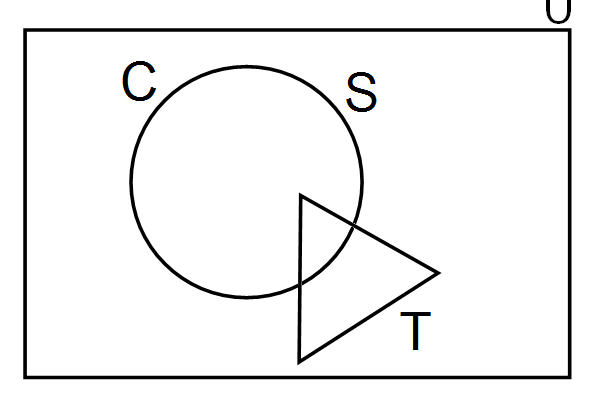
Hence, the correct option is (c).
View full question & answer→MCQ 1021 Mark
All the students of a batch opted Psychology, Business, or both. 73% of the students opted Psychology and 62% opted Business. If there are 220 students, how many of them opted for both Psychology and business?
Answer - 77
Solution:
By set theory
n(P ∩ B) = n(P) + n(B) − n(P ∪ B)
= 0.73 + 0.62 − 1.00 = 0.35
35% of 220 = 77
View full question & answer→MCQ 1031 Mark
Choose the correct answers from the given four option:
Let R be set of points inside a rectangle of sides a and b (a, b > 1) with two sides along the positive direction of x-axis and y-axis. Then
- A
R = {(x, y) : 0 ≤ x ≤ a, 0 ≤ y ≤ b}.
- B
R = {(x, y) : 0 ≤ x < a, 0 ≤ y ≤ b}.
- C
R = {(x, y) : 0 ≤ x ≤ a, 0 < y < b}.
- D
R = {(x, y) : 0 < x < a, 0 < y < b}.
Answer - R = {(x, y) : 0 < x < a, 0 < y < b}.
Solution:
Since, R be the set of points inside the rectangle.
$\therefore$ R = {(x, y) : 0 < x < a, 0 < y < b}.
View full question & answer→MCQ 1041 Mark
If A, B and C are any three sets, then $\text{A}\times (\text{B}\cup\text{C})$ is equal to.
- A
$(\text{A}\times\text{B}) \cup (\text{A}\times\text{C})$
- B
$(\text{A}\cup\text{B}) \times (\text{A}\cup\text{C})$
- C
$(\text{A}\times\text{B}) \cap (\text{A}\times\text{C})$
- D
$\text{None of these}$
Answer - $(\text{A}\times\text{B}) \cup (\text{A}\times\text{C})$
Solution:
Given A, B and C are any three sets.
Now, $\text{A}\times(\text{B }\cup \text{C})=(\text{A}\times\text{B}) \cup (\text{A}\times\text{C})$
View full question & answer→MCQ 1051 Mark
For two sets $\text{A}\cap\text{B = A}$ iff:
Answer - $\text{B}\subseteq\text{A}.$
Solution:
The union of two sets is a set of all those elements that belong to A or to B or to both A and B.
If $\text{A}\cup\text{B = A},$ then $\text{B}\subseteq\text{A}.$
View full question & answer→MCQ 1061 Mark
For any two sets A and B, A−(A−B) equals:
Answer - A ∩ B
Solution:
Now, A − (A − B) = A − (A ∩ BC)
= A ∩ (A ∩ BC)C
= A ∩(AC ∪ B)
= (A ∩ AC) ∪ (A ∩ B)
= A ∩ B
View full question & answer→MCQ 1071 Mark
If n(A) = 65, n(B) = 32 and n(A ∩ B) = 14, then n(A Δ B) equals:
Answer - 69
Solution:
$ \text{n}(\text{A}\triangle\text{B})= \text{n(A - B)} +\text{ n(B - A)}$
$\therefore(\text{A}\triangle\text{B})=\text{ (A - B)} ∪ \text{(B - A)}$
$\Rightarrow (\text{A}\triangle\text{B}) = \text{n(A)} \text{ -n(A ∩ B)} +\text{ n(B)} − \text{n(A ∩ B)}$
$\Rightarrow (\text{A}\triangle\text{B})=\text{ n(A)} +\text{ n(B)} \text{ -2n} (A∩B) = 65 + 32 - 2 × 14 = 69$
View full question & answer→MCQ 1081 Mark
- A
Difference of A and B of B and A
- B
- C
- D
Answer - Difference of A and B of B and A
View full question & answer→MCQ 1091 Mark
IF A = [5, 6, 7] and B = [7, 8, 9] then $\text{A }\cup \text{ B}$ is equal to.
Answer - [5, 6, 7, 8, 9]
Solution:
Given A = [5, 6, 7] and B = [7, 8, 9]
then $\text{A }\cup \text{ B}$ = [5, 6, 7, 8, 9]
View full question & answer→MCQ 1101 Mark
The set of intelligent students in a class is:
- A
- B
- C
- D
Not a well defined collection
Answer - Not a well defined collection
View full question & answer→MCQ 1111 Mark
The number of elements of the set {x : x ∈ Z,x2 = 1} is:
Answer - 2
Solution:
x2 = 1 ⇒ x = 1, -1
Since both solutions are integers the set has 2 elements.
View full question & answer→MCQ 1121 Mark
In any continuous class interval table (a - b):
Answer - A is included
Solution:
A is included b is included in the next interval.
View full question & answer→MCQ 1131 Mark
Choose the correct answers from the given four option:
Two finite sets have m and n elements. The number of subsets of the first set is 112 more than that of the second set. The values of m and n are, respectively,
Answer - 7, 4
Solution:
According to the question,
⇒ 2m - 2n = 12
⇒ 2n(2m-n - 1) 24. 7
⇒ 2n = 24 and 2m-n - 1 = 7
⇒ n = 2 and 2m-n = 8
⇒ 2m-n = 23 ⇒ m - n = 3 ⇒ m - 4 = 3 ⇒ m = 7
View full question & answer→MCQ 1141 Mark
If Y ∪ {1, 2} = {1, 2, 3, 5, 9}, then:
- A
The smallest set of Y is {3, 5, 9}
- B
The smallest set of Y is {2, 3, 5, 9}
- C
The largest set of Y is {1, 2, 3, 5, 9}
- D
The largest set of Y is {2, 3, 4, 9}
Answer - The smallest set of Y is {3, 5, 9}
- The largest set of Y is {1, 2, 3, 5, 9}
Solution:
Since the set of the right hand side has 5 elements,
$\therefore$ smallest set of Y has three elements and largest set of
Y has five elements,
$\therefore$ smallest set of Y is {3, 5, 9}
and largest set of Y is {1, 2, 3, 4, 9}
View full question & answer→MCQ 1151 Mark
In a certain group of 36 people, 18 are wearing hats and 24 are wearing sweaters. If six people are wearing neither a hat nor a sweater, then how many people are wearing both a hat and a sweater?
Answer - 12
Solution:
Since 6 people are wearing neither hat nor sweater
n(H ∪ S) = 36 − 6 = 30
By set theory
n(H ∩ S) = n(H) + n(S) − n(H ∪ S)
= 18 + 24 − 30 = 12
View full question & answer→MCQ 1161 Mark
In an examination 80% passed in English, 85% in Maths, 75% in both and 40 students failed in both subjects. Then the number of students appeared are:
Answer - 400
Solution:
$\text{n(E)}=80$
$\text{n(M)}=85$
$\text{n(E}\cap\text{M})=75$
$\text{n(E}\cup\text{M})=\text{n(E)}+\text{n(M)}-\text{n(E}\cap\text{m})$
$=80+85-75=90$
$\text{n(E}\cup\text{M})'=10$
Let n be the total number of students appeared
$\frac{10}{100}\times\text{n}=40$
$\therefore\text{n}=400$
View full question & answer→MCQ 1171 Mark
In a party, 70 guests were to be served tea or coffee after dinner. There were 52 guests who preferred tea while 37 preferred coffee. Each of the guests liked one or the other beverage. How many guests liked both tea and coffee?
Answer - 19
Solution:
By set theory
n(T ∩ C) = n(T) + n(C) − n(T ∪ C)
= 52 + 37 − 70 = 19
View full question & answer→MCQ 1181 Mark
Let A, B are two sets such that n(A) = 4 and n(B) = 6. Then the least possible number of elements in the power set of (A ∪ B) is:
Answer - 1024
Solution:
Given,
n(A) = 4, n(B) = 6
Then the least number of possible elements in
n(A ∪ B) = 2n(A) . 2n(B) = 24 . 26 = 210 = 1024
View full question & answer→MCQ 1191 Mark
In an examination 70% students passed both in Mathematics and Physics 85% passed in Mathematics and 80% passed in Physics If 30 students have failed in both the subjects then the total number of students who appeared in the examination is equal to:
Answer - 600
Solution:
Student passed in atleast one subject
= n (P ∪ M) = n(P) + n(M) -n (P ∪ M)
= 80 + 85 - 70 = 95
$\therefore$ 5% student failed in both the subjects
⇒ 5% of total students = 30
⇒ Total students $=\frac{30\times100}{5}=600$
View full question & answer→MCQ 1201 Mark
Which of the following sets are null sets.
- A
$(\text{x:}\mid\text{x }\mid<-4,\text{x}?\text{ N})$
- B
$2 \text{ and }3$
- C
$\text{Set of all prime numbers between 15 and 19}$
- D
$(\text{x : }\text{x}<5,\text{x}>6)$
Answer - $2 \text{ and }3$
Solution:
2 and 3 is the null set.
View full question & answer→MCQ 1211 Mark
In a science talent examination, 50% of the candidates fail in Mathematics and 50% fail in Physics. If 20% fail in both these subjects, then the percentage who pass in both Mathematics and Physics is:
Answer - 20%
Solution:
By set theory
n(M ∪ P) = n(M) + n(P) − n(M ∩ P) where M and P are sets of students failing in respective subjects.
= 0.5 + 0.5 − 0.2 = 0.8
This indicates 80% of the class fails in at least one of the given subjects while 20% pass in both.
View full question & answer→MCQ 1221 Mark
In an examination 80% passed in English, 85% in Maths, 75% in both and 40 students failed in both subjects. Then the number of students appeared are
Answer - 400
Solution:
n(E) = 80
n(M) = 85
n(E ∩ M) = 75
n(E ∪ M) = n(E) + n(M) − n(E ∩ M) = 80 + 85 − 75 = 90
n(E∪M)′ = 10
Let n be the total number of students appeared
$\frac{100}{100}\times\text{n}=40$
∴ n = 400
View full question & answer→MCQ 1231 Mark
Two finite sets have N and M elements. The number of elements in the power set of first set is 48 more than the total number of elements in power set of the second test. Then the value of M and N are.
Answer - 6, 4
Solution:
Let A and B be two sets having m and n numbers of elements respectively
Number of subsets of A = 2m
Number of subsets of B = 2n
Now, according to question
2m - 2n = 48
⇒ 2n(2m - n - 1) = 24(22 - 1)
So, n = 4 and m - n = 2
⇒ m – 4 = 2
⇒ m = 2 + 4
⇒ m = 6
View full question & answer→MCQ 1241 Mark
How many rational and irrational numbers are possible between 0 and 1?
Answer - Infinite
Solution:
There are infinite many rational and irrational numbers are possible between 0 and 1
This is because between any two numbers, there are infinite numbers.
View full question & answer→MCQ 1251 Mark
If $\text{A}\cap\text{B}=\text{B},$ then:
Answer - $\text{B}\subset\text{A}.$
Solution:
Only this case is possible.
View full question & answer→MCQ 1261 Mark
In a group of 15,7 have studied German, 8 have studied French, and 3 have not studied either. How many of these have studied both German and French?
Answer - 3
Solution:
Since 3 have neither studied German nor French
n(G ∪ F) = 15 − 3 = 12
By set theory
n(G ∩ F) = n(G) + n(F) − n(G ∪ F)
= 7 + 8 − 12 = 3
View full question & answer→MCQ 1271 Mark
If X and Y are any two non empty sets then what is (X−Y)′ equal to?
Answer - X′∪Y
Solution:
X - Y = {x : x ∈ X, x ∈ Y}
= {x : x ∈ X, x ∈ Y′}
⇒ {x : x ∈ X ∩ Y′}
⇒ (X − Y)′ = (X ∩ Y)′
= X′ ∪(Y′) = X′ ∪ Y
View full question & answer→MCQ 1281 Mark
Answer - Finite Set
Solution:
In mathematics, and more specifically set theory, the empty set is the unique set having no elements and its size or cardinality (count of elements in a set) is zero.
So, an empty set is a finite set.
View full question & answer→MCQ 1291 Mark
In a school with an envolment of 950 students, each student must join either the lions club or the country club or both. Given that 646 students are members of the lions club and 532 are members of the country club, calculate the number of students who are members of both clubs:
Answer - 228
Solution:
Total number of students = 950
Number of students who are members of lion club = 646
Number of students who are members of country club = 532
Number of students who are members of both club = (646 + 532) - 950 = 1178 - 950 = 228
$\therefore$ There are 228 students who joined both clubs.
View full question & answer→MCQ 1301 Mark
In a group, if 60% of people drink tea and 70% drink coffee.What is the maximum possible percentage of people drinking either tea or coffee but not both?
Answer - 70%
Solution:
To find maximum possible percentage of people drinking either coffee or tea, we can assume everyone drinks at least either of the options.
Hence
a + b = 100
a + 2b = 60 + 70 = 130
b = 30
View full question & answer→MCQ 1311 Mark
If X and Y are two sets such that n(X) = 45, n(X ∪ Y) = 76, n(X ∩ Y) = 12, find n(Y):
Answer - 43
Solution:
n(X ∪ Y) = n(X) + n(Y) -n(X ∩ Y)
76 = 45 + n(Y) - 12
n(Y) = 43
View full question & answer→MCQ 1321 Mark
If A = {2, 4, 6 ,8} and B = {1, 4, 7, 8} then A - B and B - A will be respectively:
Answer - {2, 6} ; {1, 7}
Solution:
A = {2, 4, 6, 8} and B = {1, 4, 7, 8}
A − B = {2, 6} and B − A = {1, 7}
View full question & answer→MCQ 1331 Mark
Let A and B be two sets such that A ∩ B = ϕ. Find the value of (A ∪ B′) =
Answer - B
Solution:
Given, A ∩ B = ϕ.
Now,
(A ∪ B′)
= (A′ ∩ B)′ [Using De Morgan's law]
= B′.[ As A′ ∩ B = B − (A ∩ B) = B since A ∩ B = ϕ]
View full question & answer→MCQ 1341 Mark
If A, B and C are any three sets, then $\text{A}-(\text{B }\cup\text{ C})$ is equal to.
- A
$(\text{A - B ) }\cup\ (\text{A - C})$
- B
$(\text{A - B ) }\cup\ \text{C}$
- C
$(\text{A - B ) }\cap\ \text{C}$
- D
$(\text{A - B ) }\cap\ (\text{A - C ) }$
Answer - $(\text{A - B ) }\cap\ (\text{A - C ) }$
Solution:
Given A, B and C are any three sets.
Now $\text{A }-(\text{B }\cup\text{ C})=(\text{A - B ) }\cap\ (\text{A - C ) }$
View full question & answer→MCQ 1351 Mark
A is set haveing 6 distinct elements. The number of distinct functions from A to A which are not objections is:
Answer - 6! − 6
Solution:
Since set A has 6 distinct elements.
Total number of function from A to A = 6!
Number of objective function from A to A is 6
Therefore the number of function ehich are not objective = 6! − 6.
View full question & answer→MCQ 1361 Mark
The number of binary operations on the set {1, 2, 3} is _________?
Answer - 39
Solution:
Let us denote this set by S, then ∣S∣ = 3.
A binary relation defined on the elements of S maps all elements in S × S to elements in S by definition.
In this case any binary relation will thus have 32 = 9 inputs each of which is an ordered pair of elements from S and only 3 number of possible outputs.
If all possible binary operations are considered then it is possible to assign any of the 3 outputs to any of the 9 inputs. So the number of all binary operations would exactly be 39.
View full question & answer→MCQ 1371 Mark
Choose the correct answers from the given four option:
Let S = {x | x is a positive multiple of 3 less than 100} P = {x | x is a prime number less than 20}. Then n(S) + n(P) is.
Answer - 31
Solution:
Given that: S = {x | x is a positive multiple of 3 < 100}
$\therefore$ S = {3, 6, 9, 12, 15 18, ....., 99}
n(S) = 33
T = (x | x is a prime number < 20)
$\therefore$ T = {2, 3, 5, 7, 11, 13, 17, 19}
n(T) = 8
So, n(S) + n(T) = 33 + 8 = 41
Hence, the correct option is (b).
View full question & answer→MCQ 1381 Mark
The number of subsets of the set {10, 11, 12} is:
Answer - 8
Solution:
No. of subsets = 23 = 8.
We have 2 choices with each of the elements: either put them in a subset or to not put them in a subset. Hence there are 8 subsets.
View full question & answer→MCQ 1391 Mark
Out of 500 first year students, 260 passed in the first semester and 210 passed in the second semester.If 170 did not pass in either semester, how many passed in both semesters?
Answer - 140
Solution:
Let A be the set of students who passed first semester so n(A) = 260
and B be the set of students who passed second semester so n(B) = 210.
Now 170 did not passed any semester.
So, (500 − 170 = 330) students passed atleast one of the semesters.
∴ n(A∪B) = 330
Now n(A ∪ B) = n(A) + n(B) − n(A ∩ B)
330 = 260 + 210 − n(A ∩ B)
n(A ∩ B) = 140
View full question & answer→MCQ 1401 Mark
If A, B, C be three sets such that $\text{A } \cup \text{ B}=\text{A } \cup \text{ C}$ and $\text{A } \cap \text{ B}=\text{A } \cap \text{ C},$ then,
Answer - B = C
Solution:
Given A, B, C be three sets such that $\text{A } \cup \text{ B}=\text{A } \cup \text{ C}$ and $\text{A } \cap \text{ B}=\text{A } \cap \text{ C},$ then, B = C
View full question & answer→MCQ 1411 Mark
Choose the correct answers from the given four option:
If A = {1, 3, 5, 7, 9, 11, 13, 15, 17} B = {2, 4, ....., 18} and N the set of natural numbers is the universal set, then $\text{A}' \cup (\text{A} \cup \text{B}) \cup \text{B}')$ is
Answer - N
Solution:
Given that:
A = {1, 3, 5, 7, 9, 11, 13, 15, 17}
B = {2, 4, ...., 18}
U = N = {1, 2, 3, 4, 5, .....}
$\text{A}'\cup(\text{A}\cup\text{B})\cap\text{B}'=\text{A}'\big[(\text{A}\cap\text{B}')\cup(\text{B}\cap\text{B}')\big]$
$=\text{A}'\cup(\text{A}\cap\text{B}')\cup\phi \ \big[\because \text{A}\cap\text{A}'=\phi\big]$
$=\text{A}'\cup(\text{A}\cap\text{B}')$
$=(\text{ A}'\cup\text{A})\cap(\text{A}'\cup\text{B}')$
$=\text{N}\cup(\text{A}'\cup\text{B}')\ \big[\because \text{A}'\cup\text{A}=\text{N}\big]$
$=\text{A}'\cup\text{B}'$
$=(\text{A}\cup\text{B}')=(\phi)'=\text{N} \ \big[\because \text{A}\cap\text{B}=\phi\big]$
Hence, the correct option is (b).
View full question & answer→MCQ 1421 Mark
If A, B and C are any three set, then A ∪ (B ∩ C):
Answer - (A ∪ B) ∩ (A ∪ C)
Solution:
Using distributive law of sets Or it is the distributive law itself.
View full question & answer→MCQ 1431 Mark
The set of integers is closed with respect to which one of the following?
- A
- B
- C
By addition and multiplication
- D
Answer - By addition and multiplication
Solution:
From group theory, integers are closed w.r.t. both addition & multiplication.
View full question & answer→MCQ 1441 Mark
For two sets A and B, A ∩ (A ∪ B) =
Answer - A
Solution:
(A ∩ A) ∪ (A ∩ B) = A ∪ (A ∩ B) = A
$\therefore\text{A}\cap\text{B}\subset\text{A}$
View full question & answer→MCQ 1451 Mark
Let V = {a, e, i, o, u} and B = {a, i, k, u}. Value of V - B and B - V are respectively.
MCQ 1461 Mark
For any two sets A and B, $\text{A}\cap\text{(A}\cup\text{B)}=$
Answer - A.
Solution:
$\text{A}\cap\text{(A}\cup\text{B)}=\text{(A}\cap\text{A)}\cup\text{(A}\cap\text{B)}=\text{A}\cup\text{(A}\cap\text{B)}=\\\text{AA}\cap\text{(A}\cup\text{B)}=\text{(A}\cap\text{A)}\cup\text{(A}\cap\text{B)}=\text{A}\cup\text{(A}\cap\text{B)}=\text{A.}$
View full question & answer→MCQ 1471 Mark
Let S be a non-empty subset of R. Consider the following statement:
p : There is a rational number x such that x > 0.
Which of the following statements is the negation of the statement P?
- A
There is no rational number x∈S such that x ≤ 0
- B
Every rational number x ∈ S satisfies x ≤ 0
- C
x ∈ S and x ≤ 0 = x is not rational
- D
There is a rational number x ∈ S such that x ≤ 0
Answer - Every rational number x ∈ S satisfies x ≤ 0
Solution:
P : there is a rational number x ∈ S such that x > 0
∼P: Every rational number x ∈ S satisfies x ≤ 0
View full question & answer→MCQ 1481 Mark
From among the given alternatives select the one in which the set of numbers is most like the set of numbers given in the question.
Given set : (7, 15, 31):
Answer - 5, 13, 29
Solution:
Let us find the Relation between the numbers of the set (7, 15, 31).
(7) × 2 + 1 = (15)
(15) × 2 + 1 = (31)
Options A,B,C are not of similar type of above set
This similar type of relation is shown by option D (7, 15, 31).
(5) × 2 + 3 = (13)
(13) × 2 + 3 = (29)
View full question & answer→MCQ 1491 Mark
Let A = {a, b}, B = {a, b, c}. What is $\text{A }\cup\text{ B }?$
View full question & answer→MCQ 1501 Mark
Set A has 3 elements and set B has 6 elements. What can be the minimum number of elements in A ∪ B?
Answer - 6
Solution:
A ∪ B must contain all the elements of the bigger set.
View full question & answer→MCQ 1511 Mark
Out of 450 students in a school, 193 students read Science Today, 200 students read Junior Statesman, while 80 students read neither. How many students read both the magazines?
Answer - 23
Solution:
Since 80 do not read any
n(S ∪ J) = 450 − 80 = 370....................(S = Science Today; J = Junior Statesman)
By set theory
n(J ∩ S) = n(J) + n(S) − n(J ∪ S)
= 200 + 193 − 370 = 23
View full question & answer→MCQ 1521 Mark
The members of the set S = {x | x is the square of an integer and x < 100} is.
- A
{0, 2, 4, 5, 9, 58, 49, 56, 99, 12}
- B
{0, 1, 4, 9, 16, 25, 36, 49, 64, 81}
- C
{1, 4, 9, 16, 25, 36, 64, 81, 85, 99}
- D
{0, 1, 4, 9, 16, 25, 36, 49, 64, 121}
Answer - {0, 1, 4, 9, 16, 25, 36, 49, 64, 81}
Solution:
The set S consists of the square of an integer less than 100
So, S = {0, 1, 4, 9, 16, 25, 36, 49, 64, 81}
View full question & answer→MCQ 1531 Mark
Let $\text{A} = \{\text{x : x} \in \text{R}, \text{x > 4}\}$ and $\text{B}= \{\text{x}\in\text{R : x} < 5\}.$ Then, $\text{A}\cap\text{B}=$
Answer - [4, 5).
Solution:
$\text{A} = \{\text{x : x} \in \text{R}, \text{x > 4}\}$ and
$\text{B}= \{\text{x}\in\text{R : x} < 5\}$
$\text{A}\cap\text{B}=[4, 5).$
View full question & answer→MCQ 1541 Mark
A = {1, 3, 5}, B = {2, 4, 6} and C = {0, 2, 4, 6, 8}. Which of the following may be considered as universal set for all the three sets A, B and C?
- A
- B
- C
{0, 1, 2, 3, 4, 5, 6, 7, 8, 9, 10}
- D
Answer - {0, 1, 2, 3, 4, 5, 6, 7, 8, 9, 10}
View full question & answer→MCQ 1551 Mark
Let n be a fixed positive integer. Let a relation R defined on I (the set of all integers) as follows: aRb iff $ \frac{\text{n}}{(\text{a}-\text{b}})$, that is, iff a − b is divisible by n, then, the relation R is:
Answer - An equivalence relation
Solution:
R is reflexive since for any integer a we have a - a = 0 and 0 is divisible by n.
Hence, aR a ∀a ∈ I.
R is symmetric, let aRb.
Then by definition of R, a - b = nk where k ∈ I.
Hence b - a = (-k)n where -k ∈ I and so bRa.
Thus we have shown that aRb ⇒ bRa.
R is transitive, let aRb and bRc.
Then by definition of R, we have a - b = k1n and b - c = k2n, where k1, k2 ∈ I.
It then follows that
a - c = (a - b) + (b - c) = k1n + k2n = (k1 + k2)n
where k1 + k2 ∈ I
View full question & answer→MCQ 1561 Mark
If n(A) = 10, n(B) = 6 and (C) = 5 for three disjoint sets A, B, C then n(A ∪ B ∪ C) equals:
Answer - 21
Solution:
Since, A, B, C are disjoint sets
∴ n(A ∪ B ∪ C) = n(A) + n(B) + n(C)
= 10 + 6 + 5 = 21
View full question & answer→MCQ 1571 Mark
The set {x : x is an even prime number} can be written as.
MCQ 1581 Mark
Which set is the subset of the set containing all the whole numbers?
Answer - All of the above
Solution:
Null set is the subset of all given sets as it can lie in all sets.
View full question & answer→MCQ 1591 Mark
If A = {1, 2, 3, 4, 5}, then the number of proper subsets of A is:
MCQ 1601 Mark
An investigator interviewed 100 students to determine the performance of three drinks: milk, coffee and tea. The investigator reported that 10 students take all three drinks milk, coffee and tea; 20 students take milk and coffee; 25 students take milk and tea; 12 students take milk only; 5 students take coffee only and 8 students take tea only. Then the number of students who did not take any of three drinks is:
Answer - 20.
Solution:
solve for None:
80 + None = 100
None = 20.
View full question & answer→MCQ 1611 Mark
If A = {1, 2, 3, 4, 5}, then the number of proper subsets of A is:
Answer - 31.
Solution:
The number of proper subsets of any set is given by the formula 2n - 1, where n is the number of elements in the set.
Here,
n = 5
$\therefore$ Number of proper subsets of A = 25 - 1 = 31.
View full question & answer→MCQ 1621 Mark
Let F1 be the set of all parallelograms, F2 the set of all rectangles, F3 the set of all rhombuses, F4 the set of all squares and F5 the set of trapeziums in a plane. Then F1 may be equal to:
- A
$\text{F}_2\cap\text{F}_3$
- B
$\text{F}_3\cap\text{F}_4$
- C
$\text{F}_2\cup\text{F}_3$
- D
$\text{F}_2\cup\text{F}_3\cup\text{F}_4\cup\text{F}_1.$
Answer - $\text{F}_2\cup\text{F}_3\cup\text{F}_4\cup\text{F}_1.$
Solution:
We know that every rectangle, rhombus and square in a plane is a parallelogram but every trapezium is not a parallelogram.
So, F1 is either of F1 or F2 or F3 or F4.
$\therefore\text{F}_1=\text{F}_1\cup\text{F}_2\cup\text{F}_3\cup\text{F}_4$
Hence, the correct answer is option (d).
View full question & answer→MCQ 1631 Mark
In a community of 175 persons, 40 read the Times, 50 read the Samachar and 100 do not read any. How many persons read both the papers?
Answer - 15
Solution:
Since 100 do not read any
n(T ∪ S) = 175 − 100 = 75
y set theory
n(T ∩ S) = n(T) + n(S) − n(T ∪ S)
= 40 + 50 − 75 = 15
View full question & answer→MCQ 1641 Mark
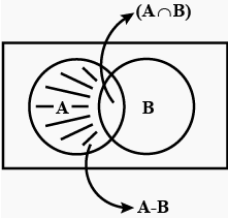
Find the equivalent set for A − B.
Answer - $\text{A}-(\text{A}\cap\text{B})$
Solution:
Hence By this graph we see that $\text{A}-\text{B}=\text{A}-(\text{A}\cap\text{B})$
View full question & answer→MCQ 1651 Mark
The range of the function f(x) = 3x - 2‚ is.
- A
$(-\infty,\infty)$
- B
$\text{R}-(3)$
- C
$(-\infty,0)$
- D
$(0,- \infty)$
Answer - $(-\infty,\infty)$
Solution:
Let the given function is
y = 3x - 2
⇒ y + 2 = 3x
$\Rightarrow \text{x} =\frac{(\text{y}+2)}{3}$
Now x is satisfied by all values.
So, Range {f(x)} = R $=(-\infty,\infty)$
View full question & answer→MCQ 1661 Mark
The relation S = {(3, 3), (4, 4)} on the set A = {3, 4, 5} is __________.
- A
Not reflexive but symmetric and transitive.
- B
- C
- D
Answer - Not reflexive but symmetric and transitive.
View full question & answer→MCQ 1671 Mark
If A = {x, y} then the power set of A is:
MCQ 1681 Mark
If A = (6, 7, 8, 9), B = (4, 6, 8, 10) and C = {x : x $\in$ N : 2 < x ≤ 7} ; find :B − C
Answer - {8, 10}
Solution:
C = {3, 4, 5, 6, 7}
B − C = {4, 8, 10}
View full question & answer→MCQ 1691 Mark
Which of the following collections are sets?
- A
The collection of all the days of a week
- B
A collection of 11 best hockey player of India.
- C
The collection of all rich person of Delhi
- D
A collection of most dangerous animals of India.
Answer - The collection of all the days of a week
View full question & answer→MCQ 1701 Mark
Let A = {1, 2, 3, 4, 5, 6, 7, 8, 9, 10}. Then the number of subsets of A containing exactly two elements is:
Answer - 45
Solution:
Number of elements in A = 10
Number of subsets of A containing exactly two elements
= Number of ways we can select 2 elements from 10 elements
$10\text{c}_2=\frac{10\times9}{2}=45$
$\therefore$ Number of subsets of A containing exactly two elements = 45
View full question & answer→MCQ 1711 Mark
If I is the set of isosceles triangle and E is the equilateral triangles then _____________.
Answer - $\text{E}\subset\text{I}$
Solution:
Given, I is the set of isosceles triangle and E is the equilateral triangles.
We know that every equilateral triangle is an isosceles triangle but the converse is not true.
View full question & answer→MCQ 1721 Mark
Given the universal set B = {−7, −3, −1, 0, 5, 6, 8, 9}, find: B = {x: − 4 < x < 6}
Answer - {−3, −1, 0, 5}
Solution:
The only 4 no.s that lie in the given range are -3, 0. -1 and 5.
View full question & answer→MCQ 1731 Mark
Suppose A1, A2, ..., A30 are thirty sets each having 5 elements and B1, B2, ..., Bn are n sets each with 3 elements. Let $\bigcup\limits^{30}_\text{i = 1}\text{A}_\text{i}=\bigcup\limits^{\text{n}}_\text{j = 1}\text{B}_\text{j}=\text{S}$ and each element of S belong to exactly 10 of the Ai's and exactly 9 of the Bj's, then n is equal to:
Answer - 45.
Solution:
It is given that each set $\text{A}_\text{j}(1\leq\text{i}\leq30)$ contains 5 elements and $\bigcup\limits^{30}_\text{i = 1}\text{A}_\text{i}=\text{S}.$
$\therefore\text{n(S)}=30\times5=150$
But, it is given that each element of S belong to exactly 10 of the Ai's.
$\therefore$ Number of distinct elements in $\text{S}=\frac{150}{10}=15......(1)$
It is also given that each set $\text{B}_\text{j}(1\leq\text{j}\leq\text{n})$ contains 3 elements and $\bigcup\limits^{\text{n}}_\text{j = 1}\text{B}_\text{j}=\text{S}.$
$\therefore\text{ n(S)}=\text{n}\times3=\text{3n}$
Also, each element of S belong to eactly 9 of Bj's.
$\therefore$ Number of distinct elements in $\text{S}=\frac{\text{3n}}{9}......(2)$
From (1) and (2), we have
$\frac{\text{3n}}{9}=15$
$\Rightarrow\text{n} = 45.$
Hence, the correct answer is option (c).
View full question & answer→MCQ 1741 Mark
Let n(A) = 28, n(A ∩ B) = 8, n(A ∪ B) = 52, then n(A ∩ B′) =.
Answer - 20
Solution:
Given n(A) = 28, n(A ∩ B) = 8.
We have A ∩ B′ = A − A ∩ B.
This give n(A ∩ B′) = n(A) − n(A ∩ B)
or, n(A ∩ B′) = 28 − 8 = 20.
View full question & answer→MCQ 1751 Mark
Which of the following has only one subset?
Answer - {}
Solution:
Empty set is the subset of itself.
View full question & answer→