MCQ 11 Mark
Which one of the following lacks active site of $\text{RNA}$ polymerase?
- A
$\alpha\alpha\ '\beta2\sigma$
- B
$\alpha\beta\beta\ '\sigma$
- C
$\alpha\alpha\ '\beta,\beta\ '\sigma$
- ✓
$\alpha_2\beta\beta\ '$
AnswerCorrect option: D. $\alpha_2\beta\beta\ '$
View full question & answer→MCQ 21 Mark
Sex is determined in human beings:
AnswerCorrect option: B. At the time of fertilization.
View full question & answer→MCQ 31 Mark
Which one of the following codons codes for the same information as $\text{UGC}?$
- ✓
$\text{UGU}$
- B
$\text{UGA}$
- C
$\text{UAG}$
- D
$\text{UGG}$
AnswerCorrect option: A. $\text{UGU}$
View full question & answer→MCQ 41 Mark
The experimental system used in studies of the discovery of replication of $\text{DNA}$ has been:
View full question & answer→MCQ 51 Mark
A person with $47$ chromosomes due to an additional $Y-$chromosome suffers from a condition called:
View full question & answer→MCQ 61 Mark
Who among the following did not provide experimental proof for the semiconservative model of $\text{DNA}$ replication?
- A
Meselson $\&$ Stahl
- B
- ✓
Watson $\&$ Crick
- D
AnswerCorrect option: C. Watson $\&$ Crick
View full question & answer→MCQ 71 Mark
Which of the following steps in transcription is catalysed by $\text{RNA}$ polymerse?
Answer$\text{RNA}$ polymerase facilitates initiation, elongation and termination during transcription. Option $'d\ ’$ is correct answer.
View full question & answer→MCQ 81 Mark
The nucleic acid synthesis takes place in:
- ✓
$5\ '-3\ '$ direction.
- B
$3\ '-5\ '$ direction.
- C
- D
AnswerCorrect option: A. $5\ '-3\ '$ direction.
View full question & answer→MCQ 91 Mark
Because most of the amino acids are represented by more than one codon, the genetic code is:
MCQ 101 Mark
Nucleotides in the two helical strands of $\text{DNA}$ are held together by:
View full question & answer→MCQ 111 Mark
Khorana first deciphered the triplet codons of:
- A
- ✓
- C
- D
Phenylalanine and methionine.
View full question & answer→MCQ 121 Mark
Discontinuous synthesis of $\text{DNA}$ occurs in one strand, because:
- A
$\text{DNA}$ molecule being synthesised is very long.
- ✓
$\text{DNA}$ dependent $\text{DNA}$ polymearse catalyses polymerisation only in one direction $(5\ ’ \rightarrow 3\ ’).$
- C
It is a more efficient process.
- D
$\text{DNA}$ ligase has to have a role.
AnswerCorrect option: B. $\text{DNA}$ dependent $\text{DNA}$ polymearse catalyses polymerisation only in one direction $(5\ ’ \rightarrow 3\ ’).$
View full question & answer→MCQ 131 Mark
$\text{DNA}$ is a polymer of nucleotides which are linked to each other by $3\ ’-5\ ’$ phosphodiester bond. To prevent polymerisation of nucleotides, which of the following modifications would you choose?
- A
Replace purine with pyrimidines.
- ✓
Remove$/$ Replace $3\ ' \ \text{OH}$ group in deoxy ribose.
- C
Remove$/$ Replace $2\ ' \ \text{OH}$ group with some other group in deoxy ribose.
- D
Both $'B\ ’$ and $'C\ ’.$
AnswerCorrect option: B. Remove$/$ Replace $3\ ' \ \text{OH}$ group in deoxy ribose.
View full question & answer→MCQ 141 Mark
Methyl guanosine triphosphate is added at $5\ '$ end of $\text{hn-RNA}$ in a process of:
View full question & answer→MCQ 151 Mark
In the lac operon of $E.$ coli, the i gene codes for.
View full question & answer→MCQ 161 Mark
The two polynucleotide chains in a $\text{DNA}$ are:
View full question & answer→MCQ 171 Mark
An individual exhibiting both male and female sexual characteristics in the body is known as:
MCQ 181 Mark
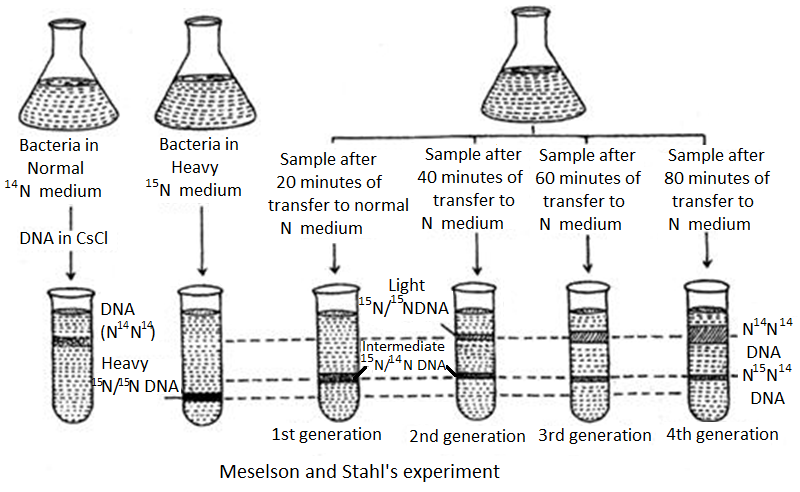
If Meselson and Stahl's experiment is continued for four generations in bacteria, the ratio of $\text{15N/15N : 15N/14N : 14N/14N}$ containing $\text{DNA}$ in the fourth generation would be:
- A
$1 : 1 : 0.$
- B
$1 : 4 : 0.$
- C
$0 : 1 : 3.$
- ✓
$0 : 1 : 7.$
AnswerCorrect option: D. $0 : 1 : 7.$
The ratio of $\ce{15_N / 15_N}$ remains zero in subsequent generation. The ratio of $\ce{15_N / 14_N}$ remains constant $($remains one$)$ and that of $\ce{14_N / 14_N}$ increases. Following figure illustrates this.
View full question & answer→MCQ 191 Mark
Transcription means synthesis of:
- A
$\text{DNA}$
- B
- ✓
$\text{mRNA}$
- D
AnswerCorrect option: C. $\text{mRNA}$
View full question & answer→MCQ 201 Mark
Which of the character is not applicable to $\text{tRNA}?$
AnswerCorrect option: D. It is the largest of the $\text{RNAs}$
View full question & answer→MCQ 211 Mark
Which was the last human chromosome to be completely sequenced:
- ✓
Chromosome $1$
- B
Chromosome $11$
- C
Chromosome $21$
- D
Chromosome $x$
AnswerCorrect option: A. Chromosome $1$
View full question & answer→MCQ 221 Mark
The type of $\text{RNA}$ polymerase controlling $\text{DNA}$ replication are:
View full question & answer→MCQ 231 Mark
$\text{DNA}$ replication is:
AnswerCorrect option: B. Semi$-$conservative and semi$-$discontinuous.
View full question & answer→MCQ 241 Mark
What is the nature of the strands of the $\text{DNA}$ duplex?
- ✓
Anti$-$parallel and complementary.
- B
Identical and complementary.
- C
Anti$-$parallel and non$-$complementary.
- D
Disimilar and non$-$complementary.
AnswerCorrect option: A. Anti$-$parallel and complementary.
View full question & answer→MCQ 251 Mark
The polytene chromosomes were discovered for the first time in:
MCQ 261 Mark
- A
Paired triplet of bases on messenger $\text{RNA}$
- B
Unpaired triplet of bases on $\text{rRNA}$
- C
Paired triplet of bases on $\text{rRNA}$
- ✓
An unpaired triplet of bases in an exposed position of $\text{tRNA}$
AnswerCorrect option: D. An unpaired triplet of bases in an exposed position of $\text{tRNA}$
View full question & answer→MCQ 271 Mark
A nucleoside differs from a nucleotide. It lacks the:
AnswerNucleoside $-$ Base $+$ sugar
Nucleotide $-$ Base $+$ sugar $+$ phosphate group.
View full question & answer→MCQ 281 Mark
Which of the following sets of codons contains only termination codons?
- ✓
$\text{UAA, UGA, UAG.}$
- B
$\text{UAA, UUU, UGG.}$
- C
$\text{UAA, UAG, UAC.}$
- D
$\text{UUU, UCC, UGG.}$
AnswerCorrect option: A. $\text{UAA, UGA, UAG.}$
View full question & answer→MCQ 291 Mark
In human beings $45$ chromosomes$/$ single $\text{X/ XO}$ abnormality causes:
View full question & answer→MCQ 301 Mark
Genetic code is a translation of the language of:
- ✓
$\text{RNA}$ into that of proteins
- B
Proteins into that of $\text{RNA}$
- C
Amino acids into that of $\text{RNA}$
- D
$\text{RNA}$ into that of $\text{DNA}$
AnswerCorrect option: A. $\text{RNA}$ into that of proteins
View full question & answer→MCQ 311 Mark
The sequence of nitrogen bases in a segment of a coding strand of $\text{DNA}$ is $\text{AATGCTTAGGCA}.$ What will be the sequence of nitrogen bases in the $\text{mRNA}$ transcribed by it?
- A
$\text{UUA CGA AUC CGU.}$
- B
$\text{AAU GCU AAC CGA.}$
- C
$\text{AAU GCA AUC CGU.}$
- ✓
$\text{AAU GCU UAG GCA.}$
AnswerCorrect option: D. $\text{AAU GCU UAG GCA.}$
View full question & answer→MCQ 321 Mark
Which of the following help in repairing of $\text{DNA}?$
AnswerCorrect option: B. $\text{DNA}$ polymerase $\text{I}$
View full question & answer→MCQ 331 Mark
During splicing, the exons are joined and the enzyme which catalyzes this reaction is:
- ✓
$\text{RNA}$ ligase
- B
$\text{RNA}$ catalase
- C
$\text{RNA}$ polymerase
- D
$\text{RNA}$ primase
AnswerCorrect option: A. $\text{RNA}$ ligase
View full question & answer→MCQ 341 Mark
When more than one codon codes for the same amino acid, what is this called?
- A
Universal nature of genetic code
- ✓
Redundancy of genetic code
- C
Punctuation in genetic code
- D
Continuous nature of genetic code
AnswerCorrect option: B. Redundancy of genetic code
View full question & answer→MCQ 351 Mark
Which of the following codes for stop signal?
- A
$\text{UAA}$
- B
$\text{UAG}$
- C
$\text{UGA}$
- ✓
View full question & answer→MCQ 361 Mark
One of the following is true with respect to $\text{AUG}.$
- ✓
- B
It codes for methionine in both prokaryotes and eukaryotes.
- C
It is also an initiation codon.
- D
It codes for methionine only.
View full question & answer→MCQ 371 Mark
Which one of the following statement is not correct?
- A
Cysteine is coded by $\text{UGU}$ and $\text{UGC}$ codons.
- B
Tyrosine is coded by $\text{UAU}$ and $\text{UAC}$ codons.
- ✓
$\text{UAA}$ codon codes for lysine.
- D
$\text{UGG}$ codon codes for tryptophan.
AnswerCorrect option: C. $\text{UAA}$ codon codes for lysine.
View full question & answer→MCQ 381 Mark
Which enzyme plays important role in transcription?
- ✓
$\text{DNA}$ dependent $\text{RNA}$ polymerase
- B
$\text{DNA}$ dependent $\text{DNA}$ polymerase
- C
$\text{RNA}$ dependent $\text{DNA}$ polymerase
- D
$\text{RNA}$ dependent $\text{RNA}$ polyrnerase
AnswerCorrect option: A. $\text{DNA}$ dependent $\text{RNA}$ polymerase
View full question & answer→MCQ 391 Mark
In Escherichia coli lac Operon is induced by:
- ✓
- B
- C
$\beta-$galactosidase.
- D
$I-$gene.
View full question & answer→MCQ 401 Mark
Human genome project was initiated by:
- ✓
Francis Collins and Roderick
- B
- C
- D
AnswerCorrect option: A. Francis Collins and Roderick
View full question & answer→MCQ 411 Mark
The wild type $E.$ coli cells are growing in normal medium with glucose. They are transferred to a medium containing only lactose as sugar. Which of the following changes takes place?
AnswerCorrect option: C. The lac operon is induced.
View full question & answer→MCQ 421 Mark
Regulatory proteins are the accessory proteins that interact with $\text{RNA}$ polymerase and affect its role in transcription. Which of the following statements is correct about regulatory protein?
AnswerCorrect option: D. They can act both as activators and as repressors.
View full question & answer→MCQ 431 Mark
The process of $\text{m RNA}$ synthesis on a $\text{DNA}$ is known as:
View full question & answer→MCQ 441 Mark
Experimental material in the study of $\text{DNA}$ replication has been:
View full question & answer→MCQ 451 Mark
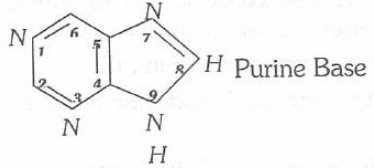
Purines possess nitrogen at which position?
- A
$1, 2, 4$ and $6$ position
- B
$1, 3, 5$ and $7$ position
- ✓
$1, 3, 7$ and $9$ position
- D
$1, 2, 6$ and $8$ position
AnswerCorrect option: C. $1, 3, 7$ and $9$ position
Purines consist of a six$-$membered and a five$-$membered nitrogen containing ring, fused together. It possesses nitrogen at $1,3,7$ and $9^{th}$ position.
View full question & answer→MCQ 461 Mark
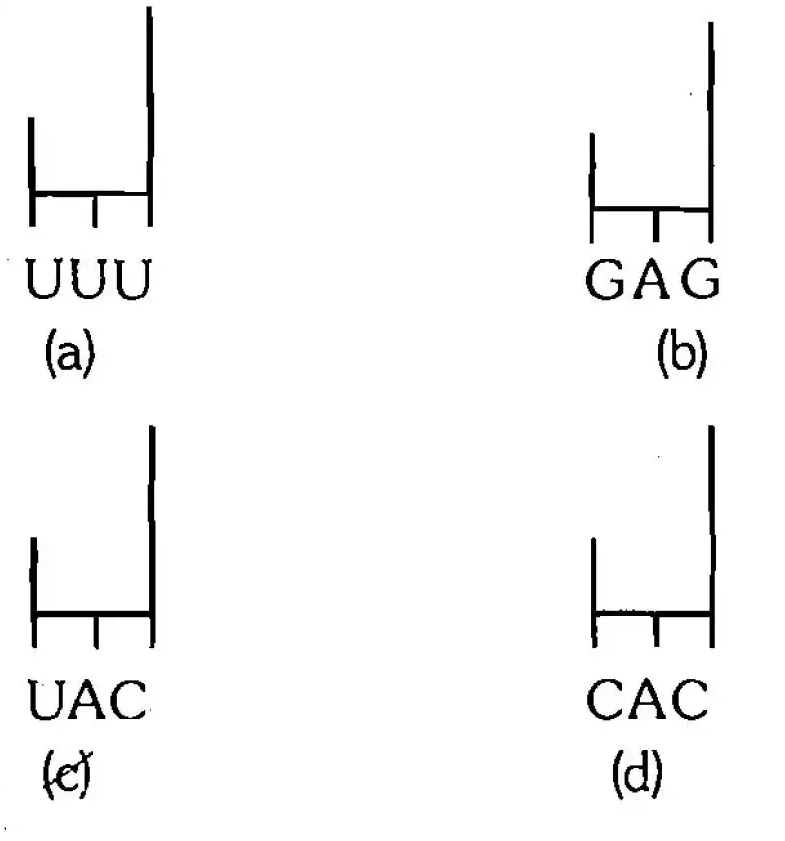
In a $\text{mRNA}$ sequence of $\mathrm{N}_2-$base is $\text{5' AUG GUG CUC AAA 3'.}$ What is the correct sequence of anticodons which recognizes codons of $\text{mRNA}:$
- A
$\text{a, b, c, d}$
- B
$\text{d, a, b, c}$
- ✓
$\text{c, d, b, a}$
- D
$\text{d, c, b, a}$
AnswerCorrect option: C. $\text{c, d, b, a}$
View full question & answer→MCQ 471 Mark
Who amongst the following scientists had no contribution in the development of the double helix model for the structure of $\text{DNA}?$
View full question & answer→MCQ 481 Mark
AnswerExplanation: (D) CsCl gradient
In the following procedure, centrifugation is done on a CsCl gradient, the DNA separate out at a point when density equals that of the salt solution.
${ }^{15} \mathrm{NH}_4 \mathrm{Cl}$ was used as a heavy isotope of ammonium chloride while, ${ }^{14} \mathrm{NH}_4 \mathrm{Cl}$ was used as the light isotope of ammonium chloride & the type of centrifugation used was density gradient centrifugation in a CsCl medium.
View full question & answer→MCQ 491 Mark
Which of the following statements is the most appropriate for sickle cell anaemia?
AnswerSickle cell disease is caused by a genetic abnormality in the gene for haemoglobin, which results in the production of sickle haemoglobin.
View full question & answer→MCQ 501 Mark
The number of base substitution possible in amino acid codons is:
MCQ 511 Mark
Down’s syndrome is due to:
AnswerCorrect option: D. Non$-$disjunction of chromosomes.
View full question & answer→MCQ 521 Mark
Sometimes the starting codon is $\text{GUG}$ in place of $\text{AUG, GUG}$ normally stands for:
View full question & answer→MCQ 531 Mark
A colourblind mother and normal father would have:
AnswerCorrect option: A. Colourblind sons and normal$/$carrier daughters.
View full question & answer→MCQ 541 Mark
Which one of the following pairs are correctly matched with regard to the codon and the amino acid coded by them?
- A
$\text{UUA} –$ Valine
- ✓
$\text{AAA} –$ Lysine
- C
$\text{AUG} –$ Cysteine
- D
$\text{CCC} –$ Alanine
AnswerCorrect option: B. $\text{AAA} –$ Lysine
A set of three nucleotide bases specify particular amino acid; the set is called as triplet codon. The triplet $"\text{UUA}"$ codes for leucine while valine is encoded by $\text{GUA, GUG, GUC, GUU};$ option $\text{A}$ is wrong. The triplet $"\text{AAA}"$ codes for lysine; option $\text{B}$ is right.
The triplet $"\text{AUG}"$ codes for methionine while cysteine is encoded by $\text{UGU}$ and $\text{UGC};$ option $\text{C}$ is wrong. The triplet $"\text{CCC}"$ codes for proline while alanine is encoded by $\text{GCA, GCC, GCG, GCU};$ option $\text{D}$ is wrong.
View full question & answer→MCQ 551 Mark
In bacteria, the codon $\text{AUG}$ stands for:
- A
- B
- C
$N-$formyl methionine
- ✓
Both $B$ and $C$
AnswerCorrect option: D. Both $B$ and $C$
View full question & answer→MCQ 561 Mark
If the sequence of nitrogen bases of the coding strand of $\text{DNA}$ in a transcription unit is$: \text{5' - ATGAATG - 3',}$ The sequence of bases in its $\text{RNA}$ transcript would be:
- ✓
$\text{5' - AUGAAUG - 3'}$
- B
$\text{5' - UACUUAC - 3'}$
- C
$\text{5' - CAUUCAU - 3'}$
- D
$\text{5' - GUAAGUA - 3'}$
AnswerCorrect option: A. $\text{5' - AUGAAUG - 3'}$
View full question & answer→MCQ 571 Mark
The $\text{RNA}$ polymerase holoenzyme transcribes:
- ✓
The structural gene and the terminator regions.
- B
The structural gene only.
- C
- D
The promoter, structural gene and the terminator region.
AnswerCorrect option: A. The structural gene and the terminator regions.
View full question & answer→MCQ 581 Mark
Degeneracy of genetic code was discovered by:
AnswerCorrect option: D. Baurnfield $\&$ Nirenberg
View full question & answer→MCQ 591 Mark
The fact that a purine base always paired through hydrogen bonds with a pyrimidine base leads to, in the $\text{DNA}$ double helix.
AnswerCorrect option: A. Uniform width throughout $\text{DNA}.$
View full question & answer→MCQ 601 Mark
In $\text{DNA}$ replication, the primer is:
- A
A small deoxyribonucleotide polymer.
- ✓
A small ribonucleotide polymer.
- C
Helix destabilizing protein.
- D
Enzyme taking part in joining nucleotides of new strand.
AnswerCorrect option: B. A small ribonucleotide polymer.
View full question & answer→MCQ 611 Mark
Which of the following is a stop codon?
- A
$\text{AUG, GUG, UUU}$
- ✓
$\text{UGA, UAG, UAA}$
- C
$\text{UUU, UAC, CUC}$
- D
$\text{CUC, UAC, UAA}$
AnswerCorrect option: B. $\text{UGA, UAG, UAA}$
View full question & answer→MCQ 621 Mark
A codon in $\text{mRNA}$ has:
- ✓
$3$ bases
- B
$2$ bases
- C
$1$ base
- D
AnswerCorrect option: A. $3$ bases
View full question & answer→MCQ 631 Mark
Operon model for regulation of transcription was proposed by.
MCQ 641 Mark
Which of the following are the functions of $\text{RNA}?$
AnswerCorrect option: A. It is a carrier of genetic information from $\text{DNA}$ to ribosomes synthesising polypeptides.
View full question & answer→MCQ 651 Mark
Lactose operon produces enzymes:
- A
$b-$galactosidase, permease and glycogen synthetase.
- ✓
$b-$galactosidase, permease and transacetylase.
- C
Permease, glycogen synthetase and transacetylase.
- D
$b-$galactosidase, permease and phosphor glucose isomerase.
AnswerCorrect option: B. $b-$galactosidase, permease and transacetylase.
View full question & answer→MCQ 661 Mark
What is not true for genetic code?
AnswerCorrect option: B. A codon in $\text{mRNA}$ is read in a non $-$ contiguous fashion.
View full question & answer→MCQ 671 Mark
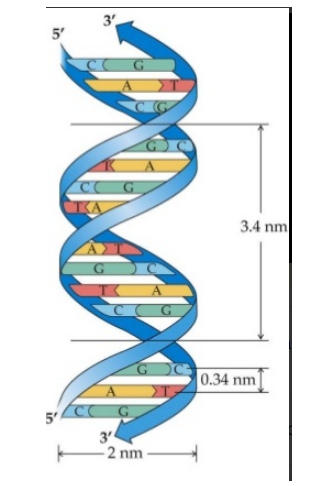
What is the width of $\text{DNA}$ molecule?
- A
$15 A^\circ$
- ✓
$20 A^\circ$
- C
$25 A^\circ$
- D
$34 A^\circ$
AnswerCorrect option: B. $20 A^\circ$
The width of the double$-$stranded $\text{DNA (B-DNA)}$ molecule is around $2\ nm$ or $20$ angstroms.
View full question & answer→MCQ 681 Mark
The enzyme$, \text{DNA}$ polymerase was discovered by:
View full question & answer→MCQ 691 Mark
The central dogma of molecular biology $($genetic information flow$)$ was modified by the discovery of.
- A
$\text{RNA}$ polymerase.
- B
$\text{DNA}$ ligase.
- ✓
- D
$\text{DNA}$ polymerase.
View full question & answer→MCQ 701 Mark
Who proved that $\text{DNA}$ is basic genetic material?
View full question & answer→MCQ 711 Mark
The triplet $\text{UUU}$ codes for:
View full question & answer→MCQ 721 Mark
The one aspect which is not a salient feature of genetic code is, its:
AnswerGenetic codes are never ambiguous. That is, it is never confusing. It is represented as triplet codons, each represents an amino acid. There are $64$ codons. Out of which $61$ codes for amino acids and $3$ are stop codons.
View full question & answer→MCQ 731 Mark
Of both normal parents, the chance of a male child becoming colourblind are:
- A
- B
Possible only when all the four grand parents had normal vision.
- C
Possible only when father’s mother was colourblind.
- ✓
Possible only when mother’s father was colourblind.
AnswerCorrect option: D. Possible only when mother’s father was colourblind.
View full question & answer→MCQ 741 Mark
In genetic coding, triplet codons make possible $64$ types of codons. If the genetic code was a doublet instead of a triplet codon, the number of types of codons possible would be:
- A
$64$ types of codons
- B
$4$ types of codons
- C
$24$ types of codonsa
- ✓
$16$ types of codons
AnswerCorrect option: D. $16$ types of codons
View full question & answer→MCQ 751 Mark
The translation termination triplet is:
- A
$\text{UAU}$
- ✓
$\text{UAA}$
- C
$\text{UAC}$
- D
$\text{UGC}$
AnswerCorrect option: B. $\text{UAA}$
View full question & answer→MCQ 761 Mark
The net electric charge on $\text{DNA}$ and histones is:
- A
- B
- ✓
Negative and positive, respectively.
- D
AnswerCorrect option: C. Negative and positive, respectively.
View full question & answer→MCQ 771 Mark
The process by which $\text{DNA}$ of nucleus passes genetic information to $\text{mRNA}$ is called:
View full question & answer→MCQ 781 Mark
Eukaryotic $\text{RNA}$ polymerase $\text{III}$ catalyses the synthesis of.
- A
$\text{mRNA.}$
- B
$\text{rRNA.}$
- C
$\text{hnRNA.}$
- ✓
$\text{tRNA.}$
AnswerCorrect option: D. $\text{tRNA.}$
View full question & answer→MCQ 791 Mark
Which of the following enzyme is used to join $\text{DNA}$ fragments?
- A
- B
- ✓
- D
$\text{DNA}$ polymerase
View full question & answer→MCQ 801 Mark
The scientists involved in discovery of $\text{DNA}$ as chemical basis of heredity were:
- A
- B
- ✓
Avery, Mac Leod and Mc Carty.
- D
AnswerCorrect option: C. Avery, Mac Leod and Mc Carty.
View full question & answer→MCQ 811 Mark
What does bacterial genome contain?
- ✓
Double stranded circular $\text{DNA}$
- B
Double stranded linear $\text{DNA}$
- C
Single stranded circular $\text{DNA}$
- D
Single stranded $\text{DNA}$
AnswerCorrect option: A. Double stranded circular $\text{DNA}$
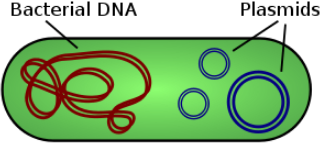
The bacterial genome contains double $–$ stranded circular $\text{DNA}.$ It also contains short circular $\text{DNA}$ called a plasmid.
It is a self $–$ replicating unit that mainly helps in transformation.
View full question & answer→MCQ 821 Mark
After crossing two plants, the progenies are found to be male sterile. This phenomenon is found to be maternally inherited and is due to some genes which are present in:
MCQ 831 Mark
During transcription, if the nucleotide sequence of the $\text{DNA}$ strand that is being coded is $\text{ATACG},$ then the nucleotide sequence in the $\text{mRNA}$ would be:
- A
$\text{TATGC}$
- B
$\text{TCTGG}$
- ✓
$\text{UAUGC}$
- D
$\text{UATGC}$
AnswerCorrect option: C. $\text{UAUGC}$
View full question & answer→MCQ 841 Mark
Assumption that genetic code is a triplet was suggested by?
MCQ 851 Mark
In a $\text{DNA}$ strand the nucleotides are linked together by:
View full question & answer→MCQ 861 Mark
Which of the following is not directly formed from $\text{DNA}?$
- A
$\text{DNA}$
- ✓
- C
$\text{mRNA}$
- D
$\text{tRNA}$
AnswerProteins are polypeptides. They are linear chains of amino acids linked by peptide bonds.
View full question & answer→MCQ 871 Mark
What is the process of joining together different $\text{DNA}$ fragments often referred as?
View full question & answer→MCQ 881 Mark
How many nitrogenous bases are there in a codon?
MCQ 891 Mark
Both husband and wife have normal vision though their fathers were colourblind. The probability of their daughter becoming colourblind is:
- ✓
$0\%$
- B
$25\%$
- C
$50\%$
- D
$75\%$
View full question & answer→MCQ 901 Mark
Which of the following statement is not true for genetic code?
AnswerCorrect option: A. A codon in $\text{mRNA}$ is read in a non$-$contiguous fashion.
- Codon in $\text{mRNA}$ consists of three nucleotides and is read in a contiguous manner.
- Genetic code is same in every organism with some exceptions. Hence, it is nearly universal.
- Genetic code is degenerate as more than one codon may code for an amino acid.
- Genetic code is unambiguous as a particular codon will always code for the same amino acid
View full question & answer→MCQ 911 Mark
$\text{DNA}$ is unique among molecules in that it can :
- A
Form multipolymerc omplexes
- B
Come apart and re$-$form
- C
Withstand very high temperatures
- ✓
View full question & answer→MCQ 921 Mark
Replication of $\text{DNA}$ is in:
- A
$3\ ' - 5\ '$ direction
- B
$2\ ' - 5\ '$ direction
- ✓
$5\ ' - 3\ '$ direction
- D
AnswerCorrect option: C. $5\ ' - 3\ '$ direction
View full question & answer→MCQ 931 Mark
Leading strand during $\text{DNA}$ replication is formed:
View full question & answer→MCQ 941 Mark
If more than one code designates the single amino acid it is:
MCQ 951 Mark
A colourblind woman marries a normal visioned male. In the offspring:
- A
Both son and daughter are colourblind.
- B
All daughters are colourblind.
- C
- ✓
All sons are colourblind.
AnswerCorrect option: D. All sons are colourblind.
View full question & answer→MCQ 961 Mark
Gel electyrophoresis is used for:
- A
Construction of recombinant $\text{DNA}$ by joining with cloning vectors
- B
Isolation of $\text{DNA}$ molecule
- C
Cutting of $\text{DNA}$ into fragments
- ✓
Separation of $\text{DNA}$ fragments according to their size
AnswerCorrect option: D. Separation of $\text{DNA}$ fragments according to their size
View full question & answer→MCQ 971 Mark
Which one of the following pairs of codons is correctly matched with their function or the signal for the particular amino acid?
- A
$\text{AUG, ACG} – \frac{\text{Start}}{\text{Methionine}}$
- B
$\text{UUA, UCA} –$ Leucine
- C
$\text{GUU, GCU} –$ Alanine
- ✓
$\text{UAG, UGA} –$ Stop
AnswerCorrect option: D. $\text{UAG, UGA} –$ Stop
View full question & answer→MCQ 981 Mark
Frame shift mutation occurs when.
- ✓
Base is deleted or added.
- B
- C
- D
Anticodons are not present.
AnswerCorrect option: A. Base is deleted or added.
View full question & answer→MCQ 991 Mark
Chargaff’s rules are applicable to:
- ✓
Single stranded $\text{RNA}.$
- B
Single stranded $\text{DNA}$ and $\text{RNA}.$
- C
Single stranded $\text{DNA}.$
- D
Double stranded $\text{DNA}.$
AnswerCorrect option: A. Single stranded $\text{RNA}.$
View full question & answer→MCQ 1001 Mark
The $\text{RNA}$ polymerase holoenzyme transcribes:
- A
The promoter, structural gene and the terminator region.
- B
- C
The structural gene and the terminator regions.
- ✓
The structural gene only.
AnswerCorrect option: D. The structural gene only.
View full question & answer→MCQ 1011 Mark
$64$ Codons constitute genetic code because:
View full question & answer→MCQ 1021 Mark
The net electric charge on $\text{DNA}$ and histones is:
- ✓
Negative and positive, respectively.
- B
- C
- D
AnswerCorrect option: A. Negative and positive, respectively.
View full question & answer→MCQ 1031 Mark
Which of the following is correct for Watson and Crick’s model of $\text{DNA}.$ It is duplex with.
- ✓
$10$ base pairs and $3.4 \mathring A$ distance for every turn.
- B
$10$ base pairs and $3.4 \mathring A$ distance for each turn of spiral.
- C
$20$ base pairs and $34 \mathring A$ for each turn.
- D
AnswerCorrect option: A. $10$ base pairs and $3.4 \mathring A$ distance for every turn.
View full question & answer→MCQ 1041 Mark
Which of the following steps in transcription is catalysed by $\text{RNA}$ polymerse?
View full question & answer→MCQ 1051 Mark
If the base sequence of a codon in $\text{mRNA}$ is $\text{5'-AUG-3',}$ the sequence of $\text{tRNA}$ pairing with it must be:
- ✓
$\text{5' - CAU - 3'}$
- B
$\text{5' - AUG - 3'}$
- C
$\text{5' - GUA - 3'}$
- D
$\text{5' - UAC - 3'}$
AnswerCorrect option: A. $\text{5' - CAU - 3'}$
View full question & answer→MCQ 1061 Mark
Protein helping in opening of $\text{DNA}$ double helix in front of replications fork is:
AnswerCorrect option: A. $\text{DNA}$ gyrase.
View full question & answer→MCQ 1071 Mark
"It has not escaped our notice that the specific pairing we have postulated immediately suggests a possible copying mechanisms for the genetic material," this is written by:
MCQ 1081 Mark
What is the function of a non$-$sense codon?
AnswerCorrect option: C. To terminate the message of a gene controlled protein synthesis.
View full question & answer→MCQ 1091 Mark
Degeneracy in the genetic code was found by:
AnswerExplanation: (D) Lagervist
The genetic code is degenerate which means that most amino acids are specied by more than one codon. As we know that there are only four nucleotides namely deoxyadenosine, deoxyguanosine, deoxythymidine and deoxycytidine. Further, there are 20 essential amino acids that are to be encoded by these four nucleotides.
A triplet code could make a genetic code for 64 different combinations (4 × 4 × 4) genetic code. Thus, there are ample of codons to specify 20 amino acids. Genetic code degeneracy was identified by Lagervist. He showed that codons GAA and GAG specify glutamic acid and exhibit degeneracy.
View full question & answer→MCQ 1101 Mark
The promoter site and the terminator site for transcription are located at:
- ✓
$5\ ' ($upstream$)$ end and $3\ ' ($downstream$)$ end, respectively of the transcription unit.
- B
The $5\ ' ($upstream$)$ end.
- C
The $3\ ' ($downstream$)$ end.
- D
$3\ ' ($downstream$)$ end and $5\ ' ($upstream$)$ end, respectively of the transcription unit.
AnswerCorrect option: A. $5\ ' ($upstream$)$ end and $3\ ' ($downstream$)$ end, respectively of the transcription unit.
View full question & answer→MCQ 1111 Mark
$3-D$ structure of $\text{RNA}$ is called:
View full question & answer→MCQ 1121 Mark
Which one of the following pairs is correctly matched?
- A
Ribosomal $\text{RNA} -$ carries aminoacids to the site of protein synthesis
- B
Transcription $-$ process by which protein is synthesized
- C
Translation $-$ process by which $\text{mRNA}$ carries the information from nucleus to the ribosome
- ✓
Anticodon $-$ site of $\text{tRNA}$ molecule that contains complementary bases to the triple code on the $\text{mRNA}$
AnswerCorrect option: D. Anticodon $-$ site of $\text{tRNA}$ molecule that contains complementary bases to the triple code on the $\text{mRNA}$
View full question & answer→MCQ 1131 Mark
A sequence of how many nucleotides in messenger $\text{RNA}$ makes a codon for an amino acid?
View full question & answer→MCQ 1141 Mark
What is the main aim of the human genome project?
- A
To introduce new genes into humans
- ✓
To identify and sequence all the genes present in human $\text{DNA}$
- C
To develop better techniques for comparing two different human $\text{DNA}$ samples
- D
To remove disease causing genes from human $\text{DNA}$
AnswerCorrect option: B. To identify and sequence all the genes present in human $\text{DNA}$
View full question & answer→MCQ 1151 Mark
In the base sequence, one strand of $\text{DNA}$ is $\text{GAT, TAG, CAT, GAC}.$ what shall be the sequence of its complementary strand?
- A
$\text{CAT, CTG, ATC, GTA}$
- B
$\text{GTA, ATC, CTG, GTA}$
- C
$\text{ATC, GTA, CTG, GTA}$
- ✓
$\text{CTA, ATC, GTA, CTG}$
AnswerCorrect option: D. $\text{CTA, ATC, GTA, CTG}$
View full question & answer→MCQ 1161 Mark
Which is not involved in protein synthesis?
MCQ 1171 Mark
Two or more codons encoding the same amino acid is due to:
MCQ 1181 Mark
Genetic code consists of:
- A
$4$ codons, each with two nucleotides
- B
$16$ codons, each with four nucleotides
- C
$64$ codons, each with two nucleotides
- ✓
$64$ codons, each with three nucleotides
AnswerCorrect option: D. $64$ codons, each with three nucleotides
View full question & answer→MCQ 1191 Mark
In $E.$ coli, the lac operon gets switched on when:
AnswerCorrect option: A. lactose is present and it binds to the repressor.
View full question & answer→MCQ 1201 Mark
The enzyme which helps to cut one strand of $\text{DNA}$ duplex to release tension of coiling of two strands is:
View full question & answer→MCQ 1211 Mark
Which of the following statements is not true for retroviruses:
- A
The gentic material in mature retroviruses in $\text{RNA}$
- B
Retroviruses are causative agents or certain kinds of cancer in man
- ✓
$\text{DNA}$ is not present at any stage in the life cycle of retroviruses
- D
Retroviruses carry gene for $\text{RNA}-$dependent $\text{DNA}$ polymerase
AnswerCorrect option: C. $\text{DNA}$ is not present at any stage in the life cycle of retroviruses
View full question & answer→MCQ 1221 Mark
One of the following is true with respect to $\text{AUG}:$
- A
It codes for methionine only.
- B
It is also an initiation codon.
- C
It codes for methionine in both prokaryotes and eukaryotes.
- ✓
View full question & answer→MCQ 1231 Mark
Code of a mature $\text{mRNA}$ and the protein synthesized from it are:
Answer
- Coplanar means in the same plane.
- Colinear means on the same line.
- Nonlinear means not in a straight line.
- Irregular means any random arrangement.
View full question & answer→MCQ 1241 Mark
Identify the group which contains only pyrimidines.
- A
- ✓
- C
Guanine, uracil and cytosine
- D
View full question & answer→MCQ 1251 Mark
The codons causing chain termination $($stop codons$)$ are:
- A
$\text{TAG, TGA}$
- B
$\text{GAT, AGT}$
- C
$\text{AGT, TAG, UGA}$
- ✓
$\text{UAG, UGA, UAA}$
AnswerCorrect option: D. $\text{UAG, UGA, UAA}$
View full question & answer→MCQ 1261 Mark
Anticodon is an unpaired triplet of bases in an exposed position of:
- A
$\text{mRNA}$
- B
$\text{rRNA}$
- ✓
$\text{tRNA}$
- D
$\text{sRNA}$
AnswerCorrect option: C. $\text{tRNA}$
View full question & answer→MCQ 1271 Mark
The most striking example of point mutation is found in a disease called.
MCQ 1281 Mark
$\text{DNA}$ repair in prokaryotes in carried out by:
AnswerCorrect option: C. $\text{DNA}$ polymerase $\text{II}$
View full question & answer→MCQ 1291 Mark
If meselson and stahl's experiment is continued for four generations in bacteria, the ratio of $\frac{15_\text{N}}{15_\text{N}}:\frac{15_\text{N}}{14_\text{N}}:\frac{14_\text{N}}{14_\text{N}} $containing $\text{DNA}$ in the fourth generation would be:
- ✓
$0 : 1 : 7$
- B
$0 : 1 : 3$
- C
$1 : 4 : 0$
- D
$1 : 1 : 0$
AnswerCorrect option: A. $0 : 1 : 7$
View full question & answer→MCQ 1301 Mark
There are $64$ types of codons in genetic code dictionary because:
- A
There are $64$ types of $\text{tRNA's}$ found in cell.
- B
There are $44$ meaningless and $20$ codons for amino acids.
- C
There are $64$ amino acids for coding.
- ✓
View full question & answer→MCQ 1311 Mark
Which of the following is a nucleoside?
MCQ 1321 Mark
In a $\text{DNA}$ strand the nucleotides are linked together by:
AnswerIn a $\text{DNA}$ strand the nucleotides are linked together by Phosphodiester bonds.
View full question & answer→MCQ 1331 Mark
Which of the following is initiator codon?
- A
$\text{UUU}$
- B
$\text{AUC}$
- C
$\text{UAC}$
- ✓
$\text{AUG}$
AnswerCorrect option: D. $\text{AUG}$
View full question & answer→MCQ 1341 Mark
If the $\text{DNA}$ codons are $\text{ATG ATG ATG}$ and a cytosine base is inserted at the beginning, which of the following will result?
- A
A non$-$sense mutation
- B
$\text{CT TGA TGA TG}$
- ✓
$\text{CAT GAT GAT G}$
- D
$\text{C CTG ATG ATG}$
AnswerCorrect option: C. $\text{CAT GAT GAT G}$
If cytosine is added in the beginning, the nucleotide becomes $: \text{CAT GAT GAT G.}$ The complementary base pairs are $- \text{GTA CTA CTA C.}$
View full question & answer→MCQ 1351 Mark
Semi$-$conservative replication of $\text{DNA}$ was first demonstrated in:
View full question & answer→MCQ 1361 Mark
The first genetic material could be:
- A
- B
- C
$\text{DNA.}$
- ✓
$\text{RNA.}$
AnswerCorrect option: D. $\text{RNA.}$
View full question & answer→MCQ 1371 Mark
Okazaki segments are formed during:
MCQ 1381 Mark
Control of gene expression takes place at the level of:
MCQ 1391 Mark
Genes located on $Y-$chromosome are:
View full question & answer→MCQ 1401 Mark
The double helix model of Watson and Crick is known as:
- A
$\text{C-DNA}$
- ✓
$\text{B-DNA}$
- C
$\text{Z-DNA}$
- D
$\text{D-DNA}$
AnswerCorrect option: B. $\text{B-DNA}$
View full question & answer→MCQ 1411 Mark
Degeneration of a genetic code is attributed to the:
MCQ 1421 Mark
A human gene product can be produced by genetically engineered bacteria. This is possible, because the:
- ✓
Genetic code is universal.
- B
Human chromosome can replicate in bacterial cell.
- C
Bacterial cell can carry out the splicing reaction.
- D
Mechanism of gene regulation is identical in humans and bacteria.
AnswerCorrect option: A. Genetic code is universal.
View full question & answer→MCQ 1431 Mark
Which one of the following triplet codes, is correctly matched with its specificity for an amino acid in protein synthesis or as 'start' or 'stop' codon:
- A
$\text{UCG}$ Start
- B
$\text{UUU}$ Stop
- C
$\text{UGU}$ Leucine
- ✓
$\text{UAC}$ Tyrosine
AnswerCorrect option: D. $\text{UAC}$ Tyrosine
View full question & answer→MCQ 1441 Mark
The following ratio is generally constant for a given species:
- A
$\frac{ \text{T + C} }{ \text{G + A} }$
- ✓
$\frac{ \text{G + C} }{ \text{A + T} }$
- C
$\frac{ \text{A + C} }{ \text{T + G} }$
- D
$\frac{ \text{A + G} }{ \text{C + T} }$
AnswerCorrect option: B. $\frac{ \text{G + C} }{ \text{A + T} }$
View full question & answer→MCQ 1451 Mark
The $\text{DNA}$ site where $\text{DNA}-$dependent $\text{RNA}$ polymerase binds for transcription, is called.
View full question & answer→MCQ 1461 Mark
Double helix model of $\text{DNA}$ which was proposed by Watson and Crick was of:
- A
$\text{C – DNA}$
- ✓
$\text{B – DNA}$
- C
$\text{D – DNA}$
- D
$\text{Z – DNA}$
AnswerCorrect option: B. $\text{B – DNA}$
View full question & answer→MCQ 1471 Mark
The enzyme that breaks Hydrogen bonds between the $2$ strands of a $\text{DNA}$ molecule is:
View full question & answer→MCQ 1481 Mark
Who was awarded Nobel Prize in $1959$ for in vitro synthesis of polyribonucleotide?
AnswerCorrect option: D. Both $B$ and $C$
Ochoa and Kornberg won the Nobel Prize in Physiology or Medicine in $1959$ for their "discovery of the mechanisms in the biological synthesis of ribonucleic acid and deoxyribonucleic acid"
View full question & answer→MCQ 1491 Mark
If the sequence of bases in $\text{DNA}$ is $\text{ATTCGATG},$ then the sequence of bases in its transcript will be:
- A
$\text{CAUCGAAU}$
- ✓
$\text{UAAGCUAC}$
- C
$\text{GUAGCUUA}$
- D
$\text{AUUCGAUG}$
AnswerCorrect option: B. $\text{UAAGCUAC}$
View full question & answer→MCQ 1501 Mark
The fact that a purine base always paired through hydrogen bonds with a pyrimidine base leads to, in the $\text{DNA}$ double helix:
AnswerCorrect option: C. Uniform width throughout $\text{DNA}.$
View full question & answer→MCQ 1511 Mark
Method by which information reaches from $\text{DNA}$ to $\text{RNA}$ is:
View full question & answer→MCQ 1521 Mark
Which of the following is an initiation codon?
- A
$\text{UAG}$
- B
$\text{AUC}$
- ✓
$\text{AUG}$
- D
$\text{CCU}$
AnswerCorrect option: C. $\text{AUG}$
View full question & answer→MCQ 1531 Mark
If genetic code is tetraplet then what is the possible number of codons which code $20$ types of amino acids?
View full question & answer→MCQ 1541 Mark
What are the $\text{DNA}$ sequences that code for protein known as?
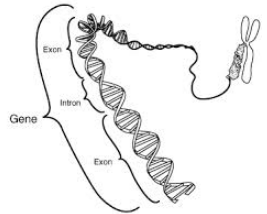
Answer$\text{DNA}$ initially transcribed to messenger $\text{RNA},$ consists of coding sequences which are called as exons which codes for proteins and non$-$coding sequences which are called as introns.
View full question & answer→MCQ 1551 Mark
Okazaki fragments are seen during.
MCQ 1561 Mark
$\text{DNA}$ replication requires which of the following enzymes?
AnswerCorrect option: B. $\text{DNA}$ polymerase and ligase
View full question & answer→MCQ 1571 Mark
The enzyme involved in transcription is:
- ✓
$\text{RNA}$ polymerase
- B
$\text{DNA}$ polymerase $\text{I}$
- C
$\text{DNA}$ polymerase $\text{II}$
- D
$\text{DNA}$ polymerase $\text{III}$
AnswerCorrect option: A. $\text{RNA}$ polymerase
View full question & answer→MCQ 1581 Mark
What is the name of double helix model of Watson and Crick?
- A
$\text{C-DNA}$
- ✓
$\text{B-DNA}$
- C
$\text{Z-DNA}$
- D
$\text{D-DNA}$
AnswerCorrect option: B. $\text{B-DNA}$
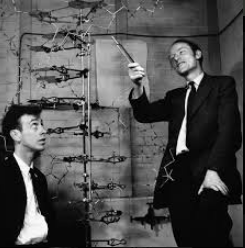
Watson and Crick shared the Nobel prize in $1962$ for their discovery, along with Maurice Wilkins for producing crystallographic evidence for a helical structure of $\text{DNA},$ which is called as $\text{B-DNA}.$
View full question & answer→MCQ 1591 Mark
$\text{DNA}$ replication is:
- A
- B
Non$-$conservative
- ✓
Semi$-$conservative
- D
AnswerCorrect option: C. Semi$-$conservative
View full question & answer→MCQ 1601 Mark
The change of the light coloured variety of peppered moth $($Biston betularia$)$ to its darker variety $($Biston carbonarid$)$ is due to:
View full question & answer→MCQ 1611 Mark
Which of the following is the simplest amino acid?
MCQ 1621 Mark
$\text{DNA}$ strands:
- A
Have quaternary structure like protein
- B
Are bonded by disulphide bonds
- C
- ✓
View full question & answer→MCQ 1631 Mark
Which of the following amino acid has hydroxyl methyl group as its $R$ group?
View full question & answer→MCQ 1641 Mark
Codons that do not code for amino acids are:
MCQ 1651 Mark
$H. J.$ Muller was awarded Nobel Prize for his:
- A
Discovery that chemicals can induce gene mutations.
- ✓
Discovery that ionizing radiations can induce gene mutations.
- C
Work on gene mapping in Drosophila.
- D
Efforts to prevent the use of nuclear weapons.
AnswerCorrect option: B. Discovery that ionizing radiations can induce gene mutations.
View full question & answer→MCQ 1661 Mark
The promoter site and the terminator site for transcription are located at:
- A
$3\ ' ($downstream$)$ end and $5\ ' ($upstream$)$ end, respectively of the transcription unit.
- ✓
$5\ ' ($upstream$)$ end and $3\ ' ($downstream$)$ end, respectively of the transcription unit.
- C
The $5\ ' ($upstream$)$ end.
- D
The $3\ ' ($downstream$)$ end.
AnswerCorrect option: B. $5\ ' ($upstream$)$ end and $3\ ' ($downstream$)$ end, respectively of the transcription unit.
View full question & answer→MCQ 1671 Mark
A nucleoside differs from a nucleotide. It lacks the:
AnswerA purine or pyrimidine base joined with a pentose sugar, either ribose or deoxyribose, is a nucleoside. A nucleotide is a nucleoside with one or more phosphate groups attached to the sugar.
View full question & answer→MCQ 1681 Mark
$\text{DNA}$ ligase helps in:
AnswerCorrect option: A. Joining segments of $\text{DNA}$
View full question & answer→MCQ 1691 Mark
If the sequence of nitrogen bases of the coding strand of $\text{DNA}$ in a transcription unit is$: \text{5' - A T G A A T G - 3'},$ The sequence of bases in its $\text{RNA}$ transcript would be;
- ✓
$\text{5' - A U G A A U G - 3'.}$
- B
$\text{5' - U A C U U A C - 3'.}$
- C
$\text{5' - C A U U C A U - 3'.}$
- D
$\text{5' - G U A A G U A - 3'.}$
AnswerCorrect option: A. $\text{5' - A U G A A U G - 3'.}$
View full question & answer→MCQ 1701 Mark
What is the total number of nitrogenous bases in human genome estimated?
- A
$3.5$ million
- B
$35$ thousand
- C
$35$ million
- ✓
$3.1$ billion
AnswerCorrect option: D. $3.1$ billion
View full question & answer→MCQ 1711 Mark
View full question & answer→MCQ 1721 Mark
Length of one loop of $\text{B DNA}$ is:
- ✓
$3.4\ nm$
- B
$0.34\ nm$
- C
$20\ nm$
- D
$10\ nm$
AnswerCorrect option: A. $3.4\ nm$
View full question & answer→MCQ 1731 Mark
In some viruses$, \text{DNA}$ is synthesised by using $\text{RNA}$ as template. Such a $\text{DNA}$ is called:
- ✓
$\text{c-DNA}$
- B
$\text{r-DNA}$
- C
$\text{B-DNA}$
- D
$\text{A-DNA}$
AnswerCorrect option: A. $\text{c-DNA}$
View full question & answer→MCQ 1741 Mark
The two strands of $\text{DNA}$ are held together by.
View full question & answer→MCQ 1751 Mark
$\text{DNA}$ polymerase is needed for:
- A
Replication of $\text{DNA}$
- B
Synthesis of $\text{DNA}$
- C
Elongation of $\text{DNA}$
- ✓
View full question & answer→MCQ 1761 Mark
Formation of $\text{mRNA}$ from $\text{DNA}$ is called as:
View full question & answer→MCQ 1771 Mark
During $\text{DNA}$ replication, the strands separate by:
- A
$\text{DNA}$ polymerase.
- B
- ✓
Unwindase$/$ helicase.
- D
AnswerCorrect option: C. Unwindase$/$ helicase.
View full question & answer→MCQ 1781 Mark
Genetic information in a $\text{DNA}$ molecule is coded in the:
- ✓
- B
- C
Turning pattern of the helix
- D
Portion of each base present
View full question & answer→MCQ 1791 Mark
A $\text{DNA}$ with unequal nitrogen bases would most probably be:
View full question & answer→MCQ 1801 Mark
Which scientist gave wobble hypothesis?
- A
$\text{R. W.}$ Holley
- B
$\text{H. G.}$ Khorana
- C
$\text{M.}$ Nirenberg
- ✓
$\text{F. H. C.}$ Crick
AnswerCorrect option: D. $\text{F. H. C.}$ Crick
View full question & answer→MCQ 1811 Mark
First codon of uracil nucleotides$, \text{UUU}$ was deciphered by:
AnswerCorrect option: D. Both $A$ and $C$
View full question & answer→MCQ 1821 Mark
The sigma factor is associated with:
- ✓
$\text{RNA}$ polymerase
- B
$\text{RNA}$ ligase
- C
$\text{DNA}$ polymerase
- D
$\text{DNA}$ ligase
AnswerCorrect option: A. $\text{RNA}$ polymerase
View full question & answer→MCQ 1831 Mark
Initiation codon of protein synthesis $($in eukaryotes$)$ is:
- A
$\text{GUA}$
- B
$\text{GCA}$
- C
$\text{CCA}$
- ✓
$\text{AUG}$
AnswerCorrect option: D. $\text{AUG}$
View full question & answer→MCQ 1841 Mark
The $3\ '- 5\ '$ phosphodiester linkages inside a polynucleotide chain serve to join:
- ✓
One nucleotide with the another nucleotide
- B
One nucleoside with another nucleoside
- C
One deoxyribose sugar with another nucleoside
- D
One nitrogenous base with pentose sugar
AnswerCorrect option: A. One nucleotide with the another nucleotide
View full question & answer→MCQ 1851 Mark
In Drosophila, a set of homeotic genes which control body plan at the time of organ differentiation is known as:
MCQ 1861 Mark
Regulatory proteins are the accessory proteins that interact with $\text{RNA}$ polymerase and affect its role in transcription. Which of the following statements is correct about regulatory protein?
AnswerCorrect option: A. They can act both as activators and as repressors.
View full question & answer→MCQ 1871 Mark
Nucleotide arrangement in $\text{DNA}$ can be seen by.
- ✓
$X-$ray crystallography.
- B
- C
- D
AnswerCorrect option: A. $X-$ray crystallography.
View full question & answer→MCQ 1881 Mark
$\text{DNA}$ replication is aided by:
AnswerCorrect option: C. Both $\text{DNA}$ polymerase and ligase
View full question & answer→MCQ 1891 Mark
Out of $\text{A = T, G = C}$ pairing, bases of $\text{DNA}$ may exist in alternate valency state owing to arrangement called.
- A
- ✓
Tautomerizational mutation.
- C
- D
AnswerCorrect option: B. Tautomerizational mutation.
View full question & answer→MCQ 1901 Mark
Discontinuous synthesis of $\text{DNA}$ occurs in one strand, because.
- ✓
$\text{DNA}$ dependent $\text{DNA}$ polymerase catalysis polymerisation only in one direction $(5\ ' \rightarrow 3\ ').$
- B
$\text{DNA}$ molecule being synthesised is very long.
- C
It is a more efficient process.
- D
$\text{DNA}$ ligase has to have a role.
AnswerCorrect option: A. $\text{DNA}$ dependent $\text{DNA}$ polymerase catalysis polymerisation only in one direction $(5\ ' \rightarrow 3\ ').$
View full question & answer→MCQ 1911 Mark
The transforming principle of Pneumococcus as found out by Avery, MacLeod and $\text{Mc}$ Carty was:
- A
$\text{mRNA}$
- ✓
$\text{DNA}$
- C
- D
AnswerCorrect option: B. $\text{DNA}$
View full question & answer→MCQ 1921 Mark
- A
Triplet, universal, ambiguous and degenerate.
- B
Triplet, universal, non$-$ambiguous and nondegenerate.
- ✓
Triplet, universal, non$-$ambiguous and degenerate.
- D
Triplet, universal, ambiguous and non$-$degenerate.
AnswerCorrect option: C. Triplet, universal, non$-$ambiguous and degenerate.
View full question & answer→MCQ 1931 Mark
Mode of $\text{DNA}$ replication in $\text{E}.$ coli is:
- A
Conservative and unidirectional
- B
Semi conservative and unidirectional
- C
Conservative and bidirectional
- ✓
Semi conservative and bidirectional
AnswerCorrect option: D. Semi conservative and bidirectional
View full question & answer→MCQ 1941 Mark
Both deoxyribose and ribose belong to a class of sugars called:
AnswerRibose is the pentose sugar in $\text{RNA},$ while deoxyribose is the pentose sugar in $\text{DNA}.$
View full question & answer→MCQ 1951 Mark
The human chromosome with the highest and least number of genes in them are respectively:
- A
Chromosome $21$ and $Y.$
- B
Chromosome $1$ and $X.$
- ✓
Chromosome $1$ and $Y.$
- D
Chromosome $X$ and $Y.$
AnswerCorrect option: C. Chromosome $1$ and $Y.$
Chromosome $1$ has $2968$ genes, while chromosome $Y$ has $231$ genes.
View full question & answer→MCQ 1961 Mark
Termination of chain growth in protein synthesis is brought about by:
- A
$\text{UUG, UGC, UCA}$
- B
$\text{UCG, GCG, ACC}$
- ✓
$\text{UAA, UAG, UGA}$
- D
$\text{UUG, UAG, UCG}$
AnswerCorrect option: C. $\text{UAA, UAG, UGA}$
View full question & answer→MCQ 1971 Mark
While analysing the $\text{DNA}$ of an organism a total number of $5386$ nucleotides were found out of which the proportion of different bases were: Adenine $= 29\%,$ Guanine $= 17\%,$ Cytosine $= 32\%,$ Thymine $= 17\%.$ Considering the Chargaff’s rule it can be concluded that:
- A
It is a double stranded circular $\text{DNA}.$
- ✓
It is single stranded $\text{DNA}.$
- C
It is a double stranded linear $\text{DNA}.$
- D
No conclusion can be drawn.
AnswerCorrect option: B. It is single stranded $\text{DNA}.$
View full question & answer→MCQ 1981 Mark
A colourblind girl is rare because she will be born only when:
- A
Her mother and maternal grandfather were colourblind.
- ✓
Her father and maternal grandfather were colourblind.
- C
Her mother is colourblind and father has normal vision.
- D
Parents have normal vision but grand parents were colourblind.
AnswerCorrect option: B. Her father and maternal grandfather were colourblind.
View full question & answer→MCQ 1991 Mark
Which one of the following is a base analogue?
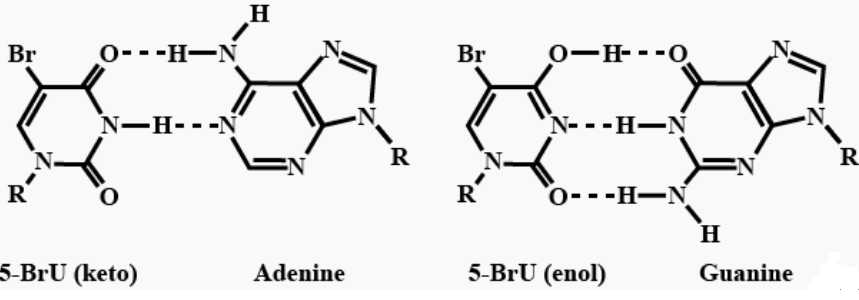
AnswerCorrect option: C. $5 -$ bromouracil
$5 -$ bromouracil is a brominated derivative of uracil that acts as an antimetabolite or base analog, substituting for thymine in $\text{DNA},$ can induce $\text{DNA}$ mutation in the same way as $2-$aminopurine. It is used mainly as an experimental mutagen.
View full question & answer→MCQ 2001 Mark
Which one is a hereditary disease?
MCQ 2011 Mark
One turn of $\text{DNA}$ possesses.
View full question & answer→MCQ 2021 Mark
While analysing the $\text{DNA}$ of an organism a total number of $5386$ nucleotides were found out of which the proportion of different bases were: Adenine $: 29\%,$ Guanine $: 17\%,$ Cytosine $: 32\%,$ Thymine $: 17\%.$ Considering the Chargaff’s rule it can be concluded that:
- ✓
It is single stranded $\text{DNA}.$
- B
It is a double stranded circular $\text{DNA}.$
- C
It is a double stranded linear $\text{DNA}.$
- D
No conclusion can be drawn.
AnswerCorrect option: A. It is single stranded $\text{DNA}.$
View full question & answer→MCQ 2031 Mark
The usual method of $\text{DNA}$ replication is:
- A
- B
- C
Non$-$conservative
- ✓
Semi$-$conservative
AnswerCorrect option: D. Semi$-$conservative
View full question & answer→MCQ 2041 Mark
Meselson and Stahl carried out centrifugation in $\mathrm{CsCl}_2$ density gradient to separate:
- A
$\text{DNA}$ from $\text{RNA.}$
- B
$\text{DNA}$ from protein.
- ✓
The normal $\text{DNA}$ from ${ }^{15} \mathrm{N}-\mathrm{DNA}$.
- D
$\text{DNA}$ from $\text{tRNA}.$
AnswerCorrect option: C. The normal $\text{DNA}$ from ${ }^{15} \mathrm{N}-\mathrm{DNA}$.
View full question & answer→MCQ 2051 Mark
Control of gene expression takes place at the level of:
MCQ 2061 Mark
In some viruses, $\text{DNA}$ is synthesised by using $\text{RNA}$ as template. Such a $\text{DNA}$ is called:
- A
$\text{A-DNA.}$
- B
$\text{B-DNA.}$
- ✓
$\text{cDNA.}$
- D
$\text{rDNA.}$
AnswerCorrect option: C. $\text{cDNA.}$
View full question & answer→MCQ 2071 Mark
The first genetic material could be:
- ✓
$\text{RNA}$
- B
$\text{DNA}$
- C
- D
AnswerCorrect option: A. $\text{RNA}$
View full question & answer→MCQ 2081 Mark
A bacterium grown over medium having radioactive $35\text{S}$ incorporates radioactivity in:
- A
- ✓
- C
$\text{DNA}$
- D
$\text{RNA}$
View full question & answer→MCQ 2091 Mark
Which of the following are a diamino and dicarboxylic amino acid?
MCQ 2101 Mark
Which was the last human chromosome to be completely sequenced:
- ✓
Chromosome $1.$
- B
Chromosome $11.$
- C
Chromosome $21.$
- D
Chromosome $x.$
AnswerCorrect option: A. Chromosome $1.$
View full question & answer→MCQ 2111 Mark
Reverse transcriptase is:
- A
$\text{RNA}$ dependent $\text{RNA}$ polymerase.
- B
$\text{DNA}$ dependent $\text{RNA}$ polymerase.
- C
$\text{DNA}$ dependent $\text{DNA}$ polymerase.
- ✓
$\text{RNA}$ dependent $\text{DNA}$ polymerase.
AnswerCorrect option: D. $\text{RNA}$ dependent $\text{DNA}$ polymerase.
View full question & answer→MCQ 2121 Mark
Semi$-$conservative model of $\text{DNA}$ replication was confirmed by:
View full question & answer→MCQ 2131 Mark
When $\text{DNA}$ replication starts:
- A
The leading strand produces Okazaki fragments.
- ✓
The hydrogen bonds between the nucleotides of two strands break.
- C
The phosphodiester bonds between the adjacent nucleotides break.
- D
The bonds between the nitrogen base and deoxyribose sugar break.
AnswerCorrect option: B. The hydrogen bonds between the nucleotides of two strands break.
View full question & answer→MCQ 2141 Mark
One turn of the helix in a $B-$form $\text{DNA}$ is approximately
- ✓
$3.4\ nm$
- B
$2\ nm$
- C
$20\ nm$
- D
$0.34\ nm$
AnswerCorrect option: A. $3.4\ nm$
View full question & answer→MCQ 2151 Mark
If a double stranded $\text{DNA}$ has $20\%$ of cytosine, what will be the percentage of adenine in it?
- A
$20\%$
- B
$40\%$
- ✓
$30\%$
- D
$60\%$
AnswerCorrect option: C. $30\%$
View full question & answer→MCQ 2161 Mark
Nucleosome core is made of:
- A
$\text{H}_1, \text{H}_2\text{A}, \text{H}_2\text{B}$ and $\text{H}_3.$
- B
$\text{H}_1, \text{H}_2\text{A}, \text{H}_2\text{B}, \text{H}_4.$
- C
$\text{H}_1,\text{H}_2\text{A}, \text{H}_2\text{B}, \text{H}_3$ and $\text{H}_3.$
- ✓
$\text{H}_2\text{A}, \text{H}_2\text{B}, \text{H}_3$ and $\text{H}_3.$
AnswerCorrect option: D. $\text{H}_2\text{A}, \text{H}_2\text{B}, \text{H}_3$ and $\text{H}_3.$
View full question & answer→MCQ 2171 Mark
Which of the following are the functions of $\text{RNA}?$
AnswerFunctions of $\text{mRNA}:$
- Carrier of genetic information from $\text{DNA}$ to ribosomes synthesising polypeptides.
- Carries amino acids to ribosomes.
- Constituent component of ribosomes.
View full question & answer→MCQ 2181 Mark
Khorana got the Nobel prize for:
- A
$\text{DNA}$ synthesis
- ✓
- C
- D
View full question & answer→MCQ 2191 Mark
Histone occupies the major grooves of $\text{DNA}$ at an angle of :
AnswerCorrect option: D. $30^\circ$ to the helix axis
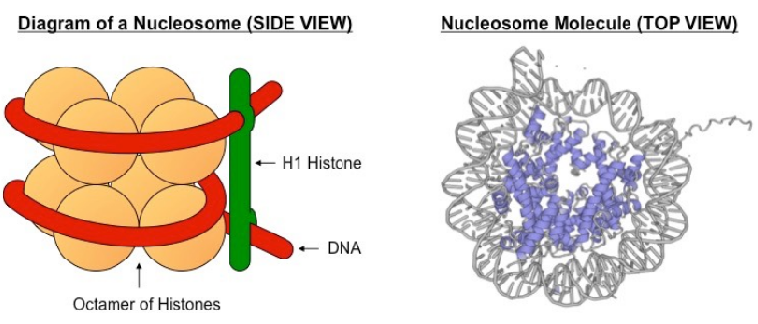
Nucleosomes are the basic structural packing unit of $\text{DNA}$ in chromatin built from histone proteins around which $\text{DNA}$ is wrapped. Histone occupies the major groove of $\text{DNA}$ at an angle of $30$ degrees.
View full question & answer→MCQ 2201 Mark
Production of a human protein in bacteria by genetic engineering is possible because:
AnswerCorrect option: D. The genetic code is universal
View full question & answer→MCQ 2211 Mark
Haemophilia is more common in males because it is a:
- A
Recessive character carried by $Y-$chromosome.
- B
Dominant character carried by $Y-$chromosome.
- C
Dominant trait carried by $X-$chromosome.
- ✓
Recessive trait carried by $X-$chromosome.
AnswerCorrect option: D. Recessive trait carried by $X-$chromosome.
View full question & answer→MCQ 2221 Mark
The transcription unit extends from:
- A
$\text{TATA}$ box to start point
- ✓
$\text{TATA}$ box to stop codon
- C
Start point to stop codon
- D
$35$ sequence to start point
AnswerCorrect option: B. $\text{TATA}$ box to stop codon
View full question & answer→MCQ 2231 Mark
$\text{DNA}$ template sequence of $\text{CTGATAGC}$ is transcribed over $\text{mRNA}$ as:
- A
$\text{GUCTUTCG}$
- ✓
$\text{GACUAUCG}$
- C
$\text{GAUTATUG}$
- D
$\text{UACTATCU}$
AnswerCorrect option: B. $\text{GACUAUCG}$
View full question & answer→MCQ 2241 Mark
Barr body in mammals represents:
AnswerCorrect option: D. One of the two $X-$chromosomes in somatic cells of females.
View full question & answer→MCQ 2251 Mark
In the double helix model of $\text{DNA},$ what would be the distance between two consecutive base pairs?
- A
$3.4\ nm$
- B
$2\ nm$
- C
$20\ nm$
- ✓
$0.34\ nm$
AnswerCorrect option: D. $0.34\ nm$
View full question & answer→MCQ 2261 Mark
Escherichia coli fully labelled with $N15$ is allowed to grow in $N14$ medium. The two strands of $\text{DNA}$ molecule of the first generation bacteria have.
- A
Different density and do not resemble parent $\text{DNA}.$
- ✓
Different density but resemble parent $\text{DNA}.$
- C
Same density and resemble parent $\text{DNA}.$
- D
Same density but do not resemble parent $\text{DNA}.$
AnswerCorrect option: B. Different density but resemble parent $\text{DNA}.$
View full question & answer→MCQ 2271 Mark
The mechanism of removing introns followed by joining of the exons in a defined order during transcription is called:
MCQ 2281 Mark
Of a normal couple, half the sons are haemophilic while half the daughters are carriers. The gene is located on:
- A
$X-$chromosome of father.
- B
$Y-$chromosome of father.
- ✓
One $X-$chromosome of mother.
- D
Both the $X-$chromosomes of mother.
AnswerCorrect option: C. One $X-$chromosome of mother.
View full question & answer→MCQ 2291 Mark
A sample of $\text{DNA}$ is found to have the base composition $($mole ratio$)$ of $A = 40, T = 22, G = 21$ and $C = 17.$ This suggests:
- A
$\text{DNA}$ is circular duplex.
- B
$\text{DNA}$ is linear duplex.
- ✓
$\text{DNA}$ is single stranded.
- D
$\text{DNA}$ has high melting point.
AnswerCorrect option: C. $\text{DNA}$ is single stranded.
View full question & answer→MCQ 2301 Mark
Degeneracy of the genetic code denotes the existence of:
- A
Multiple codons for a single amino acid
- B
- C
Base triplets that do not code for amino acids
- ✓
View full question & answer→MCQ 2311 Mark
Okazaki fragments are synthesised on:
- A
Leading strands of $\text{DNA}$ only
- ✓
Lagging strands of $\text{DNA}$ only
- C
Both leading and lagging strands of $\text{DNA}$
- D
Complementary $\text{DNA}$
AnswerCorrect option: B. Lagging strands of $\text{DNA}$ only
View full question & answer→MCQ 2321 Mark
In some viruses, $\text{RNA}$ is present instead of $\text{DNA}$ indicating that:
AnswerCorrect option: D. $\text{RNA}$ can act to transfer heredity.
View full question & answer→MCQ 2331 Mark
The process of transfer of genetic information from $\text{DNA}$ to $\text{RNA}/$formation of $\text{RNA}$ from $\text{DNA}$ is:
View full question & answer→MCQ 2341 Mark
The compound rifampicin is very:
- ✓
Potent inhibitor of bacterial $\text{RNA}$ polymerases
- B
Potent inhibitor of bacterial $\text{DNA}$ polymerases
- C
Weak inhibitor of bacterial $\text{RNA}$ polymerases
- D
Weak inhibitor of bacterial $\text{DNA}$ polymerases
AnswerCorrect option: A. Potent inhibitor of bacterial $\text{RNA}$ polymerases
View full question & answer→MCQ 2351 Mark
Which of the following enzyme is used in $\text{DNA}$ multiplication?
AnswerCorrect option: D. $\text{DNA}$ polymerase
View full question & answer→MCQ 2361 Mark
$\text{DNA}$ is a polymer of nucleotides which are linked to each other by $3\ ’-5\ ’$ phosphodiester bond. To prevent polymerisation of nucleotides, which of the following modifications would you choose?
- ✓
Remove$/$ Replace $3\ ' \ \text{OH}$ group in deoxy ribose.
- B
Remove$/$ Replace $2\ ' \ \text{OH}$ group with some other group in deoxy ribose.
- C
Both $'a\ ’$ and $'b\ ’.$
- D
Replace purine with pyrimidines.
AnswerCorrect option: A. Remove$/$ Replace $3\ ' \ \text{OH}$ group in deoxy ribose.
View full question & answer→MCQ 2371 Mark
$\text{DNA}$ directed synthesis of $\text{mRNA}$ is called as:
View full question & answer→MCQ 2381 Mark
The amino acid attaches to the $\text{tRNA}$ at its:
- A
$5\ ' -$ end.
- ✓
$3\ ' -$ end.
- C
- D
$\text{DHU}$ loop.
AnswerCorrect option: B. $3\ ' -$ end.
View full question & answer→MCQ 2391 Mark
During infection of $E.$ coli cells by bacteriophage $T2.$
- A
Proteins are the only phage components that actually enter the infected cell.
- B
Both proteins and nucleic acids enter the cell.
- C
Only proteins from the infecting phage can also be detected in progeny phage.
- ✓
Only nucleic acids enter the cell.
AnswerCorrect option: D. Only nucleic acids enter the cell.
View full question & answer→MCQ 2401 Mark
All the terminator codons begin with which nitrogenous base?
MCQ 2411 Mark
A distinct mechanism that usually involves a short segment of $\text{DNA}$ with remarkable capacity to move from one location in a chromosome to another. What is this called as?
- A
$\text{DNA}$ replication
- ✓
$\text{DNA}$ transposition
- C
$\text{DNA}$ hybridization
- D
$\text{DNA}$ recombination
AnswerCorrect option: B. $\text{DNA}$ transposition
View full question & answer→MCQ 2421 Mark
A triplet codon represents:
- ✓
A sequence of three nitrogen bases on $\text{mRNA}$
- B
A sequence of three nitrogen bases in $\text{tRNA}$
- C
A sequence of three bases in $\text{rRNA}$
- D
The presence of only three bases in $\text{mRNA}$
AnswerCorrect option: A. A sequence of three nitrogen bases on $\text{mRNA}$
View full question & answer→MCQ 2431 Mark
In split genes, the coding sequence are called.
MCQ 2441 Mark
Segments of $\text{mRNA}$ removed during splicing are called.
View full question & answer→MCQ 2451 Mark
A naturally occurring coding strand composed of alternating $C$ and $U$ residues would result in the formation of polypeptide containing:
- ✓
Alternating leu and ser residues
- B
Either leu or ser residues
- C
- D
AnswerCorrect option: A. Alternating leu and ser residues
View full question & answer→MCQ 2461 Mark
Diploid chromosome number in humans is:
MCQ 2471 Mark
The number of triplet codons having all the three bases same in $64$ triplet codons is:
View full question & answer→MCQ 2481 Mark
Portion of gene which is transcribed but not translated is:
MCQ 2491 Mark
In eukaryotes, $\text{mRNA}$ is synthesized with the aid of:
- A
$\text{RNA}$ polymerase $\text{III}.$
- ✓
$\text{RNA}$ polymerase $\text{II}.$
- C
$\text{RNA}$ polymerase $\text{I}.$
- D
AnswerCorrect option: B. $\text{RNA}$ polymerase $\text{II}.$
View full question & answer→MCQ 2501 Mark
Which one of the following is common to both prokaryotes and eukaryotes?
MCQ 2511 Mark
The human chromosome with the highest and least number of genes in them are respectively.
- ✓
Chromosome $1$ and $Y.$
- B
Chromosome $1$ and $X.$
- C
Chromosome $X$ and $Y.$
- D
Chromosome $21$ and $Y.$
AnswerCorrect option: A. Chromosome $1$ and $Y.$
View full question & answer→MCQ 2521 Mark
Out of $64$ codons$, 61$ codons code for $20$ types of amino acid. What is it called as?
- A
- B
- C
- ✓
Degeneracy of genetic code
AnswerCorrect option: D. Degeneracy of genetic code
View full question & answer→MCQ 2531 Mark
The process of translation is:
- A
- ✓
- C
$\text{DNA}$ synthesis.
- D
$\text{RNA}$ synthesis.
View full question & answer→MCQ 2541 Mark
- A
Structural pattern of an organism.
- ✓
Sequence of amino acid in protein chain.
- C
- D
Consistency of morphological trait.
AnswerCorrect option: B. Sequence of amino acid in protein chain.
View full question & answer→MCQ 2551 Mark
$\text{RNA}$ polymerase was isolated from $\text{E}.$ coli by:
View full question & answer→MCQ 2561 Mark
Out of $8$ ascospores formed in Neurospora the arrangement is $2a : 4a : 2a$ showing.
- A
- B
- ✓
Second generation division.
- D
First generation division.
AnswerCorrect option: C. Second generation division.
View full question & answer→MCQ 2571 Mark
To initiate translation, the $\text{mRNA}$ first binds to:
AnswerCorrect option: A. The smaller ribosomal sub$-$unit.
View full question & answer→MCQ 2581 Mark
In the double helix model of $\text{DNA}$ as proposed by $\text{J. D.}$ Watson and $\text{F.S.C.}$ Crick, each base pair is how far from the next base pair:
- A
$0.034\ nm$
- ✓
$0.34\ nm$
- C
$3.4\ nm$
- D
$34\ nm$
AnswerCorrect option: B. $0.34\ nm$
View full question & answer→MCQ 2591 Mark
With regard to mature $\text{mRNA}$ in eukaryotes:
- ✓
Exons appear but introns do not appear in the mature $\text{RNA}.$
- B
Exons and introns do not appear in the mature $\text{RNA}.$
- C
Introns appear but exons do not appear in the mature $\text{RNA}.$
- D
Both exons and introns appear in the mature $\text{RNA}.$
AnswerCorrect option: A. Exons appear but introns do not appear in the mature $\text{RNA}.$
View full question & answer→MCQ 2601 Mark
Khorana and his colleague synthesized an $\text{RNA}$ molecule with repeating sequences of $U$ and $G$ bases. The $\text{RNA}$ with, $\text{UGUGUGUGUGUG}$ produced a tetra$-$peptide with alternating sequences of cysteine and valine. This proves that codon for cysteine and valine is:
- A
$\text{UGG, GUU}$
- B
$\text{UUG, GGU}$
- ✓
$\text{UGU, GUG}$
- D
$\text{GUG, UGU}$
AnswerCorrect option: C. $\text{UGU, GUG}$
View full question & answer→MCQ 2611 Mark
Who amongst the following scientists had no contribution in the development of the double helix model for the structure of $\text{DNA}?$
View full question & answer→MCQ 2621 Mark
Mr. Kapoor has $Bb$ autosomal gene pair and $d$ allele sex$-$linked. What shall be proportion of $Bd$ in sperms?
- A
$0$
- B
$\frac12$
- ✓
$\frac14$
- D
$\frac18$
AnswerCorrect option: C. $\frac14$
View full question & answer→MCQ 2631 Mark
Both deoxyribose and ribose belong to a class of sugars called.
AnswerBoth deoxyribose and ribose belongs to a class of sugars called Pentoses. Pentose sugar contains five carbon sugar molecule.
View full question & answer→MCQ 2641 Mark
When a single anticodon can recognize more than one codon of $\text{mRNA}$ it is called as:
View full question & answer→MCQ 2651 Mark
If the base sequence of a codon in $\text{mRNA}$ is $\text{5'-AUG-3',}$ the sequence of $\text{tRNA}$ pairing with it must be:
- A
$\text{5' - UAC - 3'.}$
- ✓
$\text{5' - CAU - 3'.}$
- C
$\text{5' - AUG - 3'.}$
- D
$\text{5' - GUA - 3'.}$
AnswerCorrect option: B. $\text{5' - CAU - 3'.}$
View full question & answer→MCQ 2661 Mark
During transcription, the $\text{DNA}$ site at which $\text{RNA}$ polymerase binds is called as:
View full question & answer→MCQ 2671 Mark
Set of three bases $($codon$)$ in the genetic code represent $.........$
View full question & answer→MCQ 2681 Mark
Which one of the following makes use of $\text{RNA}$ as a template to synthesize $\text{DNA}:$
View full question & answer→MCQ 2691 Mark
In Streptococcus pneumoniae:
- ✓
- B
- C
Non virulent form is capsulated.
- D
View full question & answer→MCQ 2701 Mark
Semiconservative replication of $\text{DNA}$ was first demonstrated in:
View full question & answer→