MCQ 1011 Mark
The vector $(\cos\text{a}\cos\beta)\hat{\text{i}}+(\cos\text{a}\sin\beta)\hat{\text{j}}+(\sin\text{a})\hat{\text{k}}$ is a:
AnswerLet $\vec{\text{a}}=(\cos\text{a}\cos\beta)\hat{\text{i}}+(\cos\text{a}\sin\beta)\hat{\text{j}}+(\sin\text{a})\hat{\text{k}}$
$|\vec{\text{a}}|=\sqrt{\cos^2\text{a}\cos^2\beta+\cos^2\text{a}\sin^2\beta+\sin^2\text{a}}$
$=\sqrt{\cos^2\text{a}(\cos^2\beta+\sin^2\beta)+\sin^2\text{a}}$
$=\sqrt{\cos^2\text{a}(1)+\sin^2\text{a}}$
$=\sqrt{\cos^2\text{a}+\sin^2\text{a}}$
$=\sqrt{1}$
$=1$
So, $\vec{\text{a}}$ is a unit vector.
View full question & answer→MCQ 1021 Mark
If $u, v, w$ are non$-$coplanar vector and $p, q$ are real numbers, then the equality $\text{[3u pv pw] - [pv w qw] - [2w qv qu] = 0}$ holds for:
- ✓
Exactly two values of $(p, q)$
- B
More than but not all values of $(p, q)$
- C
All values of $(p, q)$
- D
Exactly one values of $(p, q)$
AnswerCorrect option: A. Exactly two values of $(p, q)$
View full question & answer→MCQ 1031 Mark
If $|\vec{\text{a}}|=\big|\vec{\text{b}}\big|,$ then $\big(\vec{\text{a}}+\vec{\text{b}}\big).\big(\vec{\text{a}}-\vec{\text{b}}\big)=$
AnswerGiven that
$|\vec{\text{a}}|=|\vec{\text{a}}|$
$\Rightarrow\big(\vec{\text{a}}+\vec{\text{b}}\big).\big(\vec{\text{a}}-\vec{\text{b}}\big)=|\vec{\text{a}}|^2-\big|\vec{\text{b}}\big|^2$
$|\vec{\text{a}}|^2-|\vec{\text{a}}|^2$
$=0$
View full question & answer→MCQ 1041 Mark
Which of the following represents coinitial vector:
- A
$c, d$
- B
$m, b$
- C
$b, d$
- ✓
Both $(a)$ and $(b)$
AnswerCorrect option: D. Both $(a)$ and $(b)$
View full question & answer→MCQ 1051 Mark
The position vectors of $P$ and $Q$ are respectively $a$ and $b.$ If $R$ is a point on $PQ, PQ$ such that $PR = 5PQ,$ then the position vector of $R$ is:
- ✓
$5b − 4a$
- B
$5b + 4a$
- C
$4b − 5a$
- D
$4b + 5a$
AnswerCorrect option: A. $5b − 4a$
Given condition
$PR = 5PQ$
$R − P = 5(Q − P)$
$R = 5Q − 5P + P$
$R = 5Q − 4P$
$R = 5b − 4a$
View full question & answer→MCQ 1061 Mark
If $\vec{\text{a}}$ be the position vector whose tip is $(5, -3)$ find the coordinates of a point $B$ such that $\vec{\text{AB}}=\vec{\text{a}}$ the coordinates of $A$ being $(4, -1):$
- ✓
$(9, -4)$
- B
$(-9, -4)$
- C
$(9, 4)$
- D
AnswerCorrect option: A. $(9, -4)$
View full question & answer→MCQ 1071 Mark
Let $\vec{\text{a}}=\text{a}_1\hat{\text{i}}+\text{a}_2\hat{\text{j}}+\text{a}_3\hat{\text{k}},\vec{\text{b}}=\text{b}_1\hat{\text{i}}+\text{b}_2\hat{\text{j}}+\text{b}_3\hat{\text{k}}$ and $\vec{\text{c}}=\text{c}_1\hat{\text{i}}+\text{c}_2\hat{\text{j}}+\text{c}_3\hat{\text{k}}$ be three zero vectors such that $\vec{\text{c}}$ is a unit vector perpendicular to both $\vec{\text{a}}$ and $\vec{\text{b}}.$ If the angle between $\vec{\text{a}}$ and $\vec{\text{b}}$ is $\frac{\pi}{6},$ then $\begin{vmatrix}\text{a}_1&\text{a}_2&\text{a}_3\\\text{b}_1&\text{b}_2&\text{b}_3\\\text{c}_1&\text{c}_2&\text{c}_3 \end{vmatrix}^2$ is equal to :
AnswerCorrect option: C. $\frac{1}{4}\big|\vec{\text{a}}\big|^2\big|\vec{\text{b}}\big|^2$
We have
$\begin{vmatrix}\text{a}_1&\text{a}_2&\text{a}_3\\\text{b}_1&\text{b}_2&\text{b}_3\\\text{c}_1&\text{c}_2&\text{c}_3 \end{vmatrix}^2$
$=\big[\big(\vec{\text{a}}\times\vec{\text{b}}\big).\vec{\text{c}}\big]^2\ ($By definition of scalar triple product$)$
$=\big[\big|\big(\vec{\text{a}}\times\vec{\text{b}}\big)\big|\big|\vec{\text{c}}\big|\cos0^\circ\big]^2$
$\big(\therefore\vec{\text{a}}\times\vec{\text{b}}$ is parallel to vector $\vec{\text{c}}$ as $\vec{\text{c}}$ is perpendicular to both $\vec{\text{a}}$ and $\vec{\text{b}}\big)$
$=\big(\big|\vec{\text{a}}\big|\big|\vec{\text{b}}\big|\sin\frac{\pi}{6}\big)^2$
$\big(\therefore\big|\vec{\text{c}}\big|=1$ and angle between $\vec{\text{a}}$ and $\vec{\text{b}}$ is $\frac{\pi}{6}\big)$
$=\big|\vec{\text{a}}\big|^2\big|\vec{\text{b}}\big|^2\big(\frac{1}{2}\big)^2$
$=\frac{1}{4}\big|\vec{\text{a}}\big|^2\big|\vec{\text{b}}\big|^2$
View full question & answer→MCQ 1081 Mark
For non$-$zero vectors $\vec{\text{a}},\vec{\text{b}}$ and $\vec{\text{c}}$ the relation $\big|\big(\vec{\text{a}}\times\vec{\text{b}}\big).\vec{\text{c}}\big|=\big|\vec{\text{a}}\big|\big|\vec{\text{b}}\big|\big|\vec{\text{c}}\big|$ holds good, if:
- A
$\vec{\text{a}}.\vec{\text{b}}=\vec{\text{b}}.\vec{\text{c}}=0$
- B
$\vec{\text{a}}.\vec{\text{b}}=0=\vec{\text{c}}.\vec{\text{a}}$
- ✓
$\vec{\text{a}}.\vec{\text{b}}=\vec{\text{b}}.\vec{\text{c}}=\vec{\text{c}}.\vec{\text{a}}=0$
- D
$\vec{\text{b}}.\vec{\text{c}}=\vec{\text{c}}.\vec{\text{a}}=0$
AnswerCorrect option: C. $\vec{\text{a}}.\vec{\text{b}}=\vec{\text{b}}.\vec{\text{c}}=\vec{\text{c}}.\vec{\text{a}}=0$
we have
$\big|\big(\vec{\text{a}}\times\vec{\text{b}}\big).\vec{\text{c}}\big|$
$=\big|\big(\vec{\text{a}}\times\vec{\text{b}}\big)\big|\big|\vec{\text{c}}\big|\big|\cos\theta\big|$
$=\big|\big(\vec{\text{a}}\times\vec{\text{b}}\big)\big|\big|\vec{\text{c}}\big| ($If $\theta=0^\circ$ or $180^\circ,$ i.e. vectors $\vec{\text{a}}\times\vec{\text{b}}$ and $\vec{\text{c}}$ are parallel$)$
$=\big|\big(\big|\vec{\text{a}}\big|\big|\vec{\text{b}}\big|\sin\alpha\big)\big|\big|\vec{\text{c}}\big|$
$=\big|\vec{\text{a}}\big|\big|\vec{\text{b}}\big|\big|\vec{\text{c}}\big| ($If $\alpha=90^\circ,$ i. e. vectors $\vec{\text{a}}$ and $\vec{\text{b}}$ are perpendicular$)$
$\therefore\big|\big(\vec{\text{a}}\times\vec{\text{b}}\big).\vec{\text{c}}\big|=\big|\vec{\text{a}}\big|\big|\vec{\text{b}}\big|\big|\vec{\text{c}}\big| ($If vectors $\vec{\text{a}},\vec{\text{b}},\vec{\text{c}}$ are perpendicular to each other$)$
Thus, the relation $\big|\big(\vec{\text{a}}\times\vec{\text{b}}\big).\vec{\text{c}}\big|=\big|\vec{\text{a}}\big|\big|\vec{\text{b}}\big|\big|\vec{\text{c}}\big|$ holds good if $\vec{\text{a}}.\vec{\text{b}}=0,\vec{\text{b}}.\vec{\text{c}}=0$ and $\vec{\text{c}}.\vec{\text{a}}=0.$
View full question & answer→MCQ 1091 Mark
Line passing through $(3, 4, 5)$ and $(4, 5, 6)$ has direction ratios:
- ✓
$1,1,1$
- B
$\sqrt{3},\sqrt{3},\sqrt{3}$
- C
$\frac{-1}{\sqrt{3}},\frac{1}{\sqrt{3}},\frac{1}{\sqrt{3}}$
- D
$7,9,11$
AnswerCorrect option: A. $1,1,1$
Given points $(3, 4, 5)$ and $(4, 5, 6)$ The are given as $(4 - 3, 5 - 4, 6 - 5) = (1, 1, 1)$
View full question & answer→MCQ 1101 Mark
If $\vec{\text{a}},\vec{\text{b}},\vec{\text{c}}$ are non $-$ coplanar vectors, then $\frac{\vec{\text{a}}.\big(\vec{\text{b}}\times\vec{\text{c}}\big)}{\big(\vec{\text{c}}\times\vec{\text{a}}\big).\vec{\text{b}}}+\frac{\vec{\text{b}}.\big(\vec{\text{a}}\times\vec{\text{c}}\big)}{\vec{\text{c}}.\big(\vec{\text{a}}\times\vec{\text{b}}\big)}$ is equal to :
AnswerWe have
$\frac{\vec{\text{a}}.\big(\vec{\text{b}}\times\vec{\text{c}}\big)}{\big(\vec{\text{c}}\times\vec{\text{a}}\big).\vec{\text{b}}}+\frac{\vec{\text{b}}.\big(\vec{\text{a}}\times\vec{\text{c}}\big)}{\vec{\text{c}}.\big(\vec{\text{a}}\times\vec{\text{b}}\big)}$
$\frac{\big[\vec{\text{a}}\vec{\text{b}}\vec{\text{c}}\big]}{\big[\vec{\text{c}}\vec{\text{a}}\vec{\text{b}}\big]}+\frac{\big[\vec{\text{b}}\vec{\text{a}}\vec{\text{c}}\big]}{\big[\vec{\text{c}}\vec{\text{a}}\vec{\text{b}}\big]}\ ($By definition of scalar tiple product$)$
$=\frac{\big[\vec{\text{a}}\vec{\text{b}}\vec{\text{c}}\big]}{\big[\vec{\text{a}}\vec{\text{b}}\vec{\text{c}}\big]}+\frac{-\big[\vec{\text{a}}\vec{\text{b}}\vec{\text{c}}\big]}{\big[\vec{\text{a}}\vec{\text{b}}\vec{\text{c}}\big]}\ ($Change in cyclic order of vectors changes the sign of the scalar triple product$)$
$=1-1$
$=0$
View full question & answer→MCQ 1111 Mark
Answer
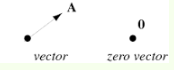
Zero vector, is a vector of length $0,$ and thus has all components equal to zero. It is the additive identity of the additive group of vectors.
Thus, it has zero magnitude and arbitrary direction. View full question & answer→MCQ 1121 Mark
$\big(\vec{\text{a}}+\vec{\text{b}}\big).\big(\vec{\text{b}}+\vec{\text{c}}\big)\times\big(\vec{\text{a}}+\vec{\text{b}}+\vec{\text{c}}\big)=$
- A
$0$
- B
$-\big[\vec{\text{a}}\vec{\text{b}}\vec{\text{c}}\big]$
- C
$2\big[\vec{\text{a}}\vec{\text{b}}\vec{\text{c}}\big]$
- ✓
$\big[\vec{\text{a}}\vec{\text{b}}\vec{\text{c}}\big]$
AnswerCorrect option: D. $\big[\vec{\text{a}}\vec{\text{b}}\vec{\text{c}}\big]$
We have
$\big(\vec{\text{a}}+\vec{\text{b}}\big).\big(\vec{\text{b}}+\vec{\text{c}}\big)\times\big(\vec{\text{a}}+\vec{\text{b}}+\vec{\text{c}}\big)$
$=\big(\vec{\text{a}}+\vec{\text{b}}.\big[\big(\vec{\text{b}}+\vec{\text{c}}\big)\times\vec{\text{a}}+\big(\vec{\text{b}}+\vec{\text{c}}\big)\times\vec{\text{b}}+\big(\vec{\text{b}}+\vec{\text{c}}\big)\times\vec{\text{c}}\big]$
$=\big(\vec{\text{a}}+\vec{\text{b}}\big).\big(\vec{\text{b}}\times\vec{\text{a}}+\vec{\text{c}}\times\vec{\text{a}}+\vec{\text{b}}\times\vec{\text{b}}+\vec{\text{c}}\times\vec{\text{b}}+\vec{\text{b}}\times\vec{\text{c}}+\vec{\text{c}}\times\vec{\text{c}}\big)$
$=\big(\vec{\text{a}}+\vec{\text{b}}\big).\big(\vec{\text{b}}\times\vec{\text{a}}+\vec{\text{c}}\times\vec{\text{a}}+0+\vec{\text{c}}\times\vec{\text{b}}+\vec{\text{b}}\times\vec{\text{c}}+0$
$=\big(\vec{\text{a}}+\vec{\text{b}}\big).\big(\vec{\text{b}}\times\vec{\text{a}}+\vec{\text{c}}\times\vec{\text{a}}-\vec{\text{b}}\times\vec{\text{c}}+\vec{\text{b}}\times\vec{\text{c}}\big)$
$=\big(\vec{\text{a}}+\vec{\text{b}}\big).\big(\vec{\text{b}}\times\vec{\text{a}}+\vec{\text{c}}\times\vec{\text{a}}\big)$
$=\vec{\text{a}}\big(\vec{\text{b}}\times\vec{\text{a}}\big)+\vec{\text{b}}.\big(\vec{\text{b}}\times\vec{\text{a}}\big)+\vec{\text{a}}.\big(\vec{\text{c}}\times\vec{\text{a}}\big)+\vec{\text{b}}.\big(\vec{\text{c}}\times\vec{\text{a}}\big)$
$=0+0+0+\big[\vec{\text{b}}\vec{\text{c}}\vec{\text{a}}\big]$
$=\big[\vec{\text{b}}\vec{\text{c}}\vec{\text{a}}\big]$
$=\big[\vec{\text{a}}\vec{\text{b}}\vec{\text{c}}\big]$
View full question & answer→MCQ 1131 Mark
If $\vec{\text{a}}=2\hat{\text{i}}-3\hat{\text{j}}+5\hat{\text{k}},\vec{\text{b}}=3\hat{\text{i}}-4\hat{\text{j}}+5\hat{\text{k}}$ and $\vec{\text{c}}=5\hat{\text{i}}-3\hat{\text{j}}-2\hat{\text{k}},$ then the volume of the parallelopiped with contermious edges $\vec{\text{a}}+\vec{\text{b}},\vec{\text{b}}+\vec{\text{c}},\vec{\text{c}}+\vec{\text{a}}$ is:
AnswerWe have $\vec{\text{a}}+\vec{\text{b}}=\big(2\hat{\text{i}}-3\hat{\text{j}}+5\hat{\text{k}}\big)+\big(3\hat{\text{i}}-4\hat{\text{j}}+5\hat{\text{k}}\big)=5\hat{\text{i}}-7\hat{\text{j}}+10\hat{\text{k}}$ $\vec{\text{b}}+\vec{\text{c}}=\big(3\hat{\text{i}}-4\hat{\text{j}}+5\hat{\text{k}}\big)\big(5\hat{\text{i}}-3\hat{\text{j}}-2\hat{\text{k}}\big)=8\hat{\text{i}}-7\hat{\text{j}}+3\hat{\text{k}}$ $\vec{\text{c}}+\vec{\text{a}}=\big(5\hat{\text{i}}-3\hat{\text{j}}-2\hat{\text{k}}\big)+\big(2\hat{\text{i}}-3\hat{\text{j}}+5\hat{\text{k}}\big)=7\hat{\text{i}}-6\hat{\text{j}}+3\hat{\text{k}}$ We know that the volume of parallelopiped whose three adjacent adges are $\vec{\text{a}}+\vec{\text{b}},\vec{\text{b}}+\vec{\text{c}}$ and $\vec{\text{c}}+\vec{\text{a}}$ is equal to: We have $\big[\vec{\text{a}}+\vec{\text{b}}\vec{\text{b}}+\vec{\text{c}}\vec{\text{c}}+\vec{\text{a}}\big]=\begin{vmatrix}5&-7&10\\8&-7&3\\7&-6&3\end{vmatrix}$ $=5(-21+18)+7(24-21)+10(-48+49)$ $=(5\times-3)+(7\times3)+(10\times1)$ $=16$ $\therefore$ volume of parallelopiped $=\big|16\big|=16$ Disclaimer: None of the given option is correct.
View full question & answer→MCQ 1141 Mark
If $\vec{\text{a}},\vec{\text{b}},\vec{\text{c}} $ are three non $-$ coplanar mutually perpendicular unit vectors, then $\big[\vec{\text{a}}\vec{\text{b}}\vec{\text{c}}\big],$ is :
AnswerCorrect option: A. $\pm 1$
We have
$\big[\vec{\text{a}}\vec{\text{b}}\vec{\text{c}}\big]$
$=\big(\vec{\text{a}}\times\vec{\text{b}}\big).\vec{\text{c}}$
$=\big|\vec{\text{a}}\times\vec{\text{b}}\big|\big|\vec{\text{c}}\big|\cos0^\circ$ or $\big|\vec{\text{a}}\times{\vec{\text{b}}}\big|\big|\vec{\text{c}}\big|\cos180^\circ$
$\big(\therefore\vec{\text{a}},\vec{\text{b}},\vec{\text{c}}$ are perpendicular to each other$)$
$=\big|\vec{\text{a}}\times\vec{\text{b}}\big|$ or $-\big|\vec{\text{a}}\times\vec{\text{b}}\big|$
$\big(\therefore\big|\vec{\text{c}}\big|=1,\cos0^\circ=1$ and $\cos180^\circ=-1\big)$
$=\big|\vec{\text{a}}\big|\big|\vec{\text{b}}\big|\sin90^\circ$ or $-\big|\text{a}\big|\big|\vec{\text{b}}\big|\sin90$
$\big(\therefore\vec{\text{a}} $ is perpendicular to $\vec{\text{b}})$
$=1 $ or $-1 \big(\therefore\big|\vec{\text{a}}\big|=1$ and $\big|\vec{\text{b}}\big|=1\big)$
$=\pm1$
View full question & answer→MCQ 1151 Mark
If $ \overrightarrow {\text{ a }}$ is vector of magnitude $x, m$ is non$-$zero scalar and $\text{m}\overrightarrow {\text{a}}$ is a unit vector then $x$ in terms of $m$ is:
- A
$\text{m}=\text{x}$
- B
$\text{x}=\mid{\text{m}}\mid$
- ✓
$\text{x}=\frac{1}{\mid\text{m}\mid}$
- D
$\text{x}=\frac{\text{m}}{2}$
AnswerCorrect option: C. $\text{x}=\frac{1}{\mid\text{m}\mid}$
Given, $\mid\text{m}\vec{\text{a}}\mid=1$
$\Rightarrow\mid\text{m}\mid\mid\vec{\text{a}}\mid=1$
$\Rightarrow\mid\text{m}\mid\text{x}=1$
$\Rightarrow\text{x}=\frac{1}{\mid\text{m}\mid}$
Remember, modulus can never be negative.
View full question & answer→MCQ 1161 Mark
Point $(4, 0)$ lies on $..........?$
- A
$\vec{\text{XO}}$
- B
$\vec{\text{YO}}$
- ✓
$\vec{\text{OX}}$
- D
$\vec{\text{OY}}$
AnswerCorrect option: C. $\vec{\text{OX}}$
View full question & answer→MCQ 1171 Mark
Let the vectors $\vec{a}\ \text{and}\ \vec{b}$ be such that $|\vec{a}|=3\ \text{and}\ \big|\vec{b}\big|=\frac{\sqrt{2}}{3},\ \text{then}\ \vec{a}\times\vec{b}$ is a unit vector, if the angle between $\vec{a}\ \text{and}\ \vec{b}\ \text{is}$
- A
$\pi/6$
- ✓
$\pi/4$
- C
$\pi/3$
- D
$\pi/2$
AnswerCorrect option: B. $\pi/4$
$\text{Given:}\ \ \big|\vec{a}\big|=3,\big|\vec{b}\big|=\frac{\sqrt{2}}{3}\ \text{and}\ \vec{a}\times\vec{b}$ is a unit vector.
$\Rightarrow\ \ \big|\vec{a}\times\vec{b}\big|=1\ $ $\Rightarrow\ \big|\vec{a}\big|.\Big|\vec{b}\Big|\ \text{sin}\ \theta=1,\ \text{where}\ \theta\ \text{is the angle between}\ \vec{a}\ \text{and}\ \vec{b}.$
$\Rightarrow\ \ 3\bigg(\frac{\sqrt{2}}{3}\bigg)\ \text{sin}\ \theta=1$ $\Rightarrow\ \sqrt{2}\ \text{sin}\ \theta=1\ \Rightarrow\ \ \text{sin}\ \theta=\frac{1}{\sqrt{2}}$
$\Rightarrow\ \text{sin}\ \theta=\text{sin}\frac{\pi}{{4}}\ \ \Rightarrow\ \theta=\frac{\pi}{4}$
Therefore, option (B) is correct.
View full question & answer→MCQ 1181 Mark
Choose the correct answer from the given four options. The angle between two vectors $\vec{\text{a}}$ and $\vec{\text{b}}$ with magnitudes $\sqrt{3}$ and $4,$ respectively, and $\vec{\text{a}}\cdot\vec{\text{b}}=2\sqrt{3}$ is:
- A
$\frac{\pi}{6}$
- ✓
$\frac{\pi}{3}$
- C
$\frac{\pi}{2}$
- D
$\frac{5\pi}{2}$
AnswerCorrect option: B. $\frac{\pi}{3}$
Here, $|\vec{\text{a}}|=\sqrt{3},|\vec{\text{b}}|=4$ and $\vec{\text{a}}\cdot\vec{\text{b}}=2\sqrt{3} [$given$]$
We know that, $\vec{\text{a}}\cdot\vec{\text{b}}=|\vec{\text{a}}||\vec{\text{b}}|\cos\theta$
$\Rightarrow2\sqrt{3}=\sqrt{3}.4.\cos\theta$
$\Rightarrow\cos\theta=\frac{2\sqrt{3}}{4\sqrt{3}}=\frac{1}{2}$
$\therefore\theta=\frac{\pi}{3}$
View full question & answer→MCQ 1191 Mark
If in a $\triangle\text{ABC}, \text{A}=(0,0),\ \text{B}=(3,3\sqrt3),\ \text{C}=(-3\sqrt3,3),$ then the vecctor of magnitude $2\sqrt2$ units directed along $AO,$ where $O$ is the circumcenter of $\triangle\text{ABC}$ is,
- ✓
$(1-\sqrt3)\hat{\text{i}}+(1+\sqrt3)\hat{\text{j}}$
- B
$(1+\sqrt3)\hat{\text{i}}+(1-\sqrt3)\hat{\text{j}}$
- C
$(1+\sqrt3)\hat{\text{i}}+(\sqrt3-1)\hat{\text{j}}$
- D
AnswerCorrect option: A. $(1-\sqrt3)\hat{\text{i}}+(1+\sqrt3)\hat{\text{j}}$
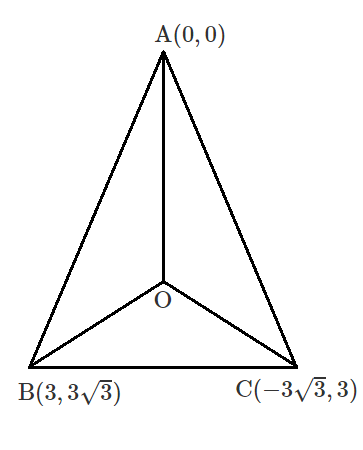
$\Big|\overrightarrow{\text{AO}}\Big|=2\sqrt2$
$\Big|\overrightarrow{\text{AO}}\Big|=\Big|\overrightarrow{\text{BO}}\Big|=\Big|\overrightarrow{\text{CO}}\Big|=2\sqrt2=\text{R}$
Let the position vector of $O$ be $\text{x}\hat{\text{i}}+\text{y}\hat{\text{j}}$
$\Big|\overrightarrow{\text{AO}}\Big|=\sqrt{\text{x}^2+\text{y}^2}$
$\therefore\ \text{x}^2+\text{y}^2=8\ \dots(1)$
Also, $\Big|\overrightarrow{\text{BO}}\Big|=\Big|\overrightarrow{\text{CO}}\Big|$
$\sqrt{(\text{x}-3)^2+(\text{y}-3\sqrt3)^2}$
$=\sqrt{(\text{x}+3\sqrt3)^2+(\text{y}-3)^2}$
$\text{x}^2-6\text{x}+9+\text{y}^2-6\sqrt3\text{y}+27$
$=\text{x}^2+6\sqrt3\text{x}+27+\text{y}^2-6\text{y}+9$
$\text{y}(6-6\sqrt3)=\text{x}(6\sqrt3+6)$
$\text{y}=\frac{\text{x}(1+\sqrt3)}{(1-\sqrt3)}\ \dots(2)$
Substituting y from $(2)$ in $(1)$ we get,
$(1-\sqrt3)^2\text{x}^2+(1+\sqrt3)^2\text{x}^2=8(1-\sqrt3)^2$
$\text{x}^2\times8=8(1-\sqrt3)^2$
$\text{x}=1-\sqrt3$
$\text{y}=1+\sqrt3$
$\therefore$ The position vector of $O$ is $(1-\sqrt3)\hat{\text{i}}+(1+\sqrt3)\hat{\text{j}}$
$\overrightarrow{\text{AO}}=(1-\sqrt3)\hat{\text{i}}+(1+\sqrt3)\hat{\text{j}}$ View full question & answer→MCQ 1201 Mark
If the vectors $4\hat{\text{i}}+11\hat{\text{j}}+\text{m}\hat{\text{k}},7\hat{\text{i}}+2\hat{\text{j}}+6\hat{\text{k}}$ and $\hat{\text{i}}+5\hat{\text{j}}+4\hat{\text{k}}$ are coplanar, then $m =$
AnswerLet
$\vec{\text{a}}=4\hat{\text{i}}+11\hat{\text{j}}+{\text{m}}\hat{\text{k}}$
$\vec{\text{b}}=7\hat{\text{i}}+2\hat{\text{j}}+6\hat{\text{k}}$
$\vec{\text{c}}=\hat{\text{i}}+5\hat{\text{j}}+4\hat{\text{k}}$
We know that vectors $\vec{\text{a}},\vec{\text{b}}$ and $\vec{\text{c}}$ are coplanar if their scalar triple product is zero, i.e. $\big[\vec{\text{a}}\vec{\text{ b }}\vec{\text{c}}\big]=0$
$\Rightarrow\begin{vmatrix}4&11&\text{m}\\7&2&6\\1&5&4 \end{vmatrix}=0$
$\Rightarrow 4(8-30)-11(28-6)+\text{m}(35-2)=0$
$\Rightarrow-88-242+33\text{m}=0$
$\Rightarrow33\text{m}=330$
$\therefore\text{m}=10$
View full question & answer→MCQ 1211 Mark
If $\vec{\text{r}}.\vec{\text{a}}=\vec{\text{r}}.\vec{\text{b}}=\vec{\text{r}}.\vec{\text{c}}=0$ for some non $-$ zero vector $\vec{\text{r}},$ then the value of $\big[\vec{\text{a}}\vec{\text{ b }}\vec{\text{c}}\big],$ is :
AnswerIf $\vec{\text{r}}.\vec{\text{a}}=0$ for some non-zero vector $\vec{\text{r}},$ then either $\vec{\text{a}}$ is a zero $-$ vector or it is perpendicular to $\vec{\text{r}}.$
If one of $\vec{\text{a}},\vec{\text{b}},\vec{\text{c}}$ is zero, then $\big[\vec{\text{a}}\vec{\text{b}}\vec{\text{c}}\big]=0$
If all $\vec{\text{a}},\vec{\text{b}}$ and $\vec{\text{c}}$ are non $-$ zero, then they must be coplanar as they are perpendicular to vector $\vec{\text{r}}.$
$\therefore\big[\vec{\text{a}}\vec{\text{b}}\vec{\text{c}}\big]=0$
View full question & answer→MCQ 1221 Mark
If $\vec{\text{a}}$ and $\vec{\text{b}}$ are two unit vectors inclined at an angle $\theta$, such that $\big|\vec{\text{a}}+\vec{\text{b}}\big|<1,$ then:
AnswerCorrect option: D. $\frac{2\pi}{3}<\theta<\pi$
We have
$\big|\vec{\text{a}}+\vec{\text{b}}\big|<1$
$\Rightarrow\sqrt{|\vec{\text{a}}|^2+\big|\vec{\text{b}}\big|^2+2|\vec{\text{a}}|\times\big|\vec{\text{b}}\big|\cos\theta<1}$
$\Rightarrow\sqrt{1^2+1^2+2\times1\times1\times\cos\theta<1}$
$\Rightarrow\sqrt{2+2\cos\theta}<1$
$\Rightarrow\sqrt{2(1+\cos\theta)}<1$
$\Rightarrow\sqrt{2\times2\cos^2\frac{\theta}{2}}<1$
$\Rightarrow2\big|\cos\frac{\theta}{2}\big|<1$
$\Rightarrow\big|\cos\frac{\theta}{2}\big|<\frac{1}{2}$
$\Rightarrow\frac{\pi}{3}<\frac{\theta}{2}<\frac{2\pi}{3}$
$\Rightarrow\frac{2\pi}{3}<\theta<\frac{4\pi}{3}$
But here $\theta$ cannot be more than $\pi.$
View full question & answer→MCQ 1231 Mark
A person travels $12\ km$ in the southward direction and then travels $5\ km$ to the right and then travels $15\ km$ toward the right and finally travels $5\ km$ towards the east, how far is he from his starting place?
- A
$5.5\ km$
- ✓
$3\ km$
- C
$13\ km$
- D
$6.4\ km$
AnswerCorrect option: B. $3\ km$
View full question & answer→MCQ 1241 Mark
The position vector of the point $(1, 2, 0)$ is:
- A
$i + j +k$
- B
$i + 2j + k$
- ✓
$i + 2j$
- D
$2j + k$
AnswerCorrect option: C. $i + 2j$
View full question & answer→MCQ 1251 Mark
Two vectors each of magnitudes $1$ unit are inclined at $60^{\circ}$ to each other. The difference of the vectors has a magnitude $............?$
- A
$0$ units
- B
$1$ units
- ✓
$2$ units
- D
$3$ units
AnswerCorrect option: C. $2$ units
View full question & answer→MCQ 1261 Mark
If the angle between the vectors $\text{x}\hat{\text{i}}+3\hat{\text{j}}-7\hat{\text{k}}$ and $\text{x}\hat{\text{i}}-\text{x}\hat{\text{j}}+4\hat{\text{k}}$ is acute, then $x$ lies in the interval:
- A
$(-4, 7)$
- B
$[-4, 7]$
- ✓
$R - [-4, 7]$
- D
$R - (4, 7)$
AnswerCorrect option: C. $R - [-4, 7]$
Let $\theta$ be the angle between $\vec{\text{a}}$ and $\vec{\text{b}}.$
$\cos\theta=\frac{\vec{\text{a}}.\vec{\text{b}}}{|\vec{\text{a}}|\big|\vec{\text{b}}\big|}=\frac{\text{x}^2-3\text{x}-28}{\sqrt{\text{x}^2+3^2+49}\sqrt{\text{x}^2+\text{x}^2+4^2}}$
For $\theta$ to be acute,
$\cos\theta>0$
$\Rightarrow\text{x}^2-3\text{x}-28>0$
$\Rightarrow(\text{x}-7)(\text{x}+4)>0$
$\Rightarrow\text{x}\in(-\infty,-4)\cup(7,\infty)$
$\Rightarrow\text{x}\in\text{R}-[-4,7]$
View full question & answer→MCQ 1271 Mark
If the position vectors of $P$ and $Q$ are $\hat{\text{i}}+3\hat{\text{j}}-7\hat{\text{k}}$ and $5\hat{\text{i}}-2\hat{\text{j}}+4\hat{\text{k}}$ then the cosine of the angle getween $\overrightarrow{\text{PQ}}$ and $y-$axis is:
- A
$\frac{5}{\sqrt{162}}$
- B
$\frac{4}{\sqrt{162}}$
- ✓
$-\frac{5}{\sqrt{162}}$
- D
$\frac{11}{\sqrt{162}}$
AnswerCorrect option: C. $-\frac{5}{\sqrt{162}}$
$\overrightarrow{\text{PQ}}=\overrightarrow{\text{OQ}}-\overrightarrow{\text{OP}}$
$=5\hat{\text{i}}-2\hat{\text{j}}+4\hat{\text{k}}-\big(\hat{\text{i}}+3\hat{\text{j}}-7\hat{\text{k}}\big)$
$=4\hat{\text{i}}-5\hat{\text{j}}+11\hat{\text{k}}$
The unit vector along $y-$axis is $\hat{\text{j}}.$
Let $\theta$ be the required angle.
$\cos\theta=\frac{\overrightarrow{\text{PQ}}.\hat{\text{j}}}{\big|\overrightarrow{\text{PQ}}\big|\big|\hat{\text{j}}\big|}$
$=\frac{-5}{\sqrt{16+25+121}\sqrt{1}}$
$=\frac{-5}{\sqrt{162}}$
View full question & answer→MCQ 1281 Mark
find the coordinate of the tip of the position vector which is equivalent to $\overrightarrow{\text{AB}}$ where the coordinates of $A$ and $B$ are $(-1, 3)$ and $(-2, 1)$ respectively:
- A
$(+1, +2)$
- B
$(+1, -2)$
- C
$(-1, +2)$
- ✓
$(-1, -2)$
AnswerCorrect option: D. $(-1, -2)$
View full question & answer→MCQ 1291 Mark
If $a + b + c = 0,$ then $a \times b =$
- A
$c \times a$
- B
$b \times c$
- C
$0$
- ✓
Both $(a)$ and $(b)$
AnswerCorrect option: D. Both $(a)$ and $(b)$
View full question & answer→MCQ 1301 Mark
The orthogonal projection of $\vec{\text{a}}$ on $\vec{\text{b}}$ is:
- A
$\frac{\big(\vec{\text{a}}.\vec{\text{b}}\big)\vec{\text{a}}}{|\vec{\text{a}}|^2}$
- ✓
$\frac{\big(\vec{\text{a}}.\vec{\text{b}}\big)\vec{\text{b}}}{\big|\vec{\text{b}}\big|^2}$
- C
$\frac{\vec{\text{a}}}{|\vec{\text{a}}|}$
- D
$\frac{\vec{\text{b}}}{\big|\vec{\text{b}}\big|}$
AnswerCorrect option: B. $\frac{\big(\vec{\text{a}}.\vec{\text{b}}\big)\vec{\text{b}}}{\big|\vec{\text{b}}\big|^2}$
The orthogonal projection of $\vec{\text{a}}$ on $\vec{\text{b}}$ is
$=\frac{\big(\vec{\text{a}}.\vec{\text{b}}\big)\vec{\text{b}}}{\big|\vec{\text{b}}\big|^2}$
View full question & answer→MCQ 1311 Mark
Choose the correct answer from the given four options. If $\vec{\text{a}},\vec{\text{b}},\vec{\text{c}}$ are unit vectors such that $\vec{\text{a}}+\vec{\text{b}}+\vec{\text{c}}=0,$ then the value of $\vec{\text{a}}\cdot\vec{\text{b}}+\vec{\text{b}}\cdot\vec{\text{c}}+\vec{\text{c}}\cdot\vec{\text{a}}$ is:
- A
$1.$
- B
$3.$
- ✓
$-\frac{3}{2}.$
- D
AnswerCorrect option: C. $-\frac{3}{2}.$
We have $\vec{\text{a}}+\vec{\text{b}}+\vec{\text{c}}=0$
$\Rightarrow(\vec{\text{a}}+\vec{\text{b}}+\vec{\text{c}})(\vec{\text{a}}+\vec{\text{b}}+\vec{\text{c}})=0$
$\Rightarrow\vec{\text{a}}^2+\vec{\text{a}}\cdot\vec{\text{b}}+\vec{\text{a}}\cdot\vec{\text{c}}+\vec{\text{b}}\cdot\vec{\text{a}}+\vec{\text{b}}^2+\vec{\text{b}}\cdot\vec{\text{c}}+\vec{\text{c}}\cdot\vec{\text{a}}+\vec{\text{c}}\cdot\vec{\text{b}}+\vec{\text{c}}^2=0$
$\Rightarrow\vec{\text{a}}^2+\vec{\text{b}}^2+\vec{\text{c}}^2+2(\vec{\text{a}}\cdot\vec{\text{b}}+\vec{\text{b}}\cdot\vec{\text{c}}+\vec{\text{c}}\cdot\vec{\text{a}})=0$ $[\because\vec{\text{a}}\cdot\vec{\text{b}}=\vec{\text{b}}\cdot\vec{\text{a}},\vec{\text{b}}\cdot\vec{\text{c}}=\vec{\text{c}}\cdot\vec{\text{b}} $ and $\vec{\text{c}}\cdot\vec{\text{a}}=\vec{\text{a}}\cdot\vec{\text{c}}]$
$\Rightarrow1+1+1+2(\vec{\text{a}}\cdot\vec{\text{b}}+\vec{\text{b}}\cdot\vec{\text{c}}+\vec{\text{c}}\cdot\vec{\text{a}})=0$
$\Rightarrow\vec{\text{a}}\cdot\vec{\text{b}}+\vec{\text{b}}\cdot\vec{\text{c}}+\vec{\text{c}}\cdot\vec{\text{a}}=-\frac{3}{2}$
View full question & answer→MCQ 1321 Mark
Which of the following represents equal vectors:
- A
$a, c$
- ✓
$b, d$
- C
$b, c$
- D
$m, d$
AnswerCorrect option: B. $b, d$
View full question & answer→MCQ 1331 Mark
If $\vec{\text{a}}=2\hat{\text{i}}-3\hat{\text{j}}-\hat{\text{k}}$ and $\vec{\text{b}}=\hat{\text{i}}+4\hat{\text{j}}-2\hat{\text{k}},$ then $\vec{\text{a}}\times\vec{\text{b}}$ is:
- A
$10\hat{\text{i}}+2\hat{\text{j}}+11\hat{\text{k}}$
- ✓
$10\hat{\text{i}}+3\hat{\text{j}}+11\hat{\text{k}}$
- C
$10\hat{\text{i}}-3\hat{\text{j}}+11\hat{\text{k}}$
- D
$10\hat{\text{i}}-2\hat{\text{j}}-10\hat{\text{k}}$
AnswerCorrect option: B. $10\hat{\text{i}}+3\hat{\text{j}}+11\hat{\text{k}}$
$\vec{\text{a}}\times\vec{\text{b}}=\begin{vmatrix}\hat{\text{i}}&\hat{\text{j}}&\hat{\text{k}}\\2&-3&-1\\1&4&-2 \end{vmatrix}$
$=10\hat{\text{i}}+3\hat{\text{j}}+11\hat{\text{k}}$
View full question & answer→MCQ 1341 Mark
A unit vector along the direction $\hat{\text{i}}+\hat{\text{j}}+\hat{\text{k}}$ has a magnitude:
- A
$\sqrt{3}$
- B
$\sqrt{2}$
- ✓
$1$
- D
$0$
AnswerA unit vector along any direction always has magnitude.
View full question & answer→MCQ 1351 Mark
Namita walks $14$ metres towards west, then turns to her right and walks $14$ metres and then turns to her left and walks $10$ metres. Again turning to her left she walks $14$ metres.What is the shortest distance $($in metres$)$ between her starting point and the present position?
AnswerSo, shortest distance $= 24$
View full question & answer→MCQ 1361 Mark
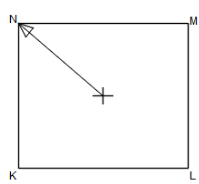
Four persons $P, Q, R$ and $S$ are initially at the four corners of a square side $d.$ Each person now moves with a constant speed $v$ in such a way that $P$ always moves directly towards $Q, Q$ towards $R, R$ towards $S,$ and $S$ towards $P.$ The four persons will meet after time.
- A
$\frac{\text{d}}{2\text{v}}$
- ✓
$\frac{\text{d}}{\text{v}}$
- C
$\frac{\text{3d}}{2\text{v}}$
- D
AnswerCorrect option: B. $\frac{\text{d}}{\text{v}}$
Here, velocity components will be $v \cos 45=\frac{\text{v}}{\sqrt{2}}$
And, displacement will be $\frac{\text{d}}{\sqrt{2}}$
So time taken will be
$\text{t}=\frac{\text{d}}{\text{v}}$
$=\frac{\frac{\text{d}}{\sqrt{2}}}{\frac{\text{v}}{\sqrt{2}}}$
$=\frac{\text{d}}{\text{v}}$
View full question & answer→MCQ 1371 Mark
If $\vec{\text{a}}.\hat{\text{i}}=\vec{\text{a}}.\big(\hat{\text{i}}+\hat{\text{j}}\big)=\vec{\text{a}}.\big(\hat{\text{i}}+\hat{\text{j}}+\hat{\text{k}}\big)=1.$then $\vec{\text{a}}=$
AnswerCorrect option: B. $\hat{\text{i}}$
Let $\vec{\text{a}}=\text{a}_1\hat{\text{i}}+\text{a}_2\hat{\text{j}}+\text{a}_3\hat{\text{k}}$
$\vec{\text{a}}.\hat{\text{i}}=\text{a}_1$
and $\vec{\text{a}}.\big(\hat{\text{i}}+\hat{\text{j}}\big)=\text{a}_1+\text{a}_2$
and $\vec{\text{a}}.\big(\hat{\text{i}}+\hat{\text{j}}+\hat{\text{k}}\big)=\text{a}_1+\text{a}_2+\text{a}_3$
Given,
$\vec{\text{a}}.\hat{\text{i}}=\vec{\text{a}}.\big(\hat{\text{i}}+\hat{\text{j}}\big)=\vec{\text{a}}.\big(\hat{\text{i}}+\hat{\text{j}}+\hat{\text{k}}\big)=1$
$\Rightarrow\text{a}_1=\text{a}_1+\text{a}_2=\text{a}_1+\text{a}_2+\text{a}_3=1$
$\Rightarrow\text{a}_1=1,\text{a}_2=0,\text{a}_3=0$
So, $\vec{\text{a}}=\text{a}_1\hat{\text{i}}+\text{a}_2\hat{\text{j}}+\text{a}_3\hat{\text{k}}=1\hat{\text{i}}+0\hat{\text{j}}+0\hat{\text{k}}=\hat{\text{i}}$
View full question & answer→MCQ 1381 Mark
The unit vector perpendicular to the plane passing through points $\text{P}\big(\hat{\text{i}}-\hat{\text{j}}+2\hat{\text{k}}\big),\text{Q}\big(2\hat{\text{i}}-\hat{\text{k}}\big)$ and $\text{R}\big(2\hat{\text{j}}+\hat{\text{k}}\big)$ is :
- ✓
$2\hat{\text{i}}+\hat{\text{j}}+\hat{\text{k}}$
- B
$\sqrt{6}\big(2\hat{\text{i}}+\hat{\text{j}}+\hat{\text{k}}\big)$
- C
$\frac{1}{\sqrt{6}}\big(2\hat{\text{i}}+\hat{\text{j}}+\hat{\text{k}}\big)$
- D
$\frac{1}{6}\big(2\hat{\text{i}}+\hat{\text{j}}+\hat{\text{k}}\big)$
AnswerCorrect option: A. $2\hat{\text{i}}+\hat{\text{j}}+\hat{\text{k}}$
The vector $\overrightarrow{\text{PQ}}\times\overrightarrow{\text{PR}}$ is perpendicular to the vectors $\overrightarrow{\text{PQ}}$ and $\overrightarrow{\text{PR}}.$
$\therefore$ Required unit vector $=\frac{\overrightarrow{\text{PQ}}\times\overrightarrow{\text{PR}}}{\big|\overrightarrow{\text{PQ}}\times\overrightarrow{\text{PR}}\big|}$
Now,
$\overrightarrow{\text{PQ}}=\text{P.V}$ of $\text{Q}-\text{P.V}.$ of ${P}$
$=\hat{\text{i}}+\hat{\text{j}}-3\hat{\text{k}}$
$\overrightarrow{\text{PR}}=\text{P.V}$ of $\text{R}-\text{P.V}.$ of ${P}$
$=-\hat{\text{i}}+3\hat{\text{j}}-\hat{\text{k}}$
$\therefore\overrightarrow{\text{PQ}}\times\overrightarrow{\text{PR}}=\begin{vmatrix}\hat{\text{i}}&\hat{\text{j}}&\hat{\text{k}}\\1&1&-3\\-1&3&-1 \end{vmatrix}$
$=8\hat{\text{i}}+4\hat{\text{j}}+4\hat{\text{k}}$
$=4\big(2\hat{\text{i}}+\hat{\text{j}}+\hat{\text{k}}\big)$
$\Rightarrow\big|\overrightarrow{\text{PQ}}\times\overrightarrow{\text{PR}}\big|$
$=\sqrt{64+16+16}$
$=\sqrt{96}$
$=4\sqrt{6}$
Required unit vector $=\frac{\overrightarrow{\text{PQ}}\times\overrightarrow{\text{PR}}}{\big|\overrightarrow{\text{PQ}}\times\overrightarrow{\text{PR}}\big|}$
$=\frac{4\big(2\hat{\text{i}}+\hat{\text{j}}+\hat{\text{k}}\big)}{4\sqrt{6}}$
$=\frac{1}{\sqrt{6}}\big(2\hat{\text{i}}+\hat{\text{j}}+\hat{\text{k}}\big)$
View full question & answer→MCQ 1391 Mark
If $a, b, c$ are unit vectors such that $a + b + c = 0,$ then the value of $a.b + b.c + c.a$ is:
AnswerCorrect option: C. $-\frac{3}{2}$
View full question & answer→MCQ 1401 Mark
If $\vec{\text{x}}$ is a vector in the direction of $(2, -2, 1)$ of magnitude $6$ and $\vec{\text{y}}$ is a vector in the direction of $(1, 1, -1)$ of magnitude $\sqrt{3}$ then $\mid\vec{\text{x}}+2\vec{\text{y}}\mid=$
- A
$40$
- B
$\sqrt{35}$
- C
$\sqrt{17}$
- ✓
$2\sqrt{10}$
AnswerCorrect option: D. $2\sqrt{10}$
They given $x$ directionwe need to find unit vector in that direction and multiply with the magnitude of $x$ they given $y$ directionwe need to find unit vector in that direction and multiply with the magnitude of $\vec{\text{x}}\text{y}$
$\frac{{6}\Big(2\hat{\text{i}}-2\hat{\text{j}}+\hat{\text{k}}\Big)}{3},\vec{\text{y}}=\frac{{\sqrt{3}}\Big(\hat{\text{i}}+\hat{\text{j}}-\hat{\text{k}}\Big)}{\sqrt{3}},$
so $\mid\vec{\text{x}}+2\vec{\text{y}}\mid=\mid6\hat{\text{i}}-2\hat{\text{j}}\mid=\sqrt{40}=2\sqrt{10}$
View full question & answer→MCQ 1411 Mark
The vectors $\vec{\text{a}}$ and $\vec{\text{b}}$ satisfy the equation $2\vec{\text{a}}+\vec{\text{b}}=\vec{\text{p}}$ and $\vec{\text{a}}+2\vec{\text{b}}=\vec{\text{q}},$ where $\vec{\text{p}}=\hat{\text{i}}+\hat{\text{j}}$ and $\vec{\text{q}}=\hat{\text{i}}-\hat{\text{j}}.$ If $\theta$ is the angle between $\vec{\text{a}}$ and $\vec{\text{b}},$ then :
- A
$\cos \theta = \frac{4}{5}$
- B
$\sin \theta = \frac{1}{\sqrt{2}}$
- ✓
$\cos \theta = -\frac{4}{5}$
- D
$\cos \theta = -\frac{3}{5}$
AnswerCorrect option: C. $\cos \theta = -\frac{4}{5}$
Given that
$2\vec{\text{a}}+\vec{\text{b}}=\vec{\text{p}}\dots(1)$
$\vec{\text{a}}+2\vec{\text{b}}=\vec{\text{q}}\dots(2)$
Solving these two we get
$\vec{\text{a}}=\frac{2\vec{\text{p}}-\vec{\text{q}}}{3},\vec{\text{b}}=\frac{2\vec{\text{q}}-\vec{\text{p}}}{3}$
And we have
$\vec{\text{p}}=\hat{\text{i}}+\hat{\text{j}}$ and $\vec{\text{q}}=\hat{\text{i}}-\hat{\text{j}}$
Substituting the values of $\vec{\text{p}}$ and $\vec{\text{q}},$ we get
$\vec{\text{a}}=\frac{2\vec{\text{p}}-\vec{\text{q}}}{3}=\frac{2\big(\hat{\text{i}}+\hat{\text{j}}\big)-\big(\hat{\text{i}}-\hat{\text{j}}\big)}{3}=\frac{\hat{\text{i}}+3\hat{\text{j}}}{3}$
$\Rightarrow|\vec{\text{a}}|=\frac{1}{3}\sqrt{1+9}=\frac{\sqrt{10}}{3}$
$\vec{\text{b}}=\frac{2\vec{\text{q}}-\vec{\text{p}}}{3}=\frac{2\big(\hat{\text{i}}-\hat{\text{j}}\big)-\big(\hat{\text{i}}+\hat{\text{j}}\big)}{3}=\frac{\hat{\text{i}}-3\hat{\text{j}}}{3}$
$\Rightarrow\big|\vec{\text{b}}\big|=\frac{1}{3}\sqrt{1+9}=\frac{\sqrt{10}}{3}$
$\vec{\text{a}}.\vec{\text{b}}=\frac{1}{9}(1-9)=\frac{-8}{9}$
We know that
$\vec{\text{a}}.\vec{\text{b}}=|\vec{\text{a}}|\big|\vec{\text{b}}\big|\cos\theta$
$\Rightarrow\frac{-8}{9}=\frac{\sqrt{10}}{3}\times\frac{\sqrt{10}}{3}\cos\theta$
$\Rightarrow\frac{-8}{9}=\frac{10}{9}\cos\theta$
$\Rightarrow\cos\theta=\frac{-8}{9}\times\frac{9}{10}=\frac{-4}{5}$
View full question & answer→MCQ 1421 Mark
The magnitude of the vector $6i + 2j + 3k$ is equal to:
View full question & answer→MCQ 1431 Mark
If $\text{OACB}$ is a parallelogram with $\overrightarrow{\text{OC}}=\vec{\text{a}}$ and $\overrightarrow{\text{AB}}=\vec{\text{b}},$ then $\overrightarrow{\text{OA}}=$
- A
$\big(\vec{\text{a}}+\vec{\text{b}}\big)$
- B
$\big(\vec{\text{a}}-\vec{\text{b}}\big)$
- C
$\frac{1}2\big(\vec{\text{b}}-\vec{\text{a}}\big)$
- ✓
$\frac{1}2\big(\vec{\text{a}}-\vec{\text{b}}\big)$
AnswerCorrect option: D. $\frac{1}2\big(\vec{\text{a}}-\vec{\text{b}}\big)$
Given a parallelogram $\text{OABC}$ such that $\overrightarrow{\text{OC}}=\vec{\text{a}}$ and $\overrightarrow{\text{AB}}=\vec{\text{b}}$. Then,
$\overrightarrow{\text{OB}}+\overrightarrow{\text{BC}}=\overrightarrow{\text{OC}}$
$\Rightarrow\ \overrightarrow{\text{OB}}=\overrightarrow{\text{OC}}-\overrightarrow{\text{BC}}$
$\Rightarrow\ \overrightarrow{\text{OB}}=\overrightarrow{\text{OC}}-\overrightarrow{\text{OA}}$ $\Big[\because\overrightarrow{\text{BC}}=\overrightarrow{\text{OA}}\Big]$
$\Rightarrow\ \overrightarrow{\text{OB}}=\vec{\text{a}}-\overrightarrow{\text{OA}}\ \dots(1)$
Therefore,
$\overrightarrow{\text{OA}}+\overrightarrow{\text{AB}}=\overrightarrow{\text{OB}}$
$\Rightarrow\ \overrightarrow{\text{OA}}+\vec{\text{b}}=\vec{\text{a}}-\overrightarrow{\text{OA}}\ [$Using $(1)]$
$\Rightarrow\ 2\overrightarrow{\text{OA}}=\vec{\text{a}}-\vec{\text{b}}$
$\Rightarrow\ \overrightarrow{\text{OA}}=\frac{1}2\big(\vec{\text{a}}-\vec{\text{b}}\big)$
View full question & answer→MCQ 1441 Mark
The scalar product of $5i + j - 3k$ and $3i - 4j + 7k$ is:
AnswerLet $A = 5i + j – 3k$
$B = 3i – 4j + 7k$
$A.B = (5i + j - 3k) (3i - 4j + 7k)$
$= 5.3 + 1.(-4) + (-3).7$
$= 15 - 4 - 21$
$= -10$
View full question & answer→MCQ 1451 Mark
Choose the correct answer from the given four options.
If $|\vec{{\text{a}}}|=10,|\vec{{\text{b}}}|=2$ and $\vec{{\text{a}}}\cdot\vec{{\text{b}}}=12,$ then value of $|\vec{{\text{a}}}\times\vec{\text{b}}|$ is :
AnswerHere, $|\vec{{\text{a}}}|=10,|\vec{{\text{b}}}|=2$ and $\vec{{\text{a}}}\cdot\vec{\text{b}}=12\ [$given$]$
$\therefore\vec{{\text{a}}}\cdot\vec{\text{b}}=|\vec{{\text{a}}}||\vec{{\text{b}}}|\cos\theta$
$12=10\times2\cos\theta$
$\Rightarrow\cos\theta=\frac{12}{20}=\frac{3}{5}$
$\Rightarrow\sin\theta=\sqrt{1-\cos\theta}$
$=\sqrt{1-\frac{9}{25}}$
$\sin\theta=\pm\frac{4}{5}$
$\therefore|\vec{{\text{a}}}\times\vec{{\text{b}}}|=|\vec{{\text{a}}}\|\vec{{\text{b}}}\|\sin\theta|$
$=10\times2\times\frac{4}{5}$
$=16$
View full question & answer→MCQ 1461 Mark
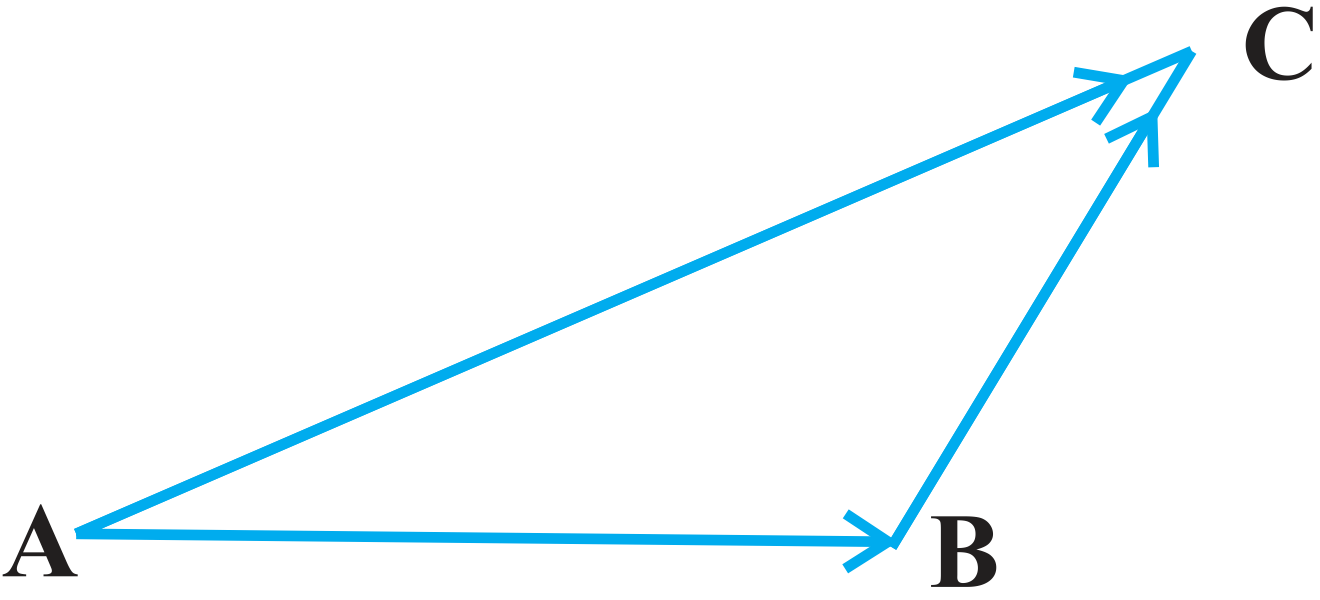
In triangle ABC (Fig 10.18), which of the following is not true:
- A
$\overrightarrow{\text{AB}}+\overrightarrow{\text{BC}}+\overrightarrow{\text{CA}}=\vec{0}$
- B
$\overrightarrow{\text{AB}}+\overrightarrow{\text{BC}}-\overrightarrow{\text{AC}}=\vec{0}$
- ✓
$\overrightarrow{\text{AB}}+\overrightarrow{\text{BC}}-\overrightarrow{\text{CA}}=\vec{0}$
- D
$\overrightarrow{\text{AB}}-\overrightarrow{\text{CB}}+\overrightarrow{\text{CA}}=\vec{0}$
AnswerCorrect option: C. $\overrightarrow{\text{AB}}+\overrightarrow{\text{BC}}-\overrightarrow{\text{CA}}=\vec{0}$
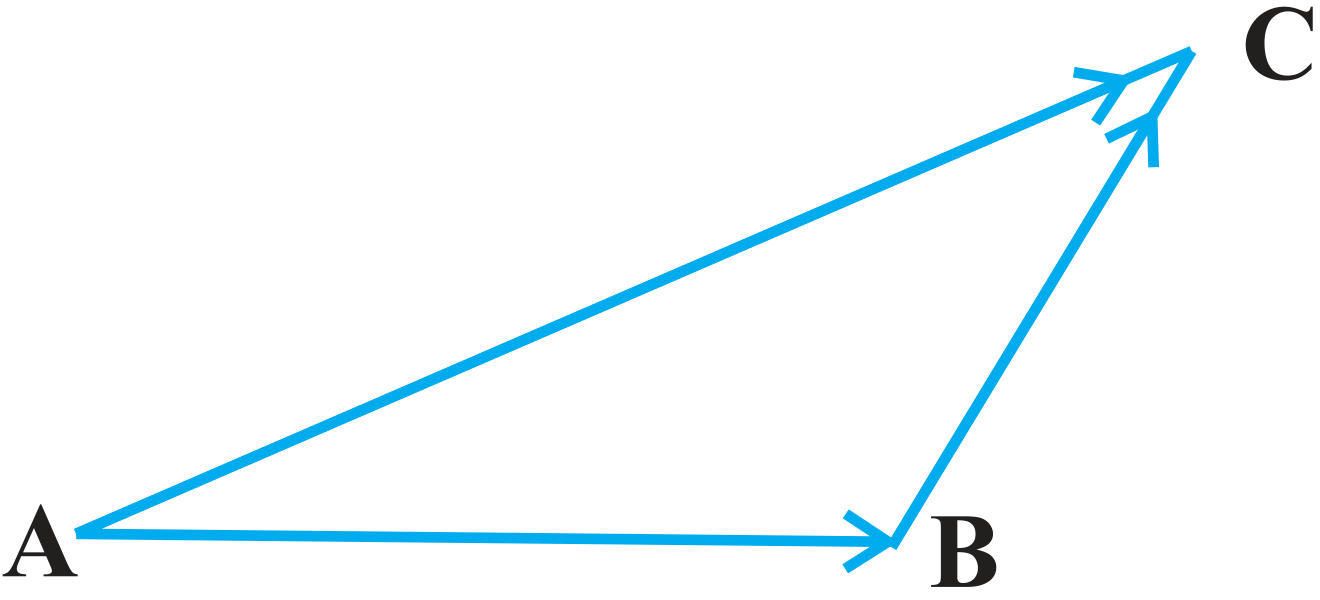 On applying the triangle law of addition in the given triangle, we have:
$\overrightarrow{\text{AB}}+\overrightarrow{\text{BC}}=\overrightarrow{\text{AC}}\ \ \ \ \ \ \ \ \ ....(1)$
$\Rightarrow\overrightarrow{\text{AB}}+\overrightarrow{\text{BC}}=-\overrightarrow{\text{CA}}$
$\Rightarrow\overrightarrow{\text{AB}}+\overrightarrow{\text{BC}}+\overrightarrow{\text{CA}}=\vec{0}\ \ \ \ ....(2)$
$\therefore$ The equation given in alternative A is true.
$\overrightarrow{\text{AB}}+\overrightarrow{\text{BC}}=\overrightarrow{\text{AC}}$
$\Rightarrow\overrightarrow{\text{AB}}+\overrightarrow{\text{BC}}-\overrightarrow{\text{AC}}=\vec{0}$
$\therefore$ The equation given in alternative B is true.
From equation (2), we have:
$\overrightarrow{\text{AB}}-\overrightarrow{\text{CB}}+\overrightarrow{\text{CA}}=\vec{0}$
$\therefore$ The equation given in alternative D is true.
Now, consider the equation given in alternative C:
$\overrightarrow{\text{AB}}+\overrightarrow{\text{BC}}-\overrightarrow{\text{CA}}=\vec{0}$
$\Rightarrow\overrightarrow{\text{AB}}+\overrightarrow{\text{BC}}=\overrightarrow{\text{CA}}\ \ \ \ ....(3)$
From equations (1) and (3), we have:
$\overrightarrow{\text{AC}}=\overrightarrow{\text{CA}}$
$\Rightarrow\overrightarrow{\text{AC}}=-\overrightarrow{\text{AC}}$
$\Rightarrow\overrightarrow{\text{AC}}+\overrightarrow{\text{AC}}=\vec{0}$
$\Rightarrow2\overrightarrow{\text{AC}}=\vec{0}$
$\Rightarrow\overrightarrow{\text{AC}}=\vec{0},$ which is not true.
Hence, the equation given in alternative C is incorrect.
The correct answer is C. View full question & answer→MCQ 1471 Mark
If $\vec{\text{a}}.\vec{\text{b}}=\vec{\text{a}}.\vec{\text{c}}$ and $\vec{\text{a}}\times\vec{\text{b}}=\vec{\text{a}}\times\vec{\text{c}}.\vec{\text{a}}\neq0,$ then :
AnswerCorrect option: A. $\vec{\text{b}}=\vec{\text{c}}$
$\vec{\text{a}}.\vec{\text{b}}=\vec{\text{a}}.\vec{\text{c}}$
$\Rightarrow\vec{\text{a}}.\vec{\text{b}}-\vec{\text{a}}.\vec{\text{c}}=0$
$\Rightarrow\vec{\text{a}}.\big(\vec{\text{b}}-\vec{\text{c}}\big)=0$
Let $\theta$ be the angle between $\vec{\text{a}}$ and $\big(\vec{\text{b}}-\vec{\text{c}}\big)$
$|\vec{\text{a}}|\big|\big(\vec{\text{b}}-\vec{\text{c}}\big)\big|\cos\theta\dots(1)$
and $\vec{\text{a}}\times\vec{\text{b}}=\vec{\text{a}}\times\vec{\text{c}}$
$\Rightarrow\vec{\text{a}}\times\vec{\text{b}}-\vec{\text{a}}\times\vec{\text{c}}=0$
$\Rightarrow\vec{\text{a}}\times\big(\vec{\text{b}}-\vec{\text{c}}\big)=0$
Then, $|\vec{\text{a}}|\big|\big(\vec{\text{b}}-\vec{\text{c}}\big)\big|\sin\theta=0\dots(2)$
Here, it is given that $\vec{\text{a}}\neq0$
Therefore, for eq. $(1)$ and eq. $(2)$ to be $0$
We have,
$\big|\big(\vec{\text{b}}-\vec{\text{c}}\big)\big|\cos\theta=0$
For $\big|\big(\vec{\text{b}}-\vec{\text{c}}\big)\big|\cos\theta=0,$ one of $\big|\big(\vec{\text{b}}-\vec{\text{c}}\big)\big|$ or $\cos\theta$ must be $0$
Case $1$ :
Let $\cos\theta=0$
$\Rightarrow\theta=90^\circ$
$\Rightarrow\sin\theta=1$
if $\big|\big(\vec{\text{b}}-\vec{\text{c}}\big)\big|\sin\theta=0$ and $\sin\theta=1$
Then $\big|\big(\vec{\text{b}}-\vec{\text{c}}\big)\big|=0$
$\Rightarrow\vec{\text{b}}=\vec{\text{c}}$
Case $2$ :
Let $\big|\big(\vec{\text{b}}-\vec{\text{c}}\big)\big|=0$
$\Rightarrow\vec{\text{b}}=\vec{\text{c}}$
Hence, $\vec{\text{b}}=\vec{\text{c}}$
View full question & answer→MCQ 1481 Mark
The value of $\big(\vec{\text{a}}\times\vec{\text{b}}\big)^2$ is:
- A
$|\vec{\text{a}}|^2+\big|\vec{\text{b}}\big|^2-\big(\vec{\text{a}}.\vec{\text{b}}\big)^2$
- ✓
$|\vec{\text{a}}|^2\big|\vec{\text{b}}\big|^2-\big(\vec{\text{a}}.\vec{\text{b}}\big)^2$
- C
$|\vec{\text{a}}|^2+\big|\vec{\text{b}}\big|^2-2\big(\vec{\text{a}}.\vec{\text{b}}\big)$
- D
$|\vec{\text{a}}|^2+\big|\vec{\text{b}}\big|^2-\vec{\text{a}}.\vec{\text{b}}$
AnswerCorrect option: B. $|\vec{\text{a}}|^2\big|\vec{\text{b}}\big|^2-\big(\vec{\text{a}}.\vec{\text{b}}\big)^2$
$\big(\vec{\text{a}}.\vec{\text{b}}\big)^2+\big|\vec{\text{a}}\times\vec{\text{b}}\big|^2$
$=\big(|\vec{\text{a}}|\big|\vec{\text{b}}\big|\cos\theta\big)^2+\big(|\vec{\text{a}}|\big|\vec{\text{b}}\big|\sin\theta\big)^2$
$=|\vec{\text{a}}|^2\big|\vec{\text{b}}\big|^2(\cos^2\theta+\sin^2\theta)$
$=|\vec{\text{a}}|^2\big|\vec{\text{b}}\big|^2$ (1)
$=|\vec{\text{a}}|^2\big|\vec{\text{b}}\big|^2$
$\therefore\big|\vec{\text{a}}\times\vec{\text{b}}\big|^2=|\vec{\text{a}}|^2\big|\vec{\text{b}}\big|^2-\big(\vec{\text{a}}.\vec{\text{b}}\big)^2$
Thus, the value of $\big(\vec{\text{a}}\times\vec{\text{b}}\big)^2$ is $|\vec{\text{a}}|^2\big|\vec{\text{b}}\big|^2-\big(\vec{\text{a}}.\vec{\text{b}}\big)^2.$
View full question & answer→MCQ 1491 Mark
If $\vec{\text{a}},\vec{\text{b}}$ represent the diagonals of a rhombus, then:
- A
$\vec{\text{a}}\times\vec{\text{b}}=\vec{0}$
- ✓
$\vec{\text{a}}.\vec{\text{b}}=0$
- C
$\vec{\text{a}}.\vec{\text{b}}=1$
- D
$\vec{\text{a}}\times\vec{\text{b}}=\vec{\text{a}}$
AnswerCorrect option: B. $\vec{\text{a}}.\vec{\text{b}}=0$
We know that the diagonals in a rhombus $\vec{\text{a}}$ and $\vec{\text{b}}$ are perpendicular.
Therefore, their dot product is zero.
$\Rightarrow\vec{\text{a}}.\vec{\text{b}}=0$
View full question & answer→MCQ 1501 Mark
In figure, which of the following is not true?
- A
$\overrightarrow{\text{AB}}+\overrightarrow{\text{BC}}+\overrightarrow{\text{CA}}=\vec0$
- B
$\overrightarrow{\text{AB}}+\overrightarrow{\text{BC}}-\overrightarrow{\text{AC}}=\vec0$
- ✓
$\overrightarrow{\text{AB}}+\overrightarrow{\text{BC}}-\overrightarrow{\text{CA}}=\vec0$
- D
$\overrightarrow{\text{AB}}-\overrightarrow{\text{CB}}+\overrightarrow{\text{CA}}=\vec0$
AnswerCorrect option: C. $\overrightarrow{\text{AB}}+\overrightarrow{\text{BC}}-\overrightarrow{\text{CA}}=\vec0$
We have, $\text{LHS} = \overrightarrow{\text{AB}}+\overrightarrow{\text{BC}}-\overrightarrow{\text{AC}}$
$=\overrightarrow{\text{AC}}-\overrightarrow{\text{CA}}$ $\Big[\because\overrightarrow{\text{AB}}+\overrightarrow{\text{BC}}=\overrightarrow{\text{AC}}\Big]$
$=-\overrightarrow{\text{CA}}-\overrightarrow{\text{CA}}$
$=-2\overrightarrow{\text{CA}}$
So, $\text{LHS}\neq\text{RHS}$
Hence, It is not true.
View full question & answer→