MCQ 1511 Mark
If $\vec{\text{a}},\ \vec{\text{b}}$ are the vectors forming consecutive sides of a regular hexagon $\text{ABCDEF},$ then the vector representing side $CD$ is,
- A
$\vec{\text{a}}+\vec{\text{b}}$
- B
$\vec{\text{a}}-\vec{\text{b}}$
- ✓
$\vec{\text{b}}-\vec{\text{a}}$
- D
$-\big(\vec{\text{a}}+\vec{\text{b}}\big)$
AnswerCorrect option: C. $\vec{\text{b}}-\vec{\text{a}}$
Let $\text{ABCDEF}$ be a regular hexagon such that $\overrightarrow{\text{AB}}=\vec{\text{a}}$ and $\overrightarrow{\text{BC}}=\vec{\text{b}}$.
We know, $AD$ is parallel to $BC$ such that $AD = 2BC.$
$\therefore\ \overrightarrow{\text{AD}}=2\overrightarrow{\text{BC}}=2\vec{\text{b}}$
In $\triangle{\text{ABC}}$, we have
$\overrightarrow{\text{AB}}+\overrightarrow{\text{BC}}=\overrightarrow{\text{AC}}$
$\Rightarrow\ \vec{\text{a}}+\vec{\text{b}}=\overrightarrow{\text{AC}}$
In $\triangle{\text{ACD}}$, we have
$\overrightarrow{\text{AC}}+\overrightarrow{\text{CD}}=\overrightarrow{\text{AD}}$
$\Rightarrow\overrightarrow{\text{CD}}=\overrightarrow{\text{AD}}-\overrightarrow{\text{AC}}$
$\Rightarrow\overrightarrow{\text{CD}}=2\vec{\text{b}}-\big(\vec{\text{a}}+\vec{\text{b}}\big)$
$\Rightarrow\overrightarrow{\text{CD}}=\vec{\text{b}}-\vec{\text{a}}$
View full question & answer→MCQ 1521 Mark
If $A(6, 3, 2), B(5, 1, 4), C(3, −4, 7), D(0, 2, 5)$ are four points, then projection of $CD$ on $AB$ is:
- ✓
$-\frac{13}{7}$
- B
$-\frac{13}{7}$
- C
$-\frac{3}{13}$
- D
$-\frac{7}{13}$
AnswerCorrect option: A. $-\frac{13}{7}$
View full question & answer→MCQ 1531 Mark
The vector equation of the plane passing through $\vec{\text{a}},\ \vec{\text{b}},\ \vec{\text{c}},$ is $\vec{\text{r}}=\alpha\vec{\text{a}}+\beta\vec{\text{b}}+\gamma\vec{\text{c}}$, provided that,
AnswerCorrect option: B. $\alpha+\beta+\gamma=1$
Given: A plane passing through $\vec{\text{a}},\ \vec{\text{b}},\ \vec{\text{c}}$.
$\Rightarrow $ Lines $\vec{\text{a}}-\vec{\text{b}}$ and $\vec{\text{c}}-\vec{\text{a}}$ lie on the plane.
The parmetric equation of the plane can be written as :
$\vec{\text{r}}=\vec{\text{a}}+\lambda_1\big(\vec{\text{a}}-\vec{\text{b}}\big)+\lambda_2\big(\vec{\text{c}}-\vec{\text{a}}\big)$
$\vec{\text{r}}=\vec{\text{a}}(1+\lambda_1+\lambda_2)-\lambda_1\vec{\text{b}}+\lambda_2\vec{\text{c}}$
Given that $\vec{\text{r}}=\alpha\vec{\text{a}}+\beta\vec{\text{b}}+\gamma\vec{\text{c}}$
$\therefore\alpha+\beta+\gamma=1+\lambda_1-\lambda_2-\lambda_1+\lambda_2$
$\alpha+\beta+\gamma=1$
View full question & answer→MCQ 1541 Mark
The system of vectors $i, j, k$ is:
View full question & answer→MCQ 1551 Mark
The direction cosines $l, m$ and $n$ of two lines are connected by the relations $l + m + n = 0, l m = 0,$ then the angles between them is:
- ✓
$\frac{\pi}{3}$
- B
$\frac{\pi}{4}$
- C
$\frac{\pi}{2}$
- D
$0$
AnswerCorrect option: A. $\frac{\pi}{3}$
View full question & answer→MCQ 1561 Mark
$\mid\text{a}\times\text{b}\mid^2+\mid\text{a.b}\mid^2=144$ and $\mid\text{a}\mid=4$ then $\mid\text{b}\mid$ is equal to:
View full question & answer→MCQ 1571 Mark
The vector $\cos\alpha\cos\beta\hat{\text{i}}+\cos\alpha\sin\beta\hat{\text{j}}+\sin\alpha\hat{\text{k}}$ is a,
View full question & answer→MCQ 1581 Mark
If $O$ and $O\ '$ are circumcenter and orthocenter of $\triangle{\text{ABC}}$ , then $\overrightarrow{\text{OA}}+\overrightarrow{\text{OB}}+\overrightarrow{\text{OC}}$ equals,
- A
$2\overrightarrow{\text{OO}\ '}$
- ✓
$\overrightarrow{\text{OO}\ '}$
- C
$\overrightarrow{\text{O}\ '\text{O}}$
- D
$2\overrightarrow{\text{O}\ '\text{O}}$
AnswerCorrect option: B. $\overrightarrow{\text{OO}\ '}$
Given : $O$ be the circumcentre an $O\ '$ be the orthocenter of $\triangle{\text{ABC}}$.
Let $G$ be the centroid of the triangle.
We know that $O, G$ and $H$ are collinear and by geometry $\overrightarrow{\text{O}\ '\text{G}}=2\overrightarrow{\text{OG}}$.
This yields, $\overrightarrow{\text{O}\ '\text{O}}=\overrightarrow{\text{O}\ '\text{G}}+\overrightarrow{\text{GO}}=2\overrightarrow{\text{GO}}+\overrightarrow{\text{GO}}=3\overrightarrow{\text{GO}}$
In other words $\overrightarrow{\text{OO}\ '}=3\overrightarrow{\text{GO}}$
Since, $\overrightarrow{\text{OG}}=\frac{\vec{\text{a}}+\vec{\text{b}}+\vec{\text{c}}}3$
$\therefore\overrightarrow{\text{OO}\ '}=3\times\frac{\vec{\text{a}}+\vec{\text{b}}+\vec{\text{c}}}3=\vec{\text{a}}+\vec{\text{b}}+\vec{\text{c}}$
$=\overrightarrow{\text{OA}}+\overrightarrow{\text{OB}}+\overrightarrow{\text{OC}}$
View full question & answer→MCQ 1591 Mark
If $\hat{\text{i}},\hat{\text{j}},\hat{\text{k}}$ are unit vectors, then
- A
$\hat{\text{i}}.\hat{\text{j}}=1$
- ✓
$\hat{\text{i}}.\hat{\text{i}}=1$
- C
$\hat{\text{i}}\times\hat{\text{j}}=1$
- D
$\hat{\text{i}}\times\big(\hat{\text{j}}\times\hat{\text{k}}\big)=1$
AnswerCorrect option: B. $\hat{\text{i}}.\hat{\text{i}}=1$
View full question & answer→MCQ 1601 Mark
Choose the correct answer from the given four options. The vectors from origin to the points $A$ and $B$ are $\vec{\text{a}}=2\hat{\text{i}}-3\hat{\text{j}}+2\hat{\text{k}}$ and $\vec{\text{b}}=2\hat{\text{i}}+3\hat{\text{j}}+\hat{\text{k}},$ respectively, then the area of the triangle $\text{OAB}$ is :
- A
$340$
- B
$\sqrt{25}$
- C
$\sqrt{229}$
- ✓
$\frac{1}{2}\sqrt{229}$
AnswerCorrect option: D. $\frac{1}{2}\sqrt{229}$
$\therefore$ Area of $\triangle\text{OAB}=\frac{1}{2}|\overrightarrow{\text{OA}}\times\overrightarrow{\text{OB}}|$
$=\frac{1}{2}|(2\hat{\text{i}}-3\hat{\text{j}}+2\hat{\text{k}})\times(2\hat{\text{i}}+3\hat{\text{j}}+\hat{\text{k}})|$
$=\frac{1}{2}\begin{vmatrix}\hat{\text{i}}&\hat{\text{j}}&\hat{\text{k}} \\2&-3&2\\2&3&1 \end{vmatrix}$
$=\frac{1}{2}|[\hat{\text{i}}(-3-6)-\hat{\text{j}}(2-4)+\hat{\text{k}}(6+6)]|$
$=\frac{1}{2}|-9\hat{\text{i}}+2\hat{\text{j}}+12\hat{\text{k}}|$
$\therefore$ Area of $\triangle\text{OAB}=\frac{1}{2}\sqrt{81+4+144}$
$=\frac{1}{2}\sqrt{229}$
View full question & answer→MCQ 1611 Mark
Point $(4, 0)$ lies on:
- A
$\vec{\text{XO}}$
- B
$\vec{\text{YO}}$
- ✓
$\vec{\text{OX}}$
- D
$\vec{\text{OY}}$
AnswerCorrect option: C. $\vec{\text{OX}}$
$\vec{\text{XO}}$ is positive $x-$axis, so $(4, 0)$ lies on it.
View full question & answer→MCQ 1621 Mark
Choose the correct answer from the given four options. The vector having initial and terminal points as $(2, 5, 0)$ and $(–3, 7, 4),$ respectively is :
- A
$-\hat{\text{i}}+12\hat{\text{j}}+4\hat{\text{k}}$
- B
$-5\hat{\text{i}}+2\hat{\text{j}}-4\hat{\text{k}}$
- ✓
$-5\hat{\text{i}}+2\hat{\text{j}}+4\hat{\text{k}}$
- D
$\hat{\text{i}}+\hat{\text{j}}+\hat{\text{k}}$
AnswerCorrect option: C. $-5\hat{\text{i}}+2\hat{\text{j}}+4\hat{\text{k}}$
Given points are $(2, 5, 0)$ and $(–3, 7, 4).$
Thus, the required vector $=(-3-2)\hat{\text{i}}+(7-5)\hat{\text{j}}+(4-0)\hat{\text{k}}$
$=-5\hat{\text{i}}+2\hat{\text{j}}+4\hat{\text{k}}$
View full question & answer→MCQ 1631 Mark
If $\text{AD, BE}$ and $\text{CF}$ are $\triangle\text{ABC},$ then $\vec{\text{AD}}+\vec{\text{BE}}+\vec{\text{CF}}$
AnswerCorrect option: A. $\vec{0}$
View full question & answer→MCQ 1641 Mark
The equation of normal to the curve $3x^2 - y^2 = 8$ which is parallel to the line $x + 3y = 8$ is:
AnswerCorrect option: C. $\text{x + 3y} \underline{+} 8 = 0$
View full question & answer→MCQ 1651 Mark
What is direction of vector $\vec{\text{a}}$ if it is multiplied with $-\lambda$:
View full question & answer→MCQ 1661 Mark
If $\vec{a}$ is a nonzero vector of magnitude 'a' and $\lambda$ a nonzero scalar, then $\lambda\ \vec{a}$ is unit vector if
- A
$\lambda=1$
- B
$\lambda=-1$
- C
$a=\big|\lambda\big|$
- ✓
$a=1/\big|\lambda\big|$
AnswerCorrect option: D. $a=1/\big|\lambda\big|$
Given: $ \vec{a}$ is a non-zero vector of magnitude a $ \Rightarrow\ \ \ |\vec{a}|=1$
Also given $\lambda\neq0\ \text{and}\ \lambda\vec{a}$ is a unit vector.
$\Rightarrow\ \ |\lambda\vec{a}|=1\ \Rightarrow\ \ |\lambda|\big|\vec{a}\big|=1$
$\Rightarrow\ \ \ \ \ \ |\lambda|a=1\ \ \Rightarrow\ \ a=\frac{1}{|\lambda|}$
Therefore, option (D) is correct.
View full question & answer→MCQ 1671 Mark
Which of the following represents collinear but not equal vectors:
- ✓
$a, c$
- B
$b, d$
- C
$b, m$
- D
Both $(a)$ and $(b)$
AnswerCorrect option: A. $a, c$
View full question & answer→MCQ 1681 Mark
If $\vec{a}$ and $\vec{b}$ are two vectors such that $|\vec{a}|=1,|\vec{b}|=2$ and $\vec{a} \cdot \vec{b}=\sqrt{3}$, then the angle between $2 \vec{a}$ and $-\vec{b}$ is:
- A
$\frac{\pi}{6}$
- B
$\frac{\pi}{3}$
- C
$\frac{5 \pi}{6}$
- D
$\frac{11 \pi}{6}$
AnswerWe have, $|\vec{a}|=1,|\vec{b}|=2$ and $\vec{a} \cdot \vec{b}=\sqrt{3}$
As, $\vec{a} \cdot \vec{b}=|a||b| \cos \theta$
$(2 \vec{a}) \cdot(-\vec{b})=|2 \vec{a}||-\vec{b}| \cos \theta$
$\Rightarrow-2(\vec{a} \cdot \vec{b})=2|\vec{a}||\vec{b}| \cos \theta \Rightarrow \cos \theta=\frac{-(\vec{a} \cdot \vec{b})}{|\vec{a}||\vec{b}|}=\frac{-\sqrt{3}}{2}$
$\therefore \quad$ Angle between $2 \vec{a}$ and $-\vec{b}=\pi-\frac{\pi}{6}$ or $\pi+\frac{\pi}{6}=\frac{5 \pi}{6}$ or $\frac{7 \pi}{6}$
View full question & answer→MCQ 1691 Mark
The unit vector perpendicular to both vectors $\hat{i}+\hat{k}$ and $\hat{i}-\hat{k}$ is:
AnswerLet the required vector be $x \hat{i}+y \hat{j}+z \hat{k}$.
Then, $x^2+y^2+z^2=1$ .............(i)
Also, $(x \hat{i}+y \hat{j}+z \hat{k}) \cdot(\hat{i}+\hat{k})=0$
$\Rightarrow \quad x+z=0 ........(ii)$
And $(x \hat{i}+y \hat{j}+z \hat{k}) \cdot(\hat{i}-\hat{k})=0$
$\Rightarrow x - z =0 .........(iii)$
Solving (ii) and (iii), we get $x=z=0$
$\therefore \quad$ From (i), $y^2=1 \Rightarrow y= \pm 1$
So, required vector is $\pm \hat{j}$.
View full question & answer→MCQ 1701 Mark
Let $\vec{a}$ be any vector such that $|\vec{a}|=a$. The value of $|\vec{a} \times \hat{i}|^2+|\vec{a} \times \hat{j}|^2+|\vec{a} \times \hat{k}|^2$ is :
- A
$a^2$
- B
$2 a^2$
- C
$3 a^2$
- D
$0$
AnswerLet $\vec{a}=x \hat{i}+y \hat{j}+z \hat{k}$, then $a^2=x^2+y^2+z^2$
Now, $\vec{a} \times \hat{i}=z \hat{j}-y \hat{k} \Rightarrow|\vec{a} \times \hat{i}|^2=y^2+z^2$
Similarly, $|\vec{a} \times \hat{j}|^2=x^2+z^2$ and $|\vec{a} \times \hat{k}|^2=x^2+y^2$
$\therefore \quad$ Required sum $=2 x^2+2 y^2+2 z^2=2 a^2$
View full question & answer→MCQ 1711 Mark
For any two vectors $\vec{a}$ and $\vec{b}$, which of the following statements is always true?
- A
$\vec{a} \cdot \vec{b} \geq|\vec{a}||\vec{b}|$
- B
$\vec{a} \cdot \vec{b}=|\vec{a}||\vec{b}|$
- ✓
$\vec{a} \cdot \vec{b} \leq|\vec{a}||\vec{b}|$
- D
$\vec{a} \cdot \vec{b}<|\vec{a}||\vec{b}|$
AnswerCorrect option: C. $\vec{a} \cdot \vec{b} \leq|\vec{a}||\vec{b}|$
$\vec{a} \cdot \vec{b} \leq|\vec{a}||\vec{b}|$
View full question & answer→MCQ 1721 Mark
The position vectors of points $P$ and $Q$ are $\vec{p}$ and $\vec{q}$ respectively. The point $R$ divides line segment $P Q$ in the ratio $3: 1$ and $S$ is the mid-point of line segment $P R$. The position vector of $S$ is
- A
$\frac{\vec{p}+3 \vec{q}}{4}$
- B
$\frac{\vec{p}+3 \vec{q}}{8}$
- C
$\frac{5 \vec{p}+3 \vec{q}}{4}$
- D
$\frac{5 \vec{p}+3 \vec{q}}{8}$
AnswerGiven, position vector of $P$ is $\overrightarrow{O P}=\vec{p}$ and position vector of $Q$ is $\overrightarrow{O P}=\vec{p}$, where $O$ is origin.
Point $R$ divides $P Q$ in ratio $3: 1$.
So, position vector of point $R$ is $\overrightarrow{O R}=\frac{3 \overrightarrow{O Q}+\overrightarrow{O P}}{4}=\frac{3 \vec{q}+\vec{p}}{4}$
Also, $S$ is the mid-point of $P R$.
So, $\overrightarrow{O S}=\frac{\overrightarrow{O P}+\overrightarrow{O R}}{2}=\frac{\vec{p}+\frac{3 \vec{q}+\vec{p}}{4}}{2}=\frac{5 \vec{p}+3 \vec{q}}{8}$
View full question & answer→MCQ 1731 Mark
The vectors $\vec{a}=2 \hat{i}-\hat{j}+\hat{k}, \vec{b}=\hat{i}-3 \hat{j}-5 \hat{k}$ and $\vec{c}=-3 \hat{i}+4 \hat{j}+4 \hat{k}$ represents the sides of
AnswerCorrect option: D. a right$-$angled triangle
Given, $\vec{a}=2 \hat{i}-\hat{j}+\hat{k}, \vec{b}=\hat{i}-3 \hat{j}-5 \hat{k}$
and $\vec{c}=-3 \hat{i}+4 \hat{j}+4 \hat{k}$, then
$|\vec{a}|=\sqrt{4+1+1}=\sqrt{6},$
$|\vec{b}|=\sqrt{1+9+25}=\sqrt{35}$ and
$|\vec{c}|=\sqrt{9+16+16}=\sqrt{41}$
since,$|\vec{c}|^2=|\vec{a}|^2+|\vec{b}|^2$
$\therefore \quad$ It is a right $-$ angled triangle.
View full question & answer→MCQ 1741 Mark
The value of $\lambda$ for which two vectors $2 \hat{i}-\hat{j}+2 \hat{k}$ and $3 \hat{i}+\lambda \hat{j}+\hat{k}$ are perpendicular is
AnswerDot product of two mutually perpendicular vectors is zero.
$(2 \hat{i}-\hat{j}+2 \hat{k}) \cdot(3 \hat{i}+\lambda \hat{j}+\hat{k})=0$
$\Rightarrow 2 \times 3+(-1) \lambda+2 \times 1=0$
$\Rightarrow 6-\lambda+2=0$
$\Rightarrow \lambda=8$
View full question & answer→MCQ 1751 Mark
If $(\hat{i}+\lambda \hat{j}) \times(5 \hat{i}+3 \hat{j}+\sigma \hat{k})=0$, what are the values of $\lambda$ and $\sigma$ ?
- ✓
$\lambda=\frac{3}{5}, \sigma=0$
- B
$\lambda=\frac{5}{3}, \sigma=5$
- C
$\lambda=3, \sigma=0$
- D
(cannot be found as there are two unknowns and only one equation)
AnswerCorrect option: A. $\lambda=\frac{3}{5}, \sigma=0$
$\lambda=\frac{3}{5}, \sigma=0$
View full question & answer→MCQ 1761 Mark
For which of these vectors is the projection on the $y$-axis zero?
(i) $2 \hat{j}$ (ii) $-5 \hat{k}$ (iii) $\hat{i}-4 \hat{k}$
View full question & answer→MCQ 1771 Mark
If $\vec{a}=4 \hat{i}+6 \hat{j}$ and $\vec{b}=3 \hat{j}+4 \hat{k}$, then the vector form of the component of $\vec{a}$ along $\vec{b}$ is
- A
$\frac{18}{5}(3 \hat{i}+4 \hat{k})$
- ✓
$\frac{18}{25}(3 \hat{j}+4 \hat{k})$
- C
$\frac{18}{5}(3 \hat{i}+4 \hat{k})$
- D
$\frac{18}{25}(4 \hat{i}+6 \hat{j})$
AnswerCorrect option: B. $\frac{18}{25}(3 \hat{j}+4 \hat{k})$
Given, $\vec{a}=4 \hat{i}+6 \hat{j}$ and $\vec{b}=3 \hat{j}+4 \hat{k}$
$\vec{a} \cdot \vec{b}=(4 \hat{i}+6 \hat{j}) \cdot(3 \hat{j}+4 \hat{k})$
$=4 \times 0+6 \times 3+0 \times 4$
$=18$
$|\vec{b}|=\sqrt{(3)^2+(4)^2}$
$=\sqrt{9+16}$
$=5$
$\therefore |\vec{b}|^2=5^2=25$
Vector component of $\vec{a}$ along $\vec{b}$
$=\left(\frac{\vec{a} \cdot \vec{b}}{|\vec{b}|^2}\right) \vec{b}$
$=\frac{18}{25}(3 \hat{j}+4 \hat{k})$.
View full question & answer→MCQ 1781 Mark
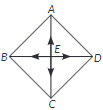
$A B C D$ is a rhombus whose diagonals intersects at $E$. Then $\overrightarrow{E A}+\overrightarrow{E B}+\overrightarrow{E C}+\overrightarrow{E D}$ equals to
- A
$\overrightarrow{0}$
- B
$\overrightarrow{ AD }$
- C
$2 \overrightarrow{B D}$
- D
$2 \overrightarrow{A D}$
View full question & answer→MCQ 1791 Mark
The magnitude of the vector $6 \hat{i}-2 \hat{j}+3 \hat{k}$ is
AnswerGiven vector is $6 \hat{ i }-2 \hat{ j }+3 \hat{k}$
$\therefore \text { Its magnitude }=\sqrt{6^2+(-2)^2+3^2}$
$=\sqrt{36+4+9}$
$=\sqrt{49}$
$=7 \text { units }$
View full question & answer→MCQ 1801 Mark
If $\theta$ is the angle between two vectors $\vec{a}$ and $\vec{b}$, then $\vec{a} \cdot \vec{b} \geq 0$ only when
AnswerGiven, $\vec{a} \cdot \vec{b} \geq 0 \Rightarrow|\vec{a}||\vec{b}| \cos \theta \geq 0$
Assuming $|\vec{a}| \neq 0$ and $|\vec{b}| \neq 0$
$
\Rightarrow \cos \theta \geq 0 \quad[\because|\vec{a}| \geq 0,|\vec{b}| \geq 0] \Rightarrow \theta \in\left[0, \frac{\pi}{2}\right]
$
View full question & answer→MCQ 1811 Mark
The value of $(\hat{i} \times \hat{j}) \cdot \hat{j}+(\hat{j} \times \hat{i}) \cdot \hat{k}$ is:
AnswerSince, $\hat{ i } \times \hat{ j }=\hat{ k }$ and $\hat{ j } \times \hat{ i }=-\hat{ k }$
$
\therefore \quad(\hat{i} \times \hat{j}) \cdot \hat{j}+(\hat{j} \times \hat{i}) \cdot \hat{k}=\hat{k} \cdot \hat{j}+(-\hat{k}) \cdot \hat{k}=0-\hat{k} \cdot \hat{k}=-1$
View full question & answer→MCQ 1821 Mark
The value of $p$ for which the vectors $2 \hat{i}+p \hat{j}+\hat{k}$ and $-4 \hat{i}-6 \hat{j}+26 \hat{k}$ are perpendicular to each other, is :
- ✓
$3$
- B
$-3$
- C
$-\frac{17}{3}$
- D
$\frac{17}{3} \quad$
AnswerGiven vector are $2 \hat{i}+p \hat{j}+\hat{k}$ and $-4 \hat{i}-6 \hat{j}+26 \hat{k}$.
Since, the given vectors are perpendicular to each other.
$\therefore \quad(2 \hat{i}+p \hat{j}+\hat{k}) \cdot(-4 \hat{i}-6 \hat{j}+26 \hat{k})=0$
$\Rightarrow 2 \times(-4)+p \times(-6)+1 \times(26)=0$
$\Rightarrow -8-6 p+26=0$
$\Rightarrow -6 p+18=0$
$\Rightarrow -6 p=-18$
$\Rightarrow p=3 .$
View full question & answer→MCQ 1831 Mark
The projection of vector $\hat{i}$ on the vector $\hat{i}+\hat{j}+2 \hat{k}$ is:
- A
$\frac{1}{\sqrt{6}}$
- B
$\sqrt{6}$
- C
$\frac{2}{\sqrt{6}}$
- D
$\frac{3}{\sqrt{6}}$
AnswerLet, $\vec{a}=\hat{i}$ and $\vec{b}=\hat{i}+\hat{j}+2 \hat{k}$
We know that, projection of vector $\vec{a}$ on $\vec{b}=\frac{\vec{a} \cdot \vec{b}}{|\vec{b}|}$
$
=\frac{\hat{i} \cdot(\hat{i}+\hat{j}+2 \hat{k})}{\sqrt{1^2+1^2+2^2}}=\frac{1}{\sqrt{6}}$
View full question & answer→MCQ 1841 Mark
If $\vec{a}, \vec{b}$ and $(\vec{a}+\vec{b})$ are all unit vectors and $\theta$ is the angle between $\vec{a}$ and $\vec{b}$, then the value of $\theta$ is :
- ✓
$\frac{2 \pi}{3}$
- B
$\frac{5 \pi}{6}$
- C
$\frac{\pi}{3}$
- D
$\frac{\pi}{6}$
AnswerCorrect option: A. $\frac{2 \pi}{3}$
Given, $|\vec{a}|=|\vec{b}|=|\vec{a}+\vec{b}|=1$
Now, $|\vec{a}+\vec{b}|^2=|\vec{a}|^2+|\vec{b}|^2+2|\vec{a}||\vec{b}| \cos \theta$
$\Rightarrow 1^2=1^2+1^2+2 \cdot 1 \cdot 1 \cos \theta$
$\Rightarrow \cos \theta=\frac{-1}{2}$
$\Rightarrow \theta=\cos ^{-1}\left(\frac{-1}{2}\right)$
$\Rightarrow \theta=\frac{2 \pi}{3}$
View full question & answer→MCQ 1851 Mark
A unit vector along the vector $4 \hat{i}-3 \hat{k}$ is
- A
$\frac{1}{7}(4 \hat{i}-3 \hat{k})$
- ✓
$\frac{1}{5}(4 \hat{i}-3 \hat{k})$
- C
$\frac{1}{\sqrt{7}}(4 \hat{i}-3 \hat{k})$
- D
$\frac{1}{\sqrt{5}}(4 \hat{i}-3 \hat{k})$
AnswerCorrect option: B. $\frac{1}{5}(4 \hat{i}-3 \hat{k})$
Let $\vec{v}=4 \hat{i}-3 \hat{k}$
$\therefore|\vec{v}|=\sqrt{4^2+(3)^2}$
$=\sqrt{16+9}=\sqrt{25}=5$
Now, $\hat{v}=$ unit vector along $\vec{v}$
$=\frac{\vec{v}}{|\vec{v}|}=\frac{1}{5}(4 \hat{i}-3 \hat{k})$
View full question & answer→MCQ 1861 Mark
If $\vec{a}+\vec{b}=\hat{i}$ and $\vec{a}=2 \hat{i}-2 \hat{j}+2 \hat{k}$, then $|\vec{b}|$ equals:
- A
$\sqrt{14}$
- ✓
$3$
- C
$\sqrt{12}$
- D
$\sqrt{17}$
Answer$\text {Given, } \hat{a}+\hat{b}=\hat{i} $ and $ \vec{a}=2 \hat{i}-2 \hat{j}+2 \hat{k}$
$\Rightarrow 2 \hat{i}-2 \hat{j}+2 \hat{k}+\vec{b}=\hat{i} $
$\Rightarrow \vec{b}=\hat{i}-(2 \hat{i}-2 \hat{j}+2 \hat{k})$
$\Rightarrow -\hat{i}+2 \hat{j}-2 \hat{k}$
$\therefore|\vec{b}|=\sqrt{(-1)^2+(2)^2+(-2)^2}$
$=\sqrt{1+4+4}$
$=\sqrt{9}$
$=3$
View full question & answer→MCQ 1871 Mark
If $\text{A B C D}$ is a parallelogram and $A C$ and $B D$ are its diagonals, then $\overrightarrow{A C}+\overrightarrow{B D}$ is:
- A
$2 \overrightarrow{D A}$
- B
$2 \overrightarrow{A B}$
- ✓
$2 \overrightarrow{B C}$
- D
$2 \overrightarrow{B D}$
AnswerCorrect option: C. $2 \overrightarrow{B C}$
Given, $A B C D$ is a parallelogram, then $A B \| C D$ and $B C \| D A$
$\overrightarrow{A C}=\overrightarrow{A B}+\overrightarrow{B C} [$Triangle law of addition$]$
$\overrightarrow{B D}=\overrightarrow{B C}+\overrightarrow{C D} [$Triangle law of addition$]$
$\therefore \overrightarrow{A C}+\overrightarrow{B D}=\overrightarrow{A B}+\overrightarrow{B C}+\overrightarrow{B C}+\overrightarrow{C D}$
$=\overrightarrow{A B}+2 \overrightarrow{B C}-\overrightarrow{A B} \quad[\because \overrightarrow{A B}=-\overrightarrow{C D}]$
$=2 \overrightarrow{B C}
$
View full question & answer→MCQ 1881 Mark
Two vectors $\vec{a}=a_1 \hat{i}+a_2 \hat{j}+a_3 \hat{k}$ and $\vec{b}=b_1 \hat{i}+b_2 \hat{j}+b_3 \hat{k}$ are collinear if
- A
$a_1 b_1+a_2 b_2+a_3 b_3=0$
- B
$\frac{a_1}{b_1}=\frac{a_2}{b_2}=\frac{a_3}{b_3}$
- ✓
$a_1=b_1, a_2=b_2, a_3=b_3$
- D
$a_1+a_2+a_3=b_1+b_2+b_3$
AnswerCorrect option: C. $a_1=b_1, a_2=b_2, a_3=b_3$
$a_1=b_1, a_2=b_2, a_3=b_3$
View full question & answer→MCQ 1891 Mark
If two vectors $\vec{a}$ and $\vec{b}$ are such that $|\vec{a}|=2,|\vec{b}|=3$ and $\vec{a} \cdot \vec{b}=4$, then $|\vec{a}-2 \vec{b}|$ is equal to
- A
$\sqrt{2}$
- ✓
$2 \sqrt{6}$
- C
- D
$2 \sqrt{2}$
AnswerCorrect option: B. $2 \sqrt{6}$
$\|\vec{a}-2 \vec{b}|^2=(\vec{a}-2 \vec{b}) \cdot(\vec{a}-2 \vec{b})$
$=\vec{a} \cdot \vec{a}-4 \vec{a} \cdot \vec{b}+4 \vec{b} \cdot \vec{b}$
$=|\vec{a}|^2-4 \vec{a} \cdot \vec{b}+4|\vec{b}|^2$
$=4-16+36$
$=24$
$\therefore|\vec{a}-2 \vec{b}|$
$=2 \sqrt{6}$
View full question & answer→MCQ 1901 Mark
The scalar projection of the vector $3 \hat{ i }-\hat{ j }-2 \hat{ k }$ on the vector $\hat{i}+2 \hat{j}-3 \hat{k}$ is
- A
$\frac{7}{\sqrt{14}}$
- B
$\frac{7}{14}$
- C
$\frac{6}{13}$
- D
$\frac{7}{2}$
AnswerScalar projection of $\vec{a}$ on $\vec{b}=\frac{\vec{a} \cdot \vec{b}}{|\vec{b}|}$ Scalar projection of $3 \hat{i}-\hat{j}-2 \hat{k}$ on vector $\hat{i}+2 \hat{j}-3 \hat{k}$
$
=\frac{(3 \hat{i}-\hat{j}-2 \hat{k}) \cdot(\hat{i}+2 \hat{j}-3 \hat{k})}{1 \hat{i}+2 \hat{j}-3 \hat{k} \mid}=\frac{7}{\sqrt{14}}$
View full question & answer→MCQ 1911 Mark
If $\hat{i}, \hat{j}, \hat{k}$ are unit vectors along three mutually perpendicular directions, then
- A
$\hat{i} \cdot \hat{j}=1$
- B
$\hat{i} \times \hat{j}=1$
- C
$\hat{ i } \cdot \hat{ k }=0$
- D
$\hat{ i } \times \hat{ k }=0$
AnswerSince, $\hat{i}, \hat{j}, \hat{k}$ are mutually perpendicular to each other.
$
\therefore \hat{ i } \cdot \hat{ k }=0
$
View full question & answer→MCQ 1921 Mark
if the projection of $\dot{a}=\hat{i}-2 \hat{j}+3 \hat{k}$ on $\vec{b}=2 \hat{i}+\lambda \hat{k}$ is zero, then the value of $\lambda$ is
- A
$0$
- B
- ✓
$\frac{-2}{3}$
- D
$\frac{-3}{2}$
AnswerCorrect option: C. $\frac{-2}{3}$
Here, $\vec{a}=\hat{i}-2 \hat{j}+3 \hat{k}, \vec{b}=2 \hat{i}+\lambda \hat{k}$
Since, projection of $\vec{a}$ on $\vec{b}=0$
$\Rightarrow \frac{\vec{a} \cdot \vec{b}}{|\vec{b}|}=0$
$\Rightarrow \frac{(\hat{i}-2 \hat{j}+3 \hat{k}) \cdot(2 \hat{i}+\lambda \hat{k})}{\sqrt{2^2+\lambda^2}}=0$
$\Rightarrow \frac{2+3 \lambda}{\sqrt{4+\lambda^2}}=0$
$\Rightarrow 2+3 \lambda=0$
$\Rightarrow \lambda$
$=-\frac{2}{3}$
View full question & answer→MCQ 1931 Mark
$A B C D$ is a rhombus, whose diagonals intersect at $E$. Then $\overrightarrow{E A}+\overrightarrow{E B}+\overrightarrow{E C}+\overrightarrow{E D}$ equals
- A
$\overrightarrow{0}$
- B
$\overrightarrow{A D}$
- C
$2 \overrightarrow{B C}$
- D
$2 \overrightarrow{A D}$
Answer$\overrightarrow{E A}+\overrightarrow{E B}+\overrightarrow{E C}+\overrightarrow{E D}=\overrightarrow{E A}+\overrightarrow{E B}-\overrightarrow{E A}-\overrightarrow{E B}$
[As diagonals of a rhombus bisect each other] $=\overrightarrow{0}$
View full question & answer→MCQ 1941 Mark
The value of $p$ for which $p(\hat{i}+\hat{j}+\hat{k})$ is a unit vector is
- A
$0$
- B
$\frac{1}{\sqrt{3}}$
- C
- D
$\sqrt{3}$
AnswerLet $\vec{a}=(\hat{i}+\hat{j}+\hat{k})$
So, unit vector of $\vec{a}=\frac{\hat{i}+\hat{j}+\hat{k}}{\sqrt{1+1+1}}=\frac{1}{\sqrt{3}}(\hat{i}+\hat{j}+\hat{k})$
$\therefore \quad$ The value of $p$ is $\frac{1}{\sqrt{3}}$.
View full question & answer→MCQ 1951 Mark
If $|\vec{a}|=3,|\vec{b}|=4$, then the value of $\lambda$ for which $\vec{a}+\lambda \vec{b}$ is perpendicular to $\vec{a}-\lambda \vec{b}$, is
- A
$\frac{9}{16}$
- ✓
$\frac{3}{4}$
- C
$\frac{3}{2}$
- D
$\frac{4}{3}$
AnswerCorrect option: B. $\frac{3}{4}$
Given that, $|\vec{a}|=3,|\vec{b}|=4$ and $\vec{a}+\lambda \vec{b}$ is perpendicular to $\vec{a}-\lambda \vec{b}$.
$\therefore(\vec{a}+\lambda \vec{b}) \cdot(\vec{a}-\lambda \vec{b})=0$
$\Rightarrow \vec{a} \cdot \vec{a}-\vec{a} \cdot \vec{b} \lambda+\lambda \vec{b} \cdot \vec{a}-\lambda^2 \vec{b} \cdot \vec{b}=0$
$\Rightarrow|\vec{a}|^2-\lambda^2|\vec{b}|^2=0$
$\Rightarrow \lambda^2=\frac{|\vec{a}|^2}{|\vec{b}|^2}$
$\Rightarrow \lambda=\frac{|\vec{a}|}{|\vec{b}|}=\frac{3}{4}$
View full question & answer→MCQ 1961 Mark
The vectors from origin to the points $A$ and $B$ are $\vec{a}=2 \hat{i}-3 \hat{j}+2 \hat{k}$ and $\vec{b}=2 \hat{i}+3 \hat{j}+\hat{k}$, respectively, then the area of triangle $O A B$ (in sq. units) is
- A
$\sqrt{340}$
- B
$\sqrt{325}$
- C
$\sqrt{229}$
- ✓
$\frac{1}{2} \sqrt{229}$
AnswerCorrect option: D. $\frac{1}{2} \sqrt{229}$
(d) : $\vec{a}=2 \hat{i}-3 \hat{j}+2 \hat{k}$ and $\vec{b}=2 \hat{i}+3 \hat{j}+\hat{k}$
$
\vec{a} \times \vec{b}=\left|\begin{array}{ccc}
\hat{i} & \hat{j} & \hat{k} \\
2 & -3 & 2 \\
2 & 3 & 1
\end{array}\right|=-9 \hat{i}+2 \hat{j}+12 \hat{k}
$
Area of $\triangle O A B=\frac{1}{2}|\vec{a} \times \vec{b}|$
$
=\frac{1}{2} \sqrt{81+4+144}=\frac{1}{2} \sqrt{229} \text { sq. units }
$
View full question & answer→MCQ 1971 Mark
The vector having initial and terminal points as $(2,5,0)$ and $(-3,7,4)$ respectively is
- A
$-\hat{i}+12 \hat{j}+4 \hat{k}$
- B
$5 \hat{i}+2 \hat{j}-4 \hat{k}$
- ✓
$-5 \hat{i}+2 \hat{j}+4 \hat{k}$
- D
$\hat{i}+\hat{j}+\hat{k}$
AnswerCorrect option: C. $-5 \hat{i}+2 \hat{j}+4 \hat{k}$
(c) : Let $A(2,5,0)$ and $B(-3,7,4)$
$
\begin{aligned}
\therefore \quad \text { Required vector } & =(-3-2) \hat{i}+(7-5) \hat{j}+(4-0) \hat{k} \\
& =-5 \hat{i}+2 \hat{j}+4 \hat{k}
\end{aligned}
$
View full question & answer→MCQ 1981 Mark
Find the projection of the vector $\hat{i}+3 \hat{j}+7 \hat{k}$ on the vector $2 \hat{i}-3 \hat{j}+6 \hat{k}$.
Answer(a) : Let $\vec{a}=\hat{i}+3 \hat{j}+7 \hat{k}$ and $\vec{b}=2 \hat{i}-3 \hat{j}+6 \hat{k}$.
Now, projection of $\vec{a}$ on $\vec{b}=\frac{\vec{a} \cdot \vec{b}}{|\vec{b}|}$
$
=\frac{(\hat{i}+3 \hat{j}+7 \hat{k}) \cdot(2 \hat{i}-3 \hat{j}+6 \hat{k})}{\sqrt{2^2+(-3)^2+6^2}}=\frac{2-9+42}{\sqrt{4+9+36}}=\frac{35}{7}=5
$
View full question & answer→MCQ 1991 Mark
Find the value of $\lambda$ so that the vectors $2 \hat{i}-4 \hat{j}+\hat{k}$ and $4 \hat{i}-8 \hat{j}+\lambda \hat{k}$ are perpendicular.
Answer(b): The given vectors are perpendicular if their dot product vanishes, i.e.,
$
\begin{aligned}
& (2 \hat{i}-4 \hat{j}+\hat{k}) \cdot(4 \hat{i}-8 \hat{j}+\lambda \hat{k})=0 \\
\Rightarrow & 8+32+\lambda=0 \Rightarrow \lambda=-40
\end{aligned}
$
View full question & answer→MCQ 2001 Mark
Find the value of $\lambda$ for which the vectors $3 \hat{i}-6 \hat{j}+\hat{k}$ and $2 \hat{i}-4 \hat{j}+\lambda \hat{k}$ are parallel.
- ✓
$\frac{2}{3}$
- B
$\frac{-3}{2}$
- C
$\frac{-2}{3}$
- D
$\frac{3}{2}$
AnswerCorrect option: A. $\frac{2}{3}$
(a) : $\vec{a}=3 \hat{i}-6 \hat{j}+\hat{k}$ and $\vec{b}=2 \hat{i}-4 \hat{j}+\lambda \hat{k}$
Since, $\vec{a}$ and $\vec{b}$ are parallel $\quad \therefore \quad \vec{a} \times \vec{b}=\overrightarrow{0}$
$
\begin{aligned}
\Rightarrow & \left|\begin{array}{ccc}
\hat{i} & \hat{j} & \hat{k} \\
3 & -6 & 1 \\
2 & -4 & \lambda
\end{array}\right|=\overrightarrow{0} \\
\Rightarrow & (-6 \lambda+4) \hat{i}-(3 \lambda-2) \hat{j}+(-12+12) \hat{k}=\overrightarrow{0} \\
\Rightarrow & (-6 \lambda+4) \hat{i}+(2-3 \lambda) \hat{j}=0 \hat{i}+0 \hat{j}
\end{aligned}
$
Comparing coefficients of $\hat{i}$ and $\hat{j}$, we get $-6 \lambda+4=0$ and $2-3 \lambda=0 \Rightarrow \lambda=2 / 3$
View full question & answer→