Questions

5 Marks Questions

Take a timed test

49 questions · self-marked practice — reveal the answer and mark yourself.

Question 15 Marks
An air-filled parallel-plate capacitor is to be constructed which can store $12\mu\text{C}$ of charge when operated at 1200V. What can be the minimum plate area of the capacitor? The dielectric strength of air is $3 \times 10^6Vm^{-1}.$
Answer
$\text{Q}=12\mu\text{c}$
$\text{V}=1200\text{V}$
$\frac{\text{v}}{\text{d}}=3\times10^{-6}\frac{\text{v}}{\text{m}}$
$\text{d}=\frac{\text{V}}{\big(\frac{\text{v}}{\text{d}}\big)}=\frac{1200}{3\times10^{-6}}=4\times10^{-4}\text{m}$
$\text{c}=\frac{\text{Q}}{\text{v}}=\frac{12\times10^{-6}}{1200}=10^{-6}\text{f}$
$\therefore\text{C}=\frac{\in_0\text{A}}{\text{d}}=10^{-8}\text{f}$
$\text{A}=\frac{10^{-8}\times\text{d}}{\in_0}=\frac{10^{-8}\times4\times10^{-4}}{8.854\times10^{-4}}=0.45\text{m}^2$
View full question & answer
Question 25 Marks
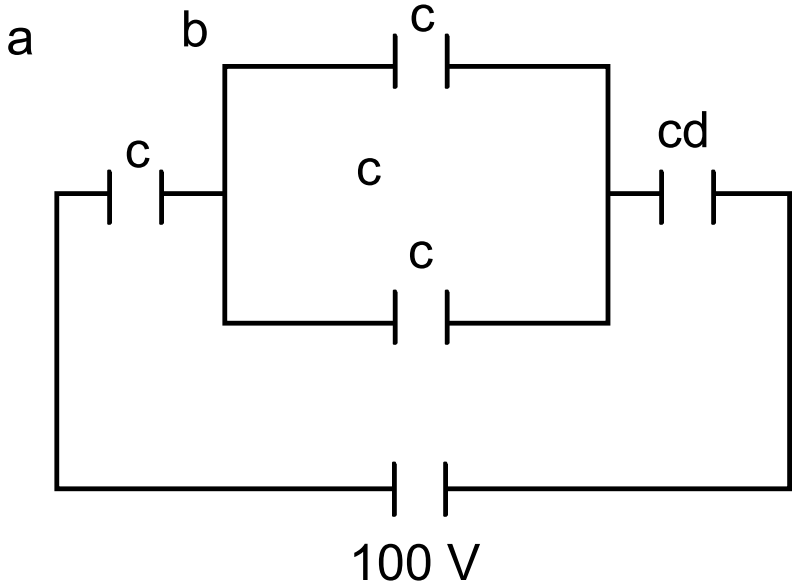
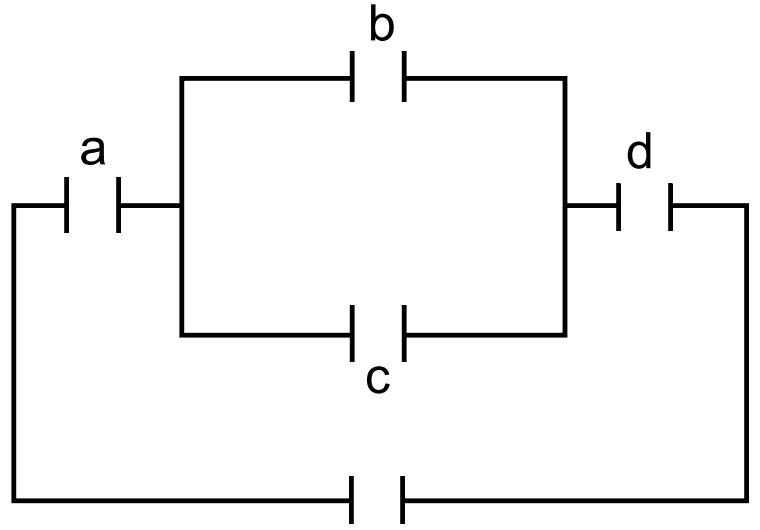
Each capacitor in figure has a capacitance of $10\mu\text{F}.$ The emf of the battery is 100V. Find the energy stored in each of the four capacitors.
Answer

$\text{C}=10\mu\text{F}=10\times10^{-6}\text{F}$
For a & d
$\text{q}=4\times10^{-4}\text{C}$
$\text{c}=10^{-5}\text{F}$
$\text{E}=\frac{1}{2}\frac{\text{q}^2}{\text{c}}$
$=\frac{1}{2}\frac{\big(4\times10^{-4}\big)^2}{10^{-5}}=8\times10^{-3}\text{J}=8\text{mJ}$
For b & c
$\text{q}=4\times10^{-4}\text{C}$
$\text{c}_{\text{eq}}=\text{2c}=2\times10^{-5}\text{F}$
$\text{V}=\frac{4\times10^{-4}}{2\times10^{-5}}=20\text{V}$
$\text{E}=\Big(\frac{1}{2}\Big)\text{cv}^2$
$=\Big(\frac{1}{2}\Big)\times10^{-5}\times(20)^2$
$=2\times10^{-3}\text{J}=2\text{mJ}$
View full question & answer
Question 35 Marks
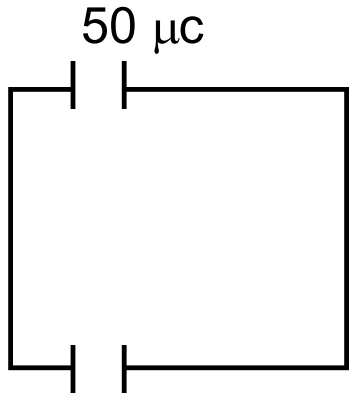
A capacitor stores $50\mu\text{C}$ charge when connected across a battery. When the gap between the plates is filled with a dielectric, a charge of $100\mu\text{C}$ flows through the battery. Find the dielectric constant of the material inserted.
Answer

Initial charge stored $=50\mu\text{c}$
Let the dielectric constant of the material induced be ‘k’.
Now, when the extra charge flown through battery is 100.
So, net charge stored in capacitor $=150\mu\text{c}$
Now, $\text{C}_1=\frac{\in_0\text{A}}{\text{d}}$ or $\frac{\text{q}_1}{\text{V}}=\frac{\in_0\text{A}}{\text{d}}\ \dots(1)$
$\text{C}_2=\frac{\in_0\text{Ak}}{\text{d}}$ or $\frac{\text{q}_2}{\text{V}}=\frac{\in_0\text{Ak}}{\text{d}}\ \dots(2)$
Dividing (1) and (2) we get $\frac{\text{q}_1}{\text{q}_2}=\frac{1}{\text{k}}$
$\Rightarrow\frac{50}{150}=\frac{1}{\text{k}}$
$\Rightarrow\text{k}=3$
View full question & answer
Question 45 Marks
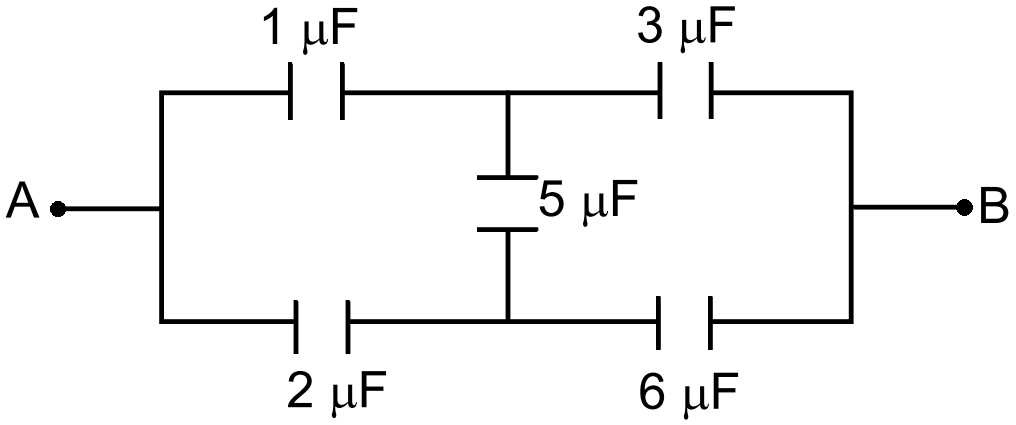
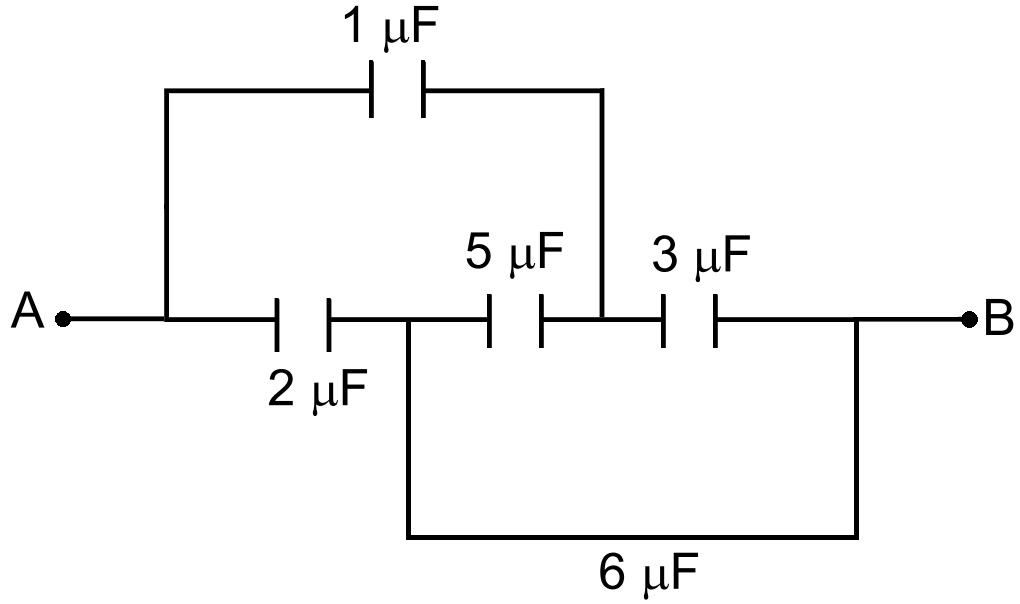
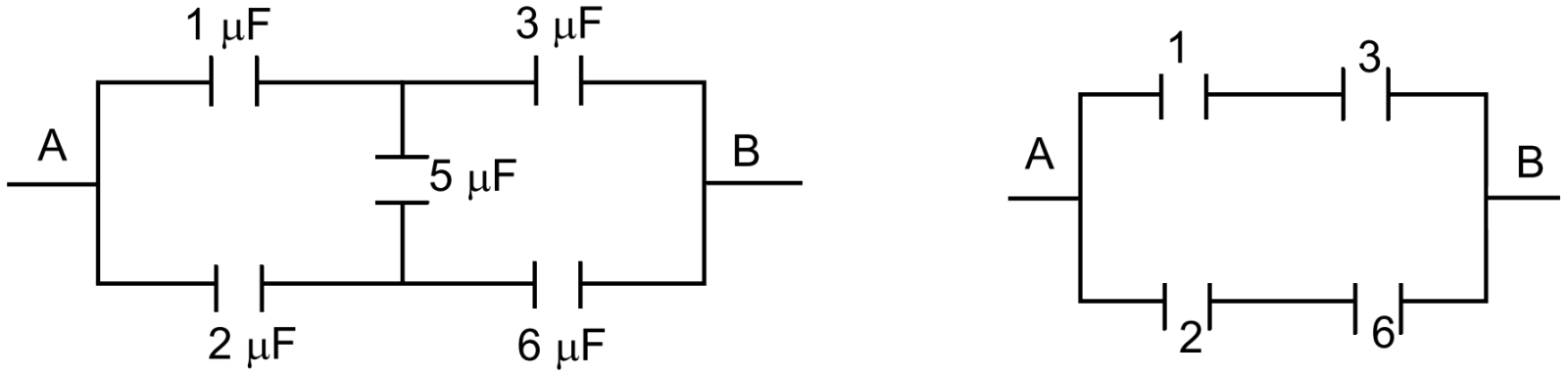
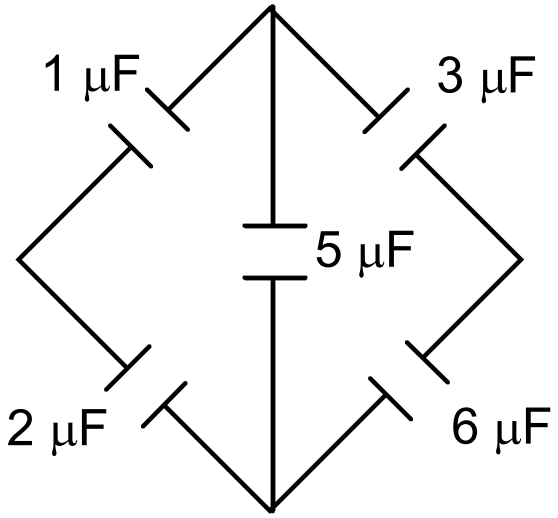
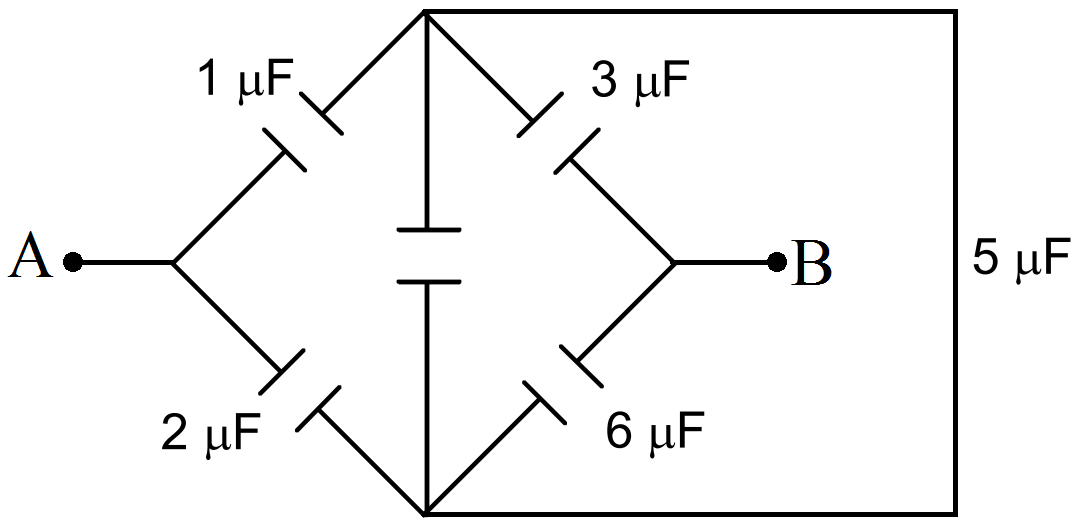
Convince yourself that parts (a), (b) and (c) of figure are identical. Find the capacitance between the points A and B of the assembly.


Answer


As the bridge in balanced there is no current through the $5\mu\text{F}$ capacitor
So, it reduces to similar in the case of (b) & (c)
As ‘b’ can also be written as:
$\text{C}_{\text{eq}}=\frac{1\times3}{1+3}+\frac{2\times6}{2+6}$
$=\frac{3}{48}+\frac{12}{8}=\frac{6+12}{8}=2.25\mu\text{F}$
View full question & answer
Question 55 Marks
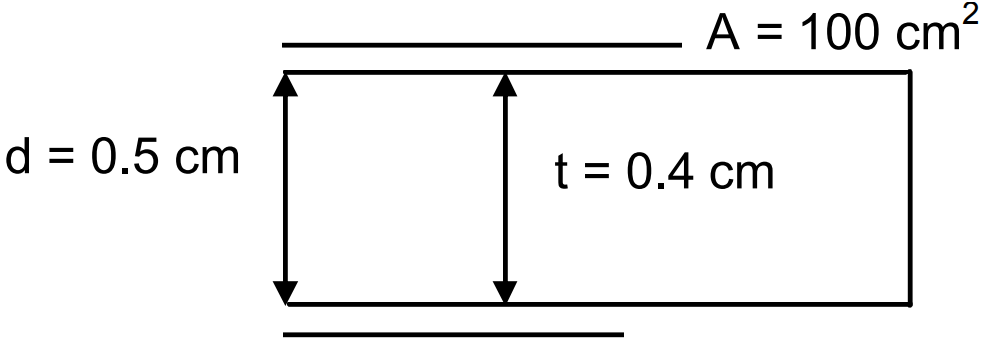
The separation between the plates of a parallel-plate capacitor is 0.500cm and its plate area is $100cm^2$. A 0.400cm thick metal plate is inserted into the gap with its faces parallel to the plates. Show that the capacitance of the assembly is independent of the position of the metal plate within the gap and find its value.
Answer

Here,
Plate area $= 100cm^2 = 10^{-2}m^2$
Separation $d = 5cm = 5 \times 10^{-3}m$
Thickness of metal $t = 4cm = 4 \times 10^{-3}m$
$\text{C}=\frac{\in_0\text{A}}{\text{d}-\text{t}+\frac{\text{t}}{\text{k}}}=\frac{\in_0\text{A}}{\text{d}-\text{t}}$
$=\frac{8.585\times10^{-12}\times10^{-2}}{(5-4)\times10^{-3}}=88\text{pf}$
Here the capacitance is independent of the position of metal. At any position the net separation is d - t.
As d is the separation and t is the thickness.
View full question & answer
Question 65 Marks
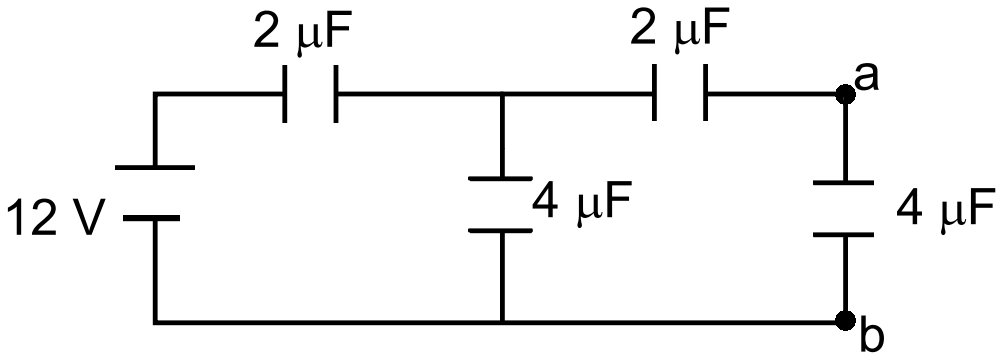
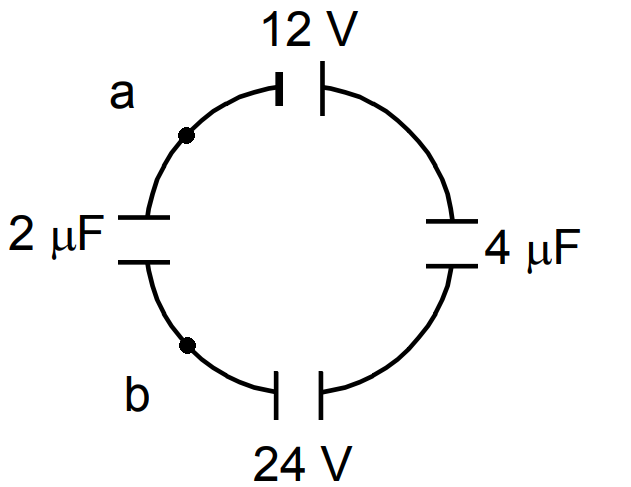
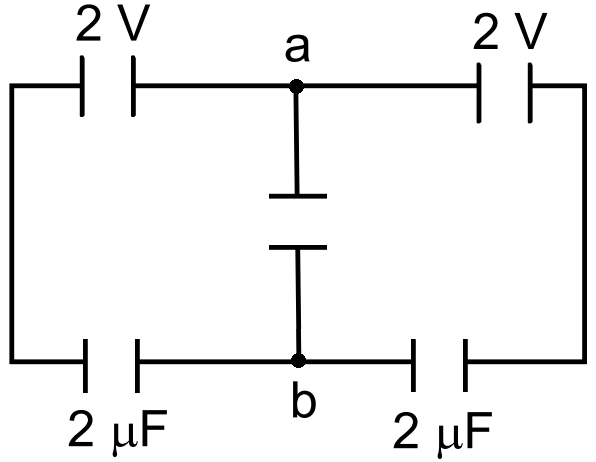
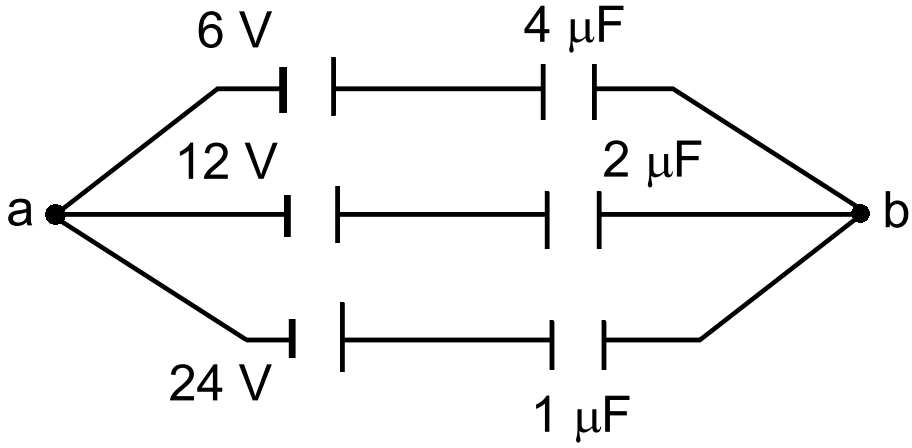
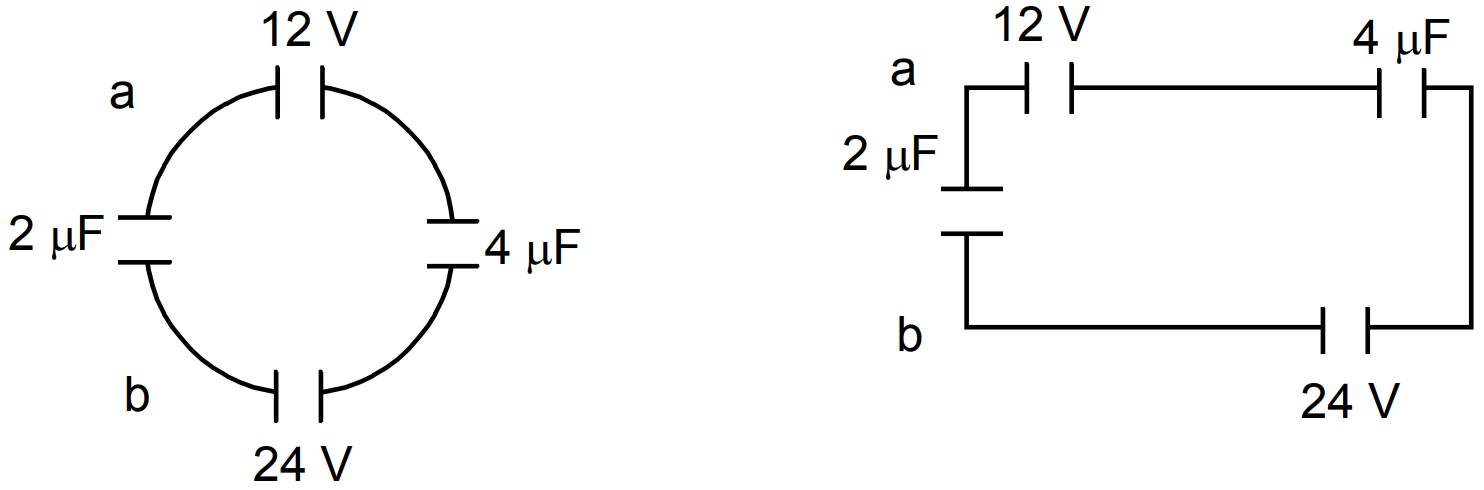
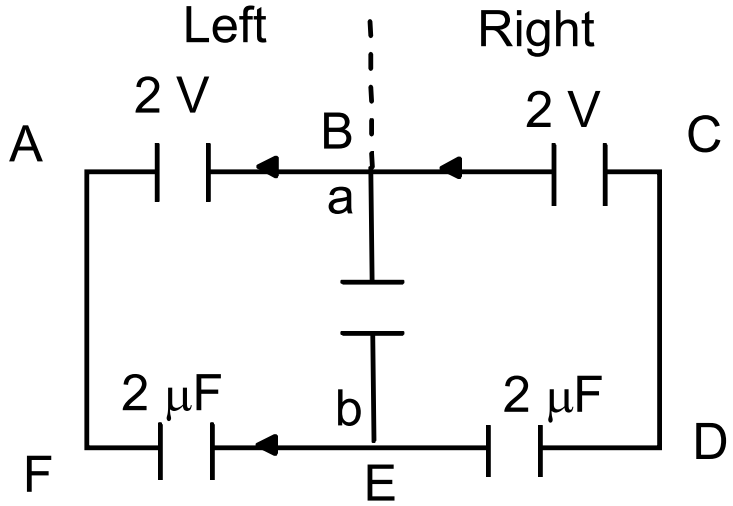
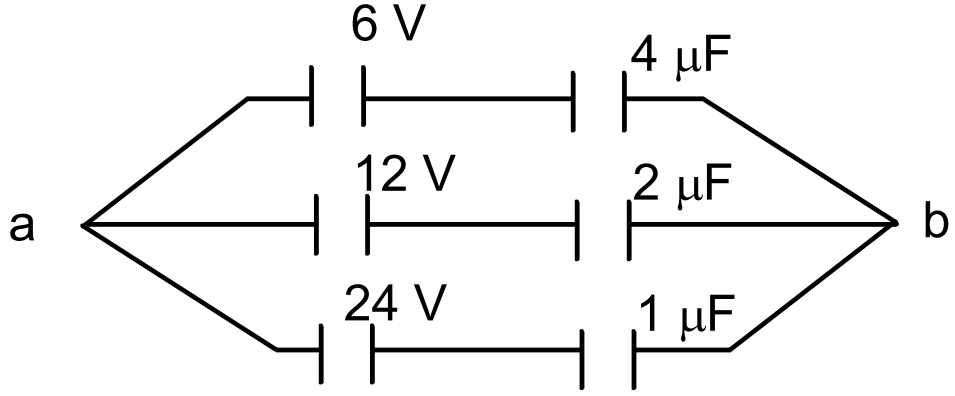
Find the potential difference $V_a - V_b$ between the points a and b shown in each part of the figure.


Answer
  1.  

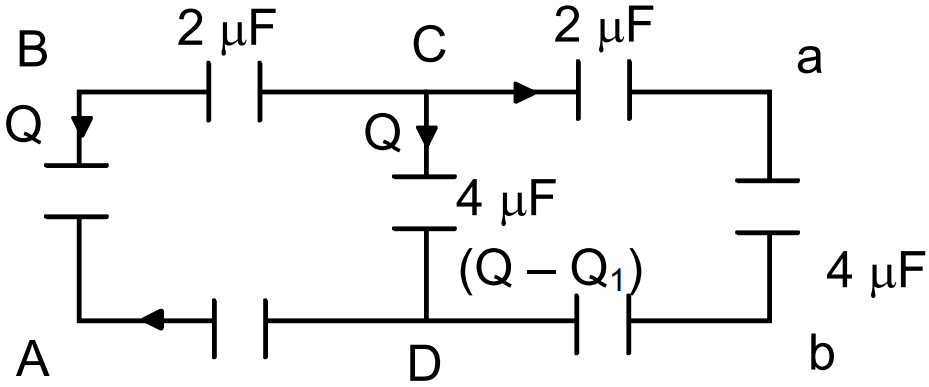
By loop method application in the closed circuit ABCabDA
$-12+\frac{2\text{Q}}{2\mu\text{F}}=\frac{\text{Q}_1}{2\mu\text{F}}+\frac{\text{Q}_1}{4\mu\text{F}}\ \dots(1)$
In the close circuit ABCDA
$-12+\frac{\text{Q}}{2\mu\text{F}}+\frac{\text{Q}+\text{Q}_1}{4\mu\text{F}}=0\ \dots(2)$
From (1) and (2) $2Q + 3Q_1 = 48 ...(3)$
And $3Q - q_1 = 48$ and subtracting $Q = 4Q_1$, and substitution in equation
$2\text{Q}+3\text{Q}_1=48$
$\Rightarrow8\text{Q}_1+3\text{Q}_1=48$
$\Rightarrow11\text{Q}_1=48,\ \text{Q}_1=\frac{48}{11}$
$\text{V}_{\text{ab}}=\frac{\text{Q}_1}{4\mu\text{F}}=\frac{48}{11\times4}=\frac{12}{11}\text{V}$
  1.  

The potential $= 24 - 12 = 12$
Potential difference $\text{V}=\frac{(2\times0+12\times4)}{2+4}=\frac{48}{6}=8\text{V}$
$\therefore$ The $V_a - V_b = -8V$
  1.  

From the figure it is cleared that the left and right branch are symmetry and reversed, so the current go towards BE from BAFEB same as the current from EDCBE.
$\therefore$ The net charge Q = 0
$\therefore\text{V}=\frac{\text{Q}}{\text{C}}=\frac{0}{\text{C}}=0$
$\therefore\text{V}_{\text{ab}}=0$
$\therefore$ The potential at K is zero.
  1.  

The net potential $=\frac{\text{Net charge}}{\text{Net capacitance}}=\frac{24+24+24}{7}$
$=\frac{72}{7}=10.3\text{V}$
$\therefore\text{V}_{\text{a}}-\text{V}_{\text{b}}=-10.3\text{V}$
View full question & answer
Question 75 Marks
It is required to construct a $10\mu\text{F}$ capacitor which can be connected across a 200V battery. Capacitors of capacitance $10\mu\text{F}$ are available but they can withstand only 50V. Design a combination which can yield the desired result.
Answer
Let there are ‘x’ no of capacitors in series ie in a row
So, x × 50 = 200
⇒ x = 4 capacitors.
Effective capacitance in a row $=\frac{10}{4}$
Now, let there are ‘y’ such rows
So, $\frac{10}{4}\times\text{y}=10$
⇒ y = 4 capacitor.
So, the combinations of four rows each of 4 capacitors.
View full question & answer
Question 85 Marks
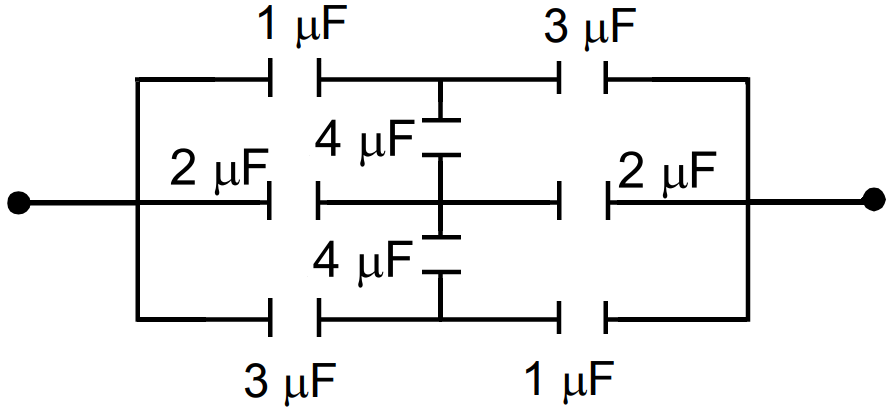
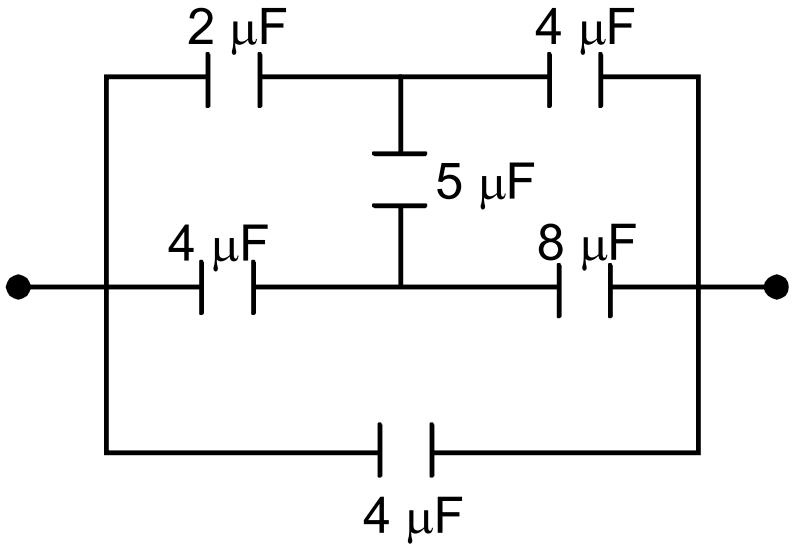
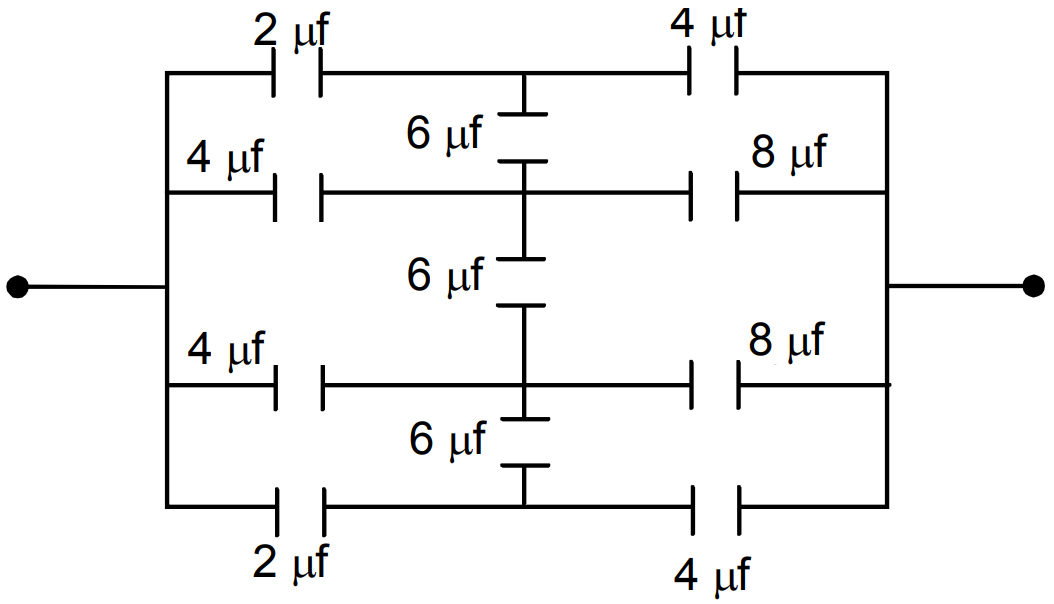
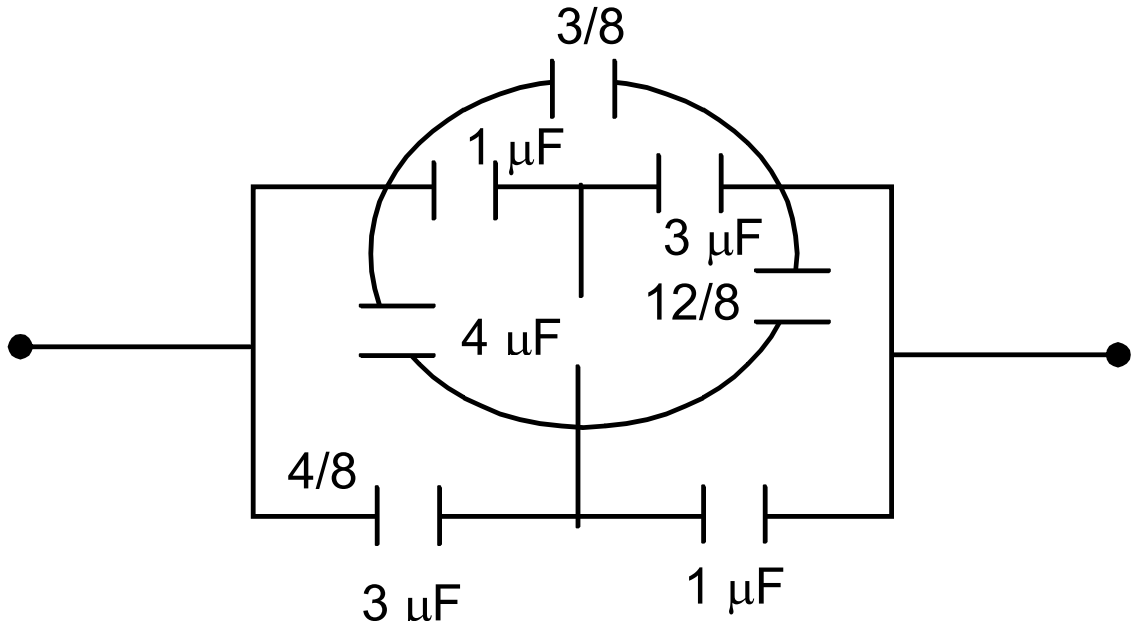
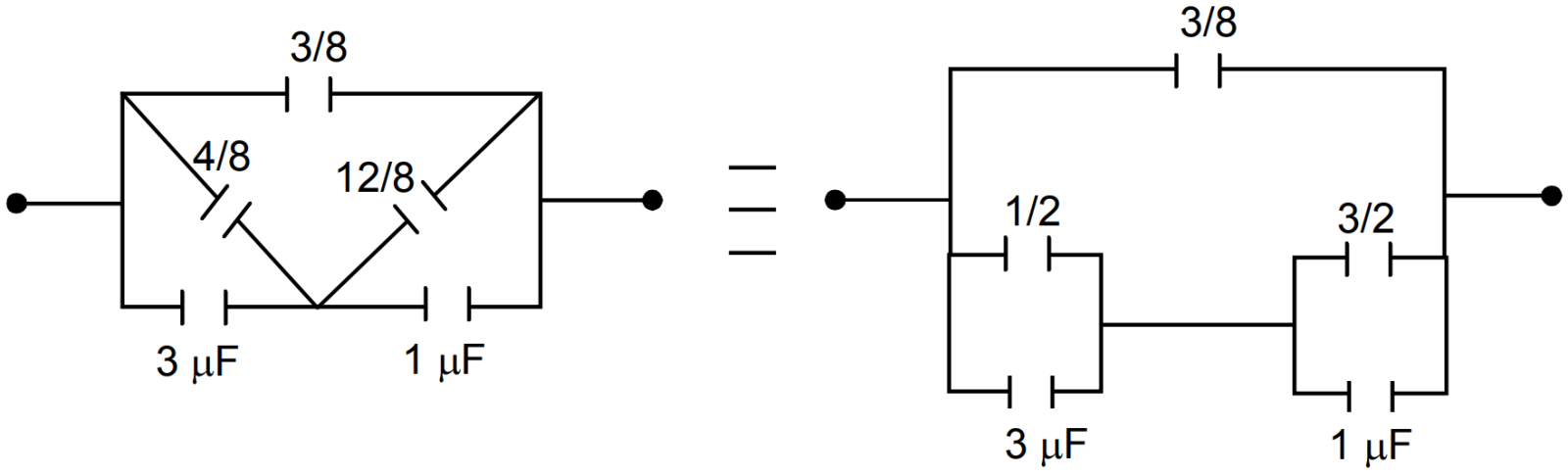
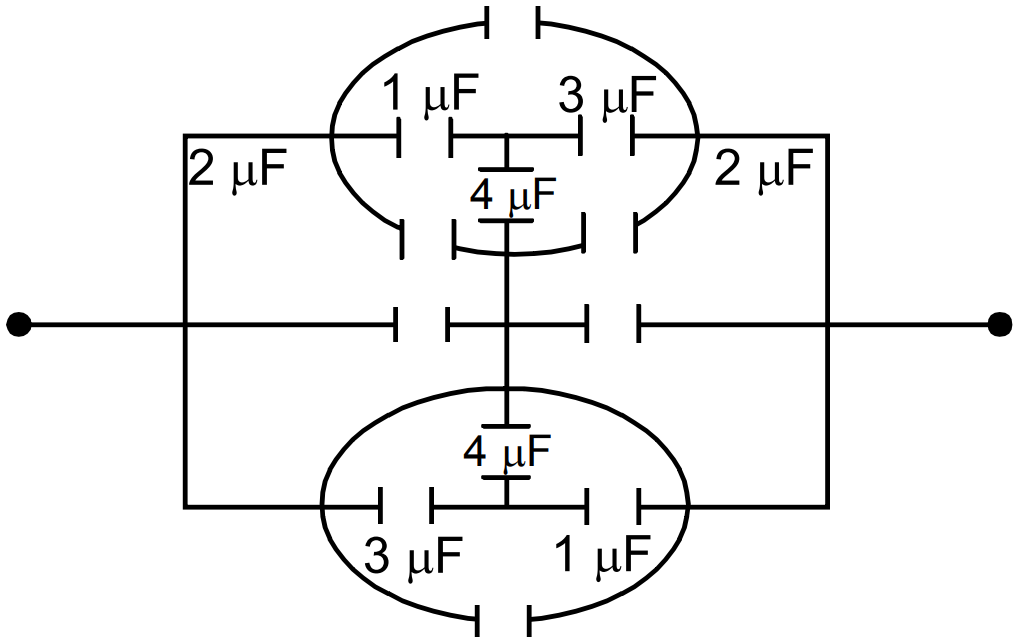
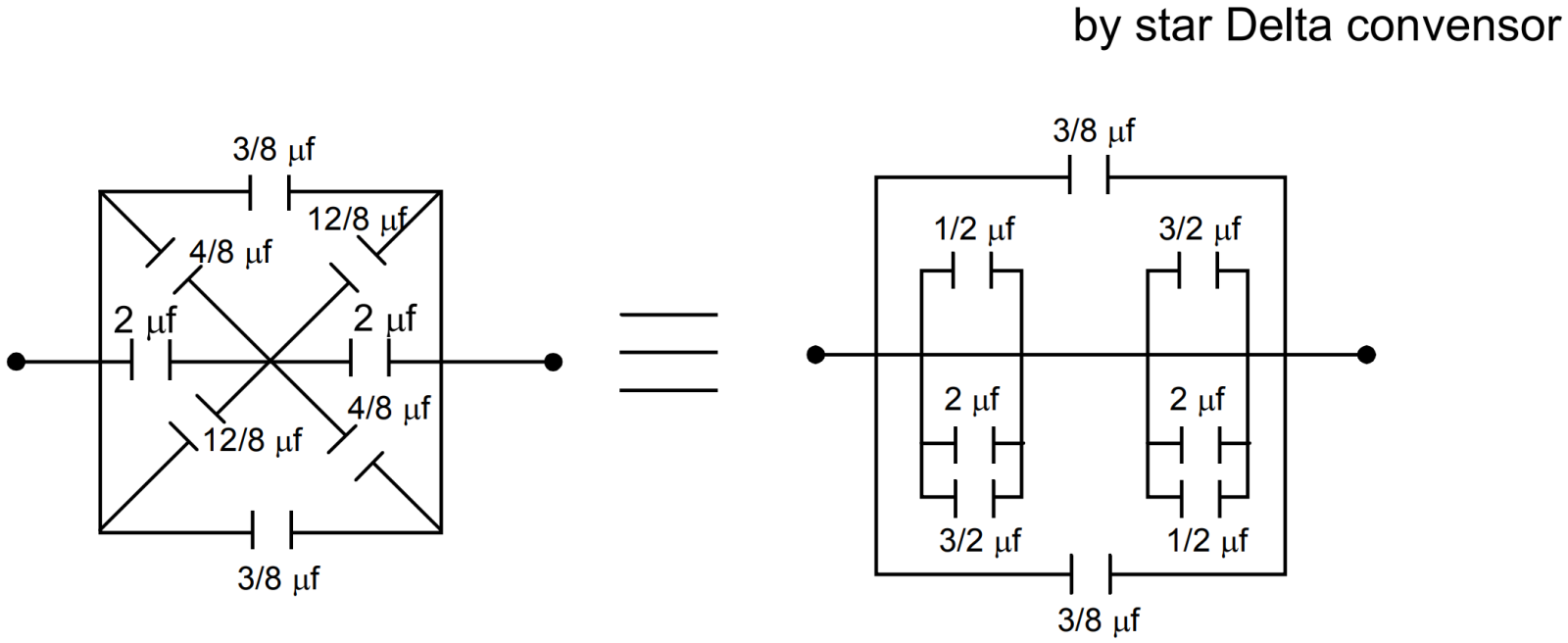
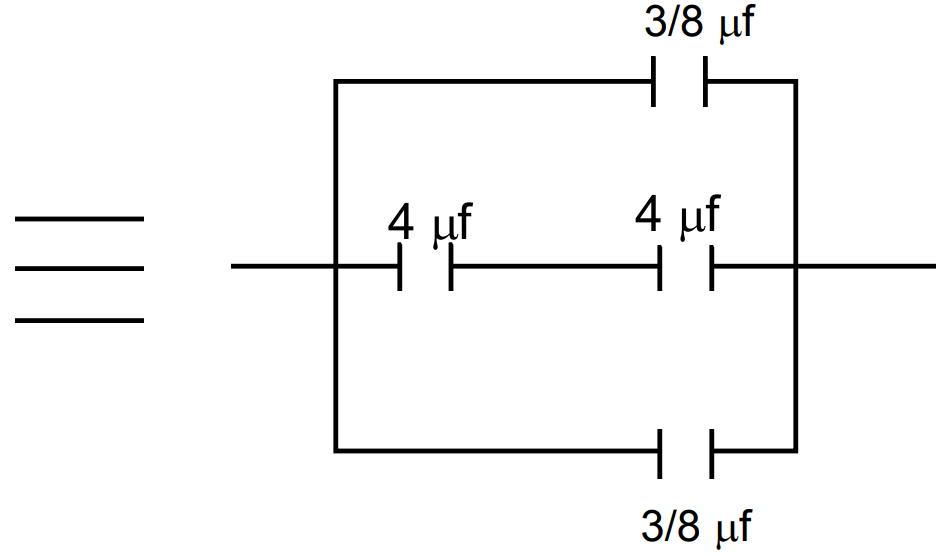
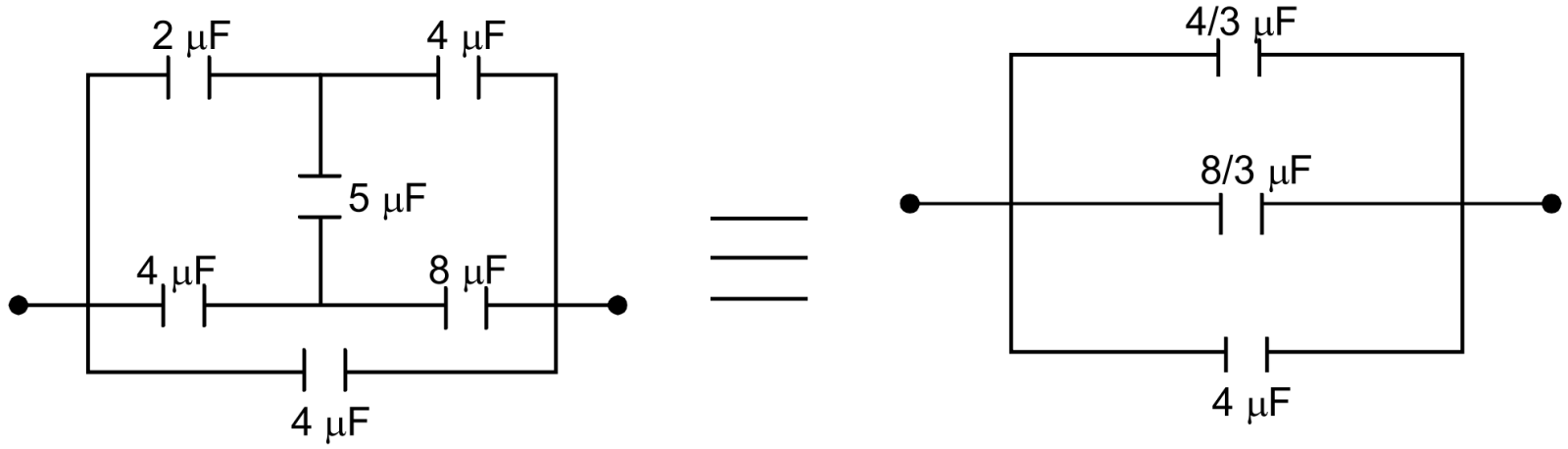
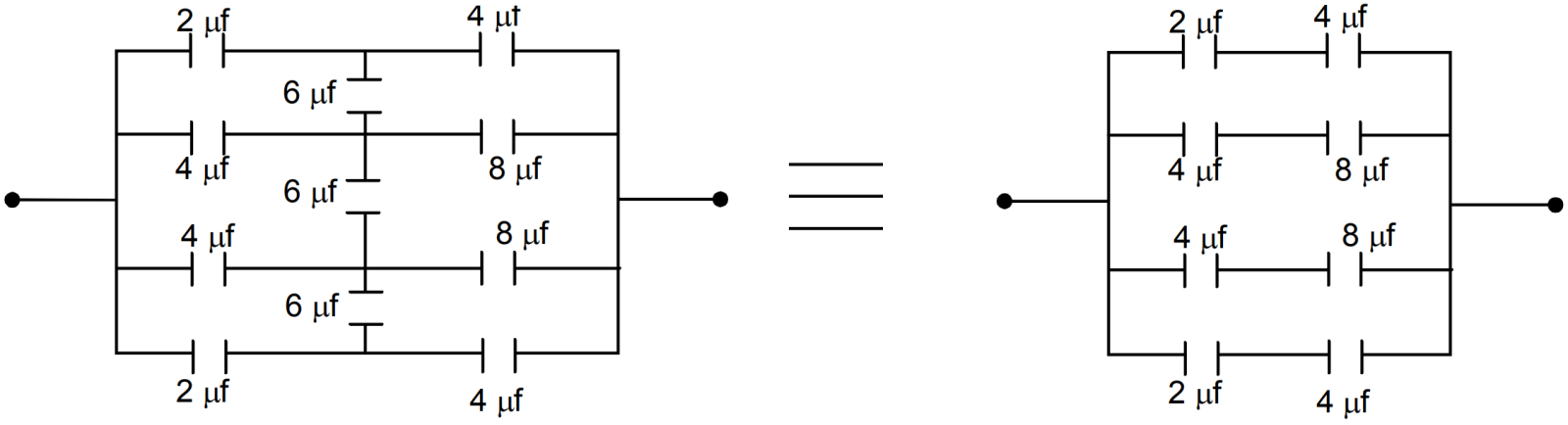
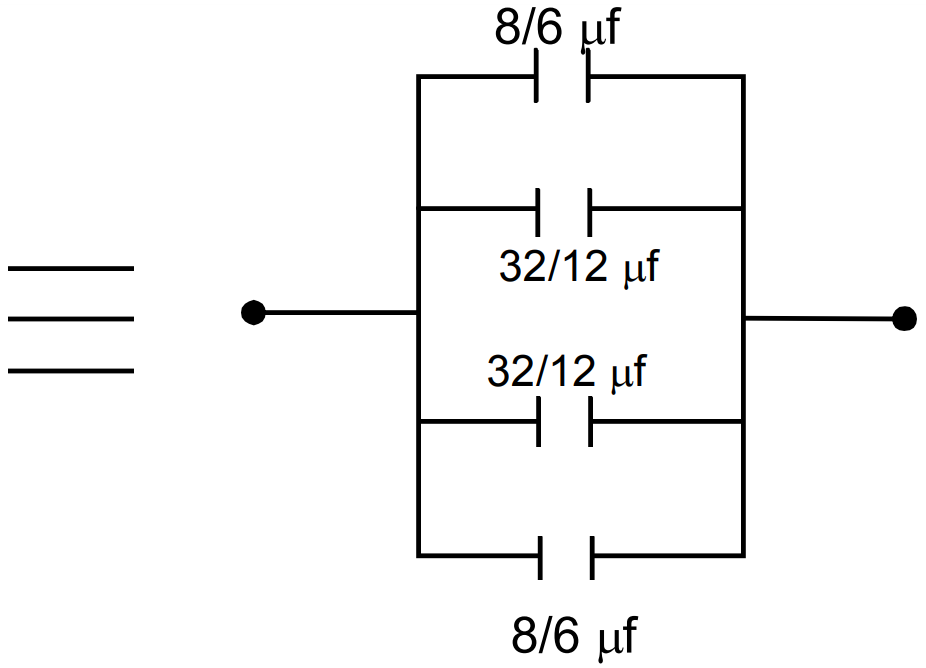
Find the equivalent capacitances of the combinations shown in figure between the indicated points.


Answer


By star Delta conversion
$\text{C}_{\text{eff}}=\frac{3}{8}+\Bigg[\frac{\big(3+\frac{1}{2}\big)\times\big(\frac{3}{2}+1\big)}{\big(3+\frac{1}{2}\big)+\big(\frac{3}2{+1\big)}}\Bigg]$
$=\frac{3}{8}+\frac{35}{24}=\frac{9+35}{24}=\frac{11}{6}\mu\text{F}$


$=\frac{3}{8}+\frac{16}{8}+\frac{3}{8}=\frac{11}{4}\mu\text{F}$

$\text{C}_{\text{ef}}=\frac{4}{3}+\frac{8}{3}+4=8\mu\text{F}$


$\text{Cef}=\frac{3}{8}+\frac{32}{12}+\frac{32}{12}+\frac{8}{6}$
$=\frac{16+32}{6}=8\mu\text{F}$
View full question & answer
Question 95 Marks
If the above capacitor is connected across a 6.0V battery, find:
  1. The charge supplied by the battery.
  2. The induced charge on the dielectric.
  3. The net charge appearing on one of the coated surfaces.
Answer
Dielectric const. = 4
F = 1.42nf, V = 6V

Charge supplied $= q = CV = 1.42 \times 10^{-9} \times 6 = 8.52 \times 10^{-9}C$
Charge Induced $=\text{q}\Big(1-\frac{1}{\text{k}}\Big)=8.52\times10^{-9}\times(1-0.25)$
$=6.39\times10^{-9}=6.4\text{nc}$
Net charge appearing on one coated surface $=\frac{8.52\mu\text{c}}{4}=2.13\text{nc}$
View full question & answer
Question 105 Marks
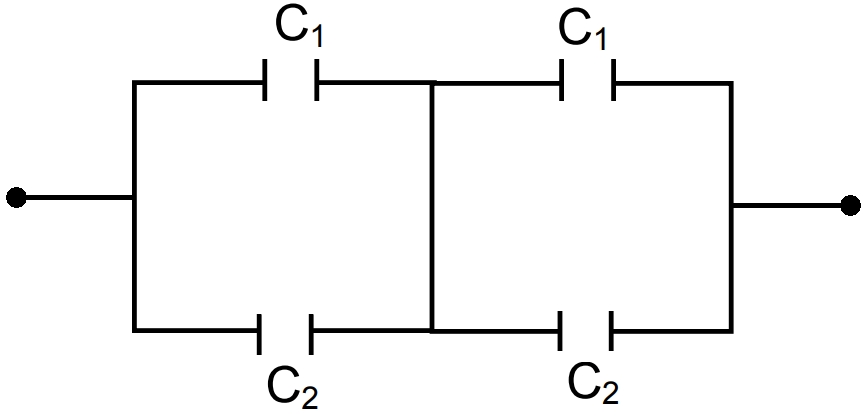
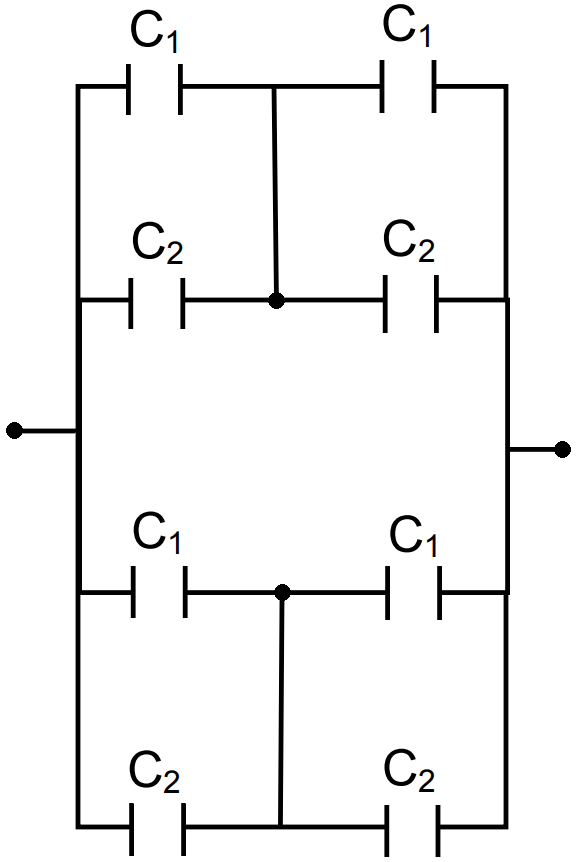
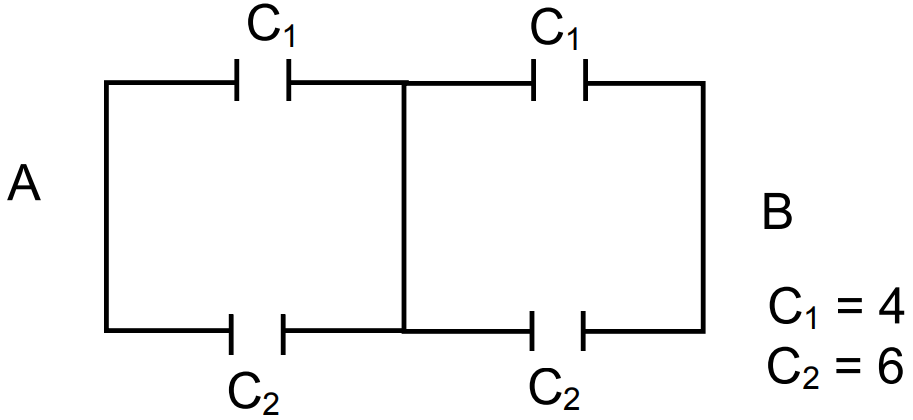
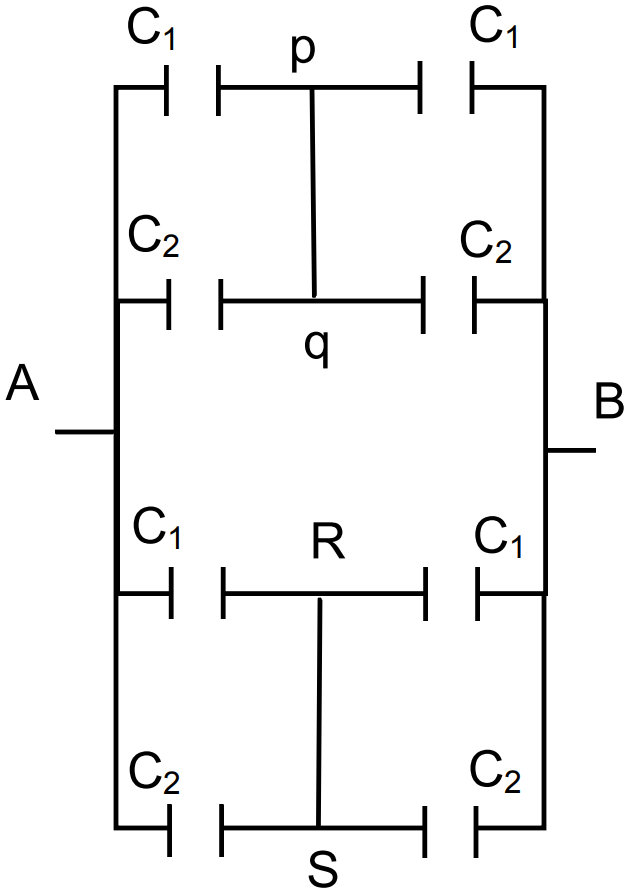
Take $\text{C}_1=4.0\mu\text{F}$ and $\text{C}_2=6.0\mu\text{F}$ in figure. Calculate the equivalent capacitance of the combination between the points indicated.

Answer
  1. $\therefore C_1, C_1$ are series & $C_2, C_2 $ are series as the V is same at p & q. So no current pass through p & q.

$\frac{1}{\text{C}}=\frac{1}{\text{C}_1}=\frac{1}{\text{C}_2}$
$\Rightarrow\frac{1}{\text{C}}=\frac{1+1}{\text{C}_1\text{C}_2}$
$\text{C}_{\text{p}}=\frac{\text{C}_1}{2}=\frac{4}{2}=2\mu\text{F}$
And $\text{C}_{\text{q}}=\frac{\text{C}_2}{2}=\frac{6}{2}=3\mu\text{F}$
$\therefore\text{C}=\text{C}_{\text{p}}+\text{C}_{\text{q}}=2+3=5\mu\text{F}$
  1. $\text{C}_1=4\mu\text{F},\ \text{C}_2=6\mu\text{F}$

In case of p & q, q = 0
$\therefore\text{C}_{\text{p}}=\frac{\text{C}_1}{2}=\frac{4}{2}=2\mu\text{F}$
$\text{C}_{\text{q}}=\frac{\text{C}_2}{2}=\frac{6}{2}=3\mu\text{F}$
& $\text{C}'=2+3=5\mu\text{F}$
$\text{C}\ \&\ \text{C}' =5\mu\text{F}$
$\therefore$ The equation of capacitor $\text{C}=\text{C}'+\text{C}''=5+5=10\mu\text{F}$
View full question & answer
Question 115 Marks
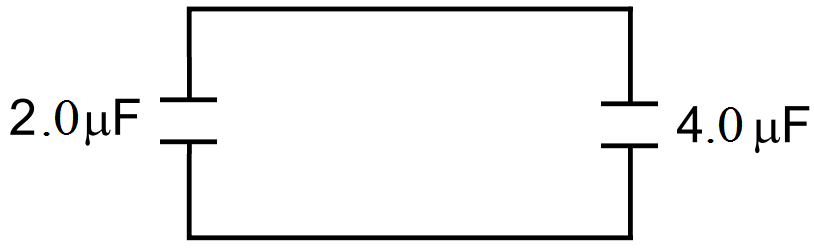
A capacitor of capacitance $2.0\mu\text{F}$ is charged to a potential difference of 12V. It is then connected to an uncharged capacitor of capacitance $4.0\mu\text{F}$ as shown in figure. Find:
  1. The charge on each of the two capacitors after the connection.
  2. The electrostatic energy stored in each of the two capacitors.
  3. The heat produced during the charge transfer from one capacitor to the other.
Answer
Initial charge stored $= C \times V = 12 \times 2 \times 10^{-6} = 24 \times 10^{-6}c$
Let the charges on 2 & 4 capacitors be $q_1 & q_2$ respectively
There, $\text{V}=\frac{\text{q}_1}{\text{C}_1}=\frac{\text{q}_2}{\text{C}_2}$
$\Rightarrow\frac{\text{q}_1}{2}=\frac{\text{q}_2}{4}$
$\Rightarrow\text{q}_2=2\text{q}_1$
$\text{q}_1+\text{q}_2=24\times10^{-6}\text{C}$
$\Rightarrow\text{q}_1=8\times10^{-6}\mu\text{C}$
$\text{q}_2=2\text{q}_1=2\times8\times10^{-6}=16\times10^{-6}\mu\text{c}$
$\text{E}_1=\Big(\frac{1}{2}\Big)\times\text{C}_1\times\text{V}_1^2$
$=\Big(\frac{1}{2}\Big)\times2\times\Big(\frac{8}{2}\Big)^2=16\mu\text{J}$
$\text{E}_2=\Big(\frac{1}{2}\Big)\times\text{C}_2\times\text{V}_2^2$
$=\Big(\frac{1}{2}\Big)\times4\times\Big(\frac{8}{4}\Big)^2=8\mu\text{J}$
View full question & answer
Question 125 Marks
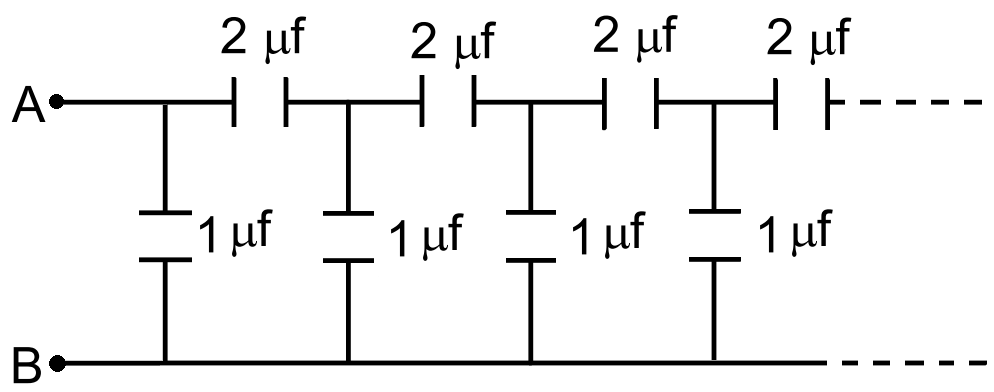
Find the equivalent capacitance of the infinite ladder shown in figure between the points A and B.
Answer


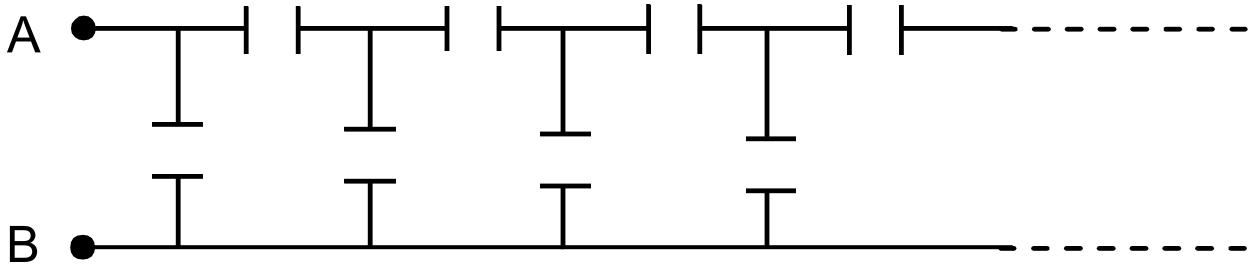
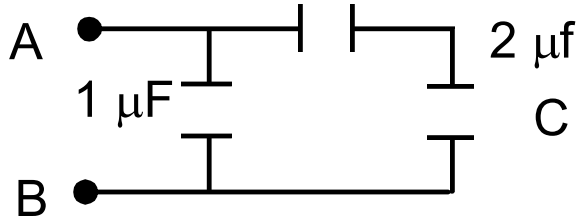
Let the equivalent capacitance be C. Since it is an infinite series. So, there will be negligible change if the arrangement is done an in Fig–II

$\text{C}_{\text{eq}}=\frac{2\times\text{C}}{2+\text{C}}+1$
$\Rightarrow\text{C}=\frac{2\text{C}+2+\text{C}}{2+\text{C}}$
$\Rightarrow(2+\text{C})\times\text{C}=3\text{C}+2$
$\Rightarrow\text{C}^2-\text{C}-2=0$
$\Rightarrow(\text{C}-2)(\text{C}+1)=0$
$\text{C}=-1$ (Impossible)
So, $\text{C}=2\mu\text{F}$
View full question & answer
Question 135 Marks
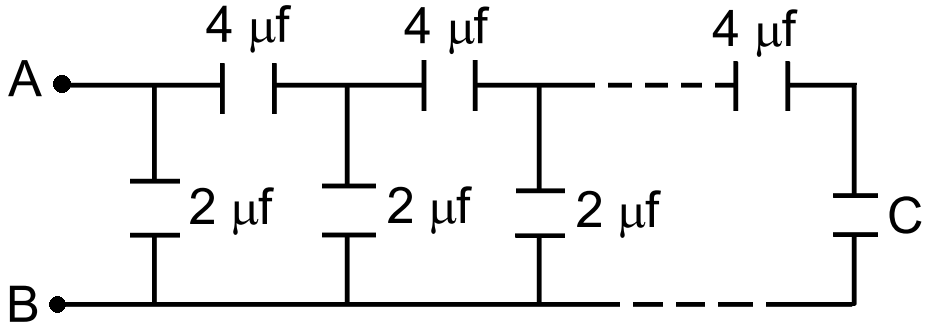
A finite ladder is constructed by connecting several sections of $2\mu\text{F},\ 4\mu\text{F}$ capacitor combinations as shown in figure. It is terminated by a capacitor of capacitance C. What value should be chosen for C, such that the equivalent capacitance of the ladder between the points A and B becomes independent of the number of sections in between?
Answer


C and $4\mu\text{F}$ are in series
So, $\text{C}_1=\frac{4\times\text{C}}{4+\text{C}}$
Then $C_1$ and $2\mu\text{F}$ are parallel
$\text{C}=\text{C}_1+2\mu\text{F}$
$\Rightarrow\frac{4\times\text{C}}{4+\text{C}}+2$
$\Rightarrow\frac{4\text{C}+8+2\text{C}}{4+\text{C}}=\text{C}$
$\Rightarrow4\text{C}+8+2\text{C}$
$=4\text{C}+\text{C}^2=\text{C}^2-2\text{C}-8=0$
$\text{C}=\frac{2\pm\sqrt{4+4\times1\times8}}{2}$
$=\frac{2\pm\sqrt{36}}{2}=\frac{2\pm6}{2}$
$\text{C}=\frac{2+6}{2}=4\mu\text{F}$
$\therefore$ The value of C is $4\mu\text{F}$
View full question & answer
Question 145 Marks
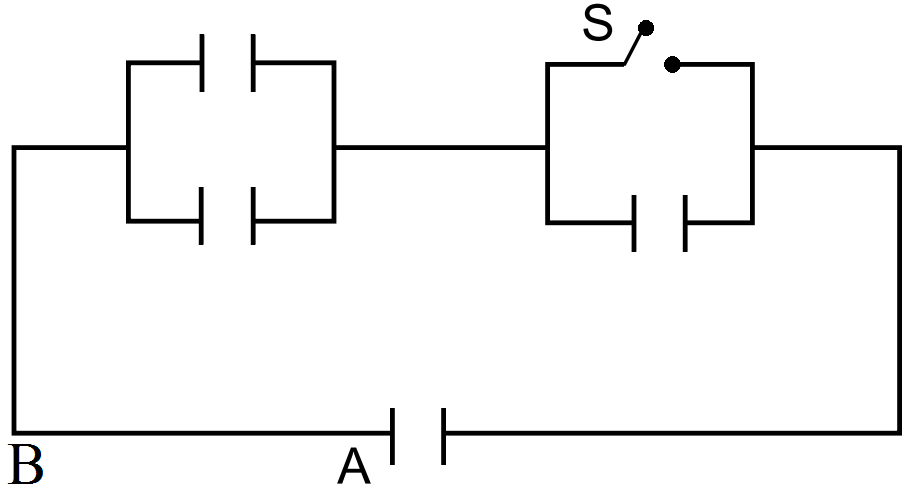
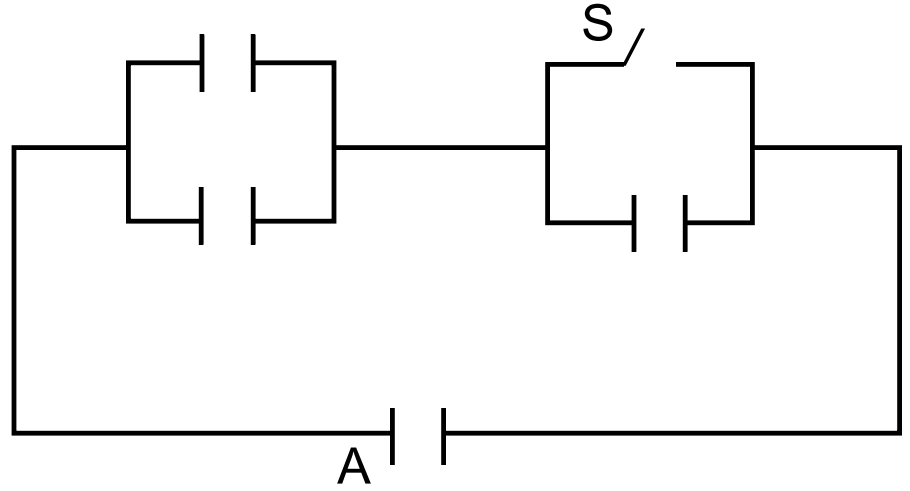
Each capacitor shown in figure has a capacitance of $5.0\mu\text{F}.$ The emf of the battery is 50V. How much charge will flow through AB if the switch S is closed?
Answer

Initially when ‘s’ is not connected,
$\text{C}_{\text{eff}}=\frac{\text{2C}}{3}\text{q}=\frac{\text{2C}}{3}\times50$
$=\frac{5}{2}\times10^{-4}=1.66\times10^{-4}\text{C}$
After the switch is made on,
Then $C_{eff} = 2C = 10^{-5}$
$Q = 10^{-5} \times 50 = 5 \times 10^{-4}$​​​​​​​
Now, the initial charge will remain stored in the stored in the short capacitor
Hence net charge flowing:
$= 5 \times 10^{-4} - 1.66 \times 10^{-4}$
$= 3.3 \times 10^{-4}C.$
View full question & answer
Question 155 Marks
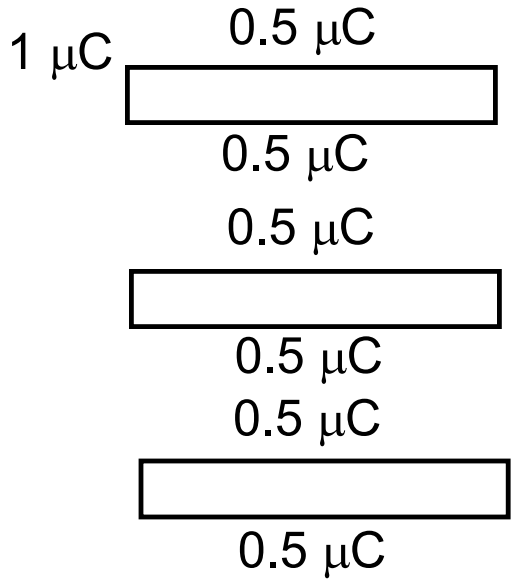
Consider the situation of the previous problem. If $1.0\mu\text{C}$ is placed on the upper plate instead of the middle, what will be the potential difference between:
  1. The upper and the middle plates?
  2. The middle and the lower plates?
Answer
Here given,
Capacitance of each capacitor, $\text{C}=50\mu\text{f}=0.05\mu\text{f}$ Charge $\text{Q}=1\mu\text{F}$ which is given to upper plate $=0.5\mu\text{c}$ charge appear on outer and inner side of upper plate and $0.5\mu\text{c}$ of charge also see on the middle.
  1. (a) Charge of each plate $=0.5\mu\text{c}$
Capacitance $=0.5\mu\text{F}$
$\therefore\text{C}=\frac{\text{q}}{\text{V}}$
$\Rightarrow\text{V}=\frac{\text{q}}{\text{C}}=\frac{0.5}{0.05}=10\text{v}$
  1. The charge on lower plate also $=0.5\mu\text{c}$
Capacitance $=0.5\mu\text{F}$
$\therefore\text{C}=\frac{\text{q}}{\text{V}}$
$\Rightarrow\text{V}=\frac{\text{q}}{\text{C}}=\frac{0.5}{0.05}=10\text{V}$
View full question & answer
Question 165 Marks
A charge of $1\mu\text{C}$ is given to one plate of a parallel-plate capacitor of capacitance $0.1\mu\text{F}$ and a charge of $2\mu\text{C}$ is given to the other plate. Find the potential difference developed between the plates.
Answer
$\text{q}_1=1\mu\text{C}=1\times10^{-6}\text{C}$
$\text{C}=0.1\mu\text{F}=1\times10^{-7}\text{F}$
$\text{q}_2=2\mu\text{C}=2\times10^{-6}\text{C}$
$\text{net q}=\frac{\text{q}_1-\text{q}_2}{2}$
$=\frac{(1-2)\times10^{-6}}{2}=-0.5\times10^{-6}\text{C}$
Potential $'\text{V}'=\frac{\text{q}}{\text{c}}=\frac{1\times10^{-7}}{-5\times10^{-7}}=-5\text{V}$
But potential can never be (-)ve.
So, V = 5V
View full question & answer
Question 175 Marks
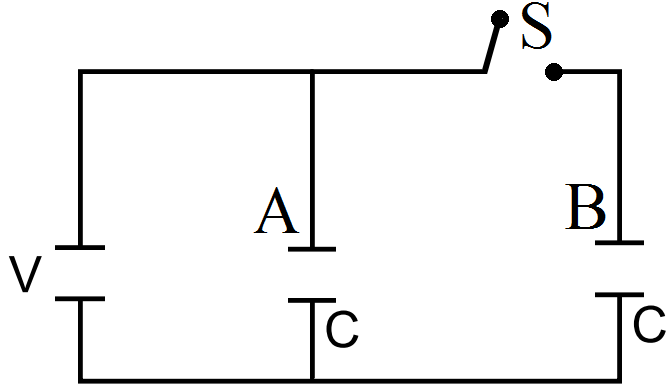
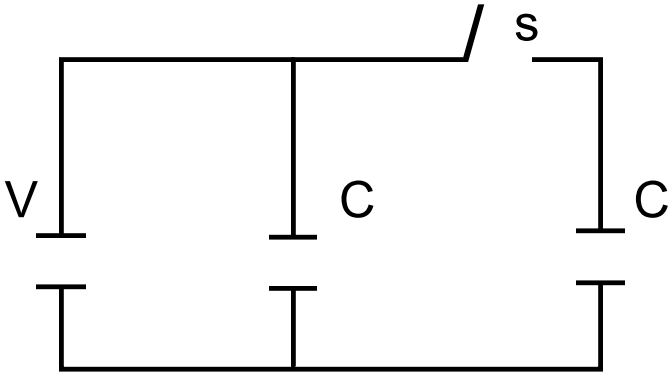
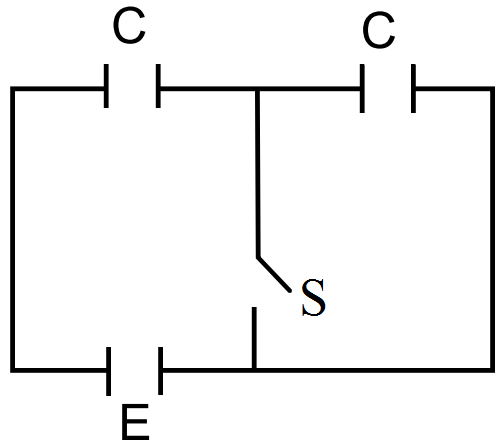
Figure shows two identical parallel plate capacitors connected to a battery through a switch S. Initially, the switch is closed so that the capacitors are completely charged. The switch is now opened and the free space between the plates of the capacitors is filled with a dielectric of dielectric constant 3. Find the ratio of the initial total energy stored in the capacitors to the final total energy stored.
Answer

Initially when switch ‘s’ is closed
Total Initial Energy $=\Big(\frac{1}{2}\Big)\text{CV}^2+\Big(\frac{1}{2}\Big)\text{CV}^2=\text{CV}^2\ \dots(1)$
When switch is open the capacitance in each of capacitors varies, hence the energy also varies.
i.e. in case of ‘B’, the charge remains.
Same i.e. cv
$\text{C}_{\text{eff}}=3\text{C}$
$\text{E}=\frac{1}{2}\times\frac{\text{q}^2}{\text{c}}$
$=\frac{1}{2}\times\frac{\text{c}^2\text{v}^2}{3\text{c}}=\frac{\text{cv}^2}{6}$
In case of 'A'
$\text{C}_{\text{eff}}=3\text{c}$
$\text{E}=\frac{1}{2}\times\text{C}_{\text{eff}}\text{v}^2$
$=\frac{1}{2}\times\text{3c}\times\text{v}^2=\frac{3}{2}\text{cv}^2$
Total final energy $=\frac{\text{cv}^2}{6}+\frac{3\text{cv}^2}{2}=\frac{10\text{cv}^2}{6}$
Now, $\frac{\text{Initial Energy}}{\text{Final Energy}}=\frac{\text{cv}^2}{\frac{10\text{cv}^2}{6}}=3$
View full question & answer
Question 185 Marks
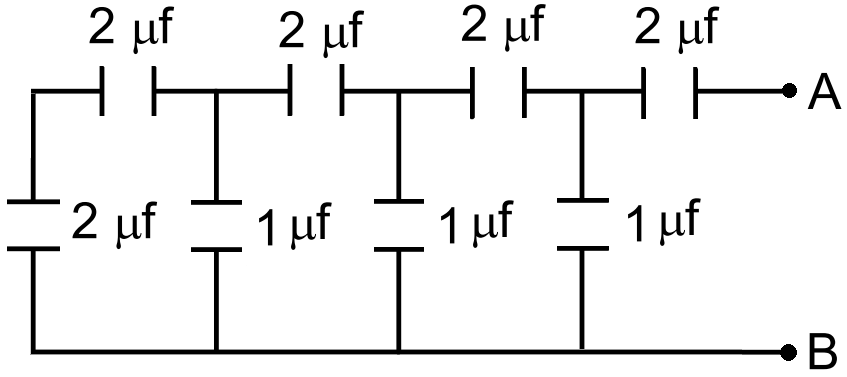
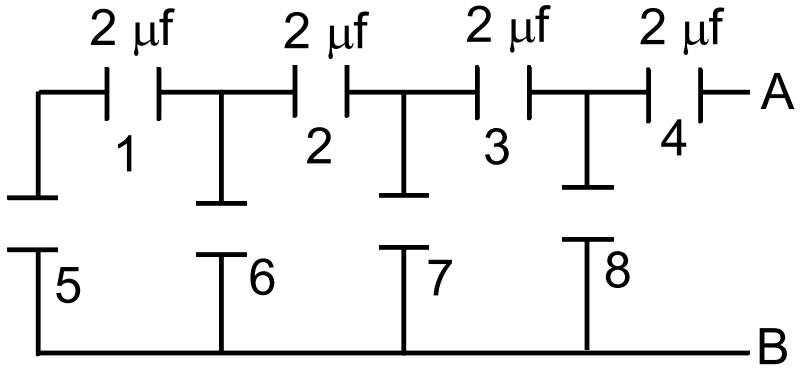
Find the capacitance of the combination shown in figure between A and B.
Answer


$= C_5$ and $C_1$ are in series
$\text{C}_{\text{eq}}=\frac{2\times2}{2+2}=1$
This is parallel to $C_6 = 1 + 1 = 2$
Which is series to $\text{C}_{\text{2}}=\frac{2\times2}{2+2}=1$
Which is parallel to $C_7 = 1 + 1 = 2$
Which is series to $\text{C}_{\text{3}}=\frac{2\times2}{2+2}=1$
Which is parallel to $C_8 = 1 + 1 = 2$
This is series to $\text{C}_{\text{4}}=\frac{2\times2}{2+2}=1$
View full question & answer
Question 195 Marks
A parallel-plate capacitor with the plate area $100cm^2$ and the separation between the plates 1.0cm is connected across a battery of emf 24 volts. Find the force of attraction between the plates.
Answer
$A = 100cm^2 = 10^{-2}m^2$
$d = 1cm = 10^{-2}m$
$V = 24V_0$
$\therefore$ The capacitance $\text{C}=\frac{\in_0\text{A}}{\text{d}}=\frac{8.85\times10^{-12}\times10^{-2}}{10^{-2}}=8.85\times10^{-12}$
$\therefore$ The energy stored $\text{C}_1=\Big(\frac{1}{2}\Big)\text{CV}^2$
$=\Big(\frac{1}{2}\Big)\times10^{-12}\times(24)^2$
$=2548.8\times10^{-12}$
$\therefore$ The forced attraction between the plates $=\frac{\text{C}_1}{\text{d}}=\frac{2548.8\times10^{-12}}{10^{-2}}=2.54\times10^{-7}\text{N.}$
View full question & answer
Question 205 Marks
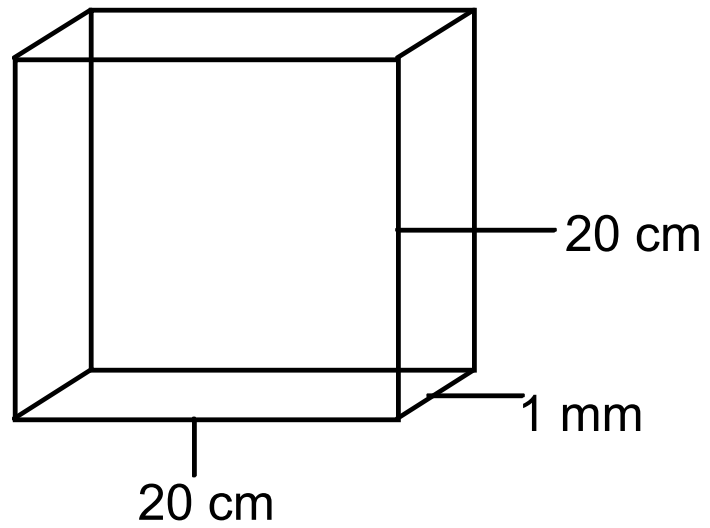
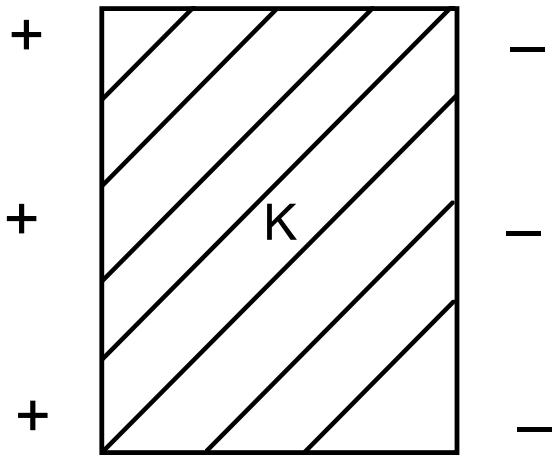
The two square faces of a rectangular dielectric slab (dielectric constant 4.0) of dimensions 20cm × 20cm × 1.0mm are metal-coated. Find the capacitance between the coated surfaces.
Answer


$A = 20cm \times 20cm = 4 \times 10^{-2}m$
$d = 1m = 1 \times 10^{-3}m$
$k = 4$
$t = d$
$\text{C}=\frac{\in_0\text{A}}{\text{d}-\text{t}+\frac{\text{t}}{\text{k}}}=\frac{\in_0\text{A}}{\text{d}-\text{d}+\frac{\text{d}}{\text{k}}}=\frac{\in_0\text{Ak}}{\text{d}}$
$=\frac{8.85\times10^{-12}\times4\times10^{-2}\times4}{1\times10^{-3}}$
$=141.6\times10^{-9}\text{F}=1.42\text{nf}$
View full question & answer
Question 215 Marks
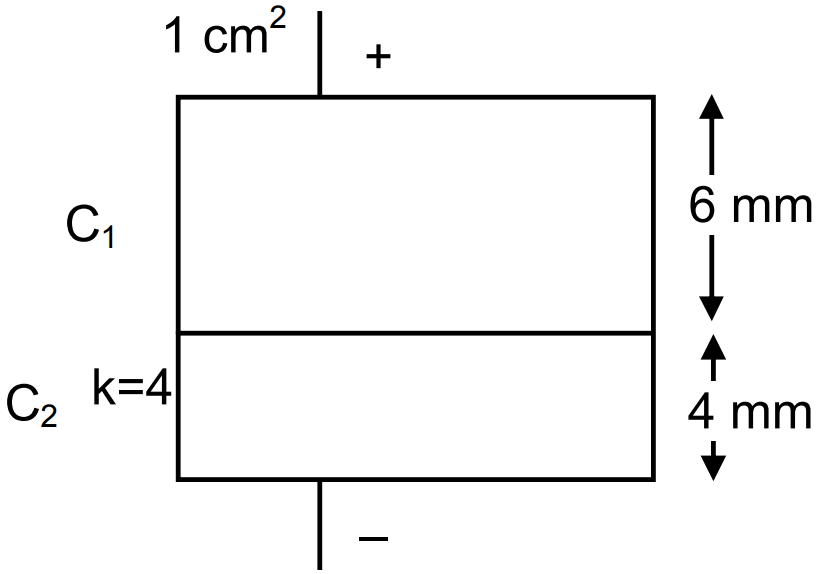
A parallel-plate capacitor has plate area $100cm^2$ and plate separation 1.0cm. A glass plate (dielectric constant 6.0) of thickness 6.0mm and an ebonite plate (dielectric constant 4.0) are inserted one over the other to fill the space between the plates of the capacitor. Find the new capacitance.
Answer


Let the capacitances be $C_1\ \&\ C_2$ net capacitance $\text{C}=\frac{\text{C}_1\text{C}_2}{\text{C}_1+\text{C}_2}$
Now, $\text{C}_1=\frac{\in_0\text{Ak}_1}{\text{d}_1}$
$\text{C}_2=\frac{\in_0\text{Ak}_2}{\text{d}_2}$
$\text{C}=\frac{\frac{\in_0\text{Ak}_1}{\text{d}_1}\times\frac{\in_0\text{Ak}_2}{\text{d}_2}}{\frac{\in_0\text{Ak}_1}{\text{d}_1}+\frac{\in_0\text{Ak}_2}{\text{d}_2}}$
$=\frac{\in_0\text{A}\Big(\frac{\text{k}_1\text{k}_2}{\text{d}_1\text{d}_2}\Big)}{\in_0\text{A}\Big(\frac{\text{k}_1\text{d}_2+\text{k}_2\text{d}_1}{\text{d}_1\text{d}_2}\Big)}$
$=\frac{8.85\times10^{-12}\times10^{-2}\times24}{6\times4\times10^{-3}+4\times6\times10^{-3}}$
$=4.425\times10^{-11}\text{C}=44.25\text{pc}.$
View full question & answer
Question 225 Marks
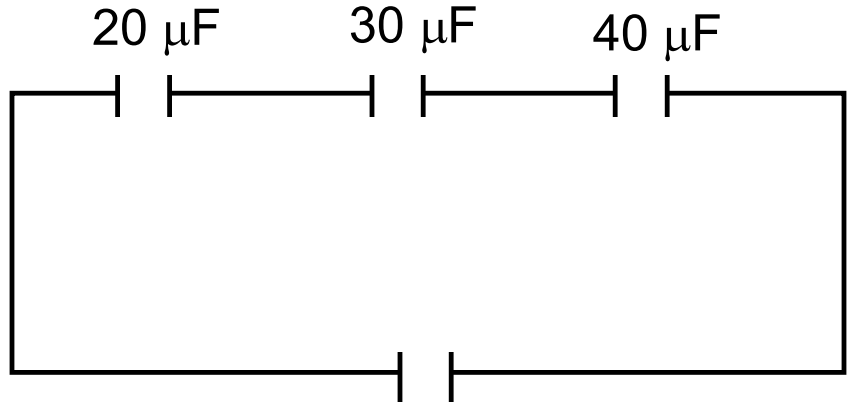
Three capacitors having capacitances $20\mu\text{F},\ 30\mu\text{F}$ and $40\mu\text{F}$ are connected in series with a 12V battery. Find the charge on each of the capacitors. How much work has been done by the battery in charging the capacitors?
Answer

$\therefore$ The equivalent capacity
$\text{C}=\frac{\text{C}_1\text{C}_2\text{C}_3}{\text{C}_2\text{C}_3+\text{C}_1\text{C}_3+\text{C}_1\text{C}_2}$
$=\frac{20\times30\times40}{30\times40+20\times40+20\times30}=\frac{24000}{2600}=9.23\mu\text{F}$
Let Equivalent charge at the capacitor = q
$\text{C}=\frac{\text{q}}{\text{V}}$
$\Rightarrow\text{q}=\text{C}\times\text{V}=9.23\times12=110\mu\text{C}$ on each.
As this is a series combination, the charge on each capacitor is same as the equivalent charge which is $110\mu\text{C}.$
Let the work done by the battery = W
$\therefore\text{V}=\frac{\text{W}}{\text{q}}$
$\Rightarrow\text{W}=\text{Vq}=110\times12\times10^{-6}$
$=1.33\times10^{-3}\text{J.}$
View full question & answer
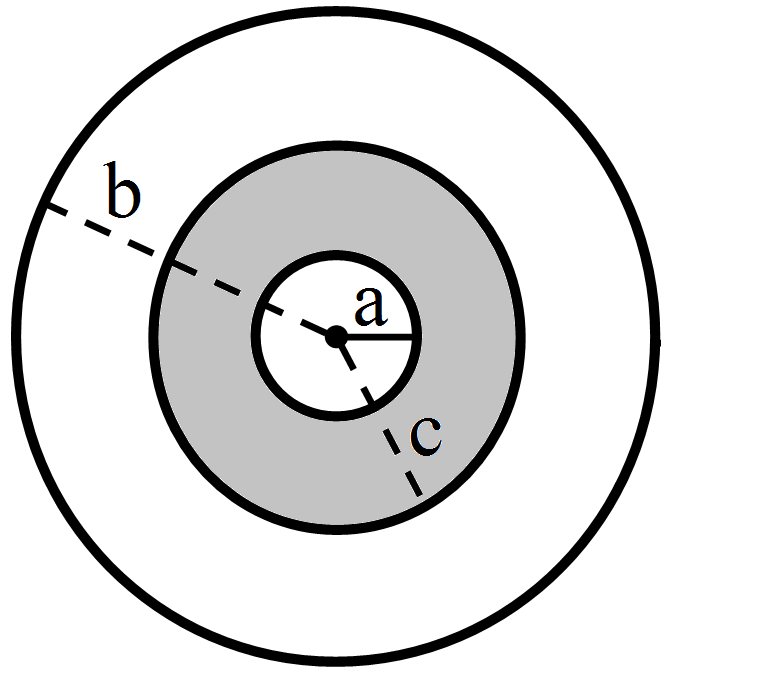
Question 235 Marks
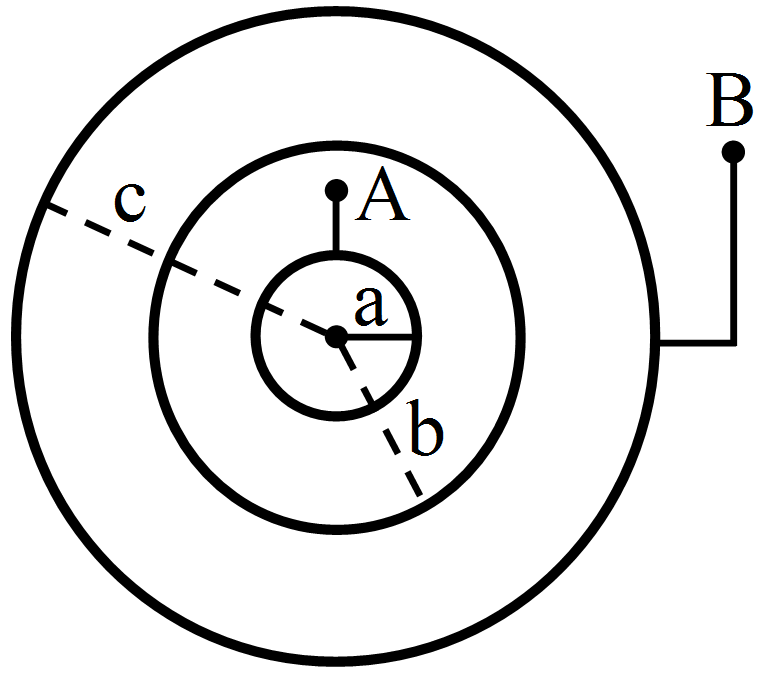
Suppose the space between the two inner shells of the previous problem is filled with a dielectric of dielectric coastant K. Find the capacitance of the system between A and B.
Answer
Here we should consider two spherical capacitor of capacitance
cab and cbc in series
$\text{Cab}=\frac{4\pi\in_0\text{abk}}{(\text{b}-\text{a})}$
$\text{Cbc}=\frac{4\pi\in_0\text{bc}}{(\text{c}-\text{b})}$
$\frac{1}{\text{C}}=\frac{1}{\text{Cab}}+\frac{1}{\text{Cbc}}$
$=\frac{(\text{b}-\text{a})}{4\pi\in_0\text{abk}}+\frac{(\text{c}-\text{b})}{4\pi\in_0\text{bc}}$
$=\frac{\text{c}(\text{b}-\text{a})+\text{ka}(\text{c}-\text{b})}{\text{k}4\pi\in_0\text{abc}}$
$\text{C}=\frac{\text{k}4\pi\in_0\text{abc}}{\text{c}(\text{b}-\text{a})+\text{ka}(\text{c}-\text{b})}$
View full question & answer
Question 245 Marks
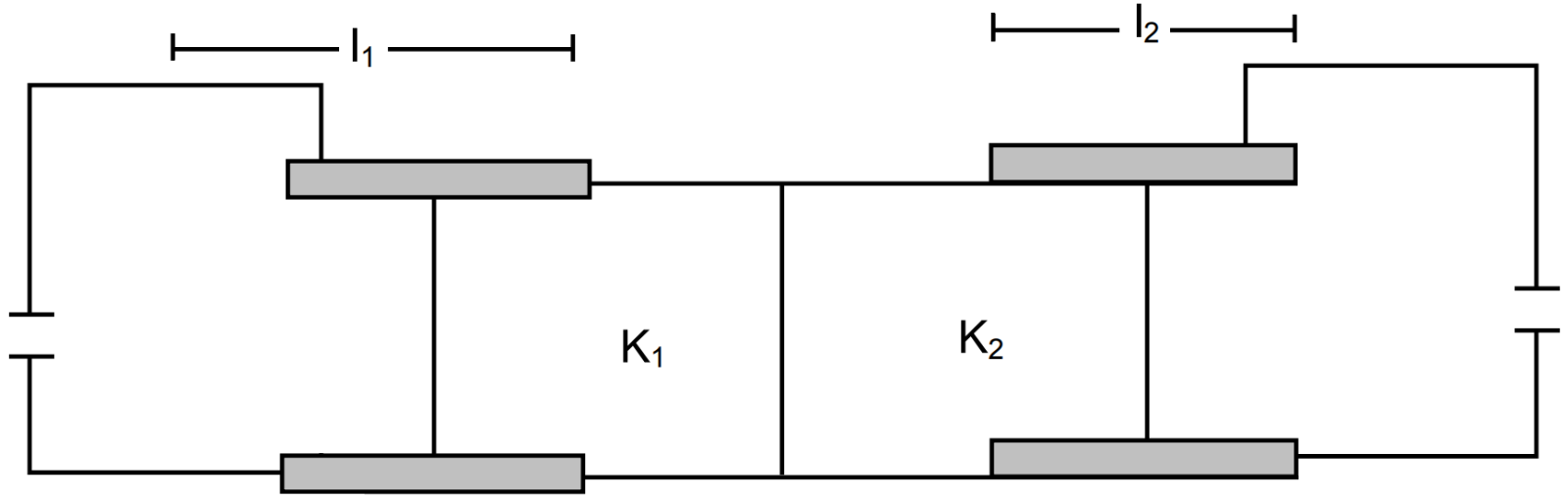
Figure shows two parallel plate capacitors with fixed plates and connected to two batteries. The separation between the plates is the same for the two capacitors. The plates are rectangular in shape with width b and lengths $l_1$ and $l_2$ The left half of the dielectric slab has a dielectric constant $K_1$ and the right half $K_2$. Neglecting any friction, find the ratio of the emf of the left. battery to that of the right battery for which the dielectric slab may remain in equilibrium.
Answer

Consider the left side
The plate area of the part with the dielectric is by its capacitance $\text{C}_1=\frac{\text{K}_1\in_0\text{bx}}{\text{d}}$ and with out dielectric $\text{C}_2=\frac{\in_0\text{b}(\text{L}_1-\text{x})}{\text{d}}$
These are connected in parallel
$\text{C}=\text{C}_1+\text{C}_2$
$=\frac{\in_0\text{b}}{\text{d}}[\text{L}_1+\text{x}(\text{k}_1-1)]$
Let the potential $V_1$
$\text{U}=\Big(\frac{1}{2}\Big)\text{CV}_1^2=\frac{\in_0\text{bv}_1^2}{2\text{d}}[\text{L}_1+\text{x}(\text{k}-1)]\ \dots(1)$
Suppose dielectric slab is attracted by electric field and an external force F consider the part dx which makes inside further, As the potential difference remains constant at V.
The charge supply, dq = (dc)v to the capacitor.
The work done by the battery is $dw_b = v.dq = (dc)v^2$​​​​​​​
The external force F does a work dwe = (–f.dx) during a small displacement.
The total work done in the capacitor is $dw_b + dw_e = (dc)v^2 - fdx$
This should be equal to the increase dv in the stored energy.
Thus $\Big(\frac{1}{2}\Big)(\text{dk})\text{v}^2=(\text{dc})\text{v}^2-\text{fdx}$
$\text{f}=\frac{1}{2}\text{v}^2\frac{\text{dc}}{\text{dx}}$
from equation (1)
$\text{F}=\frac{\in_0\text{bv}^2}{2\text{d}}(\text{k}_1-1)$
$\Rightarrow\text{V}_1^2=\frac{\text{F}\times2\text{d}}{\in_0\text{b}(\text{k}_1-1)}$
$\Rightarrow\text{V}_1=\sqrt{\frac{\text{F}\times2\text{d}}{\in_0\text{b}(\text{k}_1-1)}}$
For the right side, $\text{V}_2=\sqrt{\frac{\text{F}\times2\text{d}}{\in_0\text{b}(\text{k}_2-1)}}$
$\frac{\text{V}_1}{\text{V}_2}=\frac{\sqrt{\frac{\text{F}\times2\text{d}}{\in_0\text{b}(\text{k}_1-1)}}}{\sqrt{\frac{\text{F}\times2\text{d}}{\in_0\text{b}(\text{k}_2-1)}}}$
$\frac{\text{V}_1}{\text{V}_2}=\frac{\sqrt{\text{k}_2-1}}{\sqrt{\text{k}_1-1}}$
$\therefore$ The ratio of the emf of the left battery to the right battery $=\frac{\sqrt{\text{k}_2-1}}{\sqrt{\text{k}_1-1}}$
View full question & answer
Question 255 Marks
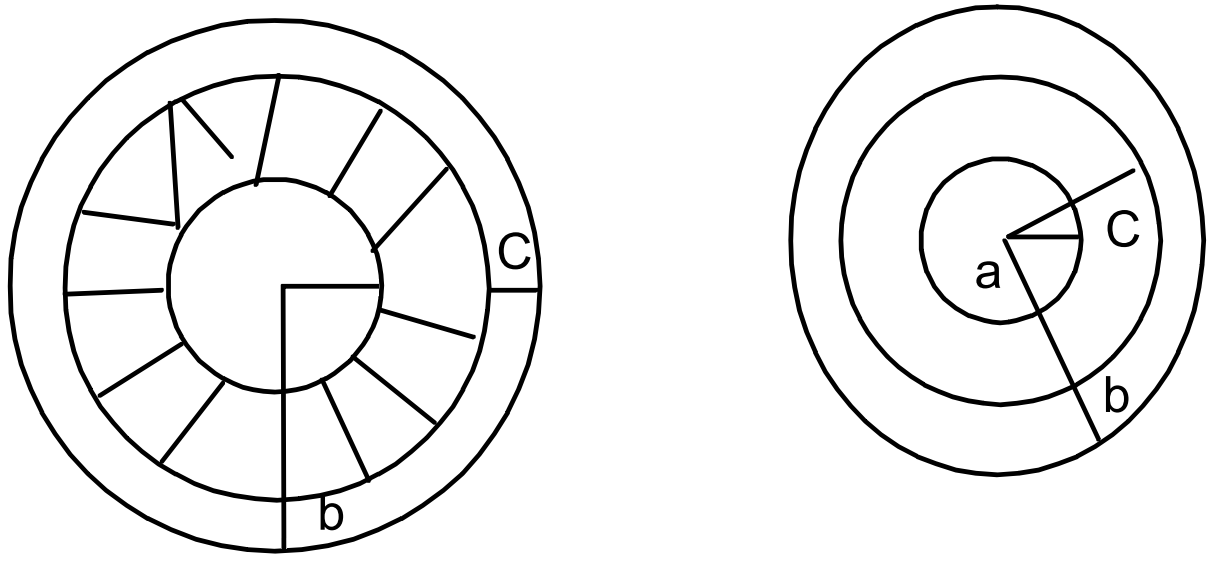
Consider an assembly of three conducting concentric spherical shells of radii a, b and c as shown in figure. Find the capecitance of the assembly between the poima A and B
Answer
These three metallic hollow spheres form two spherical capacitors, which are connected in series. Solving them individually, for (1) and (2)
$\text{C}_1=\frac{4\pi\in_0\text{ab}}{\text{b}-\text{a}}$ $(\therefore$ for a spherical capacitor formed by two spheres of radii $R_2 > R_1)$
$\text{C}=\frac{4\pi\in_0\text{R}_2\text{R}_1}{\text{R}_2-\text{R}_1}$
Similarly for (2) and (3)
$\text{C}_2=\frac{4\pi\in_0\text{bc}}{\text{c}-\text{b}}$
$\text{C}_{\text{eff}}=\frac{\text{C}_1\text{C}_2}{\text{C}_1+\text{C}_2}$
$=\frac{\frac{(4\pi\in_0)^2\text{ab}^2\text{c}}{(\text{b}-\text{a})(\text{c}-\text{a})}}{4\pi\in_0\Big[\frac{\text{ab}(\text{c}-\text{b})+\text{bc}(\text{b}-\text{a})}{(\text{b}-\text{a})(\text{c}-\text{b})}\Big]}$
$=\frac{4\pi\in_0\text{ab}^2\text{c}}{\text{abc}-\text{ab}^2+\text{b}^2\text{c}-\text{abc}}$
$=\frac{4\pi\in_0\text{ab}^2\text{c}}{\text{b}^2(\text{c}-\text{a})}$
$=\frac{4\pi\in_0\text{a}\text{c}}{\text{c}-\text{a}}$
View full question & answer
Question 265 Marks
A parallel-plate capacitor has plate area $25.0cm^2$ and a separation of 2.00mm between the plates. The capacitor is connected to a battery of 12.0V:
  1. Find the charge on the capacitor.
  2. The plate separation is decreased to 1.00mm. Find the extra charge given by the battery to the positive plate.
Answer


Plate area $A = 25cm^2 = 2.5 \times 10^{-3}m$
Separation $d = 2mm = 2 \times 10^{-3}m$
Potential $v = 12v$​​​​​​​
  1. We know
$\text{C}=\frac{\in_0\text{A}}{\text{d}}$
$=\frac{8.85\times10^{-12}\times2.5\times10^{-3}}{2\times10^{-3}}$
$=11.06\times10^{-12}\text{F}$
$\text{C}=\frac{\text{q}}{\text{v}}$
$\Rightarrow11.06\times10^{-12}=\frac{\text{q}}{12}$
$\Rightarrow\text{q}_1=1.32\times10^{-10}\text{C}.$
  1. Then d = decreased to 1mm
$\therefore\ \text{d}=1\text{mm}=1\times10^{-3}\text{m}$
$\text{C}=\frac{\in_0\text{A}}{\text{d}}=\frac{\text{q}}{\text{v}}$
$=\frac{8.85\times10^{-12}\times2.5\times10^{-3}}{1\times10^{-3}}=\frac{2}{12}$
$\Rightarrow\text{q}_2=8.85\times2.5\times12\times10^{-12}$
$\Rightarrow\text{q}_2=2.65\times10^{-10}\text{C}.$
$\therefore$ The extra charge given to plate $= (2.65 - 1.32) \times 10^{-10} = 1.33 \times 10^{-10}C.$
View full question & answer
Question 275 Marks
Two capacitors of capacitances 20.0pF and 50.0pF are connected in series with a 6.00V battery. Find:
  1. The potential difference across each capacitor.
  2. The energy stored in each capacitor.
Answer
$C_1 = 20PF = 20 \times 10^{-12}F,$
$C_2 = 50PF = 50 \times 10^{-12}F$
Effective $\text{C}=\frac{\text{C}_1\text{C}_2}{\text{C}_1+\text{C}_2}=\frac{2\times10^{-11}\times5\times10^{-11}}{2\times10^{-11}+5\times10^{-11}}$
$=1.428\times10^{-11}\text{F}$
Charge $\text{q}=1.428\times10^{-11}\times6=8.568\times10^{-11}\text{C}$
$\text{V}_1=\frac{\text{q}}{\text{C}_1}=\frac{8.568\times10^{-11}}{2\times10^{-11}}=4.284\text{V}$
$\text{V}_2=\frac{\text{q}}{\text{C}_2}=\frac{8.568\times10^{-11}}{5\times10^{-11}}=1.71\text{V}$
Energy stored in each capacitor
$\text{E}_1=\Big(\frac{1}{2}\Big)\text{C}_1\text{V}_1^2$
$=\Big(\frac{1}{2}\Big)\times2\times10^{-11}\times(4.284)^2$
$=18.35\times10^{-11}\approx184\text{PJ}$
$\text{E}_2=\Big(\frac{1}{2}\Big)\text{C}_2\text{V}_2^2$
$=\Big(\frac{1}{2}\Big)\times5\times10^{-11}\times(1.71)^2$
$=7.35\times10^{-11}\approx73.5\text{PJ}$
View full question & answer
Question 285 Marks
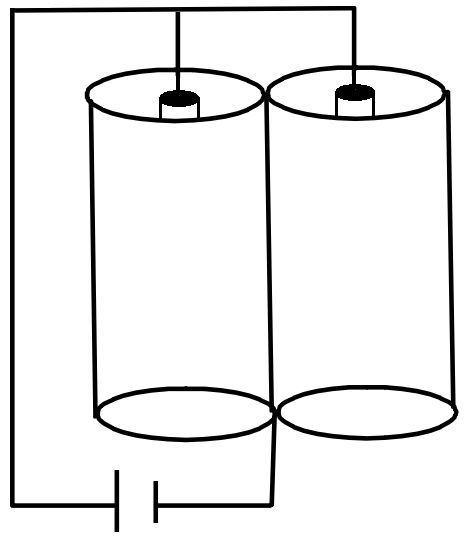
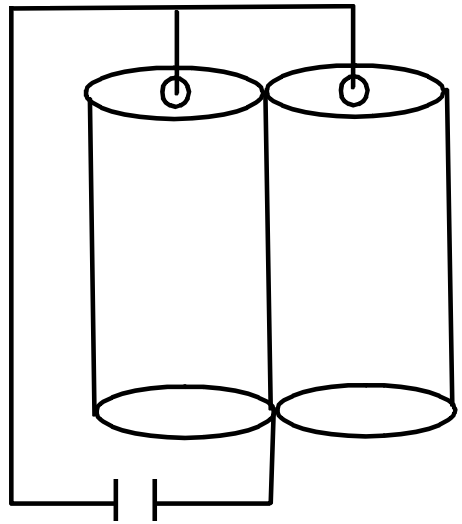
The outer cylinders of two cylindrical capacitors of capacitance $2.2\mu\text{F}$ each, are kept in contact and the inner cylinders are connected through a wire. A battery of emf 10V is connected as shown in figure. Find the total charge supplied by the battery to the inner cylinders.
Answer

The capacitance of the outer sphere $=2.2\mu\text{F}$
$\text{C}=2.2\mu\text{F}$
Potential, V = 10v
Let the charge given to individual cylinder = q.
$\text{C}=\frac{\text{q}}{\text{V}}$
$\Rightarrow\text{q}=\text{CV}=2.2\times10=22\mu\text{F}$
$\therefore$ The total charge given to the inner cylinder $=22+22=44\mu\text{F}$
View full question & answer
Question 295 Marks
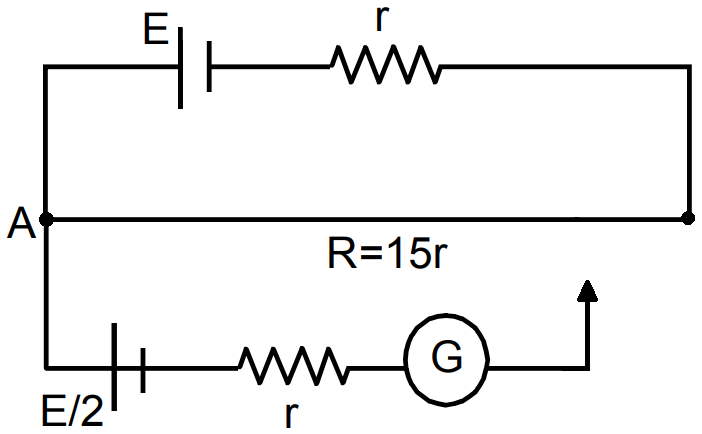
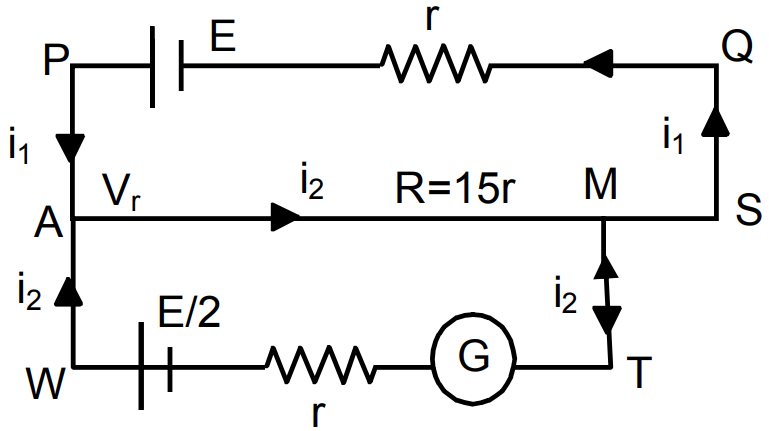
Consider the potentiometer circuit as arranged in the figure. The potentiometer wire is 600cm long. (a) At what distance from the point A should the jockey touch the wire to get zero deflection in the galvanometer? (b) If the jockey touches the wire at a distance of 560cm from A, what will be the current in the galvanometer?
Answer
Resistance per unit length $=\frac{14\text{r}}{6}$

For length x, $\text{Rx}=\frac{15\text{r}}{6}\times\text{x}$
  1. For the loop PASQ $(\text{i}_1+\text{i}_2)\frac{15}{6}\text{rx}+\frac{15}{6}(6-\text{x})\text{i}_1+\text{i}_1\text{R}=\text{E}\ ...(1)$
For the loop AWTM, $-\text{i}_2.\text{R}-\frac{15}{6}\text{rx}(\text{i}_1+\text{i}_2)=\frac{\text{E}}{2}$
$\Rightarrow\text{i}_2\text{R}+\frac{15}{6}\text{r}\times(\text{i}_1+\text{i}_2)=\frac{\text{E}}{2}\ ...(2)$
For zero deflection galvanometer $\text{i}_2=0\Rightarrow\frac{15}{6}\text{rx}.\text{i}_1=\frac{\text{E}}{2}=\text{i}_1=\frac{\text{E}}{5\text{x}.\text{r}}$
Putting $\text{i}_1=\frac{\text{E}}{5\text{x . r}}$ and $i_2 = 0$ in equation (1), we get x = 320cm.
  1. Putting x = 5.6 and solving equation (1) and (2) we get $\text{i}_2=\frac{3\text{E}}{22\text{r}}.$
View full question & answer
Question 305 Marks
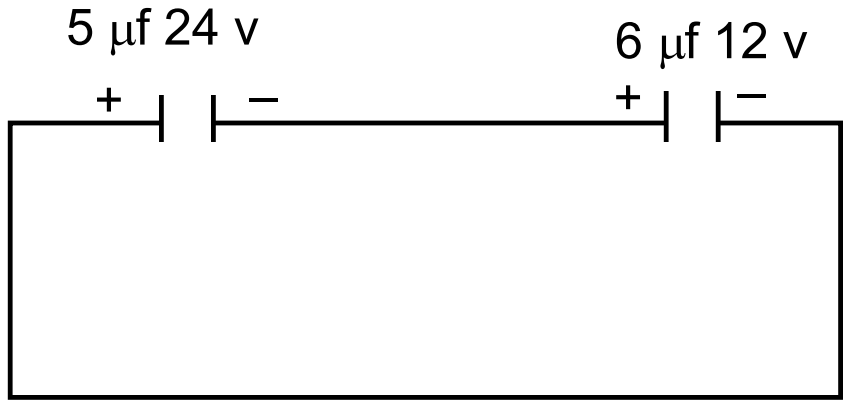
A capacitor of capacitance $5.00\mu\text{F}$ is charged to 24.0V and another capacitor of capacitance $6.0\mu\text{F}$ is charged to 12.0V:
  1. Find the energy stored in each capacitor.
  2. The positive plate of the first capacitor is now connected to the negative plate of the second and vice versa. Find the new charges on the capacitors.
  3. Find the loss of electrostatic energy during the process.
  4. Where does this energy go?
Answer
  1. $\text{C}_1=5\mu\text{f}$
$\text{V}_1=24\text{V}$
$\text{q}_1=\text{C}_1\text{V}_1=5\times24=120\mu\text{c}$
and $\text{C}_2=6\mu\text{f}$
$\text{V}_2=\text{R}$
$\text{q}_2=\text{C}_2\text{V}_2=6\times12=72$
$\therefore$ Energy stored on first capacitor
$\text{E}_1=\frac{1}2{}\frac{\text{q}_1^2}{\text{C}_1}=\frac{1}{2}\times\frac{(120)^2}{2}=1440\text{J}=1.44\text{mJ}$
Energy stored on $2^{nd}$ capacitor
$\text{E}_2=\frac{1}2{}\frac{\text{q}_2^2}{\text{C}_1}=\frac{1}{2}\times\frac{(72)^2}{6}=432\text{J}=4.32\text{mJ}$
  1. $C_1V_1$
$C_2V_2$​​​​​​​

Let the effective potential = V
$\text{V}=\frac{\text{C}_1\text{V}_1-\text{C}_2\text{V}_2}{\text{C}_1+\text{C}_2}=\frac{120-72}{5+6}=4.36$
The new charge $\text{C}_1\text{V}=5\times4.36=21.8\mu\text{c}$
and $\text{C}_2\text{V}=6\times4.36=26.2\mu\text{c}$
  1. $\text{U}_1=\Big(\frac{1}{2}\Big)\text{C}_1\text{V}^2$
$\text{U}_2=\Big(\frac{1}{2}\Big)\text{C}_2\text{V}^2$
$\text{U}_{\text{f}}=\Big(\frac{1}{2}\Big)\text{V}^2(\text{C}_1+\text{C}_2)$
$=\Big(\frac{1}{2}\Big)(4.36)^2(5+6)$
$=104.5\times10^{-6}\text{J}=0.1045\text{mJ}$
But $\text{U}_{\text{i}}=1.44+0.433=1.873$
$\therefore$ The loss in $KE = 1.873 - 0.1045 = 1.7687 = 1.77mJ$
View full question & answer
Question 315 Marks
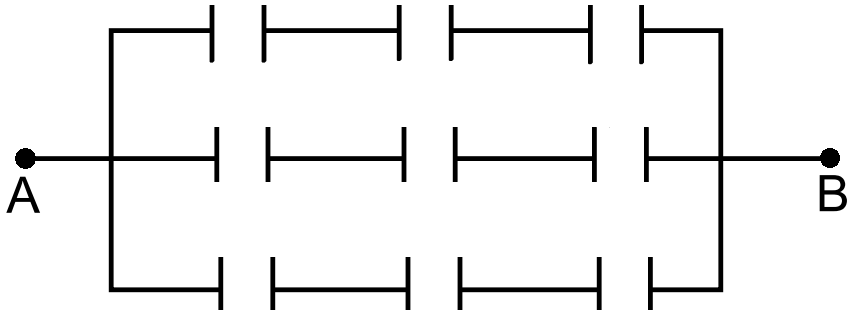
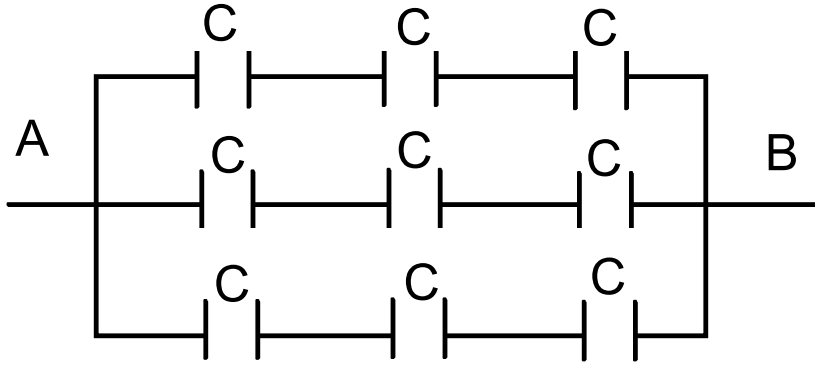
Each of the capacitors shown in figure has a capacitance of $2\mu\text{F}.$ Find the equivalent capacitance of the assembly between the points A and B. Suppose, a battery of emf 60 volts is connected between A and B. Find the potential difference appearing on the individual capacitors.
Answer

$\therefore\text{C}=2\mu\text{F}$
$\therefore$ In this system the capacitance are arranged in series. Then the capacitance is parallel to each other.
$\therefore$ The equation of capacitance in one row
$\text{C}=\frac{\text{C}}{3}$
and three capacitance of capacity $\frac{\text{C}}{3}$ are connected in parallel
$\therefore$ The equation of capacitance
$\text{C}=\frac{\text{C}}{3}+\frac{\text{C}}{3}+\frac{\text{C}}{3}=\text{C}=2\mu\text{F}$
As the volt capacitance on each row are same and the individual is
$=\frac{\text{Total}}{\text{No. of capacitance}}=\frac{60}{3}=20\text{V}$
View full question & answer
Question 325 Marks
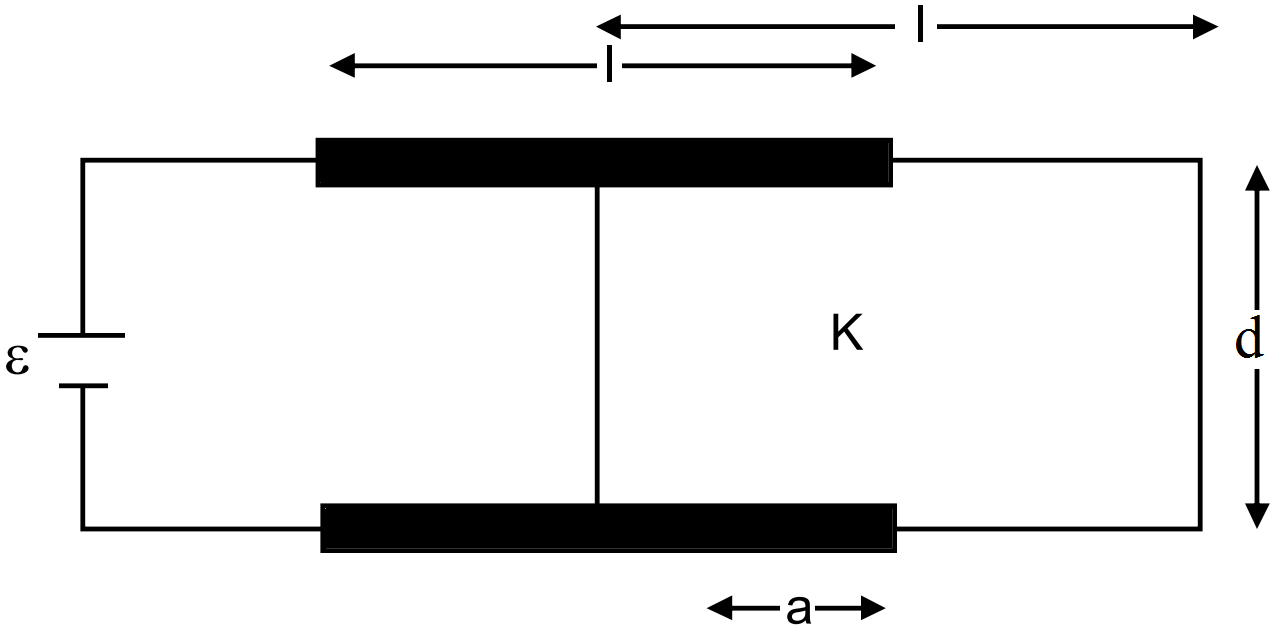
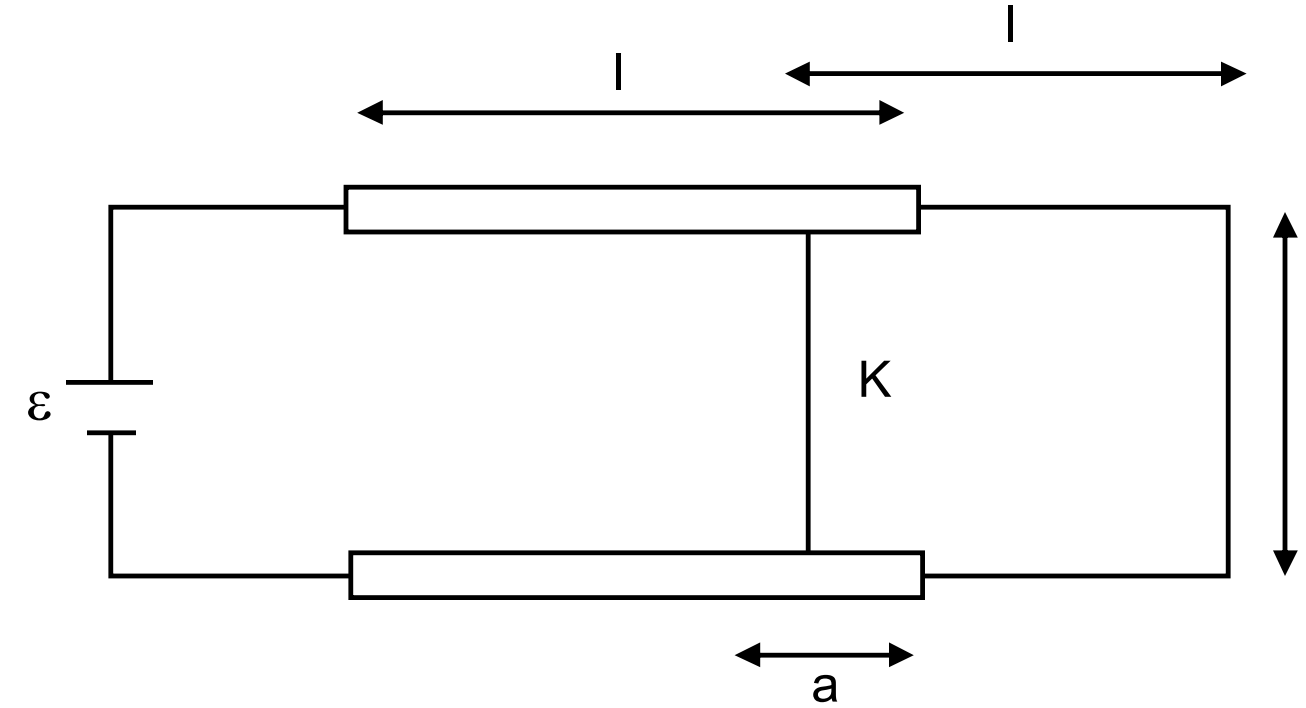
Consider the situation shown in figure. The plates of the capacitor have plate area A and are clamped in the laboratory. The dielectric slab is released from rest with a length a inside the capacitor. Neglecting any effect of friction or gravity, show that the slab will execute periodic motion and find its time period.
Answer
Capacitance of the portion with dielectrics,
$\text{C}_1=\frac{\text{k}\in_0\text{A}}{\ell\text{d}}$
Capacitance of the portion without dielectrics
$\text{C}_2=\frac{\in_0(\ell-\text{a})\text{A}}{\ell\text{d}}$

$\therefore$ Net capacitance $\text{C}=\text{C}_1+\text{C}_2$
$=\frac{\in_0\text{A}}{\ell\text{d}}[\text{ka}+(\ell-\text{a})]$
$\text{C}=\frac{\in_0\text{A}}{\ell\text{d}}[\ell+\text{a}(\text{k}-1)]$
Consider the motion of dielectric in the capacitor.
Let it further move a distance dx, which causes an increase of capacitance by dc
$\therefore$ dQ = (dc)E
The work done by the battery $dw = Vdg = E(dc)E = E^2dc$
Let force acting on it be f
$\therefore$ Work done by the force during the displacement, $dx = fdx$
$\therefore$ Increase in energy stored in the capacitor
$\Rightarrow\Big(\frac{1}{2}\Big)(\text{dc})\text{E}^2=(\text{dc})\text{E}^2-\text{fdx}$
$\Rightarrow\text{fdx}=\Big(\frac{1}2{}\Big)(\text{dc})\text{E}^2$
$\Rightarrow\text{f}=\frac{1}{2}\frac{{\text{E}^2\text{dc}}}{\text{dx}}$
$\text{C}=\frac{\in_0\text{A}}{\ell\text{d}}[\ell+\text{a}(\text{k}-1)]$ (Here x = a)
$\Rightarrow\frac{\text{dc}}{\text{da}}=\frac{-\text{d}}{\text{da}}\Big[\frac{\in_0\text{A}}{\ell\text{d}}\big\{\ell+\text{a}(\text{k}-1)\big\}\Big]$
$\Rightarrow\frac{\in_0\text{A}}{\ell\text{d}}(\text{k}-1)=\frac{\text{dc}}{\text{dx}}$
$\Rightarrow\text{f}=\frac{1}{2}\text{E}^2\frac{\text{dc}}{\text{dx}}=\frac{1}{2}\text{E}^2\Big\{\frac{\in_0\text{A}}{\ell\text{d}}(\text{k}-1)\Big\}$
$\therefore\text{a}_{\text{d}}=\frac{\text{f}}{\text{m}}=\frac{\text{E}^2\in_0\text{A}(\text{k}-1)}{2\ell\text{dm}}$ $\Big[\therefore(\ell-\text{a})=\frac{1}{2}\text{a}_{\text{d}}\text{t}^2\Big]$
$\Rightarrow\text{t}=\sqrt{\frac{2(\ell-\text{a})}{\text{a}_{\text{d}}}}=\sqrt{\frac{2(\ell-\text{a})2\ell\text{dm}}{\text{E}^2\in_0\text{A}(\text{k}-1)}}$
$=\sqrt{\frac{4\text{m}\ell\text{d}(\ell-\text{a})}{\in_0\text{AE}^2(\text{k}-1)}}$
$\therefore$ Time period $=\text{2t}=\sqrt{\frac{\text{8m}\ell\text{d}(\ell-\text{a})}{\in_0\text{AE}^2(\text{k}-1)}}$
View full question & answer
Question 335 Marks
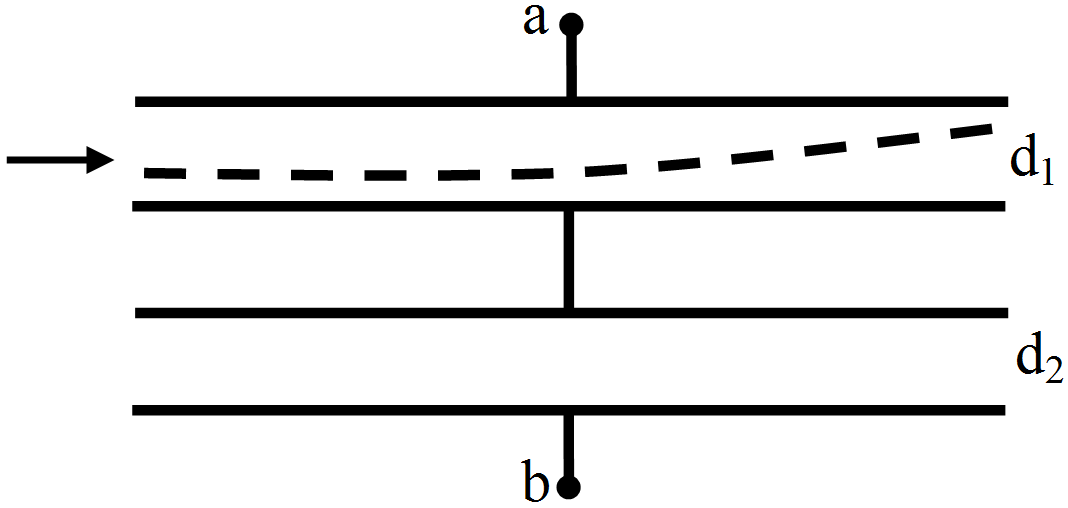
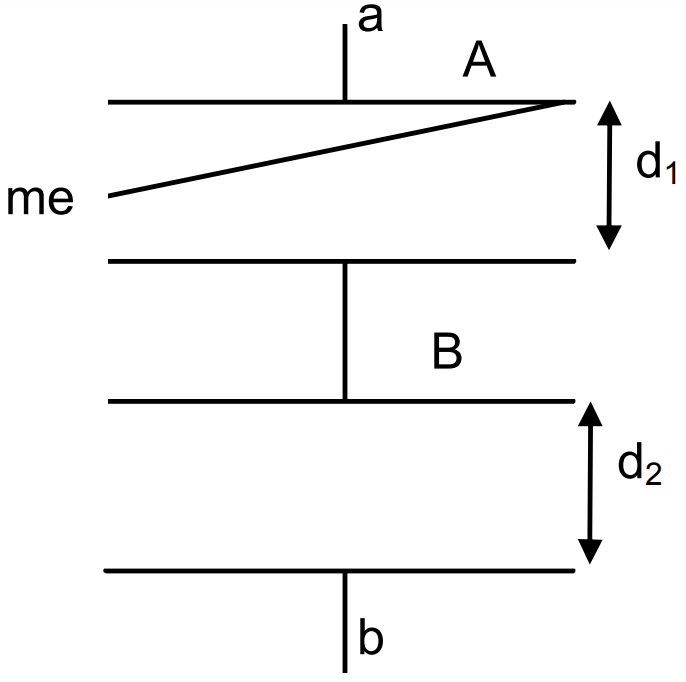
Both the capacitors shown in figure are made of square plates of edge a. The separations between the plates of the capacitors are $d_1$ and $d_2$ as shown in the figure. A potential difference V is applied between the points a and b, An electron is projected between the plates of the upper capacitor along the central line. With what minimum speed should the electron be projected so that it does not collide with any plate? Consider only the electric forces.
Answer
Let mass of electron $=\mu$
Charge electron = e
We know, ‘q’

For a charged particle to be projected in side to plates of a parallel plate capacitor with electric field E,
$\text{y}=\frac{1\text{qE}}{2\text{m}}\Big(\frac{\text{x}}{\mu}\Big)^2$
where y–Vertical distance covered or
x–Horizontal distance covered
$\mu-$Initial velocity
From the given data,
$\text{y}=\frac{\text{d}_1}{2},\ \text{E}=\frac{\text{V}}{\text{R}}=\frac{\text{qd}_1}{\in_0\text{a}^2\times\text{d}_1}=\frac{\text{q}}{\in_0\text{a}^2,}$ $\text{x}=\text{a},\ \mu=?$
For capacitor A –
$\text{V}_1=\frac{\text{q}}{\text{C}_1}=\frac{\text{qd}_1}{\in_0\text{a}^2}$ as $\text{C}_1=\frac{\in_0\text{a}^2}{\text{d}_1}$
Here q = chare on capacitor.
$q = C × V$ where C = Equivalent capacitance of the total arrangement $=\frac{\in_0\text{a}^2}{\text{d}_1+\text{d}_2}$
So, $\text{q}=\frac{\in_0\text{a}^2}{\text{d}_1+\text{d}_2}\times\text{V}$
Hence $\text{E}=\frac{\text{q}}{\in_0\text{a}^2}$
$=\frac{\in_0\text{a}^2\times\text{V}}{(\text{d}_1+\text{d}_2)\in_0\text{a}^2}=\frac{\text{V}}{(\text{d}_1+\text{d}_2)}$
Substituting the data in the known equation, we get, $\frac{\text{d}_1}{2}=\frac{1}{2}\times\frac{\text{e}\times\text{V}}{(\text{d}_1+\text{d}_2)\text{m}}\times\frac{\text{a} ^2}{\text{u}^2}$
$\Rightarrow\text{u}^2=\frac{\text{Vea}^2}{\text{d}_1\text{m}(\text{d}_1+\text{d}_2)}$
$\Rightarrow\text{u}=\Big(\frac{\text{Vea}^2}{\text{d}_1\text{m}(\text{d}_1+\text{d}_2)}\Big)^{\frac{1}{2}}$
View full question & answer
Question 345 Marks
A $5.0\mu\text{F}$ capacitor is charged to 12V. The positive plate of this capacitor is now connected to the negative terminal of a 12V battery and vice versa. Calculate the heat developed in the connecting wires.
Answer


When the capacitor is connected to the battery, a charge Q = CE appears on one plate and -Q on the other. When the polarity is reversed, a charge -Q appears on the first plate and +Q on the second. A charge 2Q, therefore passes through the battery from the negative to the positive terminal.
The battery does a work.
$W = Q \times E = 2QE = 2CE^2$
In this process. The energy stored in the capacitor is the same in the two cases. Thus the workdone by battery appears as heat in the connecting wires. The heat produced is therefore,
$2CE^2 = 2 \times 5 \times 10^{-6} \times 144 = 144 \times 10^{-5}J = 1.44mJ [$have $C = 5μf, V = E = 12V]$
View full question & answer
Question 355 Marks
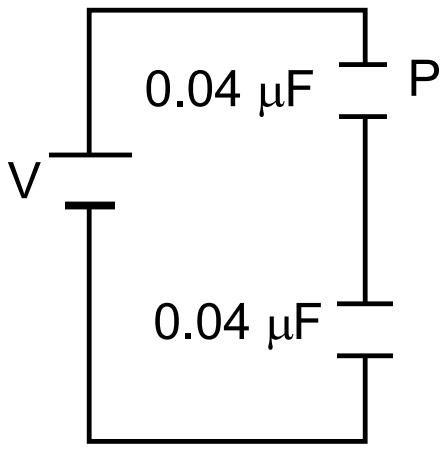
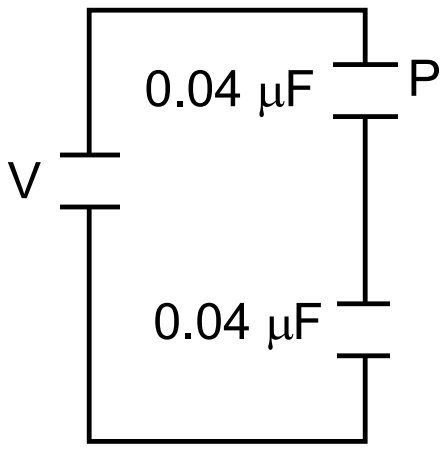
The particle P shown in figure has a mass of 10mg and a charge of $-0.01\mu\text{C}.$ Each plate has a surface area $100cm^2$ on one side. What potential difference V should be applied to the combination to hold the particle P in equilibrium?
Answer

Given that mass of particle m = 10mg
Charge 1 $=-0.01\mu\text{C}$
$A = 100cm^2$
Let potential = V
The Equation capacitance $\text{C}=\frac{0.04}{2}=0.02\mu\text{F}$
The particle may be in equilibrium, so that the wt. of the particle acting down ward, must be balanced by the electric force acting up ward.
$\therefore$ qE = Mg
Electric force $=\text{qE}=\text{q}\frac{\text{V}}{\text{d}}$ where V–Potential, d–separation of both the plates.
$=\text{q}\frac{\text{VC}}{\in_9\text{A}},\ \text{C}=\frac{\in_0\text{A}}{\text{q}},\ \text{d}=\frac{\in_0\text{A}}{\text{C}}$
$\text{qE}=\text{mg}$
$=\frac{\text{QVC}}{\in_0\text{A}}=\text{mg}$
$=\frac{0.01\times0.02\times\text{V}}{8.85\times10^{-12}\times100}=0.1\times980$
$\Rightarrow\text{V}=\frac{0.1\times980\times8.85\times10^{-10}}{0.0002}$
$=0.00043=43\text{MV}$
View full question & answer
Question 365 Marks
A sphercial capacitor is made of two conducting spherical shells of radii a and b. The space between the shells is filled with a dielectric of dielectric constant K up to a radius c as shown in figure. Calculate the capacitance.
Answer
Here, we should consider a capacitor cac and cabc in series. $\text{Cac}=\frac{4\pi\in_0\text{ack}}{\text{k}(\text{c}-\text{a})}$ $\text{Cbc}=\frac{4\pi\in_0\text{bc}}{(\text{b}-\text{c})}$
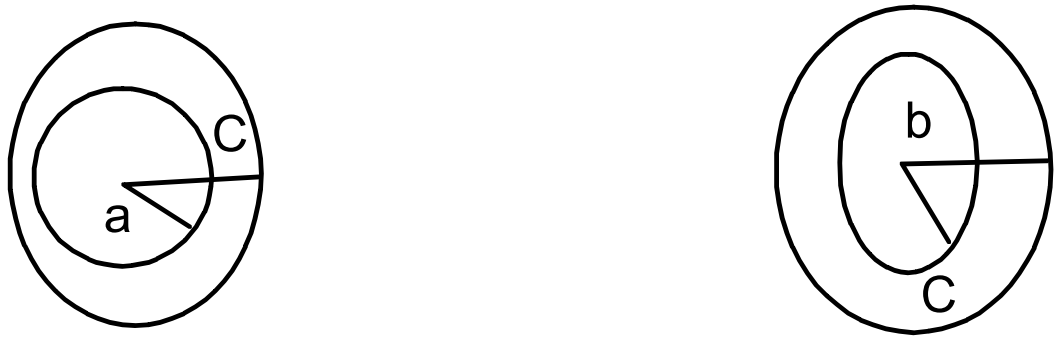
$\frac{1}{\text{C}}=\frac{1}{\text{Cac}}+\frac{1}{\text{Cbc}}$ $=\frac{(\text{c}-\text{a})}{4\pi\in_0\text{ack}}+\frac{(\text{b}-\text{c})}{4\pi\in_0\text{bc}}$ $=\frac{\text{b}(\text{c}-\text{a})+\text{ka}(\text{b}-\text{c})}{\text{k}4\pi\in_0\text{abc}}$ $\text{C}=\frac{4\pi\in_0\text{kabc}}{\text{ka}(\text{b}-\text{c})+\text{b}(\text{c}-\text{a})}$
View full question & answer
Question 375 Marks
A parallel-plate capacitor having plate area $20cm^2$ and separation between the plates 1.00mm is connected to a battery of 12.0V. The plates are pulled apart to increase the separation to 2.0mm.
  1. Calculate the charge flown through the circuit during the process.
  2. How much energy is absorbed by the battery during the process?
  3. Calculate the stored energy in the electric field before and after the process.
  4. Using the expression for the force between the plates, find the work done by the person pulling the plates apart.
  5. Show and justify that no heat is produced during this transfer of charge as the separation is increased.
Answer
Area $= a = 20cm^2 = 2 \times 10^{-2}m^2$
d = Separation $= 1mm = 10^{-3}m$
$\text{C}_{\text{i}}=\frac{\in_0\times2\times10^{-3}}{10^{-3}}=2\in_0$
$\text{C}_{\text{f}}=\frac{\in_0\times2\times10^{-3}}{2\times10^{-3}}=\in_0$
$\text{q}_{\text{i}}=24\in_0$
$\text{q}_{\text{f}}=12\in_0$
  1. So, q flown out $12\in_0.$ i.e., $q_i - q_f$​​​​​​​
So, $q = 12 \times 8.85 \times 10^{-12} = 106.2 \times 10^{-12}C = 1.06 \times 10^{-10}C$​​​​​​​
  1. Energy absorbed by battery during the process
$= q \times v = 1.06 \times 10^{-10}C \times 12$
$= 12.7 \times 10^{-10}J$​​​​​​​
  1. Before the process
$\text{E}_{\text{i}}=\Big(\frac{1}{2}\Big)\times\text{C}_{\text{i}}\times\text{V}^2$
$=\Big(\frac{1}{2}\Big)\times2\times8.85\times10^{-12}\times144$
$=12.7\times10^{-10}\text{J}$
After the force
$\text{E}_{\text{f}}=\Big(\frac{1}{2}\Big)\times\text{C}_{\text{f}}\times\text{V}^2$
$=\Big(\frac{1}{2}\Big)\times8.85\times10^{-12}\times144$
$=6.35\times10^{-10}\text{J}$
  1. Workdone = Force × Distance
$=\frac{1}{2}\frac{\text{q}^2}{\in_0\text{A}}=1\times10^{3}$
$=\frac{1}{2}\times\frac{12\times12\times\in_0\times\in_0\times10^{-3}}{\in_0\times2\times10^{-3}}$
  1. From (c) and (d) we have calculated, the energy loss by the separation of plates is equal to the work done by the man on plate. Hence no heat is produced in transformer.
View full question & answer
Question 385 Marks
Take the potential of the point B in figure to be zero:
  1. Find the potentials at the points C and D.
  2. If a capacitor is connected between C and D, what charge will appear on this capacitor?
Answer

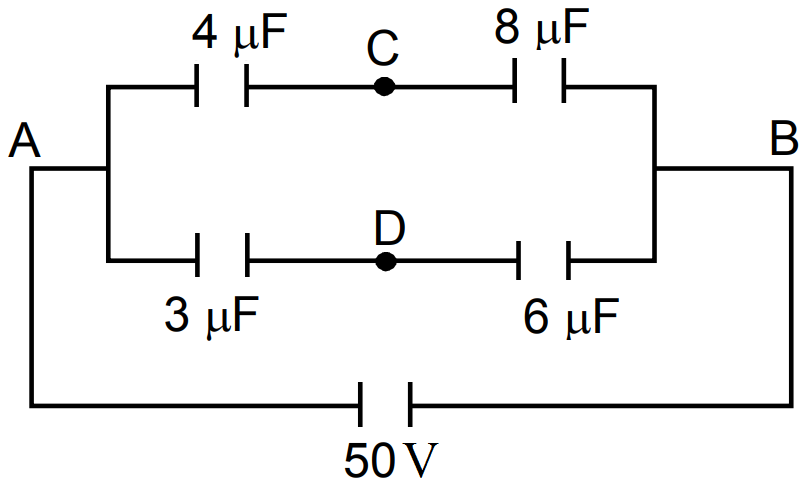
  1. Capacitor $=\frac{4\times8}{4+8}=\frac{8}{3}\mu\text{F}$
and $=\frac{6\times3}{6+3}=2\mu\text{F}$
  1. The charge on the capacitance $\frac{8}{3}\mu\text{F}$
$\therefore\text{Q}=\frac{8}{3}\times50=\frac{400}{3}$

$\therefore$ The potential at $4\mu\text{F}=\frac{400}{3\times4}=\frac{100}{3}$

at $8\mu\text{F}=\frac{400}{3\times8}=\frac{100}{6}$

The Potential difference $=\frac{100}{3}-\frac{100}{6}=\frac{50}{3}\mu\text{V}$
  1. Hence the effective charge at $2\mu\text{F}=50\times2=100\mu\text{F}$
$\therefore$ Potential at $3\mu\text{F}=\frac{100}{3};$ Potential at $6\mu\text{F}=\frac{100}{6}$

$\therefore$ Difference $=\frac{100}{3}-\frac{100}{6}=\frac{50}{3}\mu\text{V}$

$\therefore$ The potential at C & D is $\frac{50}{3}\mu\text{V}$
  1. $\therefore\frac{\text{P}}{\text{Q}}=\frac{\text{R}}{\text{S}}=\frac{1}2{}=\frac{1}{2}=$ It is balanced. So, from it is cleared that the wheat star bridge balanced.
So, the potential at the point C & D are same. So, no current flow through the point C & D.

So, if we connect another capacitor at the point C & D the charge on the capacitor is zero.
View full question & answer
Question 395 Marks
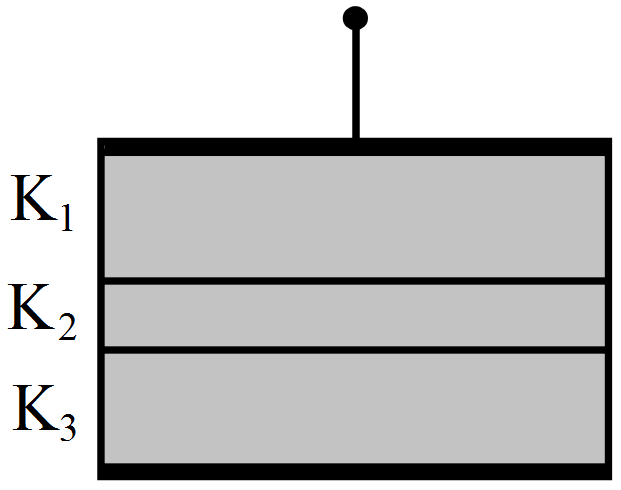
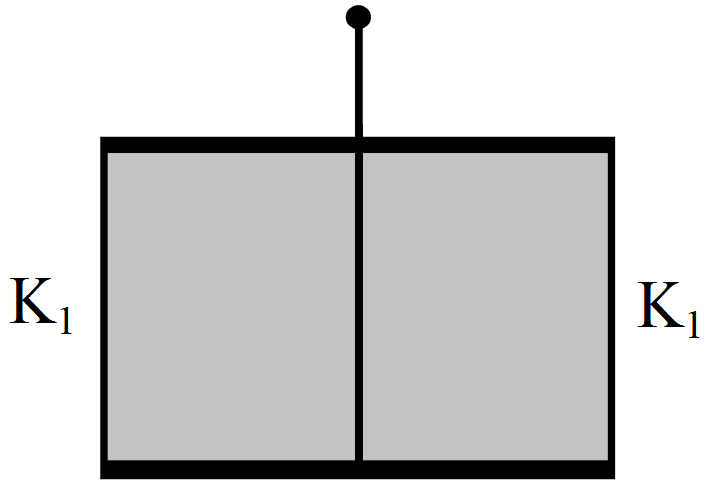
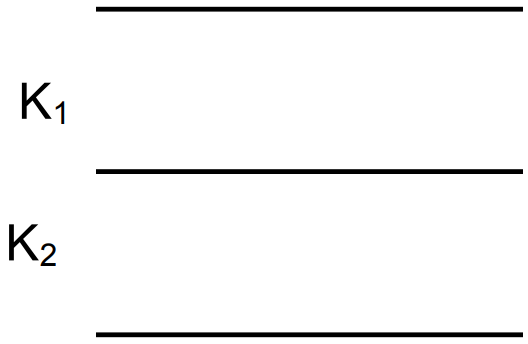
Find the capacitances of the capacitors shown in figure. The plate area is A and the separation between the plates is d. Different dielectric slabs in a particular part of the figure are of the same thickness and the entire gap between the plates is filled with the dielectric slabs.


Answer
  1. Area = A
Separation = d


$\text{C}_1=\frac{\in_0\text{Ak}_1}{\frac{\text{d}}{2}}$

$\text{C}_2=\frac{\in_0\text{Ak}_2}{\frac{\text{d}}{2}}$

$\text{C}=\frac{\text{C}_1\text{C}_2}{\text{C}_1+\text{C}_2}=\frac{\frac{2\in_0\text{Ak}_1}{\text{d}}\times\frac{2\in_0\text{Ak}_2}{\text{d}}}{\frac{2\in_0\text{Ak}_1}{\text{d}}+\frac{2\in_0\text{Ak}_2}{\text{d}}}$

$=\frac{\frac{(2\in_0\text{A})^2\text{k}_1\text{k}_2}{\text{d}^2}}{(2\in_0\text{A})\frac{\text{k}_1\text{d+}\text{k}_2\text{d}}{\text{d}^2}}=\frac{2\text{k}_1\text{k}_2\in_0\text{A}}{\text{d}(\text{k}_1+\text{k}_2)}$
  1. $\frac{1}{\text{C}}=\frac{1}{\text{C}_1}+\frac{1}{\text{C}_2}+\frac{1}{\text{C}_3}$
$=\frac{1}{\frac{3\in_0\text{Ak}_1}{\text{d}}}+\frac{1}{\frac{3\in_0\text{Ak}_2}{\text{d}}}+\frac{1}{\frac{3\in_0\text{Ak}_3}{\text{d}}}$

$=\frac{\text{d}}{3\in_0\text{A}}\Big[\frac{1}{\text{k}_1}+\frac{1}{\text{k}_2}+\frac{1}{\text{k}_3}\Big]$

$=\frac{\text{d}}{3\in_0\text{A}}\Big[\frac{\text{k}_2\text{k}_3+\text{k}_1\text{k}_3+\text{k}_1\text{k}_2}{\text{k}_1\text{k}_2\text{k}_3}\Big]$

$\therefore\text{C}=\frac{3\in_0\text{A}\text{k}_1\text{k}_2\text{k}_3}{\text{d}(\text{k}_1\text{k}_2+\text{k}_2\text{k}_3+\text{k}_1\text{k}_3)}$
  1. $\text{C}=\text{C}_1+\text{C}_2$
$=\frac{\in_0\frac{\text{A}}{2}\text{k}_1}{\text{d}}+\frac{\in_0\frac{\text{A}}{2}\text{k}_2}{\text{d}}=\frac{\in_0\text{A}}{2\text{d}}(\text{k}_1+\text{k}_2)$
View full question & answer
Question 405 Marks
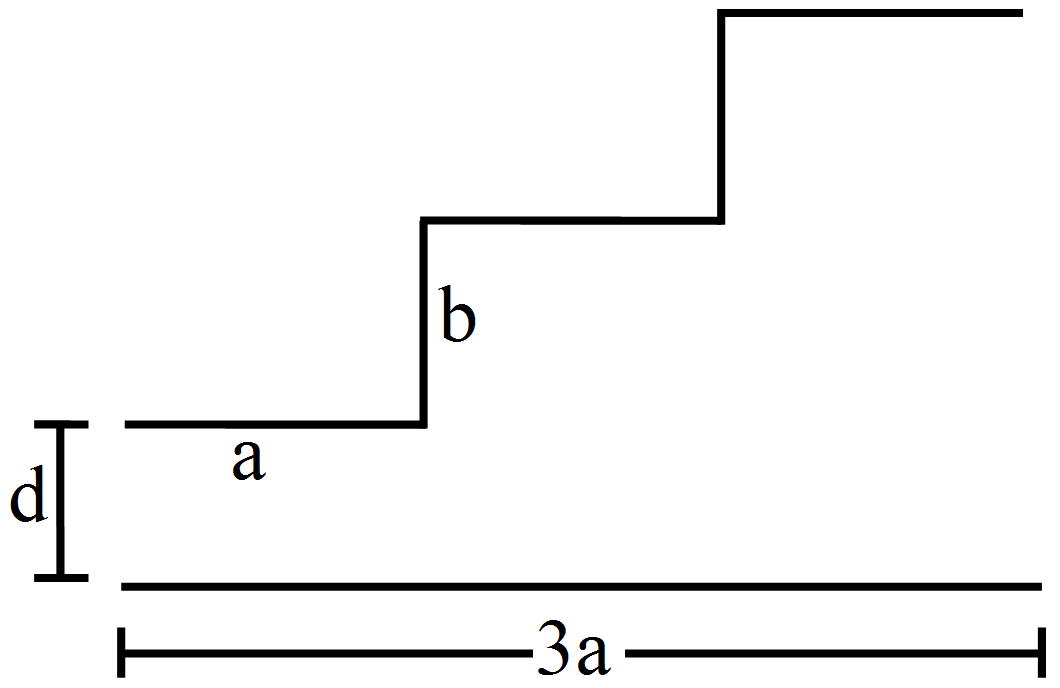
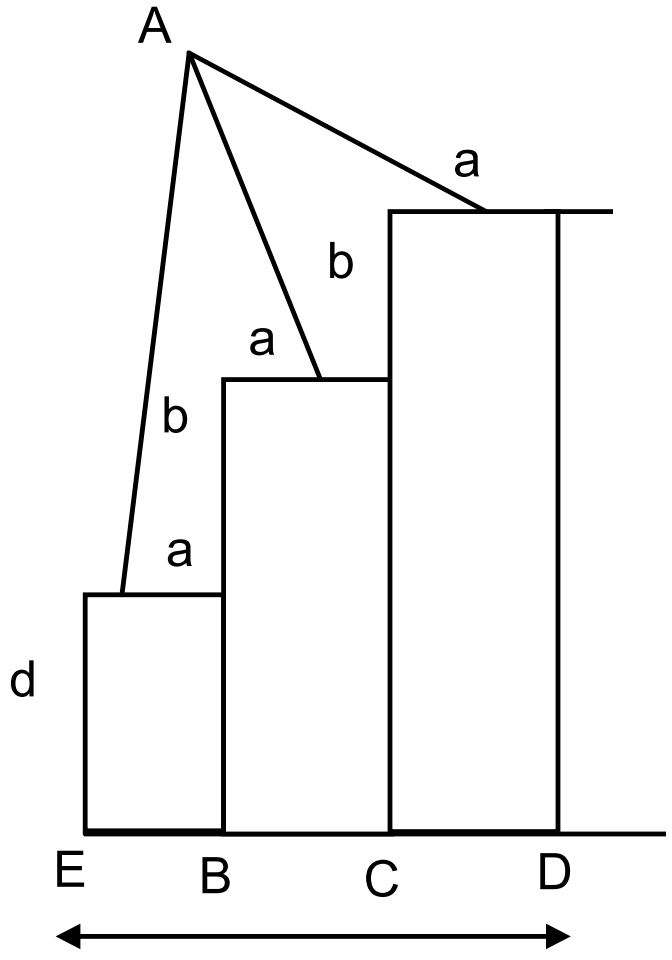
A capacitor is made of a flat plate of area A and a second plate having a stair-like structure as shown in figure. The width of each stair is a and the height is b. Find the capacitance of the assembly.
Answer

In the figure the three capacitors are arranged in parallel.
All have same surface area $=\text{a}=\frac{\text{A}}{3}$
First capacitance $\text{C}_1=\frac{\in_0\text{A}}{3\text{d}}$
Second capacitance $\text{C}_2=\frac{\in_0\text{A}}{3(\text{b}+\text{d})}$
Third capacitance $\text{C}_3=\frac{\in_0\text{A}}{3(2\text{b}+\text{d})}$
$\text{C}_{\text{eq}}=\text{C}_1+\text{C}_2+\text{C}_3$
$=\frac{\in_0\text{A}}{3\text{d}}+\frac{\in_0\text{A}}{3(\text{b}+\text{d})}+\frac{\in_0\text{A}}{3(2\text{b}+\text{d})}$
$=\frac{\in_0\text{A}}{3}\Big(\frac{1}{\text{d}}+\frac{1}{\text{b}+\text{d}}+\frac{2}{\text{2b}+\text{d}}\Big)$
$=\frac{\in_0\text{A}}{3}\Big(\frac{(\text{b}+\text{d})(2\text{b}+\text{d})+(2\text{b}+\text{d})\text{d}+(\text{b}+\text{d})\text{d}}{\text{d}(\text{b}+\text{d})(2\text{b}+\text{d})}\Big)$
$=\frac{\in_0\text{A}\big(3\text{d}^2+6\text{bd}+2\text{b}^2\big)}{3\text{d}(\text{b}+\text{d})(2\text{b}+\text{d})}$
View full question & answer
Question 415 Marks
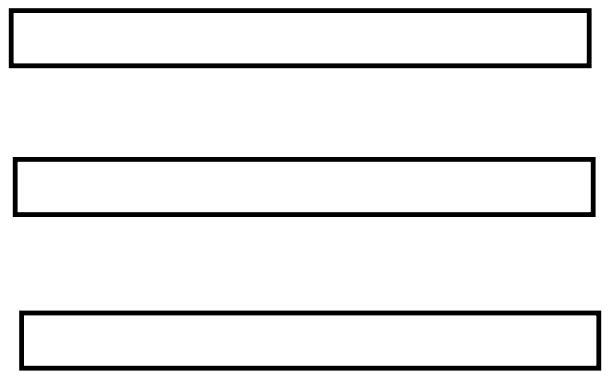
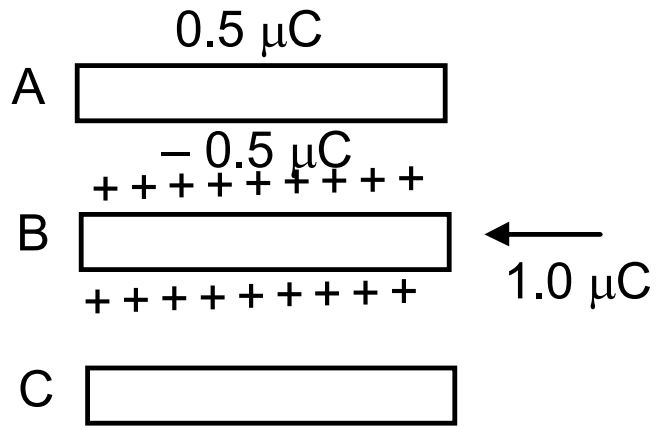
The capacitance between the adjacent plates shown in figure is 50nF. A charge of $1.0\mu\text{C}$ is placed on the middle plate:
  1. What will be the charge on the outer surface of the upper plate?
  2. Find the potential difference developed between the upper and the middle plates.
Answer

  1. When charge of $1\mu\text{C}$ is introduced to the B plate, we also get $0.5\mu\text{C}$ charge on the upper surface of Plate ‘A’.
  2. Given $\text{C}=50\mu\text{F}=50\times10^{-9}\text{F}=5\times10^{-8}\text{F}$
Now charge $=0.5\times10^{-6}\text{C}$

$\text{V}=\frac{\text{q}}{\text{C}}=\frac{5\times10^{-7}\text{C}}{5\times10^{-8}\text{F}}=10\text{V}$
View full question & answer
Question 425 Marks
A capacitor having a capacitance of $100\mu\text{F}$ is charged to a potential difference of 50V.
  1. What is the magnitude of the charge on each plate?
  2. The charging battery is disconnected and a dielectric of dielectric constant 2.5 is inserted. Calculate the new potential difference between the plates.
  3. What charge would have produced this potential difference in absence of the dielectric slab.
  4. Find the charge induced at a surface of the dielectric slab.
Answer
Capacitance $=100\mu\text{F}=10^{-4}\text{F}$
P.d = 30V
  1. $q = CV = 10^{-4} \times 50 = 5 \times 10^{-3}$
c = 5mc
Dielectric constant = 2.5
  1. New $C = C' = 2.5 \times C = 2.5 \times 10^{-4}F$
New $\text{p.d}=\frac{\text{q}}{\text{c}}$ $[\because$ 'q' remains same after disconnection of battery$]$
$=\frac{5\times10^{-3}}{2.5\times10^{-4}}=20\text{V}$
  1. In the absence of the dielectric slab, the charge that must have produced
$C \times V = 10^{-4} \times 20 = 2 \times 10^{-3}c = 2mc$
  1. Charge induced at a surface of the dielectric slab
$=\text{q}\Big(1-\frac{1}{\text{k}}\Big)$ (where k = dielectric constant, q = charge of plate)
$=5\times10^{-3}\Big(1-\frac{1}{2.5}\Big)$
$=5\times10^{-3}\times\frac{3}{5}$
$=3\times10^{-3}=3\text{mc}$
View full question & answer
Question 435 Marks
A parallel-plate capacitor having plate area $400cm^2$ and separation between the plates 1.0mm is connected to a power supply of 100V. A dielectric slab of thickness 1.0mm and dielectric constant 5.0 is inserted into the gap:
  1. Find the increase in electrostatic energy.
  2. If the power supply is now disconnected and the dielectric slab is taken out, find the further increase in energy.
  3. Why does the energy increase in inserting the slab as well as in taking it out?
Answer
$A = 400cm^2 = 4 \times 10^{-2}m^2$
$d = 1cm = 1 \times 10^{-3}m$
$V = 160V$
$t = 0.5 = 5 \times 10^{-4}m$
$k = 5$
$\text{C}=\frac{\in_0\text{A}}{\text{d}-\text{t}+\frac{\text{t}}{\text{k}}}$
$=\frac{8.85\times10^{-12}\times4\times10^{-2}}{10^{-3}-5\times10^{-4}+\frac{5\times10^{-4}}{5}}$
$=\frac{35.4\times10^{-4}}{10^{-3}-0.5}$
View full question & answer
Question 445 Marks
A parallel-plate capacitor of capacitance $5\mu\text{F}$ is connected to a battery of emf 6V. The separation between the plates is 2mm:
  1. Find the charge on the positive plate.
  2. Find the electric field between the plates.
  3. A dielectric slab of thickness 1mm and dielectric constant 5 is inserted into the gap to occupy the lower half of it. Find the capacitance of the new combination.
  4. How much charge has flown through the battery after the slab is inserted?
Answer
$\text{C}=5\mu\text{F}$
$\text{V}=6\text{V}$
$\text{d}=2\text{mm}=2\times10^{-3}\text{m}$
  1. The charge on the +ve plate
$\text{q}=\text{CV}=5\mu\text{F}\times6\text{V}=30\mu\text{c}$
  1. $\text{E}=\frac{\text{V}}{\text{d}}$
$=\frac{6\text{V}}{2\times10^{-3}\text{m}}=3\times10^3\text{V/M}$
  1. $\text{d}=2\times10^{-3}\text{m}$
$\text{t}=1\times10^{-3}\text{m}$

$\text{k}=5$ or $\text{C}=\frac{\in_0\text{A}}{\text{d}}$

$\Rightarrow5\times10^{-6}=\frac{8.85\times\text{A}\times10^{-12}}{2\times10^{-3}}\times10^{-9}$

$\Rightarrow\text{A}=\frac{10^4}{8.85}$

When the dielectric placed on it

$\text{C}_1=\frac{\in_0\text{A}}{\text{d}-\text{t}+\frac{\text{t}}{\text{k}}}=\frac{8.85\times10^{-12}\times\frac{10^4}{8.85}}{10^{-3}+\frac{10^{-3}}{5}}$

$=\frac{10^{-12}\times10^4\times5}{6\times10^{-3}}=\frac{5}{6}\times10^{-5}$

$=0.00000833=8.33\mu\text{F}.$
  1. $\text{C}=5\times10^{-6}\text{f}.$
$\text{V}=6\text{V}$

$\therefore\text{Q}=\text{CV}=3\times10^{-5}\text{f}=30\mu\text{f}$

$\text{C}'=8.3\times10^{-6}\text{f}$

$\text{V}=6\text{V}$

$\therefore\text{Q}'=\text{C}'\text{V}=8.3\times10^{-6}\times6\approx50\mu\text{F}$

$\therefore$ charge flown $=\text{Q}'-\text{Q}=20\mu\text{F}$
View full question & answer
Question 455 Marks
A capacitor having a capacitance of $100\mu\text{F}$ is charged to a potential difference of 24V. The charging battery is disconnected and the capacitor is connected to another battery of emf 12V with the positive plate of the capacitor joined with the positive terminal of the battery:
  1. Find the charges on the capacitor before and after the reconnection.
  2. Find the charge flown through the 12V battery.
  3. Is work done by the battery or is it done on the battery? Find its magnitude.
  4. Find the decrease in electrostatic field energy.
  5. Find the heat developed during the flow of charge after reconnection.
Answer
  1. Before reconnection
$\text{C}=100\mu\text{f}$

$\text{V}=24\text{V}$

$\text{q}=\text{CV}=2400\mu\text{C}$ (Before reconnection)

After connection

When $\text{C}=100\mu\text{f}$

$\text{V}=12\text{V}$

$\text{q}=\text{CV}=1200\mu\text{C}$ (After connection)
  1. C = 100, V = 12V
$\therefore$ q = CV = 1200v
  1. We know $\text{V}=\frac{\text{W}}{\text{q}}$
W = vq = 12 × 1200 = 14400 J = 14.4 mJ

The work done on the battery.
  1. Initial electrostatic field energy $\text{U}_{\text{i}}=\Big(\frac{1}{2}\Big)\text{CV}_1^2$
Final Electrostatic field energy $\text{U}_{\text{f}}=\Big(\frac{1}{2}\Big)\text{CV}_2^2$

$\therefore$ Decrease in Electrostatic

Field energy $=\Big(\frac{1}2{}\Big)\text{CV}_1^2-\Big(\frac{1}2{}\Big)\text{CV}_2^2$

$=\Big(\frac{1}{2}\Big)\text{C}(\text{V}_1^2-\text{V}_2^2)$

$=\Big(\frac{1}{2}\Big)\times100(576-144)=21600\text{J}$

$\therefore$ Energy = 21600j = 21.6mJ
  1. After reconnection
$\text{C}=100\mu\text{c},\ \text{V}=12\text{v}$

$\therefore$ The energy appeared $=\Big(\frac{1}{2}\Big)\times100\times144$

$=7200\text{J}=7.2\text{mJ}$

This amount of energy is developed as heat when the charge flow through the capacitor.
View full question & answer
Question 465 Marks
A parallel-plate capacitor of plate area A and plate separation d is charged to a potential difference V and then the battery is disconnected. A slab of dielectric constant K is then inserted between the plates of the capacitor so as to fill the space between the plates. Find the work done on the system in the process of inserting the slab.
Answer
Before inserting
$\text{C}=\frac{\in_0\text{A}}{\text{d}}\text{C}$
$\text{Q}=\frac{\in_0\text{AV}}{\text{d}}\text{C}$
After inserting
$\text{C}=\frac{\in_0\text{A}}{\frac{\text{d}}{\text{k}}}=\frac{\in_0\text{Ak}}{\text{d}}$
$\text{Q}_1=\frac{\in_0\text{Ak}}{\text{d}}\text{V}$

The charge flown through the power supply
$\text{Q}=\text{Q}_1-\text{Q}$
$=\frac{\in_0\text{AkV}}{\text{d}}-\frac{\in_0\text{AV}}{\text{d}}=\frac{\in_0\text{AV}}{\text{d}}(\text{k}-1)$
Workdone = Charge in emf
$=\frac{1}2{}\frac{\text{q}^2}{\text{C}}=\frac{1}{2}\frac{\frac{\in_0^2\text{A}^2\text{V}^2}{\text{d}^2}(\text{k}-1)^2}{\frac{\in_0\text{A}}{\text{d}}(\text{k}-1)}$
$=\frac{\in_0\text{AV}^2}{2\text{d}}(\text{k}-1)$
View full question & answer
Question 475 Marks
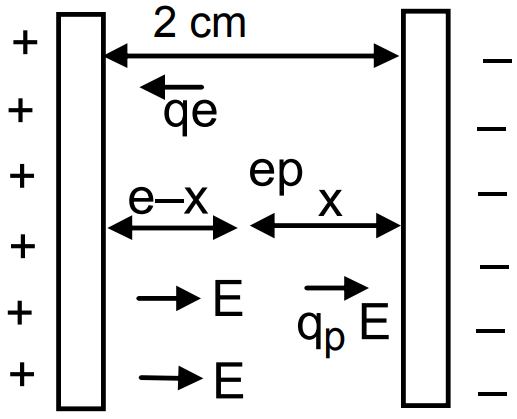
The plates of a capacitor are 2.00cm apart. An electronproton pair is released somewhere in the gap between the plates and it is found that the proton reaches the negative plate at the same time as the electron reaches the positive plate. At what distance from the negative plate was the pair released?
Answer

The acceleration of electron $\text{a}_{\text{e}}=\frac{\text{qeme}}{\text{Me}}$
The acceleration of proton $=\frac{\text{qpe}}{\text{Mp}}=\text{ap}$
The distance travelled by proton $\text{X}=\frac{1}{2}\text{apt}^2\ \dots(1)$
The distance travelled by electron ...(2)
From (1) and (2)
$\Rightarrow2-\text{X}=\frac{1}{2}\text{a}_{\text{c}}\text{t}^2$
$\text{x}=\frac{1}{2}\text{a}_{\text{c}}\text{t}^2$
$\Rightarrow\frac{\text{x}}{2-\text{x}}=\frac{\text{a}_{\text{p}}}{\text{a}_{\text{c}}}=\frac{\big(\frac{\text{q}_{\text{p}\text{E}}}{\text{M}_{\text{p}}}\big)}{\big(\frac{\text{q}_{\text{c}\text{F}}}{\text{M}_{\text{c}}}\big)}$
$=\frac{\text{x}}{2-\text{x}}=\frac{\text{M}_{\text{c}}}{\text{M}_{\text{p}}}=\frac{9.1\times10^{-31}}{1.67\times10^{-27}}$
$=\frac{9.1}{1.67}\times10^{-4}=5.449\times10^{-4}$
$\Rightarrow\text{x}=10.898\times10^{-4}-5.449\times10^{-4}\text{x}$
$\Rightarrow\text{x}=\frac{10.898\times10^{-4}}{1.0005449}=0.001089226$
View full question & answer
Question 485 Marks
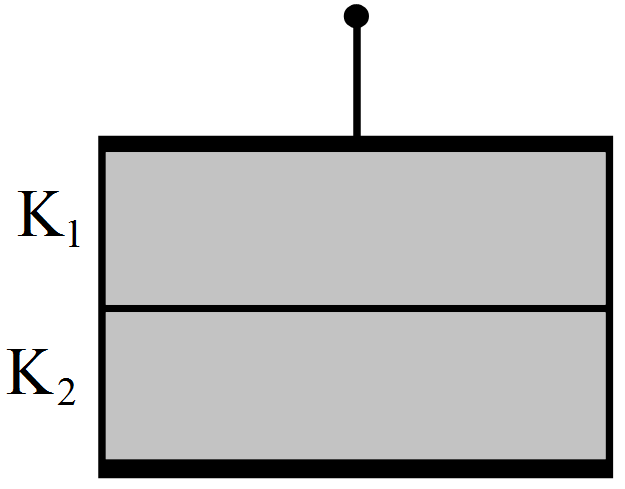
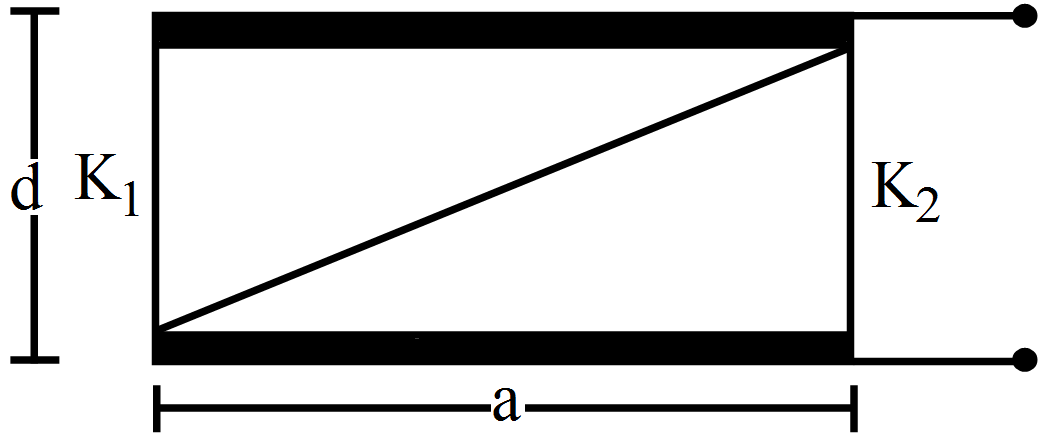
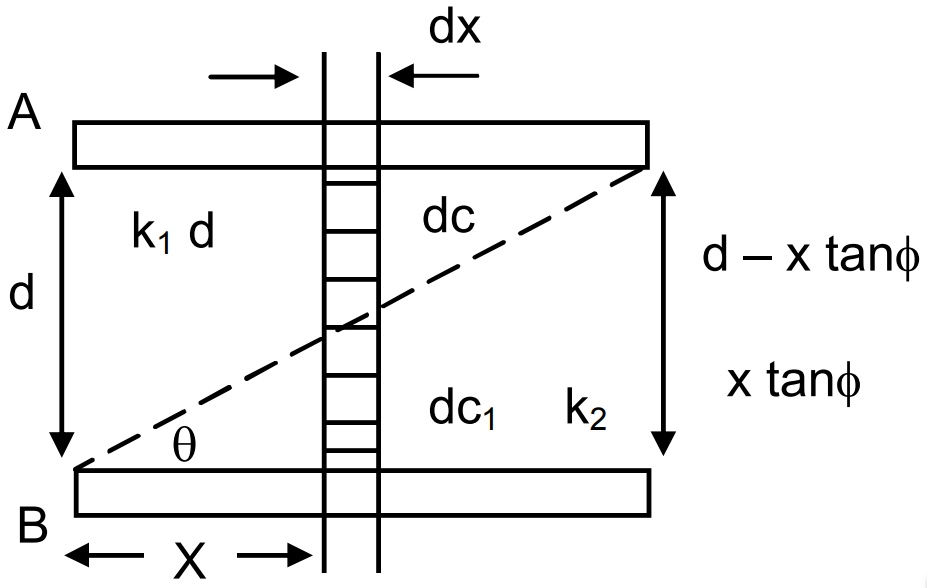
A capacitor is formed by two square metal-plates of edge a, separated by a distance d. Dielectrics of dielectric constants $K_1$ and $K_2$ are filled in the gap as shown in figure. Find the capacitance.
Answer


Consider an elemental capacitor of with dx our at a distance ‘x’ from one end. It is constituted of two capacitor elements of dielectric constants $k_1$ and $k_2$ with plate separation $\text{x}\tan\phi$ and $\text{d}-\text{x}\tan\phi$ respectively in series.
$\frac{1}{\text{dcR}}=\frac{1}{\text{dc}_1}+\frac{1}{\text{dc}_2}=\frac{\text{x}\tan\phi}{\in_0\text{k}_2(\text{bdx})}+\frac{\text{d}-\text{x}\tan\phi}{\in_0\text{k}_1(\text{bdx})}$
$\text{dcR}=\frac{\in_0\text{bdx}}{\frac{\text{x}\tan\phi}{\text{k}_2}+\frac{(\text{d}-\text{x}\tan\phi)}{\text{k}_1}}$
$\text{C}_{\text{R}}=\in_0\text{bk}_1\text{k}_2\int\frac{\text{dx}}{\text{k}_2\text{d}+(\text{k}_1+\text{k}_2)\text{x}\tan\phi}$
$=\frac{\in_0\text{bk}_1\text{k}_2}{\tan\phi(\text{k}_1-\text{k}_2)}[\log_{\text{e}}\text{k}_2\text{d}+(\text{k}_1+\text{k}_2)\text{x}\tan\phi]\text{a}$
$=\frac{\in_0\text{bk}_1\text{k}_2}{\tan\phi(\text{k}_1-\text{k}_2)}[\log_{\text{e}}\text{k}_2\text{d}+(\text{k}_1+\text{k}_2)\text{a}\tan\phi-\log_{\text{e}}\text{k}_2\text{d}]$
$\therefore\tan\phi=\frac{\text{c}}{\text{a}}$ and $\text{A}=\text{a}\times\text{a}$
$\text{C}_{\text{R}}=\frac{\in_0\text{ak}_1\text{k}_2}{\frac{\text{d}}{\text{a}}(\text{k}_1-\text{k}_2)}$ $\Big[\log_{\text{e}}\Big(\frac{\text{k}_1}{\text{k}_2}\Big)\Big]$
$\text{C}_{\text{R}}=\frac{\in_0\text{a}^2\text{k}_1\text{k}_2}{\text{d}(\text{k}_1-\text{k}_2)}$ $\Big[\log_{\text{e}}\Big(\frac{\text{k}_1}{\text{k}_2}\Big)\Big]$
$\text{C}_{\text{R}}=\frac{\in_0\text{a}^2\text{k}_1\text{k}_2}{\text{d}(\text{k}_1-\text{k}_2)}$ $\text{ln}\frac{\text{k}_1}{\text{k}_2}$
View full question & answer
Question 495 Marks
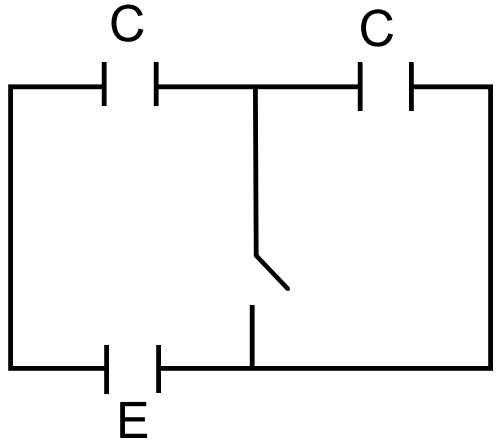
Consider the situation shown in figure. The switch S is open for a long time and then closed:
  1. Find the charge flown through the battery when the switch S is closed.
  2. Find the work done by the battery.
  3. Find the change in energy stored in the capacitors.
  4. Find the heat developed in the system.
Answer
  1. Since the switch was open for a long time, hence the charge flown must be due to the both, when the switch is closed.
$\text{C}_\text{ef}=\frac{\text{C}}{2}$

so $\text{q}=\frac{\text{E}\times\text{C}}{2}$
  1. Workdone
$=\text{q}\times\text{v}=\frac{\text{EC}}{2}\times\text{E}=\frac{\text{E}^2\text{C}}{2}$
  1. $\text{E}_{\text{i}}=\frac{1}{2}\times\frac{\text{C}}{2}\times\text{E}^2=\frac{\text{E}^2\text{C}}{4}$
$\text{E}_{\text{f}}=\frac{1}{2}\times\text{C}\times\text{E}^2=\frac{\text{E}^2\text{C}}{2}$

$\text{E}_{\text{i}}-\text{E}_{\text{j}}=\frac{\text{E}^2\text{C}}{4}$
  1. The net charge in the energy is wasted as heat.
View full question & answer