Questions · Page 2 of 2

5 Marks Questions

Question 515 Marks
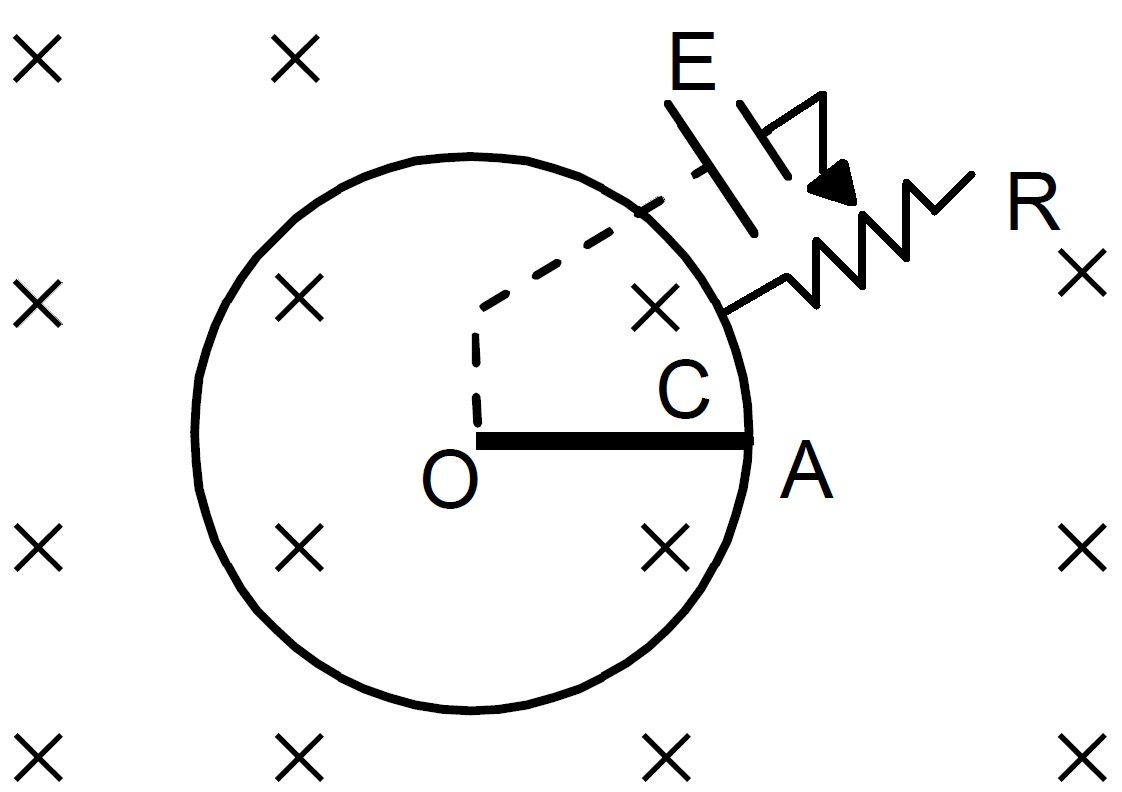
Figure shows a situation similar to the previous problem. All parameters are the same except that a battery of emf $\epsilon$ and a variable resistance R are connected between O and C. The connecting wires have zero resistance. No external force is applied on the rod (except gravity, forces by the magnetic field and by the pivot). In what way should the resistance R be changed so that the rod may rotate with uniform angular velocity in the clockwise direction? Express your answer in terms of the given quantities and the angle $\theta$ made by the rod OA with the horizontal.
Answer
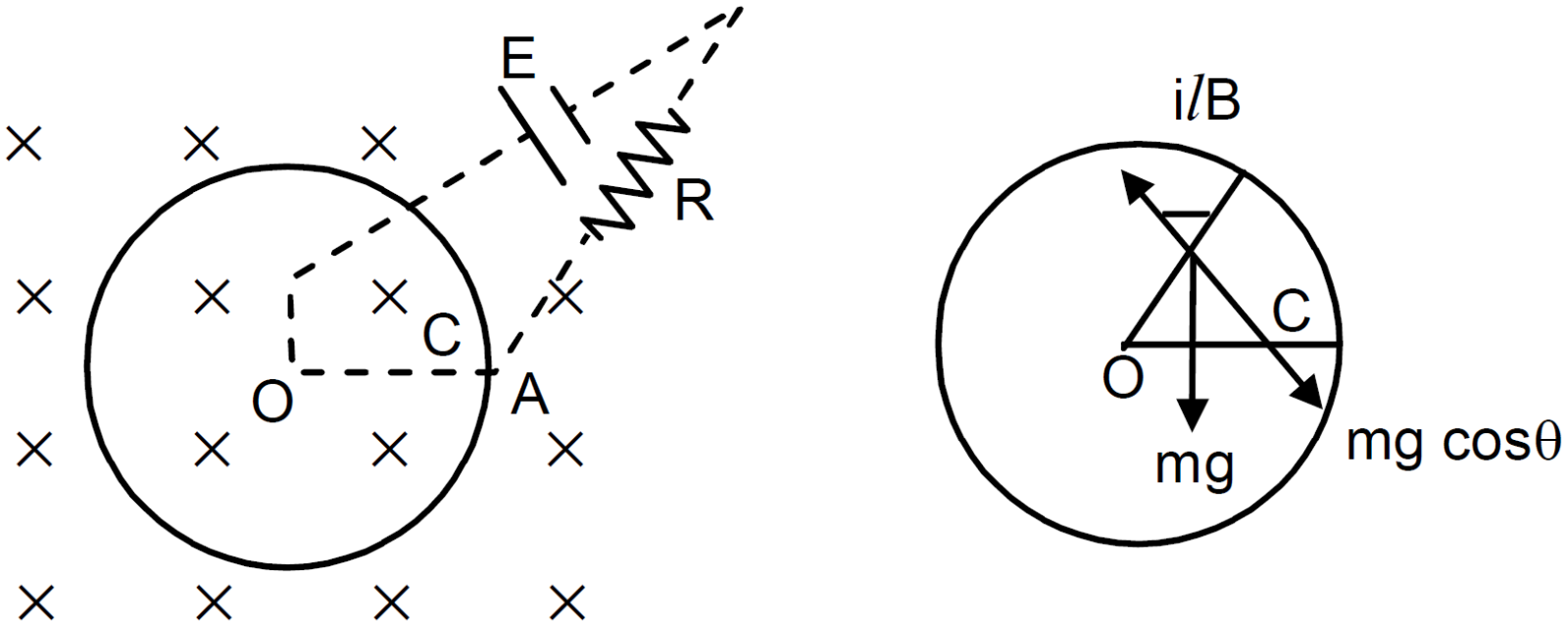
$\text{emf}=\frac{1}{2}\text{B}\omega\text{a}^2$ [from previous problem]
Current $= \frac{\text{e}+\text{E}}{\text{R}}=\frac{\frac{1}{2}\times\text{B}\omega\text{a}^2+\text{E}}{\text{R}}$
$=\frac{\text{B}\omega\text{a}^2 +2\text{E}}{2\text{R}}$
$\Rightarrow \text{mg} \cos \theta =\text{ilB}$ [Net force acting on the rod is O]
$\Rightarrow \text{mg}\cos\theta =\frac{\text{B}\omega\text{a}^2+2\text{E}}{2\text{R}}\text{a}\times\text{B}$
$\Rightarrow \text{R}=\frac{\big(\text{B}\omega\text{a}^2+2\text{E}\big)\text{ab}}{2\text{mg}\cos\theta}$
View full question & answer
Question 525 Marks
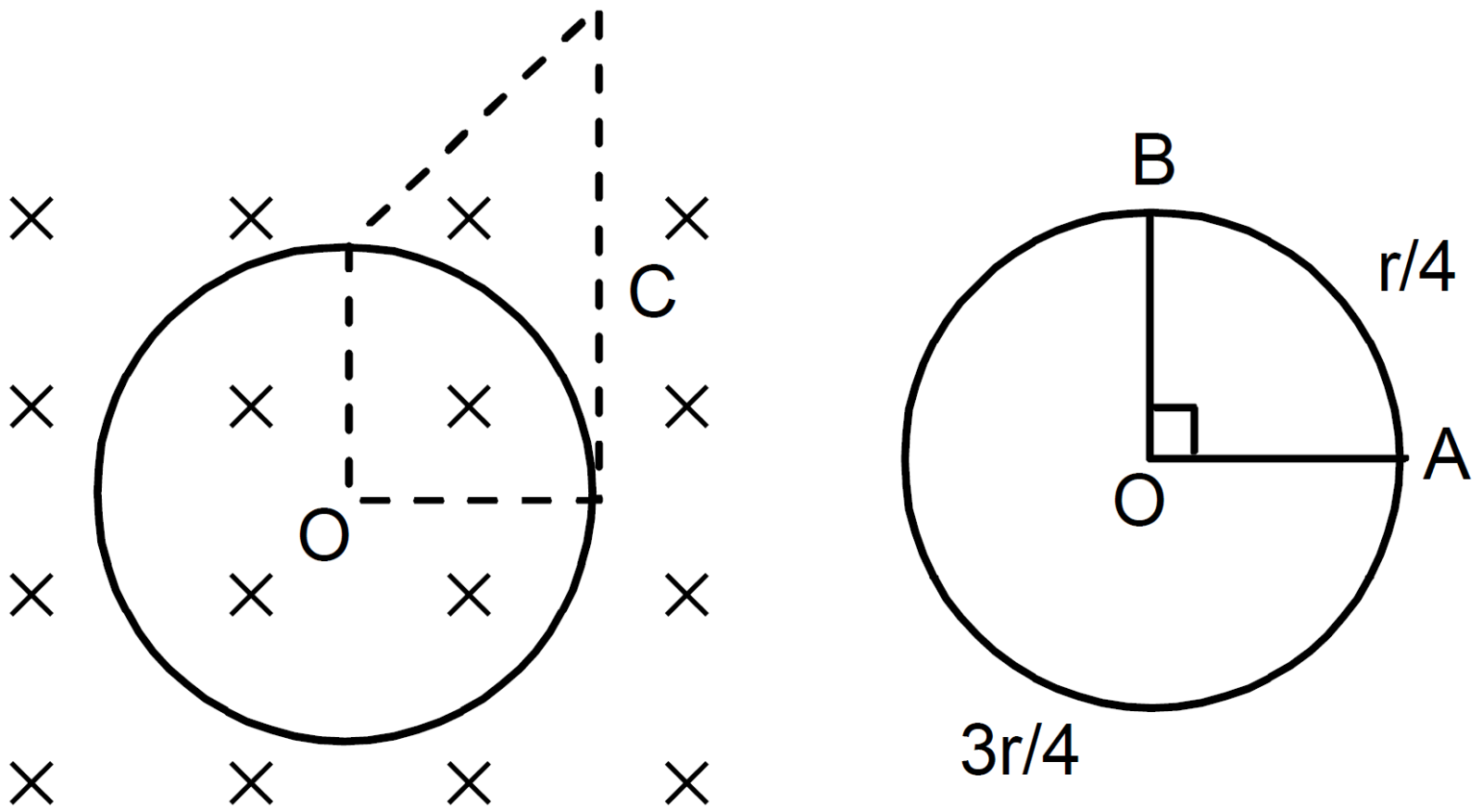
Consider the situation shown in the figure of the previous problem. Suppose the wire connecting O and C has zero resistance but the circular loop has a resistance R uniformly distributed along its length. The rod OA is made to rotate with a uniform angular speed $\omega$ shown in the figure. Find the current in the rod when $\angle\text{AOC}=90^{\circ}$
Answer

The 2 resistances $\frac{\text{r}}{4}$ and $\frac{3\text{r}}{4}$ are in parallel.
$\text{R}'=\frac{\frac{\text{r}}{4}\times\frac{3\text{r}}{4}}{\text{r}}=\frac{3\text{r}}{16} $
$\text{e}=\text{Bvl}$
$=\text{B}\times\frac{\text{a}}{2}\omega\times\text{a}=\frac{\text{B}\text{a}^2\omega}{2}$
$\text{i}=\frac{\text{e}}{\text{R}'}=\frac{\text{B}\text{a}^2\omega}{2\text{R}'}=\frac{\text{B}\text{a}^2\omega}{2\times\frac{3\text{r}}{16}}$
$=\frac{\text{ba}^2\omega16}{2\times\text{3}\text{r}}=\frac{8}{3}\frac{\text{Ba}^2\omega}{\text{r}}$
View full question & answer
Question 535 Marks
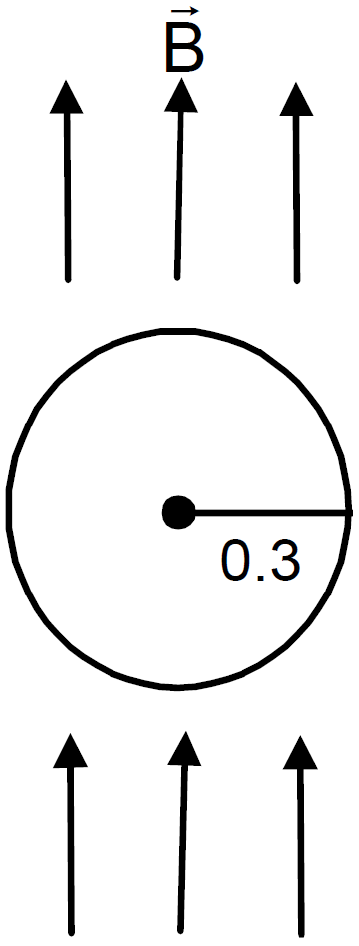
A bicycle is resting on its stand in the east$-$west direction and the rear wheel is rotated at an angular speed of $100$ revolutions per minute. If the length of each spoke is $30.0\ cm$ and the horizontal component of the earth's magnetic field is $2.0 \times 10^{-5} T,$ find the emf induced between the axis and the outer end of a spoke. Neglect centripetal force acting on the free electrons of the spoke.
Answer

$\text{l}=0.3\text{m},\vec{\text{B}}=2.0\times10^{-5}\text{T},\omega=100 \ \text{rpm}$
$\text{v}=\frac{100}{60}\times2\pi=\frac{10}{3}\pi \ \text{rad}/\text{s}$
$\text{v}=\frac{\text{l}}{2}\times\omega=\frac{0.3}{2}\times\frac{10}{3}\pi$
$\text{Emf}=\text{e}=\text{BlV}$
$=2.0\times10^{-5}\times0.3\times\frac{0.33}{2}\times\frac{10}{3}\pi$
$=3\pi\times10^{-6}\text{V}$
$=3\times3.14\times10^{-6}\text{V}$
$=9.42\times10^{-6}\text{V}.$
View full question & answer
Question 545 Marks
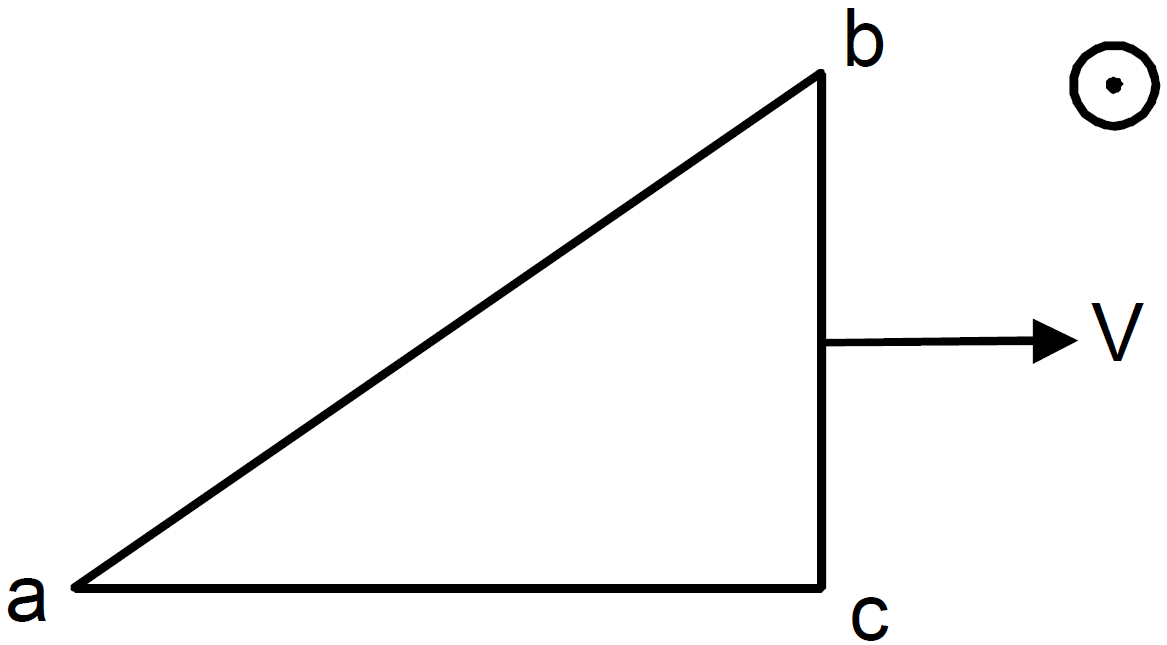
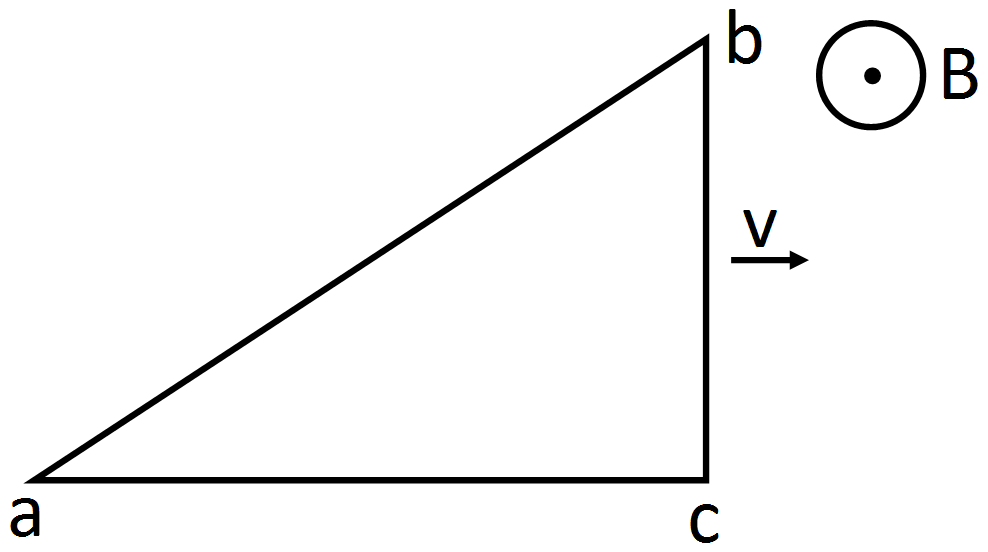
A right-angled triangle abc, made from a metallic wire, moves at a uniform speed v in its plane as shown in figure. A uniform magnetic field B exists in the perpendicular direction. Find the emf induced:
  1. In the loop abc.
  2. In the segment bc.
  3. In the segment ac.
  4. In the segment ab.
Answer

  1. Zero as the components of ab are exactly opposite to that of bc. So they cancel each other. Because velocity should be perpendicular to the length.
  2. e = Bv × l
= Bv(bc) + ve at C
  1. e = 0 as the velocity is not perpendicular to the length.
  2. e = Bv(bc) positive at ‘a’.
i.e. the component of ‘ab’ along the perpendicular direction.
View full question & answer
Question 555 Marks
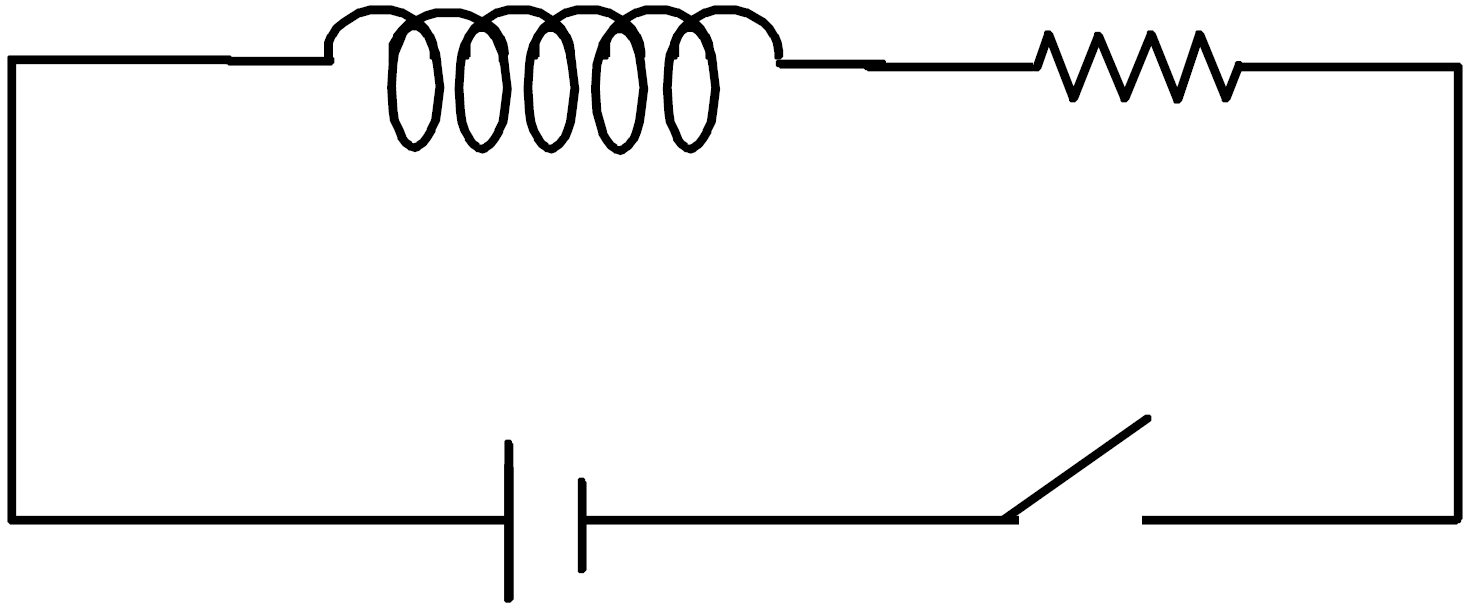
An inductor of inductance 5.0H, having a negligible resistance, is connected in series with a $100\Omega$ resistor and a battery of emf 2.0V. Find the potential difference across the resistor 20ms after the circuit is switched on.
Answer

$\text{L}=5.0\text{H}, \ \text{R}=100\Omega, \ \text{emf}=2.0\text{v}$
$\text{t}=20\text{ms}=20\times10^{-3}\text{s}=2\times10^{-2}\text{s }$
$\text{i}_0=\frac{2}{100} \ \text{now} \ \text{i}=\text{i}_0\Big(1-\text{e}^\frac{-t}{\tau}\Big) $
$\tau=\frac{\text{L}}{\text{R}}=\frac{5}{100} $
$\Rightarrow\text{i}=\frac{2}{100}\Big(1-\text{e}^\frac{-2\times10^2\times100}{5}\Big)$
$\Rightarrow\text{i}=\frac{2}{100}\Big(1-\text{e}^\frac{-2}{5}\Big) $
$\Rightarrow 0.00659=0.0066 $
$\text{V}=\text{iR}=0.006 \times100\ =0.66\text{V. }$
View full question & answer
Question 565 Marks
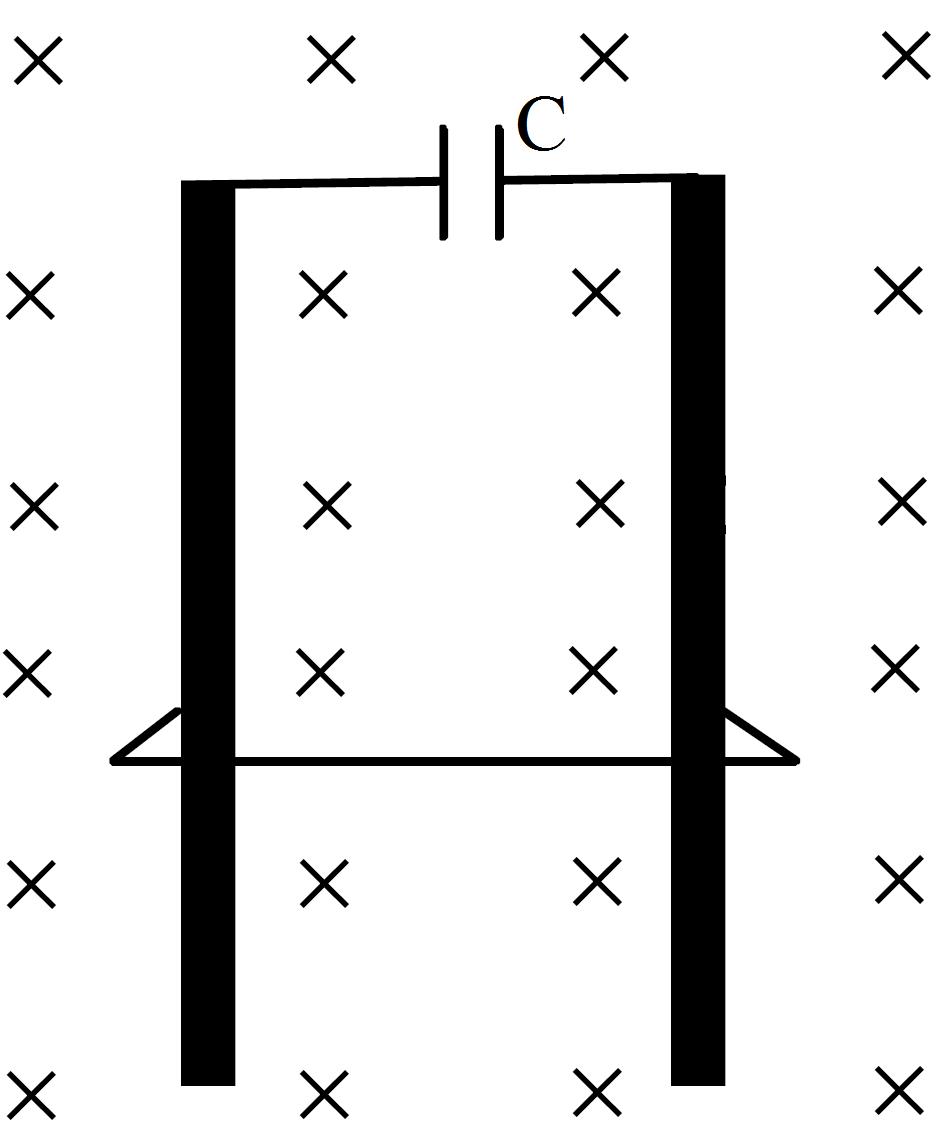
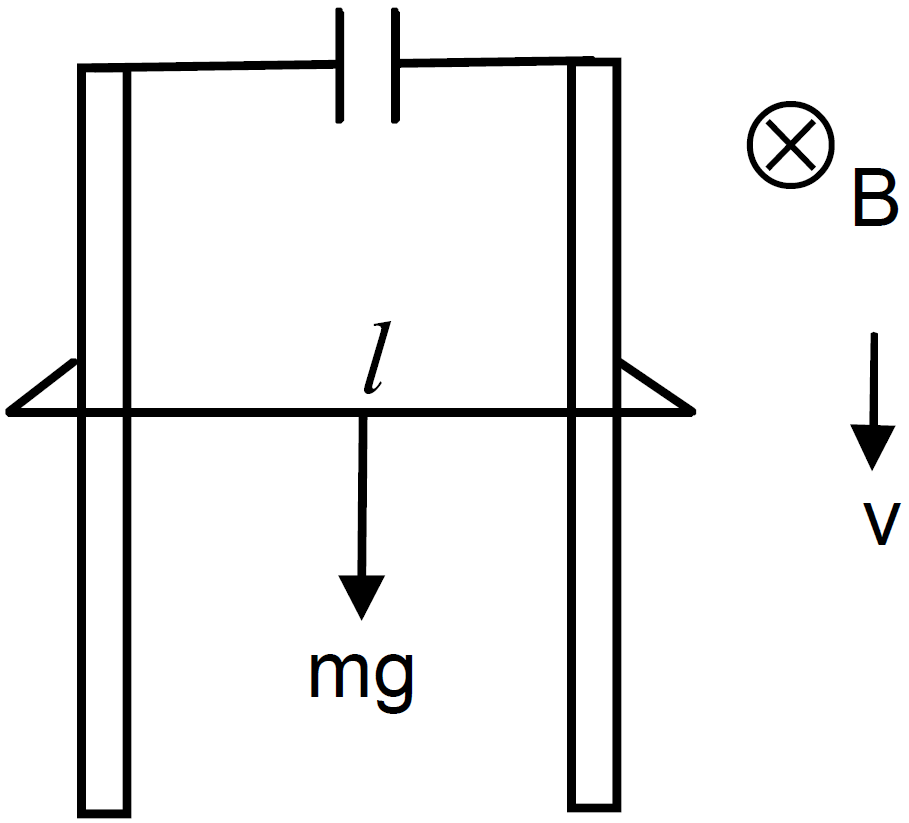
A wire of mass m and length l can slide freely on a pair of smooth, vertical rails (figure). A magnetic field B exists in the region in the direction perpendicular to the plane of the rails. The rails are connected at the top end by a capacitor of capacitance C. Find the acceleration of the wire neglecting any electric resistance.
Answer

Let the rod has a velocity v at any instant,
Then, at the point,
e = Blv
Now, q = c × potential = ce = CBlv
Current $\text{l}=\frac{\text{dq}}{\text{dt}}=\frac{\text{d}}{\text{dt}}\text{CBlv}$
$\text{CBl}\frac{\text{dv}}{\text{dt}}=\text{CBla}$ (where a → acceleration)
From figure, force due to magnetic field and gravity are opposite to each other.
So, mg – IlB = ma
$\Rightarrow\text{mg}-\text{CBla}\times\text{lB}=\text{ma}$
$\Rightarrow\text{ma}+\text{CB}^2\text{l}^2\text{a}=\text{mg}$
$\Rightarrow\text{a}\big(\text{m}+\text{CB}^2\text{l}^2\big)=\text{mg}$
$\Rightarrow \text{a}=\frac{\text{mg}}{\text{m}+\text{CB}^2\text{l}^2}$
View full question & answer
Question 575 Marks
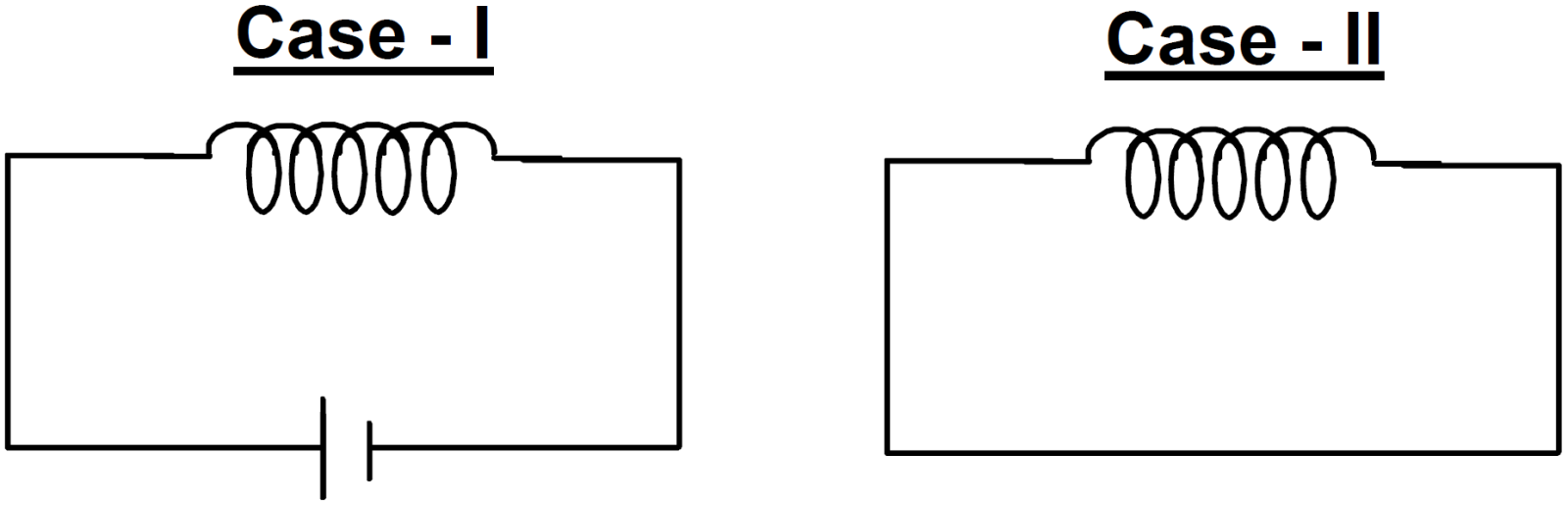
A constant current exists in an inductor-coil connected to a battery. The coil is short-circuited and the battery is removed. Show that the charge flown through the coil after the short-circuiting is the same as that which flows in one time constant before the short-circuiting.
Answer

In this case there is no resistor in the circuit.
So, the energy stored due to the inductor before and after removal of battery remains same. i.e.
$\text{V}_1=\text{V}_2=\frac{1}{2}\text{Li}^2$
So, the current will also remain same.
Thus charge flowing through the conductor is the same.
View full question & answer
Question 585 Marks
A square-shaped copper coil has edges of length 50cm and contains 50 turns. It is placed perpendicular to a 1.0T magnetic field. It is removed from the magnetic field in 0·25s and restored in its original place in the next 0·25s. Find the magnitude of the average emf induced in the loop during:
  1. Its removal.
  2. Its restoration.
  3. Its motion.
Answer
  1. During its removal.
$\phi_1=\text{B.A.}=1\times50\times0.5-25\times0.5=12.5 \ \text{Tesla-m}^2$
$\phi_2=0, \ \tau=0.25$
$\text{e}=-\frac{\text{d}\phi}{\text{dt}}=\frac{\phi_2-\phi_1}{\text{dt}}=\frac{12.5}{0.25}=\frac{125\times10^{-1}}{25\times10^{-2}}=50\text{V}$
  1. During its restoration.
$\phi_1=0; \ \phi_2=12.5 \ \text{Tesla-m}^2; \ \text{t}=0.25\text{s}$
$\text{E}=\frac{12.5-0}{0.25}=50\text{V}$
  1. During its motion.
$\phi_1=0, \ \phi_2=0$
$\text{E}=\frac{\text{d}\phi}{\text{dt}}=0$
View full question & answer
Question 595 Marks
Consider a situation similar to that of the previous problem except that the ends of the rod slide on a pair of thick metallic rails laid parallel to the wire. At one end the rails are connected by resistor of resistance R.
  1. What force is needed to keep the rod sliding at a constant speed v?
  2. In this situation what is the current in the resistance R?
  3. Find the rate of heat developed in the resistor.
  4. Find the power delivered by external agent exerting the force on the rod.
Answer

  1. Emf produced due to the current carrying wire $=\frac{\mu_0\text{vi}}{2\pi}\text{In}\Big(\frac{2\text{x}+\text{l}}{2\text{x}-\text{l}}\Big)$
Let current produced in the rod $=\text{i}'=\frac{\mu_0\text{iv}}{2\pi\text{R}}\text{In}\Big(\frac{2\text{x}+\text{l}}{2\text{x}-\text{l}}\Big)$
Force on the wire considering a small portion dx at a distance x
$\text{dF}=\text{i}'\text{B}\text{l} $
$\Rightarrow\text{dF}=\frac{\mu_0\text{iv}}{2\pi\text{r}}\text{In}\Big(\frac{2\text{x}+\text{l}}{2\text{x}-\text{l}}\Big)\times\frac{\mu_0\text{i}}{2\pi\text{x}}\times\text{dx}$
$\Rightarrow\text{dF}=\Big(\frac{\mu_0\text{i}}{2\pi}\Big)^2\frac{\text{V}}{\text{R}}\text{In}\Big(\frac{2\text{x}+\text{l}}{2\text{x}-\text{l}}\Big)\frac{\text{dx}}{\text{x}}$
$\Rightarrow\text{F}=\Big(\frac{\mu_0\text{i}}{2\pi}\Big)^2\frac{\text{V}}{\text{R}}\text{In}\Big(\frac{2\text{x}+\text{l}}{2\text{x}-\text{l}}\Big)\int\limits^{\text{x}+\frac{\text{t}}{2}}_{\text{x}-\frac{\text{t}}{2}}\frac{\text{dx}}{\text{x}}$
$=\Big(\frac{\mu_0\text{i}}{2\pi}\Big)^2\frac{\text{V}}{\text{R}}\text{In}\Big(\frac{2\text{x}+\text{l}}{2\text{x}-\text{l}}\Big)\text{In}\Big(\frac{2\text{x}+\text{l}}{2\text{x}-\text{l}}\Big)$
$=\frac{\text{V}}{\text{R}}\Big[\frac{\mu_0\text{i}}{2\pi}\text{In}\Big(\frac{2\text{x}+\text{l}}{2\text{x}-\text{l}}\Big)\Big]^2$
  1. Current $=\frac{\mu_0\text{In}}{2\pi\text{R}}\text{In}\Big(\frac{2\text{x}+\text{l}}{2\text{x}-\text{l}}\Big)$
  2. Rate of heat developed $=\text{i}^2\text{R}$
 $=\Big[\frac{\mu_0\text{iv}}{2\pi\text{R}}\Big(\frac{2\text{x}+\text{l}}{2\text{x}-\text{l}}\Big)\Big]^2\text{R}=\frac{1}{\text{R}}\Big[\frac{\mu_0\text{iv}}{2\pi}\text{In}\Big(\frac{2\text{x}+\text{l}}{2\text{x}-\text{l}}\Big)^2\Big]$
  1. Power developed in rate of heat developed $=\text{i}^2\text{R}$
$=\frac{1}{\text{R}}\Big[\frac{\mu_0\text{vi}}{2\pi}\text{In}\Big(\frac{2\text{x}+\text{l}}{2\text{x}-\text{l}}\Big)\Big]^2$
View full question & answer
Question 605 Marks
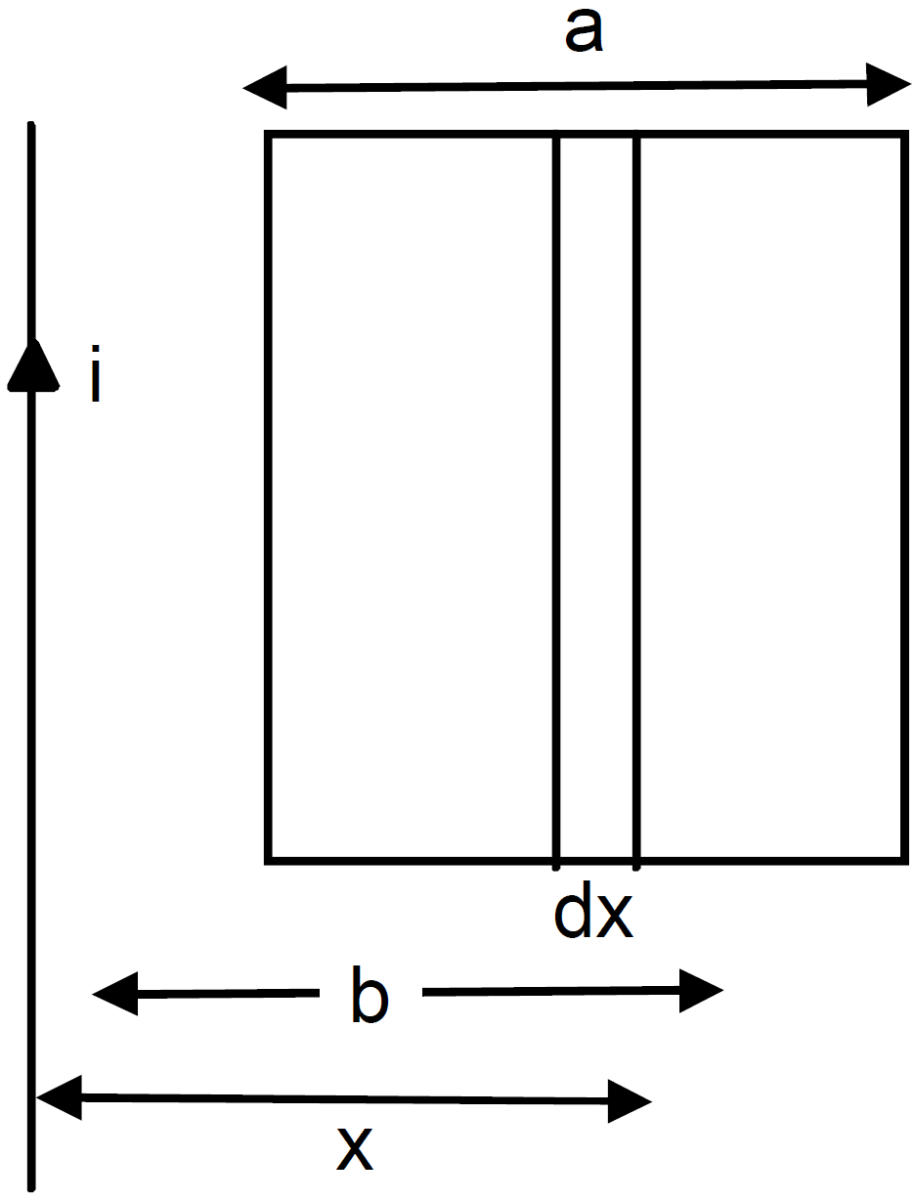
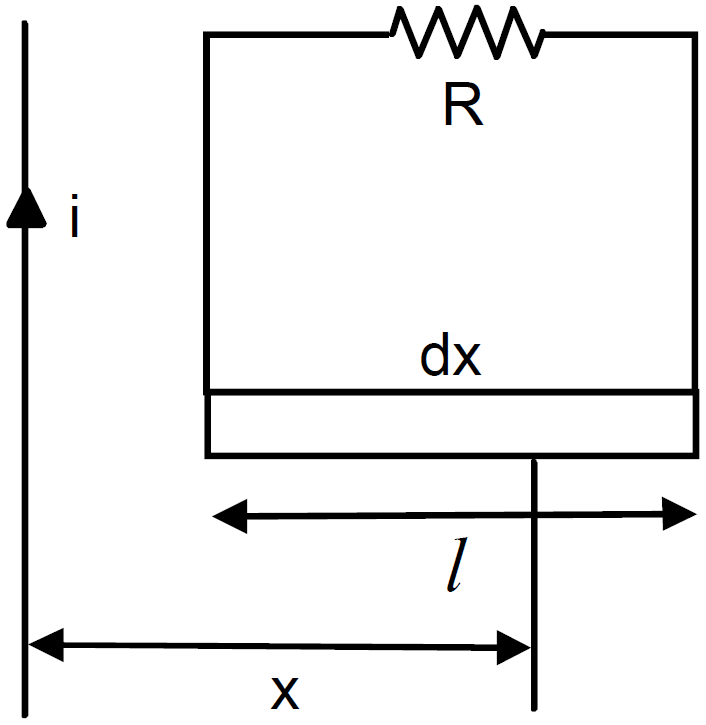
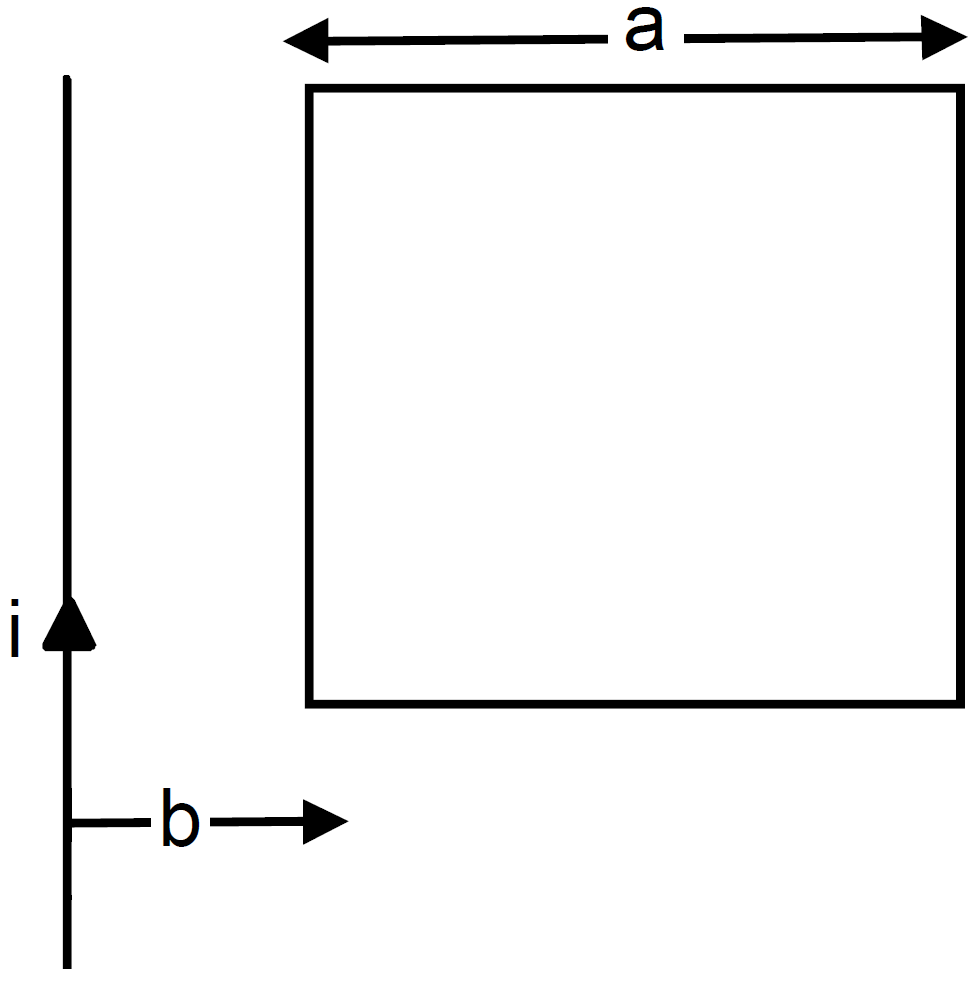
Figure shows a square frame of wire having a total resistance r placed coplanarly with a long, straight wire. The wire carries a current i given by $\text{i}=\text{i}_0\sin\omega\text{t}.$ Find
  1. The flux of the magnetic field through the square frame.
  2. The emf induced in the frame.
  3. The heat developed in the frame in the time interval 0 to $\frac{20\pi}{\omega}.$
Answer

Considering an element dx at a dist x from the wire. We have
  1. $\phi=\text{B.A.}$
$\text{d}\phi=\frac{\mu_0\text{i}\times\text{adx}}{2\pi\text{x}}$
$\phi=\int\limits^\text{a}_0\text{d}\phi=\frac{\mu_0\text{ia}}{2\pi}\int\limits^{\text{a}+\text{b}}_\text{b}\frac{\text{dx}}{\text{x}}=\frac{\mu_0\text{ia}}{2\pi}\text{In}\left\{1+\frac{\text{a}}{\text{b}}\right\}$
  1. $\text{e}=\frac{\text{d}\phi}{\text{dt}}=\frac{\text{d}}{\text{dt}}\frac{\mu_0\text{ia}}{2\pi}\text{In}\Big[1+\frac{\text{a}}{\text{b}}\Big]$
$=\frac{\mu_0\text{a}}{2\pi}\text{In}\Big[1+\frac{\text{a}}{\text{n}}\Big]\frac{\text{d}}{\text{dt}}(\text{i}_0\sin\omega\text{t})$
$=\frac{\mu_0\text{ai}_0\omega\cos\omega\text{t}}{2\pi}\text{In}\Big[1+\frac{\text{a}}{\text{b}}\Big]$
  1. $\text{i}=\frac{\text{e}}{\text{r}}=\frac{\mu_0\text{ai}_0\omega\cos\omega\text{t}}{2\pi\text{r}}\text{In}\Big[1+\frac{\text{a}}{\text{b}}\Big]$
$\text{H}=\text{i}^2\text{rt}$
$=\Big[\frac{\mu\text{ai}_0\omega\cos\omega\text{t}}{2\pi\text{r}}\text{In}\Big(1+\frac{\text{a}}{\text{b}}\Big)\Big]^2\times\text{r}\times\text{t}$
$=\frac{\mu_0^2\times\text{a}^2\times\text{i}^2_0\times\omega^2}{4\pi\times\text{r}^2}\text{In}^2\Big[1+\frac{\text{a}}{\text{b}}\Big]\times\text{r}\times\text{}\frac{20\pi}{\omega}$
$=\frac{5\mu_0^2\text{a}^2\text{i}^2_0\times\omega}{2\pi\text{r}}\text{In}^2\Big[1+\frac{\text{a}}{\text{b}}\Big] \ \Big[\therefore\text{t}=\frac{20\pi}{\omega}\Big]$
View full question & answer