Question
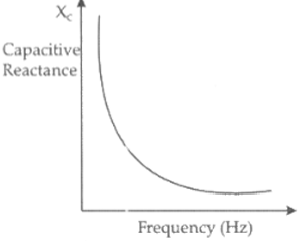
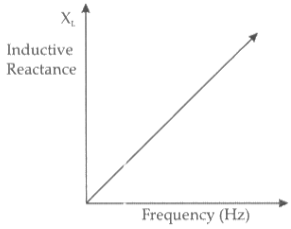
$a$. Draw graphs showing the variations of inductive reactance and capacitive reactance with the frequency of the applied ac source.
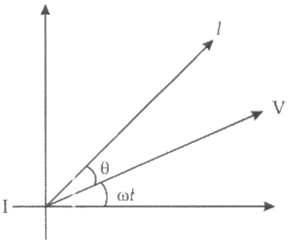
$b$. Draw the phasor diagram for a series $RC$ circuit connected to an ac source.
$c$. An alternating voltage of $220 V$ is applied across a device $X,$ a current of $0.25$ A flows, which lag behind the applied voltage in phase by $\frac{\pi}{2}$ radian. If the same voltage is applied across another device $Y,$ the same current flows but now it is in phase with the applied voltage.
$i$. Name the devices $X$ and $Y$.
$ii$. Calculate the current flowing in the circuit when the same voltage is applied across the series combination of $X$ and $Y$.
Answer

$a$. Drawing the two graphs the graph shows the variation of capacitive resistance with frequency and inductive resistance with frequency.
The two graphs are as shown
Image

Image
$b$. Drawing the phaser diagram
$($the current leads the voltage by an angle $\theta$ where $0<\theta<\frac{\pi}{2} )$.
The required phaser diagram is as shown.
Image
$[$Here, $\theta=\tan ^{-1}\left[\frac{1}{\omega C R}\right]$
$c.i$. In device $X$ :
Current lags behind the voltage by $\frac{\pi}{2}$
$\therefore X$ is an inductor.
In device $Y$ :
Current in phase with the applied voltage.
$\therefore Y$ is resistor.
$ii$. We are given that
$0.25=\frac{2 n 0}{X_L}$
or $ X _{ L }=\frac{2 n 0}{02} \Omega=880 \Omega$
Also $0.25=\frac{220}{X_R}$
$\therefore X_R=\frac{220}{0.25} \Omega=880 \Omega$
For the series combination of $X$ and $Y,$
Equivalent impedance $=\sqrt{X_L^2+X_R^2}=(880 \sqrt{2}) \Omega$
$\therefore $ Current flowing $ \frac{220}{880 \sqrt{2}} A=0.177 A$

Need a full question paper?

Generate a complete, print-ready paper with questions like this in minutes — across 16+ boards, with answer keys.

Start Generating Free

Similar questions

The difference in the frequencies of series limit of Lyman series and Balmer series is equal to the frequency of the first line of the Lyman series. Explain.
Determine the 'effective focal length' of the combination of the two lenses having focal lengths $30 \ cm$ and $-20\ cm$ if they are placed $8.0 \ cm$ apart with their principal axes coincident. Does the answer depend on which side of the combination a beam of parallel light is incident? Is the notion of effective focal length of this system useful at all?
(a) Derive the expression for the magnetic energy stored in a evil.
(b) Derive the expression for the mutual inductance between two plane coils.
Describe $p-n-p$ transistor as an amplifier in common emitter configuration with proper circuit diagram.
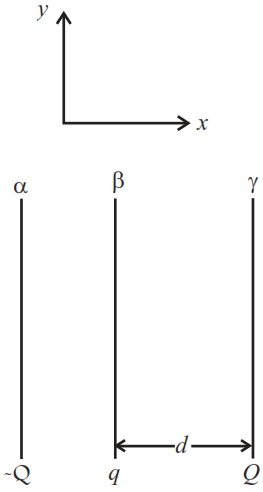
Two fixed, identical conducting plates $(\alpha\ \&\ \beta)$, each of surface area S are charged to -Q and q, respectively, where Q > q > 0. A third identical plate $(\gamma)$, free to move is located on the other side of the plate with charge q at a distance d (Fig.). The third plate is released and collides with the plate $\beta$. Assume the collision is elastic and the time of collision is sufficient to redistribute charge amongst $\beta\ \&\ \gamma$.

Find the electric field acting on the plate $\gamma$ before collision.
What is meant by electric potential? Calculate the electric potential generated by a point charge. Draw the equipotential surfaces resulting from this.
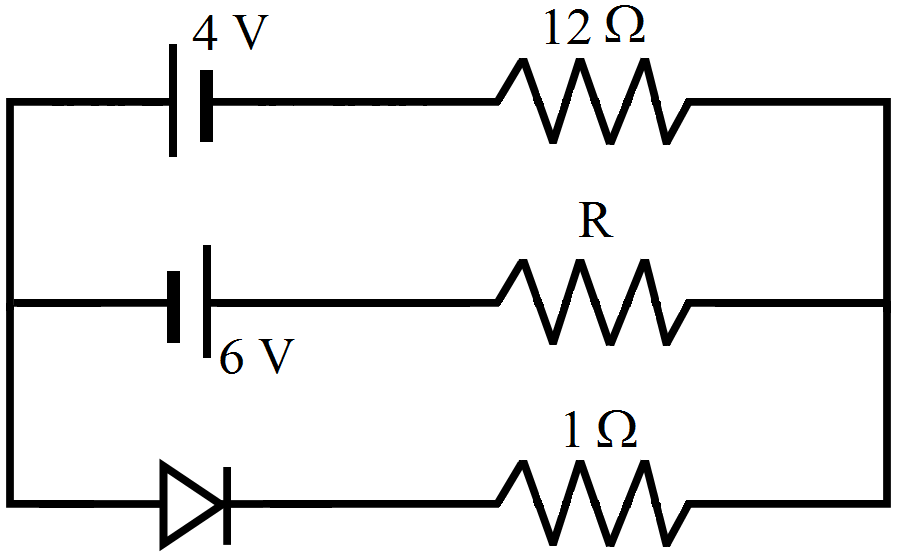
Find the current through the resistance R in figure. if.
  1. $\text{R}=12\Omega$
  2. $\text{R}=48\Omega$
The inverse square law in electrostatics is $|\text{F}|=\frac{\text{e}^2}{(4\pi\epsilon_0)\text{r}^2}$ for the force between an electron and a proton. The $\Big(\frac{1}{\text{r}}\Big)$ dependence of $|F|$ can be understood in quantum theory as being due to the fact that the 'particle' of light $($photon$)$ is massless. If photons had a mass $m_p$, force would be modified to $|\text{F}|=\frac{\text{e}^2}{(4\pi\epsilon_0)\text{r}^2}\Big[\frac{1}{\text{r}^2}+\frac{\lambda}{\text{r}}\Big].\text{e}\times\text{p}(-\lambda\text{r})$ where $\lambda=\frac{\text{m}_\text{p}\text{c}}{\text{h}}$ and $\text{h}=\frac{\text{h}}{2\pi}$. Estimate the change in the ground state energy of a $H-$ atom if $m_p$ were $10^{-6}$ times the mass of an electron.


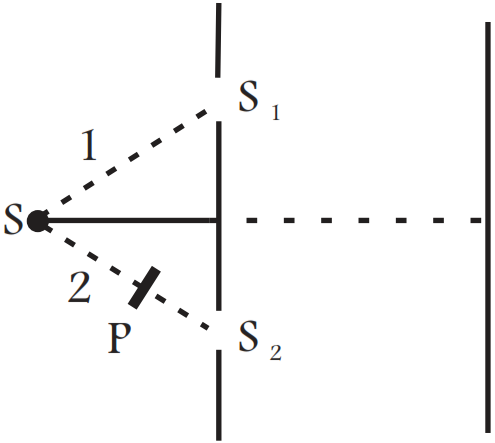
Figure shown a two slit arrangement with a source which emits unpolarised light. $P$ is a polariser with axis whose direction is not given. If $I_0$ is the intensity of the principal maxima when no polariser is present, calculate in the present case, the intensity of the principal maxima as well as of the first minima.
A circuit containing a $80\ mH$ inductor and a $60 \mu\  F$ capacitor in series is connected to a $230\ V, 50 \ Hz$ supply. The resistance of the circuit is negligible.
$a.$ Obtain the current amplitude and rms values.
$b.$ Obtain the rms values of potential drops across each element.
$c.$ What is the average power transferred to the inductor?
$d.$ What is the average power transferred to the capacitor?
$e.$ What is the total average power absorbed by the circuit? $[$‘Average’ implies ‘averaged over one cycle’.$]$