Question 13 Marks
Show that the following pairs are co-primes:$385, 621$
AnswerGiven numbers are $385$ and $621$.$\begin{array}{c|c}5&385\\\hline7&77\\\hline11&11\\\hline&1\end{array}$
$\begin{array}{c|c}3&621\\\hline3&207\\\hline3&69\\\hline23&23\\\hline&1\end{array}$
$385=5\times7\times11\times1$
$621=3\times3\times3\times23=3^3\times23\times1$
$\therefore HCF = 1$
Hence, they are co-primes.
View full question & answer→Question 23 Marks
Test the divisibility of $5869473$ by $11.$
Answer$5869473A$ number is divisible by $11$ if the the difference of the sums of the digits at the odd places and that at the even places (starting from ones place) is either $0$ or a multiple of $11.$
Sum of the digits at even places $= 7 + 9 + 8$
$= 24$
Sum of the digits in odd places $= 3 + 4 + 6 + 5$
$= 18$
Difference $= 24 - 18$
$= 6$
Since $6$ is not divisible by $11, 5869473$ is not divisible by $11.$
View full question & answer→Question 33 Marks
Find the greatest number which divides $2011$ and $2623$, leaving remainders $9$ and $5$ respectively.
AnswerClearly, we have to find the number which exactly divides $(2011 - 9)$ and $(2623 - 5).$
So, the required numbers is the $HCF$ of $2002$ and $2618.$
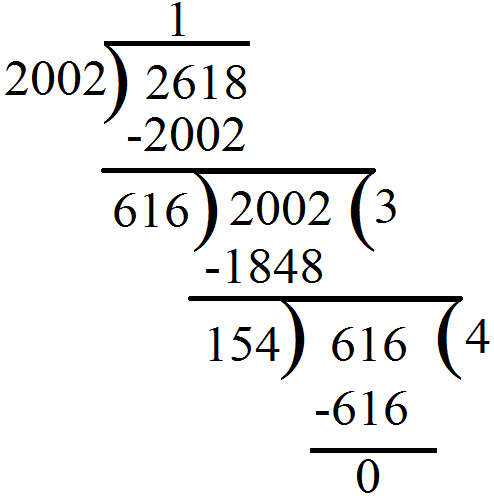
$\therefore$ The required number is $154.$ View full question & answer→Question 43 Marks
In the following numbers, replace * by the smallest number to make it divisible by $11: 26*5$
Answer26*5 Sum of the digits at odd places $= 5 + 6 = 11$
Sum of the digits at even places $= * + 2$
Difference $=$ sum of odd terms $-$ sum of even terms
$= 11 - (* + 2) = 11 - * - 2 = 9 - *$
Now, $(9 - *)$ will be divisible by $11$ if * $= 9.$
i.e., $9 - 9 = 0 0$ is divisible by $11.$
$\therefore * = 9$ Hence, the number is $2695.$
View full question & answer→Question 53 Marks
Determine the longest tape which can be used to measure exactly the lengths $7m, 3m, 85\ cm$ and $12m, 95\ cm.$
Answer$7m = 700\ cm 3m, 85\ cm = 385\ cm 12m, 95\ cm = 1395\ cm$
The required lenths of the tape that can measure the lenths $700\ cm, 385\ cm$ and $1295\ cm$
will given by the $HCF$ of $700\ cm, 385\ cm$ and $1295\ cm$.
Evaluating the $HCF$ of
$700, 385$ and $1295$ using prime fractorisation method,
we have:
$\begin{array}{c|c}2&700\\\hline2 &350\\\hline5&175\\\hline5&35\\\hline7&7\\\hline&1\end{array}$
$700=2\times2\times5\times5\times7=2^2\times5^2\times7$
$\begin{array}{c|c}5&1295\\\hline11&259\\\hline7&7\\\hline&1\end{array}$
$385=5\times11\times7$
$\begin{array}{c|c}5&1295\\\hline7&259\\\hline37&37\\\hline&1\end{array}$
$1295=5\times7\times37$
$\therefore$ Hence, the longest tape which can measure the lengths $7m, 3m, 85\ cm,$ and $12m, 95\ cm$ exactly is $35\ cm.$
View full question & answer→Question 63 Marks
Pair of numbers, werify that their product $= (HCF \times LCM) 87, 145$
Answer$87$ and $145$
$\begin{array}{c|c}3&87\\\hline29&29\\\hline&1\end{array}$
$\begin{array}{c|c}5&145\\\hline29&29\\\hline&1\end{array}$
We have: $87=3\times29$
$145=5\times29$
$HCF = 29 LCM =29\times15\times1=435$
Now, $HCF \times LCM =29\times435=12615$
Product of the two numbers $=87\times145=12615$
$\therefore HCF \times LCM =$ Product of the two numbers. Verified.
View full question & answer→Question 73 Marks
In the following numbers, replace * by the smallest number to make it divisible by $11: 467*91$
Answer467*91Sum of the digits at odd places $1 + * + 6 = 7 + *$
Sum of the digits at even places $9 + 7 + 4 = 20$
Difference = sum of odd terms - sum of even terms
$= (7 + *) - 20$
$= * - 13$
Now, $(* - 13)$ will be divisible by $11$ if * $= 2.$
$i.e., 2 - 13 = -11$
$-11$ is divisible by $11.$
$\therefore * = 2$
Hence, the number is $467291.$
View full question & answer→Question 83 Marks
Find the $HCF$ of the numbers in the following using the division method:$399, 437$
AnswerThe given numbers are $399$ and $437$.We have:
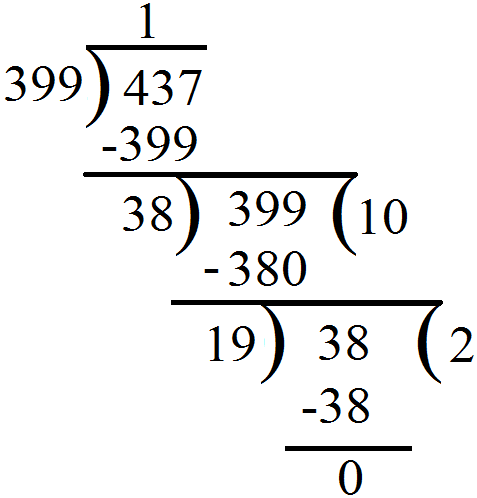
$\therefore$ The $HFC$ of $19.$ View full question & answer→Question 93 Marks
Find the $HCF$ and $LCM$ of:$693, 1078$
AnswerThe given numbers are $693$ and $1078.$ We have:
$\begin{array}{c|c}3&693\\\hline3&231\\\hline7&77\\\hline11&11\\\hline&1\end{array}$
$\begin{array}{c|c}2&1078\\\hline7&539\\\hline7&77\\\hline11&11\\\hline&1\end{array}$
Now, we have:
$693=3\times3\times7\times11$
$1078=2\times7\times7\times11$
$\therefore HCF =7\times11=77$
Also, $LCM =2\times3\times3\times7\times7\times11=9702$
View full question & answer→Question 103 Marks
Three pieces of timber, $42-m, 49-m$ and $63-m$ long, have to be devided into planks of the same length. What is the greatest possible length of each plank?
AnswerThe lengths of the three pieces of timber are $42-m, 49-m$ and $63-m$.
The greatest possible length of each plank will be given by the $HCF$ of $42, 49$ and $63.$
Firstly, we will find the $HCF$ of 4$2$ and $49$ by division method.
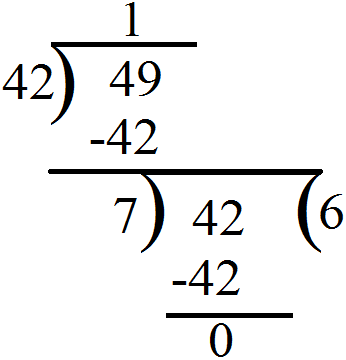
$\therefore$ The $HCF$ of $42$ and $49$ is $7.$
Now, we will find the $HCF$ of $7$ and $63.$
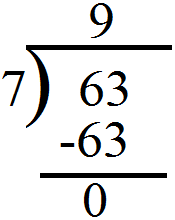
$\therefore$ The $HCF$ of $7$ and $63$ is $7.$
Therefore, $HCF$ of all three numbers is $7.$
Hence, the greatest possible length of each plank is$ 7-m.$ View full question & answer→Question 113 Marks
Find the $HCF$ and $LCM$ of:$234, 572$
AnswerThe given numbers are $234$ and $572$.We have:
$\begin{array}{c|c}2&234\\\hline3&117\\\hline3&39\\\hline13&13\\\hline&1\end{array}$
$\begin{array}{c|c}2&572\\\hline2&286\\\hline13&143\\\hline11&11\\\hline&1\end{array}$
Now, we have:
$234=2\times3\times3\times13$
$572=2\times2\times13\times11$
$\therefore$ LCM $=13\times2\times2\times11\times9$
$=5148$
Also, HCF $=13\times2=26$
View full question & answer→Question 123 Marks
Show that the following pairs are co-primes:$847, 1014$
AnswerGiven numbers are $847$ and $1014.$
$\begin{array}{c|c}7&847\\\hline11&121\\\hline11&11\\\hline&1\end{array}$
$\begin{array}{c|c}2&1014\\\hline3&507\\\hline13&169\\\hline13&13\\\hline&1\end{array}$
$847=7\times11\times11\times1=7\times11^2\times1$
$1014=2\times3\times13\times13\times1$
$\therefore$ $HCF = 1$
Hence, $847$ and $1014$ are co-primes.
View full question & answer→Question 133 Marks
On dividing $5035$ by $31$, the remainder is $13$. Find the quotient.
AnswerRemainder is $13$
$\therefore$ Number exactly divisible by $31 = 5035 - 13 = 5022$
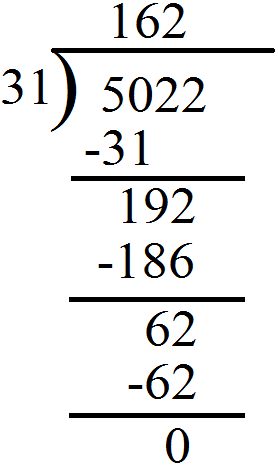
So, the required quotient is $162.$ View full question & answer→Question 143 Marks
Find the $LCM$ of the numbers given below:$28, 36, 45, 60$
AnswerThe given numbers are $28, 36, 45$ and $60$.We have:
$\begin{array}{c|c}2&28,36,45,60\\\hline2&14,18,45,30\\\hline3&7,9,45,15\\\hline3&7,3,15,5\\\hline5&7,1,5,5\\\hline7&7,1,1,1\\\hline&1,1,1,1\end{array}$
$\therefore LCM = 2 \times 2 \times 3 \times 3 \times 5 \times 7$
$= 1260$
View full question & answer→Question 153 Marks
Three measuring rods are $45\ cm, 50\ cm$ and $75\ cm$ in length. What is the least length (in metres) of a rope that can be measured by the full length of each of these three rods?
AnswerThe length of the required rope must be such that it is exactly divisible by $45, 50$ and $75$.
The least length will be given by the $LCM$ of $45, 50$ and $75.$
$\begin{array}{c|c}2&45,50,75\\\hline3&45,25,75\\\hline3&15,25,25\\\hline5&5,25,25\\\hline5&1,5,5\\\hline&1,1,1\end{array}$
Required length of the rope that can be measured by the full length of each of the three rods is $450\ cm.$
View full question & answer→Question 163 Marks
In the following numbers, replace * by the smallest number to make it divisible by $11: 1723*4$
Answer$1723*$4Sum of the digits at odd places $4 + 3 + 7 = 14$
Sum of the digits at even places * $+ 2 + 1 = 3 + *$
Difference = sum of odd terms - sum of even terms.
$= 14 - (3 + *)$
$= 11 - *$
Now, $(11 - *)$ will be divisible by $11$ if * $= 0.$
i.e., $11 - 0 = 11$
$11$ is divisible by $11.$
$\therefore * = 0$
Hence, the number is $172304.$
View full question & answer→Question 173 Marks
Give the prime factorization of the following number: $13915$
AnswerWe will use the didvision method as shown below:
$\begin{array}{c|c}5&13915\\\hline11&2783\\\hline11&253\\\hline23&23\\\hline&1\end{array}$
$\therefore13915=5\times11\times11\times23$ $=3\times11^2\times23$
View full question & answer→Question 183 Marks
Find the $LCM$ of the numbers given below:$48, 64, 72, 96, 108$
AnswerThe given numbers are $48, 64, 72, 96$ and $108$.We have:
$\begin{array}{c|c}2&48,64,72,96,108\\\hline2&24,32,36,48,54\\\hline2&12,16,18,24,27\\\hline2&6,8,9,12,27\\\hline3&3,4,9,6,27\\\hline2&1,4,3,2,9\\\hline2&1,2,3,1,9\\\hline3&1,1,3,1,9\\\hline3&1,1,1,1,3\\\hline&1,1,1,1,1\end{array}$
$\therefore LCM = 2^6× 3^3$
$= 1728$
View full question & answer→Question 193 Marks
Find the $LCM$ of the numbers given below:$36, 40, 126$
AnswerThe given numbers are $36, 40$ and $126$.We have:
$\begin{array}{c|c}2&36,40,126\\\hline3&18,20,60\\\hline3&6,20,21\\\hline2&2,20,7\\\hline2&1,10,7\\\hline5&1,5,7\\\hline7&1,1,7\\\hline&1,1,1\end{array}$
$\therefore LCM = 2 \times 3 \times 3 \times 2 \times 2 \times 5 \times 7$
$= 2520$
View full question & answer→Question 203 Marks
Find the $HCF$ of the numbers in the following using the prime factorization method:$144, 252, 630$
AnswerThe given numbers are $144, 252$ and $630$.We have:
$\begin{array}{c|c}2&144\\\hline2&72\\\hline2&36\\\hline2&18\\\hline3&9\\\hline3&3\\\hline&1\end{array}$
$\begin{array}{c|c}2&252\\\hline2&126\\\hline3&63\\\hline3&21\\\hline7&7\\\hline&1\end{array}$
$\begin{array}{c|c}2&630\\\hline3&315\\\hline3&105\\\hline5&35\\\hline7&7\\\hline&1\end{array}$
Now, $144=2\times2\times2\times2\times3\times3$
$252=2\times2\times3\times3\times7$
$630=2\times3\times3\times5\times7$
$\therefore HCF =2\times3\times3=18$
View full question & answer→Question 213 Marks
Find the $LCM$ of the numbers given below:$16, 28, 40, 77$
AnswerThe given numbers are $16, 28, 40$ and $77$.We have:
$\begin{array}{c|c}2&16,28,40,77\\\hline7&8,14,20,77\\\hline2&8,2,20,11\\\hline2&4,1,10,11\\\hline2&2,1,5,11\\\hline5&1,1,5,11\\\hline11&1,1,1,11\\\hline&1,1,1,1\end{array}$
$\therefore$ $LCM = 2 \times 7 \times 2 \times 2 \times 2 \times 5 \times 11$
$= 6160$
View full question & answer→Question 223 Marks
Find the $HCF$ and $LCM$ of$:2923, 3239$
Answer$HCF$ of $2923$ and $3239:$
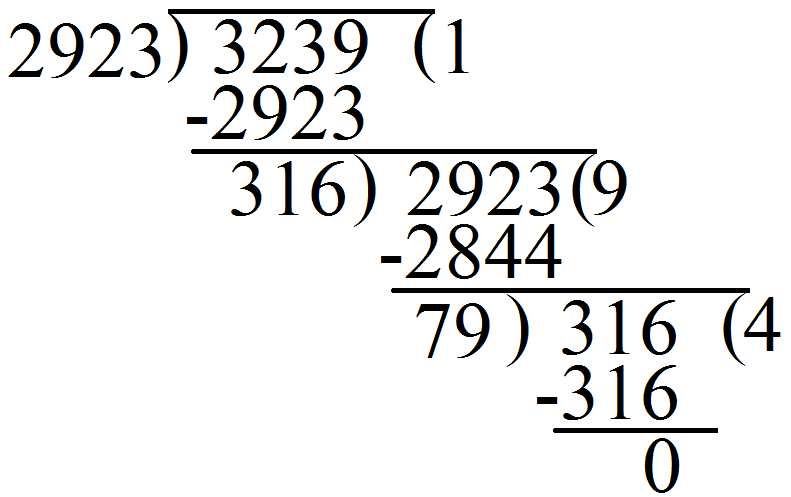
$\therefore HCF = 79$
We know that product of two numbers $= HCF \times LCM$
$\Rightarrow\text{LCM}=\frac{\text{Product of two numbers}}{\text{HCF}}$
$\Rightarrow\text{LCM}=\frac{2923\times3239}{79}$
$\therefore\text{LCM}=119843$ View full question & answer→Question 233 Marks
Show that the following pairs are co-primes:$161, 192$
AnswerThe given numbers are $161$ and $192.$
We have: $\begin{array}{c|c}2&161\\\hline23&23\\\hline&1\end{array}$
$\begin{array}{c|c}2&192\\\hline2&96\\\hline2&48\\\hline2&24\\\hline2&12\\\hline2&6\\\hline3&3\\\hline&1\end{array}$
Now, $161=7\times23\times1$
$192=2\times2\times2\times2\times2\times2\times3=2^6\times3\times1$
$\therefore HCF = 1$
Hence, $161$ and $192$ are co-primes.
View full question & answer→Question 243 Marks
Three boys step off together from the same place. If their steps measure $36\ cm, 48\ cm$ and $54\ cm$, at what distance from the starting point will they again step together?
AnswerFrom the starting point, they will step together again when they travel a distance that is exactly divisible by the lengths of their steps. The least distance from the starting point where they will step together will be given by the $LCM$ of $36, 48$ and $54.$
$\begin{array}{c|c}2&36,48,54\\\hline2&18,24,27\\\hline3&9,12,27\\\hline3&3,4,9\\\hline3&1,4,3\\\hline2&1,4,1\\\hline2&1,2,1\\\hline&1,1,1\end{array}$
The required distance $= 2 \times 2 \times 3 \times 3 \times 3 \times 2 \times 2 = 16 \times 27 = 432\ cm$
They will step together again at a distance of $432\ cm$ from the starting point
View full question & answer→Question 253 Marks
Find the least number which when divided by $16, 36$ and $40$ leaves $5$ as remainder in each case.
AnswerOn subtracting $5$ from each number: $16 - 5 = 11 36 - 5 = 31 40 - 5 = 35$
The required number will be the least common multiple of $11, 31$ and $35.$
$LCM$ of $11, 31$ and $35 = 11 \times 31 \times 35 = 11935$
This is because they do not have any factor in common.
So, $11935$ is the required number.
View full question & answer→Question 263 Marks
An electronic device makes a beep after every $15$ minutes. Another device makes a beep after every $20$ minutes. They beeped together at $6 a.m.$ At what time will they next beep together?
AnswerThe $LCM$ of the time intervals of the beeps will give the time when the electronic devices will beep together.
$LCM$ of $15$ and $20.$
$\begin{array}{c|c}5&15,20\\\hline3&3,4\\\hline2&1,4\\\hline2&1,2\\\hline&1,1\end{array}$
Required time $5 \times 3 \times 2 \times 2$
$= 60 min$
So, they will beep simultaneously after $60$ min or $1h.$
$\therefore$ They will beep together again at $7:00 a.m.$
View full question & answer→Question 273 Marks
Find the $HCF$ of the numbers in the following using the prime factorization method:$72, 108, 180$
AnswerThe given numbers are $72, 108$ and $180.$
We have:
$\begin{array}{c|c}2&72\\\hline2&36\\\hline2&18\\\hline3&9\\\hline3&3\\\hline&1\end{array}$
$\begin{array}{c|c}2&108\\\hline2&54\\\hline3&27\\\hline3&9\\\hline3&3\\\hline&1\end{array}$
$\begin{array}{c|c}2&180\\\hline2&90\\\hline3&45\\\hline3&15\\\hline5&5\\\hline&1\end{array}$
Now, $72=2\times2\times2\times3\times3=2^3\times3^2$
$108=2\times2\times3\times3\times3=2^2\times3^3$
$180=2\times2\times3\times3 \times5=2^2\times3^2\times5$
$\therefore HCF =2^2\times3^2=36$
View full question & answer→Question 283 Marks
Find the $HCF$ of the numbers in the following using the division method:$1045, 1520$
AnswerThe given numbers are $1045$ and $1520$.We have:
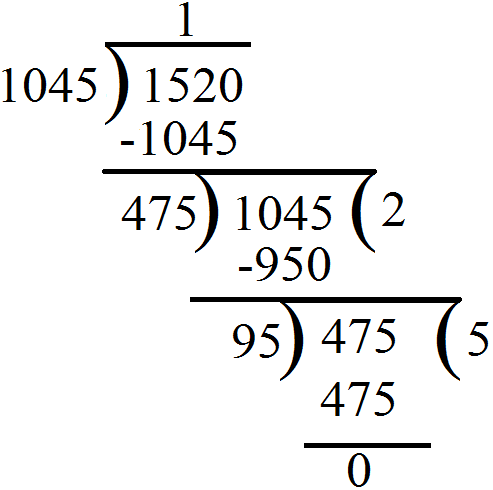
$\therefore$ The $HFC$ of $1045$ and $15202$ is $95.$ View full question & answer→Question 293 Marks
Find the $HCF$ and $LCM$ of:$145, 232$
AnswerThe given numbers are $145$ and $232$.We have:
$\begin{array}{c|c}5&145\\\hline29&29\\\hline&1\end{array}$
$\begin{array}{c|c}2&232\\\hline2&116\\\hline2&58\\\hline29&29\\\hline&1\end{array}$
Now, we have:
$145=5\times29$
$232=2\times2\times2\times29$
$\therefore HCF = 29$
Also, $LCM =29\times2\times2\times2\times5=1160$
View full question & answer→Question 303 Marks
Find the $HCF$ and $LCM$ of:$861, 1353$
AnswerThe given numbers are $861$ and $1353.$
We have:
$\begin{array}{c|c}3&861\\\hline7&287\\\hline{41}&41\\\hline&1\end{array}$
$\begin{array}{c|c}3&1353\\\hline11&451\\\hline41&41\\\hline&1\end{array}$
Now, we have:
$861=3\times41\times7$
$1353=41\times11\times3$
$\therefore$ HCF $=41\times3=123$
Also, LCM $=41\times3\times11\times7=9471$
View full question & answer→Question 313 Marks
In the following numbers, replace * by the smallest number to make it divisible by $11:$
$86*72$
Answer86*72Sum of the digits at odd places $2 + * + 8 = 10 + *$
Sum of the digits at even places $6 + 7 = 13$
Difference = sum of odd terms - sum of even terms.
$= 10 + * - 13$
$= * - 3$
Now, $(* - 3)$ will be divisible by $11$ if $* = 3.$
i.e., $3 - 3 = 0$
$0$ is divisible by $11.$
$\therefore$ * $= 3$
Hence, the number is $86372.$
View full question & answer→Question 323 Marks
In the following numbers, replace * by the smallest number to make it divisible by $11: 9*8071$
Answer9*8071Sum of the digits at odd places $1 + 0 + * = 1 + *$
Sum of the digits at even places $7 + 8 + 9 = 24$
Difference = sum of odd terms - sum of even terms.
$=1 + * - 24$
$= * - 23$
Now, $(* - 23)$ will be divisible by 11 if *$ = 1.$
i.e., $1 - 23 = -22$
$-22$ is divisible by $11.$
$\therefore * = 1$
Hence, the number is $918071.$
View full question & answer→Question 333 Marks
In the following numbers, replace * by the smallest number to make it divisible by $11: 39*43$
Answer$39*43$Sum of the digits at odd places $= 3 + * + 3 = 6 + *$
Sum of the digits at even places $= 4 + 9 = 13$
Difference = sum of odd terms - sum of even terms
$= 6 + * – 13$
$= * - 7$
Now, $(* - 7)$ will be divisible by $11$ if $* = 7.$
i.e., $7 - 7 = 0$
$0$ is divisible by $11.$
$\therefore * = 7$
Hence, the number is $39743.$
View full question & answer→Question 343 Marks
Find the least number which when divided by $25, 40$ and $60$ leaves $9$ as the remainder in each case.
Answer$25, 40$ and $60$ exactly divides the least number that is equal to their $LCM$.
So, the required number that leaves 9 as a remainder will be $LCM + 9.$
Finding the $LCM.$
$\begin{array}{c|c}2&25,40,60\\\hline2&25,20,30\\\hline2&25,10,15\\\hline3&25,5,15\\\hline5&25,5,5\\\hline5&5,1,1\\\hline&1,1,1\end{array}$
$LCM = 2^3× 3 × 5^2= 600$
$\therefore$ Required number $= 600 + 9 = 609$
View full question & answer→Question 353 Marks
The traffic lights at three different road crossings change after every $48$ seconds, $72$ seconds and $108$ seconds. If they start changing simultaneously at $8 a.m$., after how much time will they change again simultaneously?
AnswerThe time when the lights will change simultaneously again will be quantity which is exactly divisible by $48, 72$ and $108$.
The least time when they change simultaneously will be given by their $LCM.$
$\begin{array}{c|c}2&48,72,108\\\hline2&24,36,54\\\hline2&12,18,27\\\hline2&6,9,27\\\hline3&3,9,27\\\hline3&1,3,9\\\hline3&1,1,3\\\hline&1,1,1\end{array}$
Required time
$= 2^4\times 3^3$
$= 432$ seconds
$= 7$ min. $12$ second
So, the lights will changes simultaneouslyat $8:07:12 a.m.$
View full question & answer→Question 363 Marks
Show that the following pairs are co-primes:$343, 432$
AnswerThe given numbers are $343$ and $432.$
We have: $\begin{array}{c|c}7&343\\\hline7&49\\\hline7&7\\\hline&1\end{array}$
$\begin{array}{c|c}2&432\\\hline2&216\\\hline2&108\\\hline2&54\\\hline3&27\\\hline3&9\\\hline3&3\\\hline&1\end{array}$
Now, $343=7\times7\times7\times1=7^3\times1$
$432=2\times2\times2\times2\times3\times3\times3\times1$
$\therefore HCF = 1$
Hence, $343$ and $432$ are co-primes.
View full question & answer→Question 373 Marks
Pair of numbers, werify that their product $= (HCF \times LCM) 186, 403$
Answer186 and 403 $\begin{array}{c|c}2&186\\\hline3&93\\\hline31&31\\\hline&1\end{array}$
$\begin{array}{c|c}13&403\\\hline31&31\\\hline&1\end{array}$
We have: $186=2\times3\times31$
$40=31\times13 HCF = 31 LCM =31\times13\times6=2418$
Now, $HCF \times LCM =31\times2418=74958$
Product of the two numbers $=168\times403=74958$
$\therefore HCF \times LCM =$ Product of the two numbers. Verified.
View full question & answer→Question 383 Marks
Reduce the following fractions to the lowest terms:$\frac{517}{799}$
Answer$\frac{517}{799}$
To reduce the given fraction to its lowest terms,
we will divide the numerator and the denominators by their $HCF$.
Now, we will find the $HCF$ of $517$ and $799.$ 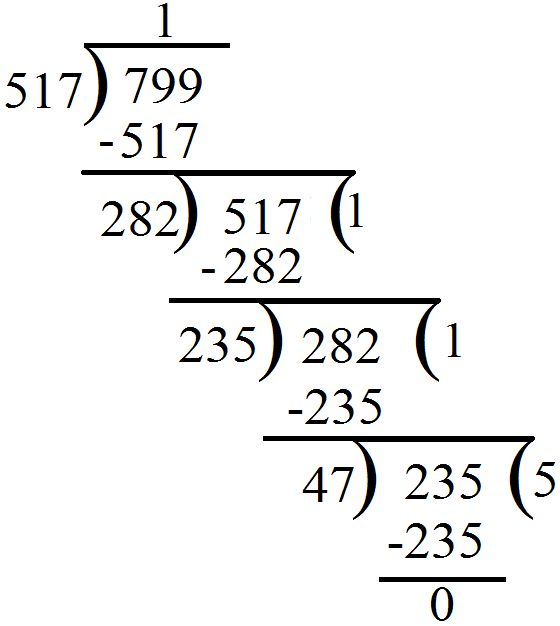
$\therefore HCF = 47$
Dividing the numerator and the denominators by the $HCF,$
we get: $\frac{517\div47}{799\div47}=\frac{11}{17}$ View full question & answer→Question 393 Marks
Find the greatest number which divides $615$ and $963$, leaving the remainder $6$ in each case.
AnswerBecause the remainder is $6$, we have to find the number that exactly devides $(615 - 6)$ and $(963 - 6)$.
Required number $= HCF$ of $609$ and $957.$
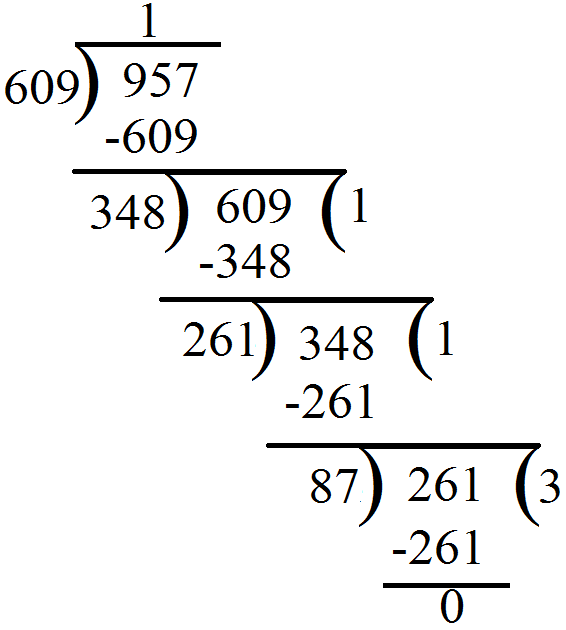
Therefore, the required number is $87.$ View full question & answer→Question 403 Marks
Pair of numbers, werify that their product $= (HCF \times LCM)$
$490, 1155$
Answer$490$ and $1155$
$\begin{array}{c|c}2&490\\\hline5&525\\\hline7&49\\\hline7&7\\\hline&1\end{array}$
$\begin{array}{c|c}5&1155\\\hline7&231\\\hline3&33\\\hline11&11\\\hline&1\end{array}$
$490=7\times7\times2\times5$
$1155=5\times7\times3\times11$
$HCF =7\times5=35$
$LCM =7\times5\times7\times2\times3\times11=16170$
Now, $HCF \times LCM =35\times16170=565950$
Product of the two numbers $=490\times1155=565950$
$\therefore HCF \times LCM =$ Product of the two numbers.
Verified.
View full question & answer→Question 413 Marks
Find the $HCF$ of the numbers in the following using the division method:$58, 70$
AnswerWe have:
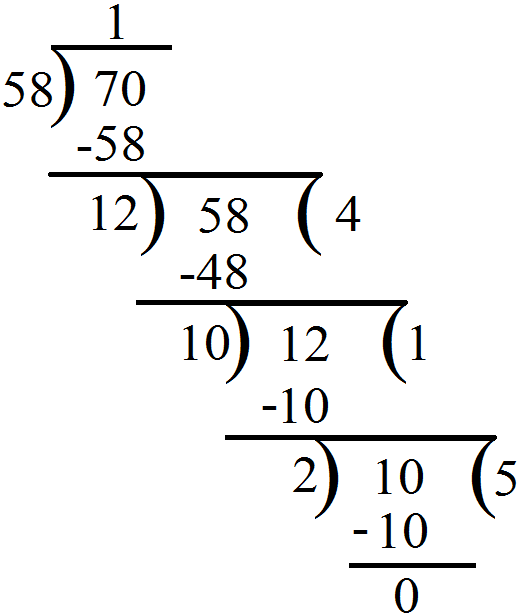
$\therefore$ The $HFC$ of $58$ and $70$ is $2.$ View full question & answer→Question 423 Marks
Find the $HCF$ of the numbers in the following using the prime factorization method:$1197, 5320, 4389$
AnswerThe given numbers are $1197, 5320$ and $4389$.We have:
$\begin{array}{c|c}3&1197\\\hline3&399\\\hline7&133\\\hline19&19\\\hline&1\end{array}$
$\begin{array}{c|c}2&5320\\\hline2&2660\\\hline2&1330\\\hline5&665\\\hline7&133\\\hline19&19\\\hline&1\end{array}$
$\begin{array}{c|c}3&4389\\\hline7&1463\\\hline19&209\\\hline11&11\\\hline&1\end{array}$
Now, $119=3\times3\times7\times19=3^2\times7\times19$
$5320=2\times2\times2\times5\times7\times19=2^3\times5\times7\times19$
$4389=3\times7\times19\times11$
$\therefore$ Required HCF $=19\times7=133$
View full question & answer→Question 433 Marks
Find the $HCF$ and $LCM$ of:$117, 221$
AnswerThe given numbers are $117$ and $221$.We have:
$\begin{array}{c|c}3&117\\\hline3&39\\\hline13&13\\\hline&1\end{array}$
$\begin{array}{c|c}13&221\\\hline17&17\\\hline&1\end{array}$
Now,
$ 177=3\times3\times13$
$221=13\times17$
$\therefore HCF = 13 × 1$
Now, $LCM =13\times17\times3\times3$
$=1989$
View full question & answer→Question 443 Marks
Find the $LCM$ of the numbers given below:$144, 180, 384$
AnswerThe given numbers are $144, 180$ and $384$.We have:
$\begin{array}{c|c}2&144,180,384\\\hline2&72,90,192\\\hline2&36,46,96\\\hline2&18,45,48\\\hline3&9,45,24\\\hline3&3,15,8\\\hline2&1,5,8\\\hline2&1,5,4\\\hline2&1,5,2\\\hline5&1,5,1\\\hline&1,1,1\end{array}$
$\therefore LCM = 2^7\times 3^2\times 5$
$= 5760$
View full question & answer→Question 453 Marks
Find the $HCF$ of the numbers in the following using the prime factorization method:$84, 120, 138$
AnswerThe given numbers are $84, 120$ and $138$.We have:
$\begin{array}{c|c}2&84\\\hline4&42\\\hline3&21\\\hline7&7\\\hline&1\end{array}$
$\begin{array}{c|c}2&120\\\hline2&60\\\hline2&30\\\hline3&15\\\hline5&5\\\hline&1\end{array}$
$\begin{array}{c|c}2&138\\\hline3&69\\\hline23&23\\\hline&1\end{array}$
Now, $84=2\times2\times3\times7$
$120=2\times2\times2\times3\times5$
$138=2\times3\times23$
$\therefore HCF =2\times3=6$
View full question & answer→Question 463 Marks
Find the $HCF$ of the numbers in the following using the prime factorization method:$106, 159, 371$
AnswerThe given numbers are $106, 159$ and $371$.We have:
$\begin{array}{c|c}2&106\\\hline53&53\\\hline&1\end{array}$
$\begin{array}{c|c}3&159\\\hline53&53\\\hline&1\end{array}$
$\begin{array}{c|c}7&371\\\hline53&53\\\hline&1\end{array}$
Now, $106=2\times53$
$159=3\times53$
$371=7\times53$
$\therefore HCF =53$
View full question & answer→Question 473 Marks
Find the least numbres divisible by $15, 20, 24, 32$ and $36.$
AnswerThe given numbers are $15, 20, 24, 32$ and $36.$
The smallest number divisible by the numbers given above will be their $LCM.'$
$\begin{array}{c|c}2&15,20,24,31,36\\\hline2&15,10,12,16,18\\\hline5&5,10,4,16,2\\\hline2&1,2,4,16,6\\\hline2&1,1,2,8,3\\\hline2&1,1,1,4,3\\\hline2&1,1,1,2,3\\\hline3&1,1,1,1,3\\\hline&1,1,1,1,1\end{array}$
$LCM = 2^5\times 3^2\times 5$
$= 1440$
$\therefore$ The least numbers divisible by $15, 20, 24, 32$ and $36$ is $1440.$
View full question & answer→Question 483 Marks
Reduce the following fractions to the lowest terms:$\frac{296}{481}$
Answer$\frac{296}{481}$ To reduce the given fraction to its lowest terms, we will divide the numerator and the denominators by their $HCF. $ Now, we will find the $HCF$ of $296$ and $481.$ 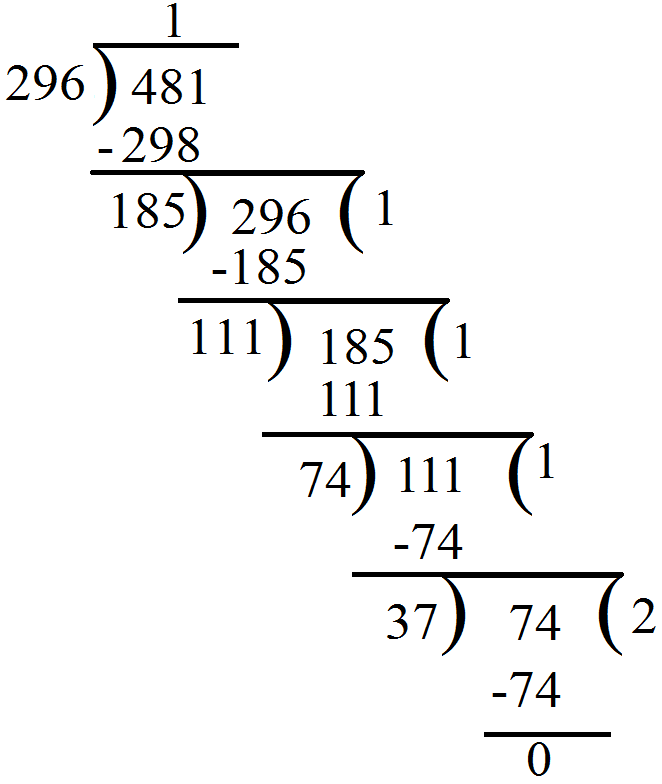
$\therefore HCF = 37$ Dividing the numerator and the denominators by the $HCF$,
we get: $\frac{296\div37}{481\div37}=\frac{8}{13}$ View full question & answer→Question 493 Marks
Three bells toll at intervals of $9, 12, 15$ minutes. If they start tolling together, after what time will they next toll together?
AnswerThree bells toll intervals of $9, 12$ and $15$ minutes.
The time when they will toll together again is given by the $LCM$ of $9, 12$ and $15.$
$\begin{array}{c|c}3&9,12,15\\\hline3&3,4,5\\\hline5&1,4,5\\\hline2&1,4,1\\\hline2&1,2,1\\\hline&1,1,1\end{array}$
Required time $= 2^3\times 3^2\times 5$
$= 180$ minutes
$= 3h$
If they start tolling together, they will toll together again after $3h.$
View full question & answer→Question 503 Marks
Reduce the following fractions to the lowest terms:$\frac{161}{207}$
Answer$\frac{161}{207}$ To reduce the given fraction to its lowest terms,
we will divide the numerator and the denominators by their $HCF.$
Now, we will find the $HCF$ of $161$ and $207.$
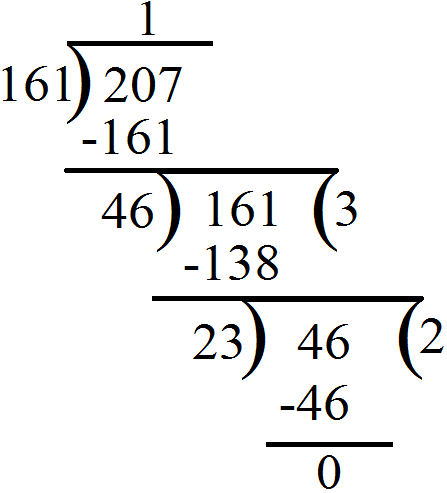
$\therefore HCF = 23$
Dividing the numerator and the denominators by the $HCF,$
we get: $\frac{161\div23}{207\div23}=\frac79$ View full question & answer→Question 513 Marks
Give the prime factorization of the following number: $8712$
AnswerWe will use the didvision method as shown below:
$\begin{array}{c|c}2&8712\\\hline2&4356\\\hline2&2178\\\hline3&1089\\\hline3&363\\\hline11&121\\\hline11&11\\\hline&1\end{array}$
$\therefore8712=2\times2\times2\times3\times3\times11\times11$ $=2^3\times3^2\times11^2$
View full question & answer→