Sample QuestionsPlaying With Numbers questions
One sample from each question group in this chapter. Select any group above to see the full set with answer keys.
Simplication of $3\frac{1}{5}\times10\frac{1}{2}$ gives us
- A
$\frac{166}{5}$
- B
$\frac{167}{5}$
- ✓
$\frac{168}{5}$
- D
$\frac{161}{5}$
Answer: C.
View full solution →Which of the following is $NOT$ a positive multiple of $12?$
Answer: A.
View full solution →Mark the correct alternative in the following:
The $LCM$ of $100$ and $101$ is:
Answer: A.
View full solution →Mark the correct alternative in the following:
Every counting number has an infinite number of
Answer: B.
View full solution →$\frac{11}{7}$ can be expressed in the form.
- A
$7\frac{1}{4}$
- B
$4\frac{1}{7}$
- ✓
$1\frac{4}{7}$
- D
$11\frac{1}{7}$
Answer: C.
View full solution →Directions: In the following questions, the Assertions $(A)$ and Reason(s) $(R)$ have been put forward. Read both the statements carefully and choose the correct alternative from the following:
Assertion (A): The multiples of $7$ are $7, 14, 21, 28,…$
Reason (R): every multiple of a number is greater than or equal to that number
- ✓
Both $A$ and $R$ are true and $R$ is the correct explanation of $A$
- B
Both $A$ and $R$ are true but $R$ is not the correct explanation of $A$
- C
$A$ is true but $R$ is false
- D
$A$ is false but $R$ is true
Answer: A.
View full solution →Directions: In the following questions, the Assertions $(A)$ and Reason(s) $(R)$ have been put forward. Read both the statements carefully and choose the correct alternative from the following:
Assertion (A): $48$ is divisible by $8.$
Reason (R): a number with $4$ or more digits is divisible by $8,$ if the number formed by the last three digits is divisible by $8.$
- ✓
Both $A$ and $R$ are true and $R$ is the correct explanation of $A$
- B
Both $A$ and $R$ are true but $R$ is not the correct explanation of $A$
- C
$A$ is true but $R$ is false
- D
$A$ is false but $R$ is true
Answer: A.
View full solution →Directions: In the following questions, the Assertions $(A)$ and Reason(s) $(R)$ have been put forward. Read both the statements carefully and choose the correct alternative from the following:
Assertion (A): The $LCM$ of $20, 25$ and $30$ is $20.$
Reason (R): The Lowest Common Multiple $(LCM)$ of two or more given numbers is the lowest (or smallest or least) of their common multiples.
- A
Both $A$ and $R$ are true and $R$ is the correct explanation of $A$
- B
Both $A$ and $R$ are true but $R$ is not the correct explanation of $A$
- C
$A$ is true but $R$ is false
- ✓
$A$ is false but $R$ is true
Answer: D.
View full solution →Directions: In the following questions, the Assertions $(A)$ and Reason(s) $(R)$ have been put forward. Read both the statements carefully and choose the correct alternative from the following:
Assertion (A): $60$ is not divisible by $3$ and $5$ which are co-primes.
Reason (R): If a number is divisible by two co-prime numbers then it is divisible by their product also.
- A
Both $A$ and $R$ are true and $R$ is the correct explanation of $A$
- B
Both $A$ and $R$ are true but $R$ is not the correct explanation of $A$
- C
$A$ is true but $R$ is false
- ✓
$A$ is false but $R$ is true
Answer: D.
View full solution →Directions: In the following questions, the Assertions $(A)$ and Reason(s) $(R)$ have been put forward. Read both the statements carefully and choose the correct alternative from the following:
Assertion (A): $7$ is a multiple of itself
Reason (R): every number is a multiple of itself
- ✓
Both $A$ and $R$ are true and $R$ is the correct explanation of $A$
- B
Both $A$ and $R$ are true but $R$ is not the correct explanation of $A$
- C
$A$ is true but $R$ is false
- D
$A$ is false but $R$ is true
Answer: A.
View full solution →Sum of two prime numbers is always even.
Prime numbers do not have any factors.
All prime numbers are odd.
If an even number is divided by $2$, the quotient is always odd.
View full solution →The product of three odd numbers is odd.
The smallest even number is ________.
The smallest composite number is _______.
The smallest prime number is ________.
Here are two different factor trees for $60.$ Write the missing numbers.
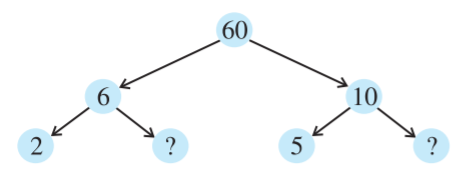
View full solution →A number is divisible by $3$ and $5.$ So it is also divisible by$………. [(5+3), (5 x 3). (5-3)]$
View full solution →What is the HCF of two consecutive odd numbers$?$
View full solution →What is the $HCF$ of two consecutive even numbers$?$
View full solution →What is the $HCF$ of two consecutive numbers$?$
View full solution →In the given expression, prime factorisation has been done or not$?\ 54 = 2 \times 3 \times 9$
View full solution →In the given expression, prime factorisation has been done or not$?\ 70 = 2 \times 5 \times 7$
View full solution →$HCF$ of co-prime numbers $4$ and $15$ was found as follows:
$4 = 2$ $\times$ $2$ and $15 = 3$ $\times$ $5$
since there is no common factor, so $H.C.F.$ of $4$ and $15$ is $0$. Is the answer correct? If not, what is the correct $H.C.F$.
View full solution →Find the $H.C.F$ of the numbers: $18, 54, 81.$
View full solution →Find the H.C.F of the numbers: $91, 112, 49.$
View full solution →Find the $H.C.F$ of the numbers: $70, 105, 175$
View full solution →Find the $H.C.F$ of the numbers: $34, 102.$
View full solution →Find the smallest four digit number which is divisible by $18, 24$ and $32.$
View full solution →Find the least number which when divided by $6, 15$ and $18$ leave remainder $5$ in each case.
View full solution →Three tankers contain $403$ litres, $434$ litres and $465$ litres of diesel, respectively. Find the maximum capacity of a container that can measure the diesel of the three containers exact number of times.
View full solution →The traffic lights at three different road crossings change after every $48$ seconds, $72$ seconds and $108$ seconds respectively. If they change simultaneously at $7 a.m$., at what time will they change simultaneously again?
View full solution →Determine the largest $3-$digit number exactly divisible by $8, 10$ and $12.$
View full solution →The product of three consecutive numbers is always divisible by $6.$ Verify this statement with the help of some examples.
View full solution →Here are two different factor trees for $60$. Write the missing numbers.
View full solution →Using divisibility tests, determine which of the following numbers are divisible by $2;$ by $3;$ by $4;$ by $5;$ by $6;$ by $8;$ by $9;$ by $10;$ by $11 ($say, yes or no$):$
| Number |
Divisible by |
| $2$ |
$3$ |
$4$ |
$5$ |
$6$ |
$8$ |
$9$ |
$10$ |
$11$ |
| $128$ |
|
|
|
|
|
|
|
|
|
| $990$ |
|
|
|
|
|
|
|
|
|
| $1586$ |
|
|
|
|
|
|
|
|
|
| $275$ |
|
|
|
|
|
|
|
|
|
| $6686$ |
|
|
|
|
|
|
|
|
|
| $639210$ |
|
|
|
|
|
|
|
|
|
| $429714$ |
|
|
|
|
|
|
|
|
|
| $2856$ |
|
|
|
|
|
|
|
|
|
| $3060$ |
|
|
|
|
|
|
|
|
|
| $406839$ |
|
|
|
|
|
|
|
|
|
View full solution →Find the $LCM$ of $12$ and $18.$
View full solution →Find the least number which when divided by $12, 16, 24$ and $36$ leaves a remainder $7$ in each case.
View full solution →