MCQ 11 Mark
Simplication of $3\frac{1}{5}\times10\frac{1}{2}$ gives us
- A
$\frac{166}{5}$
- B
$\frac{167}{5}$
- ✓
$\frac{168}{5}$
- D
$\frac{161}{5}$
AnswerCorrect option: C. $\frac{168}{5}$
$3\frac{1}{5}\times10\frac{1}{2}$
$=\frac{16}{5}\times\frac{21}{2}$
$=\frac{16\times21}{5\times2}$
$=\frac{168}{5}$
View full question & answer→MCQ 21 Mark
Which of the following is $NOT$ a positive multiple of $12?$
Answer$3$ is not a positive multiple of $12$ as it is smaller than $12.$
Rest others are multiples of $12.$
View full question & answer→MCQ 31 Mark
Mark the correct alternative in the following:
The $LCM$ of $100$ and $101$ is:
AnswerCorrect option: A. $10100$
$100 = 1 \times 2 \times 2 \times 5 \times 5$
$101 = 1 \times 101$
Since, $100$ is a composite number and $101$ is a prime number.
Thus, their $LCM = 100 \times 101 = 10100$
Hence, the correct answer is option $(a).$
View full question & answer→MCQ 41 Mark
Mark the correct alternative in the following:
Every counting number has an infinite number of
AnswerMultiples are what we get after multiplying the number by any number
Thus, every counting number has an infinite number of multiples
Hence, the correct answer is option $(b).$
View full question & answer→MCQ 51 Mark
$\frac{11}{7}$ can be expressed in the form.
- A
$7\frac{1}{4}$
- B
$4\frac{1}{7}$
- ✓
$1\frac{4}{7}$
- D
$11\frac{1}{7}$
AnswerCorrect option: C. $1\frac{4}{7}$
The mix fraction of $\frac{11}{7}$ is $1\frac{4}{7}$
View full question & answer→MCQ 61 Mark
The largest number which divides $245$ and $1029$ leaving remainder $5$ is
AnswerRequired number $= H.C.F.$ of $245 - 5 = 240$ and $1029 - 5 = 1024$
$H.C.F.$ of $240 = 2 \times 2 \times 2 \times 2 \times 3 \times 5$
$1024 = 2 \times 2 \times 2 \times 2 \times 2 \times 2 \times 2 \times 2 \times 2 \times 2$
$= 2 \times 2 \times 2 \times 2 = 16$
Therefore,$16$ is the largest number which divides $245$ and $1024$ leaving remainder $5$ in each
View full question & answer→MCQ 71 Mark
Numerator in the fraction $\frac{2}{8}$ is:
- ✓
$2$
- B
$8$
- C
$\frac{2}{8}$
- D
$\frac{1}{8}$
AnswerIf a fraction is written in the form $a/b$ so, a is known as numerator and $b$ is known as denominator..
View full question & answer→MCQ 81 Mark
Simplifying the fraction $\frac{6}{5}\times4\frac{1}{2}$ gives.
AnswerCorrect option: A. $\frac{27}{5}$
$\frac{6}{5}\times4\frac{1}{2}$
$=\frac{6}{5}\times\frac{9}{2}$
$=\frac{27}{5}$
View full question & answer→MCQ 91 Mark
If $5\frac{7}{\text{x}}\times\text{y}\frac{1}{13}=12,$ where fractions are in their lowest terms, then $x - y$ is equal to
Answer$5\frac{7}{\text{x}}\times\text{y}\frac{1}{13}=12$
By Hit and Trial method.
Let $x = 9, y = 2$
Where the fractions are in their lowest terms, then $x$ should be maximum possible single digit and $y$ is minimum possible single digit.
Putting this value in equ. $(1)$
$5\times\frac{7}{9}\times2\times\frac{1}{13}=\frac{52}{9}\times\frac{27}{13}=12$
$\therefore\text{x}-\text{y}=7$
View full question & answer→MCQ 101 Mark
Find first five common multiples of $1, 2$ and $3.$
- A
$2, 4, 8, 10, 20$
- B
$3, 6, 12, 30, 60$
- ✓
$6, 12, 18, 24, 30$
- D
$1, 2, 3, 4, 5$
AnswerCorrect option: C. $6, 12, 18, 24, 30$
$\Rightarrow LCM$ of $1, 2, 3 = 1 \times 2 \times 3 = 6$
$\therefore 6$ is the least common multiple of $1, 2, 3.$
Thus, all multiples of $6$ are common multiples of $1, 2$ and $3.$
$\therefore $ First five common multiples $= 6,12,18,24,30$
View full question & answer→MCQ 111 Mark
If numerator and denominator of a proper fractions are increased by the same quantity, then the resulting fraction is then.
- ✓
Always greater than the original fraction.
- B
Always less than the original fraction.
- C
Always equal to the original fraction.
- D
AnswerCorrect option: A. Always greater than the original fraction.
Let proper fraction $=\frac{3}{2}$
$\therefore$ Resulting fraction $=\frac{2+1}{3+1}=\frac{3}{4}$
Hence $\frac{2}{3}<\frac{3}{4}$
$\frac{3}{5}<\frac{3+1}{5+1}$
$\Rightarrow\frac{3}{5}<\frac{4}{6}$ etc.
View full question & answer→MCQ 121 Mark
The fundamental arithmetical operation on $2$ recurring decimals can be performed directly without converting them to vulgar fraction.
- ✓
Only in addition and subtraction.
- B
Only in addition and multiplication.
- C
Only in addition, subtraction and multiplication.
- D
In all the four arithmetical operations.
AnswerCorrect option: A. Only in addition and subtraction.
Only while addition and subtraction there is no need to convert the two recurring decimals to its vulgar form.
View full question & answer→MCQ 131 Mark
$286$ can be expressed as:
- ✓
$2 \times 11 \times 13$
- B
$3 \times 11 \times 13$
- C
$13 \times 5 \times 11$
- D
$11 \times 2 \times 5$
AnswerCorrect option: A. $2 \times 11 \times 13$
$2 \times 11 \times 13 = 286$
View full question & answer→MCQ 141 Mark
Mark the correct alternative in the following:
The least prime is:
Answer$2$ is the least prime number. It is the only even prime number.
View full question & answer→MCQ 151 Mark
Find the first six multiples of $17$
- A
$17, 51, 85, 102, 119$
- B
$34, 76, 102, 119, 340$
- C
$34, 51, 68, 102, 170$
- ✓
$17, 34, 51, 68, 85, 102$
AnswerCorrect option: D. $17, 34, 51, 68, 85, 102$
First six multiples of $17 = 17, 34, 51, 68, 85$ and $102.$
View full question & answer→MCQ 161 Mark
The multiple(s) of $12$ is/are
Answer$12 \times 1 = 12$
$12 \times 3 = 36$
$\therefore 12$ and $36$ are multiples,
while $4$ is a factor of $12$
So, options $A$ and $B$ are both correct.
View full question & answer→MCQ 171 Mark
Find the value of $:\frac{(0.0036) (2.8)}{(0.04) (0.1) (0.003)}$
- ✓
$840.0$
- B
$84.0$
- C
$8.4$
- D
$0.84$
AnswerCorrect option: A. $840.0$
The given expression can be simplified as follows:
$:\frac{(0.0036) (2.8)}{(0.04) (0.1) (0.003)}$ $=\frac{0.0036\times2.8}{0.04\times0.1\times0.003}=\frac{0.01008}{0.000012}=840$
Hence, the value of $:\frac{(0.0036) (2.8)}{(0.04) (0.1) (0.003)}$ is $840$
View full question & answer→MCQ 181 Mark
The total number of factors for $50$ are
AnswerNo. of factors for $50$
$50 =5\times 5\times 2=5^2\times 2^1$
Total no. of factors are $=(2+1)\times (1+1)=6$
View full question & answer→MCQ 191 Mark
$LCM$ of the numbers $36$ and $72$ is:
Answer$36 = 2 \times 2 \times 3 \times 3$
$72 = 2 \times 2 \times 2 \times 3 \times 3$
$\therefore L.C.M$ of $36$ and $72 = 2 \times 2 \times 2 \times 3 \times 3 = 72$
View full question & answer→MCQ 201 Mark
In improper fraction the numerator is always _______ the denominator.
AnswerIn an improper fraction, the numerator is always greater\ thangreater than the denominator.
Hence, the answer is greater than.
View full question & answer→MCQ 211 Mark
Three common multiples of $18$ and $6$ are:
- A
$18, 6, 9$
- B
$18, 36, 6$
- ✓
$36, 54,72$
- D
AnswerCorrect option: C. $36, 54,72$
Multiples of $18 = 18, 36, 54...$
Multiples of $6 = 6, 12, 18, ...$
The first common multiple will be $18$
And the next common multiples will be multiples of $18$
Hence, first three common multiples of $18, 6$ are $18, 36, 54$
View full question & answer→MCQ 221 Mark
Mark $(\checkmark)$ against the correct answer in the following:
Which of the following are co$-$primes?
- ✓
$91$ and $72$
- B
$34$ and $51$
- C
$21$ and $36$
- D
$15$ and $20$
AnswerCorrect option: A. $91$ and $72$
The $\text{HCF}$ of $72$ and $91$ is $1.$
So, they are co$-$primes.
$a.$ Is not correct because $34$ and $51$ have $17$ as their $\text{HCF.}$
$b.$ Is not correct because $21$ and $56$ have $3$ as their $\text{HCF.}$
$c.$ Is not correct because $15$ and $20$ have $5$ as their $\text{HCF.}$
View full question & answer→MCQ 231 Mark
A number other than one which is either divisible by $1$ or itself is called a:
AnswerA prime number (or a prime) is a natural number greater than
$1$ that has no positive divisors other than $1$ and itself.
A natural number greater than $1$ that is not a prime
number is called a composite number.
View full question & answer→MCQ 241 Mark
Find the first four common multiples of the following : $8$ and $12.$
- ✓
$24, 48, 72, 96$
- B
$48, 72, 96, 120$
- C
$24, 36, 48, 56$
- D
$24, 32, 40, 48$
AnswerCorrect option: A. $24, 48, 72, 96$
Multiples of $8 = 8, 16, 24, 32, ..$
Multiples of $12 = 12, 24, 36, 48...$
The first common multiple will be $24$
And the next common multiples will be multiples of $24$
Hence, first four common multiples of $8, 12$ are $24, 48, 72, 96$
View full question & answer→MCQ 251 Mark
The average of the first nine prime numbers is:
- A
$9$
- B
$11$
- ✓
$11\frac{1}{9}$
- D
$11\frac{2}{9}$
AnswerCorrect option: C. $11\frac{1}{9}$
first nine prime numbers : $2, 3, 5, 7, 11, 13, 17, 19, 23$
average = sum of numbers / total numbers
$=\frac{2 + 3 + 5 + 7 + 11 + 13 + 17 + 19 + 23}{9}$
$=\frac{100}{9}$
$=11\frac{1}{9}$
View full question & answer→MCQ 261 Mark
Mark the correct alternative in the following:
What least number should be replaced by * so that the number $37610*2$ is exactly divisible by $9?$
AnswerA number is divisible by $9$ if the sum of its digits is divisible by $9.$
The sum of digits in $37610*2$ is $3 + 7+ 6 + 1 + 0 + 2 = 19$
For divisble by $9$ we have to add $8$ in $19$ i.e., $8 + 19 = 27,$ which is divisible by $9.$
Hence, the correct answer is option
View full question & answer→MCQ 271 Mark
If the value of $p = 4p$ then, $p, p +2, p + 4$ is a multiple of $.......... .$
Answer$p = 4, 4 ÷ 2 = 2$
$p + 2 = 4 + 2, 6 ÷ 2 = 3$
$p + 4 = 4 + 4, 8 ÷ 2 = 4$
Product is divisible by $2.$
Therefore, $C$ is the correct answer.
View full question & answer→MCQ 281 Mark
The greatest number with four digits which when divided by $3, 5, 7, 9$ leaves the remainders $1, 3, 5, 7$ respectively, is _______.
- ✓
$9763$
- B
$9673$
- C
$9367$
- D
$9969$
AnswerCorrect option: A. $9763$
Since on dividing by $3$ the remainder is $1,$ the sum of digits of the number must add upto a number, dividing which by $3$
we get remainder $1$ Since on dividing by $5$ remainder is $3,$ unit place digit has to be either $3$ or $8$ Since on dividing by $9$
remainder is $7,$ sum of digits should give remainder $7$ when divided by $9$
Only options $(A), (B)$ satisfy these criteria Since $(A)$ is bigger, we divide it by $7$ and find remainder which turns out to be $5$.
View full question & answer→MCQ 291 Mark
The sum $\frac{7}{8}+\frac{1}{9}$ is between
- A
$\frac{1}{2} \text{and} \frac{3}{4}$
- ✓
$\frac{3}{4} \text{and} 1$
- C
$1 \text{and} 1\frac{1}{4}$
- D
$1\frac{1}{4} \text{and} 1\frac{1}{2}$
AnswerCorrect option: B. $\frac{3}{4} \text{and} 1$
The $LCM$ of the denominators of the given sum $\frac{7}{8}+\frac{1}{9}$ is $72,$ therefore, the sum can be rewritten as follows:
$\frac{7 \times 9}{8 \times 9}+\frac{1\times8}{9\times8}=\frac{63}{72}+\frac{8}{72}=\frac{71}{72}$
Since, $\frac{71}{72}<1$
Hence, the sum $\frac{7}{8}+\frac{1}{9}$ lies between $\frac{3}{4}$ and $1.$
View full question & answer→MCQ 301 Mark
Numerator in the fraction $\frac{4}{7}$ is ____.
- ✓
$4$
- B
$7$
- C
$\frac{4}{7}$
- D
$\frac{1}{7}$
AnswerIn the fraction, numerator means the upper part of fraction.
So, the numerator of the fraction $\frac{4}{7}$ is $4.$
Hence, the answer is $4.$
View full question & answer→MCQ 311 Mark
A $300$ metre long train crosses a platform in $39$ seconds while it crosses a signal pole in $18$ seconds. What is the length of the platform?
- A
$250m$
- B
$300m$
- ✓
$350m$
- D
$120m$
AnswerCorrect option: C. $350m$
Let the length of the platform be $x$ metres
Length of the platform $= 300m$
Speed of the train $=\frac{300}{18}$
$=\frac{540}{3}\text{m/s}$
$\frac{50}{3}=\frac{\text{x}+300}{39}$
$50\times39=3\text{x}+900$
$1950=3\text{x}+900$
$3\text{x}=1950-900$
$3\text{x}=1050$
$\text{x}=\frac{1050}{3}$
$\text{x}=350$
So, the length of of the platform, $x = 350m$
View full question & answer→MCQ 321 Mark
The factor(s) of $42$ is/are
Answer$42 = 1 \times 2 \times 3 \times 7.$
The factors are $1, 2, 3, 6, 7, 14, 21, 42.$
View full question & answer→MCQ 331 Mark
Study the following statements carefully.
Statement $1$: $0.35 + 0.42 - 0.58 > 0.93 - 0.62 + 0.15$
Statement $2$: Any two decimal numbers can be compared among themselves.
The comparison start with whole part. If the whole parts are equal, then the tenth parts can be compared and so on.
Which of the following options hold?
- A
Both Statement$-1$ and Statement$-2$ are true.
- B
Statement$-1$ is true but Statement$-2$ is false.
- ✓
Statement$-1$ is false but Statement$-2$ is true.
- D
Both Statement$-1$ and Statement$-2$ are false.
AnswerCorrect option: C. Statement$-1$ is false but Statement$-2$ is true.
Statement $1: 0.35 + 0.42 - 0.58 = 0.19$
And, $0.93 - 0.62 + 0.15 = 0.46$
Since, $0.19 < 0.46$
$\therefore$ Statement$- 1$ is false.
And Statement$- 2$ is true.
View full question & answer→MCQ 341 Mark
$LCM$ of the numbers $3636$ and $7272$ is
Answer$36 = 2 \times 2 \times 3 \times 3$
$72 = 2 \times 2 \times 2 \times 3 \times 3$
$\therefore L.C.M$ of 36 and $72 = 2 \times 2 \times 2 \times 3 \times 3 = 72$
View full question & answer→MCQ 351 Mark
The addition of a prime number to any odd number always yields a oran
AnswerLet us check with combination of numbers.
$A.$ Prime Number $= 2 ;$ Odd Number $= 3$
Sum $= 5$ odd number and prime
$B.$ Prime Number $= 3 ;$ Odd Number $= 5$
Sum $= 8$ even number and not prime.
Hence. answer is none of these.
View full question & answer→MCQ 361 Mark
Which of the following is greatest$?$
- A
$4th$ multiple of $52$
- B
$8th$ multiple of $37$
- ✓
$5th$ multiple of $25$
- D
$7th$ multiple of $50$
AnswerCorrect option: C. $5th$ multiple of $25$
$(a)\ 4th$ multiple of $52 = 52 \times 4 = 208$
$(b)\ 8th$ multiple of $37 = 37 \times 8 = 296$
$(c)\ 5th$ multiple of $25 = 25 \times 5 = 125$
$(d)\ 7th$ multiple of $50 = 50 \times 7 = 350$
So, $350$ is the greatest value amongst all.
View full question & answer→MCQ 371 Mark
Fractions with different denominators are called ..........fractions.
AnswerTwo fractions are called as unlike fractions, if the denominators of those fractions are different.
For example: Consider $\frac{1}{5}$ and $\frac{3}{6}$ here both the fractions have different denominators, so they are unlike fractions.
Hence, fractions with different denominators are called unlike fractions.
View full question & answer→MCQ 381 Mark
Which of the following is an improper fraction?
- A
$\big(\frac{7}{10}\big)$
- B
$\big(\frac{7}{9}\big)$
- ✓
$\big(\frac{9}{7}\big)$
- D
$\text{None of these}$
AnswerCorrect option: C. $\big(\frac{9}{7}\big)$
Improper fraction is a fraction in which numerator is greater than denominator.
$\frac{9}{7}$ follows this condition.
View full question & answer→MCQ 391 Mark
Which of the following is a vulgar fraction?
- A
$\frac{3}{10}$
- B
$\frac{13}{10}$
- ✓
$\frac{10}{3}$
- D
$\text{None of these}$
AnswerCorrect option: C. $\frac{10}{3}$
Vulgar fraction is a fraction is a fraction which cant be expressed in decimal form.
Meaning when representing in decimal it should not be of infinite form $\frac{3}{10}=0.3$
So can be represented in decimal form $\frac{13}{10}=1.3$
So, can be represented in decimal form $\frac{10}{3}=3.3333.....$ In this fraction decimal form is of infinity.
So, it cannot be expressed in a decimal form.
$\therefore \frac{10}{3}$ is a vulger fraction.
View full question & answer→MCQ 401 Mark
Find the first four common multiples of the following: $3, 4$ and $6.$
- A
$72, 78, 84, 90$
- ✓
$12, 24, 36, 48$
- C
$24, 30, 36, 42$
- D
$8, 12, 16, 21$
AnswerCorrect option: B. $12, 24, 36, 48$
Multiples of $3 = 3, 6, 9, 12, 15, 18..$
Multiples of $4 = 4, 8, 12, 16, 20..$
Multiples of $6 = 6, 12, 18, 36..$
The first common multiple will be $12$
And the next common multiples will be multiples of $12$
Hence, first four common multiples of $3, 4, 6$ are $12, 24, 36, 48$
View full question & answer→MCQ 411 Mark
Mark the correct alternative in the following:
The $HCF$ of two consecutive odd numbers is:
Answer We know that the common factor of two consecutive odd numbers is $1.$
Thus, $HCF$ of two consecutive odd numbers is $1.$
View full question & answer→MCQ 421 Mark
$LCM$ of numbers $1, 2, 3$ is equal to their
Answer$2, 3$ are primes.
$\therefore $ Each number has no factor other than $11$ and itself.
$\therefore $ Their $LCM$ is the product of the numbers.
$\therefore LCM$ of $1, 2, 3 = 2 \times 3 = 6.$
Also here $1 + 2 + 3 = 6.$
Answer- Option A and Option $C.$
View full question & answer→MCQ 431 Mark
The multiple(s) of $1212$ is/are:
Answer$12 \times 1 = 12$
$12 \times 3 = 36$
$\therefore 12$ and $36$ are multiples, while $4$ is a factor of $12$
So, options $A$ and $B$ are both correct.
View full question & answer→MCQ 441 Mark
Mark the correct alternative in the following:
The $LCM$ of $24,36$ and $40$ is:
AnswerWe have:
$24 = 2 \times 2 \times 2 \times 3 = 2^3 \times 3$
$36 = 2 \times 2 \times 3 \times 3 = 2^2 \times 3^2$
$40 = 2 \times 2 \times 2 \times 5 = 2^3 \times 5$
Here, $2, 3,$ and $5$ are the prime factors. Highest powers of $2, 3,$ and $5$ are $3, 2,$ and $1,$ respectively.
$\therefore LCM$ of $24, 36,$ and $40 = 2^3 \times 3^2 \times 5 = 8 \times 9 \times 5 = 360$
View full question & answer→MCQ 451 Mark
Mark the correct alternative in the following:
The greatest four digit number which when divided by $18$ and $12$ leaves a remainder of $4$ in each case is:
- ✓
$9976$
- B
$9940$
- C
$9904$
- D
$9868$
AnswerCorrect option: A. $9976$
$18$ = $1 \times 2 \times 3 \times 3$ = $2^1 \times 3^2$
$12 = 1 \times 2 \times 2 \times 3$ $= 2^2 \times 3^1$
$LCM$ of $18$ and $12 = 2^2 \times 3^2 = 36$
Largest $4-$digit number is $9999$
Now, if we divide $9999$ by $36,$ we will get $277.75$ as quotient.
The integer just less than $277.75$ is $277$
$\therefore$ Required number $= (36 × 277) + 4 = 9972 + 4 = 9976$
Hence, the correct answer is option $(a).$
View full question & answer→MCQ 461 Mark
Mark the correct alternative in the following:
What least value should be given to * so that the number $6342*1$ is divisible by $3?$
AnswerSum of the given digits $= 6 + 3 + 4 + 2 + 1 = 16$
We know that multiple of $3$ greater than $16$ is $18.$
$\therefore 18 - 16 = 2$
Therefore, the smallest required digit is $2.$
View full question & answer→MCQ 471 Mark
Which of the following is a reducible fraction?
- ✓
$\big(\frac{105}{112}\big)$
- B
$\big(\frac{104}{121}\big)$
- C
$\big(\frac{77}{72}\big)$
- D
$\big(\frac{46}{63}\big)$
AnswerCorrect option: A. $\big(\frac{105}{112}\big)$
If a fraction can be reduced by dividing both numerator and denominator by a common factor,
then it is reducible fraction $\frac{105}{112}=\frac{7\times15}{7\times16} ....$ here $7$ is a common factor $=\frac{15}{16}....$ reduced form
View full question & answer→MCQ 481 Mark
Which of the following is not an improperfraction$?$
- A
$\frac{4}{3}$
- B
$\frac{3}{2}$
- C
$\frac{5}{3}$
- ✓
$\frac{7}{11}$
AnswerCorrect option: D. $\frac{7}{11}$
Fractions that are greater than $0$ but less than $1$ are called proper fractions.
In proper fractions, the numerator is less than the denominator.
When a fraction has a numerator that is greater than or equal to the denominator, then the fraction is an improper fraction.
An improper fraction is always $1$ or greater than $1.$
Now looking at options
$\frac{4}{3}=1.33>1$
$\frac{3}{2}=1.5>1$
$\frac{5}{3}=1.66>1$
$\frac{7}{11}=0.63>1$
So $\frac{7}{11}$is Not a Improper fraction.
View full question & answer→MCQ 491 Mark
Mark $(\checkmark)$ against the correct answer in the following:
The greatest number which divides $134$ and $167$ leaving $2$ as remainder in each case is:
AnswerSince we need $2$ as the remainder, we will subtract $2$ from each of the numbers.
$167 - 2 = 165$
$134 - 2 = 132$
Now, any of the common factors of $165$ and $132$ will be the required divisor.
On factorising:
$165 = 3 \times 5 \times 11$
$132 = 2 \times 2 \times 3 \times 11$
Their common factors are $11$ and $3.$
So, $3 \times 11 = 33$ is the required divisor.
View full question & answer→MCQ 501 Mark
Mark the correct alternatiue in the following:
The ratio of two numbers is $3 : 4$ and their $HCF$ is $4.$ Their $LCM$ is:
AnswerTwo numbers are $3 \times HCF$ and $4 \times HCF$
i.e. $3 \times 4 = 12$ and $4 \times 4 = 16$
$LCM$ of $12$ and $16 = 48$
View full question & answer→MCQ 511 Mark
If $p$ is a prime number, find the number of factors of a number $p^3.$
AnswerThe answer must be true for any value of $p,$ so plug in an easy (prime) number for $p,$ such as $2.$
The factors of $2^3 = 8$ are $1, 2, 4,$ and $8,$ so answer $D$ is correct. In general, since $p$ is prime, the only numbers
that go into $p^3$ without a remainder are $1, p, p^21, $ and $p^3.$
View full question & answer→MCQ 521 Mark
The smallest fraction which should be subtracted from the sum of $1\frac{3}{4},2\frac{1}{2},5\frac{7}{12},3\frac{1}{3}$ and $2\frac{1}{4}$ to make the result a whole number, is _______.
- ✓
$\frac{5}{12}$
- B
$\frac{7}{12}$
- C
$\frac{1}{2}$
- D
$7$
AnswerCorrect option: A. $\frac{5}{12}$
$\Rightarrow1\frac{3}{4},2\frac{1}{2},5\frac{7}{12},3\frac{1}{3}+2\frac{1}{4}$
$=\frac{7}{4}+\frac{5}{2}+\frac{67}{12}+\frac{10}{3}+\frac{9}{4}$
$=\frac{21+30+67+40+27}{12}$
$=\frac{185}{12}$
$=15\frac{5}{12}$
$\therefore$ The smallest fraction which should be subtracted from the sum of $1\frac{3}{4},2\frac{1}{2},5\frac{7}{12},3\frac{1}{3}$ and $2\frac{1}{4}$ to make the result a whole number is $\frac{5}{12}$.
View full question & answer→MCQ 531 Mark
A number $n$ is said to be perfect if the sum of all its divisors (excluding n itself) is equal to $n.$
An example of a perfect number is:
View full question & answer→MCQ 541 Mark
Bhushan counted to $60$ using multiples of $6.$
Which statement is true about multiples of $6?$
- A
They are all odd numbers.
- B
They all have $66$ in the ones place.
- ✓
They can all be divided evenly by $3.$
- D
They can all be divided evenly by $12.$
AnswerCorrect option: C. They can all be divided evenly by $3.$
Multiple of $6$ like $6, 12, 18,24, 30$ and they can all be divided evenly by $3.$
So option $C$ is correct.
View full question & answer→MCQ 551 Mark
The factors of $a^4 -$ $4a^2$ are
- ✓
$a^2$ $(a - 2) (a + 2)$
- B
$a (a - 2) (a + 2)$
- C
$a (a + 2) (a + 2)$
- D
$a^2$ $(a - 2)^2$
AnswerCorrect option: A. $a^2$ $(a - 2) (a + 2)$
$a^4 - 4a^2 = a^2 (a^2 - 4)$
$= a^2$ $(a + 2) (a - 2)$ So correct answer will be option $A$
View full question & answer→MCQ 561 Mark
Mark the correct alternative in the following:
The number of factors of $1080$ is:
Answer$1080$ $= 2 \times 2 \times 2 \times 3 \times 3 \times 3 \times 5$ $= 2^3 \times 3^3 \times 5^1$
Thus, the total number of factors ig given by
$(3 + 1)(3 + 1)(1 + 1) = 32$
Hence, the correct answer is option $(a).$
View full question & answer→MCQ 571 Mark
$x$ is twice the difference between the $6th$ and $10th$ multiple of $7.$
Find the value of $x.$
Answer$6th$ multiple of $7 = 42$
$10th$ multiple of $7 = 70$
Now, $x = 2 × (70 − 42) = 2 × 28 = 56$
View full question & answer→MCQ 581 Mark
Choose the most appropriate option. The number of three digit numbers which are multiples of $9$ are$?$
AnswerSmallest $2$ digit number which is divisible of $9$ is $108$ and highest $3$ digit number which is divisible of $9$ is $999.$
$108,117,126,..... 999.$
Now, it becomes $A. P.$ where we can easily find nn
$T_{n = a + (n - 1)d}$
Where, $T_{n = n^{th}}$ term of $A.P.$
$a =$ First term
$d =$ Common difference.
$\therefore999=108+(\text{n}-1)9$
$\Rightarrow\text{n}-1=\frac{999-108}{9}$
$\Rightarrow\text{n}-1=\frac{891}{9}$
$\Rightarrow\text{n}-1=99$
$\therefore\text{n}=100$
View full question & answer→MCQ 591 Mark
Mark $(\checkmark)$ against the correct answer in the following: Which of the following is a composite number?
Answer$a.\ 23$ is not a composite number as it cannot be broken into factors.
$b.\ 29$ is not a composite number as it cannot be broken into factors.
$c.\ 32$ is a composite number as it can be broken into factors, which are $2 \times 2 \times 2 \times 2 \times 2.$
View full question & answer→MCQ 601 Mark
Mark the correct alternative in the following:
The $HCF$ of first $100$ natural numbers is:
AnswerThe $HCF$ of first $100$ natural numbers is $1$ because there are some prime numbers like $2, 3, 5$ and so on which can't have common factor other than $1.$
Hence, the correct answer is option $(c).$
View full question & answer→MCQ 611 Mark
Mark the correct alternative in the following:
The least number exactly divisible by $36$ and $24$ is:
Answer$36 = 2 \times 2 \times 3 \times 3 = 2^2 \times 3^2$
$24 = 2 \times 2 \times 2 \times 3 = 2^3 \times 3^1$
$LCM$ of $36$ and $24 = 2^3 \times 3^2 = 72$
Hence, the correct answer is option $(b).$
View full question & answer→MCQ 621 Mark
What is the reciprocal of $-3?$
- A
$-3$
- ✓
$-\frac{1}{3}$
- C
$\frac{1}{3}$
- D
$3$
AnswerCorrect option: B. $-\frac{1}{3}$
Reciprocal of $-3=\frac{1}{-3} $ or $\frac{-1}{3}$
View full question & answer→MCQ 631 Mark
In a unit fraction, the numerator is ________
AnswerA unit fraction is a rational number written as a fraction in which numerator is $1$ and denominator is a positive integer.
Example- $\frac{1}{2},\frac{1}{3},\frac{1}{5}$ etc.
View full question & answer→MCQ 641 Mark
Find a possible value of $v,$ if the least common multiple of $9,10,12$ nand $v$ is $540.$
Answer$LCM$ of $9,10,129 = 3 \times 310 = 2 \times 512 = 2 = 2 \times 2 \times 3$
$LCM (9,10,12) = 2 \times 2 \times 3 \times 3 \times 5 = 180$
$180$ is also multiply of $18,36,45.$
If $v$ is $18,36$ and $45$ than $LCM$ of all the number would be $180$ but its $540$
View full question & answer→MCQ 651 Mark
Which of the following is greatest?
- A
$4th$ multiple of $52$
- B
$8th$ multiple of $37$
- ✓
$5th$ multiple of $25$
- D
$7th$ multiple of $50$
AnswerCorrect option: C. $5th$ multiple of $25$
$(a) 4th$ multiple of $52 = 52 \times 4 = 208$
$(b) 8th$ multiple of $37=37 \times 8 = 296$
$(c) 5th$ multiple of $25=25 \times 5 = 125$
$(d) 7th$ multiple of $50 = 50 \times 7 = 350$
So, $350$ is the greatest value amongst all.
View full question & answer→MCQ 661 Mark
$LCM$ of the numbers $12, 24$ and $36$ is:
AnswerTaking out the factors of the given numbers, $12 = 2 \times 2 \times 3$
$24 = 2 \times 2 \times 2 \times 3$
$36 = 2 \times 2 \times 3 \times 3$
$\therefore LCM$ of $12, 24$ and $36 = 2 \times 2 \times 2 \times 3 \times 3 = 72$
View full question & answer→MCQ 671 Mark
If $p$ and $n$ are integers such that $p > n > 0$ and $p^2− n^2= 12,$ which of the following can be the value of pn? $i.\ 1$ $ii.\ 2$ $iii.\ 4$
- A
$I$ only
- B
$II$ only
- C
$I$ and $II$ only
- ✓
AnswerSince $p$ are integers so $p + n$ and $p - n$ will also be integers.
$p^2 − n^2 = (p + n) (p - n) = 4 \times 3$ On comparing wee get $p + n = 4$ and $p - n = 3$
On solving these two equation we get $p = 3.5$ and $n = 0.5pn = 3.5 \times 0.5 = 1.75$
View full question & answer→MCQ 681 Mark
Mark the correct alternatiue in the following:
If the $HCF$ of two number is $16$ and their product is $3072$, then their $LCM$ is:
Answer We know:
$HCF \times LCM =$ Product of two numbers
$\because 16 \times LCM = 3,072$
$\therefore LCM = 3,07216=192$
View full question & answer→MCQ 691 Mark
Decimal expansion of a rational number cannot be ..........
- ✓
Non-terminating and non-recrring
- B
Non-terminating and recurring
- C
- D
AnswerCorrect option: A. Non-terminating and non-recrring
The decimal expansion of a rational number always either terminates after a finite number of digits or begins to repeat the same finite sequence of digits over and over.
Moreover, any repeating or terminating decimal represents a rational number.
So,Decimal expansion of a rational number cannot be
Answer $(A)$ Non-terminating and non-recrring
View full question & answer→MCQ 701 Mark
Find a number which has a multiple of all the numbers from $1$ to $10?$
- ✓
$5040$
- B
$1260$
- C
$720$
- D
$1440$
AnswerCorrect option: A. $5040$
Number which has a multiple of all the numbers from $1$ to $10$ will be multiple of their $LCM.$
$LCM (1, 2, 3, 4, 5, 6, 7, 8, 9, 10) = 2520$
The only multiple of $2520$ from the options is $5040$ which is option $A$ so correct answer will be option $A$
View full question & answer→MCQ 711 Mark
$LCM$ of the numbers $4$ and $9$ is:
AnswerFactors of the given numbers are, $4 = 2 \times 2$
$9 = 3 \times 3$
$\therefore LCM$ of $4$ and $9 = 2 \times 2 \times 3 \times 3 = 36$
View full question & answer→MCQ 721 Mark
Mark $(\checkmark)$ against the correct answer in the following: Which of the following are co$-$primes?
- A
$39, 91$
- ✓
$161, 192$
- C
$385, 462$
- D
AnswerCorrect option: B. $161, 192$
$a.\ 39$ and $91$ are not co$-$primes as $39$ and $91$ have a common factor, i.e. $13.$
$b.\ 161$ and $192$ are co$-$primes as $161$ and $192$ have no common factor other than $1.$
$c.\ 385$ and $462$ are not co$-$primes as $385$ and $462$ have common factors $7 $ and $11.$
View full question & answer→MCQ 731 Mark
Mark the correct alternative in the following:
From the numbers $2, 3, 4, 5, 6, 7, 8, 9$ how many pairs of co-primes can be formed$?$
AnswerWe can form $19$ pairs of co primes from the $2, 3, 4, 5, 6, 7, 8, 9$ which are given below,
$(2, 3), (2, 5), (2, 7), (2, 9), (3, 4),(3, 5), (3, 7), (3, 8), (4, 5), (4, 7), (4, 9), (5, 6), (5, 7), (5, 8), (5, 9), (6, 7), (7, 8), (7, 9)$ and $(8, 9)$
Hence, the correct answer is option $(a).$
View full question & answer→MCQ 741 Mark
Factorise $(3 − 4y − 7y^2)^2− (4y + 1)^2$
- A
$(7y^2− 4) (7y^2− 8y − 2)$
- ✓
$(4 − 7y^2) (2 − 8y − 7y^2)$
- C
$(7y^2− 4) (2 − 8y − 7y^2)$
- D
$(4 − 7y^2) (7y^2+ 8y − 2)$
AnswerCorrect option: B. $(4 − 7y^2) (2 − 8y − 7y^2)$
We have, $(3 − 4y − 7y^2) 2 − (4y + 1)^2$
We know that $a^2− b^2= (a + b) (a − b)$
$\therefore \Rightarrow (3 − 4y − 7y^2+ 4y + 1) (3 − 4y − 7y^2− 4y − 1)$
$\Rightarrow (4 − 7y^2) (2 − 8y − 7y^2)$
Hence, this is the answer.
View full question & answer→MCQ 751 Mark
When $31513$ ad $34369$ are divided by a certain three digit number, the remainders are equal, then the remainder is ______.
AnswerLet the divisor be $a$ and remainder be $r$
Let $31513 = am + r$ and $34369 = an + r$
Then, $a (n - m) = 2856 = 24 \times 119 = 12 \times 238 = 8 \times 357 = 6 \times 476 = 4 \times 714$
All three digit numbers give same remainder $= 97$
View full question & answer→MCQ 761 Mark
How many factors does the number $2424$ has $?$
- A
$2$ factors
- B
$4$ factors
- C
$6$ factors
- ✓
$8$ factors
AnswerCorrect option: D. $8$ factors
Factors of $24$ are $1, 2, 3, 4, 6, 8, 12, 24$
View full question & answer→MCQ 771 Mark
Mark the correct alternatiue in the following:
The smallest number which when diminished by $3$ is divisible by $11,28,36$ and $45$ is:
AnswerRequired smallest number $= LCM$ of $(11, 28, 36, 45) + 3 = 13,860 + 3 = 13,863$
View full question & answer→MCQ 781 Mark
The number of even prime factor(s) in $1955$ is/are
AnswerFactor of $1955 = 5 × 17 × 23$
$1, 5, 17, 23$ are not even, so there are no even factors.
View full question & answer→MCQ 791 Mark
$5$ thousandths is:
- A
$0.05$
- ✓
$0.005$
- C
$5.000$
- D
$0.056$
AnswerCorrect option: B. $0.005$
A decimal is a fractional number and is indicated by digits after a period which is called a decimal point.
Tenths have one digit after the decimal point. The decimal $0.8$ is pronounced as eight tenths.
Hundredths have two digits after the decimal point.
The decimal $0.06$ is pronounced as six hundredths.
Thousandths follow a similar pattern.
They have three digits after the decimal point.
The decimal $0.005$ is pronounced as five thousandths.
Hence, five thousandths is $0.005.$
View full question & answer→MCQ 801 Mark
Convert $75\%$ into regular fraction.
- A
$\frac{1}{4}$
- B
$\frac{2}{4}$
- ✓
$\frac{3}{4}$
- D
$\frac{4}{5}$
AnswerCorrect option: C. $\frac{3}{4}$
$75\%$ can be written in regular fraction as $75\%=\frac{75}{100}$
On reducing the fraction, we get
$\frac{75}{100}=\frac{3}{4}$
View full question & answer→MCQ 811 Mark
Factors of $(a+b)^3 - (a-b)^3$ are:
- A
$2ab(3a^2+b^2)$
- B
$ab(3a^2+b^2)$
- ✓
$2b(3a^2+b^2)$
- D
$3a^2+b^2$
AnswerCorrect option: C. $2b(3a^2+b^2)$
$(a + b)^3 - (a - b)^3$
$\Rightarrow a^3 + 3a^2b + 3ab^2 + b^3 - (a^3 - 3a^2b + 3ab^2 - b^3)$
$\Rightarrow a^3 + 3a^2b + 3ab^2 + b^3 - a^3 - 3a^2b + 3ab^2 - b^3$
$\Rightarrow 6a^2b + 2b^3$
$\Rightarrow 2b (3a^2 + b^2)$
View full question & answer→MCQ 821 Mark
Which of the following fraction has denominator $4?$
- A
$\frac{42}{7}$
- B
$\frac{7}{24}$
- ✓
$\frac{9}{4}$
- D
$\frac{4}{9}$
AnswerCorrect option: C. $\frac{9}{4}$
Denominator is the number at the bottomOut of the given options, only $\frac{9}{4}$ has denominator as $4.$
Hence, the answer is $\frac{9}{4}.$
View full question & answer→MCQ 831 Mark
The prime number that comes just after $43$ is .............
AnswerA prime number is a whole number greater than $1$ whose only factors are $1$ and itself.
A factor is a whole numbers that can be divided evenly into another number.
The first few prime numbers are $2, 3, 5, 7, 11, 13, 17, 19, 23$ and $29.$
The next prime number after $43$ is $47,$So option C is the correct answer.
View full question & answer→MCQ 841 Mark
The number of divisors of $2^6.3^5.5^3.7^4.11$ is equal to:
- A
$11^2 - 1$
- B
$21^2 - 1$
- C
$31^2 - 1$
- ✓
$41^2 - 1$
AnswerCorrect option: D. $41^2 - 1$
Consider the factor $2^6$
$2^0, 2^1, 2^2, 2^3, 2^4, 2^5, 2^6.$
Any of the seven could be divisors. Arguing as above for the other factors we can say that the number of divisors are
$7 \times 6 \times 4 \times 5 \times 2 = 42 \times 40=1680=1600+80$
$=40^2 + 2\times40 +1- 1 = (40+1)^2 -1 = 41^2 -1$
View full question & answer→MCQ 851 Mark
Mark $(\checkmark)$ against the correct answer in the following: Which of the following numbers is divisible by $11?$
- A
$3333333$
- B
$1111111$
- ✓
$22222222$
- D
AnswerCorrect option: C. $22222222$
A number is divisible by $11,$ if the difference of the sum of its digits in odd places and the sum of the digits in even places $($starting from ones place$)$ is either $0$ or a multiple of $11.$
$a.\ 3333333$
Consider the number $3333333.$
Sum of its digits in odd places $(3 + 3 + 3 + 3) = 12$
Sum of its digits in even places $(3 + 3 + 3) = 9$
Difference of the two sums $= 12 - 9 = 3$
Since this number $(3)$ is not divisible by $11, 3333333$ is not divisible by $11.$
$b.\ 1111111$
Consider the number $1111111.$
Sum of its digits in odd places $(1 + 1 + 1 + 1) = 4$
Sum of its digits in even places $(1 + 1 + 1) = 3$
Difference of the two sums $= 4 - 3 = 1$
Since this number $(1) $ is not divisible by $11, 1111111$ is also not divisible by $11.$
$c.\ 22222222$
Consider the number $22222222.$
Sum of its digits in odd places $(2 + 2 + 2 + 2)= 8$
Sum of its digits in even places $(2 + 2 + 2 + 2) = 8$
Difference of the two sums $= 8 - 8 = 0$
Since this number $(0)$ is divisible by $11, 22222222$ is also divisible by $11.$
View full question & answer→MCQ 861 Mark
Mark $(\checkmark)$ against the correct answer in the following: The number which is neither prime nor composite is:
Answer$1$ is neither prime nor composite.
Is not correct because composite numbers are defined for positive numbers, but $0$ is neither a positive number nor a negative number.
Is not correct because $2$ is a prime number.
Is not correct because $3$ is a prime number.
View full question & answer→MCQ 871 Mark
Convert the following into fraction. $56\%$
- A
$\frac{50}{100}$
- ✓
$\frac{14}{25}$
- C
$56\times100$
- D
$\frac{23}{50}$
AnswerCorrect option: B. $\frac{14}{25}$
One percent is equal to one hundredth part:
$1\%\frac{1}{100}$
So in order to convert percent to fraction, divide the percent by $100\%$ and reduce the fraction.
For example $56\%$ is equal to $\frac{56}{100}$ with gcd $= 4$ is equal to $\frac{14}{25}:$
$56\%\frac{56}{100}=\frac{14}{25}$
View full question & answer→MCQ 881 Mark
The value of $\Bigg[\bigg(-2\frac{3}{4}\bigg)-\bigg(-1\frac{3}{4}\bigg)\Bigg]+\Bigg[\bigg(-2\frac{3}{4}\bigg)-\bigg(-1\frac{3}{4}\bigg)\Bigg]+ ....$ upto $30$ times is:
Answer Consider the given expression.
$\Bigg[\bigg(-2\frac{3}{4}\bigg)-\bigg(-1\frac{3}{4}\bigg)\Bigg]+\Bigg[\bigg(-2\frac{3}{4}\bigg)-\bigg(-1\frac{3}{4}\bigg)\Bigg]+ ....$ upto $30$ times
Sum $=\Bigg[\bigg(\frac{-11}{4}\bigg)-\bigg(\frac{-7}{4}\bigg)\Bigg]+\Bigg[\bigg(\frac{-11}{4}\bigg)-\bigg(\frac{-7}{4}\bigg)\Bigg]+ ....$ upto $30$ times
$=\big[-1\big]+\big[-1\big]+....$ upto $30$ times
$=-30$
Hence, the value of the expression is $-30.$
View full question & answer→MCQ 891 Mark
The number of prime factors in $1955$ are
Answer Factors of $1955 = 5 \times 17 \times 23$
Number of factors are $3.$
View full question & answer→MCQ 901 Mark
Mark the correct alternative in the following:
If $1*548$ is divisible by $3, $which of the following digits can replace $*?$
AnswerSum of the given digits $= 1 + 5 + 4 + 8 = 18$
Since $18$ is a multiple of $3,$ the required digit is $0.$
View full question & answer→MCQ 911 Mark
Place value and face value are always equal for
Answer The place value of every one-digit number is the same as and equal to its face value.
$(i)$ Place value and face value of $1, 2, 3, 4, 5, 6, 7, 8$ and $9$ are $1, 2, 3, 4, 5, 6, 7, 8$ and $9$ respectively.
$(ii)$ The place value of zero $(0)$ is always $0.$ As, in $105, 350, 42017, 90218$ the place value of $0$ in each number is $0.$
So option $A$ is the correct answer.
View full question & answer→MCQ 921 Mark
Example for an improper fraction is:
- A
$\frac{25}{26}$
- B
$\frac{12}{13}$
- ✓
$\frac{15}{14}$
- D
$\frac{19}{20}$
AnswerCorrect option: C. $\frac{15}{14}$
Improper fraction is a fraction in which the numerator is greater than the denominator, such as $\frac{3}{2}$
Hence, $\frac{15}{14}$ is an improper fraction.
View full question & answer→MCQ 931 Mark
Evaluate the following: $0.8\times\frac{\frac{7}{12}}{\frac{5}{24}}$
- ✓
$2\frac{6}{25}$
- B
$3\frac{6}{25}$
- C
$\frac{6}{25}$
- D
$\frac{26}{25}$
AnswerCorrect option: A. $2\frac{6}{25}$
Given, $0.8\times\frac{\frac{7}{12}}{\frac{5}{24}}=0.8\times\frac{7}{12}\times\frac{24}{5}=0.8\times\frac{14}{5}$
$=\frac{8}{10}\times\frac{14}{5}$
$=\frac{56}{25}$
$=2\frac{6}{25}$
View full question & answer→MCQ 941 Mark
Which of the following integers has most number of divisors?
Answer The answer must be true for any value of $p,$ so plug in an easy (prime) number for $p,$ such as $2.$
The factors of $2^3$ $= 8$ are $1, 2, 4,$ and $8,$ so answer $D$ is correct. In general, since $p$ is prime, the only numbers
that go into $p^3$ without a remainder are $1, p, p^21,$ and $p^3.$
View full question & answer→MCQ 951 Mark
How many two-digit prime numbers are there having the digit $3$ in their units place$?$
Answer$ 2$ digit prime nos. having $3$ in their units place are-
$13, 23, 43, 53, 73$
$\therefore $ There are $55$ such nos.
View full question & answer→MCQ 961 Mark
Mark $(\checkmark)$ against the correct answer in the following:
If $a$ and $b$ are co-primes, then their $LCM$ is:
AnswerCorrect option: B. $\frac{\text{a}}{\text{b}}$
If $a$ and $b$ are co-primes then their $LCM$ will be $ab.$
For example, $4$ and $9$ are co-primes.
$LCM$ of $4$ and $9$ is $4 \times 9.$
View full question & answer→MCQ 971 Mark
Mark the correct alternative in the following:
If $1*548$ is divisible by $3,$ then $*$ can take the value:
AnswerSum of the given digits $= 1 + 5 + 4 + 8 = 18$
Since $18$ is a multiple of $3,$ the required digit is $0.$
View full question & answer→MCQ 981 Mark
Numerator in the fraction $\frac{5}{6}$ is ___
- ✓
$5$
- B
$6$
- C
$\frac{1}{5}$
- D
$\frac{1}{6}$
AnswerNumerator of a fraction is the upper number.
So, the numerator of the fraction $\frac{5}{6}$ is $5.$
Hence, the answer is $5.$
View full question & answer→MCQ 991 Mark
$LCM$ of the numbers $12, 24$ and $36$ is
AnswerTaking out the factors of the given numbers,$12 = 2 \times 2 \times 3$
$24 = 2 \times 2 \times 2 \times 3$
$36 = 2 \times 2 \times 3 \times 3$
$\therefore LCM$ of 12, 24 and $36 = 2 \times 2 \times 2 \times 3 \times 3 = 72$
View full question & answer→MCQ 1001 Mark
Mark the correct alternatiue in the following:
The least number divisible by $15,20,24,32$ and $36$ is:
AnswerCorrect option: A. $1440$
The least number divisible by $15, 20, 24, 32,$ and $36$ can be found by taking their $LCM$ as:
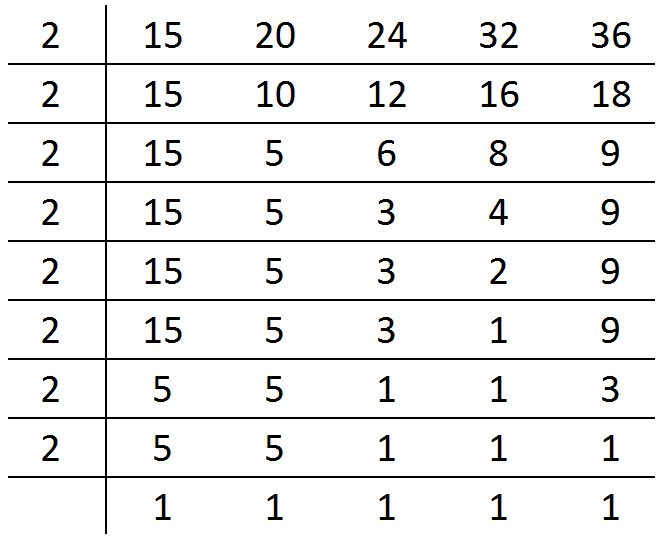
$\therefore LCM$ of $15, 20, 24, 32$ and $36 = 2 \times 2 \times 2 \times 2 \times 2 \times 3 \times 3 \times 5 = 1,440$
Hence, $1,440$ is the least number that is divisible by $15, 20, 24, 32$ and $36.$
View full question & answer→MCQ 1011 Mark
Which of the following statement is true?
AnswerCorrect option: C. Difference of two like fractions $=\frac{\text{diffrence of numerators}}{\text{common denominators}}$
Fractions with same denominator are called like fractions and a fraction that is less than one, with the numerator less than the denominator is called proper fraction.
View full question & answer→MCQ 1021 Mark
$\frac{1}{1+\frac{1}{3}}-\frac{1}{1+\frac{1}{2}}=$
- A
$-\frac{1}{3}$
- B
$-\frac{1}{3}$
- ✓
$-\frac{1}{12}$
- D
$\frac{1}{12}$
AnswerCorrect option: C. $-\frac{1}{12}$
Given that
we have to find the value of given expression
$\frac{1}{1+\frac{1}{3}}-\frac{1}{1+\frac{1}{2}}$
$=\frac{1}{\frac{1+3}{3}}-\frac{1}{\frac{1+2}{2}}$
$=\frac{3}{4}-\frac{2}{3} $
$=\frac{3\times3-2\times4}{12}$
$=\frac{1}{12}$
View full question & answer→MCQ 1031 Mark
Express $2\frac{1}{5}$ as a fraction of $7\frac{2}{9}$
- ✓
$\frac{99}{325}$
- B
$\frac{143}{9}$
- C
$\frac{67}{200}$
- D
$\frac{143}{18}$
AnswerCorrect option: A. $\frac{99}{325}$
Reqd. Fraction $=\frac{2\frac{1}{5}}{7\frac{2}{9}}=\frac{\frac{11}{5}}{\frac{65}{9}}=\frac{11}{5}\times\frac{9}{65}=\frac{99}{325}$
View full question & answer→MCQ 1041 Mark
$16.37$ and $18.97$ are
- ✓
- B
- C
Equivalent decimal fractions
- D
Answer Decimals having the same number of decimal places are called like decimals i.e.
decimals having the same number of digits on the right of the decimal point are known as like decimals.
For example, $16.37$ and $18.97$ are like decimals as both of these decimal numbers are written up to $2$ places of decimal.
Hence, $16.37$ and $18.97$ are like decimal fractions.
View full question & answer→MCQ 1051 Mark
The factor(s) of $16$ is/are
Answer$ 16 = 2 \times 2 \times 2 \times 2$ The factors are $1, 2, 4, 8, 16.$
View full question & answer→MCQ 1061 Mark
$LCM$ of the numbers $4$ and $9$ is:
Answer Factors of the given numbers are,$4 = 2 \times 2$
$9 = 3 \times 3$
$\therefore LCM$ of $4$ and $9 = 2 \times 2 \times 3 \times 3 = 36$
View full question & answer→MCQ 1071 Mark
The $1$st threecommon multiple of numbers $12, 8, 16$ are:
- A
$12,24,36$
- B
$8,16,24$
- C
$16,32,48$
- ✓
$48,96,144$
AnswerCorrect option: D. $48,96,144$
$12 = 2^2 \times 38 = 2^316 = 2^4$
$\Rightarrow LCM$ of $12, 8, 16 = 2^4 \times 3 = 48$
$\therefore 48$ is the least common multiple of $12,8,16.$
Thus, all multiples of $48$ are common multiples of $12, 8$ and $16.$
$\therefore $ First three common multiples $= 48, 96, 144$
View full question & answer→MCQ 1081 Mark
Mark $(\checkmark)$ against the correct answer in the following: Which of the following are co$-$primes$?$
- A
$8, 12$
- ✓
$9, 10$
- C
$6, 8$
- D
$15, 18$
AnswerCorrect option: B. $9, 10$
$a.\ 8, 12$ are not co$-$primes as they have a common factor $4.$
$b.\ 9, 10$ are co$-$primes as they do not have a common factor.
$c.\ 6, 8$ are not co$-$primes as they have a common factor $2.$
$d.\ 15,18$ are not co$-$primes as they have a common factor $3.$
View full question & answer→MCQ 1091 Mark
The mean of the factors of $24$ is:
- A
$\frac{10}{3}$
- ✓
$\frac{9}{4}$
- C
$\frac{15}{2}$
- D
$\frac{17}{3}$
AnswerCorrect option: B. $\frac{9}{4}$
By getting factors of $24 = 2 \times 2 \times 2 \times 3$
The mean is the average of the numbers. It is easy to calculate: add up all the numbers,
then divide by how many numbers there are.
Mean of the factors will be = $\frac{2 + 2 + 2 + 3}{4} = \frac{9}{4}$
So, the correct answer is option $B.$
View full question & answer→MCQ 1101 Mark
The simplified value of $(1-\frac{1}{3}) (1-\frac{1}{4})(1-\frac{1}{5}) .... (1-\frac{1}{99})(1-\frac{1}{100})$is:
- A
$\frac{2}{99}$
- B
$\frac{1}{25}$
- ✓
$\frac{1}{50}$
- D
$\frac{1}{100}$
AnswerCorrect option: C. $\frac{1}{50}$
$\frac{2}{3}\times\frac{3}{4}\times\frac{4}{5}\times ... \times\frac{98}{99}\times\frac{99}{100}=\frac{2}{100}=\frac{1}{50}$
View full question & answer→MCQ 1111 Mark
Mark the correct alternative in the following:
The $HCF$ of an even number and an odd number is:
Answer Example:
$HCF$ of $8$ and $21$ is $1.$
$HCF$ of $6$ and $9$ is $3.$
$HCF$ of $9$ and $36$ is $9.$
So there is no fixed number that can be the $HCF$ of an even number and an odd number.
View full question & answer→MCQ 1121 Mark
If $n$ is a natural number then $n (n + 1) (n + 2)$ is always divisible by
AnswerGiven that $n$ is a natural numberIf $n$ is even then $n, n + 2$ are divisible by $2$
If n is odd, then $n + 1$ is divisible by $2$
Therefore $n (n + 1) (n + 2)$ is always divisible by $2$
If we take three consecutive numbers, then there should be a multiple of $3$ among them Therefore $n (n + 1) (n + 2)$ is divisible by $3$
Therefore $n ( n + 1) (n + 2)$ is divisible by $2 \times 3 = 6$
View full question & answer→MCQ 1131 Mark
Mark $(\checkmark)$ against the correct answer in the following:
The $LCM$ of two co-prime numbers is their:
AnswerThe $LCM$ of two co-prime numbers is their product.
View full question & answer→MCQ 1141 Mark
$x$ is twice the difference between the $6th$ and $10th$ multiple of $7.$
Find the value of $x.$
Answer$6th$ multiple of $7 = 42$
$10th$ multiple of $7 = 70$
Now, $x = 2 \times (70 − 42) = 2 \times 28 = 56$
View full question & answer→MCQ 1151 Mark
The $LCM$ of co-prime numbers is the $.........$
Answer$LCM \times HCF =$ product of numbers
$HCF$ of co-prime numbers $=1$
So, $LCM =$ product of numbers
Therefore, $D$ is the correct answer.
View full question & answer→MCQ 1161 Mark
Mark the correct alternative in the following: Which of the following numbers is prime?
Answer
$23 = 1 \times 23,$
$23$ has only two factors $1$ and $23,$ Therfore, it is a prime number.
$51 = 1 \times 3 \times 17,$
$51$ has three factors $1, 3$ and $17,$ Therfore, it is a composite number.
$38 = 1 \times 2 \times 19,$
$38$ has three factors $1, 2$ and $19,$ Therfore, it is a composite number.
$26 = 1 \times 2 \times 13,$
$26$ has three factors $1, 2$ and $13,$ Therefore, it is a composite number.
Hence, the correct answer is option $(a).$
View full question & answer→MCQ 1171 Mark
The sum of the first five multiples of $6$ is:
Answer first five multiple of $6$ are $6 × 1 = 66 × 2 = 126 × 3 = 186 × 4 = 246 × 5 = 30$
Their sum will be $6 + 12 + 18 + 24 + 30 = 90$
View full question & answer→MCQ 1181 Mark
The sum of prime numbers out of the numbers $17, 8, 21, 13, 41, 2, 27, 31, 51$ is:
AnswerPrime numbers out of $17, 8, 21, 13, 41, 2, 27, 31, 51$ are $17, 13, 41, 2, 31.$
Sum of prime numbers $= 17 + 13 + 41 + 2 + 31 = 104.$
View full question & answer→MCQ 1191 Mark
If $A, B$ and $C$ are three numbers such that $L.C.M.$ of $A$ and $B$ is $B$ and the $L.C.M.$ of $B$ and $C$ is $C$ then the $L.C.M.$ of $A, B$ and $C$ is:
AnswerCorrect option: C. $\text{C}$
$LCM$ of $A$ and $B$ is $B$ it means that $B$ is multiple of $A.\ LCM$ of $B$ and $C$ is $C$ it means $C$ is multiple of $B$ or we can say that $C$ is multiple of $A$ also.
So $LCM$ of $A, B, C$ is $C$
View full question & answer→MCQ 1201 Mark
Mark $(\checkmark)$ against the correct answer in the following:
The $HCF$ of $144, 180$ and $192 $is:
Answer We will first factorise the two numbers:
$\begin{array}{c|c}2&144\\\hline2&72\\\hline2&36\\\hline2&18\\\hline3&9\\\hline3&3\\\hline&1\end{array}$
$\begin{array}{c|c}2&8188\\\hline2&90\\\hline3&45\\\hline3&15\\\hline5&5\\\hline&1\end{array}$
$\begin{array}{c|c}2&192\\\hline2&96\\\hline2&48\\\hline2&24\\\hline2&12\\\hline2&6\\\hline3&3\\\hline&1\end{array}$
$144=2\times2\times2\times2\times3\times3=2^4\times3^2$
$180=2\times2\times3\times3\times5=2^2\times3^2\times5$
$192=2\times2\times2\times2\times2\times3=2^6\times3$
Here, $12(i.e. 2^2 \times 3 = 12)$ is the highest common factor of the three numbers.
View full question & answer→MCQ 1211 Mark
$LCM$ of the numbers $17$ and $5$ is
Answer Factors are $17 = 1 \times 17$
$5 = 1 \times 5$
$\therefore LCM$ of $17$ and $5 = 1 \times 17 \times 5 = 85$
View full question & answer→MCQ 1221 Mark
The factor(s) of $59$ is/are
Answer$59 = 1 \times 59$
$1$ and $59$ are the factors.So, options $A$ and $B$ are correct.
View full question & answer→MCQ 1231 Mark
Mark the correct alternative in the following:
If the number $2345$ a $60b$ is exactly divisible by $3$ and $5,$ then the maximum value of $a + b$ is:
Answer A number is divisible by $5$ if its last digit is either $0$ or $5$ out of which $5$ is maxim
$\therefore b = 5$
A number is divisible by $3$ if the sum of its digits is divisible by $3$
$2 + 3 + 4 + 5 + 6 + 0 + 5 = 25$
So, we can add maximum $8$ to $25$ which will give us $33$ which is divisible by $3$
$\therefore a = 8$
Now, $a + b = 8 + 5 = 13$
Hence, the correct answer is option $(b).$
View full question & answer→MCQ 1241 Mark
Three persons begin to walk around a circular track The first completes revolution in
$15\frac{1}{6}$ seconds the second in $16\frac{1}{4}$ econds and the third in $18\frac{2}{3}$ seconds respectively
After what time will they be together at the starting point again?
- A
$1\ hr \ 40\min$
- ✓
$1\ hr\ 40\sec$
- C
$1.4\ hrs$
- D
$1\ hr\ 3\min\ 40\sec$
AnswerCorrect option: B. $1\ hr\ 40\sec$
The time after which all the three will be together will be $LCM$ of
$15\frac{1}{6}, 16\frac{1}{4}, 18\frac{2}{3}$
$LCM$ of $\frac{91}{6}, \frac{65}{4}, \frac{56}{3}=\frac{\text{LCM of 91,65,56}}{\text{HCF of 6,4,3}}=3640$ second $=1$ hour $40$ minits
View full question & answer→MCQ 1251 Mark
The resultant of $34;$ factor $\times $ factor ............ is equal to:
Answer Factor $\times $ factor $=$ product
View full question & answer→MCQ 1261 Mark
Mark the correct alternative in the following:
The sum of the prime numbers between $60$ and $75$ is:
AnswerPrime numbers between $60$ and $75$ are $61, 67, 71,$ and $73.$
Their sum is given by:
$61 + 67 + 71 + 73 = 272$
View full question & answer→MCQ 1271 Mark
The Simplified form of $0.35$ is:
- ✓
$\frac {7}{20}$
- B
$\frac {4}{20}$
- C
$\frac {35}{100 }$
- D
$\text{None}$
AnswerCorrect option: A. $\frac {7}{20}$
$0.35=\frac{35}{100}=\frac{7}{20}$
View full question & answer→MCQ 1281 Mark
Every number is a ...... and a ........ of itself.
Answer Every number is a factor and a multiple of itself.
For example, $10$ has a factor $10$ as well as a multiple $10.$
View full question & answer→MCQ 1291 Mark
Convert the following into fraction.
$44\%$
- A
$\frac{11}{44}$
- B
$\frac{44}{1000}$
- C
$\frac{44}{11}$
- ✓
$\frac{11}{25}$
AnswerCorrect option: D. $\frac{11}{25}$
Here $1\%$ can be written as $\frac{1}{100}$
So, $44\%\Rightarrow(44\times1)\%$
$=44\times\frac{1}{100}$
$=\frac{44}{100}$
$=\frac{4\times11}{4\times25}$
$=\frac{11}{25}$
$44\%\Rightarrow\frac{11}{25}$ (Fraction)
View full question & answer→MCQ 1301 Mark
Mark the correct alternative in the following:
The number of primes between $90$ and $100$ is
AnswerThere is only one prime number between $90$ and $100,$ i.e. $97.$
View full question & answer→MCQ 1311 Mark
Mark $(\checkmark)$ against the correct answer in the following:
The product of two numbers is $2160$ and their $HCF$ is $12.$ The $LCM$ of these numbers is:
AnswerHere, $HCF = 12$
Product of two number $= 2160$
We know:
$LCM \times HCF =$ Product of the two numbers
$LCM =\frac{2160}{\text{HCF}}$
$=\frac{2160}{12}$$= 180$
$LCM = 180$
View full question & answer→MCQ 1321 Mark
A number which is a factor of every number is
AnswerLets consider prime and composite numbers separately and prove $1$ is a factor in each case.
Prime:
Example: $7$
Factors of $7$ are $1,7.$
Composite:
Example: $10$
Factors of $10$ are $1, 10, 2, 5.$
View full question & answer→MCQ 1331 Mark
Mark $(\checkmark)$ against the correct answer in the following:
What least number should be replaced for $*$ so that the number $67301*2$ is exactly divisible by $9?$
Answer$6 + 7 + 3 + 0 + 1 + * + 2 = 19 + *$
$8$ is the least number that should be added to $19$ such that number will be divisible by $9.$
Sum of the digits:
$6 + 7 + 3 + 0 + 1 + 8 + 2 = 27$
$27$ is divisible by $9.$
View full question & answer→MCQ 1341 Mark
Simplification of the fraction $2\frac{1}{3}$ gives
- A
$\frac{5}{6}$
- B
$\frac{9}{3}$
- C
$\frac{2}{3}$
- ✓
$\frac{7}{3}$
AnswerCorrect option: D. $\frac{7}{3}$
$2\frac{1}{3}=\frac{3\times2+1}{3}=\frac{7}{3}$
View full question & answer→MCQ 1351 Mark
Mark the correct alternative in the following:
Which of the following are not twin-primes?
- A
$3, 5$
- B
$5, 7$
- C
$11, 13$
- ✓
$17, 23$
AnswerCorrect option: D. $17, 23$
Pairs of prime numbers that differ by $2$ are called twin primes.
The difference between $17$ and $23$ is $6.$
Hence, $17$ and $23$ are not twin primes.
View full question & answer→MCQ 1361 Mark
the first four common multiple of numbers $6, 8, 10$ are:
- A
$10, 20, 30, 40$
- ✓
$120, 240, 360, 480$
- C
$8, 40, 80, 120$
- D
$6, 60, 120, 240$
AnswerCorrect option: B. $120, 240, 360, 480$
$6 = 2 \times 38 = 2^310 = 2 \times 5$
$\Rightarrow LCM$ of $6, 8, 10 = 2^3 \times 3 \times 5 = 120$
$\therefore 120$ is the least common multiple of $6, 8, 10.$
Thus, all multiples of $120$ are common multiples of $6,8$ and $10.$
$\therefore $ First four common multiples$ = 120, 240, 360, 480$
View full question & answer→MCQ 1371 Mark
Mark $(\checkmark)$ against the correct answer in the following:
$\frac{289}{391}$ when reduced to lowest term is:
- A
$\frac{13}{17}$
- B
$\frac{17}{19}$
- ✓
$\frac{17}{23}$
- D
$\frac{17}{21}$
AnswerCorrect option: C. $\frac{17}{23}$
$\begin{array}{c|c}17&289\\\hline17&17\\\hline&1\end{array}$
$\begin{array}{c|c}17&391\\\hline23&23\\\hline&1\end{array}$
$289 = 17 × 17$
$391 = 17 × 23$
The $HCF$ of $289$ and $391$ is $17.$
Dividing both the numerator and the denominator by $17:$
$\frac{289\div17}{391\div17}=\frac{17}{23}$
View full question & answer→MCQ 1381 Mark
Bhushan counted to $60$ using multiples of $6.$
Which statement is true about multiples of $6?$
- A
They are all odd numbers.
- B
They all have $6$ in the ones place.
- ✓
They can all be divided evenly by $3.$
- D
They can all be divided evenly by $12.$
AnswerCorrect option: C. They can all be divided evenly by $3.$
Multiple of $6$ like $6, 12, 18, 24, 30$ and they can all be divided evenly by $3.$
So option $C$ is correct.
View full question & answer→MCQ 1391 Mark
If the value of $p = 4$ then, $p, p +2, p + 4$ is a multiple of .......... .
Answer$p = 4, 4 ÷ 2 = 2$
$p + 2 = 4 + 2, 6 ÷ 2 = 3$
$p + 4 = 4 + 4, 8 ÷ 2 = 4$
Product is divisible by $2.$
Therefore, $C$ is the correct answer.
View full question & answer→MCQ 1401 Mark
Mark the correct alternative in the following:
What least number be assigned to $*$ so that number $653*47$ is divisible by $11?$
AnswerSum of the digits at odd places $= 6 + 3 + 4 = 13$
Sum of the digits at even places $= 5 + * + 7 = 12 + *$
Difference $= 13 - [12 + *] = 1 − *$
If $6,53,*47$ is divisible by $11,$ then $1 - *$ must be zero or multiple of $11.$
$1 - * = 0 or 11$
$* = 1$ or $- 10$
But $*$ is a digit, so $*$ must be $1.$
View full question & answer→MCQ 1411 Mark
LCM of two co-prime numbers is their
Answer$LCM$ of two co -prime numbers is their product.
Example: Consider $6$ and $7,$
Multiple of $6 = 6, 12, 18, 24, 30, 36, 42, 48$
Multiple of $7 = 7, 14, 21, 28, 35, 42$
$L.C.M$ of $6$ and $7 = 42$
The product of $6$ and $7 = 6 \times 7 = 42$
View full question & answer→MCQ 1421 Mark
Select the correct option.
The $HCF$ and the $LCM$ of $12, 21, 15$ respectively are
- ✓
$3, 140$
- B
$12, 420$
- C
$3, 420$
- D
$420, 3$
AnswerCorrect option: A. $3, 140$
Numbers $= 12, 15, 21$
$12 = 2 \times 2 \times 3$
$15 = 3 \times 5$
$21 = 3 \times 7$
$HCF =$ Product of smallest power of each common prime factor $=3′ = 3$
$LCM =$ Product of greatest power of each prime factor
$2^2\times 3 \times 5 \times 7 = 4 \times 3 \times 5 \times 7 = 420$
$(C)\ 3, 420$
View full question & answer→MCQ 1431 Mark
Mark $(\checkmark)$ against the correct answer in the following:
The least number divisible by each of the numbers $15, 20, 24, 32$ and $36$ is:
AnswerCorrect option: C. $1440$
The least number divisible by each of the numbers $15, 20, 24, 32$ and $36$ is their $LCM.$
$\begin{array}{c|c}2&15,20,24,32,36\\\hline2&15,10,12,16,18\\\hline2&15,5,6,8,9\\\hline2&15,5,3,4,9\\\hline2&15,5,3,2,9\\\hline3&15,5,3,1,9\\\hline3&5,5,1,1,3\\\hline5&5,5,1,1,1\\\hline&1,1,1,1,1\end{array}$
$LCM= 2^5 \times 3^2 \times 5$
$= 1440$
View full question & answer→MCQ 1441 Mark
Mark the correct alternative in the following:
The $HCF$ of two consecutive natural numbers is:
AnswerThe $HCF$ of any two consecutive natural numbers is $1$ because two consecutive natural numbers are always co-prime.
View full question & answer→MCQ 1451 Mark
Simplify:
$\frac{\sqrt3+\sqrt2}{\sqrt3-\sqrt2}+\frac{\sqrt3-\sqrt2}{\sqrt3+\sqrt2}$
- A
$4\sqrt6$
- ✓
$10$
- C
$2$
- D
$\frac{4\sqrt6}{5}$
Answer$\frac{\sqrt3+\sqrt2}{\sqrt3-\sqrt2}+\frac{\sqrt3-\sqrt2}{\sqrt3+\sqrt2}$
$=\frac{\big(\sqrt3+\sqrt2\big)^2+\big(\sqrt3-\sqrt2\big)^2}{3-2}$
$=\frac{3+2+3+2}{1}=10$
View full question & answer→MCQ 1461 Mark
Mark the correct alternative in the following:
The $GCD$ of two numbers is $17$ and their $LCM$ is $765.$ How many pairs of values can the numbers assume$?$
Answer$GCD$ of two numbers is $17$
So, the numbers can be $17a$ and $17b.$
Now, $17a \times 17b = 17 \times 765$
$\Rightarrow ab = 45$
So, we can get two pairs
$a = 5$ and $b = 9$ or $a = 9$ and $b = 5$
Thus, the numbers are $17 \times 5 = 85$ and $17 \times 9 = 153.$
Also, we can get the other pair $17 \times 1 = 17$ and $765.$
Hence, the correct answer is option $(b).$
View full question & answer→MCQ 1471 Mark
Convert $\frac{7}{4}$ into mixed fraction.
AnswerCorrect option: A. $1\frac{3}{4}$
$\frac{7}{4}=1\frac{3}{4}$
View full question & answer→MCQ 1481 Mark
Find the number of factors of $512.$
AnswerFactors of $512 = 1, 2, 4, 8, 16, 32, 64, 128, 256, 512$
Therefore, number of factors of $512 = 10.$
View full question & answer→MCQ 1491 Mark
The number of prime factors of $(3 \times 5)^{12}$ $(2 \times 7)^{10}$$(10)^{25}$is:
Answer$(3 × 5)^{12} \times (2 × 7)^{10} \times 10^{25} = 2^{35} \times 3^{12} \times 5^{37} \times 7^{10}$
Therefore, number of prime factors is equal to $4,$
i.e., ${2, 3, 5, 7}$
View full question & answer→MCQ 1501 Mark
Fractions with different denominators are called .......... fractions.
AnswerTwo fractions are called as unlike fractions, if the denominators of those fractions are different.
For example: Consider $\frac {1}{5}$ and $\frac {3}{6},$ here both the fractions have different denominators, so they are unlike fractions.
Hence, fractions with different denominators are called unlike fractions.
View full question & answer→MCQ 1511 Mark
The $LCM$ of co-prime numbers is the .........
Answer$LCM \times HCF =$ product of numbers
$HCF$ of co-prime numbers $=1$
So, $LCM = LCM =$ product of numbers
Therefore, $D$ is the correct answer.
View full question & answer→MCQ 1521 Mark
Numerator in the fraction $\frac{5}{6}$ is ..........
- ✓
$5$
- B
$6$
- C
$\frac{1}{5}$
- D
$\frac{1}{6}$
AnswerWhen an object is divided into a number of equal parts then each part is called a fraction.
For example, in a fraction $\frac{2}{5},$ the numerator is $2$ and the denominator is $5,$
where the numerator represents how many parts is there in the fraction and the denominator represents how many equal parts in the whole object.
Hence, numerator of the fraction $\frac{5}{6}$ is $5.$
View full question & answer→MCQ 1531 Mark
Mark $(\checkmark)$ against the correct answer in the following:
$\frac{289}{391}$ When reduced to the lowest terms is:
- A
$\frac{11}{23}$
- B
$\frac{13}{31}$
- C
$\frac{17}{31}$
- ✓
$\frac{17}{23}$
AnswerCorrect option: D. $\frac{17}{23}$
$HCF = 17$
Dividing both the numerator and the denominator by the $HCF$ of $289$ and $391:$
$\begin{array}{c|c}17&289\\\hline17&17\\\hline&1\end{array}$
$\begin{array}{c|c}17&391\\\hline23&23\\\hline&1\end{array}$
$\frac{289\div17}{391\div17}=\frac{17}{23}$
View full question & answer→MCQ 1541 Mark
Mark $(\checkmark)$ against the correct answer in the following:
Every counting number has an infinite number of:
AnswerEvery counting number has an infinite number of multiples.
If $p$ is a counting number, its multiples are $1p, 2p, 3p....$
View full question & answer→MCQ 1551 Mark
Mark $(\checkmark)$ against the correct answer in the following:
The $LCM$ of $12, 15, 20, 27$ is:
Answer$\begin{array}{c|c}2&12,15,20,27\\\hline2&6,15,10,27\\\hline3&3,15,5,27\\\hline3&1,5,5,9\\\hline3&1,5,5,3\\\hline5&1,5,5,1\\\hline&1,1,1,1\end{array}$
$LCM$ $2^2 × 3^3 × 5 = 540$
View full question & answer→MCQ 1561 Mark
Sum of factors of $78$ are ________.
AnswerFactors of $78$ are $1, 2, 3, 6, 13, 26, 39$ and $78.$
Required sum $= 1 + 2 + 3 + 6 + 13 + 26 + 39 + 78 = 168.$
View full question & answer→MCQ 1571 Mark
Which of the following is $NOT$ a positive multiple of $12:$
Answer$3$ is not a positive multiple of $12$ as it is smaller than $12.$
Rest others are multiples of $12.$
View full question & answer→MCQ 1581 Mark
Mixed fraction for $\frac{39}{12}$ is:
- A
$3\frac{1}{12}$
- B
$3\frac{2}{12}$
- ✓
$3\frac{3}{12}$
- D
$2\frac{14}{12}$
AnswerCorrect option: C. $3\frac{3}{12}$
To convert an improper fraction to a mixed fraction, we divide the numerator by the denominator, then write down the whole number answer.
Finally we write down any remainder above the denominator.
$39 ÷ 12 = 3$ leaving remainder $3$
Therefore, the answer will be, $3$ whole $\frac{3}{12}$
Hence, the mixed fraction of $\frac{39}{12}$ is $3\frac{3}{12}$.
View full question & answer→MCQ 1591 Mark
Find two common multiples of $12,15$
- A
$48, 96$
- ✓
$60, 120$
- C
$10, 20$
- D
$24, 30$
AnswerCorrect option: B. $60, 120$
$12 = 2^2 \times 315 = 3 \times 5$
$\Rightarrow LCM = 2^2 \times 3 \times 5 = 60$
$\therefore 60$ is the least common multiple of $12,15.$ Thus,
all multiples of $60$ are common multiples of $12$ and $15.$
Answer $= 60,120$
View full question & answer→MCQ 1601 Mark
$1$ is a ............ of every prime number.
Answer$1$ is a factor of prime number.
View full question & answer→MCQ 1611 Mark
How many three - quarters part of $24$ pancakes can be made$?$
AnswerTo find : How many three-quarters part of $24$ pancakes
$\frac{3}{4}\times24=18$
Three - quarters part of $24$ pancakes $= 18$
View full question & answer→MCQ 1621 Mark
Mark $(\checkmark)$ against the correct answer in the following:
The smallest number which when diminished by $3$ is divisible by $14, 28, 36$ and $45,$ is:
AnswerCorrect option: C. $1263$
The smallest number that is exactly divisible by $14, 28, 36$ and $45$ will be their $LCM.$
So, the required number will be the $LCM$ plus $3.$
$\begin{array}{c|c}2&11,28,36,45\\\hline2&11,14,18,45\\\hline3&11,7,9,45\\\hline3&11,7,3,15\\\hline5&11,7,1,5\\\hline7&11,7,1,1\\\hline11&11,1,1,1\\\hline&1,1,1,1\end{array}$
$LCM$ of the three numbers $= 2^2 \times 3^2 \times 5 \times 7 \times 11$
$= 13860$
$\therefore $ Required number $= 13860 + 3 = 13863$
View full question & answer→MCQ 1631 Mark
The sum of the first five prime numbers is:
AnswerRequired sum $= (2 + 3 + 5 + 7 + 11) = 28$
Note: $11$ is not a prime number.
View full question & answer→MCQ 1641 Mark
$LCM$ of the numbers $17$ and 5 is:
AnswerFactors are $17 = 1 \times 175 = 1 \times 5$
$\therefore LCM$ of $17$ and $5 = 1 \times 17 \times 5 = 85$
View full question & answer→MCQ 1651 Mark
Mark $(\checkmark)$ against the correct answer in the following:
The $LCM$ of $24, 36, 40$ is:
Answer$\begin{array}{c|c}2&24,36,40\\\hline2&12,18,20\\\hline2&6,9,10\\\hline3&3,9,5\\\hline3&1,3,5\\\hline5&1,1,5\\\hline&1,1,1\end{array}$
$LCM = 2^3 \times 3^2 \times 5$
$= 360$
View full question & answer→MCQ 1661 Mark
The expression $10xy^4 - 10x^4y$ can be expressedin factors as:
- A
$10xy (x - y)(x^2 + xy + y^2 )$
- B
$10xy (y - x)(x^2 - xy + y^2)$
- ✓
$10xy(y - x)(x^2 + xy + y^2)$
- D
AnswerCorrect option: C. $10xy(y - x)(x^2 + xy + y^2)$
$10xy^4−10x^4y$
$= 10xy(y^3 - x^3)$
$= 10xy (y - x) (y^2 + x^2 + xy) [∵a3−b3=(a−b)(a2+b2+ab)]$
Option $C$ is correct.
View full question & answer→MCQ 1671 Mark
Mark the correct alternative in the following:
Which of the following are co-primes?
- A
$8,10$
- ✓
$9,10$
- C
$6,8$
- D
$5,18$
AnswerCorrect option: B. $9,10$
$ 9 = 3 \times 3 \times 1$
$10 = 2 \times 5 \times 1$
Though both $9$ and $10$ are composite numbers, the only factor common to them is $1.$
Therefore, $9$ and $10$ are co-primes.
View full question & answer→MCQ 1681 Mark
Which of the following integers has most number of divisors?
Answer$ 176 = 2 \times 2 \times 2 \times 2 \times 11$
$182 = 2 \times 7 \times 13$
$99 = 3 \times 11 \times 3$
$101$ is a prime so has only $1$ and itself as factors.
Hence, clearly, $176176$ has the greatest number of divisors.
View full question & answer→MCQ 1691 Mark
Which one of the following is a prime number$?$
Answer$\sqrt{437}.2$
All prime numbers less than $2222$ are: $2, 3, 5, 7, 11, 13, 17, 19.$
$161$ is divisible by $7,$ and $221$ is divisible by $13.$
$373$ is not divisible by any of the above prime numbers.
$\therefore 373373$ is prime.
View full question & answer→MCQ 1701 Mark
In the numeration system with base $5,$ counting is as follows $: 1, 2, 3, 4, 10, 11, 12, 13, 14, 20,$ ____.
The number whose description in the decimal system is $69,$ when described in the base $5$ system, is a number with:
- A
- B
Two non-consecutive digits
- ✓
- D
Three non-consecutive digits
Answer$69 = 2.5^2+ 3.5 + 4.1 = 234_5 ($that is,$ 234$ in the base $5$ system$).$ The correct choice is, therefore, $(c).$
View full question & answer→MCQ 1711 Mark
Every number is a ...... and a ........ of itself.
AnswerEvery number is a factor and a multiple of itself. For example,
$10$ has a factor $10$ as well as a multiple $10.$
View full question & answer→MCQ 1721 Mark
Factors of $4X^2 - Y^2 + 2X - 2Y - 3XY$ are:
- A
$(x + y) (4x + y - 2)$
- ✓
$(x - y) (4x + y + 2)$
- C
$(x + y) (4x - y - 2)$
- D
$(xy + 2)$
AnswerCorrect option: B. $(x - y) (4x + y + 2)$
On putting $X = Y$ we observed that expression turns out to zero which means $(x - y)$ is one factor
$4x^2 - y^2 + 2x - 2y - 3xy$ it can be written as follow
$4x (x - y) + y(x - y) + 2(x - y)$
$(x - y) (4x + y + 2)$
View full question & answer→MCQ 1731 Mark
Mark the correct alternative in the following:
The $HCF$ of $100$ and $101$ is:
Answer$100 = 1 \times 2 \times 2 \times 5 \times 5$
$101 = 1 \times 101$
Since, $100$ is a composite number and $101$ is a prime number.
Thus, their $HCF$ is $1.$
Hence, the correct answer is option $(a).$
View full question & answer→MCQ 1741 Mark
A group of $616$ students is to march behind an army band of $32$ members in a parade. The two groups must march in the same number of columns. What can be the maximum number of columns in which they march$?$
View full question & answer→MCQ 1751 Mark
What are the three common multiples of $18$ and $6?$
- A
$18, 6, 9$
- B
$18, 36, 6$
- ✓
$36, 54, 72$
- D
AnswerCorrect option: C. $36, 54, 72$
Multiples of $18 = 18, 36, 54, 72.....$
Multiples of $6 = 6, 12, 18, 24....$
The first common multiple will be $18$
And the next common multiples will be multiples of $18$
Hence, the common multiples of $18, 6$ are $18, 36, 54, 72...$
View full question & answer→MCQ 1761 Mark
One of the factors of the expressions $X^2 + 5X + 25$is
- A
$x+5$
- B
$x-5$
- C
$\text{x}=\sqrt{5}$
- ✓
AnswerCompare the expression $x^2 + 5x + 25$ with $ax^2 + bx + c.$
Here, $a = 1, b = 5, c = 25$
Since, $D = b2 - 4ac = 52 - 4 (1)(25) = -75$
Discriminant$ (D) < 0$
$\therefore$ this expression has no real roots.
Option $D$ is correct.
View full question & answer→MCQ 1771 Mark
Mark the correct alternative in the following:
The $HCF$ of two consecutive even numbers is:
Answer$HCF$ of two consecutive even numbers is always $2.$
For example:
$HCF$ of $4$ and $6$ is $2.$
$HCF$ of $10$ and $12$ is $2$ and so on.
View full question & answer→MCQ 1781 Mark
$4\frac{7}{11}=\frac{?}{11}$
Answer$11\frac{7}{4}=\frac{4\times11+7}{11}=\frac{51}{11}$
View full question & answer→MCQ 1791 Mark
Mark the correct alternative in the following:
Which of the following numbers are twin primes?
- ✓
$3, 5$
- B
$5, 11$
- C
$3, 11$
- D
$13, 17$
AnswerCorrect option: A. $3, 5$
Twin primes are pairs of primes which differ by two.
In $(3, 5),$ the difference between the two primes is $2.$
Therefore, $(3, 5)$ are twin primes.
Hence, the correct answer is option $(a)$
View full question & answer→MCQ 1801 Mark
$LCM$ of numbers $1, 2, 3$ is equal to their
Answer$2, 3$ are primes.
$\therefore $ Each number has no factor other than $1$ and itself.
$\therefore $ Their $LCM$ is the product of the numbers.
$\therefore LCM$ of $1, 2, 3 = 2 \times 3 = 6.$
Also here $1 + 2 + 3 = 6.$
Answer- Option $A$ and Option $C.$
View full question & answer→MCQ 1811 Mark
Mark the correct alternatiue in the following:
If $x$ and $y$ are two co-primes, then their $LCM$ is
AnswerThe $LCM$ of two co-prime numbers is equal to their product.
Thus, $LCM$ of $'x'$ and $'y'$ will be $xy.$
View full question & answer→MCQ 1821 Mark
Which one of the following is not a prime number?
Answer$91$ is divisible by $7.$ So, it is not a prime number.
View full question & answer→MCQ 1831 Mark
Express the number as product of its prime factors: $5005$
- A
$4 \times 17 \times 13 \times 7$
- ✓
$5 \times 11 \times 13 \times 7$
- C
$7 \times 11 \times 19 \times 29$
- D
$5 \times 13 \times 19 \times 29$
AnswerCorrect option: B. $5 \times 11 \times 13 \times 7$
$5005 = 5 \times 7 \times 11 \times 13$
View full question & answer→MCQ 1841 Mark
Find the first four common multiples of the following $: 3$ and $4.$
- A
$24, 28, 32, 36$
- B
$24, 27, 33, 36$
- ✓
$12, 24, 36, 48$
- D
$12, 15, 20, 24$
AnswerCorrect option: C. $12, 24, 36, 48$
Multiples of $3 = 3, 6, 9, 12, 15, 18..$
Multiples of $4 = 4, 8, 12, 16, 20..$
The first common multiple will be $12$
And the next common multiples will be multiples of $12$
Hence, first four common multiples of $3, 4$ are $12, 24, 36, 48$
View full question & answer→MCQ 1851 Mark
A number which is a factor of every number is:
AnswerA number which is a factor of every number is $1.$
View full question & answer→MCQ 1861 Mark
If $(x + a)$ is a factor of $x2 + px + q$ and $x2 + mx + n$ then the value of a is:
- A
$\frac{\text{m - p}}{\text{n - q}}$
- ✓
$\frac{\text{n - q}}{\text{m - p}}$
- C
$\frac{\text{n + q}}{\text{m + p}}$
- D
$\frac{\text{m + P}}{\text{n + q}}$
AnswerCorrect option: B. $\frac{\text{n - q}}{\text{m - p}}$
Let, $P (x) = x2 + px + q$ and $Q(x) = x2 + mx + n$
Given $(x + a)$ is factor of $P(x)$ and $Q(x)$
$\therefore$ $P(−a) = 0$ and $Q(-a) = 0$
$\therefore$ $P(−a)$ $= Q(−a)$
$⇒ (−a)^2 + p(−a) + q = (−a)^2 + m(−a) + n = 0$
$⇒ a^2 − ap + q = a^2 − am + n$
$⇒ q − n = ap − am$
⇒ $\text{a}=\frac{\text{q - n}}{\text{p - m}}$
⇒ $\text{a}=\frac{\text{n - q}}{\text{m - p}}$
View full question & answer→MCQ 1871 Mark
A fraction equivalent to $\frac{2}{7}$ is:
- A
$\frac{14}{17}$
- ✓
$\frac{4}{14}$
- C
$1$
- D
$\frac{4}{28}$
AnswerCorrect option: B. $\frac{4}{14}$
A fraction equivalent to $\frac{2}{7}$ is $\frac{4}{14}$.
Equivalent fractions are got by multiplying the numerator and denominator with the same number.
In this case, it is.$2.$
View full question & answer→MCQ 1881 Mark
A number which is a factor of every number is
Answer A number which is a factor of every number is $1.$
View full question & answer→MCQ 1891 Mark
Simplify: $\frac{7\sqrt3}{\sqrt10+\sqrt3}-\frac{2\sqrt5}{\sqrt6+\sqrt5}-\frac{3\sqrt2}{\sqrt15+3\sqrt2}$
Answer $\frac{7\sqrt3}{\sqrt10+\sqrt3}-\frac{2\sqrt5}{\sqrt6+\sqrt5}-\frac{3\sqrt2}{\sqrt15+3\sqrt2}$
$=\frac{7\sqrt3\big(\sqrt10-\sqrt3\big)}{\big(\sqrt10+\sqrt3\big)\big(\sqrt10-\sqrt3\big)}-\frac{2\sqrt5\big(\sqrt6-\sqrt5\big)}{\big(\sqrt6+\sqrt5\big)\big(\sqrt6-\sqrt5\big)}-\frac{3\sqrt2\big(\sqrt15-3\sqrt2\big)}{\big(\sqrt15-3\sqrt2\big)\big(\sqrt15+3\sqrt2\big)}$
$=\frac{7\sqrt3\big(\sqrt10-\sqrt3\big)}{10-3}-\frac{2\sqrt5\big(\sqrt6-\sqrt5\big)}{6-5}-\frac{3\sqrt2\big(\sqrt15-3\sqrt2\big)}{15-18}$
$=\frac{7\sqrt3\big(\sqrt10-\sqrt3\big)}{7}-\frac{2\sqrt5\big(\sqrt6-\sqrt5\big)}{1}-\frac{3\sqrt2\big(\sqrt15-3\sqrt2\big)}{3}$
$=\frac{21\sqrt30-63425\sqrt30+210+21\sqrt30-18*7}{21}$
$=\frac{21}{21}=1$
View full question & answer→MCQ 1901 Mark
Mark the correct alternative in the following:
Which of the following numbers is a perfect number$?$
Answer A number for which the sum of all its factors is equal to twice the number is called a perfect number.
Factors of $6$ are $1, 2, 3,$ and $6.$
Sum of the factors of $6 = 1 + 2 + 3 + 6 = 12 = 2 \times 6$
Hence, $6$ is a perfect number.
View full question & answer→MCQ 1911 Mark
Mark $(\checkmark)$ against the correct answer in the following: Which of the following is a prime number$?$
Answer$a.\ 117$ is not a prime number because $117$ can be written as $3 \times 39.$
$b.\ 171$ is not a prime number because $171$ can be written as $19 \times 9.$
$c.\ 179$ is prime number.
View full question & answer→MCQ 1921 Mark
The highest common factor of the expressions $x^2 + x - (K + 7)$ and $2x^2 + Kx - 12$ is
$x + 4,$ the value of $K$ will be
Answer $\because x + 4 = 0$
$\Rightarrow x = −4$
$\therefore$ On putting $ x=-4$
$x=−4$ in each of the expression the remainder will be zero
$\Rightarrow (-4)^2 + (-4) - (k + 7) = 0$
$\Rightarrow 16 - 4 - k - 7 = 0$
$\therefore k = 5$
Or $ 2x^2 + kx - 12$
$\because x + 4 = 0$
$\Rightarrow x = -4$
$\therefore$ On putting $x = -4$ in each of the expression the remainder will be zero
$2(4)^2 + k(4) - 12 = 0$
$\Rightarrow 32 + 4k - 12 = 0$
$\Rightarrow 4k = 20$
$\Rightarrow k = 5$
View full question & answer→MCQ 1931 Mark
Find all of the factors of $47.$
Answer $47$ is a prime number.
So, the divisors of $47$ is $1,47.$
View full question & answer→MCQ 1941 Mark
The number of divisors of $441, 1125$ and $384$ are in:
AnswerCorrect option: B. $G.P.$
Since acc. to given ques.
$\frac{\text{a}{+2}}{2}=\frac{\text{b}{+4}}{4}=\frac{\text{c}{+6}}{6}=12 $
$\Rightarrow\text{a}=22, \text{b}=44,\text{c}=66 $
$\Rightarrow\text{abc}=(22)(44)(66)$
$=63888=11^3×2^4×3^6$
Total no. of factors of composite numbers $N=p^m q^n$
where $N$ is composite number and p and q are prime numbers Then,
Total factors of $N = (m+1)(n+1)$
Number of factors
$= (3+1)(4+1)(1+1) = 40$
$= (3+1)(4+1)(1+1) = 40$
View full question & answer→MCQ 1951 Mark
Mark $(\checkmark)$ against the correct answer in the following:
The $HCF$ of $144$ and $198$ is:
AnswerWe first factorise the two numkbers:
$\begin{array}{c|c}2&144\\\hline2&72\\\hline2&36\\\hline2&18\\\hline3&9\\\hline3&3\\\hline&1\end{array}$
$\begin{array}{c|c}2&198\\\hline3&99\\\hline3&33\\\hline11&11\\\hline&1\end{array}$
$144=2\times2\times2\times2\times3\times3=2^4\times3^2$
$198=2\times3\times3\times11=2\times3^2\times11$
Here, $18(2 × 3^2 = 18)$ is the highest common factor of the two numbers.
View full question & answer→MCQ 1961 Mark
What is the least number by which $2352$ is tobe multiplied to make it a perfect square$?$
Answer$22352$
$21776$
$2588$
$2294$
$3147$
$749$
$7$
$L.C.M$ of $ 2352 =2^2\times 2^2\times 7^2\times 3$
To make $23522352 $ a perfect square it must be multiplied by $3$
View full question & answer→MCQ 1971 Mark
Mark the correct alternative in the following:
What least number be assigned to $*$ so that the number $63576*2$ is divisible by $8?$
AnswerThe given number is divisible by $8$ if the number formed by its last three digits is divisible by $8.$
Hence, $63,57,6*2$ is divisible by $8$ if $ 6*2$ is divisible by $8.$
Thus, the least value of $*$ will be $3.$
View full question & answer→MCQ 1981 Mark
Mark the correct alternative in the following:
The smallest prime just greater than the $HCF$ of $84$ and $144$ is:
Answer $84 = 1 × 2 × 2 × 3 × 7 = 2^2 × 3^1 × 7^1$
$144 = 1 ×2 × 2 × 2 × 2 × 3 × 3 = 2^4 × 3^2$
$HCF$ of $84$ and $144 = 2^2 × 3^1= 12$
Prime number just greater than $12$ is $13.$
Hence, the correct answer is option $(d).$
View full question & answer→MCQ 1991 Mark
If the numerator and denominator of a proper fraction are increased by the same quantity, then the resulting fraction is?
- ✓
Always greater than the original fraction.
- B
Always less than the original fraction.
- C
Always equal to the original fraction.
- D
AnswerCorrect option: A. Always greater than the original fraction.
Let $\frac{1}{2}$ is original fraction.$\Rightarrow\frac{1}{2}=0.5$
$\Rightarrow $ Numerator and denominator increased by $5=\frac{1+5}{2+5}=\frac{5}{7}=0.71$
$\therefore\frac{1}{2}<\frac{5}{7}$
$\therefore$ If the numerator and denominator of a proper fraction are increased by the same quantity, then the resulting fraction is Always greater than the original fraction.
View full question & answer→MCQ 2001 Mark
Which one of the following is a prime number$?$
View full question & answer→MCQ 2011 Mark
$LCM$ of the numbers $36$ and $72$ is
Answer$36 = 2 \times 2 \times 3 \times 3$
$72 = 2 \times 2 \times 2 \times 3 \times 3$
$\therefore L.C.M$ of $36$ and $72 = 2 \times 2 \times 2 \times 3 \times 3 = 72$
View full question & answer→MCQ 2021 Mark
Multilplication of numbers $0.25 \times 0.4$ can be represented as
AnswerCorrect option: B. $\frac{1}{10}$
$0.25\times0.4=\frac{25}{100}\times\frac{4}{10}$
$=\frac{100}{100 \times10}=\frac{1}{10}$
View full question & answer→MCQ 2031 Mark
Find the equivalent fraction of $\frac{36}{48}$ of denominator $4.$
- A
$\frac{6}{4}$
- ✓
$\frac{3}{4}$
- C
$\frac{4}{3}$
- D
$\frac{4}{5}$
AnswerCorrect option: B. $\frac{3}{4}$
Let the number be $x$
So, $\frac{36}{48}=\frac{\text{x}}{4}\Rightarrow\text{x}=\frac{4\times36}{48}$
now, $\text{x}=\frac{4.12.3}{12.4}=3$
$\Rightarrow $ Equivalent Fraction $=\frac{3}{4}$
View full question & answer→MCQ 2041 Mark
Multiple(s) of $14$ is/are:
Answer Multiples of $14$ are $14 \times 1, 14 \times 2 ....$
And $7$ and $1$ are the factors of $14.$
So, option $C$ is correct.
View full question & answer→MCQ 2051 Mark
Mark $(\checkmark)$ against the correct answer in the following:
The $HCF$ of two co-primes is:
Answer$ HCF$ of two co-primes is $1.$
This is because two co-prime numbers do not have any common factor.
For example, $15$ and $16$ are co-primes.Their.
$HCF$ is $1.$
View full question & answer→MCQ 2061 Mark
The largest number which divides $70$ and $125,$ leaving remainders $5$ and $8$ respectively is :
Answer Number when divides $70$ and $125$ leaves remainders $5$ and
$8,$ then
$70 - 5 = 65$
$125 − 8 = 117$
then $HCF$ of $65$ and $117$ is
$65 = 5 \times 13117 = 3 \times 3 \times 13$
Hence, $HCF$ of $65$ and $117$ is $13.$
$13$ is the largest number which divides $70$ and $125$ and leaves remainders $5$ and $8.$
View full question & answer→MCQ 2071 Mark
Express the following number as a product of its prime factors : $3825$
- A
$3 × 5^2 ×17^3$
- B
$3^2 × 5 × 17$
- ✓
$3^2 × 5^2 × 17$
- D
$3^2 × 5^3 × 17$
AnswerCorrect option: C. $3^2 × 5^2 × 17$
$3825 = 3 × 3 × 5 × 5 ×17 = 3^2 × 5^2 × 17$
View full question & answer→MCQ 2081 Mark
What is the largest odd-numbered factor of $45004500?$
- A
$1105$
- ✓
$1125$
- C
$1135$
- D
$1145$
AnswerCorrect option: B. $1125$
Factor of $4500 = 2 \times 2250$
$\Rightarrow 2 \times 2 \times 1125$
$\therefore$ odd numbered factor of $4500$ is $1125.$
View full question & answer→MCQ 2091 Mark
Mark $(\checkmark)$ against the correct answer in the following: Which of the following numbers is divisible by $6?$
- ✓
$8790432$
- B
$98671402$
- C
$85492014$
- D
AnswerCorrect option: A. $8790432$
A number is divisible by $6,$ if it is divisible by both $2$ and $3.$
$a.\ 8790432$
Consider the number $8790432.$
The number in the ones digit is $2.$
Therefore, $8790432$ is divisible by $2.$
Now, the sum of its digits $(8 + 7 + 9 + 0 + 2 + 3 + 2)$ is $33.$
Since $33$ is divisible by $3$, we can say that $8790432$ is also divisible by $3.$
Since $8790432$ is divisible by both $2$ and $3$, it is also divisible by $6.$
$b.\ 98671402$
Consider the number $98671402.$
The number in the ones digit is $2.$
Therefore, $98671402$ is divisible by $2.$
Now, the sum of its digits $(9 + 8 + 6 + 7 + 1 + 4 + 0 + 2)$ is $37.$
Since $37$ is not divisible by $3,$ we can say that $98671402$ is also not divisible by $3.$
Since $98671402$ is not divisible by both $2$ and $3,$ it is not divisible by $6.$
$c.\ 85492014$
Consider the number $85492014.$
The number in the ones digit is $4.$
Therefore, $85492014$ is divisible by $2.$
Now, the sum of its digits $(8 + 5 + 4 + 9 + 2 + 0 + 1 + 4)$ is $33.$
Since $33$ is divisible by $3,$ we can say that $85492014$ is also divisible by $3.$
Since $85492014$ is divisible by both $2$ and $3,$ it is also divisible by $6.$
View full question & answer→MCQ 2101 Mark
The prime number which comes just after $43$ is _____
AnswerA prime number (or a prime) is a natural number greater than
$1$ that has no positive divisors other than $1$ and itself.
By Euclids theorem, there is an infinite number of prime numbers.
The prime number which comes just after $43$ is $47.$
So option $C$ is the correct answer.
View full question & answer→MCQ 2111 Mark
$LCM$ of two co-prime numbers is their
Answer$LCM$ of two co -prime numbers is their product.
Example: Consider $6$ and $7,$
Multiple of 6$ = 6, 12, 18, 24, 30, 36, 42, 48$
Multiple of $7 = 7, 14, 21, 28, 35, 42$
$L.C.M$ of $66$ and $7 = 42$
The product of $6$ and $7 = 6 × 7 = 42$
View full question & answer→MCQ 2121 Mark
Mark the correct alternative in the following:
Which one of the following numbers is exactly divisible by $11?$
- A
$235641$
- B
$245642$
- C
$315624$
- ✓
$415624$
AnswerCorrect option: D. $415624$
Sum of digits at odd places $= 4 + 5 + 2 = 11$
Sum of digits at even places $= 1 + 6 + 4 = 11$
Difference of these two sums $= 11 - 11 = 0$
Therefore, $4,15,624 $ is divisible by $11.$
View full question & answer→MCQ 2131 Mark
Mark the correct alternative in the following:
The greatest five digit number exactly divisible by $9$ and $13$ is:
- A
$99945$
- ✓
$99918$
- C
$99964$
- D
$99972$
AnswerCorrect option: B. $99918$
$ LCM$ of $9$ and $13 = 9 × 13 = 117$
Largest 5-digit number is $99999$
Now, if we divide $99999$ by $117,$ we will get $854.69$ as quotient.
The integer just less than $854.69$ is $854$
$\therefore$ Required number $= 117 × 854 = 99918$
Hence, the correct answer is option $(b).$
View full question & answer→MCQ 2141 Mark
The $LCM$ of two numbers is $x$ and their $HCF$ is $y.$ The product of two numbers is:
AnswerCorrect option: D. $\text{xy}$
$\text{xy}$
View full question & answer→MCQ 2151 Mark
State which of the following statement is true $2^{16} −1$ is divisibleby:
Answer $2^{16} – 1 = 65536 – 1 = 65535$
$= 3 × 5 × 17 × 257$
Hence, $2^{16} – 1$ is divisible by $17$
View full question & answer→MCQ 2161 Mark
$L.C.M. $ of two co-prime numbers is their
Answer The two numbers which have only $1$ as their common factor are called co-primes.
For example, Factors of $5$ are $1, 5$
Factors of $3$ are $1, 3$
Common factors is $1.$
So they are co-prime numbers.
To find their $LCM,$ we
then choose each prime number with the greatest power and multiply them to get the $LCM.$
$\Rightarrow LCM = 3 \times 5 = 15$
Hence, $LCM$ of two co-prime numbers is their product.
View full question & answer→MCQ 2171 Mark
Each of the following is a factor of $80$, except
Answer The positive integers factor of $8080$ are $1, 2, 4, 5, 8, 10, 20, 40$
and $80$ Then in given option the option $C$ is $12$ not
the factor a factor of $80$. Answer is $12.$
View full question & answer→MCQ 2181 Mark
Let, $x, y$ and $z$ are the natural numbers. Which of the following statements is true$?$
$I)$ If $x$ is divisible by $y$ and $y$ is divisible by $z,$ then $x$ must be divisible by $z.$
$II)$ If $x$ is a factor of $y$ and $z,$ then $x$ must be a factor of $y + z.$
$III)$ If $x$ is a factor of $y$ and $z,$ then $x$ must be a factor of $\frac{\text{y}}{\text{z}}.$
- A
$I, II$ and $III$
- B
$I$ only
- ✓
$I$ and $II$
- D
$II $ only
AnswerCorrect option: C. $I$ and $II$
$I.$ If $x$ is divisible by $y$ and $y$ is divisible by $z$ then $x$ must be divisible by $z$
Let $x $be $12, y $ be $4$ and $z$ be $2.$
So, here we can see that $12$ is divisible by $2.$ Hence true.
$II.$ If $x$ is a factor of $y$ and $z$ then $x$ must be a factor of $y + z$
Let $x$ be $3, y$ be $6$ and $z$ be $15.$
So, here we can see that $21$ is divisible by $3.$ Hence true.
$III$ If $x$ is a factor of $y$ and $z$ then $x$ must be a factor of$\frac{\text{y}}{\text{z}}$
Let$ x$ be $2, y$ be $4$ and $z$ be $6.$
So, here we can see that $\frac{4}{6}$ is not divisible by $2.$ Hence untrue.
Therefore, option $C$ is correct.
View full question & answer→MCQ 2191 Mark
Simplified form of $ \Big(\frac{5718\times5718-4135\times4135}{5718+4135}\Big)$ is:
- A
$1683$
- ✓
$1583$
- C
$1783$
- D
$1563$
AnswerCorrect option: B. $1583$
$\frac{5718\times5718-4135\times4135}{5718+4135}$
$=\frac{(5718)^2-(4135)^2}{5718 + 4135}$
$\therefore(\text{a}^2-\text{b}^2)=(\text{a}+\text{b})+(\text{a}-\text{b})$
$=\frac{5718\times5718-4135\times4135}{5718+4135}$
$=5718-4135$
$=1583$
View full question & answer→MCQ 2201 Mark
The mixed fraction $5\frac{4}{7}$ can be expressed as
- A
$\frac{33}{7}$
- ✓
$\frac{39}{7}$
- C
$\frac{33}{4}$
- D
$\frac{39}{4}$
AnswerCorrect option: B. $\frac{39}{7}$
$\therefore5\frac{4}{7}=\frac{(7\times5)+4}{7}=\frac{35+4}{7}$
$=\frac{39}{5}$
View full question & answer→MCQ 2211 Mark
Mark the correct alternative in the following:
Which of the following numbers is divisible by $9?$
- ✓
$9076185$
- B
$92106345$
- C
$10349576$
- D
$95103476$
AnswerCorrect option: A. $9076185$
In $90,76,185:$
Sum of the digits $= 9 + 0 + 7 + 6 + 1 + 8 + 5 = 36$
Since $36$ is divisible by $9, 9076185$ is divisible by $9.$
View full question & answer→MCQ 2221 Mark
If $x^2 - 4$ is a factor of $2x^3+ ax^2+ bx + 12$ where a and b are constant Then values of $a$ and $b$ are
- A
$-3, 8$
- B
$3, 8$
- ✓
$-3, -8$
- D
$3, -8$
AnswerCorrect option: C. $-3, -8$
$x^2 - 4$ is a factor of $2x^3+ ax^2+ bx + 12$
$x^2 - 4 = 0$
$\Rightarrow x = 2$ and $x = -2$
$2x^3 + ax^2 + bx + 12 = 0$ at $x = 2$ and $x = -2$
By putting $x = 2$ in given polynomial. we get
$\Rightarrow 2(2)^3 + a(2)^2+ b(2) + 12 = 0$
$\Rightarrow 16 + 4a + 2b + 12 = 0$
$\Rightarrow 4a + 2b = -28 .........(1)$
By putting $x = -2$ in given polynomial. we get
$\Rightarrow 2(-2)3 + a(-2)2 + b(-2) + 12 = 0$
$\Rightarrow -16 + 4a - 2b + 12 = 0$
$\Rightarrow 4a - 2b = 4 .........(2)$
By adding $(1)$ and $(2)$ we get
$8a = -24$
$\Rightarrow a = -3$
Now, put a in $(1)$ we get
$4(-3) + 2b = -28$
$\Rightarrow 2b = -16$
$\Rightarrow b = -8$
View full question & answer→MCQ 2231 Mark
Mark the correct alternative in the following:
$5*2$ is a three digit number with $*$ as a missing digit. If the number is divisible by $6,$ the missing digit is.
AnswerA number divisible by $6$ must also be divisible by $3$ as $6$ is a multiple of $3.$
Sum of the given digits $= 5 + 2 = 7$
We know that multiple of $3$ greater than $7$ is $9.$
$\therefore 9 - 7 = 2$
Therefore, the required digit is $2.$
View full question & answer→MCQ 2241 Mark
Mark $(\checkmark)$ against the correct answer in the following:
Three bells toll together at intervals of $9, 12, 15$ minutes. If they start tolling together, after what time will they next toll together?
- A
$1\text{ hour}$
- B
$1\frac12\text{ hours}$
- C
$2\frac12\text{hours}$
- ✓
$3\text{ hours}$
AnswerCorrect option: D. $3\text{ hours}$
The $L.C.M$. of $9, 12$ and $15$ will give us the minutes after which the bells will next toll together.
$\begin{array}{c|c}2&9,12,15\\\hline2&9,6,15\\\hline3&9,6,15\\\hline3&3,1,5\\\hline5&1,1,5\\\hline&1,1,1\end{array}$
$LCM = 2^2 × 3^2 × 5$
$= 180$
So,the bells will toll together after $180\ min.$
On converting into hours:
$180/60 = 3 hours$
View full question & answer→MCQ 2251 Mark
Mark the correct alternative in the following:
Which of the following is a prime number?
Answer$263 = 1 \times 263$
The number $263$ has only two factors, $1$ and $263.$
Hence, it is a prime number.
View full question & answer→MCQ 2261 Mark
$20$ is written as the product of primes as:
AnswerCorrect option: C. $2 \times 2 \times 5$
To write a number as product of its primes, we divide it by various prime numbers $2, 3, 5, 7$ etc one by one and check by which prime numbers it is divisible with and how many times.
Hence, $20 = 2 \times 10 = 2 \times 2 \times 5$
View full question & answer→MCQ 2271 Mark
What is the largest odd number that is a factor of $860860?$
AnswerFactor of $860 = 2 \times 430 = 2 \times 2 \times 215215$ is an odd number,
so the largest odd number factor of $860860$ is $215215.$
View full question & answer→MCQ 2281 Mark
If two numbers are relatively prime or co- prime, then their $HCF$ is ...............
AnswerCo-prime number is a set of numbers or integers which have only $1$ as their common factor i.e. their $(HCF)$ will be $1.$
The factors of prime number is $11$ and number itself, so $HCF$ of such numbers is $1.$
Therefore, $C$ is the correct answer.
View full question & answer→MCQ 2291 Mark
Find the greatest number that will divide $43, 91$ and $183$ so as to leave the same remainder in each case.
AnswerHere, we need to find differences between the given numbers.
If two numbers give the same remainder when divided by some other number, then their difference must give a remainder of zero when divided by that number.
Our numbers here are $91 - 43 = 48, 183 - 91 = 92, 183 - 43 = 140$
So we have the set of numbers $\{48, 92, 140\}$ and we want to know the biggest number that divides all these numbers.
So, $48 = 2 \times 2 \times 2 \times 3$
$92 = 2 \times 2 \times 23$
$140 = 2 \times 2 \times 5 \times 7$
The greatest common divisor of $\{48, 92, 140\}$ is $4.$
View full question & answer→MCQ 2301 Mark
The number of prime numbers between $00$ and $20$ is
AnswerThe prime numbers between $0$ and $20$ are $2, 3, 5, 7, 11, 13, 172,3,5,7,11,13,17$ and $19$
$\therefore $ number of prime numbers between $0$ and $20$ is $8.$
View full question & answer→MCQ 2311 Mark
The regular fraction of $8\frac{5}{9}$ is:
- A
$\frac{79}{9}$
- ✓
$\frac{77}{9}$
- C
$\frac{73}{9}$
- D
$\text{None of these}$
AnswerCorrect option: B. $\frac{77}{9}$
$8\frac{5}{9}=\frac{9\times8+5}{9}$
$=\frac{72+5}{9}=\frac{77}{9}$
View full question & answer→MCQ 2321 Mark
Mark the correct alternative in the following:
What least value should be given to $*$ so that the number $915*26$ is divisible by $9?$
AnswerA number is divisible by $9$ if the sum of its digits is a multiple of $9.$
Sum of the given digits $= 9 + 1 + 5 + 2 + 6 = 23$
We know that multiple of $9$ greater than $23$ is $27.$
$\therefore 27 - 23 = 4$
Hence, the smallest required digit is $4.$
View full question & answer→MCQ 2331 Mark
How many of the following numbers are divisible by $132?$
$264, 396, 462, 792, 968, 2178, 5184, 6336$
Answer$132 = 4 × 3 × 11$
So, if the number divisible by all the three number $4, 3, 114, 3, 11,$ then the number is divisible by $132$ also.
$264 \rightarrow 11, 3, 4264 \rightarrow 11, 3, 4 (/)$
$396 \rightarrow 11, 3, 4396 \rightarrow 11, 3, 4 (/)$
$462 \rightarrow 11, 3, 4462 \rightarrow 11, 3, 4 (X)$
$792 \rightarrow 11, 3, 4792 \rightarrow 11, 3, 4 (/)$
$968 \rightarrow 11, 3, 4968 \rightarrow 11, 3, 4 (X)$
$2178 \rightarrow 11, 3, 42178 \rightarrow 11, 3, 4 (X)$
$5184 \rightarrow 11, 3, 45184 \rightarrow 11, 3, 4 (X)$
$6336\rightarrow 11,3,46336 \rightarrow 11, 3, 4 (/)$
Therefore the following numbers are divisible by $132 : 264, 396, 792, 6336$
Required number of number $= 4$
View full question & answer→MCQ 2341 Mark
Mark the correct alternatiue in the following:
Three numbers are in the ratio $1 : 2 : 3$ and their $HCF$ is $6,$ the numbers are:
- A
$4, 8, 12$
- B
$5,1 0, 15$
- ✓
$6, 12, 18$
- D
$10, 20, 30$
AnswerCorrect option: C. $6, 12, 18$
Three numbers are $1\times HCF, 2 \times HCF,$ and $3 \times HCF,$
i.e. $1 \times 6 = 6, 2 \times 6 = 12,$ and $3 \times 6 = 18.$
Thus, the numbers are $6, 12, 18.$
View full question & answer→MCQ 2351 Mark
The number $2.525252$ can be written as a fraction, when reduced to the lowest term, the sum of the numerator and denominator is:
AnswerLet the given number be $x=2.525252....$
multiplying with $100$ on both sides
$\Rightarrow 100x = 252.525252.$
$\Rightarrow 100x = 250 + 2.5252...$
$\Rightarrow 99x = 250$
$\Rightarrow \text{x}=\frac{250}{99}$
$\therefore$ Sum of numerator and denominator $=25099 = 349$
View full question & answer→MCQ 2361 Mark
What are the three common multiples of $18$ and $6?$
- A
$18, 6, 9$
- B
$18, 36, 6$
- ✓
$36, 54, 72$
- D
AnswerCorrect option: C. $36, 54, 72$
Multiples of $18 = 18, 36, 54, 72.....$
Multiples of $6 = 6, 12, 18, 24....$
The first common multiple will be $18$
And the next common multiples will be multiples of $18$
Hence, the common multiples of $18, 6$ are $18, 36, 54, 72...$
View full question & answer→MCQ 2371 Mark
Mark $(\checkmark)$ against the correct answer in the following:
The $HCF$ of two numbers is $145$ and their $LCM$ is $2175.$ If one of the numbers is $725$, the other number is:
AnswerOne of the numbers is $725.$
$HCF = 145$
$LCM = 2175$
We know:
$LCM \times HCF =$ Product of the two numbers
$\therefore$ Product of the two numbers $= 145 \times 2175$
$= 315375$
$\therefore$ Other number $=\frac{315375}{725}$
$=435$
View full question & answer→MCQ 2381 Mark
Mark the correct alternative in the following:
Which of the following numbers is divisible by $11?$
- A
$1111111$
- ✓
$22222222$
- C
$3333333$
- D
$4444444$
AnswerCorrect option: B. $22222222$
In $2,22,22,222,$ the difference of the sum of alternate digits $2 + 2 + 2 + 2 = 8$ and $2 + 2 + 2 +2 = 8$ is zero.
Hence, the number is divisible by $11.$
View full question & answer→MCQ 2391 Mark
Multiple(s) of $14$ is/are
AnswerMultiples of $14$ are $14 \times 1, 14 \times 2 ....$
And $7$ and $1$ are the factors of $14.$
So, option $C$ is correct.
View full question & answer→MCQ 2401 Mark
Find the $1$st common multiple of $6$ and $8.$
Answer
$1st$ common multiple of $6, 8$ is same as $LCM$ of these numbers.
$6 = 2 \times 38 = 2^3$
$\therefore LCM = 2^3 \times 3 = 24$
View full question & answer→MCQ 2411 Mark
Three common multiples of $18$ and $6$ are:
- A
$18, 6, 9$
- B
$18, 36, 6$
- ✓
$36, 54, 72$
- D
AnswerCorrect option: C. $36, 54, 72$
Multiples of $18 = 18, 36, 54...$
Multiples of $6 = 6, 12, 18, ...$
The first common multiple will be $18$
And the next common multiples will be multiples of $18$
Hence, first three common multiples of $18, 6$ are $18, 36, 54$
View full question & answer→MCQ 2421 Mark
$L.C.M.$ of two co-prime numbers is their
AnswerThe two numbers which have only $1$ as their common factor are called co-primes.
For example, Factors of $5$ are $1,5$
Factors of $3$ are $1, 3$
Common factors is $1.$
So they are co-prime numbers.
To find their $LCM,$ we
then choose each prime number with the greatest power and multiply them to get the $LCM.$
$\Rightarrow LCM = 3 \times 5 = 15$
Hence, $LCM$ of two co-prime numbers is their product.
View full question & answer→MCQ 2431 Mark
The $LCM$ of $5$ and $6$ is
View full question & answer→MCQ 2441 Mark
The $LCM$ of $9$ and $45$ is
View full question & answer→MCQ 2451 Mark
The $LCM$ of $12$ and $48$ is
View full question & answer→MCQ 2461 Mark
The $LCM $ of $6$ and $18$ is
View full question & answer→MCQ 2471 Mark
The $LCM$ of $5$ and $20$ is
View full question & answer→MCQ 2481 Mark
The $HCF$ of $30$ and $42$ is
View full question & answer→MCQ 2491 Mark
The $HCF$ of $36$ and $84$ is
View full question & answer→MCQ 2501 Mark
The $HCF$ of $27$ and $63$ is
View full question & answer→MCQ 2511 Mark
The $HCF$ of $24 $ and $36$ is
View full question & answer→MCQ 2521 Mark
The $HCF$ of $8$ and $12$ is
View full question & answer→MCQ 2531 Mark
The smallest common factor of $4, 12$ and $16$ is
View full question & answer→MCQ 2541 Mark
The greatest common factor of $75,60$ and $210$ is
View full question & answer→MCQ 2551 Mark
The common factor of $3, 4$ and $9$ is
View full question & answer→MCQ 2561 Mark
The greatest common factor of $5, 15$ and $25$ is
View full question & answer→MCQ 2571 Mark
The greatest common factor of $4, 8$ and $12$ is
View full question & answer→MCQ 2581 Mark
Which of the following pairs of number are co-prime$?$
- A
$30415$
- B
$17, 68$
- ✓
$16, 81$
- D
$15, 100$
AnswerCorrect option: C. $16, 81$
View full question & answer→MCQ 2591 Mark
Which of the following pairs of number are not co$-$prime$?$
- A
$7,15$
- B
$12,49$
- C
$18,23$
- ✓
$12,21$
AnswerCorrect option: D. $12,21$
View full question & answer→MCQ 2601 Mark
The common factor of $4$ and $15$ is
View full question & answer→MCQ 2611 Mark
The common factor of $9$ and $15$ is
View full question & answer→MCQ 2621 Mark
The greatest common factor of $8$ and $20$ is
View full question & answer→MCQ 2631 Mark
$1000$ is divisible by
View full question & answer→MCQ 2641 Mark
$1331$ is divisible by
View full question & answer→MCQ 2651 Mark
$200$ is divisible by
View full question & answer→MCQ 2661 Mark
$116$ is divisible by
View full question & answer→MCQ 2671 Mark
$275$ is divisible by
View full question & answer→MCQ 2681 Mark
$128$ is divisible by
View full question & answer→MCQ 2691 Mark
Which of the following statements is false?
AnswerCorrect option: A. All even numbers are composite numbers.
View full question & answer→MCQ 2701 Mark
Which of the following statements is true?
- ✓
The product of two even numbers is always even.
- B
The sum of three odd numbers is even.
- C
All prime numbers are odd.
- D
Prime numbers do not have any factors
AnswerCorrect option: A. The product of two even numbers is always even.
View full question & answer→MCQ 2711 Mark
Which of the following numbers is composite?
- A
$50600, 8500, 7235, 4000$
- B
$50600, 8500, 4000, 7200$
- ✓
$50600, 7235, 8500, 4000$
- D
$50600, 7235, 4000, 8500$
AnswerCorrect option: C. $50600, 7235, 8500, 4000$
View full question & answer→MCQ 2721 Mark
Which of the following numbers is prime?
- A
$7500, 2000, 525, 132$
- B
$132, 525, 2000, 7500$
- ✓
$132, 525, 7500, 2000$
- D
$7500, 2000, 132, 525$
AnswerCorrect option: C. $132, 525, 7500, 2000$
View full question & answer→MCQ 2731 Mark
The greatest prime number between $1$ and $10$ is
View full question & answer→MCQ 2741 Mark
The least prime number between $1$ and $10$ is
View full question & answer→MCQ 2751 Mark
The smallest even number is
MCQ 2761 Mark
The smallest odd number is
MCQ 2771 Mark
$1$ is
- A
- B
- ✓
neither prime nor composite
- D
AnswerCorrect option: C. neither prime nor composite
View full question & answer→MCQ 2781 Mark
The prime number which is even, is
MCQ 2791 Mark
The smallest composite number is
MCQ 2801 Mark
The smallest prime number is
MCQ 2811 Mark
Which of the following number is not a multiple of $9?$
View full question & answer→MCQ 2821 Mark
Which of the following number is not a multiple of $5?$
View full question & answer→MCQ 2831 Mark
Which of the following number is not a multiple of $6?$
View full question & answer→MCQ 2841 Mark
Which of the following number is not a factor of $18?$
View full question & answer→MCQ 2851 Mark
Which of the following numbers is not a factor of $20?$
View full question & answer→MCQ 2861 Mark
Which of the following numbers is not a factor of $12?$
View full question & answer→MCQ 2871 Mark
Which of the following number is not a multiple of $27?$
View full question & answer→MCQ 2881 Mark
Which of the following number is not a factor of $21?$
View full question & answer→MCQ 2891 Mark
Which of the following numbers is not a factor of $15?$
View full question & answer→MCQ 2901 Mark
Which of the following numbers is not a factor of $24?$
View full question & answer→MCQ 2911 Mark
Which of tfie following numbers is not a factor of $36?$
View full question & answer→MCQ 2921 Mark
Which of the following numbers is not a factor of $68?$
View full question & answer→