In $\triangle\text{ABC},$ if $\angle\text{A} = 45^\circ$ and $\angle\text{B} = 70^\circ,$ then the shortest and the longest sides of the triangle are ________ .
Answer
BC, AC Solution: Smallest angle is A and greatest angle is B and hence sides opposite to these angles are BC and AC and they are shortest and longest respectively.
In $\angle\text{ABC}, \angle\text{A}=40^\circ$ and $\angle\text{B}=60^\circ$ Then, the longest side of $\triangle\text{ABC}$ is:
Answer
AB Solution: The third angle $\angle\text{C}=80^\circ$ [Angle sum property] The side opposite to the longest angle is the longest side. Therefore, AB is the longest side of the triangle.
In $\triangle\text{ABC,}$ if $\angle\text{C}>\angle\text{B},$ then:
Answer
AB > AC Solution: We know that in a triangle, the greater angle has the longer side opposite to it. In $\triangle\text{ABC},$ $\angle\text{C}>\angle\text{B}$ $\Rightarrow\text{AB > AC}$
If one angle of a triangle is equal to the sum of the other two angles, then the triangle is:
Answer
A right triangle Solution: Let the three angles of a triangle be A, B and C. Now, A + B + C = 180° If A = B + C Then A + (A) = 180° i.e. 2A = 180° i.e. A = 90° Since, one of the angle is 90°, the triangle is a Right triangle.
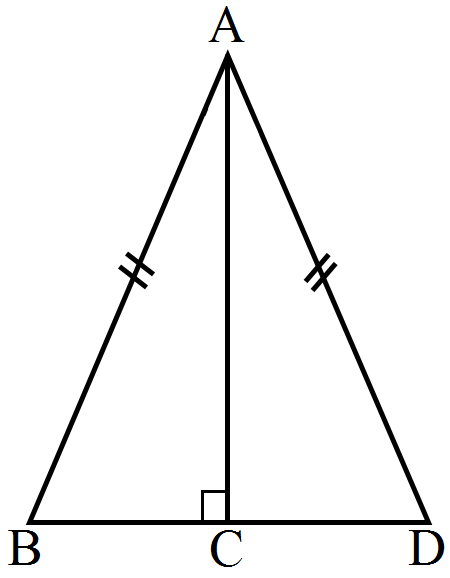
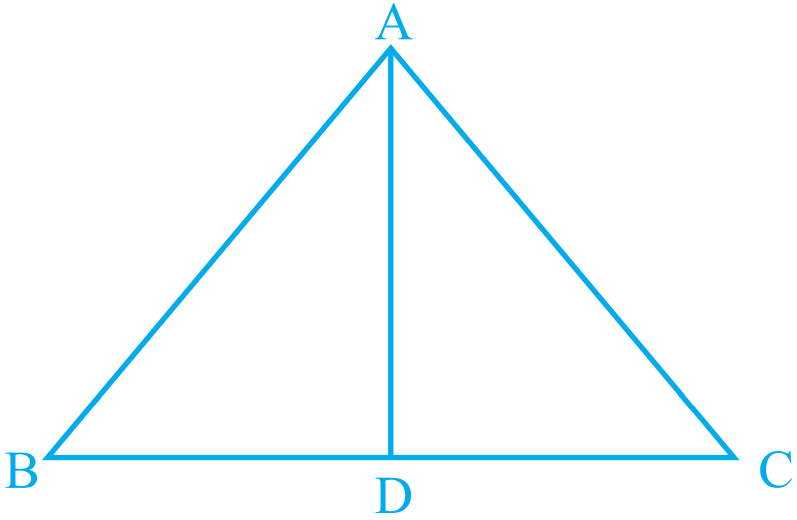
RHS Solution: In $\triangle\text{ABD}$ and $\triangle\text{ACD},$ we have $\angle\text{ADB} = \angle\text{ADC}$ (Right angles) AB = AC (Given and hypotenuses) AD = AD (common in both) Therefore, $\triangle\text{ABD}\cong\triangle\text{ACD}$ by RHS.
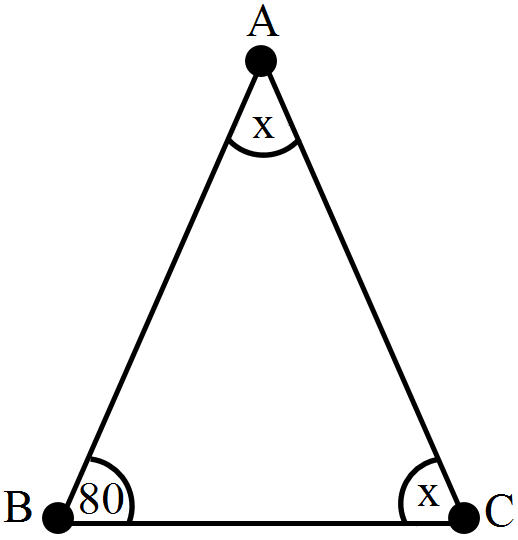
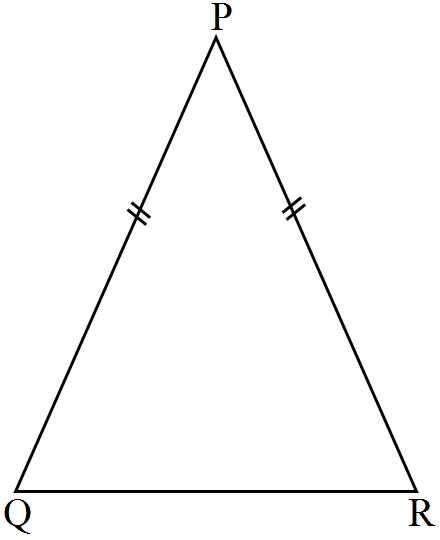
40º Solution: Since, It is given that PQ = QR, then $\angle\text{Q} = \angle\text{R}$ (Isosceles trangle property) As $\angle\text{Q} = 70^\circ,$ therefore $\angle\text{R} = 70^\circ,$ Sum of all the three angles of triangle = 180º, therefore $\angle\text{P}+\angle\text{Q}+\angle\text{R}=180^\circ$ $\angle\text{P} = 180 - 70 - 70\ = \ 40^\circ$
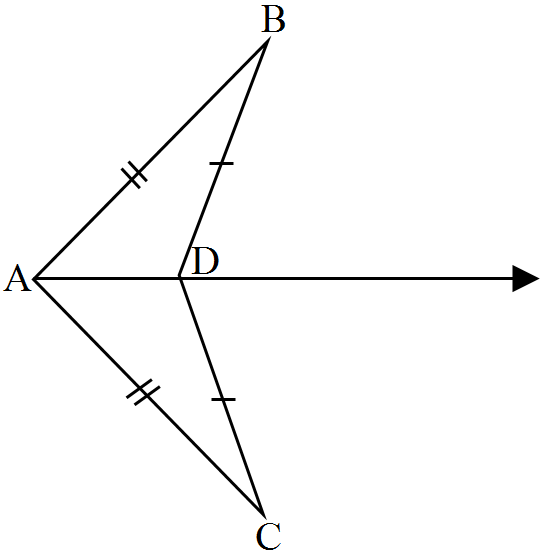
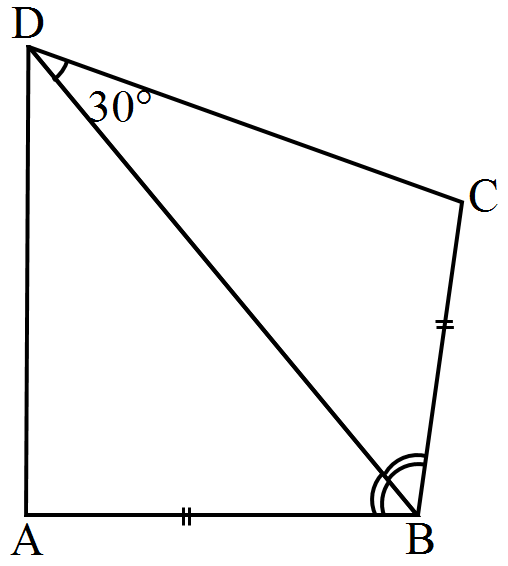
$\angle\text{BDA}$ Solution: In triangle ABD and CBD AB = BC and $\angle\text{ABD} = \angle\text{CBD},$ (Given) BD (Common) Therefore In triangle ABD and CBD are congruent by SAS criteria. Therefore, $\angle\text{BDA}=30^\circ$ (by CPCT)
IF $\text{AB}⊥\text{BC}$ and $\angle\text{BAC} = \angle\text{BCA},$ then which of the following statements is true?
Answer
AB = BC Solution: ABC is a right-angled isosceles triangle with $\angle\text{BAC} = \angle\text{BCA},$ and hence sides opposite to equal angles must be equal. Hence, we can say that AB = BC.
Two sides of a triangle are of lengths 5cm and 1.5cm. The length of the third side of the triangle cannot be.
Answer
3.4cm Solution: Given that: Two sides of triangle are 5cm and 1.5cm. We know that the sum of two sides of the triangle is always greater than the third side. Hence, 3.4cm cannot be the third side. If it is the third side the sum of 3.4cm and 1.5cm will be smaller than 5cm, so, the triangle will not be possible.
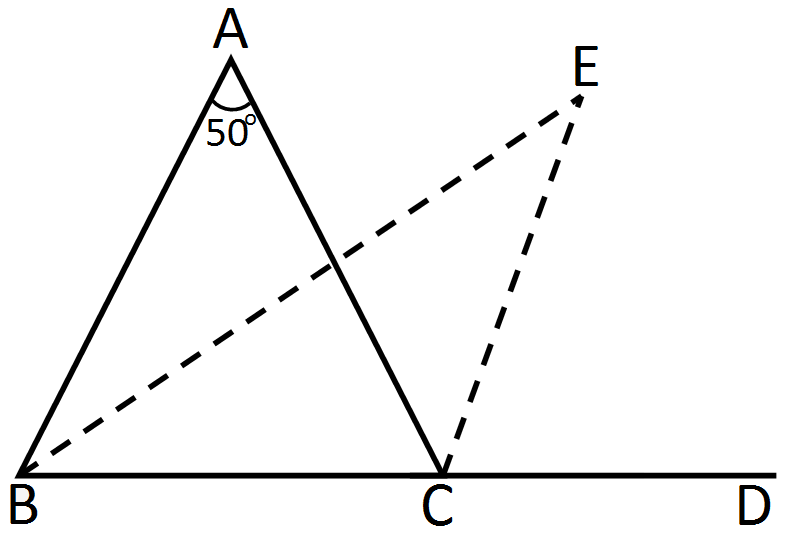
In a $\triangle\text{ABC},\angle\text{A}=50^\circ$ and BC is produced to a point D. If the bisectors of $\angle\text{ABC}$ and $\angle\text{ACD}$ meet at E, then $\angle\text{E}=$
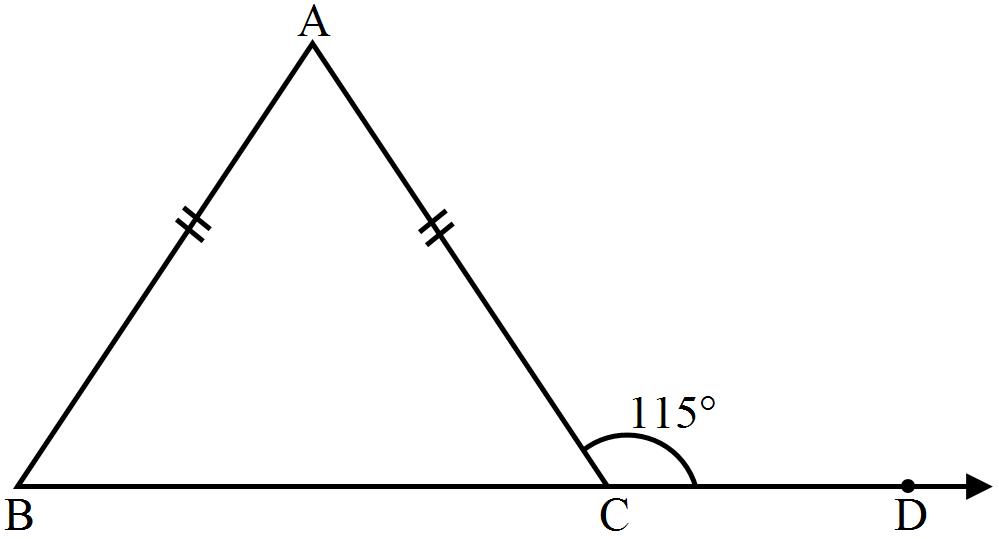
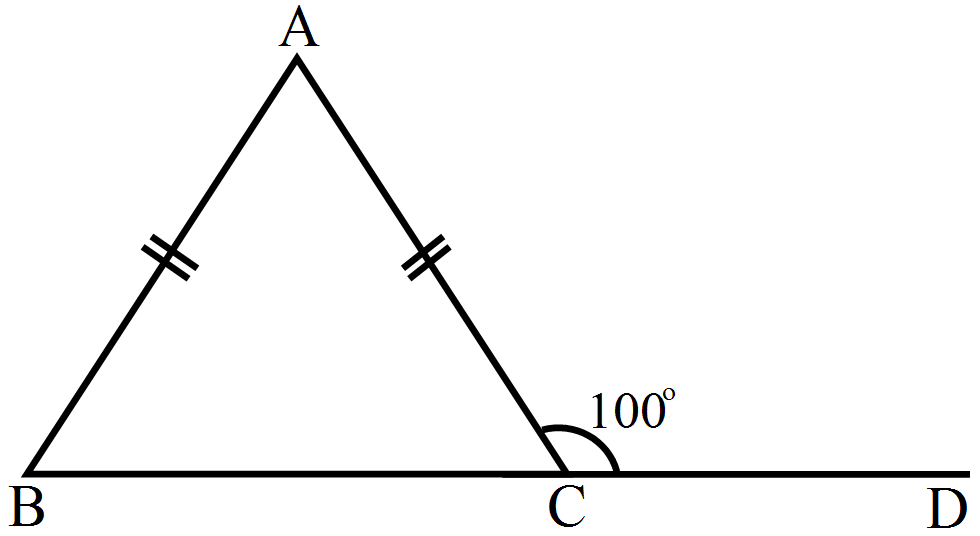
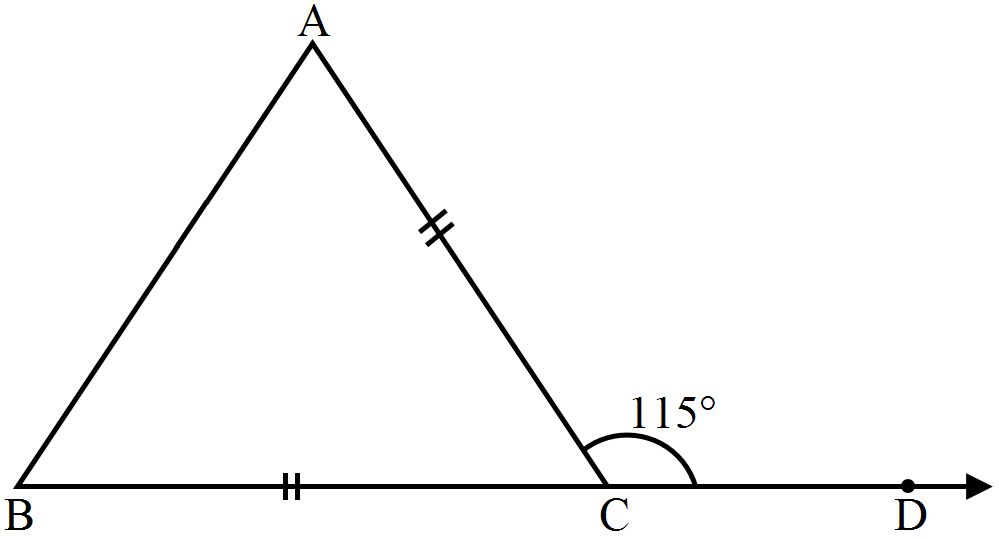
57.5º Solution: As BC = AC, therefore triangle ABC is an isoscelestriangle. Given $\angle\text{ACD} = 115^\circ,\ \angle\text{ACB} = 180-115=65^\circ$ (Linear Pair) As AC = BC, therefore $\angle\text{A} =\angle\text{B}$ As sum of all the three angles of atriangle is 180° Therefore, $\angle\text{A} + \angle\text{B} + \angle\text{ACB} = 180^\circ$ $\angle\text{A} = \angle\text{B} = 57.5$
In a $\triangle\text{ABC},$ If $\angle\text{A}= 45^\circ$ and $\angle\text{B}= 70^\circ.$ Determine the shortest sides of the triangles.
Answer
BC Solution: $\angle\text{A}+\angle\text{B}+\angle\text{C}=180^\circ$ $\angle\text{A}=45^\circ$ $\angle\text{B}=70^\circ$ $\angle\text{C}+45^\circ+70^\circ=180^\circ$ $\angle\text{C}+115^\circ=180^\circ$ $\angle\text{C}=180^\circ-115^\circ$ $\angle\text{C}=65^\circ$ $\angle\text{A}$ is shortest angle and the side opp to shortest angle is shortest. So, BC is the shotest side.
In $\triangle\text{ABC}$ and $\triangle\text{DEF}$ its is given that $\angle\text{B}=\angle\text{E}$ and $\angle\text{C}=\angle\text{F}$ in order that $\triangle\text{ABC}≅\triangle\text{DEF}$ we must have,
Answer
BC = EF Solution: In $\triangle\text{ABC}$ and $\triangle\text{DEF}$ $\angle\text{B}=\angle\text{E}$ and $\angle\text{C}=\angle\text{F}$ For congruence, BC = EF Therefore by AAS axiom $\triangle\text{ABC}≅\triangle\text{DEF}$
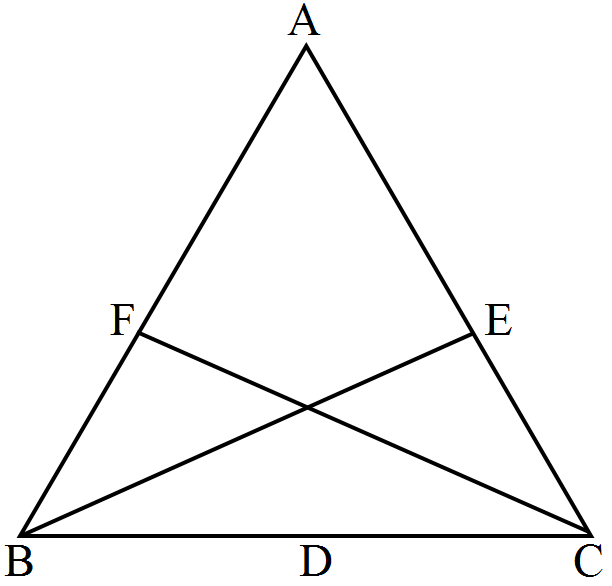
AB + BC + AC > 2AD Solution: In triangle ADB AB + BD > AD In triangle ADC AC + DC > AD Adding both AB + AC + BD + DC > 2AD Now BD + DC = BC So, AB + AC + BC > 2AD
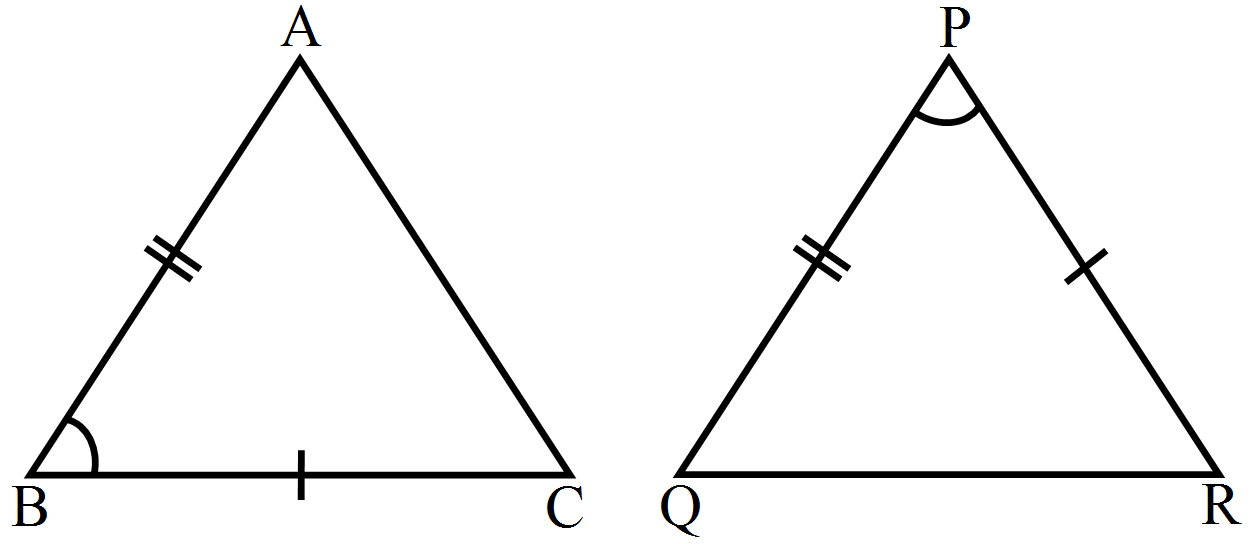
In triangles ABC and PQR three equality relations between some parts are as follows: AB = QP, $\angle\text{B} = \angle\text{P},$ BC = PR. State which of the congruence conditions applies:
Answer
SAS Solution: Two sides and included angle are equal and is SAS axiom.
In a $\triangle\text{ABC},$ if $\angle\text{B} = \angle\text{C} = 45^\circ,$ which is the longest side?
Answer
BC Solution: We know that sum of all angles of a triangle is 180° $\angle\text{A} + \angle\text{B} + \angle\text{C} = 180^\circ$ $\angle\text{B} = \angle\text{C} = 45^\circ$ $\angle\text{A} + 45^\circ + 45^\circ = 180^\circ$ $\angle\text{A} + 90^\circ = 180^\circ$ $\angle\text{A} = 180^\circ - 90^\circ$ $\angle\text{A} = 90^\circ$ So, angle A is the largest and the side opposite to the greatest angle is the longest so, side BC is the longest.
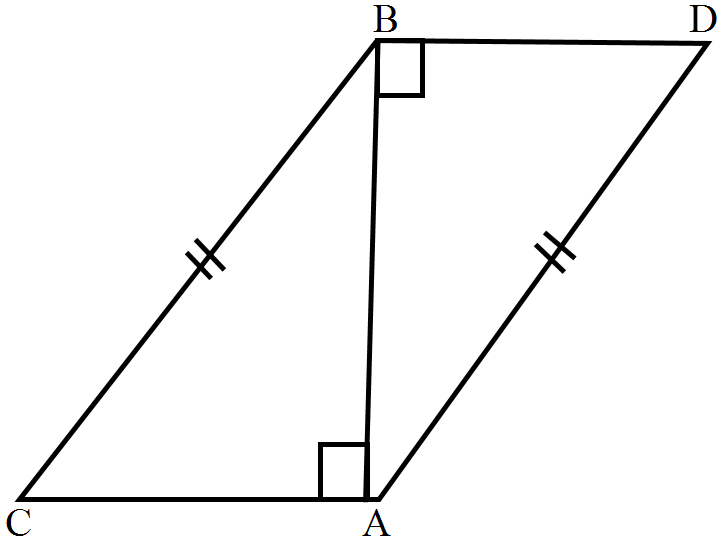
RHS Solution: In $\triangle\text{ABC}$ and $\angle\text{BAC}=\angle\text{ABD}$ BAD, we have (Right angles) BC = AD (Hypotentuses and Given) AB = AB (common in both) Hence, $\triangle\text{ABC}\cong\triangle\text{BAD}$ by RHS criterion.
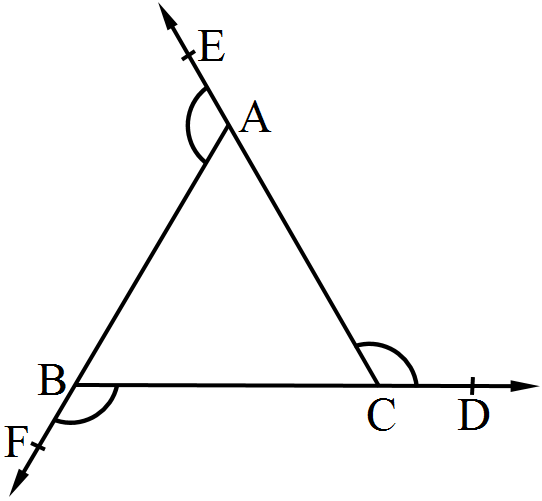
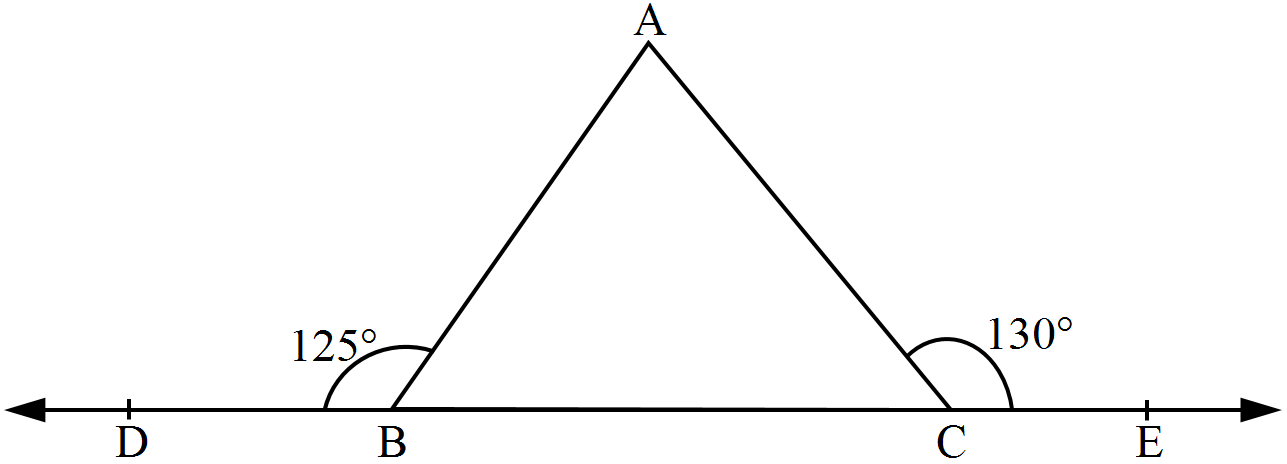
75º Solution: We have, $∴\ \angle\text{ABD}+\angle\text{ABC}=180^\circ$ [$∵$ E is a straight line] $⇒125^\circ+\angle\text{ABC}=180^\circ$ $⇒\angle\text{ABC}=55^\circ$ Also, $\angle\text{ACE}+\angle\text{ACB}=180^\circ$ $⇒130^\circ+\angle\text{ACB}=180^\circ$ $⇒\angle\text{ACB}=50^\circ$ $∴\angle\text{BAC}+\angle\text{ABC}+\angle\text{ACB}=180^\circ$ [Sum of the angles of a triangle] $⇒\angle\text{BAC}+55^\circ+50^\circ=180^\circ$ $⇒\angle\text{BAC}=75^\circ$ $⇒\angle\text{A}=75^\circ.$
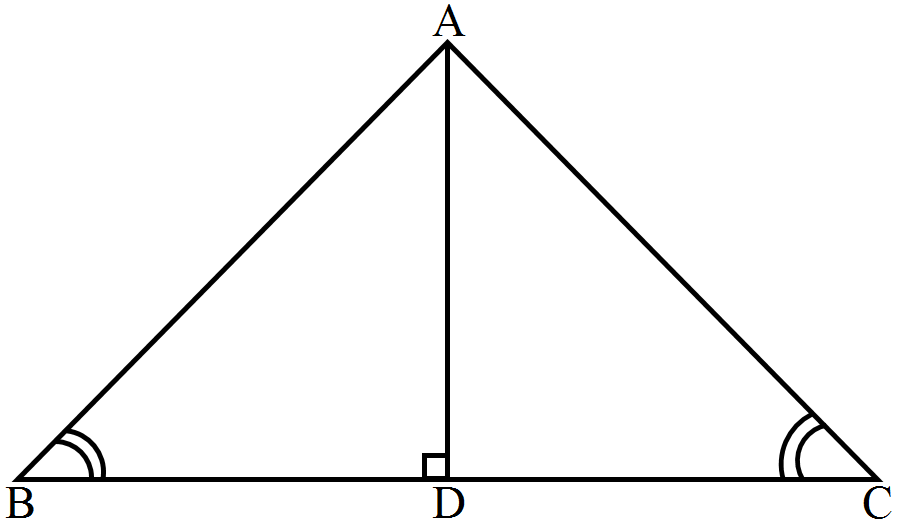
In the adjoining figure, $\angle\text{B} = \angle\text{C}$ and $\text{AD}\bot\text{BC}.$ The rule by which $\triangle\text{ABD}\cong\triangle\text{ADC}.$
Answer
In $\triangle\text{ABD}$ and $\triangle\text{ADC},$ we have
$\angle\text{ABD} = \angle\text{ACD} \ ($given$)$
$\angle\text{BDA} = \angle\text{CDA} \ (90^\circ)$
$AD = AD ($common in both$)$
Hence, $\triangle\text{ABD}\cong\triangle\text{ADC}$ by $\text{AAS}$ criterion.
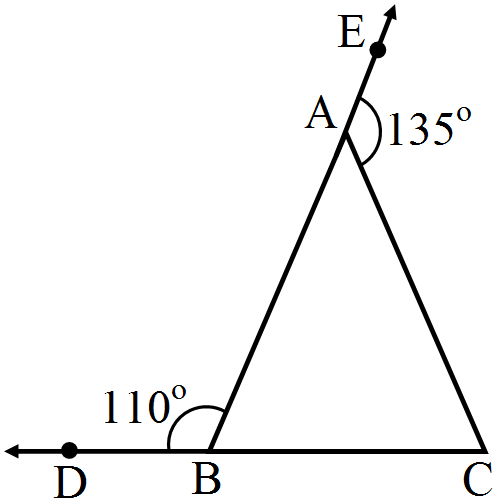
65º Solution: Since BAE is a straight line, we have $\angle\text{BAC}+\angle\text{CAE}=180^\circ$ .....(Supplementary angles) $\Rightarrow\angle\text{BAC}+135^\circ=180^\circ$ $\Rightarrow\angle\text{BAC}=45^\circ$ Since CBD is a straight line, we have $\angle\text{ABD}+\angle\text{ABC}=180^\circ$ ....(Supplmenetary angles) $\Rightarrow110^\circ+\angle\text{ABC}=180^\circ$ $\Rightarrow\angle\text{ABC}=70^\circ$ In $\triangle\text{ABC},$ we have $\angle\text{BAC}+\angle\text{ABC}+\angle\text{ACB}=180^\circ$ .....(Angle sum property) $\Rightarrow45^\circ+70^\circ+\angle\text{ACB}=180^\circ$ $\Rightarrow\angle\text{ACB}=65^\circ$
Two sides of a triangle are of length 4cm and 2.5cm. The length of the third side of the triangle cannot be:
Answer
6.5cm Solution: The sum of any two sides of a triangle is greater than the third side. Since, 4cm + 2.5cm = 6.5cm The length of third side of a triangle cannot be 6.5cm.
In $\triangle\text{AOC}$ and $\triangle\text{XYZ},\ \angle\text{A}=\angle\text{X},\ \angle\text{AO} = \angle\text{XY},\ \angle\text{AC} = \angle\text{XZ},$ then by which congruence rule $\triangle\text{AOC}\cong\triangle\text{XYZ}?$
Answer
SAS Solution: According to SAS criterion, if the corresponding sides and their included angles are equal, then the triangles are congruent. Here, in $\triangle\text{AOC}$ and $\triangle\text{XYZ},$ AO = XY, and AC = XZ are the corresponding sides and $\angle\text{A}=\angle\text{X}$ are included angles, Hence, $\triangle\text{AOC}\cong\triangle\text{XYZ},$ by SAS.
The triangle is not possible with the given measurements:
Answer
5.4cm, 2.3cm, 3.1cm Solution: In a triangle, the sum of any two sides must be greater than the third side and here 2.3 + 3.1 = 5.4 and hence, the triangle is not possible with the given measurements.
In a $\triangle\text{ABC},$ if $\angle\text{A}−\angle\text{B}=42^\circ$ and $\angle\text{B}−\angle\text{C}=21^\circ$ then $\angle\text{B} = ?$
Answer
53º Solution: Let, $\angle\text{A}−\angle\text{B}=42°...\ \text{(i)}$ and $\angle\text{B}−\angle\text{C}=21^\circ ...\ \text{(ii)}$ Adding (i) and (ii),we get $\angle\text{A}−\angle\text{C}=63° ...\ \text{(iii)}$ $\angle\text{B}=\angle\text{A}−42^\circ$ [using (i)] $\angle\text{C}=\angle\text{A}−63^\circ$ [Using (iii)] $∴\angle\text{A}+\angle\text{B}+\angle\text{C}=180^\circ$ [Sum of the angles of a triangle] $⇒\angle\text{A}+\angle\text{A}−42^\circ+\angle\text{A}−63^\circ=180^\circ$ $⇒3\angle\text{A}−105^\circ=180^\circ$ $⇒3\angle\text{A}=285^\circ$ $∴\angle\text{B}=(95−42)^\circ$ $⇒\angle\text{B}=53^\circ$
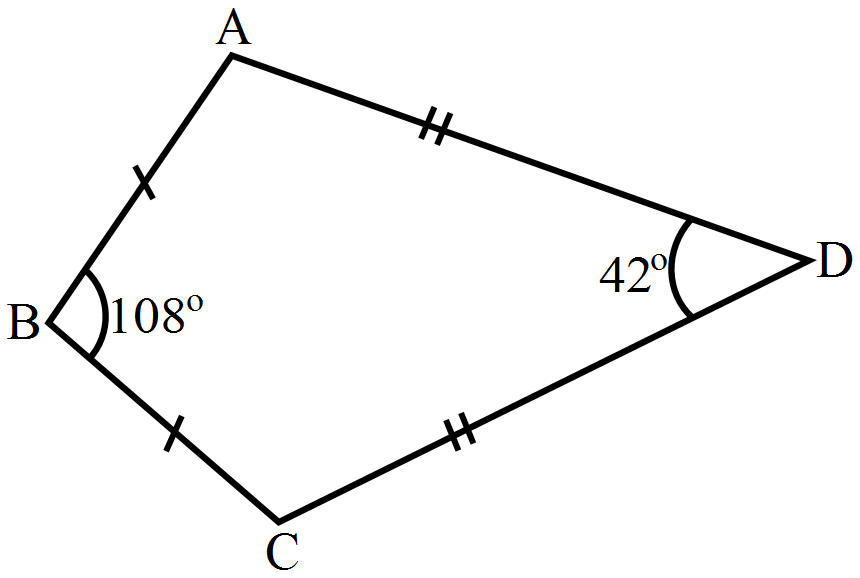
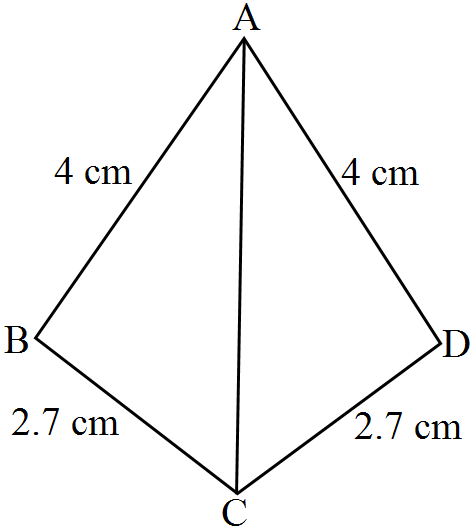
SSS Solution: In $\triangle\text{ABC} $ and $\triangle\text{ADC}, $ we have AB = AD (4cm) BC = DC (2.7cm) AC = AC (commom in both) Hence, $\triangle\text{ABC}\cong\triangle\text{ADC}$ by SSS criterion.
If $\triangle\text{ABC}≅\triangle\text{PQR}$ and $\triangle\text{ABC}$ is not congruent to $\triangle\text{RPQ},$ then which of the following is not true:
Answer
BC = PQ Solution: According to the condition given in the question, If $\triangle\text{ABC}≅\triangle\text{PQR}$ and $\triangle\text{ABC}$ is not congruent to $\triangle\text{RPQ}.$ Then, clearly BC ≠ PQ $\therefore$ It is false
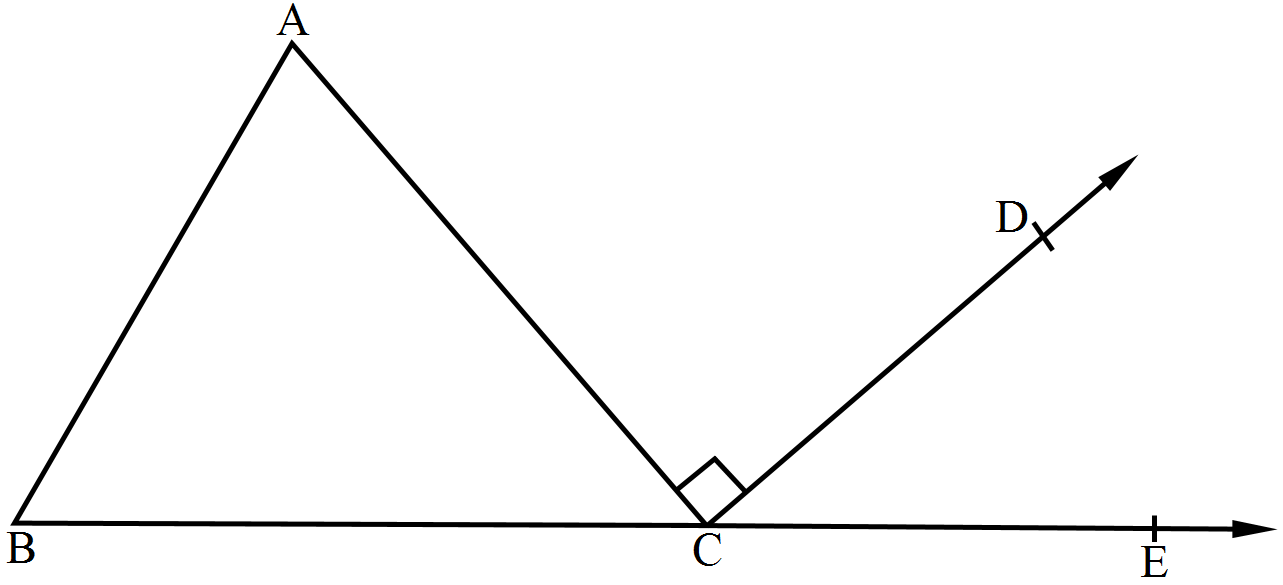
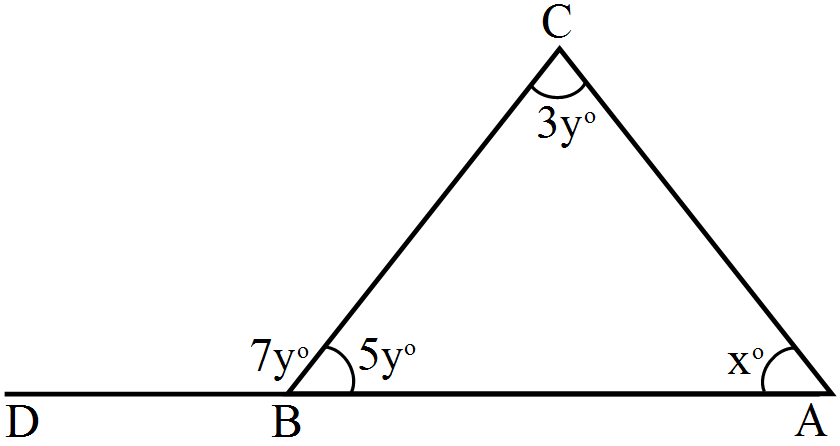
60º Solution: Let $ \angle\text{A}=(3\text{x})^\circ,\ \angle\text{B}=(2\text{x})^\circ$ and $\angle\text{C}=\text{x}^\circ$ Then, 3x + 2x + x = 180º [Sum of the angles of a triangle] ⇒ 6x = 180º ⇒ x = 30º Hence, the angles are $\angle\text{A}=3×30^\circ=90^\circ,\ \angle\text{B}=2×30^\circ=60^\circ$ and $\angle\text{C}=30^\circ$ Side BC of triangle ABC is produced to E. $\therefore\ \angle\text{ACE}=\angle\text{A}+\angle\text{B}$ $⇒\angle\text{ACD}+\angle\text{ECD}=90^\circ+60^\circ$ $⇒90^\circ+\angle\text{ECD}=150^\circ$ $⇒\angle\text{ECD}=60^\circ$
In the following, write the correct answer.
If AB = QR, BC = PR and CA = PQ, then:
Answer
$\triangle\text{CBA}\cong\triangle\text{PRQ}$ Solution:
We know that, if is congruent to, then sides of $\triangle\text{RST}$ fall on corresponding equal sides of angles of fall on corresponding equal angles.
Here, given AB = QR, BC = PR and CA = PQ, which shows that AB covers QR, BC covers PR and CA covers PQ i.e., A correspond to Q, B correspond to R and C correspond to P.
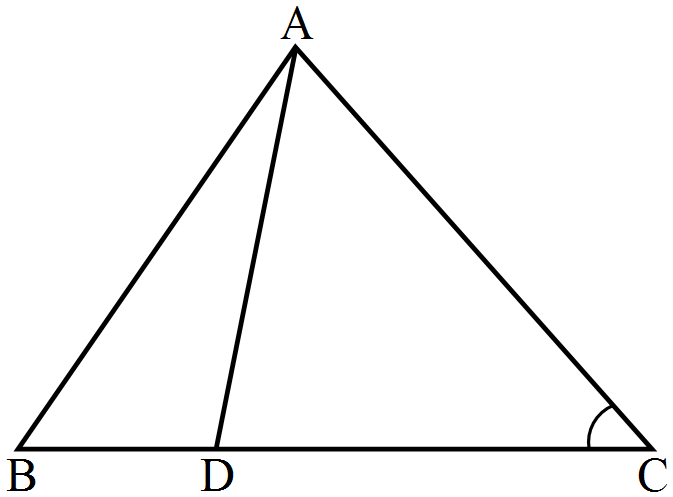
AB > AD Solution: Given $\text{AB > AC}$ $\therefore\angle\text{ACB}>\angle\text{ABC}$...(We know that, if two sides of a triangle unequal, then the longer side has the greater angle opposite to it.) $\angle\text{ADB}>\angle\text{ACD}$ ...(Exterior angle of a triangle is greater that the interior opposite angles) $\therefore\angle\text{ADB}>\angle\text{ACB}>\angle\text{ABC}$ $\therefore\angle\text{ADB}>\angle\text{ABD}$ $\therefore\text{AB > AD}$
In $\angle\text{ABC}$ and $\angle\text{DEF},$ AB = DE and $\angle\text{A} = \angle\text{D}.$ Then, the two triangles will be congruent by SAS axiom if:
Answer
AC = DF Solution: The SAS rule states that: If two sides and the included angle of one triangle are equal to two sides and included angle of another triangle, then the triangles are congruent. Here, in $\angle\text{ABC},$ the two sides are AB and AC and the included angle is $\angle\text{A}.$ For $\angle\text{DEF},$ the two corresponding sides are DE and DF and the included angle is $\angle\text{D}.$ Hence, the two triangles will be congruent by SAS axiom if AC = DF.
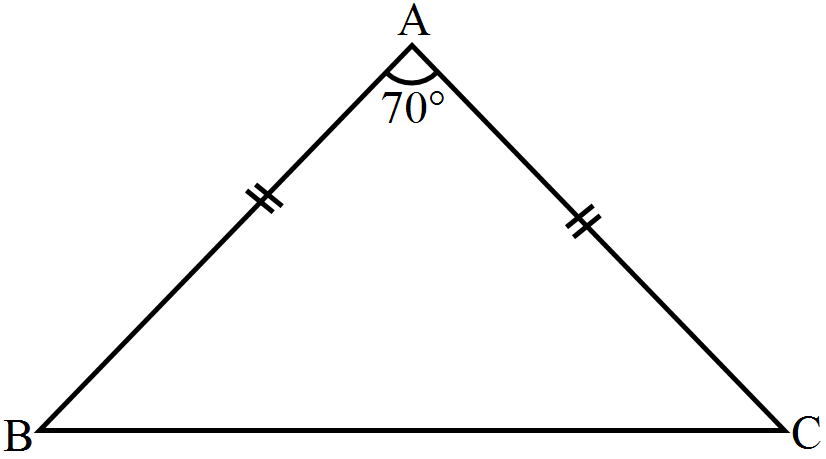
55º Solution: Since, It is given that AB = AC, then $\angle\text{B}=\angle\text{C}$ (Isosceles triangle property) Given $\angle\text{A}=70^\circ$ Let angle B and C be xº. Sum of all the three angles of triangle = 180º, therefore $\angle\text{A}+\angle\text{B}+\angle\text{C}=180^\circ$ 70 + x + x = 180º x = 55º $\angle\text{C}=55^\circ$
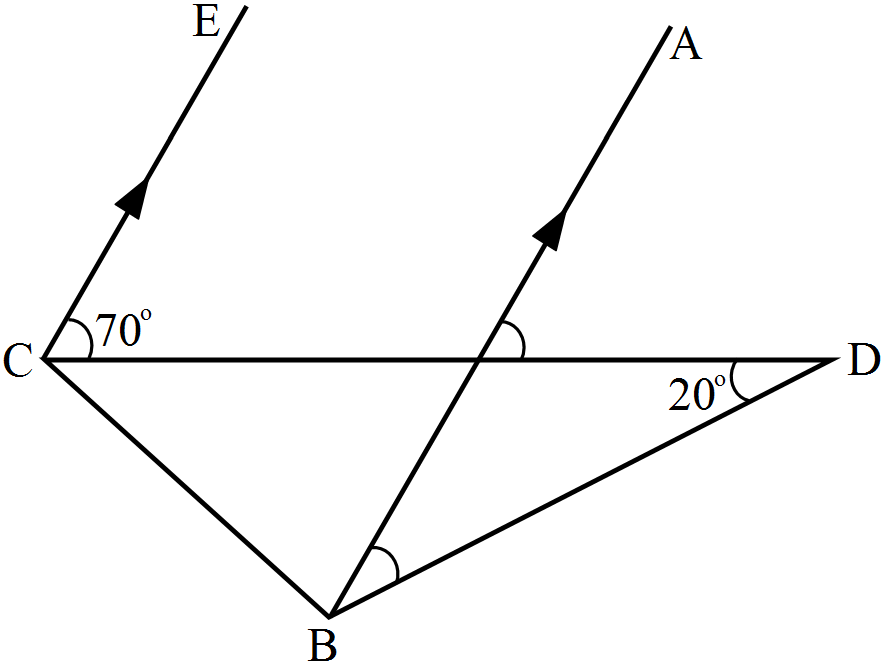
50º Solution: EC || AB And, CD is transverse to it. Now $\angle\text{ECD}=\angle\text{AOD}=70^\circ$ (Corresponding angles) In $\triangle\text{OBD}$ $\angle\text{OBD}+\angle\text{BOD}+\angle\text{ODB}=180^\circ$ $\angle\text{BOD}=180^\circ-\angle\text{AOD}=180^\circ-70^\circ=110^\circ$ So $\angle\text{OBD}=180^\circ-\angle\text{BOD}-\angle\text{ODB}$ $=180^\circ-110^\circ-20^\circ$ $=50^\circ$
In $\triangle\text{ABC}$ and 6PQR, AB = PR and $\angle\text{A}=\angle\text{P}.$ Then, the two triangles will be congruent by SAS axiom if:
Answer
AC = PQ Solution: $\angle\text{A}$ is included between AB and AC and LP is included between PQ and PR and corresponding sides must be equal. Since AB = PR, hence AC = PQ for the given triangles to be congruent by SAS axiom.