Question 1511 Mark
In the following, write the correct answer.
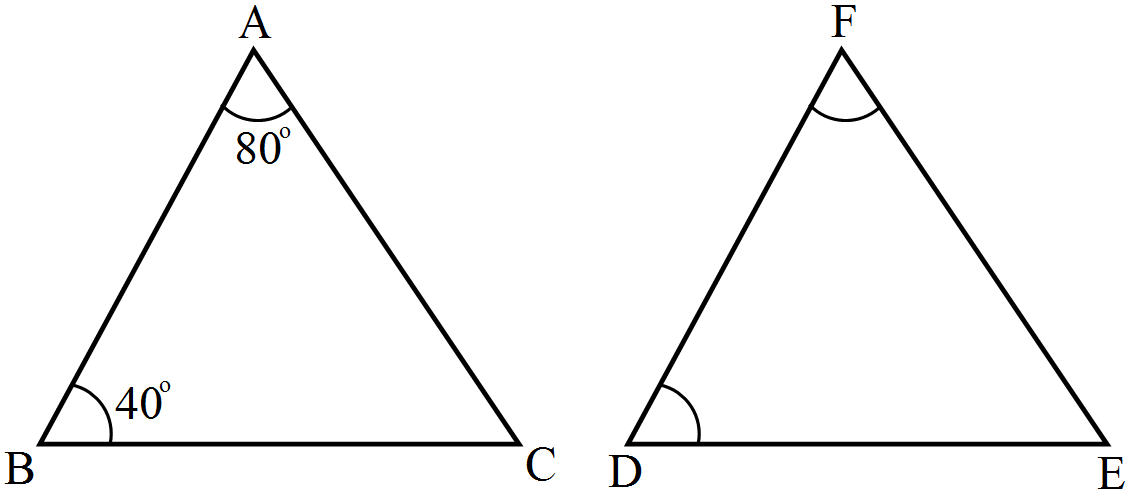
It is given that $\triangle\text{ABC}=\triangle\text{FDE}$ and AB = 5 cm, $∠\text{B} = 40°$and $∠\text{A} = 80°$then which of the following is true?
Answer
- $\text{DF}=5\text{CM}, \angle\text{E}=60^{\circ}$
Solution:
Given $\triangle\text{ABC}=\triangle\text{FDE}$ and AB = 5cm, $∠\text{B} = 40°,\angle\text{A}=80^{\circ}$
Since, $\triangle\text{ABC}=\triangle\text{FDE}$
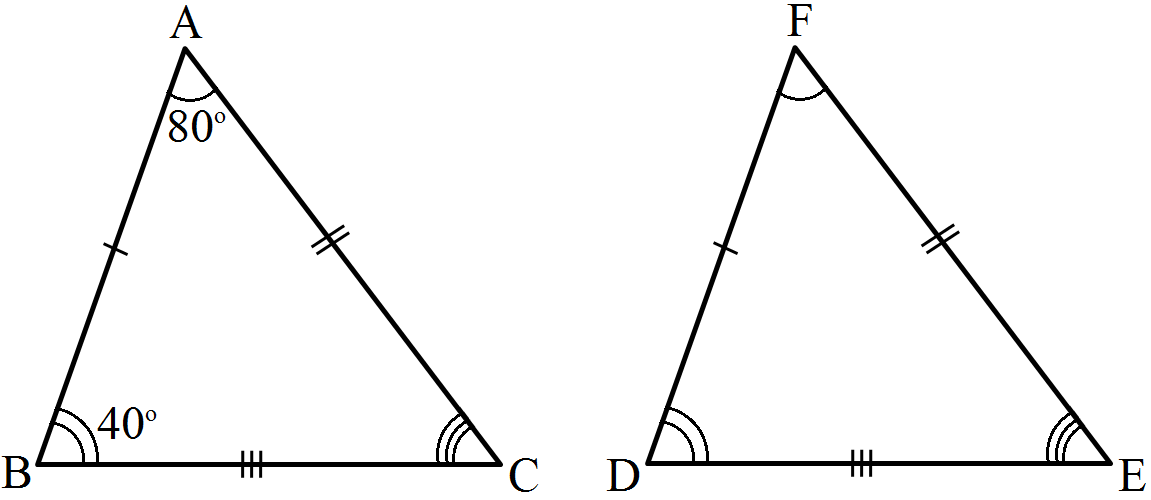
DF = AB
DF = 5cm
$\angle\text{E}=\angle\text{C}$
$\angle\text{E}=\angle\text{C}=180^{\circ}-(\angle\text{A}+\angle\text{B})$
$\angle\text{E}=180^{\circ}-(80^{\circ}+40^{\circ})$
$\angle\text{E}=60^{\circ}$
View full question & answer→Question 1521 Mark
If the measures of angles of a triangle are in the ratio of 3 : 4 : 5, what is the measure of the smallest angle of the triangle?
Answer- 45º
Solution:
The measures of angles of a triangle are in ratio 3: 4: 5.
Let the angles be 3x, 4x and 5x.
In any triangle, sum of all angles = 180º
⇒ 3x + 4x + 5x = 180º
⇒ 12x = 180º
⇒ x = 15º
So, smallest angle = 3 × 15º = 45º
View full question & answer→Question 1531 Mark
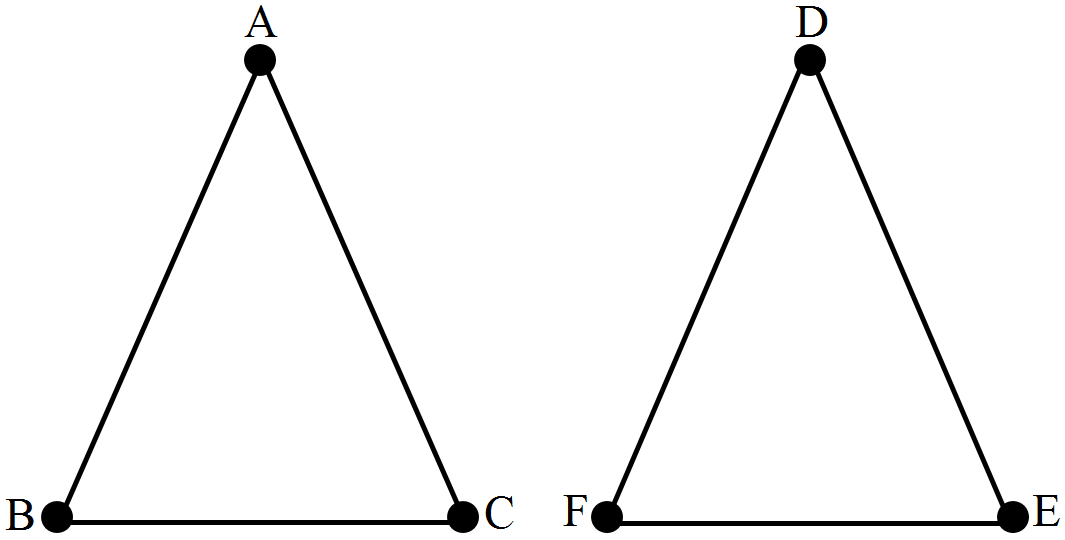
If ABC and DEF are two triangles such that $\triangle\text{ABC}\cong\triangle\text{FDE}$ and $\text{AB}=5\text{m},\angle\text{B}=40^\circ$ and $\angle\text{A}=80^\circ.$ Then, which of the following is true?
Answer- $\text{DF}=5\text{cm},\angle\text{E}=60^\circ$
Solution:
In $\triangle\text{ABC},$
$\angle\text{C}=180^\circ-\angle\text{A}+\angle\text{B}=180^\circ-80^\circ-40^\circ=60^\circ$
$\triangle\text{ABC}\cong\triangle\text{FDE}$
$\Rightarrow\text{AB}=\text{FD}=5\text{cm}$
$\Rightarrow\angle\text{B}=\angle\text{D}=40^\circ$
$\Rightarrow\angle\text{A}=\angle\text{F}=80^\circ$
$\Rightarrow\angle\text{C}=\angle\text{E}=60^\circ$
$\Rightarrow\text{DF}=\text{FD}=5\text{cm}$ and $\angle\text{E}=60^\circ$
Hence, correct option is (c).
View full question & answer→Question 1541 Mark
In triangles ABC and PQR, if $\angle\text{A}=\angle\text{R},\ \angle\text{B}=\angle\text{P}$ and AB = RP, then which one of the following congruence conditions applies:
Answer- ASA
Solution:
Since, the two adjacent angles and the contained side are shown equal while proving the two triangles congruent. Hence, by A.S.A. theorem the two triangles can be proved congruent.
View full question & answer→Question 1551 Mark
Answer- 50º
Solution:
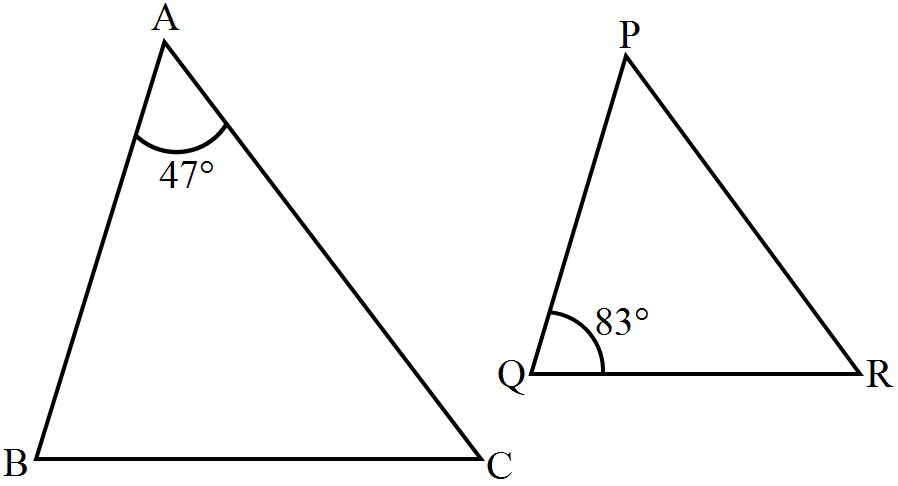
Since, $\triangle\text{ABC}$ and $\triangle\text{PQR}$ are similar triangles.
then, $\angle\text{B} = \angle\text{Q} = 83^\circ$
Thus, in $\triangle\text{ABC},$
$\angle\text{C} = 180^\circ - (\angle\text{A} + \angle\text{B})$
or, $\angle\text{C} = 180^\circ - (47^\circ + 83^\circ)$
$\angle\text{C}=50^\circ$
View full question & answer→Question 1561 Mark
Answer- 57.5º
Solution:
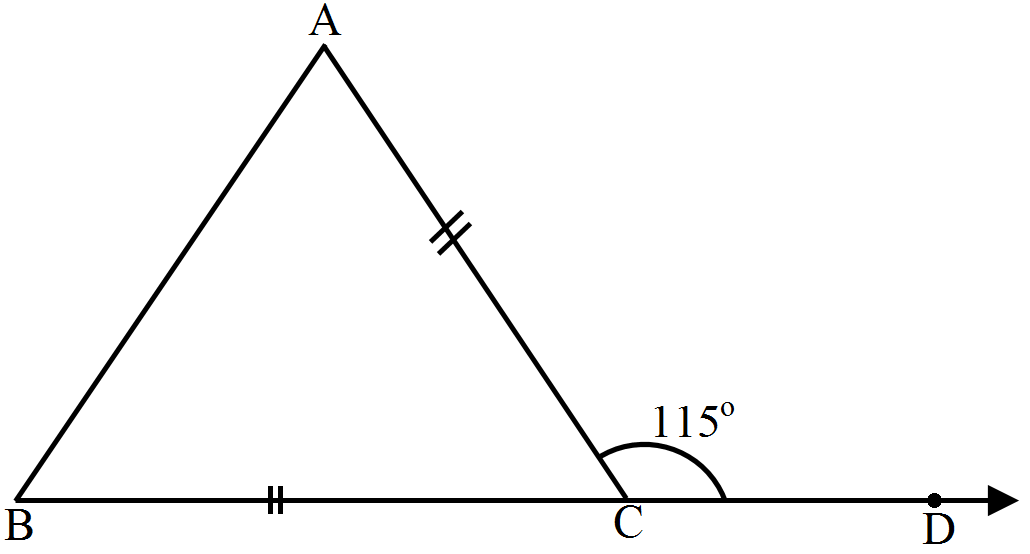
As BC = AC, therefore triangle ABC is an isoscelestriangle.
Given $\angle\text{ACD} = 115^\circ,\ \angle\text{ACB} = 180 - 115 = 65^\circ$ (Linear Pair)
As AC = BC, therefore $\angle\text{A} =\angle\text{B}$
As sum of all the three angles of atriangle is 180º
Therefore. $\angle\text{A}+\angle\text{B} +\angle\text{ACB} = 180^\circ$
$\angle\text{A} =\angle\text{B}=57.5^\circ$
View full question & answer→Question 1571 Mark
In the adjoining figure,$ AB = AC$. If $\angle\text{ACD} = 115^\circ,$ then the measure of $\angle\text{A}$ is:
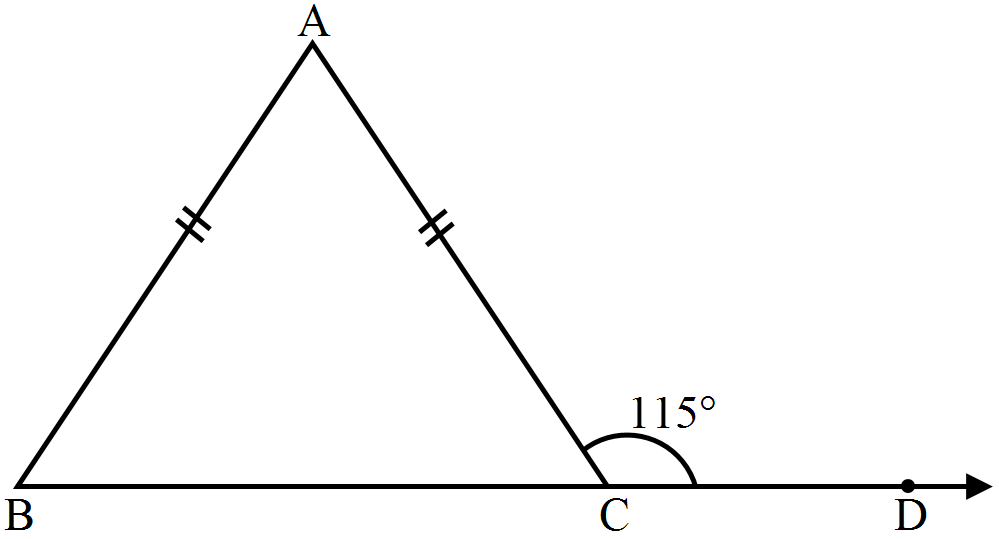
Answer$\angle\text{ACD} = 115^\circ,\ \angle\text{ACB} = 180-115=65^\circ ($Linear Pair$)$
Since, It is given that $AB = AC,$ then $\angle\text{ABC} = \angle\text{ACB} \ ($Isosceles trangle property$)$
As $\angle\text{ACB} = 65^\circ,$ therefore $\angle\text{ACB} = 65^\circ$
Sum of all the three angles of triangle $= 180^\circ$
$\therefore \angle\text{ABC} + \angle\text{ACB} + \angle\text{A} = 180^\circ$
$\angle\text{A} = 180 - 65 - 65 = 50^\circ$
View full question & answer→Question 1581 Mark
Answer- 115°
Solution:
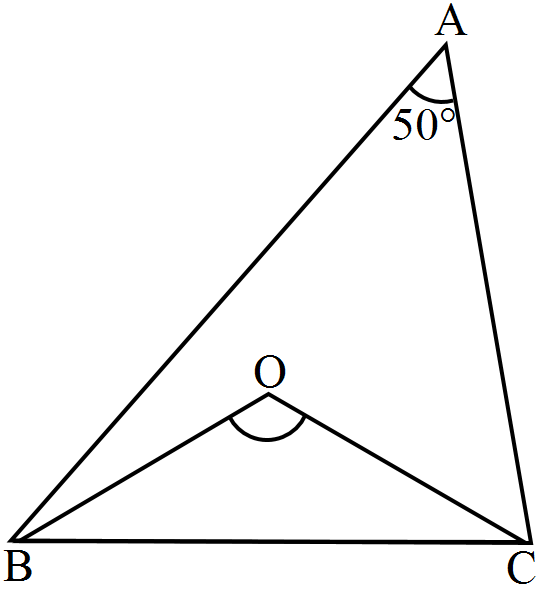
In $\triangle\text{ABC}$ we have:
$\angle\text{A}+\angle\text{B}+\angle\text{C}=180^\circ$ [Sum of the angles of a trianlge]
$⇒50^\circ+\angle\text{B}+\angle\text{C}=180^\circ$
$⇒\angle\text{B}+\angle\text{C}=130^\circ$
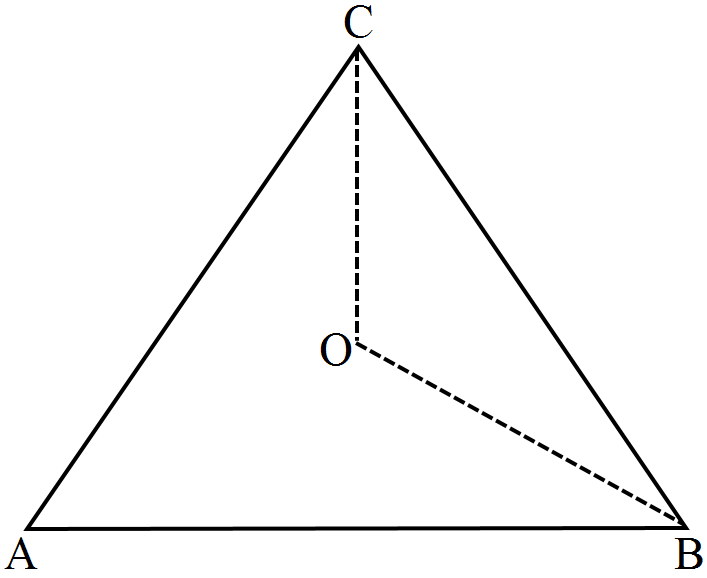
$\Rightarrow\ \frac{1}{2}\angle\text{B}\ +\ \frac{1}{2}\angle\text{C}=65^\circ\ ...\ (\text{i})$
In $\triangle\text{OBC},$ we have:
$\angle\text{OBC}+\angle\text{OCB}+\angle\text{BOC}=180^\circ$
$\Rightarrow\ \frac{1}{2}\angle\text{B}\ +\ \frac{1}{2}\angle\text{C}\ +\ \angle\text{BOC}=180^\circ$
$⇒65^\circ+\angle\text{BOC}=180^\circ$
$⇒\angle\text{BOC}=115^\circ.$
View full question & answer→Question 1591 Mark
Answer- AB + BC + AC > 2AD
Solution:
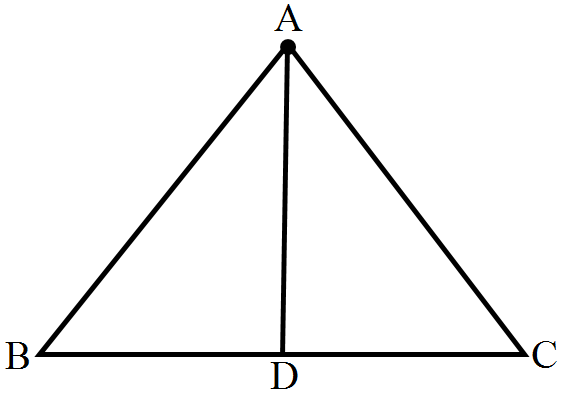
In triangle ADB
AB + BD > AD
In triangle ADC
AC + DC > AD
Adding both
AB + AC + BD + DC > 2AD
Now BD + DC = BC
So, AB + AC + BC > 2AD
View full question & answer→Question 1601 Mark
Answer- $\angle\text{CAD}$
Solution:
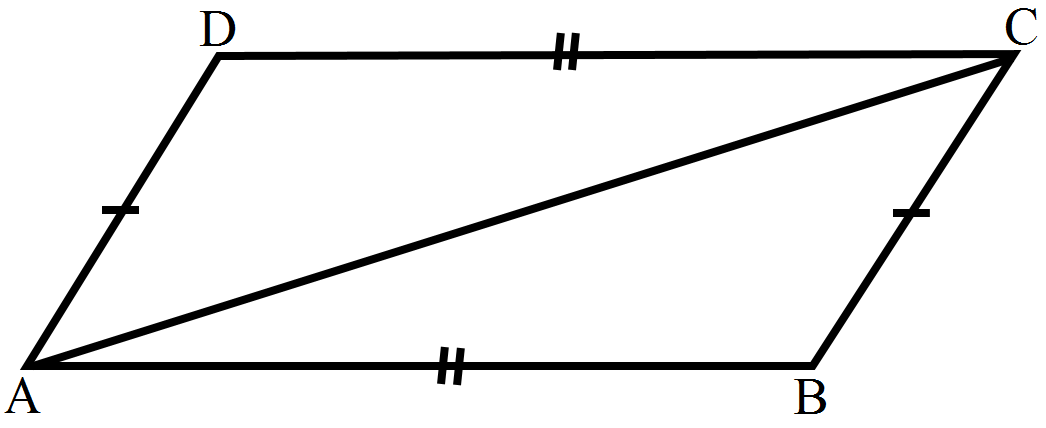
As AB = CD,
so, $\angle\text{ACB}=\angle\text{CAD}$ (alternate angles).
View full question & answer→Question 1611 Mark
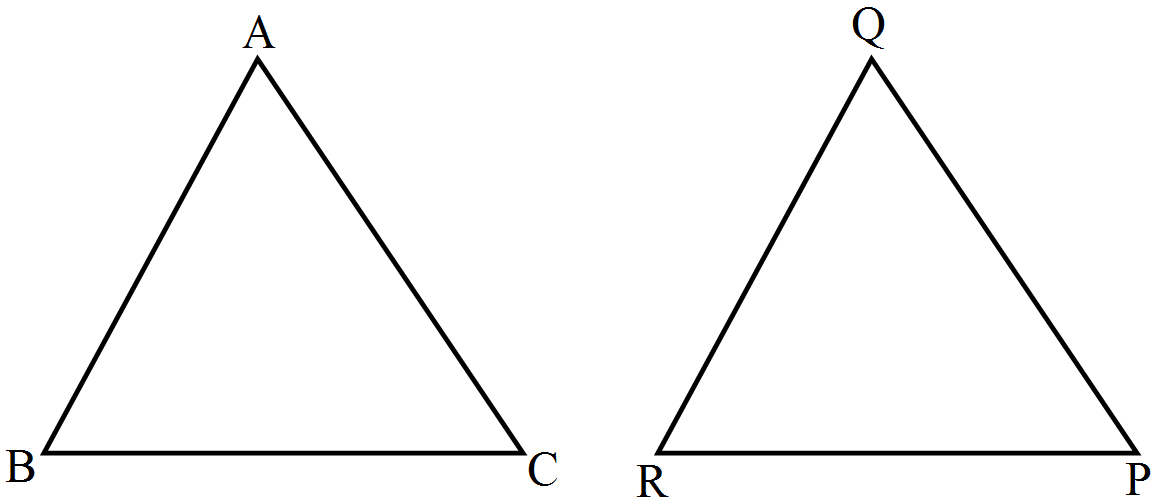
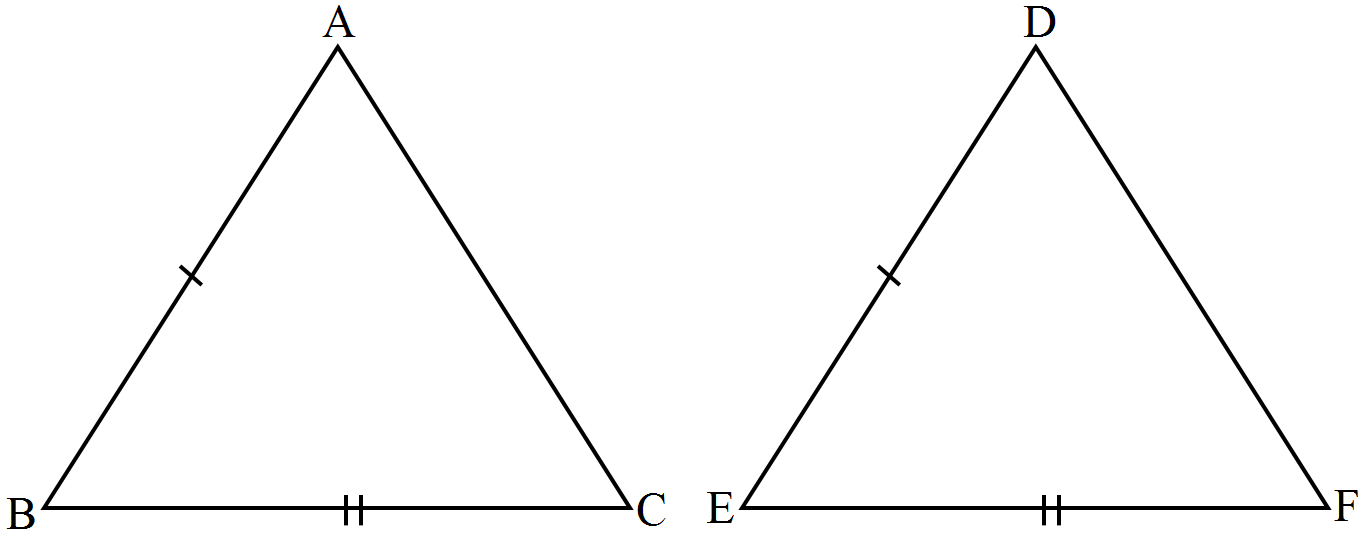
If AB = QR, BC = RP and CA = PQ, then which of the following holds?
Question 1621 Mark
Answer- 22
Solution:
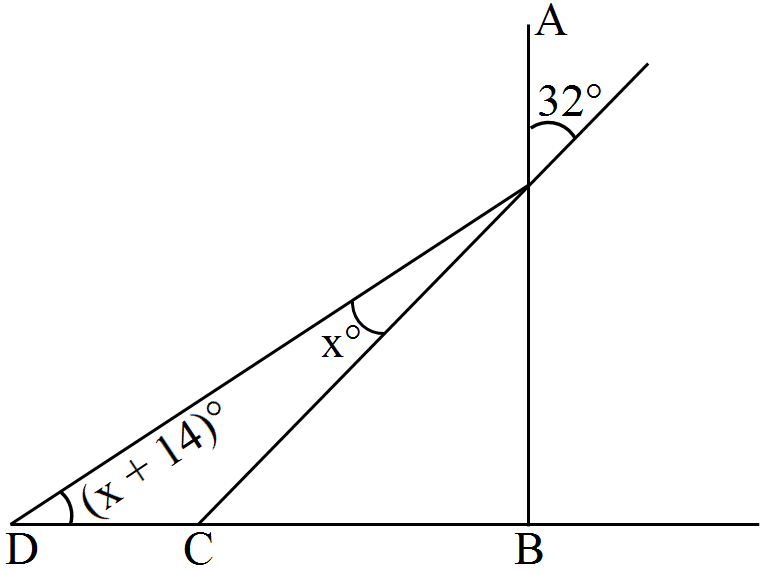
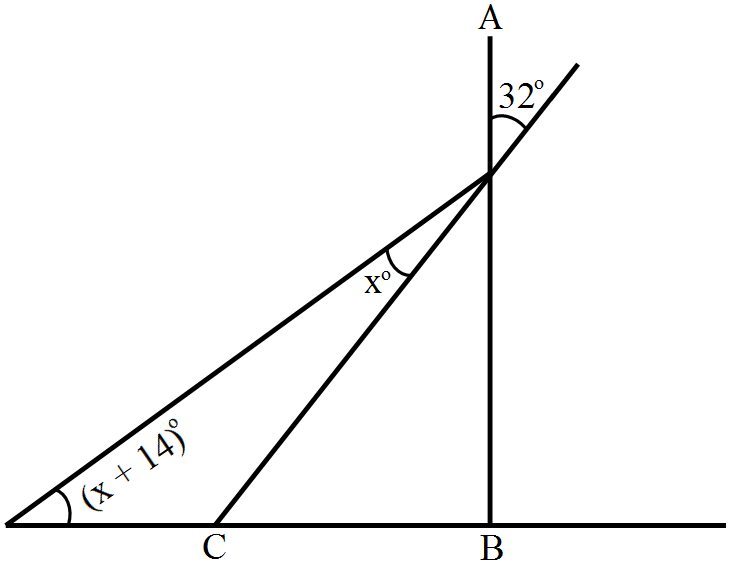
$\text{AB} ⊥ \text{BC}$
$⇒\ \angle\text{ABC}=90^\circ$
$\angle\text{CAB}=32^\circ$ (Opposite angles)
Now, in $\triangle\text{ABD}$
$\angle\text{DAB }= \text{x}^\circ+32^\circ$
$\angle\text{ABD}=90^\circ$
$\angle\text{BDA }= \text{x}^\circ+14^\circ$
In a $\triangle,$ sum of all angles = 180°
$⇒ \angle\text{DAB} + \angle\text{ABD} + \angle\text{BDA} = 180^\circ$
$⇒\text{x}^\circ + ^\circ32°+90^\circ + \text{x}^\circ+14^\circ = 180^\circ$
$⇒\ 2\text{x}^\circ = 180^\circ - 136^\circ$
$⇒\ 2\text{x}^\circ = 44$
$⇒\ \text{x}^\circ= 22$
View full question & answer→Question 1631 Mark
Answer- It is 1 : 1
Solution:
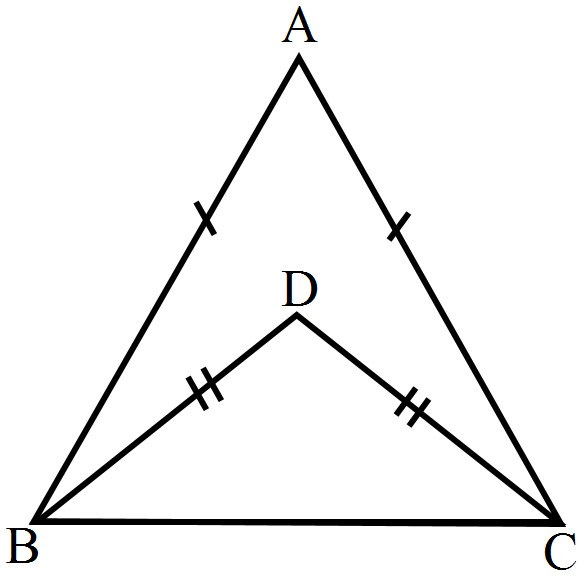
In $\triangle\text{ABC}$
$\text{AB = AC}$
$\therefore \angle\text{ABC} = \angle\text{ACB}$ (angles opposite to equal sides of a triangle are equal) ...(1)
In $\triangle\text{DBC},$
$\text{DB = DC},$
$\therefore \angle\text{DBC} = \angle\text{DCB}$ (angles opposite to equal sides of a triangle are equal) ...(2)
subtract 2 from 1
$\angle\text{ABC}-\angle\text{DBC} = \angle\text{ACB}-\angle\text{DCB}$ (equals subtracted from equals gives equal)
$= \angle\text{ABD} = \angle\text{ACD}$
Divide both the sides by $\triangle\text{ACD}$
$\Rightarrow\frac{\angle\text{ABD}}{\angle\text{ACD}}=1$
$\therefore \angle\text{ABD} : \angle\text{ACD}=1:1$
View full question & answer→Question 1641 Mark
Answer- 75º
Solution:
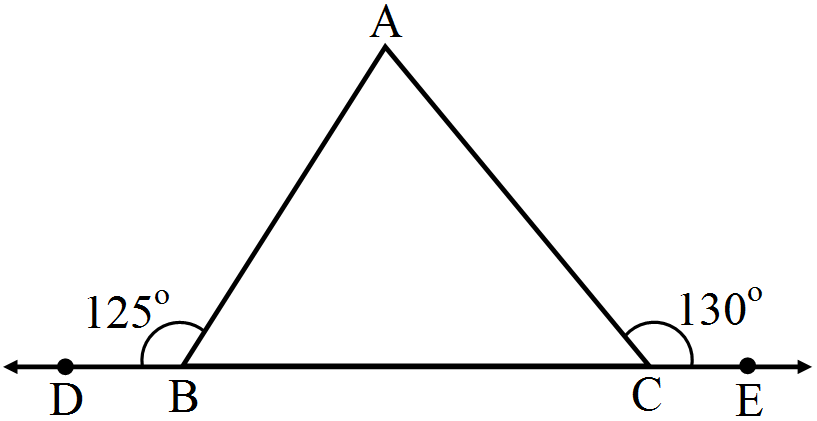
Since DE is a straights line,
$\angle\text{ACB}+\angle\text{ACE}=180^\circ$
$\Rightarrow\angle\text{ACB}+130^\circ=180^\circ$
$\Rightarrow\angle\text{ACB}=50^\circ$
In $\triangle\text{ABC},$
$\angle\text{ABD}=\angle\text{BAC}+\angle\text{ACB}$ ......(Exterior angle is equal to sum of the remote interior angles)
$\Rightarrow125^\circ=\angle\text{BAC}+50^\circ$
$\Rightarrow\angle\text{BAC}=75^\circ$
that is, $\angle\text{A}=75^\circ.$
View full question & answer→Question 1651 Mark
The length of two sides of a triangle are 7 units and 10 units. Which of the following length can be the length of the third side?
Answer- 13cm
Solution:
As per the rule in a triangle, sum of any 2 sides should be greater than the third side. So, the lenght of the third side should be 13, since with 7, 10 and 13 we have 7 + 10 > 13, 7 + 13 > 10 and 13 + 10 > 7.
View full question & answer→Question 1661 Mark
Answer- 100º
Solution:
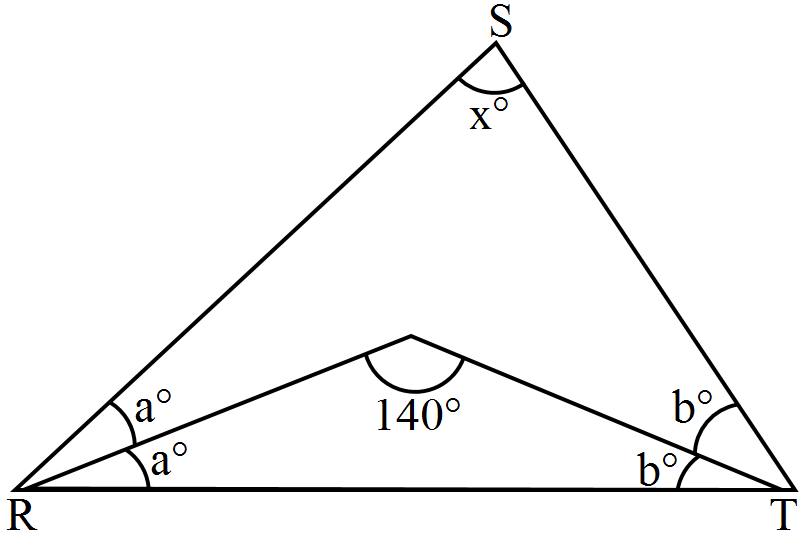
In $\triangle\text{RST}$
$\angle\text{R} + \angle\text{S} + \angle\text{T} = 180^\circ$
⇒ 2aº + xº + 2bº = 180º
⇒ xº = 180º - 2(a + b)º ... (i)
Now, in $\triangle\text{ROT}$
$\angle\text{ORT} + \angle\text{ROT} + \angle\text{OTR} = 180^\circ$
⇒ aº + 140º + bº = 180º
⇒ (a + b)º = 180º - 140º = 40º ...(ii)
From eq. (i) and (ii)
xº = 180º − 2(40º)
⇒ x = 100º
View full question & answer→Question 1671 Mark
Which of the following is not a criterion for congruence of triangles?
Answer- SSA
Solution:
If two triangles have two congruent sides and a congruent non-included angle, then $\triangle$ s are not necessarily corgruent. This is why there is no 'side side angle'
i.e. SSA postulate.
Hence, correct option is (b).
View full question & answer→Question 1681 Mark
Find the measure of each exterior angle of an equilateral triangle.
Answer- 120º
Solution:
We know that in equilateral triangle each angle is 60º
And we know sum of interior angle and exterior angle is 180º
Let exterior angle be x
60º + x = 180º
x = 180º - 60º
x = 120º
View full question & answer→Question 1691 Mark
The sum of the interior angles of a triangle is:
Answer- 180º
Solution:
For a triangle,
Number of sides (n) = 3
Sum of interior angles = (n - 2) × 180º
= (3 - 2) × 180º
= 1 × 180º
= 180º
View full question & answer→Question 1701 Mark
An exterior angle of a triangle is equal to 100º and two interrior opposite angles are equal. Each of these angles is equal to:
Answer- 50º
Solution:
Let the two interior opposite angles be xº each.
Now, the exterior angle is equal to the sum of the two interior opposite angles.
xº + xº = 180º
⇒ 2xº = 100º
⇒ xº = 50º
View full question & answer→Question 1711 Mark
In a triangle ABC, $\angle\text{B} = 35^\circ$ and $\angle\text{C} = 60^\circ,$ then the shortest side is:
Answer- AC
Solution:
Side opposite to smallest angle is shortest side angles of triangle are 35, 60 and 85.
View full question & answer→Question 1721 Mark
Side BC of a triangle ABC has been produced to a point D such that $\angle\text{ACD}=120^\circ.$ If $\angle\text{B}=\frac{1}{2}\angle\text{A},$ then $\angle\text{A}$ is equal to :
Answer- 80º
Solution:
$\angle\text{B}=\frac{1}{2}\angle\text{A}$
$\angle\text{ACD}$ is an exterior angle.
$\Rightarrow\angle\text{A}+\angle\text{B}=\angle\text{ACD}$
$\Rightarrow\angle\text{A}=\frac{1}{2}\angle\text{A}=120^\circ$
$\Rightarrow\frac{3\angle\text{A}}{2}=120^\circ$
$\Rightarrow3\angle\text{A}=240^\circ$
$\Rightarrow\angle\text{A}=80^\circ$
View full question & answer→Question 1731 Mark
Answer- 1 : 1
Solution:
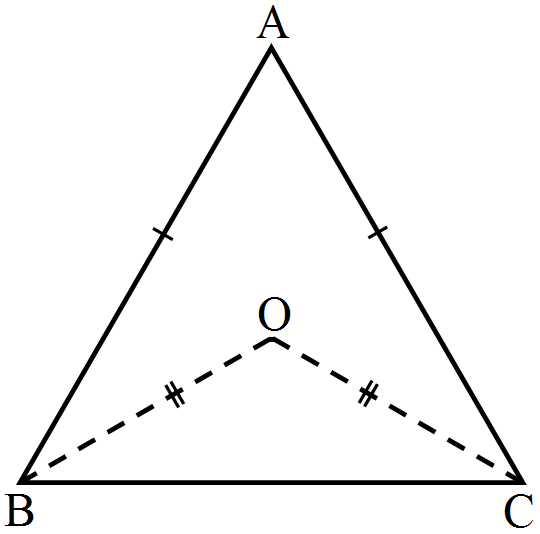
In $\triangle\text{ABC},$
$\text{AB = AC}\Rightarrow\angle\text{ABC}=\angle\text{ACB}...(\text{i})$
In $\triangle\text{OBC},$
$\text{OB = OC} \Rightarrow\angle\text{OBC}=\angle\text{OCB}...(\text{ii})$
Subtraction (ii) from (i), we get
$\Rightarrow\angle\text{ABO}=\angle\text{ACO}$
So, $\angle\text{ABO}:\angle\text{ACO}=1:1$
View full question & answer→Question 1741 Mark
In $\triangle\text{PQR},\ \angle\text{P} = 60^\circ,\ \angle\text{Q} = 50^\circ.$ Which side of the triangle is the longest?
Answer- PQ
Solution:
In $\triangle\text{PQR},\ \angle\text{P} = 60^\circ,\ \angle\text{Q} = 50^\circ.$
Now, by angle sum property, $\angle\text{P} +\angle\text{Q} +\angle\text{R} = 180^\circ$
$60^\circ + 50^\circ + \angle\text{R} = 180^\circ$
or, $\angle\text{R} = 180^\circ - 110^\circ = 70^\circ$
So, $\angle\text{R}$ is the largest angle and the side opposite to it, i.e, PQ will be the longest side.
![]()
View full question & answer→Question 1751 Mark
Answer- PR = QS
Solution:
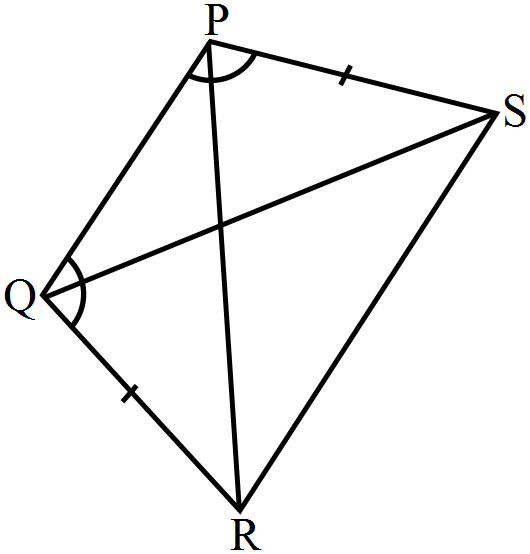
In $\triangle\text{QPR}$ and $\triangle\text{PQS},$
QR = PS (Given)
$\angle\text{RQP} = \angle\text{SPQ}$ (Given)
PQ = PQ (Common)
$\therefore \triangle\text{QPR} ≅ \triangle\text{PQS}$ (SAS Axio)
$\therefore$ PR = QS (C.P.C.T.)
View full question & answer→Question 1761 Mark
In triangles ABC and PQR, if $\angle\text{A}=\angle\text{R},\angle\text{B}=\angle\text{P}$ and $\text{AB}=\text{RP},$ then which one of the following congruence conditioins applies:
Answer- ASA
Solution:
From given conditions,
$\angle\text{B}=\angle\text{P}$
$\angle\text{A}=\angle\text{R}$
And the side containing then is also equal
i.e $\text{AB}=\text{PR}$
So ASA property.
Hence, correct option is (b).
View full question & answer→Question 1771 Mark
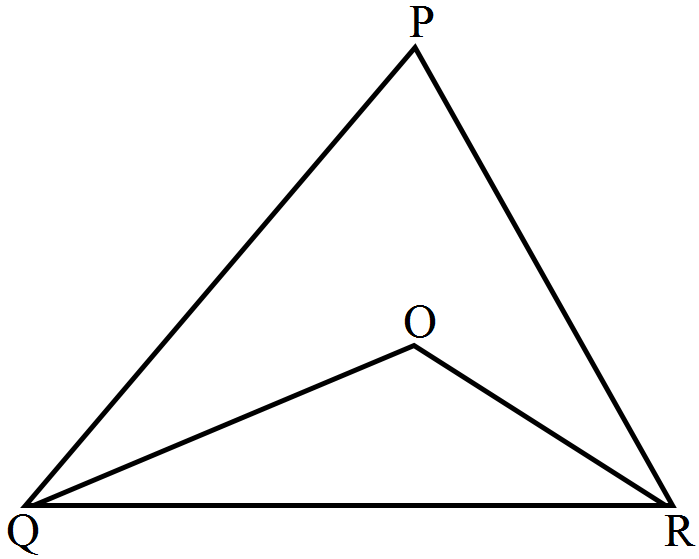
Answer- OQ > OR
Solution:
Since PQ > PR then $\angle\text{R}>\angle\text{Q}$ and hence their bisectors follow the same.
I.e $\frac{\text{R}}{2}>\frac{\text{Q}}{2}$ and hence OQ > OR.
View full question & answer→Question 1781 Mark
It is given that$\triangle\text{ABC}\cong\triangle\text{FDE}$ in which AB = 5cm, $\angle\text{B}=40^{\circ},\angle\text{A}=80^{\circ}$and FD = 5cm. Then, which of the following is true?
View full question & answer→Question 1791 Mark
In a $\triangle\text{ABC},$ if $\angle\text{A} = 60^\circ, \ \angle\text{B} = 80^\circ$ and the bisectors of $\angle\text{B}$ and $\angle\text{C}$ meet at O, the $\angle\text{BOC} =$
View full question & answer→Question 1801 Mark
In figure, $X$ is a point in the interior of square $\text {ABCD. AXYZ}$ is also a square. If $DY = 3\ cm$ and $AZ = 2\ cm,$ then $BY =$
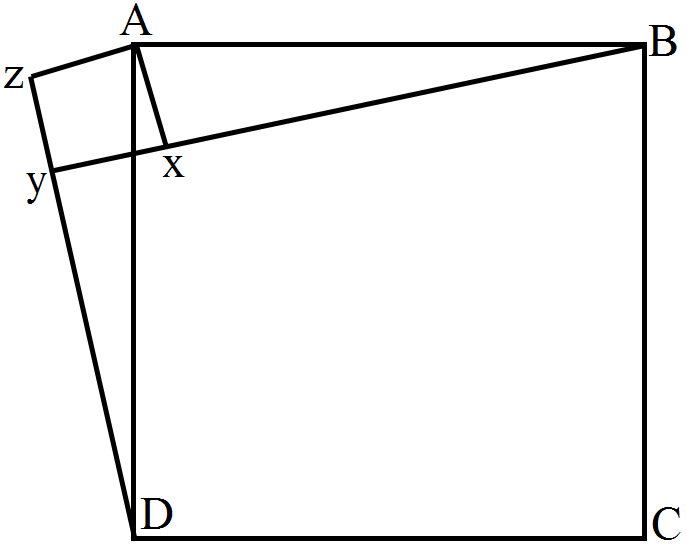
Answer$\angle\text{Z} = 90^\circ$ $($Angle of square$)$
Therefore, $\text {AZD}$ is a right angle triangle,
By Pythagoras theorem,
$AD^2 = AZ^2 + ZD^2$
$AD^2 = 22 + (2 + 3)^2$
$AD^2 = 4 + 25$
$\text{AD} = \sqrt{29}$
In $\triangle\text{AXB},$ with $X$ as right angle,
By Pythagoras theorem,
$AB^2 = AX^2 + XB^2$
$XB^2 = 29 - 4$
$XB = 5$
$BY = XB + XY$
$= 5 + 2$
$= 7\ cm$
View full question & answer→Question 1811 Mark
Find the measure of each exterior angle of an equilateral triangle.
Answer- 120º
Solution:
We know that in equilateral triangle each angle is 60°
and we know sum of interior angle and exterior angle is 180°
let exterior angle be x
60º + x = 180º
x = 180º - 60º
x = 120º
View full question & answer→Question 1821 Mark
In right-angled $\triangle\text{DEF}$ if $\angle\text{E} = 90^\circ$ then:
Answer- DF is the longest side.
Solution:
In a triangle, only one right angle is possible, hence it is the greatest angle and the side opposite to it is the longest side. Here, the side opposite to $\angle\text{E}$ is DF, hence, it is the longest side.
View full question & answer→Question 1831 Mark
In $\triangle\text{ABC}, \ \angle\text{C} = \angle\text{A}$ and BC = 6cm and AC = 5cm. Then the length of AB is:
Answer- 6cm
Solution:
Sides opposite to equal angles are equal. Since, $\angle\text{C} = \angle\text{A},$ hence, AB = BC = 6cm.
View full question & answer→Question 1841 Mark
Which of the following is not possible in case of triangle ABC?
Answer- AB = 2cm, BC = 4cm, CA = 7cm.
Solution:
Sum of any two sides is greater than third side, but here 2 + 4 < 7.
View full question & answer→Question 1851 Mark
In triangles ABC and DEF, AB = FD and $\angle\text{A} = \angle\text{D}.$ The two triangles will be congruent by SAS axiom if:
View full question & answer→Question 1861 Mark
P is a point on side BC of a $\triangle\text{ABC}$ such that AP bisects $\angle\text{BAC}.$ Then,
Answer- BA > BP
Solution:
Since, AP bisects $\angle\text{BAC}.$
Hence the point P on BC also bisects it as it the opposite side of $\angle\text{BAC}.$
Hence, we can conclude that, BA > BP.
View full question & answer→Question 1871 Mark
in $\triangle\text{ABC}$ and $\triangle\text{DEF}$ it is given that AB = DE and BC = EF in order that $\triangle\text{ABC}≅\triangle\text{DEF},$ we must have
View full question & answer→Question 1881 Mark
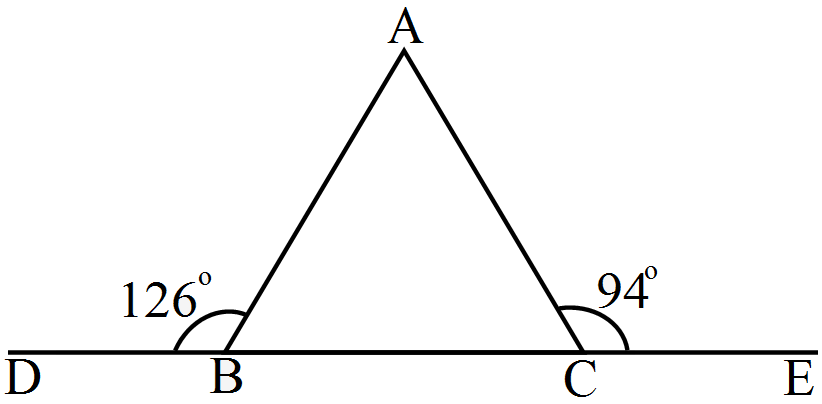
The base BC of triangle ABC is produced both ways and the measure of exterior angles formed are 94º and 126º. Then, $\angle\text{BAC}=$
View full question & answer→Question 1891 Mark
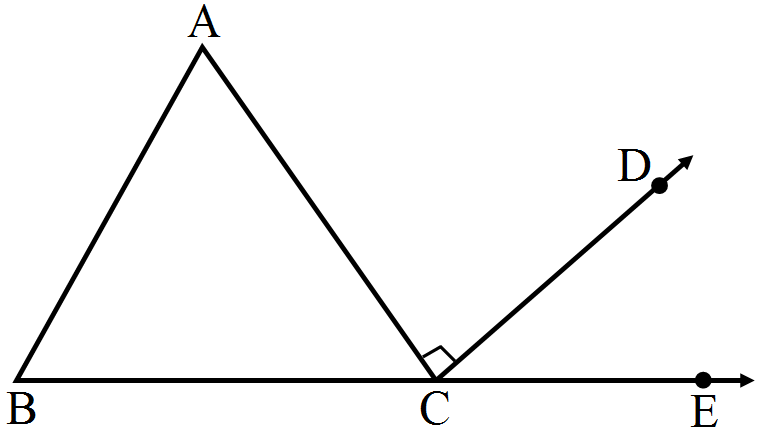
Answer- 60º
Solution:
we know that
$\angle\text{A}+\angle\text{B}+\angle\text{C}=180^\circ$ .....(Angle sum property)
$\therefore\angle\text{A}=\Big(180\times\frac{3}{6}\Big)=90^\circ$
$\angle\text{B}=\Big(180\times\frac{2}{6}\Big)=60^\circ\ \text{and}$
$\angle\text{C}=\Big(180\times\frac{1}{6}\Big)=30^\circ$
Now,
$\angle\text{ACE}=\angle\text{A}+\angle\text{B}$ .....(Exterior angle is equal to sum of the remote interior angles)
$=90^\circ+60^\circ$
$=150^\circ$
$\angle\text{ACE}=\angle\text{ECD}+\angle\text{ACD}$
$\therefore150^\circ=\angle\text{ECD}+90^\circ$
$\therefore\angle\text{ECD}=60^\circ$
View full question & answer→Question 1901 Mark
Answer- 120º
Solution:
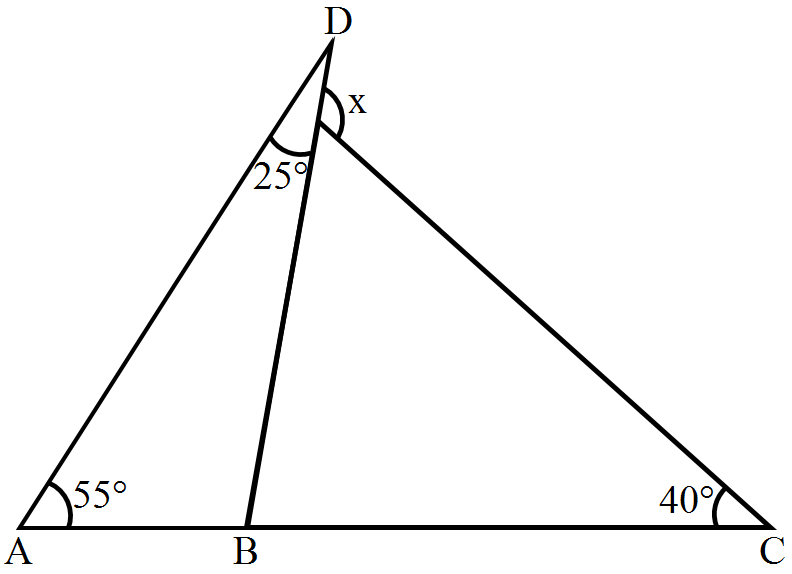
In $\triangle\text{ABD}$
$\angle\text{A} + \angle\text{B} + \angle\text{D} = 180^\circ$
$⇒ 55^\circ + \angle\text{DBA} + 25^\circ = 180^\circ$
$⇒ \angle\text{DBA} = 180^\circ - 55^\circ - 25^\circ$
$= 180^\circ - 80^\circ$
$⇒ \angle\text{DBA} = 100^\circ$
So, $\angle\text{DBC} = 180^\circ - \angle\text{DBA}$
$= 180^\circ - 100^\circ$
$ \angle\text{DBC} = 80^\circ$
Now, $\triangle\text{EBC}$
$\angle\text{A} + \angle\text{EBC} + \angle\text{C} = 180^\circ$
$⇒ \angle\text{E} + 80^\circ + 40^\circ = 180^\circ ( \angle\text{DBC} = \angle\text{EBC})$
$⇒ \angle\text{E} = 180^\circ - 120^\circ = 60^\circ$
Also, $\text{x} = 180^\circ - \angle\text{E} = 180^\circ - 60^\circ$
$⇒ \text{x} = 120^\circ$
View full question & answer→Question 1911 Mark
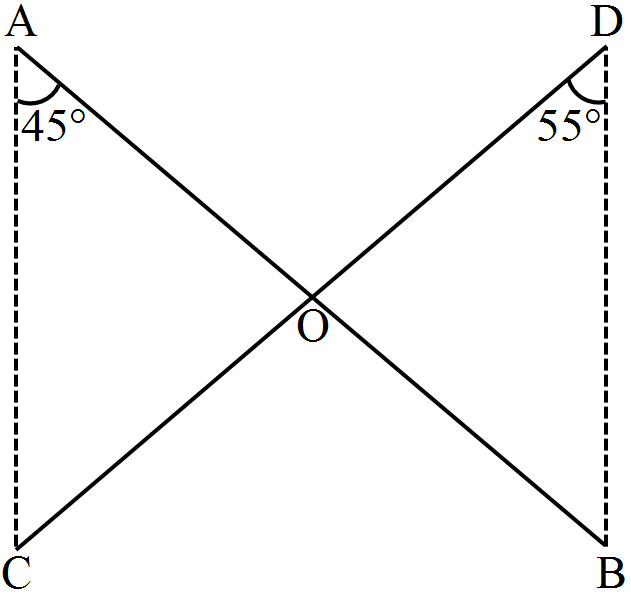
Line sgements AB and CD intersect at O such that $\text{AC}||\text{DB}.$ If $\angle\text{CAB} = 45^\circ$ and $\angle\text{CDB} = 55^\circ,$ then $\angle\text{BOD} =$
View full question & answer→Question 1921 Mark
Two sides of a triangle are oflengths 5cm and 1.5cm. The length of the third side of the triangle cannot be:
Answer- 3.4cm
Solution:
Given that: Two sides of triangle are 5cm and 1.5cm. We know that the sum of two sides of the triangle is always greater than the third side. Hence, 3.4cm cannot be the third side. If it is the third side the sum of 3.4cm and 1.5cm will be smaller than 5cm, so, the triangle will not be possible.
View full question & answer→Question 1931 Mark
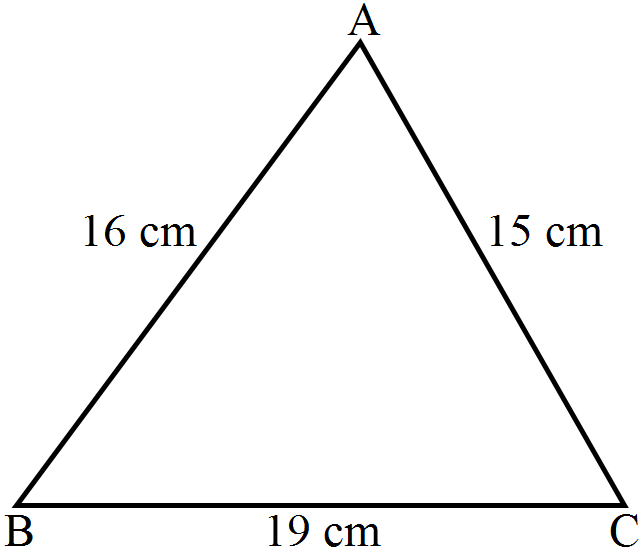
Answer- $\angle\text{B}$ is the smallest angle in the triangle.
Solution:
In a triangle angle opposite to smallest side is least AC is least side and hence B is smaller.
View full question & answer→Question 1941 Mark
In $\triangle\text{ABC},$ $\angle\text{A} = 35^\circ$ and $\angle\text{B} = 65^\circ$, then the longest side of the triangle is:
Answer- AB
Solution:
As per angle sum property, $\angle\text{A} +\angle\text{B}+\angle\text{C}= 180^\circ$
Hence, $35^\circ + 65^\circ + \angle\text{C} = 180^\circ$
$\Rightarrow\ \angle\text{C} = 80^\circ$ which is the greatest angle.
We know that the side opposite to the greatest angle i.e AB would be the greatest.
Hence, AB is the longest side.
View full question & answer→Question 1951 Mark
If a, b, c are the lengths of the sides of a triangle, then
Answer- C < A + B
Solution:
Put the sidesof triangle a, b, c
For a possible triangle the following are possible.
a + b > = c
b + c > = a
a + c > = b
View full question & answer→Question 1961 Mark
Answer- 22º
Solution:
$\text{AB}\perp\text{BC}$
$\Rightarrow\angle\text{ABC}=90^\circ$
$\angle\text{CAB}=32^\circ$ (Opposite angles)
Now, in $\triangle\text{ABD}$
$\angle\text{DAB}=\text{x}^\circ+32^\circ$
$\angle\text{ABD}=90^\circ$
$\angle\text{BDA}=\text{x}^\circ+14^\circ$
In a $\triangle,$ sum of all angles = 180º
$\Rightarrow\angle\text{DAB}+\angle\text{ABD}+\angle\text{BDA}=180^\circ$
$\Rightarrow\text{x}^\circ+32^\circ+90^\circ+\text{x}^\circ+14^\circ=180^\circ$
$\Rightarrow2\text{x}^\circ=180^\circ-136^\circ$
$\Rightarrow2\text{x}^\circ=44^\circ$
$\Rightarrow\text{x}^\circ=22^\circ$
View full question & answer→Question 1971 Mark
Answer- A triangle can have two acute angles.
Solution:
We know that, by the angle sum property,
the sum of all the angles of a triangle is 180° ...(i)
So, if two angles are right angles, then their sum is 180°.
So, the measure of the third angle is zero, which is not possible.
Thus, (a) is not true.
View full question & answer→Question 1981 Mark
If triangle PQR is right angled at Q, then.
Answer- PR > PQ
Solution:
Then the hypotnuse should be always greater than the remaining two sides.
View full question & answer→Question 1991 Mark
D is a point on the side BC of a $\triangle\text{ABG}$ such that AD bisects $\triangle\text{BAC}$ then:
Answer- BA > BD
Solution:
Since, $\angle\text{BAC}$ is bisected by AD, then $\angle\text{BAD}$ is less than $\angle\text{ABC},$ hence the side opposite $\angle\text{ABC},$ i.e. BA is greater than the side opposite to $\angle\text{BAD}$ i.e., BD.
View full question & answer→Question 2001 Mark
Answer- $\angle\text{BDA}$
Solution:
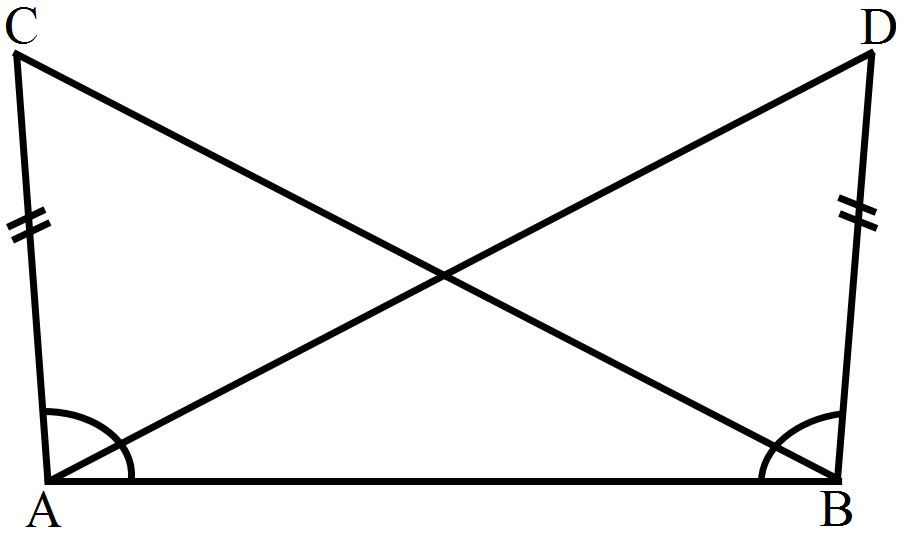
In Triangle CAB and traingle DBA,
AC = BD and $\angle\text{CAB} = \angle\text{DBA}$ (Given)
AB (Common)
Therefore, Triangle CAB and traingle DBA are congruent by SAS criteria
Therefore, $\angle\text{ACB} = \angle\text{BDA}$ (by CPCT)
View full question & answer→