Question 12 Marks
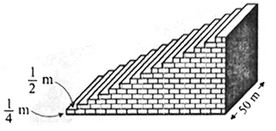
A small terrace at a football ground comprises of 15 steps each of which is 50 m long and built of solid concrete.
Each step has a rise of $\frac{1}{4}$m and a tread of $\frac{1}{2}$m. (see figure). Calculate the total volume of concrete required to build the terrace.
[Hint: Volume of concrete required to build the first step = $\frac 14 \times \frac 12 \times$ 50 $m^3$]
AnswerVolume of concrete required to build the first step, second step and third step (in $m^2$)
= $\frac{1}{4} \times \frac{1}{2} \times 50,\left( {2 \times \frac{1}{4}} \right) \times \frac{1}{2} \times 50,\left( {3 \times \frac{1}{4}} \right) \times \frac{1}{2} \times 50$
= $ \frac{{50}}{8},2 \times \frac{{50}}{8},3 \times \frac{{50}}{8},.....$
$\therefore $ Total volume of concrete required = $\frac{{50}}{8} + 2 \times \frac{{50}}{8} + 3 \times \frac{{50}}{8} + ....$
$ = \frac{{50}}{8}\left[ {1 + 2 + 3 + .......} \right]$
$S_n$ = $\frac{{n}}{2}$ [(2a + (n - 1)d]
$S_{15}$ $ = \frac{{50}}{8} \times \frac{{15}}{2}\left[ {2 \times 1 + (15 - 1) \times 1} \right]\left[ {\because n = 15} \right]$
$ = \frac{{50}}{8} \times \frac{{15}}{2} \times 16$
$= 750 m^3$
View full question & answer→Question 22 Marks
Find the sum of first $51$ terms of an AP whose second and third terms are $14$ and $18$ respectively.
AnswerThe general term of an AP is given by $a _{ n }= a +( n -1) d$ and $S _{ n }=\frac{n}{2}[2 a +( n -1) d ]$.
Given that $a _2=14$ and $a _3=18$
So, $d=a_3-a_2=18-14=4$
Now, $a _2=14$
$\Rightarrow a +4=14$
$\Rightarrow a=10$
Also, $S_{51}=\frac{{51}}{2}[2(10)+(50)4]$
$\Rightarrow S_{51}=\frac{{51}}{2}[20+200]$
$\Rightarrow S_{51}=\frac{{51}}{2}[220]$
$\Rightarrow S_{51}=51 \times 110$
$\Rightarrow S_{51}=5610$
View full question & answer→Question 32 Marks
The first and the last terms of an $A.P$ are $17$ and $350$ respectively. If the common difference is $9$, how many terms are there and what is their sum?
AnswerLet their be n terms in the given AP.
First term, $a = 17$
Last term,$ l = 350$
Common difference, $d=9$
Now, $T_n= 350$
$\Rightarrow a + (n-1)d = 350$
$\Rightarrow 17 + (n-1) 9 = 350$
$\Rightarrow (n-1)(9) = 333$
$\Rightarrow n-1 = 37$
$\Rightarrow n = 38$
Therefore,there are 38 terms in the AP
Now, $S _{ n }=\frac{n}{2}[ a +1]$
$\Rightarrow S_{38}=\frac{38}{2}[17+350]=19 \times 367=6973$
View full question & answer→Question 42 Marks
In an AP: l = 28, S = 144, and there are total 9 terms. Find 'a'.
AnswerHere, l = 28
S = 144
n = 9
We know that
$S = \frac{n}{2}(a + l)$
$ \Rightarrow 144 = \frac{9}{2}(a + 28)$
$ \Rightarrow \frac{{(144)(2)}}{9} = a + 28$
$ \Rightarrow $ 32 = a + 28
$ \Rightarrow $ a = 32 - 28
$ \Rightarrow $ a = 4
View full question & answer→Question 52 Marks
Find the sum of the APs: $\frac{1}{{15}},\frac{1}{{12}},\frac{1}{{10}},.....$ to 11 terms.
AnswerHere, $a = \frac{1}{{15}}$
$d = \frac{1}{{12}} - \frac{1}{{15}} = \frac{1}{{60}}$
n = 11
We know that
$ \Rightarrow {S_n} = \frac{n}{2}\left[ {2a + (n - 1)d} \right]$
$ \Rightarrow {S_{11}} = \frac{{11}}{2}\left[ {2\left( {\frac{1}{{15}}} \right) + (11 - 1)\left( {\frac{1}{{60}}} \right)} \right]$
$ \Rightarrow {S_{11}} = \frac{{11}}{2}\left[ {\frac{2}{{15}} + \frac{1}{6}} \right]$
$ \Rightarrow {S_{11}} = \frac{{11}}{2}\left[ {\frac{3}{{10}}} \right]$
$ \Rightarrow {S_{11}} = \frac{{33}}{{20}}$
So, the sum of the first 11 terms of the given AP is $\frac{{33}}{{20}}$.
View full question & answer→Question 62 Marks
Find the sum of the APs: 0.6, 1.7, 2.8,…., to 100 terms.
AnswerHere, a = 0.6
d = 1.7 -0.6 = 1.1
n = 100
We know that
${S_n} = \frac{n}{2}\left[ {2a + (n - 1)d} \right]$
$ \Rightarrow {S_{100}} = \frac{{100}}{2}\left[ {2(0.6) + (100 - 1)(1.1)} \right]$
$ \Rightarrow {S_{100}} = 50[1.2 + 108.9]$
$ \Rightarrow {S_{100}} = 50[110.1]$
So, the sum of the first 100 terms of the given AP is 5505.
View full question & answer→Question 72 Marks
Find the sum of the APs: –37, –33, –29, …, to 12 terms.
AnswerHere, a = -37
d = -33 - (-37) = -33 + 37 = 4
n = 12
We know that
${S_n} = \frac{n}{2}\left[ {2a + (n - 1)d} \right]$
$ \Rightarrow {S_{12}} = \frac{{12}}{2}[2( - 37) + (12 - 1)4]$
$ \Rightarrow {S_{12}} = 6[ - 74 + 44]$
$ \Rightarrow {S_{12}} = 6[ - 30]$
$ \Rightarrow {S_{12}} = - 180$
So, the sum of the first 12 terms of the given AP is -180.
View full question & answer→Question 82 Marks
Find the sum of an AP given as: $2, 7, 12,...$ upto 10 terms.
AnswerHere, a = 2, d = 5 and n = 10
Sum of n terms can be given as follows:
$S_n=\frac{n}{2}[2 a+(n-1) d]$
$\mathrm{S}_{10}=\frac{10}{2}[2 \times 2+(10-1) 5]$
$= 5(4 + 45)$
$ = 5 \times 49$
$= 245$
Thus, the sum of the 10 terms of given $AP, (S_{10}) = 25$
View full question & answer→Question 92 Marks
Are the given numbers $1, 3, 9, 27, ........$ forms an $AP$? If It forms an $AP$, then find the common difference d and write the next three terms.
AnswerAccording to question we are given that a spiral is made up of successive semi-circles, with centres alternately at A and B, starting with centre at A, of radii 0.5 cm, 1.0 cm, 1.5 cm, 2.0 cm, ....as shown in Fig.Let $l_1, l_2, l_3, l_4,..l_{13}$ be the lengths (circumferences) of semi-circles of radii $r_1= 0.5 cm, r_2 =1.0 cm, r_3 = 1.5 cm, r_4 = 2.0 cm, r_5 = 2.5 cm,...$ respectively.
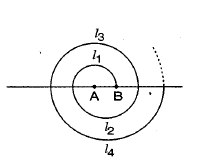
Now, Semi-perimeter of circle = $\pi\cdot r $
Therefore,
$l _ { 1 } = \pi r _ { 1 } = \pi \times 0.5 = \frac { \pi } { 2 } \mathrm { cm }$
$l _ { 2 } = \pi r _ { 2 } = \pi \times 1 = 2 \left( \frac { \pi } { 2 } \right) \mathrm { cm }$
$l _ { 3 } = \pi r _ { 3 } = \pi \times \frac { 3 } { 2 } = 3 \left( \frac { \pi } { 2 } \right) \mathrm { cm }$
$l _ { 4 } = \pi r _ { 4 } = \pi \times 2 = 4 \left( \frac { \pi } { 2 } \right) \mathrm { cm }$
and
$l _ { 13 } = \pi r _ { 13 } = \pi \times \frac { 13 } { 2 } \mathrm { cm } = 13 \left( \frac { \pi } { 2 } \right) \mathrm { cm }$
Therefore total length of the spiral $= l_1 + l_2 + l_3 +...+ l_{13}$
$\bf= \left\{ \frac { \pi } { 2 } + 2 \left( \frac { \pi } { 2 } \right) + 3 \left( \frac { \pi } { 2 } \right) + \dots + 13 \left( \frac { \pi } { 2 } \right) \right\} $
$\bf= \frac { \pi } { 2 } ( 1 + 2 + 3 + \cdots + 13 ) $
$\bf= \frac { \pi } { 2 } \times \frac { 13 } { 2 } ( 1 + 13 ) \quad \left[ \text { Using } S _ { n } = \frac { n } { 2 } ( a + l ) \right]$
$\bf= \frac { \pi } { 2 } \times \frac { 13 } { 2 } \times 14$ = $\bf\frac { 1 } { 2 } \times \frac { 22 } { 7 } \times 13 \times 7$ = $\bf {143 cm}$
which is required length of the spiral made up of thirteen consecutive semi-circles. View full question & answer→Question 102 Marks
Is the given series: $-\frac{1}{2},-\frac{1}{2},-\frac{1}{2},-\frac{1}{2}, \ldots$ forms an AP? If It forms an AP, then find the common difference d and write the next three terms.
AnswerHere, it is given that all terms are same, so the common difference $(d) = 0$
since $a_{k+1}- a_k$ is the same for all values of k
Hence, it forms an AP.
The next three terms will be the same, i.e. $ - \frac{1}{2}$,$ - \frac{1}{2}$,$ - \frac{1}{2}$
View full question & answer→Question 112 Marks
Is the given sequence: $1^2, 3^2, 5^2, 7^2, .....$. forms an $AP$? If it forms an AP, then find the common difference d and write the next three terms.
AnswerThe given terms can be written as follows:
$1, 9, 25, 49,....$
Here, $a_2- a_1= 9 - 1 = 8$
$a_3- a_2= 25 - 9 = 16$
$a_4- a_3= 49 - 25 = 24$
Since $a_{k+1}- a_k$ is not same for all values of k
Hence, it is not an AP. So we can not find next three terms.
View full question & answer→Question 122 Marks
Is the given sequence: $\sqrt{3}, \sqrt{6}, \sqrt{9}, \sqrt{12}, \dots$ form an AP? If it forms an AP, then find the common difference d and write the next three terms.
AnswerFrom the given information, we can have
${a_{2}-a_{1}=\sqrt{6}-\sqrt{3}}$
${a_{3}-a_{2}=\sqrt{9}-\sqrt{6}=3-\sqrt{6}}$
$a_{4}-a_{3}=\sqrt{12}-\sqrt{9}=2 \sqrt{3}-3$ $(since\sqrt{12}=\sqrt{2} \times 2 \times 3=2 \sqrt{3}) $
since $a_{k+1}-a_{k}$ is not the same for all values of k.
Hence, it is not an AP.
View full question & answer→Question 132 Marks
Is the given sequence: $a^1, a^2, a^3, a^4,...$ forms an AP? If it forms an AP, then find the common difference d and write the next three terms.
AnswerHere, it is given that the exponent is increasing in each subsequent term:
$a_4= a^4, a_3= a^3, a_2= a^2, a_1= a^1$
$a_2- a_1= a^2- a^1$
$a_3- a_2= a^3- a^2$
$a_4- a_3= a^4- a^3$
Since, the common difference is not same, since $a_{k+1}- a_k$ is not same for all values of k
Hence, the given sequence does not forms an AP. So,we can not find next three terms.
View full question & answer→Question 142 Marks
In the AP, 5,?,?, $9\frac{1}{2}$ find the missing terms?
AnswerLet the common difference of the given AP be d.
a = 5
4th term $ = 9\frac{1}{2}$
$ \Rightarrow 5 + (4 - 1)d = \frac{{19}}{2}\left[ {\because {a_n} = a + (n - 1)d} \right]$
$ \Rightarrow 3d = \frac{{19}}{2} - 5$
$ \Rightarrow 3d = \frac{9}{2}$
$ \Rightarrow d = \frac{3}{2}$
Therefore,
Second term $ = 5 + \frac{3}{2} = \frac{{13}}{2} = 6\frac{1}{2}$
and, third term $ = \frac{{13}}{2} + \frac{3}{2} = 8$
Hence, the missing terms in the boxes are $6\frac{1}{2}$ and 8.
View full question & answer→Question 152 Marks
In the AP 2, ? , 26, find the missing terms?
AnswerLet the common difference of the given AP be d.
Then,
Third term = 2 + d + d = 2 + 2d
According to the question,
2 + 2d = 26
$ \Rightarrow $ 2d = 26 - 2
$ \Rightarrow $ 2d = 24
$ \Rightarrow d = \frac{{24}}{2} = 12$
So, second term = 2 + d = 2 + 12 = 14
Hence, the missing termed is 14
View full question & answer→Question 162 Marks
Determine the AP whose third term is 16 and the $7^{\text {th }}$ term exceeds the $5^{\text {th }}$ term by 12 .
Answer$a_3 = 16$
$ \Rightarrow a + 2d = 16 ..... (i)$
$a_7 = a_5 + 12$
$ \Rightarrow a + 6d = a + 4d + 12$
$ \Rightarrow 2d = 12$
$ \Rightarrow d = 6$
Put the value of d in eq. (i)
$a + 2 \times 6 = 16$
$ \Rightarrow a = 16 - 12$
$ \Rightarrow a = 4$
$4, 10, 16....$
View full question & answer→Question 172 Marks
How many three-digit numbers are divisible by $7$?
AnswerAll 3-digit numbers divisible by 7 are
$105,112,119, \ldots, 994 .$
Clearly, these numbers form an AP with $a =105, d=(112-105)=7$ and $I =994$.
Let it contain $n$ terms. Then,
$T_n=994 \Rightarrow a+(n-1) d=994$
$\Rightarrow 105+(n-1) 7=994$
$\Rightarrow 98+7 n=994$
$\Longrightarrow 7 n=896$
$\Rightarrow n=128$
Hence, there are $128$ three-digit numbers divisible bym $7$ .
View full question & answer→Question 182 Marks
Two APs have the same common difference. The difference between their 100th terms is $100$, what is the difference between their $1000th$ terms?
AnswerLet the common difference of two AP's be d, their first terms as a and a' nth term of both the AP's will be given by
$a_n=a+(n-1) d \text { and }$
$a_n^{\prime}=a^{\prime}+(n-1) d, \text { respectively }$
Now 100 th term of 1 st AP will be given by: $a_{100}=a+(100-1) d=a+99 d$
100th term of second AP will be given by: $a^{\prime}{ }_{100}=a+(100-1) d=a^{\prime}+99 d$
Now given, $a _{100}- a ^{\prime}{ }_{100}=( a +99 d)-\left( a ^{\prime}+99 d\right)=100$
$\Rightarrow a_{100}-a_{100}^{\prime}=\left(a-a^{\prime}\right)=100$
So, difference does not depend on number of terms. Thus, $a_{1000}-a_{1000}^{\prime}=100=a_{100}-a_{100}^{\prime}$
Hence, the difference between their 1000 th terms is 100.
View full question & answer→Question 192 Marks
Which term of the AP : $3,15,27,39$, ........ will be 132 more than its $54^{\text {th }}$ term?
AnswerHere, first term $= a = 3$ and common difference $= d = 15 – 3 = 12$
Let nth term of the given AP be 132 more than its $54^{th}$ term, then
$a_n = a_{54} + 132$
$\Rightarrow a + (n – 1)d = a + (54 – 1)d + 132$
$\Rightarrow (n – 1) d = (54 – 1)d + 132$
$\Rightarrow (n – 1) 12 = (53)12 + 132$
$\Rightarrow (n – 1) 12 = 768$
$\Rightarrow (n – 1) = 64$
$\Rightarrow n = 65$
Hence, the 65th term will be $132$ more than the $54\ th$ term.
View full question & answer→Question 202 Marks
The $17\ th$ term of an AP exceeds its 10th term by $7$. Find the common difference.
AnswerLet the first term and the common difference of the AP be a and d respectively.
Given that, $a_{17} = a_{10}+7$
$ \Rightarrow a + (17 - 1) d = a + (10 - 1)d + 7 [\because a_n = a +(n - 1)d]$
$ \Rightarrow a + 16d = a + 9d + 7$
$ \Rightarrow 16d - 9d = 7$
$ \Rightarrow 7d = 7$
$ \Rightarrow d = \frac{7}{7} = 1$
Hence, the common difference is 1.
View full question & answer→Question 212 Marks
Is the sequence $0.2, 0.22, 0.222, 0.2222, …$. forms an $AP$? If it forms an $AP$, find the common difference d and write three more terms.
Answer$0.2, 0.22, 0.222, 0.2222, 000$
$a_2 - a_1 = 0.22 - 0.2 = 0.02$
$a_3 - a_2 = 0.222 - 0.22 = 0.002$
$As a_2 -a_1$ $ \ne $ $a_3 - a_2,$ the given list of numbers does not form an AP.
View full question & answer→Question 222 Marks
For the AP 0.6, 1.7, 2.8, 3.9 ........, write the first term and the common difference.
Answer0.6, 1.7, 2.8, 3.9...
First term = a= 0.6
Common difference (d) = Second term -First term
= Third term - Second term and so on
Therefore, Common difference (d) = 1.7−0.6=1.1
View full question & answer→Question 232 Marks
Write first four terms of the AP, when the first term a = 10 and the common difference d = 10.
Answera = 10, d = 10
First term a = 10
Second term = 10 + d = 10 + 10 = 20
Third term = 20 + d = 20 + 10 = 30
Fourth term = 30 + d = 30 + 10 = 40
Hence, first four terms of the given AP are 10, 20, 30, 40
View full question & answer→Question 242 Marks
Write first four terms of the $AP$, when the first term $a = -1.25$ and the common difference, $d = –0.25$
AnswerHere, $a_1=a=-1.25, d=-0.25$
First term, $a =-1.25$
Second term, $a_2=-1.25+d=-1.25+(-0.25)=-1.50$
Third term $=-1.50+d=-1.50+(-0.25)=-1.75$
Fourth term $=-1.75+d=-1.75+(-0.25)=-2.00$
Hence, first four terms of the given AP are $-1.25,-1.75,-2.00$
View full question & answer→Question 252 Marks
Write the first four terms of the AP, when the first term a = -1 and the common difference d = $\frac{1}{2}$
Answera = -1, $d = \frac{1}{2}$
First term = a = -1
Second term = -1 + d $ = - 1 + \frac{1}{2} = - \frac{1}{2}$
Third term $ = - \frac{1}{2} + d = - \frac{1}{2} + \frac{1}{2} = 0$
Fourth term = 0 + d $ = 0 + \frac{1}{2} = \frac{1}{2}$
Hence, the first four terms of the given AP are -1, $ - \frac{1}{2},0,\frac{1}{2}$.
View full question & answer→Question 262 Marks
Write first four terms of the AP, when the first term a = 4 and the common difference d = -3
Answera = 4, d = -3
First term = a = 4
Second term = 4 + d = 4 + (-3) = 1
Third term = 1 + d = 1 + (-3) = -2
Fourth term = $- 2 + d = - 2 + ( - 3 ) = - 5$
Hence, four first terms of the AP are 4, 1, -2, -5.
View full question & answer→Question 272 Marks
Write the first four terms of the AP, when the first term a = -2 and the common difference d = 0
Answera = -2, d = 0
First term = a = -2
Second term = -2 + d = -2 + 0 = -2
Third term = -2 + d = -2 + 0 = -2
Fourth term = -2 + d = -2 + 0 = -2
Hence, first four terms of the given AP are -2, -2, -2, -2 respectively.
View full question & answer→Question 282 Marks
Find the 11th term from the last term (towards the first term) of the AP :$ 10, 7, 4, ..., -62.$
Answer$a = – 62, d = 3$
$a_{11}= a + 10d$
$= – 62 + 10(3)$
$= – 32$
View full question & answer→Question 292 Marks
How many two-digit numbers are divisible by 3?
AnswerThe two -digit numbers divisible by 3 start from 12,15,18,21,...,99
Here,
$a=12$
$d=3$
$a_n=a+(n-1)d$
$\Rightarrow$ $99=12+(n-1)(3)$
$\Rightarrow$$ 99=12+3n-3$
$\Rightarrow$ $90=3n$
$\Rightarrow$ n=30
Thus, 30 two-digit numbers are divisible by 3.
View full question & answer→Question 302 Marks
Are the given numbers form an AP? If they form an AP, write the next two terms: $1, 1, 1, 2, 2, 2, 3, 3, 3, ...$
AnswerFrom the given numbers,we can have
$a_2 – a_1 = 1 – 1 = 0$
$a_3 – a_2 = 1 – 1 = 0$
$a_4 – a_3 = 2 – 1 = 1$
Here, $a_2 – a_1 = a_3 – a_2$ but $a_3 – a_2$ $\neq$ $a_4 – a_3$
So, the given list of numbers does not form an AP. Thus we cannot find two terms.
View full question & answer→Question 312 Marks
Are the given numbers form an $AP$? If they form an $AP$, write the next two terms: $-2, 2, -2, 2, -2, ...$
AnswerFrom the given numbers,we can have
$a_2 – a_1 = 2 – (–2) = 2 + 2 = 4$
$a_3 – a_2 = –2 – 2 = –4$
$As a_2 – a_1 \neq a_3 – a_2 ,$
i.e. the common difference is not same, so the given list of numbers does not form an AP. Thus, we cannot find the next two terms.
View full question & answer→Question 322 Marks
Are the given numbers form an AP? If they form an AP, write the next two terms: $1, -1, -3, -5, ...$
AnswerFrom the given numbers, we have
$a_2 – a_1 = –1 – 1 = –2$
$a_3– a_2 = –3 – ( –1 ) = – 3 + 1 = –2$
$a_4 – a_3 = –5 – ( –3 ) = – 5 + 3 = –2$
$i.e., a_{k + 1} – a_k$ is the same every time
So, the given list of numbers forms an AP with the common difference $d = –2$
The next two terms are:
$-5 + (-2) = -7$ and
$-7 + (-2) = -9$
View full question & answer→Question 332 Marks
Are the given numbers form an AP? If they form an AP, write the next two terms: $4, 10, 16, 22, ...$
AnswerFrom the given numbers, we can have
$a_2 – a_1 = 10 – 4 = 6$
$a_3 – a_2 = 16 – 10 = 6$
$a_4 – a_3 = 22 – 16 = 6$
$i.e., a_{k + 1} – a_k $is the same every time
So, the given list of numbers forms an AP with the common difference $d = 6.$
The next two terms are:
$22 + 6 = 28$ and
$28 + 6 = 34$
View full question & answer→Question 342 Marks
Find the sum of first 24 terms of the list of numbers whose nth term is given by $a_n = 3 + 2n.$
Answer$a_n = 3 + 2n$
Put $n = 1, 2, 3,...$
$a_1 = 5, a_2 = 7, a_3 = 9....$
$a = 5, d = 7 - 5 = 2$
${S_{24}} = \frac{{24}}{2}\left[ {2 \times 5 + (24 - 1) \times 2} \right]$$= 12[10 + 46] = 672$
View full question & answer→Question 352 Marks
Find the sum of the first n positive integers or natural numbers.
AnswerAs per the given statement we have to find $S_n = 1 + 2 + 3 +......+n$
Here a = 1 and the last term l is n.
we know that, $S_{n}=\frac{n(a+l)}{2} $ or $S_{n}=\frac{n(1+n)}{2}$
So, the sum of the first n positive integers is given by
$S_{n}=\frac{n(n+1)}{2}$
View full question & answer→Question 362 Marks
How many terms of the given AP: $24, 21, 18, . . .$ must be taken so that their sum becomes $78$?
AnswerHere it is given that $a = 24, d = 21 – 24 = –3, Sn = 78$, We need to find n.
We know that $S_{n}=\frac{n}{2}[2 a+(n-1) d]$
So,$78=\frac{n}{2}[48+(n-1)(-3)]=\frac{n}{2}[51-3 n]$
or $3n^2 – 51n + 156 = 0$
$n^2 – 17n + 52 = 0$
$(n – 4)(n – 13) = 0$
$n = 4 or 13$
Both values of n are admissible. So, the number of terms is either $4$ or $13$
View full question & answer→Question 372 Marks
In a flower bed, there are $23$ rose plants in the first row, $21$ in the second, $19$ in the third, and so on. There are $5$ rose plants in the last row. How many rows are there in the flower bed?
AnswerThe number of rose plants in the $1^{st}, 2^{nd}, ......$ are $23, 21, 19,...5$
$a = 23, d = 21 - 23 = - 2 , a_n = 5$
$\therefore$$ a_n = a + (n - 1 )d$
$or, 5 = 23 + (n - 1)(-2)$
$or, 5 = 23 -2n + 2$
$or, 5 = 25 -2n$
$or, 2n = 20$
$or, n =10$
So, there are 10 rows.
View full question & answer→