Question 1015 Marks
Points A and B are 70km apart on a highway. A car starts from A and another car starts from B simultaneously. If they travel in the same direction, they meet in 7 hours. But, if they travel towards each other, they meet in 1 hour. Find the speed of each car.
AnswerLet P and Q be the cars starting from A and B respectively and let their speeds be x km/hr and y km/hr respectively.
Case: I
when the cars P and Q move in the same direction.
Distance covered by the car P in 7 hours = 7x km
Distance covered by the car Q in 7 hours = 7y km
Let the cars meet at point M.

$\therefore$ AM = 7x km and BM = 7y km
$\therefore$ AM - BM = AB
⇒ 7x - 7y = 70
⇒ 7(x - y) = 70
⇒ x - y = 10 ...(1)
Case: II
When the cars P and Q move in opposite directions
Distance covered by P in 1 hour = x km
Distance covered by Q in 1 hour = y km
In this case let the cars meet at a point N.

$\therefore$ AN = x km and BN = y km
$\therefore$ AN + BN = AB
x + y = 70 ...(2)
Adding (1) and (2), we get
2x = 80
⇒ x= 40
Putting x = 40 in (1), we get
40 - y = 10
⇒ y = (40 - 10) = 30
$\therefore$ x = 40, y = 30
Hence, the speeds of these cars are 40km/hr and 30km/hr respectively. View full question & answer→Question 1025 Marks
Solve each of the following given systems of equations graphically and find the vertices and area of the triangle formed by these lines and the x-axis:
x - 2y + 2 = 0, 2x + y - 6 = 0
Answer$\text{x}-2\text{y}+ 2 = 0$ $\Rightarrow\text{y}=\frac{\text{x}+2}{2}$
$2\text{x} + \text{y} - 6 = 0$ $\Rightarrow\text{y}=6-\text{2x}$
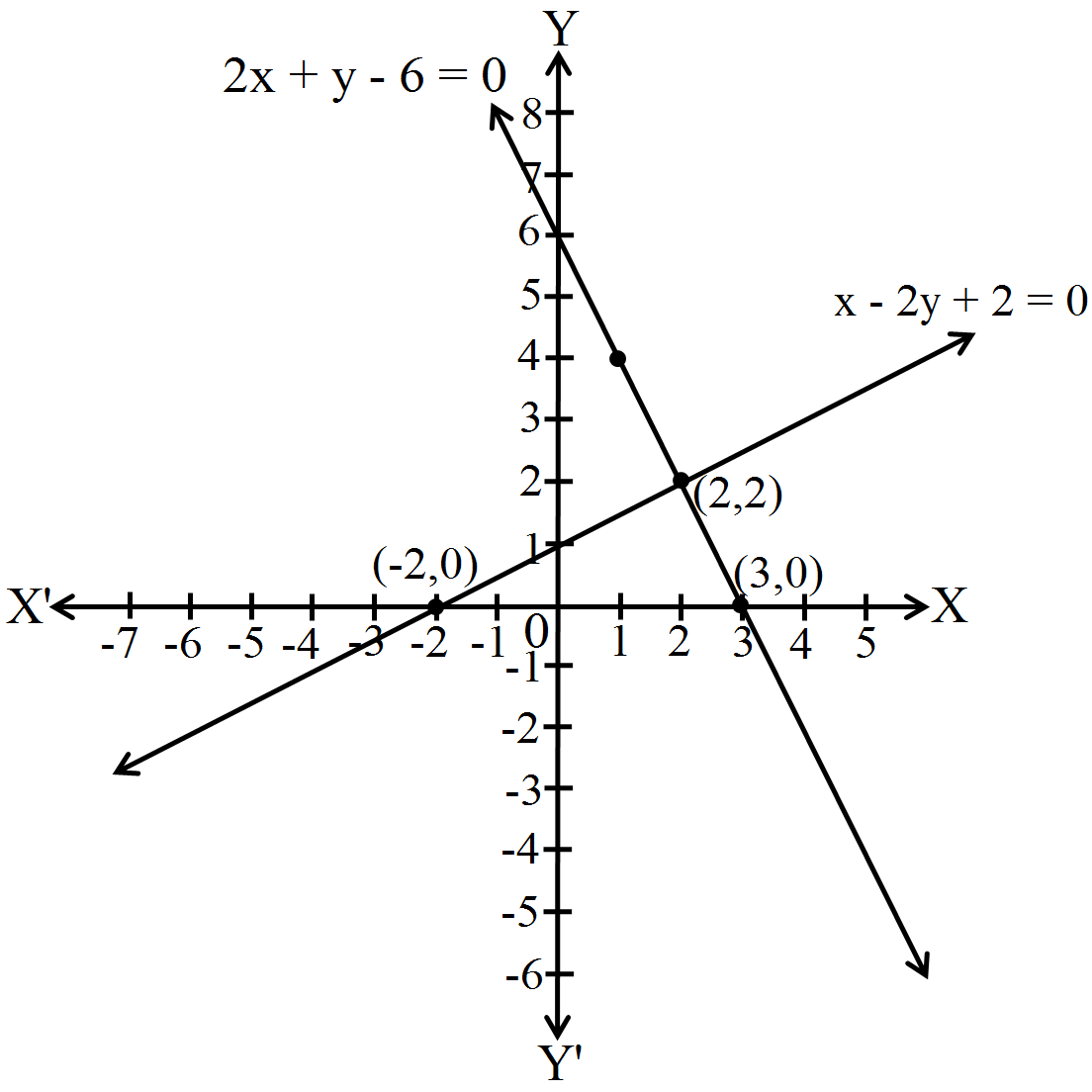
Since the two graph intersect at (2, 2), x = 2 and y = 2 The vertices of the triangle formed by these lines and the x-axis are (2, 2), (3, 0) and (-2, 0). So, height of the triangle = distance from (2, 2) to x-axis = 2 units Base = 5 units Area of triangle $=\frac{1}{2}\times$ base × height $=\frac{1}{2}\times5\times2$ $=5\ \text{sq. units}$ View full question & answer→Question 1035 Marks
Solve for x and y:
$\frac{9}{\text{x}}-\frac{4}{\text{y}}=8,$
$\frac{13}{\text{x}}+\frac{7}{\text{y}}=\text{101}$ $(\text{x}\neq0,\ \text{y}\neq0).$
AnswerPutting $\frac{1}{\text{x}}=\text{u}$ and $\frac{1}{\text{y}}=\text{v}$ the given equations become 9u - 4v = 8 ...(1) 13u + 7v = 101 ...(2)Multiplying (1) by 7 and (2) by 4, we get
63u - 28v = 56 ...(3)
52u + 28v = 404 ...(4)
Adding (3) and (4), we get
115u = 460
$\Rightarrow\text{u}=\frac{460}{115}=4$Putting u = 4 in (1), we get
9 × 4 - 4v = 8
⇒ 36 - 4v = 8
⇒ -4v = 8 - 36
⇒ -4v = -28
⇒ v = 7
Now, u = 4
$\Rightarrow\frac{1}{\text{x}}=4$ $\Rightarrow\text{x}=\frac{1}{4}$ and, v = 7 $\Rightarrow\frac{1}{\text{y}}=7$ $\Rightarrow\text{y}=\frac{1}{7}$$\therefore$ The solution is $\text{x}=\frac{1}{4}$ and $\text{y}=\frac{1}{7}$
View full question & answer→Question 1045 Marks
If twice the son's age in years is added to the father's age, the sum is 70 years. But, if twice the father's age is added to the son's age, the sum is 95 years. Find the age of the father and son.
AnswerLet the present ages of the mother and her son be x and y respectively.
According to the given question:
x + 2y = 70 ...(1)
and
2x + y = 95 ...(2)
Multiplying (1) by 1 and (2) by 2, we get
x + 2y = 70 ...(3)
4x + 2y = 190 ...(4)
Subtracting (3) from (4), we get
3x = 120
$\Rightarrow\text{x}=\frac{120}{3}=40$
Putting x = 40 in (1), we get
40 + 2y = 70
⇒ y = 15
$\therefore$ x = 40, y = 15
Hence, the ages of the mother and the son are 40 years and 15 years respectively.
View full question & answer→Question 1055 Marks
90% and 97% pure acid solutions are mixed to obtain 21 litres of 95% pure acid solution. Find the quantity of each type of acids to be mixed to form the mixture.
AnswerLet the x litres of 90% and y litres of 97% pure acid solutions be mixed.
According to the given condition,
$\frac{90}{100}\text{x}+\frac{97}{100}\text{y}=\frac{95}{100}(21)$
⇒ 90x + 97y = 95(21)
⇒ 90x + 97y = 1995 ...(i)
Since the amount of each solutions adds to 21 liters,
⇒ x + y = 21 ...(ii)
Multiplying (ii) by 90, we get
⇒ 90x + 90y = 1890 ...(iii)
Subtract (iii) from (i).
⇒ 7y = 105
⇒ x = 80
Substituting y = 15 in (ii), we get
⇒ x = 6.
Hence, the amount of each type is 6 liters and 15 liters.
View full question & answer→Question 1065 Marks
Solve the following systems of equations by using the method of cross multiplication:
$\frac{\text{a}}{\text{x}}-\frac{\text{b}}{\text{y}}=0$
$\frac{\text{ab}^2}{\text{x}}+\frac{\text{a}^2\text{b}}{\text{y}}=\text{a}^2+\text{b}^2,$ where $\text{x}\neq0$ and $\text{y}\neq0$
AnswerSubstituting $\frac{1}{\text{x}}=\text{u}$ and $\frac{1}{\text{y}}=\text{v}$ in the given equations, we get
$au - bv + 0 = 0 ...(i)$
$ab^2u + a^2bv - (a^2 + b^2) = 0 ...(ii)$
$Here, a_1 = a, b_1 = -b, c_1 = 0, a_2 = ab^2, b_2 = a^2b and c_2 = -(a^2 + b^2).$
By cross multiplication, we have:
$\frac{\text{u}}{\text{b}_1\text{c}_2-\text{b}_2\text{c}_1}=\frac{\text{v}}{\text{c}_1\text{a}_2-\text{c}_2\text{a}_1}=\frac{1}{\text{a}_1\text{b}_2-\text{a}_2\text{b}_1}$
$\Rightarrow\frac{\text{u}}{(-\text{b})[-(\text{a}^2+\text{b}^2)]-(\text{a}^2\text{b})(0)}=\frac{\text{v}}{(0)(\text{a}^2\text{b})-(-\text{a}^2-\text{b}^2)(\text{a})}\\=\frac{1}{(\text{a})(\text{a}^2\text{b})-(\text{ab}^2)(-\text{b})}$
$\Rightarrow\frac{\text{u}}{\text{b}(\text{a}^2-\text{b}^2)}=\frac{\text{v}}{\text{a}(\text{a}^2+\text{b}^2)}=\frac{1}{\text{ab}(\text{a}^2+\text{b}^2)}$
$\Rightarrow\text{u}=\frac{\text{b}(\text{a}^2+\text{b}^2)}{\text{ab}(\text{a}^2+\text{b}^2)},\ \text{v}=\frac{\text{a}(\text{a}^2+\text{b}^2)}{\text{ab}(\text{a}^2+\text{b}^2)}$
$\Rightarrow\text{u}=\frac{1}{\text{a}},\ \text{v}=\frac{1}{\text{b}}$
$\Rightarrow\frac{1}{\text{x}}=\frac{1}{\text{a}},\ \frac{1}{\text{y}}=\frac{1}{\text{b}}$
$\Rightarrow\text{x}=\text{a},\ \text{y}=\text{b}$
Hence, x = a and y = b is the required solution.
View full question & answer→Question 1075 Marks
Solve for x and y:
$\frac{44}{\text{x}+\text{y}}+\frac{30}{\text{x}-\text{y}}=10,$
$\frac{55}{\text{x}+\text{y}}-\frac{40}{\text{x}-\text{y}}=13$
AnswerPutting $\frac{1}{\text{x}+\text{y}}=\text{u}$ and $\frac{1}{\text{x}-\text{y}}=\text{v}$ in the equation, we get
44u + 30v = 10 ...(1)
55u + 40v = 13 ...(2)
Multiply (1) by 4 and (2) by 3, we get
176u + 120v = 40 ...(3)
165u - 120v = 39 ...(4)
Subtracting (4) from (3), we get
$\text{11u}=1$
$\text{u}=\frac{1}{11}$
Putting $\text{u}=\frac{1}{11},$ in (1), we get
$44\times\frac{1}{11}+\text{30v}=10$
$\Rightarrow4+\text{30v}=10$
$\Rightarrow\text{30v}=10-4$
$\Rightarrow\text{30v}=6$
$\Rightarrow\text{v}=\frac{6}{30}=\frac{1}{5}$
Now, $\text{u}=\frac{1}{11}$
$\Rightarrow\frac{1}{\text{x}+\text{y}}=\frac{1}{11}$
$\Rightarrow\text{x}+\text{y}=11\ \dots(5)$
and $\text{v}=\frac{1}{5}$
$\Rightarrow\frac{1}{\text{x}-\text{y}}=\frac{1}{5}$
$\Rightarrow\text{x}-\text{y}=5\ \dots(6)$
Adding (5) and (6), we get
$\text{2x}=16$
$\Rightarrow\text{x}= \frac{16}{2}=8$
Putting x = 8 in (5), we get
8 + y = 11
⇒ y = 11 - 8 = 3
$\therefore$ the solution is x = 8, and y = 3
View full question & answer→Question 1085 Marks
In a cyclic quadrilateral ABCD, it is given that $\angle\text{A}=(\text{2x}+4)^\circ,\ \angle\text{B}=(\text{y}+3)^\circ,$ $\angle\text{C}=(\text{2y}+10)^\circ$ and $\angle\text{D}=(\text{4x}-5)^\circ$ Find the four angles.
AnswerGiven that in a cyclic quadrilateral ABCD,
$\angle\text{A}=(\text{2x}+4)^\circ,\ \angle\text{B}=(\text{y}+3)^\circ,$ $\angle\text{C}=(\text{2y}+10)^\circ$ and $\angle\text{D}=(\text{4x}-5)^\circ$
We know that,
Opposite angles of a quadrilateral sum upto 180°
$\Rightarrow\angle\text{B}+\angle\text{D}=180^\circ$
⇒ (y + 3)° + (4x - 5)° = 180°
⇒ 4x + y = 182 ...(i)
Similarly, $\angle\text{A}+\angle\text{C}=180^\circ$
⇒ (2x + 4)° + (2y + 10)° = 180°
⇒ 2x + 2y = 166
⇒ x + y = 83 ...(i)
Subtracting (ii) from (i), we get
⇒ 3x = 99
⇒ x = 33
Substituting x = 33 in (ii), we get
⇒ y = 50
Hence, the angles of ABCD are
So, $\angle\text{A}=70^\circ,\ \angle\text{B}=53^\circ,$ $\angle\text{C}=110^\circ$ and $\angle\text{D}=127^\circ$
View full question & answer→Question 1095 Marks
Show graphically that each of the following given systems of equations has infinitely many solutions:
3x - y = 5, 6x - 2y = 10
AnswerOn a graph paper, draw a horizontal line X'OX and a vertical line YOY' representing the x-axis and y-axis, respectively. The given system equations is 3x - y = 5, 6x - 2y = 10 Graph of 3x - y = 5: 3x - y = 5 ⇒ y = 3x - 5 ...(1) Thus, we have the following table for equation (1)
On the graph paper plot the points A(1, -2), B(0, -5) and C(2, 1). Join AB and AC to get the graph line BC. Thus, the line BC is the graph of the equation of 3x - y = 5. Graph of 6x - 2y = 10: For graph of 6x - 2y = 10 $\Rightarrow\text{y}=\frac{\text{6x}-10}{2}\ \dots(2)$ Thus, we have the following table for equation (2)
These points are the same as obtained above.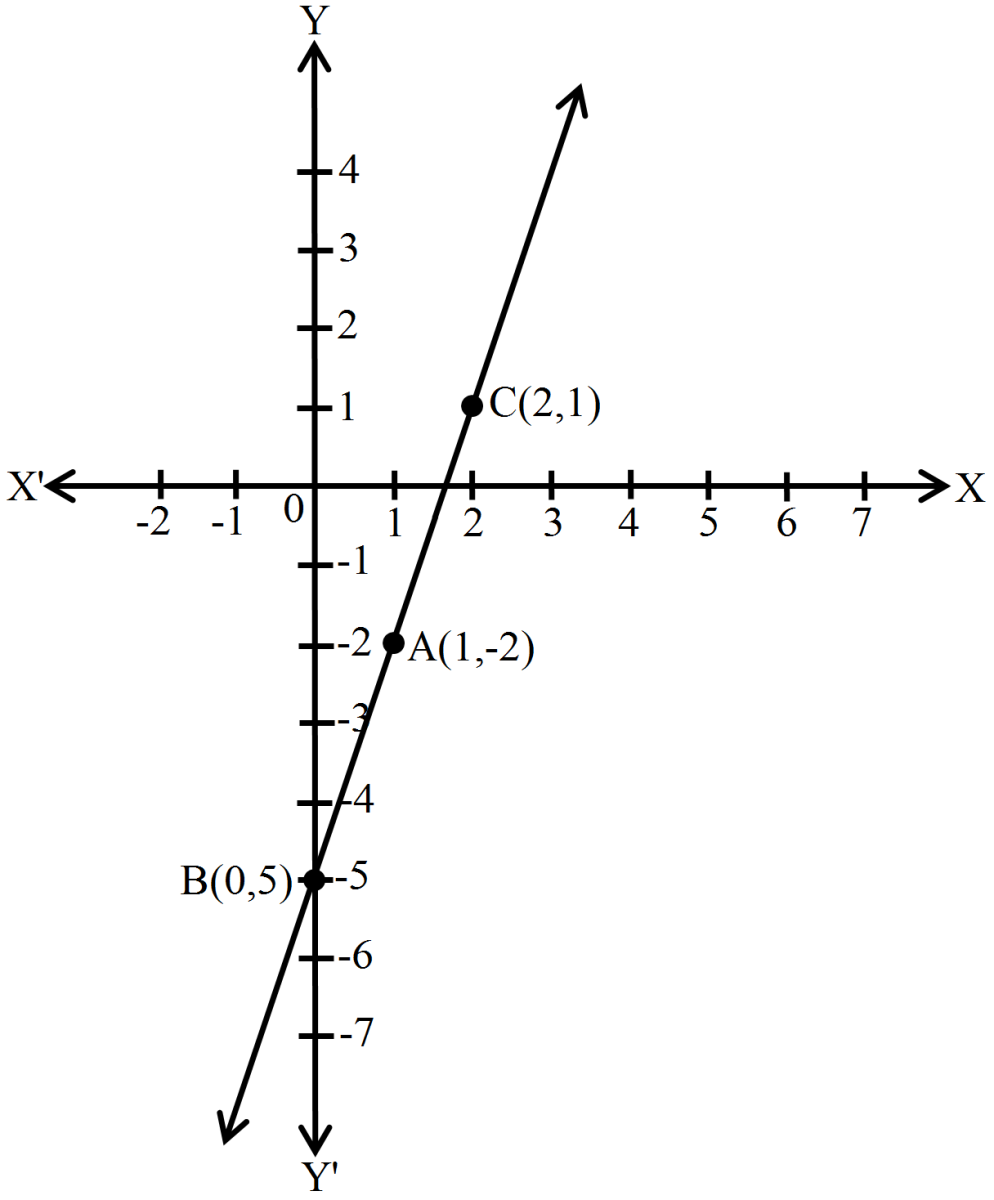
From the graph, it is clear that these two lines coincide. Both equations represents same graph. Hence, these lines have infinitely many solutions. View full question & answer→Question 1105 Marks
A jeweller has bars of 18-carat gold and 12-carat gold. How much of each must be melted together to obtain a bar of 16-carat gold, weighing 120 g? (Given: Pure gold is 24-carat).
AnswerLet the amount of 18-carat gold and 12-car at gold to be melted be x g and y g respectively.
According to the given condition,
$\frac{18}{24}\text{x}+\frac{12}{24}\text{y}=\frac{16}{24}(120)$
⇒ 18x + 12y = 16(120)
⇒ 3x + 2y = 320 ...(i)
Since the amount of each add up to 120g,
⇒ x + y = 120 ...(ii)
Multiplying (ii) by 2, we get
⇒ 2x + 2y = 240 ...(iii)
Subtract (iii) from (i).
⇒ x = 80
Substituting x = 80 in (ii), we get
⇒ y = 40.
Hence, the amount of 18-carat gold is 80g and the amount of 12-carat gold is 40g.
View full question & answer→Question 1115 Marks
Solve for x and y:
217x + 131y = 913,
131x + 217y = 827
AnswerThe given equations are:
217x + 131y = 913 ...(1)
131x + 217y = 827 ...(2)
Adding (1) and (2), we get
348x + 348y = 1740
348(x + y) = 1740
x + y = 5 ...(3)
Subtracting (2) from (1), we get
86x - 86y = 86
⇒ 86(x - y) = 86
⇒ x - y = 1 ...(4)
Adding (3) and (4), we get
2x = 6
⇒ x = 3
Putting x = 3 in (3), we get
3 + y = 5
⇒ y = 5 - 3 = 2
$\therefore$ The solution is x = 3, y = 2
View full question & answer→Question 1125 Marks
Solve the following systems of equations by using the method of cross multiplication:
$\frac{\text{x}}{6}+\frac{\text{y}}{15}=4,$
$\frac{\text{x}}{3}-\frac{\text{y}}{15}=\frac{\text{19}}{4}$
AnswerThe given equations may be written as: $\frac{\text{x}}{6}+\frac{\text{y}}{15}-4=0\ \dots(\text{i})$ $\frac{\text{x}}{3}-\frac{\text{y}}{15}-\frac{\text{19}}{4}=0\ \dots(\text{ii})$ Here, $\text{a}_1=\frac{1}{6},\ \text{b}_1=\frac{1}{15},\ \text{c}_1=-4,$ $\text{a}_2=\frac{1}{3},\ \text{b}_2=-\frac{1}{12}$ and $\text{c}_2=-\frac{19}{4}$ By cross multiplication, we have: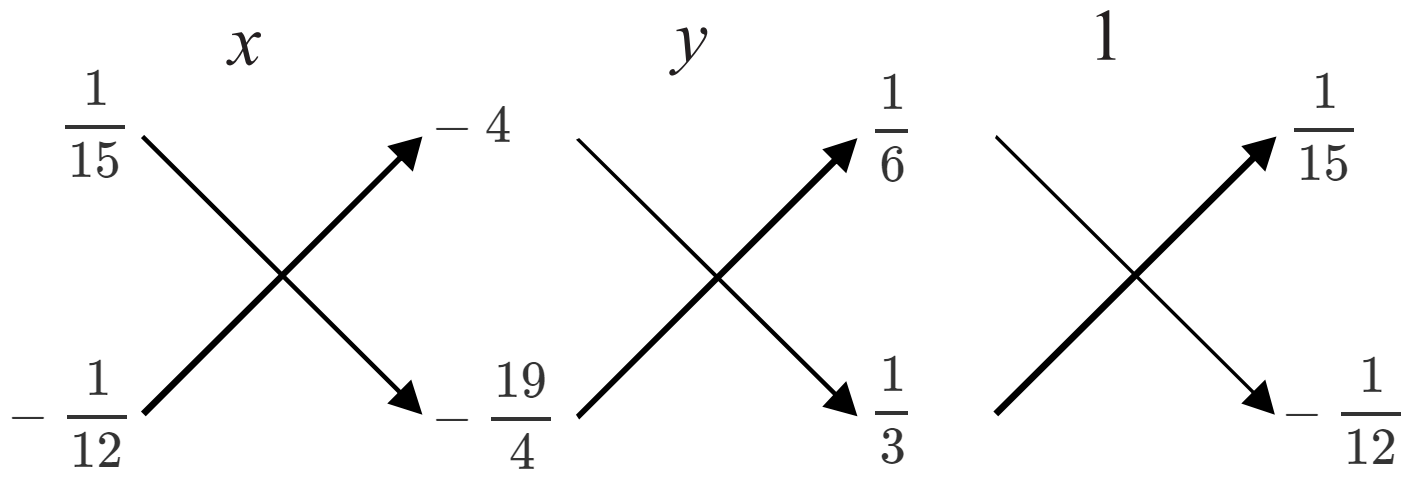
$\therefore\frac{\text{x}}{\big[\frac{1}{15}\times\big(-\frac{19}{4}\big)-\big(-\frac{1}{12}\big)\times(-4)\big]}=\frac{{\text{y}}}{\big[(-4)\times\frac{1}{3}-\big(\frac{1}{6}\big)\times\big(-\frac{19}{4}\big)\big]}\\=\frac{1}{\big[\frac{1}{{6}}\times\big(\frac{-1}{12}\big)-\frac{1}{3}\times\frac{1}{15}\big]}$ $\Rightarrow\frac{\text{x}}{\big(-\frac{19}{60}-\frac{1}{3}\big)}=\frac{\text{y}}{\big(-\frac{4}{3}+\frac{19}{24}\big)}=\frac{1}{\big(-\frac{1}{72}-\frac{1}{45}\big)}$ $\Rightarrow\frac{\text{x}}{\big(-\frac{39}{60}\big)}=\frac{\text{y}}{\big(-\frac{13}{24}\big)}=\frac{1}{\big(\frac{13}{360}\big)}$ $\Rightarrow\text{x}=\Big[\Big(-\frac{39}{60}\Big)\times\Big(-\frac{360}{13}\Big)\Big]=18,$ $\text{y}=\Big[\Big(-\frac{13}{24}\Big)\times\Big(-\frac{360}{13}\Big)\Big]=15$ Hence, x = 18 and y = 15 is the required solution. View full question & answer→Question 1135 Marks
Solve each of the following given systems of equations graphically and find the vertices and area of the triangle formed by these lines and the y-axis:
2x - 5y + 4 = 0, 2x + y - 8 = 0
AnswerOn a graph paper, draw a horizontal line X'OX and a vertical line YOY' representing the x-axis and y-axis, respectively.
The given system equations is 2x - 5y + 4 = 0, 2x + y - 8 = 0
Graph of 2x - 5y + 4 = 0:
2x - 5y + 4 = 0
$\Rightarrow\text{y}=\frac{\text{2x}-4}{5}\ \dots(1)$
Thus, we have the following table for equation (1)
On the graph paper plot the points A(3, 2), B(-2, 0) and C(8, 4).
Join AB and AC to get the graph line BC.
Thus, the line BC is the graph of the equation of 2x - 5y + 4 = 0.
Graph of 2x + y - 8 = 0:
For graph of 2x + y - 8 = 0
⇒ y = -2x + 8 ...(2)
Thus, we have the following table for equation (2)
Now, on the same graph paper plot the points P(1, 6) and Q(2, 4).
The third point A(3, 2) has already been plotted.
Join PA.
Thus, line PA is the graph of the equation 2x + y - 8 = 0.
On extending the graph lines on both sides, we find that these graph lines intersect the y-axis at the point R(0, 8) and S(0, 0.8). View full question & answer→Question 1145 Marks
Show graphically that each of the following given systems of equations is inconsistent, i.e., has no solutions:
2x + y = 2, 2x + y = 6
Answer$2\text{x}+\text{y}=2$ $\Rightarrow\text{y}=2-\text{2x}$
$\text{2x}+\text{y}=6$ $\Rightarrow\text{y}=6-\text{2x}$
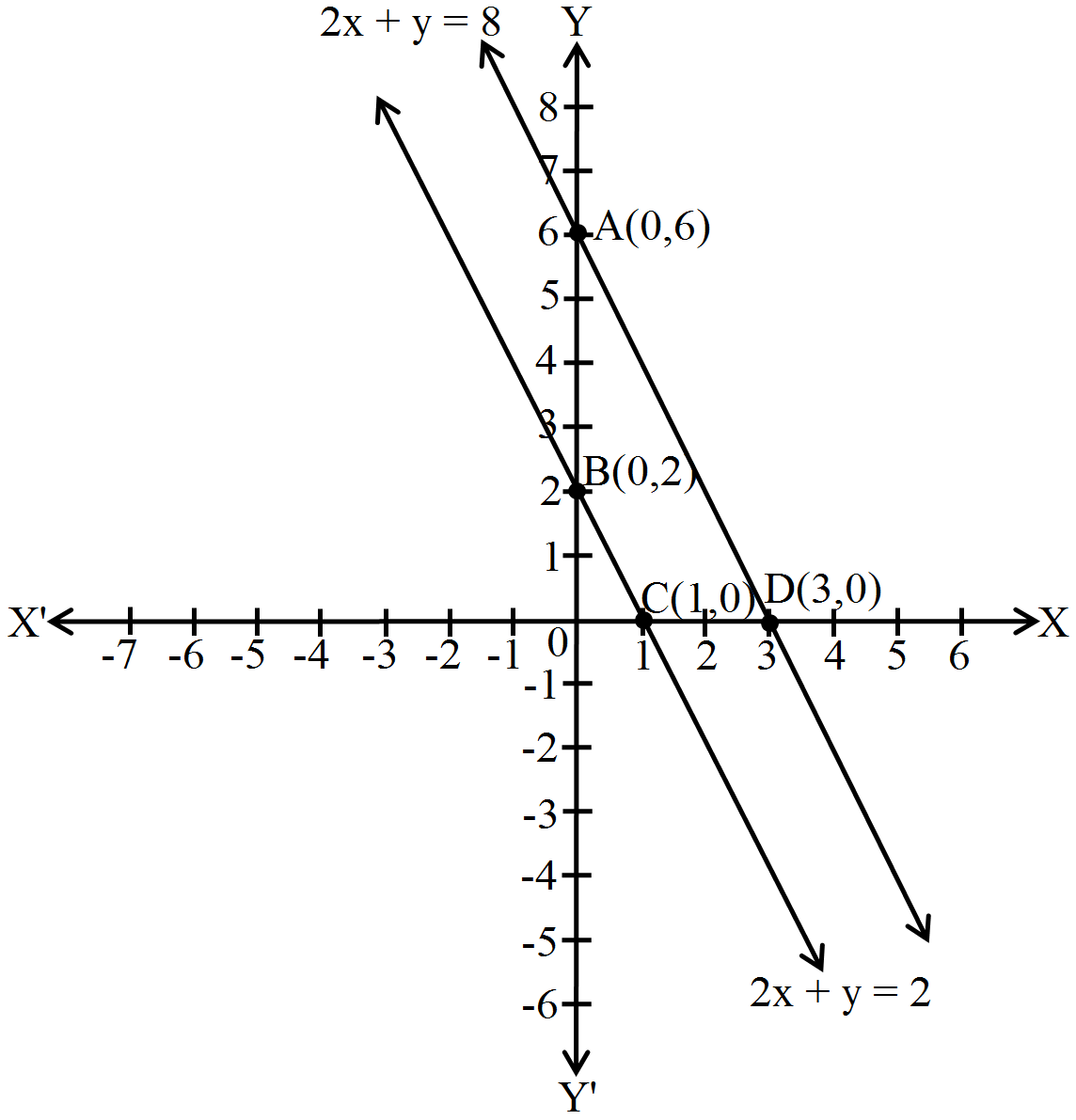
Since the two graph of the system of equations is parallel lines, the system has no solution and hence is inconsistent. View full question & answer→Question 1155 Marks
Solve for x and y:
$\frac{5}{\text{x}}-\frac{3}{\text{y}}=1,$
$\frac{3}{\text{2x}}+\frac{2}{\text{3y}}=\text{5}$ $(\text{x}\neq0,\ \text{y}\neq0).$
AnswerPutting $\frac{1}{\text{x}}=\text{u}$ and $\frac{1}{\text{y}}=\text{v}$ the given equations become 5u - 3v = 1 ...(1) $\frac{3\text{u}}{2}+\frac{\text{2v}}{3}=5$ $\frac{\text{9v}+4\text{v}}{6}=5$ 9u + 4v = 30 ...(2)Multiplying (1) by 4 and (2) by 3, we get
20u - 12v = 4 ...(3)
27u + 12v = 90 ...(4)
Adding (3) and (4), we get
47u = 94
$\Rightarrow\text{u}=\frac{94}{47}=2$Putting u = 2 in (1), we get
(5 × 2) - 3v = 1
⇒ 10 - 3v = 1
⇒ -3v = 1 - 10
⇒ -3v = -9
⇒ v = 3
Now, u = 2
$\Rightarrow\frac{1}{\text{x}}=2$ $\Rightarrow\text{x}=\frac{1}{2}$ and, v = 3 $\Rightarrow\frac{1}{\text{y}}=3$ $\Rightarrow\text{y}=\frac{1}{3}$$\therefore$ The solution is $\text{x}=\frac{1}{2}$ and $\text{y}=\frac{1}{3}$
View full question & answer→Question 1165 Marks
Solve the following system of equations graphically:
x + 2y + 2 = 0,
3x + 2y - 2 = 0
AnswerOn a graph paper, draw a horizontal line X'OX and a vertical line YOY' representing the x-axis and y-axis, respectively. Given equations are x + 2y + 2 = 0 and 3x + 2y - 2 = 0 Graph of x + 2y + 2 = 0: x + 2y + 2 = 0 $\Rightarrow\text{y}=\frac{-\text{x}-2}{2}\ \dots(1)$ Thus, we have the following table for x + 2y + 2 = 0
On the graph paper plot the points A(-2, 0), B(0, -1) and C(2, -2). Join AB and BC to get the graph line AC. Thus, the line AC is the graph of the equation of x + 2y + 2 = 0. Graph of 3x + 2y - 2 = 0: For graph of 3x + 2y - 2 = 0 $\Rightarrow\text{y}=\frac{-\text{3x}+2}{2}\ \dots(2)$ Thus, we have the following table for 3x + 2y - 2 = 0
Now, on the same graph paper plot the points P(0, 1) and Q(4, -5). The third point C(2, -2) has already been plotted. Join PC and QC to get the line PQ. Thus, line PQ is the graph of the equation 3x + 2y - 2 = 0.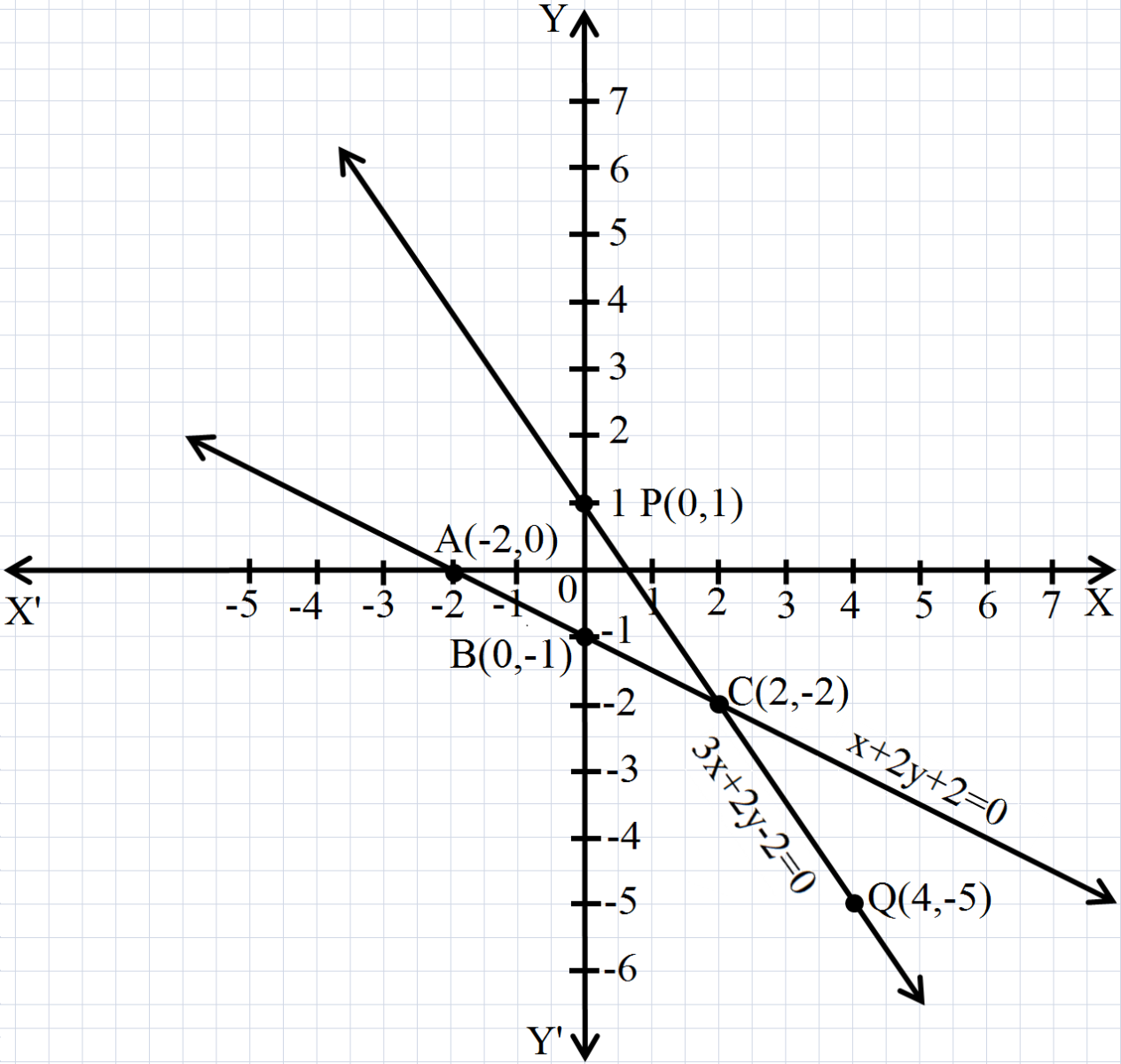
The two graph lines intersect at C(2, -2). $\therefore$ x = 2, y = -2 is the solution of the given system of equations. View full question & answer→Question 1175 Marks
Five years hence, a man's age will be three times the age of his son. Five years ago, the man was seven times as old as his son. Find their present ages.
AnswerLet the present age of the man be x years, and his son's age be y years.
Accroding to the first condition,
x + 5 = 3(y + 5)
⇒ x + 5 = 3y + 15
⇒ x - 3y = 10 ...(i)
According to the second condition,
x - 5 = 7(y - 5)
⇒ x - 5 = 7y - 35
⇒ x - 7y = - 30 ...(iii)
Subtracting (ii) from (i), we get
4y = 40
⇒ y - 10
Substituting y = 10 in (i), we get
⇒ x = 40
So, the present age of the man is 40 years, and that of his son is 10 years
View full question & answer→Question 1185 Marks
If three times the larger of two numbers is divided by the smaller, we get 4 as the quotient and 8 as the remainder. If five times the smaller is divided by the larger, we get 3 as the quotient and 5 as the remainder. Find the numbers.
AnswerLet the larger number be x and smaller be y repectively.
We know,
Dividend = Divisor × Quotient + Remainder
3x = y × 4 + 8
3x - 4y = 8 ...(1)
And
5y = x × 3 + 5
-3x + 5y = 5 ...(2)
Adding (1) and (2), we get
y = 13
Putting y = 13 in (1)
3x - 4 × 13 = 8
⇒ 3x = 8 + 52
⇒ 3x = 60
$\Rightarrow\text{x}=\frac{60}{3}$
⇒ x = 20
Hence, the larger and smaller numbers are 20 and 13 respectively.
View full question & answer→Question 1195 Marks
Solve the following systems of equations by using the method of cross multiplication:
$\text{7x}-\text{2y}=3,$
$\text{11x}-\frac{3}{2}\text{y}=8$
AnswerThe given equations may be written as: $\text{7x}-\text{2y}-3=0\ \dots(\text{i})$
$\text{11x}-\frac{3}{2}\text{y}-8=0\ \dots(\text{ii})$
Here, $a_1 = 7, b_1 = -2, c_1 = -3,$
$a_2 = 11, b_2 =$ $-\frac{3}{2}$ and $c_2 = -8$ By cross multiplication,
we have:
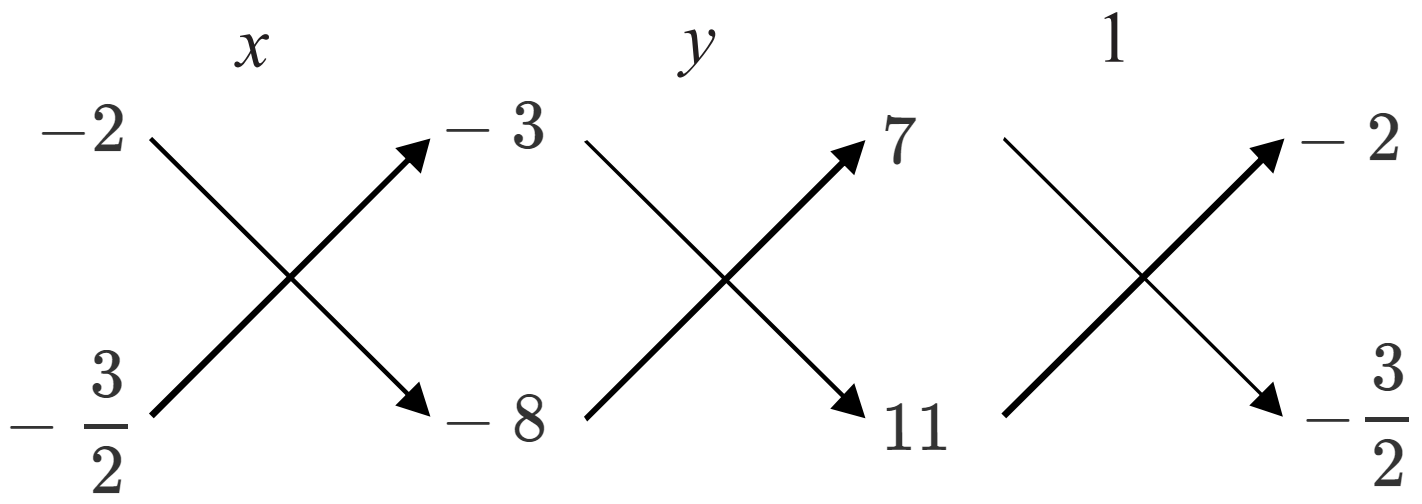
$\therefore\frac{\text{x}}{\big[(-2)\times(-8)-\big(\frac{3}{2}\big)\times(-3)\big]}=\frac{{\text{y}}}{[(-3)\times11-(-8)\times7]}=\frac{1}{\big[7\times\big(\frac{-3}{2}\big)-11\times(-2)\big]}$
$\Rightarrow\frac{\text{x}}{\big(16-\frac{9}{2}\big)}=\frac{\text{y}}{(-33+56)}=\frac{1}{\big(-\frac{21}{2}+22\big)}$
$\Rightarrow\frac{\text{x}}{\big(\frac{23}2{}\big)}=\frac{\text{y}}{23}=\frac{1}{\big(\frac{23}{2}\big)}$
$\Rightarrow\text{x}=\frac{\frac{23}{2}}{\frac{23}{2}}=1,\ \text{y}=\frac{23}{\frac{23}{2}}=2$
Hence, x = 1 and y = 2 is the required solution. View full question & answer→Question 1205 Marks
Show graphically that each of the following given systems of equations has infinitely many solutions:
x - 2y = 5, 3x - 6y = 15
Answer$\text{x}-\text{2y}=5$ $\Rightarrow\text{y}=\frac{\text{x}-\text{5}}{2}$
$\text{3x}-\text{6y}=15$ $\Rightarrow\text{y}=\frac{\text{2x}-15}{6}$
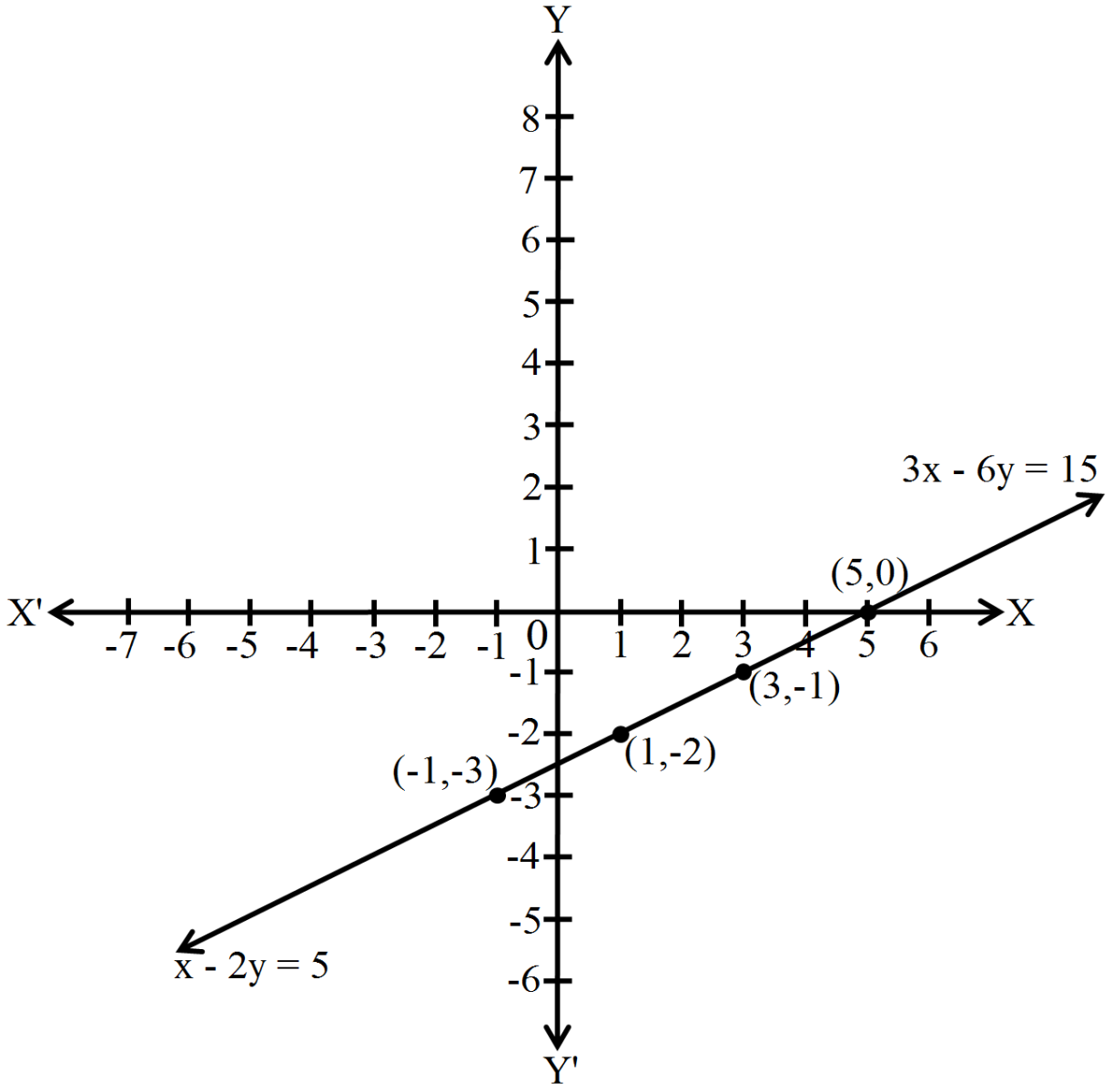
Since the two graph of the system of equations is coincident lines, the system has infinitely many solutions. View full question & answer→Question 1215 Marks
Solve each of the following given systems of equations graphically and find the vertices and area of the triangle formed by these lines and the y-axis:
x - y - 5 = 0, 3x + 5y - 15 = 0
Answer$\text{x}-\text{y}-5 = 0$ $\Rightarrow\text{y}=\text{x}-5$
$3\text{x} + 5\text{y} -15 = 0$ $\Rightarrow\text{y}=\frac{15-\text{3x}}{5}$
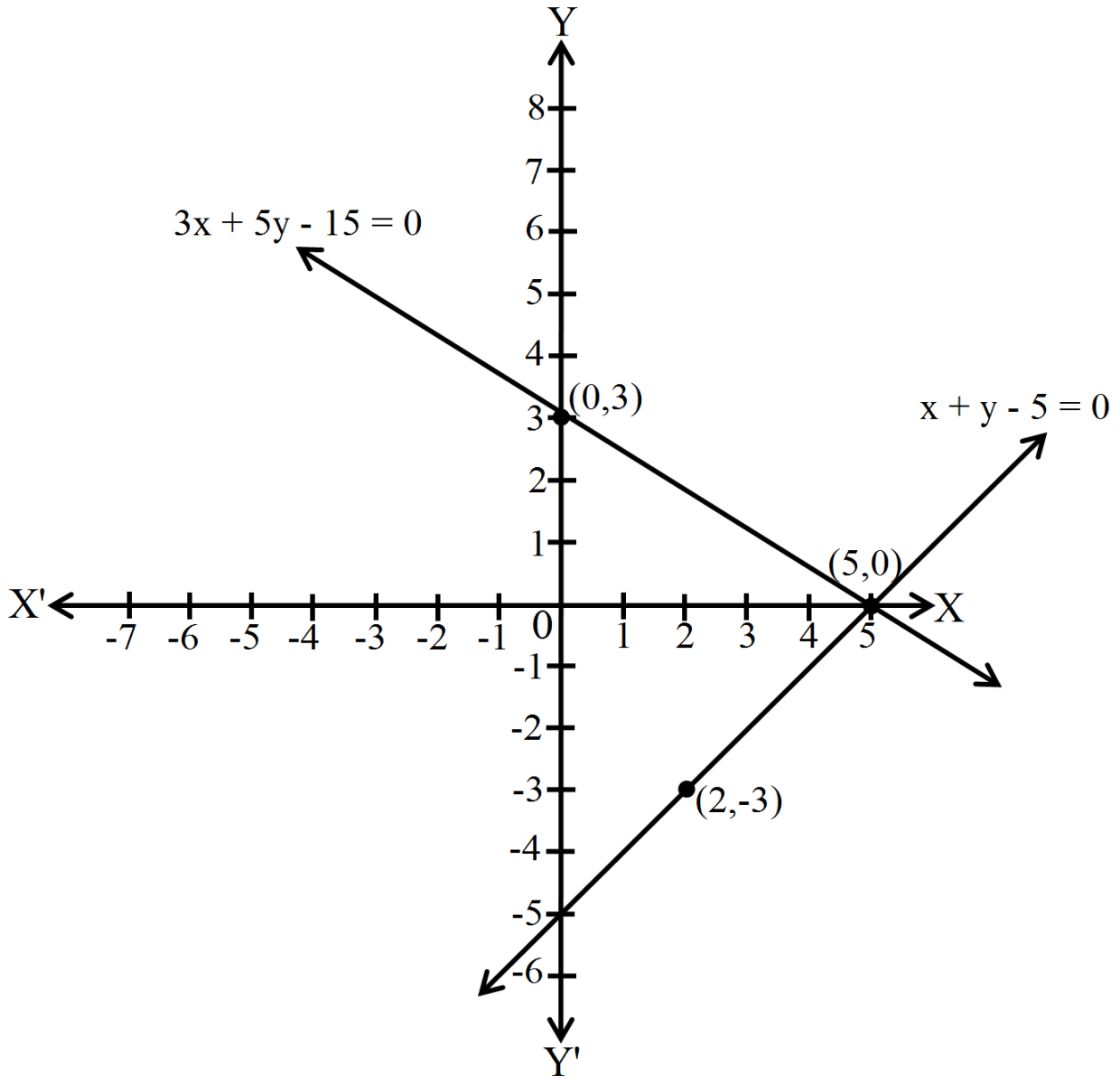
Since the two graph intersect at (5, 0), x = 5 and y = 0 The vertices of the triangle formed by these lines and the y-axis are (5, 0), (0, 3) and (0, -5). So, height of the triangle = distance from (5, 0) to y-axis = 5 units Base = 8 units Area of triangle $=\frac{1}{2}\times$ base × height $=\frac{1}{2}\times8\times5$ $=20\ \text{sq. units}$ View full question & answer→Question 1225 Marks
Solve the following system of equations graphically:
3x + 2y = 12,
5x - 2y = 4
Answer$\text{3x}+\text{2y}=12$ $\Rightarrow\text{y}=\frac{12-\text{3x}}{2}$
$\text{5x}-\text{2y}=4$ $\Rightarrow\text{y}=\frac{\text{5x}-4}{2}$
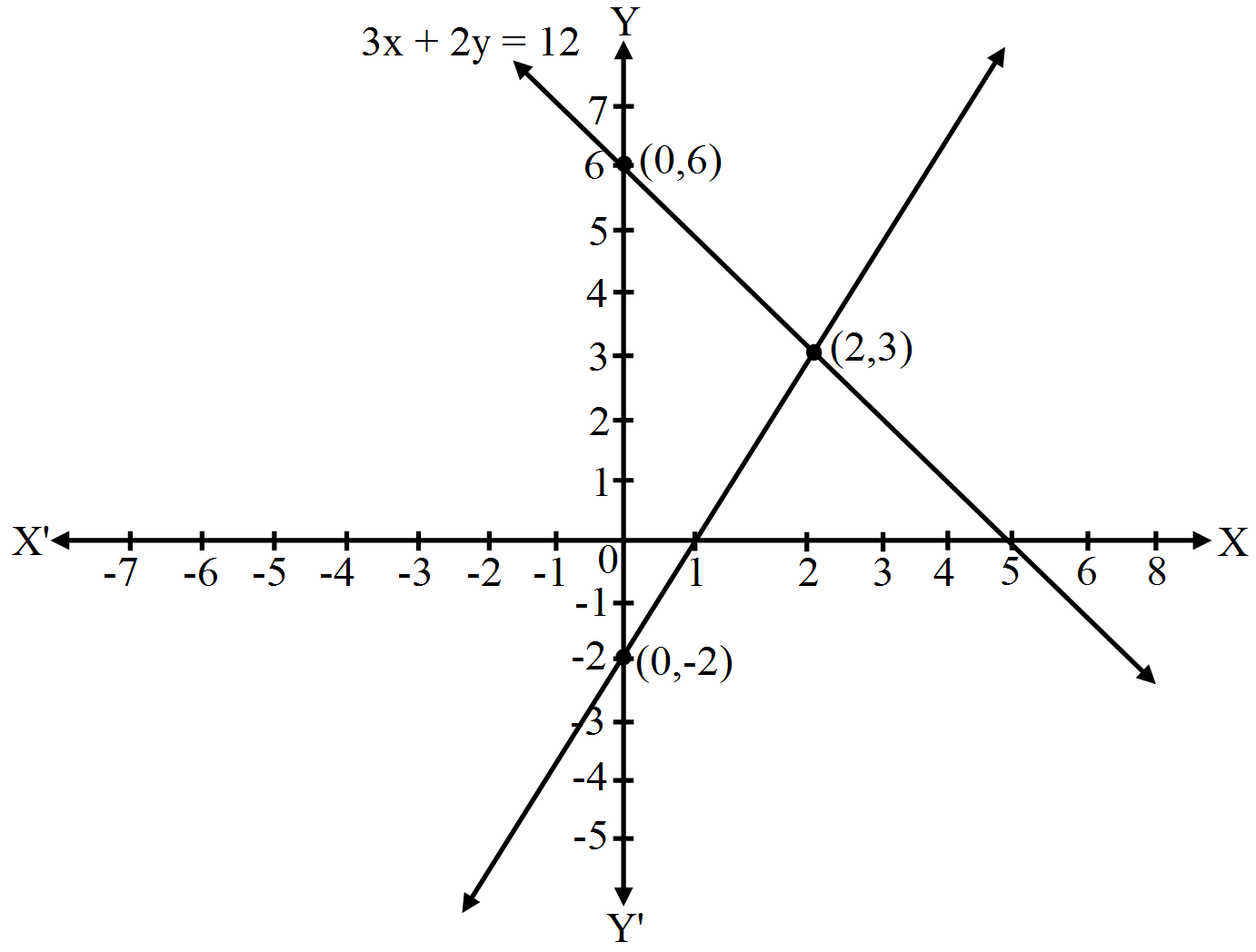
Since the two graph intersect at (2, 3), x = 2 and y = 3 View full question & answer→Question 1235 Marks
Find the angles of a cyclic quadrilateral ABCD in which:
$\angle\text{A}=(\text{4x}+20)^\circ,$ $\angle\text{B}=(\text{3x}-5)^\circ,$ $\angle\text{C}=(\text{4y})^\circ$ and $\angle\text{D}=(\text{7y}+5)^\circ.$
AnswerGiven:
In a cyclic quadrilateral ABCD, we have:
$\angle\text{A}=(4\text{x}+20)^\circ$
$\angle\text{B}=(3\text{x}-5)^\circ$
$\angle\text{C}=(4\text{y})^\circ$
$\angle\text{D}=(7\text{y}+5)^\circ$
$\angle\text{A}+\angle\text{C}=180^\circ$ and $\angle\text{B}+\angle\text{D}=180^\circ$ [Since ABCD is a cyclic quadrilateral]
Now, $\angle\text{A}+\angle\text{C}=(4\text{x}+20)^\circ+(4\text{y})^\circ=180^\circ$
⇒ 4x + 4y + 20 = 180
⇒ 4x + 4y = 180 - 20 = 160
⇒ x + y = 40 ....(i)
Also, $\angle\text{B}+\angle\text{D}=(3\text{x}-5)^\circ+(7\text{y}+5)^\circ=180^\circ$
⇒ 3x + 7y = 180 ...(ii)
On multiplying (i) by 3, we get:
⇒ 3x + 3y = 120 ...(iii)
On subtracting (iii) from (ii), we get:
4y = 60
⇒ y = 15
On subtracting y = 15 in (1), we get:
x + 15 = 40
⇒ x = (40 - 15) = 25
Therefore, we have:
$\angle\text{A}=(4\text{x}+20)^\circ=(4\times25+20)^\circ=120^\circ$
$\angle\text{B}=(3\text{x}-5)^\circ=(3\times25-5)^\circ=70^\circ$
$\angle\text{C}=(4\text{y})^\circ=(4\times15)^\circ=60^\circ$
$\angle\text{D}=(7\text{y}+5)^\circ=(7\times15+5)^\circ=(105+5)^\circ=110^\circ$
View full question & answer→Question 1245 Marks
Solve for x and y:$\frac{\text{bx}}{\text{a}}+\frac{\text{ay}}{\text{b}}=\text{a}^2+\text{b}^2,$
$\text{x}+\text{y}=\text{2ab}$
Answer$\frac{\text{bx}}{\text{a}}-\frac{\text{ax}}{\text{b}}+\text{a}^2+\text{b}^2$
By taking L.C.M., we get
$\frac{\text{b}^2\text{x}+\text{a}^2\text{y}}{\text{ab}}=\text{a}^2+\text{b}^2$
$b^2x + a^2y = ab(a^2 + b^2) ...(1)$
$x + y = 2ab ...(2)$
Multiplying (1) by 1 and (2) by $a^2$
$b^2x + a^2y = a^3b + ab^3 ...(3)$
$a^2x + a^2y = 2a^3b ...(4)$
Subtracting (4) from (3), we get
$b^2x - a^2x = a^3b + ab^3 - 2a^3b$
$x(b^2- a^2) = ab^3- a^3b$
$x(b^2 - a^2) = ab(b^2 - a^2)$
$\therefore\ \text{x}=\frac{\text{ab}(\text{b}^2-\text{a}^2)}{(\text{b}^2-\text{a}^2)}=\text{ab}$
Substituting x = ab, in (3), we get
$b^2(ab) + a^2y = a^3b + ab^3$
$b^3a + a^2y = a^3b + ab^3$
$a^2y = a^3b + ab^3 - b^3a$
$a^2y = a^3b$
$\Rightarrow\text{y}=\frac{\text{a}^3\text{b}}{\text{a}^3}=\text{ab}$
$\therefore$ solution is x = ab, y = ab
View full question & answer→Question 1255 Marks
Solve the following systems of equations by using the method of cross multiplication:
$3x + 2y + 25 = 0,$
$2x + y + 10 = 0$
AnswerThe given equations are: $3x + 2y + 25 = 0 ...(i) 2x + y + 10 = 0 ...(ii)$
Here, $a_1 = 3, b_1 = 2, c_1 = 25,$
$a_2 = 2, b_2 = 1$ and $c_2 = 10$ By cross multiplication, we have:
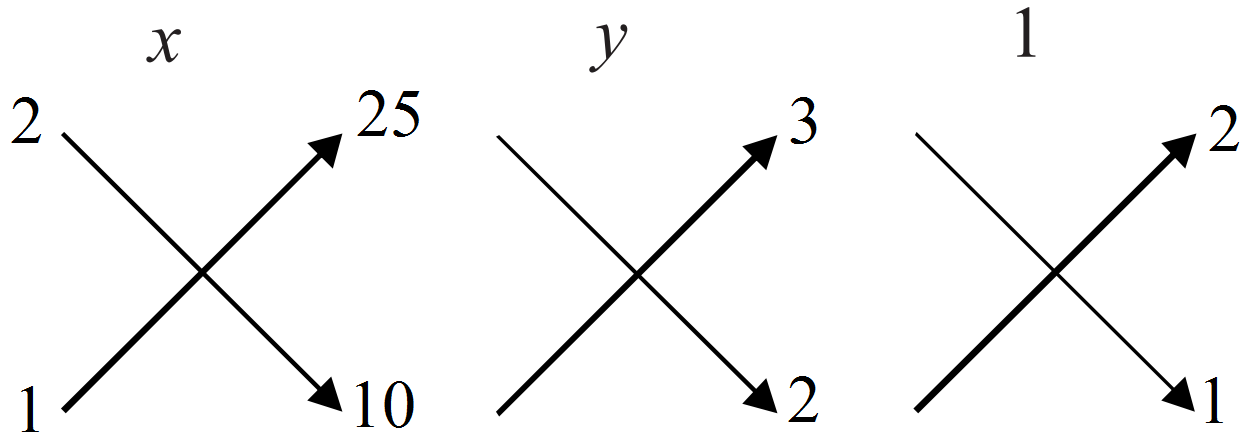
$\therefore\frac{\text{x}}{[2\times10-25\times1]}=\frac{{\text{y}}}{[25\times2-10\times3]}=\frac{1}{[3\times1-2\times2]}$
$\Rightarrow\frac{\text{x}}{(20-25)}=\frac{\text{y}}{(50-30)}=\frac{1}{(3-4)}$
$\Rightarrow\frac{\text{x}}{(-5)}=\frac{\text{y}}{(20)}=\frac{1}{(-1)}$
$\Rightarrow\text{x}=\frac{-5}{-1}=5,\ \text{y}=\frac{20}{-1}=-20$
Hence, x = 5 and y = -20 is the required solution. View full question & answer→Question 1265 Marks
Solve each of the following given systems of equations graphically and find the vertices and area of the triangle formed by these lines and the y-axis:
2x - 3y + 6 = 0, 2x + 3y - 18 = 0
Answer$2\text{x}-3\text{y}+6 = 0$ $\Rightarrow\text{y}=\frac{2\text{x}+6}{3}$
$2\text{x} + 3\text{y} -18 = 0$ $\Rightarrow\text{y}=\frac{18-\text{2x}}{3}$
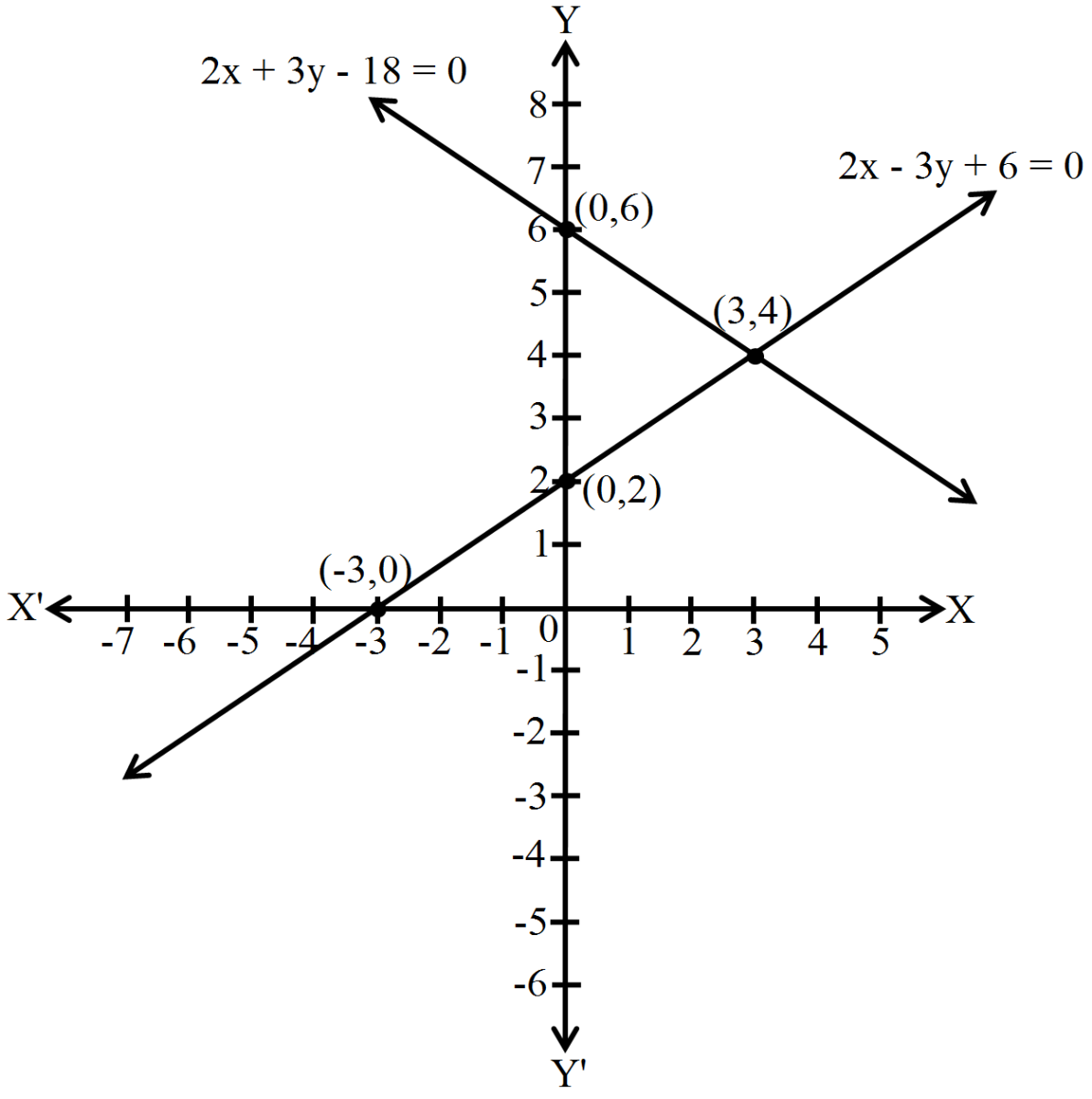
Since the two graph intersect at (3, 4), x = 3 and y = 4 The vertices of the triangle formed by these lines and the y-axis are (3, 4), (0, 6) and (0, 2). So, height of the triangle = distance from (3, 4) to y-axis = 3 units Base = 4 units Area of triangle $=\frac{1}{2}\times$ base × height $=\frac{1}{2}\times4\times3$ $=6\ \text{sq. units}$ View full question & answer→Question 1275 Marks
Solve for x and y:
$\frac{35}{\text{x}+\text{y}}+\frac{14}{\text{x}-\text{y}}=19,$ $\frac{14}{\text{x}+\text{y}}+\frac{35}{\text{x}-\text{y}}=37$
AnswerWe have: $\frac{35}{\text{x+y}}+\frac{14}{\text{x}-\text{y}}=19$ and $\frac{14}{\text{x+y}}+\frac{35}{\text{x}-\text{y}}=37$ Taking $\frac{1}{\text{x+y}}=\text{u}$ and $\frac{1}{\text{x}-\text{y}}=\text{v}.$
$35 u+14 v-19=0.......(i) 14 u+35 v-37=0$
Here, $a_1=35, b_1=14, c_1=-19, a_2=14, b_2=35, c_2=-37$ By cross multiplying, we have:
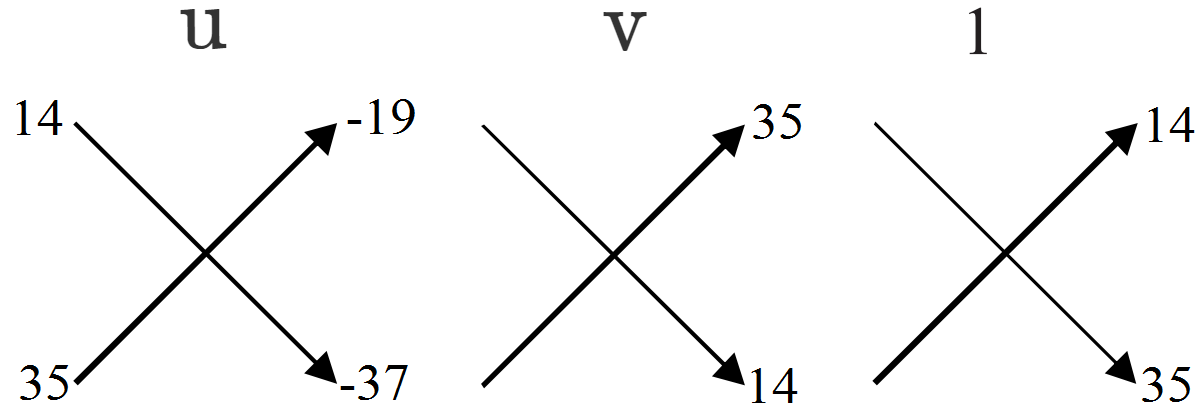
$\therefore\frac{\text{u}}{[14\times(-37)-35\times(-19)]}=\frac{\text{v}}{[(-19)\times14-(-37)\times(35)]}=\frac{1}{[35\times35-14\times14]}$
$\Rightarrow\frac{\text{u}}{-518+665}=\frac{\text{v}}{-266+1295}=\frac{1}{1225-196}$
$\Rightarrow\frac{\text{u}}{147}=\frac{\text{v}}{1029}=\frac{1}{1029}$
$\Rightarrow\text{u}=\frac{147}{1029}=\frac{1}{7},\ \text{v}=\frac{1029}{1029}=1$
$\Rightarrow\frac{1}{\text{x+y}}=\frac{1}{7},\ \frac{1}{\text{x}-\text{y}}=1$
$\therefore( x + y )=7 \ldots$...iii) And, $( x - y )=1 \ldots$ (iv) Again, the equation (iii) and (iv) can be written as follows: $x + y -7=0 \ldots$ (v) x $-y-1=0 \ldots$ (vi) Here $a_1=1, b_1=1, c_1=-7, a_2=1, b_2=-1, c_2=-1$ By multiplication, we have: 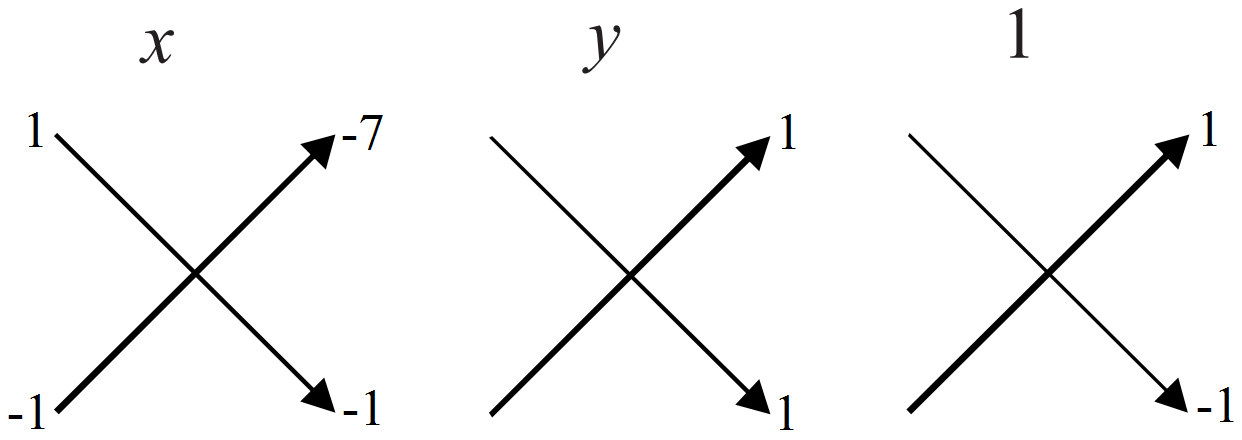
$\Rightarrow\frac{\text{x}}{[1\times(-1)-(-1)\times(-7)]}=\frac{\text{y}}{[(-7)\times1-(-1)\times1]}=\frac{1}{[1\times(-1)-1\times1]}$ $\Rightarrow\frac{\text{x}}{-1-7}=\frac{\text{y}}{-7+1}=\frac{1}{-1-1}$
$\Rightarrow\frac{\text{x}}{-8}=\frac{\text{y}}{-6}=\frac{1}{-2}$
$\Rightarrow\text{x}=\frac{-8}{-2}=4,\ \text{y}=\frac{-6}{-2}=3$ Hence, x = 4 and y = 3 is the required solution. View full question & answer→Question 1285 Marks
A man invested an amount at 10% per annum and another amount at 8% per annum simple interest. Thus, he received ₹ 1350 as annual interest. Had he interchanged the amounts invested, he would have received ₹ 45 less as interest. What amounts did he invest at different rates?
AnswerLet the amounts invested at 10% and 8% p.a. be Rs. x and Rs. y respectively.
Then, SI on Rs. x at 10% p.a. for 1 year $=\text{Rs. }\Big(\frac{\text{x}\times10\times1}{100}\Big)$
$=\text{Rs. }\frac{\text{x}}{10}$
and SI on Rs. y at 8% p.a. for 1 year $=\text{Rs. }\Big(\frac{\text{y}\times8\times1}{100}\Big)$
$=\text{Rs. }\frac{\text{2y}}{25}$
Total SI = Rs. 1350
$\therefore\frac{\text{x}}{10}+\frac{\text{2y}}{25}=1350$
⇒ 5x + 4y = 67500 ...(i)
SI on Rs. x at 8% p.a. for 1 year $=\text{Rs. }\Big(\frac{\text{x}\times8\times1}{100}\Big)$
$=\text{Rs. }\frac{\text{2x}}{25}$
and SI on Rs. y at 10% p.a. for 1 year $=\text{Rs. }\Big(\frac{\text{y}\times10\times1}{100}\Big)$
$=\text{Rs. }\frac{\text{y}}{10}$
Total SI - Rs. 1350 - Rs 45 = Rs 1305
$\therefore\frac{2\text{x}}{25}+\frac{\text{y}}{10}=1305$
4x + 5y = 65250 ...(ii)
Adding (i) and (ii), we get
9x + 9 = 132750
⇒ x + y = 14750 ...(iii)
Subtracting (ii) from (i), we get
x - y = 2250 ...(iv)
Adding (iii) and (iv), we get
2x = 17000
⇒ x = 8500
Substituting x = 8500 in (iii), we get
y = 6250
Hence, amount invested at 10% = Rs. 8500
and amount invested at 8% = Rs. 6250
View full question & answer→Question 1295 Marks
In a $\triangle\text{ABC},\ \angle\text{A}=\text{x}^\circ,$ $\angle\text{B}=(\text{3x}-2)^\circ,\ \angle\text{C}=\text{y}^\circ$ and $\angle\text{C}-\angle\text{B}=9^\circ$ Find the three angles.
AnswerIn a $\triangle\text{ABC},$
$\angle\text{A}+\angle\text{B}+\angle\text{C}=180^\circ$ ...(Angle Sum Property)
⇒ x° + (3x - 2)° + y° = 180°
⇒ 4x + y = 182 ...(i)
Also, given that
$\angle\text{C}-\angle\text{B}=9^\circ$
⇒ y° - (3x - 2)° = 9°
⇒ y - 3x + 2 = 9
⇒ 3x - y = -7 ...(ii)
Adding (i) and (ii), we get
7x = 175
⇒ x = 25
Substituting x = 25 in (i), we get
⇒ y = 82
So, $\angle\text{A}=25^\circ,\ \angle\text{B}=(3\text{x} - 2)^\circ=73^\circ$ and $\angle\text{C}=82^\circ$
View full question & answer→Question 1305 Marks
Solve for x and y:
$\frac{5}{\text{x}}-\frac{3}{\text{y}}=1,$
$\frac{3}{\text{2x}}+\frac{2}{\text{3y}}=\text{5}$ $(\text{x}\neq0,\ \text{y}\neq0).$
AnswerPutting $\frac{1}{\text{x}}=\text{u}$ and $\frac{1}{\text{y}}=\text{v}$ the given equations become 5u - 3v = 1 ...(1) $\frac{3\text{u}}{2}+\frac{\text{2v}}{3}=5$ $\frac{\text{9v}+4\text{v}}{6}=5$ 9u + 4v = 30 ...(2)Multiplying (1) by 4 and (2) by 3, we get
20u - 12v = 4 ...(3)
27u + 12v = 90 ...(4)
Adding (3) and (4), we get
47u = 94
$\Rightarrow\text{u}=\frac{94}{47}=2$Putting u = 2 in (1), we get
(5 × 2) - 3v = 1
⇒ 10 - 3v = 1
⇒ -3v = 1 - 10
⇒ -3v = -9
⇒ v = 3
Now, u = 2
$\Rightarrow\frac{1}{\text{x}}=2$ $\Rightarrow\text{x}=\frac{1}{2}$ and, v = 3 $\Rightarrow\frac{1}{\text{y}}=3$ $\Rightarrow\text{y}=\frac{1}{3}$$\therefore$ The solution is $\text{x}=\frac{1}{2}$ and $\text{y}=\frac{1}{3}$
View full question & answer→Question 1315 Marks
Solve for x and y:
x + y = 5xy,
3x + 2y = 13xy $(\text{x}\neq0,\ \text{y}\neq0).$
Answerx + y = 5xy and 3x + 2y = 13xy
Dividing throughtout by xy, we get
$\frac{1}{\text{y}}+\frac{1}{\text{x}}=5$ and $\frac{3}{\text{y}}+\frac{2}{\text{x}}=13$
Put $\frac{1}{\text{x}}=\text{u}$ and $\frac{1}{\text{y}}=\text{v}$
So, we get
u + v = 5 ...(i) and 2u + 3v = 13 ...(ii)
Multiply (i) by 3 and subtract it from (ii).
⇒ 3u + 3v = 15 and 2u + 3v = 13
⇒ u = 2
Substituting u = 2 in (i), we get v = 3
$\Rightarrow\frac{1}{\text{x}}=2$ and $\frac{1}{\text{y}}=3$
$\Rightarrow\text{x}=\frac{1}{2}$ and $\text{y}=\frac{1}{3}$
View full question & answer→Question 1325 Marks
Solve each of the following given systems of equations graphically and find the vertices and area of the triangle formed by these lines and the x-axis:
x - y + 3 = 0, 2x + 3y - 4 = 0
Answerx - y + 3 = 0 ⇒ y = x + 3
2x + 3y - 4 = 0 $\Rightarrow\text{y}=\frac{4-\text{2x}}{3}$
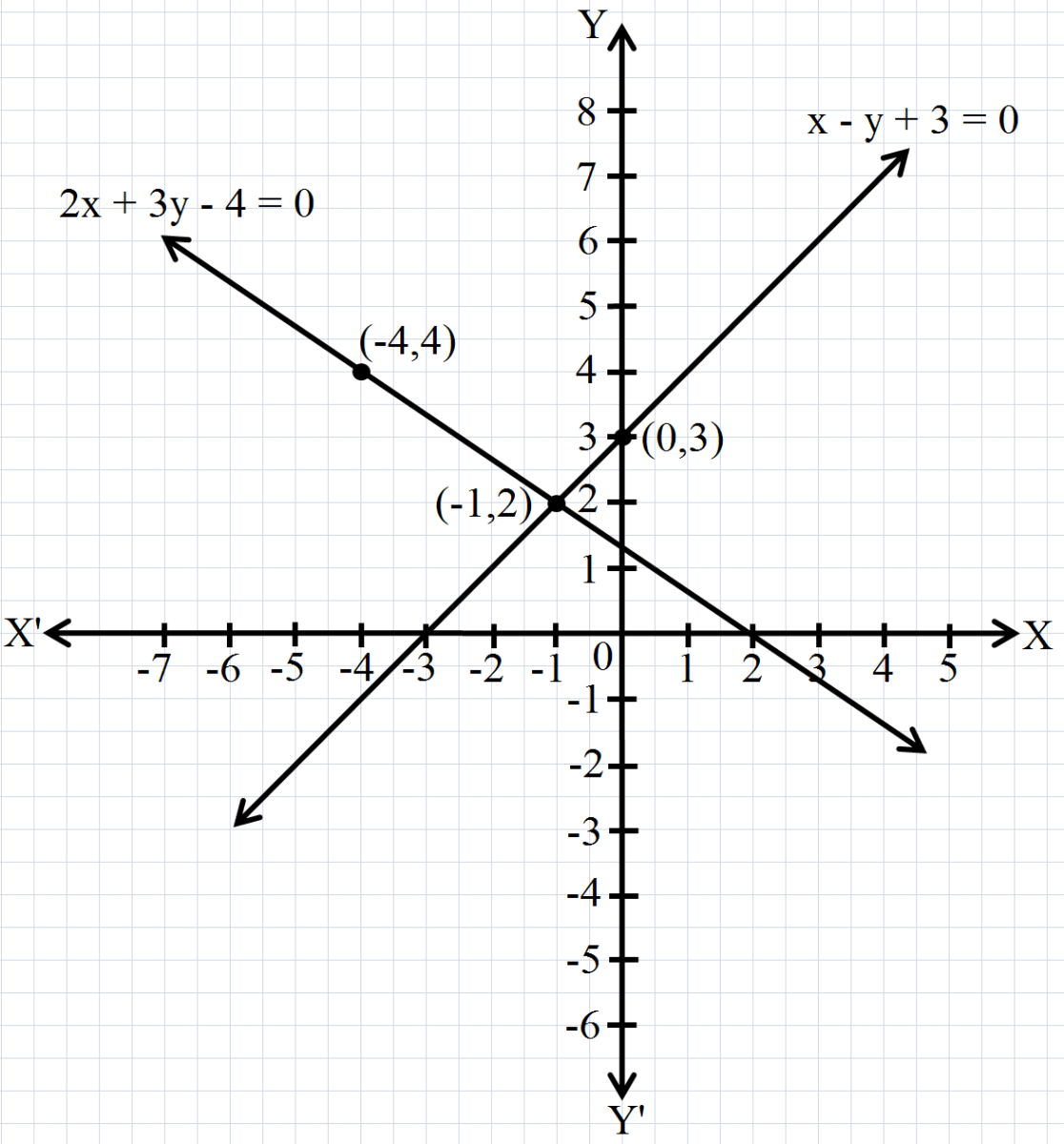
Since the two graph intersect at (-1, 2), x = -1 and y = 2 The vertices of the triangle formed by these lines and the x-axis are (-3, 0), (2, 0) and (-1, 2). So, height of the triangle = distance from (-1, 2) to x-axis = 2 units Base = 5 units Area of triangle $=\frac{1}{2}\times$ base × height $=\frac{1}{2}\times5\times2$ $=5\ \text{sq. units}$ View full question & answer→Question 1335 Marks
Show graphically that each of the following given systems of equations has infinitely many solutions:
2x + 3y = 6, 4x + 6y = 12
Answer$\text{2x}+\text{3y}=6$ $\Rightarrow\text{y}=\frac{\text{6}-\text{2x}}{3}$
$\text{4x}+\text{6y}=12$ $\Rightarrow\text{y}=\frac{12-\text{4x}}{6}$
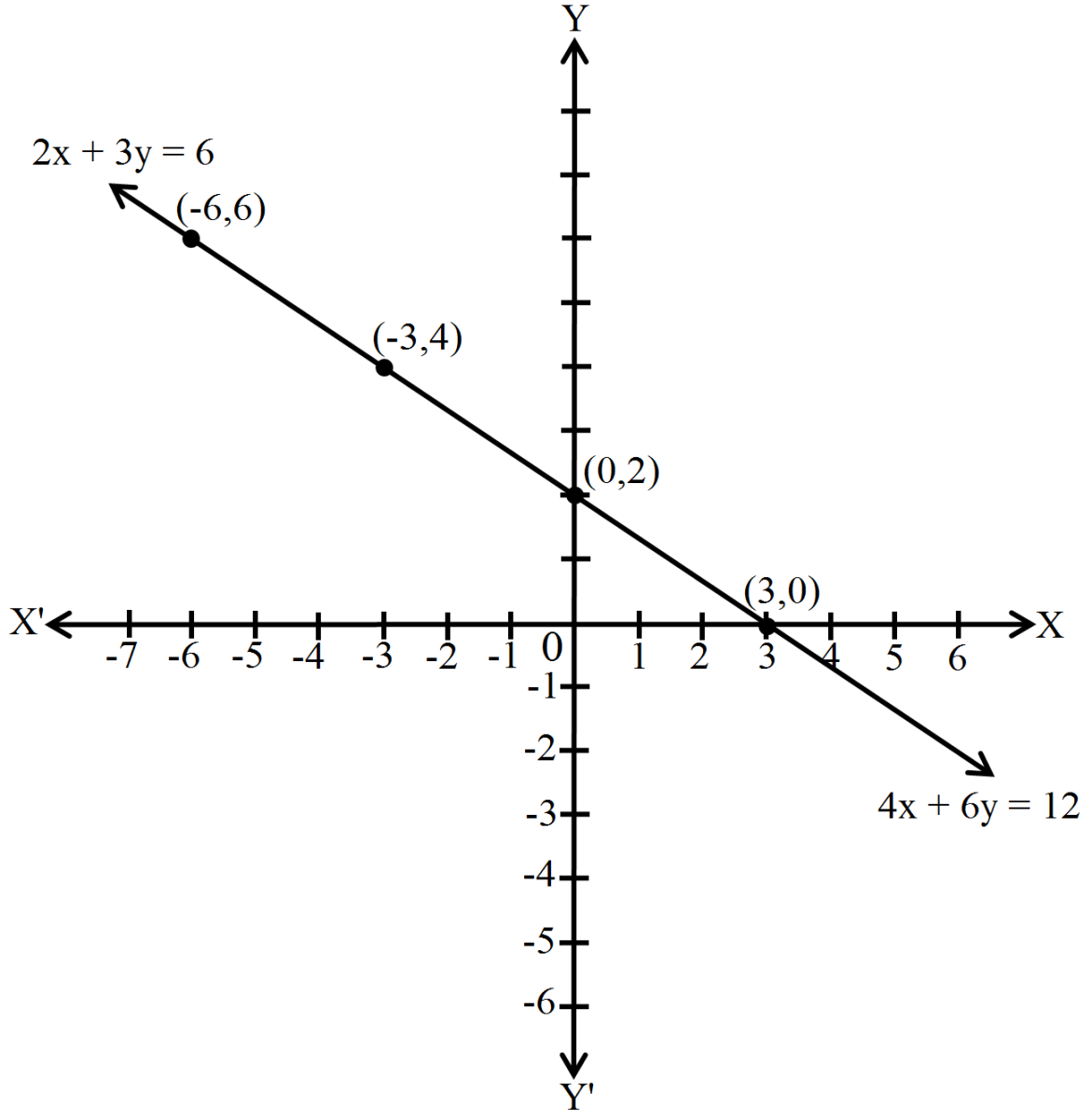
Since the two graph of the system of equations is coincident lines, the system has infinitely many solutions. View full question & answer→Question 1345 Marks
The sum of two numbers is 16 and the sum of their reciprocals is $\frac{1}{3}.$ Find the numbers.
AnswerLet the two numbers be x and y respectively.
Accroding to the given question:
$\therefore$ x + y = 16 ...(1)
And
$\frac{1}{\text{x}}+\frac{1}{\text{y}}=\frac{1}{3}\ \dots(2)$
From (2),
$\frac{\text{x}+\text{y}}{\text{xy}} =\frac{1}{3}$ or $\frac{16}{\text{xy}}=\frac{1}{3}$ [x + y = 16]
$\therefore$ xy = 48
We know,
$(x - y)^2 = (x + y)^2 - 4xy$
$= 16^2 - 4 \times 48 = 256 - 192 = 64$
$\therefore$ x - y = 8 ...(3)
Adding (1) and (3), we get
2x = 24
$\therefore$ x = 12
Putting x = 12 in (1),
y = 16 - x
= 16 - 12
= 4
$\therefore$ The required numbers are 12 and 4
View full question & answer→Question 1355 Marks
Solve the following systems of equations by using the method of cross multiplication:
$6x - 5y - 16 = 0,$
$7x - 13y + 10 = 0$
AnswerThe given equations are: $6 x-5 y-16=0 \ldots$ (i) $7 x-13 y+10=0 \ldots$ (ii) Here, $a_1=6, b_1=-5, c_1=-16, a_2=7, b_2=-13$ and $c_2=10$ By cross multiplication, we have
: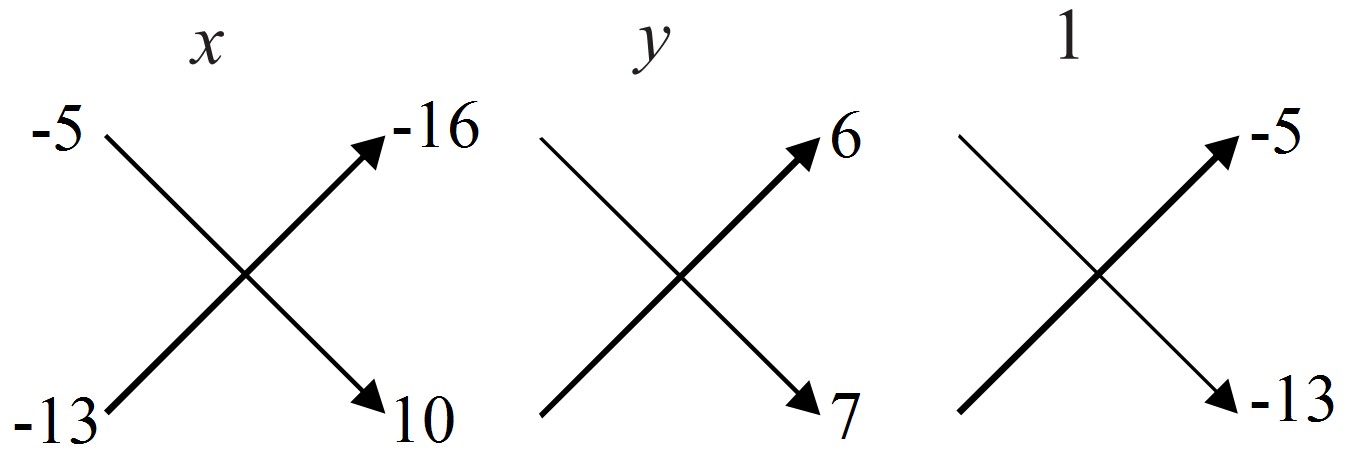
$\therefore\frac{\text{x}}{[(-5)\times10-(-16)\times(-13)]}=\frac{{\text{y}}}{[(-16)\times7-10\times6]}=\frac{1}{[6\times(-13)-(-5)\times7]}$
$\Rightarrow\frac{\text{x}}{(-50-208)}=\frac{\text{y}}{(-112-60)}=\frac{1}{(-78+35)}$
$\Rightarrow\frac{\text{x}}{(-258)}=\frac{\text{y}}{(-172)}=\frac{1}{(-43)}$
$\Rightarrow\text{x}=\frac{-258}{-43}=6,\ \text{y}=\frac{-172}{-43}=4$
Hence, x = 6 and y = 4 is the required solution. View full question & answer→Question 1365 Marks
Solve for x and y:
$2\text{x}-\frac{3}{\text{y}}=\text{9},$
$\text{3x}+\frac{7}{\text{y}}=\text{2}$ $(\text{y}\neq0).$
AnswerPutting $\frac{1}{\text{y}}=\text{v}$ the given equations become 2x - 3v = 9 ...(1) 3x + 7v = 2 ...(2)Multiplying (1) by 7 and (2) by 3, we get
14x - 21v = 63 ...(3)
9x + 21v = 6 ...(4)
Adding (3) and (4), we get
23x = 69
$\Rightarrow\text{x}=\frac{39}{13}=3$Putting x = 3 in (1), we get
2 × 3 - 3v = 9
-3v = 9 - 6
⇒ -3v = 3
⇒ v = -1
$\Rightarrow\frac{1}{\text{y}}=-1$⇒ y = -1
$\therefore$ The solution is x = 3 and y = 1
View full question & answer→Question 1375 Marks
If 1 is added to both of the numerator and denominator of a fraction, it becomes $\frac{4}{5}.$ If however, 5 is subtracted from both numerator and denominator, the fraction $\frac{1}{2}.$ Find the fraction.
AnswerLet the required fraction be $\frac{\text{x}}{\text{y}}.$
Then, we have:
$\frac{\text{x}+1}{\text{y}+1}=\frac{4}{5}$
⇒ 5(x + 1) = 4(y + 1)
⇒ 5x + 5 = 4y + 4
⇒ 5x - 4y = -1 ...(i)
Again, we have:
$\frac{\text{x}-5}{\text{y}-5}=\frac{1}{2}$
⇒ 2(x - 5) = 1(y - 5)
⇒ 2x - 10 = y - 5
⇒ 2x - y = 5 ...(ii)
On multiplying (ii) by 4, we get:
⇒ 8x - 4y = 20 ....(iii)
On subtracting (i) from (iii), we get:
3x = (20 - (-1)) = 20 + 1 = 21
⇒ 3x = 21
⇒ x = 7
On substituting x = 7 in (i), we get:
5 × 7 - 4y = -1
⇒ 35 - 4y = -1
⇒ 4y = 36
⇒ y = 9
$\therefore$ x = 7 and y = 9
Hence, the required fraction is $\frac{7}{9}.$
View full question & answer→