Question 15 Marks
If $\tan\theta=\frac{20}{21},$ show that $\frac{\big(1-\sin\theta+\cos\theta\big)}{\big(1+\sin\theta+\cos\theta\big)}=\frac37.$
AnswerGiven: $\tan\theta=\frac{20}{21}=\frac{20\text{k}}{21\text{k}}$
Let us draw a $\triangle\text{ABC}$ in which $\angle\text{B}=90^\circ$ and $\angle\text{A}=\theta$
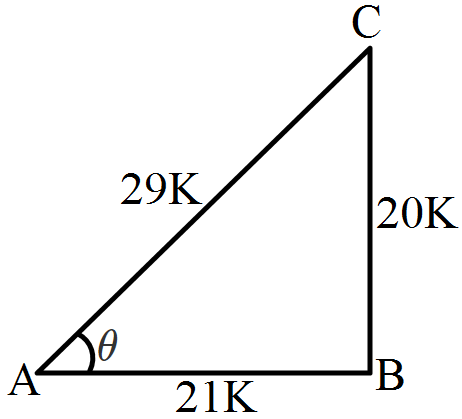
By pythagoras theorem, we have
$AC^2 = (AB^2 + BC^2)$
$= (21k)^2 + (20k)^2$
$= 441k^2 + 400k^2$
$= 841k^2$
$\therefore\text{AC}=29\text{k}$
$\sin\theta=\frac{\text{BC}}{\text{AC}}=\frac{20\text{k}}{29\text{k}}=\frac{20}{29},\cos\theta=\frac{\text{AB}}{\text{AC}}=\frac{21\text{k}}{29\text{k}}=\frac{21}{29}$
$\text{L.H.S.}=\frac{1-\sin\theta+\cos\theta}{1+\sin\theta+\cos\theta}=\frac{1-\frac{20}{29}+\frac{21}{29}}{1+{\frac{20}{29}+\frac{21}{29}}}=\frac{\frac{29-20+21}{29}}{\frac{29+20+21}{29}}$
$=\frac{30}{70}=\frac{3}{7}=\text{R.H.S}$ View full question & answer→Question 25 Marks
In a $\triangle\text{ABC},\angle\text{B}=90^\circ,\text{AB}=24\text{cm}$ and BC = 7cm.
Find:
- $\sin\text{A}$
- $\cos\text{A}$
- $\sin\text{C}$
- $\cos\text{C}.$
Answer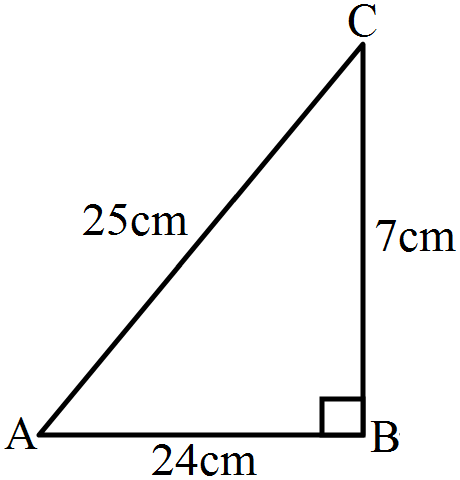
By pythagoras theoram, we have
$\text{AC}^2 = \text{AB}^2 - \text{BC}^2$
$\Rightarrow\text{AC}^2=(24)^2+(7)^2$
$\Rightarrow\text{AC}^2=576+49=625$
$\Rightarrow\text{AC}=25\text{cm}$
Now, For T-Ratios of $\angle\text{A},$ base = AB and perpendicular = BC
- $\sin\text{A}=\frac{\text{BC}}{\text{AC}}=\frac{7}{25}$
- $\cos\text{A}=\frac{\text{AB}}{\text{AC}}=\frac{24}{25}$
Similarly, For T-Ratios of $\angle\text{C},$ base = BC and perpendicular = AB
- $\sin\text{C}=\frac{\text{AB}}{\text{AC}}=\frac{24}{25}$
- $\cos\text{C}=\frac{\text{BC}}{\text{AC}}=\frac{7}{25}.$
View full question & answer→Question 35 Marks
If $\sin\alpha=\frac12,$ Prove that $\big(3\cos\alpha-4\cos^3\alpha\big)=0.$
Answer$\sin\alpha=\frac12\Rightarrow\sin^2\alpha=\frac14$
$\therefore\cos^2\alpha=1-\sin^2\alpha=1-\frac14=\frac34$
$\Rightarrow\cos\alpha=\frac{\sqrt{3}}{2}$
$\therefore\ \text{L.H.S.}=3\cos\alpha-4\cos^2\alpha$
$=3\times\frac{\sqrt{3}}{2}-4\Big(\frac{\sqrt{3}}{2}\Big)^2$
$=\frac{3\sqrt{3}}{2}-4\times\frac{3\sqrt{3}}{8}$
$=\frac{3\sqrt{3}}{2}-\frac{3\sqrt{3}}{2}$
$=0$
$=\text{R.H.S}$
View full question & answer→Question 45 Marks
If $\sin\theta=\frac{3}{4},$ show that $\sqrt{\frac{\text{cosec}^2\theta-\cot^2\theta}{\sec^2\theta-1}}=\frac{\sqrt{7}}{3}.$
Answer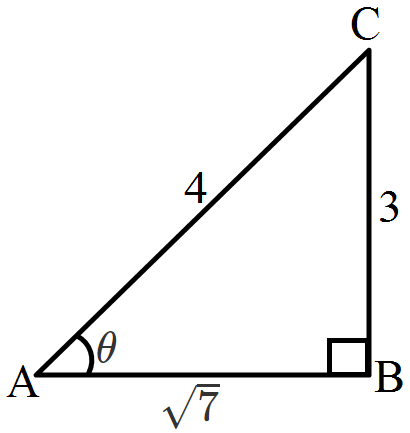
$\sin\theta=\frac34\Rightarrow\text{cosec}\theta=\frac43$
Consider $\triangle\text{ABC},$ where $\angle\text{B}=90^\circ$ and $\angle\text{A}=\theta$
Then, $\sin\theta=\frac{\text{Perpendicular}}{\text{Hypotenuse}}=\frac{\text{BC}}{\text{AC}}=\frac34$
Let BC = 3 and AC = 4
Then, by pythagoras theorem,
$AB^2 = AC^2 - BC^2$
$\Rightarrow 4^2 - 3^2 = 16 - 9 = 7$
$\Rightarrow\text{AB}=\sqrt{7}$
Now,
$\cot\theta=\frac{\text{Base}}{\text{Perpendicular}}=\frac{\text{AB}}{\text{BC}}=\frac{\sqrt{7}}{3}$
$\sec\theta=\frac{\text{Hypotenuse}}{\text{Base}}=\frac{\text{AC}}{\text{AB}}=\frac{4}{\sqrt{7}}$
$\therefore\text{L.H.S.}=\sqrt{\frac{\text{cosec}^2\theta-\cot^2\theta}{\sec^2\theta-1}}$
$=\sqrt{\frac{\big(\frac{4}{3}\big)^2-\Big(\frac{\sqrt{7}}{3}\Big)}{\Big(\frac{4}{\sqrt{7}}\Big)^2-1}}$
$=\sqrt{\frac{\frac{\frac{16}{9}-\frac{7}{9}}{12}}{\frac{16}{7}-1}}$
$=\sqrt{\frac{1}{\frac97}}$
$=\sqrt{\frac{7}{9}}$
$=\frac{\sqrt{7}}{3}$
$=\text{R.H.S.}$ View full question & answer→Question 55 Marks
If $\tan\theta=\frac{1}{\sqrt{7}},$ show that $\frac{\big(\text{coses}^2\theta-\sec^2\theta\big)}{\big(\text{cosec}^2\theta+\sec^2\theta\big)}=\frac34.$
AnswerGiven: $\tan\theta=\frac{\text{BC}}{\text{AB}}=\frac{1}{\sqrt{7}}$
Let BC = 1k and $\text{AB}=\sqrt{7}\text{k}$
Where k is positive
Let us draw a $\triangle\text{ABC}$ in which $\angle\text{B}=90^\circ$ and $\angle\text{A}=\theta$
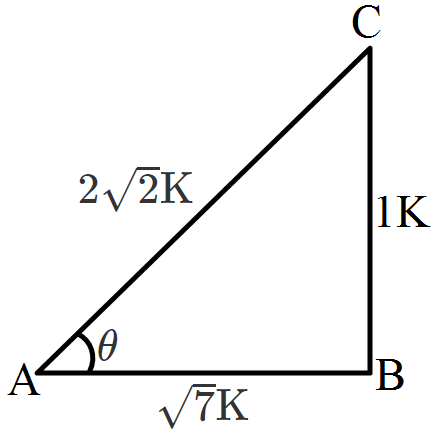
By pythagoras theorem, we have
$\text{AC}^2 = (\text{AB}^2 + \text{BC}^2)$
$\Rightarrow\text{AC}^2=\Big[\big(\sqrt{7}\text{k}\big)^2+\big(1\text{k}\big)^2\Big]$
$= 7\text{k}^2 + 1\text{k}^2 = 8\text{k}^2$
$\Rightarrow\text{AC}=2\sqrt{2}\text{k}$
$\text{cosec}\theta=\frac{\text{AC}}{\text{BC}}=\frac{2\sqrt{2}\text{k}}{1\text{k}}={2\sqrt{2}}$
$\sec\theta=\frac{\text{AC}}{\text{AB}}=\frac{2\sqrt{2}\text{k}}{\sqrt{7}\text{k}}=\frac{2\sqrt{2}}{\sqrt{7}}$
$\Rightarrow\frac{\big(\text{cosec}^2\theta-\sec^2\theta\big)}{\big(\text{cosec}^2\theta+\sec^2\theta\big)}=\begin{bmatrix}\frac{\big(2\sqrt{2}\big)^2-\Big(\frac{2\sqrt{2}}{\sqrt{7}}\Big)^2}{\big(2\sqrt{2}\big)^2+\Big(\frac{2\sqrt{2}}{\sqrt{7}}\Big)^2}\end{bmatrix}$
$=\frac{\big(8-\frac{8}{7}\big)}{\big(8+\frac87\big)}=\frac{\big(\frac{48}{7}\big)}{\big(\frac{64}{7}\big)}=\frac{48}{64}=\frac34$
Hence, $\Big(\frac{\text{cosec}^2\theta-\sec^2\theta}{\text{cosec}^2\theta+\sec^2\theta}\Big)=\frac34$ View full question & answer→Question 65 Marks
In a $\triangle\text{ABC},\angle\text{C}=90^\circ,\angle\text{ABC}=\theta^\circ,\text{BC}=21\text{units}$ and AB = 29units.
Show that $\big(\cos^2\theta-\sin^2\theta\big)=\frac{41}{841}.$
Answer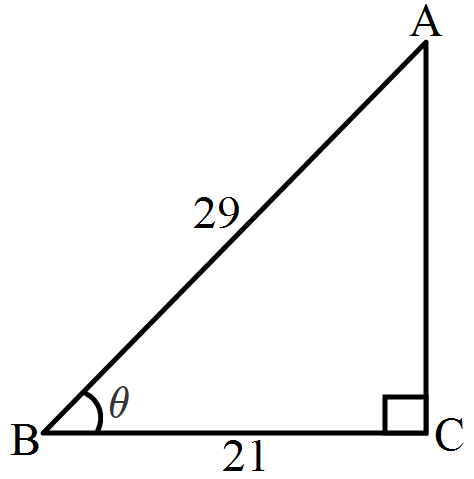
In $\triangle\text{ABC},\angle\text{C}=90^\circ$
AB = 29 units and BC = 21 units
By Pythagoras theorem, we have
$\text{AC}^2=\text{AB}^2-\text{BC}^2$
$=29^2-21^2=841-441=400$
$\Rightarrow\text{AC}=20\text{ units}$
$\therefore\ \sin\theta=\frac{\text{Perpendicular}}{\text{Hypotenuse}}=\frac{\text{AC}}{\text{AB}}=\frac{20}{29}$
$\cos\theta=\frac{\text{Base}}{\text{Hypotenuse}}=\frac{\text{BC}}{\text{AB}}=\frac{21}{29}$
$\therefore\text{L.H.S.}=\cos^2\theta-\sin^2\theta$
$=\Big(\frac{21}{29}\Big)^2-\Big(\frac{20}{29}\Big)^2$
$=\frac{441}{841}-\frac{400}{841}$
$=\frac{41}{841}$
$=\text{R.H.S.}$ View full question & answer→Question 75 Marks
If $\cot\theta=2,$ find the value of the all T-ratios of $\theta.$
AnswerGiven: $\cot\theta=\frac{\text{AB}}{\text{BC}}=\frac{2\text{k}}{1\text{k}}$
Let AB = 2k
and BC = 1k, where k is positive.
Let us draw a $\triangle\text{ABC}$ in which $\angle\text{B}=90^\circ$ and $\angle\text{BAC}=\theta$
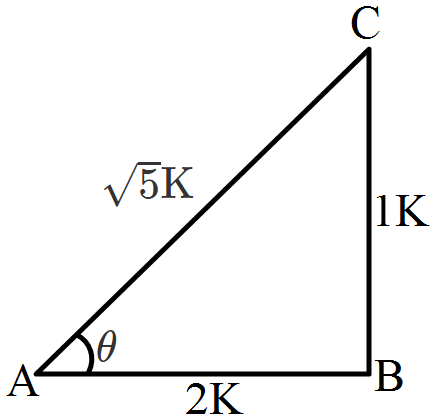
By pythagoras theorem, we have
$\text{AC}^2 = (\text{AB})^2 + (\text{BC})^2 $
$=\Big[(2\text{k})^2+(1\text{k})^2\Big]$
$=\Big(4\text{k}^2+1\text{k}^2\Big)5\text{k}^2$
$\therefore\text{AC}=\sqrt{5}\text{k}^2=\sqrt{5}\text{k}$
$\therefore\sin\theta=\frac{\text{BC}}{\text{AC}}=\frac{1\text{k}}{\sqrt{5}\text{k}}=\frac{1}{\sqrt{5}}$
$\cos\theta=\frac{\text{BC}}{\text{AC}}=\frac{2\text{k}}{\sqrt{5}\text{k}}=\frac{1}{\sqrt{5}}$
$\tan\theta=\frac{1}{\cot\theta}=\frac12;\cot\theta=2$ (Given)
$\text{cosec}\theta=\frac{1}{\sin\theta}=\sqrt{5}$
$\sec\theta=\frac{1}{\sin\theta}=\frac{\sqrt{5}}{2}$ View full question & answer→Question 85 Marks
If $3\cot\theta=4,$ show that $\frac{(1-\tan^2\theta)}{(1+\tan^2\theta)}=\big(\text{cos}^2\theta-\sin^2\theta\big).$
Answer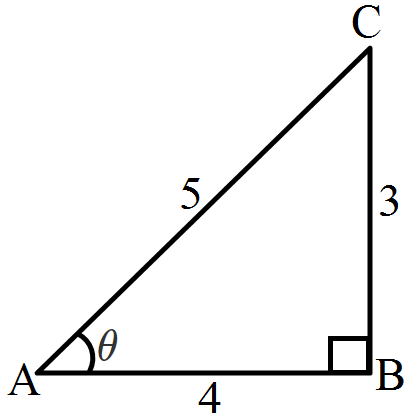
$3\cot\theta=4\Rightarrow\cot\theta=\frac43\Rightarrow\tan\theta=\frac34$
Consider $\triangle\text{ABC},$ where $\angle\text{B}=90^\circ$ and $\angle\text{A}=\theta$
Then, $\cot\theta=\frac{\text{Base}}{\text{Perpendicular}}=\frac{\text{AB}}{\text{BC}}=\frac43$
Let AB = 4 and BC = 3
Then, by pythagoras theoram,
$\text{AC}^2 = \text{AB}^2 + \text{BC}^2$
$=4^3+3^2=16+9=25$
$\Rightarrow\text{AC} = 5$
Now,
$\sin\theta=\frac{\text{Perpendicular}}{\text{Hypotenuse}}=\frac{\text{BC}}{\text{AC}}=\frac35$
$\cos\theta=\frac{\text{Base}}{\text{Hypotenuse}}=\frac{\text{AB}}{\text{AC}}=\frac45$
$\therefore\text{L.H.S.}=\frac{\big(1-\tan^2\theta\big)}{\big(1+\tan^2\theta\big)}$
$=\frac{1-\big(\frac{3}{4}\big)^2}{1+\big(\frac{3}{4}\big)^2}$
$=\frac{1-\frac{9}{16}}{1+\frac{9}{16}}=\frac{\frac{8}{16}}{\frac{25}{16}}=\frac{8}{25}$
$\text{R.H.S.}=\cos^2\theta-\sin^2\theta=\Big(\frac45\Big)^2=\Big(\frac{3}{5}\Big)^2$
$=\frac{16}{25}-\frac{9}{25}=\frac{8}{25}$
Hence, $\frac{(1-\tan^2\theta)}{(1+\tan^2\theta)}=\big(\text{cos}^2\theta-\sin^2\theta\big).$ View full question & answer→Question 95 Marks
In the adjoining figure, $\angle\text{B}=90^\circ,\angle\text{BAC}=\theta,\text{BC}=\text{CD}=4\text{cm}$ and AD = 10cm. Find
- $\sin\theta$
- $\cos\theta.$
Hint: $\text{AB}^2=\big(\text{AD}^2-\text{BD}^2\big)=36\text{cm}^2$ $\therefore\text{AB}=6\text{cm}.$ $\text{AC}^2=\big(\text{AB}^2+\text{BC}^2\big)=52\text{cm}^2$ $\therefore\text{AC}=2\sqrt{13}\text{cm}.$ Thus, AB = 6cm and $\text{AC}=2\sqrt{13}\text{cm}.$ 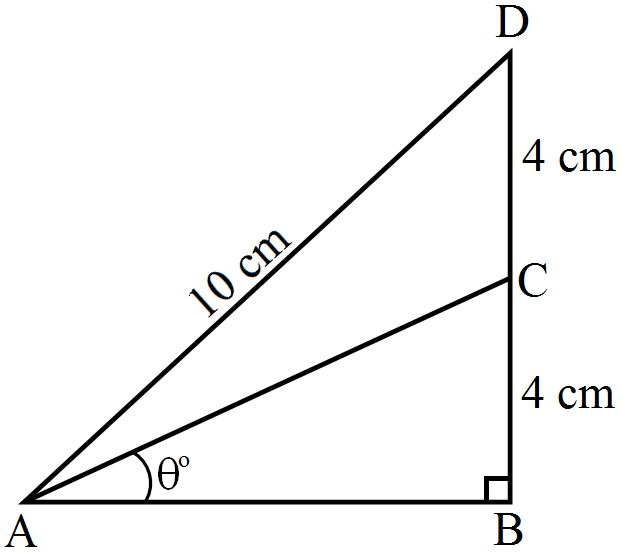
Answer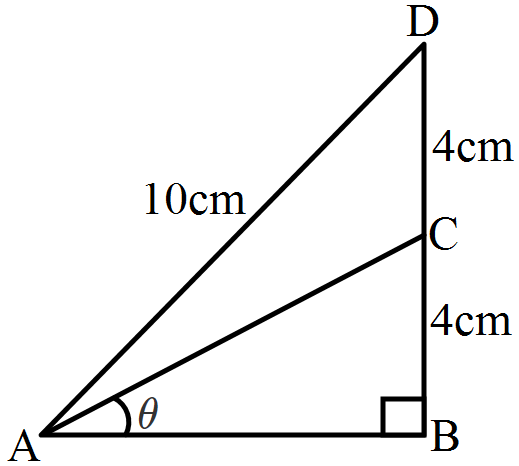
In $\triangle\text{ABC},$ $\angle\text{B}=90^\circ$
$\text{AD}=10\text{cm}$
$\text{BD}=\text{BC}+\text{CD}$
$=4+4=8\text{cm}$
By pythagoras theoram, we have
$\text{AB}^2 = \text{AD}^2 - \text{BD}^2$
$=10^2-8^2=100-64=36$
$\Rightarrow\text{AB}=6\text{cm}$
Now, in $\triangle\text{ABC},\angle\text{B}=90^\circ.$
By Pythagoras theorem, we have
$\text{AC}^2 = \text{AB}^2 - \text{BC}^2$
$=6^2+4^2=36+16=52$
$\Rightarrow\text{AC}=2\sqrt{13}\text{cm}$
- $\sin\theta=\frac{\text{Perpendicular}}{\text{Hypotenuse}}$
$=\frac{\text{BC}}{\text{AC}}=\frac{4}{2\sqrt{13}}=\frac{2}{\sqrt{13}}=\frac{2\sqrt{13}}{13}$
- $\cos\theta=\frac{\text{Base}}{\text{Hypotenuse}}$
$=\frac{\text{AB}}{\text{AC}}=\frac{6}{2\sqrt{13}}=\frac{3}{\sqrt{13}}=\frac{3\sqrt{13}}{13}.$ View full question & answer→Question 105 Marks
If $\tan\theta=\frac{4}{3},$ show that $(\sin\theta+\cos\theta)=\frac75.$
AnswerGiven: $\tan\theta=\frac{\text{BC}}{\text{AB}}=\frac{4}{3}$
Let BC = 4k and AB = 3k
Where k is positive
Let us draw a $\triangle\text{ABC}$ in which $\angle\text{B}=90^\circ$ and $\angle\text{BAC}=\theta$
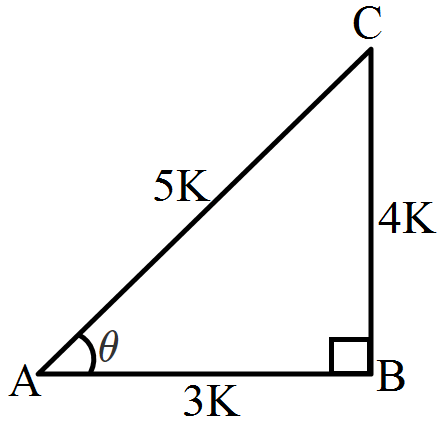
By Pythagoras theorem, we get
$\big(\text{AC}\big)^2=\big(\text{AB}\big)^2+\big(\text{BC}\big)^2$
$\Rightarrow\big(\text{AC}\big)^2=\Big[\big(3\text{k}\big)^2+\big(4\text{k}\big)^2\Big]$
$\Rightarrow\big(\text{AC}\big)^2=\big(9\text{k}^2+16\text{k}^2\big)=25\text{k}^2$
$\therefore\text{AC}=\sqrt{9\text{k}^2}=5\text{k}$
$\sin\theta=\frac{4\text{k}}{5\text{k}}=\frac45$
$\cos\theta=\frac{3\text{k}}{5\text{k}}=\frac{3}{5}$
$\Rightarrow(\sin\theta+\cos\theta)=\Big(\frac{4}{5}+\frac35\Big)=\frac75$
Hence, $(\sin\theta+\cos\theta)=\frac75.$ View full question & answer→Question 115 Marks
If $\text{x}=\cot\text{A}+\cos\text{A}$ and $\text{y}=\cot\text{A}-\cos\text{A},$ Prove that $\Big(\frac{\text{x}-\text{y}}{\text{x}+\text{y}}\Big)^2+\Big(\frac{\text{x}-\text{y}}{2}\Big)^2=1.$
Answer$\text{x}=\cot\text{A}+\cos\text{A}$ and $\text{y}=\cot\text{A}-\cos\text{A}$
Thus, we have
$\text{x}+\text{y}=(\cot\text{A}+\cos\text{A})\\+(\cot\text{A}-\cos\text{A})=2\cos\text{A}$
$\text{x}-\text{y}=(\cot\text{A}+\cos\text{A})\\-(\cot\text{A}-\cos\text{A})=2\cos\text{A}$
$\text{L.H.S.}=\Big(\frac{\text{x}-\text{y}}{\text{x}+\text{y}}\Big)^2+\Big(\frac{\text{x}-\text{y}}{2}\Big)^2-1$
$=\Big(\frac{2\cos\text{A}}{2\cot\text{A}}\Big)^2+\Big(\frac{2\cos\text{A}}{2}\Big)^2$
$=\Big(\frac{\cos\text{A}}{\cot\text{A}}\Big)^2+(\cos\text{A})^2$
$=\Bigg(\frac{\cos\text{A}}{\frac{\cos\text{A}}{\sin\text{A}}}\Bigg)^2+(\cos\text{A})^2$
$=(\sin\text{A})^2+(\cos\text{A})^2$
$=\sin^2\text{A}+\cos^2\text{A}$
$=1$
$=\text{R.H.S}$
View full question & answer→Question 125 Marks
If $3\cot\theta=2,$ show that $\frac{(4\sin\theta-3\cos\theta)}{(2\sin\theta+6\cos\theta)}=\frac13.$
AnswerGiven:
$\cot\theta=2,\ \therefore\cot\theta=\frac23=\frac{2\text{k}}{3\text{k}}$
Let us draw a $\triangle\text{ABC},$ where $\angle\text{B}=90^\circ$ and $\angle\text{A}=\theta$
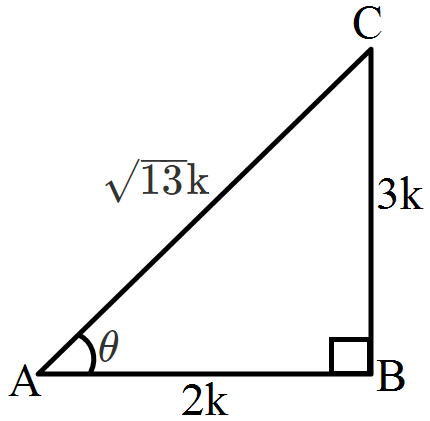
By pythagoras theoram, we have
$\text{AC}^2 = \text{AB}^2 + \text{BC}^2$
$=\big(2\text{k}\big)^2+\big(3\text{k}\big)^2$
$=4\text{k}^2+9\text{k}^2=13\text{k}^2$
$\Rightarrow\text{AC}=\sqrt{13}\text{k}$
$\therefore\sin\theta=\frac{3\text{k}}{\sqrt{13\text{k}}}=\frac{3}{\sqrt{13}}$
$\cos\theta=\frac{2\text{k}}{\sqrt{13}\text{k}}=\frac{2}{\sqrt{13}}$
$\therefore\text{L.H.S.}=\frac{(4\sin\theta-3\cos\theta)}{(2\sin\theta+6\cos\theta)}$
$=\frac{4\times\frac{3}{\sqrt{13}}-3\times\frac{2}{\sqrt{13}}}{2\times\frac{3}{\sqrt{13}}+6\times\frac{2}{\sqrt{13}}}$
$=\frac{\frac{12-6}{\sqrt{13}}}{\frac{6+12}{\sqrt{13}}}$
$=\frac{6}{18}=\frac13$
$=\text{R.H.S.}$ View full question & answer→Question 135 Marks
If $\sin\theta=\frac{\text{a}}{\text{b}},$ show that $(\sec\theta+\tan\theta)=\sqrt{\frac{\text{b}+\text{a}}{\text{b}-\text{a}}}.$
Answer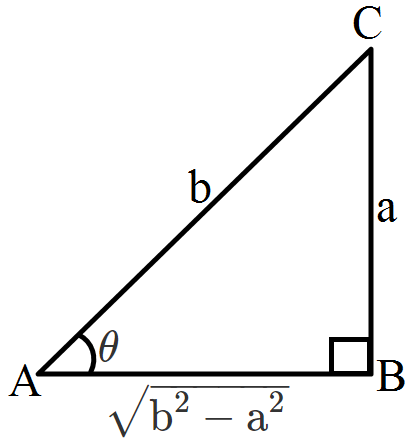
$\sin\theta=\frac{\text{a}}{\text{b}}$
Consider $\triangle\text{ABC},$ where $\angle\text{B}=90^\circ$ and $\angle\text{A}=\theta$
Then, $\sin\theta=\frac{\text{Perpendicular}}{\text{Hypotenuse}}=\frac{\text{BC}}{\text{AC}}=\frac{\text{a}}{\text{b}}$
Let BC = a and AC = b
Then, by pythagoras theorem,
$\text{AB}^2 = \text{AC}^2 - \text{BC}^2 = \text{b}^2 - \text{a}^2$
$\Rightarrow\text{AB}=\sqrt{\text{b}^2-\text{a}^2}$
Now,
$\sec\theta=\frac{\text{Hypotenuse}}{\text{Base}}=\frac{\text{AC}}{\text{AB}}=\frac{\text{b}}{\sqrt{\text{b}^2-\text{a}^2}}$
$\tan\theta=\frac{\text{Perpendicular}}{\text{Base}}=\frac{\text{BC}}{\text{AB}}=\frac{\text{a}}{\sqrt{\text{b}^2-\text{a}^2}}$
$\therefore\text{L.H.S.}=(\sec\theta+\tan\theta)$
$=\frac{\text{b}}{\sqrt{\text{b}^2-\text{a}^2}}+\frac{\text{a}}{\sqrt{\text{b}^2-\text{a}^2}}$
$=\frac{\text{b}+\text{a}}{\sqrt{\text{b}^2-\text{a}^2}}$
$\frac{\text{b}+\text{a}}{\sqrt{(\text{b}+\text{a})(\text{b}-\text{a})}}$
$=\frac{{\sqrt{\text{b}+\text{a}}}\times\sqrt{\text{b}+\text{a}}}{\sqrt{(\text{b}+\text{a})}\times\sqrt{\text{b}-\text{a}}}$
$=\sqrt{\frac{\text{b}+\text{a}}{\text{b}-\text{a}}}$
$=\text{R.H.S.}$ View full question & answer→Question 145 Marks
If $3\tan\theta=4,$ show that $\frac{(4\cos\theta-\sin\theta)}{(2\cos\theta+\sin\theta)}=\frac45.$
Answer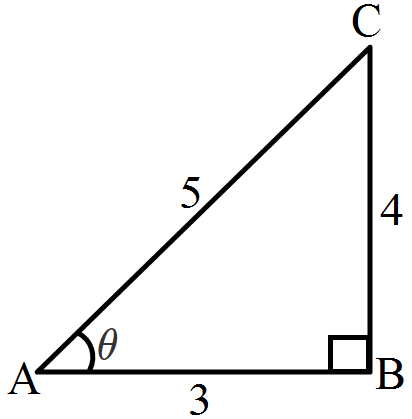
$3\tan\theta=4\Rightarrow\tan\theta=\frac43$
Consider $\triangle\text{ABC},$ where $\angle\text{B}=90^\circ$ and $\angle\text{A}=\theta$
Then, $\tan\theta=\frac{\text{Perpendicular}}{\text{Base}}=\frac{\text{BC}}{\text{AB}}=\frac43$
Let BC = 4 and AB = 3
Then, by pythagoras theoram,
$AC^2 = AB^2 + BC^2$
$= 3^2 + 4^2 = 9 + 16 = 25$
$\Rightarrow AC = 5$
Now,
$\sin\theta=\frac{\text{Perpendicular}}{\text{Hypotenuse}}=\frac{\text{BC}}{\text{AC}}=\frac45$
$\cos\theta=\frac{\text{Base}}{\text{Hypotenuse}}=\frac{\text{AB}}{\text{AC}}=\frac35$
$\therefore\text{L.H.S.}=\frac{(4\cos\theta-\sin\theta)}{(2\cos\theta+\sin\theta)}$
$=\frac{4\times\frac35-\frac45}{2\times\frac{3}{5}+\frac{4}{5}}$
$=\frac{\frac85}{\frac{10}{5}}$
$=\frac{8}{5}\times\frac12$
$=\frac45$
$=\text{R.H.S.}$ View full question & answer→Question 155 Marks
If $\sin\text{A}=\frac{9}{41},$ find the value of $\cos\text{A}$ and $\tan\text{A}.$
Answer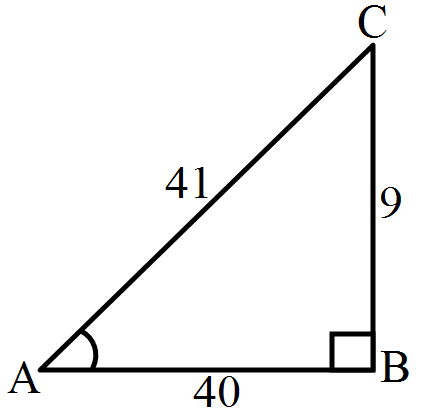
Cosider $\triangle\text{ABC},$ where $\angle\text{B}=90^\circ$
Then, $\sin\text{A}=\frac{\text{Perpendicular}}{\text{Hypotenuse}}=\frac{\text{BC}}{\text{AC}}=\frac{9}{41}$
Let BC = 9 and AC = 41
Then, by Pythagoras theoram,
$AC^2 = (AB)^2 + (BC)^2$
$\Rightarrow (AB)^2 = (AC)^2 - (BC)^2$
$= 41^2 - 9^2 = 1681 - 81 = 1600$
$\Rightarrow AB = 40$
Now,
$\cos\text{A}=\frac{\text{Base}}{\text{Hypotenuse}}=\frac{\text{AB}}{\text{AC}}=\frac{40}{41}$
$\tan\text{A}=\frac{\text{Perpendicular}}{\text{Base}}=\frac{\text{BC}}{\text{AB}}=\frac{9}{40}$ View full question & answer→Question 165 Marks
If $\cos\theta=\frac{3}{5},$ show that $\frac{(\sin\theta-\cos\theta)}{2\tan\theta}=\frac{3}{160}.$
Answer$\cos\theta=\frac{3}{5}\Rightarrow\cos^2\theta=\frac{9}{25}$
$\therefore\sin^2\theta=1-\cos^2\theta=1-\frac{9}{25}=\frac{25-9}{25}=\frac{16}{25}$
$\Rightarrow\sin\theta=\frac45$
$\Rightarrow\tan\theta=\frac{\sin\theta}{\cos\theta}=\frac{\frac{4}{5}}{\frac{3}{5}}=\frac43$
$\Rightarrow\cot\theta=\frac{1}{\tan\theta}=\frac34$
Thus,
$\text{L.H.S.}=\frac{(\sin\theta-\cot\theta)}{2\tan\theta}$
$=\frac{\frac{4}{5}-\frac{3}{4}}{2\times\frac{4}{3}}$
$=\frac{\frac{16-15}{20}}{\frac{8}{3}}$
$=\frac{1}{20}\times\frac38$
$=\frac{3}{160}$
$=\text{R.H.S.}$
View full question & answer→Question 175 Marks
If $\cos\theta=\frac{7}{25},$ find the value of the all T-ratios of $\theta.$
AnswerGiven: $\cos\theta=\frac{7}{25}$
Let AB = 7k and AC = 25k
Where k is positive
Let us draw a $\triangle\text{ABC}$ in which $\angle\text{B}=90^\circ$ and $\angle\text{BAC}=\theta$
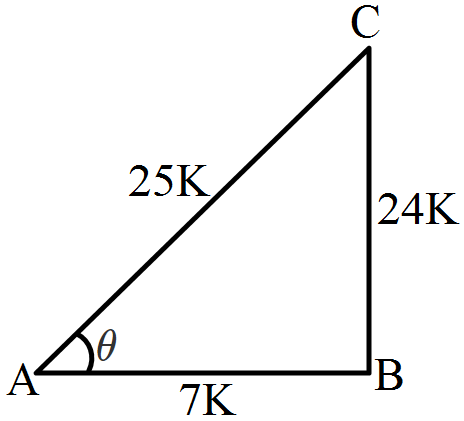
By pythagoras theorem, we have
$\text{AC}^2 = \text{AB}^2 + \text{BC}^2$
$\Rightarrow\text{BC}^2 = \text{AC}^2 - \text{BC}^2$
$\text{AB}^2=\Big[(25\text{k})^2=\big(\sqrt{7}\text{k}\big)^2\Big]$
$=\big(625\text{k}^2-49\text{k}^2\big)$
$=576\text{k}^2$
$\Rightarrow\text{BC}=\sqrt{576\text{k}^2}=24\text{k}$
$\therefore\sin\theta=\frac{\text{BC}}{\text{AC}}=\frac{24\text{k}}{25\text{k}}=\frac{24}{25},\cos\theta=\frac{7}{25}$ (Given)
$\tan\theta=\frac{\sin\theta}{\cos\theta}=\Big(\frac{24}{25}\times\frac{25}{7}\Big)=\frac{24}{7}$
$\text{cosec}\theta=\frac{1}{\sin\theta}=\frac{25}{24},$
$\sec\theta=\frac{1}{\cos\theta}=\frac{25}{7}$ and $\cot \theta=\frac{1}{\tan\theta}=\frac{7}{24}$ View full question & answer→Question 185 Marks
If $\theta=\frac{15}{8},$ find the value of the all T-ratios of $\theta.$
Answer
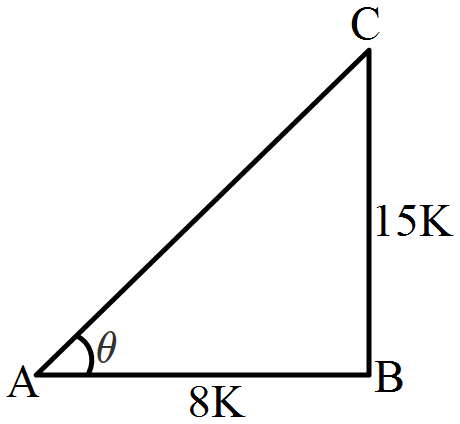 Given: $\tan\text{A}=\frac{\text{BC}}{\text{AB}}=\frac{15}{8}$
Let BC = 15k and AB = 8k, where k is positive.
Let us draw a $\triangle\text{ABC}$ in which $\angle\text{B}=90^\circ$ and $\angle\text{BAC}=\theta$
By pythagoras theorem, we have
$\text{AC}^2 = \text{AB}^2 + \text{BC}^2 $
$= (8\text{k})^2 + (15\text{k})^2 $
$= 64\text{k}^2 + 225\text{k}^2 = 289\text{k}^2$
$\Rightarrow\text{AC} = 17\text{k}$
Thus, we have
$\sin\theta=\frac{\text{BC}}{\text{AC}}=\frac{15\text{k}}{17\text{k}}=\frac{15}{17}$
$\cos\theta=\frac{\text{AB}}{\text{AC}}=\frac{8\text{k}}{17\text{k}}=\frac{8}{17}$
$\tan\theta=\frac{15}{8}$ (Given)
$\text{cosec}\theta=\frac{1}{\sin\theta}=\frac{17}{15}$
$\sec\theta=\frac{1}{\cos\theta}=\frac{17}{15}$
$\cot\theta=\frac{1}{\tan\theta}=\frac{8}{15}$ View full question & answer→Question 195 Marks
If $\tan\theta=\frac{\text{a}}{\text{b}},$ show that $\frac{(\text{a}\sin\theta-\text{b}\cos\theta)}{(\text{a}\sin\theta+\text{b}\cos\theta)}=\frac{\big(\text{a}^2-\text{b}^2\big)}{\big(\text{a}^2 +\text{b}^2\big)}.$
AnswerGiven:
$\tan\theta=\frac{\text{a}}{\text{b}}=\frac{\text{ak}}{\text{bk}}=\frac{\text{BC}}{\text{AB}}$
Let us draw a $\triangle\text{ABC}$ in which $\angle\text{B}=90^\circ$ and $\angle\text{A}=\theta$
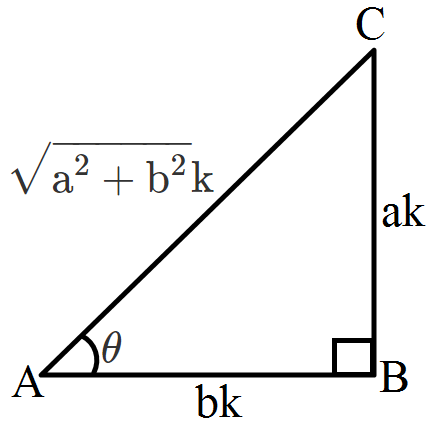
By pythagoras theoram, we have
$\text{AC}^2=\text{AB}^2+\text{BC}^2=\text{b}^2\text{k}^2+\text{a}^2\text{k}^2$
$\therefore\text{AC}=\sqrt{\text{a}^2+\text{b}^2}\text{k}$
$\sin\theta=\frac{\text{BC}}{\text{AC}}=\frac{\text{ak}}{\sqrt{\text{a}^2+\text{b}^2}\text{k}}=\frac{\text{a}}{\sqrt{\text{a}^2+\text{b}^2}}$
$\cos\theta=\frac{\text{AB}}{\text{AC}}=\frac{\text{bk}}{\sqrt{\text{a}^2+\text{b}^2}\text{k}}=\frac{\text{b}}{\sqrt{\text{a}^2+\text{b}^2}}$
$\text{L.H.S.}=\frac{\text{a}\sin\theta-\text{b}\cos\theta}{\text{a}\sin\theta+\text{b}\cos\theta}$
$=\frac{\text{a}\frac{\text{a}}{\sqrt{\text{a}^2+\text{b}^2}}-\text{b}.\frac{\text{b}}{\sqrt{\text{a}^2+\text{b}^2}}}{\text{a}\frac{\text{a}}{\sqrt{\text{a}^2+\text{b}^2}}+\text{b}.\frac{\text{b}}{\sqrt{\text{a}^2+\text{b}^2}}}=\frac{\frac{\text{a}^2-\text{b}^2}{\sqrt{\text{a}^2+\text{b}^2}}}{\frac{\text{a}^2+\text{b}^2}{\sqrt{\text{a}^2+\text{b}^2}}}=\frac{\text{a}^2-\text{b}^2}{\text{a}^2+\text{b}^2}$
$=\text{R.H.S.}$ View full question & answer→Question 205 Marks
In a $\triangle\text{ABC},\angle\text{B}=90^\circ,\angle\text{AB}=12\text{cm}$ and BC = 5cm.
Find:
- $\cos\text{A}$
- $\text{cosec}\text{A}$
- $\cos\text{C}$
- $\text{cosec}\text{C}.$
Answer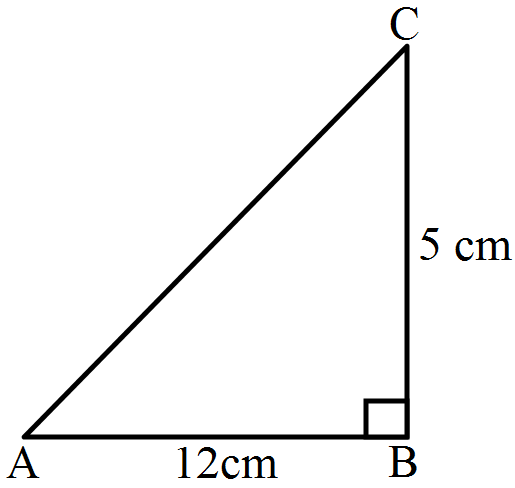
In $\triangle\text{ABC},\angle\text{B}=90^\circ$
AB = 12cm and BC = 5cm
By Pythagoras theorem, we have
$\text{AC}^2=\text{AB}^2+\text{BC}^2$
$=12^2+5^2=144+25=169$
$\Rightarrow\text{AC}=13\text{cm}$
- $\cos\text{A}=\frac{\text{Base}}{\text{Hypotenuse}}=\frac{\text{AB}}{\text{AC}}=\frac{12}{13}$
- $\text{cosec}\text{A}=\frac{\text{Hypotenuse}}{\text{Perpendicular}}=\frac{\text{AC}}{\text{BC}}=\frac{13}{5}$
- $\cos\text{C}=\frac{\text{Base}}{\text{Hypotenuse}}=\frac{\text{BC}}{\text{AC}}=\frac{5}{13}$
- $\text{cosec}\text{C}=\frac{\text{Hypotenuse}}{\text{Perpendicular}}=\frac{\text{AC}}{\text{AB}}=\frac{13}{12}$
View full question & answer→Question 215 Marks
If $\text{x}=\text{cosec}\text{A}+\cos\text{A}$ and $\text{y}=\text{cosec}\text{A}-\cos\text{A}$ then Prove that $\Big(\frac{2}{\text{x}+\text{y}}\Big)^2+\Big(\frac{\text{x}-\text{y}}{2}\Big)^2-1=0.$
Answer$\text{x}=\text{cosec}\text{A}+\cos\text{A}$ and $\text{y}=\text{cosec A}-\cos\text{A}$
Thus, we have
$\text{x}+\text{y}=(\text{cosec A}+\cos\text{A})\\+(\text{cosec A}-\cos\text{A})=2\text{cosec A}$
$\text{x}-\text{y}=(\text{cosec A}+\cos\text{A})\\-(\text{cosec A}-\cos\text{A})=2\cos\text{A}$
$\text{L.H.S.}=\Big(\frac{2}{\text{x}+\text{y}}\Big)^2+\Big(\frac{\text{x}-\text{y}}{2}\Big)^2-1$
$=\Big(\frac{2}{2\text{cosec A}}\Big)^2+\Big(\frac{2\cos\text{A}}{2}\Big)^2-1$
$=\Big(\frac{1}{\text{cosec A}}\Big)^2+(\cos\text{A})^2-1$
$=(\sin\text{A})^2+(\cos\text{A})^2-1$
$=\sin^2\text{A}+\cos^2\text{A}-1$
$=1-1$
$=0$
$=\text{R.H.S}$
View full question & answer→Question 225 Marks
In the figure of $\triangle\text{PQR},\angle\text{P}=\theta^\circ$and $\angle\text{R}=\phi^\circ.$
Find:
- $\big(\sqrt{\text{x}+1}\big)\cot\phi$
- $\big(\sqrt{\text{x}^3+\text{x}^2}\big)\tan\theta$
- $\cos\theta$
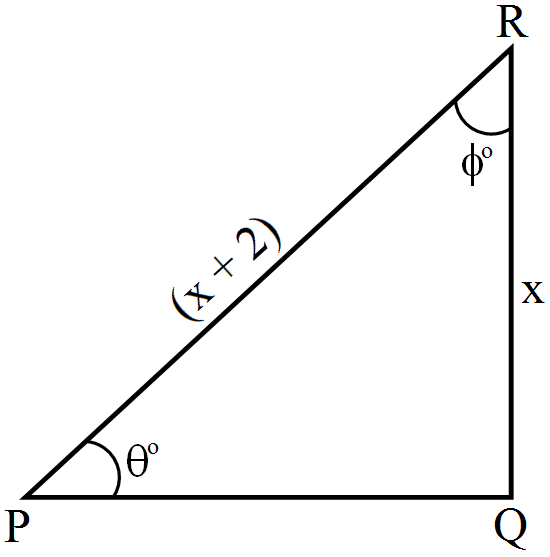
Answer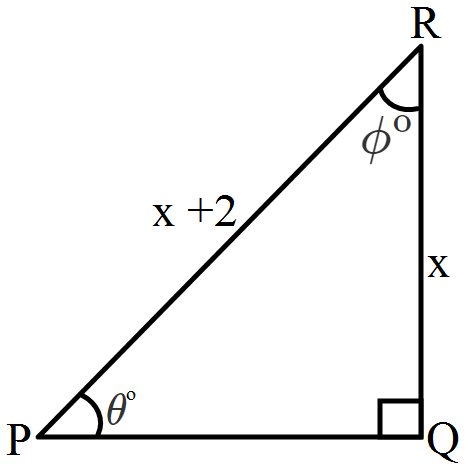
In $\triangle\text{PQR},\angle\text{Q}=90^\circ,\angle\text{P}=\theta^\circ$ and $\angle\text{R}=\phi^\circ$
By Pythagoras theorem, we have
$\text{PQ}^2=\text{PR}^2-\text{QR}^2$
$=\big(\text{x}+2\big)^2-\text{x}^2=\text{x}^2+4\text{x}+4-\text{x}^2=4(\text{x}+1)$
$\Rightarrow\text{PQ}=2\sqrt{\text{x}+1}$
Now, $\cot\phi=\frac{\text{QR}}{\text{PQ}}=\frac{\text{x}}{2\sqrt{\text{x}+1}}$ and $\tan\theta=\frac{\text{QR}}{\text{PQ}}=\frac{\text{x}}{2\sqrt{\text{x}+1}}$
$\big(\sqrt{\text{x}+1}\big)\cot\phi=\big(\sqrt{\text{x}+1}\big)\times\frac{\text{x}}{2\sqrt{\text{x}+1}}=\frac{\text{x}}{2}$
$\big(\sqrt{\text{x}^3+\text{x}^2}\big)\tan\theta=\big(\sqrt{\text{x}^2(\text{x}+1)}\big)\\\tan\theta=\text{x}\big(\sqrt{\text{x}+1}\big)\times\frac{\text{x}}{2\sqrt{\text{x}+1}}=\frac{\text{x}^2}{2}$
$\cos\theta=\frac{\text{PQ}}{\text{PR}}=\frac{2\sqrt{\text{x}+1}}{\text{x}+2}$ View full question & answer→Question 235 Marks
In a right $\triangle\text{ABC},$ right-angled at B, if $\tan\text{A}=1$ then verify that $2\sin\text{A}\cdot\cos\text{A}=1.$
Answer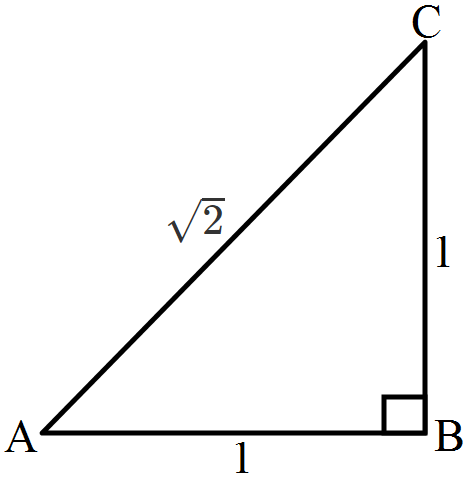 $\tan\text{A}=1$
Consider $\triangle\text{ABC},$ where $\angle\text{B}=90^\circ$
Then, $\tan\text{A}=\frac{\text{Perpendicular}}{\text{Base}}=\frac{\text{BC}}{\text{AB}}=\frac11$
Let BC = 1 and AB = 1
Then, by Pythagoras theoram,
$\text{AC}^2=\text{AB}^2+\text{BC}^2$
$=2^2+1^2=1=2$
$\Rightarrow\text{AC}=\sqrt{2}$
Now,
$\sin\text{A}=\frac{\text{Perpendicular}}{\text{Hypotenuse}}=\frac{\text{BC}}{\text{AC}}=\frac{1}{\sqrt{2}}$
$\cos\text{A}=\frac{\text{Base}}{\text{Hypotenuse}}=\frac{\text{AB}}{\text{AC}}=\frac{1}{\sqrt{2}}$
$\therefore\text{L.H.S.}=2\sin\text{A}\cdot\cos\text{A}$
$=2\times\frac{1}{\sqrt{2}}\times\frac{1}{\sqrt{2}}$
$=\frac22$
$=1$
$=\text{R.H.S.}$ View full question & answer→Question 245 Marks
If $\cot\theta=\frac{3}{4},$ show that $\sqrt{\frac{\sec\theta-\text{cosec}\theta}{\sec\theta+\text{cosec}\theta}}=\frac{1}{\sqrt{7}}.$
Answer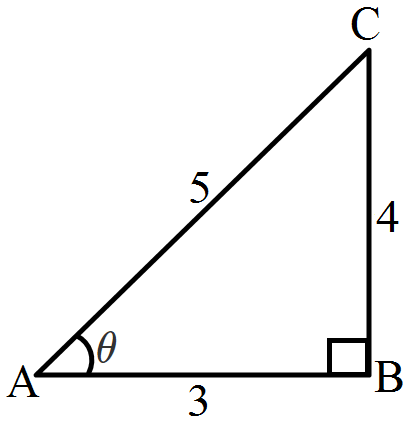
$\cot\theta=\frac34$
Consider $\triangle\text{ABC},$ where $\angle\text{B}=90^\circ$ and $\angle\text{A}=\theta$
Then, $\cot\theta=\frac{\text{Base}}{\text{Hypotenuse}}=\frac{\text{AB}}{\text{AC}}=\frac34$
Let AB = 3 and BC = 4
Then, by pythagoras theorem,
$AC^2 = AB^2 + BC^2$
$\Rightarrow 3^2 + 4^2$
$= 9 + 16 = 25$
$\Rightarrow AC = 5$
Now,
$\sec\theta=\frac{\text{Hypotenuse}}{\text{Base}}=\frac{\text{AC}}{\text{AB}}=\frac53$
$\text{cosec}\theta=\frac{\text{Hypotenuse}}{\text{Perpendicular}}=\frac{\text{AC}}{\text{BC}}=\frac54$
$\therefore\text{L.H.S.}=\sqrt{\frac{\sec\theta-\text{cosec}\theta}{\sec\theta-\text{cosec}\theta}}$
$=\sqrt{\frac{\frac{5}{3}-\frac{5}{4}}{\frac{5}{4}+\frac{5}{4}}}$
$=\sqrt{\frac{\frac{20-15}{12}}{\frac{20+15}{12}}}$
$=\sqrt{\frac{5}{35}}$
$=\sqrt{\frac{1}{7}}$
$=\frac{1}{\sqrt{7}}$
$=\text{R.H.S.}$ View full question & answer→Question 255 Marks
In a $\triangle\text{ABC},\angle\text{B}=90^\circ$ and $\tan\text{A}=\frac{1}{\sqrt{3}}.$ Prove that:
- $\sin\text{A}\cdot\cos\text{C}+\cos\text{A}\cdot\sin\text{C}=1$
- $\cos\text{A}\cdot\cos\text{C}-\sin\text{A}\cdot\sin\text{C}=0$
Answer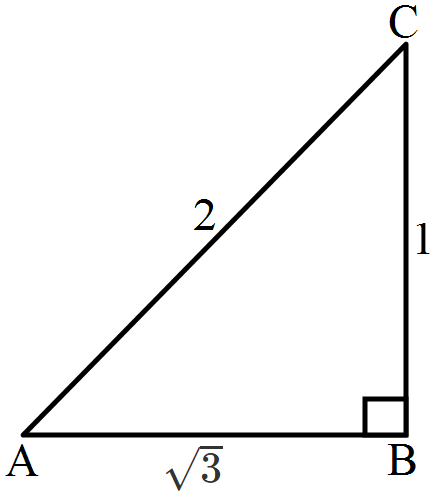
$\tan\text{A}=\frac{1}{\sqrt{3}}$
Consider $\triangle\text{ABC},$ where $\angle\text{B}=90^\circ$
Then, $\tan\text{A}=\frac{\text{Perpendicular}}{\text{Base}}=\frac{\text{BC}}{\text{AB}}=\frac{1}{\sqrt{3}}$
Let BC = 1 and $\text{AB}=\sqrt{3}$
Then, by Pythagoras theoram,
$\text{AC}^2=\text{AB}^2+\text{BC}^2$
$=\big(\sqrt{3}\big)^2+1^2=3+1=4$
$\Rightarrow\text{AC}=2$
Now,
$\sin\text{A}=\frac{\text{Perpendicular}}{\text{Hypotenuse}}=\frac{\text{BC}}{\text{AC}}=\frac12$ and $\cos\text{A}=\frac{\text{Base}}{\text{Hypotenuse}}=\frac{\text{AB}}{\text{AC}}=\frac{\sqrt{3}}{2}$
$\sin\text{C}=\frac{\text{Perpendicular}}{\text{Hypotenuse}}=\frac{\text{AB}}{\text{AC}}=\frac{\sqrt{3}}{2}$ and $\cos\text{C}=\frac{\text{Base}}{\text{Hypotenuse}}=\frac{\text{AB}}{\text{AC}}=\frac{1}{2}$
- $\text{L.H.S.}=\sin\text{A}\cos\text{C}+\cos\text{A}\sin\text{C}$
$=\frac12\times\frac12+\frac{\sqrt{3}}{2}\times\frac{\sqrt{3}}{2}$
$=\frac14+\frac{3}{4}$
$=\frac44$
$=1$
$=\text{R.H.S.}$
- $\text{L.H.S.}=\cos\text{A}\cos\text{C}-\sin\text{A}\sin\text{C}$
$=\frac{\sqrt{3}}{2}\times\frac12-\frac12\times\frac{\sqrt{3}}{2}$
$=\frac{\sqrt{3}}{4}-\frac{\sqrt{3}}{4}$
$=0$
$=\text{R.H.S.}$ View full question & answer→Question 265 Marks
If $\sec\theta=\frac{5}{4},$ show that $\frac{\big(\sin\theta-2\cos\theta\big)}{\big(\tan\theta-\cot\theta\big)}=\frac{12}{7}.$
View full question & answer→Question 275 Marks
If $\angle\text{A}$ and $\angle\text{B}$ are acute angles such that $\sin\text{A}=\sin\text{B}$ then prove that $\angle\text{A}=\angle\text{B}.$
AnswerConsider two right $\triangle\text{XAY}$ and WBZ such that $\sin\text{A}=\sin\text{B}$
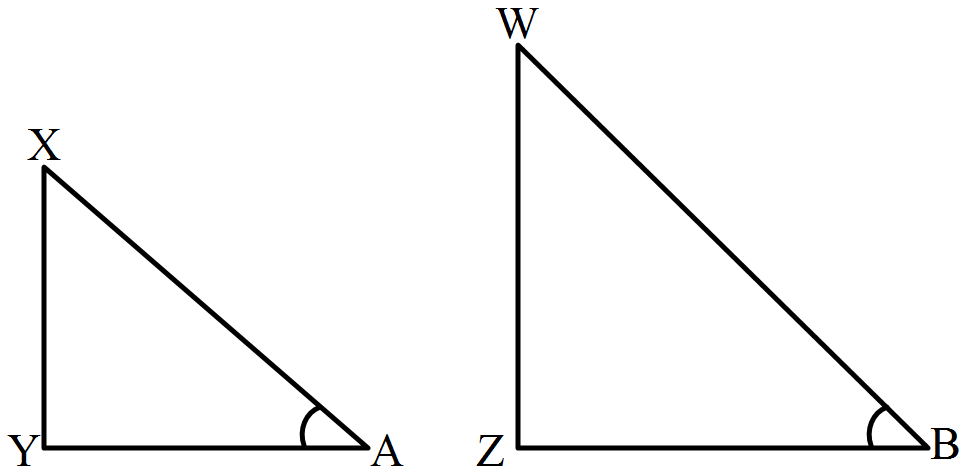
We have,
$\sin\text{A}=\frac{\text{XY}}{\text{XA}}$ and $\sin\text{B}=\frac{\text{WZ}}{\text{WB}}$
Since $\sin\text{A}=\sin\text{B}$
$\Rightarrow\frac{\text{XY}}{\text{XA}}=\frac{\text{WZ}}{\text{WB}}$
$\Rightarrow\frac{\text{XY}}{\text{WZ}}=\frac{\text{XA}}{\text{WB}}=\text{k}(\text{say})\dots(\text{i})$
$\Rightarrow\text{XY}=\text{k}\times\text{WZ}$ and $\text{XA}=\text{k}\times\text{WB}\dots(\text{ii})$
Using Pythagoras theoram in $\triangle\text{XAY}$ and WBZ, we have
$\text{XA}^2=\text{XY}^2+\text{AY}^2$ and $\text{WB}^2=\text{WZ}^2+\text{BZ}^2$
$\Rightarrow\text{AY}=\sqrt{\text{XA}^2-\text{XY}^2}$ and $\text{BZ}=\sqrt{\text{WB}^2-\text{WZ}^2}$
$\Rightarrow\frac{\text{AY}}{\text{BZ}}=\frac{\sqrt{\text{XA}^2-\text{XY}^2}}{\sqrt{\text{WB}^2-\text{WZ}^2}}=\frac{\sqrt{\text{k}^2\text{WB}^2-\text{k}^2\text{WZ}^2}}{\sqrt{\text{WB}^2-\text{WZ}^2}}$
$\Rightarrow\frac{\text{AY}}{\text{BZ}}=\text{k}\dots(\text{iii})$
From (i), (ii) and (iii), we get
$\frac{\text{XY}}{\text{WZ}}=\frac{\text{XA}}{\text{WB}}=\frac{\text{AY}}{\text{BZ}}$
$\Rightarrow\triangle\text{XYA}\sim\triangle\text{WZB}$
$\Rightarrow\angle\text{A}=\angle\text{B}$ View full question & answer→Question 285 Marks
If $\angle\text{A}$ and $\angle\text{B}$ are acute angles such that $\tan\text{A}=\tan\text{B}$ then prove that $\angle\text{A}=\angle\text{B}.$
AnswerConsider two right $\triangle\text{XAY}$ and WBZ such that $\tan\text{A}=\tan\text{B}$
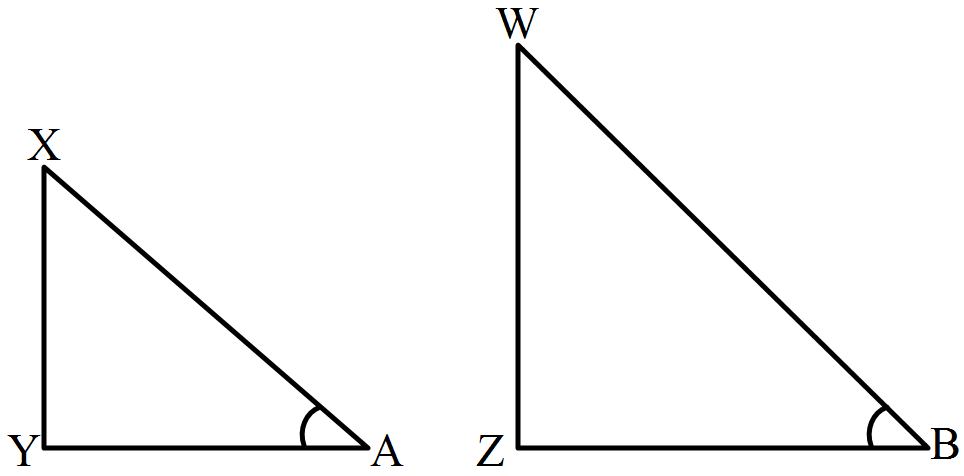
We have,
$\tan\text{A}=\frac{\text{XY}}{\text{XA}}$ and $\tan\text{B}=\frac{\text{WZ}}{\text{WB}}$
Since $\tan\text{A}=\tan\text{B}$
$\Rightarrow\frac{\text{XY}}{\text{AY}}=\frac{\text{WZ}}{\text{BZ}}$
$\Rightarrow\frac{\text{XY}}{\text{WZ}}=\frac{\text{AY}}{\text{BZ}}=\text{k}(\text{say})\dots(\text{i})$
$\Rightarrow\text{XY}=\text{k}\times\text{WZ}$ and $\text{AY}=\text{k}\times\text{BZ}\dots(\text{ii})$
Using Pythagoras theoram in $\triangle\text{XAY}$ and WBZ, we have
$\text{XA}^2=\text{XY}^2+\text{AY}^2$ and $\text{WB}^2=\text{WZ}^2+\text{BZ}^2$
$\Rightarrow\text{XA}^2={\text{k}^2\text{WZ}^2+\text{k}^2\text{BZ}^2}$ and $\text{WB}^2={\text{WZ}^2+\text{BZ}^2}$
$\Rightarrow\text{XA}^2={\text{k}^2\big(\text{WZ}^2+\text{BZ}^2}\big)$ and $\text{WB}^2={\text{WZ}^2+\text{BZ}^2}$
$\Rightarrow\frac{\text{XA}^2}{\text{WB}^2}=\frac{\text{k}^2\big({\text{WZ}^2+\text{BZ}^2\big)}}{\big({\text{WZ}^2+\text{BZ}^2\big)}}=\text{k}^2$
$\Rightarrow\frac{\text{XA}}{\text{WB}}=\text{k}\dots(\text{iii})$
From (i), (ii) and (iii), we get
$\frac{\text{XY}}{\text{WZ}}=\frac{\text{AY}}{\text{BZ}}=\frac{\text{XA}}{\text{WB}}$
$\Rightarrow\triangle\text{AYX}\sim\triangle\text{BZW}$
$\Rightarrow\angle\text{A}=\angle\text{B}$ View full question & answer→