MCQ 11 Mark
$\mathrm{H}_2 \mathrm{O}_2+\mathrm{O}_3 \rightarrow \mathrm{H}_2 \mathrm{O}+2 \mathrm{O}_2$, in this reaction :
- A
$\mathrm{H}_2 \mathrm{O}_2$ is bleached.
- ✓
$\mathrm{H}_2 \mathrm{O}_2$ is oxidised.
- C
$\mathrm{H}_2 \mathrm{O}_2$ is dehydrated.
- D
$\mathrm{H}_2 \mathrm{O}_2$ is neither oxidised nor reduced.
AnswerCorrect option: B. $\mathrm{H}_2 \mathrm{O}_2$ is oxidised.
Oxidation half reactions is,
$\mathrm{H}_2 \mathrm{O}_2 \rightarrow 2 \mathrm{H}^{+}+\mathrm{O}_2+2 \mathrm{e}^{-}$
View full question & answer→MCQ 21 Mark
What is the oxidation number of lithium in $\ce{LiCl}\ ?$
AnswerOxidation number of $\ce{Li}$ in $\ce{LiCl } : x − 1 = 0$
$\Rightarrow x = +1$
View full question & answer→MCQ 31 Mark
In $\mathrm{Ni}(\mathrm{CO})_4,$ the oxidation state of $\ce{Ni}$ is?
AnswerIn nickel tetracarbonyl, the oxidation state for nickel is assigned as zero. The formula conforms to the $18-$ electron rule. The molecule is tetrahedral, with four carbonyl $($carbon monoxide$)$ ligands attached to nickel.
View full question & answer→MCQ 41 Mark
Which of the following elements does not show disproportionation tendency?
- A
$\ce{Cl}$
- B
$\ce{Br}$
- ✓
$\ce{F}$
- D
$\ce{I}$
AnswerCorrect option: C. $\ce{F}$
Being the most electronegative element, $F$ can only be reduced and hence it always shows an oxidation number of $-1$. Further, due to the absence of $d-$ orbitals, it cannot be oxidized and hence it does not show $+ve$ oxidation numbers. In other words, $F$ cannot be simultaneously oxidized as well as reduced and hence does not show disproportionation reactions. Thus, option $(c)$ is correct.
View full question & answer→MCQ 51 Mark
Which of the following is not an example of redox reaction?
- A
$\text{CuO}+\text{H}_2\xrightarrow{ \ \ \ \ \ \ \ \ \ }\text{Cu}+\text{H}_2\text{O}$
- B
$\text{Fe}_2\text{O}_3+3\text{CO}\xrightarrow{ \ \ \ \ \ \ \ \ \ }2\text{Fe}+3\text{CO}_2$
- C
$2\text{K}+\text{F}_2\xrightarrow{ \ \ \ \ \ \ \ }2\text{KF}$
- ✓
$\text{BaCl}_2+\text{H}_2\text{SO}_4\xrightarrow{ \ \ \ \ \ \ \ \ }\text{BaSO}_4+2\text{HCl}$
AnswerCorrect option: D. $\text{BaCl}_2+\text{H}_2\text{SO}_4\xrightarrow{ \ \ \ \ \ \ \ \ }\text{BaSO}_4+2\text{HCl}$
$\text{BaCl}_2+\text{H}_2\text{SO}_4\xrightarrow{ \ \ \ \ \ \ \ \ }\text{BaSO}_4+2\text{HCl}$ is not a redox reaction. It is an example of double displacement reactions.
View full question & answer→MCQ 61 Mark
Which of the following metal displacement reaction will not take place and why?
- ✓
$\text{Cu}+\text{Mg}^{2+}\xrightarrow{ \ \ \ \ \ \ \ }$
- B
$\text{Mg}+\text{Cu}^{2+}\xrightarrow{ \ \ \ \ \ \ \ }$
- C
$\text{Pb}+\text{Ag}^+\xrightarrow{ \ \ \ \ \ \ \ }$
- D
$\text{Zn}+\text{Cu}^{2+}\xrightarrow{ \ \ \ \ \ \ \ }$
AnswerCorrect option: A. $\text{Cu}+\text{Mg}^{2+}\xrightarrow{ \ \ \ \ \ \ \ }$
Will not take place because $'\text{Cu}\ '$ is less reactive than $\text{Mg}.$
View full question & answer→MCQ 71 Mark
In which of the following groups of iodine compounds shows increasing order of oxidation states :
- ✓
$\ce{HlO_4, ICl, I_2, Hl}$
- B
$\ce{Hl, I_2, IC, HIO_4}$
- C
$\ce{I_2, HI, HIO_4 , HI}$
- D
$\ce{ICl HIO_4,HI, I_2}$
AnswerCorrect option: A. $\ce{HlO_4, ICl, I_2, Hl}$
$\mathrm{HI}(-1), \mathrm{I}_2(\mathrm{O}), \mathrm{ICl}(+1), \mathrm{HIO}_4(+7)$
View full question & answer→MCQ 81 Mark
The formation of nitrous oxide from nitrogen and oxygen is the example for
- A
- B
Chemical combination of one element and one compound.
- C
Chemical combination of two compounds.
- ✓
Chemical combination of two elements.
AnswerCorrect option: D. Chemical combination of two elements.
The formation of nitrous oxide from nitrogen and oxygen is the example for chemical combination of two elements.
$\text{N}_2\text{O}\rightleftarrows\text{N}_2+\text{O}.$
$\text{N}_2\text{O}\rightleftarrows\text{N}_2+\text{O}_2$
View full question & answer→MCQ 91 Mark
Oxidation number of $C$ in $\text{HNC}$ is $ ..........$
AnswerOxidation number of hydrogen is $+1.$
As nitrogen is more electronegative than carbon so its oxidation number is $-3$.
Net charge on compound is zero.
Now we can find oxidation number of carbon:
Let oxidation number of carbon is $x,$
$1 + (−3) + x = 0$
$x = +2$
View full question & answer→MCQ 101 Mark
Which of the following is a redox reaction $($disproportionation reaction$).$
- A
$\text{PCl}_3+3\text{H}_2\text{O}\xrightarrow{ \ \ \ \ \ \ \ \ \ \ \ }\text{H}_3\text{PO}_3+3\text{HCL}$
- B
$\text{CO}^{3+}+6\text{NO}_2^-\xrightarrow{\ \ \ \ \ \ \ \ \ }[\text{CO(NO}_2)_6]^{3-}$
- C
$\text{Hg}_2\text{CrO}_4+2\text{OH}^-\xrightarrow{ \ \ \ \ \ \ \ \ }\text{Hg}_2\text{O}+\text{CrO}_4^{2-}+\text{H}_2\text{O}$
- ✓
$3\text{Br}_2+6\text{OH}^-\xrightarrow{ \ \ \ \ \ \ \ }5\text{Br}^-+\text{BrO}_3^-+3\text{H}_2\text{O}$
AnswerCorrect option: D. $3\text{Br}_2+6\text{OH}^-\xrightarrow{ \ \ \ \ \ \ \ }5\text{Br}^-+\text{BrO}_3^-+3\text{H}_2\text{O}$
$\because$ Oxidation state of $\ce{Br_2}$ is increasing from $0$ to $+5,$ decreasing from $0$ to $-1$.
View full question & answer→MCQ 111 Mark
Plumbous ion is represented as :
- ✓
$ \mathrm{Pb}^{+2}$
- B
$ \mathrm{~Pb}^{+4}$
- C
$ \mathrm{~Pb}^{+3} $
- D
$\mathrm{~Pb}^{+1}$
AnswerCorrect option: A. $ \mathrm{Pb}^{+2}$
$\mathrm{~Pb}^{2+}=$ Plumbous ion
$\mathrm{~Pb}^{4+}=$ Plumbic ion
View full question & answer→MCQ 121 Mark
What is the oxidation state of $\text{Mn}$ in the compound $\ce{K_2MnO_4}\ ?$
View full question & answer→MCQ 131 Mark
In which of the following, the highest oxidation state is not possible?
AnswerCorrect option: B. $\mathrm{XeF}_8$
$\ce{Xe}$ shows $+8$ oxidation state in $\mathrm{XeF}_8$ but it does not exist because of steric hindrance of $8F$ atoms.
View full question & answer→MCQ 141 Mark
What is the oxidation number of $O$ in a diatomic molecule $\ce{(O_2)}\ ?$
AnswerThe oxidation state of any element in its native state is zero.
View full question & answer→MCQ 151 Mark
The reaction, $\text{2H}_2\text{O(I)}\xrightarrow{\ \ \ \ \Delta\ \ \ }\text{2H}_2\text{(g)}+\text{O}_2\text{(g)}$ is an example of :
View full question & answer→MCQ 161 Mark
The given reactions such as :
$i. \mathrm{Zn}+2 \mathrm{HCl} \rightarrow \mathrm{ZnCl}_2+\mathrm{H}_2$
$ii. \mathrm{Fe}+2 \mathrm{HCl} \rightarrow \mathrm{FeCl}_2+\mathrm{H}_2$
Are represented as :
- A
Displacement of zinc and iron metals.
- B
Displacement of only zinc metals.
- C
Displacement of only iron metals.
- ✓
Displacement of hydrogen.
AnswerCorrect option: D. Displacement of hydrogen.
View full question & answer→MCQ 171 Mark
Identify disproportionation reaction :
- A
$\text{CH}_4+2\text{O}_2\xrightarrow{ \ \ \ \ \ \ \ \ }\text{CO}_2+2\text{H}_2\text{O}$
- B
$\text{CH}_4+4\text{Cl}_2\xrightarrow{ \ \ \ \ \ \ \ \ }\text{CCl}_4+4\text{HCl}$
- C
$2\text{F}_2+2\text{OH}^-\xrightarrow{ \ \ \ \ \ \ \ \ }2\text{F}^-+\text{OF}_2+\text{H}_2\text{O}$
- ✓
$2\text{NO}_2+2\text{OH}^-\xrightarrow{ \ \ \ \ \ \ \ \ }\text{NO}^-_2+\text{NO}^-_3+\text{H}_2\text{O}$
AnswerCorrect option: D. $2\text{NO}_2+2\text{OH}^-\xrightarrow{ \ \ \ \ \ \ \ \ }\text{NO}^-_2+\text{NO}^-_3+\text{H}_2\text{O}$
Reactions in which the same substance is oxidized as well as reduced are called disproportionation reactions.
Writing the $O.N$. of each element above its symbol in the given reactions,
- $\stackrel{-4+1}{\text{CH}}_4+\stackrel{0}{\text{2O}}_2\xrightarrow{ \ \ \ \ \ \ \ \ }\stackrel{+4-2}{\text{CO}}_2+\stackrel{+1-2}{\text{2H}}_2\text{O}$
- $\stackrel{-4+1}{\text{CH}}_4+\stackrel{0}{\text{4Cl}}_2\xrightarrow{ \ \ \ \ \ \ \ \ }\stackrel{+4-1}{\text{CCl}}_4+\stackrel{+1-1}{\text{4HCl}}\text{}$
- $2\stackrel{0}{\text{F}}_2+\stackrel{-2+1}{\text{2OH}^-}\xrightarrow{ \ \ \ \ \ \ \ \ }\stackrel{-1}{\text{2F}^-+}\stackrel{+2-1}{\text{OF}_2}+\stackrel{+1-2}{\text{H}_2\text{O}}$
- $\stackrel{+4-2}{\text{2NO}_2}+\stackrel{-2+1}{\text{2OH}^-}\xrightarrow{ \ \ \ \ \ \ \ \ }\stackrel{+3-2}{\text{NO}^-_2}+\stackrel{+5-2}{\text{NO}^-_3}+\stackrel{+1-2}{\text{H}_2\text{O}}$
Thus, in reaction $(d), N$ is both oxidized as well as reduced since the $O . N $. of $N$ increases from $+4$ in $\mathrm{NO}_2$ to $+5$ in $ \mathrm{NO}^{-}3$ and decreases from $+4$ in $\mathrm{NO}_2$ to $+3$ in $\mathrm{NO}^{-} 2$. View full question & answer→MCQ 181 Mark
Which among the following shows maximum oxidation state?
Answer
| Metal |
Maximum Oxidation state |
| $V$ |
$+3$ |
| $Cr$ |
$+6$ |
| $Fe$ |
$+3$ |
| $Mn$ |
$+7$ |
View full question & answer→MCQ 191 Mark
What is the oxidation state of central atom in $\ce{Ca[PtCl_4]}\ ?$
Answer$\mathrm{Ca}\left[\mathrm{PtCl}_4\right] \Leftrightarrow \mathrm{Ca}^{+2}[\mathrm{PtCl} 4]^{2-}$
$\text { Take }[\mathrm{PtCl} 4]^{2-} \text {. Central atom }=\mathrm{Pt} \text {. }$
Let $x$ be the oxidation no. of $\ce{Pt},$
$\ce{Cl}$ oxidation no. is $−1.$
$x + 4(−1) = −2$
$x − 4 = −2$
$x = 2$
View full question & answer→MCQ 201 Mark
The oxidation state of the underlined element in the given compound is : $\ce{BaCl_2}$
Answer$\ce{BaCl_2}$
$\Rightarrow x + (−2) = 0$
$\Rightarrow x = 2$
As chlorine needs only one electron to get octet.
View full question & answer→MCQ 211 Mark
The oxidation numbers of the sulphur atoms in peroxy monosulphuric acid $\ce{(H_2 SO_5)}$ and peroxydisulphuric and $\ce{(H_2S_2O_8)}$ are respectively.
- A
$+8$ and $+7$
- B
$+3$ and $+3$
- ✓
$+6$ and $+6$
- D
$+4$ and $+6$
AnswerCorrect option: C. $+6$ and $+6$
By looking the structure of $\ce{H_2 SO_5},$ we can observe that there are two oxygen atoms which are linked by peroxide linkage so their oxidation numbers are $-1.$
Rest oxygen atoms attached normally so their oxidation state is $-2.$
The oxidation number of hydrogen is $+1.$
So oxidation number of sulphur is
$2(+1) + x + 2(−1) + 3(−2) = 0, x = +6$
View full question & answer→MCQ 221 Mark
In which of the following compounds, is the oxidation number of sulphur is the least?
AnswerCorrect option: C. $ \mathrm{Na}_2 \mathrm{~S}_4 \mathrm{O}_8 $
The oxidation number of sulphur in $\ce{SO_2,SO_3,Na_2 SO_4}$ and $\ce{H_2SO_4}$ are $+4,+6,+2.5$ and $+6$ respectively.
View full question & answer→MCQ 231 Mark
In the electrochemical series, metals are arranged in order of their tendency to :
- A
Release halogens from their salts.
- B
- C
- ✓
AnswerIn the electrochemical series, metals are arrange in order of their tendency to lose electrons.
Oxidation potential increases down the group. $($tendency to lose electron increases$).$
Reduction potentials decreases down the group. $($tendency to gain $e−$ decreases$).$
View full question & answer→MCQ 241 Mark
The oxidation numbers of sulphur in $\ce{S_8, S_2 , F_2}$ and $\ce{F_2S}$ respectively, are :
- A
$0, +1$ and $−2$
- B
$+2, +1$ and $−2$
- ✓
$0, +1$ and $+2$
- D
$−2, +1$ and $−2$
AnswerCorrect option: C. $0, +1$ and $+2$
View full question & answer→MCQ 251 Mark
Oxygen has an oxidation state of $+2$ in.
- A
$\ce{H_2O_2}$
- ✓
$\ce{OF_2}$
- C
$\ce{SO_2}$
- D
$\ce{H_2O}$
AnswerCorrect option: B. $\ce{OF_2}$
Oxidation state of oxygen is always $-2$ except in peroxides,superoxides and when it reacts with fluorine.
In $\ce{H_2O_2},$ oxidation state of $H$ is $+1,$ so oxidation state of oxygen is $-1.$
In $\ce{OF_2}$, oxidation state of $F$ is $-1,$ so oxidation state of oxygen is $+2.$
In $\ce{SO_2}$ and $\ce{H_2O}$, oxidation state of oxygen is $-2.$
View full question & answer→MCQ 261 Mark
Metals exhibit $........$ oxidation states in their compounds.
AnswerAs metals have great tendency in donating electrons it will have positive oxidation states.
For example $\ce{Na}$ is metal has atomic number $11$
So electronic configuration is $2, 8, 1$
So after donating one electron its octet get completed and become stable and becomes $\ce{Na}^+$
View full question & answer→MCQ 271 Mark
Oxidation state of nitrogen in $\ce{NH_2OH}$ is :
AnswerLet $x$ be the oxidation state of $N$ in $\ce{NH_2OH}$.
Since the overall charge on the complex is $0,$ the sum of oxidation states of all elements in it should be equal to $0.$
Therefore, $x + 2 − 1 = 0$ or, $x = −1$.
View full question & answer→MCQ 281 Mark
The oxidation number of chromium in $\ce{CrO_5}$ is :
AnswerThe oxidation number of chromium in chromium pentaoxide is $6.$
View full question & answer→MCQ 291 Mark
The lowest possible oxidation number for hydrogen is :
MCQ 301 Mark
The sum of oxidation number of all the atoms in a neutral molecule must be zero.
AnswerThe sum of oxidation number of all the atoms in a neutral molecule must be zero.
For example, neutral molecules such as $\mathrm{O}_2, \mathrm{P}_4, \mathrm{O}_3, \mathrm{~S}_8$ and $\mathrm{KMnO}_4$ have the sum of oxidation number of all the atoms equal to zero.
For an ion, the sum of oxidation number of all the atoms is equal to the charge on the ion.
For example, in cyanide ion $\ce{(CN}^-$), the sum of oxidation number of all the atoms is equal to $−1.$
In ammonium ion $\ce{(NH_4})+,$ the sum of oxidation number of all the atoms is equal to $+1.$
View full question & answer→MCQ 311 Mark
Which titrant is used in the Iodometric titration which involves $\ce{I_2} ?$
AnswerCorrect option: C. $ \mathrm{Na}_2 \mathrm{S}_2 \mathrm{O}_3$
Iodometry is one of the most important redox titration methods. Iodine reacts directly, fast and quantitively with many organic and inorganic substances.
Thanks to its relatively low, $\ce{pH}$ independent redox potential, and reversibility of the iodine/ iodide reaction, iodometry can be used both to determine amount of reducing agents $($by direct titration with iodine$)$ and of oxidizing agents $($by titration of iodine with thiosulfate$).$
View full question & answer→MCQ 321 Mark
In $\ce{MgCl_2},$ the oxidation number of chlorine is :
AnswerIn $\ce{MgCl_2},$ oxidation number of $\ce{Cl}$ is :
$\Rightarrow 2 + 2x = 0$
$\Rightarrow x = −1.$
View full question & answer→MCQ 331 Mark
The oxidation state of $\ce{Cr}$ in $\mathrm{K}_2 \mathrm{Cr}_2 \mathrm{O}_7$ is :
Answer$\mathrm{K}_2 \mathrm{Cr}_2 \mathrm{O}_7$
Let the oxidation state of $\ce{Cr}$ is $x.$
$2(+1) + 2x + 7(−2) = 0$
$+2 + 2x − 14 = 0$
$2x − 12 = 0$
$2x = 12$
$x = +6$
View full question & answer→MCQ 341 Mark
In the given reaction, $\mathrm{CH}_2=\mathrm{CH}_2(\mathrm{~g})+\mathrm{H}_2(\mathrm{~g}) \rightarrow \mathrm{CH}_3-\mathrm{CH}_3(\mathrm{~g})$ ethene undergoes :
Answer$\mathrm{CH}_2=\mathrm{CH}_2+\mathrm{H}-\mathrm{H} \rightarrow \mathrm{H}_3 \mathrm{C}-\mathrm{CH}_3$
$($Addition of hydrogen$)$
Because of the addition of hydrogen, there occurs reduction of ethylene.
View full question & answer→MCQ 351 Mark
Tailing of mercury is $ .......... $ redox change.
AnswerWhen ozone is passed through mercury, mercurous oxide $\ce{(Hg_2O)}$ is formed.
Due to this, mercury loses its meniscus and starts sticking to the glass.
This phenomenon is known as Tailing of mercury.
$2 \mathrm{Hg}+\mathrm{O}_3 \rightarrow \mathrm{Hg}_2 \mathrm{O}+\mathrm{O}_2$.
In this reaction, the oxidation number of mercury changes from $0$ to $+1$. Thus, it is oxidized.
The oxidation number of oxygen changes from 0 to $-2$. Thus, it is reduced.
View full question & answer→MCQ 361 Mark
The half $-$ cell reaction is the one that :
- ✓
Takes place at one electrode.
- B
Consumes half a unit of electricity.
- C
Involves half a mole of electrolyte.
- D
Goes half way to completion.
AnswerCorrect option: A. Takes place at one electrode.
A half reaction is either the oxidation or reduction reaction component of a redox reaction. A half reaction is obtained by considering the change in oxidation states of individual substances involved in the redox reaction. Half $-$ reactions are often used as a method of balancing redox reactions.
View full question & answer→MCQ 371 Mark
The oxidation state of the most electronegative element in the products of the reaction between $\mathrm{BaO}_2$ and $\mathrm{H}_2 \mathrm{SO}_4$ are :
- A
$0$ and $−1$
- ✓
$−1$ and $−2$
- C
$−2$ and $0$
- D
$−2$ and $+1$
AnswerCorrect option: B. $−1$ and $−2$
$\mathrm{BaO}_2+\mathrm{H}_2 \mathrm{SO}_4 \rightarrow \mathrm{BaSO}_4+\mathrm{H}_2 \mathrm{O}_2$
The most electronegative element in the product is oxygen.
The oxidation state of oxygen in $\mathrm{BaSO}_4$ is $-2$ and in $\mathrm{H}_2 \mathrm{O}_2$ is $-1 .$
View full question & answer→MCQ 381 Mark
AnswerHeat is released in exothermic reactions.
View full question & answer→MCQ 391 Mark
When $P$ reacts with caustic soda, the products are $\ce{PH_3}$ and $\ce{NaH_2PO_2}$. The reaction is an example of.
- A
- B
- ✓
Both oxidation and reduction.
- D
AnswerCorrect option: C. Both oxidation and reduction.
$\mathrm{P}_4+3 \mathrm{NaOH}+3 \mathrm{H}_2 \mathrm{O} \rightarrow \mathrm{PH}_3+3\mathrm{NaH}_2 \mathrm{PO}_2$
In reactant $P$ is present in $(0)$ oxidation state and in $\ce{PH_3}$ , it is present in $(-3)$ oxidation state and in $\ce{NaH_2PO_2}$ it is present in $(+1)$ oxidation state.
View full question & answer→MCQ 401 Mark
The rods of transition metals such as copper and zinc where potential difference is generated, are termed as :
MCQ 411 Mark
Standard reduction frotential of $\text{X, Y, Z}$ are ${-1.2v, +0.5v, -3.0v}$ respectively, the reducing power of the metals will be :
- ✓
$\text{Y > Z > X}$
- B
$\text{Y > X > Z}$
- C
$\text{Z > X > Y}$
- D
$\text{X > Y > Z}$
AnswerCorrect option: A. $\text{Y > Z > X}$
$'Z\ '$ is best because it has lowest standard reduction potential whereas $'Y\ '$ is weakest due to highest standard reduction potential.
View full question & answer→MCQ 421 Mark
A redox reaction is one in which :
- A
Both the substance are reduced.
- B
Both the substance are oxidised.
- ✓
One substance is reduced and other is oxidised.
- D
AnswerCorrect option: C. One substance is reduced and other is oxidised.
In a redox reaction both oxidation and reduction is happening together.
View full question & answer→MCQ 431 Mark
What is the oxidation number of $\ce{Si}$ in the compound $\ce{CaSiO_3} \ ?$
Answer$\ce{CaSiO_3}$
Total charge present $= 0.$
Oxidation no. of Oxygen is $−2.$
Oxidation no. od Calcium is $+2.$
Let, oxidation no. of Slilicon be $X.$
So, $[+2] + x + 3[−2] = 0$
$2 + x − 6 = 0$
$x = 4$
View full question & answer→MCQ 441 Mark
The difference in the oxidation numbers of the two types of sulphur atoms in $\mathrm{Na}_2 \mathrm{~S}_4 \mathrm{O}_6$ is :
AnswerIn $\mathrm{Na}_2\mathrm{~S}_4 \mathrm{O}_6,$ the oxidation number of end sulphur atoms is $+5$ each and the oxidation number of middle sulphur atoms is $0$ each.
The difference in the oxidation numbers of the two types of sulphur atoms is $5 − 0 = 0.$
View full question & answer→MCQ 451 Mark
Consider the given standard electrode potentials :
$\ce{i}.\frac{\text{K}^+}{\text{K}}=-3.02\text{V}$
$\ce{ii}.\frac{\text{Cu}^{2+}}{\text{Cu}}=+0.34\text{V}$
$\ce{iii}.\frac{\text{Hg}^{2+}}{\text{Hg}}=0.92\text{V}$
$\ce{iv}.\frac{\text{Cr}^{3+}}{\text{Cr}}=-0.74\text{V}$
Decreasing order of reducing power of these elements is :
- A
$\text{I > II > III > IV}$
- B
$\text{I > IV > III > II}$
- ✓
$\text{I > IV > II > III}$
- D
$\text{III > II > IV > I}$
AnswerCorrect option: C. $\text{I > IV > II > III}$
View full question & answer→MCQ 461 Mark
Which of the following pairs of ions cannot coexist in aqueous solution?
- ✓
$\text{Cr}^{2+}$ and $ \ \text{MnO}_4^-$
- B
$\text{Fe}^{3+}$ and $\ \text{Cr}_2\text{O}_7^{2-}$
- C
$\text{Cr}^{2+}$ and $\ \text{I}_3^-$
- D
$\text{Mn}^{2+}$ and $\ \text{Cl}^-$
AnswerCorrect option: A. $\text{Cr}^{2+}$ and $ \ \text{MnO}_4^-$
It is because $\text{Cr}^{2+}$ is strongly reducing, it will get oxidised by $\text{MnO}_4^-$ to $\text{Cr}^{3+}$
View full question & answer→MCQ 471 Mark
In the chemical reaction, $\mathrm{K}_2 \mathrm{Cr}_2 \mathrm{O}_7+\mathrm{xH}_2 \mathrm{SO}_4+\mathrm{ySO}_2 \rightarrow \mathrm{K}_2 \mathrm{SO}_4+\mathrm{Cr}_2\left(\mathrm{SO}_4\right)_3+\mathrm{zH}_2 \mathrm{O}$
the value of $x + y + z$
AnswerThe balanced redox reaction is : $\mathrm{K}_2 \mathrm{Cr}_2 \mathrm{O}_7+\mathrm{xH}_2 \mathrm{SO}_4+\mathrm{3SO}_2 \rightarrow \mathrm{K}_2 \mathrm{SO}_4+\mathrm{Cr}_2\left(\mathrm{SO}_4\right)_3+\mathrm{zH}_2 \mathrm{O}$
$x = 1, y = 3, z = 1$
View full question & answer→MCQ 481 Mark
Which of the following compounds we use in our laboratory as a standard solution $($titrant$) \ ?$
AnswerA reagent, called the titrant or titrator is prepared as a standard solution.
A known concentration and volume of titrant reacts with a solution of analyte or titrand to determine concentration.
$\mathrm{KMnO}_4, \mathrm{~K}_2 \mathrm{Cr}_2 \mathrm{O}_7, \mathrm{Na}_2 \mathrm{~S}_2 \mathrm{O}_3$ etc. are compounds we use in our laboratory as a standard solution.
View full question & answer→MCQ 491 Mark
Which is the best description of behaviour of bromine in the given equation? $\mathrm{H}_2 \mathrm{O}+\mathrm{Br}_2 \rightarrow \mathrm{HBr}+\mathrm{HOBr}$
- A
- ✓
Both oxidised and reduced.
- C
- D
AnswerCorrect option: B. Both oxidised and reduced.
View full question & answer→MCQ 501 Mark
When tin $(IV)$ chloride is treated with excess of conc. hydrochloric acid, the complex ion $\ce{(SnCl_6)}^{2−}$ is formed. The oxidation state of tin in this complex ion is?
AnswerLet oxidation state of $\text{Sn}$ is $x$ and we know oxidation of $\text{Cl}$ is $−1,$ so $x + 6(−1) = −2, x = +4.$
View full question & answer→MCQ 511 Mark
Which of the following reactions represent $(s)$ redox process?
AnswerElectrochemical processes for the extraction of highly reactive metals and non $-$ metals, manufacturing of chemical compounds like caustic soda, operation of dry and wet batteries and corrosion of metals fall within the range of redox processes.
View full question & answer→MCQ 521 Mark
The correct statement for the molecule $\ce{CsI_3}$ is that :
- A
It contains $\mathrm{Cs}^{3+}$ and $\mathrm{I}^{-}$ions.
- B
It contains $\mathrm{Cs}^{+}, \mathrm{I}^{-}$and lattice $\mathrm{I}_2$ molecule.
- C
It is a covalent molecule.
- ✓
It contains $\mathrm{Cs}^{+}$and $\mathrm{I}_3^{-}$ ions.
AnswerCorrect option: D. It contains $\mathrm{Cs}^{+}$and $\mathrm{I}_3^{-}$ ions.
$\mathrm{CsI}_3 \rightarrow \mathrm{Cs}^{+}+\mathrm{I}_3^{-}$
$\Rightarrow \ce{Cs}$ cannot show $+3$ oxidation state.
$\Rightarrow \ce{I_2}$ molecules are too large to be accommodated in the lattice.
View full question & answer→MCQ 531 Mark
The given reaction, $\mathrm{CuSO}_4+\mathrm{Zn} \rightarrow \mathrm{Cu}+\mathrm{ZnSO}_4$ is an example of :
AnswerCorrect option: A. Metal displacement reaction.
View full question & answer→MCQ 541 Mark
Which is the best description of behaviour of bromine in the given equation? $\mathrm{H}_2 \mathrm{O}+\mathrm{Br}_2 \rightarrow \mathrm{HBr}+\mathrm{HOBr}$
- A
- ✓
Both oxidised and reduced.
- C
- D
AnswerCorrect option: B. Both oxidised and reduced.
View full question & answer→MCQ 551 Mark
What is the oxidation number of $\text{Br}$ in the compound $\ce{RbBrO_4}\ ?$
Answer$\text{RbBrO}_4$
Total charge $= 0.$
$\text{Rb}$ is a group $I$ element.
So, its oxidation no. $= +1.$
Oxidation no. of oxygen $= −2.$
Let, Oxidation no. of $\text{Br}$ be $x.$
So, $1 + x + 4(−2) = 0$
$1 + x − 8 = 0$
$x − 7 = 0$
$x =7$
View full question & answer→MCQ 561 Mark
In redox reaction $\text{Cu}_\text{(s)}+2\text{Ag}^+\text{(aq)}\xrightarrow{\ \ \ \ \ \ \ \ \ }\text{Cu}^{2+}\text{(aq)}+2\text{Ag}$ the weakest oxidising agent and weakest reducing agents are :
- ✓
$\mathrm{Cu}^{2+}$ and $\ce{Ag}$ respectively.
- B
$\ce{Ag}$ and $\mathrm{Cu}^{2+}$ respectively.
- C
$\mathrm{Ag}^{+}$and $\mathrm{Cu}^{2+}$ respectively.
- D
$\mathrm{Ag}^{+}$and $\mathrm{Cult}^{2+}$ respectively.
AnswerCorrect option: A. $\mathrm{Cu}^{2+}$ and $\ce{Ag}$ respectively.
$\ce{Cu^{2+}}$ and $\ce{Ag}$ are weakest oxidising and reducing agents respectively because $\ce{Cu^{2+}}$ cannot gain electron easily and $\ce{Ag}$ cannot lose electron easily in above reaction.
View full question & answer→MCQ 571 Mark
In the reaction $,2 \mathrm{KClO}_3 \rightarrow 2 \mathrm{KCl}+3 \mathrm{O}_2,$ the elements which have been oxidised and reduced respectively are :
View full question & answer→MCQ 581 Mark
$\ce{Mg + CuO \rightarrow MgO + Cu}$ Which of the following is wrong relating to the above reaction?
- A
$\text{CuO}$ gets reduced.
- B
$\text{Mg}$ gets oxidised.
- ✓
$\text{CuO}$ gets oxidised.
- D
AnswerCorrect option: C. $\text{CuO}$ gets oxidised.
The reaction $\ce{Mg + CuO \rightarrow MgO + Cu}$ is a redox reaction.
$\text{CuO}$ loses an $O$ atom to form $\text{Cu}.$ Thus, it is reduced.
$\text{Mg}$ gains an $O$ atom. Thus, it is oxidized.
View full question & answer→MCQ 591 Mark
In which of the following does sulphur has the lowest oxidation state?
- A
$ \mathrm{H}_2 \mathrm{SO}_4 $
- B
$ \mathrm{SO}_2 $
- C
$\mathrm{H}_3 \mathrm{SO}_3$
- ✓
$ \mathrm{H}_2 \mathrm{~S}$
AnswerCorrect option: D. $ \mathrm{H}_2 \mathrm{~S}$
Sulphur has the lowest oxidation state in $ \mathrm{H}_2 \mathrm{~S}$ that is $−2.$
View full question & answer→MCQ 601 Mark
In the given reaction $,2 \mathrm{Na}+\mathrm{S} \rightarrow \mathrm{Na}_2 \mathrm{S},$ sulphur is :
View full question & answer→MCQ 611 Mark
Solution of potassium chloride or ammonium nitrate in salt $-$ bridge usually solidified by boiling with :
AnswerCorrect option: A. Agar $-$ agar.
A solution of potassium chloride or ammonium nitrate is solidified by boiling with agar $-$ agar and later cooling to a jelly like substance.
View full question & answer→MCQ 621 Mark
What is the oxidation number of chlorine in $\text{ClO}^-_3$?
AnswerLet $x$ be the oxidation number of chlorine in $\text{ClO}^-_3$
The oxidation number of oxygen is $−2.$
The sum of the oxidation numbers of chlorine and oxygen is $−1,$ which is equal to the charge on ion.
View full question & answer→MCQ 631 Mark
The more positive the value of $\text{E}^\ominus,$ the greater is the tendency of the species to get reduced. Using the standard electrode potential of redox couples given below find out which of the following is the strongest oxidising agent : $\text{E}^{\ominus}\text{values:} \text{ Fe}^{3+}/ \text{ Fe}^{2+}=+0.77;\text{I}_2(\text{S})/\text{ I}^-=+0.54; \text{Cu}^{2+}/\text{ Cu}=+0.34;\text{Ag}^+/\text{ Ag}=+0.80\text{V}$
AnswerCorrect option: D. $ \mathrm{Ag}^{+} $
Since $ \mathrm{Ag}^{+}\text{Ag}$ has highest positive value of $\text{E}^\ominus$, therefore, $ \mathrm{Ag}^{+} $ is the strongest oxidizing agent with highest tendency to get reduced.
View full question & answer→MCQ 641 Mark
On reduction of $\text{KMnO}_4$ by oxalic acid in acidic medium, the oxidation number of $\text{Mn}$ chnages. What is the magnitude of this change?
- ✓
$7$ to $2$
- B
$6$ to $2$
- C
$5$ to $2$
- D
$7$ to $4$
AnswerCorrect option: A. $7$ to $2$
In acidic medium reduction of $\text{KMnO}_4$ takes place as follows :
So oxidation state of $\text{Mn}$ changes from $+7$ to $+2.$
View full question & answer→MCQ 651 Mark
The oxidation number of $\text{Cr}$ in $\mathrm{K}_2 \mathrm{Cr}_2 \mathrm{O}_7$ is :
AnswerThe sum of the oxidation numbers in a polyatomic ion is equal to the charge on the ion.
The oxidation number of simple ions is equal to the charge on the ion.
The metals in Group $\text{IA (K)}$ atom has an oxidation number of $+1$.
Oxygen usually has an oxidation number of $−2.$
Oxidation no of $\text{Cr}$ in $\mathrm{K}_2 \mathrm{Cr}_2 \mathrm{O}_7$
$=2\times 1+2\times \text{x}+7\times (−2)=0$
$\text{x}=\frac{14-2}{2}=+6$
View full question & answer→MCQ 661 Mark
Which of the following solution is strongest oxidizing agent?
- A
$\text{MnO}_4^- $ in acidic medium.
- ✓
$\text{MnO}_4^-$ in basic medium.
- C
$\text{MnO}_2$ in basic medium.
- D
$\text{CrO2}_4^-$ in basic medium.
AnswerCorrect option: B. $\text{MnO}_4^-$ in basic medium.
$\text{MnO}_4^-+3\text{e}^-+2\text{H}_2\text{O}\xrightarrow{ \ \ \ \ \ \ \ \ }\text{MnO}_2+4\text{OH}^- \
\text{E}^\circ = 1.69V,$ which is highest.
View full question & answer→MCQ 671 Mark
The most common oxidation states of the most electronegative elements in their compounds are :
- A
$0$ and $-1$
- ✓
$-1$ and $-2$
- C
$-2$ and $0$
- D
$-2$ and $+1$
AnswerCorrect option: B. $-1$ and $-2$
View full question & answer→MCQ 681 Mark
The oxidation number of $\text{Mn}$ in potassium permanganate is :
AnswerLet $x $ be the oxidation number of manganese in potassium permanganate. $\ce{(KMnO_4)}$
The oxidation numbers of potassium and oxygen are $+1$ and $−2$ respectively.
The sum of the oxidation numbers in a neutral molecule is zero.
View full question & answer→MCQ 691 Mark
In a solution of $\text{KMnO}_4, \text{MnO}_4^-$ acts as a:
AnswerIn redox titrations, the reagent which itself is intense in colour,
e.g. permanganate ion, $[\text{MnO}]_4^-$ acts as self indicator.
View full question & answer→MCQ 701 Mark
One mole of $\mathrm{N}_2 \mathrm{H}_4$ loses $10$ moles of electrons to form a new compound $A.$ Assuming that all the nitrogen appears in the new compound, what is the oxidation state of nitrogen in $A\ ?$
$[$There is no change in the oxidation state of hydrogen$]$
AnswerThe oxidation state of $N$ in hydrazine is $-2.$
$1$ mole of hydrazine contains $2$ moles of $N$ and loses $10$ moles of electrons.
Hence, $1 N$ atom will lose $5$ electrons.
Hence, its oxidation number will increase by $5.$
Hence, the oxidation number of $N$ in compound $A$ will be $−2 + 5 = +3.$
View full question & answer→MCQ 711 Mark
Oxidation number of $C$ in $\text{HCCOH}$ is $ .........$
View full question & answer→MCQ 721 Mark
$\text{E}^\ominus$ values of some redox couples are given below. On the basis of these values choose the correct option : $\text{E}^\ominus\text{values} : \text{Br}_2/ \text{ Br}^-=+1.90;\text{ Ag}^+/\text{ Ag(S)}=+0.80 \text{Cu}^{2+}/\text{ Cu(s)}=+0.34;\text{I}_2\text{(s)}/\text{ I}^-=0.54$
- A
$\text{Cu}$ will reduce $\text{Br} ^{-}$
- B
$\text{Cu}$ will reduce $\text{Ag}$
- C
$\text{Cu}$ will reduce $\text{I}^-$
- ✓
$\text{Cu}$ will reduce $\text{Br}_2$
AnswerCorrect option: D. $\text{Cu}$ will reduce $\text{Br}_2$
Copper will reduce $\text{Br}_2$, if the $E^\circ $ of the redox reaction, $2 \mathrm{Cu}+\mathrm{Br}_2 \mathrm{~CuBr}_2$ is $+\text{ve}.$
Now $\text{Cu}\xrightarrow{ \ \ \ \ \ \ }\text{Cu}^{2+}+2\text{e}^{-};\text{E}^{0}=-0.34\text{V}$
$\text{Br}_2+2\text{e}^{-}\xrightarrow{ \ \ \ \ \ \ \ \ \ }2 \text{Br}^{-};\text{E}^0=+1.90\text{V}$
$\underline{ \ \ \ \ \ \ \ \ \ \ \ \ \ \ \ \ \ \ \ \ \ \ \ \ \ \ \ \ \ \ \ \ \ \ \ \ \ \ \ \ \ \ \ \ \ \ \ \ \ \ \ \ \ \ \ \ \ \ \ \ \ \ \ }$
$\text{Cu + Br}_2\xrightarrow{ \ \ \ \ \ \ \ \ }\text{CuBr}_2;\text{E}^{0}=+1.56\text{V}$
Since $E^\circ$ of this reaction is $+\text{ve},$ therefore, $\text{Cu}$ can reduce $\text{Br}_2$ and hence option $(d)$ is correct.
View full question & answer→MCQ 731 Mark
Oxidation number of sulphur in marshall's acid $(\mathrm{H}_2 \mathrm{~S}_2 \mathrm{O}_8)$ is :
AnswerLet $x$ be the oxidation number of sulphur in marshall's acid $(\mathrm{H}_2 \mathrm{~S}_2 \mathrm{O}_8)$. It contains a peroxide linkage.
Thus, the oxidation number of two $O$ atoms is $−1$ and that of the remaining $O$ atoms is $−2$.
The oxidation number of $H$ is $+1.$
For the neutral molecule, the sum of the oxidation numbers is zero.
Therefore, $2(+1) + 2x + 2(−1) + 6(−2) = 0$ or, $x = +6$
View full question & answer→MCQ 741 Mark
The average oxidation number of iodine in $\text{l}_3^{-}$ ion is :
- A
$-1$
- ✓
$\frac{-1}{3}$
- C
$+1$
- D
$\frac{+1}{3}$
AnswerCorrect option: B. $\frac{-1}{3}$
$\text{I}_3^-$
$\because3\text{x}=1$
$\Rightarrow\text{x}=\frac{-1}{3}$
View full question & answer→MCQ 751 Mark
The oxidation number of $P$ in $\mathrm{Na}_4 \mathrm{P}_2 \mathrm{O}_7$ is :
View full question & answer→MCQ 761 Mark
In which of the following reactions, the oxidation state of nitrogen is not changed?
- A
Action of very dilute $\mathrm{HNO}_3$ on magnesium.
- B
Action of conc.$\mathrm{HNO}_3$ on zinc.
- ✓
Action of conc.$\mathrm{HNO}_3$ on copper.
- D
Action of very dilute $\mathrm{HNO}_3$ on zinc.
AnswerCorrect option: C. Action of conc.$\mathrm{HNO}_3$ on copper.
(C) Action of conc.$\mathrm{HNO}_3$ on copper.
View full question & answer→MCQ 771 Mark
The state oxidation state of aluminium is $ .........$
- A
$+3$
- ✓
$+1$ and $+3$
- C
$+2$ and $+3$
- D
$+1$
AnswerCorrect option: B. $+1$ and $+3$
The vast majority of compounds with $\text{Al}$ minerals feature aluminium in the oxidation state $+3. \text{Al(III)}$ is six coordinate or tetra coordinate. Most $\text{Al}$ compounds exist in $+3$ oxidation state but a few exist in $+1$ oxidation state like $\text{AlF, AlCl, AlBr}$ when the trihalide is heated with $\text{Al}.$
View full question & answer→MCQ 781 Mark
Oxidation number of chlorine in $\ce{O}_3$ is ?
Answer$\ce{O}_3$ Ozone is a molecule only consist of three oxygen atom.
View full question & answer→MCQ 791 Mark
An element if present in the free or the uncombined state, its each atom bears an oxidation number :
- A
More than $1$
- B
Less than $1$
- C
More than $2$
- ✓
View full question & answer→MCQ 801 Mark
When ammonium nitrate is gently heated, an oxide of nitrogen is formed. What is the oxidation state of nitrogen in this oxide?
AnswerWhen ammonium nitrate is gently heated, dinitrogen monoxide $\ce{N_2O}$ is obtained.
Let $x$ be the oxidation state of $N$ in $\ce{N_2O}.$
The oxidation state of oxygen is $−2.$
The sum of the oxidation states for neutral molecule is $0.$
Hence, $2x+(−2) = 0$ or, $x = +1.$
Therefore, the oxidation state of $N$ is $+1.$
View full question & answer→MCQ 811 Mark
In the reaction between copper nitrate solution and zinc, copper ions are reduced by gaining electrons from :
MCQ 821 Mark
The value of $n$ in the molecular formula $\mathrm{Be_n} \mathrm{Al}_2 \mathrm{Si}_6 \mathrm{O}_{18}$ is :
View full question & answer→MCQ 831 Mark
Which of the following processes does not involve oxidation of iron?
- A
- B
Decolourisation of blue $\ce{CuSO}_4$ solution by $\ce{Fe}.$
- ✓
Formation of $\ce{Fe(CO)}_5$ from $\ce{Fe}.$
- D
Liberation of $H_2$ from steam by iron at high temperature.
AnswerCorrect option: C. Formation of $\ce{Fe(CO)}_5$ from $\ce{Fe}.$
$\because$ There is no change in oxidation state.
$\text{Fe}+5\text{CO}\xrightarrow{ \ \ \ \ \ \ }\text{Fe(CO)}_5$
$0\ \ \ \ \ \ \ \ \ \ \ 0 \ \ \ \ \ \ \ \ \ \ \ \ 0 \ \ \ \ \ 0$
View full question & answer→MCQ 841 Mark
The oxidation state of phosphorous is $...........$ in phosphoric acid.
AnswerThe oxidation state of $P$ is $+5$ in phosphoric acid.
The structure is given below
View full question & answer→MCQ 851 Mark
In which of the following substances, sulphur has the lowest oxidation number?
- A
$c\mathrm{H}_2 \mathrm{SO}_4$
- B
$\mathrm{SO}_2$
- C
$\mathrm{H}_2 \mathrm{SO}_3$
- ✓
$ \mathrm{H}_2 \mathrm{S} $
AnswerCorrect option: D. $ \mathrm{H}_2 \mathrm{S} $
View full question & answer→MCQ 861 Mark
The oxidation state of central atom in the anion of compound $\mathrm{Na} \mathrm{H}_2 \mathrm{PO}_2$ will be :
Answer$\mathrm{Na}\left(\mathrm{H}_2\right) \mathrm{PO}_2$
$= +1 + (2x + 1) + x + 2(−2) = 0$
$x − 1 = 0$
or $x = 1$
View full question & answer→MCQ 871 Mark
Oxygen shows oxidation state of $-1$ in the compound :
AnswerCorrect option: D. $\mathrm{Na}_2 \mathrm{O}_2$
$\mathrm{Na}^2 \mathrm{O}^2$:
$2 + 2x = 0$
$\Rightarrow 2x = −2$
$\Rightarrow x = −1.$
View full question & answer→MCQ 881 Mark
Oxidation state of iodine in $\mathrm{ICl}_2{ }^{-}$ is :
Answer$\text{Cl}$ is in $-1$ oxidation state since it has lower atomic number than iodine.
Let the oxidation state of iodine be $x.$
$x + (−1) \times 2 = −1$
View full question & answer→MCQ 891 Mark
Identify the strongest acids out of the following list.
AnswerCorrect option: A. $\mathrm{HBrO}_4$
As the oxidation state of central atom increases, acidity increases.
So, the strongest acid is the one which has maximum value of oxidation number of the central atom.
$\mathrm{HBrO}_4$
$\text{O.N}$ of $\text{Br} = +7$
$\text{HOCl; O.N}$ of $\text{Cl} = +1$
$\mathrm{HNO}_2; \text{O.N}$ of $N = +3$
$\mathrm{H}_3 \mathrm{PO}_3;\text{O.N}$ of $P = +3$
As, oxidation state of bromine is $+7,$ which is highest in all.
View full question & answer→MCQ 901 Mark
Carbon is in lowest oxidation state in :
- A
$\text{HCOOH}$
- ✓
$\text{HCHO}$
- C
$\text{CF}_4$
- D
$\text{CO}_2$
AnswerCorrect option: B. $\text{HCHO}$
View full question & answer→MCQ 911 Mark
Oxidation number of $\ce{Cr}$ in $\mathrm{CrO}_2 \mathrm{Cl}_2$ is $+6$. Oxidation number $($per atom$)$ of oxygen is :
AnswerLet the oxidation state of $O$ be $x.$
Since, the compound $\mathrm{CrO}_2 \mathrm{Cl}_2$ is neutral, sum of oxidaton states of all elements must be zero.
Hence, $6 + 2x − 2 = 0\ ($neutral compound$) =$
So, $x = −2$
View full question & answer→MCQ 921 Mark
The oxidation number of $\text{Ni}$ in $\mathrm{Ni}(\mathrm{CO})_4$ is $+2.$
AnswerLet $x$ be the oxidation number of $\text{Ni}$ in $\mathrm{Ni}(\mathrm{CO})_4$.
Since the overall charge on the complex is $0,$ the sum of oxidation states of all elements in it should be equal to $0.$
Therefore, $x + 4 (0) = 0$
Hence, $x = 0.$
View full question & answer→MCQ 931 Mark
Which of the following processes takes place in oxidation?
AnswerAddition of oxygen takes place in oxidation.
View full question & answer→MCQ 941 Mark
What electrolyte is used to electroplate silver onto a spoon?
AnswerIn silver plating, the object $($eg.spood$)$ to be plated is made the cathode of an electrolytic cell. The anode is bar of silver metal and the electrodyte must contain $\text{Ag} +$ ions $($i.e. $\text{AgNO}_3),$ so that when the direct current is passed through the cell, positive $\text{(Ag}^+)$ ions move towards the negative anode $($spoon$)$ where they are neutralized by $e−$ and stick to spoon as silver metal.
View full question & answer→MCQ 951 Mark
The oxidation state of nitrogen in $\text{NaNO}_3$ is :
AnswerThe overall charge is zero $($because it is not an ion$).$
Since sodium is a $1A$ family member, the charge is $+1.$
The charge of oxygen is almost always $-2.$
Hence, $1 + \text{OS}$ of $N + (3 \times −2) = 0$
View full question & answer→MCQ 961 Mark
The oxidation number of cobalt in $\mathrm{K}\left[\mathrm{Co}(\mathrm{CO})_4\right]$ is :
AnswerThe oxidation number of colbalt in $\mathrm{K}\left[\mathrm{Co}(\mathrm{CO})_4\right]$ is :
$+1 + x + 0 \times 4 = 0$
$\therefore x = −1.$
View full question & answer→MCQ 971 Mark
To balance the charges which of the following is added to one side of the half $-$ reaction?
AnswerElectrons are added to one side of the half $-$ reaction to balance the charge.
View full question & answer→MCQ 981 Mark
In the compounds $\mathrm{KMnO}_4$ and $\mathrm{K}_2 \mathrm{Cr}_2 \mathrm{O}_7,$ the highest oxidation state is of the element.
AnswerIn $\mathrm{KMnO}_4, K$ is in $+1$ oxidation state, $O$ is in $-2$ oxidation state $\text{Mn}$ is present in $+7$ oxidation state.
In $\mathrm{K}_2 \mathrm{Cr}_2 \mathrm{O}_7, K$ is in $+1$ oxidation state, $O$ is in $-2$ oxidation state $\text{Cr}$ is present in $+6$ oxidation state.
So $\text{Mn}$ is present in highest oxidation state.
View full question & answer→MCQ 991 Mark
Oxidation number of fluorine in $\ce{F_2O}$ is :
AnswerOxidation number of fluorine is always $-1$ as it is most electronegative element.
View full question & answer→MCQ 1001 Mark
The oxidation state of oxygen is maximum in $ .........$
- A
Bleaching powder $\left(\mathrm{CaOCl}_2\right)$
- ✓
Oxygen difluoride $\left(\mathrm{OF}_2\right)$
- C
Dioxygen difluoride $\left(\mathrm{O}_2 \mathrm{~F}_2\right)$
- D
Hydrogen peroxide $\left(\mathrm{H}_2 \mathrm{O}_2\right)$
AnswerCorrect option: B. Oxygen difluoride $\left(\mathrm{OF}_2\right)$
The oxidation states of oxygen in bleaching powder, oxygen difluoride, dioxygen difluoride and hydrogen peroxide are $−2, +2, +1$ and $−1$ respectively.
View full question & answer→MCQ 1011 Mark
The brown ring complex compound is formulated as $\left[\mathrm{Fe}\left(\mathrm{H}_2 \mathrm{O}\right)_5(\mathrm{NO})\right] \mathrm{SO}_4$. The oxidation state of iron in this complex is :
View full question & answer→MCQ 1021 Mark
The oxidation state of iodine in $\mathrm{H}_4 \mathrm{IO}_6{ }^{\ominus}$ is :
AnswerLet $x$ be the oxidation state of $I$ in $\mathrm{H}_4 \mathrm{IO}_6{ }^{\ominus}$.
Since, the overall charge on the complex is $−1,$ the sum of oxidation states of all elements in it should be equal to $−1.$
Therefore,
$+4 +x + 6(−2) = −1$
or, $x = +7$
View full question & answer→MCQ 1031 Mark
When $\mathrm{SO}_2$ is passed through an acidified solution of $\mathrm{K}_2 \mathrm{Cr}_2 \mathrm{O}_7,$ then chromium sulphate is formed. Change in oxidation state of $\text{Cr}$ is from.
- ✓
$+4$ to $+2$
- B
$+6$ to $+3$
- C
$+7$ to $+2$
- D
$+5$ to $+3$
AnswerCorrect option: A. $+4$ to $+2$
In acidic medium $\text{Cr}$ is reduced from $+6$ to $+3$ as :
$\mathrm{Cr}_2 \mathrm{O}_7^{-2}+14 \mathrm{H}^{+}+6 \mathrm{e}^{-} \rightarrow 2 \mathrm{Cr}^{+3}+7 \mathrm{H}_2 \mathrm{O}$
and $\mathrm{SO}_2$ is oxidised to $\mathrm{SO}_3$ as :
$\mathrm{SO}_2+\mathrm{H}_2 \mathrm{O} \rightarrow \mathrm{SO}_3+2 \mathrm{H}^{+}+\mathrm{e}^{-}$
View full question & answer→MCQ 1041 Mark
In alkaline medium, the reaction of hydrogen peroxide with potassium permanganate produces a compound in which the oxidation state of $\text{Mn}$ is :
View full question & answer→MCQ 1051 Mark
In Daniell cell, electrons flow from :
AnswerIn Daniell cell, electrons flow from anode to cathode and current flows from cathode to anode.
View full question & answer→MCQ 1061 Mark
In the reaction $,4 \mathrm{Na}+\mathrm{O}_2 \rightarrow 2 \mathrm{Na}_2 \mathrm{O},$ sodium acts as a/an :
View full question & answer→MCQ 1071 Mark
$ ? + \mathrm{O}_2 \rightarrow 2 \mathrm{~K}_2 \mathrm{O}$
Answer$ ? +\mathrm{O}_2 \rightarrow 2 \mathrm{~K}_2 \mathrm{O}$
Since in the product side there are $4$ atoms of potassium. so, to have a balanced equation, reactant side should also have $4K.$
View full question & answer→MCQ 1081 Mark
Oxidation state of nitrogen is not an integer in :
- A
Hydroxyl amine $\left(\mathrm{NH}_2 \mathrm{OH}\right)$
- B
Ammonia $\left(\mathrm{NH}_3\right)$
- C
Hydrazine $\left(\mathrm{N}_2 \mathrm{H}_4\right)$
- ✓
Hydrazoic acid $\left(\mathrm{N}_3 \mathrm{H}\right)$
AnswerCorrect option: D. Hydrazoic acid $\left(\mathrm{N}_3 \mathrm{H}\right)$
In $\ce{N_3H},$ the oxidation state of $N$ is $-\frac{1}{3}$. Hence, it is not an integer.
The oxidation state of $N$ in $\mathrm{NH}_2 \mathrm{OH}, \mathrm{NH}_3$ and $\mathrm{N}_2 \mathrm{H}_4$ are $-1,-3$ and $-2$ respectively.
View full question & answer→MCQ 1091 Mark
A mole of $\ce{N_2H_4}$ loses $10$ mol of electrons to form a new compound $Y$. Assuming that all the nitrogen appears in the new compound, what is the oxidation state of nitrogen in $Y\ ?\ ($There is no change in the oxidation number of hydrogen$)$.
AnswerAs given,
$\mathrm{N}_2 \mathrm{H}_4 \rightarrow 2 \mathrm{y}+10 \mathrm{e}^{-}$
Let $x$ be the oxidation state of $N$ in $\mathrm{N}_2 \mathrm{H}_4$.
Since, the overall charge on the complex is $0,$ the sum of oxidation states of all elements in it should be equal to $0.$
$2x + 4 = 0$
$2y = 2x,$ by replacing $y,$ we get
$2x + 4 = 10$
or $, x = 3$
View full question & answer→MCQ 1101 Mark
The oxidation number of $\text{Mn}$ is $+8$ in the compound:
AnswerCorrect option: B. $ \mathrm{MnO}_4 $
In $ \mathrm{MnO}_4 $
manganese oxidation number is $+8.$
Oxidation number of oxygen is $−2. \mathrm{MnO}_4 $
is neutral molecule so total oxidation number of molecule is zero.
Oxidation number of $\text{Mn} + 4(−2) = 0$
Oxidation number of $\text{Mn} = +8.$
View full question & answer→MCQ 1111 Mark
The oxidation number of Phosphorus in $\mathrm{Mg}_2 \mathrm{P}_2 \mathrm{O}_7$ is :
Answer$\text{Mg}$ has o.n. $= +2$ and $O$ has o.n. $= -2$
$( 2 \times 2 ) + 2x + ( 7 \times -2) = 0$
$4 + 2x - 14 = 0$
$2x = 10$
$x = +5\ ($o.n. of $P)$
View full question & answer→MCQ 1121 Mark
Consider the following chemical reaction $\text{MnO}_4^-\text{(aq)}+\text{I}^-\text{(aq)}\xrightarrow{\ \ \ \ \ \ \ }\text{MnO}_2\text{(s)}+\text{I}_2\text{(s)}$ Which of the following reactions is an oxidation half $-$ reaction?
AnswerCorrect option: B. $\mathrm{I}^{-}(\mathrm{aq}) \rightarrow \mathrm{I}_2(\mathrm{~s})$.
$\text{MnO}^-_4\text{(aq)}+\text{I}^-\text{(aq)}\xrightarrow{\ \ \ \ \ \ \ }\text{MnO}_2+\text{I}_2\text{(s)}$
Oxidation half reaction : $\text{I}^-\text{(aq)}\text{}\xrightarrow{\ \ \ \ \ \ \ \ \ \ \ \ }\text{I}_2\text{(s)}$
Reduction half reaction : $\text{MnO}^-_4\text{(aq)}\xrightarrow{\ \ \ \ \ \ \ }\text{MnO}_2\text{(s)}$
View full question & answer→MCQ 1131 Mark
$\text{xKMnO}_4+\text{NH}_3\xrightarrow{ \ \ \ \ \ \ \ \ \ \ }\text{yKNO}_3$
$+\text{MnO}_3+\text{KOH}+\text{H}_2\text{O}$
- A
$x = 4, y = 6$
- B
$x = 8, y = 6$
- C
$x = 3, y = 8$
- ✓
$x = 8, y = 3$
AnswerCorrect option: D. $x = 8, y = 3$
$8\text{KMnO}_4+3\text{NH}_3\xrightarrow{ \ \ \ \ \ \ \ \ \ \ }3\text{KNO}_3$
$+8\text{MnO}_3+5\text{KOH}+2\text{H}_2\text{O}$
View full question & answer→MCQ 1141 Mark
Which of the following metal displacement reaction will not take place and why?
- ✓
$\text{Cu}+\text{Mg}^{2+}\xrightarrow{ \ \ \ \ \ }$
- B
$\text{Mg}+\text{Cu}^{2+}\xrightarrow{ \ \ \ \ \ }$
- C
$\text{Cu}+\text{Ag}^+\xrightarrow{ \ \ \ \ \ }$
- D
$\text{Zn}+\text{Cu}^{2+}\xrightarrow{ \ \ \ \ \ }$
AnswerCorrect option: A. $\text{Cu}+\text{Mg}^{2+}\xrightarrow{ \ \ \ \ \ }$
Will not take place because $'\text{Cu}\ '$ is less reactive than $\text{Mg}.$
View full question & answer→MCQ 1151 Mark
Oxidation state of $\ce{Fe}$ in Sodium Nitroprusside is :
View full question & answer→MCQ 1161 Mark
The oxidation state of $\text{Cr}$ in $\text{CrO}_5$, is:
Answer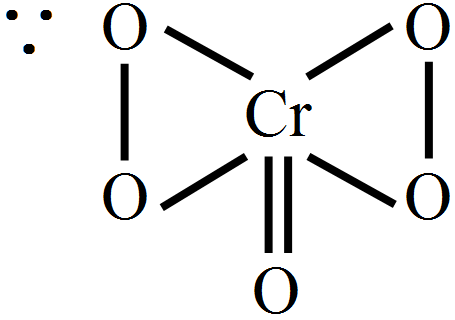
There are two Peroxide linkage $\text{O}^{2-}_2$
$\because$ Oxidation state is $x - 1 - 1 - 1 - 1 - 2 = 0$
$x = +6$ View full question & answer→MCQ 1171 Mark
Oxidation number of $S$ in $\mathrm{S}_2 \mathrm{O}_3{ }^{2-}$ is :
AnswerLet Oxidation number of $S$ in $\mathrm{S}_2 \mathrm{O}_3{ }^{2-}$ be $x.$
Thus,
$2\text{x} + (-2 \times 3) = -2 $
$2\text{x} -6 = -2$
$2\text{x} = -2 + 6$
$2\text{x} = 4$
$\text{x}=\frac{4}{2}$
$\text{x}=2$
So the oxidation state of sulfur is $+2.$
View full question & answer→MCQ 1181 Mark
The oxidation state of the metal atom is zero in :
AnswerIn iron carbonyl, the oxidation state of metal is zero. In all other given compounds, metal has positive oxidation state.
View full question & answer→MCQ 1191 Mark
If a reaction is carried out in acidic medium then which is used to balance the equation?
- ✓
$\mathrm{H}^{+}$ ions.
- B
$\mathrm{OH}^{-}$ ions.
- C
$\mathrm{H}^{-}$ ions.
- D
$\mathrm{O}^{2-}$ ions.
AnswerCorrect option: A. $\mathrm{H}^{+}$ ions.
If a reaction is carried out in acidic medium, $\mathrm{H}^{+}$ ions are used to balance the equation. If it is carried out in basic medium, $\text{OH}^-$ ions are used.
View full question & answer→MCQ 1201 Mark
When a piece of magnesium ribbon is placed in a beaker of copper sulfate solution, which one of the following is most likely to happen?
- A
A vigorous reaction immediately takes place, with the release of a lot of heat.
- B
The blue colour of the copper sulfate solution gets darker.
- ✓
The blue colour of the copper sulfate solution gets lighter.
- D
The magnesium catches fire.
AnswerCorrect option: C. The blue colour of the copper sulfate solution gets lighter.
$\mathrm{Mg}+\mathrm{CuSO}_4 \rightarrow \mathrm{MgSO}_4+\mathrm{Cu}$
$($Blue$)$
By adding Magnesium to $\mathrm{CuSO}_4$, it turns to $\mathrm{MgSO}_4$.
Because $\text{Mg}$ is above $\text{Cu}$ in reactivity series.
So $\text{Mg}$ displaces $\text{Cu}$ in $\mathrm{CuSO}_4$.
As reaction processes, $\mathrm{CuSO}_4$ content decreases.
View full question & answer→MCQ 1211 Mark
Find the oxidation number of $V$ in $\mathrm{Rb}_4 \mathrm{Na}\left[\mathrm{HV}_{10} \mathrm{O}_{28}\right].$
Answer$H(1) + 1 + 1 + 10x − 2(28) = 0$
$6 + 10x − 56 = 0$
$10x = 50$
$x = +5$
View full question & answer→MCQ 1221 Mark
A balanced chemical equation is in accordance with :
- A
- B
Law of constant proportion.
- ✓
Law of conservation of mass.
- D
AnswerCorrect option: C. Law of conservation of mass.
The Law of Conservation Of Mass states that matter can be changed from one form to another and mixtures can be prepared or pure substances can be decomposed but the total amount of mass remains constant. In a chemical equation the number of moles of reactants is equal to the number of moles of products irrespective of the type of reaction the total moles in equation remains constant.
View full question & answer→MCQ 1231 Mark
Which one of the following substances is a good oxidising agent?
AnswerA good oxidizing agent is one which can readily oxidize other chemical species and reduce itself.
Therefore, the compound which is good oxidizing agent must have initial oxidation as high, so that it can reduce its oxidation state and get reduced and oxidize others.
Coke : Reducing agent
Hydrogen peroxide $ \ce{(H_2O_2)}$ : because oxidation state of oxygen is $-1$ in hydrogen peroxide.
So, it oxidizes to $0$ acts as a reducing agent it reduces to $-2$ acts as an oxidizing agent.
But, generally, it acts as an oxidizing agent because a stable oxidation state of oxygen is $-2\ ($oxide form$)$
$\ce{H_2O}$ : Reducing agent.
$\ce{SO_2}$ : sulfur in the $+4$ oxidation state, sulfur dioxide is a reducing agent.
It is oxidized by halogens to give the sulfuryl halides, such as sulfuryl chloride.
View full question & answer→MCQ 1241 Mark
Number of moles of $\text{MnO}_4^-$ required to oxidise one mole of ferrous oxalate completely in acidic medium will be :
- ✓
$0.6$ moles.
- B
$0.4$ moles.
- C
$7.5$ moles.
- D
$0.2$ moles.
AnswerCorrect option: A. $0.6$ moles.
$[\text{MnO}^-_4+8\text{H}+5\text{C}^-\xrightarrow{ \ \ \ \ \ \ \ }\text{Mn}^{2+}+3\text{H}_2\text{O}]\times3$
$\text{Fe}^{2+}\xrightarrow{ \ \ \ \ \ \ \ \ \ \ }\text{Fe}^{3+}+\text{e}^-$
$\ \text{COO}^- \xrightarrow{ \ \ \ \ \ \ \ \ }2\text{CO}_2+2\text{e}^-$
$\ |$
$\text{COO}^- $
$[\text{Fe}^{2+}+\ \text{COO}^- \xrightarrow{ \ \ \ \ \ \ \ \ }\text{Fe}^{3+}+2\text{CO}_2+3\text{e}]\times5$
$\ \ \ \ \ \ \ \ \ \ \ \ \ \ \ \ \ |$
$\ \ \ \ \ \ \ \ \ \ \ \ \ \ \ \ \text{COO}^- $
$24\text{H}^+3\text{MnO}_4^-+5\text{Fe}\text{C}_2\text{O}_4$
$\xrightarrow{ \ \ \ \ \ \ \ \ \ \ \ }3\text{Mn}^{2+}+5\text{Fe}^{3+}+5\text{CO}_2+12\text{H}_2\text{O}$
$5$ moles of $ \mathrm{FeC}_2 \mathrm{O}_4 $ is getting oxidising by $ 3 $ mole of $ \mathrm{KMnO}_4$
$1$ mole of $ \mathrm{FeC}_2 \mathrm{O}_4$ is getting oxidising by $\frac{3}{5}=0.6\text{ moles}$
View full question & answer→MCQ 1251 Mark
Choose the correct explanation regarding half $-$ reaction such as $\text{Cr}_2\text{O}^{2-}_7\xrightarrow{\ \ \ \ \ \ \ \ }\text{Cr}^{3+}$ from the following.
View full question & answer→MCQ 1261 Mark
In the reaction, $2 \mathrm{Na}_2 \mathrm{~S}_2 \mathrm{O}_3+\mathrm{I}_2 \rightarrow \mathrm{Na}_2 \mathrm{~S}_4 \mathrm{O}_6+2 \mathrm{NaI}, \mathrm{I}_2$ acts as :
- ✓
- B
- C
Oxidising as well as reducing agent.
- D
View full question & answer→MCQ 1271 Mark
In $\mathrm{FeCr}_2 \mathrm{O}_4$ the oxidation numbers of $\text{Fe}$ and $\text{Cr}$ are :
- ✓
$+2$ and $+3$
- B
$0$ and $+2$
- C
$+2$ and $+6$
- D
$+3$ and $+6$
AnswerCorrect option: A. $+2$ and $+3$
$\text{FeCr}_2\text{O}_4$
$\text{Fe: x} + 6 + (4 \times −2) = 0$
$\Rightarrow \text{x}=8−6$
$\Rightarrow \text{x}=+2.$
$\text{Cr}:2+2\text{x}+(4\times −2)=0$
$\Rightarrow 2\text{x}=8−2$
$\Rightarrow \text{x}=\frac{6}{2}$
$\Rightarrow \text{x}=+3.$
View full question & answer→MCQ 1281 Mark
Identify which of the following reactions is/ are combustion reactions :
- A
$\text{C}+\text{O}_2\xrightarrow{\ \ \Delta\ \ }\text{CO}_2$
- B
$\text{H}_2+\text{Cl}_2\xrightarrow{\ \ \Delta \ \ }2\text{HCl}$
- C
$\text{CH}_4+\text{O}_2\xrightarrow{\ \ \ \Delta\ \ \ }\text{CO}_2+\text{H}_2\text{O}$
- ✓
Both $(a)$ and $(c)$
AnswerCorrect option: D. Both $(a)$ and $(c)$
View full question & answer→MCQ 1291 Mark
Water molecule is formed by the reaction, $2 \mathrm{H}_2+\mathrm{O}_2 \rightarrow 2 \mathrm{H}_2 \mathrm{O}_2$ What does happen in this reaction?
- ✓
Electrons are transferred from $H$ to $O-$ atom.
- B
Electrons are transferred from $0$ to $H-$ atom.
- C
Electrons are accepted by $H$ from $O-$ atom.
- D
Electrons are donated by $O$ to $H-$ atom.
AnswerCorrect option: A. Electrons are transferred from $H$ to $O-$ atom.
View full question & answer→MCQ 1301 Mark
The oxidation number of sulphur in $\mathrm{H}_2 \mathrm{SO}_4$ is:
AnswerFor a compound $\mathrm{H}_2 \mathrm{SO}_4$,
As net charge on compound is $0$
Charge on: $H = 1$
$S = x$
$O = −2$
$1(2) + x + (−2) (4) = 0$
$2 + x − 8 = 0$
$x = 6$
View full question & answer→MCQ 1311 Mark
What is the sum of oxidation number of various elements in $\mathrm{HCO}_3{ }^{\ominus} ($bicarbonate$)$ ion?
AnswerThe sum of oxidation number of various elements in $\text{HCO}^-_3 ($bicarbonate$)$ ion is $1 + 4 + 3(−2) = −1.$
View full question & answer→MCQ 1321 Mark
From the given species such as $Li, K, Ca$ and $Na$, which of the following is the strongest reducing agent?
View full question & answer→MCQ 1331 Mark
The oxidation number of $Cl$ in $\mathrm{CaOCl}_2$ is:
- ✓
$−1$ and $+1$
- B
$+2$
- C
$−2$
- D
AnswerCorrect option: A. $−1$ and $+1$
In the given compound $\mathrm{CaOCl}_2$ , one $Cl$ is directly attached to $Ca$ and other to $O$.
$ \mathrm{OCl}^{\ominus}:-2+\mathrm{x}=-1 $
$\Rightarrow \mathrm{x}=+1$
$ \mathrm{Cl}^{\ominus}:-1 $
Oxidation states of $Cl$ are $−1$ and $+1$.
View full question & answer→MCQ 1341 Mark
It is found that $V$ forms a double salt isomorphous with Mohr's salt. The oxidation number of $V$ in this compound is $.........$
AnswerDouble salt of $V$ isomorphous with Mohr's salt is $\left(\mathrm{NH}_4\right) 2 \mathrm{~V}\left(\mathrm{SO}_4\right)_2 \cdot 6 \mathrm{H}_2 \mathrm{O}$.
When double salt dissolves in water it dissociates to give $\mathrm{NH}_4{ }^{+}, \mathrm{V}^{+2}$ and $\mathrm{SO} 4-2$.
So oxidation state of vanadium is $+2$.
View full question & answer→MCQ 1351 Mark
The oxidation number of chlorine in $\ce{NaClO_3}$ is:
AnswerThe overall charge of molecule is zero $($because it's not an ion$)$. Since sodium is a $1A$ family member, you can assume that the charge is $+1$. The charge of oxygen is almost always $−2$ so you can assume that as well.
$(+1) +$ oxidation of $Cl + 3(−2) = 0$
View full question & answer→MCQ 1361 Mark
The lowest possible oxidation state of nitrogen is $−3$ as in $N^{-3}$.
AnswerThe lowest possible oxidation state of nitrogen is $−3$ as in $N^{-3}$.
Nitrogen can form compounds in which oxidation state ranges from $−3$ to $+5$.
Ammonia, $\ce{NH_3}$ and magnesium nitride, $\ce{Mg_3N_2}$ have $N$ in $−3$ oxidation state.
$N$ has $5$ valence electrons. It accepts $3$ electrons to complete its octet.
View full question & answer→MCQ 1371 Mark
In the following reaction, $2 \mathrm{Mg}(\mathrm{s})+\mathrm{O}_2(\mathrm{~g}) \rightarrow 2 \mathrm{Mgo}(\mathrm{s})$ with respect to $Mg$, the process is called :
AnswerOxidation is a process, which involves addition of oxygen$/$ electronegative element to a substance or removal of hydrogen$/$ electropositive element from a substance. e.g.,
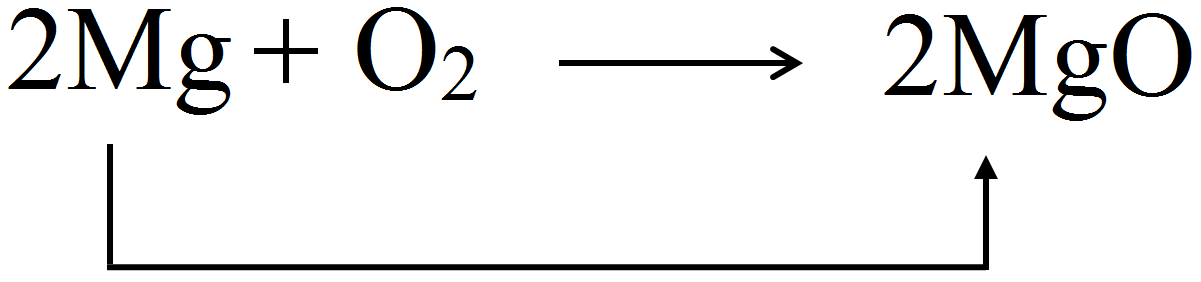
Addition of oxygen $=$ oxidation View full question & answer→MCQ 1381 Mark
Which of the following arrangements represent increasing oxidation number of the central atom?
- ✓
$\text{CrO}^{-}_2,\text{ClO}^-_3,\text{CrO}^{2-}_4,\text{MnO}^-_4$
- B
$\text{ClO}^-_3,\text{CrO}^{2-}_4,\text{MnO}^-_4,\text{CrO}^{-}_2$
- C
$\ce{{CrO}^-_2,{ClO}^-_3,{MnO}^-_4,{CrO}^{2-}_4}$
- D
$\ce{{CrO}^{2-}_4,{MnO}^-_4,{CrO}_2^-,{ClO}^-_3}$
AnswerCorrect option: A. $\text{CrO}^{-}_2,\text{ClO}^-_3,\text{CrO}^{2-}_4,\text{MnO}^-_4$
Writing the $O.N$. of $Cr, C$l and $Mn$ each species in the four set of ions,
we have,
- $\stackrel{+3}{\text{Cr}}\text{O}^-_2,\stackrel{+5}{\text{Cl}}\text{O}^-_3,\stackrel{+6}{\text{Cr}}\text{O}^{2-}_4,\stackrel{+7}{\text{Mn}}\text{O}^-_4$
- $\stackrel{+5}{\text{Cl}}\text{O}^-_3,\stackrel{+6}{\text{Cr}}\text{O}^{2-}_4,\stackrel{+7}{\text{Mn}}\text{O}^-_4,\stackrel{+3}{\text{Cr}}\text{O}^-_2$
- $\stackrel{+3}{\text{Cr}}\text{O}^-_2,\stackrel{+5}{\text{Cl}}\text{O}^-_3,\stackrel{+7}{\text{Mn}}\text{O}^-_4,\stackrel{+6}{\text{Cr}}\text{O}^{2-}_4$
- $\stackrel{+6}{\text{Cr}}\text{O}^{2-}_4,\stackrel{+7}{\text{Mn}}\text{O}^-_4,\stackrel{+3}{\text{Cr}}\text{O}^-_2,\stackrel{+5}{\text{Cl}}\text{O}^{3-}_3$
Only in arrangement $(a)$, the $O.N$. of central atom increases from left to right. Therefore, option $(a)$ is correct. View full question & answer→MCQ 1391 Mark
$\mathrm{H}_2 \mathrm{SO}_5+\mathrm{H}_2 \mathrm{O} \rightarrow \mathrm{H}_2 \mathrm{SO}_4+\mathrm{H}_2 \mathrm{O}_2$ Oxidation number of sulphur in $\mathrm{H}_2 \mathrm{SO}_5$ in the above reaction is:
AnswerFormation of $\mathrm{H}_2 \mathrm{O}_2$ indicates that there is one peroxy linkage in $\mathrm{H}_2 \mathrm{SO}_5$. The oxidation state of $H = +1.$
Therefore, $x + 2 − 2 − 6 = 0$ or, $x = +6$
Hence, $x = 6.$
Thus, oxidation number of sulphur $= +6.$
View full question & answer→MCQ 1401 Mark
In the balanced chemical equation : $\text{IO}_3+\text{aI}^-+\text{bH}^+\xrightarrow{ \ \ \ \ \ }\text{cH}_2\text{O}+\text{dI}_2\ a, b, c, d$ respectively are:
- ✓
$5, 6, 3, 3$
- B
$5, 3, 6, 3$
- C
$3, 5, 3, 6$
- D
$5, 6, 5, 5$
AnswerCorrect option: A. $5, 6, 3, 3$
$\text{IO}_3+\text{aI}^-+\text{bH}^+\xrightarrow{ \ \ \ \ \ \ \ }\text{cH}_2\text{O}+\text{dI}_2$
View full question & answer→MCQ 1411 Mark
Negative $ER$ indicates that redox couple is:
- A
Weaker reducing agent than $H^+/ H$, couple.
- ✓
Stronger reducing agent than $H^+/ H,$ couple.
- C
Stronger oxidising agent than $H^+/ H,$ couple.
- D
AnswerCorrect option: B. Stronger reducing agent than $H^+/ H,$ couple.
View full question & answer→MCQ 1421 Mark
Identify the pair of binary corresponds in which nitrogen exhibits the lowest and the highest oxidation state.
- A
$\mathrm{NH}_3, \mathrm{NO}_2$
- ✓
$\mathrm{N}_3 \mathrm{H}, \mathrm{N}_2 \mathrm{O}_5$
- C
$\mathrm{N}_2, \mathrm{HNO}_3$
- D
$\mathrm{N}_2 \mathrm{O}, \mathrm{N}_2 \mathrm{O}_5$
AnswerCorrect option: B. $\mathrm{N}_3 \mathrm{H}, \mathrm{N}_2 \mathrm{O}_5$
Oxidation of nitrogen in $N_3H$ is $-\frac{1}{3},$ which is the lowest possible.
Oxidation of nitrogen in $N_2O_5$ is $+5$ which is the highest possible.
View full question & answer→MCQ 1431 Mark
When $KMnO_4$ is reduced with oxalic acid in acidic solution, the oxidation number of $Mn$ changes from.
- ✓
$7$ to $2$
- B
$7$ to $4$
- C
$7$ to $6$
- D
$6$ to $2$
AnswerCorrect option: A. $7$ to $2$
In acidic medium it reacts as follows : $\mathrm{MnO}_4^{-}+8 \mathrm{H}^{+}+5 \mathrm{e}^{-} \rightarrow \mathrm{Mn}^{+2}+4 \mathrm{H}_2 \mathrm{O}$
So oxidation state of $Mn$ changes from $+7$ to $+2.$
View full question & answer→MCQ 1441 Mark
The oxidation state of manganese in $\mathrm{K}_2 \mathrm{MnO}_4$ is:
View full question & answer→MCQ 1451 Mark
The oxidation number of chlorine is maximum in $.........$
AnswerCorrect option: C. $ \mathrm{KClO}_4 $
The oxidation numbers of chlorine in $\ce{HOCl},\ \mathrm{Cl}_2 \mathrm{O}_6 ,\ \mathrm{KClO}_4 $
and $\ce{NaClO3}$ are $+1, +6, +7$ and $+5$ respectively. Hence, the oxidation number of chlorine is maximum in $ \mathrm{KClO}_4 $
.
View full question & answer→MCQ 1461 Mark
In which of the following compounds, an element exhibits two different oxidation states:
- A
$\mathrm{NH}_2 \mathrm{OH} $
- ✓
$ \mathrm{NH}_4 \mathrm{NO}_3 $
- C
$ \mathrm{~N}_2 \mathrm{H}_4 $
- D
$ \mathrm{~N}_3 \mathrm{H}$
AnswerCorrect option: B. $ \mathrm{NH}_4 \mathrm{NO}_3 $
$ \mathrm{NH}_4 \mathrm{NO}_3 $ is an ionic compound consisting of $\mathrm{NH}_4{ }^{+}$ and $\mathrm{NO}_3{ }^{-}$ ion.
The oxidation number of $N$ in two species is different as shown below:
In $NH$;,
Let the oxidation state of $N$ in $\mathrm{NH}_4{ }^{+}$ be $x$.
$x + 4 \times (+l) = +l$
$x = -3$
In $\mathrm{NO}_3{ }^{-}$
Let the oxidation state of N in $\mathrm{NO}_3{ }^{-}$ be $y$,
$y + 3 \times (-2) = -1$
$y = +5$
View full question & answer→MCQ 1471 Mark
The oxidation number of sulphur in $\mathrm{S}_8, \mathrm{~S}_2 \mathrm{~F}_2$ and $\mathrm{H}_2 \mathrm{S}$ respectively are $.........$
- ✓
$0, +1$ and $−2$
- B
$+2, +1$ and $−2$
- C
$0, +1$ and $+2$
- D
$−2, +1$ and $−2$
AnswerCorrect option: A. $0, +1$ and $−2$
Oxidation number of sulphur in $S_8$ is $0$.
Oxidation number of $F$ is $-1$ so oxidation number of sulphur in $\mathrm{S}_2 \mathrm{F}_2$ is $+1$.
Oxidation number of $H$ is $+1$ so oxidation number of sulphur in $\mathrm{H}_2 \mathrm{S}$ is $-2$.
View full question & answer→MCQ 1481 Mark
The oxidation state of $C$ in diamond is:
AnswerCarbon in diamond is in elemental state, so the oxidation state of $C$ in diamond is zero.
The structure of diamond has been shown below:
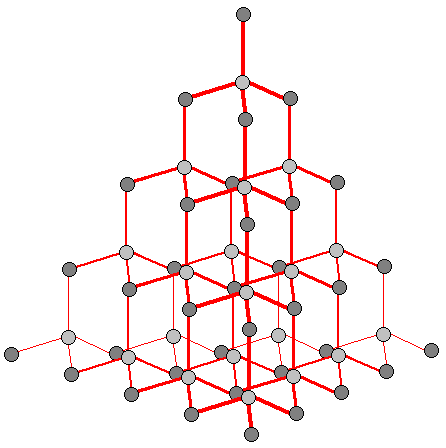
View full question & answer→MCQ 1491 Mark
Using the standard electrode potential, find out the pair between which redox reaction is not feasible: $\text{E}^{\ominus}\text{values:}$ $\text{Fe}^{3+}/\text{ Fe}^{2+}=+0.77;\text{I}_2/\text{I}^{-}=+0.54;$$\text{Cu}^{2+}/\text{Cu}=+0.34;\text{Ag}^+/\text{Ag}=+0.80\text{V}$
- A
$\text{Fe}^{3+}$ and $\text{ I}^-$
- B
$\ce{Ag}$ and $\ce{Cu}$
- C
$\text{Fe}^{3+}$ and $\text{Cu}$
- ✓
$\text{Ag}$ and $\ce{{Fe}^{3+}}$
AnswerCorrect option: D. $\text{Ag}$ and $\ce{{Fe}^{3+}}$
Using the standard electrode potential, find out the pair between which redox reaction is not feasible.
- $2\text{Fe}^{3+}+2\text{e}^-\xrightarrow[]{\ \ \ \ \ \ \ \ \ \ \ }2\text{Fe}^{2+};\ \text{E}^0=+0.77\text{V}\\\ \ \ \ \ \ \ \ \ \ \ \ \ \ \ \ 2\text{I}^-\xrightarrow[]{\ \ \ \ \ \ \ \ \ \ \ }\text{I}_2+2\text{e}^-;\text{E}^0=-0.54\text{V (sign of E}^{\text{0}}\text{is reversed})\\\underline{\\ \ \ \ \ \ \ \ \ \ \ \ \ \ \ \ \ \ \ \ \ \ \ \ \ \ \ \ \ \ \ \ \ \ \ \ \ \ \ \ \ \ \ \ \ \ \ \ \ \ \ \ \ \ \ \ \ \ \ \ \ \ \ \ \ \ \ \ \ \ \ \ \ \ \ \ }\\ \ \ \ \ \ \ 2\text{Fe}^{3+}2\text{I}^-\xrightarrow[]{\ \ \ \ \ \ \ \ \ \ \ \\ }2\text{Fe}^{2+}+\text{I}_2;\text{E}^0_{\text{cell}}=+0.23\text{V}\\ \text{This reaction is feasible since E}^0_\text{cell}=+0.23\text{V}$
- $\ \ \ \ \ \ \ \ \ \ \ \ \ \ \ \ \ \text{Cu}\xrightarrow[]{\ \ \ \ \ \ \ \ \ \ \ }\text{Cu}^{2+}+2\text{e}^-;\text{E}^0=-0.34\text{V(sing of E}^0\text{is reversed)}\\\ 2\text{Ag}^++2\text{e}^-\xrightarrow[]{\ \ \ \ \ \ \ \ \ \ \ }2\text{Ag};\text{E}^0=+0.80\text{V}\\\underline{\\ \ \ \ \ \ \ \ \ \ \ \ \ \ \ \ \ \ \ \ \ \ \ \ \ \ \ \ \ \ \ \ \ \ \ \ \ \ \ \ \ \ \ \ \ \ \ \ \ \ \ \ \ \ \ \ \ \ \ \ \ \ \ \ \ \ \ \ \ }\\ \ \text{Cu}+2\text{Ag}^+\xrightarrow[]{\ \ \ \ \ \ \ \ \ \ \ }\text{Cu}^{2+}+2\text{Ag;}\text{E}^0=+0.46\text{V} \\ \text{This reaction is feasible since E}^0_\text{cell}=+\text{Ve.}$
- $2\text{Fe}^{3+}+2\text{e}^-\xrightarrow[]{\ \ \ \ \ \ \ \ \ \ \ }2\text{Fe}^{2+};\ \text{E}^0=+0.77\text{V}\\\ \ \ \ \ \ \ \ \ \ \ \ \ \ \ \ \text{Cu}\xrightarrow[]{\ \ \ \ \ \ \ \ \ \ \ }\text{Cu}^{2+}+2\text{e}^-;\text{E}^0=-0.34\text{V (sign of E}^{\text{0}}\text{is reversed})\\\underline{\\ \ \ \ \ \ \ \ \ \ \ \ \ \ \ \ \ \ \ \ \ \ \ \ \ \ \ \ \ \ \ \ \ \ \ \ \ \ \ \ \ \ \ \ \ \ \ \ \ \ \ \ \ \ \ \ \ \ \ \ \ \ \ \ \ \ \ \ \ \ \ \ \ \ \ \ }\\ \ \ \ \ \ \ 2\text{Fe}^{3+}\text{Cu}\xrightarrow[]{\ \ \ \ \ \ \ \ \ \ \ \\ }2\text{Fe}^{2+}+\text{Cu}^{2+};\text{E}^0=+0.43\text{V}\\ \text{This reaction is feasible since E}^0_\text{cell}=+0.43\text{V}$
- $ \ \ \ \ \ \ \ \ \ \ \ \ \ \ \ \ \text{Ag}\xrightarrow[]{\ \ \ \ \ \ \ \ \ \ \ }\text{Ag}^+\text{e}^-;\text{E}^0=-0.80\text{V(sing of E}^0\text{is reversed}\\\ \text{Fe}^{3+}+2\text{e}^-\xrightarrow[]{\ \ \ \ \ \ \ \ \ \ \ }\text{Fe}^{2+};\text{E}^0+0.77\text{V}\\\underline{\\ \ \ \ \ \ \ \ \ \ \ \ \ \ \ \ \ \ \ \ \ \ \ \ \ \ \ \ \ \ \ \ \ \ \ \ \ \ \ \ \ \ \ \ \ \ \ \ \ \ \ \ \ \ \ \ \ \ \ \ \ \ \ \ \ \ \ \ \ \ \ \ \ \ \ \ }\\ \ \ \ \text{Ag}+\text{Fe}^{3+}\xrightarrow[]{\ \ \ \ \ \ \ \ \ \ \ \\ }\text{Ag}^+\text{Fe}^{2+};\text{E}^0=-0.03\text{V}\\ \text{This reaction is not feasible since E}^0_\text{cell}=-\text{ve.}$
Thus, option $(d)$ is correct. View full question & answer→MCQ 1501 Mark
Oxidation number of $Cl$ in $\ce{CaOCl_2}$ is $.........$
- ✓
$−1$ and $+1$
- B
$+2$
- C
$−2$
- D
AnswerCorrect option: A. $−1$ and $+1$
In $\ce{Ca(OCl)Cl}$, two $Cl$ atoms are in different oxidation state i.e., one $Cl^-$ in $-1$ oxidation state and other as $\ce{OCl^-}$ in $+1$ oxidation state.
View full question & answer→MCQ 1511 Mark
Which are of the following can act as oxidising as well reducing agent?
- A
$H_2$
- B
$I_2$
- C
$\ce{H_2O_2}$
- ✓
AnswerAll of them can act as oxidising as well as reducing agent because their oxidation state can increase as well as decrease.
View full question & answer→MCQ 1521 Mark
he ratio of oxygen atom having $−2$ and $−1$ oxidation numbers in $\text{S}_2\text{O}^{2-}_8$ is $.........$
AnswerThe ratio of oxygen atom having $−2$ and $−1$ oxidation numbers in $\text{S}_2\text{O}^{2-}_8$ is three as only one peroxy linkage is present.
So, we can see from the structure below that the number of oxygen atoms having $−2$ oxidation state is $6$ while those having $−1$ oxidation state is $2$.
View full question & answer→MCQ 1531 Mark
$\mathrm{KMnO}_4$ and $\mathrm{K}_2 \mathrm{Cr}_2 \mathrm{O}_7$ are $.........$ agents and $\mathrm{Na}_2 \mathrm{~S}_2 \mathrm{O}_7$ is $.........$ agent.
AnswerAn oxidizing agent $($oxidant, oxidizer$)$ is a substance that has the ability to oxidize other substances $($cause them to lose electrons$)$.
$\mathrm{KMnO}_4$, $\mathrm{K}_2 \mathrm{Cr}_2 \mathrm{O}_7$ are oxidizing agent.
A reducing agent $($also called a reductant or reducer$)$ is an element $($such as calcium$)$ or compound that loses $($or "donates"$)$ an electron to another chemical species in a redox chemical reaction. Since the reducing agent is losing electrons, it is said to have been oxidized.
$\mathrm{Na}_2 \mathrm{~S}_2 \mathrm{O}_3$ is a reducing agent.
View full question & answer→MCQ 1541 Mark
Which of the following statement$(s)$ is$/$ are not true about the following decomposition reaction :
$2\text{KClO}_3\xrightarrow{ \ \ \ \ \ \ \ }2\text{KCl}+3\text{O}_2$
- A
Potassium is undergoing oxidation.
- B
Chlorine is undergoing oxidation.
- C
- ✓
None of the species are undergoing oxidation or reduction.
AnswerCorrect option: D. None of the species are undergoing oxidation or reduction.
View full question & answer→MCQ 1551 Mark
A half cell reaction is one which:
- A
Involves only half a mole of electrolyte.
- B
Goes only half way to completion.
- ✓
Takes place at one electrode.
- D
Consumes half a unit of electricity.
AnswerCorrect option: C. Takes place at one electrode.
In an electrochemical cell, a redox reaction occurs. Oxidation occurs at one electrode and reduction occurs at another electrode. The reaction occuring at each electrode is known as half cell reaction.
View full question & answer→MCQ 1561 Mark
The oxidation state of phosphorus is maximum in $.........$
- A
Phospine $\left(\mathrm{PH}_3\right)$.
- B
Diphosphine $\left(\mathrm{P}_2 \mathrm{H}_4\right)$.
- ✓
Metaphosphoric acid $\left(\mathrm{HPO}_3\right)$.
- D
Phosphorus acid $\left(\mathrm{H}_3 \mathrm{PO}_3\right)$.
AnswerCorrect option: C. Metaphosphoric acid $\left(\mathrm{HPO}_3\right)$.
The oxidation states of phosphorus in phosphine, diphosphine, metaphosphoric acid and phosphorus acid are $−3, −2, +5$ and $+3$ respectively. Hence, it is maximum in metaphosphoric acid.
View full question & answer→MCQ 1571 Mark
Oxidation number of carbon in $\ce{(CN)_2}$ is $.........$
AnswerLet $x$ be the oxidation number of $C$ in $\ce{(CN)_2}$.
Since the overall
Charge on the compound is $0$, the sum of oxidation states of all elements in it should be equal to $0$.
Therefore, $2(x + (−3)) = 0$ or, $x = +3$
View full question & answer→MCQ 1581 Mark
The oxidation number of carbon in $\mathrm{CH}_2 \mathrm{Cl}_2$ is
AnswerLet $x$ be the oxidation state of $C$ in $\mathrm{CH}_2 \mathrm{Cl}_2$.
Since the overall charge on the complex is $0$, the sum of oxidation states of all elements in it should be equal to $0$.
Therefore, $x + 2 + 2(−1) = 0$
View full question & answer→MCQ 1591 Mark
Thiosulphate reacts differently with iodine and bromine in the reactions given below: $\ce{2 {S}_2{O}^{2-}_3 + {I}\xrightarrow{ \ \ \ \ \ \ \ } {S}_4{O}^{2-}_6 + 2 {I}^{-}{S}_2{O}^{2-}_3 + 2{Br}_2 + 5 {H}_2{O}\xrightarrow{ \ \ \ \ \ \ \ }2{SO}^{2-}_4 + 2 {Br}^{-} + 10 {H}^{+}}$ Which of the following statements justifies the above dual behaviour of thiosulphate?
- ✓
Bromine is a stronger oxidant than iodine.
- B
Bromine is a weaker oxidant than iodine.
- C
Thiosulphate undergoes oxidation by bromine and reduction by iodine in these reactions.
- D
Bromine undergoes oxidation and iodine undergoes reduction in these reactions.
AnswerCorrect option: A. Bromine is a stronger oxidant than iodine.
$\ce{2{S}_2{O}^{2-}_3({aq}) + {I}_2 {(s)}\xrightarrow{ \ \ \ \ \ \ \ \ \ } {S}_4{O}^{2-}_6({aq}) + 2{I}^{-}({aq})$
${S}_2{O}^{2-}_3({aq}) + 2{Br}({l}) + 5{H}_2 {O}({l})\xrightarrow{ \ \ \ \ \ \ \ \ \ }2{SO}^{2-}_4({Aq}) + 4 {Br}^{-}({aq}) + 10 {H}^{+}({aq})}$
Bromine being stronger oxidizing agent than $I_2$, it oxidises S of $\mathrm{S}_2 \mathrm{O}^{2-}{ }_3$ to $\mathrm{SO}^{2-}{ }_4$ whereas $\mathrm{I}_2$ oxidises it only into $\mathrm{S}_4 \mathrm{O}^{2-}{ }_6$ ion.
View full question & answer→MCQ 1601 Mark
The oxidation number of an element in a compound is evaluated on the basis of certain rules. Which of the following rules is not correct in this respect?
- ✓
The oxidation number of hydrogen is always $+1$.
- B
The algebraic sum of all the oxidation numbers in a compound is zero.
- C
An element in the free or the uncombined state bears oxidation number zero.
- D
In all its compounds, the oxidation number of fluorine is $– 1$.
AnswerCorrect option: A. The oxidation number of hydrogen is always $+1$.
In ionic hydrides hydrogen exist in $-1$ oxidation state because the hydrogen acquires negative charge in the presence of its companion.
View full question & answer→MCQ 1611 Mark
The oxidation state of chromium in the final product formed in the reaction between $KI$ and acidified potassium dichromate solution is:
AnswerThe balanced reaction equation for reaction between potassium iodide and acidified potassium dichromate is :
$\mathrm{K}_2 \mathrm{Cr}_2 \mathrm{O}_7+7 \mathrm{H}_2 \mathrm{SO}_4+6 \mathrm{KI} \rightarrow \mathrm{Cr}_2\left(\mathrm{SO}_4\right)_3+3 \mathrm{I}_2+7 \mathrm{H}_2 \mathrm{O}+4 \mathrm{~K}_2 \mathrm{SO}_4$
In this reaction, potassium dichromate gives a chromium sulfate. The oxidation state of chromium in chromium sulfate can be calculated as:
Consider, the oxidation state of $Cr$ be $X$ in $\mathrm{Cr}_2\left(\mathrm{SO}_4\right)_3$
$\therefore 2\text{X} + 3(−2) = 0$
$∴ 2\text{X}−6=0$
$∴ 2\text{X}=6$
$\therefore X=\frac{6}{2}$
$∴X=+3$
Therefore, the oxidation state of $Cr$ in the final product is $+3$.
View full question & answer→MCQ 1621 Mark
In which one of the following compounds does oxygen have an oxidation number of $+2$ ?
- ✓
$ \mathrm{F}_2 \mathrm{O} $
- B
$ \mathrm{Cl}_2 \mathrm{O} $
- C
$ \mathrm{Na}_2 \mathrm{O}_2 $
- D
$ \mathrm{Na}_2 \mathrm{O} $
AnswerCorrect option: A. $ \mathrm{F}_2 \mathrm{O} $
Flourine is more electronegative than oxygen which in turn is more electronegative than $Cl$ and $Na$.
View full question & answer→MCQ 1631 Mark
In which of the following, iron is present in its lowest oxidation state?
- A
$ \mathrm{FeSO}_4 .7 \mathrm{H}_2 \mathrm{O} $
- ✓
$ \mathrm{Fe}(\mathrm{CO})_5$
- C
$ \mathrm{Fe}_{0.94} \mathrm{O} $
- D
$ \mathrm{Fe}_3 \mathrm{O}_4 $
AnswerCorrect option: B. $ \mathrm{Fe}(\mathrm{CO})_5$
The oxidation state of iron in iron pentacarbonyl is $0$.
In all other compounds, iron has a positive oxidation state.
Thus, $ \mathrm{Fe}(\mathrm{CO})_5$ has the lowest oxidation state of iron.
View full question & answer→MCQ 1641 Mark
In which of the following compounds the oxidation number of carbon is not zero?
- A
$\text{HCHO}$
- B
$\mathrm{CH}_3 \mathrm{COOH} $
- C
$\mathrm{C}_{12} \mathrm{H}_{22} \mathrm{O}_{11} $
- ✓
$ \mathrm{CH}_3 \mathrm{CHO}$
AnswerCorrect option: D. $ \mathrm{CH}_3 \mathrm{CHO}$
Oxidation number of $C$ in $ \mathrm{CH}_3 \mathrm{CHO}$ is $-1$, in other it is zero.
View full question & answer→MCQ 1651 Mark
The largest oxidation number exhibited by an element depends on its outer electronic configuration. With which of the following outer electronic configurations the element will exhibit largest oxidation number?
- A
$3 d^1 4 s^2 $
- B
$ 3 d ^34 s ^2 $
- C
$ 3 d^5 4 s^1 $
- ✓
$ 3 d^5 4 s^2$
AnswerCorrect option: D. $ 3 d^5 4 s^2$
Highest $O.N$. of any transition element $= (n – 1)d$ electrons $+ns$ electrons. Therefore, larger the number of electrons in the $3d$ orbitals, higher is the maximum $O.N$.
- $ 3 d^1 4 s^2=3 $
- $ 3 d^2 4 s^2=3+2=5 $
- $ 3 d^5 4 s^1=5+1=6 $
- $ 3 d^5 4 s^2=5+2=7$
View full question & answer→MCQ 1661 Mark
The oxidation number of nitrogen atoms in $\mathrm{NH}_4 \mathrm{NO}_3$ are:
- A
$+3, +3$
- B
$+3, −3$
- ✓
$−3, +5$
- D
$−5, +3$
AnswerCorrect option: C. $−3, +5$
View full question & answer→MCQ 1671 Mark
An element in its native state will have the oxidation number :
MCQ 1681 Mark
What is the oxidation number of $Mg$ and $N$ in magnesium nitride?
- ✓
$Mg = +2; N = −3$
- B
$Mg = +1; N = −3$
- C
$Mg = +2; N = −2$
- D
AnswerCorrect option: A. $Mg = +2; N = −3$
In magnesium nitride $(\mathrm{Mg}_3 \mathrm{~N}_2)$, the oxidation number of $Mg$ and $N$ are $+2$ and $−3$ respectively.
View full question & answer→MCQ 1691 Mark
Identify redox reaction among the following:
AnswerCorrect option: C. Metal displacement reaction.
Metal displacement reactions are redox reactions in which both oxidation and reduction takes place.Example; $Mg + \mathrm{ZnSO}_4 \rightarrow \mathrm{MgSO}_4+\mathrm{Zn}$
Here $Mg$ is undergoing oxidation with an increase in oxidation number from $0$ to $+2$ and $Zn$ is undergoing reduction with a decrease in oxidation number.
View full question & answer→MCQ 1701 Mark
Which of the following is not a redox reaction?
- ✓
$\text{CaCO}_3\xrightarrow{ \ \ \ \ \ \ \ }\text{CaO}+\text{CO}_2$
- B
$2\text{H}_2+\text{O}_2\xrightarrow{ \ \ \ \ \ \ }2\text{H}_2\text{O}$
- C
$2\text{Na}+2\text{H}_2\text{O}\xrightarrow{ \ \ \ \ \ \ \ }2\text{NaOH}+\text{H}_2$
- D
$\text{MnCl}_3\xrightarrow{ \ \ \ \ \ \ }\text{MnCl}_2+\frac{1}{2}\text{Cl}_2$
AnswerCorrect option: A. $\text{CaCO}_3\xrightarrow{ \ \ \ \ \ \ \ }\text{CaO}+\text{CO}_2$
View full question & answer→MCQ 1711 Mark
When magnesium and iron react with steam, they produce:
- ✓
$\ce{H_2}$
- B
$\ce{O_2}$
- C
$\ce{CO_2}$
- D
AnswerCorrect option: A. $\ce{H_2}$
View full question & answer→