Question 15 Marks
A saturn year is $29.5$ times the earth year. How far is the saturn from the sun if the earth is $1.50 \times 10^8km$ away from the sun?
AnswerDistance of the Earth from the Sun, re = $1.5 \times 10^8km = 1.5 \times 10^{11}m$ Time period of the Earth = $T_e$ Time period of Saturn, $T_s = 29.5T_e$ Distance of Saturn from the Sun $= r_s$ From Kepler’s third law of planetary motion, we have $\text{T}=\Big(\frac{4\pi^2\text{r}^3}{\text{GM}}\Big)^\frac{1}{2}$ For Saturn and Sun, we can write $\frac{\text{r}_\text{s}^{3}}{\text{r}_\text{e}^3}=\frac{\text{T}_\text{s}^2}{\text{T}_\text{e}^2}$
$\text{r}_\text{s}=\text{r}_\text{e}\Big(\frac{\text{T}_\text{s}}{\text{T}_\text{e}}\Big)^\frac{2}{3}$
$=1.5\times10^{11}\Big(\frac{29.5\text{T}_\text{e}}{\text{T}_\text{e}}\Big)^\frac{2}{3}$
$=1.5\times10^{11}(29.5)^\frac{2}{3}$
$=1.5\times10^{11}\times9.55$
$=14.32\times10^{11}\text{m}$ Hence, the distance between Saturn and the Sun is $1.43 \times 10^{12}m$.
View full question & answer→Question 25 Marks
Does the escape speed of a body from the earth depend on (a) the mass of the body, (b) the location from where it is projected, (c) the direction of projection, (d) the height of the location from where the body is launched?
Answer
- No, from the formula $\upsilon_\text{e}=\sqrt{\frac{2\text{GM}}{\text{R}}},$ it is clear that escape velocity does not depend on the mass of the body.
- The escape velocity depends upon the value of gravitational potential at the point from where the body is projected. The gravitational potential energy of body $\text{E}=-\frac{\text{GMm}}{\text{R}}$ is slightly different at different points ($\because$ the earth is not a perfect sphere and hence R is different ai different points). Because of this escape velocity depend slightly on the latitude of the place from where the body is projected.
- The escape velocity of a body does not depend upon its direction of projection.
- Since the gravitational potential energy at a point at the height h from the earth surface is $\frac{\text{GMs}}{\text{(R+h)}},$ the escape velocity will be different for different values of h.
View full question & answer→Question 35 Marks
Which of the following symptoms is likely to afflict an astronaut in space (a) swollen feet, (b) swollen face, (c) headache, (d) orientational problem.
Answer(b) Swollen face, (c) headache, (d) orientational problem.
- Legs hold the entire mass of a body in standing position due to gravitational pull. In space, an astronaut feels weightlessness because of the absence of gravity. Therefore, swollen feet of an astronaut do not affect him/ her in space.
- A swollen face is caused generally because of apparent weightlessness in space. Sense organs such as eyes, ears nose, and mouth constitute a person’s face. This symptom can affect an astronaut in space.
- Headaches are caused because of mental strain. It can affect the working of an astronaut in space.
- Space has different orientations. Therefore, orientational problem can affect an astronaut in space.
View full question & answer→Question 45 Marks
A satellite orbits the earth at a height of 400 km above the surface. How much energy must be expended to rocket the satellite out of the earth's gravitational influence? Mass of the satellite $=200 \mathrm{~kg}$; mass of the earth $=6.0 \times$ $10^{24} \mathrm{~kg}$; radius of the earth $=6.4 \times 10^6 \mathrm{~m} ; \mathrm{G}=6.67 \times 10^{-11} \mathrm{~N} \mathrm{~m}^2 \mathrm{~kg}^{-2}$.
AnswerMass of the Earth, $M = 6.0 \times 10^{24}kg$ Mass of the satellite, $m = 200kg$ Radius of the Earth, $R_e = 6.4 \times 10^6m$ Universal gravitational constant, $G = 6.67 \times 10^{–11}Nm^2kg^{–2}$ Height of the satellite, $h = 400km = 4 \times 10^5m = 0.4 \times 10^6m$ Total energy of the satellite at height $\text{h}=\Big(\frac{1}{2}\Big)\text{mv}^2+\Big[\frac{-\text{GM}_\text{e}\text{m}}{(\text{R}_\text{e}+\text{h})}\Big]$ Orbital velocity of the satellite, $\text{v}=\Big[\frac{\text{GM}_\text{e}}{(\text{R}_\text{e}+\text{h})}\Big]^\frac{1}{2}$ Total energy of height, $\text{h}=\frac{\big(\frac{1}{2}\big)\text{GM}_\text{e}\text{m}}{(\text{R}_\text{e}+\text{h})}-\frac{\text{GM}_\text{e}\text{m}}{(\text{R}_\text{e}+\text{h})}$$=-\frac{\big(\frac{1}{2}\big)\text{GM}_\text{e}\text{m}}{(\text{R}_\text{e}+\text{h})}$
The negative sign indicates that the satellite is bound to the Earth. This is called bound energy of the satellite. Energy required to send the satellite out of its orbit = -(Bound energy)$=\frac{\big(\frac{1}{2}\big)\text{GM}_\text{e}\text{m}}{(\text{R}_\text{e}+\text{h})}$
$=\frac{\big(\frac{1}{2}\big)\times6.67\times10^{-11}\times6\times10^{24}\times200}{(6.4\times10^6+0.4\times10^6)}$
$=5.9\times10^9\text{ j.}$
View full question & answer→Question 55 Marks
Suppose there existed a planet that went around the sun twice as fast as the earth. What would be its orbital size as compared to that of the earth?
AnswerTime taken by the Earth to complete one revolution around the Sun, $T_e=1$ year Orbital radius of the Earth in its orbit, $R_e=1 \mathrm{AU}$ Time taken by the planet to complete one revolution around the Sun, $T_p=1 / 2 T_e=1 / 2$ year Orbital radius of the planet $=R_p$ From Kepler's third law of planetary motion, we can write: $\left(R_p / R_e\right)^3=\left(T_p / T_e\right)^2\left(R_p / R_e\right)=$ $\left(T_p / T_e\right)^{2 / 3}=(1 / 2 / 1)^{2 / 3}=0.5^{2 / 3}=0.63$ Hence, the orbital radius of the planet will be 0.63 times smaller than that of the Earth.
View full question & answer→Question 65 Marks
A body weighs 63N on the surface of the earth. What is the gravitational force on it due to the earth at a height equal to half the radius of the earth?
AnswerWeight of the body, W = 63N Acceleration due to gravity at height h from the Earth’s surface is given by the relation:$\text{g}'=\frac{\text{g}}{\big[1+\big(\frac{\text{h}}{\text{R}_\text{e}}\big)\big]^2}$
Where, g = Acceleration due to gravity on the Earth’s surface $R_e$ = Radius of the EarthFor $\text{h}=\frac{\text{R}_\text{e}}{2}$
$\text{g}'=\frac{\text{g}}{\big[1+\big(\frac{\text{R}_\text{e}}{2\text{R}_\text{e}}\big)\big]^2}$
$=\frac{\text{g}}{\big[1+\big(\frac{1}{2}\big)\big]^2}=\Big(\frac{4}{9}\Big)\text{g}$
Weight of a body of mass m at height h is given as: W‘ = mg $=\text{m}\times\Big(\frac{4}{9}\Big)\text{g}=\Big(\frac{4}{9}\Big)\text{mg}$ $=\Big(\frac{4}{9}\Big)\text{W}$ $=\Big(\frac{4}{9}\Big)\times63=28\text{N.}$
View full question & answer→Question 75 Marks
The escape speed of a projectile on the earth’s surface is $11.2km s^{-1}$. A body is projected out with thrice this speed. What is the speed of the body far away from the earth? Ignore the presence of the sun and other planets.
AnswerEscape velocity of a projectile from the Earth, $V_\mathrm{esc}=11.2 \mathrm{~km} / \mathrm{s}$ Projection velocity of the projectile, $\mathrm{v}_{\mathrm{p}}=3 \mathrm{v}_{\text {esc }}$ Mass of the projectile $=m$ Velocity of the projectile far away from the Earth $=\mathrm{v}_{\mathrm{f}}$ Total energy of the projectile on the Earth $=$ $(1 / 2) \mathrm{mv}_{\mathrm{p}}{ }^2-(1 / 2) \mathrm{mv}_{\mathrm{esc}}{ }^2$ Gravitational potential energy of the projectile far away from the Earth is zero. Total energy of the projectile far away from the Earth $=(1 / 2) \mathrm{mv}^2 \mathrm{f}$ From the law of conservation of energy, we have$\frac{1}{2}\text{mv}_\text{p}^2-\frac{1}{2}\text{mv}_\text{esc}^2=\frac{1}{2}\text{mv}_\text{f}^2$
$\text{v}_\text{f}=\sqrt{\text{v}_\text{p}^2-\text{v}_\text{esc}^2}$
$=\sqrt{(3\text{v}_\text{esc})^2-(\text{v}_\text{esc})^2}$
$=\sqrt{8}\text{v}_\text{esc}$
$=\sqrt{8}\times11.2=31.68\text{km/s}$
View full question & answer→Question 85 Marks
Choose the correct alternative: The energy required to launch an orbiting satellite out of earth’s gravitational influence is more/ less than the energy required to project a stationary object at the same height (as the satellite) out of earth’s influence.
AnswerLess.Explanation:
An orbiting satellite acquires a certain amount of energy that enables it to revolve around the Earth. This energy is provided by its orbit. It requires relatively lesser energy to move out of the influence of the Earth’s gravitational field than a stationary object on the Earth’s surface that initially contains no energy.
View full question & answer→Question 95 Marks
Assuming the earth to be a sphere of uniform mass density, how much would a body weigh half way down to the centre of the earth if it weighed 250N on the surface?
AnswerGiven: Weight of a body of mass m at the Earth’s surface, W = mg = 250N Where g = acceleration due to gravity on earth’s surface, mass of the body = m and weight of the body = W Depth, $\text{d}=\Big(\frac{1}{2}\Big)\text{R}_\text{e}$ Where, $R_e$ = Radius of the Earth Acceleration due to gravity at depth = g’ and is given as: $\text{g}'=\Big(\frac{(1-\text{d})}{\text{R}_\text{e}}\Big)\text{g}$ $=\Big(\frac{1-(\text{R}_\text{e})}{(2\times\text{R}_\text{e})}\Big)\text{g}$ $=\Big(\frac{1}{2}\Big)\text{g}$ Weight of the body at depth d, W’ = mg’ $=\text{m}\times\Big(\frac{1}{2}\Big)\text{g}$ $=\Big(\frac{1}{2}\Big)\text{W}$ $=\Big(\frac{1}{2}\Big)\times250$ $=125\text{N}$
View full question & answer→Question 105 Marks
In the following two exercises, choose the correct answer from among the given ones: The gravitational intensity at the centre of a hemispherical shell of uniform mass density has the direction indicated by the arrow (see Fig.) (i) a, (ii) b, (iii) c, (iv) 0.
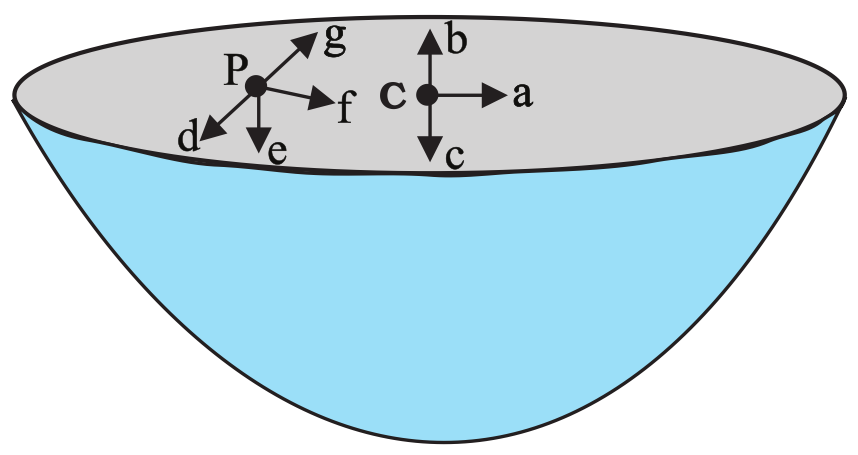
AnswerGravitational potential (V) is constant at all points in a spherical shell. Hence, the gravitational potential gradient $\Big(\frac{\text{dV}}{\text{dr}}\Big)$ is zero everywhere inside the spherical shell. The gravitational potential gradient is equal to the negative of gravitational intensity. Hence, intensity is also zero at all points inside the spherical shell. This indicates that gravitational forces acting at a point in a spherical shell are symmetric. If the upper half of a spherical shell is cut out (as shown in the given figure), then the net gravitational force acting on a particle located at centre O will be in the downward direction. 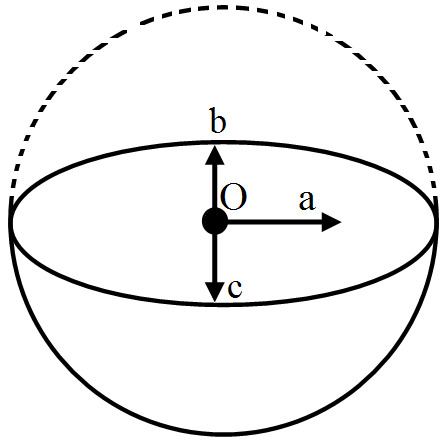 Since gravitational intensity at a point is defined as the gravitational force per unit mass at that point, it will also act in the downward direction. Thus, the gravitational intensity at centre O of the given hemispherical shell has the direction as indicated by arrow c.
 View full question & answer→Question 115 Marks
A spaceship is stationed on Mars. How much energy must be expended on the spaceship to launch it out of the solar system? Mass of the space ship $=1000 \mathrm{~kg}$; mass of the sun $=2 \times 10^{30} \mathrm{~kg}$; mass of mars $=6.4 \times 10^{23} \mathrm{~kg}$; radius of mars $=3395 \mathrm{~km}$; radius of the orbit of mars $=2.28 \times 10^8 \mathrm{~km} ; G=6.67 \times 10^{-11} \mathrm{~N} \mathrm{~m}^2 \mathrm{~kg}^{-2}$.
AnswerMass of the spaceship, $m_s=1000 \mathrm{~kg}$ Mass of the Sun, $M=2 \times 10^{30} \mathrm{~kg}$ Mass of Mars, $\mathrm{mm}=6.4 \times 10^{23} \mathrm{~kg}$ Orbital radius of Mars, $\mathrm{R}=2.28 \times 10^8 \mathrm{~kg}=2.28 \times 10^{11} \mathrm{~m}$ Radius of Mars, $\mathrm{r}=3395 \mathrm{~km}=3.395 \times 10^6 \mathrm{~m}$ Universal gravitational constant, $\mathrm{G}=6.67 \times 10^{-11} \mathrm{~m}^2 \mathrm{~kg}^{-2}$ Potential energy of the spaceship due to the gravitational attraction of the Sun $=-$ $\mathrm{GMm}_{\mathrm{s}} / \mathrm{R}$ Potential energy of the spaceship due to the gravitational attraction of Mars $=-\mathrm{GM}_{\mathrm{m}} \mathrm{m}_{\mathrm{s}} / \mathrm{r}$ Since the spaceship is stationed on Mars, its velocity and hence, its kinetic energy will be zero.
Total energy of the spaceship = $(-GMm_s)/R - (-GM_mm_s)/r = -Gm_s(M/R + m_m/r)$ The negative sign indicates that the system is in bound state. Energy required for launching the spaceship out of the solar system = -(Total energy of the spaceship) $=\text{Gm}_\text{s}\Big(\frac{\text{M}}{\text{R}}+\frac{\text{m}_\text{m}}{\text{r}}\Big)$ $=6.67\times10^{-11}\times10^3\times\Big(\frac{2\times10^{30}}{2.28\times10^{11}}+\frac{6.4\times10^{23}}{3.395\times10^6}\Big)$ $=6.67\times10^{-8}(87.72\times10^{17}+1.88\times10^{17})$ $=6.67\times10^{-8}\times89.50\times10^{17}$ $=596.97\times10^{9}$ $=6\times10^{11}\text{J}$
View full question & answer→Question 125 Marks
Let us assume that our galaxy consists of $2.5 \times 10^{11}$ stars each of one solar mass. How long will a star at a distance of $50,000ly$ from the galactic centre take to complete one revolution? Take the diameter of the Milky Way to be $10^5ly$.
AnswerMass of our galaxy Milky Way, $M = 2.5 \times 10^{11}$ solar mass Solar mass = Mass of Sun = $2.0 \times 10^{36}kg$ Mass of our galaxy, $M = 2.5 \times 10^{11} \times 2 \times 10^{36} = 5 \times 10^{41}kg$ Diameter of Milky Way, $d = 10^5ly$ Radius of Milky Way, $r = 5 \times 10^4ly 1ly = 9.46 \times 10^{15}m$
$\therefore r = 5 \times 10^4 \times 9.46 \times 10^{15} = 4.73 \times 10^{20}m$
Since a star revolves around the galactic centre of the Milky Way, its time period is given by the relation: $\text{T}=\Big(\frac{4\pi^2\text{r}^3}{\text{GM}}\Big)^\frac{1}{2}$$=\bigg(\frac{4\times(3.14)^2\times(4.73)^2\times10^{60}}{6.67\times10^{-11}\times5\times10^{41}}\bigg)^\frac{1}{2}=\bigg(\frac{39.48\times105.82\times10^{30}}{33.35}\bigg)^{\frac{1}{2}}$
$=(125.27\times10^{30})^\frac{1}{2}=1.12\times10^{16}\text{ s}$
$1\text{ year}=365\times324\times60\times60\text{s}$
$1\text{s}=\frac{1}{365\times24\times60\times60}\text{ year}$
$\therefore\ 1.12\times10^{16}\text{ s}=\frac{1.12\times10^{16}}{365\times24\times60\times60}$
$=3.55\times10^{8}\ \text{year}$
View full question & answer→Question 135 Marks
A rocket is fired ‘vertically’ from the surface of mars with a speed of $2km\ s^{-1}$. If $20\%$ of its initial energy is lost due to martian atmospheric resistance, how far will the rocket go from the surface of mars before returning to it? Mass of mars $= 6.4 \times 10^{23}kg;$ radius of mars $= 3395km;\ G = 6.67 \times 10^{-11}N\ m^2\ kg^{-2}.$
AnswerInitial velocity of the rocket, $v = 2km/s = 2 \times 10^3m/s$
Mass of Mars, $M = 6.4 \times 10^{23}kg$
Radius of Mars, $R = 3395km = 3.395 \times 10^6m$
Universal gravitational constant, $G = 6.67\times 10^{–11}N m^2 kg^{–2}$^
Mass of the rocket = m Initial kinetic energy of the rocket $= (1/2)mv^2$^
Initial potential energy of the rocket = -GMm/R
Total initial energy $= (1/2)mv^2- GMm/R$
If 20% of initial kinetic energy is lost due to Martian atmospheric resistance,
then only 80% of its kinetic energy helps in reaching a height.
Total initial energy available $= (80/100) \times (1/2) mv^2 - GMm/R = 0.4mv^2 - GMm/R$
Maximum height reached by the rocket = h At this height, the velocity and hence,
the kinetic energy of the rocket will become zero.
Total energy of the rocket at
height h = -GMm/(R + h)
Applying the law of conservation of energy for the rocket,
we can write: $0.4mv^2 - GMm/R$
$= -GMm/(R + h) 0.4v^2 $
$= GM/R - GM/(R + h) $
$= GMh/R(R + h) (R + h)/h $
$= GM/0.4v^2R R/h $
$= (GM/0.4v^2R ) - 1 h $
$= R/[(GM/0.4v^2R) - 1] $
$= 0.4R^2v^2 / (GM - 0.4v^2R) $
$= 0.4 \times (3.395 \times 10^6)^2 \times (2 \times 10^3)^2/[ 6.67 \times 10^{11} \times 6.4 \times 10^{23} - 0.4 \times (2 \times 10^3)^2 \times (3.395 \times 10^6)] $
$= 18.442 \times 10^{18}/[42.688 \times 10^{12} - 5.432 \times 10^{12}] $
$= 18.442 \times 10^6/37.256 $
$= 495 \times 10^3m $
$= 495km.$
View full question & answer→Question 145 Marks
For the above problem, the direction of the gravitational intensity at an arbitrary point P is indicated by the arrow (i) d, (ii) e, (iii) f, (iv) g.
AnswerGravitational potential (V) is constant at all points in a spherical shell. Hence, the gravitational potential gradient $\Big(\frac{\text{dV}}{\text{dR}}\Big)$ is zero everywhere inside the spherical shell. The gravitational potential gradient is equal to the negative of gravitational intensity. Hence, intensity is also zero at all points inside the spherical shell. This indicates that gravitational forces acting at a point in a spherical shell are symmetric. If the upper half of a spherical shell is cut out (as shown in the given figure), then the net gravitational force acting on a particle at an arbitrary point P will be in the downward direction. 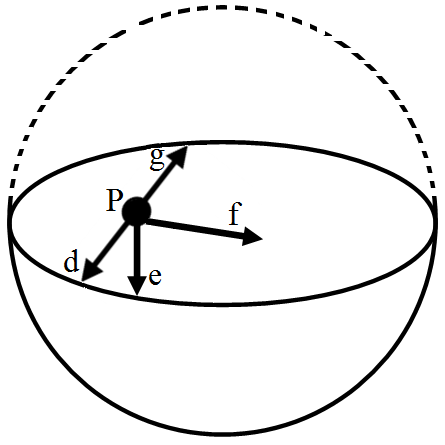 Since gravitational intensity at a point is defined as the gravitational force per unit mass at that point, it will also act in the downward direction. Thus, the gravitational intensity at an arbitrary point P of the hemispherical shell has the direction as indicated by arrow e. Hence, the correct answer is (ii).
 View full question & answer→Question 155 Marks
Io, one of the satellites of Jupiter, has an orbital period of $1.769$ days and the radius of the orbit is $4.22 \times 10^8m$. Show that the mass of Jupiter is about one-thousandth that of the sun.
AnswerOrbital period of lo, $\mathrm{T}_{10}=1.769$ days $=1.769 \times 24 \times 60 \times 60 \mathrm{secOrbital}$ radius of lo, $\mathrm{R}_{10}=4.22 \times 10^8 \mathrm{~m}$
Satellite lo is revolving around the Jupiter
Mass of the satellite is given as:
$\mathrm{M}_{\mathrm{j}}=\frac{\left(4 \pi^2 \mathrm{R}_{\mathrm{l}}^3\right)}{\left(\mathrm{GT}_{\mathrm{Io}}^2\right)}$
Where,
$\mathrm{M}_{\mathrm{J}}=$ Mass of Jupiter
$G=$ Universal gravitational constant
Orbital period of the Earth, $\mathrm{T}_{\mathrm{e}}=365.25$ days $=365.25 \times 24 \times 60 \times 60$ s
Orbital radius of the Earth,
$R_e = 1AU = 1.496 \times 10^{11}m$
Mass of the Sun $\text{M}_\text{s}=\frac{(4\pi^2\text{R}_\text{e}^3)}{(\text{GT}_\text{e}^2)}\ ....(\text{ii})$
Therefore, $\Big(\frac{\text{M}_\text{s}}{\text{M}_\text{j}}\Big)=\frac{(4\pi^2\text{R}_\text{e}^3)}{(\text{GT}_\text{e}^2)}\times\frac{(\text{GT}_\text{Io}^2)}{(4\pi^2\text{R}_\text{Io}^3)}$
$= ((1.769 \times 24 \times 60 \times 60)/ (365.25 x 24 x 60 x60))^2\times ((1.496 x 10^{11})/ (4.22 \times 10^8))^3$
$= 1045.04$
Therefore, $(M_s/ M_J) ≈ 1000$
$M_s ≈ 1000M_J$
This shows the mass of Jupiter is $(1/1000^{th})$ the mass of the sun.
View full question & answer→Question 165 Marks
A star $2.5$ times the mass of the sun and collapsed to a size of $12km$ rotates with a speed of $1.2$ rev. per second. (Extremely compact stars of this kind are known as neutron stars. Certain stellar objects called pulsars belong to this category). Will an object placed on its equator remain stuck to its surface due to gravity? (mass of the sun = $2 \times 10^{30}kg$).
AnswerA body gets stuck to the surface of a star if the inward gravitational force is greater than the outward centrifugal force caused by the rotation of the star. Gravitational force, $f_g=-G M m / R^2$ Where, $M=$ Mass of the star $=2.5 \times 2 \times$ $10^{30}=5 \times 10^{30} \mathrm{~kg} \mathrm{~m}=$ Mass of the body $R=$ Radius of the star $=12 \mathrm{~km}=1.2 \times 10^4 \mathrm{~m} \therefore \mathrm{fg}_{\mathrm{g}}=6.67 \times 10^{-11} \times 5 \times 10^{30}$ $\times \mathrm{m} /\left(1.2 \times 10^4\right)^2=2.31 \times 10^{11} \mathrm{~m} \mathrm{~N}$ Centrifugal force, $\mathrm{f}_{\mathrm{c}}=\mathrm{mr} \omega^2 \omega=$ Angular speed $=2 \pi \mathrm{v}$
$v=$ Angular frequency $=1.2 \mathrm{rev} \mathrm{s}^{-1} \mathrm{f}_{\mathrm{c}}=\mathrm{mR}(2 \pi \mathrm{v})^2=\mathrm{m} \times\left(1.2 \times 10^4\right) \times 4 \times(3.14)^2 \times(1.2)^2=1.7 \times 10^5 \mathrm{~m} \mathrm{~N}$ Since $\mathrm{f}_{\mathrm{g}}$ $>f_c$ the body will remain stuck to the surface of the star.
View full question & answer→Question 175 Marks
A rocket is fired vertically with a speed of $5 \mathrm{~km} \mathrm{~s}^{-1}$ from the earth's surface. How far from the earth does the rocket go before returning to the earth? Mass of the earth $=6.0 \times 10^{24} \mathrm{~kg}$; mean radius of the earth $=6.4 \times 10^6 \mathrm{~m}$; $\mathrm{G}=6.67$ $\times 10^{-11} \mathrm{Nm}^2 \mathrm{~kg}^{-2}$.
AnswerVelocity of the rocket, $v = 5km/s = 5 \times 10^3m/s$ Mass of the Earth, $M_e = 6 \times 10^{24}kg$ Radius of the Earth, $R_e = 6.4 \times 10^6m$ Height reached by rocket mass, m = h At the surface of the Earth, Total energy of the rocket = Kinetic energy + Potential energy$=\Big(\frac{1}{2}\Big)\text{mv}^2+\Big(\frac{-\text{GM}_\text{e}\text{m}}{\text{R}_\text{e}}\Big)$
At highest point h, v = 0 And, Potential energy $=\frac{-\text{GM}_\text{e}\text{m}}{(\text{R}_\text{e}+\text{h})}$ Total energy of the rocket $=0+\Big[\frac{-\text{GM}_\text{e}\text{m}}{(\text{R}_\text{e}+\text{h})}\Big]$
$=\frac{-\text{GM}_\text{e}\text{m}}{(\text{R}_\text{e}+\text{h})}$ From the law of conservation of energy, we have Total energy of the rocket at the Earth’s surface = Total energy at height h $\Big(\frac{1}{2}\Big)\text{mv}^2+\Big(\frac{-\text{GM}_\text{e}\text{m}}{\text{R}_\text{e}}\Big)=\frac{-\text{GM}_\text{e}\text{m}}{(\text{R}_\text{e}+\text{h})}$
$\Big(\frac{1}{2}\Big)\text{v}^2=\text{GM}_\text{e}\Bigg[\frac{\big(\frac{1}{\text{R}_\text{e}}\big)-1}{(\text{R}_\text{e}+\text{h})}\Bigg]$
$=\text{GM}_\text{e}\bigg[\frac{(\text{R}_\text{e}+\text{h}-\text{R}_\text{e})}{\text{R}_\text{e}(\text{R}_\text{e}+\text{h})}\bigg]$
$\Big(\frac{1}{2}\Big)\text{v}^2=\frac{\text{gR}_\text{e}\text{h}}{(\text{R}_\text{e}+\text{h})}$ Where $\text{g}=\frac{\text{GM}}{\text{R}_\text{e}^2}=9.8\text{ms}^{-2}$
$\therefore\ \text{v}^2(\text{R}_\text{e}+\text{h})=2\text{gR}_\text{e}\text{h}$
$\text{v}^2\text{R}_\text{e}=\text{h}(2\text{gR}_\text{e}-\text{v}^2)$
$\text{h}=\frac{\text{R}_\text{e}\text{v}^2}{(2\text{gR}_\text{e}-\text{v}^2)}$
$=\frac{6.4\times10^6\times(5\times10^3)^2}{2\times9.8\times6.4\times10^{6}-(5\times10^3)^2}$
$\text{h}=1.6\times10^6\text{m}$ Height achieved by the rocket with respect to the centre of the Earth $=\text{R}_\text{e}+\text{h}$
$=6.4\times10^6+1.6\times10^6=8\times10^6\text{m.}$
View full question & answer→Question 185 Marks
A saturn year is $29.5$ times the earth year. How far is the saturn from the sun if the earth is $1.50 \times 10^8km$ away from the sun?
AnswerDistance of the Earth from the Sun, $\mathrm{re}=1.5 \times 10^8 \mathrm{~km}=1.5 \times 10^{11} \mathrm{~m}$ Time period of the Earth $=\mathrm{T}_{\mathrm{e}}$ Time period of Saturn, $\mathrm{T}_5=29.5 \mathrm{~T}_{\mathrm{e}}$ Distance of Saturn from the Sun $=\mathrm{r}_{\mathrm{s}}$ From Kepler's third law of planetary motion, we have $\mathrm{T}=\left(\frac{4 \pi^2 \mathrm{r}^3}{\mathrm{GM}}\right)^{\frac{1}{2}}$ For Saturn and Sun, we can write $\frac{\mathrm{r}_{\mathrm{s}}^3}{\mathrm{r}_{\mathrm{e}}^3}=\frac{\mathrm{T}_{\mathrm{s}}^2}{\mathrm{~T}_{\mathrm{e}}^2} \mathrm{r}_{\mathrm{s}}=\mathrm{r}_{\mathrm{e}}\left(\frac{\mathrm{T}_{\mathrm{s}}}{\mathrm{T}_{\mathrm{e}}}\right)^{\frac{2}{3}}=1.5 \times 10^{11}\left(\frac{29.5 \mathrm{~T}_{\mathrm{e}}}{\mathrm{T}_{\mathrm{e}}}\right)^{\frac{2}{3}}$
$=1.5 \times 10^{11}(29.5)^{\frac{2}{3}}=1.5 \times 10^{11} \times 9.55=14.32 \times 10^{11} \mathrm{~m}$ Hence, the distance between Saturn and the Sun is $1.43 \times 10^{12} \mathrm{~m}$
View full question & answer→Question 195 Marks
Does the escape speed of a body from the earth depend on (a) the mass of the body, (b) the location from where it is projected, (c) the direction of projection, (d) the height of the location from where the body is launched?
Answer
- No, from the formula $\upsilon_\text{e}=\sqrt{\frac{2\text{GM}}{\text{R}}},$ it is clear that escape velocity does not depend on the mass of the body.
- The escape velocity depends upon the value of gravitational potential at the point from where the body is projected. The gravitational potential energy of body $\text{E}=-\frac{\text{GMm}}{\text{R}}$ is slightly different at different points ($\because$ the earth is not a perfect sphere and hence R is different ai different points). Because of this escape velocity depend slightly on the latitude of the place from where the body is projected.
- The escape velocity of a body does not depend upon its direction of projection.
- Since the gravitational potential energy at a point at the height h from the earth surface is $\frac{\text{GMs}}{\text{(R+h)}},$ the escape velocity will be different for different values of h.
View full question & answer→Question 205 Marks
Explain gravitational potential at a point in gravitational field. Give relation between gravitational field intensity and gravitational potential.
AnswerGravitational potential at a point in a gravitational field of a body is defined as the amount of work done in bringing a body of unit mass from infinity to that point without acceleration. Consider two points A and B, distance dr apart in a uniform gravitational field of intensity $\vec{\text{I}}$ Let the direction of $\vec{\text{I}}$ be along AB. Gravitational force on the particle of mass m placed at B will be, $\vec{\text{F}}=\text{m}\vec{\text{I}}.$ Work done by gravitational force for the displacement of the particle from B to A (i.e. a displacement $\overrightarrow{\text{dr}})$ will be $\text{dW}=\vec{\text{F}}.\overrightarrow{\text{dr}}=\text{m}\vec{\text{I}}.\ \overrightarrow{\text{dr}}=\text{mI}\text{ dr }\cos180^\circ$ Change in gravitational potential, $\text{dV}=\frac{\text{dW}}{\text{m}}=-\text{Idr}$ $\Rightarrow\text{I}=-\frac{\text{dV}}{\text{dr}}$ $\text{Here,}\frac{\text{dV}}{\text{dr}}$ is called gravitational potential gradient.
View full question & answer→Question 215 Marks
If the earth supposed to be a uniform sphere, contracts slightly so that its radius becomes less by $\Big(\frac{\text{R}}{\text{n}}\Big)$ than before, show that the length of the day shortens by $\Big(\frac{48}{\text{n}}\Big)$ hours.
AnswerThe present length of day, T = 24 hours; $\omega=\frac{2\pi}{\text{T}}$ Let M be the mass of the earth, R and R' be the radii of earth before and after contraction. Then $\text{R}'=\text{R}-\frac{\text{R}}{\text{n}}=\text{R}\big(1-\frac{1}{\text{n}}\Big)$ According to law of conservation of angular momentum, $\text{I}\omega=\text{I}'\omega'$ $\text{or }\frac{2}{5}\text{ MR}^2\omega=\frac{2}{5}\text{MR}'^2\omega'^2$ $\text{or }\omega'=\frac{\text{R}^2\omega}{\text{R}'^2}$$=\frac{\text{R}^2\omega}{\text{R}^2\Big[1-\big(\frac{1}{\text{n}}\big)\Big]^2}$
$=\Big(1-\frac{1}{\text{n}}\Big)^{-2}\omega=\Big(1+\frac{2}{\text{n}}\Big)\omega$ $\therefore\text{T}'=\frac{2\pi}{\omega'}=\frac{2\pi}{\Big[1+\big(-\frac{2}{\text{n}}\big)\Big]\omega}$ $=\frac{2\pi}{\omega}\Big(1+\frac{2}{\text{n}}\Big)^{-1}=\text{T}\Big(1-\frac{2}{\text{n}}\Big)$ $\text{or }\text{T}'-\text{T}=\frac{2\text{T}}{\text{n}}$ $=\frac{2\times24}{\text{n}}=\frac{48}{\text{n}}\text{hours}.$
View full question & answer→Question 225 Marks
What are geostationary satellites? Calculate the height of the orbit above the surface of the earth in which a satellite, if placed, will appear stationary.
AnswerA satellite which revolves around the earth with the same angular speed in the same direction as is done by earth around its axis is called geostationary or geosynchronous satellite. Velocity of such a satellite relative to earth is zero. T = 24h height of geostationary satellite $\text{h}=\Big(\frac{\text{T}^2\text{R}^2\text{g}}{4\pi^2}\Big)^{\frac{1}{3}}-\text{R}$ $\text{R} = 6.4 \times 10^6\text{m}$ $\text{g} = 9.8\text{m/s}^2$ $\text{T = 24hr}. = 24 \times 60 \times 60\text{sec}$ $\text{h}=\Big(\frac{(86400)^2\times(6.4\times10^6)^2\times9.8}{4\times(3.14)^2}\Big)^{\frac{1}{3}}-(6.4\times10^6)$ $\text{h}=3.6\times10^7\text{m}=36000\text{km}$ So for the orbit to appear stationary, it should be at the height of 36000km.
View full question & answer→Question 235 Marks
A body is projected vertically from the surface of earth with a velocity equal to half of the escape velocity. What is the maximum height reached by the body?
Answer$-\frac{\text{GMm}}{\text{R}+\text{h}}+0=-\frac{\text{GMm}}{\text{R}}+\frac{1}{2}\text{m}\Big[\frac{1}{2}\sqrt{\frac{2\text{GM}}{\text{R}}}\Big]^2$ (Using law of conservation of energy) $\Rightarrow-\frac{\text{GMm}}{\text{R}+\text{h}}+\frac{\text{GMm}}{\text{R}}=\frac{1}{8}\frac{\text{m}2\text{GM}}{\text{R}}$ $=\frac{2\text{GMm}}{8\text{R}}=\frac{\text{GMm}}{\text{4R}}$ $\text{or }-\frac{\text{GMm}}{\text{R+h}}=\frac{\text{GMm}}{\text{4R}}-\frac{\text{GMm}}{\text{R}}$$=-\frac{3}{4}\frac{\text{GMm}}{\text{R}}$
$\Rightarrow\frac{1}{\text{R}+\text{h}}=\frac{3}{4\text{R}}\text{ or }3\text{R}+3\text{h}=4\text{R}$
$\Rightarrow3\text{h}=4\text{R}-3\text{R}=\text{R}$
$\text{or }\text{h}=\frac{\text{R}}{3}$
View full question & answer→Question 245 Marks
A geostationary satellite is orbiting the earth at a height of 6R above the surface of earth. Here R is the radius of the earth. What is the time period of another satellite at a height of 2.5R from the surface of the earth?
AnswerIn first case, radius or orbit R + 6R = 7R In second case, redius of orbit R + 2.5R = 3.5R $\frac{\text{T}'^2}{\text{T}'^2}=\frac{\text{R}'^3}{\text{R}^3}$ $\Rightarrow\ \text{T}'^2=\Big(\frac{\text{R}'}{\text{R}}\Big)^3\text{T}^2$ $\Rightarrow\ \text{T}'^2=\Big[\frac{3.5\text{R}}{7\text{R}}\Big]^3\times24\times24$ $\Rightarrow\ \text{T}'=\frac{24}{\sqrt{8}}\text{hs}=\frac{12}{1.414}\text{hr}$ $\Rightarrow\text{T}'=8.49\text{hr}.$
View full question & answer→Question 255 Marks
A space ship is stationed on Mars. How much energy must be expended on the space ship to rocket it out of the solar system? Mass of the spaceship $=1000 \mathrm{~kg}$, mass of the $\mathrm{Sun}=2 \times 10^{30} \mathrm{~kg}$, radius of Mars $=3395 \mathrm{~km}$, Mass of the Mars $=6.4 \times 10^{23} \mathrm{~kg}$. Radius of the orbit of Mars $=2.28 \times 10^{11} \mathrm{~m} . \mathrm{G}=6.67 \times 10^{-11} \mathrm{Nm}^2 \mathrm{~kg}^{-2}$
AnswerLet R be the radius of orbit of Sun and R' be the radius of the Mars. M be the mass of the Sun and M' be the mass of Mars. If m is the mass of the spaceship, then potential energy of spaceship due to gravitational attraction of the Sun $ = -\frac{\text{GMm}}{\text{R}}$ Potential energy of spaceship due to gravitational attraction of Mars $ = -\frac{\text{GMm}'}{\text{R}'}$ Since the K.E. of spaceship is zero, therefore, total energy of space ship $=-\frac{\text{GMm}}{\text{R}}-\frac{\text{GM}'\text{m}}{\text{R}}=-\text{GM}\Big(\frac{\text{M}}{\text{R}}+\frac{\text{M}'}{\text{R}'}\Big)$
$\therefore$ energy required to rocket out the spaceship from the solar system. = -(Total energy of spaceship) $=-\Big[-\text{Gm}\Big(\frac{\text{M}}{\text{R}}+\frac{\text{M}'}{\text{R}'}\Big)\Big]$
$=\text{Gm}\Big[\frac{\text{M}}{\text{R}}+\frac{\text{M}'}{\text{R}'}\Big]$
$=6.67\times10^{-11}\times1000\times\Big[\frac{2\times10^{30}}{2.28\times10^{11}}+\frac{6.4\times10^{23}}{3395\times10^3}\Big]$
$=6.67\times10^{-8}\Big[\frac{20}{2.28}+\frac{6.4}{33.95}\Big]\times10^{18}\text{J}$
$=5.98\times10^{11}\text{J}.$
View full question & answer→Question 265 Marks
Three masses, each equal to M, are placed at the three corners of a square of side 'a'. Calculate the force of attraction on unit mass at the fourth corner.
Answer$\text{F}_1=\text{F}_2=\frac{\text{GM}}{\text{a}^2}$ Resultant of $F_1$ and $F_2$ is $\sqrt{2}\frac{\text{GM}}{\text{a}^2}$ pointing towards the centre. $\text{F}_3=\frac{\text{GM}}{(\sqrt{2}\text{a})^2}=\frac{\text{GM}}{2\text{a}^2}$ Both $\frac{\sqrt{2}\text{GM}}{\text{a}^2}\text{ and }\frac{\text{GM}}{2\text{a}^2}$ act in the same direction (along the diagonal) 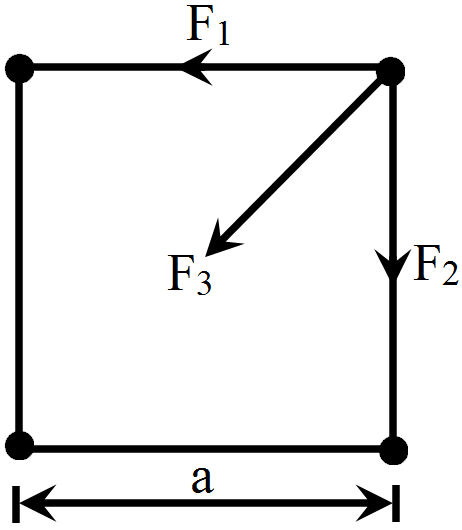
Their resultant is $\frac{\sqrt{2}\text{GM}}{\text{a}^2}+\frac{\text{GM}}{2\text{a}^2}\text{ or }\frac{\text{GM}}{\text{a}^2}\Big(\sqrt{2}+\frac{1}{2}\Big)$ View full question & answer→Question 275 Marks
Which of the following symptoms is likely to afflict an astronaut in space (a) swollen feet, (b) swollen face, (c) headache, (d) orientational problem.
Answer(b) Swollen face, (c) headache, (d) orientational problem.
- Legs hold the entire mass of a body in standing position due to gravitational pull. In space, an astronaut feels weightlessness because of the absence of gravity. Therefore, swollen feet of an astronaut do not affect him/ her in space.
- A swollen face is caused generally because of apparent weightlessness in space. Sense organs such as eyes, ears nose, and mouth constitute a person’s face. This symptom can affect an astronaut in space.
- Headaches are caused because of mental strain. It can affect the working of an astronaut in space.
- Space has different orientations. Therefore, orientational problem can affect an astronaut in space.
View full question & answer→Question 285 Marks
Define the term orbital speed. Establish a relation for orbital speed of a satellite orbiting very close to the surface of the earth. Find the ratio of this orbital speed and escape speed.
AnswerOrbital speed: It is the minimum speed required to put the satellite into given orbit around the earth. 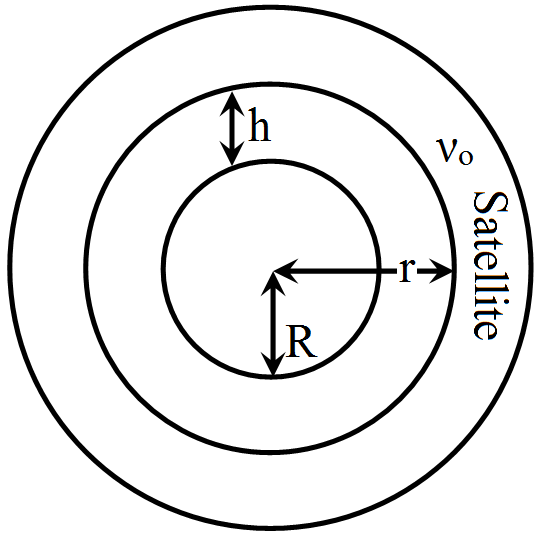
M = mass of earth R = radius of earth m = mass of satellite $v_0$ = orbital velocity of satellite h = height of satellite above surface of earth. r = R + h According to Newton's law of gravitation, $\text{F} = \frac{\text{GMm}}{\text{r}^2}$ Centripetal force $\text{F} = \frac{\text{mv}_{\text{o}}}{\text{r}}$ In equilibrium, gravitational pull provides the required centripetal force. $\frac{\text{mv}^2_{\text{o}}}{\text{r}}=\frac{\text{GMm}}{\text{r}^2}$ $\Rightarrow\text{v}_{\text{o}}=\sqrt{\frac{\text{GM}}{\text{r}}}$ $\text{v}_{\text{o}}=\sqrt{\frac{\text{gR}^2}{\text{r}}}=\sqrt{\frac{\text{gR}^2}{\text{R+h}}}$ $\text{for h }<<\text{R}$ $\text{R}+\text{h}\approx\text{R}$ $\therefore\text{v}_{\text{o}}=\sqrt{\text{gR}}$ $\Rightarrow\text{v}_{\text{e}}=\sqrt{2\text{gR}}$ $\frac{\text{v}_{\text{o}}}{\text{v}_{\text{e}}}=\frac{1}{\sqrt{2}}$ View full question & answer→Question 295 Marks
A mass m is left free at a distance 3R from the surface of earth. On reaching the surface, what will be its velocity?
AnswerInitial energy $=-\frac{\text{GM}_\text{m}}{4\text{R}}$ On reaching the surface of earth. $\text{Energy}=\frac{\text{GM}_\text{m}}{\text{R}}+\frac{1}{2}\ \text{mv}^2$ $\therefore-\frac{\text{GM}_\text{m}}{\text{R}}+\frac{1}{2}\text{mv}^2=-\frac{\text{GM}\text{m}{}}{4\text{R}}$ $\text{v}^2=2\Big[-\frac{\text{GM}_\text{m}}{\text{R}}\Big(\frac{1}{4}-1\Big)\Big]$ $\therefore\ \text{v}=\sqrt{\frac{3\ \text{GM}_\text{m}}{2\ \text{R}}}\ \text{ms}^{-1}$
View full question & answer→Question 305 Marks
What happens to a body when it is projected vertically upwards from the surface of the earth with a speed of 11200m/s, and why? Compare escape speeds for two planets of masses M and 4M and radii 2R and R respectively.
AnswerSpeed of projection = 11200m/s = 11.2km/s Since this is equal to the escape velocity, the mass thrown should escape from the surface of earth. Escape speed on the surface of a planet is given by, $\text{v}_{\text{e}}=\sqrt{2\text{gR}}$ $\Rightarrow\text{v}_{\text{e}}=\sqrt{\frac{2\text{GM}}{\text{R}}}$ where M and R are the mass and radius of the planet. $\text{M}_1=\text{M}_2=1:4$ $\text{R}_1:\text{R}_2=2:1$ $\therefore\frac{\text{v}_{\text{e1}}}{\text{v}_{\text{e2}}}=\sqrt{\frac{\text{M}_1}{\text{M}_2}\frac{\text{R}_2}{\text{R}_1}}=\sqrt{\frac{1}{4}}\times\frac{1}{2}$ $=\sqrt{\frac{1}{8}}=\frac{1}{2\sqrt{2}} $
View full question & answer→Question 315 Marks
Mean solar day is the time interval between two successive noon when sun passes through zenith point (meridian). Sidereal day is the time interval between two successive transit of a distant star through the zenith point (meridian). By drawing appropriate diagram showing earth’s spin and orbital motion, show that mean solar day is four minutes longer than the sidereal day. In other words, distant stars would rise 4 minutes early every successive day.
AnswerAccording to the diagram alongside, when the earth revolves about its polar axis in one sidereal day, it also moves from E to E’ around the sun due to translational motion and the point P’ is at P’’. When the Earth still rotates through an angle about its axis to complete one solar day until the point P’ is at P”, again facing the sun.
Earth advances in its orbit by approximately 1° every day, i.e. in 24 hours. Then, it will have to rotate by 361° (which we define as 1 day) to have the sun at zenith point again, 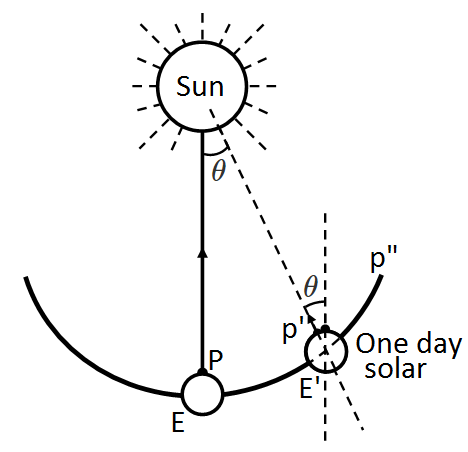 $\therefore$ Time taken to traverse $1^0=\frac{24\text{h}}{361^0}\times1^0\frac{24\times60\times6\text{s}}{361}=239.3\text{s}$ i.e., 239.3s = 3 min 59.3s ≈ 4 min Hence, distante stars would rise 4 minutes early every successive day.
 View full question & answer→Question 325 Marks
A satellite orbits the earth at a height of 400 km above the surface. How much energy must be expended to rocket the satellite out of the earth's gravitational influence? Mass of the satellite $=200 \mathrm{~kg}$; mass of the earth $=6.0 \times$ $10^{24} \mathrm{~kg}$; radius of the earth $=6.4 \times 10^6 \mathrm{~m} ; \mathrm{G}=6.67 \times 10^{-11} \mathrm{~N} \mathrm{~m}^2 \mathrm{~kg}^{-2}$.
AnswerMass of the Earth, $M = 6.0 \times 10^{24}kg$ Mass of the satellite, $m = 200kg$ Radius of the Earth, $R_e = 6.4 \times 10^6m$ Universal gravitational constant, $G = 6.67 \times 10^{–11}Nm^2kg^{–2}$ Height of the satellite, $h = 400km = 4 \times 10^5m = 0.4 \times 10^6m$ Total energy of the satellite at height $\text{h}=\Big(\frac{1}{2}\Big)\text{mv}^2+\Big[\frac{-\text{GM}_\text{e}\text{m}}{(\text{R}_\text{e}+\text{h})}\Big]$ Orbital velocity of the satellite, $\text{v}=\Big[\frac{\text{GM}_\text{e}}{(\text{R}_\text{e}+\text{h})}\Big]^\frac{1}{2}$ Total energy of height, $\text{h}=\frac{\big(\frac{1}{2}\big)\text{GM}_\text{e}\text{m}}{(\text{R}_\text{e}+\text{h})}-\frac{\text{GM}_\text{e}\text{m}}{(\text{R}_\text{e}+\text{h})}$$=-\frac{\big(\frac{1}{2}\big)\text{GM}_\text{e}\text{m}}{(\text{R}_\text{e}+\text{h})}$
The negative sign indicates that the satellite is bound to the Earth. This is called bound energy of the satellite. Energy required to send the satellite out of its orbit = -(Bound energy)$=\frac{\big(\frac{1}{2}\big)\text{GM}_\text{e}\text{m}}{(\text{R}_\text{e}+\text{h})}$
$=\frac{\big(\frac{1}{2}\big)\times6.67\times10^{-11}\times6\times10^{24}\times200}{(6.4\times10^6+0.4\times10^6)}$
$=5.9\times10^9\text{ j.}$
View full question & answer→Question 335 Marks
Suppose there existed a planet that went around the sun twice as fast as the earth. What would be its orbital size as compared to that of the earth?
AnswerTime taken by the Earth to complete one revolution around the Sun, $\mathrm{T}_{\mathrm{e}}=1$ year Orbital radius of the Earth in its orbit, $R_e=1$ AU Time taken by the planet to complete one revolution around the Sun, $T_p=1 / 2 T_e=1 / 2$ year Orbital radius of the planet $=R_p$ From Kepler's third law of planetary motion, we can write: $\left(R_p / R_e\right)^3=\left(T_p / T_e\right)^2\left(R_p / R_e\right)=$ $\left(T_p / T_e\right)^{2 / 3}=(1 / 2 / 1)^{2 / 3}=0.5^{2 / 3}=0.63$ Hence, the orbital radius of the planet will be 0.63 times smaller than that of the Earth.
View full question & answer→Question 345 Marks
A body weighs 63N on the surface of the earth. What is the gravitational force on it due to the earth at a height equal to half the radius of the earth?
AnswerWeight of the body, W = 63N Acceleration due to gravity at height h from the Earth’s surface is given by the relation:$\text{g}'=\frac{\text{g}}{\big[1+\big(\frac{\text{h}}{\text{R}_\text{e}}\big)\big]^2}$
Where, g = Acceleration due to gravity on the Earth’s surface $R_e$ = Radius of the EarthFor $\text{h}=\frac{\text{R}_\text{e}}{2}$
$\text{g}'=\frac{\text{g}}{\big[1+\big(\frac{\text{R}_\text{e}}{2\text{R}_\text{e}}\big)\big]^2}$
$=\frac{\text{g}}{\big[1+\big(\frac{1}{2}\big)\big]^2}=\Big(\frac{4}{9}\Big)\text{g}$
Weight of a body of mass m at height h is given as: W‘ = mg $=\text{m}\times\Big(\frac{4}{9}\Big)\text{g}=\Big(\frac{4}{9}\Big)\text{mg}$ $=\Big(\frac{4}{9}\Big)\text{W}$ $=\Big(\frac{4}{9}\Big)\times63=28\text{N.}$
View full question & answer→Question 355 Marks
What is the effect of rotation on the value of 'g'? Derive the relation.
AnswerConsider a mass m placed at a latitude $\theta$ Two forces are experienced by it namely, 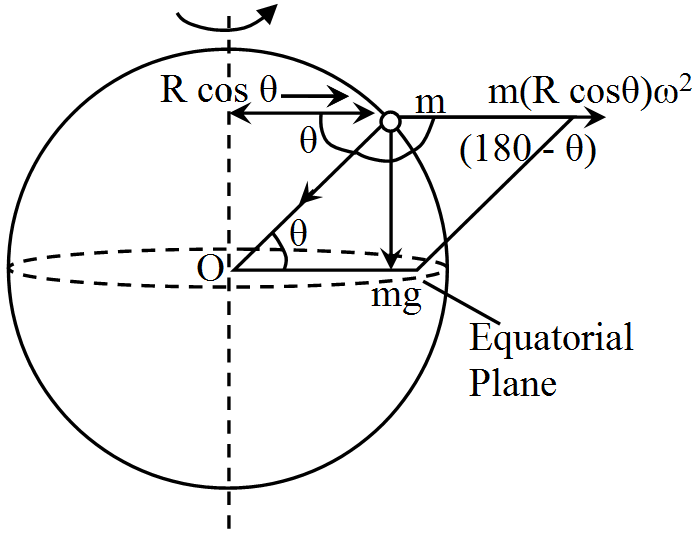
- The gravitational force 'mg' towards centre O.
- The centrifugal force trying to lift the mass away. The net force is given by,
$\text{mg}_{\theta}=\sqrt{(\text{mg})^2+(\text{mR}\cos\theta\ \omega^2)^2+2(\text{mg})\$\text{mR}\cos\theta\ \omega^2)\cos(180^\circ-\theta)}$
The radius is $\text{R}\cos\theta$ since the centrifugal force is due to the rotation about the axis of the earth.
$\text{mg}_{\theta}=\text{mg}\Bigg(1+\Big(\frac{\text{R}\omega^2\cos^2\theta}{\text{g}}\Big)^2-2\frac{\text{R}\omega^2}{\text{g}}\cos^2\theta\Bigg)^{\frac{1}{2}}$
$\therefore\text{g}_{\theta}\Big(1-\frac{2\text{R}\omega^2}{\text{g}}\cos^2\theta\Big)^{\frac{1}{2}}$
Since $\Big(\frac{\text{R}\omega^2}{\text{g}}\Big)^2$ is negligibly small.
$\text{g}_{\theta}=\text{g}\Big(1-\frac{\text{R}\omega^2}{\text{g}}\cos^2\theta\Big)$ View full question & answer→Question 365 Marks
Show the nature of the following graph for a satellite orbiting the earth.
- KE vs orbital radius R
- PE vs orbital radius R
- TE vs orbital radius R.
AnswerLet us first consider the diagram, which represents a satellite of mass m, moving around the earth in a circular orbit of radius R.
Orbital speed of the satellite is given by $\text{v}_0\sqrt{\frac{\text{GM}}{\text{R}}}$.
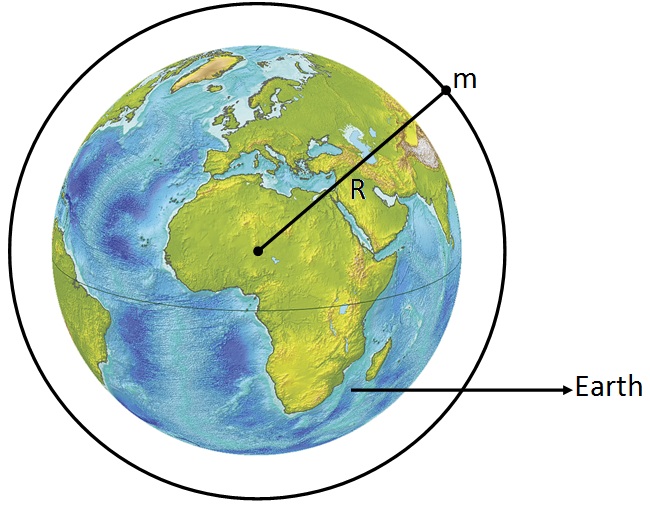
where, M is the mass of earth and R is the radius of the earth.
- So, kinetic energy of the satellite is given by
$\text{K}=\frac{1}{2}\text{mv}_0^2=\frac{1}{2}\text{m}\times\frac{\text{GM}}{\text{R}}$
We can say that kinetic energy is inversely proportional to R. It means the KE decreases exponentially with radius. The graph will be a rectangular hyperbola.
Hence, the variation of kinetic energy versus orbital radius is shown in graph.
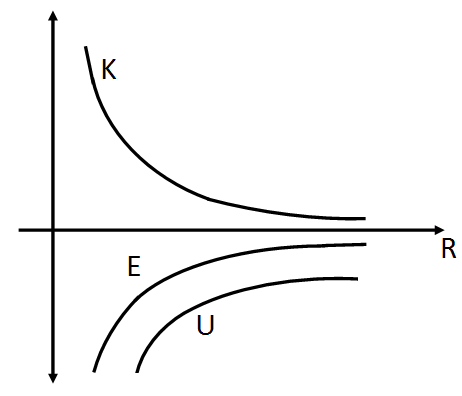
- Potential energy of a satellite
$\text{U} = \frac{-\text{GMm}}{\text{R} = -\text{2K}}$
So, potential energy is twice of kinetic energy and negative sign implies that graph is downward hyperbola.
- Total energy of the satellite
$\text{E = K + U}=\frac{\text{GMm}}{\text{2R}}-\frac{\text{GMm}}{\text{R}}$
$=-\frac{\text{GMm}}{\text{2R}}$
Negative total energy, E signifies that earth and the satellite is a bounded system.
If $\text{E}\geq\text{U},$ the satellite will be free from earth’s gravity. View full question & answer→Question 375 Marks
Define escape speed and derive the expression for escape velocity on earth's surface.
Answer
- The minimum speed required for an object to reach infinity (i.e., to get escape from earth gravitational pull) is called escape velocity.
- $\frac{1}{2}\text{m}\Big(\text{v}_{\text{i}}^2\Big)_{\text{e}}=\frac{\text{GmM}_{\text{p}}}{\text{h}+\text{R}_{\text{p}}}$
$\begin{bmatrix}\text{where M}_{\text{p}}=\text{Mass of planet}\\\ \ \ \ \ \ \ \ \ \ \text{R}_{\text{p}}=\text{Radius of planet}\end{bmatrix}$
If the object is thrown from surface of a planet h = 0, we get
$(\text{v}_{\text{i}})_{\text{e}}=\sqrt{\frac{2\text{GM}_{\text{p}}}{\text{R}_{\text{p}}}}$
$\text{but }\text{g}=\frac{\text{GM}_{\text{p}}}{\text{R}_{\text{p}}}\text{ we get}$
$(\text{v}_{\text{i}})_{\text{e}}=\sqrt{2\text{gR}_{\text{p}}}$
- Depends on location as 'g' varies with location, as most of the celestial bodies are not perfectly spherical.
View full question & answer→Question 385 Marks
The escape speed of a projectile on the earth’s surface is $11.2km s^{-1}$. A body is projected out with thrice this speed. What is the speed of the body far away from the earth? Ignore the presence of the sun and other planets.
AnswerEscape velocity of a projectile from the Earth, $v_{esc} = 11.2km/s$ Projection velocity of the projectile, $v_p = 3v_{esc}$ Mass of the projectile = m Velocity of the projectile far away from the Earth = $v_f$ Total energy of the projectile on the Earth = $(1/2)mv_p^2 - (1/2)mv_{esc}^2$ Gravitational potential energy of the projectile far away from the Earth is zero. Total energy of the projectile far away from the Earth = $(1/2)mv^2_f$ From the law of conservation of energy, we have$\frac{1}{2}\text{mv}_\text{p}^2-\frac{1}{2}\text{mv}_\text{esc}^2=\frac{1}{2}\text{mv}_\text{f}^2$
$\text{v}_\text{f}=\sqrt{\text{v}_\text{p}^2-\text{v}_\text{esc}^2}$
$=\sqrt{(3\text{v}_\text{esc})^2-(\text{v}_\text{esc})^2}$
$=\sqrt{8}\text{v}_\text{esc}$
$=\sqrt{8}\times11.2=31.68\text{km/s}$
View full question & answer→Question 395 Marks
- Two particles of equal masses go around a circle of radius R under the action of their mutual gravitational force. Find the speed of each particle
- What is the binding energy of a satellite? Derive an expression for it.
Answer
- The particles will always remain diametrically opposite so that the force on each particle will be directed along the radius. Consider the motion of one of the particles. The force on the particle is given by
$\text{F}=\frac{\text{Gm}^2}{4\text{R}^2}$
$\therefore\frac{\text{Gm}^2}{4\text{R}^2}=\frac{\text{mv}^2}{\text{R}}$
$\Rightarrow\text{v}=\sqrt{\frac{\text{Gm}}{4\text{R}}}$
- Binding energy is the minimum energy required to free a satellite from the gravitational attraction.
$\text{T.E.}=\text{P.E.}+\text{K.E.}=-\frac{\text{GMm}}{\text{R}}+\frac{1}{2}\text{mv}^2$
$\text{T.E.}=-\frac{\text{GMm}}{\text{R}}+\frac{\text{mGM}}{\text{R}}=\frac{-\text{GMm}}{\text{2R}}$
Binding energy (B.E.) = -(T.E.) $=\frac{\text{GMm}}{2\text{R}}$ View full question & answer→Question 405 Marks
Show that the gravitational potential at a point of distant r from the mass M is given by, $\text{V}=-\Big(\frac{\text{GM}}{\text{r}}\Big)$
AnswerThe gravitational force of attraction between M and m when x is the distance between their centres is given by. $\text{F}=\frac{\text{GMm}}{\text{x}^2}$ Suppose the body be moved through a distance dr, therefore, work done is given by, $\text{dW}=\text{Fdx}=\frac{\text{GMm}}{\text{x}^2}\text{dx}$ When the body is brought from infinity to some distance r, $\int\text{dW}=\int^\limits{\text{x}=\text{r}}_\limits{\text{x}=\infty}\frac{\text{GMm}}{\text{x}^2}\text{dx}$ $\text{or }\text{W}=\text{GMm}\Big[\frac{-1}{\text{x}}\Big]^{\text{r}}_{\infty}$ $=-\text{GMm}\Big[\frac{1}{\text{r}}-\frac{1}{\infty}\Big]=\frac{-\text{GMm}}{\text{r}}$ This amount of work done is the change in the potential energy of the body.$\therefore\text{P.E}(\text{U})=\frac{-\text{GMm}}{\text{r}}$
Gravitational potential $\text{V}=\frac{\text{U}}{\text{m}}=\frac{-\text{GM}}{\text{r}}$
View full question & answer→Question 415 Marks
What is the gravitational potential and gravitational potential energy of a body of $0.2kg$ at a height $1600km$ above the surface of the earth? ($G= 6.67 \times 10^{-11}Nm^2kg^{-2}$, mass of the earth = $6 \times 10^{24}kg$ and radius of the earth = $6400km$).
AnswerGiven that, $G = 6.67 \times 10^{-11} Nm^2kg^{-2} m = 6 \times 10^{24}kg R$
$= 6400km = 6400 \times 10^3m h = 1600km = 1600 \times 10^3m m = 0.2kg$ Gravitational potential, $\text{V}=-\frac{\text{GM}}{\text{R+h}}$ $=\frac{-6.67\times10^{-11}\times6\times10^{24}}{(6400+1600)\times10^3}$ $\approx-5\times10^7\text{Jkg}^{-1}$ Gravitational potential energy, $\text{E}=-\frac{\text{GMm}}{\text{R}+\text{h}}=\text{Vm}$ $=-5\times10^7\times0.2=-10^7\text{J}.$
View full question & answer→Question 425 Marks
Choose the correct alternative: The energy required to launch an orbiting satellite out of earth’s gravitational influence is more/ less than the energy required to project a stationary object at the same height (as the satellite) out of earth’s influence.
AnswerLess.Explanation:
An orbiting satellite acquires a certain amount of energy that enables it to revolve around the Earth. This energy is provided by its orbit. It requires relatively lesser energy to move out of the influence of the Earth’s gravitational field than a stationary object on the Earth’s surface that initially contains no energy.
View full question & answer→Question 435 Marks
- Define escape velocity.
- Derive expression for the escape velocity of an object from the surface of a planet.
- Does it depend on location from where it is projected?
Answer
- The minimum speed required for an object to reach infinity (i.e., to get escape from earth) is called escape velocity.
- $\frac{1}{2}\text{m}\Big(\text{v}_{\text{i}}^2\Big)_{\text{e}}=\frac{\text{GmM}_{\text{p}}}{\text{h+R}_{\text{p}}}$
$\begin{bmatrix}\text{where M}_{\text{p}}=\text{Mass of planet}\\\ \ \ \ \ \ \ \ \ \ \text{R}_{\text{p}}=\text{Radius of planet}\end{bmatrix}$
If the object is thrown from surface of a planet h = 0, we get
$(\text{v}_{\text{i}})_{\text{e}}=\sqrt{\frac{2\text{GM}_{\text{p}}}{\text{R}_{\text{p}}}}$
$\text{but }\text{g}=\frac{\text{GM}_{\text{p}}}{\text{R}_{\text{p}}}\text{ we get}$
$(\text{v}_{\text{i}})_{\text{e}}=\sqrt{2\text{gR}_{\text{p}}}$
- Depends on location as 'g' varies with location, as most of the celestial bodies are not perfectly spherical.
View full question & answer→Question 445 Marks
Assuming the earth to be a sphere of uniform mass density, how much would a body weigh half way down to the centre of the earth if it weighed 250N on the surface?
AnswerGiven: Weight of a body of mass m at the Earth’s surface, W = mg = 250N Where g = acceleration due to gravity on earth’s surface, mass of the body = m and weight of the body = W Depth, $\text{d}=\Big(\frac{1}{2}\Big)\text{R}_\text{e}$ Where, $R_e$ = Radius of the Earth Acceleration due to gravity at depth = g’ and is given as: $\text{g}'=\Big(\frac{(1-\text{d})}{\text{R}_\text{e}}\Big)\text{g}$ $=\Big(\frac{1-(\text{R}_\text{e})}{(2\times\text{R}_\text{e})}\Big)\text{g}$ $=\Big(\frac{1}{2}\Big)\text{g}$ Weight of the body at depth d, W’ = mg’ $=\text{m}\times\Big(\frac{1}{2}\Big)\text{g}$ $=\Big(\frac{1}{2}\Big)\text{W}$ $=\Big(\frac{1}{2}\Big)\times250$ $=125\text{N}$
View full question & answer→Question 455 Marks
An artificial satellite of mass $1000kg$ revolves around the earth in circular orbit of radius $6500km$. Calculate,
- Orbital velocity.
- Orbital kinetic energy.
- Gravitational potential energy.
- Total energy in the orbit. [Mass of the earth = $6 \times 1024kg, G = 6.67 \times 10-11 Nm^2/ kg]$
Answer
- Orbital velocity $v_0 =\sqrt{\frac{\text{GM}}{\text{r}}},$ where M is the mass of earth and r the radius of the path.
$\therefore\text{v}_{\text{o}}=\sqrt{\frac{6.67\times10-11\times6\times10^{24}}{6500\times10^3}}$
$=6.16\times10^7\text{ms}^{-1}$
- Orbital K.E. $=\frac{1}{2}\text{mv}^2_{\text{o}}=\frac{1}{2}\text{m}\frac{\text{GM}}{\text{r}}$
$=\frac{1}{2}\times10^3\times\frac{6.67\times10^{-11}\times6\times10^{24}}{6500\times10^3}$
$\text{K.E.}=\frac{61.67\times10^{11}}{2}=30.84\times10^{11}\text{J}$
- Gravitational potential energy
$=\frac{-\text{GMm}}{\text{r}}=-2\times\text{K.E.}$
- Total energy in orbit = P.E. + K.E.
$=-\text{K.E.}=-30.84\times10^{11}\text{J}$ View full question & answer→Question 465 Marks
A $400kg$ satellite is in a circular orbit of radius $2R_E$ about the earth. How much energy is required to transfer it to circular orbit of radius $4R_E$? What are the changes in the kinetic energy and potential energy?
AnswerTotal energy with a satellite $=-\frac{\text{GMm}}{\text{2r}},$ where r is the radius. Change in energy for transferring from $2R_E$ to $4R_E$
$\Rightarrow\Delta\text{E}=-\frac{\text{GMm}}{8\text{R}_{\text{E}}}-\Big(\frac{\text{GMm}}{4\text{R}_{\text{E}}}\Big)$ $=\frac{\text{GMm}}{8\text{R}_{\text{E}}}=\frac{\text{mg}\text{R}_{\text{E}}}{8}$m = 400kg, g = 9.8m/s putting these value.
$\Delta\text{E}=3.13\times10^9\text{J}$ Change in P.E. $=2(\Delta\text{E})=6.26\times10^9\text{J}$ Change in K.E $=-\Delta\text{E}=-3.13\times10^9\text{J}$
View full question & answer→Question 475 Marks
In the following two exercises, choose the correct answer from among the given ones: The gravitational intensity at the centre of a hemispherical shell of uniform mass density has the direction indicated by the arrow (see Fig.) (i) a, (ii) b, (iii) c, (iv) 0.
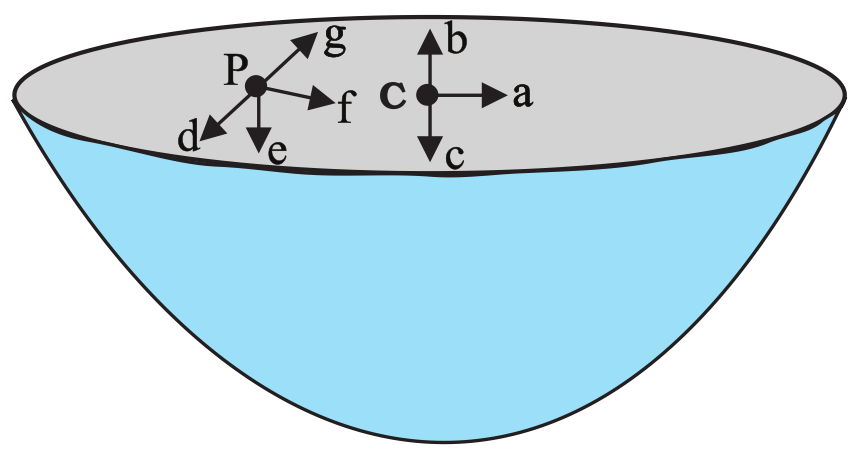
AnswerGravitational potential (V) is constant at all points in a spherical shell. Hence, the gravitational potential gradient $\Big(\frac{\text{dV}}{\text{dr}}\Big)$ is zero everywhere inside the spherical shell. The gravitational potential gradient is equal to the negative of gravitational intensity. Hence, intensity is also zero at all points inside the spherical shell. This indicates that gravitational forces acting at a point in a spherical shell are symmetric. If the upper half of a spherical shell is cut out (as shown in the given figure), then the net gravitational force acting on a particle located at centre O will be in the downward direction. 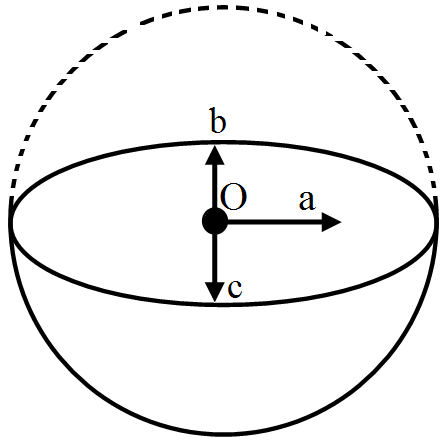 Since gravitational intensity at a point is defined as the gravitational force per unit mass at that point, it will also act in the downward direction. Thus, the gravitational intensity at centre O of the given hemispherical shell has the direction as indicated by arrow c.
 View full question & answer→Question 485 Marks
Two masses of 90kg and 160kg are at a distance 5m apart. Compute the magnitude of intensity of the gravitational field at a point distance 3m from the 90kg and 4m from the 160kg mass. $G = 6.67 \times 10^{-11}Nm^2kg^{-2}$.
AnswerLet A and B be the positions of the masses and P be the point at which the gravitational intensity is to be computed. Gravitational intensity at P due to mass at B will be, $\text{E}_{\text{B}}=\text{G}\frac{160}{(4)^2}=10\text{G},\text{ along PB}$ $\text{In }\triangle\text{APB},\text{ AB}^2=\text{AP}+\text{PB}^2,$ $\therefore\angle\text{APB}=90^\circ$
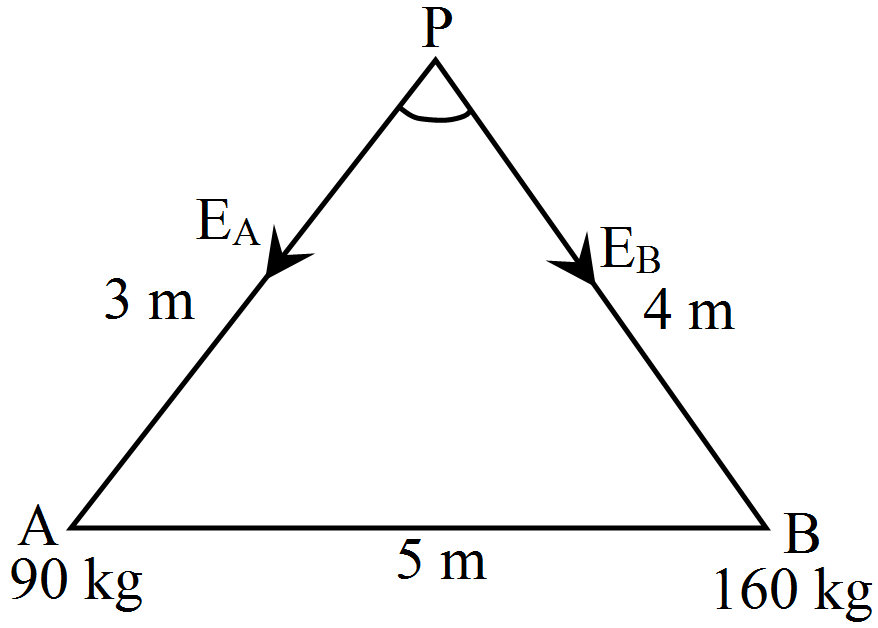
$\text{and }\text{E}_{\text{A}}=\text{G}\frac{90}{(3)^2}=10\text{G}\text{ along PA}$ $\therefore$ The magnitude of resultant gravitational intensity at P will be $\text{E}=\sqrt{\text{E}^2_{\text{A}}+\text{E}^2_{\text{B}}}$ $=\sqrt{(10\text{G})^2+(10\text{G})^2}=10\sqrt{2}\text{G}$ $=10\sqrt{2}\times6.67\times10^{-11}\text{N/kg}$ $=9.43\times10^{-10}\text{Nkg}^{-1}$ View full question & answer→Question 495 Marks
State Kepler's laws on planetary motion. Explain the way the three laws can be proved.
AnswerKepler's Laws of planetary motion:
- All the planets move in elliptical path with sun at their foci.
- The line joining the sun and the planet sweeps out equal areas in equal intervals of time.
- The square of the time period of revolution is proportional to the cube of the semi-major axis of the elliptical orbit $\text{T}^2\propto\text{a}^3.$
If $r_1$ and $r_2$ are the shortest and the longest distances of the planet from the sun, the semi-major axis is given by $\Big(\frac{\text{r}_1+\text{r}_2}{2}\Big)$
Ist law is proved from angular momentum conservation in a circular path.
Since L = 2m × aerial velocity, for equal time, area swept will be same. So $2^{nd}$ law is proved.
From $\text{F}\propto\frac{1}{\text{r}^2},\frac{\text{mv}^2}{\text{r}}=\text{F}\text{ and }\text{T}=\frac{2\pi\text{r}}{\text{v}}$ one can prove
$\text{T}^2\propto\text{a}^3$ thereby proving 3rd law View full question & answer→Question 505 Marks
Jupiter has a mass 318 times that of the earth, and its radius is 11.2 times the earth's radius. Estimate the escape velocity of a body from Jupiter's surface given that the escape velocity from the earth's surface is $11.2km s^{-1}$.
AnswerEscape Velocity from the earth's surface is, $\sqrt{\frac{2\text{GM}}{\text{R}}}=11.2\text{ (given})\dots(1)$ Now, escape velocity from Jupiter's surface will be $\text{v}_{\text{e}}=\sqrt{\frac{2\text{Gm}'}{\text{R}}}$ $\text{But m}'=318\text{m}\text{ and }\text{R}'=11.2\text{R}$ $\text{Hence},\text{v}_{\text{e}}=\sqrt{\frac{2\text{G}(318\text{m})}{11.2\text{R}}}$ $=\sqrt{\frac{2\text{Gm}}{\text{R}}}\times\sqrt{\frac{318}{11.2}}$ $=11.12\times\sqrt{\frac{318}{11.2}}=59.7\text{kms}^{-1}$
View full question & answer→