Question 515 Marks
A rocket is launched vertically from the surface of the earth with an initial speed of 10km/s. How far above the surface of the earth would it go? Ignore the atmospheric resistance. Radius of the earth = 6400km.
AnswerTotal energy on the surface of the earth $=\text{K.E.}+\text{P.E.}$ $=\frac{1}{2}\text{mv}^2-\frac{\text{GmM}}{\text{R}}$ KE = 0 at the highest point, therefore, $\text{P.E.}=\frac{\text{GmM}}{\text{R}+\text{h}},$ where h is the maximum height attained. Using the law of conservation of energy, $\frac{1}{2}\text{mv}^2-\frac{\text{GmM}}{\text{R}}=-\frac{\text{GmM}}{\text{R}+\text{h}}$ $=\text{GmM}\Big[\frac{1}{\text{R}}-\frac{1}{\text{R}+\text{h}}\Big]$ $\text{or }\text{v}^2=\frac{2\text{gRh}}{(\text{R+h})}$ $\text{or }\text{h}=\text{R}\Big(\frac{2\text{gR}}{\text{v}^2}-1\Big)^{-1}$ $=\text{R}\Big(\frac{2\times9.8\times6.4\times10^6}{10^8}-1\Big)^{-1}$ $\text{or }\text{h}=3.93\text{R}=2.5\times10^7\text{m.}$
View full question & answer→Question 525 Marks
Derive a relation for work done in a gravitational field. Using it, (i) find potential difference between a pair of points. (ii) express whether gravitational force is conservative or non-conservative.
AnswerThe gravitational force of attraction between M and m when x is the distance between their centres is given by $\text{F} =\frac{\text{GMm}}{\text{x}^2}$ Suppose the body be moved through a distance dx, therefore, work done is given by, $\text{dW}=\text{Fdx}=\frac{\text{GMm}}{\text{x}^2}\text{dx}$ When the body is brought from infinity to some distance r, we write, $\int\text{dW}=\int^\limits{\text{x}=\text{r}}_\limits{\text{x}=\infty}\frac{\text{GMm}}{\text{x}^2}\text{dx}$ $\text{or }\text{W}=\text{GMm}\Big[\frac{-1}{\text{x}}\Big]^{\text{r}}_{\infty}$ $=-\text{GMm}\Big[\frac{1}{\text{r}}-\frac{1}{\infty}\Big]=\frac{-\text{GMm}}{\text{r}}$ This amount of work done is the change in the potential energy of the body. $=-\text{GMm}\Big[\frac{1}{\text{r}}-\frac{1}{\infty}\Big]=\frac{-\text{GMm}}{\text{r}}$ Gravitational potential $\text{V}=\frac{\text{U}}{\text{m}}=\frac{-\text{GM}}{\text{r}}$ The general expression for gravitational potential due to the earth (mass M) at
- Distance r is, V $=\frac{-\text{GM}}{\text{r}}$
Potential at a point A $(r_a) =-\frac{\text{GM}}{\text{r}_{\text{a}}}$
Potential at a point B $(r_b) =-\frac{\text{GM}}{\text{r}_{\text{b}}}$
$\therefore$ Difference in Potential between the points
$=-\text{GM}\Big(\frac{1}{\text{r}_{\text{a}}}-\frac{1}{\text{r}_{\text{b}}}\Big)$
- Since work done against gravitational force is (a) independent of path and dependent only on the initial and final points and (b) the work done in a closed path is zero, it is a conservative force.
View full question & answer→Question 535 Marks
Obtain an expression for the acceleration due to gravity on the surface of the earth in terms of man of the earth and its radius. Discuss the variation of acceleration due to gravity with altitude and depth. If a body is taken to a height equal to $\frac{\text{R}}{4}$ from the surface of the earth then find percentage decrease in the weight of the body? Where R is radius of the earth.
AnswerConsider the mass of earth M, radius R with centre 0. Suppose a body of mass m placed on the surface of earth, where acceleration due to gravity is g. The force on body of mass m, outside the surface of earth is due to earth whose mass M is concentrated at the centre O.
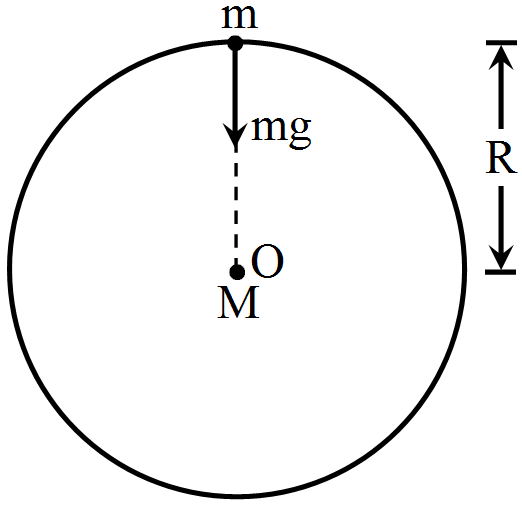
Let F be the force of attraction between body and the earth. According to Newton's law of gravitation. $\text{F} =\frac{\text{GMm}}{\text{x}^2}$ Form gravity pull, F = mg $\therefore\text{mg}=\frac{\text{GMm}}{\text{R}^2}$ $\Rightarrow\text{g}=\frac{\text{GM}}{\text{R}^2}$Effect of altitude:
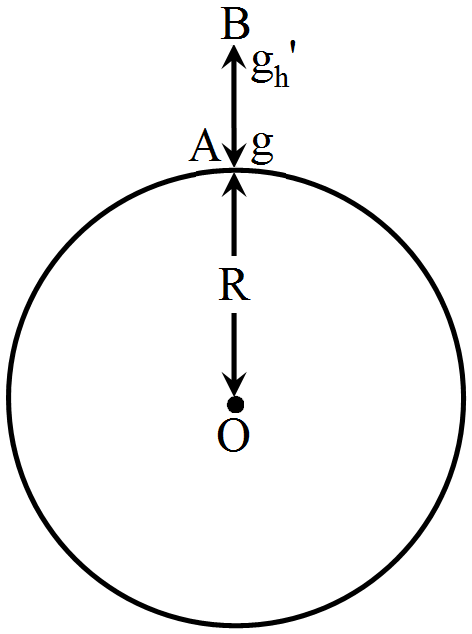
$\text{g}_{\text{h}}'=\text{g}\Big(1-\frac{2\text{h}}{\text{R}}\Big)\text{when h}<<\text{R}$ So, the value of acceleration due to gravity (g) decrease with height. Effect of depth: $\text{g}_{\text{d}}'=\text{g}\Big(1-\frac{\text{d}}{\text{R}}\Big)$ So, the value of acceleration due to gravity (g) decreases with depth. As body is taken to a height equal to $\frac{\text{R}}{4}$ from the surface of the earth.
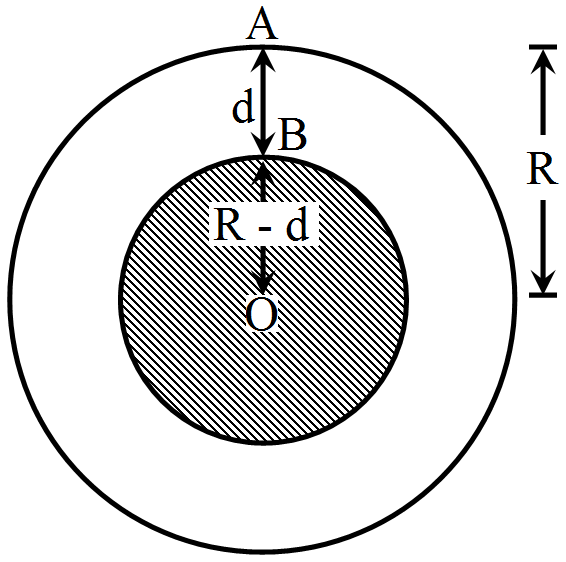
$\therefore\frac{\text{g}_{\text{h}}}{\text{g}}=\frac{\text{R}^2}{\Big(\text{R}+\frac{\text{R}}{4}\Big)^2}$ $=\frac{\text{R}^2}{\Big(\frac{5\text{SR}}{4}\Big)^2}=\frac{16}{25}$ weight of body at altitude h is = $mg'{}_h\ %$ decrease in weight $=\frac{\text{mg}-\text{mg}'}{\text{mg}}\times100$ $=1-\frac{\text{g}'}{\text{g}}\times100$ $=\Big(1-\frac{16}{25}\Big)\times100=\frac{9}{25}\times100$ $=36\%$ View full question & answer→Question 545 Marks
For the above problem, the direction of the gravitational intensity at an arbitrary point P is indicated by the arrow (i) d, (ii) e, (iii) f, (iv) g.
AnswerGravitational potential (V) is constant at all points in a spherical shell. Hence, the gravitational potential gradient $\Big(\frac{\text{dV}}{\text{dR}}\Big)$ is zero everywhere inside the spherical shell. The gravitational potential gradient is equal to the negative of gravitational intensity. Hence, intensity is also zero at all points inside the spherical shell. This indicates that gravitational forces acting at a point in a spherical shell are symmetric. If the upper half of a spherical shell is cut out (as shown in the given figure), then the net gravitational force acting on a particle at an arbitrary point P will be in the downward direction. 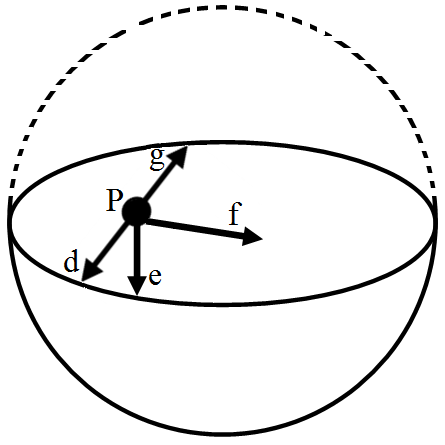 Since gravitational intensity at a point is defined as the gravitational force per unit mass at that point, it will also act in the downward direction. Thus, the gravitational intensity at an arbitrary point P of the hemispherical shell has the direction as indicated by arrow e. Hence, the correct answer is (ii).
 View full question & answer→Question 555 Marks
Obtain an expression for the escape velocity of an object of mass m from the surface of a planet of mass M and radius R. For planet earth, escape velocity is known to have a value of 11.2km/s. How fast will an object be moving when at infinity if it is launched with a speed of 22.4km/s from the surface of the earth?
AnswerThe minimum velocity required to escape from the gravitational force of earth is called escape velocity. Total energy is the sum of P.E. and K.E. $\text{T.E}=\frac{-\text{GMm}}{\text{R}}+\frac{1}{2}\text{mv}^2$ To escape, K.E. should be greater than P.E., i.e., $\frac{1}{2}\text{mv}^{2\text{t}}\geq\frac{\text{GMm}}{\text{R}}$ $\text{v}_{\text{e}}=\sqrt{2\frac{\text{GM}}{\text{R}}}=\sqrt{2\text{gR}}$ Intial velocity of the object(m) $=22.4\text{km/s}=2\text{v}_{\text{e}}$ P.E. on the surface of earth Conserving energy we get $=-\frac{\text{GM}_{\text{e}}\text{m}}{\text{R}_{\text{e}}}+\frac{1}{2}\text{m}(2\text{v}_{\text{e}})^2$ $=-\frac{\text{GM}_{\text{e}}\text{m}}{\text{x}}+\frac{1}{2}\text{mv}^2$ $\therefore-\frac{\text{GM}_{\text{e}}\text{m}}{\text{R}_{\text{e}}}+\frac{1}{2}\text{m}4\frac{\text{GM}_{\text{e}}}{\text{R}_{\text{e}}}=\frac{1}{2}\text{mv}^2$ $\Big(\because-\frac{\text{GM}_{\text{e}}\text{m}}{\text{x}}=0\text{ as far point is at infinity.}\Big)$$-\frac{2\text{GM}_{\text{e}}}{\text{R}_{\text{e}}}=\sqrt{2\text{gR}_{\text{e}}}=\text{v}_{\text{e}}=11.2\text{km/sec}$
View full question & answer→Question 565 Marks
Two bodies of masses M, and M, are placed at a distance d apart. Show that at the position, where the gravitational field due to them is zero, the potential is given by $\text{v}=\frac{-\text{G}}{\text{d}}(\text{M}_1+\text{M}_2+2\sqrt{\text{M}_1\text{M}_2}).$
AnswerThe gravitational field strength at a distance From the mass $M_1 \text{F}_1 =\frac{\text{GM}_1}{\text{x}^2}$
The gravitational field strength at the same point at a distance (d - x) from $M_2 \text{F}_2 =\frac{\text{GM}}{\text{d-x}^2}$
According to the given condition, $F_1 = F_2 \frac{\text{GM}_1}{\text{x}^2}=\frac{\text{GM}_2}{(\text{d}-\text{x})^2}$
$\text{or }\frac{\text{x}}{\text{d}-\text{x}}=\sqrt{\frac{\text{M}_1}{\text{M}_2}}$
$\text{or }\text{x}=\frac{\text{d}\sqrt{\text{M}_1}}{\sqrt{\text{M}_1}+\sqrt{\text{M}_2}}\dots(1)$
$\text{and }(\text{d}-\text{x})=\frac{\text{d}\sqrt{\text{M}_2}}{\sqrt{\text{M}_1+\sqrt{\text{M}_2}}}\dots(2)$ If V be the gravitational potential at the point under consideration due to $M_1$ and $M_2$_ we have $\text{V}=-\frac{\text{GM}_1}{\text{x}}-\frac{\text{GM}_2}{(\text{d}-\text{x})}\dots(3)$ Putting values of x and (d - x) from (1) and (2) in (3) $\text{V}=-\text{G}\Bigg[\frac{\text{M}_1\big(\sqrt{\text{M}_1}+\sqrt{\text{M}_2}\big)}{\text{d}\sqrt{\text{M}_1}}+\frac{\text{M}_2\big(\text{M}_1+\sqrt{\text{M}_2}\big)}{\text{d}\sqrt{\text{M}_2}}\Bigg]$
$=-\frac{\text{G}}{\text{d}}\Big[\sqrt{\text{M}_1}\big(\sqrt{\text{M}_1}+\sqrt{\text{M}_2}\big)+\sqrt{\text{M}_2}\big(\sqrt{\text{M}_1}+\sqrt{\text{M}_2}\Big]$
$=-\frac{\text{G}}{\text{d}}\Big[\text{M}_1+\text{M}_2+2\sqrt{\text{M}_1\text{M}_2}\Big]$
View full question & answer→Question 575 Marks
Two identical heavy spheres are separated by a distance $10$ times their radius. Will an object placed at the mid point of the line joining their centres be in stable equilibrium or unstable equilibrium? Give reason for your answer.
Answer$\text{m}_1=\text{m}_2=\text{M }\text{r}=10\text{R}$ Let mass m is placed at the mid point P of line joining the centres of A and B sphere
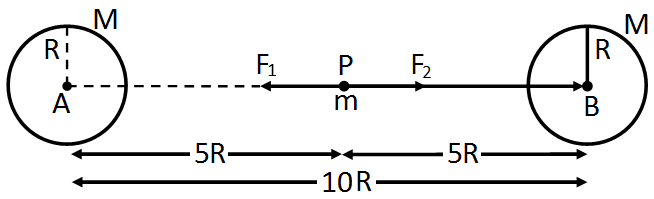
$|\text{F}_2|=|\text{F}_1|=\frac{\text{GMm}}{(5\text{R})^2}$ $|\text{F}_1|=|\text{F}_2|=\frac{\text{GMm}}{(25\text{R})^2}$ As the direction of force $F_1$ and $F_2$ are opposite (equal and opposite forces acting on m at P). The net force $F_1 + F_2 = 0, (F_1 = -F_2)$. m will be in equilibrium. If now m is displaced by x slightly from P to A then PA = (5R - x) and PB = (5R + x) $\text{F}_1=\frac{\text{GMm}}{(5\text{R}-\text{x})^2}$ and $\text{F}_2=\frac{\text{GMm}}{(5\text{R}+\text{x})^2}$
$\therefore\ \text{F}_2<\text{F}_1$ Hence the resultant force acting on P is towards A, resulting in an unstable equilibrium. View full question & answer→Question 585 Marks
Io, one of the satellites of Jupiter, has an orbital period of $1.769$ days and the radius of the orbit is $4.22 \times 10^8m$. Show that the mass of Jupiter is about one-thousandth that of the sun.
AnswerOrbital period of Io, $T_{Io}= 1.769 days = 1.769 \times 24 \times 60 \times 60sec$Orbital radius of Io, $R_{Io} = 4.22 \times 10^8m$
Satellite Io is revolving around the Jupiter
Mass of the satellite is given as:
$\text{M}_\text{j}=\frac{(4\pi^2\text{R}_\text{Io}^3)}{(\text{GT}_\text{Io}^2)}$
Where,
$M_J$ = Mass of Jupiter
G = Universal gravitational constant
Orbital period of the Earth, $T_e = 365.25 days = 365.25 \times 24 \times 60 \times 60s$
Orbital radius of the Earth,
$R_e = 1AU = 1.496 \times 10^{11}m$
Mass of the Sun $\text{M}_\text{s}=\frac{(4\pi^2\text{R}_\text{e}^3)}{(\text{GT}_\text{e}^2)}\ ....(\text{ii})$
Therefore, $\Big(\frac{\text{M}_\text{s}}{\text{M}_\text{j}}\Big)=\frac{(4\pi^2\text{R}_\text{e}^3)}{(\text{GT}_\text{e}^2)}\times\frac{(\text{GT}_\text{Io}^2)}{(4\pi^2\text{R}_\text{Io}^3)}$
$= ((1.769 \times 24 \times 60 \times 60)/ (365.25 \times 24 \times 60 \times 60))^2\times ((1.496 x 10^{11})/ (4.22 \times 10^8))^3$
$= 1045.04$
Therefore, $(M_s/ M_J) ≈ 1000$
$M_s ≈ 1000M_J$
This shows the mass of Jupiter is $(1/1000^{th})$ the mass of the sun.
View full question & answer→Question 595 Marks
Is it possibe for a body to have inertia but no weight?
AnswerKey concept: The weight of a body is the force with which it is attracted towards the centre of earth. When a body is stationary with respect to the earth, its weight equals the gravity. This weight of the body is known as its static or true weight. Inertia is a property of mass. Hence, a body can have inertia (i.e., mass) but no weight. Everybody always have inertia but its weight (mg) can be zero, when it is taken at the centre of the earth or during free fall under gravity or a body placed at a very large distance from earth. Basically weight of a body can zero when acceleration due to gravity is zero, that condition is called weightlessness.
For example: When a satellite revolves in its orbit around the earth.
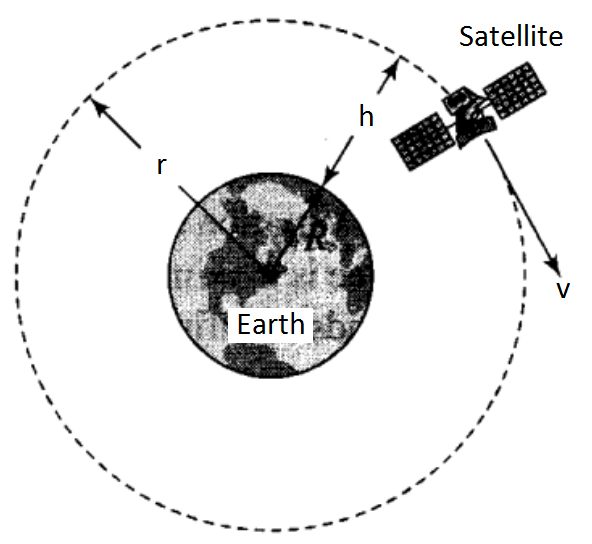
Weight less ness possess many serious problems to the astronauts. It becomes quite difficult for them to control their movements. Everything in the satellite has to be kept tied down. They can be displaced due to their inertia. Creation of artificial gravity is the answer to this problem.
View full question & answer→Question 605 Marks
The mass of the planet Jupiter is $1.9 \times 10^{27} \mathrm{~kg}$ and that of the Sun is 1.991030 kg . The mean distance of the Jupiter from the Sun is $7.8 \times 10^{11} \mathrm{~m}$. Calculate the gravitational force which the Sun exerts on Jupiter, assuming that Jupiter moves in circular orbit around the Sun. Calculate the speed of the Jupiter. G $=6.6710^{-11} \mathrm{Nm}^2 \mathrm{~kg}^{-2}$
AnswerHere, $M_J = 1.9 \times 1027kg; M_s = 1.99\% 1030kg; r = 7.8 \times 10^{11}m; G = 6.67 \times 10^{-11}Nm? kg 2 F = ?$
Now $\text{F}=\frac{\text{GM}_{\text{J}}\text{M}_{\text{s}}}{\text{r}^2}$ $=\frac{6.67\times10^{-11}\times1.9\times10^{27}\times1.99\times10^{30}}{(7.8\times10^{11})^2}$ $=4.15\times10^{23}\text{N}$ Since the gravitational pull of Sun to Jupiter provides the required centripetal force to the Jupiter, therefore the velocity of the Jupiter v can be given by the relation. $=4.15\times10^{23}\text{N.F}=\frac{\text{M}_{\text{J}}\text{v}^2}{\text{r}}$ $\text{or }\text{v}=\sqrt{\frac{\text{Fr}}{\text{M}_{\text{J}}}}$ $=\sqrt{\frac{4.15\times10^{23}\times7.8\times10^{11}}{1.9\times10^{27}}}$ $=1.3\times10^4\text{ms}^{-1}.$
View full question & answer→Question 615 Marks
What is the difference between gravitational potential and gravitational potential energy. Derive an expression for gravitational potential energy of a body.
AnswerThe gravitational force of attraction between M and m when x is the distance between their centres is given by, $\text{F}=\frac{\text{GMm}}{\text{x}^2}$ Suppose the body is moved through a distance dx, therefore, work done is given by, $\text{dW}=\text{Fdx}=\frac{\text{GMm}}{\text{x}^2}\text{dx}$ When the body is brought from infinity to some distance r, We write, $\int\text{dW}=\int^\limits{\text{x}=\text{r}}_\limits{\text{x}=\infty}\frac{\text{GMm}}{\text{x}^2}\text{dx}$ $\text{or }\text{W}=\text{GMm}\Big[\frac{-1}{\text{x}}\Big]^{\text{r}}_{\infty}$ $=-\text{GMm}\Big[\frac{1}{\text{r}}-\frac{1}{\infty}\Big]=\frac{-\text{GMm}}{\text{r}}$ This amount of work done is the change in the potential energy of the body. $\therefore\text{P.E.}\text{ (U)}=\frac{-\text{GMm}}{\text{r}}$ Gravitational potential $\text{V}=\frac{\text{U}}{\text{m}}=\frac{-\text{GM}}{\text{r}}$ The general expression for gravitational potential due to the earth (mass M) at distance r is, $\text{v}=-\frac{\text{GM}}{\text{r}}$ Work done to carry any mass m is stored as P.E. in it at that position and is,$\text{P.E.}=-\frac{\text{GMm}}{\text{r}}$
View full question & answer→Question 625 Marks
A body weighs 90kgf on the surface of earth. How much will it weigh on the surface of a planet whose mass is $\frac{1}{9}$ and radius $\frac{1}{2}$ that of earth?
AnswerLet M, R, be the mass and radius of earth. M., R, be the mass and radius of planet. $\text{M} _{\text{p}} = \frac{\text{M}}{9}$ $\text{R} _{\text{p}} = \frac{\text{R}}{2}$ F = Wt. of body = 90kgf = 90 × 9.8N $\text{F}=\text{mg}\text{ and }\text{g}=\frac{\text{GM}}{\text{R}^2}$ $\text{F}=\frac{\text{GMm}}{\text{R}^2}$ $90\times9.8=\frac{\text{GMm}}{\text{R}^2}$ If F' is weight of body on surface of planet, then $\text{F}'=\frac{\text{GM}_{\text{p}\text{m}}}{\text{R}^2_\text{p}}=\frac{\text{G}\Big(\frac{\text{M}}{9}\Big)\text{m}}{\Big(\frac{\text{R}}{2}\Big)^2}$ $=\frac{4}{9}\frac{\text{GMm}}{\text{R}^2}=\frac{4}{9}\times90\times9.8=40\text{kgf}$
View full question & answer→Question 635 Marks
What do you mean by orbital velocity? Find the expression for orbital velocity.
AnswerThe velocity required to put a satellite into its orbit around the earth is called orbital velocity. A satellite moves around the earth in its orbit with orbital velocity.
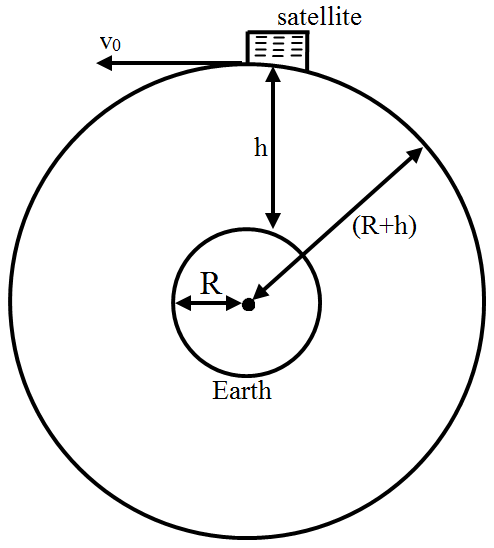
Consider a satellite of mass m revolving around the earth in an orbit of radius R + h, where R is the radius of earth and h is the height of satellite from the surface of earth. Let $v_0$ be the orbital velocity of the satellite. The gravitational force between the satellite and the earth provides the necessary centripetal force to the satellite to move in a circular path around the earth. i.e., Gravitational force = Centripetal force $\frac{\text{GMm}}{(\text{R}+\text{h})^2}=\frac{\text{mv}_0^2}{(\text{R}+\text{h})}$ $\Rightarrow\ \text{v}_0^2=\frac{\text{GM}}{(\text{R}+\text{h})}$ $\text{v}_0=\Big[\frac{\text{GM}}{(\text{R}+\text{h})}\Big]^\frac{1}{2}$ Since, $\frac{\text{GM}}{\text{R}^2}=\text{g}$ $\text{GM}=\text{gR}^2$
$\therefore\text{v}_0=\Big[\frac{\text{gR}^2}{(\text{R}+\text{h})}\Big]^\frac{1}{2}$ If satellite is very close to the surface of earth, then (R + h) = R Hence, $\text{v}_0=\sqrt{\text{gR}}.$ View full question & answer→Question 645 Marks
A star 2.5 times the mass of the sun and collapsed to a size of 12 km rotates with a speed of 1.2 rev . per second. (Extremely compact stars of this kind are known as neutron stars. Certain stellar objects called pulsars belong to this category). Will an object placed on its equator remain stuck to its surface due to gravity? (mass of the sun $=2 \times$ $\left.10^{30} \mathrm{~kg}\right)$.
AnswerA body gets stuck to the surface of a star if the inward gravitational force is greater than the outward centrifugal force caused by the rotation of the star. Gravitational force, $\mathrm{f}_{\mathrm{g}}=-\mathrm{GMm} / \mathrm{R}^2$ Where, $\mathrm{M}=$ Mass of the star $=2.5 \times 2 \times$ $10^{30}=5 \times 10^{30} \mathrm{~kg} \mathrm{~m}=$ Mass of the body $R=$ Radius of the star $=12 \mathrm{~km}=1.2 \times 10^4 \mathrm{~m} \therefore \mathrm{fg}_{\mathrm{g}}=6.67 \times 10^{-11} \times 5 \times 10^{30}$ $\times \mathrm{m} /\left(1.2 \times 10^4\right)^2=2.31 \times 10^{11} \mathrm{~m} \mathrm{~N}$ Centrifugal force, $\mathrm{f}_{\mathrm{c}}=\mathrm{mr} \boldsymbol{\omega}^2 \omega=$ Angular speed $=2 \pi \mathrm{v}$ $v=$ Angular frequency $=1.2 \mathrm{rev} \mathrm{s}^{-1} \mathrm{f}_{\mathrm{c}}=\mathrm{mR}(2 \pi \mathrm{v})^2=\mathrm{m} \times\left(1.2 \times 10^4\right) \times 4 \times(3.14)^2 \times(1.2)^2=1.7 \times 10^5 \mathrm{~m} \mathrm{~N}$ Since $\mathrm{f}_{\mathrm{g}}$ $>f_{C^{\prime}}$ the body will remain stuck to the surface of the star.
View full question & answer→Question 655 Marks
Define gravitational potential energy of a body. Derive an expression for the gravitational potential energy of a body of mass 'm' located at a distance 'r' from the centre of the earth.
AnswerGravitational potential energy. The work done in carrying a mass 'm' from infinity to a point at distance r is called gravitational potential energy. $\text{G.P.E.}=-\frac{\text{GMm}}{\text{r}}$i.e., G.P.E. = Mass × Gravitational potential
It is a scalar quantity measured in joule. Negative sign means that the mass is bound to M. The gravitational force of attraction between M and m when x is the distance between their centres is given by, $\text{F}=\frac{\text{GMm}}{\text{x}^2}$ Suppose the body is moved through a distance dx, therefore, work done is given by, $\text{dW}=\text{Fdx}=\frac{\text{GMm}}{\text{x}^2}\text{dx}$ When the body is brought from infinity to some distance r, We write, $\int\text{dW}=\int^\limits{\text{x}=\text{r}}_\limits{\text{x}=\infty}\frac{\text{GMm}}{\text{x}^2}\text{dx}$ $\text{or }\text{W}=\text{GMm}\Big[\frac{-1}{\text{x}}\Big]^{\text{r}}_{\infty}$ $=-\text{GMm}\Big[\frac{1}{\text{r}}-\frac{1}{\infty}\Big]=\frac{-\text{GMm}}{\text{r}}$ This amount of work done is the change in the potential energy of the body. $\therefore\text{P.E.}\text{ U }=\frac{-\text{GMm}}{\text{r}}$
View full question & answer→Question 665 Marks
Two satellites $S_1$ and $S_2$ revolve round a planet in coplanar circular orbit in the same sense. Their periods of revolution are one hour and $8$ hours respectively. The radius of the orbit of $S_1$ is $10^4km$. When $S_2$ is close to $S_1$ find:
- The speed of $S_2$ relative to $S_1$.
- The angular speed of $S_2$ as actually observed by an astronaut in $S_1$.
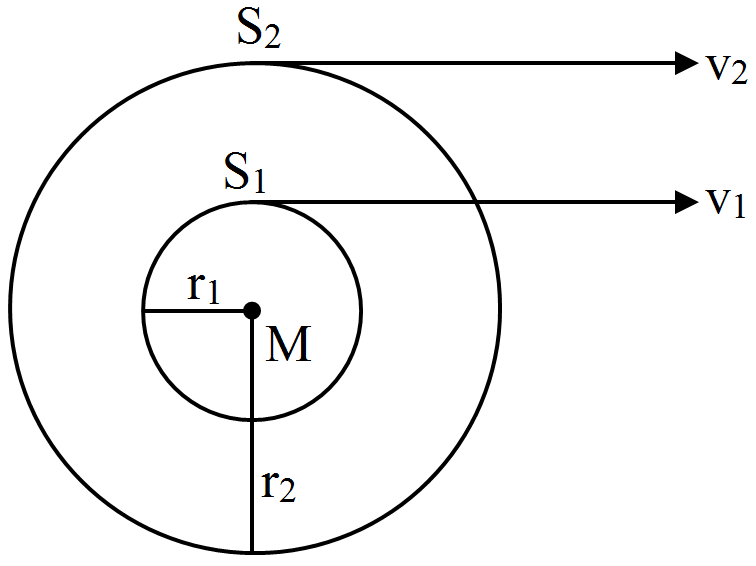
AnswerThe centripetal force required by a satellite of mass m revolving in a circular orbit of radius r with a speed v is supplied by the gravitational force extended by the planet of mass M on the satellite. Thus $\frac{\text{mv}^2}{\text{r}}=\text{G}\frac{\text{Mm}}{\text{r}^2}$
$\text{v}=\sqrt{\frac{\text{GM}}{\text{r}}}$ The period of revolution of the satellite is, $\text{T}=\frac{2\pi\text{r}}{\text{v}}=2\pi\sqrt{\frac{\text{r}^3}{\text{GM}}}$ For satellite $S_1$ let $T = T_1, r = r_1, v = v_1$ Then, $\text{T}^2_1=\frac{4\pi^2\text{r}^3_1}{\text{GM}}$ For satellite S_2, $\text{T}^2_2=\frac{4\pi^2\text{r}^3_2}{\text{GM}}.$ Therefore $\frac{\text{T}_1^2}{\text{T}_2^2}=\frac{\text{r}_1^3}{\text{r}_2^3}$
$\text{r}_2=\text{r}_1\Big(\frac{\text{T}_2}{\text{T}_1}\Big)^\frac{2}{3}$
$=10^4\Big(\frac{8}{1}\Big)^\frac{2}{3}=4\times10^4\text{km}$
$\text{v}_1=\frac{2\pi\text{r}_1}{\text{T}_1}=\frac{2\pi\times10^4}{1}$
$=2\pi\times10^4\text{km/ hr}$
$\text{v}_2=\frac{2\pi\text{r}_2}{\text{T}_2}=\frac{2\pi\times4\times10^4}{8}$
$=\pi\times10^4\text{km/ hr}$ Velocity of S_2 relative to$\text{S}_1=\text{v}_2-\text{v}_1=\text{v}_\text{r}\ (\text{say})$
$\text{v}_\text{r}=(\pi\times10^4-2\pi\times10^4)\text{km/ hr}$
$=-\pi\times10^4\text{km/ hr}$
Let $r_2 - r_1 = r$ The angular velocity of $S_2$ relative to $S_1$ is given by $\omega=\frac{\text{v}_\text{r}}{\text{r}}=\frac{\pi\times10^4}{(4-1)10^4}\text{ rad/ hr}$
$\omega=\frac{\pi}{3}\text{ rad/ hr}$
View full question & answer→Question 675 Marks
An object of mass m is raised from the surface of the earth to a height equal to the radius of the earth, that is, taken from a distance R to 2R from the centre of the earth. What is the gain in its potential energy?
AnswerAs the object of mass m is lifted upward from surface of earth to a height equal to the radius of earth. i.e., from $\text{R}\rightarrow2\text{R}$ P.E. of body on the surface of earth $=\frac{\text{-GMm}}{\text{R}}$ 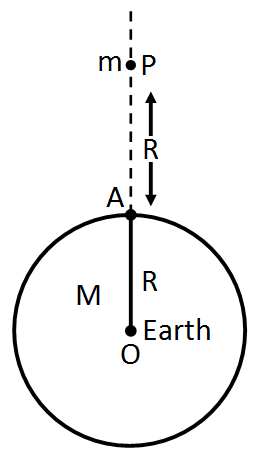 P.E. of the object at a equal to the radius of earth $=\frac{\text{-GMm}}{\text{R}}$ Gain in P.E. $\text{E}_\text{pf}-\text{E}_\text{pi}$ Gain in P.E. $=\frac{\text{-GMm}}{\text{2R}}$ $=\Big(\frac{\text{-GMm}}{\text{R}}\Big)$ $=\frac{\text{GMm}}{\text{R}}\Big[-\frac{1}{2}+1\Big]$ $=\frac{\text{GMm}}{\text{2R}}\text{ GM = gR}^2$ Gain in P.E. $=\frac{\text{gR}^2\text{m}}{\text{2R}}$ $=\frac{1}{2}\text{mgR}$
 View full question & answer→Question 685 Marks
Suppose a hole was drilled completely through the earth along a diameter. Show that the force on a mass m at a distance r from the centre of the earth is $ \text{F}= \frac{-\text{mgr}}{\text{R}}$ assuming that the density of the earth is uniform.
AnswerThe gravitational force on the mass m arises only from a sphere of radius r enclosing the mass as shown in figure. 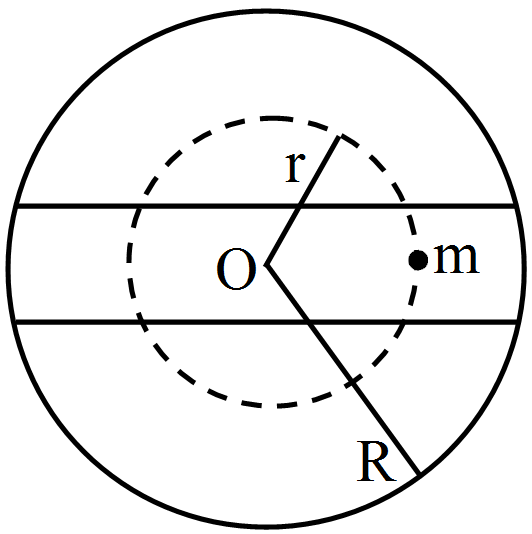 Mass pf the sphere $\text{M}_1=\frac{4}{3}\pi\text{r}^3\rho,$ where $\rho$ is the density of the earth. The force on the mass m is $\text{F}=-\frac{\text{GM}_1\text{m}}{\text{r}^2}$ -ve sign indicates that the force attractive. $\text{F}=-\Big(\frac{\text{GM}}{\text{R}^2}\big)\frac{\text{M}_1}{\text{M}}\Big(\frac{\text{mR}^2}{\text{r}^2}\Big),$ where M is the total mass of the earth. $\text{But }\frac{\text{GM}}{\text{R}^2}\text{g and }\frac{\text{M}_1}{\text{M}}$ $=\frac{\frac{4}{3}\pi\text{r}^3\rho}{\frac{4}{3}\pi\text{R}^3\rho}=\frac{\text{r}^3}{\text{R}^3}$ $\therefore\text{F}=-(\text{g})\Big(\frac{\text{r}^3}{\text{R}^3}\Big)\Big(\frac{\text{mR}^2}{\text{r}^2}\Big)=-\text{mg}\frac{\text{r}}{\text{R}}$ Moreover, acceleration acting on the mass m is given by, $\frac{\text{F}}{\text{m}}=-\Big(\frac{\text{g}}{\text{R}}\Big)\text{r}$ or acceleration $\propto$ displacement. It also proves that m will execute S.H.M. about the centre of the earth O.
 View full question & answer→Question 695 Marks
Define escape speed. Show that its value on the surface is $\text{v}_{\text{e}}=\sqrt{2\text{gR}.}$ R = Radius of planet (Earth)
AnswerEscape Speed: It is defined as the minimum speed with which the body has to be projected vertically upwards from the surface of earth (or any other planet) so that it just crosses the gravitational field of earth (or of that planet) and never returns on its own. Let earth be a perfect sphere of mass M, radius R with centre at 0. Let a body of mass m to be projected from a point A on the surface of earth, as shown in figure. Join OA and produce it further. P and Q are at a distance x and (x + dx) from the centre of the earth. Gravitational force of attraction on the body at P is $\text{F}=\frac{\text{GMm}}{\text{x}^2}$ This much force has to be applied on the body to take the body in the upward direction. Work done in taking the body against gravitational attraction from P to Q is $\text{dW}=\text{F}\text{ dx}=\frac{\text{GMm}}{\text{x}^2}\text{dx}$ Total work done in taking the body against gravitational attraction from surface of earth (i.e. x = R) to a region beyond the gravitational field of earth $(\text{i.e.}\text{ x}=\infty)$ can be calculated by interchanging the above expression within the limits $\text{x}=\text{R}\text{ to }\text{x}=\infty$ Thus, total work done is 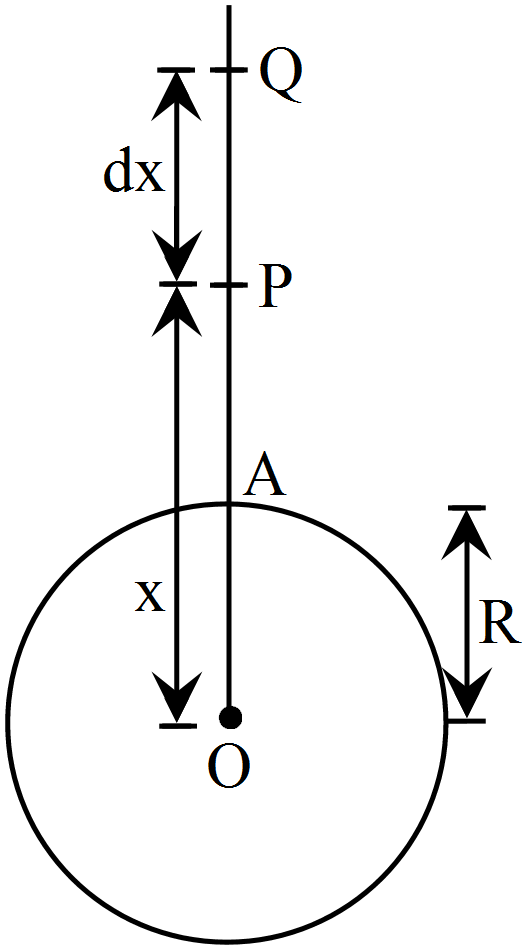 $\text{W}=\int^\limits{\infty}_\limits{\text{R}}\frac{\text{GMm}}{\text{x}^2}=\text{GMm}\int^\limits{\infty}_\limits{\text{R}}\text{x}^{-2}\text{dx}$ $=\text{GMm}\Big[\frac{\text{x}^{-2+1}}{-2+1}\Big]^{\infty}_{\text{R}}=-\text{GMm}\Big[\frac{1}{\text{x}}\Big]_{\text{R}}^{\infty}$ $=-\text{GMm}\Big[\frac{1}{\infty}-\frac{1}{\text{R}}\Big]=\frac{\text{GMm}}{\text{R}}$ This work done is at the cost of kinetic energy given to the body at the surface of the earth. K.E. of the body $=\frac{1}{2}\text{mv}_{\text{e}}^2,\text{v}_{\text{e}}$ = escape speed of the $\therefore\frac{1}{2}\text{mv}_{\text{e}}^2=\frac{\text{GMm}}{\text{R}}$ $\text{or }\text{v}_{\text{e}}^2=\frac{2\text{GM}}{\text{R}}\text{ or }\text{v}_{\text{e}}=\sqrt{\frac{\text{2GM}}{\text{R}}}$ $\text{or }\text{v}_{\text{e}}=\sqrt{2\text{gR}}.$
 View full question & answer→Question 705 Marks
Find the gravitational pull between a sphere of mass M, and a uniform rod of length L and mass m as shown in the given figure.
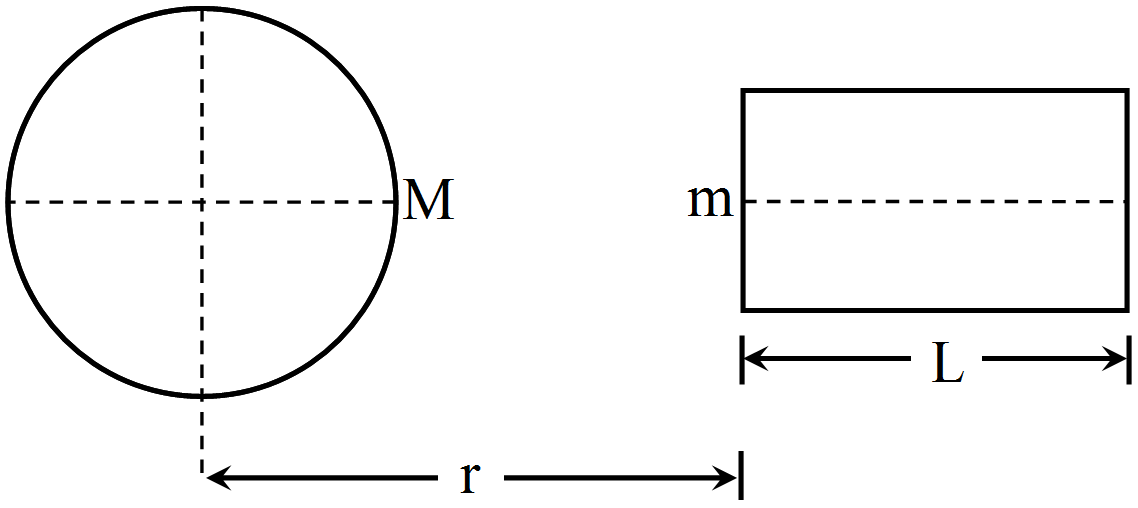
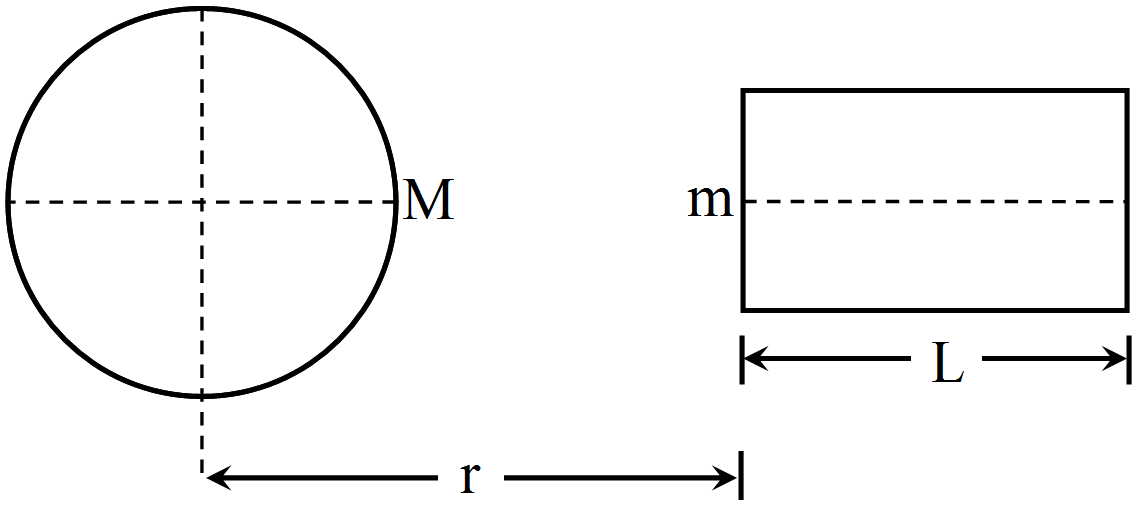
AnswerSince it is a uniform sphere, its entire mass may be considered concentrated at its centre. Consider a small element of mass dm of the rod in the figure. 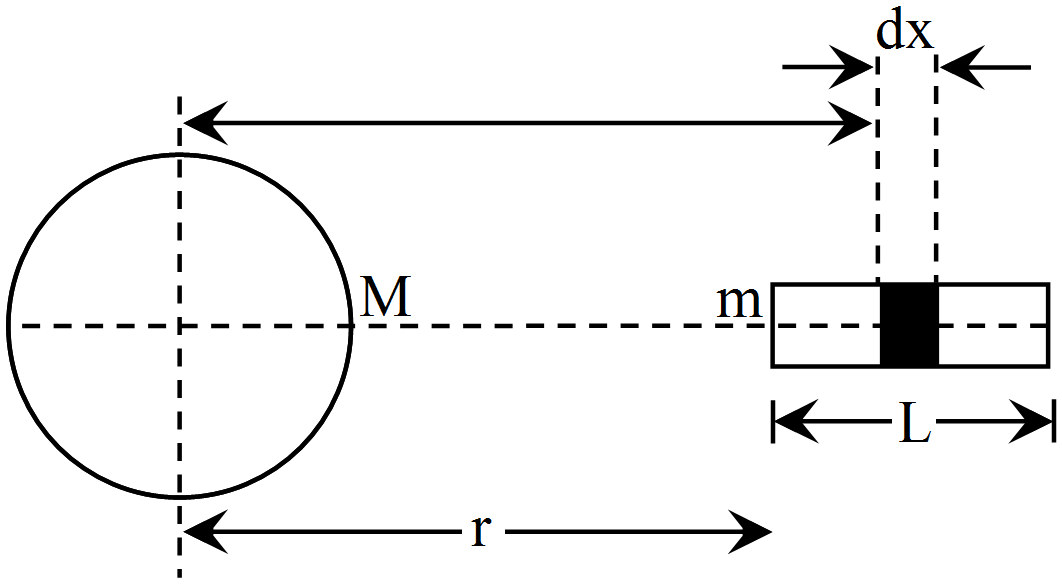 $\therefore\text{dm}=\frac{\text{m}}{\text{L}}\text{dx}$Let dF be the gravitational pull between M and dm.
Then $\text{dF}=\frac{\text{GMdm}}{\text{x}^2}=\frac{\text{GM mdx}}{\text{x}^2\text{L}}$
$\int\text{dF}=\int^\limits{\text{r+L}}_\limits{\text{r}}\Big(\frac{\text{GMm}}{\text{L}}\Big)\frac{\text{dx}}{\text{x}^2}$
$\text{or }\text{F}=\frac{\text{GMm}}{\text{L}}\Big|\frac{\text{x}^{-2+1}}{-2+1}\Big|^{\text{r+L}}_{\text{r}}$
$=\frac{\text{GMm}}{\text{L}}\Big|\frac{\text{1}}{\text{r}}-\frac{1}{\text{r+L}}\Big|$ $=\frac{\text{GMm}}{\text{L}}\times\frac{\text{L}}{\text{r}(\text{r}+\text{L})}=\frac{\text{GMm}}{\text{r}(\text{r}+\text{L})}$ $=\frac{\text{GMm}}{\text{r}^2}(\text{ if r }>>\text{ L})$ Thus, the rod behaves almost like a point mass, kept at a distance r from the centre of the sphere. View full question & answer→Question 715 Marks
Discuss the variation of g with depth. Derive an expression for it. What is the value of g at the centre of earth?
AnswerLet the planet earth be made of material of density $\rho$ and is of radius R. 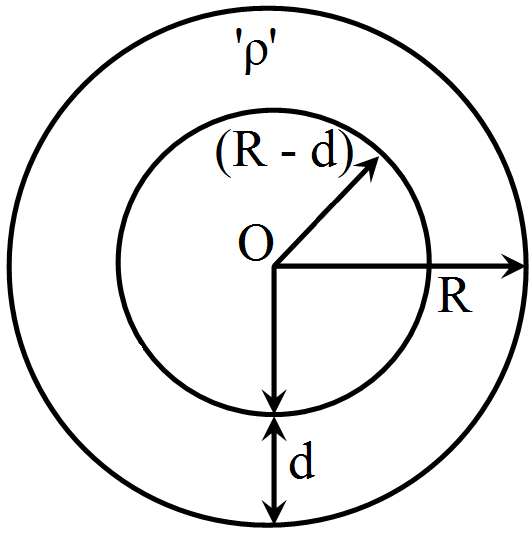 $\therefore$ Mass of earth $=\text{M}=\frac{4}{3}\pi\text{R}^3\rho$ and acceleration due to gravity on earth = g $\therefore\text{g}=\frac{\text{GM}}{\text{R}^2}=\frac{\text{G}}{\text{R}^2}\times\frac{4}{3}\pi\text{R}^3\rho$ $\therefore\text{g}=\text{G}\frac{4}{3}\pi\text{R}\rho\dots(1)$ At a depth d, the gravitational force is due to the mass distributed in the sphere of radius (R - d). $\therefore$ The acceleration due to gravity at the depth d. $\text{g}'=\frac{\text{GM}'}{(\text{R}-\text{d}^2)}=\text{G}\frac{4}{3}\frac{\pi(\text{R}-\text{d})^3\rho}{(\text{R}-\text{d}^2)}$ $\text{g}'=\text{G}\frac{4}{3}\pi(\text{R}-\text{d})\dots(2)$ Dividing g' by g, we get $\frac{\text{g}'}{\text{g}}=\frac{\text{R}-\text{d}}{\text{R}}=1-\frac{\text{d}}{\text{R}}$ $\therefore\text{g}'=\text{g}\frac{(\text{R}-\text{d})}{\text{R}}=\text{g}\Big(1-\frac{\text{d}}{\text{R}}\Big)$ $\therefore$ g reduces as we move from surface to inwards and is zero at the centre.
 View full question & answer→Question 725 Marks
Briefly describe the Cavendish torsion balance. How is it used to measure G?
AnswerIt consists of two small lead balls (each of mass m) attached to the opposite ends of a light rod. This arrangement (with its axis horizontal) is suspended by a fine quartz fibre. Two large lead balls (each of mass M) are placed on the opposite ends of another rod that is pivoted at the centre.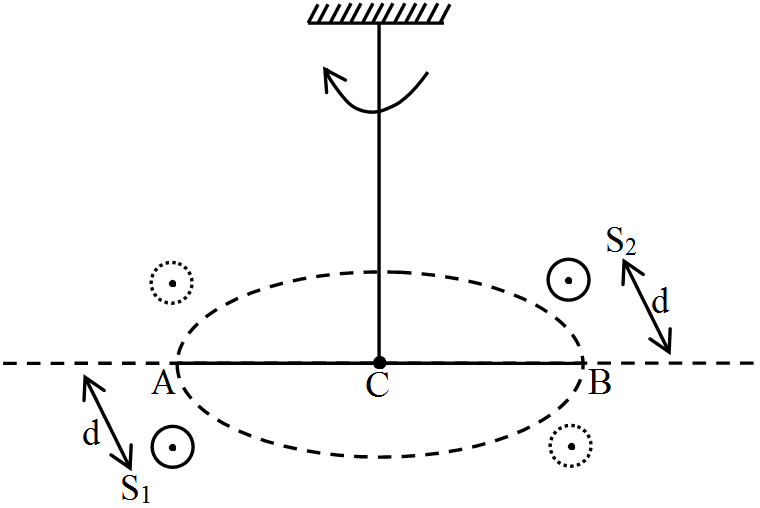
Due to the gravitational attraction, the small ball moves towards the larger one, and it causes twist in the wire. The angle by which the wire gets twisted or deflected is measured by recording the deflection of the beam of light reflected from the small mirror attached to the wire. In equilibrium, deflecting torque = restoring torqueor $\frac{\text{GMm}}{\text{d}^2}\times2\text{l}=\tau\theta$
or $\text{G}=\tau\theta\Big(\frac{\text{d}^2}{2\text{Mml}}\Big)\dots(1)$
where 2l is length of the beam, t is the restoring couple per unit angular twist, d is the distance between a small, and the nearby large sphere in equilibrium. Putting the values of various parameters in (i), the value of G can be calculated. View full question & answer→Question 735 Marks
Two stationary particles of masses $M_1$ and $M_2$ are a distance d' apart. A third particle lying on the line joining the particles, experiences no resultant gravitational force. What is the distance of this particle from $M_1$?
Answer
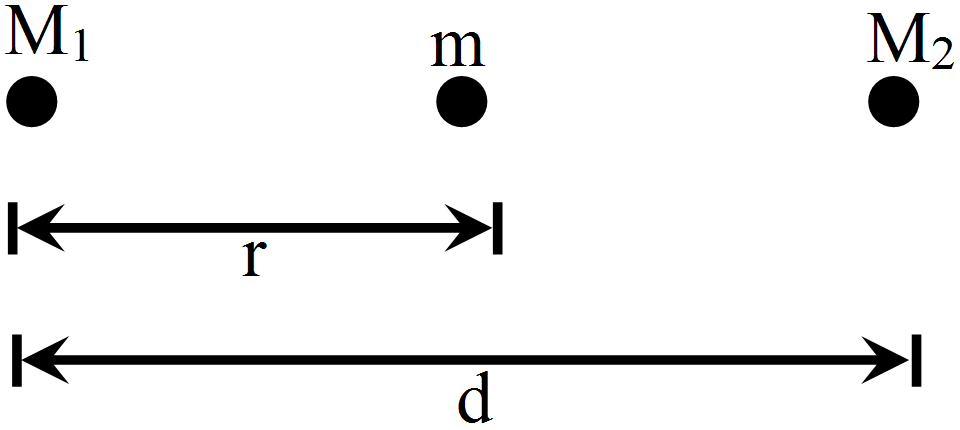
The force on the third parcticle, say of mass m towards $M_1$ is
$\text{F}=\text{G}\frac{\text{GMm}}{\text{r}^2}$
The force on m towards $M_2$ is
$\text{F}=\text{G}\frac{\text{M}_2\text{m}}{(\text{d}-\text{r})^2}$
Equating the two forces, we have
$\text{G}\frac{\text{M}_1\text{m}}{\text{r}^2}=\text{G}\frac{\text{M}^2\text{m}}{(\text{d}-\text{r})^2}$
$\Big[\frac{\text{d}-\text{r}}{\text{r}}\Big]^2=\frac{\sqrt{\text{M}_2}}{\sqrt{\text{M}_1}}$
$\Rightarrow\frac{\text{d}}{\text{r}}-1=\frac{\sqrt{\text{M}_2}}{\sqrt{\text{M}}_1}$
$\Rightarrow\frac{\text{d}}{\text{r}}=\frac{\sqrt{\text{M}_2}+\sqrt{\text{M}_1}}{\sqrt{\text{M}_1}}$
$\Rightarrow\text{r}=\text{d}\Bigg[\frac{\sqrt{\text{M}_1}}{\sqrt{\text{M}_1+\sqrt{\text{M}_2}}}\Bigg]$ View full question & answer→Question 745 Marks
Find the variation of acceleration due to gravity below the surface of earth at depth d.OR
Write Kepler's laws for planetary motion.
AnswerLet the planet earth be made of material of density $\rho$ with radius R.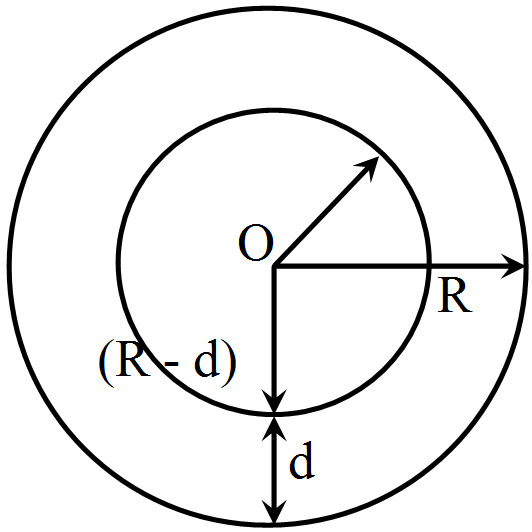
At depth d, the gravitational force is due to mass distributed in the sphere of radius (R - d). $\therefore$ The acceleration due to gravity at depth $\text{g}'=\frac{\text{GM}'}{(\text{R}-\text{d})^2}=\text{G}\frac{4\pi}{3}\times\frac{(\text{R}-\text{d})^3\text{P}}{(\text{R}-\text{d})^2}$ $=\text{G}\frac{4}{3}\pi(\text{R}^3-\text{d})\rho$ $\text{i.e.}\frac{\text{g}'}{\text{g}}=\frac{(\text{R}-\text{d})}{\text{R}}=\text{g}\frac{(\text{R}-\text{d})}{\text{R}}=\text{g}\Big(1-\frac{\text{d}}{\text{R}}\Big)$ $\therefore$ g reduces as we move from surface to centre.Alternate Answer
- Law of orbit: The planets including earth, go around the sun in elliptical orbits.
- Law of area: The line joining the sun and the planet sweeps equal area in equal intervals of time.
- Law of periods: The square of time period of revolution is directly proportional to the cube of semi-major axis of the elliptical orbit.
View full question & answer→Question 755 Marks
What is gravitational potential? Find the expression for gravitational potential energy. A $400kg$ satellite is in a circular orbit of radius $2R_E$ about the earth. Calculate the kinetic energy, potential energy and total energy of the satellite. Given that radius of Earth $R_E = 6.4 \times 10^6m$ and mass of Earth $M = 6 \times 10^{24}kg$.
AnswerGravitational potential: The gravitational potential at a point in the gravitational field of a body is defined as the amount of work done in displacing a body of unit mass from infinity to that point in the field.
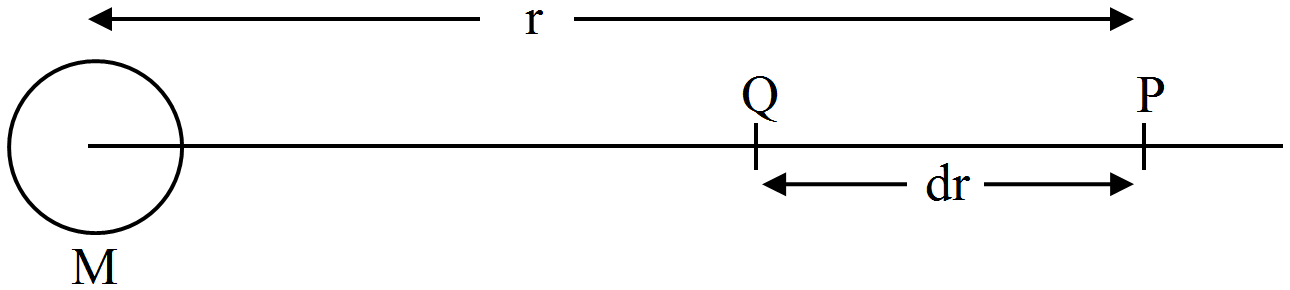
Consider a body of unit mass placed at a distance r from the centre of a mass M. Then the gravitational force acting on the unit mass is given by, $\text{F}=\frac{\text{GM}\times1}{\text{r}^2}=\frac{\text{GM}}{\text{r}^2}\dots(\text{i})$ The direction of this force is towards the centre of the body of mass M. Let the unit mass be displaced from point P to Q, through a distance dr towards mass M, then the work done is given by, $\text{dW}=\vec{\text{F}}.\vec{\text{dr}}=\text{F.dr}\cos\theta$
$=\text{F dr}\cos0$
$\Rightarrow\ \text{dW}=\text{F dr}=\frac{\text{GM}}{\text{r}^2}\text{dr}$ (From eq. (i)) ...(ii)Total work done in displacing the unit mass from infinity $(\text{r}=\infty)$ to the point P whose distance from mass M is r can be calculated by integrating eqn. (ii) between limits $\text{r}=\infty$ to r = r
$\therefore\ \int\text{dW}=\int\limits^{\text{r}}_\infty\frac{\text{GM}}{\text{r}^2}\text{dr}$
$\text{W}=\int\limits^{\text{r}}_\infty\frac{\text{GM}}{\text{r}^2}\text{dr}\Rightarrow\ \text{W}=\text{GM}\int\limits^{\text{r}}_\infty\text{r}^{-2}\text{dr}$
$=\text{GM}\Big[\frac{\text{r}^{-1}}{-1}\Big]^{\text{r}}_\infty$
$\text{W}=-\text{GM}\Big[\frac{1}{\text{r}}\Big]^\text{r}_\infty=-\text{GM}\Big[\frac{1}{\text{r}}-\frac{1}{\infty}\Big]$
$\Rightarrow\ \text{W}=-\frac{\text{GM}}{\text{r}}$
$\Big[\because\frac{1}{\infty}=0\Big]$ This work done is equal to the gravitational potential Gravitational potential, $\text{V}=-\frac{\text{GM}}{\text{r}}.$
Numerical: Here $M = 6 \times 10^{24}kg, m = 400kg, R_E = 6.4 \times 10^6m$
hence $r = 2R_E = 12.8 \times 10^6m$ and $G = 6.67 \times 10^{-11}Nm^2 kg^{-2}$^
$\therefore$ K.E. of satellite, $\text{K}=\frac{\text{GMm}}{2\text{r}}$
$=\frac{(6.67\times10^{-11})\times(6\times10^{24})\times400}{2\times(12.8\times10^6)}=6.25\times10^9\text{J}$ P.E. of satellite, $\text{U}=-\frac{2\text{GMm}}{2\text{r}}=-2\text{K}$
$=-2\times6.25\times10^9\text{J}=-12.5\times10^9\text{J}$ and Total energy of satellite, $E = K + U \Rightarrow E = (6.25 \times 10^9 - 12.5 \times 10^9)J = -6.25 \times 10^9J$ View full question & answer→Question 765 Marks
State Kepler's laws of planetary motion. What would be the speed of rotation of the earth in order that a body on the equator has no weight? Determine the apparent weights of the bodies situated at a latitude of $60°$ and at the poles. The radius of the earth = $6400km$ and $g = 9.8ms^{-1}$.
AnswerKepler's Laws of Planetary Motion:Johannes Kepler formulated three laws which describe planetary motion. They are as follows:
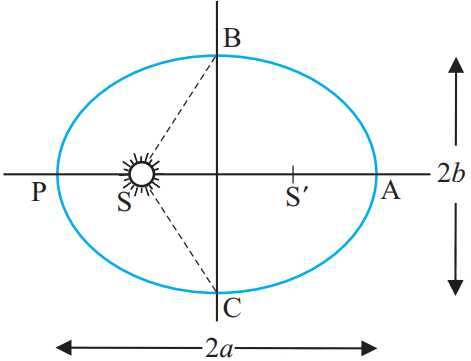
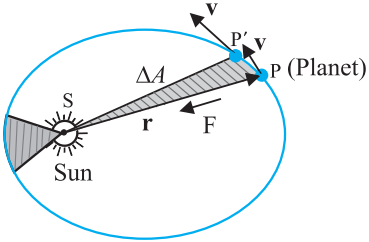
- Law of orbits: Each Planet revolves around the sun in an elliptical orbit with the sun at one of the foci of the ellipse.
- Law of areas: The speed of planet varies in such a way that the radius, vector drawn from the sun to Planet sweeps out equal areas in equal times.
- Law of periods: The square of the time period of revolution is proportional to the cube of the semi-major axis of the elliptical orbit. i.e., $\text{T}^2\propto\text{r}^3.$
If $r_1$ and $r_2$ are the shortest and the longest distances of the planet from the sun, the semi-major axis is given by $\Big(\frac{\text{r}_1+\text{r}_2}{2}\Big).$
The body will become weightless if the gravitational force mg on it is entirely used up in providing the centripetal acceleration for the rotation of the earth,
Then, $\text{mg}=\frac{\text{mv}^2}{\text{R}}=\text{m}\omega^2\text{R}$
$\omega^2=\frac{\text{g}}{\text{R}}=\frac{9.8}{6400\times10^3}$
$\omega=1.237\times10^{-3}\text{ rad s}^{-1}$
If the earth rotates at this speed, the bodies on the equator will have no weight. At a latitude $\phi$ the apparent weight $W_A$ is given by,
$\text{W}_\text{A}=\text{mg}\Big(1-\frac{\omega^2\text{R}}{\text{g}}\cos^2\phi\Big)$
Here, however, $\text{g}=\omega^2\text{R}$
Therefore, $\text{W}_\text{A}=\text{mg}(1-\cos^2\phi)$
When, $\phi=60^\circ,\ \cos\phi=\frac{1}{2}$
$\text{W}_\text{A}=\text{mg}\Big(1-\frac{1}{4}\Big)=\frac{3}{4}\times\text{true weight}$
At poles, $\phi=\frac{\pi}{2}$
$W_A$ = mg = true weight
Thus, a body situated on the poles remains unaffected, whatever the speed of rotation of the earth. View full question & answer→Question 775 Marks
An artificial satellite of mass $100kg$ is in a circular orbit at $500km$ above the earth's surface.
- Find the acceleration due to gravity at any point along the satellite path.
- What is the centripetal acceleration of the satellite?
Take radius of earth as $6.5 \times 10^6m$. AnswerHere, $h = 500km = 0.5 \times 10^6m; R = 6.5 \times 10^6m$ Radius of orbit = $R + h = 6.5 \times 10^6 + 0.5 \times 10^6 = 7.0 \times 10^6m$
- Now, $\text{g}=\text{g}\Big(\frac{\text{R}}{\text{R}+\text{h}}\big)^2=9.8\Big(\frac{6.5\times10^6}{7\times10^6}\Big)$
$=9.1\text{ms}^{-2}$
- Centripetal force on the satellite,
$\text{F}=\frac{\text{mv}^2}{\text{r}}$
$\therefore$ Centripetal acceleration,
$\text{a}=\frac{\text{F}}{\text{m}}=\frac{\text{v}^2}{\text{r}}=\frac{\Big(\sqrt{\frac{\text{gR}^2}{\text{r}}}\Big)^2}{\text{r}}$
$=\frac{\text{gR}^2}{\text{r}^2}=\text{g}\frac{\text{R}^2}{(\text{R}+\text{h})^2}=8.45\text{ms}^{-2}$ View full question & answer→Question 785 Marks
State Newton's law of Gravitation. Find the percentage decrease in the weight of the body when taken to a height of 16km. above the surface of the earth. Radius of the earth is 6400km.
AnswerIt states that every body in the universe attracts every other body with a force which is directly propotional to the product of their masses and inversely propotional to square of distance between them. $\text{F}=\frac{\text{Gm}_1\text{m}_2}{\text{r}^2}$ $m_1$ and $m_2$ → mass of two bodies r → distance between two bodies. The acceleration due to gravity at a height 'h' above the surface of the earth is $\text{g}'=\text{g}\Big(1-\frac{2\text{h}}{\text{R}}\Big)$ $\text{g}-\text{g}'=\Big(\frac{2\text{hg}}{\text{R}}\Big)$ $\frac{\text{mg}-\text{mg}'}{\text{mg}}\times100=\frac{\text{g}-\text{g}'}{\text{g}}\times100$ $=\frac{2\text{h}}{\text{R}}\times100$ $=\frac{2\times16}{6400}\times100=0.5\%$
View full question & answer→Question 795 Marks
To what height a mass can go, when sent up with a velocity half of the escape velocity?
AnswerInitial velocity $=\frac{1}{2}\text{v}_{\text{e}},$ $\text{v}_{\text{e}}=\sqrt{2\text{gR}}=\sqrt{\frac{2\text{GM}}{\text{R}}}$ Any mass can go up till all the kinetic energy is transformed into potential energy. Applying conservation of energy we have, $\Rightarrow-\frac{\text{GMm}}{\text{R}}+\frac{1}{2}\text{m}\Big(\frac{1}{2}\text{v}_{\text{e}}\Big)^2=-\frac{\text{GMm}}{\text{R+h}}$ $\Rightarrow-\frac{\text{GMm}}{\text{R}}+\frac{1}{2}\text{m}\frac{1}{4}\frac{2\text{GM}}{\text{R}}=-\frac{\text{GMm}}{\text{R+h}}$ $\Rightarrow\frac{\text{GMm}}{\text{R}}\Big(-1+\frac{1}{4}\Big)=-\frac{\text{GMm}}{\text{R+h}}$ $\Rightarrow\frac{3}{4\text{R}}=\frac{1}{\text{R+h}}$ $\Rightarrow3\text{R}+3\text{h}=4\text{R}$ $\Rightarrow3\text{h}=\text{R}$ $\text{h}=\frac{\text{R}}{3}$
View full question & answer→Question 805 Marks
A rocket is fired vertically with a speed of $5 \mathrm{~km} \mathrm{~s}^{-1}$ from the earth's surface. How far from the earth does the rocket go before returning to the earth? Mass of the earth $=6.0 \times 10^{24} \mathrm{~kg}$; mean radius of the earth $=6.4 \times 10^6 \mathrm{~m} ; \mathrm{G}=6.67$ $\times 10^{-11} \mathrm{Nm}^2 \mathrm{~kg}^{-2}$.
AnswerVelocity of the rocket, $v = 5km/s = 5 \times 10^3m/s$ Mass of the Earth, $M_e = 6 \times 10^{24}kg$ Radius of the Earth, $R_e = 6.4 \times 10^6^m$ Height reached by rocket mass, m = h At the surface of the Earth, Total energy of the rocket = Kinetic energy + Potential energy$=\Big(\frac{1}{2}\Big)\text{mv}^2+\Big(\frac{-\text{GM}_\text{e}\text{m}}{\text{R}_\text{e}}\Big)$
At highest point h, v = 0 And, Potential energy $=\frac{-\text{GM}_\text{e}\text{m}}{(\text{R}_\text{e}+\text{h})}$ Total energy of the rocket $=0+\Big[\frac{-\text{GM}_\text{e}\text{m}}{(\text{R}_\text{e}+\text{h})}\Big]$
$=\frac{-\text{GM}_\text{e}\text{m}}{(\text{R}_\text{e}+\text{h})}$ From the law of conservation of energy, we have Total energy of the rocket at the Earth’s surface = Total energy at height h $\Big(\frac{1}{2}\Big)\text{mv}^2+\Big(\frac{-\text{GM}_\text{e}\text{m}}{\text{R}_\text{e}}\Big)=\frac{-\text{GM}_\text{e}\text{m}}{(\text{R}_\text{e}+\text{h})}$
$\Big(\frac{1}{2}\Big)\text{v}^2=\text{GM}_\text{e}\Bigg[\frac{\big(\frac{1}{\text{R}_\text{e}}\big)-1}{(\text{R}_\text{e}+\text{h})}\Bigg]$
$=\text{GM}_\text{e}\bigg[\frac{(\text{R}_\text{e}+\text{h}-\text{R}_\text{e})}{\text{R}_\text{e}(\text{R}_\text{e}+\text{h})}\bigg]$
$\Big(\frac{1}{2}\Big)\text{v}^2=\frac{\text{gR}_\text{e}\text{h}}{(\text{R}_\text{e}+\text{h})}$ Where $\text{g}=\frac{\text{GM}}{\text{R}_\text{e}^2}=9.8\text{ms}^{-2}$
$\therefore\ \text{v}^2(\text{R}_\text{e}+\text{h})=2\text{gR}_\text{e}\text{h}$
$\text{v}^2\text{R}_\text{e}=\text{h}(2\text{gR}_\text{e}-\text{v}^2)$
$\text{h}=\frac{\text{R}_\text{e}\text{v}^2}{(2\text{gR}_\text{e}-\text{v}^2)}$
$=\frac{6.4\times10^6\times(5\times10^3)^2}{2\times9.8\times6.4\times10^{6}-(5\times10^3)^2}$
$\text{h}=1.6\times10^6\text{m}$ Height achieved by the rocket with respect to the centre of the Earth $=\text{R}_\text{e}+\text{h}$
$=6.4\times10^6+1.6\times10^6=8\times10^6\text{m.}$
View full question & answer→Question 815 Marks
What are geostationary satellites? Find the expression of total energy of a satellite revolving around the surface of the earth. What is the significance of negative sign in the expression? Write the expression of angular momentum of a satellite.
AnswerGeostationary satellite: The satellite having the same time period of revolution as that of the earth is called geostationary satellite. 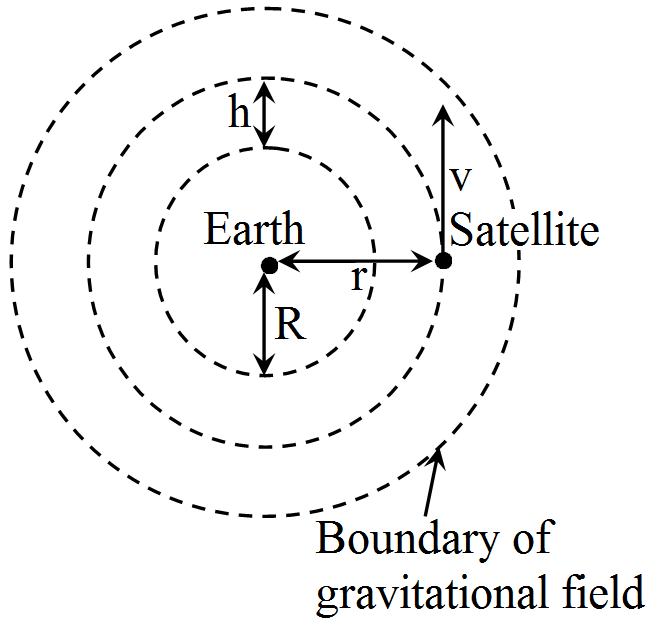 Let a satellite of mass 'm' is revolving around the earth of mass M, radius R, with orbital velocity 'v', in an orbit of radius r, then potential energy of a satellite is $\text{U}=-\frac{\text{GMm}}{\text{r}}$The K.E of a satellite,
$\text{K}=\frac{1}{2}\text{mv}^2$ $=\frac{1}{2}\text{m}\Big(\frac{\text{GM}}{\text{r}}\Big)$ $\Big[\because\text{v}=\sqrt{\frac{\text{GM}}{r}}\Big]$ Thus, total mechanical energy of the satellite is, $\text{E}=\text{U}+\text{K}$ $=-\frac{\text{GMm}}{\text{r}}+\frac{1}{2}\frac{\text{GMm}}{\text{r}}$ $=-\frac{\text{GMm}}{2\text{r}}$ $\text{E}=-\frac{\text{GMm}}{2\text{r}}=-\frac{\text{GMm}}{2(\text{R}+\text{h})}$ If the satellite is close to earth, then $\text{R}\approx\text{r}$ Now, total energy of satellite, $\text{E}=-\frac{\text{GMm}}{2\text{R}}$
-ve sign shows that there is attractive gravitational force exerted by the earth on the satellite. Angular momentum, L - when a satellite of mass m is orbiting with linear speed v on the orbital path of radius r around the earth, its angular momentum is given $\text{L}=\text{mvr}=\text{mr}\sqrt{\frac{\text{GM}}{\text{r}}}=[\text{m}^2\text{GMr}]^{\frac{1}{2}}$ View full question & answer→Question 825 Marks
Two lead spheres of 20cm and 2cm diameter respectively are placed with centres 100cm apart. Calculate the attraction between them, given the radius of the earth as $6.37 \times 10^8cm$ and its mean density as $5.53 \times 103kgm^{-3}$, specific gravity of lead = 11.5. If the lead spheres are replaced by brass spheres of the same radii, would the force of attraction be the same?
AnswerHere $\text{r}_1=\frac{0.20}{2}=0.1\text{m};$ $\text{r}_2=\frac{0.02}{2}=0.01\text{m};$ $\text{r}=1.0\text{m};$ $\rho_3=5.53\times10^3\text{kg m}^{-3};$ $\rho'=11.5\times10^3\text{kg/m}^3$ Mass of first lead sphere $m_1 =\frac{4}{3}\pi\text{r}^3\rho'$ $=\frac{4}{3}\times3.14\times(0.1)^3\times11.5\times10^3$ $=48.15\text{kg}$ Mass of second lead sphere, $\text{m}_2=\frac{4}{3}\pi\text{r}^3_2\rho'$ $=\frac{4}{3}\times3.14\times(0.01)^3\times11.5\times10^3$ $=4.815\text{kg}$ We know that, g $=\frac{\text{G}}{\text{R}^2}\frac{4}{3}\pi\text{R}^3\rho\text{ or }\text{G}=\frac{3\text{g}}{4\pi\text{R}\rho}$ Force of attraction between lead spheres will be $\text{F}=\frac{\text{Gm}_1\text{m}_2}{\text{r}^2}=\frac{3\text{g}}{4\pi\text{R}\rho}\times\frac{\text{m}_1\text{m}_2}{\text{r}^2}$ $=\frac{3\times9.8\times48.15\times4.815}{4\times3.14\times(6.37\times10^6)\times5.53\times10^3\times1^2}$ $=13.39\times10^{-9}\text{N}$ As the density of brass sphere is less than that of lead sphere hence, the masses of spheres will become less when lead spheres are replaced by brass sphere. Since $\text{F}\propto\text{m}_1\text{m}_2$ hence force of attraction between brass spheres will be less than those of lead spheres.
View full question & answer→Question 835 Marks
A mass m is placed at P a distance h along the normal through the centre O of a thin circular ring of mass M and radius r
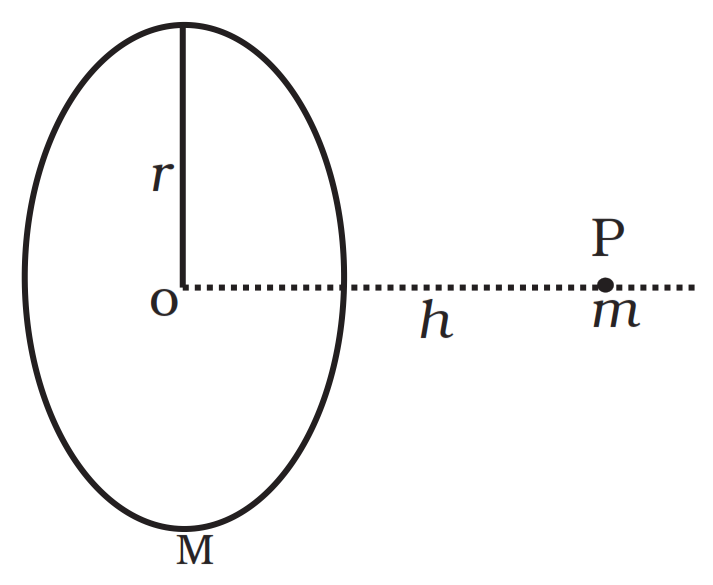
If the mass is removed further away such that OP becomes 2h, by what factor the force of gravitation will decrease, if h = r?
AnswerA ring has a radius r and mass M, and if a mass m is placed at a distance h axially at P. Consider a small element of the ring of mass dM at point A. Distance between dM and m is x.
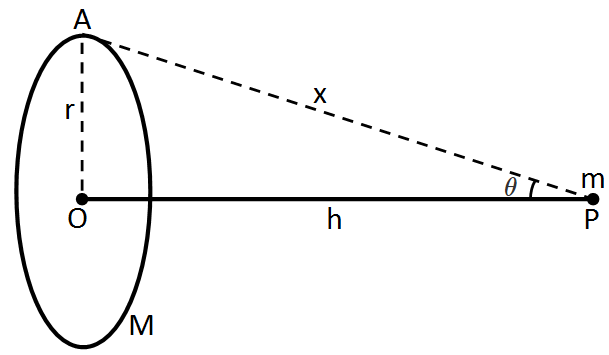
Also $x^2 = r^2 + h^2$ Gravitational force between dM and m $\text{dF}=\frac{\text{G(dM)m}}{\text{x}^2}$
$\text{dF}$ has two components $\text{dF}\cos^0$ along PO and $\text{dF}\sin^0$ perpendicular to PO. Due to the symmetry of the ring, $\int \text{dF}\sin\theta=0$ Net force on mass m due to ring is given by $\text{F}=\int\text{dF}\cos\theta=\int\frac{\text{G(dm)m}}{\text{x}^2}.\frac{\text{h}}{\text{x}}$
$=\frac{\text{Gmh}}{\text{x}^3}\int\text{dM}=\frac{\text{GMmh}}{\text{x}^3}=\frac{\text{GMmh}}{(\text{r}^2+\text{h}^2)^{\frac{3}{2}}}...(1)$ When mass is displaced upto distance 2h then; $\text{F}'=\frac{\text{GMm2h}}{(\text{r}^2(2\text{h})^2)^{\frac{3}{2}}}=\text{F}'=\frac{\text{GMm2h}}{(\text{r}^2(4\text{h})^2)^{\frac{3}{2}}}...(2)$ When h = r from eq. (1) $\text{F}=\frac{\text{GMmr}}{(\text{r}^2 +\text{r}^2)^{\frac{3}{2}}}=\frac{\text{GMm}}{2\sqrt{2}\text{r}^2}...(3)$ from eq.(2) $\text{F}'=\frac{\text{GMmr}}{(\text{r}^2 +4\text{r}^2)^{\frac{3}{2}}}=\frac{\text{2GMm}}{5\sqrt{5}\text{r}^2}...(4)$ Dividing eq (4) and eq (3) we have $\frac{\text{F}'}{\text{F}}=\frac{4\sqrt{2}}{5\sqrt{5}}$ or $\text{F}'=\frac{4\sqrt{2}}{5\sqrt{5}}\text{F},$ is the gravitational force between m and ring at distance 2h. View full question & answer→Question 845 Marks
Let us assume that our galaxy consists of $2.5 \times 10^{11}$ stars each of one solar mass. How long will a star at a distance of $50,000 \mathrm{ly}$ from the galactic centre take to complete one revolution? Take the diameter of the Milky Way to be $10^5 \mathrm{ly}$.
AnswerMass of our galaxy Milky Way, $M = 2.5 \times 10^{11}$ solar mass Solar mass = Mass of Sun = $2.0 \times 10^{36}kg$ Mass of our galaxy, $M = 2.5 \times 10^{11} \times 2 \times 10^{36} = 5 \times 10^{41}kg$ Diameter of Milky Way, $d = 10^5ly$ Radius of Milky Way, $r = 5 \times 10^4ly 1ly = 9.46 \times 10^{15}m$
$\therefore r = 5 \times 10^4 \times 9.46 \times 10^{15} = 4.73 \times 10^{20}m$
Since a star revolves around the galactic centre of the Milky Way, its time period is given by the relation: $\text{T}=\Big(\frac{4\pi^2\text{r}^3}{\text{GM}}\Big)^\frac{1}{2}$
$=\bigg(\frac{4\times(3.14)^2\times(4.73)^2\times10^{60}}{6.67\times10^{-11}\times5\times10^{41}}\bigg)^\frac{1}{2}=\bigg(\frac{39.48\times105.82\times10^{30}}{33.35}\bigg)^{\frac{1}{2}}$
$=(125.27\times10^{30})^\frac{1}{2}=1.12\times10^{16}\text{ s}$
$1\text{ year}=365\times324\times60\times60\text{s}$
$1\text{s}=\frac{1}{365\times24\times60\times60}\text{ year}$
$\therefore\ 1.12\times10^{16}\text{ s}=\frac{1.12\times10^{16}}{365\times24\times60\times60}$
$=3.55\times10^{8}\ \text{year}$
View full question & answer→Question 855 Marks
A rocket is fired ‘vertically’ from the surface of mars with a speed of $2km\ s^{-1}$. If 20% of its initial energy is lost due to martian atmospheric resistance, how far will the rocket go from the surface of mars before returning to it? Mass of mars $= 6.4 \times 10^{23}kg;$ radius of mars $= 3395km;\ G = 6.67 \times 10^{-11}N\ m^2\ kg^{-2}.$
AnswerInitial velocity of the rocket, $v = 2km/s = 2 \times 10^3m/s$
Mass of Mars, $M = 6.4 \times 10^{23}kg$
Radius of Mars, $R = 3395km = 3.395 \times 10^6m$
Universal gravitational constant, $G = 6.67\times 10^{–11}N\ m^2 kg^{–2}$
Mass of the rocket = m Initial kinetic energy of the rocket $= (1/2)mv^2$
Initial potential energy of the rocket = -GMm/R
Total initial energy $= (1/2)mv^2- GMm/R$
If 20% of initial kinetic energy is lost due to Martian atmospheric resistance,
then only 80% of its kinetic energy helps in reaching a height.
Total initial energy available $= (80/100) \times (1/2) mv^2 - GMm/R = 0.4mv^2 - GMm/R$
Maximum height reached by the rocket = h At this height,
the velocity and hence, the kinetic energy of the rocket will become zero.
Total energy of the rocket at height $h = -GMm/(R + h)$
Applying the law of conservation of energy for the rocket, we can write: $0.4mv^2 - GMm/R = -GMm/(R + h) 0.4v^2$
$= GM/R - GM/(R + h) = GMh/R(R + h) $
$(R + h)/h = GM/0.4v^2R $
$R/h = (GM/0.4v^2R ) - 1 $
$h= R/[(GM/0.4v^2R) - 1] = 0.4R^2v^2 / (GM - 0.4v^2R) $
$= 0.4 \times (3.395 \times 10^6)^2 \times (2 \times 10^3)^2/[ 6.67 \times 10^{11} \times 6.4 \times 10^{23} - 0.4 \times (2 \times 10^3)^2 \times (3.395 \times 10^6)]$
$ = 18.442 \times 10^{18}/[42.688 \times 10^{12} - 5.432 \times 10^{12}] $
$= 18.442 \times 10^6/37.256 $
$= 495 \times 10^3m = 495km.$
View full question & answer→Question 865 Marks
A satellite is to be placed in equatorial geostationary orbit around earth for communication.
- Calculate height of such a satellite.
- Find out the minimum number of satellites that are needed to cover entire earth so that at least one satellites is visible from any point on the equator.
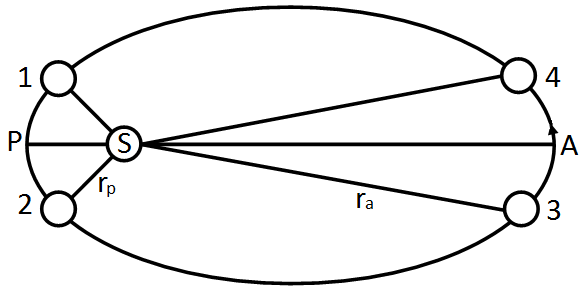
[$M = 6 \times 10^{24}kg, R = 6400km, T = 24h, G = 6.67 \times 10^{–11}$ SI units] AnswerFrom the geometry of the ellipse of eccentricity e and semi major axis a, the aphelion and perihelion distances are:$r_p = a(1 - e)$ and $r_a= a(1 + e)...(i)$
As the earth orbits the sun, the angular momentum is conserved and a real velocity is constant.
Let M be the mass of the earth,
$v_p$= velocity of the earth at perihelion (perigee).
$v_a$= velocity of the earth at aphelion or apogee.
$\omega_\text{p}$ = angular velocity of the earth at perihelion.
$\omega_\text{a}$ = angular velocity of the earth at aphelion.
Angular momentum and areal velocity are constant as the earth orbits the sun.
$\text{r}^2_\text{p}\omega_\text{p}=\text{r}^2_\text{a}\omega_\text{a}...(\text{ii})$
From (i) and (ii), we get
$\frac{\omega_\text{p}}{\omega_\text{a}}=\Big(\frac{1+\text{e}}{1-\text{e}}\Big)^2\text{e}=0.0167$
$\therefore\ \frac{{\omega_\text{p}}}{{\omega_\text{a}}}=1.0691$
Let $\omega$ be the mean angular speed corresponds to mean solar day.
$\therefore\ \Big(\frac{{\omega_\text{p}}}{\omega}\Big)\Big(\frac{\omega}{{\omega_\text{a}}}\Big)=1.0691$
$\omega^2={\omega_\text{p}}{\omega_\text{a}}$
$\therefore\ \frac{{\omega_\text{p}}}{\omega}=\frac{\omega}{{\omega_\text{a}}}=1.034$
If mean angular velocity co corresponds to $1^{\circ}$ per day, then $p=1.034^{\circ}$ per day and $a=0.967^{\circ}$ per day. Since, $361^{\circ}=24$ mean solar day we get $(360+1.034)$ which corresponds to $24 \mathrm{~h}, 8.14^{\prime \prime}\left(8.1^{\prime \prime}\right.$ longer) and $360.967^{\circ}$, corresponds to 23 h $59 \mathrm{~min} 52^{\prime \prime}$ ( $7.9^{\prime \prime}$ smaller).
This does not explain the actual variation of the length of the day during the year. View full question & answer→Question 875 Marks
A star like the sun has several bodies moving around it at different distances. Consider that all of them are moving in circular orbits. Let r be the distance of the body from the centre of the star and let its linear velocity be v, angular velocity $\omega$, kinetic energy K, gravitational potential energy U, total energy E and angular momentum l. As the radius r of the orbit increases, determine which of the above quantities increase and which ones decrease.
AnswerIn equilibrium condition, when a body moves around a star, the gravitational pull result in a centripetal force. Let us consider a body of mass m is rotating around the star S of mass M in circular path of radius r. 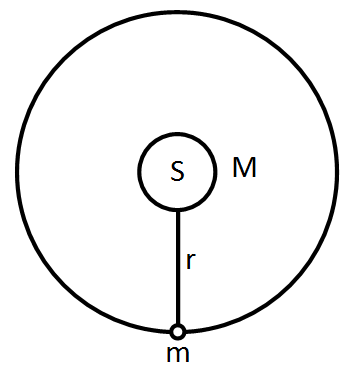 $\text{F}_\text{c}=\frac{\text{mv}^2_0}{\text{r}}=\frac{\text{GMm}}{\text{r}^2}$
- Then orbital velocity $\text{v}_0=\sqrt{\frac{\text{GM}}{\text{r}}}\text{or}\text{ v}_0\propto\frac{1}{\sqrt{\text{r}}}$
Hence, on increasing radius of circular path orbital velocity decreases.
- Angular velocity $\omega=\frac{2\pi}{\text{T}}$ and $\text{T}^2\propto\text{r}^3$ by Kepler’s third law
$\therefore\ \omega=\frac{2\pi}{\text{Kr}^{\frac{3}{2}}} \text{ or }\omega\propto\frac{1}{\sqrt{\text{r}^3}}$
Hence, on increasing the radius of circular orbit the angular velocity decreased.
- Kinetic energy $\text{E}_\text{k}=\frac{1}{2}\text{ m }\frac{\text{GM}}{\text{r}}$
Or $\text{E}_\text{k}\propto\frac{1}{\text{r}}.$ Hence on increasing the radius of circular path the kinetic energy decreased.
- Gravitation potential energy $\text{E}_\text{p}=\frac{-\text{GMm}}{\text{r}}$ or $\text{E}_\text{p}\propto-\Big(\frac{1}{\text{r}}\Big)$ so.
On increasing radius of circular orbit the P.E. (Ep) increases.
- Total energy $\text{E}=\text{E}_\text{k}+\text{E}_\text{p}=\frac{\text{GMm}}{2\text{r}}+\Big(\frac{-\text{GMm}}{\text{r}}\Big)$
$\text{E}=\frac{-\text{GMm}}{2\text{r}}$
Hence, on increasing the radius of circular orbit the total energy E will also be increased.
- Angular momentum $=\text{L}=\text{mvr}=\text{m}\sqrt{\frac{\text{GM}}{\text{r}}}\text{r}$
$\text{L}=\text{m}\sqrt{\text{GMr}}$ or $\text{L}\propto\sqrt{\text{r}}$
Hence, the increasing radius r of circular orbit increases the angular momentum. View full question & answer→Question 885 Marks
Six point masses of mass m each are at the vertices of a regular hexagon of side l. Calculate the force on any of the masses.
AnswerResultant force will be equal to sum of individual forces by each point mass (m). According to the diagram below, in which six point masses are placed at six vertices A, B, C, D, E and F. $\text{AC}=\sqrt{\text{AB}^2+\text{BC}^2-2(\text{AB})(\text{BC})\cos120^0}$ $=\sqrt{\text{l}^2+\text{l}^2-2(\text{l})(\text{l})(-1/2)}$ Similarly, $\text{AE}=\text{l}\sqrt{3}$ $\text{AD}=\sqrt{\text{AC}^2+\text{CD}^2}=\sqrt{3\text{l}^2+\text{l}^2}=2\text{l}$
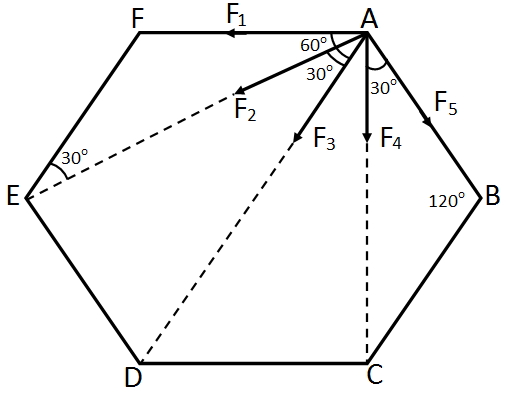
Force on mass m at A due to mass m at F is, $\text{F}_1=\frac{\text{Gm}^2}{\text{l}^2} \text{ along AF}$ Force on mass m at A due to mass m at E is, $\text{F}_2=\frac{\text{Gm}^2}{(\sqrt{\text{3l}})^2}=\frac{\text{Gm}^2}{3\text{l}^2}\text{ along AE}$ $[\because\text{AC}=\sqrt{3}\text{l}]$ Force on mass m at A due to mass m at D is, $\text{F}_3=\frac{\text{Gm}\times\text{m}}{({\text{2l}})^2}=\frac{\text{Gm}^2}{4\text{l}^2}\text{ along AD}$ $[\because\text{AD}={2}\text{l}]$ Force on mass m at A due to mass m at C is, $\text{F}_4=\frac{\text{Gm}\times\text{m}}{(\sqrt{\text{3l}})^2}=\frac{\text{Gm}^2}{3\text{l}^2}\text{ along AC}.$ Force on mass m at A due to mass m at B is, $\text{F}_5=\frac{\text{Gm}\times\text{m}}{{\text{l}}^2}=\frac{\text{Gm}^2}{\text{l}^2}\text{ along AB}$ Since $F_1$ and $F_5$ are equal in magnitude and make equal angle (i.e., 60° each) withAD, their resultant is along AD. $\text{F}_{15}=\sqrt{\text{F}_1^2+\text{F}_5^2+2\text{F}_1\text{F}_5\cos120^0}$ $=\frac{\text{Gm}^2}{\text{l}^2} \text{ along AD}$ $[\because\text{Angle between F}_1\text{ and F}_5=120^0]$ Similarly, resultant force due to $F_2$ and $F_4$ is also along AD, $\text{F}_{24}=\sqrt{\text{F}_2^2+\text{F}_4^2+2\text{F}_2\text{F}_4\cos60^0}$ $=\frac{\sqrt{3}\text{Gm}^2}{\text{3l}^2}=\frac{\text{GM}^2}{\sqrt{3\text{l}^2}}\text{ along AD}$ So, net force along AD $\text{F}_\text{net}=\text{F}_{15}+\text{F}_{24}+\text{F}_3$ $=\frac{\text{GM}^2}{\text{l}^2}+\frac{\text{GM}^2}{\sqrt{3\text{l}^2}}+\frac{\text{GM}^2}{\text{4l}^2}$ $=\frac{\text{GM}^2}{\text{l}^2}\Big(1+\frac{1}{\sqrt{3}}+\frac{1}{4}\Big)$ View full question & answer→Question 895 Marks
A spaceship is stationed on Mars. How much energy must be expended on the spaceship to launch it out of the solar system? Mass of the space ship $= 1000kg;$ mass of the sun $= 2 \times 10^{30}kg;$ mass of mars $= 6.4 \times 10^{23}kg;$ radius of mars = 3395km; radius of the orbit of mars $= 2.28 \times 10^8km;\ G = 6.67 \times 10^{-11}N\ m^2\ kg^{-2}.$
AnswerMass of the spaceship, $m_s = 1000kg$
Mass of the Sun, $M = 2 \times 10^{30}kg$
Mass of Mars, $mm = 6.4 \times 10^{23}kg$
Orbital radius of Mars, $R = 2.28 \times 10^8kg =2.28 \times 10^{11}m$
Radius of Mars, $r = 3395km = 3.395 \times 10^6m$
Universal gravitational constant, $G = 6.67 \times 10^{-11}m^2 kg^{–2}$
Potential energy of the spaceship due to the gravitational attraction of the Sun $= -GMm_s/R$
Potential energy of the spaceship due to the gravitational attraction of Mars $= -GM_mm_s/r$
Since the spaceship is stationed on Mars, its velocity and
hence, its kinetic energy will be zero. Total energy of the spaceship$ = (-GMm_s)/R - (-GM_mm_s)/r = -Gm_s(M/R + m_m/r)$
The negative sign indicates that the system is in bound state.
Energy required for launching the spaceship out of the solar system
= -(Total energy of the spaceship)
$=\text{Gm}_\text{s}\Big(\frac{\text{M}}{\text{R}}+\frac{\text{m}_\text{m}}{\text{r}}\Big)$
$=6.67\times10^{-11}\times10^3\times\Big(\frac{2\times10^{30}}{2.28\times10^{11}}+\frac{6.4\times10^{23}}{3.395\times10^6}\Big)$
$=6.67\times10^{-8}(87.72\times10^{17}+1.88\times10^{17})$
$=6.67\times10^{-8}\times89.50\times10^{17}$
$=596.97\times10^{9}$
$=6\times10^{11}\text{J}$
View full question & answer→Question 905 Marks
A satellite is in an elliptic orbit around the earth with aphelion of $6R$ and perihelion of $2R$ where $R = 6400km$ is the radius of the earth. Find eccentricity of the orbit. Find the velocity of the satellite at apogee and perigee. What should be done if this satellite has to be transferred to a circular orbit of radius $6R$?$[G = 6.67 \times 10^{–11} SI$ units and $M = 6 \times 10^{24}kg]$
Answer$r_p = 2R r_a=6R$ Hence, $r_p = a(1 - e) = 2R ...(i) r_a= a(1 + e) = 6R ...(ii)$ on dividing (i) by (ii) $\frac{1-\text{e}}{1+\text{e}}=\frac{2}{6}$
$3-3\text{e}=1+\text{e}$
$4\text{e}=2\Rightarrow\text{e}=\frac{1}{2}$ There is not external force or torque on system. So by the law of conservation of angular momentum. $\text{L}_1=\text{L}_2$
$\text{m}_\text{a}\text{v}_\text{a}\text{r}_\text{a}=\text{m}_\text{p}\text{v}_\text{p}\text{r}_\text{p}\text{ m}_\text{a}=\text{m}_\text{p}=\text{m}=$ mass of satellite $\therefore\ \frac{\text{v}_\text{a}}{\text{v}_\text{p}}=\frac{\text{r}_\text{p}}{\text{r}_\text{a}}\frac{2\text{R}}{6\text{R}}=\frac{1}{3}$ So, $\text{v}_\text{p}=3\text{v}_\text{a}$ Apply conservation of energy at apogee an d perigee …(iii) $\frac{1}{2}\text{mv}_\text{p}^2-\frac{\text{GMm}}{\text{r}_\text{p}}=\frac{1}{2}\text{mv}^2_\text{a}-\frac{\text{GMm}}{\text{r}_\text{a}}$ Multiplying $\frac{2}{\text{m}}$ to both side and putting r_p= 2R and r_a = 6R $\text{v}^2_\text{p}-\frac{2\text{GM}}{2\text{R}}=\text{v}^2_\text{a}-\frac{2\text{GM}}{6\text{R}}$ (where M is mass of earth) $\text{v}_\text{a}=\frac{\text{v}_\text{p}}{3}$
$\text{v}^2_\text{p}-\text{v}^2_\text{a}=\frac{\text{GM}}{\text{R}}-\frac{1}{3}\frac{\text{GM}}{\text{R}}$
$\text{v}^2_\text{p}-\Big(\frac{\text{v}_\text{p}}{3}\Big)^2=\frac{\text{GM}}{\text{R}}\Big[1+\frac{1}{3}\Big]$
$\text{v}^2_\text{p}\frac{8}{9}=\frac{\text{GM}}{\text{R}}.\frac{2}{3}$
$\text{v}^2_\text{p}=\frac{\text{GM}}{\text{R}}\frac{2}{3}\times\frac{9}{8}=\frac{3}{4}\frac{\text{GM}}{\text{R}}$
$\text{v}_\text{p}=\sqrt{\frac{3}{4}\frac{\text{GM}}{\text{R}}}=\sqrt{\frac{3\times6.67\times10^{-11}\times6\times10^{24}}{4\times6.6\times10^6}}$
$=\sqrt{\frac{9\times667\times10^{24-6-11-1}}{128}}$
$\text{v}_\text{p}=\sqrt{\frac{6003\times10^{18-11-1}}{128}}=\sqrt{46.89\times10^6}$
$=6.85\times10^3\text{m/s}=6.85\text{km/s}$
$\text{v}_\text{a}=\frac{\text{v}_\text{p}}{3}=\frac{6.85}{3}=2.28\text{km/s} $
$\text{v}_\text{c}=\sqrt{\frac{\text{GM}}{\text{r}}}=\sqrt{\frac{6.67\times10^{-11}\times6\times10^{24}}{6\text{R}}}$
$=\sqrt{\frac{6.67\times6\times10^{24-11}}{6\times6.8\times10^6}}=\sqrt{\frac{667}{640}\times10^{13-6}}$
$=\sqrt{1.042\times10\times10^6}=\sqrt{10.42\times10^6}$
$\text{v}_\text{c}=3.23\text{km/s}$ Hence to transfer to a circular orbit at apogee we have to boost the velocity by $\text{v}_0-\text{v}_\text{a}=(3.23-2.28)=0.95\text{km/ s}$
View full question & answer→Question 915 Marks
Earth’s orbit is an ellipse with eccentricity $0.0167$. Thus, earth’s distance from the sun and speed as it moves around the sun varies from day to day. This means that the length of the solar day is not constant through the year. Assume that earth’s spin axis is normal to its orbital plane and find out the length of the shortest and the longest day. A day should be taken from noon to noon. Does this explain variation of length of the day during the year?
AnswerAccording to the diagram,
$r_p$ = radius of perigee = $2R$
$r_a$ = radius of apogee = $6R$
a = semi - major axis of the ellipse
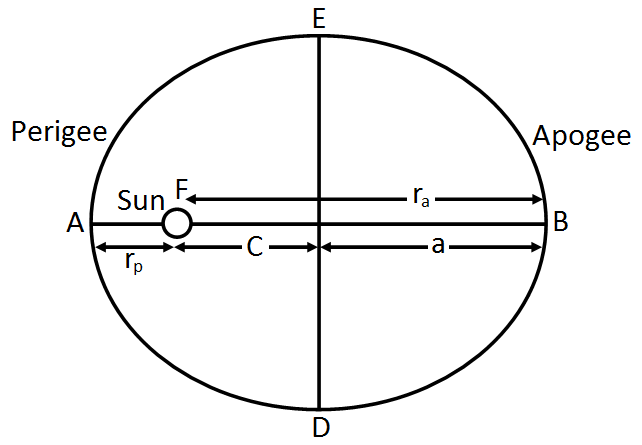
Hence, we can write
$r_a = a(1 + e) = 6R$
$P_p = a(1 - e) = 2R$
$\frac{\text{a(1+e)}}{\text{a(1}-\text{e})}=\frac{6\text{R}}{2\text{R}}=3$
By solving, we get eccentricity $\text{e}=\frac{1}{2}$
If $v_a$ and $v_p$ are the velocities of the satellite (of mass m) at aphelion and perihelion respectively, then by conservation of angular momentum
$\therefore\ \text{L}_\text{at perigee}=\text{L}_\text{at apogee}$
$\text{mv}_\text{p}\text{r}_\text{p}=\text{mv}_\text{a}\text{r}_\text{a}$
$\therefore\ \frac{\text{v}_\text{a}}{\text{v}_\text{p}}=\frac{\text{r}_\text{p}}{\text{r}_\text{a}}=\frac{1}{3}$
Applying conservation of energy,
Energy at perigee = Energy at apogee
where M is the mass of the earth
$\therefore\ \text{v}_\text{p}^2\Big(1-\frac{1}{9}\Big)=-2\text{GM}\Big(\frac{1}{\text{r}_\text{a}}-\frac{1}{\text{r}_\text{p}}\Big)$
$=2\text{GM}\Big(\frac{1}{\text{r}_\text{p}}-\frac{1}{\text{r}_\text{a}}\Big)$ $(\text{By putting v}_\text{a}=\frac{\text{v}_\text{p}}{3})$
$\text{v}_\text{p}=\frac{\Big[2\text{GM}\big(\frac{1}{\text{r}_\text{p}}-\frac{1}{\text{r}_\text{a}}\big)\Big]^{\frac{1}{2}}}{\Big[1-\big(\frac{\text{v}_\text{a}}{\text{v}_\text{p}}\big)^2\Big]^{\frac{1}{2}}}$
$=\Bigg[\frac{\frac{2\text{GM}}{\text{R}}\Big(\frac{1}{2}-\frac{1}{6}\Big)}{\Big(1-\frac{1}{9}\Big)}\Bigg]^{\frac{1}{2}}=\Big(\frac{\frac{2}{3}}{\frac{8}{9}}\frac{\text{GM}}{\text{R}}\Big)^{\frac{1}{2}}=\sqrt{\frac{3}{4}\frac{\text{GM}}{\text{R}}}=6.85\text{km/ s}$
$\text{v}_\text{p}=6.85\text{km/ s,}\text{ v}_\text{a}=2.28\text{km/ s,}$
For circular orbit of radius r,
$v_c$ = orbital velocity $=\sqrt{\frac{\text{GM}}{\text{r}}}$
For $r = 6R, v_c$ $=\sqrt{\frac{\text{GM}}{\text{6R}}}$ = 3.23km/ s View full question & answer→Question 925 Marks
Two uniform solid spheres of equal radii $R$, but mass $M$ and $4 M$ have a centre to centre separation $6 R$, as shown in Fig. $7.10$. The two spheres are held fixed. A projectile of mass $m$ is projected from the surface of the sphere of mass $M$ directly towards the centre of the second sphere. Obtain an expression for the minimum speed $v$ of the projectile so that it reaches the surface of the second sphere.
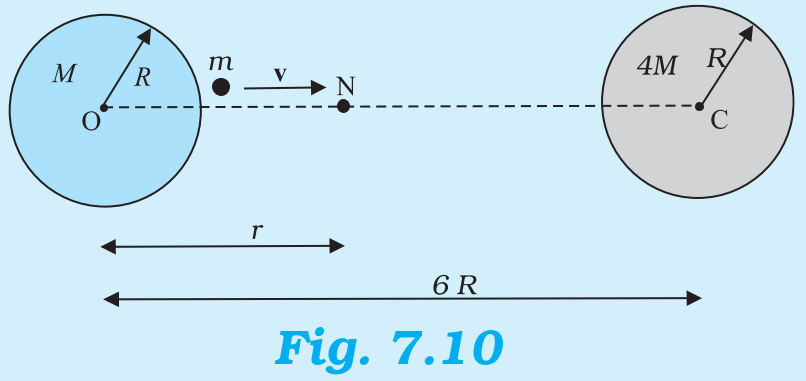
AnswerThe projectile is acted upon by two mutually opposing gravitational forces of the two spheres.
The neutral point $N\ ($see Fig. $7.10)$ is defined as the position where the two forces cancel each other exactly.
If $ON =r$, we have
$\frac{G M m}{r^2}=\frac{4 G M m}{(6 R-r)^2}$
$(6 R-r)^2=4 r^2$
$6 R-r= \pm 2 r$
$r=2 R \text { or }-6 R .$
The neutral point $r=-6 R$ does not concern us in this example.
Thus $ON =r=2 R$.
It is sufficient to project the particle with a speed which would enable it to reach $N$.
Thereafter, the greater gravitational pull of $4 M$ would suffice.
The mechanical energy at the surface of $M$ is
$E_i=\frac{1}{2} m v^2-\frac{G M m}{R}-\frac{4 G M m}{5 R} .$
At the neutral point $N$, the speed approaches zero.
The mechanical energy at $N$ is purely potential.
$E_N=-\frac{G M m}{2 R}-\frac{4 G M m}{4 R} .$
From the principle of conservation of mechanical energy
$\frac{1}{2} v^2-\frac{G M}{R}-\frac{4 G M}{5 R}=-\frac{G M}{2 R}-\frac{G M}{R}$
or
$v^2=\frac{2 G M}{R}\left(\frac{4}{5}-\frac{1}{2}\right)$
$v=\left(\frac{3 G M}{5 R}\right)^{1 / 2}$
View full question & answer→Question 935 Marks
Three equal masses of $m kg$ each are fixed at the vertices of an equilateral triangle $ABC$.
$(a)$ What is the force acting on a mass $2 m$ placed at the centroid $G$ of the triangle?
$(b)$ What is the force if the mass at the vertex $A$ is doubled?
Take $AG = BG = CG =1 m ($see $Fig. 7.5)$
Answer$(a)$ The angle between $GC$ and the positive $x-$axis is $30^{\circ}$ and so is the angle between $GB$ and the negative $x-$axis. The individual forces in vector notation are
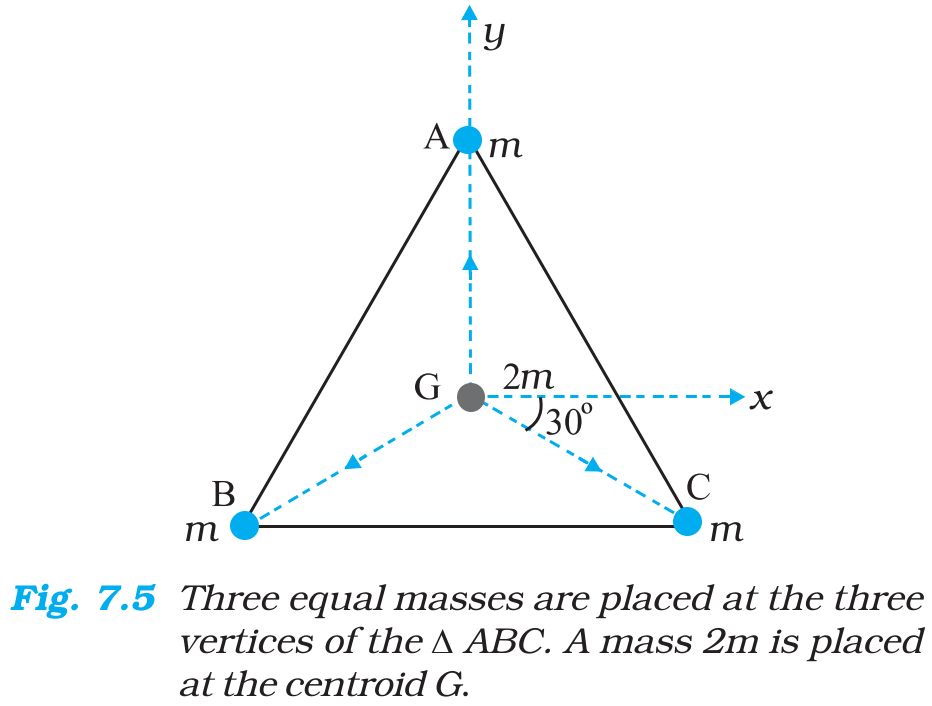
$F _{ GA }=\frac{G m(2 m)}{1} \hat{ j }$
$F _{ GB }=\frac{G m(2 m)}{1}\left(-\hat{ i } \cos 30^{\circ}-\hat{ j } \sin 30^{\circ}\right)$
$F _{ GC }=\frac{G m(2 m)}{1}\left(+\hat{ i } \cos 30^{\circ}-\hat{ j } \sin 30^{\circ}\right)$
From the principle of superposition and the law of vector addition, the resultant gravitational force $F _{ R }$ on $(2 m)$ is
$F _{ R }= F _{ GA }+ F _{ GB }+ F _{ GC }$
$F _{ R }=2 G m^2 \hat{ j }+2 G m^2\left(-\hat{ i } \cos 30^{\circ}-\hat{ j } \sin 30^{\circ}\right)$
$+2 G m^2\left(\hat{ i } \cos 30^{\circ}-\hat{ j } \sin 30^{\circ}\right)=0$
Alternatively, one expects on the basis of symmetry that the resultant force ought to be zero.
$(b)$ Now if the mass at vertex A is doubled then
$F _{G A}^{\prime}=\frac{ G 2 m \cdot 2 m}{1} \hat{ j }=4 Gm ^2 \hat{ j }$
$F _{G B}^{\prime}= F _{G B} \text { and } F _{G C}^{\prime}= F _{G C}$
$F _R^{\prime}= F _{G A}^{\prime}+ F _{G B}^{\prime}+ F _{G C}^{\prime}$
$F _{ R }^{\prime}=2 G m^2 \hat{ j }$ View full question & answer→