MCQ 11 Mark
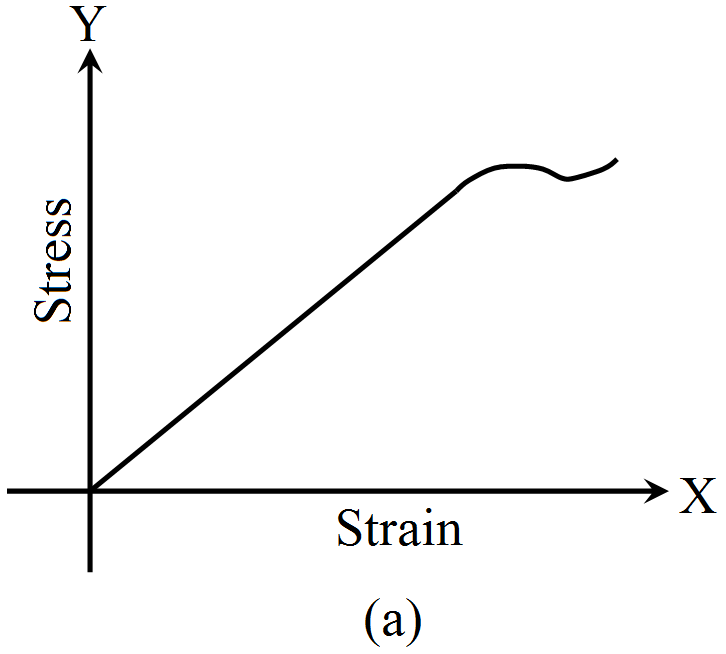
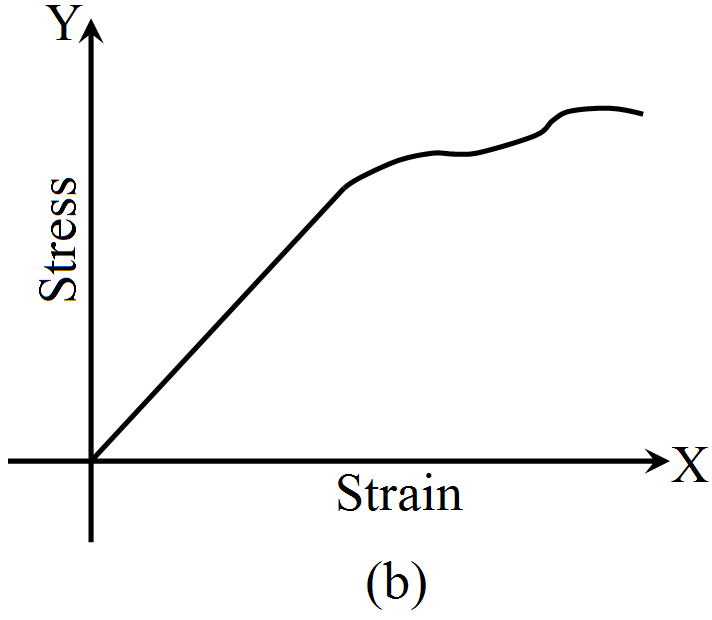
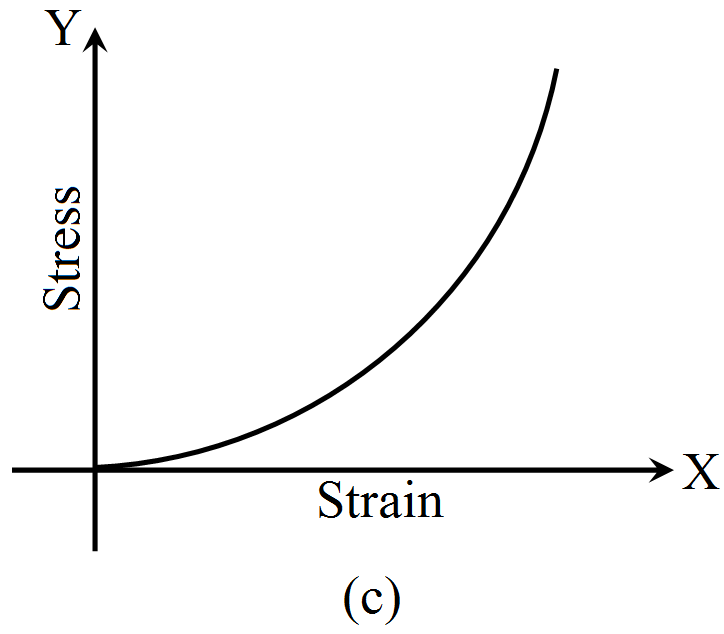
Following are the graphs of elastic materials. Which one corresponds to that of brittle material?
MCQ 21 Mark
Two wires $A$ and $B$ of the same material have radii in the ratio $2 : 1$ and lengths in the ratio $4 : 1$. The ratio of the normal forces required to produce the same change in the lengths of these two wires is:
- ✓
$1 : 1$
- B
$2 : 1$
- C
$1 : 2$
- D
$1 : 4$
AnswerCorrect option: A. $1 : 1$
View full question & answer→MCQ 31 Mark
Modulus of rigidity of ideal liquids is
AnswerAs the liquid is ideal, hence it does not have frictional force among it's layers, thus the tangential forces are zero as there is no stress developed. This verifies.
View full question & answer→MCQ 41 Mark
The load versus elongation graph for four wires of the same material is shown in the fig. The thinnest wire is represented by the line.
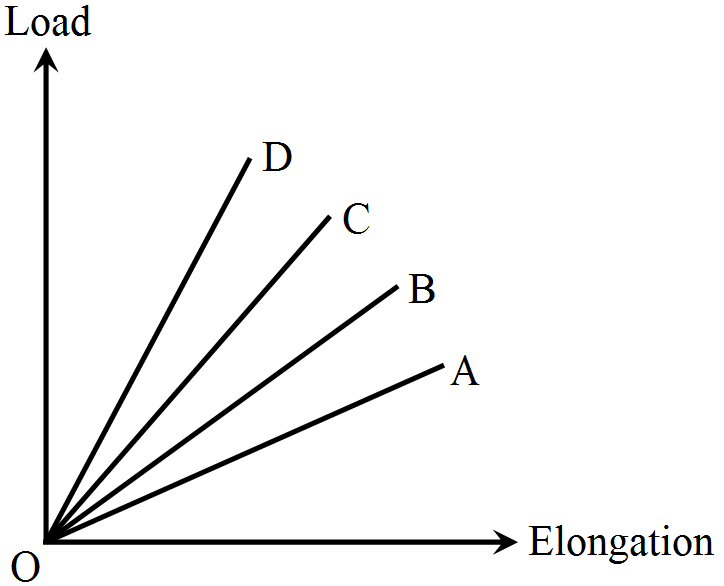
AnswerFor a thinnest wire, the elongation in the wire will be maximum for a given load, which is so corresponding to line $OA.$
View full question & answer→MCQ 51 Mark
A mild steel wire of length $2L$ and cross $-$ sectional area $A$ isstretched, well within elastic limit, horizontally between two pillars. A mass $m$ is suspended from the mid point of the wire.Strain in the wire is 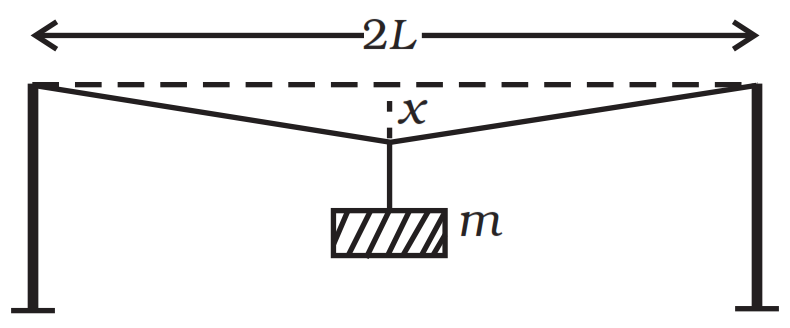
- ✓
$\frac{\text{x}^2}{2\text{L}^2}$
- B
$\frac{\text{x}}{\text{L}}$
- C
$\frac{\text{x}^2}{\text{L}}$
- D
$\frac{\text{x}^2}{\text{2L}}$
AnswerCorrect option: A. $\frac{\text{x}^2}{2\text{L}^2}$
$\Delta\text{l}=(\text{AO+BO})-\text{AB}$
$\Delta\text{L}=2\text{AO}-\text{2l}=2[\text{AO}-\text{l}]$
$=2\Big[\big(\text{l}^2+\text{x}^2\big)^{\frac{1}{2}}-1\Big]$
$=2\text{l}\Big[\Big(1+\frac{\text{x}^2}{\text{l}^2}\Big)^{\frac{1}{2}}-1\Big]$
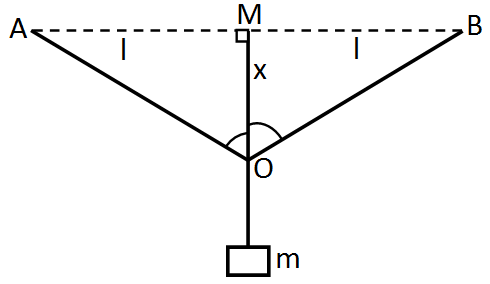
$\Delta\text{l}=2\text{l}\Big[1+\frac{\text{x}^2}{\text{2l}^2}-1\Big]$
$=2\text{l}.\frac{\text{x}^2}{2\text{l}^2}=\frac{\text{x}^2}{\text{l}}$
Strain $=\frac{\Delta\text{l}}{2\text{l}}=\frac{\frac{\text{x}^2}{\text{l}}}{\text{2l}}=\frac{\text{x}2}{2\text{l}^2}$
verifies the Option $(a).$ View full question & answer→MCQ 61 Mark
Two wires of the same material and length but diameter in the ratio $1 : 2$ are stretched by the same load. The ratio of elastic potential energy per unit volume for the two wires is:
- A
$1 : 1$
- B
$2 : 1$
- C
$4 : 1$
- ✓
$16 : 1$
AnswerCorrect option: D. $16 : 1$
View full question & answer→MCQ 71 Mark
A spring is stretched by applying a load to its free end. The strain produced in the spring is
AnswerWhen a spring is stretched by a load its shape $($shear$)$ and length changes. So strain produced is shearing and longitudinal strain.
View full question & answer→MCQ 81 Mark
The stress $-$ strain graphs for two materials are shown in $($assume same scale$).$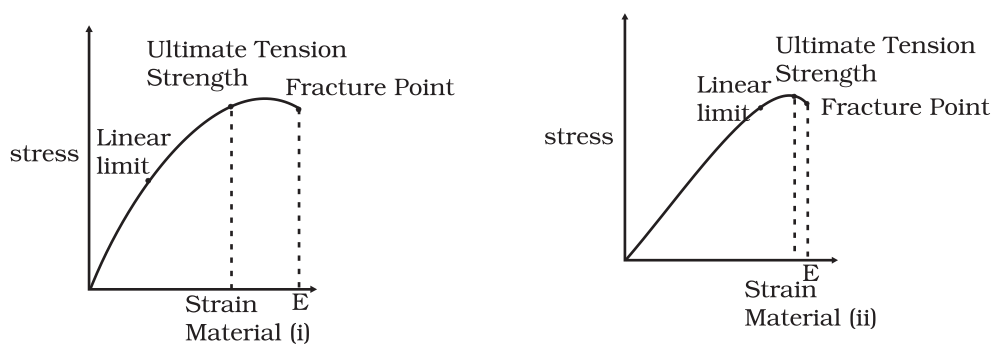
- A
Material $(ii)$ is more elastic than material $(i)$ and hence material $(ii)$ is more brittle.
- B
Material $(ii)$ is more brittle than material $(i).$
- C
Material $(ii)$ is elastic over a larger region of strain as compared to $(i).$
- ✓
$B$ and $C$
AnswerCorrect option: D. $B$ and $C$
On comparing ultimate tensile strength of the materials, $(ii)$ is greater than $(i).$
Hence, material $(ii)$ is elastic over larger region as compare to $(i)$ so the material $(ii)$ is elastic over a larger region of strain as compared to $(i) ($verifies option $b).$
As the fracture point of material $(ii)$ is nearer than $(i),$ hence the material $(ii)$ is more brittle than material $(i).$
View full question & answer→MCQ 91 Mark
Elasticity of a material can be altered by:
MCQ 101 Mark
A wire suspended vertically from one end, is stretched by attaching a weight $200N$ to the lower end. The weight stretches the wire by $1mm.$ The energy gained by the wire is:
- ✓
$0.1J$
- B
$0.2J$
- C
$0.4J$
- D
$10J$
AnswerCorrect option: A. $0.1J$
View full question & answer→MCQ 111 Mark
A wire of length $L$ and radius $r$ is rigidly fixed at one end. On stretching the other end of the wire with a force $F,$ the increase in its length is $l.$ If another wire of same material but of length $2L$ and radius $2r$ is stretched with a force of $2F,$ the increase in its length will be:
- ✓
$\text{l}$
- B
$2\text{l}$
- C
$\frac{\text{l}}{2}$
- D
$\frac{\text{l}}{4}$
AnswerCorrect option: A. $\text{l}$
View full question & answer→MCQ 121 Mark
$A$ and $B$ are two wires. The radius of $A$ is twice that of $B.$ They are stretched by the same load. Then, the stress on $B$ is:
- A
Equal to that on $A.$
- ✓
Four times that on $A.$
- C
Two times that on $A.$
- D
Half that on $A.$
AnswerCorrect option: B. Four times that on $A.$
View full question & answer→MCQ 131 Mark
A rod elongates by l when a body of mass $M$ is suspended from it. The work done is:
- A
$\text{Mgl}$
- ✓
$\frac{1}{2}\text{mgl}$
- C
$\text{2Mgl}$
- D
AnswerCorrect option: B. $\frac{1}{2}\text{mgl}$
Work done $=\frac{1}{2}\text{F}\times\Delta\text{l}=\frac{1}{2}\text{Mgl}.$
View full question & answer→MCQ 141 Mark
The maximum load a wire can withstand without breaking, when its length is reduced to half of its original length, will
Answer$\text{Breaking stress}=\frac{\text{Breaking force}}{\text{Area of cross - section}}$
Since breaking force doesn't depend on length, hence changing the cross section has no effect.
So the breaking force remain same.
View full question & answer→MCQ 151 Mark
A long spring is stretched by $2\ cm$ and its potential energy is $V.$ If the spring is stretched by $10\ cm,$ its potential energy will be:
- A
$\frac{\text{V}}{5}$
- B
$\frac{\text{V}}{25}$
- C
$5\text{V}$
- ✓
$25\text{V}$
AnswerCorrect option: D. $25\text{V}$
$P.E.$ of a stretched spring, $\text{V}=\frac{1}{2}\text{kx}^2,$
where $k$ is the spring constant,
$\therefore\text{V}=\frac{1}{2}\text{k}\times2^2$ or $\text{k}=\frac{\text{V}}{2}$
And Now, $P.E., V' =\frac{1}{2}\text{k}\times10^2$
$=\frac{1}{2}\Big(\frac{\text{V}}{2}\Big)\times100$
$=25\text{V}$
View full question & answer→MCQ 161 Mark
One end of a uniform wire of length $L$ and of weight $W$ is attached rigidly to a point in the roof and weight $W_1$ is suspended from the lower end. If $S$ is the area of cross$-$section of the wire, the stress in the wire at a height $\frac{3}{4}$ from its lower end is;
- A
$\frac{\text{W}_1}{\text{S}}$
- B
$\frac{\Big(\text{W}_1+\frac{\text{W}}{4}\Big)\text{S}}{\text{S}}$
- ✓
$\frac{\Big(\text{W}_1+\frac{3\text{W}}{4}\Big)}{\text{S}}$
- D
$\frac{(\text{W}_1+\text{W})}{\text{S}}$
AnswerCorrect option: C. $\frac{\Big(\text{W}_1+\frac{3\text{W}}{4}\Big)}{\text{S}}$
Total force acting at a point $\frac{3\text{L}}{4}$ from its lowest end $=$ Weight suspended $+$ Weight of the wire of length $\frac{3\text{L}}{4}=\Big(\text{W}_1+\frac{3\text{W}}{4}\Big).$
Hence stress,
$=\frac{\text{Force}}{\text{Area}}=\frac{\Big(\text{W}_1+\frac{3\text{W}}{4}\Big)}{\text{S}}$
View full question & answer→MCQ 171 Mark
A wire fixed at the upper end stretches by length $I$ by applying a force $F.$ The work done in stretching is:
AnswerCorrect option: D. $\frac{\text{Fl}}{2}$
Work done $=$ Average force $\times$ Extension, $=\Big(\frac{0+\text{F}}{2}\Big)\times\text{l}=\frac{1}{2}\text{Fl}$
View full question & answer→MCQ 181 Mark
The upper end of a wire of radius $4\ mm$ and length $100\ cm$ is clamped and its other end is twisted through an angle of $30^\circ .$ Then, angle of shear is:
- A
$12^\circ$
- ✓
$0.12^\circ$
- C
$1.2^\circ$
- D
$0.012^\circ$
AnswerCorrect option: B. $0.12^\circ$
View full question & answer→MCQ 191 Mark
A copper and a steel wire of the same diameter are connected end to end. A deforming force $F$ is applied to this composite wire which causes a total elongation of $1\ cm.$ The two wires will have
- A
The same stress and strain.
- ✓
The same stress but different strain.
- C
The same strain but different stress.
- D
Different strains and stress.
AnswerCorrect option: B. The same stress but different strain.
View full question & answer→MCQ 201 Mark
The length of a wire increases by $1\%$ by a load of $2\ \text{kg-wt.}$ The linear strain produced in the wire will be:
- A
$0.02$
- B
$0.001$
- ✓
$0.01$
- D
$0.002$
AnswerCorrect option: C. $0.01$
View full question & answer→MCQ 211 Mark
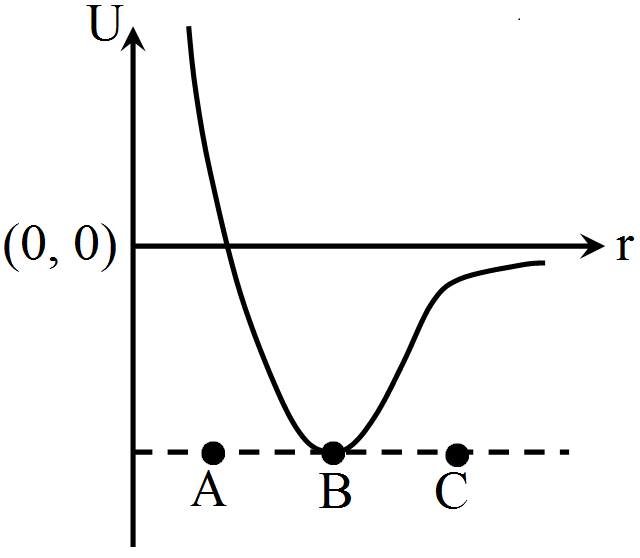
The potential energy $U$ between two molecules as a function of the distance $r$ between them has been shown in the adjoining figure. The two molecules are:
- A
Attracted when $r$ lies between $A$ and $B$ and repelled when $r$ lies between $B$ and $C.$
- ✓
Attracted when $r$ lies between $B$ and $C$ and repelled when $r$ lies between $A$ and $B.$
- C
Attracted when they reach $B.$
- D
Repelled when they reach $B.$
AnswerCorrect option: B. Attracted when $r$ lies between $B$ and $C$ and repelled when $r$ lies between $A$ and $B.$
View full question & answer→MCQ 221 Mark
A steel ring of radius $r$ and cross$-$section area $A$ is shifted on to a wooden disc of radius $R(R > r)$. If Young's modulus be $E$, then the force with which the steel ring is expanded is:
- A
$\frac{\text{AER}}{\text{T}}$
- ✓
$\frac{\text{AE}(\text{R}-\text{r})}{\text{r}}$
- C
$\frac{\text{E}(\text{R}-\text{r})}{ \text{Ar}}$
- D
$\frac{\text{Er}}{\text{AR}}$
AnswerCorrect option: B. $\frac{\text{AE}(\text{R}-\text{r})}{\text{r}}$
View full question & answer→MCQ 231 Mark
On suspending a weight $Mg,$ the length $l$ of elastic wire having area of cross$-$section $A,$ becomes double the initial length. The instantaneous stress action on the wire is:
- A
$\frac{\text{Mg}}{\text{A}}$
- B
$\frac{\text{Mg}}{2\text{A}}$
- ✓
$\frac{2\text{Mg}}{\text{A}}$
- D
$\frac{4\text{Mg}}{\text{A}}$
AnswerCorrect option: C. $\frac{2\text{Mg}}{\text{A}}$
View full question & answer→MCQ 241 Mark
The property of a body by virtue of which it tends to regain its original size and shape of a body when applied force is removed, is known as:
AnswerThe property of a body, by virtue of which it tends to regain its original size and shape when the applied force is removed, is known as elasticity and the deformation caused is known as elastic deformation.
View full question & answer→MCQ 251 Mark
A uniform bar of square cross$-$section is lying along a frictionless horizontal surface. A horizontal force is applied to pull it from one of its ends, then:
- A
The bar is under same stress throughout its length.
- B
The bar is not under any stress because force has been applied only at one end.
- C
The bar simply moves without any stress in it.
- ✓
The stress developed gradually reduces to zero at the end of the bar where no force is applied.
AnswerCorrect option: D. The stress developed gradually reduces to zero at the end of the bar where no force is applied.
View full question & answer→MCQ 261 Mark
Young's modulus of a material has the same unit as:
MCQ 271 Mark
On applying a stress of $20 \times 10^8 Nm ^{-2}$, the length of a perfectly elastic wire is doubled. Its Young's modulus will be:
- A
$40 \times 10^8Nm^{-2}$
- ✓
$20 \times 10^8Nm^{-2}$
- C
$10 \times 10^8Nm^{-2}$
- D
$5 \times 10^8Nm^{-2}$
AnswerCorrect option: B. $20 \times 10^8Nm^{-2}$
$20 \times 10^8Nm^{-2}$
View full question & answer→MCQ 281 Mark
Amaterial has Poisson's ratio $0.5.$ If a uniform rod of it suffers a longitudinal strain of $2 \times 10^{-3}$, then the percentage change in volume is:
AnswerAs, the Poisson's ratio of material is $0.5$, so there is no change in volume.
View full question & answer→MCQ 291 Mark
A wire is suspended from the ceiling and stretched under the action of a weight $F$ suspended from its other end. The force exerted by the ceiling on it is equal and opposite to the weight.
- A
Tensile stress at any cross section $A$ of the wire is $F/ A.$
- B
Tension at any cross section $A$ of the wire is $F.$
- C
Tensile stress at any cross section $A$ of the wire is $2F/ A.$
- ✓
$A$ and $B$
AnswerCorrect option: D. $A$ and $B$
Stress $=\frac{\text{F}}{\text{A}}$ verifies option $(a).$
Here, Tension is balanced by force $F.$
Hence, $T = F$ verifies option $(d).$
View full question & answer→MCQ 301 Mark
- A
Decrease of $PE$ with separation between atoms/ molecules.
- B
Increase of $PE$ with separation between atoms/ molecules.
- ✓
Asymmetric nature of $PE$ curve.
- D
AnswerCorrect option: C. Asymmetric nature of $PE$ curve.
View full question & answer→MCQ 311 Mark
A uniform cube is subjected to volume compression. If each side is decreased by $1\%$, then bulk strain is:
- A
$0.01$
- B
$0.06$
- C
$0.02$
- ✓
$0.03$
AnswerCorrect option: D. $0.03$
View full question & answer→MCQ 321 Mark
A copper and a steel wire of the same diameter are connected end to end. A deforming force $F$ is applied to this composite wire which causes a total elongation of $1\ cm.$ The two wires will have
AnswerCorrect option: D. $A$ and $B$
$\because\text{stress}=\frac{\text{F}}{\text{A}}$
$\because$ area of cross section for both wire same and stretched by same force.
So their stress are equal verifies option $(a).$
$\text{strain}=\frac{\text{stress}}{\text{Y}}$
As stress for both wires are same,
$\text{strain}_\text{steel}\propto=\frac{\text{1}}{\text{Y}_\text{steel}}$ and $\text{(strain)}_\text{Al}\propto\frac{1}{\text{Y}_\text{Al}}$
$\frac{\text{strain}_\text{steel}}{\text{(strain)}_\text{Al}}=\frac{\text{Y}_\text{Al}}{\text{Y}_\text{steel}}$
$\text{Y}_\text{Al}<\text{Ys}$ So $\frac{\text{Al}}{\text{steel}}$
or $(\text{strain})_\text{steel}<(\text{strain})_\text{Al}$
Verifies option $(d).$
View full question & answer→MCQ 331 Mark
Wire $A$ and $B$ are made from the same material $A$ has twice the diameter and three times the length of $B$. If the elastic limits are not reached, when each is stretched by the same tension, the ratio of energy stored in $A$ to that in $B$ is:
- A
$2 : 3$
- ✓
$12 : 1$
- C
$3 : 2$
- D
$6 : 1$
AnswerCorrect option: B. $12 : 1$
Given $D_A=2 D ; I_A=3 I, D_B=D, I_B=I$
$F_A=F=F_B, Y_A=Y_B=Y$
Energy stored $(E) =\frac{1}{2}\times\frac{(\text{Stress})^2}{\text{Y}}\times\text{Volume}$
$\therefore\text{E}_\text{A}=\frac{\frac{\text{F}}{\pi}(2\text{D})^2}{\text{Y}}\times\frac{\pi(2\text{D})^2}{4}\times3\text{l}$
$\text{E}_\text{B}=\frac{1}{2}\frac{\frac{\text{F}}{\pi}\text{D}^2}{\text{Y}}\times\frac{\pi\text{D}^2}{4}\times\text{l}$
$\frac{\text{E}_\text{A}}{\text{E}_\text{B}}=\frac{12}{1}$
View full question & answer→MCQ 341 Mark
A cube of aluminum of side $0.1m$ is subjected to a shearing force of $100N.$ The top face of the cube is displaced through $0.02\ cm$ with respect to the bottom face. The shearing strain would be:
- A
$0.02$
- B
$0.1$
- C
$0.005$
- ✓
$0.002$
AnswerCorrect option: D. $0.002$
View full question & answer→MCQ 351 Mark
A wire of diameter $1\ mm$ breaks under a tension of $1000N.$ Another wire of same material as that of the first one, but of diameter $2\ mm$ breaks under a tension of:
- A
$500N$
- B
$1000N$
- C
$10000N$
- ✓
$4000N$
AnswerCorrect option: D. $4000N$
View full question & answer→MCQ 361 Mark
A wire of length $L$ and cross section $A$ is make of material of Young's modulus $Y.$ It is stretched by an amount $x.$ the work done is:
- A
$\frac{\text{YxA}}{2\text{L}}$
- B
$\frac{\text{Yx}^2\text{A}}{\text{L}}$
- ✓
$\frac{\text{Yx}^2\text{A}}{2\text{L}}$
- D
$\frac{2\text{Yx}^2\text{A}}{\text{L}}$
AnswerCorrect option: C. $\frac{\text{Yx}^2\text{A}}{2\text{L}}$
Here, $\Delta\text{l}=\text{x},\text{Y}=\frac{\frac{\text{F}}{\text{A}}}{\frac{\Delta\text{l}}{\text{L}}}\ \text{or}\ \frac{\text{YA}\Delta\text{l}}{\text{L}}$
Te work in done form $0$ to $x($change in length$)$,
so the average distance, $=\frac{0+\Delta\text{l}}{2}=\frac{\Delta\text{l}}{2}$
Work done $=$ Force $\times$ Distance,
$=\frac{\text{YA}\Delta\text{l}}{\text{L}}\times\frac{\Delta\text{l}}{2}$
$=\frac{\text{YA}(\Delta\text{l})^2}{2\text{L}}$
$=\frac{\text{YAx}^2}{2\text{L}}$
View full question & answer→MCQ 371 Mark
Dimensional formula of stress is same as that of:
MCQ 381 Mark
Two rods of different materials having coefficient of thermal expansion $\alpha_1,\alpha_2$ and Young's modulus $Y_1, Y_2$, respectively are fixed between two rigid massive walls. The rods are heated such that they undergo the same increase in temperature. There is no bending of the rods. If $\alpha_1:\alpha_2=2:3,$ the thermal stresses developed in the two rods are equal provided $Y_1 : Y_2$ is equal to:
- A
$2 : 3$
- B
$1 : 1$
- ✓
$3 : 2$
- D
$4 : 9$
AnswerCorrect option: C. $3 : 2$
Expansion in rod due to rise in temperature $=$ compression in rod,
$\therefore\frac{\alpha_1}{\alpha_2}=\frac{\text{Y}_1}{\text{Y}_2}$ or $\frac{\alpha_2}{\alpha_1}=\frac{3}{2}$
View full question & answer→MCQ 391 Mark
Which of the following is not a unit of Young's modulus?
AnswerCorrect option: D. $\text{Nm}^{-1}$
View full question & answer→MCQ 401 Mark
A rectangular frame is to be suspended symmetrically by two strings of equal length on two supports. It can be done in one of the following three ways;
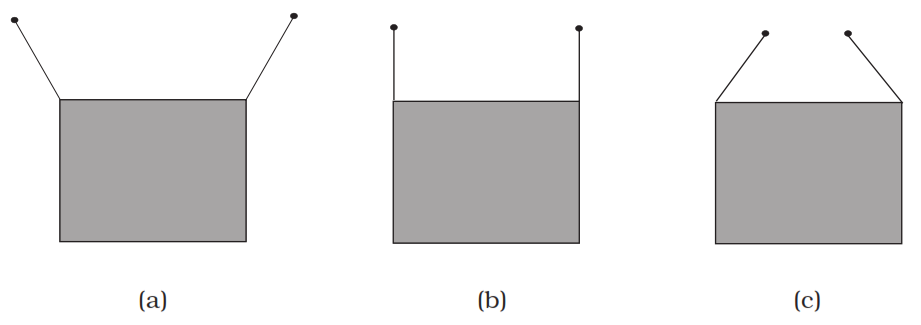
The tension in the strings will be
- A
- B
Least in $(a).$
- ✓
Least in $(b)$.
- D
Least in $(c).$
AnswerCorrect option: C. Least in $(b)$.
According to the $\text{FBD}$ diagram of the rectangular frame.
Let $M$ be the mass of rectangular frame and $0$ be the angle which the tension $T$ in the string makes with the horizontal
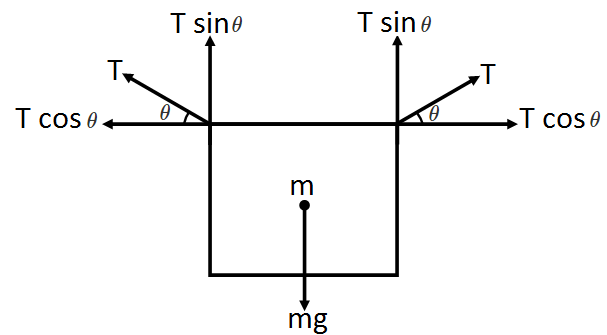
Balancing vertical forces,
$2\text{T}\sin\theta-\text{mg}=0 [T$ is tension in the string$]$
$\Rightarrow2\text{T}\sin\theta=\text{mg}$
Total horizontal force will be zero because of equal and opposite forces balance each other $(\text{T}\cos\theta).$
Now from Eq. $(i), \text{T}=\frac{\text{mg}}{2\sin\theta}$
Here, we know $mg$ is constant.
$\Rightarrow\text{T}\propto\frac{1}{\sin\theta}$
$T$ is least if $\sin\theta$ has maximum value.
$\text{T}_\text{min}=\frac{\text{mg}}{2\sin\theta_\text{max}}\text{ (since,}\sin\theta_{\text{max}}=1)$
$\sin\theta_\text{max}=1\Rightarrow\theta=90^\circ$
So the correct option is option $(c).$
Hence, tension is least for the case $(b).$ View full question & answer→MCQ 411 Mark
- A
The bulk modulus is infinite.
- B
The shear modulus is zero.
- C
The shear modulus is infinite.
- ✓
Both $A$ and $B$
AnswerCorrect option: D. Both $A$ and $B$
An ideal liquid is not compressible.
Bulk modulus $(\text{K})=\frac{-\text{p(V)}}{\Delta\text{V}} (\because\Delta\text{V=0})$
$\because\Delta\text{V=0}$ for ideal liquid.
$\therefore\text{K=}\infty$ for ideal liquid.
As there is no net tangential force on liquid $(S.T.$ is all around on a particle$)$ so shearing strain $\Delta\theta=0$ and $F=0.$
$\eta=\frac{\text{F/A}}{\Delta\theta}=\frac{0}{0}$ indeterminant value.
Hence, verifies option $(a)$ and $(b)$ and rejects option $(c).$
View full question & answer→MCQ 421 Mark
Elasticity is shown by materials because inter$-$atomic or inter$-$molecular forces:
AnswerCorrect option: D. Becomes non$-$zero when a body is deformed.
When a body is deformed, atoms/molecules are displaced from their equilibrium positions $(F = 0)$.
As a result, there is a force $(\text{F}\not=0)$ acts between them to restore their position.
View full question & answer→MCQ 431 Mark
Consider two cylindrical rods of identical dimensions, one of rubber and the other of steel. Both the rods are fixed rigidly at one end to the roof. $A$ mass $M$ is attached to each of the free ends at the centre of the rods.
- A
Both the rods will elongate but there shall be no perceptible change in shape.
- B
The steel rod will elongate and change shape but the rubber rod will only elongate.
- C
The steel rod will elongate without any perceptible change in shape, but the rubber rod will elongate and the shape of the bottom edge will change to an ellipse.
- ✓
The steel rod will elongate, without any perceptible change in shape, but the rubber rod will elongate with the shape of the bottom edge tapered to a tip at the centre.
AnswerCorrect option: D. The steel rod will elongate, without any perceptible change in shape, but the rubber rod will elongate with the shape of the bottom edge tapered to a tip at the centre.
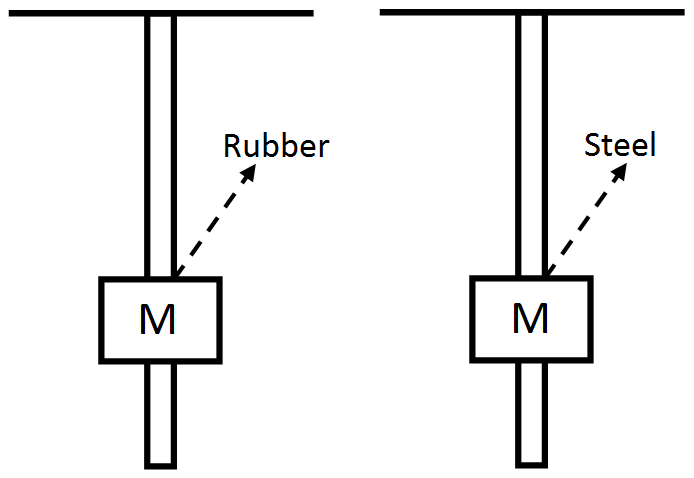
According to the diagram shown below in which a mass $AT$ is attached at the centre of each rod, then both rods will be elongated. But due to different elastic properties of material the steel rod will elongate without making any perceptible change in shape, but the rubber rod will elongate with the shape of the bottom edge tapered to a tip at the centre. View full question & answer→MCQ 441 Mark
Young's modulus of a wire depends on:
- ✓
- B
- C
Its area of cross-section.
- D
Both $(b)$ and $(c).$
View full question & answer→MCQ 451 Mark
A wire suspended vertically from one of its ends is stretched by attaching a weight of $200N$ to the lower end. The weight stretches the wire by $1\ mm.$ Then the elastic energy stored in the wire is:
- A
$0.2J$
- B
$10J$
- C
$20J$
- ✓
$0.1J$
AnswerCorrect option: D. $0.1J$
$\text{U}-=\frac{1}{2}\text{F}\times\Delta\text{l}$
$=\frac{1}{2}\times200\times10^{-3}$
$=0.1\text{J}.$
View full question & answer→MCQ 461 Mark
Bulk modulus of water is $2 × 10^9N/ m^2$. The pressure required to increase the density of water by $0.1% in N/ m^2$ is:
- A
$2 \times 10^9$
- B
$2 \times 10^8$
- ✓
$2 \times 10^6$
- D
$2 \times 10^4$
AnswerCorrect option: C. $2 \times 10^6$
$\Delta\text{p}=\text{k}\frac{\Delta\rho}{\rho}=2\times10^9\times\Big(\frac{0.1}{100}\Big)$
$=2\times10^6\text{N}/\ \text{m}^2.$
View full question & answer→MCQ 471 Mark
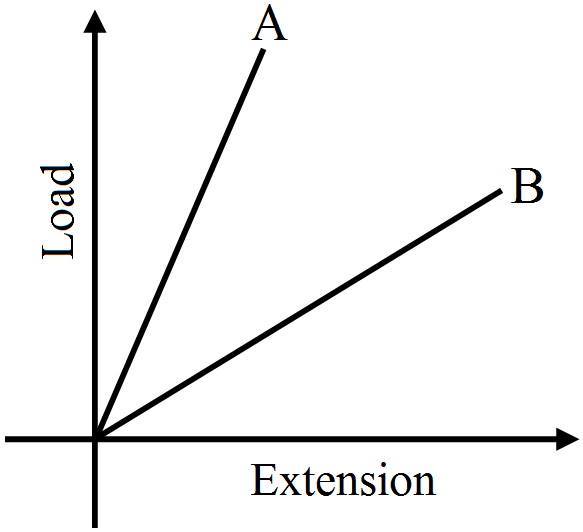
In the given figure, if the dimension of the wire are the same and materials are different, Young's modulus is more for:
MCQ 481 Mark
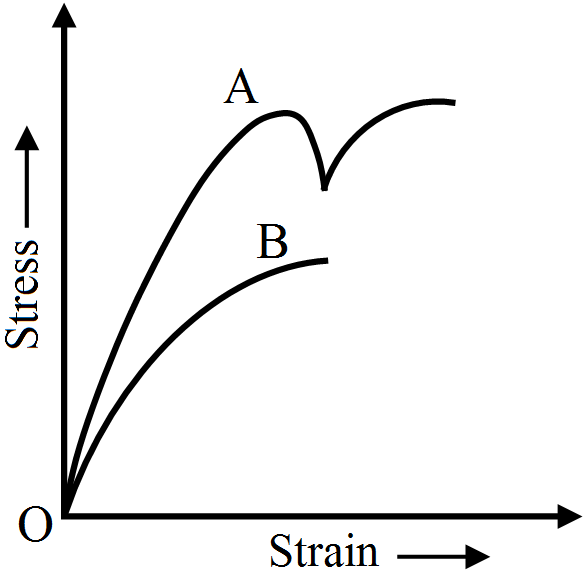
Stress-strain curves for the material $A$ and $B$ are shown below: Then,
- A
$A$ is brittle material.
- B
$B$ is ductile material.
- ✓
$B$ is brittle material.
- D
Both $(a)$ and $(b).$
AnswerCorrect option: C. $B$ is brittle material.
$B$ is brittle as there is no plastic region. However, $A$ is ductile as it has large plastic range of extension.
View full question & answer→MCQ 491 Mark
Elastic limit is equal to:
MCQ 501 Mark
Which of the following statements is incorrect?
- A
Young's modulus and shear modulus are relevant only for solids.
- B
Bulk modulus is relevant for liquids and gases.
- C
Metals have larger values of Young's modulus than elastomers.
- ✓
Alloys have larger values of Young's modulus than metals.
AnswerCorrect option: D. Alloys have larger values of Young's modulus than metals.
Metals have larger values of Young's modulus than alloy and elastomers.
View full question & answer→MCQ 511 Mark
A rigid bar of mass $M$ is supported symmetrically by three wires each of length $l.$ Those at each end are of copper and the middle one is of iron. The ratio of their diameters, if each is to have the same tension, is equal to
- A
$\text{Y}_\text{copper}/\text{Y}_\text{iron}.$
- ✓
$\sqrt{\frac{\text{Y}_\text{iron}}{\text{Y}_\text{copper}}}.$
- C
$\frac{\text{Y}^2_\text{iron}}{\text{Y}^2_\text{copper}}.$
- D
$\frac{\text{Y}_\text{iron}}{\text{Y}_\text{copper}}.$
AnswerCorrect option: B. $\sqrt{\frac{\text{Y}_\text{iron}}{\text{Y}_\text{copper}}}.$
As the bar is supported symmetrically by the three wires, therefore extension in each wire is same. Let $T$ be the tension in each wire and diameter of the wire is $D,$ then Young’s modulus is
$(\text{Y})=\frac{\text{Stress}}{\text{Strain}}=\frac{\text{F/A}}{\Delta\text{L}/\text{L}}=\frac{\text{F}}{\text{A}}\times\frac{\text{L}}{\Delta\text{L}}$
$=\frac{\text{F}}{\pi(\text{D/2})^2}\times\frac{\text{L}}{\Delta\text{L}}=\frac{4\text{FL}}{\pi\text{D}^2\Delta\text{L}}$
$\Rightarrow\ \text{D}^2=\frac{4\text{FL}}{\pi\Delta\text{LY}}\Rightarrow\ \text{D}=\sqrt{\frac{4\text{FL}}{\pi\Delta\text{LY}}}$
As $F$ and $\frac{\text{L}}{\Delta\text{L}}$ are constants.
Hence, $\text{D}\propto\sqrt{\frac{1}{\text{Y}}}$
or $\text{D}=\frac{\text{K}}{\sqrt{\text{Y}}} (K$ is the proportionality constant$)$
Now we can find ratio as $\frac{\text{D}_\text{copper}}{\text{D}_\text{iron}}=\sqrt{\frac{\text{Y}_\text{iron}}{\text{Y}_\text{copper}}}$
View full question & answer→MCQ 521 Mark
$K$ is a force constant of a spring. The work done in increasing its extension from $l_1$ to $l_2$ will be:
- A
$\text{K}(\text{l}_1-\text{l}_2)$
- B
$\frac{\text{K}(\text{l}_1+\text{l}_2)}{2}$
- C
$\text{K}\big(\text{l}^2_1+\text{l}^2_1\big)$
- ✓
$\frac{\text{K}\big(\text{l}^2_2+\text{l}^2_1\big)}{2}$
AnswerCorrect option: D. $\frac{\text{K}\big(\text{l}^2_2+\text{l}^2_1\big)}{2}$
The energy stored in the spring extension $\text{l}_1=\frac{1}{2}\text{Kl}^2_1.$
The energy stored in the spring for extension $\text{l}_2=\frac{1}{2}\text{Kl}^2_2.$
Therefore work done in increasing its extension for $\text{l}_1\ \text{l}_2=\frac{1}{2}\text{Kl}^2_2+\frac{1}{2}\text{Kl}^2_1$
View full question & answer→MCQ 531 Mark
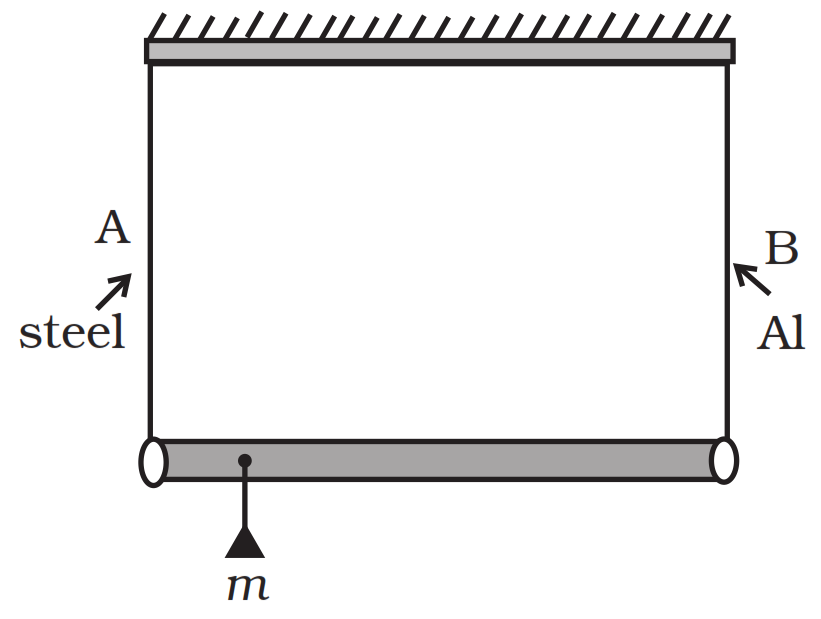
A rod of length $l$ and negligible mass is suspended at its two ends by two wires of steel $($wire $A)$ and aluminium $($wire $B)$ of equal lengths. The cross $-$ sectional areas of wires $A$ and $B$ are $1.0\ mm^2$ and $2.0\ mm^2,$ respectively. $(Y_{al} = 70 \times 10Nm^{-2}$ and $Y_{steel} = 200 \times 10^9Nm^{-2})$
- A
Mass $m$ should be suspended close to wire $A$ to have equal stresses in both the wires.
- B
Mass $m$ should be suspended close to $B$ to have equal stresses in both the wires.
- C
Mass $m$ should be suspended close to wire $A$ to have equal strain in both wires.
- ✓
Both $B$ and $C$
AnswerCorrect option: D. Both $B$ and $C$
According to the diagram a massless rod is suspended at its two ends by two wires of steel $($wire $A)$ and aluminum $($wire $B)$ of equal lengths.
Let the mass is suspended at $x$ from the end $B,$ which develop equal stress in wires.
Let $T_a$ and $T_B$ be the tensions in wire $A$ and wire $B$ respectively.
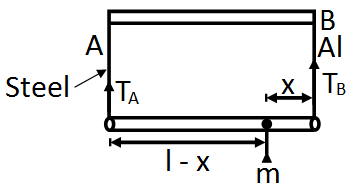
stress in steel wire $A, \text{S}_\text{A}=\frac{\text{T}_\text{A}}{\text{A}_\text{A}}=\frac{\text{T}_\text{A}}{10^{-6}}$
stress in $Al$ wire $\text{S}_\text{B}=\frac{\text{T}_\text{B}}{\text{A}_\text{B}}=\frac{\text{T}_\text{B}}{2\times10^{-6}}$
where $A_A$ and $A_B$ are cross $-$ sectional areas of wire $A$ and $B$ respectively.
Also, from rotational equilibrium, net torque is zero,
i.e. $\text{T}_\text{B}\text{x}-\text{T}_\text{A}(\text{l}-\text{x})=0$
$\Rightarrow\frac{\text{T}_\text{B}}{\text{T}_\text{A}}=\frac{\text{l}-\text{x}}{\text{x}} ...(\text{i})$
For equal stress, $S_A$ = $S_B$
$\Rightarrow\text{S}_\text{A}=\text{S}_\text{B}$
$\Rightarrow\frac{\text{T}_\text{A}}{10^{-6}}=\frac{\text{T}_\text{B}}{2\times10^{-6}}$
$\Rightarrow\frac{\text{l}-\text{x}}{\text{x}}=2$
$\Rightarrow\frac{\text{l}}{\text{x}}-1=2$
$\Rightarrow\text{x}=\frac{\text{l}}{\text{3}}$
$\Rightarrow\text{l}-\text{x}=\text{l}-\frac{\text{l}}{\text{3}}=\frac{2\text{l}}{3}$
Hence, mass $m$ should be suspended close to wire $B (Al$ wire$).$
We know, Strain $=\frac{\text{Stress}}{\text{Y}}$
So, for equal strain in the wires,
$\Rightarrow\ \frac{\text{S}_\text{A}}{\text{Y}_\text{Steel}}=\frac{\text{S}_\text{B}}{\text{Y}_\text{Al}}$
$\Rightarrow\ \frac{\text{Y}_\text{Steel}}{\text{T}_\text{A}/\text{a}_\text{A}}=\frac{\text{Y}_\text{Al}}{\text{T}_\text{B}/\text{a}_\text{B}}$
$\Rightarrow\ \frac{\text{Y}_\text{Steel}}{\text{Y}_\text{Al}}=\frac{\text{T}_\text{A}}{\text{T}_\text{B}}\times\frac{\text{a}_\text{B}}{\text{a}_\text{A}}=\Big(\frac{\text{x}}{\text{l}-\text{x}}\Big)\Big(\frac{2\text{a}_\text{A}}{\text{a}_\text{A}}\Big)$
$\Rightarrow\ \frac{200\times10^9}{70\times10^9}=\frac{\text{2x}}{\text{l}-\text{x}}$
$\Rightarrow\frac{20}{7}=\frac{\text{2x}}{\text{l}-\text{x}}$
$\Rightarrow17\text{x}=10\text{l}$
$\Rightarrow\text{x}=\frac{10\text{l}}{17}$
$\Rightarrow\text{l}-\text{x}=\text{l}-\frac{10\text{l}}{17}=\frac{7\text{l}}{17}$
Hence, mass $m$ should be suspended close to wire $A ($steel wire$).$ View full question & answer→MCQ 541 Mark
The temperature of a wire is doubled. The Young’s modulus of elasticity
AnswerKey concept: Youngs modulus $(Y).$
It is defined as the ratio of normal stress to longitudinal strain within limit of proportionality.
$\text{Y}=\frac{\text{Normal stress}}{\text{Longitudinal strain}}=\frac{\text{F/A}}{\Delta\text{L/L}}=\frac{\text{FL}}{\text{A}\Delta\text{L}}$
The fractional change in length of any material is defined as
$\frac{\Delta\text{L}}{\text{L}_0}=\alpha\Delta\text{T}$
where $\Delta T$ is change in the temperature, $L_o$ is original length, $\alpha$ is the coefficient of linear expansion of the given material and $L_o$ is the original length of material.
So, simply change in length is due to change in temperature.
$\Delta\text{A}=\text{L}_0\alpha\Delta\text{T}$
And Young's modulus
$(\text{Y})=\frac{\text{Stress}}{\text{Strain}}=\frac{\text{FL}_0}{\text{A}\times\Delta\text{L}}=\frac{\text{FL}_0}{\text{AL}_0\alpha\Delta\text{T}}\propto\frac{1}{\Delta\text{T}}$
As $\text{Y}\propto\frac{1}{\Delta\text{T}}$
View full question & answer→MCQ 551 Mark
When an elastic material with Young's modulus $Y$ is subjected to stretching stress $S,$ the elastic energy stored per unit volume of the material is:
AnswerCorrect option: C. $\frac{\text{S}^2}{2\text{Y}}$
Elastic energy per unit volume,
$\text{u}=\frac{1}{2}\times\text{Stress}\times\text{Strain}$
$=\frac{1}{2}\times\text{Stress}\times\frac{\text{Stress}}{\text{Young modulus}}$
$=\frac{1}{2}\text{S}\times\frac{\text{S}}{\text{Y}}$
$=\frac{\text{S}^2}{2\text{y}}$
View full question & answer→MCQ 561 Mark
In solids, inter$-$atomic forces are:
AnswerCorrect option: C. Combination of $(a)$ and $(b).$
View full question & answer→MCQ 571 Mark
A wire of length $2m$ is made from $10\ cm^3$ of copper. A force $F$ is applied so that its length increases by $2\ mm.$ Another wire of length $8m$ is made from the same volume of copper. If the force $F$ is applied to it, its length will increase by:
- A
$0.8\ cm$
- B
$1.6\ cm$
- C
$2.4\ cm$
- ✓
$3.2\ cm$
AnswerCorrect option: D. $3.2\ cm$
View full question & answer→MCQ 581 Mark
Rigidity modulus of steel is $n$ and its Young's modulus is $Y.$ A piece of steel of cross$-$sectional area a is stretched into a wire of length $L$ are $\frac{\text{a}}{10}.$ Then:
- A
$Y$ increases and $\eta$ decreases.
- ✓
$Y$ and $\eta$ remain the same.
- C
$Y$ decreases and $\eta$ increases.
- D
Both $Y$ and $\eta$ increases.
AnswerCorrect option: B. $Y$ and $\eta$ remain the same.
Modulus of rigidity and Young's Modulus of elasticity are constants for a given material.
View full question & answer→MCQ 591 Mark
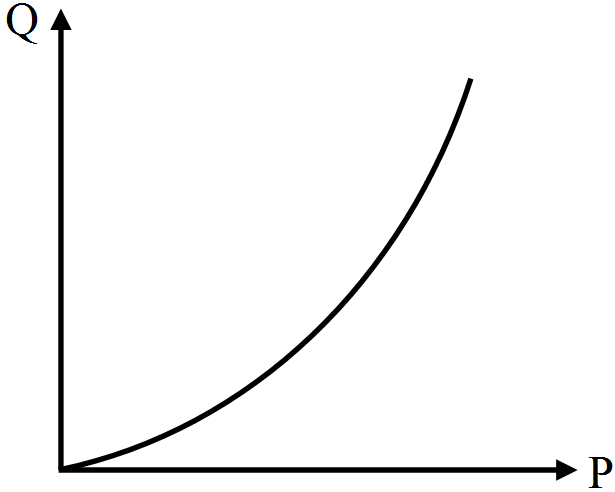
The graph shows the behavior of a length of wire in the region for which the substance obeys Hooke's law. $P$ and $Q$ represent.
- A
$P =$ applied force, $Q =$ extension.
- B
$P =$ extension, $Q =$ applied force.
- ✓
$P =$ extension, $Q =$ stored elastic energy.
- D
$P =$ stored elastic energy, $Q =$ extension.
AnswerCorrect option: C. $P =$ extension, $Q =$ stored elastic energy.
The graph between applied force and extension will be straight line because in elastic range,
Applied force $\propto$ extension,
But the graph between extension and stored elastic energy will be parabolic in nature.
As, $\text{U}=\frac{1}{2}\text{kx}^2$ or $\text{U}\propto\text{x}^2.$
View full question & answer→MCQ 601 Mark
The upper end of a wire of radius $4\ mm$ and length $100\ cm$ is clamped and its other end is twisted through an angle of $30^\circ .$ The angle of shear is:
- A
$12^\circ$
- B
$1.2^\circ$
- ✓
$0.12^\circ$
- D
$0.012^\circ$
AnswerCorrect option: C. $0.12^\circ$
Angle of twist at free end,
$=30^\circ=\frac{30}{180}\times\pi\text{ rad}=\frac{\pi}{6}\text{rad}$
Displacement of the free surface,
$\Delta\text{L}=\frac{2\not=\text{r}}{2\not=}\times\frac{\not=}{6}=\frac{\pi\text{r}}{6}=\frac{\pi\times0.4}{6}\text{cm}$
Angle of shear or shearing strain $=\frac{\Delta\text{L}}{\text{L}}$
$=\frac{\pi\times\frac{0.4}{6}}{100}\text{rad}$
$=\frac{\not=\times0.4}{6\times100}\times\frac{180}{\not=}\text{ degree}=0.12^\circ$
View full question & answer→MCQ 611 Mark
A spring of force constant $k$ is cut into two equal parts. The force constant of each part is:
- A
$\frac{\text{k}}{2}$
- B
$k$
- ✓
$2k$
- D
$4k$
View full question & answer→MCQ 621 Mark
When a pressure of $100$ atmosphere is applied on a spherical ball of rubber, then its volume reduces to $0.01\%.$ The bulk modulus of the material of the rubber in dyne $cm^{-2}$ is:
- A
$10 \times 10^{12}$
- B
$100 \times 10^{12}$
- ✓
$1 \times 10^{12}$
- D
$20 \times 10^{12}$
AnswerCorrect option: C. $1 \times 10^{12}$
$1\text{atm}=10^5\text{Nm}^{-2}$
$\therefore100\text{atm}=10^7\text{Nm}^{-2}$ and $\Delta\text{V}=0.01\%\text{V}$
$\therefore\frac{\Delta\text{V}}{\text{V}}=0.0001$
$\text{B}=\frac{\text{P}}{\frac{\Delta\text{V}}{\text{V}}}=1\times10^{11}\text{Nm}^{-2}$
$=1\times10^{12}\frac{\text{dune}}{\text{cm}^2}$
View full question & answer→MCQ 631 Mark
In steel, the Young's modulus and the strain at the breaking point are $2 \times 10^{11}\ Nm^{-2}$ and $0.15,$ respectively. The stress at the breaking point for steel is therefore:
- A
$1.33 \times 10^{11}Nm^{-2}$
- B
$1.33 \times 10^{12}Nm^{-2}$
- C
$7.5 \times 10^{-13}Nm^{-2}$
- ✓
$3 \times 10^{10}Nm^{-2}$
AnswerCorrect option: D. $3 \times 10^{10}Nm^{-2}$
View full question & answer→MCQ 641 Mark
The nature of molecular forces resembles with the nature of the:
MCQ 651 Mark
A steel rod of length $1m$ and radius $10mm$ is stretched by a force $100kN$ along its length. The stress produced in the rod is $Y_{steel} = 2 \times 10^{11}Nm^{-2}$.
- A
$3.18 \times 10^6 \mathrm{Nm}^{-2}$
- B
$3.18 \times 10^7 \mathrm{Nm}^{-2}$
- ✓
$3.18 \times 10^8 \mathrm{Nm}^{-2}$
- D
$3.18 \times 10^9 \mathrm{Nm}^{-2}$
AnswerCorrect option: C. $3.18 \times 10^8 \mathrm{Nm}^{-2}$
View full question & answer→