Questions

Case study (4 Marks)

Take a timed test

9 questions · self-marked practice — reveal the answer and mark yourself.

Question 14 Marks
Read the passage given below and answer the following questions from 1 to 5.Following are properties of vectors
a) Two vectors A and B are said to be equal if, and only if, they have the same magnitude and the same direction.
b) Multiplying a vector A with a positive number λ gives a vector whose magnitude is changed by the factor λ but the direction is the same as that of A:
$|\ \lambda\text{ A }|=\lambda\text{ A }|$
c) The null vector also results when we multiply a vector A by the number zero. Properties of 0 are
A + 0 = A
λ 0 = 0
0 A = 0
d) Subtraction of vectors can be defined in terms of addition of vectors. We define the difference of two vectors A and B as the sum of two vectors A and –B :
A – B = A + (–B).
  1. Two vectors A and B are said to be equal if:
  1. they have the same magnitude
  2. they have the same direction
  3. they have the same magnitude and the same direction
  4. None of these
  1. Multiplying a vector A with a positive number will impact:
  1. Change in magnitude
  2. Change in direction
  3. Change in both magnitude and the same direction
  4. None of these
  1. What is null vector?
  1. How we can perform subtraction of two vectors?
  1. Enlist any 4 properties of vectors.
Answer
  1. (c) they have the same magnitude and the same direction
  2. (a) Change in magnitude
  3. Null vector is defined as the vector having zero magnitude and any direction. Consider two vectors A and –A. Their sum is A + (–A). Since the magnitudes of the two vectors are the same, but the directions are opposite, the resultant vector has zero magnitude and is represented by 0 called a null vector or a zero vector. . Properties of 0 are
A + 0 = A
λ 0 = 0
  1. Subtraction of vectors can be defined in terms of addition of vectors. We define the difference of two vectors A and B as the sum of two vectors A and –B:
A – B = A + (–B)
  1. Following are properties of vectors
a) Two vectors A and B are said to be equal if, and only if, they have the same magnitude and the same direction.
b) Multiplying a vector A with a positive number λ gives a vector whose magnitude is changed by the factor λ but the direction is the same as that of A :
$|\ \lambda\text{ A }|=\lambda\text{ A }|$
c) The null vector also results when we multiply a vector A by the number zero. Properties of 0 are
A + 0 = A
λ 0 = 0
0 A = 0
d) Subtraction of vectors can be defined in terms of addition of vectors. We define the difference of two vectors A and B as the sum of two vectors A and –B :
A – B = A + (–B)
View full question & answer
Question 24 Marks
Read the passage given below and answer the following questions from (i) to (v). When an object follows a circular path at a constant speed, the motion of the object is called uniform circular motion. The word
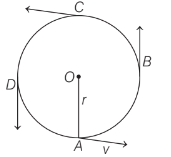
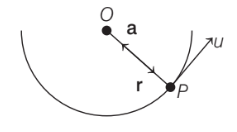
uniform refers to the speed which is uniform (constant) throughout the motion. Although the speed does not vary, the particle is accelerating because the velocity changes its direction at every point on the circular track. The figure shows a particle P which moves along a circular track of radius r with a uniform speedu.
  1. A circular motion:
  1. Is one-dimensional motion.
  2. Is two-dimensional motion.
  3. It is represented by combination of two variable vectors.
  4. Both (b) and (c)
  1. For a particle performing uniform circular motion, choose the incorrect statement from the following.
  1. Magnitude of particle velocity (speed) remains constant.
  2. Particle velocity remains directed perpendicular to radius vector.
  3. Direction of acceleration keeps changing as particle moves.
  4. Angular momentum is constant in magnitude but direction keeps changing.
  1. Two cars A and B move along a concentric circular path of radius $r_A$ and $r_B$ with velocities $v_A$ and $v_B$ maintaining constant distance, then $\frac{\text{v}_{\text{A}}}{\text{v}_\text{B}}$ is equal to:
  1. $\frac{\text{r}_{\text{B}}}{\text{r}_\text{A}}$
  2. $\frac{\text{r}_{\text{A}}}{\text{r}_\text{B}}$
  3. $\frac{\text{r}_{\text{A}}^2}{\text{r}_\text{B}^2}$
  4. $\frac{\text{r}_{\text{B}}^2}{\text{r}_\text{A}^2}$
  1. A car runs at a constant speed on a circular track of radius 100m, taking 62.8s for every circular lap. The average velocity and average speed for each circular lap, respectively is:
  1. $0,0$
  2. $0,10ms^{-1}$
  3. $10ms^{-1}, 10ms^{-1}$
  4. $10ms^{-1}, 0$
  1. A particle is revolving at 1200 rpm in acircle of radius 30cm. Then, its acceleration is:
  1. $1600ms^{-2}$
  2. $4740ms^{-2}$
  3. $2370ms^{-2}$
  4. $5055ms^{-2}$
Answer
  1. (d) Both (b) and (c)
Explanation:
Circular motion is an example of two-dimensional motion with radius vector as
$\text{r}=\text{a}\cos\omega\text{t}\hat{\text{i}}+\text{a}\sin\omega\text{t}\hat{\text{j}}$
Both the components $\text{r}=\text{a}\cos\omega\text{t}\hat{\text{i}}$ and $\text{a}\sin\omega\text{t}\hat{\text{j}}$ are perpendicular to each other.
  1. (c) Direction of acceleration keeps changing as particle moves.
Explanation:
If a particle is performing uniform circular motion, then its
  1. Speed will be constant throughout the motion.
  2. Velocity will be tangential in the direction of motion at a particular point.
  1. Acceleration, $\text{a}=\frac{\text{v}^2}{\text{r}}$ will always be towards centre of the circular path.
  2. Angular momentum (mvr) is constant in magnitude but direction keeps on changing.
  1. (b) $\frac{\text{r}_{\text{A}}}{\text{r}_\text{B}}$
Explanation:
Angular velocity $\omega$ is constant.
$\text{v}=\text{r}\omega$
$\therefore\text{v}\propto\text{r}$ or $\frac{\text{v}_\text{A}}{\text{v}_\text{B}}=\frac{\text{r}_{\text{A}}}{\text{r}_{\text{B}}}$
  1. (b) $0,10ms^{-1}$
Explanation:
On a circular path in completing one turn,the distance travelled is $2\pi\text{r},$ while displacement
is zero. Hence, average velocity
$=\frac{\text{displacement}}{\text{time interval}}=\frac{0}{\text{t}}=0$
Average speed $=\frac{\text{Distance}}{\text{Time interval}}$
$=\frac{2\pi\text{r}}{\text{t}}=\frac{2\times3.14\times100}{62.8}=10\text{ms}^{-1}$
  1. (b) $4740ms^{-2}$
Explanation:
Given, V = 1200 rpm $\frac{1200}{60}\text{rps}$
$\text{r}=30\text{cm}=\frac{30}{100}\text{m}$
Acceleration of the particle = Centripetal acceleration
$=\omega^2\text{r}=(2\pi\text{v})^2\text{r}$
$=\Big(2\times\frac{22}{7}\times\frac{1200}{60}\Big)^2\times\frac{30}{100}\approx4740\text{ms}^{-2}$
View full question & answer
Question 34 Marks
Read the passage given below and answer the following questions from 1 to 5. If A is vector given by $A = Ax\ i + Ay\j$ where The quantities $A_x$ and $A_y$ are called x, and y- components of the vector A. Note that Ax is itself not a vector, but $A_x$ i is a vector, and so is $A_y\ j$. Using simple trigonometry, we can express $A_x$ and $A_y$ in terms of the magnitude of A and the angle \theta it makes with the x-axis. $\text{Ax} = \text{A} \cos(\theta)$
$\text{Ay} = \text{A} \text{ \sin}(\theta)$ If A and $\theta$ are given, Ax and Ay can be obtained using If Ax and Ay are given, A and $\theta$ can be obtained as follows – $\text{A}^2_\text{x}+\text{A}^2_\text{y}=(\text{A}\cos\theta)^2+(\text{A}\sin\theta)^2$ $\text{A}^2_\text{x}+\text{A}^2_\text{y}=\text{A}^2\cos^2\theta+\text{A}^2\sin^2\theta$ $\Rightarrow\text{A}^2_\text{x}+\text{A}^2_\text{y}=\text{A}^2(\cos^2\theta+\sin^2\theta)$ ${A}^2_\text{x}+\text{A}^2_\text{y}=\text{A}^2(\because\sin^2\theta+\cos^2\theta=1)$ $\text{A}^2=\text{A}^2_\text{y}+\text{A}^2_\text{y}$ $\Rightarrow\text{A}=\sqrt{\text{A}^2_\text{x}+\text{A}^2_\text{y }}...$ $\text{Dividing}\text{ A}_\text{y}\text{ by} \text{ A}_\text{y},\text{we get}$ $\frac{\text{A}_\text{y}}{\text{A}_\text{x}}=\frac{\text{A}\sin\theta}{\text{A}\cos\theta}$ $\Rightarrow\frac{\text{A}_\text{y}}{\text{A}_\text{x}}=\tan\theta$ $\tan\theta=\frac{\text{A}_\text{y}}{\text{A}_\text{x}}$ $\theta=\tan^{-1}\Big[\frac{\text{A}_\text{y}}{\text{A}_\text{x}}\Big]$
Position vector-The position vector r of a particle P located in a plane with reference to the origin of an x-y reference frame is given by $r = x i + y j$ where x and y are components of r along x-, and y- axes or simply they are the coordinates of the object. Suppose a particle moves along the Then, the displacement is: $\triangle r = r_2-r_1.$ We can write this in a component form: $\triangle r = (x’ i + y’ j) – ( x i + y j) = i\triangle x – j\triangle y$ Where $\triangle x = x’ – x, \triangle y = y – y.$
The average velocity (v) of an object is the ratio of the displacement and the corresponding time Interval. $\text{V}=\frac{\triangle\text{r}}{\triangle\text{t}}$
$=\frac{\text{i}\triangle\text{x}-\text{j}\triangle\text{y}}{\triangle\text{t}}$
$=\text{i}\times\frac{\triangle\text{x}}{\triangle\text{t}}+\text{j}\times\frac{\triangle\text{y}}{\triangle\text{t}}$
$=\text{V}_\text{x}\text{i}+\text{V}_\text{y}\text{j}$ So, if the expressions for the coordinates x and y are known as functions of time, we can use these equations to find vx and vy. The magnitude of v is then $V = ( v_x^2+ v_y^2)$ and the direction of v is given by the angle q and given by $\tan(\theta)=\frac{\text{vx}}{\text{vy}}$
  1. If A is vector given by A = Ax i + Ay j .if the magnitude of vector is A and the angle $\theta$ it makes with the x-axis Ax can be given by:
  1. Ax = A cos(q)
  2. Ax = A sin(q)
  3. Ax = A tan(q)
  4. None of the above
  1. If A is vector given by A = Ax i + Ay j .if the magnitude of vector is A and the angle $\theta$ it makes with the x-axis Ay can be given by:
  1. Ax = A cos(q)
  2. Ax = A sin(q)
  3. Ax = A tan(q)
  4. None of the above
  1. Write a note on position vector and displacement of object:
  1. Write a note on average velocity:
  1. If A is vector given by A = Ax i + Ay j where obtain expression for resultant amplitude of vector and its angle with x axis:
Answer
  1. (a) Ax = A cos(q)
  2. (b) Ax = A sin(q)
  3. Position vector- The position vector r of a particle P located in a plane with reference to the origin of an x-y reference frame is given by r = x i + y j where x and y are components of r along x-, and y- axes. The displacement is: $\triangle r = r_2-r_1.$ We can write this in a component form:
$\triangle r = (x’ i + y’ j) – ( x i + y j)$
$= i\triangle x – j\triangle y$
Where $Δx = x’ – x, \triangle y = y – y . $
  1. The average velocity (v) of an object is the ratio of the displacement and the corresponding time Interval.
$\text{V}=\frac{\triangle\text{r}}{\triangle\text{t}}$
$=\frac{\text{i}\triangle\text{x}-\text{j}\triangle\text{y}}{\triangle\text{t}}$
$=\text{i}\times\frac{\triangle\text{x}}{\triangle\text{t}}+\text{j}\times\frac{\triangle\text{y}}{\triangle\text{t}}$
$=\text{V}_\text{x}\text{i}+\text{V}_\text{y}\text{j}$
  1. If A and $\theta$ are given, Ax and Ay can be obtained using If Ax and Ay are given, A and $\theta$ can be obtained as follows
$\text{A}^2_\text{x}+\text{A}^2_\text{y}=(\text{A}\cos\theta)^2+(\text{A}\sin\theta)^2$
$\text{A}^2_\text{x}+\text{A}^2_\text{y}=\text{A}^2\cos^2\theta+\text{A}^2\sin^2\theta$
$\Rightarrow\text{A}^2_\text{x}+\text{A}^2_\text{y}=\text{A}^2(\cos^2\theta+\sin^2\theta)$
${A}^2_\text{x}+\text{A}^2_\text{y}=\text{A}^2(\because\sin^2\theta+\cos^2\theta=1)$
$\text{A}^2=\text{A}^2_\text{y}+\text{A}^2_\text{y}$
$\Rightarrow\text{A}=\sqrt{\text{A}^2_\text{x}+\text{A}^2_\text{y }}...$
$\text{Dividing}\text{ A}_\text{y}\text{ by} \text{ A}_\text{y},\text{we get}$
$\frac{\text{A}_\text{y}}{\text{A}_\text{x}}=\frac{\text{A}\sin\theta}{\text{A}\cos\theta}$
$\Rightarrow\frac{\text{A}_\text{y}}{\text{A}_\text{x}}=\tan\theta$
$\tan\theta=\frac{\text{A}_\text{y}}{\text{A}_\text{x}}$
$\theta=\tan^{-1}\Big[\frac{\text{A}_\text{y}}{\text{A}_\text{x}}\Big]$
View full question & answer
Question 44 Marks
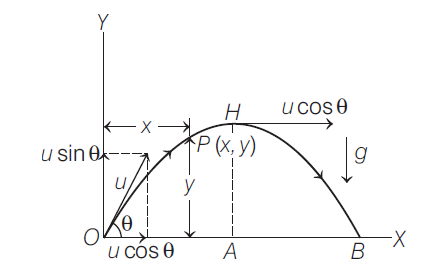
Read the passage given below and answer the following questions from 1 to 5. Projectile motion is a form of motion in which an object or particle is thrown with some initial velocity near the earth’s surface and it moves along a curved path under the action of gravity alone. The path followed by a projectile is called its trajectory, which is shown below. When a projectile is projected obliquely, then its trajectory is as shown in the figure below. Here velocity u is resolved into two components, we get (a) u cosθ along OX and (b) u sinθ along OY.
  1. The example of such type of motion is:
  1. Motion of car on a banked road.
  2. Motion of boat in sea.
  3. A javelin thrown by an athlete.
  4. Motion of ball thrown vertically upward.
  1. The acceleration of the object in horizontal direction is:
  1. Constant
  2. Decreasing
  3. Increasing
  4. Zero
  1. The vertical component of velocity at point H is:
  1. Maximum
  2. Zero
  3. Double to that at O
  4. Equal to horizontal component
  1. A cricket ball is thrown at a speed of 28m/s in a direction 30° with the horizontal. The time taken by the ball to return to the same level will be:
  1. 2.0s
  2. 3.0s
  3. 4.0s
  4. 2.9s
  1. In above case, the distance from the thrower to the point where the ball returns to the same level will be:
  1. 39m
  2. 69m
  3. 68m
  4. 72m
Answer
  1. (c) Motion of car on a banked road.
  1. (d) Zero
  1. (b) Zero
  1. (d)2.9s
  1. (b) 69m
View full question & answer
Question 54 Marks
Read the passage given below and answer the following questions from (i) to (v). Relative Velocity Every motion is relative as it has to be observed with respect to an observer. Relative velocity is a measurement of velocity of an object with respect to other observer. It is defined as the time rate of change of relative position of one object with respect to another. For example, if rain is falling vertically with a velocity v, and a man is moving horizontally with $v_m$, the man can protect himself from the rain if he holds his umbrella in the direction of relative velocity of rain w.r.t. man.
  1. Two bodies are held separated by 9.8m vertically one above the other. They are released simultaneously to fall freely under gravity. After 2s, the relative distance between them is:
  1. 4.9m
  2. 19.6m
  3. 9.8m
  4. 39.2m
  1. If two objects P andQ move along parallel straight lines in opposite direction with velocities $v_P$ and $v_Q$ respectively, then relative velocity of P w.r.t.Q,
  1. $v_{PQ} = v_P = v_0$
  2. $v_P - v_0$
  3. $v_P + v_0$
  4. $v_0 - v_p$
  1. A train is moving towards East and a car is along North, both with same speed. The observed direction of car to the passenger in the train is:
  1. East - North direction
  2. West - North direction
  3. South - East direction
  4. None of the above
  1. Buses A and B are moving in the same direction with velocities $20\hat{\text{i}}\text{ms}^{-1}$ and $15\hat{\text{i}}\text{ms}^{-1},$ respectively. Then, relative velocity of A w.r.t. B is:
  1. $35\hat{\text{i}}\text{ms}^{-1}$
  2. $5\hat{\text{i}}\text{ms}^{-1}$
  3. $5\hat{\text{j}}\text{ms}^{-1}$
  4. $35\hat{\text{j}}\text{ms}^{-1}$
  1. A girl riding a bicycle with a speed of $5\ ms\ -1$ towards east direction sees raindrops falling vertically downwards. On increasing the speed to $15ms^{-1},$ rain appears to fall making an angle of $45^\circ$ of the vertical. Find the magnitude of velocity of rain.
  1. $5\text{ms}^{-1}$
  2. $5\sqrt5\text{ms}^{-1}$
  3. $25\text{ms}^{-1}$
  4. $10\text{ms}^{-1}$
Answer
  1. (c) 9.8m
Explanation:
Since, they are following freely, so both the bodies will fall same distance in same time
interval.
So, the relative separation between them will remain unchanged.
  1. (c) $v_P + v_0$
Explanation:
Relative velocity of P w.r.t. Q is given by
$v_{PQ} = v_p - (-v_Q) = v_p + v_Q$
  1. (b) West - North direction
Explanation:
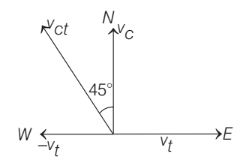
Velocity of car w.r.t. train, $v_d = v_c - v_t$
$\Rightarrow va = vc + (-v_t)$

Velocity of car w.r.t. train $(v_d) $ ct is towards West-North.
  1. (b) $5\hat{\text{i}}\text{ms}^{-1}$
Explanation:
Given, $\text{v}_{\text{A}}=20\hat{\text{i}}\text{ms}^{-1}$
$\text{v}_{\text{B}}=15\hat{\text{i}}\text{ms}^{-1}$
Relative velocity of A w.r.t. B,
$\text{v}_{\text{AB}}=\text{v}_\text{A}-\text{v}_\text{B}=20\hat{\text{i}}-15\hat{\text{i}}=5\hat{\text{i}}\text{ms}^{-1}$
  1. (b) $5\sqrt5\text{ms}^{-1}$
Explanation:
Given, velocity of girl, $\text{v}_{\text{g}}=5\hat{\text{i}}\text{ms}^{-1}$
Let velocity of rain, $\text{v}_{\text{r}}=\text{v}_{\text{x}}\hat{\text{i}}+\text{v}_{\text{y}}\hat{\text{j}}\text{ms}^{-1}$
Relative velocity of rain
$=\text{v}_{\text{r}}-\text{v}_{\text{g}}=(\text{v}_{\text{x}}-5)\hat{\text{i}}+\text{v}_{\text{y}}\hat{\text{j}}$
Now, it is vertical, so
$\tan\theta=\frac{\text{v}_{\text{x}}-5}{\text{v}_{\text{y}}}=0$
$\Rightarrow v_x - 5 = 0$
$\Rightarrow v_x = 5 ....(i)$
On increasing the speed of the girl, relative velocity becomes
$(\text{v}_{\text{x}}-5)\hat{\text{i}}+\text{v}_{\text{y}}\hat{\text{j}}$
$\tan\theta=\tan45^\circ=\frac{\text{v}_{\text{x}}-15}{\text{v}_{\text{y}}}=1$
$\Rightarrow v_x - 15 = v_y$
$\Rightarrow v_y = -10 [$using Eq. $(i)]$
$\therefore\text{Velocity of rain}=(5\hat{\text{i}}-10\hat{\text{j}})\text{ms}^{-1}$
⇒ Magnitude of velocity of rain
$=\sqrt{(5)^2+(10)^2}$
$=\sqrt{125}=5\sqrt{5}\text{ms}^{-1}$
View full question & answer
Question 64 Marks
Read the passage given below and answer the following questions from 1 to 5.In physics, we can classify quantities as scalars or vectors. Basically, the difference is that a direction is associated with a vector but not with a scalar. A scalar quantity is a quantity with magnitude only. It is specified completely by a single number, along with the proper unit. Examples are: the distance between two points, mass of an object, the temperature of a body and the time at which a certain event happened. The rules for combining scalars are the rules of ordinary algebra. Scalars can be added, subtracted, multiplied and divided just as the ordinary numbers. A vector quantity is a quantity that has both a magnitude and a direction and obeys the triangle law of addition or equivalently the parallelogram law of addition. So, a vector is specified by giving its magnitude by a number and its direction. Some physical quantities that are represented by vectors are displacement, velocity, acceleration and force. Answer the following
  1. Force is example of:
  1. Scalar
  2. Vector
  3. Tensor
  4. None of these
  1. Mass of an object is:
  1. Scalar
  2. Vector
  3. Tensor
  4. None of these
  1. Define scalar quantity and vector quantity
  1. Can we add vectors like ordinary algebra? If not then how vectors are added?
  1. Differentiate between scalar and vectors
Answer
  1. (b) Vector
  2. (a) Scalar
  3. A scalar quantity is a quantity with magnitude only. It is specified completely by a single number, along with the proper unit are: the distance between two points, mass of an object, the temperature of a body and the time at which a certain event happened.
  4. No. We can’t add vectors like ordinary algebra rules. Then question naturally arises that how can we add them so we can add then with the help of triangle law of vector addition and parallelogram law of vector addition.
  5. Difference between scalar and vector is given below
Sr No
Scalar quantity
Vector quantity
1
A scalar quantity has only magnitude, but no direction.
Vector quantity has both magnitude and direction.
2
It changes with the change in their magnitude
It changes with the change in their direction or magnitude or both.
3
Every scalar quantity is one-dimensional.
Vector quantity can be one, two or three-dimensional.
4
Scalar quantity cannot be resolved as it has exactly the same value regardless of direction.
Vector quantity can be resolved in any direction using the sine or cosine of the adjacent angle.
5
Examples are; between two points, mass of an object
 
View full question & answer
Question 74 Marks
Read the passage given below and answer the following questions from (i) to (v). Vectors
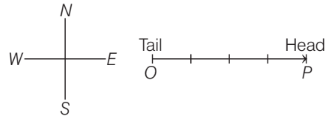
Vectors are the physical quantities which have both magnitudes and directions and obey the triangle/parallelogram laws of addition and subtraction. It is specified by giving its magnitude by a number and its direction. e.g. Displacement, acceleration, velocity, momentum, force, etc. A vector is represented by a bold face type and also by an arrow placed over a letter, i.e. F, a, b or $\overrightarrow{\text{F}},\overrightarrow{\text{a}},\overrightarrow{\text{b}}.$ The length of the line gives the magnitude and the arrowhead gives the direction. The point P is called head or terminal point and pointO is called tail or initial point of the vector OP.
  1. Amongst the following quantities, which is not a vector quantity?
  1. Force
  2. Acceleration
  3. Temperature
  4. Velocity
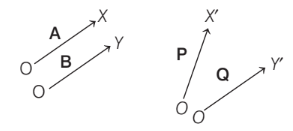
  1. Set of vectors A and B, P and Q are as shown below

Length of A and B is equal, similarly length of P and Q is equal. Then, the vectors which are equal, are:
  1. A and P
  2. P and Q
  3. A and B
  4. B and Q
  1. $\mid\lambda\text{A}\mid=\lambda\mid\text{A}\mid,$ if:
  1. $\lambda>0$
  2. $\lambda,<0$
  3. $\lambda,=0$
  4. $\lambda,\neq0$
  1. Among the following properties regarding null vector which is incorrect?
  1. A + 0 = A
  2. $\lambda0=\lambda$
  3. 0A = 0
  4. A - A = 0
  1. The x and y components of a position vector P have numerical values 5 and 6, respectively. Direction and magnitude of vector P are:
  1. $\tan^{-1}\big(\frac{6}{5}\big)\text{and}\sqrt{61}$
  2. $\tan^{-1}\big(\frac{5}{6}\big)\text{and}\sqrt{61}$
  3. 60° and 8
  4. 30° and 9
Answer
  1. (c) Temperature
Explanation:
Temperature is not a vector quantity because it has magnitude only.
However, force, acceleration and velocity have both a magnitude and a direction.
So, these are vectors in nature.
  1. (c) A and B
Explanation:
Two vectors are said to be equal, if and only if they have the same magnitude and direction.
Among the given vectors A and B are equal vectors as they have same magnitude (length) and direction.
However, P and Q are not equal even though they are of same magnitude because their directions are different.
  1. (c) $\lambda>0$
Explanation:
$\mid\lambda\text{A}\mid=\lambda\mid\text{A}\mid,$ if $\lambda>0$ as multiplication of vector A with a positive number $\lambda$ gives a
vector whose magnitude is changed by the factor $\lambda$ but the direction is same as that of A.
  1. (b) $\lambda0=\lambda$
Explanation:
Null vector 0 is a vector, whose magnitude iszero and its direction cannot be specified.
So, it means, $\mid0\mid=0.$
Thus, $\lambda0=0.$
Hence, property given in option (b) is incorrect.
  1. (c) 60° and 8
Explanation:
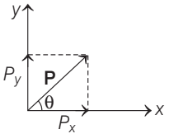
Let P be as shown in the figure, then according to the given information

Px = 5, Py = 6
$\therefore\mid\text{P}\mid=\sqrt{\text{P}_\text{x}^2+\text{P}_\text{y}^2}$
$=\sqrt{25+336}$
$\Rightarrow\mid\text{P}\mid=\sqrt{61}$ and $\tan\theta=\frac{\text{P}_\text{y}}{\text{P}_\text{x}}=\frac{6}{5}$
$\Rightarrow\theta=\tan^{-1}\big(\frac{6}{5}\big)$
View full question & answer
Question 84 Marks
Read the passage given below and answer the following questions from $i$ to $v.$ When an object follows a circular path at a constant speed, the motion of the object is called uniform circular motion. The word “uniform” refers to the speed, which is uniform (constant) throughout the motion. Suppose an object is moving with uniform speed $v$ in a circle of radius $R$ Since the velocity of the object is changing continuously in direction, the object undergoes acceleration. Let us find the magnitude and the direction of this acceleration. Thus, the acceleration of an object moving with speed v in a circle of radius $R$ has a magnitude $V^2/R$ and is always directed towards the centre. This is why this acceleration is called centripetal acceleration (a term proposed by Newton). A thorough analysis of centripetal acceleration was first published in $1673$ by the Dutch scientist Christiaan Huygens $(1629-1695)$ but it was probably known to Newton also some years earlier. “Centripetal” comes from a Greek term which means ‘centre-seeking’. Since $v$ and $R$ are constant, the magnitude of the centripetal acceleration is also constant. However, the direction changes pointing always towards the centre. Therefore, a centripetal acceleration is not a constant vector. We can express centripetal acceleration ac in terms of angular speed as $\text{a}_\text{c}=\omega^2\text{R}$ The time taken by an object to make one revolution is known as its time period T and the number of revolution made in one second is called its frequency $v (=1/T).$ However, during this time the distance moved by the object is $\text{s}=2\pi\text{R}.$ Therefore, $\text{v}=2\pi\frac{\text{R}}{\text{T}}=2\pi\text{ Rv}$ In terms of frequency n, we have $\omega=2\pi\text{v}$
$\text{V}=2\pi\text{ RV}$
$\text{ac}=4\pi^2\text{v}^2\text{R}$
  1. SI unit of angular velocity is
  1. Rev/ sec
  2. $m/ s$
  3. $m/ s^2$ 
  4. None of these
  1. A centripetal acceleration is not a constant vector. True or false?
  1. True
  2. False
  1. Define Uniform circular motion
  2. What is meaning of word centripetal?
  3. What is centripetal acceleration? Give its relation with angular velocity
Answer
  1. (a) Rev/ sec
  2. (a) True
  3. When an object moves in a circular path with uniform speed, its motion is called uniform circular motion.
  4. “Centripetal” comes from a Greek term which means ‘centre-seeking’ i.e. always directed towards centre of a circle.
  5. Acceleration of particle performing uniform circular motion which is always directed towards centre of a circle is called centripetal acceleration. We can express centripetal acceleration ac in terms of angular speed as.
$\omega=2\pi\text{v}$
However, during this time the distance moved by the object is $s = 2\pi R.$ In terms of frequency V, we have
$\omega=2\pi\text{v}$
$\text{V}=2\pi\text{ RV}$
$\text{ac}=4\pi^2\text{v}^2\text{R}$
View full question & answer
Question 94 Marks
Read the passage given below and answer the following questions from $i$ to $v.$ we consider the motion of a projectile. An object that is in flight after being thrown or projected is called a projectile. Such a projectile might be a football, a cricket ball, a baseball or any other object. The motion of a projectile may be thought of as the result of two separate, simultaneously occurring components of motions. One component is along a horizontal direction without any acceleration and the other along the vertical direction with constant acceleration due to the force of gravity. It was Galileo who first stated this independency of the horizontal and the vertical components of projectile motion in his Dialogue on the great world systems. Horizontal range of a projectile: The horizontal distance travelled by a projectile from its initial position $(x = y = 0)$ to the position where it passes $y = 0$ during its fall is called the horizontal range, $R$. It is the distance travelled during the time of flight $T_f .$ Therefore, the range $\text{R is R} =(\text{v}_o\cos\theta_o(\text{T}_\text{f})$
$\text{R}=\frac{(\text{v}_\text{o}\cos\theta_\text{o})(2\text{v}_\text{o}\sin\theta_\text{o})}{\text{g}}$
$\text{R}=\frac{(\text{v}_\text{o}^{2}\sin\theta_\text{o})}{g}$ This shows that for a given projection velocity, $R$ is maximum when $2\theta_\text{o}$ is maximum, i.e., when $\theta_\text{o}=45^\circ.$ The maximum horizontal range is, therefore $\text{R}=\frac{\text{v}_\text{o}^2}{g}$ Maximum height of a projectile: Maximum height that can be achieved during projectile and it is given by: $\text{H}_\text{m}=\frac{\text{(v}_\text{o}\sin\theta)^2}{2g}$
  1. Range in projectile motion is maximum when $\theta^\circ:$
  1. $45^0$
  2. $0^0$
  3. $90^0$
  4. None of these
  1. Who was first stated this independency of the horizontal and the vertical components of projectile motion in his Dialogue on the great world system?
  1. Galileo
  2. Newton
  3. Einstein
  4. None of these
  1. What is projectile motion?
  1. What is horizontal range of projectile? Give its formula:
  1. What is maximum height of projectile? Give its formula:
Answer
  1. (a) $45^0$
  2. (a) Galileo
  3. The motion of object under only gravity force in the air is called projectile motion.
  4. The horizontal distance travelled by a projectile from its initial position to the position where it passes same horizontal position during its fall is called the horizontal range, $R$. It is the distance travelled during the time of flight $T_f $. Therefore, the range $R$ is.
$\text{R is R} =(\text{v}_o\cos\theta_o(\text{T}_\text{f})$
$\text{R}=\frac{(\text{v}_\text{o}\cos\theta_\text{o})(2\text{v}_\text{o}\sin\theta_\text{o})}{\text{g}}$
$\text{R}=\frac{(\text{v}_\text{o}^{2}\sin\theta_\text{o})}{g}$
  1. Maximum height of a projectile: Maximum height that can be achieved during projectile and it is given by
$\text{H}_\text{m}=\frac{\text{(v}_\text{o}\sin\theta)^2}{2g}$
View full question & answer