Question types

Motion in a Plane question types

379 questions across 8 question groups — pick any mix to generate a Physics paper with step-by-step answer keys.

379
Questions
8
Question groups
5
Question types
Sample Questions

Motion in a Plane questions

One sample from each question group in this chapter. Select any group above to see the full set with answer keys.

The length of seconds hand of a watch is $1\ cm.$ The change in velocity of its tip in $15$ seconds in $cm/ s$ is:
  • A
    $\text{zero}$
  • B
    $\frac{\text{x}}{(30\sqrt{2})}$
  • C
    $\frac{\pi}{30}$
  • $\frac{2\pi}{(30\sqrt{2})}$

Answer: D.

View full solution
What is the position vector of a point mass moving on a circular path of radius of $10m$ with angular frequency of $2 \text{rads}^{-1}$ after $\frac{\pi}{8}\text{s}?$ Initially the point was on $Y-$axis.
  • A
    $5.(\hat{\text{i}}+\hat{\text{j}})$
  • $5\sqrt{2}(\hat{\text{i}}+\hat{\text{j}})$
  • C
    $\hat{\text{i}}+\hat{\text{j}}$
  • D
    $\frac{1}{\sqrt{2}}(\hat{\text{i}}+\hat{\text{j}})$

Answer: B.

View full solution
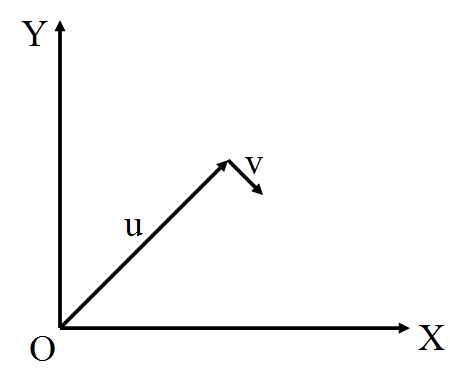
Figure shows the orientation of two vectors $u$ and $v$ in the $XY$ plane.

If $\text{u}=\text{a}\hat{\text{i}}+\text{b}\hat{\text{j}}$ and $\text{v}=\text{p}\hat{\text{i}}+\text{q}\hat{\text{j}}$ which of the following is correct?
  • A
    $a$ and $p$ are positive while $b$ and $q$ are negative.
  • $a, p$ and $b$ are positive while $q$ is negative.
  • C
    $a, q$ and $b$ are positive while $p$ is negative.
  • D
    $a, b, p$ and $q$ are all positive.

Answer: B.

View full solution
For a particle performing uniform circular motion, choose the correct statement$(s)$ from the following:
  • A
    Magnitude of particle velocity $($speed$)$ remains constant.
  • B
    Particle velocity remains directed perpendicular to radius vector.
  • C
    Direction of acceleration keeps changing as particle moves.
  • All of the above

Answer: D.

View full solution
Read each statement below carefully and state, with reasons and examples, if it is true or false: A scalar quantity is one that Is conserved in a process.
View full solution
Read each statement below carefully and state, with reasons and examples, if it is true or false: A scalar quantity is one that Must be dimensionless.
View full solution
Read each statement below carefully and state, with reasons, if it is true or false: The velocity vector of a particle at a point is always along the tangent to the path of the particle at that point.
View full solution
Read each statement below carefully and state with reasons, if it is true or false: The total path length is always equal to the magnitude of the displacement vector of a particle.
View full solution
Read each statement below carefully and state with reasons, if it is true or false: Three vectors not lying in a plane can never add up to give a null vector.
View full solution
Pick out the only vector quantity in the following list: Temperature, pressure, impulse, time, power, total path length, energy, gravitational potential, coefficient of friction, charge.
View full solution
Prove that the horizontal range is same when angle of projection is:
  1. Greater than $45^\circ$ by certain value.
  2. Less than $45^\circ$ by the same value.
View full solution
Galileo, in his book Two New Sciences, stated the “for elevations which exceed or fall short of 45° by equal amounts, the ranges are equal.” Prove this statement.
View full solution
Q 223 Marks Question3 Marks
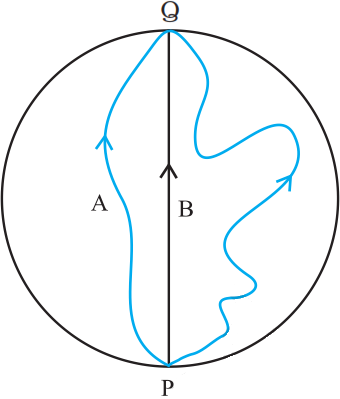
Three girls skating on a circular ice ground of radius 200m start from a point P on the edge of the ground and reach a point Q diametrically opposite to P following different paths as shown in Fig. What is the magnitude of the displacement vector for each? For which girl is this equal to the actual length of path skate?
View full solution
Q 233 Marks Question3 Marks
Pick out the two scalar quantities in the following list: force, angular momentum, work, current, linear momentum, electric field, average velocity, magnetic moment, relative velocity.
View full solution
Q 253 Marks Question3 Marks
Shows that the projection angle $\theta_0$ for a projectile launched from the origin is given by, $\theta_0=\tan^{-1}\Big(\frac{4\text{h}_\text{m}}{\text{R}}\Big)$ where the symbols have their usual meaning.
View full solution
$\hat{\text{i}}$ and $\hat{\text{j}}$ are unit vectors along x- and y- axis respectively. What is the magnitude and direction of the vectors $\hat{\text{i}}+\hat{\text{j}},$ and $\hat{\text{i}}-\hat{\text{j}}$? What are the components of a vector $\text{A}=2\hat{\text{i}}+3\hat{\text{j}}$ along the directions of $\hat{\text{i}}+\hat{\text{j}}$ and $\hat{\text{i}}-\hat{\text{j}}$? [You may use graphical method]
View full solution
A particle starts from the origin at t = 0s with a velocity of $10.0\hat{\text{j}}\text{m/s}$ and moves in the x - y plane with a constant acceleration of $(8.0\hat{\text{i}}+2.0\hat{\text{j}})\text{ms}^{-2}.$ (a) At what time is the x- coordinate of the particle 16m? What is the y-coordinate of the particle at that time? (b) What is the speed of the particle at the time?
View full solution
The position of a particle is given by $\text{r}=3.0\text{t}\hat{\text{i}}-2.0\text{t}^2\hat{\text{j}}+4.0\hat{\text{k }}\text{m}$ Where t is in seconds and the coefficients have the proper units for r to be in metres. (a) Find the v and a of the particle? (b) What is the magnitude and direction of velocity of the particle at t = 2.0s?
View full solution
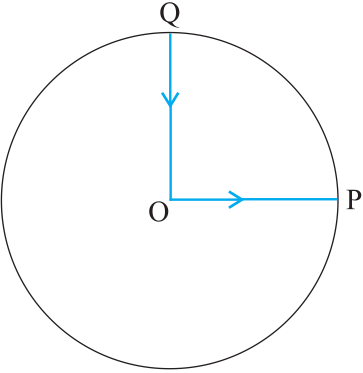
A cyclist starts from the centre O of a circular park of radius 1km, reaches the edge P of the park, then cycles along the circumference, and returns to the centre along QO as shown in Fig. If the round trip takes 10 min, what is the (a) net displacement, (b) average velocity, and (c) average speed of the cyclist?
View full solution
On an open ground, a motorist follows a track that turns to his left by an angle of 600 after every 500m. Starting from a given turn, specify the displacement of the motorist at the third, sixth and eighth turn. Compare the magnitude of the displacement with the total path length covered by the motorist in each case.
View full solution
Read the passage given below and answer the following questions from 1 to 5.Following are properties of vectors
a) Two vectors A and B are said to be equal if, and only if, they have the same magnitude and the same direction.
b) Multiplying a vector A with a positive number λ gives a vector whose magnitude is changed by the factor λ but the direction is the same as that of A:
$|\ \lambda\text{ A }|=\lambda\text{ A }|$
c) The null vector also results when we multiply a vector A by the number zero. Properties of 0 are
A + 0 = A
λ 0 = 0
0 A = 0
d) Subtraction of vectors can be defined in terms of addition of vectors. We define the difference of two vectors A and B as the sum of two vectors A and –B :
A – B = A + (–B).
  1. Two vectors A and B are said to be equal if:
  1. they have the same magnitude
  2. they have the same direction
  3. they have the same magnitude and the same direction
  4. None of these
  1. Multiplying a vector A with a positive number will impact:
  1. Change in magnitude
  2. Change in direction
  3. Change in both magnitude and the same direction
  4. None of these
  1. What is null vector?
  1. How we can perform subtraction of two vectors?
  1. Enlist any 4 properties of vectors.
View full solution
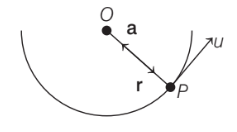
Read the passage given below and answer the following questions from (i) to (v). When an object follows a circular path at a constant speed, the motion of the object is called uniform circular motion. The word
uniform refers to the speed which is uniform (constant) throughout the motion. Although the speed does not vary, the particle is accelerating because the velocity changes its direction at every point on the circular track. The figure shows a particle P which moves along a circular track of radius r with a uniform speedu.
  1. A circular motion:
  1. Is one-dimensional motion.
  2. Is two-dimensional motion.
  3. It is represented by combination of two variable vectors.
  4. Both (b) and (c)
  1. For a particle performing uniform circular motion, choose the incorrect statement from the following.
  1. Magnitude of particle velocity (speed) remains constant.
  2. Particle velocity remains directed perpendicular to radius vector.
  3. Direction of acceleration keeps changing as particle moves.
  4. Angular momentum is constant in magnitude but direction keeps changing.
  1. Two cars A and B move along a concentric circular path of radius $r_A$ and $r_B$ with velocities $v_A$ and $v_B$ maintaining constant distance, then $\frac{\text{v}_{\text{A}}}{\text{v}_\text{B}}$ is equal to:
  1. $\frac{\text{r}_{\text{B}}}{\text{r}_\text{A}}$
  2. $\frac{\text{r}_{\text{A}}}{\text{r}_\text{B}}$
  3. $\frac{\text{r}_{\text{A}}^2}{\text{r}_\text{B}^2}$
  4. $\frac{\text{r}_{\text{B}}^2}{\text{r}_\text{A}^2}$
  1. A car runs at a constant speed on a circular track of radius 100m, taking 62.8s for every circular lap. The average velocity and average speed for each circular lap, respectively is:
  1. $0,0$
  2. $0,10ms^{-1}$
  3. $10ms^{-1}, 10ms^{-1}$
  4. $10ms^{-1}, 0$
  1. A particle is revolving at 1200 rpm in acircle of radius 30cm. Then, its acceleration is:
  1. $1600ms^{-2}$
  2. $4740ms^{-2}$
  3. $2370ms^{-2}$
  4. $5055ms^{-2}$
View full solution
Read the passage given below and answer the following questions from 1 to 5. If A is vector given by $A = Ax\ i + Ay\j$ where The quantities $A_x$ and $A_y$ are called x, and y- components of the vector A. Note that Ax is itself not a vector, but $A_x$ i is a vector, and so is $A_y\ j$. Using simple trigonometry, we can express $A_x$ and $A_y$ in terms of the magnitude of A and the angle \theta it makes with the x-axis. $\text{Ax} = \text{A} \cos(\theta)$
$\text{Ay} = \text{A} \text{ \sin}(\theta)$ If A and $\theta$ are given, Ax and Ay can be obtained using If Ax and Ay are given, A and $\theta$ can be obtained as follows – $\text{A}^2_\text{x}+\text{A}^2_\text{y}=(\text{A}\cos\theta)^2+(\text{A}\sin\theta)^2$ $\text{A}^2_\text{x}+\text{A}^2_\text{y}=\text{A}^2\cos^2\theta+\text{A}^2\sin^2\theta$ $\Rightarrow\text{A}^2_\text{x}+\text{A}^2_\text{y}=\text{A}^2(\cos^2\theta+\sin^2\theta)$ ${A}^2_\text{x}+\text{A}^2_\text{y}=\text{A}^2(\because\sin^2\theta+\cos^2\theta=1)$ $\text{A}^2=\text{A}^2_\text{y}+\text{A}^2_\text{y}$ $\Rightarrow\text{A}=\sqrt{\text{A}^2_\text{x}+\text{A}^2_\text{y }}...$ $\text{Dividing}\text{ A}_\text{y}\text{ by} \text{ A}_\text{y},\text{we get}$ $\frac{\text{A}_\text{y}}{\text{A}_\text{x}}=\frac{\text{A}\sin\theta}{\text{A}\cos\theta}$ $\Rightarrow\frac{\text{A}_\text{y}}{\text{A}_\text{x}}=\tan\theta$ $\tan\theta=\frac{\text{A}_\text{y}}{\text{A}_\text{x}}$ $\theta=\tan^{-1}\Big[\frac{\text{A}_\text{y}}{\text{A}_\text{x}}\Big]$
Position vector-The position vector r of a particle P located in a plane with reference to the origin of an x-y reference frame is given by $r = x i + y j$ where x and y are components of r along x-, and y- axes or simply they are the coordinates of the object. Suppose a particle moves along the Then, the displacement is: $\triangle r = r_2-r_1.$ We can write this in a component form: $\triangle r = (x’ i + y’ j) – ( x i + y j) = i\triangle x – j\triangle y$ Where $\triangle x = x’ – x, \triangle y = y – y.$
The average velocity (v) of an object is the ratio of the displacement and the corresponding time Interval. $\text{V}=\frac{\triangle\text{r}}{\triangle\text{t}}$
$=\frac{\text{i}\triangle\text{x}-\text{j}\triangle\text{y}}{\triangle\text{t}}$
$=\text{i}\times\frac{\triangle\text{x}}{\triangle\text{t}}+\text{j}\times\frac{\triangle\text{y}}{\triangle\text{t}}$
$=\text{V}_\text{x}\text{i}+\text{V}_\text{y}\text{j}$ So, if the expressions for the coordinates x and y are known as functions of time, we can use these equations to find vx and vy. The magnitude of v is then $V = ( v_x^2+ v_y^2)$ and the direction of v is given by the angle q and given by $\tan(\theta)=\frac{\text{vx}}{\text{vy}}$
  1. If A is vector given by A = Ax i + Ay j .if the magnitude of vector is A and the angle $\theta$ it makes with the x-axis Ax can be given by:
  1. Ax = A cos(q)
  2. Ax = A sin(q)
  3. Ax = A tan(q)
  4. None of the above
  1. If A is vector given by A = Ax i + Ay j .if the magnitude of vector is A and the angle $\theta$ it makes with the x-axis Ay can be given by:
  1. Ax = A cos(q)
  2. Ax = A sin(q)
  3. Ax = A tan(q)
  4. None of the above
  1. Write a note on position vector and displacement of object:
  1. Write a note on average velocity:
  1. If A is vector given by A = Ax i + Ay j where obtain expression for resultant amplitude of vector and its angle with x axis:
View full solution
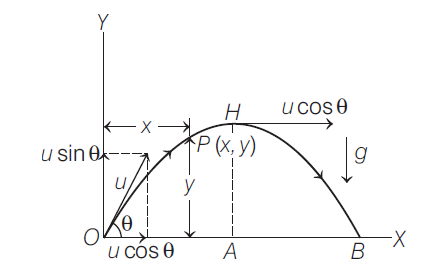
Read the passage given below and answer the following questions from 1 to 5. Projectile motion is a form of motion in which an object or particle is thrown with some initial velocity near the earth’s surface and it moves along a curved path under the action of gravity alone. The path followed by a projectile is called its trajectory, which is shown below. When a projectile is projected obliquely, then its trajectory is as shown in the figure below. Here velocity u is resolved into two components, we get (a) u cosθ along OX and (b) u sinθ along OY.
  1. The example of such type of motion is:
  1. Motion of car on a banked road.
  2. Motion of boat in sea.
  3. A javelin thrown by an athlete.
  4. Motion of ball thrown vertically upward.
  1. The acceleration of the object in horizontal direction is:
  1. Constant
  2. Decreasing
  3. Increasing
  4. Zero
  1. The vertical component of velocity at point H is:
  1. Maximum
  2. Zero
  3. Double to that at O
  4. Equal to horizontal component
  1. A cricket ball is thrown at a speed of 28m/s in a direction 30° with the horizontal. The time taken by the ball to return to the same level will be:
  1. 2.0s
  2. 3.0s
  3. 4.0s
  4. 2.9s
  1. In above case, the distance from the thrower to the point where the ball returns to the same level will be:
  1. 39m
  2. 69m
  3. 68m
  4. 72m
View full solution
Read the passage given below and answer the following questions from (i) to (v). Relative Velocity Every motion is relative as it has to be observed with respect to an observer. Relative velocity is a measurement of velocity of an object with respect to other observer. It is defined as the time rate of change of relative position of one object with respect to another. For example, if rain is falling vertically with a velocity v, and a man is moving horizontally with $v_m$, the man can protect himself from the rain if he holds his umbrella in the direction of relative velocity of rain w.r.t. man.
  1. Two bodies are held separated by 9.8m vertically one above the other. They are released simultaneously to fall freely under gravity. After 2s, the relative distance between them is:
  1. 4.9m
  2. 19.6m
  3. 9.8m
  4. 39.2m
  1. If two objects P andQ move along parallel straight lines in opposite direction with velocities $v_P$ and $v_Q$ respectively, then relative velocity of P w.r.t.Q,
  1. $v_{PQ} = v_P = v_0$
  2. $v_P - v_0$
  3. $v_P + v_0$
  4. $v_0 - v_p$
  1. A train is moving towards East and a car is along North, both with same speed. The observed direction of car to the passenger in the train is:
  1. East - North direction
  2. West - North direction
  3. South - East direction
  4. None of the above
  1. Buses A and B are moving in the same direction with velocities $20\hat{\text{i}}\text{ms}^{-1}$ and $15\hat{\text{i}}\text{ms}^{-1},$ respectively. Then, relative velocity of A w.r.t. B is:
  1. $35\hat{\text{i}}\text{ms}^{-1}$
  2. $5\hat{\text{i}}\text{ms}^{-1}$
  3. $5\hat{\text{j}}\text{ms}^{-1}$
  4. $35\hat{\text{j}}\text{ms}^{-1}$
  1. A girl riding a bicycle with a speed of $5\ ms\ -1$ towards east direction sees raindrops falling vertically downwards. On increasing the speed to $15ms^{-1},$ rain appears to fall making an angle of $45^\circ$ of the vertical. Find the magnitude of velocity of rain.
  1. $5\text{ms}^{-1}$
  2. $5\sqrt5\text{ms}^{-1}$
  3. $25\text{ms}^{-1}$
  4. $10\text{ms}^{-1}$
View full solution
Read each statement below carefully and state, with reasons, if it is true or false: The velocity vector of a particle at a point is always along the tangent to the path of the particle at that point.
View full solution
Read each statement below carefully and state with reasons, if it is true or false: The total path length is always equal to the magnitude of the displacement vector of a particle.
View full solution
Read each statement below carefully and state with reasons, if it is true or false: Three vectors not lying in a plane can never add up to give a null vector.
View full solution

Generate a Motion in a Plane paper free

Pick question groups from the list above, set marks and difficulty, and export a branded PDF with step-by-step answer keys. First 3 chapters free — no signup.

Download App