Questions

M.C.Q (1 Marks)

Take a timed test

23 questions · auto-graded multiple-choice test.

MCQ 11 Mark
A person standing near the edge of the top of a building throws two balls $A$ and $B.$ The ball $A$ is thrown vertically upward and $B$ is thrown vertically downward with the same speed. The ball $A$ hits the ground with a speed $v_A$ and the ball $B$ hits the ground with a speed $v_B$. We have:
  • A
    $\mathrm{v}_{\mathrm{A}}>\mathrm{v}_{\mathrm{B}}$
  • B
    $v_A<v_B$
  • $v_A=v_B$
  • D
    The relation between $v_A$ and $v_B$ depends on height of the building above the ground.
Answer
Correct option: C.
$v_A=v_B$
Total energy of any particle $=\frac{1}{2}\text{mv}^2+\text{mgh}$
Both the particles were at the same height and thrown with equal initial velocities, so their initial total energies are equal. By the law of conservation of energy, their final energies are equal.
At the ground, they are at the same height.
So, their $P.E.$ are also equal; this implies that their $K.E.$ should also be equal. In other words, their final velocities are equal.
View full question & answer
MCQ 21 Mark
In a projectile motion the velocity:
  • A
    Is always perpendicular to the acceleration.
  • B
    Is never perpendicular to the acceleration.
  • Is perpendicular to the acceleration for one instant only.
  • D
    Is perpendicular to the acceleration for two instants.
Answer
Correct option: C.
Is perpendicular to the acceleration for one instant only.
In projectile motion, velocity is perpendicular to acceleration only at the highest point. Here, velocity is along the horizontal direction and acceleration is along the vertically downward direction.
View full question & answer
MCQ 31 Mark
Two bullets are fired simultaneously, horizontally and with different speeds from the same place. Which bullet will hit the ground first?
  • A
    The faster one.
  • B
    The slower one.
  • Both will reach simultaneously.
  • D
    Depends on the masses.
Answer
Correct option: C.
Both will reach simultaneously.
Because the downward acceleration and the initial velocity in downward direction of the two bullets are the same, they will take the same time to hit the ground and for a half projectile.
Time of flight $=\text{T}=\sqrt{\frac{2\text{h}}{\text{g}}}$
View full question & answer
MCQ 41 Mark
A person travelling on a straight line moves with a uniform velocity $\text{v}_1$ for some time and with uniform velocity $\text{v}_2$ for the next equal time. The average velocity is given by:
  • $\text{v}=\frac{\text{v}_1+\text{v}_2}{2}$
  • B
    $\text{v}=\sqrt{\text{v}_1\text{v}_2}$
  • C
    $\frac{2}{\text{v}}=\frac{1}{\text{v}_1}+\frac{1}{\text{v}_2}$
  • D
    $\frac{1}{\text{v}}=\frac{1}{\text{v}_1}+\frac{1}{\text{v}_2}$
Answer
Correct option: A.
$\text{v}=\frac{\text{v}_1+\text{v}_2}{2}$
Velocity is uniform in both cases; that is, acceleration is zero.
We have:
$\text{d}_1=\text{v}_1\text{t}$ and $\text{d}_2=\text{v}_2\text{t}$
Total displacement, $\text{d = d}_1+\text{d}_2$
Total time, $\text{t = t + t = 2t}$
$\therefore$ Average velocity, $\text{v}=\frac{\text{d}_1+\text{d}_2}{2\text{t}}=\frac{\text{v}_1+\text{v}_2}{2}$
View full question & answer
MCQ 51 Mark
Pick the correct statements:
  • A
    Average speed of a particle in a given time is never less than the magnitude of the average velocity.
  • B
    It is possible to have a situation in which $\Big|\frac{\text{d}\vec{\text{v}}}{\text{dt}}\Big|\neq0$ but $\frac{\text{d}}{\text{dt}}|\vec{\text{v}}|=0.$
  • C
    The average velocity of a particle is zero in a time interval. It is possible that the instantaneous velocity is never zero in the interval.
  • All of the above
Answer
Correct option: D.
All of the above
  1. Average speed of a particle in a given time is never less than the magnitude of the average velocity.
  2. It is possible to have a situation in which $\Big|\frac{\text{d}\vec{\text{v}}}{\text{dt}}\Big|\neq0$ but $\frac{\text{d}}{\text{dt}}|\vec{\text{v}}|=0.$
  3. The average velocity of a particle is zero in a time interval. It is possible that the instantaneous velocity is never zero in the interval.
Example, the motion of a particle on a circular track with a constant speed.
Average velocity $=\frac{\text{Displacement}}{\text{Total time}}$
$\text{Displacement}\leq\text{Distance}$
$\therefore\text{Average velocrty}\leq\text{Average speed}$
In uniform circular motion, speed is constant but velocity is not.
$\text{i.e.},\Big|\frac{\text{d}\vec{\text{v}}}{\text{dt}}\Big|\neq0$ but $\frac{\text{d}}{\text{dt}}=|\vec{\text{v}}|=0$ which proves case $(b)$
  1. In one complete circle of uniform motion, average velocity is zero. Instantaneous velocity is never zero in the interval.
View full question & answer
MCQ 61 Mark
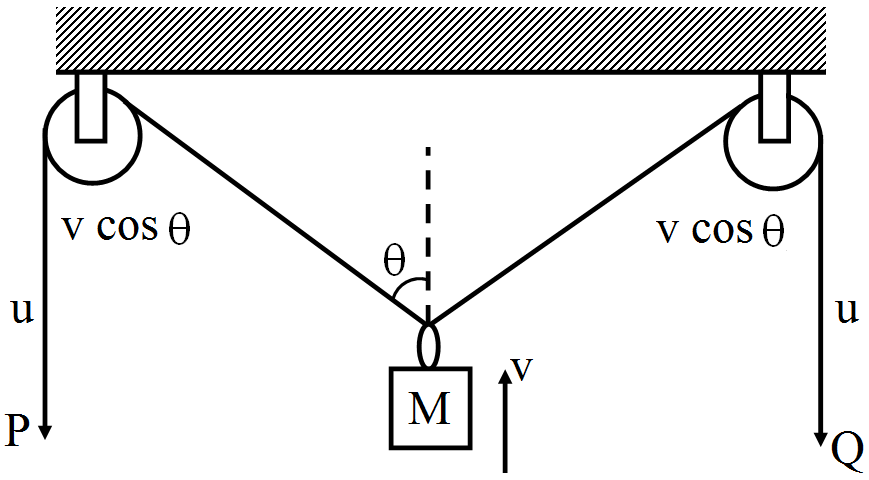
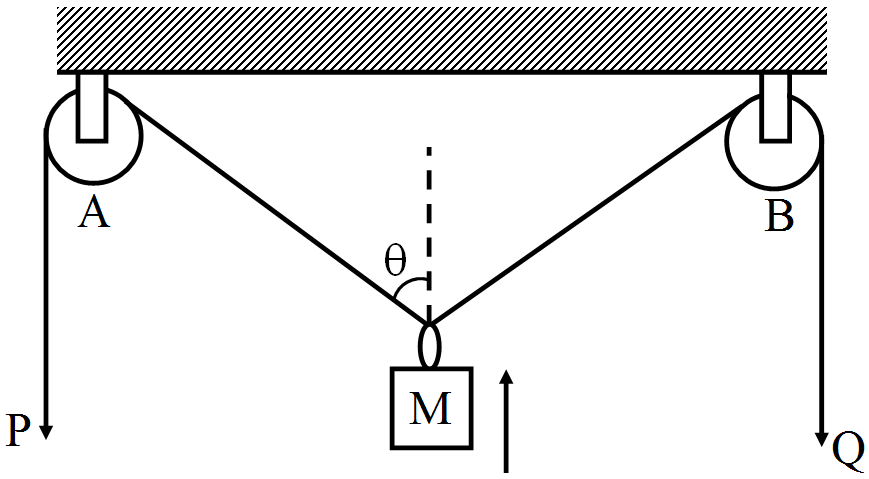
In the arrangement shown in figure, the ends P and Q of an inextensible string move downwards with uniform speed u. Pulleys A and B are fixed. The mass M moves upwards with a speed:
  • A
    $2\text{u}\cos\theta$
  • $\frac{\text{u}}{\cos\theta}$
  • C
    $\frac{\text{2u}}{\cos\theta}$
  • D
    $\text{u}\cos\theta$
Answer
Correct option: B.
$\frac{\text{u}}{\cos\theta}$


Along the string, the velocity of each object is the same.
$2\text{v}\cos(\theta)=2\text{u}$
$\text{v}=\frac{\text{u}}{\cos(\theta)}$
View full question & answer
MCQ 71 Mark
The accelerations of a particle as seen from two frames $S_1$ and $S_2$ have equal magnitude $4 \mathrm{~m} / \mathrm{s}^2$.
  • A
    The frames must be at rest with respect to each other.
  • B
    The frames may be moving with respect to each other but neither should be accelerated with respect to the other.
  • C
    The acceleration of $\mathrm{S}_2$ with respect to $\mathrm{S}_1$ may either be zero or $8 \mathrm{~m} / \mathrm{s}^2$.
  • The acceleration of $S_2$ with respect to $S_1$ may be anything between zero and $8 \mathrm{~m} / \mathrm{s}$.
Answer
Correct option: D.
The acceleration of $S_2$ with respect to $S_1$ may be anything between zero and $8 \mathrm{~m} / \mathrm{s}$.
$\overrightarrow{\text{a}}_{\text{s}_2\text{s}_1}=\overrightarrow{\text{a}}_{\text{s}_2\text{P}}+\overrightarrow{\text{a}}_{\text{Ps}_1}$
$\big|\overrightarrow{\text{a}}_{\text{s}_2\text{s}_1}|=\sqrt{4^2+4^2+32\cos(\theta)}$
$-1<\cos(\theta)<1$
$0<\overrightarrow{\text{a}}_{\text{s}_2\text{s}_1}<8$
View full question & answer
MCQ 81 Mark
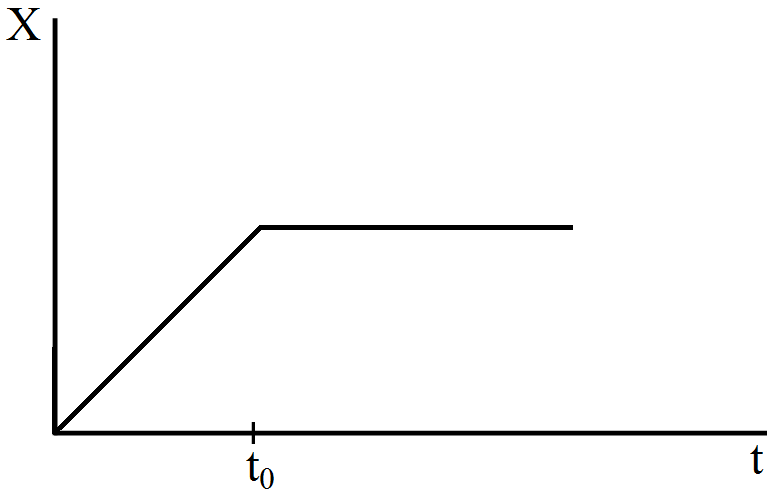
Figure shows the displacement$-$time graph of a particle moving on the $X-$axis.
  • A
    The particle is continuously going in positive $x$ direction.
  • B
    The particle is at rest.
  • C
    The velocity increases up to a time to, and then becomes constant.
  • The particle moves at a constant velocity up to a time to, and then stops.
Answer
Correct option: D.
The particle moves at a constant velocity up to a time to, and then stops.
The slope of the $x - t$ graph gives the velocity. In the graph, the slope is constant from $t=0$ to $t=f_0$,
so the velocity is constant. After $\mathrm{t}=\mathrm{t}_0$,
the displacement is zero; i.e., the particle stops.
View full question & answer
MCQ 91 Mark
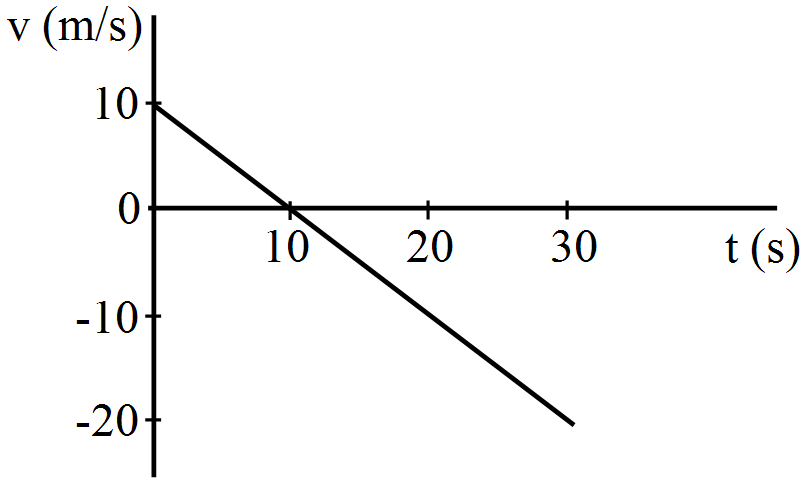
The velocity$-$time plot for a particle moving on a straight line is shown in the figure:
  • A
    The particle has a constant acceleration.
  • B
    The average speed in the interval $0$ to $10s$ is the same as the average speed in the interval $10s$ to $20s.$
  • C
    The particle has zero displacement.
  • Both $B$ and $C$
Answer
Correct option: D.
Both $B$ and $C$
  1. The slope of the $v-t$ graph gives the acceleration. For the given graph, the slope is constant. So, acceleration is constant.
  2. From $0$ to $10$ seconds, velocity is in positive direction and then in negative direction. This means that the particle turns around at $t = 10s.$
  3. Area in the $v-t$ curve gives the distance travelled by the particle.
Distance travelled in positive Direction $\neq$ Distance travelled in negative direction
$\therefore\text{Displacement}\neq\text{Zero}$
  1. The area of the $v-t$ graph from $t = 0s$ to $t = 10s$ is the same as that from $t = 10s$ to $t = 20s.$ So, the distance covered is the same. Hence, the average speed is the same.
View full question & answer
MCQ 101 Mark
Mark the correct statements for a particle going on a straight line:
  • A
    If the velocity and acceleration have opposite sign, the object is slowing down.
  • B
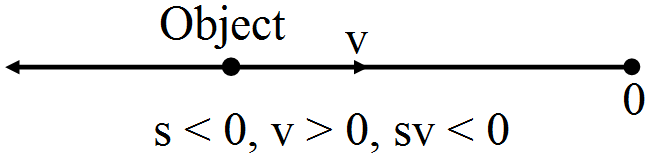
    If the position and velocity have opposite sign, the particle is moving towards the origin.
  • C
    If the velocity is zero for a time interval, the acceleration is zero at any instant within the time interval.
  • All of the above
Answer
Correct option: D.
All of the above
  1. Acceleration is given by
$-\text{a}=\frac{\text{dv}}{\text{dt}}$
$-\text{a}<0$
$\Rightarrow\frac{\text{dv}}{\text{dt}}<0$
$\Rightarrow\text{V}_{\text{final}}<\text{V}_{\text{initial}}$
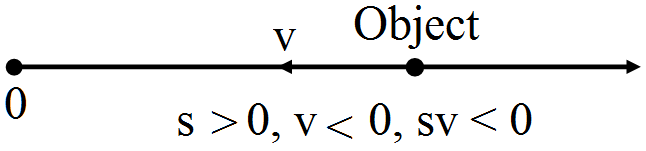
  1. If the position and velocity have opposite signs, the particle moves towards the origin. It can be explained by following figure:

Object is moving toward the origin.

Object is moving toward the origin.
  1. If the velocity is zero in a certain time interval, then the change in the velocity in that time interval will also be zero. As acceleration is rate of change of velocity, it will also be zero at an instant in that time interval.
View full question & answer
MCQ 111 Mark
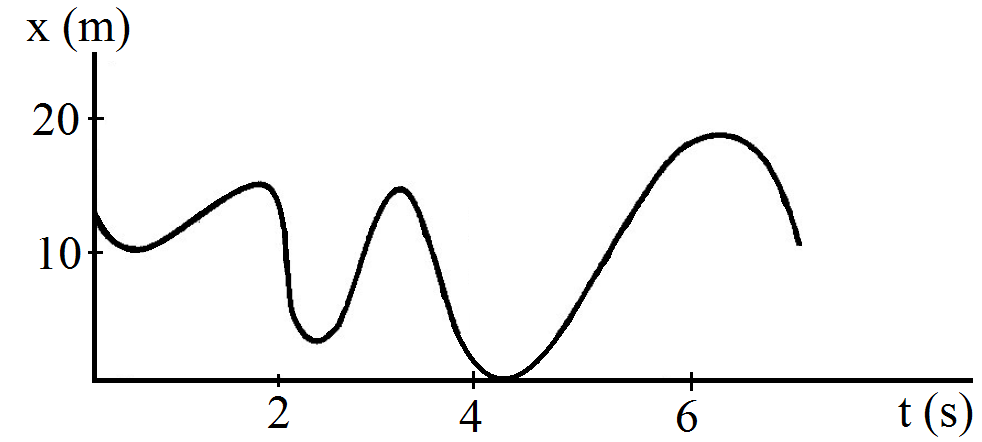
Figure shows the position of a particle moving on the $X-$axis as a function of time.
  • The particle has come to rest $6$ times.
  • B
    The maximum speed is at $t = 6s.$
  • C
    The velocity remains positive for $t = 0$ to $t = 6s.$
  • D
    The average velocity for the total period shown is negative.
Answer
Correct option: A.
The particle has come to rest $6$ times.
 
  1. The slope of the $x-$tgraph gives the velocity. Here, $6$ times the slope is zero. So, the particle has come to rest $6$ times.
  2. As the slope is not maximum at $t = 6s,$ the maximum speed is not at $t = 6s.$
  3. As the slope is not positive from $t = 0s$ to $t = 6s,$ the velocity does not remain positive.
  4. Average velocity $\frac{\text{Total displacement}}{\text{Total time taken}}=\frac{\text{x final}-\text{x initial}}{\text{t}}$
For the shown time $(r = 6s),$ the displacement of the particle is positive.
Therefore, the average velocity is positive.
View full question & answer
MCQ 121 Mark
A particle moves along the $X-$axis as $x = u(t - 2s) + a(t - 2s)^2.$
  • A
    The initial velocity of the particle is $u.$
  • B
    At $t = 2s$ particle is at the origin.
  • C
    The acceleration of the particle is $2a.$
  • Both $B$ and $C$
Answer
Correct option: D.
Both $B$ and $C$
Initial velocity $=\Big|\frac{\text{dx}}{\text{dt}}\Big|_{\text{t} = 0}$
$\frac{\text{dx}}{\text{dt}}=\text{u}+2\text{a}(\text{t}-2\text{s})$
$\Big|\frac{\text{dx}}{\text{dt}}\Big|_{\text{t}=0}=\text{u}-4\text{as}\neq\text{u}$
Acceleration $=\frac{\text{d}^2\text{x}}{\text{dt}^2}=2\text{a}$
At $t = 2s,$
$x = u(2s - 2s) + a(2s - 2s)^2 = 0 ($origin$)$
View full question & answer
MCQ 131 Mark
Mark the correct statements:
  • The magnitude of the velocity of a particle is equal to its speed.
  • B
    The magnitude of average velocity in an interval is equal to its average speed in that interval
  • C
    It is possible to have a situation in which the speed of a particle is always zero but the average speed is not zero.
  • D
    It is possible to have a situation in which the speed of the particle is never zero but the average speed in an interval is zero.
Answer
Correct option: A.
The magnitude of the velocity of a particle is equal to its speed.
Average speed $=\frac{\text{Total distance travelled}}{\text{Total time taken}}$
$\text{Distance}\geq\text{Displacement}$
$\therefore\text{Average speed}\geq\text{Average velocity}$
The magnitude of average velocity in an interval is not always equal to its average speed in that interval.
  1. If speed is always zero, then the distance travelled is always zero. Hence, the total distance travelled and the average speed will be zero.
  2. If the speed of a particle is never zero, the distance travelled by the particle is never zero. Hence, the average speed will not be zero.
View full question & answer
MCQ 141 Mark
An object may have:
  1. Varying speed without having varying velocity.
  2. Varying velocity without having varying speed.
  3. Nonzero acceleration without having varying velocity.
  4. Nonzero acceleration without having varying speed.
  • A
    Only $A$
  • B
    $A$ and $B$
  • C
    $B$ and $C$
  • $B$ and $D$
Answer
Correct option: D.
$B$ and $D$
Velocity and acceleration are vector quantities that can be changed by changing direction only $($keeping magnitude constant$).$
View full question & answer
MCQ 151 Mark
A motor car is going due north at a speed of 50km/h. It makes a 90° left turn without changing the speed. The change in the velocity of the car is about:
  • A
    50km/h towards west.
  • 70km/h towards south-west.
  • C
    70km/h towards north-west.
  • D
    zero.
Answer
Correct option: B.
70km/h towards south-west.
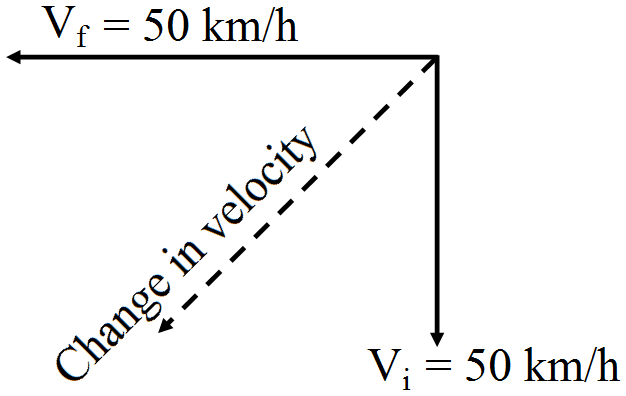
Final velocity, $\overrightarrow{\text{V}}_{\text{f}}=-50\hat{\text{i}}\text{km/h}$
Initial velocity, $\overrightarrow{\text{V}}_{\text{i}}=50\hat{\text{j}}\text{km/h}$
Change in velocity, $\triangle\overrightarrow{\text{V}}=\overrightarrow{\text{V}}_{\text{f}}-\overrightarrow{\text{V}}_{\text{i}}$
$|\triangle\text{V}|=\sqrt{50^2+50^2+2\times50\times50\cos(90^{\circ})}=70\text{km/h}$
It is towards southwest, as shown in the figure.

View full question & answer
MCQ 161 Mark
A stone is released from an elevator going up with an acceleration a. The acceleration of the stone after the release is:
  • A
    a upward.
  • B
    (g - a) upward.
  • C
    (g - a) downward.
  • g downward.
Answer
Correct option: D.
g downward.
Gravity is the only force acting on the stone when it is released. And, we know that gravity is always in the downward direction.
View full question & answer
MCQ 171 Mark
A person travelling on a straight line moves with a uniform velocity $\text{v}_1$ for a distance $x$ and with a uniform velocity $\text{v}_2$ for the next equal distance. The average velocity $v$ is given by:
  • A
    $\text{v}=\frac{\text{v}_1+\text{v}_2}{2}$
  • B
    $\text{v}=\sqrt{\text{v}_1\text{v}_2}$
  • $\frac{2}{\text{v}}=\frac{1}{\text{v}_1}+\frac{1}{\text{v}_2}$
  • D
    $\frac{1}{\text{v}}=\frac{1}{\text{v}_1}+\frac{1}{\text{v}_2}$
Answer
Correct option: C.
$\frac{2}{\text{v}}=\frac{1}{\text{v}_1}+\frac{1}{\text{v}_2}$
Velocity is uniform in both cases; that is, acceleration is zero.
$\text{x = v}_1\text{t}_1\Rightarrow\text{t}_1=\frac{\text{x}}{\text{v}_1}$
$\text{x = v}_2\text{t}_2\Rightarrow\text{t}_2=\frac{\text{x}}{\text{v}_2}$
Total displacement, $\text{x}'=\text{2x}$
Total time, $\text{t}=\text{t}_1+\text{t}_2$
$\therefore$ Average velocity, $\text{v}=\frac{\text{x}'}{\text{t}}=\frac{2\text{v}_1\text{v}_2}{\text{v}_1+\text{v}_2}$
$\Rightarrow\frac{2}{\text{v}}=\frac{1}{\text{v}_1}+\frac{1}{\text{v}_2}$
View full question & answer
MCQ 181 Mark
The range of a projectile fired at an angle of 15° is 50m. If it is fired with the same speed at an angle of 45°, its range will be:
  • A
    25m
  • B
    37m
  • C
    50m
  • 100m.
Answer
Correct option: D.
100m.
For the same urange, $\text{R}\propto\sin(2\theta).$
So,
$\frac{\text{R}_1}{\text{R}_2}=\frac{\sin(2\theta_1)}{\sin(2\theta_2)}$
$\Rightarrow\text{R}_2=50\times\frac{\sin(90)}{\sin(30)}=100\text{m}$
View full question & answer
MCQ 191 Mark
A particle has a velocity $u$ towards east at $t=0$. Its acceleration is towards west and is constant. Let $x_A$ and $x_B$ be the magnitude of displacements in the first $10$ seconds and the next $10$ seconds:
  • A
    $x_A < x_B$
  • B
    $x_A=x_B$
  • C
    $x_A>x_B$
  • The information is insufficient to decide the relation of $x_A$ with $x_B$.
Answer
Correct option: D.
The information is insufficient to decide the relation of $x_A$ with $x_B$.
As velocity and acceleration are in opposite directions, velocity will become zero after some time $(t)$ and the particle will return.
$\therefore0=\text{u}-\text{at}$
$\Rightarrow\text{t}=\frac{\text{u}}{\text{a}}$
Because the value of acceleration is not given, we cannot say that the particle will return after/ before $10$ seconds.
View full question & answer
MCQ 201 Mark
A river is flowing from west to east at a speed of 5 metres per minute. A man on the south bank of the river, capable of swimming at 10 metres per minute in still water, wants to swim across the river in the shortest time. He should swim in a direction:
  • Due north.
  • B
    30° east of north.
  • C
    30° north of west.
  • D
    60° east of north.
Answer
Correct option: A.
Due north.
If the man swims at any angle east to the north direction, although his relative speed will increase, he will have to travel a larger distance. So, he will take more time.
If the man swims at any angle west to the north direction, his relative speed will decrease. So, he will take more time.
View full question & answer
MCQ 211 Mark
Consider the motion of the tip of the minute hand of a clock. In one hour:
  1. The displacement is zero.
  2. The distance covered is zero.
  3. The average speed is zero.
  4. The average velocity is zero.
  • A
    $A$ and $B$
  • B
    $A$ and $D$
  • C
    $B$ and $C$
  • $B$ and $D$
Answer
Correct option: D.
$B$ and $D$
Displacement is zero because the initial and final positions are the same.
$\text{Average velocity}=\frac{\text{Displacement}}{\text{Total time}} =0$
$\text{Distance covered}=2\pi\text{r}\neq0$
$\text{Average speed}=\frac{\text{Distance travelled}}{\text{Total time taken}}\neq0$
View full question & answer
MCQ 221 Mark
The velocity of a particle is zero at $t = 0.$
  1. The acceleration at $t = 0$ must be zero.
  2. The acceleration at $t = 0$ may be zero.
  3. If the acceleration is zero from $t = 0$ to $t = 10s,$ the speed is also zero in this interval.
  4. If the speed is zero from $t = 0$ to $t = 10s$ the acceleration is also zero in this interval.
  • A
    $A$ and $B$
  • B
    $B$ and $C$
  • C
    $A$ and $D$
  • $B, C$ and $D$
Answer
Correct option: D.
$B, C$ and $D$
 
  1. Acceleration will be zero only when the change in velocity is zero.
  2. Since the acceleration is zero from $t= 0s$ to $t = 10s,$ change in velocity is $0.$
Velocity in this interval $=$ Initial velocity $= 0$
Also,
Speed in this interval $=$ Initial speed $= 0$
  1. From $t = 0s$ to $t = 10s,$ speed is zero.
Here, velocity is zero and initial velocity is zero.
So, the change in velocity is zero; i.e., acceleration is zero.
View full question & answer
MCQ 231 Mark
Two projectiles $A$ and $B$ are projected with angle of projection $15^{\circ}$ for the projectile $A$ and $45^{\circ}$ for the projectile $B$. If $R_A$ and $R_B$ be the horizontal range for the two projectiles, then:
  • A
    $R_A<R_B$
  • B
    $R_A=R_B$
  • C
    $R_A>R_B$
  • The information is insufficient to decide the relation of $\mathrm{R}_{\mathrm{A}}$ with $\mathrm{R}_{\mathrm{B}}$.
Answer
Correct option: D.
The information is insufficient to decide the relation of $\mathrm{R}_{\mathrm{A}}$ with $\mathrm{R}_{\mathrm{B}}$.
  1. The information is insufficient to decide the relation of $\mathrm{R}_{\mathrm{A}}$ with $\mathrm{R}_{\mathrm{B}}$.
Explanation:
Horizontal range for the projectile, $\text{R}=\frac{\text{u}^2\sin(2\text{a})}{\text{g}}$
Information of the initial velocity is not given in the question.
View full question & answer