Questions

5 Marks Questions

Take a timed test

14 questions · self-marked practice — reveal the answer and mark yourself.

Question 15 Marks
The conduction band of a solid is partially filled at 0K. Will it be a conductor, a semiconductor or an insulator?
Answer
It will be a conductor. As the elements having partially filled conduction band belong to the category of elements whose outermost subshell consists of an odd number of electrons, they are good conductors of electricity. When an electric field is applied, electrons in the partially filled band gain energy and start drifting. So, the conductor will conduct even at 0K. A semiconductor behaves like an insulator at 0K and an insulator conducts poorly only at very high temperatures.
As the given material has free electrons to conduct even at 0K, it is a conductor.
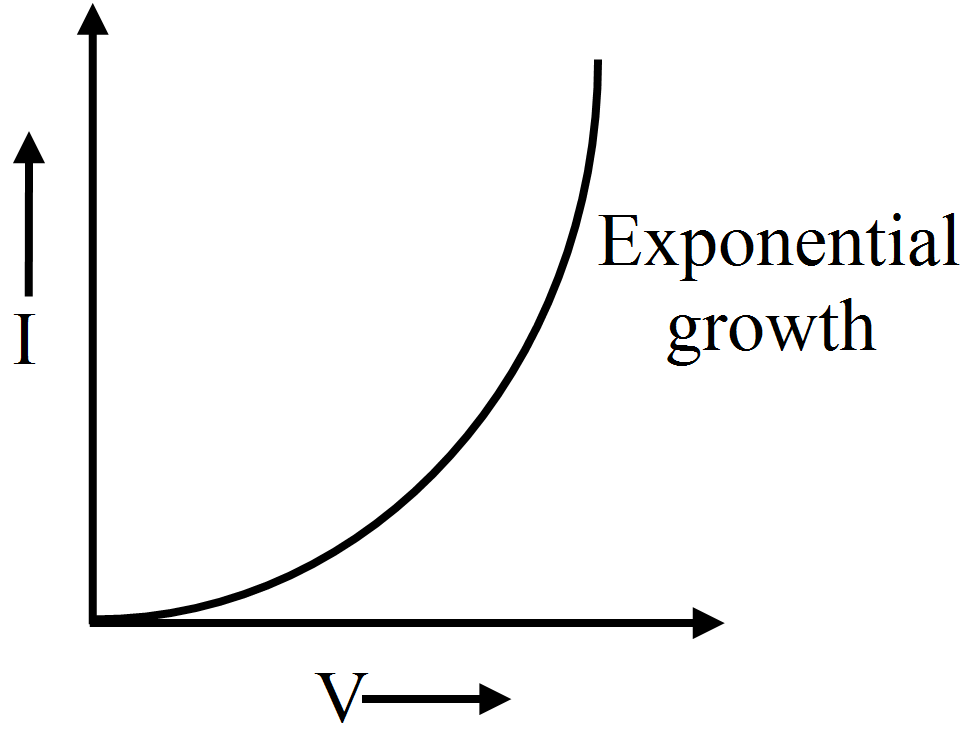
View full question & answer
Question 25 Marks
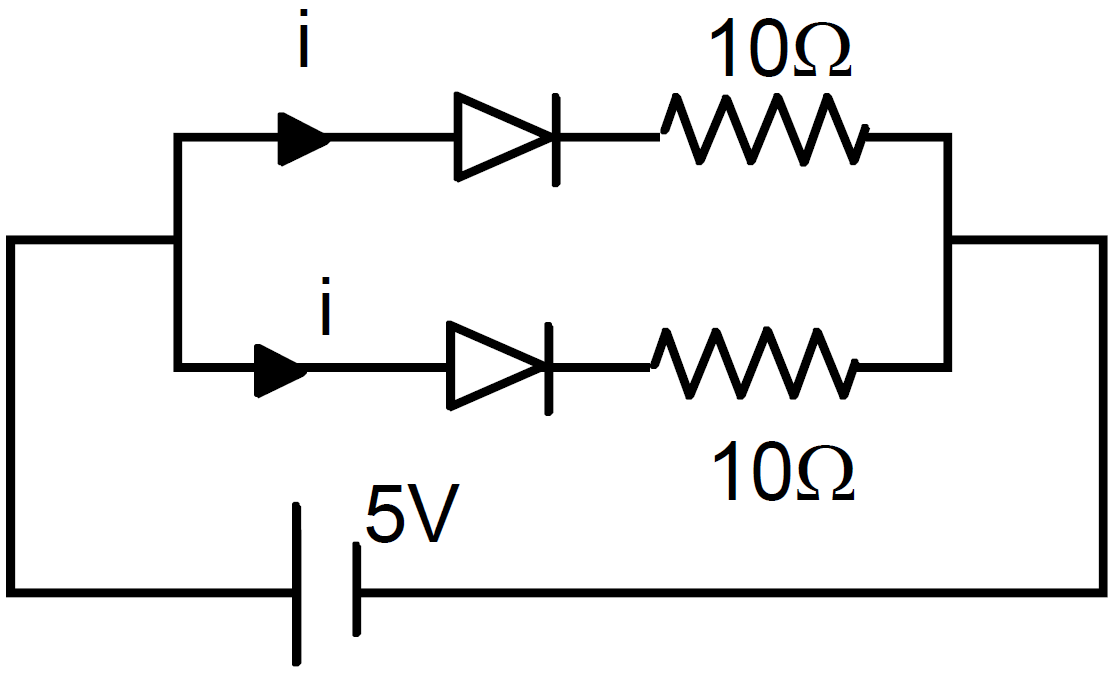
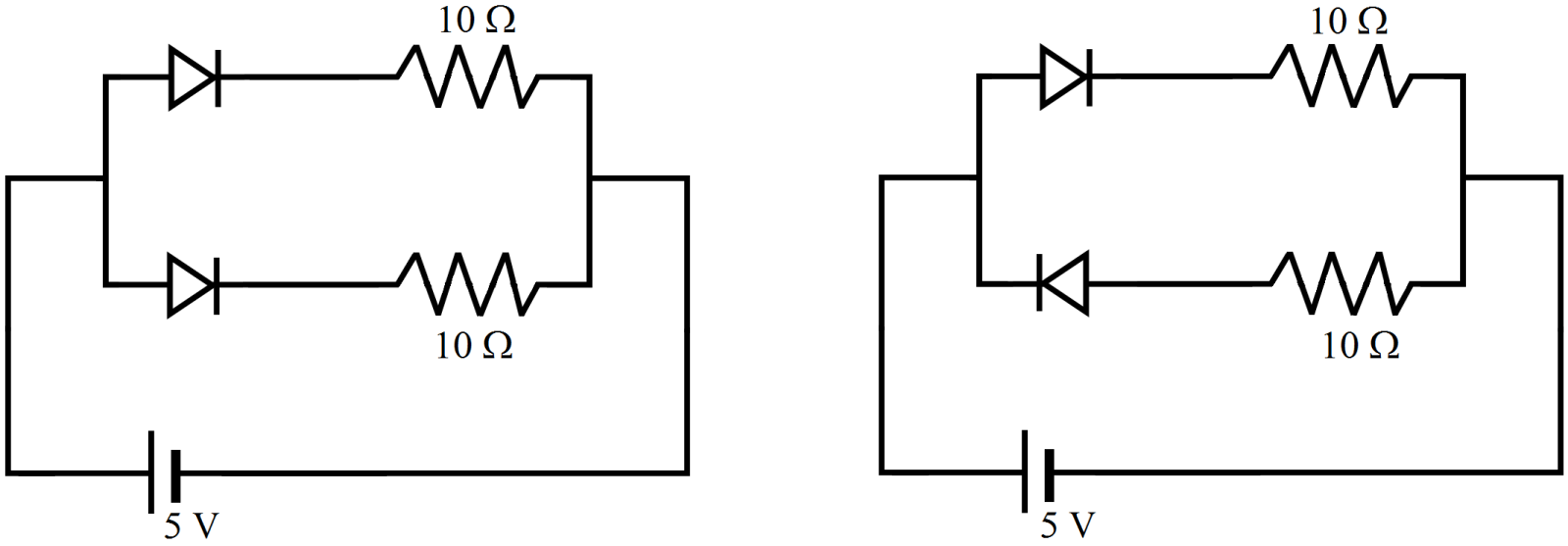
Find the current through the battery circuits shown in figure.
Answer
Both diodes are forward biased. Thus the net diode resistance is 0. $\text{i}=\frac{5}{\frac{10\times10}{10+10}}=\frac{5}{5}=1\text{A}$
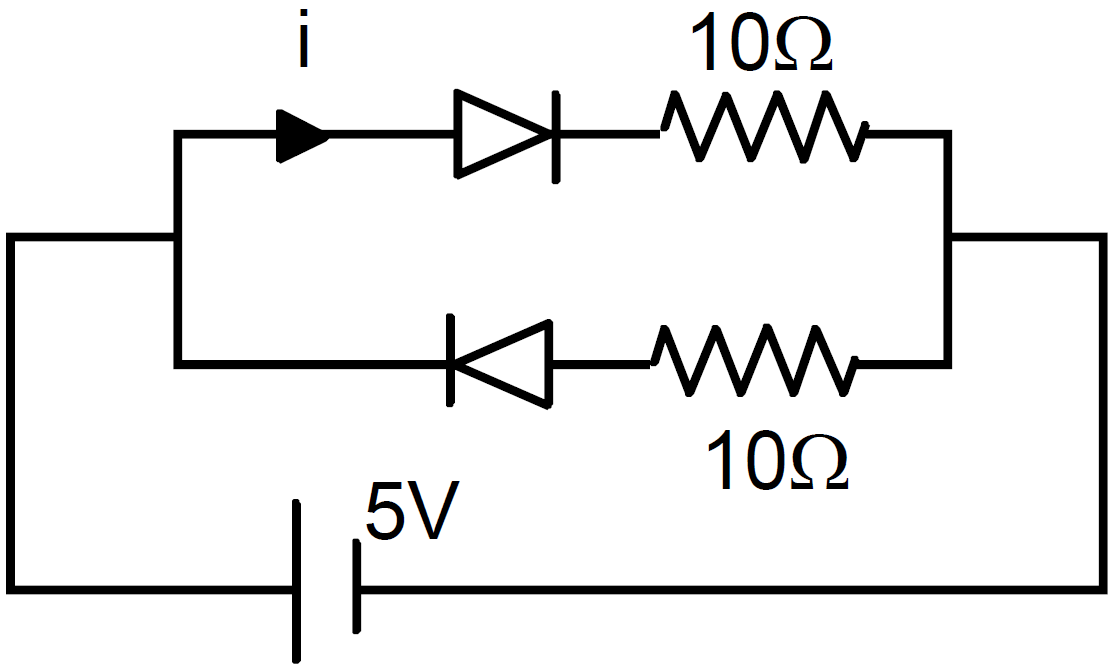
One diode is forward biased and other is reverse biased. $\text{i}=\frac{\text{V}}{\text{R}_\text{net}}=\frac{5}{10+0}=\frac{1}{2}=0.5\text{A}$
View full question & answer
Question 35 Marks
The conductivity of an intrinsic samiconductor depends on temperature as $\sigma=\sigma_0\text{ e}^{\frac{-\Delta\text{E}}{2\text{kT}}}$ where $\sigma_0$ is a constant. Find the temperature at which the conductivity pf an intrinsic germanium semiconductor will be double of its value at T = 300K. Assume that the gap for germanium is 0.650eV and remains constant as the temperature is increased.
Answer
$\sigma=\sigma_0\text{e}^{\frac{-\Delta\text{E}}{2\text{KT}}}$$\Delta\text{E}=0.650\text{eV},\text{T}=300\text{K}$
According to question, $\text{K}=8.62\times10^{-5}\text{eV}$
$\sigma_0\text{e}^{\frac{-\Delta\text{E}}{2\text{KT}}}=2\times\sigma_0\text{e}^{\frac{-\Delta\text{E}}{2\times\text{K}\times300}}$
$\Rightarrow\text{e}^{\frac{-0.65}{2\times8.62\times10^{-5}\times\text{T}}}=6.96561\times10^{-5}$
Taking in on both sides,
We get, $\frac{-0.65}{2\times8.62\times10^{-5}\times\text{T}'}=-11.874525$
$\rightarrow\frac{1}{\text{T}'}=\frac{11.574525\times2\times8.62\times10^{-5}}{0.65}$
$\Rightarrow\text{T}'=317.51178=318\text{K}.$
View full question & answer
Question 45 Marks
Consider a p-n junction diode having the characteristic $\text{i}-\text{i}_0\Big(\text{e}^{\frac{\text{eV}}{\text{kT}}}-1\Big)$ where $\text{i}_0=20\mu\text{A}.$ The diode is operated at T = 300K.
  1. Find the current through the diode when a voltage of 300mV is applied across it in forward bias.
  2. At what voltage does the current double?
Answer
  1. $\text{i}_0=20\times10^{-6}\text{A},\ \text{T}=300\text{K, V}=300\text{mV}$
$\text{i}=\text{i}_0\text{e}^{\frac{\text{eV}}{\text{KT}}-1}$ $=20\times10^{-6}\Big(\text{e}^{\frac{100}{8.62}}-1\Big)=2.18\text{A}=2\text{A}.$
  1. $4=20\times10^{-6}\Big(\text{e}^{\frac{\text{V}}{8.62\times3\times10^{-2}}}-1\Big)$
$\Rightarrow\text{e}^{\frac{\text{V}\times10^3}{8.62\times3}}-1=\frac{4\times10^6}{20}$

$\Rightarrow\text{e}^{\frac{\text{V}\times10^3}{8.62\times3}}=200001\Rightarrow\frac{\text{V}\times10^{3}}{8.62\times3}=12.2060$

$\Rightarrow\text{V}=315\text{mV}=318\text{mV}.$
View full question & answer
Question 55 Marks
When a p-n junction is reverse-biased, the current becomes almost constant at $25\mu\text{A}.$ When it is forwardbiased at 200mV, a current of $75\mu\text{A}$ is obtained. Find the magnitude of diffusion current when the diode is,
  1. Unbiased.
  2. Reverse-biased at 200mV.
  3. Forward-biased at 200mV.
Answer
  1. $\text{i}_1=25\mu\text{A},\text{V}=200\text{mV},\text{i}_2=75\mu\text{A}$
When in unbiased condition drift current = diffusion current

$\therefore$ Diffusion current $=25\mu\text{A}.$
  1. On reverse biasing the diffusion current becomes ‘O’.
  2. On forward biasing the actual current be x.
x - Drift current = Forward biasing current

$\Rightarrow\text{x}-25\mu\text{A}=75\mu\text{A}$

$\Rightarrow\text{x}=(75+25)\mu\text{A}=100\mu\text{A}.$
View full question & answer
Question 65 Marks
A load resistor of $2\text{k}\Omega$ is connected in the collector branch of an amplifier circuit using a transistor in common-emitter mode. The current gain $\beta=50.$ The input resistance of the transistor is $0.50\text{k}\Omega.$ If the input current is changed by $50\mu\text{A}.$
  1. By what amount does the output voltage change?
  2. By what amount does the input voltage change?
  3. What is the power gain?
Answer
Given,
Base current gain, $\beta=50$
Change in base current, $\delta\text{I}_\text{b}=50\mu\text{A}$
Load resistance, $\text{R}_\text{L}=2\text{k}\Omega$
Input resistance, $\text{R}_\text{i}=0.50\text{k}\Omega$
  1. The change in output voltage is given by
$\text{V}_0=\text{I}_\text{c}\times\text{R}_\text{L}$

$\because\text{I}_\text{c}=\beta\times\text{I}_\text{b}$

$\therefore\text{V}_0=\beta\times\text{I}_\text{b}\times\text{R}_\text{L}$

$\Rightarrow\text{V}_0=50\times50\mu\text{A}\times2\text{k}\Omega$

$\Rightarrow\text{V}_0=5\text{V}$
  1. The change in input voltage is given by
$\delta\text{V}_\text{i}=\delta\text{l}_\text{b}\times\text{R}_\text{i}$

$\Rightarrow\delta\text{V}_\text{i}=50\times10^{-6}\times5\times10^2$

$\Rightarrow\delta\text{V}_\text{i}=25\times10^{-3}$

$\Rightarrow\delta\text{V}_\text{i}=25\text{mV}$
  1. Power gain is given by
$\beta^2\times\frac{\text{R}_\text{L}}{\text{R}_\text{i}}$

$\Rightarrow2500\times\frac{2}{0.5}$

$\Rightarrow2500\times\frac{20}{5}=10^4.$
View full question & answer
Question 75 Marks
How many is energy states are present in one mole of sodium vapour? Are they all filled in normal conditions? "How many 3s energy states are present in one mole of sodium vapour? Are they all filled in normal conditions?
Answer
For sodium, the atomic number is 11. The electronic configuration of sodium is $1 s^2 2 s^2 2 p^6 3 s^1$. One sodium atom has 11 electrons. Thus, if the sodium crystals consist of N atoms, the total number of electrons will be 11N. We know that for each atom, there are two states in the energy level 1s. Thus, the sodium crystal will have 2N states for 1s energy level. Similarly, the number of states in 3s energy level will also be 2N. 1s state is filled under normal condition. But the 3s state has only one electron per sodium atom, so the 3s band will be half-filled.
View full question & answer
Question 85 Marks
Let $\text{X}=\overline{\text{ABC}}+\overline{\text{BCA}}+\overline{\text{CAB}}.$ Evaluate X for:
  1. $\text{A}=1,\text{B}=0,\text{C}=1$
  2. $\text{A}=\text{B}=\text{C}=1$
  3. $\text{A}=\text{B}=\text{C}=0$
Answer
Given,
Output $\text{X}=\overline{\text{ABC}}+\overline{\text{BCA}}+\overline{\text{CAB}}$
  1. $\text{A}=1,\text{B}=0,\text{C}=1$
$\text{X}=1.\Big(\overline{0.1}\Big)+0\Big(\overline{1.1}\Big)+1\Big(\overline1.0\Big)$

$=1.\bar{0}+0.\bar{1}+1.\bar{0}$

$=1.1+0.0+1.1$

$=1+0+1$

$=1+1$

$=1$
  1. $\text{A}=\text{B}=\text{C}=1$
$\text{X}=1\Big(\overline{1.1}\Big)+1\Big(\overline{1.1}\Big)+1\Big(\overline{1.1}\Big)$

$=1.\bar{1}+1.\bar{1}+1.\bar{1}$

$=1.0+1.0+1.0$

$=0+0+0$

$=0$
  1. $\text{A}=\text{B}=\text{C}=0$
$\text{X}=0\Big(\overline{0.0}\Big)+0\Big(\overline{0.0}\Big)+0\Big(\overline{1.1}\Big)$

$=0.\bar{0}+0.\bar{0}+0.\bar{0}$

$=0.1+0.1+0.1$

$=0+0+0$

$=0.$
View full question & answer
Question 95 Marks
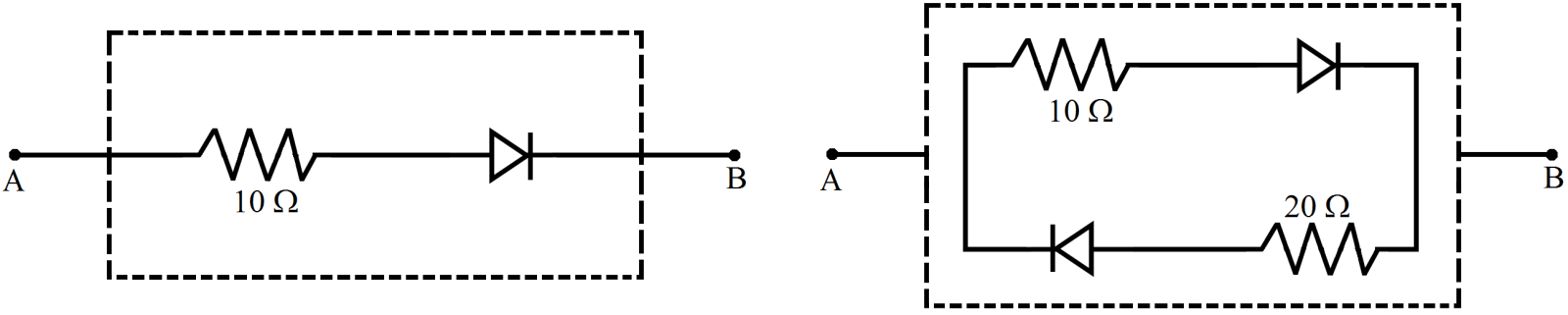
Draw the current-voltage characteristics for the device shown in figure. between the terminals A and B.
Answer
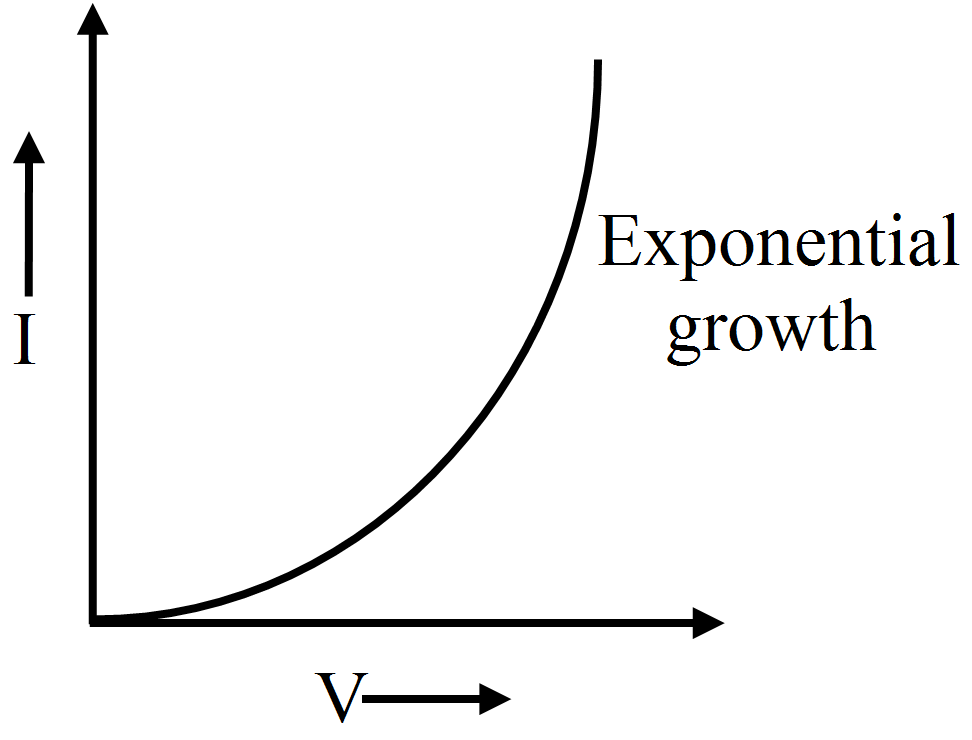
  1. If a battery is connected between terminals A and B, with positive terminal connected to point A and negative terminal connected to point B, then the diode will get forward biassed by the applied voltage. So, the current voltage graph for this circuit will be the same as that of the characteristic curves of a forward-biassed diode.
  1. If a battery is connected between terminals A and B, with positive terminal connected to point A and negative terminal connected to point B, then the upper diode will get forward biassed and the lower diode will get reverse biassed by the applied voltage. So, this lower branch can be replaced by an open circuit; hence, the current flow through this branch will be zero. The current flows only through the upper diode, so the circuit on simplification will become identical to the circuit in part (a). Hence, the current voltage graph for this circuit will be the same as that of the characteristic curves of a forward-biassed diode.
View full question & answer
Question 105 Marks
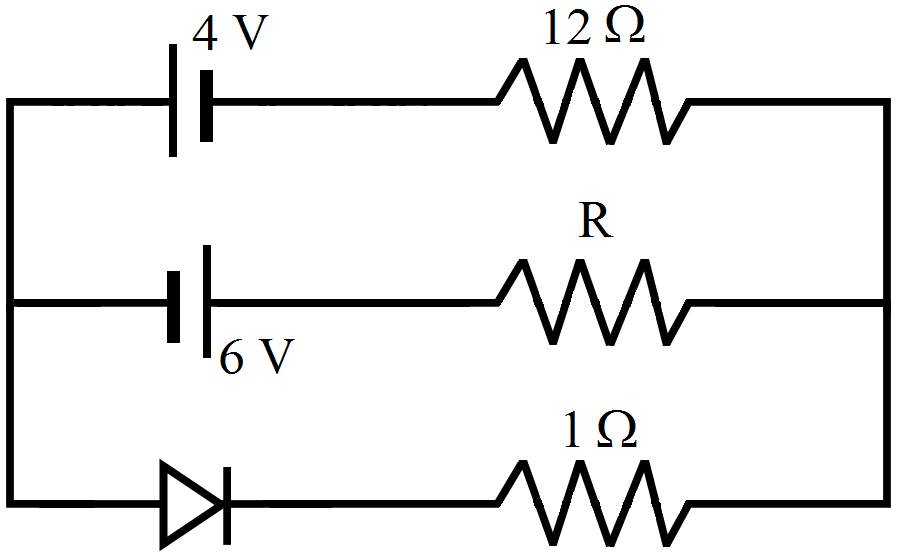
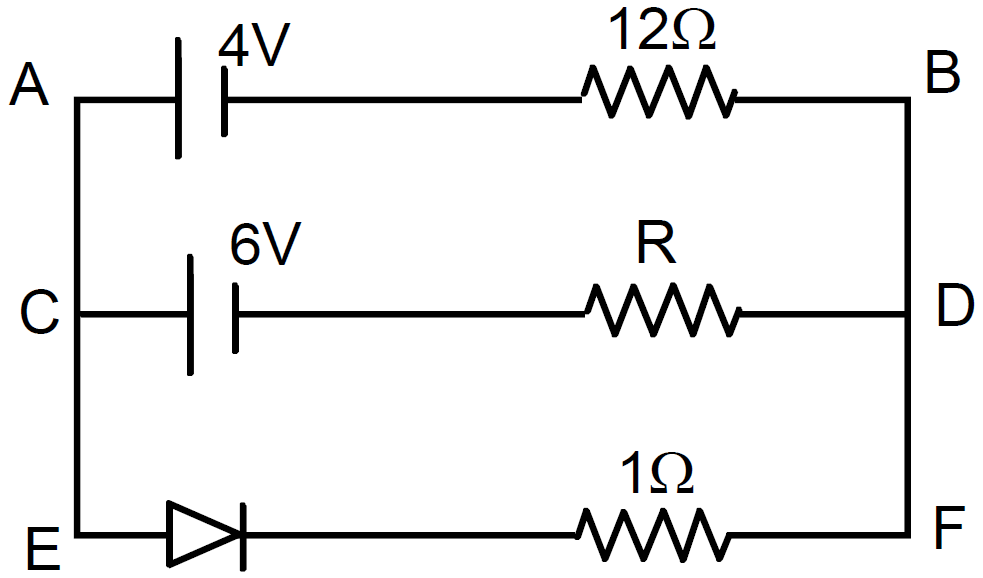
Find the current through the resistance R in figure. if.
  1. $\text{R}=12\Omega$
  2. $\text{R}=48\Omega$
Answer

  1. When $\text{R}=12\Omega$
The wire EF becomes ineffective due to the net (-)ve voltage.

Hence, current through $\text{R}=\frac{10}{24}=0.4166=042\text{A}.$
  1. Similarly for $\text{R}=48\Omega$
$\text{i}=\frac{10}{(48+12)}=\frac{10}{60}=0.16\text{A}.$
View full question & answer
Question 115 Marks
In semiconductors, thermal collisions are responsible for taking a valence electron to the conduction band. Why does the number of conduction electrons not go on increasing with time as thermal collisions conμnuously take place?
Answer
An electron jumps from the valence band to the conduction band only when it has gained sufficient energy. The thermal collisions sometimes do not provide sufficient energy to the electron to jump. Also, energy is lost in the form of heat because of the collision of the carriers with other charge carriers and atoms. Because of all these losses, only few electrons are left with sufficient energy to jump from the valence band to the conduction band. So, the population of electron in the conduction band does not keep on increasing with time.
View full question & answer
Question 125 Marks
The current−voltage characteristic of an ideal p-n junction diode is given by $\text{i}=\text{i}_0\Big(\text{e}^{\frac{\text{eV}}{\text{kT}}}-1\Big)$ where, the drift current $i_0$ equals $10\mu\text{A}.$ Take the temperature T to be 300K.
  1. Find the voltage $V_0$ for which $\text{e}^{\frac{\text{eV}}{\text{KT}}}=100.$ One can neglect the term 1 for voltages greater than this value.
  2. Find an expression for the dynamic resistance of the diode as a function of $V$ for $V > V_0$.
  3. Find the voltage for which the dynamic resistance is $0.2\Omega.$
Answer
 
  1. The current‒voltage relationship of a diode is given by $\text{i}=\text{i}_0\Big(\text{e}^{\frac{\text{eV}}{\text{kT}-1}}\Big)$
For a large value of voltage, 1 can be neglected.
$\text{i}\approx\text{i}_0\text{e}^{\frac{\text{eV}}{\text{KT}}}$
Again, we need to find the voltage at which
$\text{e}^{\frac{\text{eV}}{\text{KT}}}=100$
$\Rightarrow\frac{\text{eV}}{\text{kT}}=\text{In }100$
$\Rightarrow\text{V}=\frac{\text{In }100\times\text{kT}}{\text{e}}$
$\Rightarrow\text{V}=\frac{2.303\times\log\ 100\times8.62\times10^{-5}\times300}{\text{e}}$
$\Rightarrow\text{V}=0.12\text{V}$
  1. Given:
$\text{i}=\text{i}_0\Big(\text{e}^{\frac{\text{eV}}{\text{kT}-1}}\Big)\ ...(1)$
We know that the dynamic resistance of a diode is the rate of change of voltage w.r.t. current.
i.e. $\text{R}=\frac{\text{dV}}{\text{di}}$
As the exponential factor dominates the factor of 1, we can neglect this factor.
Now, on differentiating eq. (1) w.r.t. V, we get,
$\frac{\text{di}}{\text{dV}}=\text{i}_0\frac{\text{e}}{\text{kT}}\text{e}^{\frac{\text{eV}}{\text{kT}}}$
$\Rightarrow\frac{1}{\text{R}}=\frac{\text{ei}_0}{\text{kT}}\text{e}^{\frac{\text{eV}}{\text{kT}}}$
$\Rightarrow\text{R}=\frac{\text{kT}}{\text{ei}_0}\text{e}^{\frac{-\text{eV}}{\text{kT}}}\ ...(2)$
  1. Given,
$\text{R}=2\Omega$
On substituting this value in eq. (2), we get
$2=\frac{8.62\times10^{-5}\times300}{\text{e}\times10\times10^{-6}}\text{e}^{\frac{\text{-eV}}{8.62\times10^{-5}\times300}}$
$\Rightarrow\text{V}=0.25\text{V}.$
View full question & answer
Question 135 Marks
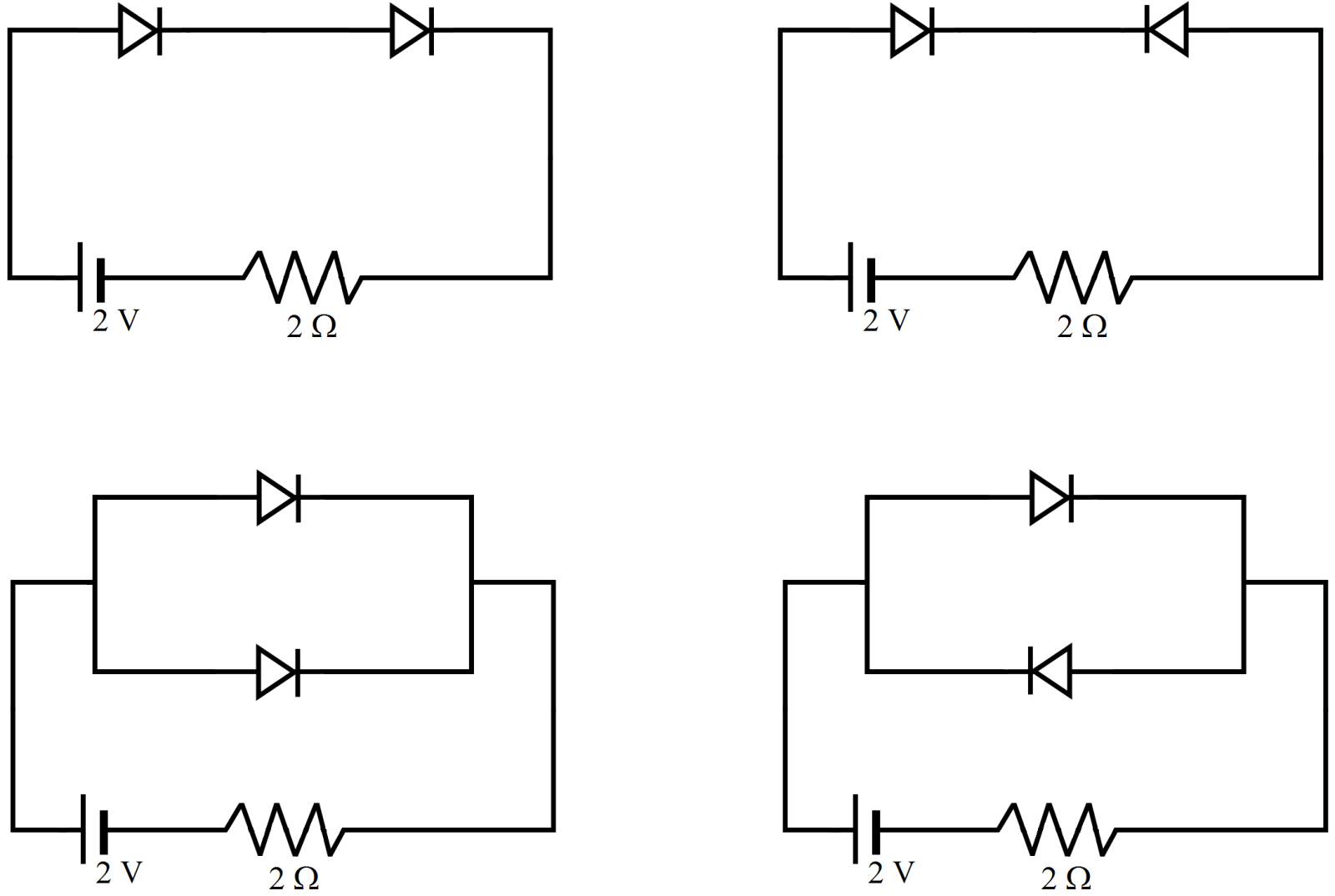
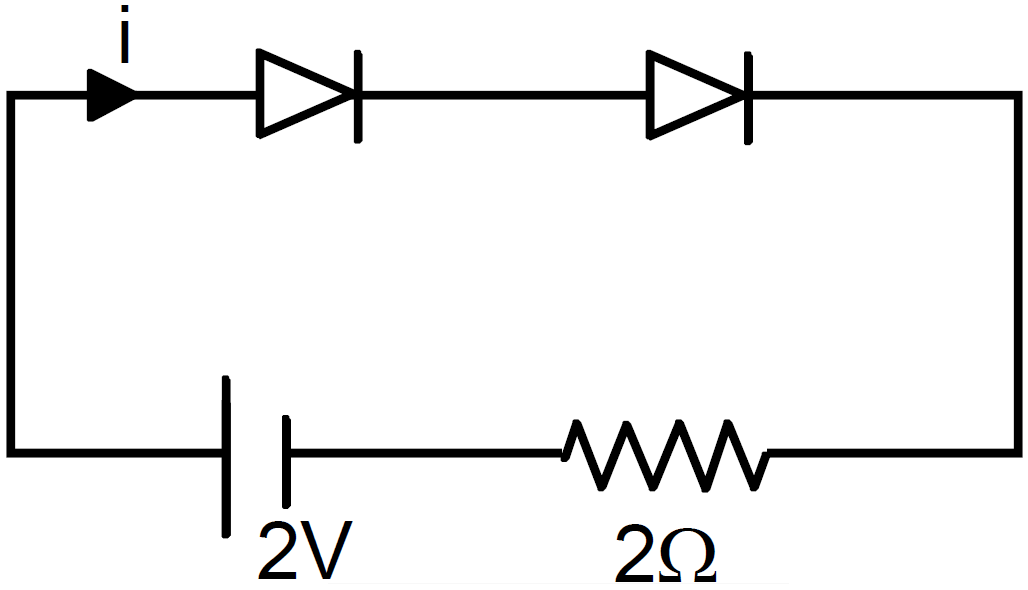
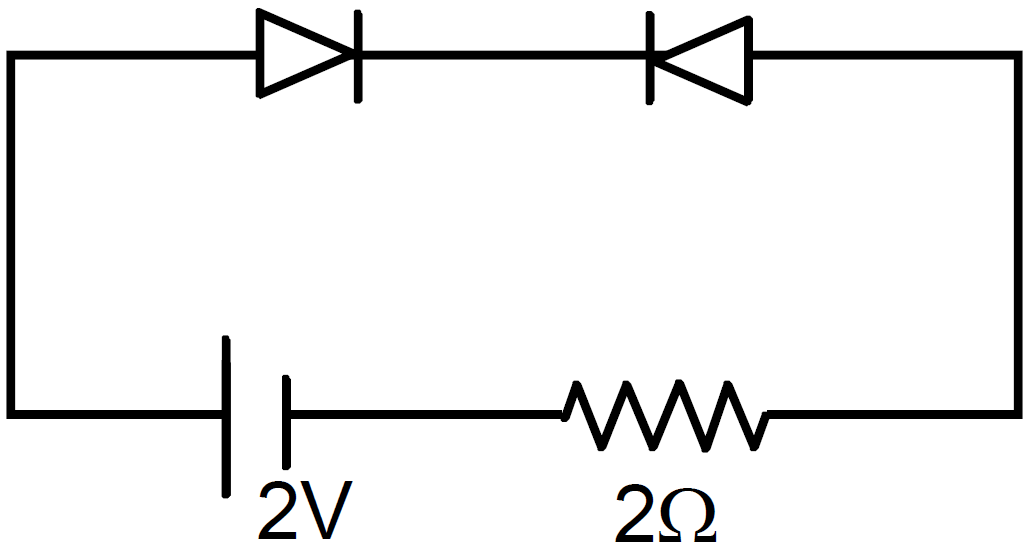
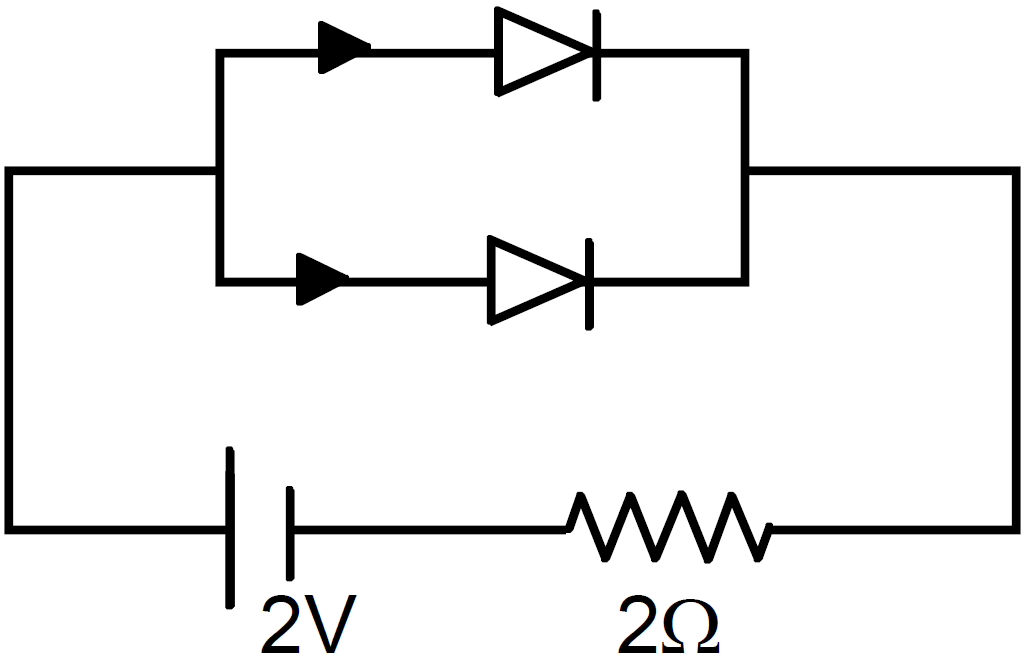
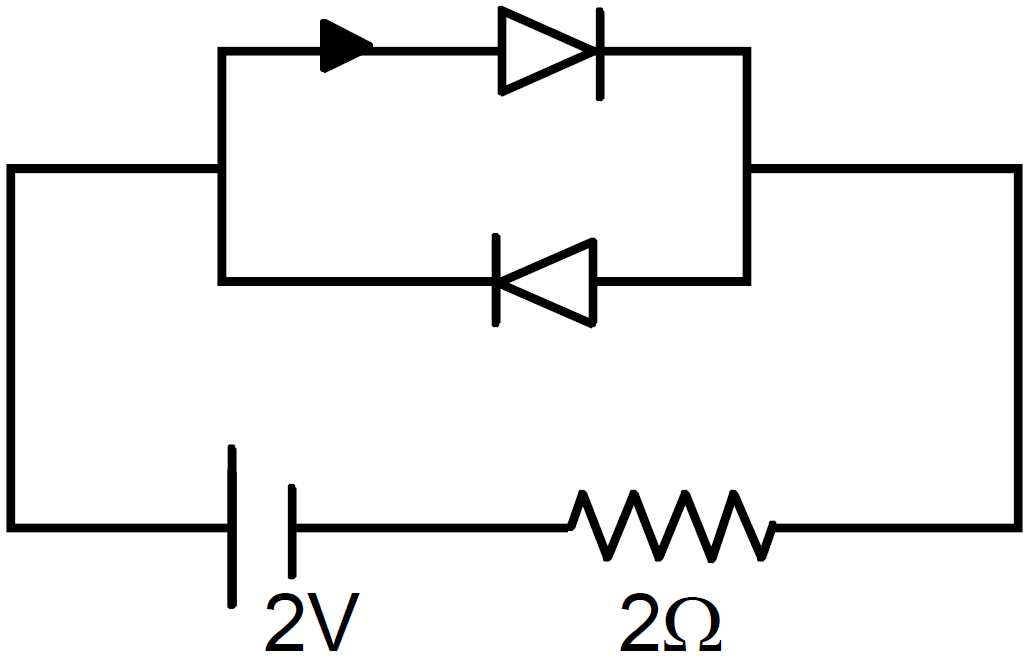
Find the currents through the resistances in the circuits shown in figure.
Answer
  1. Since both the diodes are forward biased net resistance = 0


$\text{i}=\frac{2\text{V}}{2\Omega}=1\text{A}$
  1. One of the diodes is forward biased and other is reverse biase.
Thus the resistance of one becomes $\infty.$


$\text{i}=\frac{2}{2+\infty}=0\text{A}$

Both are forward biased.

Thus the resistance is 0.


$\text{i}=\frac{2}{2}=1\text{A}.$

One is forward biased and other is reverse biased.

Thus the current passes through the forward biased diode.


$\therefore\text{i}=\frac{2}{2}=1\text{A}.$
View full question & answer
Question 145 Marks
When an electron goes from the valence band to the conduction band in silicon, its energy is increased by 1.1eV. The average energy exchanged in a thermal collision is of the order of kT which is only 0.026eV at room temperature. How is a thermal collision able to take some of the electrons from the valence band to the conduction band?
Answer
Fermi level: it is the energy level occupied by the highest energy electron.
In an extrinsic semiconductor for example in n-type semiconductor, fermi level lies close to the conduction band so it needs a very small amount of energy to excite the electron from fermi level to conduction band. This energy is comparable to the thermal excitation energy. So even at room temperature, these semiconductors can conduct. For a p-type semiconductor, fermi level lies close to valence bane because here conduction takes place majorly via holes. So by the thermal excitation, a bond is broken and an electron hole pair is created. Out of this, hole comes to the valence band for conduction or equivalently an electron goes to the conduction band. In an intrinsic semiconductor, no impurity is doped so fermi level lies at the centre of band gap. Here only few electrons get sufficient energy via repeated thermal collisions to jump from the fermi level to the conduction band. Hence the conductivity of intrinsic semiconductor is less as compared to extrinsic semiconductor.
View full question & answer