Questions

5 Marks Questions

🎯

Test yourself on this topic

10 questions · timed · auto-graded

Question 15 Marks
Divide $15\text{y}^4+16\text{y}^3+\frac{10}{3}\text{y}-9\text{y}^2-6\text { by }3\text{y}-2.$ Write down the coefficients of the terms in the quotient.
Answer
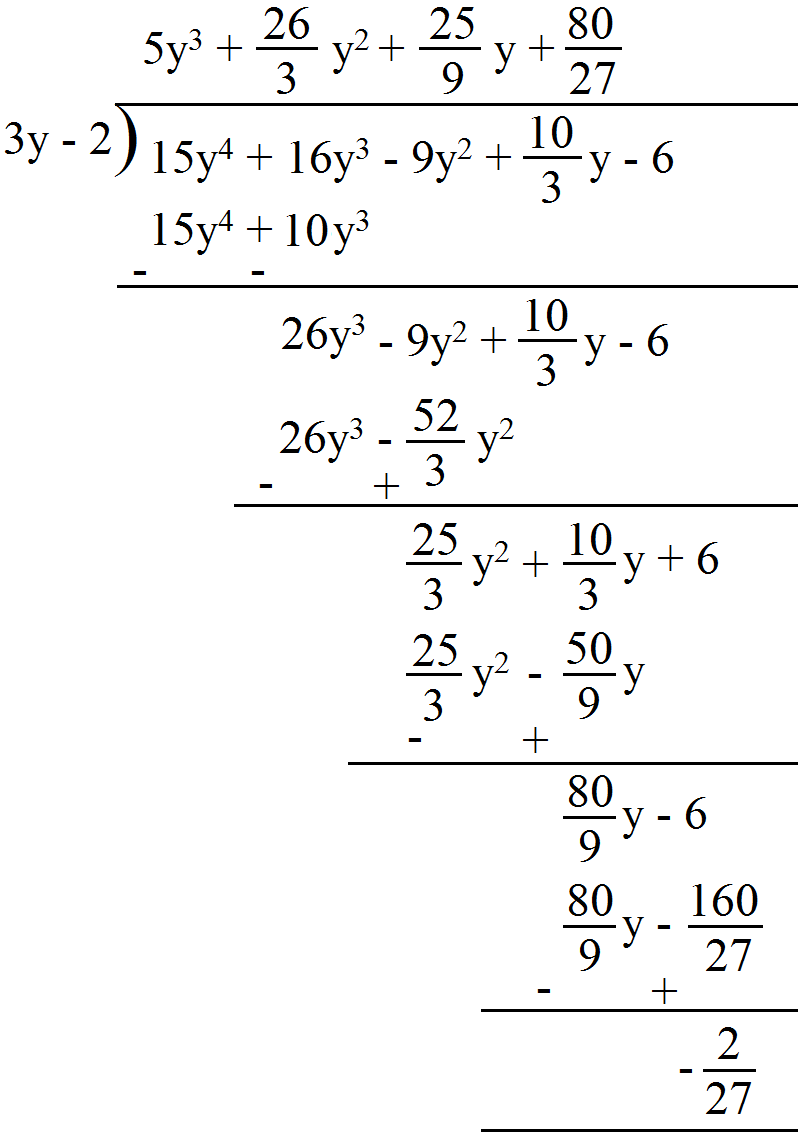
$\therefore$ Quotient $=5\text{y}^3+\Big(\frac{26}{3}\Big)\text{y}^2+\Big(\frac{25}{9}\Big)\text{y}+\Big(\frac{80}{27}\Big)$
Remainder $=\Big(\frac{-2}{27}\Big)$
Coefficient of $\text{y}^3=5$
Coefficient of $\text{y}^2=\Big(\frac{26}{3}\Big)$
Coefficient of $\text{y}=\Big(\frac{25}{9}\Big)$
Constant $=\Big(\frac{80}{2}\Big)$
View full question & answer
Question 25 Marks
Verify the division algorithm i.e., Dividend = Divisor $\times $ Quotient + Remainder, in the following. Also write the quotient and remainder.
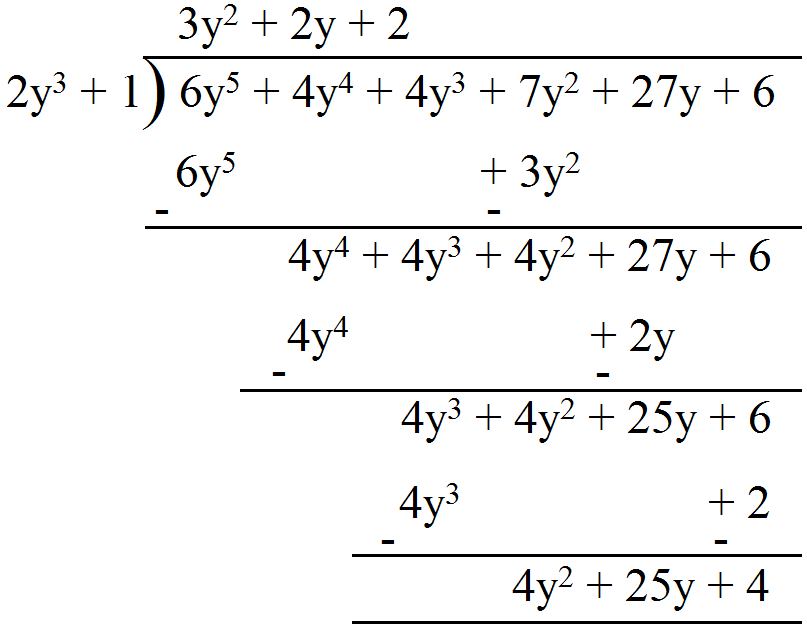
Dividend: $6y^5+ 4y^4+ 4y^3+ 7y^2+ 27y + 6$
Divisor: $2y^3+ 1$
Answer


Quotient $= 3y^2+ 2y + 2$
Remainder $= 4y^2+ 25y + 4$
Divisor $= 2y^3+ 1$
Divisor $\times $ Quotient + Remainder $= (2y^2+ 1)(3y^2+ 2y + 2) + 4y^2+ 25y + 4$
$ =6 y^5+4 y^4+4 y^3+3 y^2+2 y+2+4 y^2+25 y+4 $
$ =6 y^5+4 y^4+4 y^3+7 y^2+27 y+6 $
= Dividend
Divisor $\times $ Quotient + Remainder = Dividend
Hence verified.
View full question & answer
Question 35 Marks
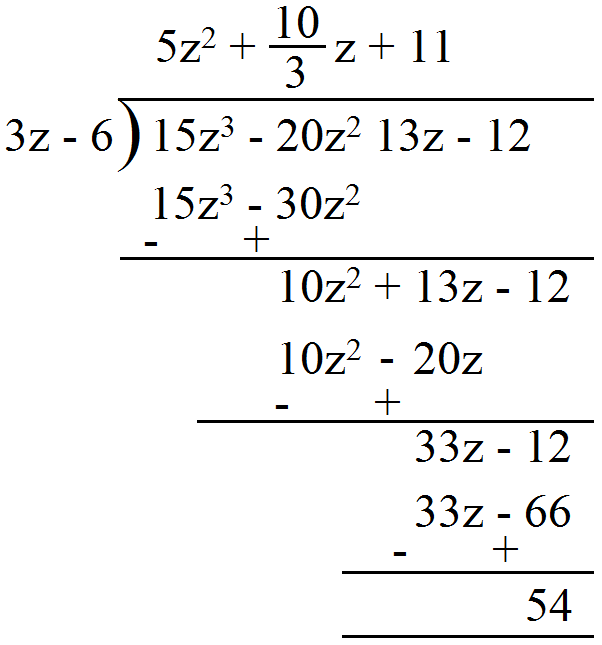
Verify the division algorithm i.e., Dividend = Divisor $\times $ Quotient + Remainder, in the following. Also write the quotient and remainder.
Dividend: $15z^3- 20z^2+ 13z - 12$
Divisor: $3z - 6$
Answer

Quotient $=5\text{z}^2+\frac{10}{3}\text{z}+11$
Remainder $=54$ Divisor $\times $ Quotient + Remainder $=(3\text{z}-6)\Big(5\text{z}^2+\frac{10}{3}\text{z}+11\Big)+54$
$=15\text{z}^3+10\text{z}^2+33\text{z}-30\text{z}^2-20\text{z}-66+54$
$15\text{z}^3-20\text{z}^2+13\text{z}-12$
$=\text{Dividend}$
Thus, Divisor $\times $ Quotient + Remainder = Dividend
Hence verified.
View full question & answer
Question 45 Marks
Verify the division algorithm i.e., Dividend = Divisor $\times $ Quotient + Remainder, in the following.
Also write the quotient and remainder.
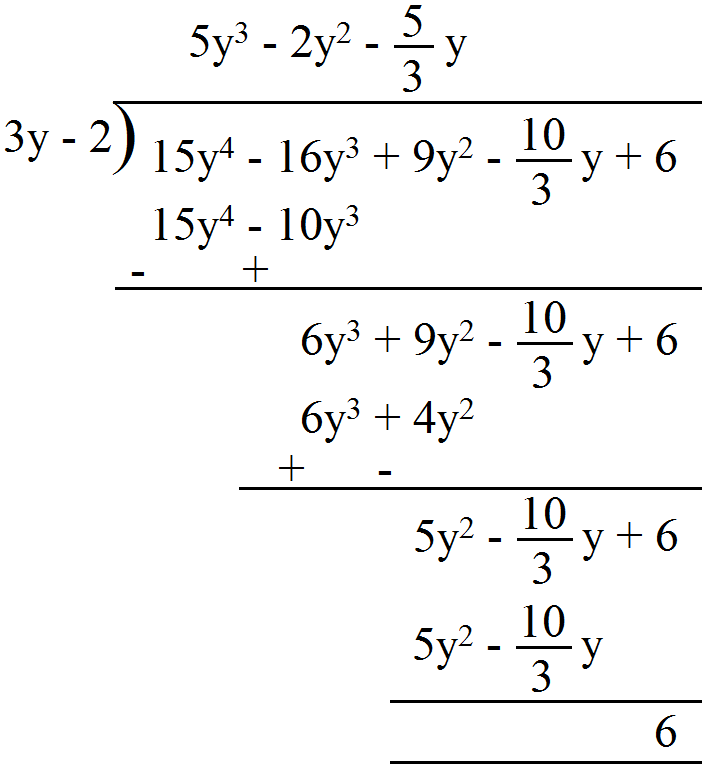
Dividend: $15\text{y}^4-16\text{y}^3+9\text{y}^2-\frac{10}{3}\text{y}+6$
Divisor: $3\text{y}-2$
Answer

Quotient $5\text{y}^3-2\text{y}^2+\frac{5}{3}\text{y}$
Remainder $=6$
Divisor $=3\text{y}-2$ Divisor $\times $ Quotient + Remainder
$=\Big(3\text{y}-2\Big)\Big(5\text{y}^3-2\text{y}^2+\frac{5}{3}\text{y}\Big)+6$
$156\text{y}^4-6\text{y}^3+5\text{y}^3+4\text{y}^2-\frac{10}{3}\text{y}+6$
$=15\text{y}^4-16\text{y}^3+9\text{y}^2-\frac{10}{3}\text{y}+6$
$=\text{Dividend}$
Divisor $\times $ Quotient + Remainder = Dividend Hence verified.
View full question & answer
Question 55 Marks
Find whether, or not the first polynomial is a factor of the second:
$\frac{3\text{y}^3+5\text{y}^2+5\text{y}+2}{\text{y}-2}$
Answer
$\frac{3\text{y}^3+5\text{y}^2+5\text{y}+2}{\text{y}-2}$
$=\frac{3\text{y}^2(\text{y}-2)+11\text{y}+27(\text{y}-2)+56}{\text{y}-2}$
$=\frac{(\text{y}-2)\big(3\text{y}+11\text{y}+27\big)+56}{\text{y}-2}$
$=\Big(3\text{y}^2+11\text{y}+27\Big)+\frac{56}{\text{y}-2}$
Therefore, $(y - 2)$ is not a factor of $3y^3+ 5y^2+ 5y + 2$
View full question & answer
Question 65 Marks
Verify the division algorithm i.e., Dividend = Divisor $\times $ Quotient + Remainder, in the following. Also write the quotient and remainder.
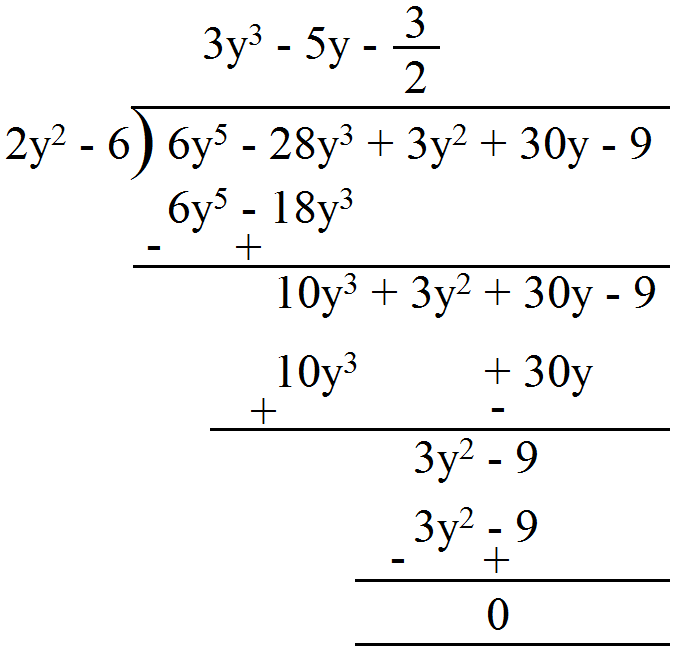
Dividend: $6y^5- 28y^2+ 30y - 9$
Divisor: $2y^2- 6$
Answer

Quotient $=3\text{y}^3-5\text{y}+\frac{3}{2}$
Remainder $=0$
Divisor $=2\text{y}^2-6$
Divisor $\times $ Quotient + Remainder = $\Big(2\text{y}^2-6\Big)\Big(3\text{y}^3-5\text{y}+\frac{3}{2}\Big)+0$
$=6\text{y}^5-10\text{y}^3+3\text{y}^2-18\text{y}^3+30\text{y}-9$
$=6\text{y}^5-28\text{y}^3+3\text{y}^2+30\text{y}-9$
$=\text{Dividend}$ Thus, Divisor $\times $ Quotient + Remainder = Dividend Hence verified.
View full question & answer
Question 75 Marks
Verify the division algorithm i.e., Dividend = Divisor $\times $ Quotient + Remainder, in the following. Also write the quotient and remainder.
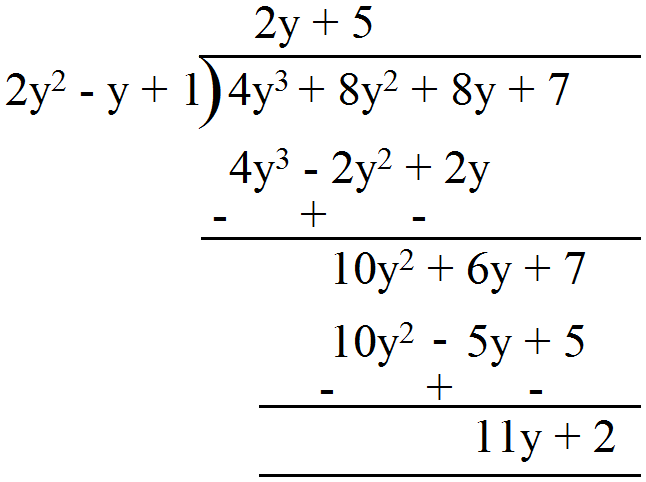
Dividend: $4y^3+ 8y + 8y^2+ 7$
Divisor: $2y^2- y + 1$
Answer


$  \text { Quotient }=2 y+5 $
$ \text { Remainder }=11 y+2 $
$ \text { Divisor }=2 y^2-y+1 $
$\text { Divisor } \times \text { Quotient }+ \text { Remainder }=\left(2 y^2-y+1\right)(2 y+5)+11 y+2 $
$=4 y^3+10 y^2-2 y^2-5 y+2 y+5+11 y+2 $
$ =4 y^3+8 y^2+8 y+7 $
= Dividend
Divisor × Quotient + Remainder = Dividend
Hence verified.
View full question & answer
Question 85 Marks
Find whether, or not the first polynomial is a factor of the second: $\frac{8\text{y}^2-2\text{y}+1}{4\text{y}+1}$
Answer
$\frac{8\text{y}^2-2\text{y}+1}{4\text{y}+1}$
$=\frac{2\text{y(4}\text{y+1)}-1(4\text{y}+1)+2}{4\text{y}+1}$
$=\frac{(4\text{y}+1)(2\text{y}-1)+2}{4\text{y}+1}$
$=2\text{y}-1+\frac{2}{4\text{y}+1}$
$=\frac{\text{x}^2-5\text{x}+6}{\text{x}-3}$
$=\frac{\text{x}^2-3\text{x}-2\text{x}+6}{\text{x}-3}$
$=\frac{\text{x}(\text{x}-3)-2(\text{x}-2)}{\text{x}-3}$
$=\frac{(\text{x}-3)(\text{x}-2)}{\text{x}-3}=\text{x}-2$
Therefore, remainder $= 2 (4y + 1)$ is not a factor of $8y^2- 2y + 1$
View full question & answer
Question 95 Marks
Using division of polynomials, state whether.
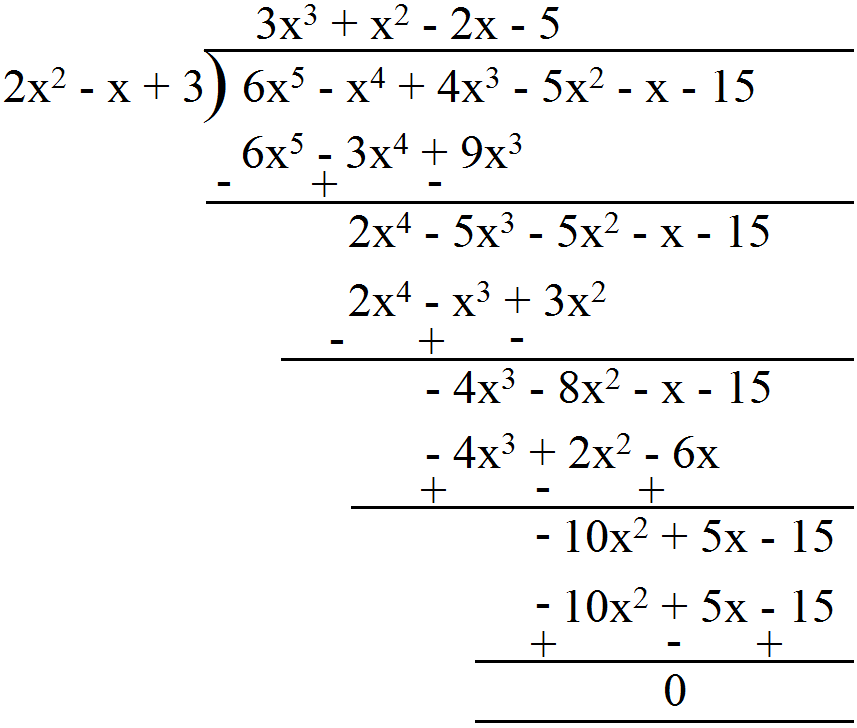
$2 x^2-x+3$ is a factor of $6 x^5-x^4+4 x^3-5 x^2-x-15$
Answer


Remainder is zero. Therefore, $2 x^2-x+3$ is a factor of $6 x^5-x^4+4 x^3-5 x^2-x-15$
View full question & answer
Question 105 Marks
Verify the division algorithm i.e., Dividend = Divisor $\times $ Quotient + Remainder, in the following. Also write the quotient and remainder.
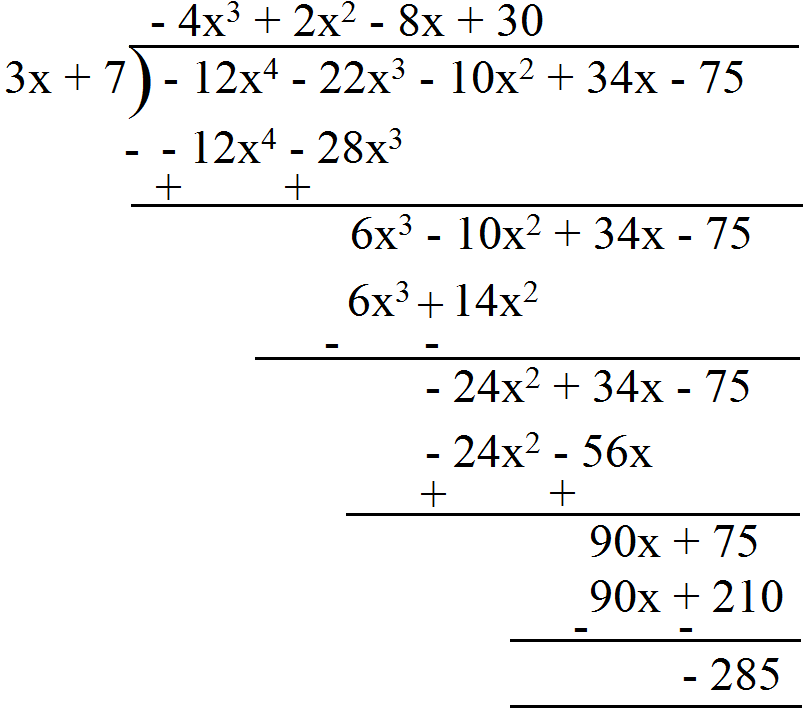
Dividend: $34x - 22x^3- 12x^4- 10x^2- 75$
Divisor: $3x + 7$
Answer

Quotient $= -4x^3+ 2x^2- 8x + 30$
Remainder $= -285$
Divisor $= 3x + 7$ Divisor × Quotient + Remainder $= (3x + 7)(-4x^3+ 2x^2- 8x + 30) - 285$
$= -12x^4+ 6x^3- 24x^2+ 90x - 28x^3+ 14x^2- 56x + 210 - 285$
$= -12x^4- 22x^3- 10x^2+ 34x - 75$
= Dividend Divisor $\times $ Quotient + Remainder = Dividend Hence verified.
View full question & answer