Questions

3 Marks Question

Take a timed test

39 questions · self-marked practice — reveal the answer and mark yourself.

Question 13 Marks
Name the three basic tissue systems in the flowering plants. Give the tissue names under each system.
Answer
Tissue System
Tissues present
Epidermal tissue system.
Epidermis, trichomes, hairs, stomata.
Ground tissue system.
Parenchyma, collenchyma, sclerenchyma, mesophyll.
Vascular tissue system.
Xylem, phloem, cambium.
View full question & answer
Question 23 Marks
Cut a transverse section of young stem of a plant from your school garden and observe it under the microscope. How would you ascertain whether it is a monocot stem or a dicot stem? Give reasons.
Answer
Vascular bundles in dicot stem are arranged in a ring whereas in monocot stem vascular bundles are scattered throughout the ground tissue. On the basis of arrangement of vascular bundles it can be ascertained whether the young stem is dicot or monocot. Besides undifferentiated ground tissue, sclerenchymatous hypodermis, oval or circular vascular bundles with Y shaped xylem are other differentiating features of monocot stem.
View full question & answer
Question 33 Marks
What is periderm? How does periderm formation take place in the dicot stems?
Answer
Phelloderm, phellogen and phellem together constitute the periderm. Periderm is protective in function. Dicot stems produce cork cambium or phellogen in the outer cortical cells. Phellogen cells divide on both the outer side as well as the inner side to form secondary tissues. The secondary tissue produced on the inner side of the phellogen is called secondary cortex or phelloderm. On the outer side phellogen produces cork or phellem.
View full question & answer
Question 43 Marks
Cork cambium forms tissues that form the cork. Do you agree with this statement? Explain.
Answer
When secondary growth occurs in the dicot stem and root, the epidermal layer gets broken. There is a need to replace the outer epidermal cells for providing protection to the stem and root from infections. Therefore, the cork cambium develops from the cortical region. It is also known as phellogen and is composed of thin-walled rectangular cells. It cuts off cells toward both sides. The cells on the outer side get differentiated into the cork or phellem, while the cells on the inside give rise to the secondary cortex or phelloderm. The cork is impervious to water, but allows gaseous exchange through the lenticels. Phellogen, phellem, and phelloderm together constitute the periderm.
View full question & answer
Question 53 Marks
Plants require water for their survival. But when watered excessively, plants die. Discuss.
Answer
Plants require water in the process of synthesis of carbohydrates (photosynthesis) illustrated by the following equation:
$6 \mathrm{CO}_2+12 \mathrm{H}_2 \mathrm{O}=\mathrm{C}_6 \mathrm{H}, 2 \mathrm{O}_6+6 \mathrm{H}_2 \mathrm{O}+6 \mathrm{O}_2$
 Hence, water is necessary for their survival. Plants die when watered in excess, because excess water replaces and removes the air trapped between the soil particles.
So, plant roots do not get $\mathrm{O}_2$ for respiration. Once, root cells die, water and mineral absorption is stopped and this leads to gradual death of the plant.
View full question & answer
Question 63 Marks
Give atleast three points of differences between spring wood and autumn wood.
Answer
 
Spring Wood
Autumn Wood
1
The wood formed during favourable growth season (spring and summer), is called spring wood.
The wood formed during unfavourable growth periods (winter and autumn), is called autumn wood.
2
The cambium is very active and the secondary xylem vessels are larger in dimension.
The cambium is less active and the wood produced has vessels of narrow dimension.
3
It is lighter in colour.
It is darker in colour.
4
It has a lower density.
It has a higher density.
View full question & answer
Question 73 Marks
A particular plant tissue is responsible for a particular task. It is similar to which of the following? How does specialization help in making our work easy?
  1. A particular teacher is responsible for teaching a particular subject in school.
  2. A particular student is good at a certain subject only.
  3. Some students are good at many subjects.
Answer
  1. A particular teacher is responsible for teaching a particular subject in school.
Explanation:
Specialization means expertise in a particular field or a particular task. A person cannot do everything. Someone may have basic idea about most of the things, but the person can be an expert in some selected things only. Let us take the example of a biology teacher. The biology teacher must be having good knowledge of other science subjects; like physics and chemistry but her expertise is biology. She may be able to clear some confusions of a student in physics and chemistry, but when it comes to biology; she can be the best person to give conceptual learning.
View full question & answer
Question 83 Marks
Answer the following questions with reference to the anatomy of dicot stem
  1. Type of cells present in the hypodermis.
  2. Why is the endodermis layer referred to as starch sheath?
  3. Why are the vascular bundles present here referred to as 'open' and 'conjoint'?
Answer
  1. Collenchyma.
  2. Since the endodermal cells are rich in starch grains, it is referred to as starch sheath.
  3.  
  • The vascular bundle is referred to as 'open'; because it possesses cambium that has the ability to produce secondary xylem and secondary phloem tissues, i.e. secondary growth.
  • The vascular bundle is referred to as 'conjoint' because the xylem and phloem are situated along the same radius in the vascular bundle.
View full question & answer
Question 93 Marks
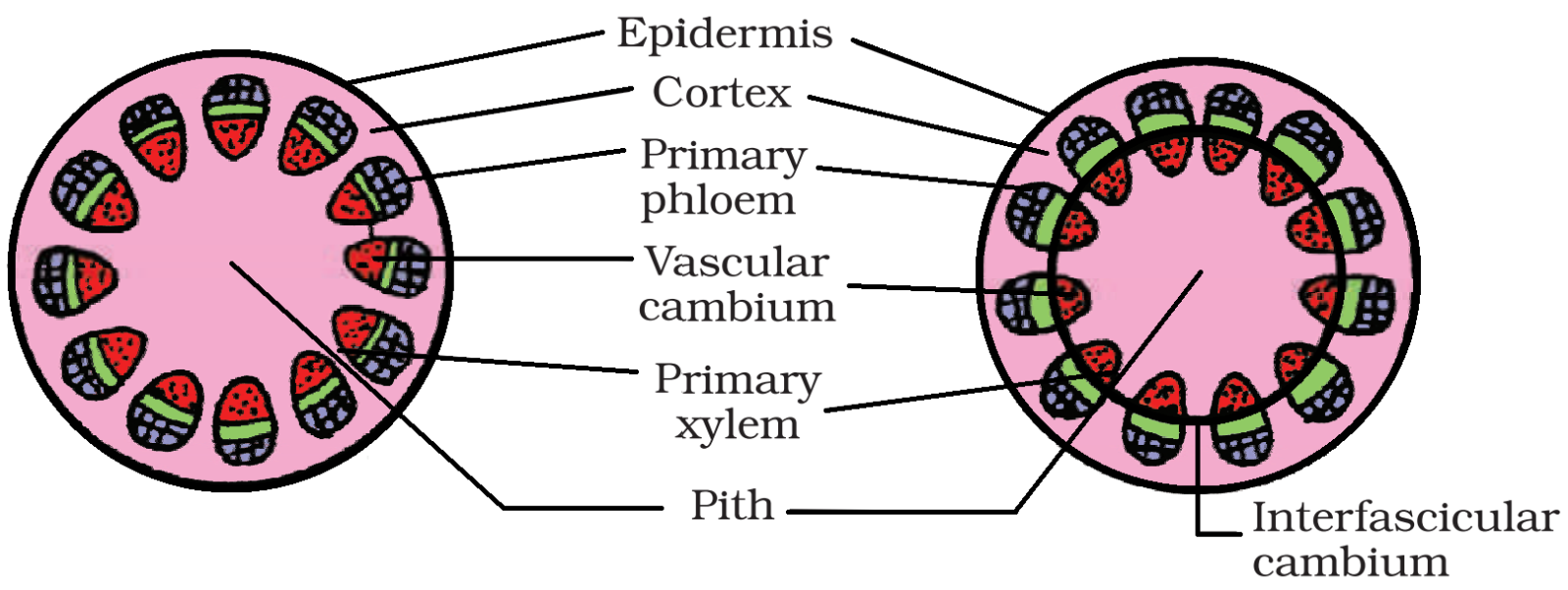
Explain the process of formation of vascular cambium.
Answer
The portion of conjunctive parenchyma or tissue present below the phloem bundles dedifferentiates to form brick-shaped cells of vascular cambium. The process of dedifferentiation of conjunctive parenchyma spreads laterally between xylem and phloem bundles. The portion of the pericycle in contact with protoxylem also becomes meristematic. It produces a complete continuous wavy ring of vascular cambium that passes from below the phloem bundles to above the xylem bundles.
View full question & answer
Question 103 Marks
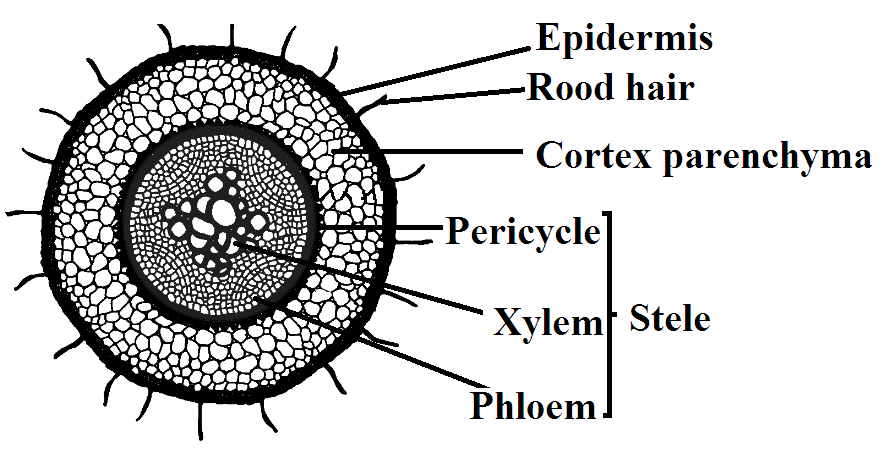
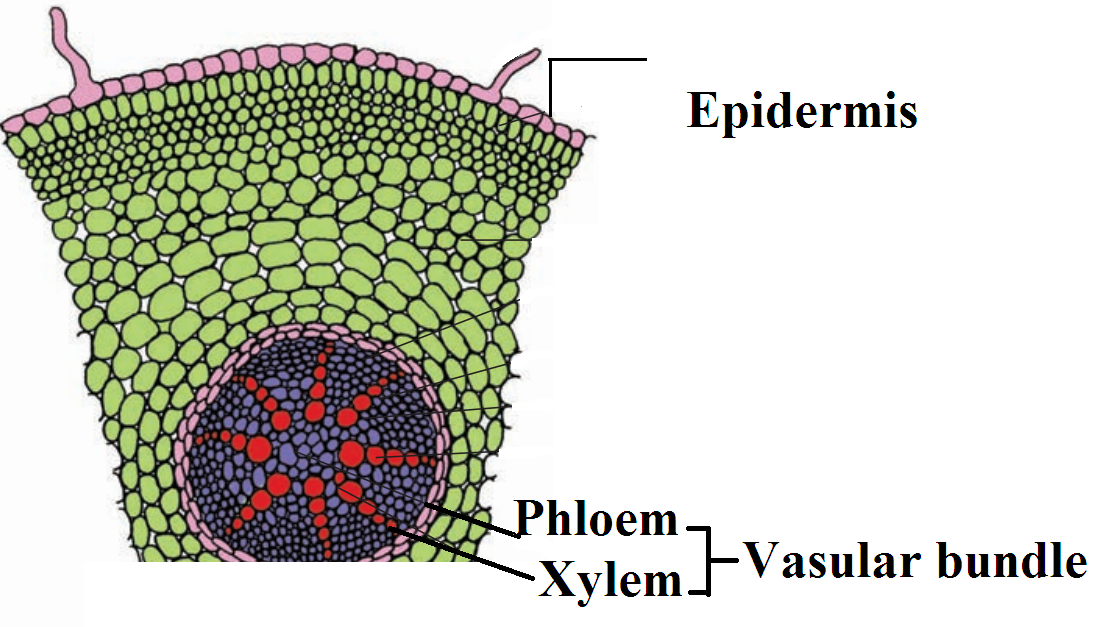
Answer the following with reference to the anatomy of dicot root:
  1. Where is pericycle located?
  2. How are xylem vessels arranged?
  3. What do you call such an arrangement?
  4. Which type of cells constitute the cortex?
Answer
(a)Pericycle is located just inner to the endodermis. (b)The protoxylem elements are towards the outer surface, while the metaxylem elements are found towards the centre/ pith.(c)Xylem is exarch.
(d)Parenchyma cells constitute the cortex.
View full question & answer
Question 113 Marks
If one debarks a tree, what parts of the plant is being removed?
Answer
Debark means removal of bark. In common language and economic botany all dead cells lying outside phellogen are collectively called bark [In anatomical usage, bark includes all tissues outside vascular cambium. It is then differentiated into outer bark or rhytidome (consisting of dead cells) and inner bark (or living cells, i.e. periderm and secondary phloem)]. The outer layers of the bark are constantly peeled off on account of formation of new secondary vascular tissues in the interior.
View full question & answer
Question 123 Marks
Give reason for each of the following:
  1. The vascular bundles of an isobilateral leaf are near similar in size, except that in the midrib.
  2. Heart wood is dark brown in colour.
  3. Cells of phellem/cork are impervious to water.
  4. Quantity of secondary xylem produced is more than the quantity of secondary phloem during secondary growth.
  5. Phellogen is a secondary meristem.
Answer
  1. An isobilateral leaf shows parallel venation, where the veins except the main/mid vein are of same thickness; as the size of vascular bundles depends on the thickness of the veins, they are near similar in size.
  2. Heart wood is dark brown in colour due to accumulation of organic compounds like tannin, resin, oils, gums, and aromatic substances.
  3. Cells of phellem are suberised; hence, are impervious to water.
  4. The cambium is more active on its inner surface than the outer surface; hence, more secondary xylem than secondary phloem is produced.
  5. Phellogen differentiates from the outer layers of cortex during secondary growth; hence, it is a secondary meristem.
View full question & answer
Question 133 Marks
What do hardwood and softwood stand for?
Answer
Hardwood is the name of dicot wood. The wood contains vessels and is therefore called porous wood. The content of the tracheids is very low (less than 5%). Wood or xylem fibers are abundant. The wood is comparatively difficult to work with. Softwood is the name of gymnospermous wood. This wood is devoid of vessels therefore, also called non- porous wood. The content of tracheids can be 90-95%. Wood or xylem fibers are fewer and the wood is easy to work with.
View full question & answer
Question 143 Marks
Is Pinus an evergreen tree? Comment.
Answer
Yes, Pinus trees are evergreen, coniferous resinous trees. The leaves in gymnosperms are well-adapted to withstand extremes of temperature, humidity and wind. In conifers, the needle-like leaves reduce the surface area. Their thick cuticle and sunken stomata also help to reduce water loss. Unlike deciduous plants, Pinus do not shed their leaves so it is an evergreen tree.
View full question & answer
Question 153 Marks
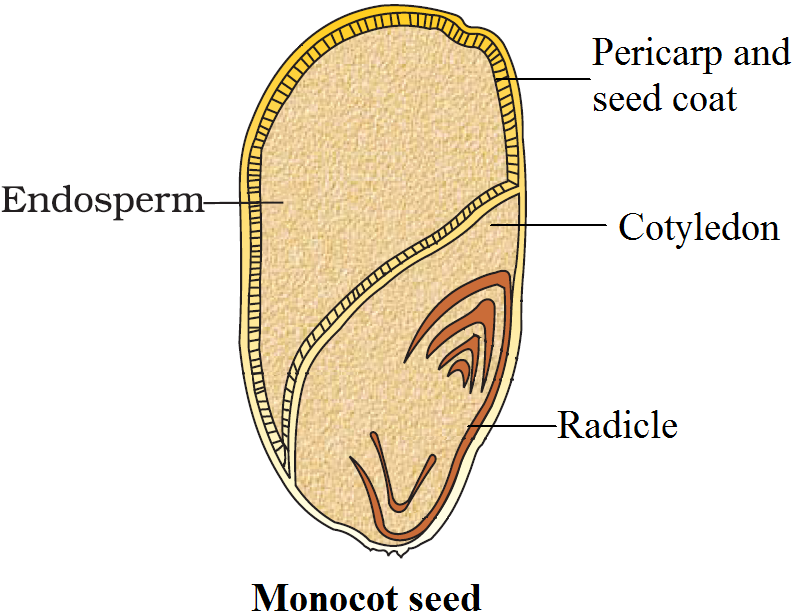
What are the main structures in a monocot seeds? Describe with the help of suitable diagram.
Answer
Structure of Monocotyledonous Seed:
  1. Generally, monocotyledonous seeds are endospermic but some as in orchids are non-endospermic.
  1. In the seeds of cereals such as maize the seed coat is membranous and generally fused with the fruit wall.
  2. The endosperm is bulky and stores food. The outer covering of endosperm separates the embryo by a proteinous layer called aleurone layer.
  3. The embryo is small and situated in a groove at one end of the endosperm. It consists of one large and shield shaped cotyledon known as scutellum and a short axis with a plumule and a radicle.
  4. The plumule and radicle are enclosed in sheaths which are called coleoptile and coleorhiza respectively.
View full question & answer
Question 163 Marks
Answer the following with reference to the anatomy of monocot stem How are the vascular bundles arranged? How are the xylem vessels arranged in each bundle? What do you call such an arrangement? Vascular bundles are closed ones. What type of tissue is lacking in them?
Answer
  1. The vascular bundles are scattered in the ground tissue. Protoxylem is towards the inner side and meta xylem is towards the outside; there is a protoxylem lacuna just beneath the protoxylem element.
  2. Xylem is endarch.
  3. Cambium is lacking.
View full question & answer
Question 173 Marks
How the arrangement of vascular bundles in monocots differs from dicots?
Answer
In dicots, cambium is present between phloem and xylem. These types of vascular bundles are capable to form secondary xylem and phloem tissues. These are known as open vascular bundles. In monocots, vascular bundle have no cambium present hence, they do not form secondary tissues. These are known as closed vascular tissues.
View full question & answer
Question 183 Marks
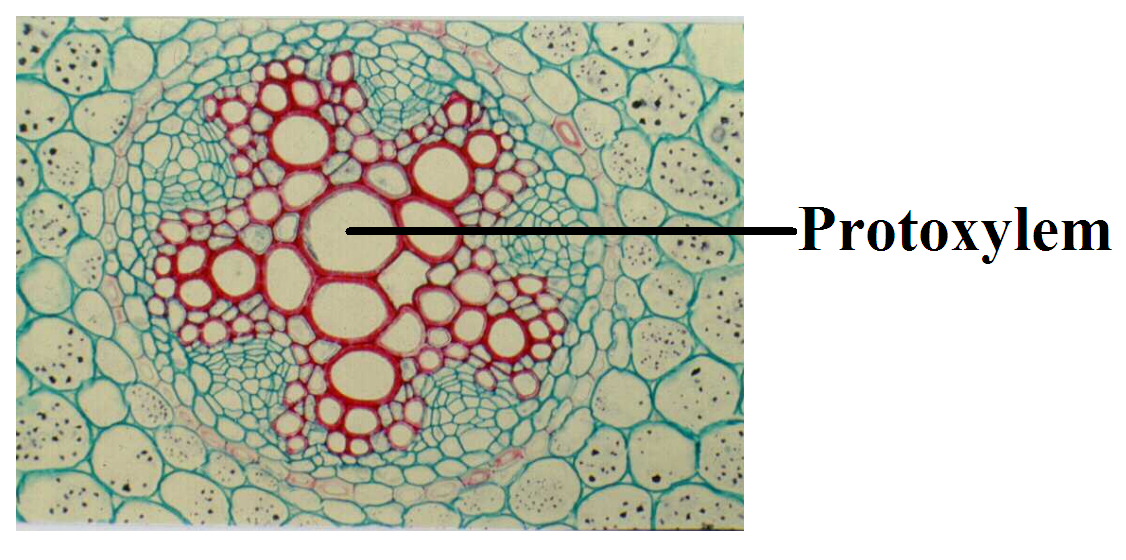
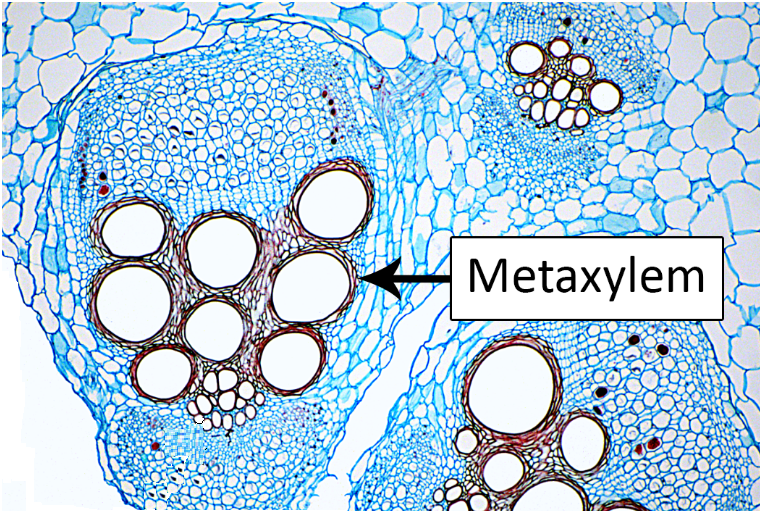
Distinguish between the following: Protoxylem and metaxylem.
Answer
Protoxylem
Metaxylem
It is the first or earlier formed xylem. Matures before the growth and differentiation of plant organs. Protoxylem elements are smaller in diameter. Tyioses absent in protoxylem vessels. Fibres are absent.
It is the later formed xylem. Matures after the growth and differentiation of plant organs. Metaxylemd elements are broader and greater in diameter. Tyioses are generally present. Fibres may be present.
View full question & answer
Question 193 Marks
The bulk of a plant is made up of dead tissues so that physical strength can be attained and resources can be utilized in a better way. What lesson can be learnt from this strategy of plants? How does focusing on something help us in our life?
  1. We should learn to save money so that it can be utilized for better purposes.
  2. Instead of wasting our energy on trivial matters, we should focus on more E productive works.
  3. Physical exercise is good for a strong body, while mental exercise is good for a strong mind.
Answer
  1. Instead of wasting our energy on trivial matters, we should focus on more E productive works.
Explanantion:
Focus is very important in life. As a student, we should focus on our study goals and on our career goals. The age of an eleventh class student is the age where foundation of a good future is laid. If someone develops many distractions and indulges in small pleasures of life, he may lose focus from his study and his career goal. Instead, if someone keeps a focus on study and career goal; the future is easily taken care of. Once this phase is over, it would never come back and we cannot undo the wrongs which were done in the past.
View full question & answer
Question 203 Marks
Write the characteristics of heartwood and sapwood.
Answer
  1. Heartwood: It is secondary xylem with highly lignified walls. In old trees, considerable region of secondary xylem is dark brown due to accumulation of tannin, resins, oils, gums and other organic materials. The substances make is heart and resistant to microbes and insects.
  2. Sapwood: Sapwood is the peripheral region of secondary xylem which is lighter in colour and involved in conduction of water and minerals from root to leaf.
View full question & answer
Question 213 Marks
An abnormal type of secondary growth is called anomalous secondary growth.
  1. In which plants it occur?
  2. How does it occur?
Answer
  1. It occurs in some arborescent monocots (e.g., Dracaena, Yucca, Agave) and storage roots (e.g., beet, sweet potato).
  2. In arborescent monocot stems, a secondary cambium grows in hypodermal region. It later forms conjunctive tissue and patches of meristematic cells. The meristematic patches grow into secondary vascular bundles. Anomalous vascular bundles also occur in cortex (e.g., Nyctanthes) and pith (e.g., Boerhavia). In storage roots (e.g., beet), accessory cambial rings appear on the outside of endodermis. They produce less secondary xylem, but more secondary phloem.
View full question & answer
Question 223 Marks
Answer the following with reference to the anatomy of monocot stem:
  1. How are the vascular bundles arranged?
  2. How are the xylem vessels arranged in each bundle?
  3. What do you call such an arrangement?
  4. Vascular bundles are closed ones. What type of tissue is lacking in them?
Answer
  1. The vascular bundles are scattered in the ground tissue. Protoxylem is towards the inner side and meta xylem is towards the outside; there is a protoxylem lacuna just beneath the protoxylem element.
  2. Xylem is endarch.
  3. Cambium is lacking.
View full question & answer
Question 233 Marks
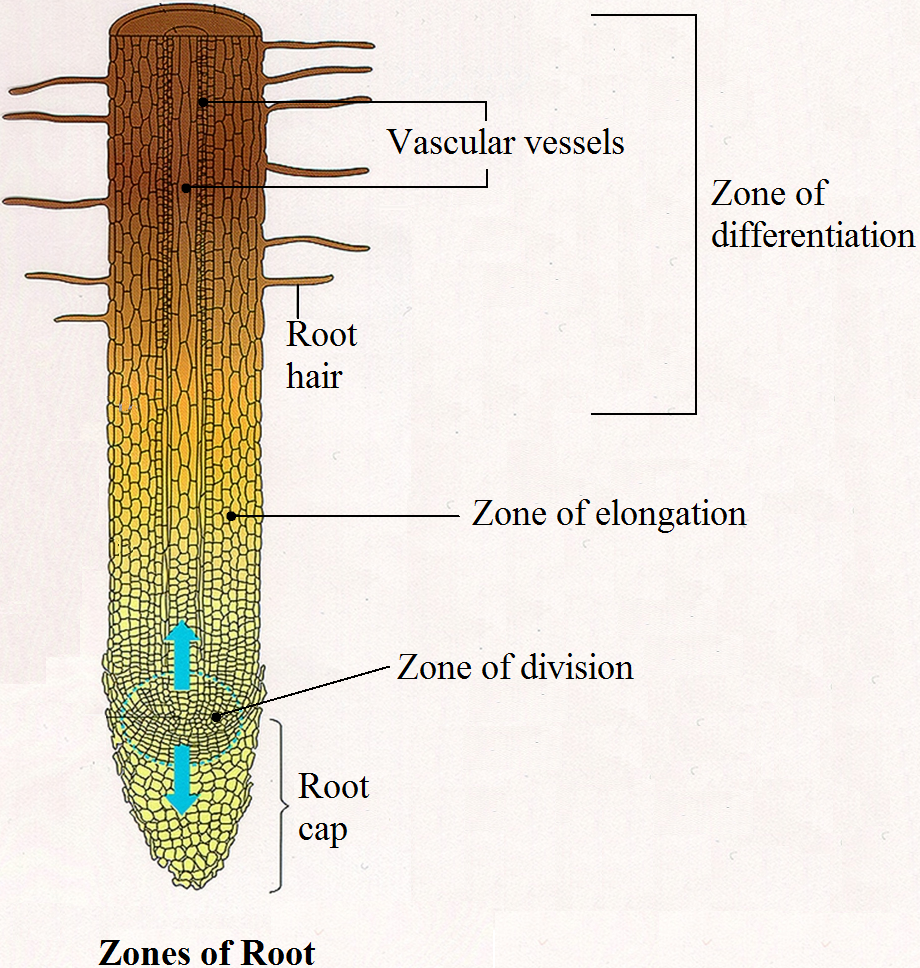
With the help of proper diagram describe various regions of root.
Answer
Regions of the Root:
  1. Root Cap: The root is covered at the apex by a thimble-like structure called the root cap. It protects the tender apex of the root as it makes its way through the soil.
  2. Region of Elongation: A few millimetres above the root cap is the region of meristematic activity. The cells of this region are very small, thin-walled and with dense protoplasm. They divide repeatedly. The cells proximal to this region undergo rapid elongation and enlargement and are responsible for the growth of the root in length. This region is called the region of elongation.
  1. Region of Maturation: The cells of the elongation zone gradually differentiate and mature. Hence, this zone, proximal to region of elongation, is called the region of maturation. From this region some of the epidermal cells form very fine and delicate, thread-like structures called root hairs. These root hairs absorb water and minerals from the soil.
View full question & answer
Question 243 Marks
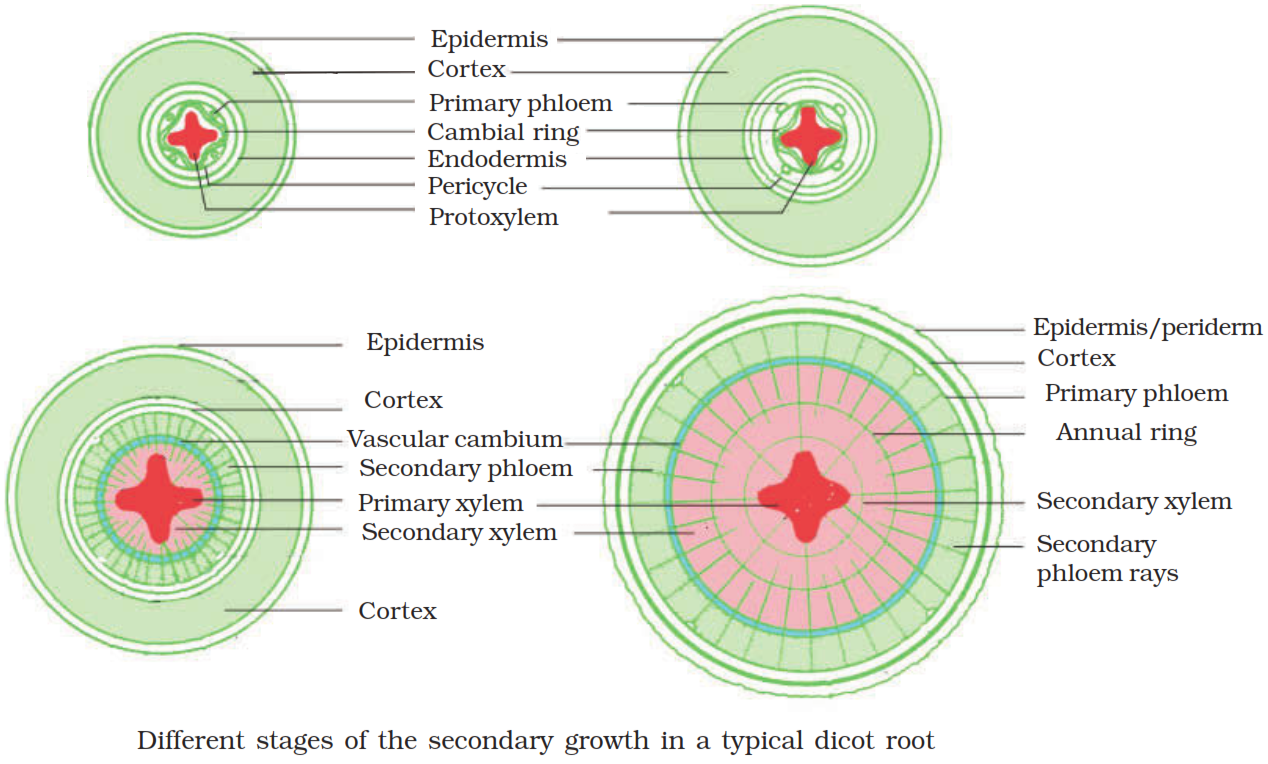
How is secondary growth accomplished in dicot roots? Explain with the help of schematic diagrams.
Answer
  • The secondary growth in dicot roots starts with the appearance of cambium in the stelar region.
  • The cambium originates from the cells located below the phloem groups and the pericycle cells lying opposite to the xylem groups.
  • Initially it is a complete and continuous wavy ring, but later becomes circular in outline.
  • The cells of cambium produce secondary xylem elements on its interior and secondary phloem on its outer side.
  • A cork cambium originates from the peripheral layers of cortex and it produces secondary cortex on its inner side and cork on its outer side.
View full question & answer
Question 253 Marks
Distinguish between the following: Interfasicular cambium and intrafasicular cambium.
Answer
Intra fascicular Cambium
Intre fascicular Cambium
Cambium present in between the primary xylem and primary phloem is called-intra fascicular cambium, as in dicot stems.
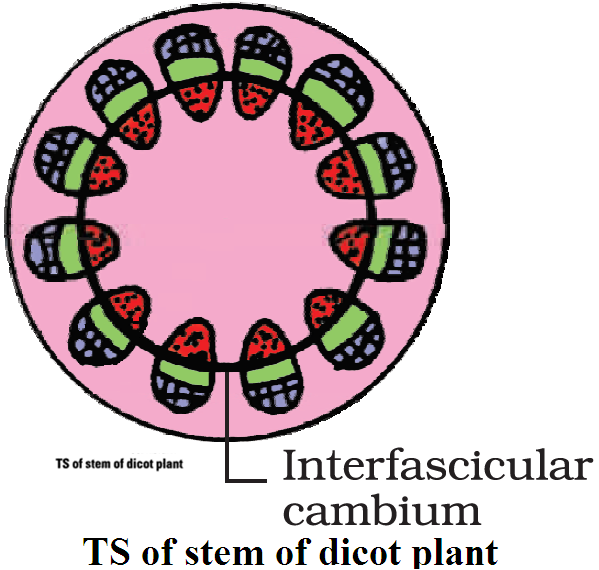
The cambium present in between the two vascular bundles making the cambium continuous and forming a complete ring of cambium is called interfascicularconbium.
View full question & answer
Question 263 Marks
Give atleast three points of differences between Heartwood and Sapwood.
Answer
 
Heart Wood
Sap Wood
1
It is the central core of wood formed after a certain years of secondary growth.
It is the peripheral part of the wood, formed after certain years of secondary growth.
2
It is composed of dead cells and darker in colour.
It is composed of living cells and lighter in colour.
3
It has no function in conduction.
It helps in conduction.
4
As it contains extractives (gums, resins, tannins, etc), it is more durable and resistant to attack by microbes and insects.
As it does not have these extractives, it is less durable and resistant to attack by insects and microbes.
View full question & answer
Question 273 Marks
Distinguish between the following: Stele and vascular bundle.
Answer
Stela
Vascular Bundle
Stele refers to conducting tissue or the central part of root or stem in plants. It comprises of vascul tissue, ground tissue and pith and limiting boundaries, i.e., endodermis and pericycle.
Vascular bundle comprises of vascular/ conducting tissues xylem and phloem. Sometimes cambium is also included as in dicots.
View full question & answer
Question 283 Marks
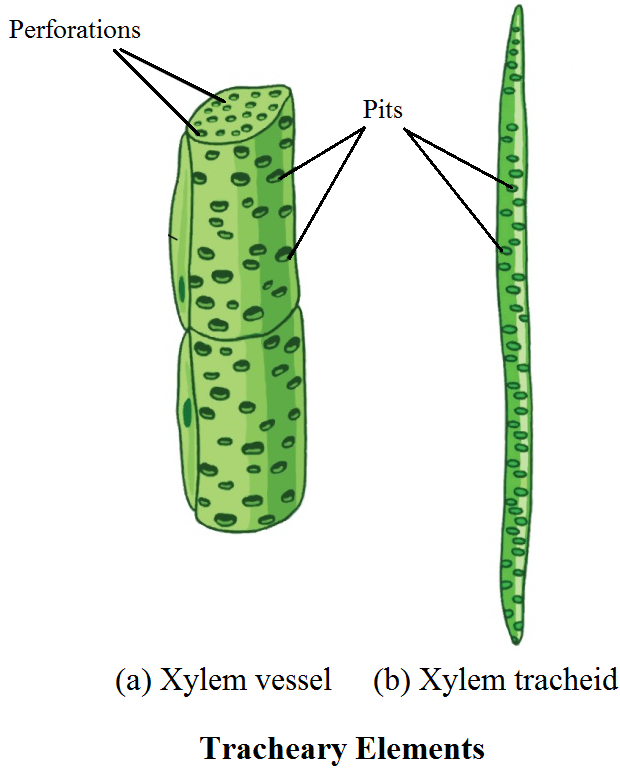
How are tracheids different from vessels found in angiosperms? Give a labelled sketch of each of them.
Answer
 
Xylem tracheids
Xylem vessel
1
They are elongated, tube-like, thick-walled (lignified) cells.
They are long tube-like structures formed of a number of vessel members.
2
They have tapering ends.
They have perforated end walls.
View full question & answer
Question 293 Marks
Which are called complex permanent tissues? Describe in detail.
Answer
The complex permanent tissues are made of more than one type of cells. They are of two types:
  1. Xylem.
  2. Phloem.
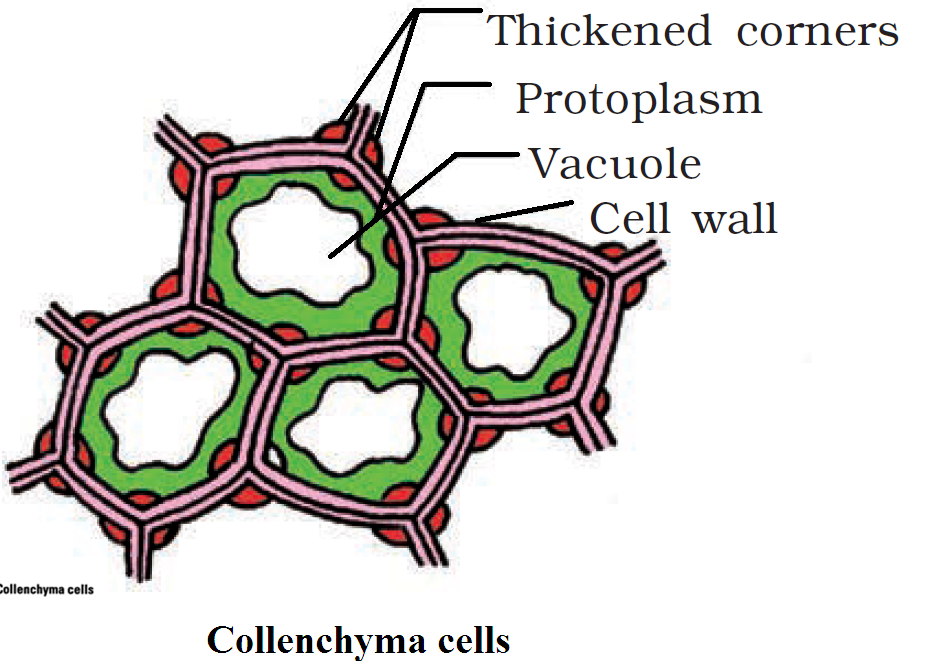
The characteristic features of collenchymatous tissues are listed below,
  1. It is present only in layer below the epidermis in dicotyledonous plants.
  2. It is found either as a homogeneous layer or in patches.
  3. Collenchyma consists of cells which are much thickened at the corners due to a deposition of cellulose, hemicellulose and pectin.
  4. The cells may be oval, spherical or polygonal and often contain chloroplasts.
  5. These cells assimilate food, when they contain chloroplasts.
View full question & answer
Question 303 Marks
What is the symmetry of a flower?
Answer
Symmetry of Flowers:
  1. Actinomorphic (radial symmetry): When a flower can be divided into two equal radial halves in any radial plane passing through the centre, it is said to be actinomorphic, e.g., mustard, datura, chilli.
  2. Zygomorphic (bilateral symmetry): When it can be divided into two similar halves only in one particular vertical plane, it is zygomorphic, e.g., pea, gulmohur, bean, Cassia.
  3. Asymmetric: (irregular) if it cannot be divided into two similar halves by any vertical plane passing through the centre, as in canna.
View full question & answer
Question 313 Marks
What is bark? What are its different types?
Answer
Bark is the all tissues exterior to the vascular cambium including secondary phloem and periderm. Bark is of two types. The bark that is formed early in the season is called early or soft bark, while towards the end of the season late or hard bark is formed.
View full question & answer
Question 323 Marks
Write the precise function of: Collenchyma.
Answer
Collenchyma It's function is to provide mechanical support to young growing herbaceous stem. It's cells have angular thickening at corners.
View full question & answer
Question 333 Marks
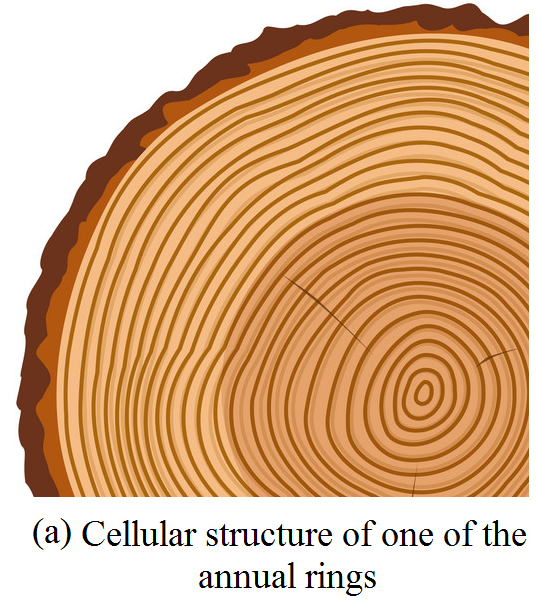
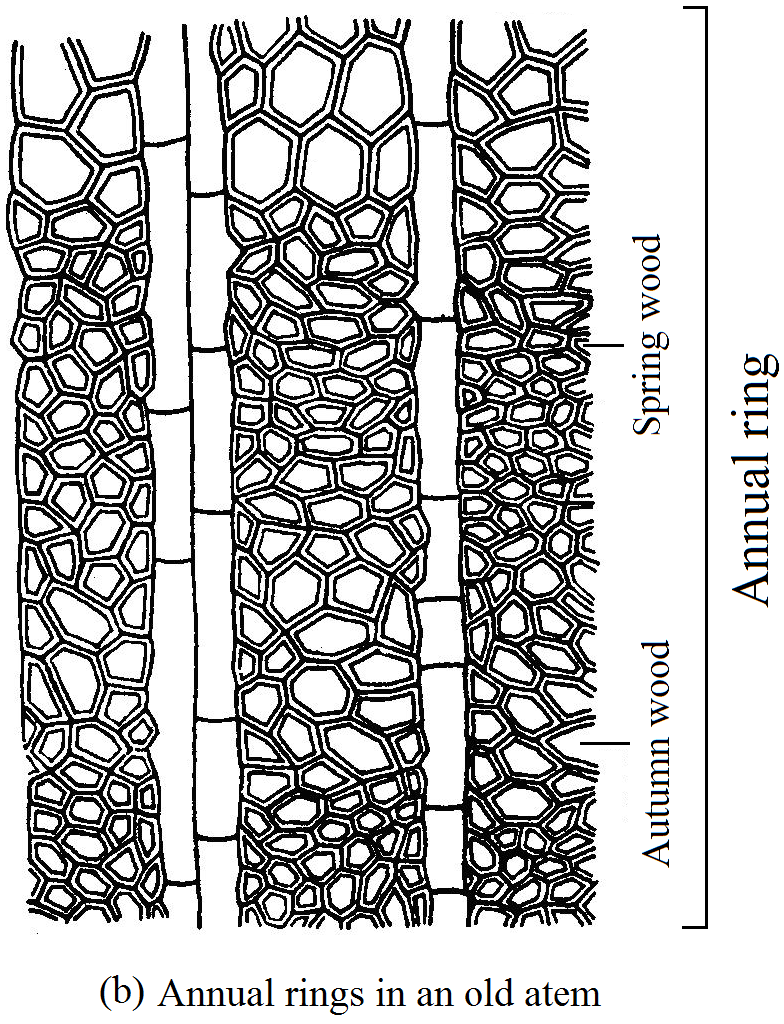
Demonstrate and explain the formation of annual ring in the transverse section of the stem.
Answer
In the transverse section of the stem, the springwood and autumnwood appear in the form of distinct concentric circles known as annual rings. One spring wood circle and one autumnwood circle together constitute an annual ring. Like this, year after year such rings appear and their identity is well-marked.
View full question & answer
Question 343 Marks
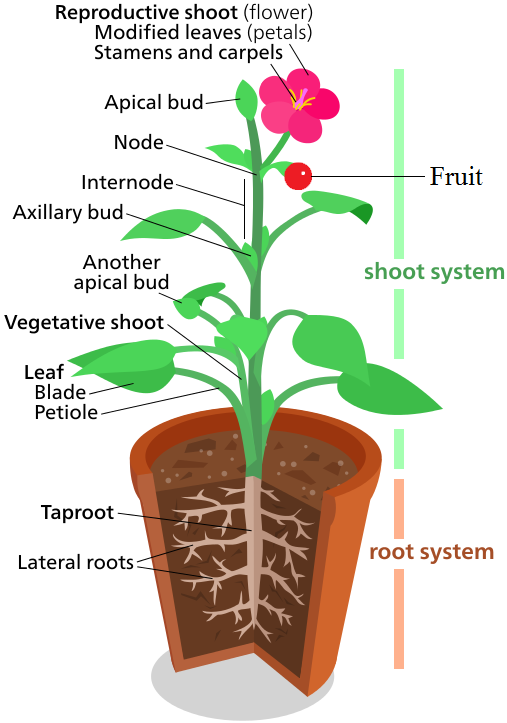
Draw a diagram of a flowering plant and write functions of different parts.
Answer

Functions of major parts of a flowering plant:
  • Root: Absorption of water and minerals, anchorage, food storage and hormone & synthesis.
  • Stem: Mechanical support and base for aerial parts, conduction of water, minerals and food.
  • Leaf: Photosynthesis, food storage.
  • Flower: Sexual Reproduction.
Fruit: Storage of seed and nutrients for seed.
View full question & answer
Question 353 Marks
The cross-section of a plant material showed the following features when viewed under the microscope.
  1. The vascular bundles were radially arranged.
  2. Four xylem strands with exarch condition of protoxylem.
To which organ should it be assigned?
Answer
Debark means the removal of bark, i.e., all tissue exterior to the vascular cambium, including secondary phloem. Bark refers to a number of tissue types, viz., periderm (phellogen, pheltem and phelloderm) and secondary phloem.
View full question & answer
Question 363 Marks
Write the precise function of: Interfascicular cambium.
Answer
Inter fascicular Cambium its function is to bring about secondary growth in the dicot stem and root. It is a kind of secondary meristematic tissue present in between two vascular bundles.
View full question & answer
Question 373 Marks
On biology practical day, teacher placed the slide for the spotting of a monocot root and gave the test based on the given slide and told the students to draw a TS of a monocot and label the different structures they have observed in the slide. Archana at the same time failed to identify the all other internal structure found in the root except the endodermis. She got sad and asked her teacher to guide her after the test.
  1. What according to you, is the endodermis in monocot root? Write its cellular structure.
  2. Where are casparian strips located?
  3. What is the role of passage cells in endodermis? Also write their location.
  4. What according to you were the value possessed by Archana?
Answer
  1. The endodermis is single-layered, made up of barrel-shaped cells which do not enclose intercellular spaces.
  2. The young endodermal cells possess an internal strip of suberin and lignin which is known as casparian strips.
  3. Endodermal cells lying opposite to the protoxylem groups, remain in the primary stage with usual casparian strips. These unthickened cells are called passage cells. The passage cells are meant for the conduction of fluids inwardly from the cortex and outwardly from the interior to the cortex.
  4. Archana was responsible and intelligent student. She was careful for her studies and career.
View full question & answer
Question 383 Marks
A transverse section of a trunk shows alternate concentric rings
  1. What are these rings known as?
  2. How are these rings formed?
  3. What is the significance of these alternate concentric rings?
OR
A transverse section of a stem of a tree shows concentric rings. How are these rings formed? Statethe significance of these rings.
Answer
  1. These rings are known as annual ring.
  2.  
  • The activity of cambium is influenced by internal factors as well as external factors.
  • In spring season, the cambium is active and produces large number of xylary elements, with larger diameter; the wood formed in spring, is called early wood or spring wood.
  • In winter, the cambium is less active and produces few xylary elements, that too with narrow vessels; the wood formed in winter, is called late wood or autumn wood.
  • These two types of wood appear as alternate concentric rings and constitute the annual rings.
  1. The age of a tree can be calculated by counting the number of annual rings.
View full question & answer
Question 393 Marks
Deciduous plants shed their leaves during hot summer or autumn. This process of shedding of leaves is called abscission. Apart from physiological changes, what anatomical mechanism is involved in the abscission of leaves?
Answer
The hormones secreted by plant body influence anatomical changes in it. In the future area of abscission, a special narrow abscission zone develops. It consists of a upper lignified and suberised protective layer. The separation layer consists of unthickened cells where the hydrolysing enzymes develop. Pectinases are secreted out to dissolve middle lamellae. Cellulases bring about hydrolysis of cell walls. Due to this, the separation layer becomes soft and weak. This leads to shedding of leaves from plants.
View full question & answer