Questions · Page 1 of 5

M.C.Q (1 Marks)

🎯

Test yourself on this topic

50 questions · timed · auto-graded

MCQ 11 Mark
According to atomic hypothesis:
  • A
    Atoms attract each other when they are little distance apart.
  • B
    Atoms repel if they being squeezed into one another.
  • Both $(a)$ and $(b).$
  • D
    Neither $(a)$ nor $(b).$
Answer
Correct option: C.
Both $(a)$ and $(b).$
Atoms attracts when they are little distance apart and repel, if they being squeezed into one another.
View full question & answer
MCQ 21 Mark
In a diatomic molecule, the rotational energy at a given temperature.
  • A
    Obeys Maxwell’s distribution.
  • B
    Have the same value for all molecules.
  • C
    Is $(2/3)^{rd}$ the translational kinetic energy for each molecule.
  • Both  $A$ and $C$
Answer
Correct option: D.
Both  $A$ and $C$
Consider a diatomic molecule along $z-$axis so its rotational energy about $z-$axis is zero.
So energy of diatomic molecule,
$\text{E}=\frac{1}{2}\text{mv}_\text{x}^2+\frac{1}{2}\text{mv}_\text{y}^2+\frac{1}{2}\text{mv}_\text{z}^2+\frac{1}{2}\text{I}_\text{x}\omega_\text{x}^2+\frac{1}{2}\text{I}_\text{y}\omega_\text{y}^2 ($as moment of inertia along $z$ axis is zero$)$

The independent terms in the above expression is $5.$
As we can predict velocities of molecules by Maxwell’s distribution.
Hence the above expression also obeys Maxwell’s distribution.
As $2$ rotational and $3$ translational energies are associated with each molecule.
So the rotational energy at given temperature is $2/3$ of its translational Kinetic energy of each molecule.
View full question & answer
MCQ 31 Mark
The monoatomic molecules have only three degrees of freedom because they can possess:
  • Only translatory motion.
  • B
    Only rotatory motion.
  • C
    Both translatory and rotatory motion.
  • D
    Translatory, rotatory and vibratory motion.
Answer
Correct option: A.
Only translatory motion.
View full question & answer
MCQ 41 Mark
The temperature of the mixture of one mole of helium and one mole of hydrogen is increased from $0^\circ C$ to $100^\circ C$ at constant pressure. The amount of heat delivered will be:
  • A
    $600\ \text{cal}$
  • $1200\ \text{cal}$
  • C
    $1800\ \text{cal}$
  • D
    $3600\ \text{cal}$
Answer
Correct option: B.
$1200\ \text{cal}$
View full question & answer
MCQ 51 Mark
The energy of a given sample of an ideal gas depends only on its:
  • A
    Volume.
  • B
    Pressure.
  • C
    Density.
  • Temperature.
Answer
Correct option: D.
Temperature.
Temperature of a gas is directly proportional to its kinetic energy.
Thus, energy of an ideal gas depends only on its temperature.
View full question & answer
MCQ 61 Mark
The $\text{r.m.s.}$ velocity of a gas is:
  • A
    Directly proportional to the density of the gas.
  • B
    Inversely proportional to the density of the gas.
  • C
    Directly proportional to the square of density.
  • Inversely proportional to the square root of the density of the gas.
Answer
Correct option: D.
Inversely proportional to the square root of the density of the gas.
View full question & answer
MCQ 71 Mark
During an adiabatic process, the pressure of a gas is found to be proportional to the cube of its temperature. The ratio of $\frac{\text{C}_{\text{P}}}{\text{C}_{\text{V}}}$ for the gas is:
  • A
    $\frac{4}{3}$
  • B
    $2$
  • C
    $\frac{5}{3}$
  • $\frac{3}{2}$
Answer
Correct option: D.
$\frac{3}{2}$
View full question & answer
MCQ 81 Mark
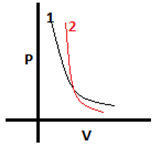
In the given diagram, one graph is of an ideal gas and another is of a real gas. Select the correct option.
  • A
    $1-$real gas, $2-$ideal gas
  • $1-$ideal gas, $2-$real gas
  • C
    Both are for an ideal gas at different temperatures
  • D
    Their graphs cannot intersect
Answer
Correct option: B.
$1-$ideal gas, $2-$real gas
Real gases, unlike ideal gases, consider volume taken up by molecules because of which mean free path decreases or collisions increase and hence pressure increases.
So, at low volumes this factor will play a big role and thus for a particular volume in the low volume range, pressure of real gases will be higher.
To see which graph belongs to whom we can draw a line parallel to the pressure axis at very low volume. The one having higher pressure will be that of real gases.
Therefore, $2-$real gas $\&\ 1-$ideal gas.
View full question & answer
MCQ 91 Mark
In kinetic theory’ of gases, it is assumed that:
  • A
    The collisions are not perfectly elastic.
  • B
    The molecular collisions change the density of the gas.
  • C
    The molecules don’t collide with each other on the well.
  • Between two collisions the molecules travel with uniform velocity.
Answer
Correct option: D.
Between two collisions the molecules travel with uniform velocity.
View full question & answer
MCQ 101 Mark
Average kinetic energy of molecules is:
  • A
    Independent of absolute temperature.
  • B
    Inversely proportional to absolute temperature.
  • Directly proportional to absolute temperature.
  • D
    Directly proportional to score root of temperature.
Answer
Correct option: C.
Directly proportional to absolute temperature.
The measure of average kinetic energy of molecules is called temperature.
View full question & answer
MCQ 111 Mark
A hotter gas implies higher average value of:
  • A
    Heat content
  • $K.E.$
  • C
    Total energy
  • D
    Internal energy
Answer
Correct option: B.
$K.E.$
View full question & answer
MCQ 121 Mark
Moon has no atmosphere because:
  • A
    It is far away form the surface of the earth.
  • B
    Its surface temperature is $10^\circ C.$
  • The $\text{r.m.s.}$ velocity of all the gas molecules is more then the escape velocity of the moons surface.
  • D
    The escape velocity of the moons surface is more than the $\text{r.m.s}$ velocity of all molecules.
Answer
Correct option: C.
The $\text{r.m.s.}$ velocity of all the gas molecules is more then the escape velocity of the moons surface.
View full question & answer
MCQ 141 Mark
The correct statement of the law of equipartition of energy is:
  • A
    The total energy of a gas is equally divided among all the molecules.
  • The gas possess equal energies in all the three directions $x, y$ and $z-$axis.
  • C
    The total energy of a gas is equally divided between kinetic and potential energies.
  • D
    The total kinetic energy of a gas molecules is equally divided among translational and rotational kinetic energies.
Answer
Correct option: B.
The gas possess equal energies in all the three directions $x, y$ and $z-$axis.
View full question & answer
MCQ 151 Mark
A rigid container of negligible heat capacity contains one mole of an ideal gas. The temperature of the gas increases by $1^\circ C$ if $3.0\ \text{cal}$ of heat is added to it. The gas may be:
  • A
    Helium.
  • B
    Carbon dioxide.
  • C
    Oxygen.
  • Both $B$ and $C$
Answer
Correct option: D.
Both $B$ and $C$
The temperature of one mole of a gas kept in a container of fixed volume is increased by $1$ degree Celsius if $3$ calories,
i.e. $12.54J$ of heat is added to it.
So, its molar heat capacity, $C_v=12.54 \mathrm{~J}^{-} \mathrm{JK}^{-1} \mathrm{~mol}^{-1}$, as molar heat capacity at fixed volume is the heat supplied to a mole of gas to increase its temperature by a degree. For a monatomic gas, ​$\text{C}_\text{v}\simeq\frac{3}{2}\text{R}=1.5\times8.314=12.54\text{JK}^{-1}\text{mol}^{-1}.$
Among the given gases, only helium and argon are inert and hence, monoatomic.
Therefore, the gas may be helium or argon.
View full question & answer
MCQ 161 Mark
$K.E.$ of gas molecules is zero at:
  • A
    $0^\circ C$
  • B
    $273^\circ t$
  • $-273^\circ C$
  • D
    None of the above
Answer
Correct option: C.
$-273^\circ C$
View full question & answer
MCQ 171 Mark
One mole of ideal gas required $207J$ heat to rise the temperature by $10^\circ K$ when heated at constant pressure. If the same gas is heated at constant volume to raise the temperature by the same $10^\circ K$ the heat required is $(R = 8/ 3J/ \text{mole}^\circ \text{K})$
  • A
    $1987J$
  • B
    $29J$
  • C
    $215.3J$
  • $124J$
Answer
Correct option: D.
$124J$
View full question & answer
MCQ 181 Mark
The $\text{rms}$ speed of oxygen at room temperature is about $500\ m/ s.$ The rms speed of hydrogen at the same temperature is about:
  • A
    $125\ ms^{-1}$
  • $2000\ ms^{-1}$
  • C
    $8000\ ms^{-1}$
  • D
    $31\ ms^{-1}$
Answer
Correct option: B.
$2000\ ms^{-1}$
Given,
Molecular mass of hydrogen, $M_H = 2$
Molecular mass of oxygen, $M_O = 32$
$\text{RMS}$ speed is given by,
$\text{v}_\text{rms}=\sqrt{\frac{3\text{RT}}{\text{M}}}$
$\Rightarrow\sqrt{\frac{3\text{RT}}{\text{M}_\text{O}}}=500$
Now,
$\Rightarrow\frac{\text{v}_\text{Orms}}{\text{v}_\text{Hrms}}=\frac{\sqrt{\frac{3\text{RT}}{\text{M}_\text{O}}}}{\sqrt{\frac{3\text{RT}}{\text{M}_\text{H}}}}$
$\Rightarrow\frac{\text{v}_\text{Orms}}{\text{v}_\text{Hrms}}=\frac{\sqrt{\frac{3\text{RT}}{32}}}{\sqrt{\frac{3\text{RT}}{2}}}$
$\Rightarrow\frac{\text{v}_\text{Orms}}{\text{v}_\text{Hrms}}=\frac{1}{4}$
$\Rightarrow\frac{500}{\text{v}_\text{Hrms}}=\frac{1}{4}$
$\Rightarrow\text{v}_\text{Hrms}=4\times500=2000\ \text{ms}^{-1}$
View full question & answer
MCQ 191 Mark
According to the kinetic theory of gases, the temperature of a gas is a measure of average:
  • A
    Velocities of its molecules.
  • B
    Linear momenta of its molecules.
  • Kinetic energies of its molecules.
  • D
    Angular momenta of its molecules.
Answer
Correct option: C.
Kinetic energies of its molecules.
View full question & answer
MCQ 201 Mark
Which of the following is the unit of specific:
  • A
    $Jkg/^\circ c$
  • $J/kg^\circ c$
  • C
    $kg^\circ c/J$
  • D
    $Jkg/^\circ c^2$
Answer
Correct option: B.
$J/kg^\circ c$
View full question & answer
MCQ 211 Mark
The $\text{rms}$ speed of oxygen molecules in a gas is $v.$ If the temperature is doubled and the oxygen molecules dissociate into oxygen atoms, the rms speed will become:
  • A
    $\text{v}$
  • B
    $\text{v}\sqrt{2}$
  • $2\text{v}$
  • D
    $4\text{v}$
Answer
Correct option: C.
$2\text{v}$
Given, $\text{v}=\sqrt{\frac{3\text{RT}}{32}}$
Let the new rms speed be $v'.$
Molecule dissociate, $M = 16$
$\text{v}'=\sqrt{\frac{3\text{R}(2\text{T})}{16}}$
$=\sqrt{\frac{3\text{R}(4\text{T})}{32}}$
$=2\sqrt{\frac{3\text{R}\text{T}}{32}}$
$=2\text{v}$
View full question & answer
MCQ 221 Mark
An ideal gas is that which can:
  • A
    Be solidified
  • B
    Liquefied
  • C
    Not be liquefied
  • Not be solidified
Answer
Correct option: D.
Not be solidified
The term ideal gas refers to a hypothetical gas composed of molecules which follow a few rules:
Ideal gas molecules do not attract or repel each other.
View full question & answer
MCQ 231 Mark
Four cylinders contain equal number of moles of argon, hydrogen, nitrogen and carbon dioxide at the same temperature. The energy is minimum in:
  • Argon.
  • B
    Hydrogen.
  • C
    Nitrogen.
  • D
    Carbon dioxide.
Answer
Correct option: A.
Argon.
The energy of a gas is measured as $C_vT$. All the four cylinders are at the same temperature but the gases in them have different values of $C_v$, such that it is least for the monatomic gas and keeps on increasing as we go from monatomic to tri$-$atomic. Among the above gases, argon is monatomic, hydrogen and nitrogen are diatomic and carbon dioxide is tri$-$atomic. Therefore, the energy is minimum in argon.
View full question & answer
MCQ 241 Mark
Which of the following parameters is the same for molecules of all gases at a given temperature?
  • A
    Mass.
  • B
    Speed.
  • C
    Momentum.
  • Kinetic energy.
Answer
Correct option: D.
Kinetic energy.
Temperature is defined as the average kinetic energy of the molecules in a gas sample. Average is same for all the molecules of the sample. So, kinetic energy is the same for all.
View full question & answer
MCQ 251 Mark
There is some liquid in a closed bottle. The amount of liquid remains constant as time passes. The vapour in the remaining part:
  • Must be saturated.
  • B
    Must be unsaturated.
  • C
    May be unsaturated.
  • D
    There will be no vapour.
Answer
Correct option: A.
Must be saturated.
Since the amount of liquid is constant, there is no vapourisation of the liquid inside the bottle. Also, since there cannot be a liquid with no vapours at all and vapourisation cannot take place in the remaining saturated part, the remaining part must be saturated with the vapours of the liquid.
View full question & answer
MCQ 261 Mark
The diatomic molecule is treated as:
  • A
    Harmonic oscillator
  • Rigid rotator
  • C
    Both $a$ and $b$
  • D
    None
Answer
Correct option: B.
Rigid rotator
View full question & answer
MCQ 271 Mark
The molar specific heat at constant pressure of an ideal gas is $\Big(\frac{7}{2}\text{R}\Big).$ The ratio of specific heat at constant pressure to that at constant volume is:
  • A
    $\frac{9}{7}$
  • $\frac{7}{5}$
  • C
    $\frac{5}{7}$
  • D
    $\frac{8}{7}$
Answer
Correct option: B.
$\frac{7}{5}$
$\text{C}_{\text{P}}=\frac{7}{2}\text{R}$
$\text{C}_{\text{V}}=\text{C}_{\text{P}}-\text{R}=\frac{7}{2}\text{R}-\text{R}=\frac{5}{2}\text{R}$
$\gamma=\frac{\text{C}_{\text{P}}}{\text{C}_{\text{V}}}=\frac{\frac{7}{2}\text{P}}{\frac{5}{2}\text{R}}=\frac{7}{5}$
View full question & answer
MCQ 281 Mark
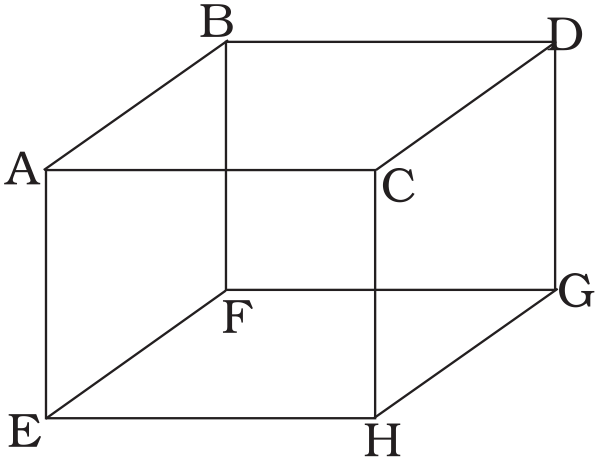
$1$ mole of an ideal gas is contained in a cubical volume $\text{V, ABCDEFGH}$ at $300K ($figure$)$. One face of the cube $\text{(EFGH)}$ is made up of a material which totally absorbs any gas molecule incident on it. At any given time,
  • A
    The pressure on $\text{EFGH}$ would be zero.
  • B
    The pressure on all the faces will be equal.
  • C
    The pressure of $\text{EFGH}$ would be double the pressure on $\text{ABCD.}$
  • The pressure on $\text{EFGH}$ would be half that on $\text{ABCD.}$ 
Answer
Correct option: D.
The pressure on $\text{EFGH}$ would be half that on $\text{ABCD.}$ 
Pressure on the wall due to force exerted by molecule on walls due to its rate of transfer of momentum to the wall. The molecule bounces back due to elastic collision and magnitude of momentum transferred to wall by each molecule is $\text{2mv}$ but wall $\text{EFGH}$ absorbs those molecule which strikes to it. Therefore rate of change in momentum to it become only mv so the pressure of $\text{EFGH}$ would be half of $\text{ABCD}.$
View full question & answer
MCQ 291 Mark
How many degrees of freedom are there in a monatomic gas?
  • A
    $1$
  • B
    $2$
  • $3$
  • D
    $0$
Answer
Correct option: C.
$3$
A monatomic gas has $3$ translational degrees of freedom.
View full question & answer
MCQ 301 Mark
What is the mass of $22.4L$ of $CO_2$ at $\text{STP}?$
  • A
    $1g$
  • $44g$
  • C
    $44\ kg$
  • D
    $1\ kg$
Answer
Correct option: B.
$44g$
$22.4L$ of a gas at $\text{STP}$ has a weight equal to its molar mass.
So, the weight of $CO_2$ will be $12 + 16 + 16$
$= 44g.$
View full question & answer
MCQ 311 Mark
When $20\ \text{cal}$ of heat is supplied to a system, the increase in internal energy is $50J$. If the external work done is $35J$, the mechanical equivalent of heat is:
  • $4.25\ \text{J/ cal}$
  • B
    $1.26\ \text{J/ cal}$
  • C
    $4.92\ \text{J/ cal}$
  • D
    $2.1\ \text{J/ cal}$
Answer
Correct option: A.
$4.25\ \text{J/ cal}$
According to first law of thermodynamics $\text{J}\triangle\text{Q}=\triangle\text{W}+\triangle\text{U},$
where $J$ is the mechanical equivalent of heat.
$J \times 20 = 50 + 35$
$J = 4.25\ \text{J/ cal}$
View full question & answer
MCQ 321 Mark
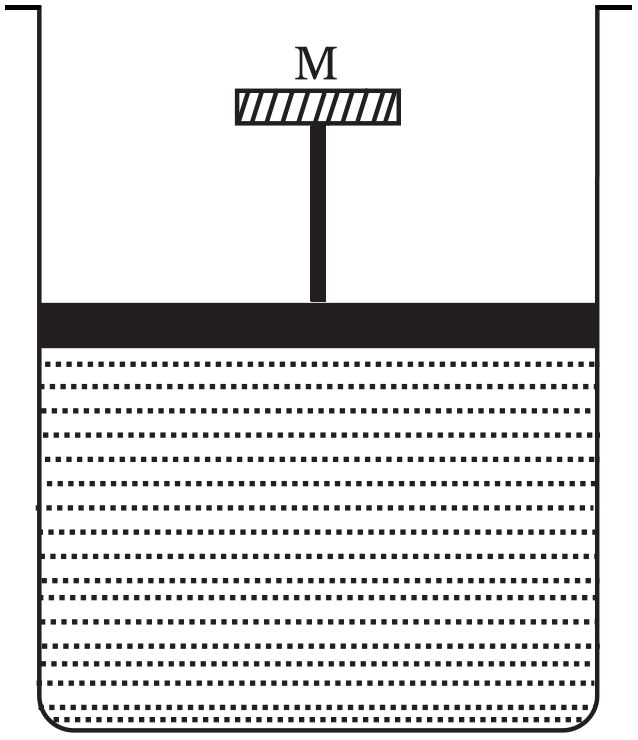
A cylinder containing an ideal gas is in vertical position and has a piston of mass M that is able to move up or down without friction ( figure). If the temperature is increased.
  • A
    Both P and V of the gas will change.
  • B
    Only P will increase according to Charles’ law.
  • V will change but not P.
  • D
    P will change but not V.
Answer
Correct option: C.
V will change but not P.
c. V will change but not P.
Explanation:
The pressure on the ideal gas does not changes from initial to final position. According to the given arrangement P = Mg/ A which shows that pressure is constant. As piston and cylinder is frictionless so by ideal gas equation, PV = nRT.
View full question & answer
MCQ 331 Mark
The deviation of gases from the behaviour of ideal gas is due to:
  • Attraction of molecules
  • B
    Absolute scale of temp
  • C
    Covalent bonding of molecules
  • D
    Colourless molecules
Answer
Correct option: A.
Attraction of molecules
View full question & answer
MCQ 341 Mark
In a diatomic molecules, the rotational energy at a given temperature:
  • Obeys Maxwell’s distribution
  • B
    Have the same volue for all molecules
  • C
    Equals the translational kinetic energy for each molecule
  • D
    None of these
Answer
Correct option: A.
Obeys Maxwell’s distribution
View full question & answer
MCQ 351 Mark
Liquids have:
  • A
    Fixed shape and volume.
  • B
    Variable shape and volume.
  • Variable shape but fixed volume.
  • D
    Fixed shape but variable volume.
Answer
Correct option: C.
Variable shape but fixed volume.
View full question & answer
MCQ 361 Mark
We took two separate gases with the same number densities for both. If the ratio of the diameters of their molecules is $4 : 1,$ then ratio of their mean free paths is:
  • A
    $1 : 4$
  • B
    $4 : 1$
  • C
    $2 : 1$
  • $1 : 16$
Answer
Correct option: D.
$1 : 16$
View full question & answer
MCQ 371 Mark
Law of equipartition of energy is used to:
  • A
    Predict the specific heats of gases.
  • B
    Predict the specific heats of solids.
  • Both $(a)$ and $(b).$
  • D
    Neither $(a)$ nor $(b).$
Answer
Correct option: C.
Both $(a)$ and $(b).$
Law of equipartition of energy is used to predict the specific heat of gases and solids.
View full question & answer
MCQ 381 Mark
Real gases show mark able deviation from that of ideal gas behavior at:
  • A
    Low temperature and high pressure.
  • High temperature and high pressure.
  • C
    Low temperature and high pressure.
  • D
    Low temperature and low pressure.
Answer
Correct option: B.
High temperature and high pressure.
At low temperature or high$-$pressure, gases deviate from ideal behavior. This is because at low temperature the gases molecules come close to each other and their kinetic energy decreases.
View full question & answer
MCQ 391 Mark
The velocity of the molecules of a gas at temperature $120K$ is $v.$ At what temperature will the velocity be $2v\ ?$
  • A
    $120K$
  • B
    $240K$
  • $480K$
  • D
    $1120K$
Answer
Correct option: C.
$480K$
View full question & answer
MCQ 401 Mark
If $C_P, C_V$ are molar specific heats of a solid and $R$ is universal gas constant, then:
  • A
    $C_P-C_V=R$
  • B
    $C_P-C_V=0$
  • C
    $C_P - C_V$ is negative
  • $(C_P-C_V)<< R$
Answer
Correct option: D.
$(C_P-C_V)<< R$
In case of solides, $C_P=C_V$
$\therefore C_P-C_V<< R$
View full question & answer
MCQ 421 Mark
The three states of matter depend on:
  • A
    Biomass
  • B
    Potential energy
  • C
    Force
  • Temperature
Answer
Correct option: D.
Temperature
View full question & answer
MCQ 431 Mark
A man is climbing up a spiral type of staircase. His degrees of freedom are:
  • A
    $1$
  • B
    $2$
  • $3$
  • D
    More than $3$
Answer
Correct option: C.
$3$
View full question & answer
MCQ 441 Mark
What is meant by mean free path?
  • It is the average distance a molecule travels without colliding.
  • B
    Average distance between $2$ molecules.
  • C
    Average distance travelled by a molecule before colliding with a wall of the container.
  • D
    Sum of distance travelled by all molecules.
Answer
Correct option: A.
It is the average distance a molecule travels without colliding.
Mean free path of a molecule is defined as the average distance travelled by molecules before colliding.
View full question & answer
MCQ 451 Mark
What is the number of molecules in $2.24L$ of $SO_2$ at $\text{STP}\ ?$
  • A
    $6.023 \times 10^{23}$
  • $6.023 \times 10^{22}$
  • C
    $6.023 \times 10^{20}$
  • D
    $6.023 \times 10^{21}$
Answer
Correct option: B.
$6.023 \times 10^{22}$
According to Avogadro’s law $22.4L$ of any gas at $\text{STP}$ is $6.023 \times 10^{23}$.
So, in $2.24L$ there will be $\frac{6.023\times10^{23}}{10}$
$= 6.023 \times 10^{22}$​​​​​​​.
View full question & answer
MCQ 461 Mark
The molar heat capacity of oxygen gas at $\text{STP}$ is nearly $2.5R.$ As the temperature is increased, it gradually increases and approaches $3.5R.$ The most appropriate reason for this behaviour is that at high temperatures:
  • A
    Oxygen does not behave as an ideal gas.
  • B
    Oxygen molecules dissociate in atoms.
  • C
    The molecules collide more frequently.
  • Molecular vibrations gradually become effective.
Answer
Correct option: D.
Molecular vibrations gradually become effective.
Molar specific heat capacity has direct dependence on the degree of freedom of gas molecules. As temperature is increased, the gas molecules start vibrating about their mean position, leading to change $($increase$)$ in the degree of freedom and hence, increasing molar heat capacity.
View full question & answer
MCQ 471 Mark
The average energy associated with each translational degree of freedom is:
  • A
    $\frac{3}{2}\text{k}_{\text{B}}\text{T}$
  • B
    $\text{k}_{\text{B}}\text{T}$
  • $\frac{1}{2}\text{k}_{\text{B}}\text{T}$
  • D
    $2\text{k}_{\text{B}}\text{T}$
Answer
Correct option: C.
$\frac{1}{2}\text{k}_{\text{B}}\text{T}$
View full question & answer
MCQ 481 Mark
According to Kinetic theory of gases, molecules are:
  • A
    Perfectly inelastic particles in random motion.
  • Perfectly elastic particles in random motion.
  • C
    Perfectly inelastic particles at rest.
  • D
    Perfectly elastic particles at rest.
Answer
Correct option: B.
Perfectly elastic particles in random motion.
Assumptions of Kinetic Theory of Gases All gases are made up of molecules which are constantly and persistently moving in random directions.
The separation between the molecules is much greater than the size of molecules.
When a gas sample is kept in a container, the molecules of the sample do not exert any force on the walls of the container during the collision.
The time interval of collision between two molecules, and between a molecule and the wall is considered to be very small.
All the collisions between molecules and even between molecules and wall are considered to be elastic.
All the molecules in a certain gas sample obey Newton’s laws of motion.
If a gas sample is left for a sufficient time, it eventually comes to a steady state.
The density of molecules and the distribution of molecules are independent of position, distance and time.
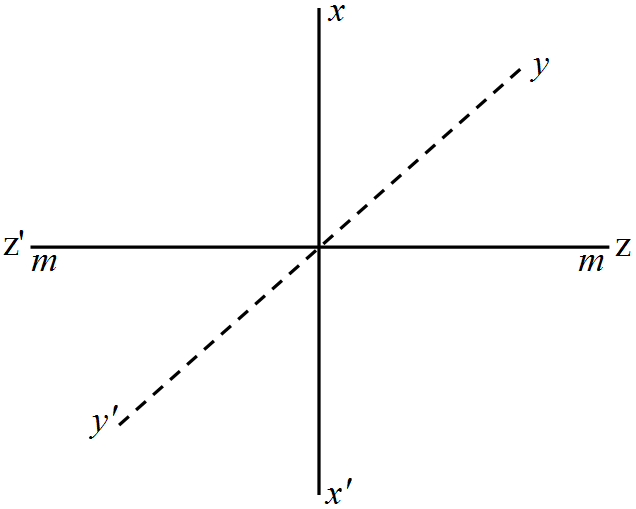
View full question & answer
MCQ 491 Mark
Temperature remaining constant, the pressure of gas is decreased by $20\%$. The percentage change in volume:
  • A
    Increases by $20\%$
  • B
    Decreases by $20\%$
  • Increases by $25\%$
  • D
    Decreases by $25\%$
Answer
Correct option: C.
Increases by $25\%$
View full question & answer
MCQ 501 Mark
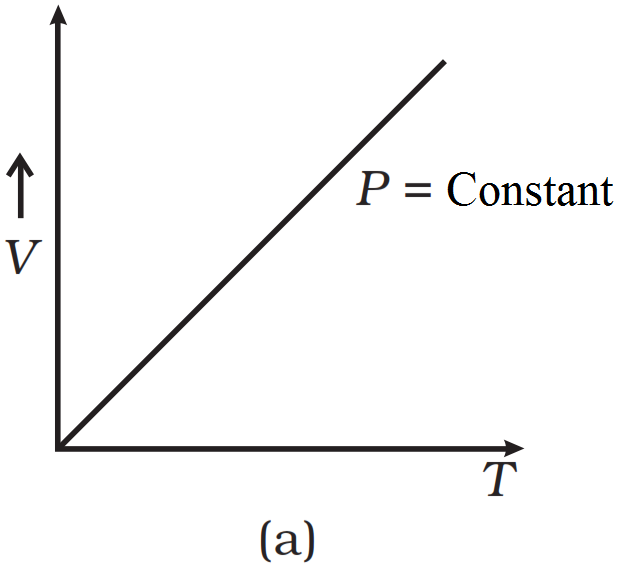
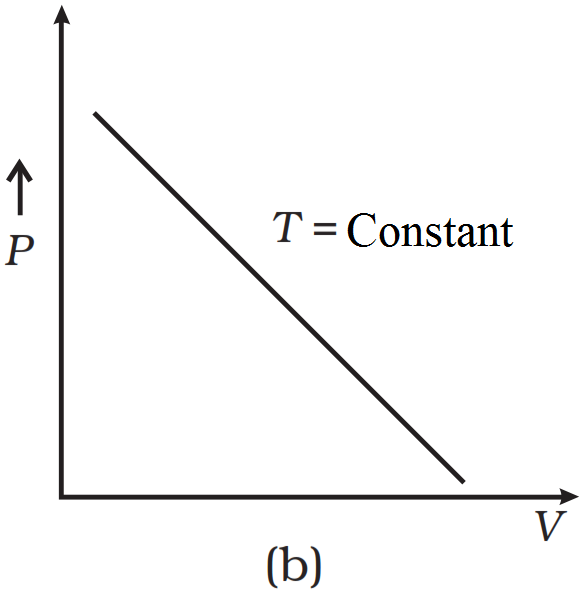
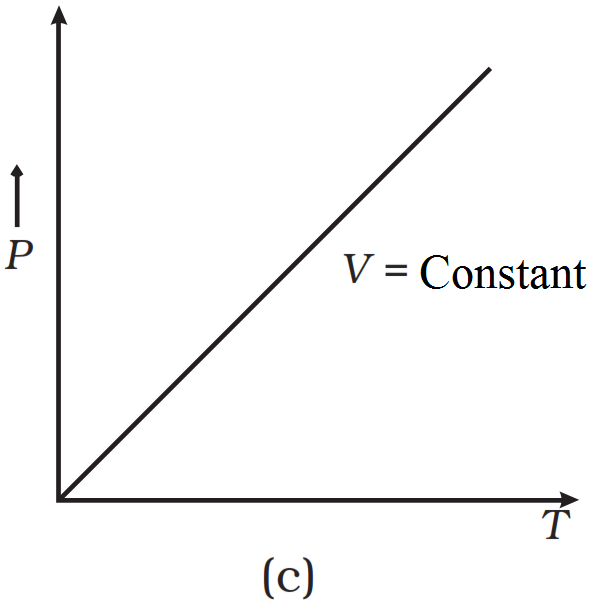
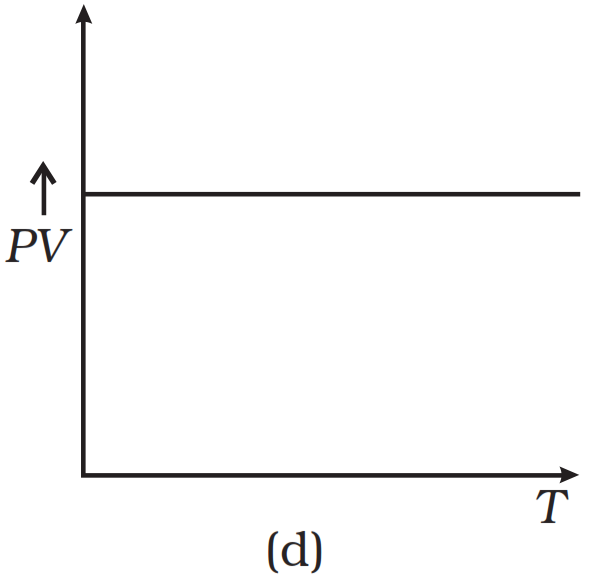
Which of the following diagrams $($figure$)$ depicts ideal gas behaviour?
  • A
  • B
  • C
Answer
Correct option: D.

For ideal gas behaviour,
$\text{PV = nRT}$
  1. When pressure, $P =$ constant.
From $(i)$ Volume $V \propto$ Temperature $T$
Graph of $V$ versus $T$ will be straight line.
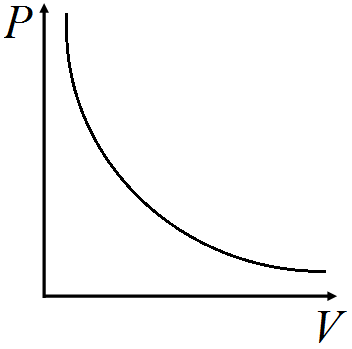
  1. When $T =$ constant.
So, graph of $P$ versus $V$ will be a rectangular hyperbola.
Hence this graph is wrong.
The correct graph is shown below:
  1. When $V=$ constant.
From $(i) \text{P}\propto\text{T}$
So, graph is a straight line passing throught the origin.
  1. From $(i) \text{PV}\propto\text{T}$
$\Rightarrow\frac{\text{PV}}{\text{T}} =$ constant
So, graph of $PV$ versus $T$ will be a straight line parallel to the temperature axis $(x-$axis$).$
i.e., slope of this graph will be zero.
So, $(d)$ is not correct.
View full question & answer
M.C.Q (1 Marks) - Physics STD 11 Science Questions - Vidyadip