Question 15 Marks
Doubly-ionised helium ions are projected with a speed of $10km/s^{-1}$ in a direction perpendicular to a uniform magnetic field of magnitude 1.0T. Find
- The force acting on an ion.
- The radius of the circle in which it circulates.
- The time taken by an ion to complete the circle.
Answer$\text{V}=10\text{Km}=10^4\text{m/s}$$\text{B}=1\text{T},\text{q}=2\text{e}.$
- $\text{F}=\text{qVB}=2\times1.6\times10^{-19}\times10^4\times1$
$=3.2\times10^{-15}\text{N}$
- $\text{r}=\frac{\text{mV}}{\text{qB}}=\frac{4\times1.6\times10^{-27}\times10^4}{2\times1.6\times10^{-19}\times1}$
$=2\times\frac{10^{-23}}{10^{-19}}=2\times10^{-4}\text{m}$
- Time taken $\frac{2\pi\text{r}}{\text{V}}=\frac{2\pi\text{mv}}{\text{qB}\times\text{v}}=\frac{2\pi\times4\times1.6\times10^{-27}}{2\times1.6\times10^{-19}\times1}$
$=4\pi\times10^{-8}=4\times3.14\times10^{-8}$
$=12.56\times10^{-8}=1.256\times10^{-7}\text{}.$ View full question & answer→Question 25 Marks
Two particles, each with mass m are placed at a separation d in a uniform magnetic field B, as shown in the figure. They have opposite charges of equal magnitude q. At time $t = 0$, the particles are projected towards each other, each with a speed v. Suppose the Coulomb force between the charges is switched off.
- Find the maximum value $v_m$ of the projection speed, so that the two particles do not collide.
- What would be the minimum and maximum separation between the particles if $\text{v}=\text{v}_{\text{m}}\sqrt{2}?$
- At what instant will a collision occur between the particles if $v = 2v_m$?
- Suppose $v = 2v_m$ and the collision between the particles is completely inelastic. Describe the motion after the collision.
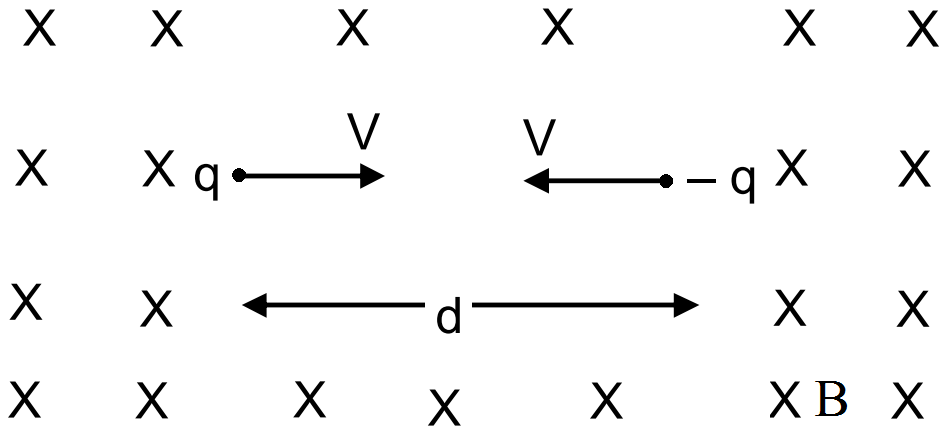
Answer
- The particulars will not collide if,
$\text{d}=\text{r}_1+\text{r}_2$
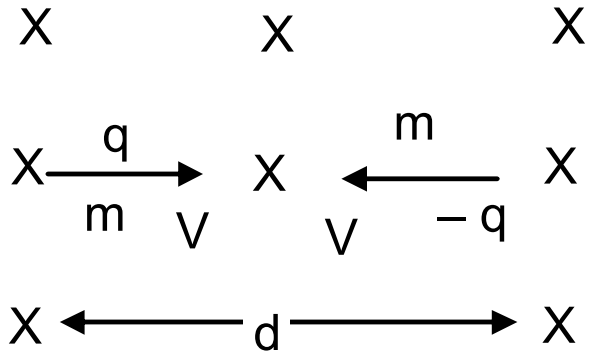
$\Rightarrow\text{d}=\frac{\text{mV}_\text{m}}{\text{qB}}+\frac{\text{mV}_\text{m}}{\text{qB}}$
$\Rightarrow\text{d}=\frac{2\text{mV}_\text{m}}{\text{qB}}$
$\text{V}_\text{m}=\frac{\text{qBd}}{2\text{m}}$
- $\text{V}=\frac{\text{V}_\text{m}}{2}$
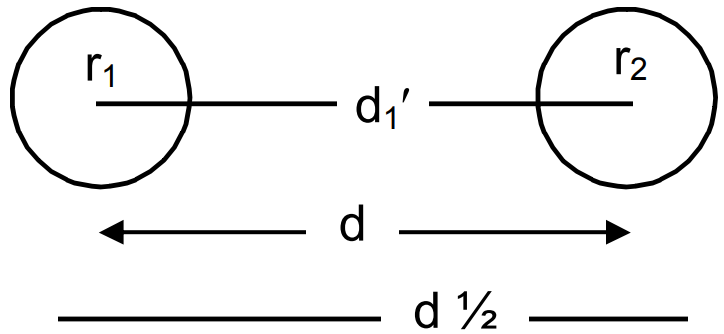
$\text{d}_1'=\text{r}_1+\text{r}_2=\Big(\frac{\text{m}\times\text{qBd}}{2\times2\text{m}\times\text{qB}}\Big)=\frac{\text{d}}{2}$ (min. dist.)
Max. distance $\text{d}_2'=\text{d}+2\text{r}=\text{d}+\frac{\text{d}}{2}=\frac{3\text{d}}{2}$
- $\text{V}=2\text{V}_\text{m}$
$\text{r}_1'=\frac{\text{m}_2\text{V} _\text{m}}{\text{qB}}=\frac{\text{m}\times2\times\text{qBd}}{2\text{n}\times\text{qB}}$
$\text{r}_2=\text{d}$
$\therefore$ The arc is $\frac{1}{6}$
- $\text{V}_\text{m}=\frac{\text{qBd}}{2\text{m}}$
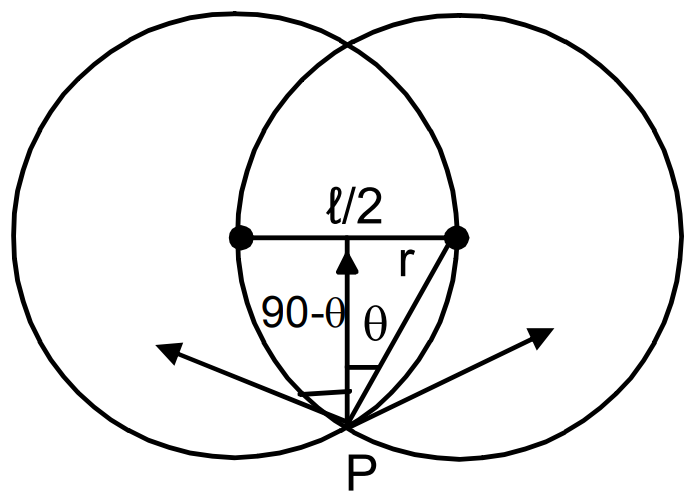
The particles will collide at point P. At point p, both the particles will have motion m in upward direction. Since the particles collide inelastically the stick together.
Distance l between centres $=\text{d},\sin\theta=\frac{1}{2\text{r}}$
Velocity upward $=\text{v}\cos90-\theta=\text{V}\sin\theta=\frac{\text{Vl}}{2\text{r}}$
$\frac{\text{mv}^2}{\text{r}}=\text{qvB}$
$\Rightarrow\text{r}=\frac{\text{mv}}{\text{qB}}$
$\text{V}\sin\theta=\frac{\text{vl}}{2\text{r}}=\frac{\text{vl}}{2\frac{\text{mv}}{\text{qb}}}=\frac{\text{qBd}}{2\text{m}}=\text{V}_\text{m}$
Hence the combined mass will move with velocity $V_m$. View full question & answer→Question 35 Marks
An electron is projected horizontally with a kinetic energy of $10keV$. A magnetic field of strength $1.0 \times 10^{-7}T$ exists in the vertically upward direction.
- Will the electron deflect towards the right or left of its motion?
- Calculate the sideways deflection of the electron while travelling through 1m. Make appropriate approximations.
Answer
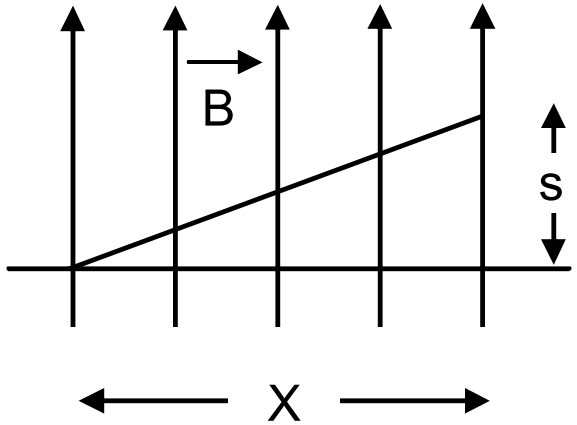
$\text{KE}=10\text{Kev}=1.6\times10^{-15}\text{J}$
$\overrightarrow{\text{B}}=1\times10^{-7}\text{T}$
- The electron will be deflected towards left
- $\Big(\frac{1}{2}\Big)\text{mv}^2=\text{KE}$
$\Rightarrow\text{V}=\sqrt{\frac{\text{KE}\times2}{\text{m}}}$
$\text{F}=\text{qVB}\ \&\text{ accin}=\frac{\text{qVB}}{\text{m}_\text{e}}$
Applying $\text{s}=\text{ut}+\Big(\frac{1}{2}\Big)\text{at}^2=\frac{1}{2}\times\frac{\text{qVB}}{\text{m}_\text{e}}\times\frac{\text{x}^2}{\text{v}^2}$
$=\frac{\text{qBx}^2}{2\text{m}_\text{e}\text{V}}$
$=\frac{\text{qBx}^2}{2\text{m}_\text{e}\sqrt{\frac{\text{KE}\times2}{\text{m}}}}$
$=\frac{1}{2}\times\frac{1.6\times10^{-19}\times1\times10^{-7}\times1^2}{9.1\times10^{-31}\times\sqrt{\frac{1.6\times10^{-15}\times2}{9.1\times10^{-31}}}}$
By solving we get, $\text{s}=0.0148\approx1.5\times10^{-2}\text{cm}$ View full question & answer→Question 45 Marks
A magnetic field of $(4.0\times10^{-3}\vec{\text{k}})$ T exerts a force of $(4.0\vec{\text{i}}+3.0\vec{\text{j}})\times10^{-10}$ N on a particle with a charge of $1.0\times10^{-9}\text{C}$ and going in the x−y plane. Find the velocity of the particle.
Answer$\text{B}=4\times10^{-3}\text{T}(\hat{\text{k}})$$\text{F}=[4\hat{\text{i}}+3\hat{\text{j}}\times10^{-10}]\text{N}.$
$\text{F}_\text{x}=4\times10^{-10}\text{N}$
$\text{F}_\text{y}=3\times10^{-10}\text{N}$
$\text{Q}=1\times10^{-9}\text{C}.$
Considering the motion along x-axis:
$\text{F}_\text{x}=\text{quV}_\text{y}\text{B}$
$\Rightarrow\text{V}_\text{x}=\frac{\text{F}}{\text{qB}}$
$=\frac{3\times10^{-10}}{1\times10^{-9}\times4\times10^{-3}}$
$=75\text{m/s}$
Velocity $=(-75\hat{\text{i}}+100\hat{\text{j}})\text{m/s}$
View full question & answer→Question 55 Marks
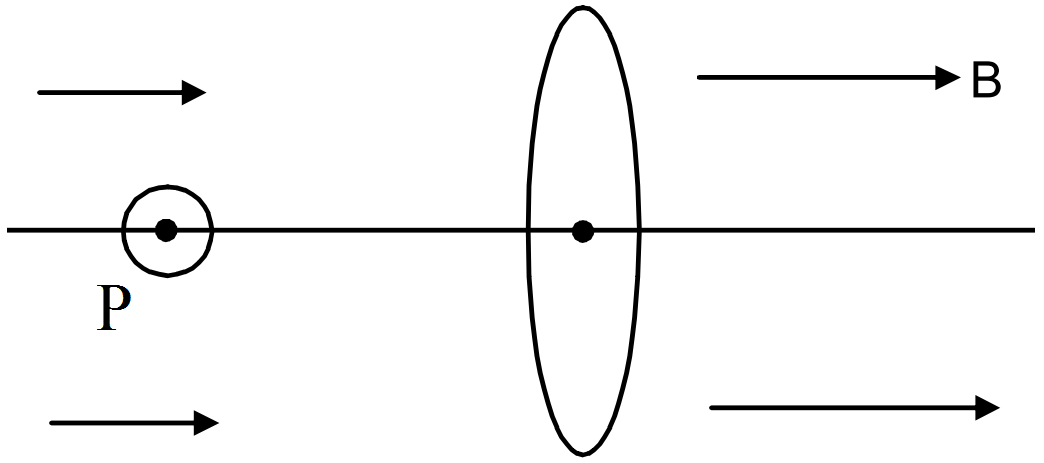
Shows a convex lens of focal length $12cm$ lying in a uniform magnetic field B of magnitude $1.2T$ parallel to its principal axis. A particle with charge $2.0 \times 10^{-3}C$ and mass $2.0 \times 10^{-5} kg$ is projected perpendicular to the plane of the diagram with a speed of $4.8 ms^{-1}$. The particle moves along a circle with its centre on the principal axis at a distance of $18cm$ from the lens. Show that the image of the particle moves along a circle and find the radius of that circle.
Answer
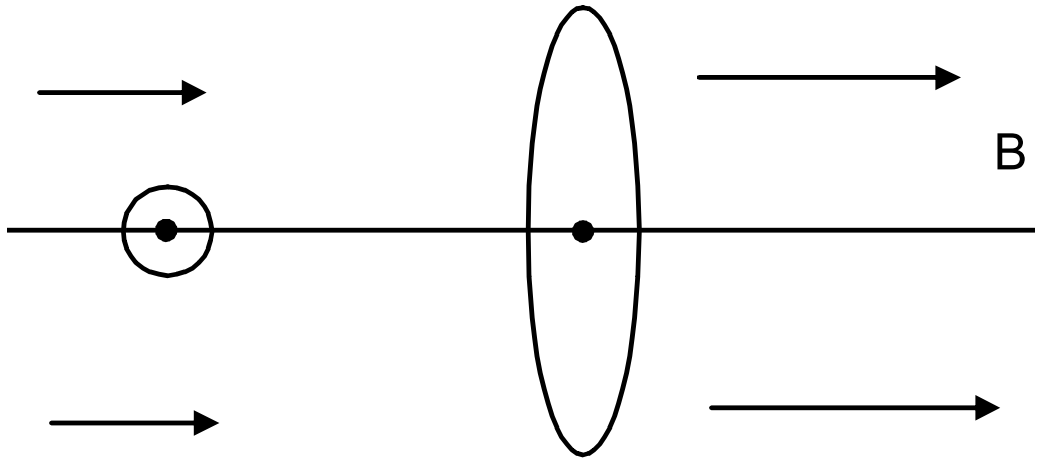
The object will make a circular path, perpendicular to the plance of paper Let the radius of the object be r.
$\frac{\text{mv}^2}{\text{r}}=\text{qvB}\Rightarrow\text{r}=\frac{\text{mV}}{\text{qB}}$
Here object distance K = 18cm.
$\frac{1}{\text{v}}-\frac{1}{\text{u}}=\frac{1}{\text{f}}$ (lens eqn.) $\Rightarrow\frac{1}{\text{v}}-\Big(\frac{1}{-18}\Big)=\frac{1}{12}\Rightarrow\text{v}=36\text{cm}.$
Let the radius of the circular path of image = r'
So magnification $=\frac{\text{v}}{\text{u}}=\frac{\text{r}'}{\text{r}}\Big(\text{magnetic path}=\frac{\text{image height}}{\text{object height}}\Big)$
$\Rightarrow\text{r}'=\frac{\text{v}}{\text{u}}\text{r}$
$\Rightarrow\text{r}'=\frac{36}{18}\times4=8\text{cm}$
Hence radius of the circular path in which the image moves is 8cm View full question & answer→Question 65 Marks
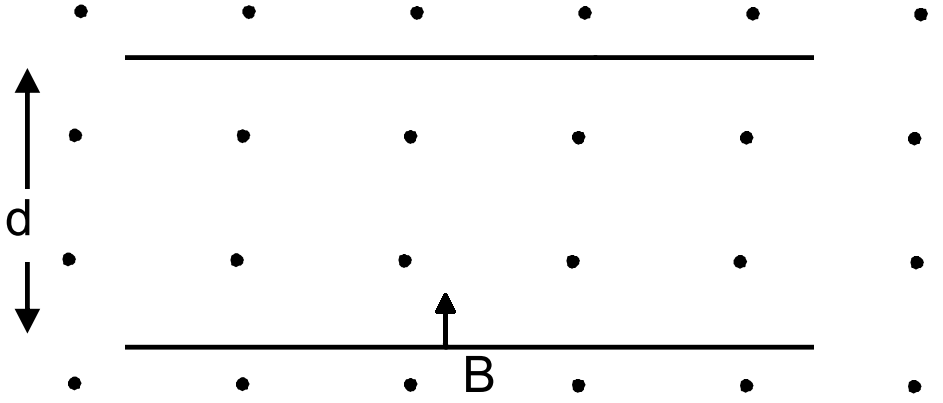
An electron is emitted with negligible speed from the negative plate of a parallel-plate capacitor charged to a potential difference V. The separation between the plates is d and a magnetic field Bexists in the space, as shown in the figure. Show that the electron will fail to strike the upper plates if $\text{d}>\Big(\frac{2\text{m}_\text{e}\text{v}}{\text{eB}^2}\Big)^{\frac{1}{2}}.$
Answer
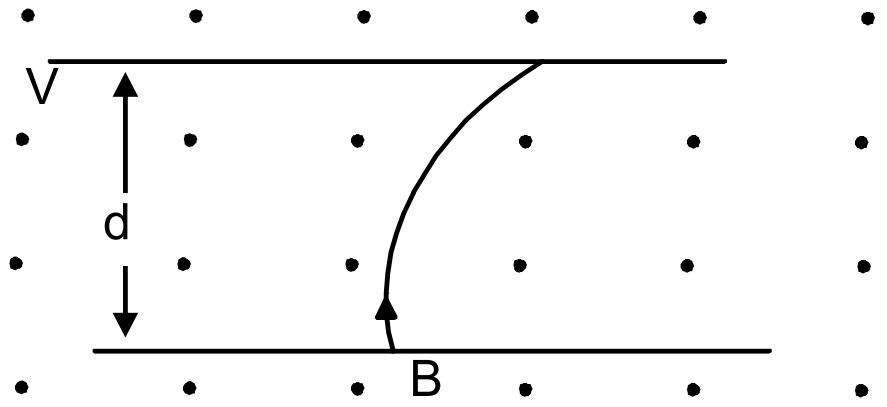
The force experienced first is due to the electric field due to the capacitor
$\text{E}=\frac{\text{V}}{\text{d}}$
$\text{F}=\text{eE}$
$\text{a}=\frac{\text{eE}}{\text{m}_\text{e}}$ [Where e → charge of electron $m_e$ → mass of electron]
$\text{v}^2=\text{u}^2+2\text{ as}$
$\Rightarrow\text{v}^2=2\times\frac{\text{eE}}{\text{m}_\text{e}}\times\frac{2\times\text{e}\times\text{V}\times\text{d}}{\text{dm}_\text{e}}$
$\text{v}=\sqrt{\frac{2\text{eV}}{\text{m}_\text{e}}}$
Now, The electron will fail to strike the upper plate only when d is greater than radius of the are thus formed.
$\text{d}>\frac{\text{m}_\text{e}\times\sqrt{\frac{2\text{eV}}{\text{m}_\text{e}}}}{\text{eB}}$
$\Rightarrow\text{d}>\frac{\sqrt{2\text{m}_\text{e}\text{V}}}{\text{eB}^2}$ View full question & answer→Question 75 Marks
Suppose that the radius of cross-section of the wire used in the previous problem is r. Find the increase in the radius of the loop if the magnetic field is switched off. Young's modulus of the material of the wire is Y.
Answer
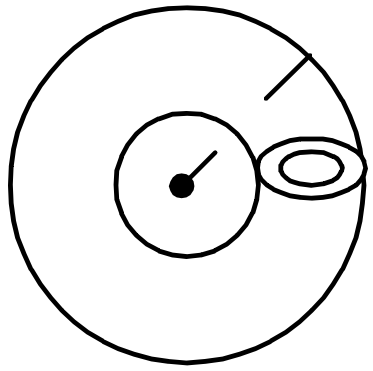 $\text{Y}=\frac{\text{Stress}}{\text{Strain}}=\frac{\Big(\frac{\text{F}}{\pi\text{r}^2}\Big)}{\Big(\frac{\text{dl}}{\text{L}}\Big)}$
$\Rightarrow\frac{\text{dl}}{\text{L}}\text{Y}=\frac{\text{F}}{\pi\text{r}^2}$
$\Rightarrow\text{dl}=\frac{\text{F}}{\pi\text{r}^2}\times\frac{\text{L}}{\text{Y}}$
$=\frac{\text{iaB}}{\pi\text{r}^2}\times\frac{2\pi\text{a}}{\text{Y}}=\frac{2\pi\text{a}^2\text{iB}}{\pi\text{r}^2\text{Y}}$
So, $\text{dp}=\frac{2\pi\text{a}^2\text{iB}}{\pi\text{r}^2\text{Y}}$ (for small cross sectional circle)
$\text{dr}=\frac{2\pi\text{a}^2\text{iB}}{\pi\text{r}^2\text{Y}}\times\frac{1}{2\pi}=\frac{\text{a}^2\text{iB}}{\pi\text{r}^2\text{Y}}$ View full question & answer→Question 85 Marks
A particle with a charge of $5.0 \mu C$ and a mass of $5.0 \times 10^{-12} kg$ is projected with a speed of $1.0 km s ^{-1}$ in a magnetic field of magnitude 5.0 mT . The angle between the magnetic field and the velocity is $\sin ^{-1}(0.90)$. Show that the path of the particle will be a helix. Find the diameter of the helix and its pitch.
Answer$q = 5 uF = 5 \times 10^{-6} C m = 5 \times 10^{-12}kg, V = 1km/s = 103 m/s$
$\theta$ $= Sin^{-1} (0.9),$
$B = 5 \times 10^{-3}T$
We have $mv'^2 = qv'B$
$\text{r}=\frac{\text{mv}'}{\text{qB}}=\frac{\text{mv}\sin\theta}{\text{qB}}$
$=\frac{5\times10^{-12}\times10^3\times9}{5\times10^{-6}+5\times10^3+10}$
$=0.18\text{ metre}$
Hence dimeter = 36cm. pitch $=\frac{2\pi\text{r}}{\text{v}\sin\theta}\text{v}\cos\theta$$=\frac{2\times3.1416\times0.1\times\sqrt{1-0.51}}{0.9}$
$=0.54\text{ meter}=54\text{mc.}$
The velocity has a x-component along with which no force acts so that the particle, moves with uniform velocity. The velocity has a y-component with which is accelerates with acceleration a. with the Vertical component it moves in a circular crosssection. Thus it moves in a helix.
View full question & answer→Question 95 Marks
Consider a solid sphere of radius r and mass m that has a charge q distributed uniformly over its volume. The sphere is rotated about its diameter with an angular speed $\omega.$ Show that the magnetic moment $\mu$ and the angular momentum l of the sphere are related as $\mu=\frac{\text{q}}{2\text{m}}\text{l}.$
Answer
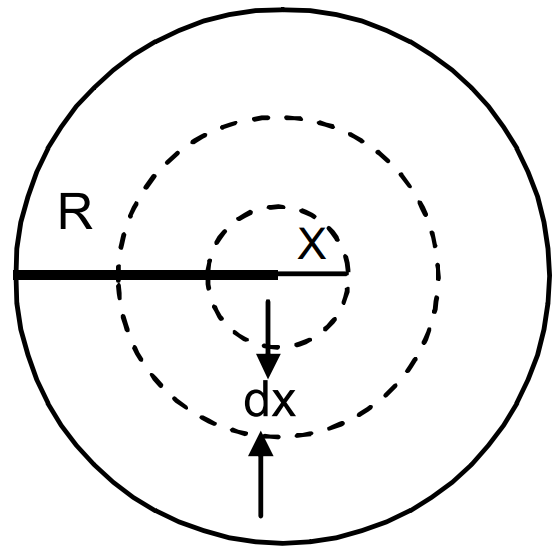 Considering a strip of width dx at a distance x from centre,
$\text{di}\frac{\text{dp}}{\text{dt}}=\frac{\text{q}4\pi\text{x}^2\text{dx}}{\Big(\frac{4}{3}\Big)\pi\text{R}^3\text{}}4\pi\text{x}^2\text{dx}$
$\text{di}=\frac{\text{dq}}{\text{dt}}=\frac{\text{q}4\pi\text{x}^2\text{dx}}{\Big(\frac{4}{3}\Big)\pi\text{R}^3\text{t}}=\frac{3\text{q}\text{x}^2\text{dx}\omega}{\text{R}^32\pi}$
$\text{d}\mu=\text{di}\times\text{A}=\frac{3\text{q}\text{x}^2\text{d}\text{x}\omega}{\text{R}^32\pi}\times4\pi\text{x}^{2\ =\ \frac{6\text{q}\omega}{\text{R}^3}\text{x}^4\text{dx}}$
$\mu=\int\limits_0^{\mu}\text{d}\mu\int\limits_0^{\text{R}}\frac{6\text{q}\omega}{\text{R}^3}\text{x}^4\text{dx}=\frac{6\text{q}\omega}{\text{R}^3}\Big[\frac{\text{x}^5}{5}\Big]_0$
$\text{R}=\frac{\text{6}\text{q}\omega\text{R}^5}{\text{R}^3}\frac{\text{R}^5}{5}=\frac{6}{5}\text{q}\omega\text{R}^2$ View full question & answer→Question 105 Marks
A charged particle is accelerated through a potential difference of 12kV and acquires a speed of $1.0 \times 10^6m s^{−1}$. It is then injected perpendicularly into a magnetic field of strength 0.2T. Find the radius of the circle described by it.
Answer$\text{V}=12\text{KV}$$\text{E}=\frac{\text{qV}}{\text{ml}}$
Now, $\text{F}=\text{qE}=\frac{\text{qV}}{\text{l}}$
$\text{a}=\frac{\text{F}}{\text{m}}=\frac{\text{qv}}{\text{ml}}$
$\text{v}=1\times10^6\text{m/s}$
$\text{v}=\sqrt{2\times\frac{\text{qV}}{\text{ml}}\times\text{l}}=\sqrt{2\times\frac{\text{q}}{\text{m}}\times12\times10^3}$
$1\times10^6=\sqrt{2\times\frac{\text{q}}{\text{m}}\times12\times10^3}$
$\Rightarrow10^{12}=24\times10^3\times\frac{\text{q}}{\text{m}}$
$\Rightarrow\frac{\text{m}}{\text{q}}=\frac{24\times10^3}{10^{12}}=24\times10^{-9}$
$\Rightarrow\frac{\text{mV}}{\text{qB}}=\frac{24\times10^{-9}\times1\times10^6}{2\times10^{-1}}=12\times10^{-2}\text{m}=12\text{cm}$
View full question & answer→Question 115 Marks
Electrons emitted with negligible speed from an electron gun are accelerated through a potential difference V along the x-axis. These electrons emerge from a narrow hole into a uniform magnetic field B directed along this axis. However, some of the electrons emerging from the hole make slightly divergent angles, as shown in the figure. Show that these paraxial electrons are refocussed on the x-axis at a distance $\sqrt{\frac{8\pi^2\text{mV}}{\text{eB}^2}}.$
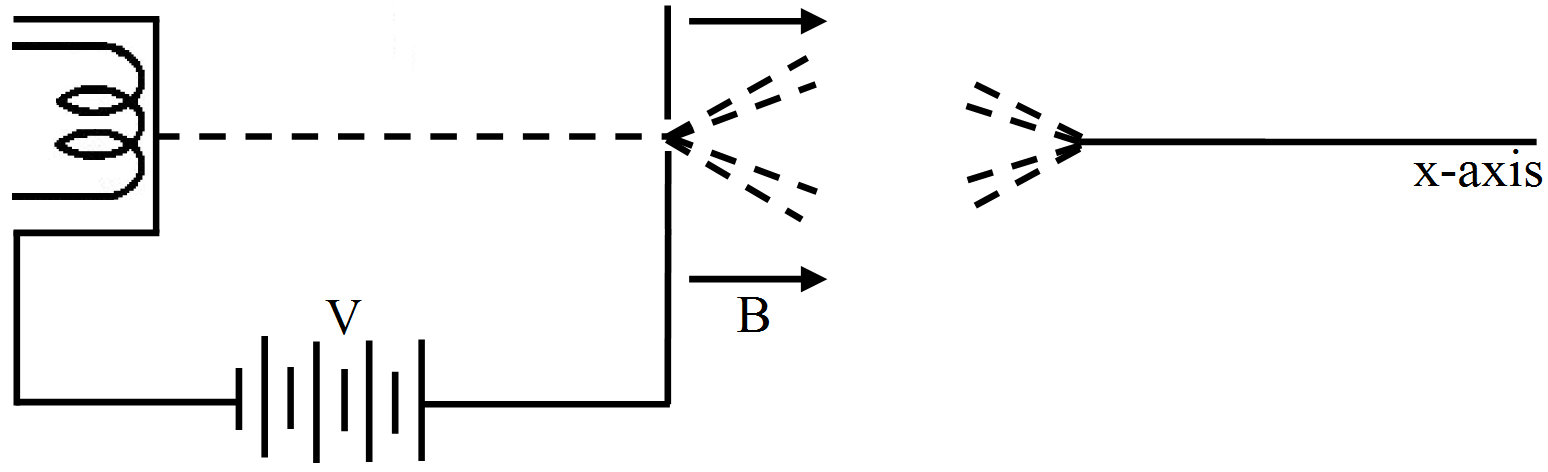
AnswerGiven magnetic field = B, Pd = V, mass of electron = m, Charge = q, Let electric field be ‘E’
$\therefore\text{E}=\frac{\text{V}}{\text{R}'}$
Force Experienced = eE Acceleration $=\frac{\text{eE}}{\text{m}}=\frac{\text{eE}}{\text{Rm}}$ Now, $V^2 = 2 \times a \times s$
$[\because\text{x}=0]$
$\text{V}=\sqrt{\frac{2\text{e}\times\text{V}\times\text{R}}{\text{Rm}}}=\sqrt{\frac{\text{2eV}}{\text{m}}}$
Time taken by particle to cover the arc $=\frac{2\pi\text{m}}{\text{qB}}=\frac{2\pi\text{m}}{\text{eB}}$ Since the acceleration is along ‘Y’ axis. Hence it travels along x axis in uniform velocity, Therefore, $\text{v}\times\text{t}=\sqrt{\frac{2\text{em}}{\text{m}}}\times\frac{2\pi\text{m}}{\text{eB}}\sqrt{\frac{8\pi^2\text{mV}}{\text{eB}^2}}$
View full question & answer→Question 125 Marks
A 50-turn circular coil of radius 2.0cm carrying a current of 5.0A is rotated in a magnetic field of strength 0.20T.
- What is the maximum torque that acts on the coil?
- In a particular position of the coil, the torque acting on it is half of this maximum. What is the angle between the magnetic field and the plane of the coil?
Answer$\text{n}=50,\ \text{r}=0.02\text{m}$$\text{A}=\pi\times(0.02)^2,\ \text{B}=0.02\text{T}$
$\text{i}=5\text{A},\ \mu=\text{niA}=50\times5\times\pi\times\text{4}\times10^{-4}$
$\tau$ is max. when $\theta=90^\circ$
$\tau=\mu\times\text{B}=\mu\text{B}\sin90^\circ$
$=\mu\text{B}=50\times3.14\times4\times10^{-4}\times2\times10^{-1}$
$=6.28\times10^{-2}\text{N-M}$
Given $\tau=\Big(\frac{1}{2}\Big)\tau_\text{max}$
$\Rightarrow\sin\theta=\Big(\frac{1}{2}\Big)$
or, $\theta=30^\circ=$ Angle between area vector & magnetic field.
⇒ Angle between magnetic field and the plane of the coil $=90^\circ-30^\circ=60^\circ$
View full question & answer→Question 135 Marks
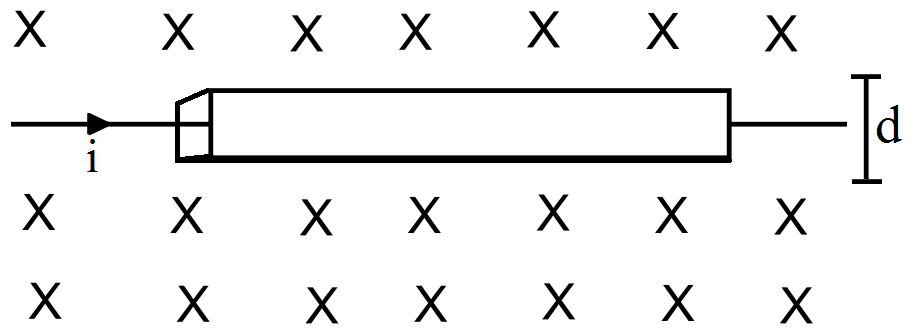
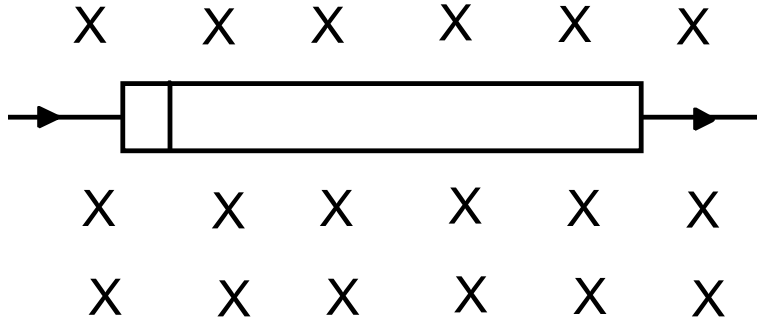
A current i is passed through a silver strip of width d and area of cross-section A. The number of free electrons per unit volume is n.
- Find the drift velocity v of the electrons.
- If a magnetic field B exists in the region, as shown in the figure, what is the average magnetic force on the free electrons?
- Due to the magnetic force, the free electrons get accumulated on one side of the conductor along its length. This produces a transverse electric field in the conductor, which opposes the magnetic force on the electrons. Find the magnitude of the electric field which will stop further accumulation of electrons.
- What will be the potential difference developed across the width of the conductor due to the electron-accumulation? The appearance of a transverse emf, when a current-carrying wire is placed in a magnetic field, is called Hall effect.
Answer
- $\text{i}=\text{V}_0\text{n}\text{Ae}$
$\Rightarrow\text{V}_0=\frac{\text{i}}{\text{nae}}$
- $\text{F}=\text{ilB}=\frac{\text{iB}}{\text{nA}}$ (upwards)
- Let the electric field be E
$\text{Ee}=\frac{\text{iB}}{\text{An}}\Rightarrow\text{E}=\frac{\text{iB}}{\text{Aen}}$
- $\frac{\text{dv}}{\text{dr}}=\text{E}\Rightarrow\text{dV}=\text{Edr}$
$=\text{E}\times\text{d}=\frac{\text{ib}}{\text{Aen}}\text{d}$ View full question & answer→Question 145 Marks
Consider a non-conducting plate of radius r and mass m that has a charge q distributed uniformly over it. The plate is rotated about its axis with an angular speed $\omega.$ Show that the magnetic moment $\mu$ and the angular momentum of the plate are related as $\mu=\frac{\text{q}}{2\text{m}}\text{l}.$
Answer
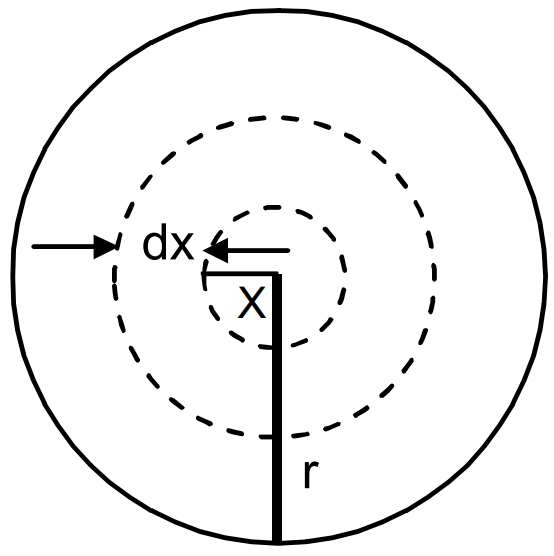 dp on the small length dx is $\frac{\text{q}}{\pi\text{r}^2}2\pi\text{x}\text{ dx}.$
$\text{di}=\frac{\text{q}2\pi\times\text{dx}}{\pi\text{r}^2\text{t}}=\frac{\text{q}2\pi\text{dx}\omega}{\pi\text{r}^2\text{q}2\pi}=\frac{\text{q}\omega}{\pi\text{r}^2}\text{xdx}$
$\text{d}\mu=\text{n}\text{ di}\text{A}=\frac{\text{q}\omega\text{xdx}}{\pi\text{r}^2}\pi\text{x}^2$
$\mu=\int\limits_0^\mu\text{d}\mu=\int\limits_0^{\text{r}}\frac{\text{q}\omega}{\text{r}^2}\text{x}^3\text{dx}=\frac{\text{q}\omega}{\text{r}^2}\Big[\frac{\text{x}^4}{4}\Big]^\text{r}=\frac{\text{q}\omega\text{r}^4}{\text{r}^2\times4}=\frac{\text{q}\omega\text{r}^2}{4}$
$\text{l}=\text{I}\omega=\Big(\frac{1}{2}\Big)\text{mr}^2\omega$
$\Big[\therefore$ M.I. for disc is $\Big(\frac{1}{2}\Big)\text{mr}^2\Big]$
$\frac{\mu}{\text{l}}=\frac{\text{q}\omega\text{r}^2}{4\times\Big(\frac{1}{2}\Big)\text{mr}^2\omega}$
$\Rightarrow\frac{\text{q}}{\text{l}}=\frac{\text{q}}{2\text{m}}$
$\Rightarrow\mu=\frac{\text{q}}{2\text{m}}\text{l}$ View full question & answer→Question 155 Marks
A circular loop carrying a current i is made of a wire of length L. A uniform magnetic field B exists parallel to the plane of the loop.
- Find the torque on the loop.
- If the same length of the wire is used to form a square loop, what would be the torque? Which is larger?
Answerradius = r Circumference $=\text{L}=2\pi\text{r}$$\Rightarrow\text{r}=\frac{\text{L}}{2\pi}$
$\Rightarrow\pi\text{r}^2=\frac{\pi\text{L}^2}{4\pi^2}=\frac{\text{L}^2}{4\pi}$
Circumfernce = L$4\text{S}=\text{L}$
$\Rightarrow\text{S}=\frac{\text{L}}{4}$
Area $=\text{S}^2=\Big(\frac{\text{L}}{4}\Big)^2=\frac{\text{L}^2}{16}$$\tau=\text{i}\overrightarrow{\text{A}}\times\overrightarrow{\text{B}}=\frac{\text{iL}^2\text{B}}{16}$
View full question & answer→Question 165 Marks
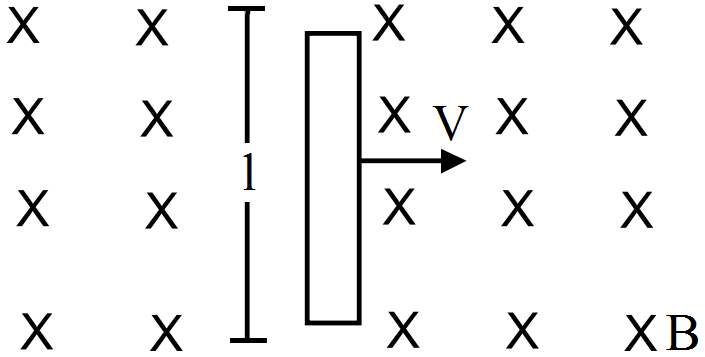
A conducting wire of length l, lying normal to a magnetic field B, moves with a velocity v, as shown in the figure.
- Find the average magnetic force on a free electron of the wire.
- Due to this magnetic force, electrons concentrate at one end, resulting in an electric field inside the wire. The redistribution stops when the electric force on the free electrons balances the magnetic force. Find the electric field developed inside the wire when the redistribution stops.
- What potential difference is developed between the ends of the wire?
Answer
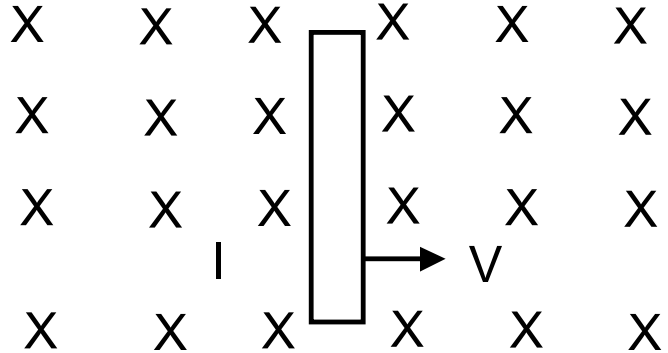 Velocity of electron = v
Magnetic force on electron
F = evB
- F = qE ; F = evB
$\Rightarrow\text{qE}=\text{evB}$
$\Rightarrow\text{eE}=\text{evB}$
$\Rightarrow\overrightarrow{\text{E}}=\text{vB}$
- $\text{E}=\frac{\text{dV}}{\text{dr}}=\frac{\text{V}}{\text{l}}$
$\Rightarrow\text{V}=\text{lE}=\text{lvB}$ View full question & answer→Question 175 Marks
When a proton is released from rest in a room, it starts with an initial acceleration $a_0$ towards west. When it is projected towards north with a speed $v_0$, it moves with an initial acceleration $3a_0$ towards west. Find the electric field and the maximum possible magnetic field in the room.
Answer$\text{q}_\text{p}=\text{e},\ \text{mp}=\text{m},\ \text{F}=\text{q}_\text{p}\times\text{E}$$\text{ma}_0=\text{eE}$
$\text{E}=\frac{\text{ma}_0}{\text{e}}$ towards west

The acceleration changes from $a_0$ to $3a_0$
Hence net acceleration produced by magnetic field $\overrightarrow{\text{B}}$ is $2a_0$.
Force due to magnetic field
$\overrightarrow{\text{F}}_\text{B}=\text{m}\times2\text{a}_0=\text{e}\times\text{V}_0\times\text{B}$
$\Rightarrow\text{B}=\frac{2\text{ma}_0}{\text{eV}_0}$ downwards View full question & answer→Question 185 Marks
A particle of mass m and charge q is released from the origin in a region in which the electric field and magnetic field are given by
$\overrightarrow{\text{B}}=-\text{B}_0\overrightarrow{\text{j}}$ and $\overrightarrow{\text{E}}=\text{E}_0\overrightarrow{\text{k}}.$ Find the speed of the particle as a function of its z-coordinate.
Answer
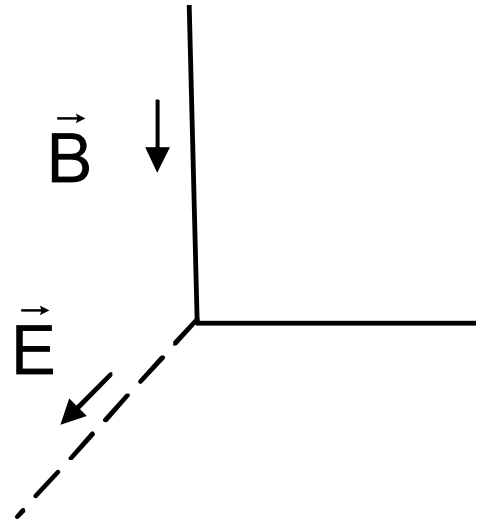 Velocity will be along x - z plane
$\overrightarrow{\text{B}}-\text{B}_0\overrightarrow{\text{j}}$
$\overrightarrow{\text{E}}=\text{E}_0\hat{\text{k}}$
$\text{F}=\text{q}\big(\overrightarrow{\text{E}}+\overrightarrow{\text{V}}\times\overrightarrow{\text{B}}\big)$
$=\text{q}\Big[\text{E}_0\hat{\text{k}}+(\text{u}_\text{x}\hat{\text{i}}+\text{u}_\text{x}\hat{\text{k}})(-\text{B}_0\hat{\text{j}})\Big]$
$=(\text{qE}_0)\hat{\text{k}}-(\text{u}_\text{x}\text{B}_0)\hat{\text{k}}+(\text{u}_\text{z}\text{B}_0)\hat{\text{i}}$
$\text{F}_\text{z}=(\text{qE}_0-\text{u}_\text{x}\text{B}_0)$
since $\text{u}_\text{x}=0,\ \text{F}_\text{z}=\text{qE}_0$
$\Rightarrow\text{a}+\text{z}=\frac{\text{qE}_0}{\text{m}}$
So, $\text{v}^2=\text{u}^2+2$
as, $\Rightarrow\text{v}^2=2\frac{\text{qE}}{\text{m}}\text{Z}$ [distance along Z direction be z]
$\Rightarrow\text{V}\sqrt{\frac{2\text{qE}_0\text{Z}}{\text{m}}}$ View full question & answer→Question 195 Marks
The magnetic field existing in a region is given by $\overrightarrow{\text{B}}=\text{B}_0\Big(1+\frac{\text{x}}{\text{l}}\Big)\overrightarrow{\text{k}}.$ A square loop of edge land carrying a current i, is placed with its edges parallel to the x - y axes. Find the magnitude of the net magnetic force experienced by the loop.
Answer
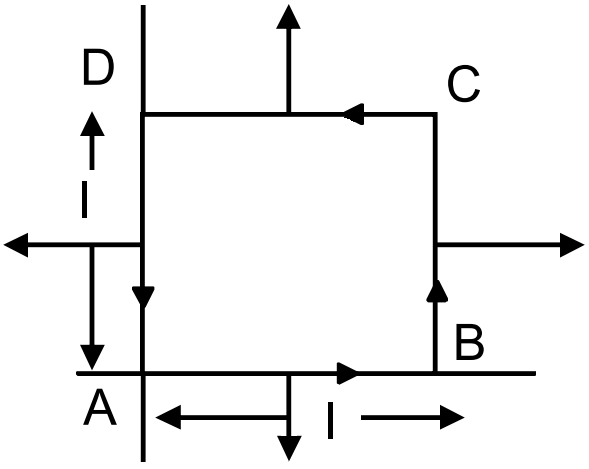
$\overrightarrow{\text{B}}=\text{B}_0\Big(1+\frac{\text{x}}{\text{l}}\Big)\hat{\text{k}}$
$f_1$ = force on AB $=\text{iB}_0[1+0]\text{l}=\text{iB}_0\text{l}$
$f_2$ = force on CD$=\text{iB}_0[1+0]\text{l}=\text{iB}_0\text{l}$
$f_3$ = force on AD$=\text{iB}_0\Big[1+\frac{0}{1}\Big]\text{l}=\text{iB}_0\text{l}$
$f_4$ = force on AB $=\text{iB}_0\Big[1+\frac{1}{1}\Big]2=\text{iB}_0\text{l}$
Net horizontal force $=\text{F}_1-\text{F}_2=0$
Net vertical force$=\text{F}_4-\text{F}_3=\text{iB}_0\text{l}$ View full question & answer→Question 205 Marks
A particle of charge $2.0 \times 10^{-8} \mathrm{C}$ and mass $2.0 \times 10^{-10} \mathrm{~g}$ is projected with a speed of $2.0 \times 10^3 \mathrm{~m} / \mathrm{s}^{-1}$ in a region with a uniform magnetic field of 0.10 T . The velocity is perpendicular to the field. Find the radius of the circle formed by the particle and also the time period.
Answer$\text{q}=2.0\times10^{-8}\text{C}$$\overrightarrow{\text{B}}=0.10\text{T}$
$\text{m}=2.0\times10^{-10}\text{g}=2\times10^{-13}\text{g}$
$\text{v}=2.0\times10^3\text{m}$
$\Rightarrow{\text{R}}=\frac{\text{mv}}{\text{qB}}=\frac{2\times10^{-13}\times2\times10^3}{2\times10^{-8}\times10^{-1}}$
$=0.2\text{m}=20\text{cm}$
$\text{T}=\frac{2\pi\text{m}}{\text{qB}}=\frac{2\times3.14\times2\times10^{-13}}{2\times10^{-8}\times10^{-1}}=6.28\times10^{-4}\text{s}$
View full question & answer→Question 215 Marks
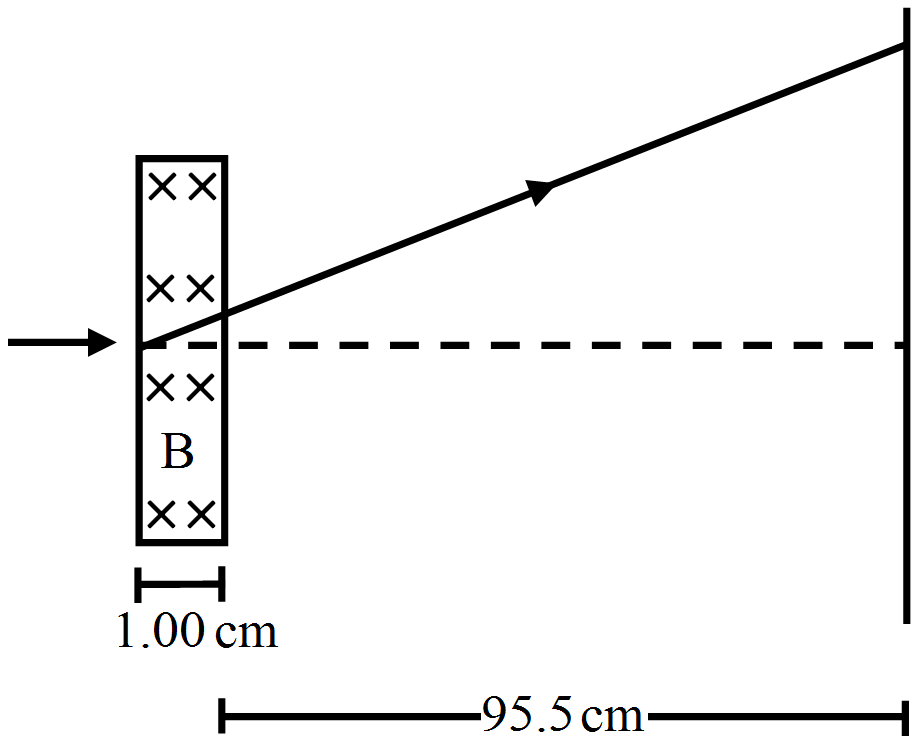
A narrow beam of singly charged potassium ions of kinetic energy 32keV is injected into a region of width 1.00cm with a magnetic field of strength 0.500T, as shown in the figure. The ions are collected at a screen 95.5cm away from the field region. If the beam contains isotopes of atomic weights 39 and 41, find the separation between the points where these isotopes strike the screen. Take the mass of a potassium ion $= A (1.6 \times 10^{-27})kg,$ where A is the mass number.
AnswerKinetic energy of singly-charged potassium ions $ = 32\ keV$
Width of the magnetic region $= 1.00cm$
Magnetic field's strength, $B = 0.500T$
Distance between the screen and the region = 95.5cm
Atomic weights of the two isotopes are 39 and 41.
Mass of a potassium ion $= A (1.6 \times 10^{-27})kg$ For a singly-charged potassium ion K-39
Mass of $K-39 = 39 \times 1.6 \times 10^{-27}kg,$ Charge, $q = 1.6 \times 10^{-19}C$
As per the question, the narrow beam of singly-charged potassium ions is injected into a region of magnetic field.
As, K.E = 32keV$\frac{\text{1}}{2}\text{mv}^2=32\times10^3\times1.6\times10^{-19}$
$\frac{1}{2}\times39\times(1.6\times10^{-27})\times\text{v}^2$
$=32\times10^3\times1.6\times10^{-19}$
v = 4.05 We know that throughout the motion, the horizontal velocity remains constant.
So, the time taken to cross the magnetic field,
$\text{t}=\frac{\text{d}}{\text{v}}=\frac{0.01}{4.05\times10^5}$
$= 24.7 \times 10^{-9}s$
Now, the acceleration in the magnetic field region F = qvB = ma
$\text{a}=\frac{\text{qvB}}{\text{m}}$
$=\frac{1.6\times10^{19}\times4.05\times10^5}{39\times1.6\times10^{-27}}$
$= 5192 \times 10^8 m/s^2$^
Velocity in the vertical direction,
$v_y = at = 5193.53 \times 10^8 \times 24.7 \times 10^{-9} = 12824.24m/s$
Time taken to reach the screen
$=\frac{\text{d}}{\text{v}}=\frac{0.955}{4.05\times10^5}$
= 0.000002358s. Distance moved vertically in this time
$= v_y \times t = 12824.24 \times 2358 \times 10^{-9} $
$= 3023.95 \times 10^{-5}m$
Vertical distance travelled by the particle inside magnetic field can be found out by using equaton of motion
$v^2 = 2aS $
$\Rightarrow (12824.24)^2 = 2 \times 5192 \times 10^8 \times S $
$\Rightarrow 15.83 \times 10^{-5} = S$
Net display from line $= 15.83 \times 10^{-5} + 3023.95 \times 10^{-5}$
= 3039.787 10^{-5}m. For the potassium ion K-41
$\frac{1}{2}\times41\times1.6\times10^{-27}$
$v^2= 32 \times 10^3 \times 1.6 \times 10^{-9} $
$\Rightarrow v = 3.94 \times 10^5m/s$
Similarly, acceleration, $= 4805 \times 10^8m/s^2$
t = time taken for exiting the magnetic field $= 25.4 \times 10^{-9} \sec.$
$v_{y1}= at$ (vertical velocity)
$= 4805 \times 10^8 \times 25.4 \times 10^{-9} $
$= 12204.7 \times 10^{-9}m/s$
Time to reach the screen $= 2423 \times 10^{-9} s.$
Distance moved vertically $= 12204.7 \times 2423 \times 10^{-9} $
$= 2957.1 \times 10^{-5}$^
Now, Vertical distance travelled by the particle inside magnetic field can be found out by using equaton of motion
$v^2 = 2aS (12204.7)^2 $
$= 2 \times 4805 \times 10^8S $
$\Rightarrow S = 15.49 \times 10^{-5}m$
Net distance travelled $= 15.49 \times 10^{-5} + 2957.1 \times 10^{-5}$
$= 2972.68 \times 10^{-5}m.$
Net gap between K-39 and $K-41 = 3039.787 \times 10^{-5} - 2972.68 \times 10^{-5} = 67mm.$
View full question & answer→Question 225 Marks
A $10g$ bullet with a charge of $4.00\mu\text{C}$ is fired at a speed of $270m/s^{-1}$ in a horizontal direction. A vertical magnetic field of $500\mu\text{T}$ exists in the space. Find the deflection of the bullet due to the magnetic field as it travels through 100m. Make appropriate approximations.
Answer$\text{m}=10\text{g}=10\times10^{-3}\text{kg}$$\text{q}=400\text{mc}=400\times10^{-6}\text{C}$
$\text{v}=270\text{m/s},$
$\text{B}=500\mu\text{t}=500\times10^{-6}$ Tesla
Force on the particle $=\text{quB}=4\times10^{-6}\times270\times500\times10^{-6}=54\times10^{-8}(\text{k})$
Acceleration on the particle $=54\times10^{-6}\text{m/s}^2(\text{k})$
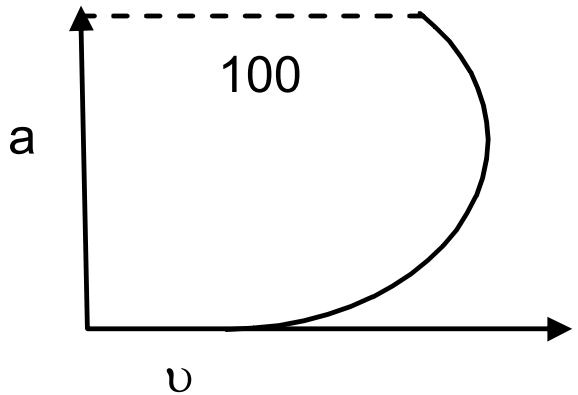
Velocity along $\hat{\text{i}}$ and acceleration along $\hat{\text{k}}$
along x-axis the motion is uniform motion and along y-axis it is accelerated motion.
Along -X axis $100=270\times\text{t}$
$\Rightarrow\text{t}=\frac{10}{27}$
Along -Z axis $\text{s}=\text{ut}+\Big(\frac{1}{2}\Big)\text{at}^2$
$\Rightarrow\text{s}=\frac{1}{2}\times54\times10^{-6}{=-6}\times\frac{10}{27}\times\frac{10}{27}$
$=3.7\times10^{-6}$ View full question & answer→Question 235 Marks
A proton goes undeflected in a crossed electric and magnetic field (the fields are perpendicular to each other) at a speed of $2.0 \times 10^5ms^{-1}$. The velocity is perpendicular to both the fields. When the electric field is switched off, the proton moves along a circle of radius $4.0cm$. Find the magnitudes of the electric and magnetic fields. Take the mass of the proton = $1.6 \times 10^{-27}kg$
Answer$M_P: = 1.6 \times 10^{–27}Kg u = 2 \times 10^5m/s r = 4cm = 4 \times 10^{-2}m$ Since the proton is undeflected in the combined magnetic and electric field. Hence force due to both the fields must be same. i.e. qE = quB ⇒ E = uB Won, when the electricfield is stopped, then if forms a circle due to force of magnetic field We know, $=\frac{\text{m}\mu}{\text{qB}}$$\Rightarrow4\times10^2=\frac{1.6\times10^{27\times2\times10^5}}{1.6\times10^{-19}\times\text{B}}$
$\Rightarrow\text{B}=\frac{1.6\times10^{-27}\times2\times10^5}{1.6\times10^{-19}\times\text{B}}$
$=0.5\times10^{-1}=0.005\text{T}$
$\text{E}=\text{uB}=2\times10^5\times0.05=1\times10^4\frac{\text{N}}{\text{C}}$
View full question & answer→Question 245 Marks
A rectangular loop of sides $20cm$ and $10cm$ carries a current of $5.0A$. A uniform magnetic field of magnitude $0.20T$ exists parallel to the longer side of the loop.
- What is the force acting on the loop?
- What is the torque acting on the loop?
Answer
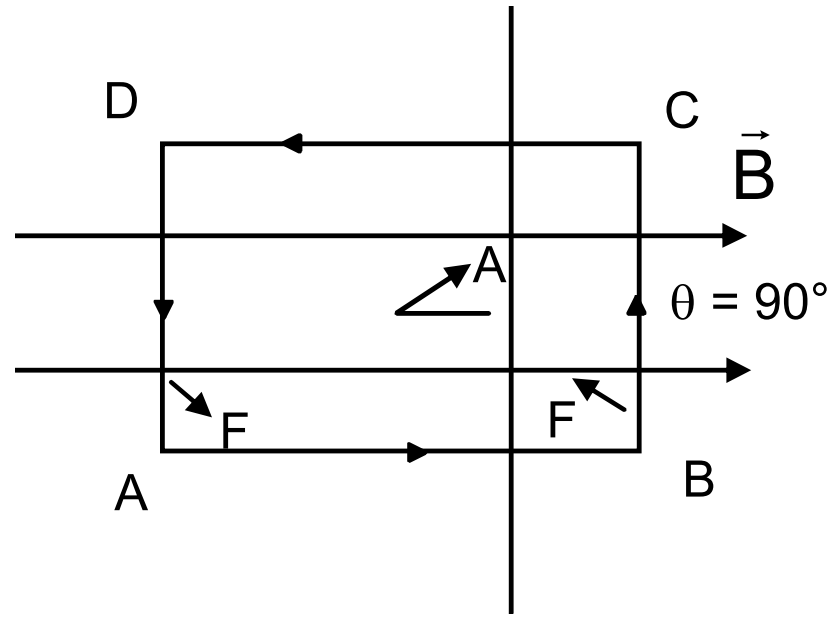
$l = 20cm = 20 \times 10^{-2}m$
$B = 10cm = 10 \times 10^{-2}m$
$i = 5A,$
$B = 0.2T$
There is no force on the sides AB and CD. But the force on the sides AD and BC are opposite. So they cancel each other.
Torque on the loop
$\tau=\text{ni}\overrightarrow{\text{A}}\times\overrightarrow{\text{B}}=\text{ni}\text{ AB}\sin90^\circ$
$\Rightarrow1\times5\times20\times10^{-2}\times10\times10^{-2}0.2$
$=2\times10^{-2}=0.02\text{N-M}$
Parallel to the shorter side. View full question & answer→Question 255 Marks
- An electron moves along a circle of radius 1m in a perpendicular magnetic field of strength 0.50T. What would be its speed? Is it reasonable?
- If a proton moves along a circle of the same radius in the same magnetic field, what would be its speed?
Answer
- $\text{R}=1\text{n},$
$\text{B}=0.5\text{T},$
$\text{r}=\frac{\text{mv}}{\text{qB}}$
$\Rightarrow1=\frac{9.1\times10^{-31}\times\text{v}}{1.6\times10^{-19}\times0.5}$
$\Rightarrow\text{v}=\frac{1.6\times0.5\times106{-19}}{9.1\times10^{-31}}$
$=0.0879\times10^{10}\approx8.8\times10^{10}\text{m/s}$
No, it is not reasonable as it is more than the speed of light.
- $\text{r}=\frac{\text{Mv}}{\text{qB}}$
$\Rightarrow1=\frac{1.6\times10^{27}\times\text{v}}{1.6\times10^{-19}\times0.5}$
$\Rightarrow\text{v}=\frac{1.6\times106{19}\times0.5}{1.6\times10^{27}}$
$=0.5\times10^8=5\times10^7\text{m/s}$ View full question & answer→Question 265 Marks
A proton projected in a magnetic field of $0.020T$ travels along a helical path of radius $5.0cm$ and pitch $20cm$. Find the components of the velocity of the proton along and perpendicular to the magnetic field. Take the mass of the proton = $1.6 \times 10^{-27}kg$
Answer$\overrightarrow{\text{B}}=0.020\text{T} M_p = 1.6 \times 10^{-27}kg$
Pitch = $20cm = 2 \times 10^{-1}m$
Radius = $5cm = 5 \times 10^{-2}m$
We know for a helical path, the velocity of the proton has got two components $\theta_\bot\ \&\ \theta_\text{H}$
Now, $\text{r}\frac{\text{m}\theta_\bot}{\text{qB}}$
$\Rightarrow5\times10^{-2}=\frac{1.6\times10^{-27}\times\theta_\bot}{1.6\times10^{-19}\times2\times10^{-2}}$
$\Rightarrow\theta_\bot=\frac{5\times10^{-2}\times1.6\times10^{-19}\times2\times10^{-2}}{1.6\times10^{-27}}$
$=1\times10^5\text{m/s}$
However, $\theta_\bot$ remains constant
$\text{T}=\frac{2\pi\text{m}}{\text{qB}}$
patch $=\theta_\text{H}\times\text{T}$ or, $\theta_\text{H}=\frac{\text{pitch}}{\text{T}}$
$\theta_\text{H}=\frac{2\times10^{-1}}{2\times3.14\times1.6\times10^{-27}}\times1.6\times10^{-19}\times2\times10^{-2}$
$=0.6369\times10^5\approx6.4\times10^4\text{m/s}$
View full question & answer→Question 275 Marks
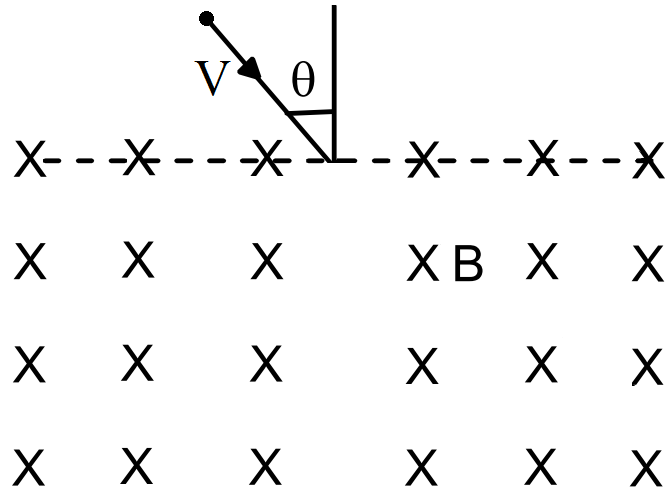
A particle of mass m and positive charge q, moving with a uniform velocity v, enters a magnetic field B, as shown,
- Find the radius of the circular arc it describes in the magnetic field.
- Find the angle subtended by the arc at the centre.
- How long does the particle stay inside the magnetic field?
- Solve the three parts of the above problem if the charge q on the particle is negative.
Answer
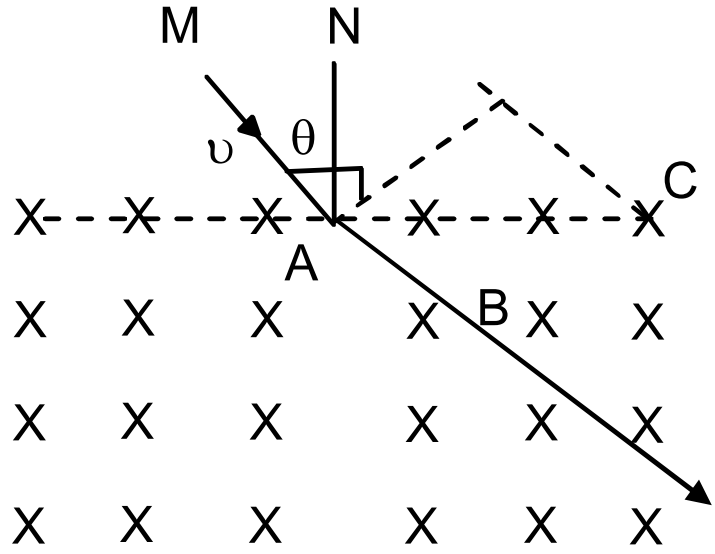
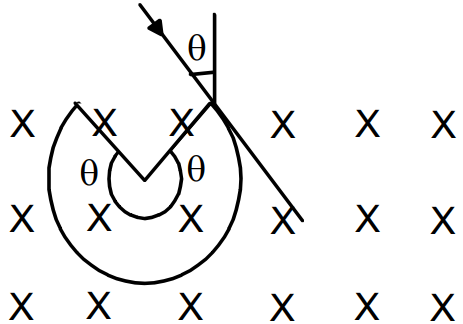
- Radius of circular arc $=\frac{\text{mv}}{\text{qB}}$
- Since MA is tangent to are ABC, described by the particle.
Hence $\angle\text{MAO}=90^\circ$
Now, $\angle\text{NAC}=90^\circ[\because\text{NA}\text{ is}\perp\text{r}]$
$\therefore\angle\text{OAC}=\angle\text{OCA}=\theta$ [By geometry]
Then $\angle\text{AOC}=180-(\theta+\theta)=\pi-2\theta$
- Dist. Covered $\text{l}=\text{r}\theta=\frac{\text{mv}}{\text{pB}}(\pi-2\theta)$
$\text{t}=\frac{\text{l}}{\text{v}}=\frac{\text{m}}{\text{qB}}(\pi-2\theta)$
- If the charge ‘q’ on the particle is negative. Then
- Radius of Circular arc $=\frac{\text{mv}}{\text{qB}}$
- In such a case the centre of the arc will lie with in the magnetic field, as seen in the fig. Hence the angle subtended by the major arc $=\pi+2\theta$
- Similarly the time taken by the particle to cover the same path $=\frac{\text{m}}{\text{qB}}(\pi+2\theta)$
View full question & answer→Question 285 Marks
A particle of mass m and charge q is projected into a region that has a perpendicular magnetic field B. Find the angle of deviation of the particle as it comes out of the magnetic field if the width d of the region is very slightly smaller than
- $\frac{\text{mv}}{\text{qB}}$
- $\frac{\text{mv}}{2\text{qB}}$
- $\frac{2\text{mv}}{\text{qB}}.$
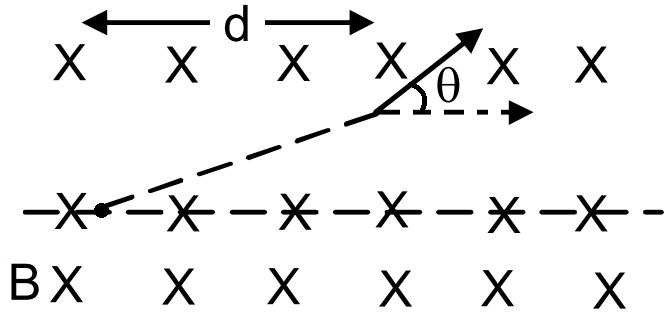
Answer
- Mass of the particle = m, Charge = q, Width = d
if $\text{d}=\frac{\text{mV}}{\text{qB}}$

The d is equal to radius. $\theta$ is the angle between the radius and tangent which is equal to $\frac{\pi}{2}$ (As shown in the figure)
- if $\approx\frac{\text{mV}}{2\text{qB}}$ distance travelled $=\Big(\frac{1}{2}\Big)$ of radius
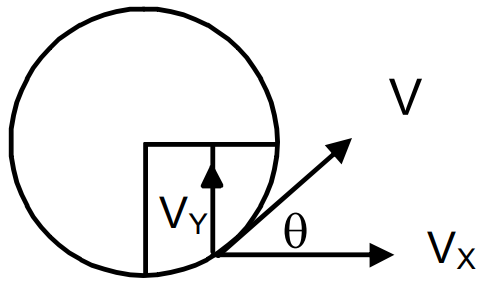
Along x-directions $d = V_Xt$ [Since acceleration in this direction is 0. Force acts along $\overrightarrow{\text{j}}$ directions]
$\text{t}=\frac{\text{d}}{\text{V}_\text{X}}\ ...(1)$
$\text{V}_\text{Y}=\text{u}_\text{Y}+\text{a}_\text{Y}\text{t}=\frac{0+\text{qu}_\text{X}\text{Bt}}{\text{m}}=\frac{\text{qu}_\text{Y}\text{Bt}}{\text{m}}$
From (1) putting the value of t, $\text{V}_\text{Y}=\frac{\text{qu}_\text{X}\text{Bd}}{\text{m}\text{V}_\text{X}}$
$\text{Tan}\theta\frac{\text{V}_\text{Y}}{\text{V}_\text{X}}=\frac{\text{qBd}}{\text{mV}_\text{X}}=\frac{\text{qBmV}_\text{X}}{2\text{qBmV}_\text{X}}=\frac{1}{2}$
$\Rightarrow\theta=\tan^{-1}\Big(\frac{1}{2}\Big)=26.4\approx30^\circ=\frac{\pi}{6}$
- $\text{d}\approx\frac{2\text{mu}}{\text{qB}}$
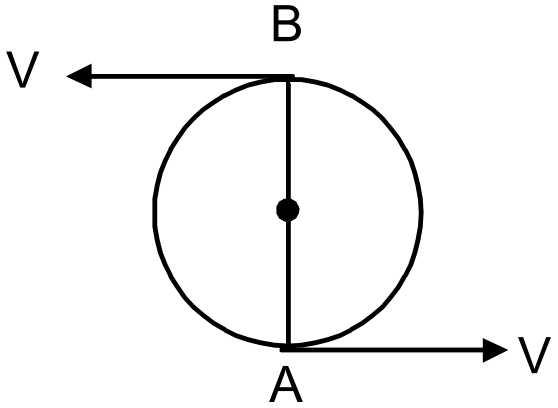
Looking into the figure, the angle between the initial direction and final direction of velocity is $\pi. $ View full question & answer→Question 295 Marks
A narrow beam of singly-charged carbon ions, moving at a constant velocity of $6.0 \times 10^4m s^{-1}$, is sent perpendicularly in a rectangular region of uniform magnetic field $B = 0.5T$ It is found that two beams emerge from the field in the backward direction, the separations from the incident beam being $3.0cm$ and $3.5cm$. Identify the isotopes present in the ion beam. Take the mass of an ion = $A(1.6 \times 10^{-27})kg$, where A is the mass number.
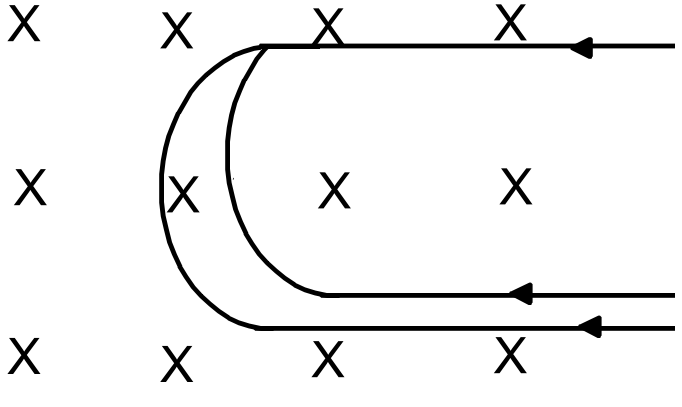
Answer
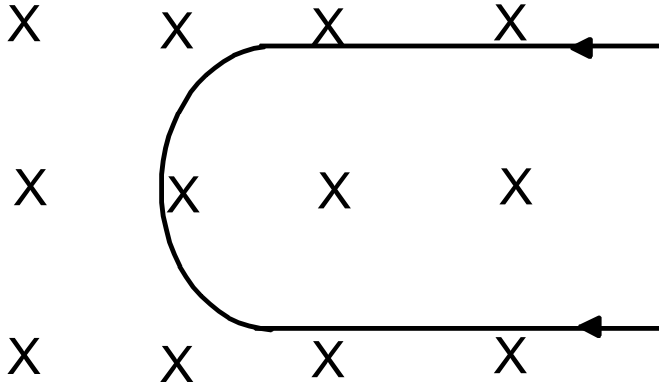
$\text{u}\times10^4\text{m/s}$
$\text{B}=0.5\text{T},$
$\text{r}=\frac{3}{2}=1.5\text{cm},$
$\text{r}_1=\frac{\text{mv}}{\text{qB}}=\frac{\text{A}\times(1.6\times10^{27})\times6\times10^4}{1.6\times10^{-19}\times0.5}$
$\Rightarrow1.5=\text{A}\times12\times10^{-4}$
$\Rightarrow\text{A}=\frac{1.5}{12\times106{-4}}=\frac{15000}{12}$
$\text{r}_2=\frac{\text{mu}}{\text{qB}}$
$\Rightarrow\frac{3.5}{2}=\frac{\text{A}'\times(1.6\times106{-27})\times6\times10^4}{1.6\times10^{-19}\times0.5}$
$\Rightarrow\text{A}'=\frac{3.5\times0.5\times10^{-19}}{2\times6\times10^4\times10^{-27}}$
$=\frac{3.5\times0.5\times10^4}{12}$
$\frac{\text{A}}{\text{A}'}=\frac{1.5}{12\times10^{-4}}\times\frac{12\times10^{-4}}{3.5\times0.5}=\frac{6}{7}$
Taking common ration = 2 (For Carbon). The isotopes used are $C^{12}$ and $C^{14}$ View full question & answer→Question 305 Marks
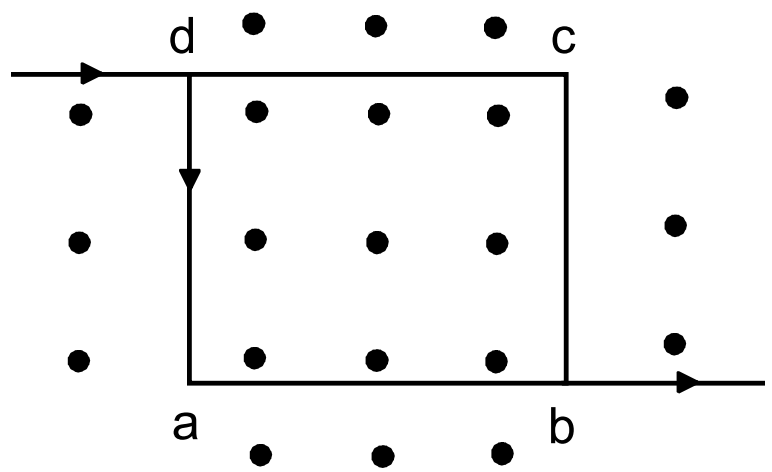
A current of 2A enters at the corner d of a square frame abcd of side 20cm and leaves at the opposite corner b. A magnetic field B = 0.1 T exists in the space in a direction perpendicular to the plane of the frame, as shown in the figure. Find the magnitude and direction of the magnetic forces on the four sides of the frame.
Question 315 Marks
An electron of kinetic energy 100eV circulates in a path of radius 10cm in a magnetic field. Find the magnetic field and the number of revolutions per second made by the electron.
Answer$\text{KE}=100\text{eV}=1.6\times10^{-17}\text{J}$$\Big(\frac{1}{2}\Big)\times9.1\times10^{-31}\times\text{V}^2=1.6\times10^{-17}\text{J}$
$\Rightarrow\text{V}^2=\frac{1.6\times10^{-17}\times2}{9.1\times10^{31}}=-0.35\times10^{14}$
or, $\text{V}=0.591\times10^7\text{m/s}$
Now, $\text{r}=\frac{\text{mv}}{\text{qB}}$
$\Rightarrow\frac{9.1\times10^{-31}\times0.591\times10^7}{1.6\times10^{19}\times\text{B}}=\frac{10}{100}$
$\Rightarrow\text{B}=\frac{9.1\times0.591}{1.6}\times\frac{10^{-23}}{10^{-19}}$
$=3.3613\times10^{-4}\text{T}\approx3.4\times10^{-4}\text{T}$
$\text{T}=\frac{2\pi\text{m}}{\text{qB}}=\frac{2\times3.14\times9.1\times106{-31}}{1.6\times10^{-19}\times3.4\times10^{-4}}$
No. of Cycles per Second $\text{f}=\frac{1}{\text{T}}$
$=\frac{1.6\times3.4}{2\times3.14\times9.1}\times\frac{10^{-19}\times10^{-4}}{10^{-31}}$
$=0.0951\times10^8\approx9.51\times10^6$
View full question & answer→Question 325 Marks
$\mathrm{Fe}^{+}$ions are accelerated through a potential difference of 500 V and are injected normally into a homogeneous magnetic field B of strength 20.0mT. Find the radius of the circular paths followed by the isotopes with mass numbers 57 and 58 . Take the mass of an ion $=\mathrm{A}\left(1.6 \times 10^{-27}\right) \mathrm{kg}$, where A is the mass number.
Answer$\text{V} = 500\text{V}$$\text{B}=20\text{mT}=(2\times10^{-3})\text{T}$
$\text{E}=\frac{\text{V}}{\text{d}}=\frac{500}{\text{d}}$
$\Rightarrow\text{F}=\frac{\text{q}500}{\text{d}}$
$\Rightarrow\text{a}=\frac{\text{q500}}{\text{dm}}$
$\Rightarrow\text{u}^2=2\text{ad}=2\times\frac{\text{q}500}{\text{dm}}\times\text{d}$
$\Rightarrow\text{u}^2=\frac{1000\times\text{q}}{\text{m}}$
$\Rightarrow\text{u}=\sqrt{\frac{1000\times\text{q}}{\text{m}}}$
$\Rightarrow\text{r}_1=\frac{\text{m}_1\sqrt{1000\times\text{q}_1}}{\text{q}_1\sqrt{\text{m}_1}\text{B}}$
$=\frac{\sqrt{\text{m}_1}\sqrt{1000}}{\sqrt{\text{q}_1}\text{B}}$
$=\frac{\sqrt{57\times1.6\times10^{-27}\times10^3}}{\sqrt{1.6\times10^{-19}}\times2\times10^{-3}}$
$=1.19\times10^{-2}\text{m}=119\text{cm}$
$\Rightarrow\text{r}_1=\frac{\text{m}_2\sqrt{1000\times\text{q}^2}}{\text{q}_2\sqrt{\text{m}_2}\text{B}}$
$=\frac{\sqrt{\text{m}_2}\sqrt{1000}}{\sqrt{\text{q}_2}\text{B}}$
$=\frac{\sqrt{1000\times58\times1.6\times10^{-27}}}{\sqrt{1.6\times10^{-19}\times20\times106{-3}}}$
$=1.20\times10^{-2}\text{m}=120\text{cm}$
View full question & answer→