Question 15 Marks
In an experiment on photoelectric effect, the stopping potential is measured for monochromatic light beams corresponding to different wavelengths. The data collected are 11s follows:
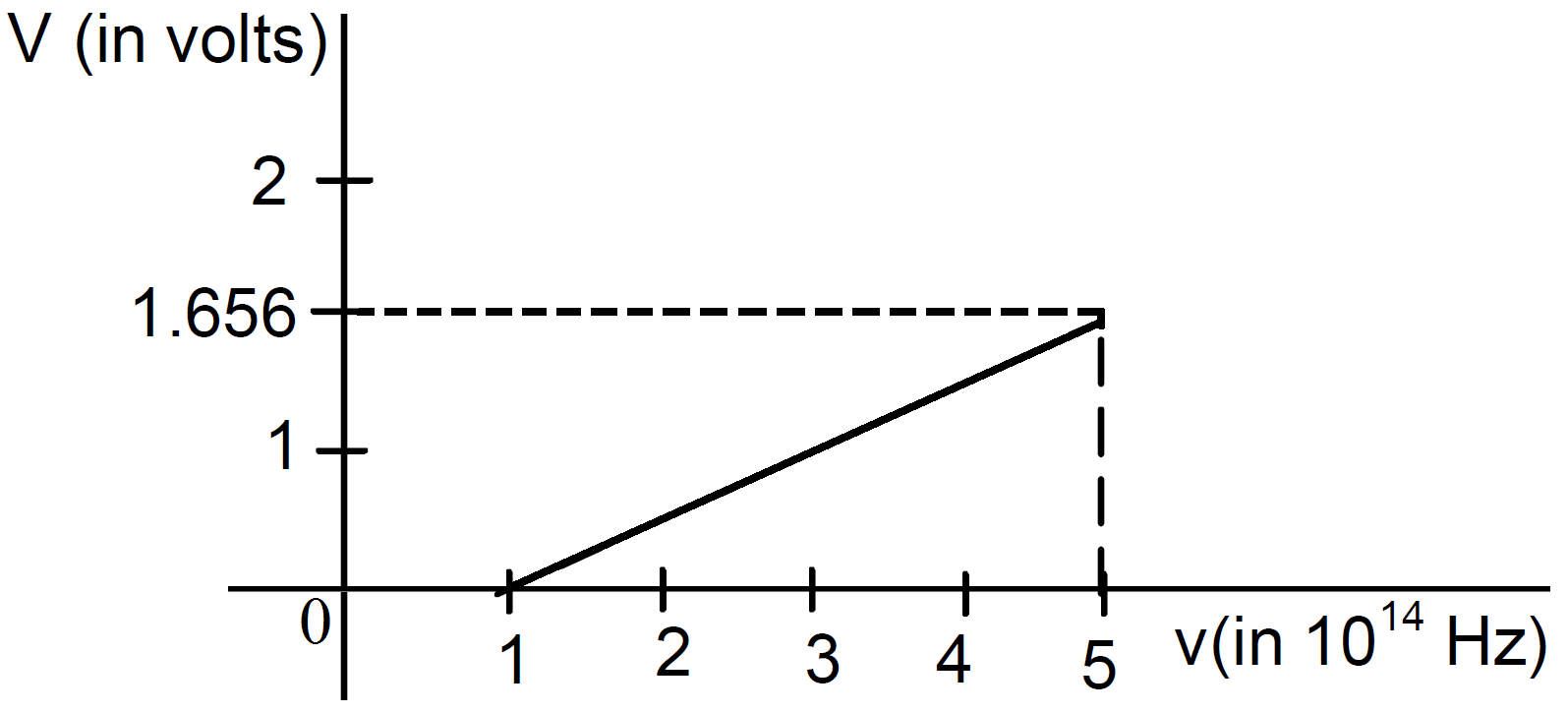
Plot the stopping potential against inverse of wavelength $\big(\frac{1}{\lambda}\big) $ on a graph paper and find
| wavelength (nm) | 350 | 400 | 450 | 500 | 550 |
| stopping potential(V): | 1.45 | 1.00 | 0.66 | 0.38 | 0.16 |
- The Planck constant,
- The work function of the emitter and.
- The threshold wavelength.
Answer
$\therefore\frac{\text{hc}}{350}=\text{w+1.45}\dots (1)$
and $\frac{\text{hc}}{400}=\text{w+1}\dots(2)$
Subtracting (2) from (1) and solving to get the value of h we get
$h = 4.2 \times 10^{-15} ev-sec$
View full question & answer→- when $\lambda=350,\text{v}_\text{s}=1.45$
$\therefore\frac{\text{hc}}{350}=\text{w+1.45}\dots (1)$
and $\frac{\text{hc}}{400}=\text{w+1}\dots(2)$
Subtracting (2) from (1) and solving to get the value of h we get
$h = 4.2 \times 10^{-15} ev-sec$
- Now work function $=\text{w}=\frac{\text{hc}}{\lambda}=\text{ev-s}$
- $\text{w}=\frac{\text{hc}}{\lambda}=\lambda_{\text{there cathod}}=\frac{\text{hc}}{\text{w}}$