Questions

5 Marks Questions

Take a timed test

12 questions · self-marked practice — reveal the answer and mark yourself.

Question 15 Marks
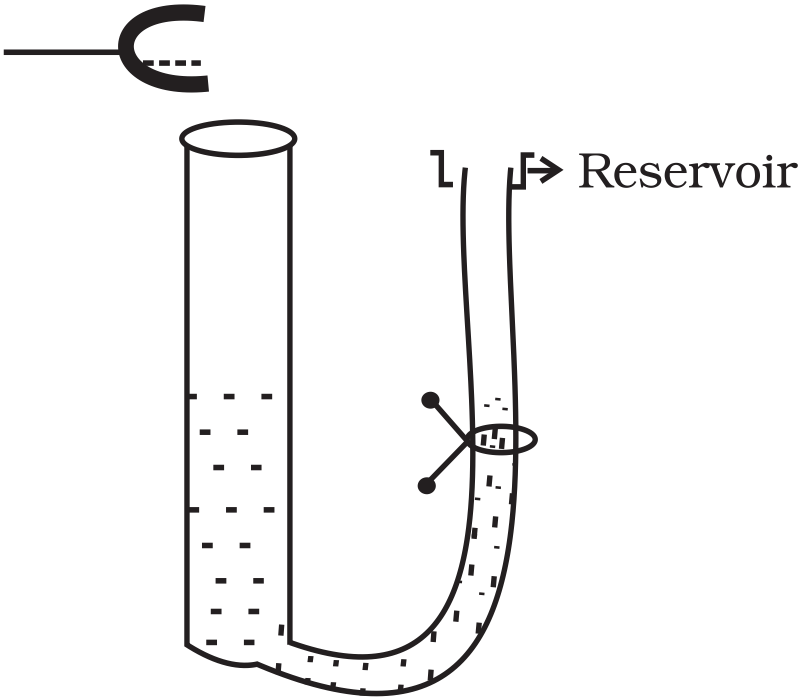
A tuning fork vibrating with a frequency of 512Hz is kept close to the open end of a tube filled with water The water level in the tube is gradually lowered. When the water level is 17cm below the open end, maximum intensity of sound is heard. If the room temperature is 20° C, calculate
  1. Speed of sound in air at room temperature
  2. Speed of sound in air at 0° C
  3. If the water in the tube is replaced with mercury, will there be any difference in your observations?
Answer
  1. If a pipe partially filled with water whose upper surface of the water acts as a reflecting surface of a closed organ pipe. If the length of the air column is varied until its natural frequency equals the frequency of the fork, then the column resonates and emits a loud note.
The frequency of tuning fork,f = 512Hz.

For observation of first maxima of intensity,
  1. We know that $\text{v}\propto\sqrt{\text{T}}$
where tempreature (T) is in kwlcin.

$\frac{\text{v}_{20}}{\text{v}_0}=\sqrt{\frac{273+20}{273+0}}=\sqrt{\frac{293}{273}}$

$\frac{\text{v}_{20}}{\text{v}_0}=\sqrt{1.073}=1.03$

$\text{v}_0=\frac{\text{v}_{20}}{1.03}=\frac{348.16}{1.03}=338\text{m/ s}$
  1. The resonance will still be observed for 17cm length of air column above mercury. However, due to more complete reflection of sound waves at mercury surface, the intensity of reflected sound increases.
View full question & answer
Question 25 Marks
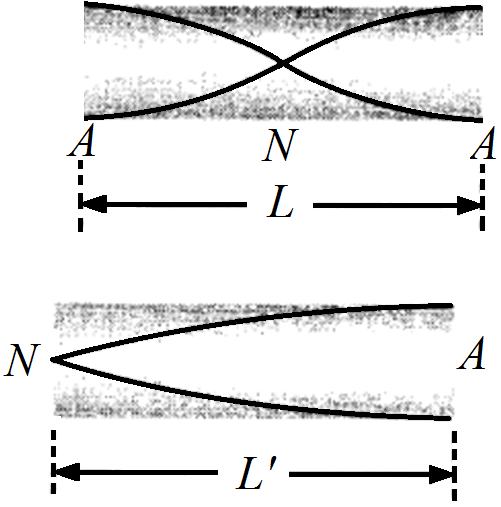
An organ pipe of length L open at both ends is found to vibrate in its first harmonic when sounded with a tuning fork of 480Hz. What should be the length of a pipe closed at one end, so that it also vibrates in its first harmonic with the same tuning fork?
Answer
For first harmonic of open organ pipe $\text{L}=\frac{\lambda}{2}$$\Rightarrow\lambda=2\text{L}\Rightarrow\frac{\text{v}}{f_0}=2\text{L}\Rightarrow(\text{f}_0)_\text{open}=\frac{\text{v}}{2\text{L}}$
Where v is speed of the sound wave in air. For first harmonic of closed organ pipe $\text{L}'=\frac{\lambda}{4}$$\Rightarrow\lambda=4\text{L}'\Rightarrow\frac{\text{v}}{\text{f}_0}=4\text{L}'\Rightarrow(\text{f}_0)_\text{close}=\frac{\text{v}}{4\text{L}'}$
$\Rightarrow\lambda=4\text{L}'\Rightarrow\frac{\text{v}}{2\text{L}}=\frac{\text{v}}{4\text{L}'}$ [$\therefore$ speed remains constant]
$\Rightarrow\frac{\text{L}'}{\text{L}}=\frac{2}{4}=\frac{1}{2}\Rightarrow\text{L}'=\frac{\text{L}}{2}$
View full question & answer
Question 35 Marks
A sitar wire is replaced by another wire of same length and material but of three times the earlier radius. If the tension in the wire remains the same, by what factor will the frequency change?
Answer
Thewire is stretched both and so frequency of stretched wure is $\text{v}=\frac{\text{n}}{2\text{L}}\sqrt{\frac{\text{T}}{\text{m}}}$ As number of harmonic n, lengthL and tensuin (T) are kept same in both cases.$\therefore\text{v}\propto\frac{1}{\sqrt{\text{m}}}$
$\frac{\text{v}_1}{\text{v}_2}=\frac{\sqrt{\text{m}_2}}{\sqrt{\text{m}_1}}\ ...(\text{i})$
Mass per unit length $=\frac{\text{mass of wire}}{\text{length}}=\frac{(\pi\text{r}^2\text{l})\rho}{\text{l}}$$\text{m}=\pi\text{r}^2\rho$
As matterial of wire is same.$\frac{\text{m}_2}{\text{m}_1}=\frac{\pi\text{r}_2^2\rho}{\pi\text{r}^2_1\rho}=\frac{(3\text{r})^2}{\text{r}^2}=\frac{9}{1}$
$\therefore\frac{\text{v}_1}{\text{v}_2}==\sqrt{\frac{9}{1}}=\frac{3}{1}$
$\therefore\text{v}_2=\frac{1}{3}\text{v}_1$
So the frequency of sitar reduced by $\frac{1}{2}$ of previous value.
View full question & answer
Question 45 Marks
A sonometer wire is vibrating in resonance with a tuning fork. Keeping the tension applied same, the length of the wire is doubled. Under what conditions would the tuning fork still be is resonance with the wire?
Answer
Wire of sonometer is twice the length which it vibrates in its second harmonic. Thus, if the tuning fork resonates at L, it will resonate at 2L. This can be explained as below: The frequency of sonometer is given by$\text{f}=\frac{\text{n}}{2\text{L}}\sqrt{\frac{\text{T}}{\mu}}=\frac{\text{nv}}{2\text{L}}$ (n = number of loops)
For a given sonometer velocity of wave will be constant. if after chaning the leggth of wire the tuing fork still be in resonance witrh the wire. then, $\frac{\text{n}}{\text{L}}=\text{constant}\Rightarrow\frac{\text{n}^2}{\text{L}^2}$$\frac{\text{n}^1}{\text{L}^1}=\frac{\text{n}^2}{2\text{L}^2}\Rightarrow\text{n}_2=2\text{n}_1$
Hence, when the wire is doubled the number of loops also get doubled to produce the resonance. That is it resonates in second harmonic.
View full question & answer
Question 55 Marks
In the given progressive wave $​​​​\text{y}=5\sin(100\pi\text{t+0.4x})$ where y and x are in m, t is in s. What is the:
Particle velocity amplitude.
Answer
Standard form of progressive wave travelling in $+\text{x}$ direction (kx and $\omega\text{}t$ have opposite sign is given) Eqn. is $\text{y}=\text{a}\sin(\omega\text{t}-\text{kx}+\phi)$$\text{y}=5\sin(100\pi\text{t}-0.4\pi\text{t}+0)$
Particle (medium) velocity in the direction of amplitude at a distance $\text{x}$ from source.
$\text{y}=5\sin(100\pi\text{t}-0.4\pi\text{x})$
$\frac{\text{dy}}{\text{dt}}=5\times100\pi\cos(100\pi\text{t}-0.4\pi\text{x})$
For maximum velocity of particle is at its mean position
$\cos(100\pi\text{t}-0.4\pi\text{x})=1$
$\Rightarrow100\pi\text{t}-0.4\pi\text{t=0}$
$\therefore\Big(\frac{\text{dy}}{\text{dt}}\Big)_\text{max}=5\times100\pi\times1$
$\text{v}_\text{max}$ of medium particle $=500\pi\text{m/ s}$
View full question & answer
Question 65 Marks
For the harmonic travelling wave $\text{y}=2\cos2\pi(10\text{t}-0.0080\text{x}+3.5)$ where x and y are in cm and t is second. What is the phase difference between the oscillatory motion at two points separated by a distance of:
What is the phase difference between the oscillation of a particle located at x = 100cm at t = T and t = 5s?
Answer
$\text{y}=2\cos2\pi(10\text{t}-0.0080\text{x+3.5})$$\text{y}=2\cos(20\pi\text{t}-0.0016\pi\text{x}+7.0\pi)$
Wave is propagated in $+\text{x}$ direction because $\omega\text{t}$ and kx are in with opposite sign standard equation $\text{y}=\text{a}\cos(\omega\text{t}-\text{kx}+\phi)$
$\text{a}=2\ \omega=20\pi,\ \text{k}=0.016\pi$ and $\phi=7\pi$
$\text{T}=\frac{2\pi}{\omega}=\frac{2pi}{20\pi}=\frac{1}{10}\sec$
$\text{x}=100\text{cm}$
At $\text{x}=100,\ \text{t}=\text{T}$
$\phi_120\pi\text{T}-0.016\pi(100)+7\pi=20\pi\times\frac{1}{10}-1.6\pi+7\pi=7.4\pi$
At $\text{t}=5\text{s}$
$\phi_120\pi\text{(5)}-0.016\pi(100)+7\pi=100\pi-1.6\pi+7\pi=105.4\pi$
$\phi_2-\phi_1=105.4\pi-7.4\pi=98\pi\ \text{radian}$
View full question & answer
Question 75 Marks
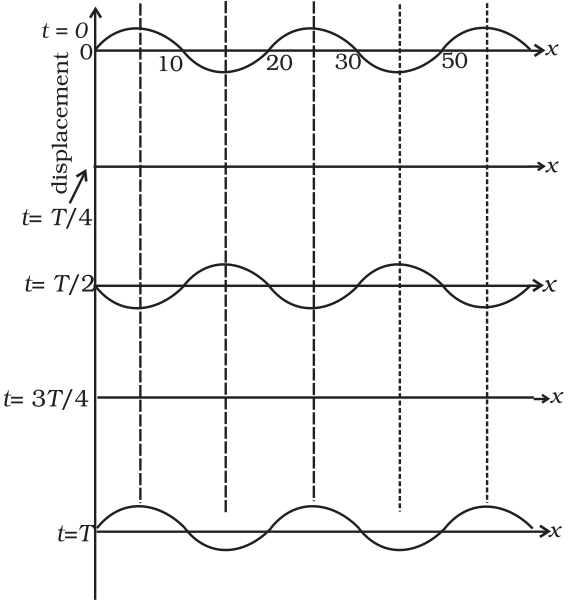
The wave pattern on a stretched string is shown in Interpret what kind of wave this is and find its wavelength.
Answer
The displacement of medium particlles at distance 10, 20, 30, 40, and 50cm are always rest which is the property of nodes in stationary wave.$\text{AT}\ \text{t}=\frac{\text{T}}{4}$ and $\frac{\text{3T}}{4}$ all particle are at rest wgich is in stationary wave when the particle crossrs its mean position.
so thet praph of wave shos stationaty wave. The wave at $\text{x}=10,\ 20,\ 30,\ 40\text{cm}$ there are nodes and distance between successive nodes is $\frac{\lambda}{2}$$\therefore\frac{\lambda}{2}=(30-20)$ or $\lambda=20\text{cm.}$
View full question & answer
Question 85 Marks
Given below are some functions of x and t to represent the displacement of an elastic wave.$​​​​\text{y}=100\cos(100\pi\text{t+0.5x})$
Answer
$\text{y}=4\sin\Big(5\text{x}-\frac{\text{t}}{2}\Big)+3\cos\Big(5\text{x}-\frac{\text{t}}{2}\Big)$$\text{Let}4=\text{a}\cos\phi\ ...(\text{ii})$and $3=\text{a}\sin\phi\ ...(\text{iii})$
$\text{a}^2\cos^2\phi+\text{a}^2\sin^2\phi=4^2+3^2$ Squaring and adding (ii), (iii)
$\text{a}^2=25\text{K}\Rightarrow\text{a}=5$
Substituting (ii), (iii) in (i)
$\text{y}=\text{a}\cos\phi\sin\Big(5\text{x}-\frac{\text{t}}{2}\Big)+\text{a}\sin\phi\cos\Big(5\text{x}-\frac{\text{t}}{2}\Big)$
$\text{y}=\text{a}\sin\Big(5\text{x}-\frac{\text{t}}{2}+\phi\Big)$
$\text{y}=\text{5}\sin\Big(5\text{x}-\frac{\text{t}}{2}+\phi\Big)$
Which represents the progressive wave in $+\text{x}$ direction as the sign of Kx (or5x) and $\omega\text{t}\Big(\frac{1}{2}\text{t}\Big)$ are opposite so it travels in $+\text{x}$ direction. So (d) (ii)
View full question & answer
Question 95 Marks
The displacement of an elastic wave is given by the function $\text{y}=3\sin\omega\text{t}+4\cos\omega\text{t}$ where y is in cm and t is in second. Calculate the resultant amplitude.
Answer
$\because\text{y}=3\sin\omega\text{t}+4\cos\omega\text{t}\ ...(\text{i})$Let $3=\text{a}\cos\phi\ ...(\text{ii})$
$4=\text{a}\sin\phi\ ...{\text{iii}}$
Then $\text{y}=\text{a}\cos\phi\sin\omega\text{t}+\text{a}\sin\phi\cos\omega\text{t}$
$\text{y}=\text{a}\sin(\omega\text{t}+\phi) $
From (ii) and(iii)
$\tan \phi=\frac{4}{3}$ or $\phi=\tan^{-1}\frac{4}{3}$
On squaring and adding (ii) and (iii) equations
$\text{a}_2\cos^2\phi+\text{a}^2\sin^2\phi=3^2+4^2$
$\text{a}^2(\cos^2\phi+\sin^2\phi)=9+16$
$\text{a}^2=25\Rightarrow\text{a}=5$
$\text{y}'=5\sin(\omega\text{t}+\phi)$ when $\phi=\tan^{-1}\frac{4}{3}$
Hence, New amplitude is 5 cm.
View full question & answer
Question 105 Marks
If c is r.m.s. speed of molecules in a gas and v is the speed of sound waves in the gas, show that c/ v is constant and independent of temperature for all diatomic gases.
Answer
We know that $\text{c}\sqrt{\frac{3\text{p}}{\rho}}$ for molecules.$\text{c}=\sqrt{\frac{3\text{RT}}{\text{M}}}$
$\therefore\frac{\text{p}}{\rho}=\frac{\text{PT}}{\text{M}}\because\frac{\text{P}}{\rho}=\frac{\text{RT}/\text{V}}{\text{M/V}}$
M = molar mass of gas$\text{v}=\sqrt{\frac{\gamma\text{P}}{\rho}}=\sqrt{\frac{\gamma\text{RT}}{\text{M}}}$
$\therefore\text{RV}=\text{nRT}$
$\text{n}=1$
$\text{p}\frac{\text{PT}}{\text{V}}$
$\frac{\text{c}}{\text{v}}=\frac{\sqrt{\frac{3\text{RT}}{\text{M}}}}{\sqrt{}\frac{\gamma\text{RT}}{\text{M}}}=\sqrt{\frac{3}{\gamma}}$
$\gamma=\frac{\text{C}_\text{P}}{\text{C}_\text{v}}=$ adiabatic constant for diatomic gas
$\gamma=\frac{7}{5}$
$\therefore\frac{\text{c}}{\text{v}}=\sqrt{\frac{3}{7/5}}=\sqrt{\frac{15}{7}}=$ constant.
View full question & answer
Question 115 Marks
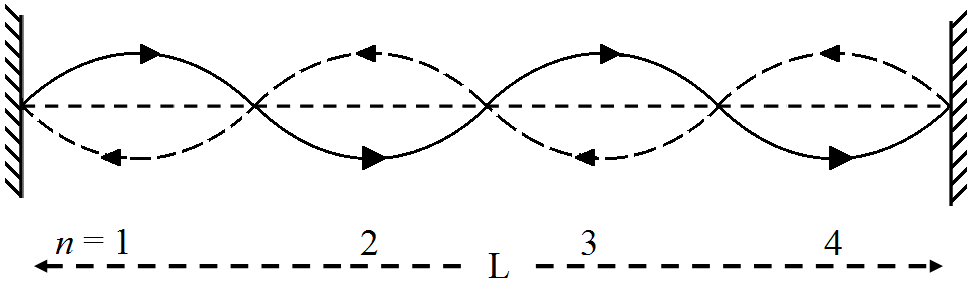
Show that when a string fixed at its two ends vibrates in 1 loop, 2 loops, 3 loops and 4 loops, the frequencies are in the ratio 1 : 2 : 3 : 4.
Answer
​​​​Let n be the number of loop in the string.The length of each loop is $\frac{\lambda}{2}$
$\therefore\text{L}=\frac{\text{n}\lambda}{2}$ or $\lambda=\frac{2\text{L}}{\text{n}}$

$\text{v}=\text{v}\lambda$ and $\lambda=\frac{\upsilon}{\text{v}}.$
so $\frac{\upsilon}{\text{v}}=\frac{2\text{L}}{\text{n}}$
$\text{v}=\frac{\text{n}}{2\text{L}}.\text{v}$ v is stretch string $=\sqrt{\frac{\text{T}}{\text{m}}}$
$\therefore\text{v}=\frac{\text{n}}{2\text{L}}\sqrt{\frac{\text{T}}{\text{m}}}$
For n =1, $\text{v}_1=\frac{1}{2\text{L}}\sqrt{\frac{\text{T}}{\text{m}}}=\text{v}_0$
If n = 2 then $\text{v}_2=\frac{2}{2\text{L}}\sqrt{\frac{\text{T}}{\text{m}}}=2\text{v}_0$
n = 3 then $\text{v}_3=\frac{3}{2\text{L}}\sqrt{\frac{\text{T}}{\text{m}}}=3\text{v}_0$
$\therefore\text{v}_1:\text{v}_2:\text{v}_3:\text{v}_4:=\text{n}_1:\text{n}_2:\text{n}_3:\text{n}_4:=1:2:3:4$
View full question & answer
Question 125 Marks
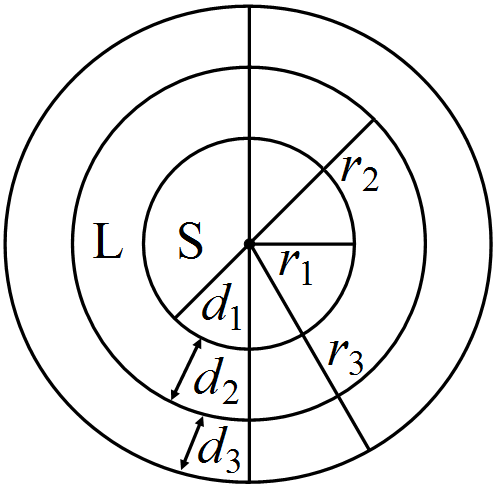
The earth has a radius of $6400km$. The inner core of 1000km radius is solid. Outside it, there is a region from $1000km$ to a radius of $3500km$ which is in molten state. Then again from $3500km$ to $6400km$ the earth is solid. Only longitudinal (P) waves can travel inside a liquid. Assume that the P wave has a speed of $8km s^{–1}$ in solid parts and of $5km s^{–1}$ in liquid parts of the earth. An earthquake occurs at some place close to the surface of the earth. Calculate the time after which it will be recorded in a seismometer at a diametrically opposite point on the earth if wave travels along diameter?
Answer
$\text{r}_1=1000\text{km}$$\text{r}_2=3500\text{km}$
$\text{r}_3=6400\text{km}$
$\text{d}_1=1000\text{km}$
$\text{d}_2=3500-1000=2500\text{km}$
$\text{d}_3=6400-3500=2900\text{km}$

Solid distance diametrically
$=2(\text{d}_1+\text{d}_3)=(1000+2900)$
$2\times3900\text{km}$
Time taken by wave produced by earthquake in solid part
$=\frac{3900\times2}{8}\sec$
Liquid part along diametrically $2\text{d}_2=2\times2500$
$\therefore$ Time taken by seismic wave in liquid part $=\frac{2\times2500}{5}$
Total time $\frac{2\times3900}{8}+\frac{2\times2500}{5}=2\Big[\frac{3900}{8}+\frac{2500}{5}\Big]$
$=2[487.5+500]=2\times987.5=1975\sec.$
$=32\ \text{min}\ 55\sec.$
View full question & answer