Questions

Case study (4 Marks)

Take a timed test

10 questions · self-marked practice — reveal the answer and mark yourself.

Question 14 Marks
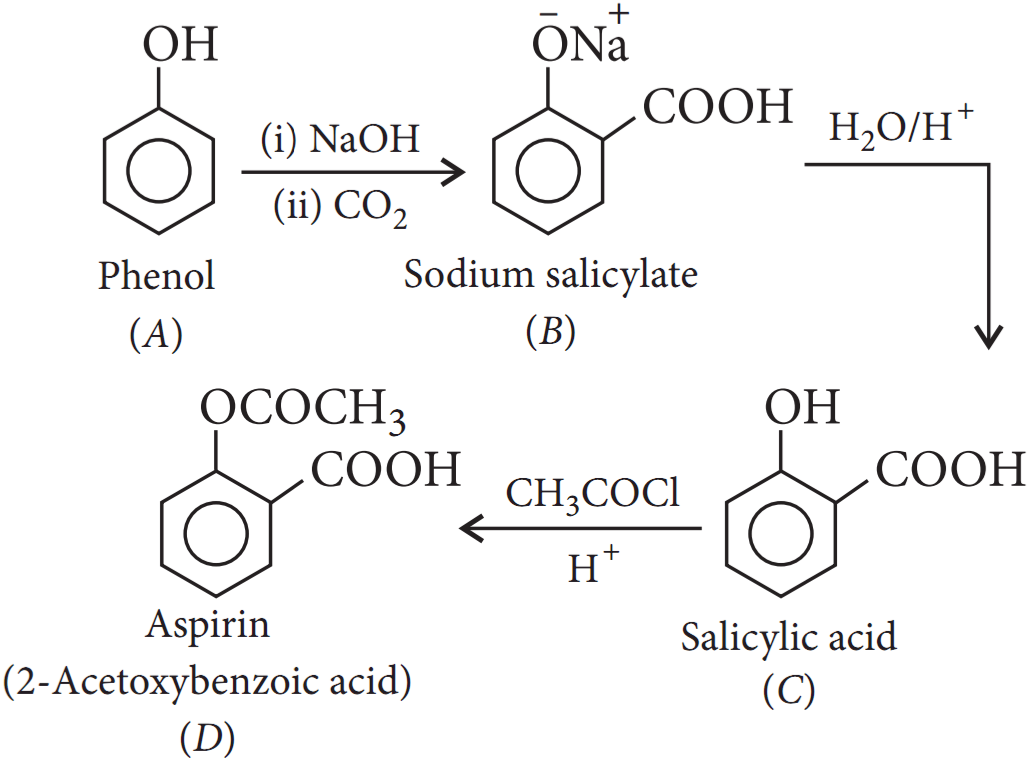
Read the passage given below and answer the following questions: An organic compound (A) having molecular formula $C_6H_6O$ gives a characteristic colour with aqueous $FeCl_3$ solution. (A) on treatment with $CO_2$ and $NaOH$ at $400K$ under pressure gives (B), which on acidification gives a compound (C). The compound (C) reacts with acetyl chloride to give (D) which is a popular pain killer. The following questions are multiple choice questions. Choose the most appropriate answer:
  1. Compound (A) is:
  1. 2-Hexanol.
  2. Dimethyl ether.
  3. Phenol.
  4. 2-Methyl pentanol.
  1. Compound (C) is:
  1. Salicylic acid.
  2. Salicyladehyde.
  3. Benzoic acid.
  4. Benzaldehyde.
  1. Number of carbon atoms in compound (D) is:
  1. 7
  2. 6
  3. 8
  4. 9
  1. The conversion of compound (A) to (C) is known as:
  1. Reimer-Tiemann reaction.
  2. Kolbe's reaction.
  3. Schimdt reaction.
  4. Swarts reaction.
  1. Compound (A) on heating with compound (C) in presence of $POCl_3$​​​​​​​ gives a compound (D) which is used:
  1. In perfumery as a ftavouring agent
  2. As an antipyretic
  3. As an analgesic
  4. As an intestinal antiseptic.
Answer
  1. (c) Phenol.
Explanation:
  1. (a) Salicylic acid.
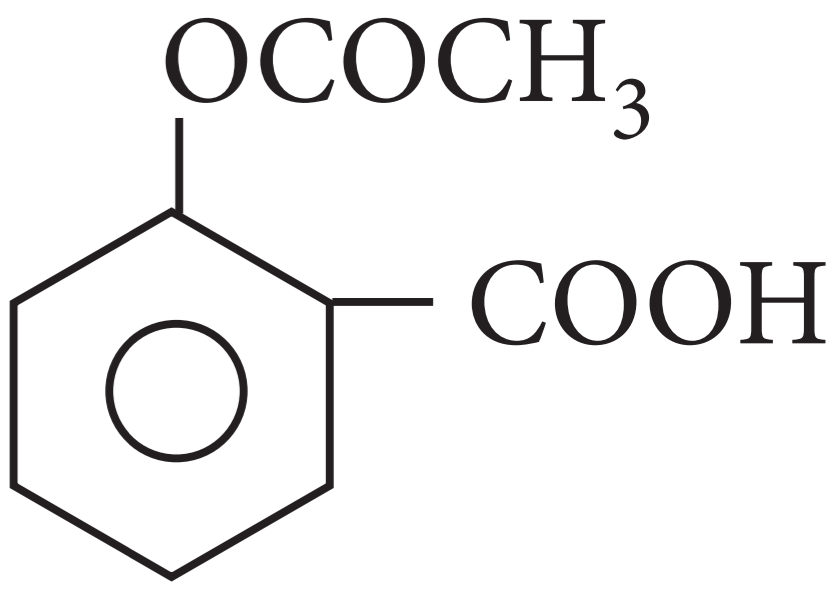
  2. (d) 9
Explanation:

It has 9 C-atoms.
  1. (b) Kolbe's reaction.
Explanation:
Sodium phenoxide when heated with $CO_2$ at $400K$ under a pressure of 4-7 atm followed by acidification gives 2-hydroxybenzoic acid (salicylic acid) as the main product along with a small amount of 4-hydroxybenzoic acid. This reaction is called Kolbe's reaction.
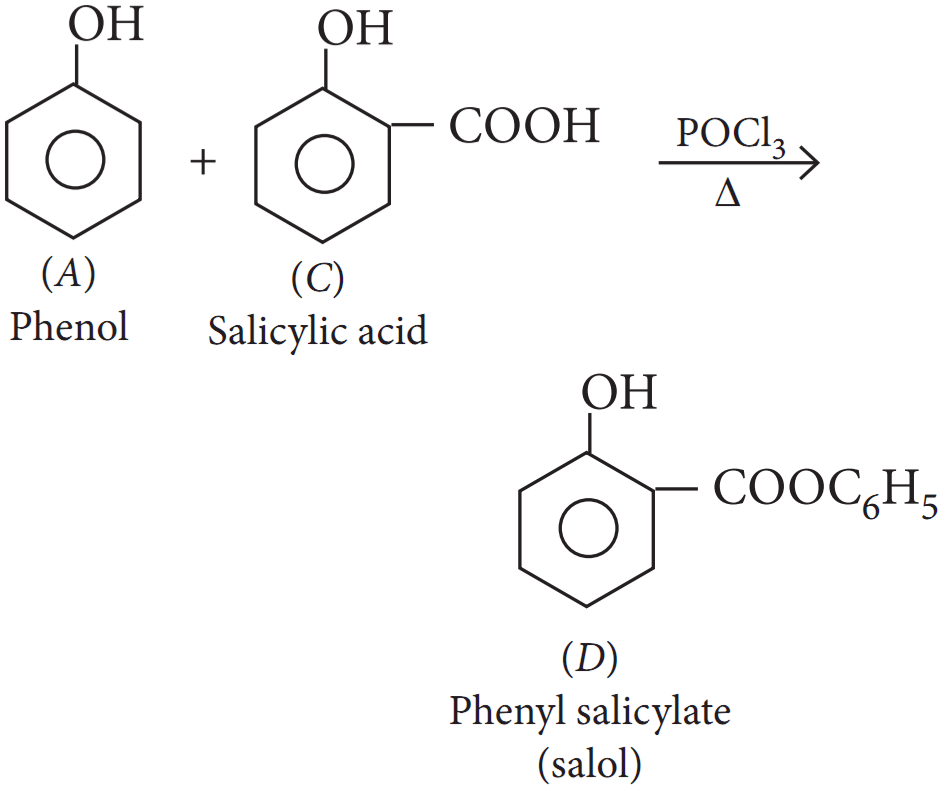
  1. (d) As an intestinal antiseptic.
​​​​​​​​​​​​​​​​​​​​​​​​​​​​Explanation:

Salol is used as an intestinal antiseptic.
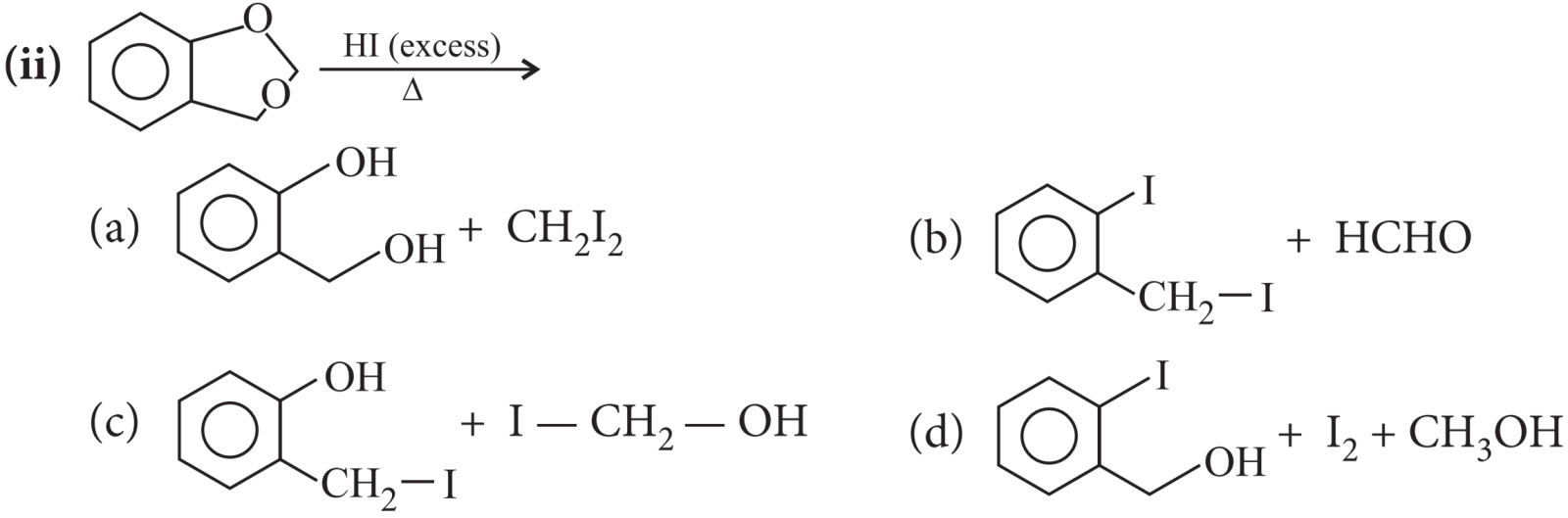
View full question & answer
Question 24 Marks
Read the passage given below and answer the following questions:
Ethers are readily cleaved by HI or HBr at 373K to form an alcohol and an alkyl halide.
$\text{R}-\text{O}-\text{R}+\text{HX}\xrightarrow{373\text{K}}\text{R}-\text{X}+\text{R}-\text{OH}$
$\text{R}-\text{OH}+\text{HX}\xrightarrow{373\text{K}}\text{R}-\text{X}+\text{H}_2\text{O}$
Mixed ether, containing primary or secondary alkyl group, when heated with hydrogen halide, the lower alkyl group forms halide and higher will form an alcohol. Tertiary alkyl ether when heated with hydrogen halide gives tertiary alkyl halide.
The following questions are multiple choice questions. Choose the most appropriate answer:
  1. Among the following ethers, which one will produce methyl alcohol on treatment with hot concentrated HI?
  1. $\ \ \ \ \ \ \ \ \ \ \ \ \text{CH}_3\\\ \ \ \ \ \ \ \ \ \ \ \ \ \ |\\\text{CH}_3-\text{C}-\text{O}- \text{CH}_3\\\ \ \ \ \ \ \ \ \ \ \ \ \ \ |\\\ \ \ \ \ \ \ \ \ \ \ \ \ \text{CH}_3 $
  2. $\text{CH}_3-\text{CH}-\text{CH}_2-\text{O}-\text{CH}_3\\\ \ \ \ \ \ \ \ \ \ \ \ \ |\\\ \ \ \ \ \ \ \ \ \ \ \text{CH}_3$
  3. $\text{CH}_3-\text{CH}_2-\text{CH}_2-\text{CH}_2-\text{O}-\text{CH}_3$
  4. $\text{CH}_3-\text{CH}_2-\text{CH}-\text{O}-\text{CH}_3\\\ \ \ \ \ \ \ \ \ \ \ \ \ \ \ \ \ \ \ \ \ \ \ \ \ \ |\\\ \ \ \ \ \ \ \ \ \ \ \ \ \ \ \ \ \ \ \ \ \ \ \ \ \text{CH}_3$
  1. When $CH_2 = CH - O - CH_2 - CH_3$ reacts with one mole of HI, one of the products formed is:
  1. Ethane.
  2. Ethanol.
  3. Iodoethene.
  4. Ethanal.
  1. $(CH_3)_3COCH_3$ and $CH_3OC_2H_5$​​​​​​​ are treated with hydroiodic acid. The fragments obtained after reactions are respectively:
  1. $(CH_3)_3CI + CH_3OH; CH_3I + C_2H_5OH$
  2. $(CH_3)_3CI + CH_3OH; CH_3OH + C_2H_5I$
  3. $(CH_3)_3COH + CH_3I; CH_3OH + C_2H_5I$
  4. $CH_3I + (CH_3)_3COH; CH_3I + C_2H_5OH$
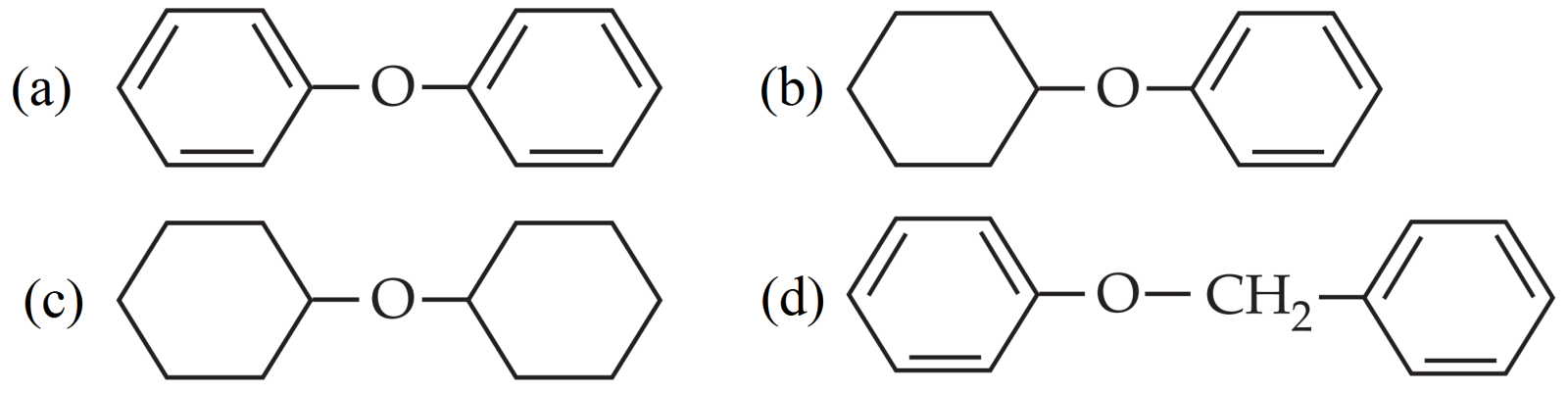
  1. Which of the following ether is unlikely to be cleaved by hot cone. HBr?
Answer
  1. (a) $\ \ \ \ \ \ \ \ \ \ \ \ \text{CH}_3\\\ \ \ \ \ \ \ \ \ \ \ \ \ \ |\\\text{CH}_3-\text{C}-\text{O}- \text{CH}_3\\\ \ \ \ \ \ \ \ \ \ \ \ \ \ |\\\ \ \ \ \ \ \ \ \ \ \ \ \ \text{CH}_3 $
Explanation:
$\ \ \ \ \ \ \ \ \ \ \ \ \text{CH}_3\\\ \ \ \ \ \ \ \ \ \ \ \ \ \ |\\\text{CH}_3-\text{C}-\text{O}\text{CH}_3+\text{HI}\xrightarrow{\text{S}_\text{N}1}\\\ \ \ \ \ \ \ \ \ \ \ \ \ \ |\\\ \ \ \ \ \ \ \ \ \ \ \ \ \text{CH}_3\ \ \ \ \ \ \ \ \ \ \ \ \ \text{(Hot andconc.)}$
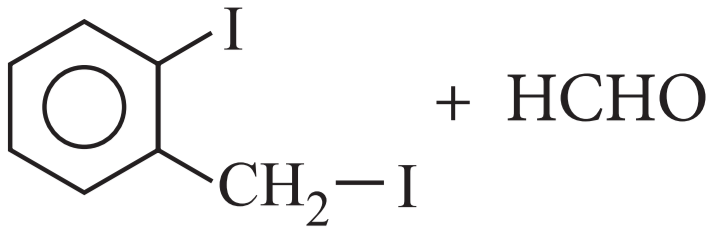
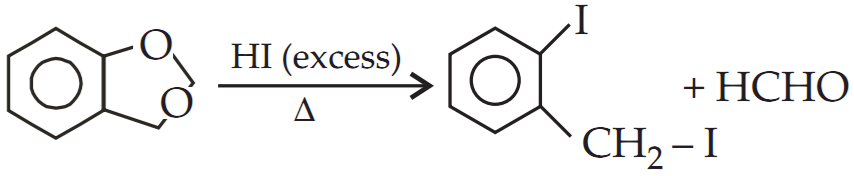
  1. (b)

Explanation:
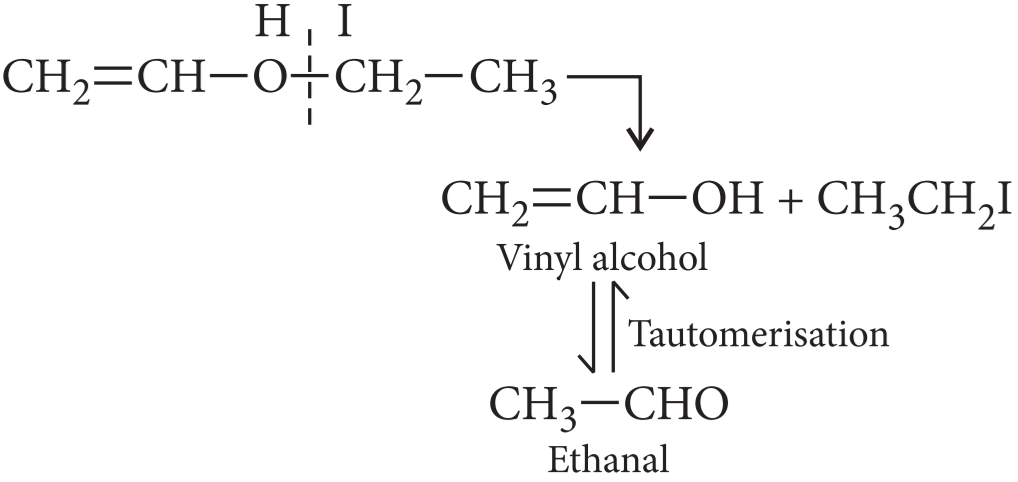
  1. (d) Ethanal.
Explanation:
  1. (a) $(CH_3)_3CI + CH_3OH; CH_3I + C_2H_5OH$
Explanation:
When mixed ethers are used, the formation of alkyl iodide depends on the nature of alkyl groups. Methyl iodide is formed when one group is methyl and the other a primary or secondary alkyl group. Here reaction follows $S_N2$ mechanism and because of the steric effect of the larger group, $I^-$ attacks the smaller (Me) group.
$\text{CH}_3\text{OC}_2\text{H}_5+\text{HI}\rightarrow\text{CH}_3\text{I}+\text{C}_2\text{H}_5\text{OH}$
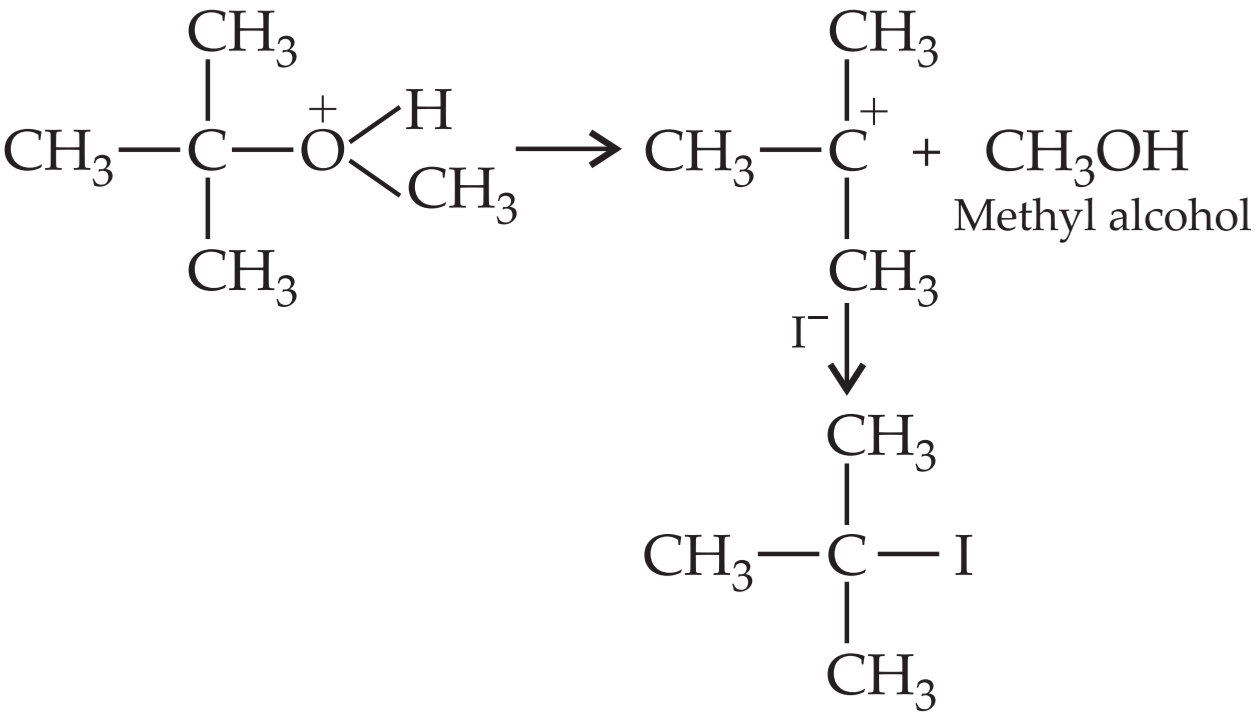
When the substrate is a methyl t-alkyl ether, the products are t-RI and MeOH. Here, reaction follows $S_N1$ mechanism and formation of products is controlled by the stability of carbocation. Since carbocation stability order is:
$3^\circ>2^\circ>1^\circ>\stackrel{+}{\hbox{ CH}}_3,$ therefore alkyl halide is always derived from tert-alkyl group.
$\ \ \ \ \ \ \ \ \ \ \ \ \text{CH}_3\ \ \ \ \ \ \ \ \ \ \ \ \ \ \ \ \ \ \ \ \ \ \ \ \ \ \ \ \ \ \ \ \ \ \ \ \ \ \ \ \ \ \ \ \ \ \ \text{CH}_3\\ \ \ \ \ \ \ \ \ \ \ \ \ \ | \ \ \ \ \ \ \ \ \ \ \ \ \ \ \ \ \ \ \ \ \ \ \ \ \ \ \ \ \ \ \ \ \ \ \ \ \ \ \ \ \ \ \ \ \ \ \ \ \ \ \ \ \ \ \ |\ \\\text{CH}_3-\text{C}-\text{O}-\text{CH}_3+\text{HI}\xrightarrow[\text{S}_\text{N}1]{373\text{K}}\text{CH}_3-\text{C}-\text{I}+\text{CH}_3\text{OH}\\ \ \ \ \ \ \ \ \ \ \ \ \ \ |\ \ \ \ \ \ \ \ \ \ \ \ \ \ \ \ \ \ \ \ \ \ \ \ \ \ \ \ \ \ \ \ \ \ \ \ \ \ \ \ \ \ \ \ \ \ \ \ \ \ \ \ \ \ \ |\\ \ \ \ \ \ \ \ \ \ \ \ \ \text{CH}_3\ \ \ \ \ \ \ \ \ \ \ \ \ \ \ \ \ \ \ \ \ \ \ \ \ \ \ \ \ \ \ \ \ \ \ \ \ \ \ \ \ \ \ \ \ \ \text{CH}_3\\ _\text{rert-Butyl methyl ether}\ \ \ \ \ \ \ \ \ \ \ \ \ \ \ \ \ \ \ \ \ \ \ \ \ \ \ \ \ \ \ \ \ _\text{tert-Butyl iodide} $
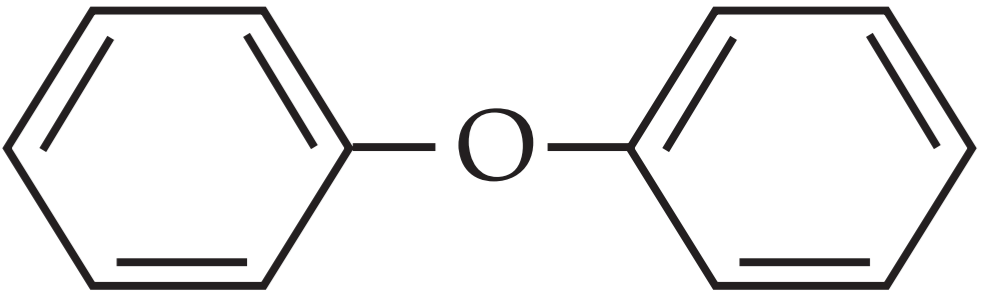
  1. (a)

Explanation:
Diphenyl ethers are not cleaved by HBr or HI.
View full question & answer
Question 34 Marks
Read the passage given below and answer the following questions:
Although chlorobenzene is inert to nucleophilic substitution, however it gives quantitative yield of phenol when heated with aq. $Na OH$ at high temperature and under high pressure. As far as electrophilic substitution in phenol is concemed the — OH group is an activating group, hence, its presence enhances the electrophilic substitution at o - and p - positions.
The following questions are multiple choice questions. Choose the most appropriate answer:
  1. Conversion of chlorobenzene into phenol involves:
  1. Modified $S_N1$ mechanism.
  2. Modified $S_N2$ mechanism.
  3. Both (a) and (b).
  4. Elimination-addition mechanism.
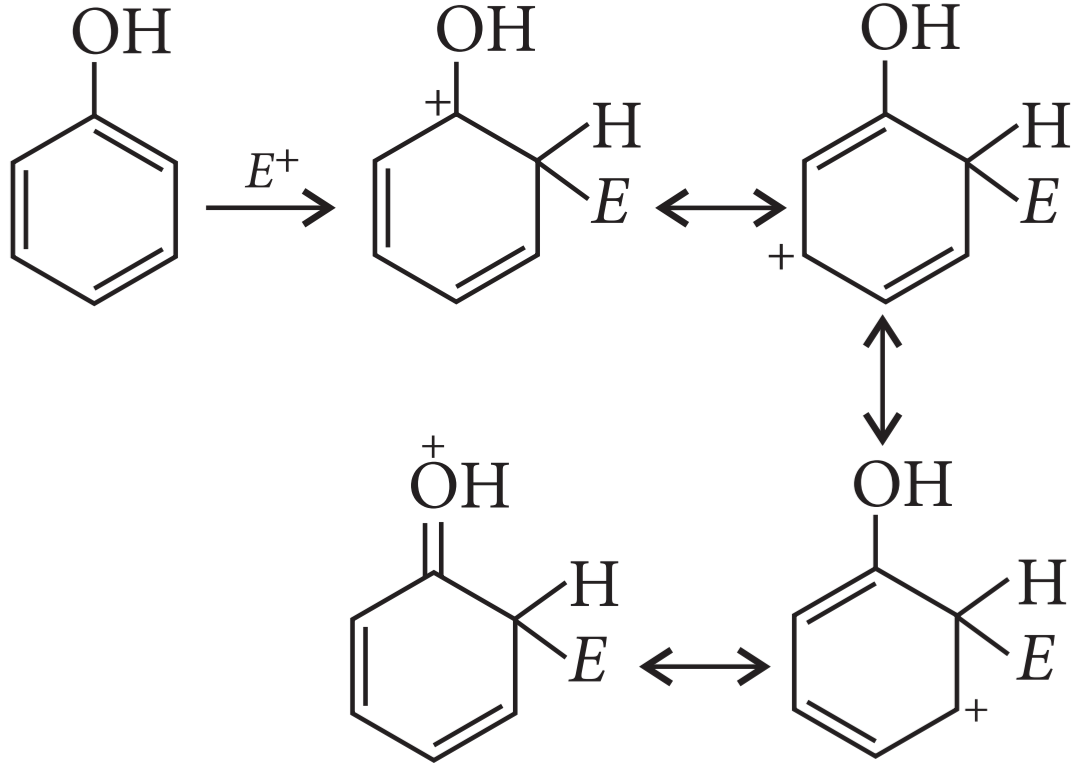
  1. Phenol undergoes electrophilic substitution more readily than benzene because:
  1. The intermediate carbocation is a resonance hybrid of more resonating structures than that from benzene.
  2. The intermediate is more stable as it has positive charge on oxygen, which can be better accommodated than on carbon.
  3. In one of the canonical structures, every atom (except hydrogen) has complete octet.
  4. The — OH group is o, p-directing which like all other o, p - directing group, is activating.
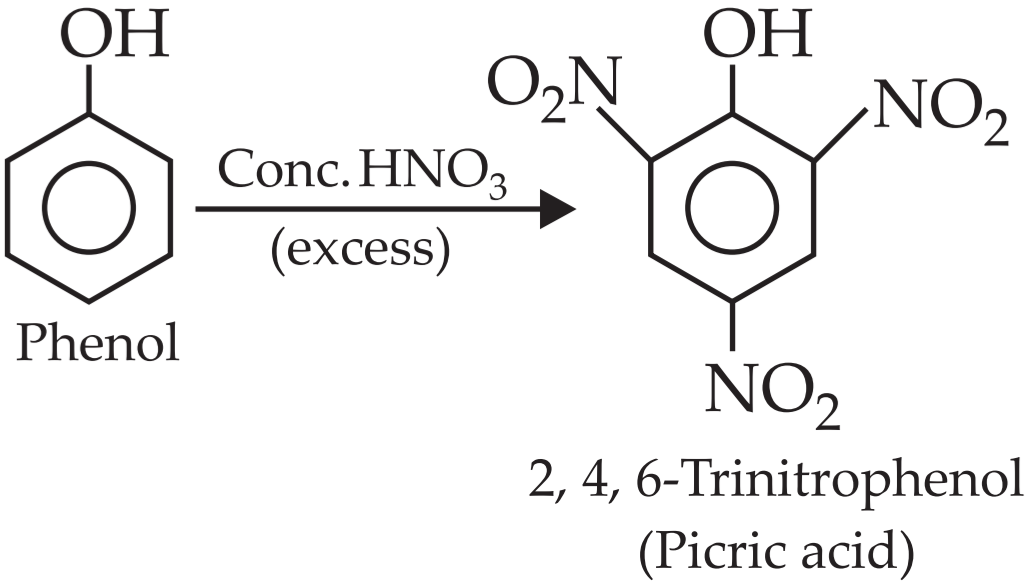
  1. Phenol on treatment with excess of cone. $HNO_3$ gives:
  1. O - nitrophenol.
  2. P - nitrophenol.
  3. O - and p - nitrophenol.
  4. 2, 4, 6 - trinitrophenol.
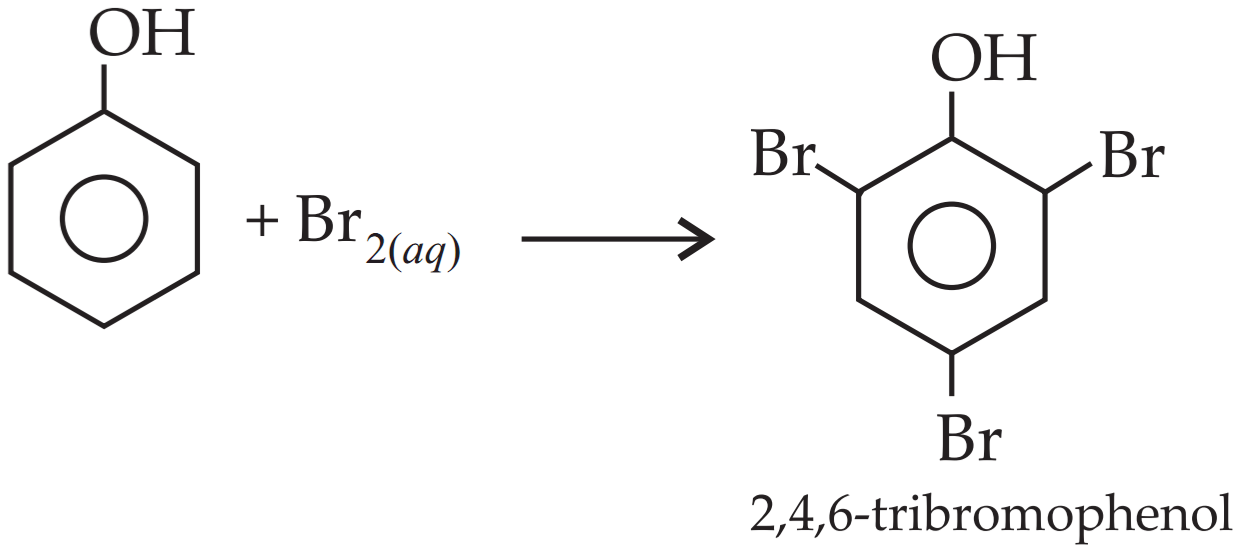
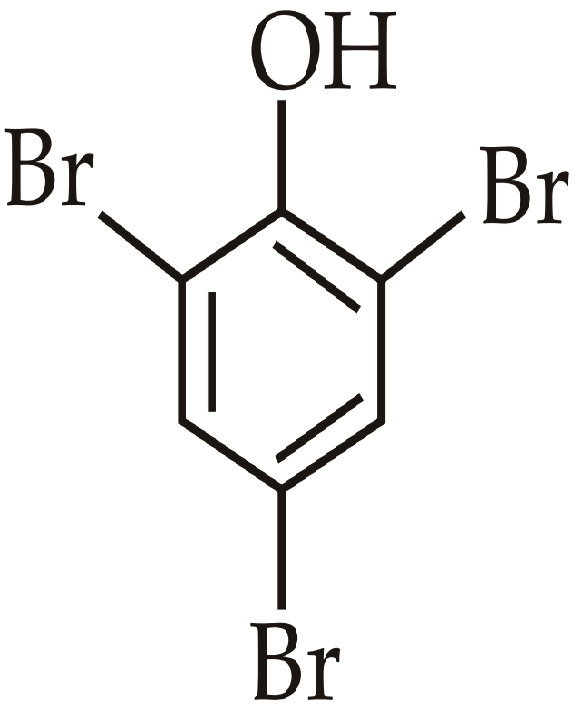
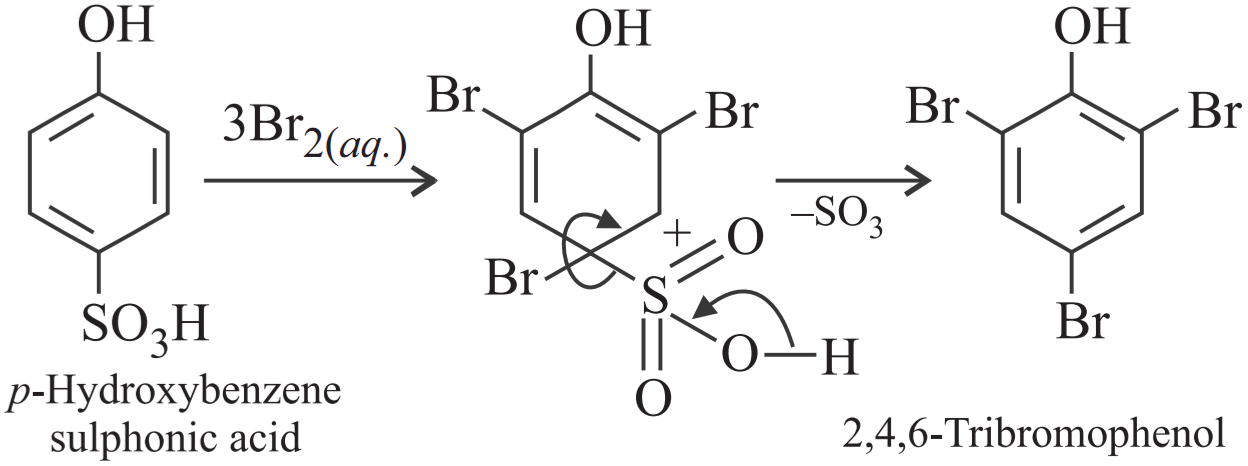
  1. Phenol is heated with a solution of mixture of $KBr$ and $KBrO_3$. The major product obtained in the above reaction is:
  1. 2 - bromophenol.
  2. 3 - bromophenol.
  3. 4 - bromophenol.
  4. 2, 4, 6 - tribromophenol.
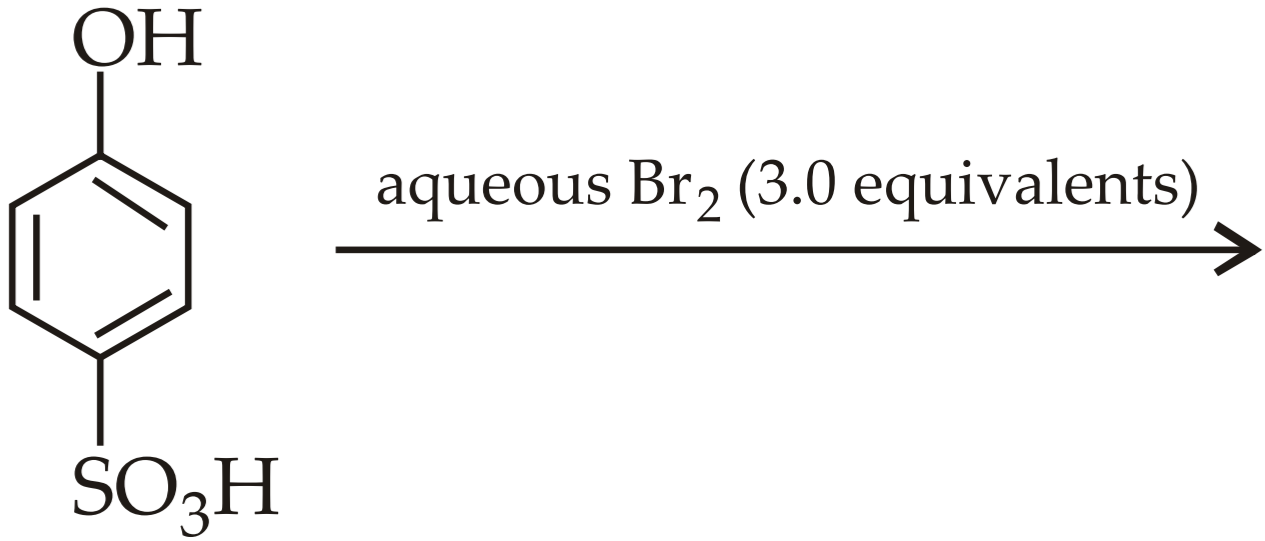
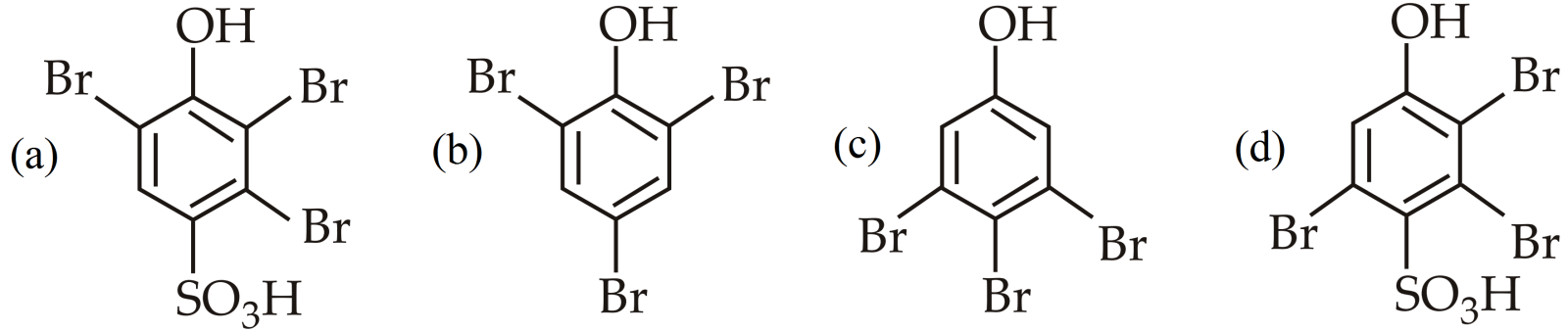
  1. The major product of the following reaction is:

Answer
    1. (d) Elimination-addition mechanism.
    2. (c) In one of the canonical structures, every atom (except hydrogen) has complete octet.
    Explanation:
    1. (d) 2, 4, 6 - trinitrophenol.
    Explanation:
    1. (d) 2, 4, 6 - tribromophenol.
    Explanation:
    $\text{KBr}_{\text{(aq)}}+\text{KBrO}_{3\text{(aq)}}\rightarrow\text{Br}_{2\text{(aq)}}$
    This bromine reacts with phenol and 2, 4, 6 - tribromophenol.
    1. ​​​​​​​(b)
    ​​​​​​​
    ​​​​​​​​​​​​​​​​​​​​​Explanation:
View full question & answer
Question 44 Marks
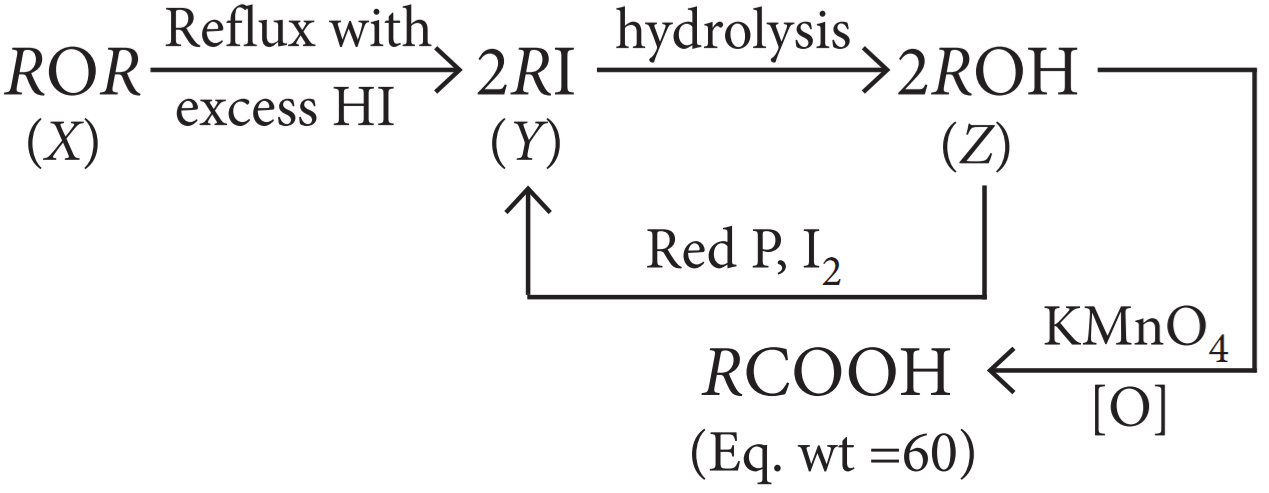
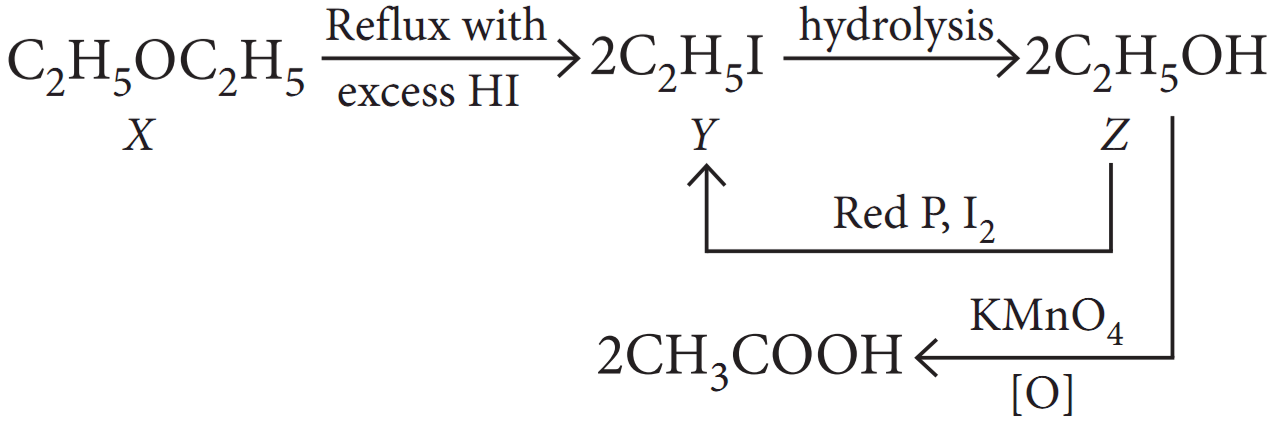
Read the passage given below and answer the following questions: A compound (X) containing C, H and O is unreactive towards sodium. It also does not react with Schiff s reagent. On refluxing with an excess of hydroiodic acid, (X) yields only one organic product ( Y). On hydrolysis, (Y) yields a new compound (Z) which can be converted into (Y) by reaction with red phosphorus and iodine. The compound (Z) on oxidation with potassium permanganate gives a carboxylic acid. The equivalent weight of this acid is 60. The following questions are multiple choice questions. Choose the most appropriate answer:
  1. The compound (X) is an:
  1. Acid.
  2. Aldehyde.
  3. Alcohol.
  4. Ether.
  1. The IUPAC name of the acid formed is:
  1. Methanoic acid.
  2. Ethanoic acid.
  3. Propanoic acid.
  4. Butanoic acid.
  1. Compound (Y) is:
  1. Ethyl iodide.
  2. Methyl iodide.
  3. Propyl iodide.
  4. Mixture of (a) and (b).
  1. Compound (Z) is:
  1. Methanol.
  2. Ethanol.
  3. Propanol.
  4. Butanol.
  1. Compound (X) on treatment with excess of $Cl_2$ in presence of tight gives:
  1. $\propto-$ Chlorodiethyl ether.
  2. $\propto,\propto'-$ Dichlorodiethyl ether.
  3. Perchlorodiethyl ether.
  4. None of these.
Answer
  1. (d) Ether.
Explanation:
Since the compound X is unreactive towards sodium so it is neither an acid nor an alcohol. Since the compound X is unreactive towards Schiff's base so it is not an aldehyde.
The compound X forms only one product on reaction with excess HI, indicates that the compound X may be ether.
  1. (b) Ethanoic acid.
Explanation:
The reactions can be written as:

Since the equivalent weight of carboxylic acid is 60. So, it must be $CH_3COOH$ i.e., ethanoic acid.
  1. (a) Ethyl iodide.
​​​​​​​​​​​​​​​​​​​​​Explanation:
The alcohol Z in that case should be $C_2H_5OH$ and the compound Y should be ethyl iodide. X is therefore diethyl ether $(C_2H_5 — O — C_2H_5)​​​​​​​$
  1. (b) Ethanol.
  2. (c) Perchlorodiethyl ether.
​​​​​​​​​​​​​​​​​​​​​​​​​​​​Explanation:
In the presence of light and excess of chlorine, all the hydrogen atoms of diethyl ether are substituted to give perchlorodiethyl ether.
$\text{CH}_3\text{CH}_2-\text{O}-\text{CH}_2\text{CH}_3+10\text{Cl}_2\xrightarrow{\text{hu}}\\ \ \ \ \ \ \ \ \ \ \ \ \ \ \ \ \ \ \ \ \ \ \ \ \ \ \ \ \ \ \ \ \ \ \ \ \ \ \ \ \ \ \ \ \ \ \ \text{(excess)}$
$\text{CCl}_3\text{CC}_2-\text{O}-\text{CCl}_2-\text{CCl}_3+\text{10HCI}\\ \ \ \ \ \ \ \ \ \ \ \ \ \ \ \text{Perchlorodierhyl ether }$​​​​​​​
View full question & answer
Question 54 Marks
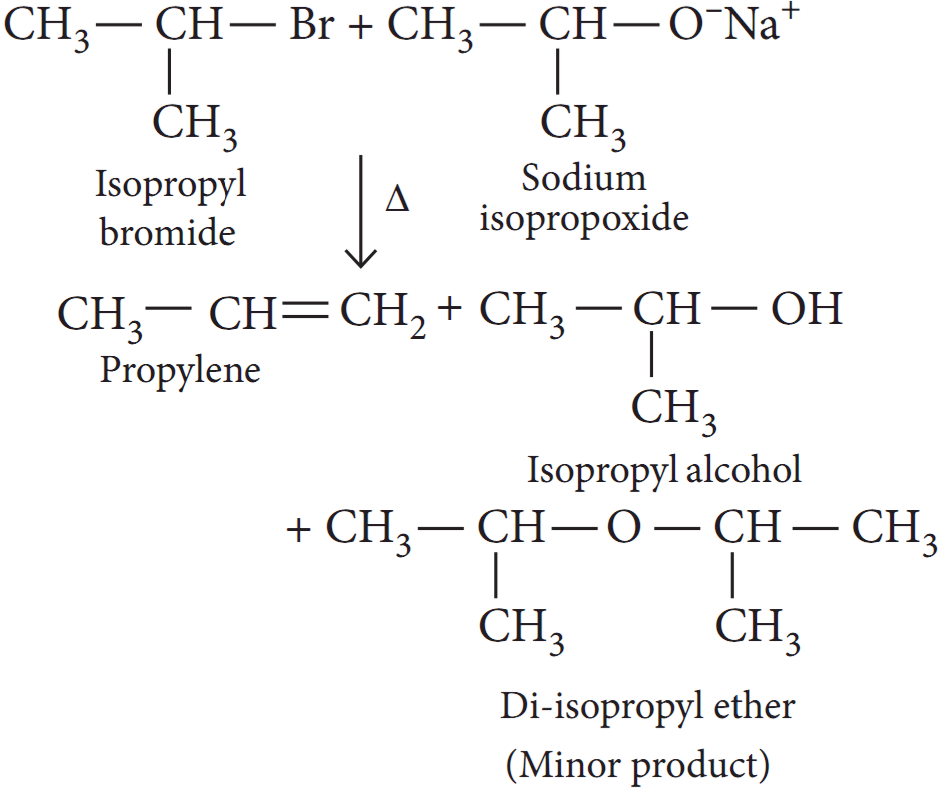
Read the passage given below and answer the following questions: Williamson's synthesis is used for the preparation of symmetrical as well as unsymmerical ether. It is $S_N2$ reaction mechanism. In Williamson's synthesis, $1º$ alkyl halide are used for preparation of ethers because $2º$ and $3º$ alkyl halide give alkene. Ethers are cleaved by hydrogen halides to alcohol and alkyl halide where alkyl halide is corresponding to that alkyl which has less number of carbon atom (it is because of less steric hindrance). In polar media unsymmetrical ether like tertiary butyl ethyl ether gives ethyl alcohol and tertiary butyl halide as reaction proceeds via carbocation. In these questions (Q. No. i-iv), a statement of assertion followed by a statement of reason is given. Choose the correct answer out of the following choices.
  1. Assertion and reason both are correct statements and reason is correct explanation for assertion.
  2. Assertion and reason both are correct statements but reason is not correct explanation for assertion.
  3. Assertion is correct statement but reason is wrong statement.
  4. Assertion is wrong statement but reason is correct statement.
  1. Assertion: Rate of reaction of alkyl halide in Williamson's synthesis reaction is 1ºRX > 2ºRX > 3ºRX.
Reason: It is a type of bimolecular substitution reaction $(S_N2)$.
  1. Assertion: T-Butyl methyl ether is not prepared by the reaction of t-butyl bromide with sodium methoxide.
Reason: Sodium methoxide is a weak nucleophile.
  1. Assertion: Williamson's synthesis method cannot be used for preparing diphenyl ether.
Reason: Aryl halides do not undergo nucleophilic substitution easily.
  1. Assertion: When isopropyl bromide is treated with sodium isopropoxide, di-isopropyl ether is obtained as a major product.
Reason: With secondary alkyl halides, both substitution and elimination occur.
  1. Assertion: Both symmetrical and unsymmetrical ethers can be prepared by Williamson's synthesis.
Reason: Williamson's synthesis is an example of nucleophilic substitution reaction.
Answer
  1. (a) Assertion and reason both are correct statements and reason is correct explanation for assertion.
Explanation:
Williamson's synthesis occurs by $S_N2$ mechanism and primary alkyl halides are most reactive in $S_N2$ reactions.
  1. (c) Assertion is correct statement but reason is wrong statement.
Explanation:
Sodium methoxide is a strong nucleophile. ln presence of a strong base, i.e., sodium methoxide, t-butyl bromide undergoes dehyrohalogenation to form isobutylene.
  1. (a) Assertion and reason both are correct statements and reason is correct explanation for assertion.
​​​​​​​​​​​​​​​​​​​​​Explanation:
Diary! ethers cannot be prepared by Williamson's synthesis since aryl halides do not undergo nucleophilic substitution easily.
  1. (d) Assertion is wrong statement but reason is correct statement.
​​​​​​​​​​​​​​​​​​​​​Explanation:
Since secondary and tertiary alkyl halides prefer to undergo elimination rather th an substitution, therefore, even symmetrical ethers containing secondary and tertiary alkyl groups cannot be prepared in good yields by Williamson synthesis.
  1. (b) Assertion and reason both are correct statements but reason is not correct explanation for assertion.
​​​​​​​​​​​​​​​​​​​​​​​​​​​​Explanation:
Depending upon whether the alkyl halide and the alkoxide ion carry the same or different alkyl groups, both symmetrical and unsymmetrical ethers can be prepared by Williamsons synthesis.
View full question & answer
Question 64 Marks
Read the passage given below and answer the following questions:
Both alcohols and phenols are acidic in nature, but phenols are more acidic than alcohols. Acidic strength of alcohols mainly depends upon the inductive effect. Acidic strength of phenols depends upon a combination of both inductive effect and resonance effects of the substituent and its position on the benzene ring. Electron withdrawing groups increases the acidic strength of phenols whereas electron donating groups decreases the acidic strength of phenols. Phenol is a weaker acid than carboxylic acid.
The following questions are multiple choice questions. Choose the most appropriate answer:
  1. Phenols are highly acidic as compare to alcohols due to:
  1. The higher molecular mass of phenols.
  2. The stronger hydrogen bonds in phenols.
  3. Alkoxide ion is a strong conjugate base.
  4. Phenoxide ion is resonance stabilised.
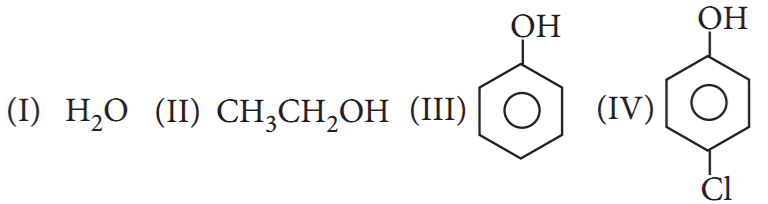
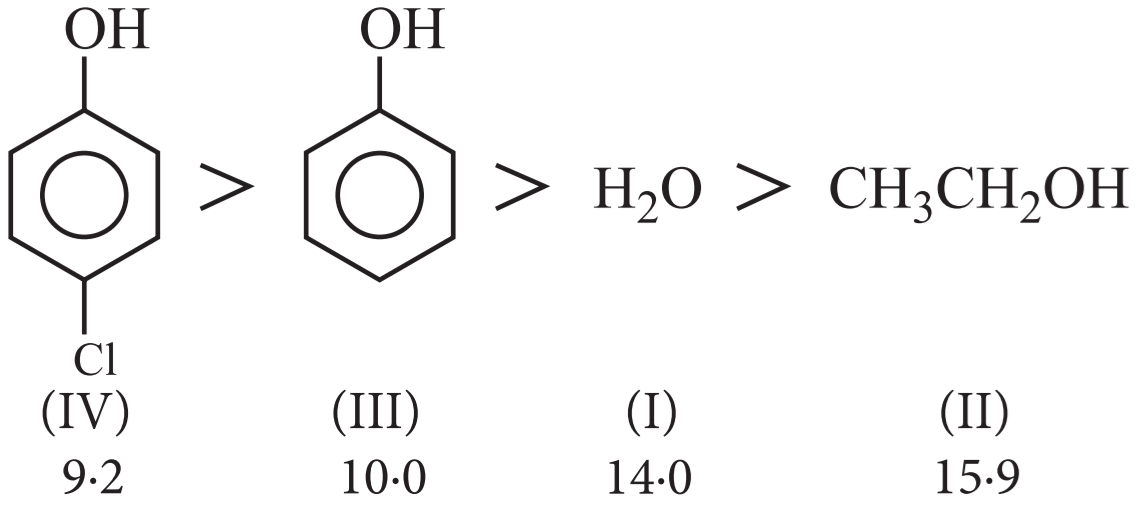
  1. The correct order of acidic strength among the following is:
  1. (III) > (IV) > (II) > (I)
  2. (IV) > (III) > (I) > (II)
  3. (IV) > (III) > (II) > (I)
  4. (I) > (II) > (IV) > (III)
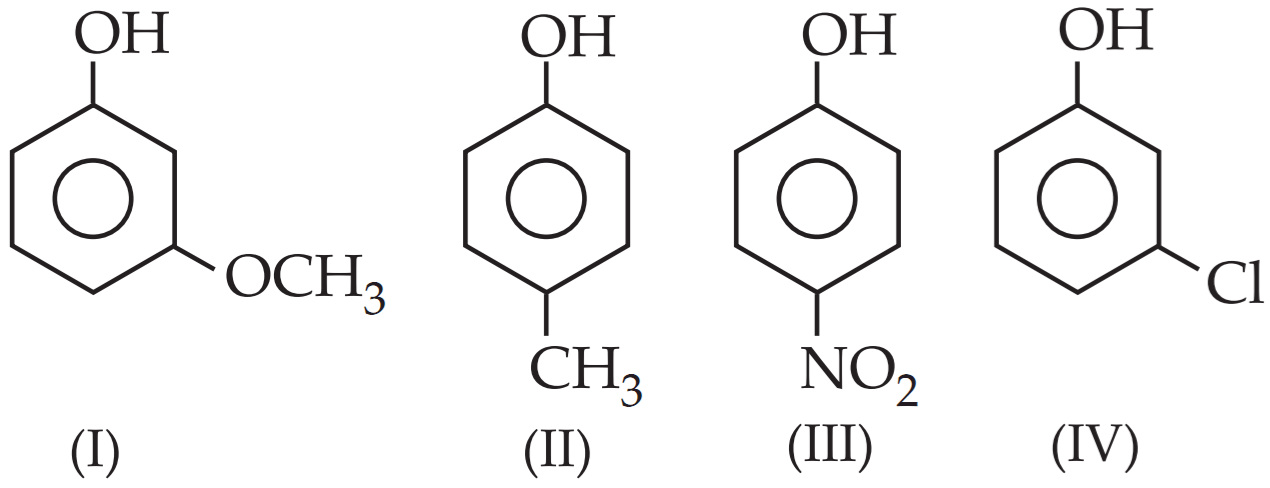
  1. The correct decreasing order of $pK_a$ value is:
  1. II > IV > I > III
  2. IV > II > III > I
  3. II I> II > IV > I
  4. IV > I > II > III
  1. The compound that does not liberate $CO_2$, on treatment with aqueous sodium bicarbonate solution is:
  1. Benzoic acid.
  2. Benzenesulphonic acid.
  3. Salicylic acid.
  4. Carbolic acid.
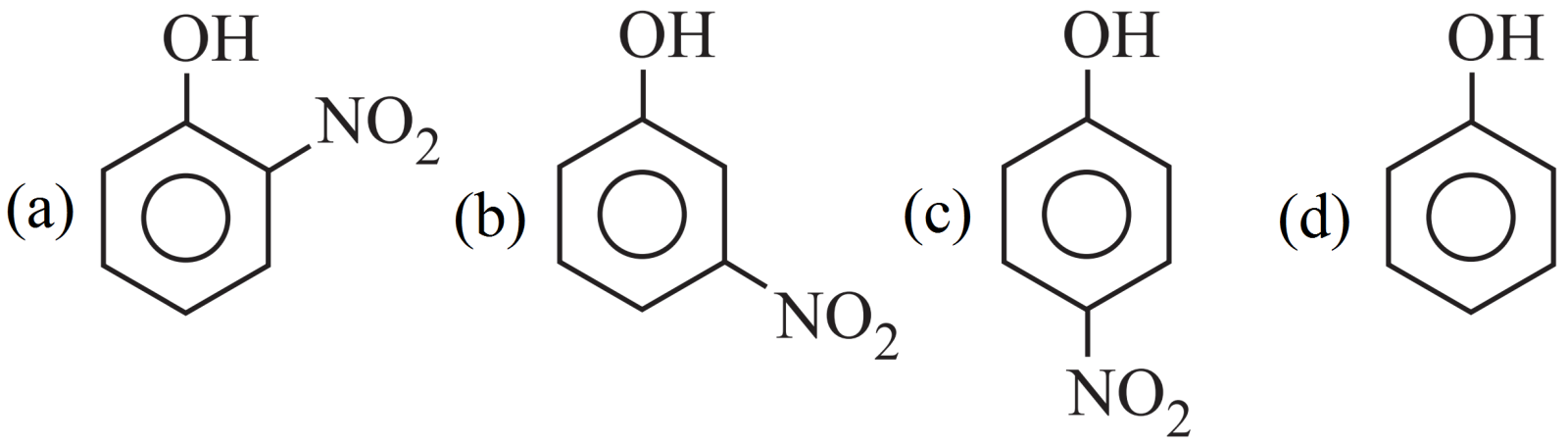
  1. Most acidic amongst the following is:
Answer
  1. (d) Phenoxide ion is resonance stabilised.
  2. (b) (IV) > (III) > (I) > (II)
Explanation:
The order of acidic strength is,
  1. (a) II > IV > I > III
Explanation:
Weaker acids have higher $pK_a. - OCH_3$ at meta-position exerts only - I effect, hence increases the acidity.
- I effect order: - $NO_2 > - OCH_3 > - Cl$.
- $CH_3$ has + I effect. So, order is (a).
  1. (d) Carbolic acid.
Explanation:
Phenol (Carbolic acid) is a weaker acid than carbonic acid $(H_2CO_3)$ and does not liberate $CO_2​​​​​​​$​​​​​​​ on treatment with aqueous sodium bicarbonate solution.
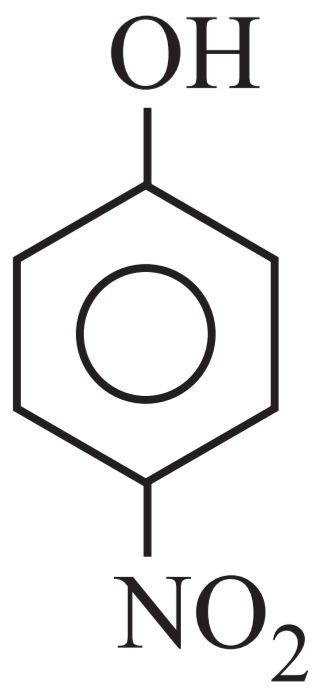
  1. (c)

​​​​​​​​​​​​​​Explanation:
- $NO_2$ exhibits both - I and - R influence to stabilise the corresponding phenoxide. ln ortho derivative, intermolecular H - bonding lowers the acidity.
View full question & answer
Question 74 Marks
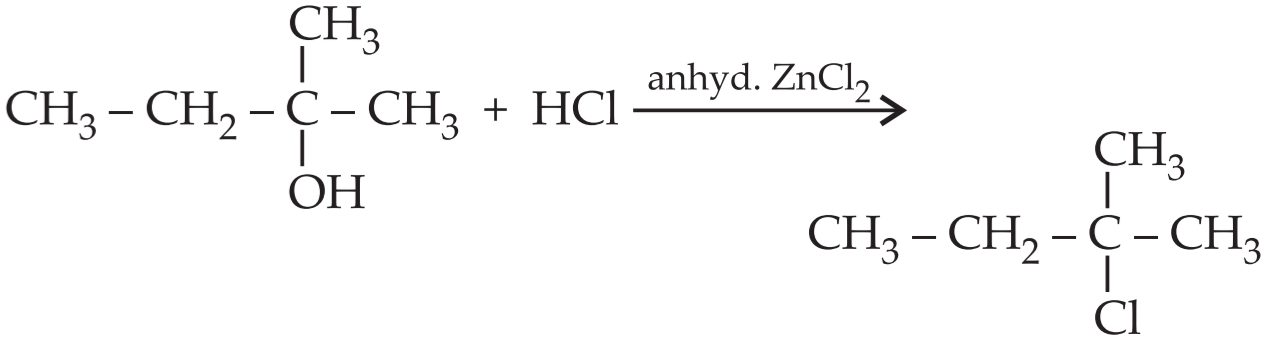
Read the passage given below and answer the following questions: Lucas test is a test to differentiate between primary, secondary and tertiary alcohols. This test consists of treating an alcohol with Lucas' reagent, and turbidity, due to the formation of insoluble alkyl chloride, is observed. Lucas test is based on the difference in reacting of three classes of alcohols with hydrogen chloride via $S_N1$ reaction. The different reactivity reflects the differing ease of formation of the corresponding carbocations. In these questions $(Q.$ No. $i-iv),$ a statement of assertion followed by a statement ofreason is given. Choose the correct answer out of the following choices.
  1. Assertion and reason both are correct statements and reason is correct explanation for assertion.
  2. Assertion and reason both are correct statements but reason is not correct explanation for assertion.
  3. Assertion is correct statement but reason is wrong statement.
  4. Assertion is wrong statement but reason is correct statement.
  1. Assertion: Equimolar mixture of cone. $HCI$ and anhydrous $ZnCl_2$ is called Lucas' reagent.
Reason: Lucas' reagent can be used to distinguish between methanol and ethanol.
  1. Assertion: $2-$Methyl$-2-$butanol gives no turbidity with Lucas' reagent at room temperature.
Reason: It is a $3^\circ$ alcohol.
  1. Assertion: Tertiary alcohols react fastest with Lucas' reagent by $S_N1$ mechanism.
Reason: $3^\circ$ carbocation is most stable.
  1. Assertion: Amongst the compounds, $H2C = CHCH_2OH (I), C_6H_5OH (II), CH_3CH_2CH_2OH (III)$ and $(CH_3)_3COH (IV),$ only $(IV)$ reacts with Lucas' reagent at room temperature.
Reason: Tertiary alcohol gives turbidity immediately with Lucas' reagent.
  1. Assertion: Lucas test can be used to distinguish between $1-$propanol and $2-$propanol.
Reason: Lucas test is based upon the difference in reactivity of primary, secondary and tertiary alcohols with cone. HCI and anhyd. $ZnCl_2.$
Answer
  1. (c) Assertion is correct statement but reason is wrong statement.
Explanation:
Both methanol and ethanol are $1^\circ$ alcohols and hence, cannot be distinguished by Lucas' reagent.
  1. (d) Assertion is wrong statement but reason is correct statement.
Explanation:
Tertiary alcohols immediately react with Lucas' reagent.
  1. (a) Assertion and reason both are correct statements and reason is correct explanation for assertion.
  2. (d) Assertion is wrong statement but reason is correct statement.
​​​​​​​​​​​​​​​​​​​​​Explanation:
The order of reactivity of alcohols towards Lucas' reagent is $3^\circ$ alcohol $> 2^\circ$ alcohol $> 1^\circ$ alcohol. $1^\circ$ alcohols do not react with Lucas' reagent at room temperature. It requires high temperature. The benzyl and allyl alcohols react as rapidly as $3^\circ$ alcohols with Lucas' reagent because their cations are resonance stabilised.
  1. (b) Assertion and reason both are correct statements but reason is not correct explanation for assertion.
​​​​​​​​​​​​​​​​​​​​​​​​​​​​Explanation:
When Lucas' reagent $($cone. $HCI + ZnCl_2)$ is added to $2-$propanol $(2^\circ$ alcohol$)$ turibitity appears within five minutes whereas with $1-$propanol no turbidity appears and solution remains clear at room temperature.
View full question & answer
Question 84 Marks
Read the passage given below and answer the following questions:
Dehydration of alcohols can lead to the formation of either alkenes or ethers. This dehydration can be carried out either with protonic acids such as cone.$H_2SO_4, H_3PO_4$ or catalysts such as anhydrous $ZnCl_2$ or $Al_2O_3$. When primary alcohols are heated with cone. $H_2SO_4$ at $433-44 K$, they undergo intramolecular dehydration to form alkenes. Secondary and tertiary alcohols undergo dehydration under milder conditions. The ease of dehydration of alcohols follows the order: $3^\circ > 2^\circ > 1^\circ$.
The dehydration of alcohols always occurs in accordance with the Saytzeff's rule. Primary alcohols when heated with protic acid at 413K, gives dialkyl ether.
$\text{CH}_3\text{CH}_2\text{OH}\xrightarrow[433.433\text{K}]{\text{conc. H}_2\text{SO}_4}\text{CH}_2=\text{CH}_2+\text{H}_2\text{O}$
$2\text{CH}_3\text{CH}_2\text{OH}\xrightarrow[433\text{K}]{\text{conc. H}_2\text{SO}_4}\text{CH}_3\text{CH}_2-\text{O}-\text{CH}_2\text{CH}_3+\text{H}_2\text{O}$
The following questions are multiple choice questions. Choose the most appropriate answer:
  1. Which one of the following alcohols undergoes acid-catalysed dehydration to alkenes most readily?
  1. $(CH_3)_2CHCH_2OH$
  2. $(CH3)_3COH$
  3. $CH_3CHOHCH_3$
  4. $CH_3CH_2CH_2OH$
  1. Dehydration of alcohol is an example of which type of reaction?
  1. Substitution.
  2. Elimination.
  3. Addition.
  4. Rearrangment.
  1. The alcohol which does not give a stable compound on dehydration is:
  1. Ethyl alcohol.
  2. Methyl alcohol.
  3. N-propyl alcohol.
  4. N-butyl alcohol.
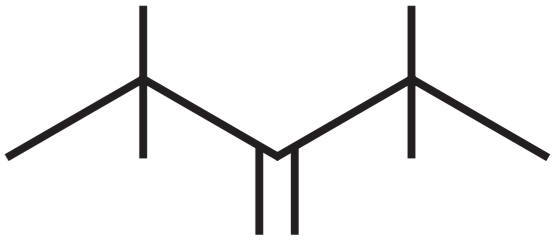
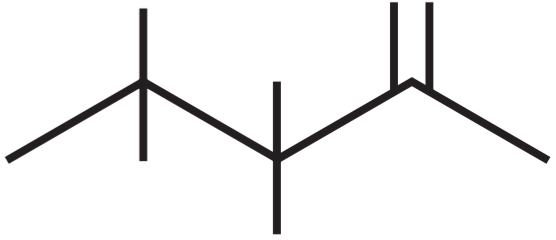
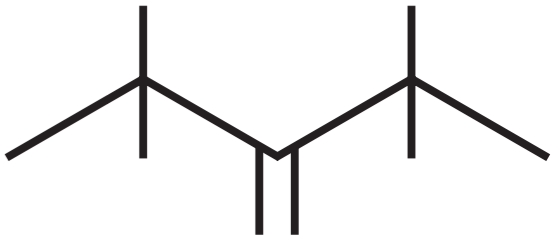
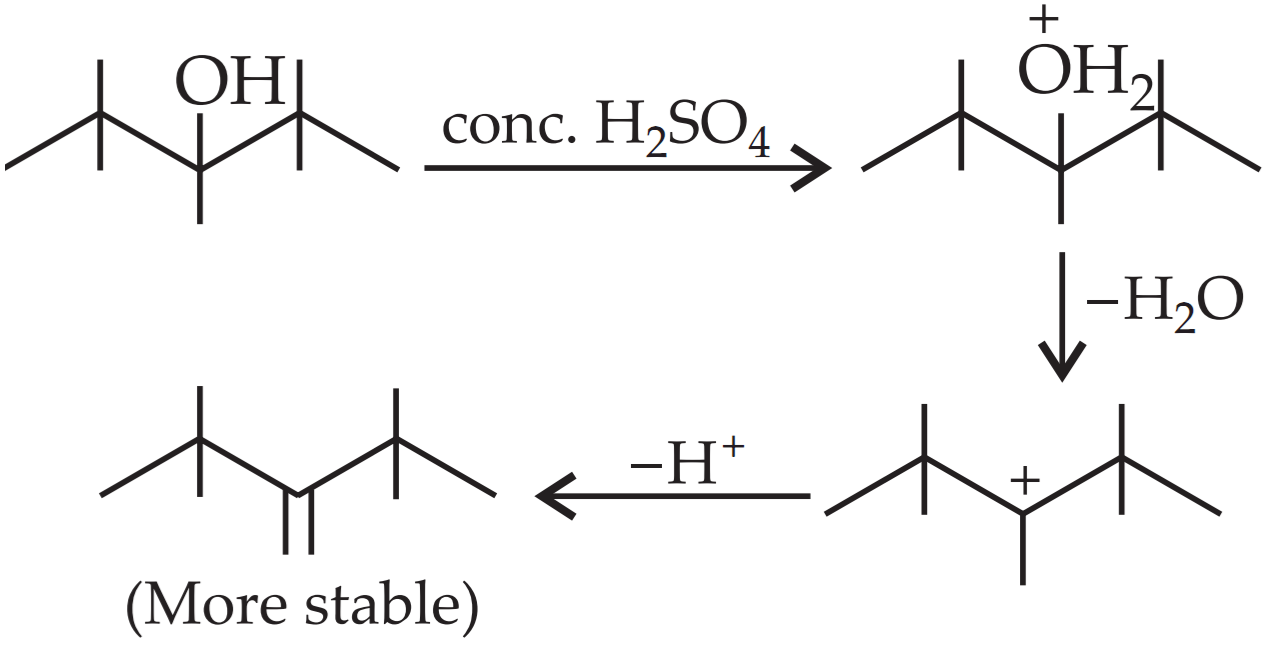
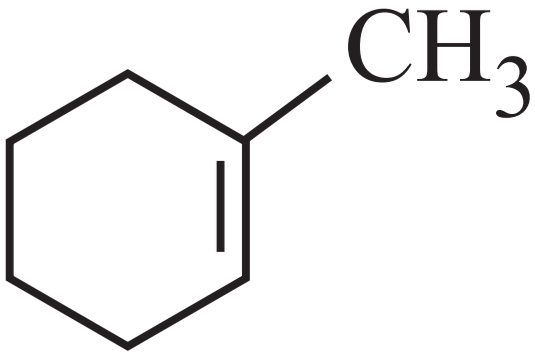
  1. The most stable product (s) is/ are:

  1.  
  1.  
  1. Both (a) and (b)
  2. None of these.
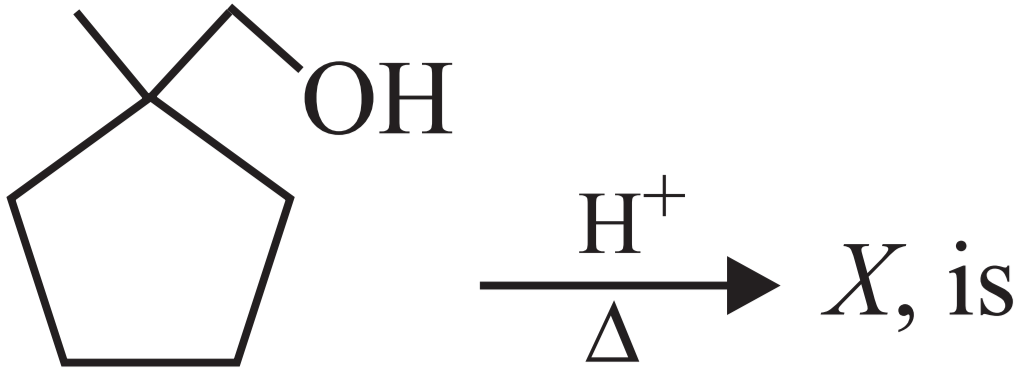
  1. The product of the reaction
Answer
  1. (b) $(CH3)_3COH$
Explanation:
The order of dehydration of alcohols is 3º > 2º > 1º.
  1. (b) Elimination.
Explanation:
The dehydration of alcohol is an example of elimination reaction.
  1. (b) Methyl alcohol.
​​​​​​​​​​​​​​Explanation:
Dehydration of $CH_3OH$ will give methylene (a carbene) which is unstable.
$\text{CH}_3\text{OH}\xrightarrow{\text{H}_2\text{SO}_4}\text{:CH}_2+\text{H}_2\text{O} \\ \ \ \ \ \ \ \ \ \ \ \ \ \ \ \ \ \ \ \ \ \ \ \ \ \text{(unstable) }$
  1. (a)

​​​​​​​​​​​​​​​​​​​​​Explanation:
  1. (c)

​​​​​​​​​​​​​​​​​​​​​Explanation:
View full question & answer
Question 94 Marks
Read the passage given below and answer the following questions:
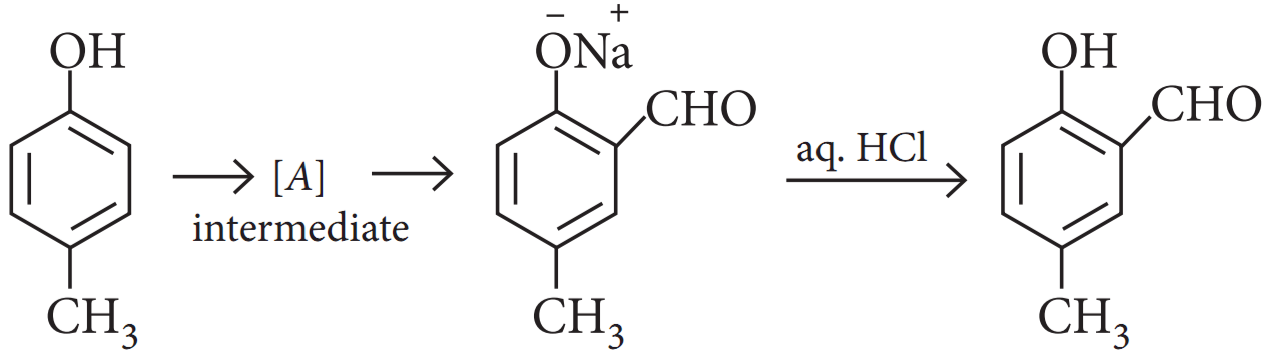
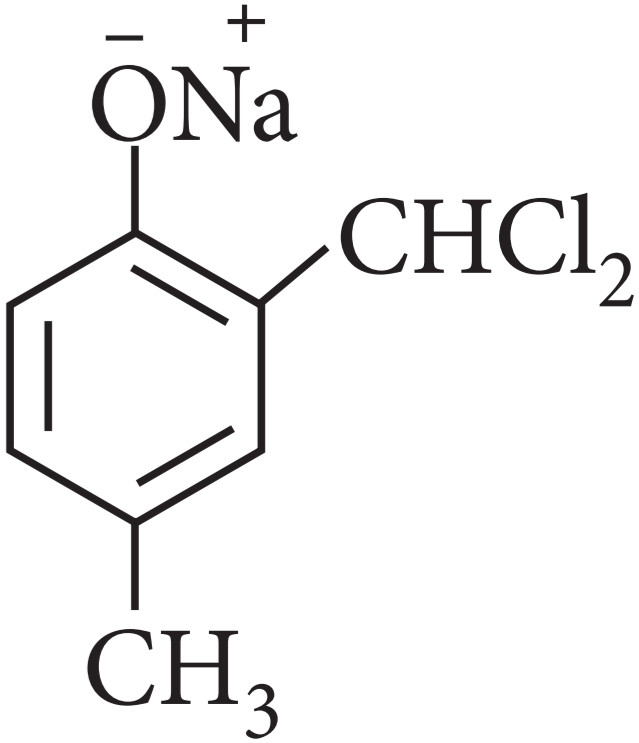
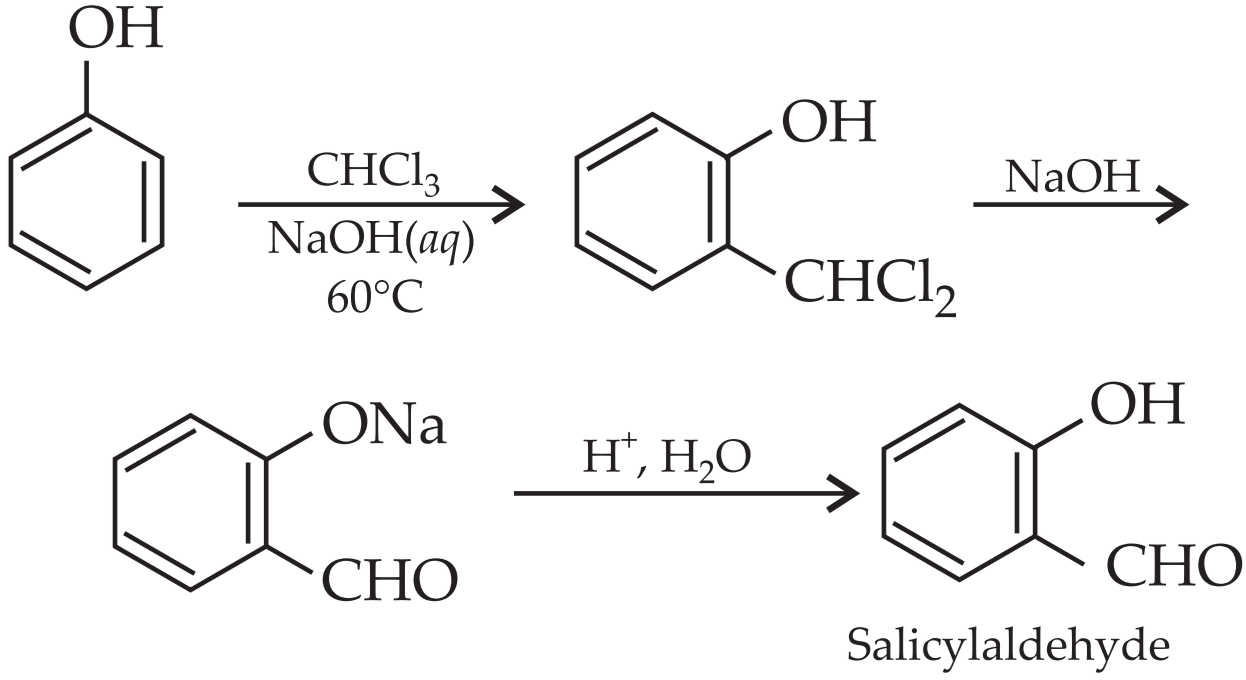
Reimer-Tiemann reaction introduces an aldehyde group, on aromatic ring of phenol, ortho to the hydroxyl group. This is a general method for the synthesis of substituted salicylaldehydes as depicted below.

The following questions are multiple choice questions. Choose the most appropriate answer:
  1. Reimer-Tiemann reaction is an example of:
  1. Nucleophilic substitution reaction.
  2. Electrophilic substitution reaction.
  3. Nucleophilic addition reaction.
  4. Electrophilic addition reaction.
  1. Which of the following reagents is used in the given reaction in steps I?
  1. aq. $NaOH + CH_3Cl$
  2. aq. $NaOH + CH_2Cl_2$
  3. aq. $NaOH + CHCl_3$
  4. aq. $NaOH + CCl_4$
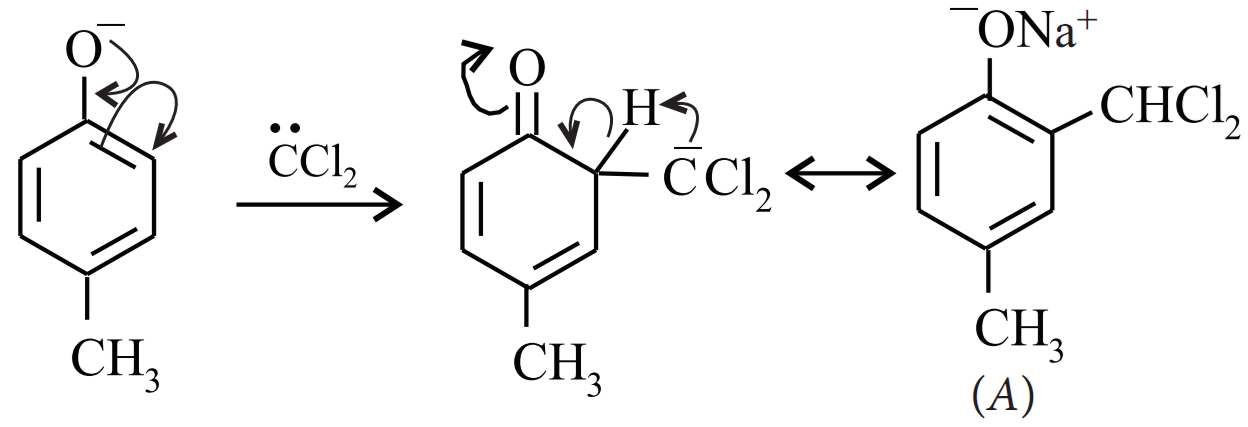
  1. The electrophile in this reaction (A) is:
  1. : $CHCI$
  2. $^+CHCl_2$
  3. : $CCl_2$
  4. .$CCl_3$
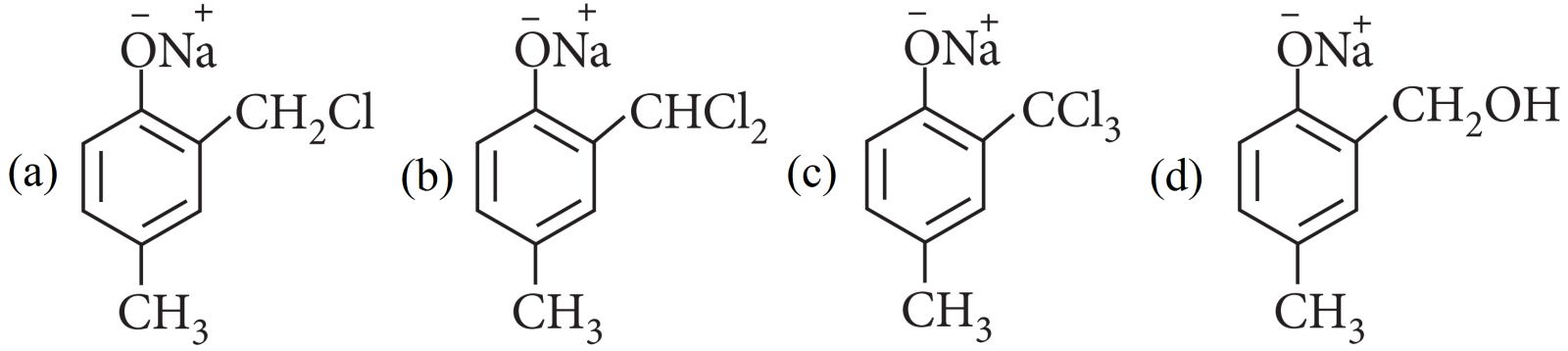
  1. The structure of the intermediate (A) is:
  1. When phenol reacts with chloroform in presence of KOH, the product formed is:
  1. Salicylic acid.
  2. Salicylaldehyde.
  3. Both (a) and (b).
  4. None of these.
Answer
  1. (b) Electrophilic substitution reaction.
Explanation:
It is an electrophilic substitution reaction.
  1. (c) aq. $NaOH + CHCl_3$
  2. (c) : $CCl_2$
Explanation:
  1. (b)

Explanation:
  1. (b) Salicylaldehyde.
Explanation:
View full question & answer
Question 104 Marks
Read the passage given below and answer the following questions:
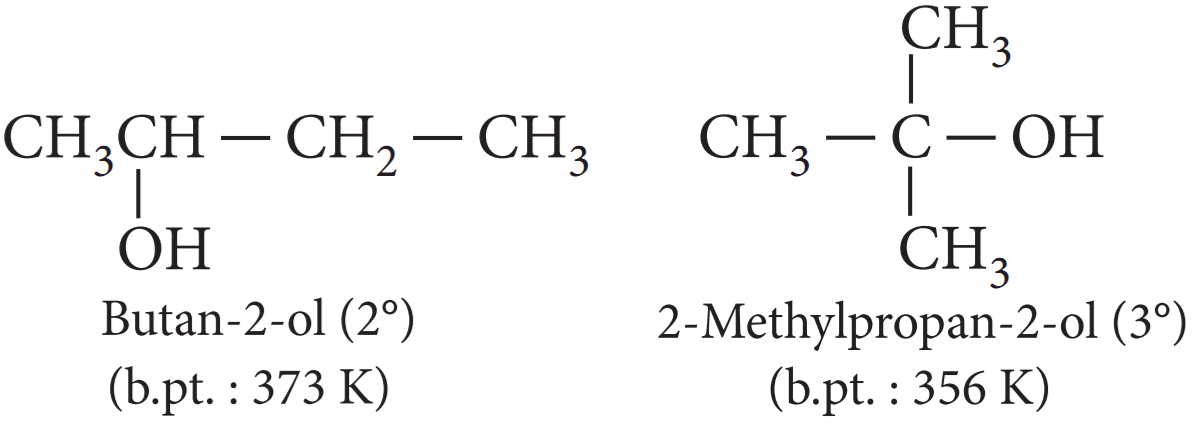
Due to intermolecular hydrogen bonding, the boiling points of alcohols and phenols are much higher than those of corresponding haloalkanes, haloarenes, aliphatic and aromatic hydrocarbons. Among isomeric alcohols, the boiling points follow the order: primary > secondary > tertiary. Boiling points of ethers are much lower than those of isomeric alcohols. The solubility of alcohols in water decreases as the molecular mass of alcohols increases. Amongst isomeric alcohols solubility increases with branching. The solubility of phenols in water is much lower than that of alcohols. Lower ethers such as dimethyl ether and ethyl methyl ether are soluble in water, but the solubility decreases as the molecular mass increases.
In these questions (Q. No. i-iv), a statement of assertion followed by a statement of reason is given. Choose the correct answer out of the following choices.
  1. Assertion and reason both are correct statements and reason is correct explanation for assertion.
  2. Assertion and reason both are correct statements but reason is not correct explanation for assertion.
  3. Assertion is correct statement but reason is wrong statement.
  4. Assertion is wrong statement but reason is correct statement.
  1. Assertion: Alcohols have higher boiling points than ethers of comparable molecular masses.
Reason: Alcohols and ethers are isomeric in nature.
  1. Assertion: The solubility of phenols in water is much lower than that of alcohols.
Reason: Phenols do not form H-bonds with water.
  1. Assertion: Among n-butane, ethoxyethane, 1-propanol and 2-propanol, the increasing order of boiling points is, 1-butanol < 1-propanol < ethoxyethane < n-butane.
Reason: Boiling point increases with increase in molecular mass.
  1. Assertion: Dimethyl ether and diethylether are soluble in water.
Reason: As the molecular mass increases, solubility of ethers in water decreases.
  1. Assertion: Butan-2-ol has higher boiling point than 2-methylpropan-2-ol.
Reason: Amongst isomeric alcohols, the boiling points decreases with branching.
Answer
  1. (b) Assertion and reason both are correct statements but reason is not correct explanation for assertion.
Explanation:

Due to the presence of intermolecular H-bondi ng in alcohols, they have higher boiling points than isomeric ethers.
  1. (c) Assertion is correct statement but reason is wrong statement.
​​​​​​​Explanation:

Like alcohols, phenols also form H-bond with water. But the solubility of phenols in water is much lower than that of alcohols because of the larger non-polar hydrocarbon part (benzene ring) present in their molecules.
  1. (d) Assertion is wrong statement but reason is correct statement.
​​​​​​​​​​​​​​​​​​​​​Explanation:

Boiling point increases with increase in molecular mass so, 1-butanol has higher boiling point than 1-propanol. Ethers do not form hydrogen bonds thus, they have lower boiling points than the corresponding alcohols.

Due to weak dipole-dipole interactions, the boiling points of lower ethers are only slightly higher than those of the n-alkanes having comparable molecular masses,

Thus, the increasing order of boiling points is n-butane < ethoxyethane < 1-propanol < l-butanol.
  1. (b) Assertion and reason both are correct statements but reason is not correct explanation for assertion.
​​​​​​​​​​​​​​​​​​​​​​​​​​​​Explanation:

The solubility of lower ethers in water is due to the formation of H-bonds between water and ether molecules. As the molecular mass increases, the solubility of ethers in water decreases due to corresponding increase in the hydrocarbon portion of the molecule.
  1. (a) Assertion and reason both are correct statements and reason is correct explanation for assertion.
​​​​​​​​​​​​​​​​​​​​​​​​​​​​​​​​​​​Explanation:


Amongst isomeric alcohols,the boiling points decrease with branching due to a corresponding decrease in surface area.
View full question & answer