Question 13 Marks
Lanthanum, gadolinium and lutetium are extraordinarily stable in $+3$ oxidation state. Explain.
(Atomic number: $La = 57, Gd = 64, Lu = 71$)
Answer$_{57}\text{La}\xrightarrow{\ \ \ \ \ \ }\ _{54}\text{La}^{3+}$
$[\text{Xe}]\ 5\text{d}1\ 6\text{s}2\ \ \ \ \ \ \ \ \ \ [\text{Xe}]\ 5\text{d}\ 0\ 6\text{s}0\\\ \ \ \ \ \ \ \ \ \ \ \ _{64}\text{Gd}\xrightarrow{\ \ \ \ \ \ \ \ \ }\ _{61}\text{Gd}^{3+}$
$[\text{Xe}]\ 4\text{f}^7\ 5\text{d}^1\ 6\text{s}^2\ \ \ \ \ \ \ \ \ [\text{Xe}]\ 4\text{f}^7\ 5\text{d}^0\ 6\text{s}^0\\\ \ \ \ \ \ \ \ \ \ \ \ \ \ \ \ \ \ \ _{71}\text{Lu}\xrightarrow{\ \ \ \ \ \ \ \ \ \ }{68}\text{Lu}^{3+}$
$[\text{Xe}]\ 4\text{f}^{14}\ 5\text{d}^1\ 6\text{s}^2\ \ \ \ \ \ \ \ [\text{Xe}]\ 4\text{f}^{14}\ 5\text{d}^0\ 6\text{s}^0$
From their electronic configurations, we find that $La^{3+}, Gd^{3+}$ and $Lu^{3+}$ have empty, exactly half-filled and fully filled valency shells, respectively, which make them extra stable.
View full question & answer→Question 23 Marks
To what extent do the electronic configurations decide the stability of oxidation states in the first series of the transition elements? Illustrate your answer with examples.
AnswerThe elements in the first-half of the transition series exhibit many oxidation states with Mn exhibiting maximum number of oxidation states ( +2 to +7 ). The stability of +2 oxidation state increases with the increase in atomic number. This happens as more electrons are getting filled in the d -orbital. However, Sc does not show +2 oxidation state. Its electronic configuration is $4 \mathrm{~s}^2 3 \mathrm{~d}^1$. It loses all the three electrons to form $\mathrm{Sc}^{3+} .+3$ oxidation state of Sc is very stable as by losing all three electrons, it attains stable noble gas configuration, [Ar]. Ti ( +4 ) and $\mathrm{V}(+5)$ are very stable for the same reason. For Mn, +2 oxidation state is very stable as after losing two electrons, its d -orbital is exactly half-filled, $[\mathrm{Ar}] 3 \mathrm{~d}^5$.
View full question & answer→Question 33 Marks
Write down the number of 3d electrons in each of the following ions: $Ti^{2+}, V^{2+}, Cr^{3+}, Mn^{2+}, Fe^{2+}, Fe^{3+}, Co^{2+}, Ni^{2+}$ and $Cu^{2+}$. Indicate how would you expect the five $3d$ orbitals to be occupied for these hydrated ions (octahedral).
Answer
| Metal ion |
Number of d-electrons |
Filling of d-orbitals |
| $Ti^{2+}$ |
$2$ |
${t^2}_{28}$ |
| $V^{2+}$ |
$3$ |
$\mathrm{t}^3{ }_{28}$ |
| $Cr^{3+}$ |
$3$ |
$\mathrm{t}^3{ }_{28}$ |
| $Mn^{2+}$ |
$5$ |
$\mathrm{t}^3{ }_{28} \mathrm{e}^2{ }_8$ |
| $Fe^{2+}$ |
$6$ |
$\mathrm{t}^4{ }_{28} \mathrm{e}^2{ }_8$ |
| $Fe^{3+}$ |
$5$ |
$\mathrm{t}^3{ }_{28} \mathrm{e}^2{ }_8$ |
| $CO^{2+}$ |
$7$ |
$\mathrm{t}^5{ }_{28} \mathrm{e}_8$ |
| $Ni^{2+}$ |
$8$ |
$\mathrm{t}^6{ }_{28} \mathrm{e}^2{ }_8$ |
| $Cu^{2+}$ |
$9$ |
$\mathrm{t}^6{ }_{28} \mathrm{e}^3{ }_8$ |
View full question & answer→Question 43 Marks
Compare the general characteristics of the first series of the transition metals with those of the second and third series metals in the respective vertical columns. Give special emphasis on the following points:Electronic configurations:
AnswerIn the 1st, 2ndand 3rdtransition series, the 3d, 4d and 5 dorbitals are respectively filled.
We know that elements in the same vertical column generally have similar electronic configurations.
In the first transition series, two elements show unusual electronic configurations:
$Cr(24) = 3d^5 4s^1$
$Cu(29) = 3d^{10} 4s^1$
Similarly, there are exceptions in the second transition series. These are:
$Mo(42) = 4d^5 5s^1$
$Tc(43) = 4d^6 5s^1$
$Ru(44) = 4d^7 5s^1$
$Rh(45) = 4d^8 5s^1$
$Pd(46) = 4d^8 5s^1$
$Ag(47) = 4d^{10} 5s^0$
There are some exceptions in the third transition series as well. These are:
$W(74) = 5d^4 6s^2$
$Pt(78) = 5d^9 6s^1$
$Au(79) = 5d^{10} 6s^1$
As a result of these exceptions, it happens many times that the electronic configurations of the elements present in the same group are dissimilar. View full question & answer→Question 53 Marks
Indicate the steps in the preparation of:
$KMnO_4$ from pyrolusite ore.
AnswerPottassium Permanganate $(KMnO_4)$ is prepared from Pyrolusite ore $(MnO_2)$. The finely powdered Pyrolusite ore $(MnO_2)$ is fused with an alkali metal hydroxide like KOH in the presence of air or an oxidizing agent like $KNO_3$ to give the dark green potassium Manganate $(K_2MnO_4)$. Potassium manganate disproportionate in a neutral or acidic solution to give potassium permanganate.
$2\text{MnO}_2+4\text{KOH}+\text{O}_2\rightarrow2\text{K}_2\text{MnO}_4+2\text{H}_2\text{O}$
$3\text{MnO}^{2-}_4+4\text{H}^+\rightarrow2\text{MnO}^-_4+\text{MnO}_2+2\text{H}_2\text{O}$
Commercially potassium permanganate is prepared by the alkaline oxidative fusion of Pyrolusite ore $(MnO_2)$ followed by the electrolytic oxidation of manganate (4) ion.
$2\text{MnO}_2+4\text{KOH}+\text{O}_2\rightarrow2\text{K}_2\text{MnO}_4+2\text{H}_2\text{O}$
View full question & answer→Question 63 Marks
What can be inferred from the magnetic moment values of the following complex species?
| Example |
Magnatic Moment (BM) |
| $K_4[Mn(CN)_6]$ |
$2.2$ |
| $[Fe(H_2O)_6]^{2+}$ |
$5.3$ |
| $K_2[MnCl_4]$ |
$5.9$ |
AnswerMagnetic moment $(m)$ is given as $\mu=\sqrt{\text{n}(\text{n}+2)}$
For value $n = 1,$ $\mu=\sqrt{1(1+2)}=\sqrt3=1.732$
For value $n = 2,$ $\mu=\sqrt{2(2+2)}=\sqrt8=2.83$
For value $n = 3,$ $\mu=\sqrt{3(3+2)}=\sqrt{15}=3.87$
For value $n = 4,$ $\mu=\sqrt{4(4+2)}=\sqrt{24}=4.889$
For value $n = 5,$ $\mu=\sqrt{5(5+2)}=\sqrt{35}=5.92$
- $K_4[Mn(CN)_6]$
For in transition metals, the magnetic moment is calculated from the spin-only formula.
Therefore,
$\sqrt{\text{n}(\text{n}+2)}=\sqrt8=2.2$
We can see from the above calculation that the given value is closest to $n = 1$. Also, in this complex, Mn is in the $+2$ oxidation state. This means that Mn has $5$ electrons in the d orbital. Hence, we can say that $CN^-$ is a strong field ligand that causes the pairing of electrons.
- $[Fe(H_2O)_6]^{2+}$
$\sqrt{\text{n}(\text{n}+2)}=5.3$
We can see from the above calculation that the given value is closest to $n = 4$. Also, in this complex, Fe is in the $+2$ oxidation state. This means that Fe has 6 electrons in the d orbital. Hence, we can say that $H_2O$ is a weak field ligand and does not cause the pairing of electrons.
- $K_2[MnCl_4]$
$\sqrt{\text{n}(\text{n}+2)}=5.9$
We can see from the above calculation that the given value is closest to $n = 5$. Also, in this complex, Mn is in the $+2$ oxidation state. This means that Mn has 5 electrons in the d orbital. Hence, we can say that $Cl^-$ is a weak field ligand and does not cause the pairing of electrons. View full question & answer→Question 73 Marks
What are alloys? Name an important alloy which contains some of the lanthanoid metals. Mention its uses.
AnswerAn alloy is a blend of metals prepared by mixing the components. Alloys may be homogeneous solid solutions in which the atoms of one metal are distributed randomly among the atoms of the other. Such alloys are formed by atoms with metallic radii that are within about 15 percent of each other. Because of similar radii and other characteristics of transition metals, alloys are readily formed by these metals. An important alloy which contains some of the lanthanoid is mischmetall. Mischmetall consists of a lanthanoid metal (~95%) and iron (~5%) and traces of S, C, Ca and Al.
Uses:
- Mischmetall is used in Mg based alloy to produce bullets, shell and lighter flint.
Some individual Ln oxides are used asjphosphorus in television screens and similar fluorescing surfaces.
View full question & answer→Question 83 Marks
What is lanthanoid contraction? What are the consequences of lanthanoid contraction?
AnswerAs we move along the lanthanoid series, the atomic number increases gradually by one. This means that the number of electrons and protons present in an atom also increases by one. As electrons are being added to the same shell, the effective nuclear charge increases. This happens because the increase in nuclear attraction due to the addition of proton is more pronounced than the increase in the interelectronic repulsions due to the addition of electron. Also, with the increase in atomic number, the number of electrons in the 4f orbital also increases. The 4f electrons have poor shielding effect. Therefore, the effective nuclear charge experienced by the outer electrons increases. Consequently, the attraction of the nucleus for the outermost electrons increases. This results in a steady decrease in the size of lanthanoids with the increase in the atomic number. This is termed as lanthanoid contraction.Consequences of lanthanoid contraction
- There is similarity in the properties of second and third transition series.
- Separation of lanthanoids is possible due to lanthanide contraction.
- It is due to lanthanide contraction that there is variation in the basic strength of lanthanide hydroxides. Basic strength decreases from $\text{La(OH)}_3 \ \text{to} \ \text{Lu(OH)}_3$
View full question & answer→Question 93 Marks
Indicate the steps in the preparation of:
$K_2Cr_2O_7$ from chromite ore.
AnswerThe preparation of potassium dichromate from chromite involves the following main steps:
- The chromate ore is finely ground and heated strongly with molten alkali in the presence of air.
$2\text{FeCr}_2\text{O}_4+8\text{NaOH}+7/2\text{O}_2\rightarrow4\text{NaCr}_2\text{O}_4+\text{Fe}_2\text{O}_3+4\text{H}_2\text{O}\\\text{Chromite}\ \ \ \ \ \ \ \ \ \ \ \ \ \ \ \ \ \ \ \ \ \ \ \ \ \ \ \ \ \ \ \ \ \ \ \ \ \ \text{Sodium chromate}$
- The solution of sodium chromate is filtered and acidified with dilute sulphuric acid so that sodium dichromate is obtained.
$2\text{Fe}_2\text{Cr}_2\text{O}_4+\text{H}_3\text{SO}_4\rightarrow\text{Na}_2\text{Cr}_2\text{O}_7+\text{Na}_2\text{SO}_4+\text{H}_2\text{O}\\\text{Sodium}\ \ \ \ \ \ \ \ \ \ \ \ \ \ \ \ \ \ \ \ \ \ \ \ \ \ \ \ \ \ \ \ \text{Sodium}\\ \text{Chromate} \ \ \ \ \ \ \ \ \ \ \ \ \ \ \ \ \ \ \ \ \ \ \ \ \ \text{dichromate}$
- A calculated quantity of potassium chloride is added to a hot concentrated solution of sodium dichromate. Potassium dichromate is less soluble therefore it crystallizes out first.
$2\text{Na}_2\text{Cr}_2\text{O}_7+2\text{KCl}\rightarrow\text{K}_2\text{Cr}_2\text{O}_7+\text{NaCl}\\\text{Sodium}\ \ \ \ \ \ \ \ \ \ \ \ \ \ \ \ \ \ \ \ \ \ \ \ \ \ \ \text{Potessium}\\\text{dichromate} \ \ \ \ \ \ \ \ \ \ \ \ \ \ \ \ \ \ \ \ \text{dichromate}$ View full question & answer→Question 103 Marks
The chemistry of the actinoid elements is not so smooth as that of the lanthanoids. Justify this statement by giving some examples from the oxidation state of these elements.
AnswerAmong the actinoids, there is a greater range of oxidation states as compared to lanthanoids. This is in part due to the fact that 5f, 6d and 7s levels are of very much comparable energies and the frequent electronic transition among these three levels is possible. This 6d-5f transition and larger number of oxidation states among actinoids make their chemistry more complicated particularly among the 3rd to 7th elements. Following examples of oxidation states of actinoids. Justify the complex nature of their chemistry.
- Uranium exhibits oxidation states of +3, +4, +5, +6 in its compounds. However, the dominant oxidation state in actinoides is +3.
- Nobelium, No is stable in +2 state because of completely filled $f^{14}$ orbitals in this state.
- Berkelium, BK in +4 oxidation state is more stable due to $f^7$ (exactly half filled) configuration.
- Higher oxidation states are exhibited in oxo ions are $UO_2{}^{2+}, PuO_2{}^{2+}, NpO^+$ etc.
View full question & answer→Question 113 Marks
Compare the chemistry of actinoids with that of the lanthanoids with special reference to:
Chemical reactivity
AnswerChemical reactivity: The earlier members of the lanthanoids series are quite reactive similar to calcium but, with increase in atomic number, they behave more like aluminium. The metals combine with hydrogen when. gently heated in the gas. Carbides, $Ln_3C$, $Ln_2C_3$ and $LnC_2$ are formed when the metals are heated with carbon. They liberate hydrogen from dilute acid and burn in halogens to form halides. They form oxides $M_2O_3$ and hydroxides $M(OH)_3$. Actinoids are highly reactive metals, especially when finely divided. The action of boiling water on thern gives a mixture of oxide and hydride and combination with most non-metals take place at moderate temperatures. HCl attacks all metals but most are slightly affected by nitric acid owing to the formation of protective oxide layers, alkalis have no action. Actinoids are more reactive than lanthanoids due to bigger atomic size and lower ionisation energy.
View full question & answer→Question 123 Marks
How would you account for the following:
E° of Cu is +0.34 V while that of Zn is -0.76 V.
AnswerHigh ionisation enthalpy to transform $\mathrm{Cu}(\mathrm{s})$ to $\mathrm{Cu}^{2+}(\mathrm{aq})$ is not balanced by its hydration enthalpy. However, in case of Zn after removal of electrons from 4 s -orbital, stable $3 \mathrm{~d}^{10}$ configuration is acquired.
View full question & answer→Question 133 Marks
Describe the trends in the following properties of the first series of the transition elements:
- Oxidation states.
- Atomic sizes.
- Magnetic behaviour of dipositive gaseous ions $(M^{2+})$.
Answer
- As there is very little energy difference between 4s and 3d orbitals, electrons from both energy levels can be used for chemical bond formation. Therefore, all elements except Sc and Zn of the first transition series show a number of oxidation states.
- Atomic radii of the first transition series decrease from Sc to Cr, then remains almost constant till Ni and then increases from Cu to Zn. The reason of this variation in atomic radii has been attributed to the increase in nuclear charge in the beginning of the series. But as the electrons continue to be filled in d-orbitals, they screen the outer 4s electrons from the influence of nuclear charge. When the increased nuclear charge and the increased screening effect balance each other in the middle of transition series, the atomic radii become almost constant (Mn to Fe). Towards the end of the series, the repulsive interaction between electrons in orbitals become very dominant. As a result there is an expansion of the electron cloud; consequently, the atomic size increases.
- Except $Zn^{2+}$, all other divalent gaseous ions of the first series of the transition elements contain unpaired electrons in their 3d-subshell and are therefore paramagnetic in nature.
View full question & answer→Question 143 Marks
Give reasons for the following:
i. The transition metals generally form coloured compounds.
ii. $\mathrm{E}^{\circ}$ value for $\left(\mathrm{Mn}^{3+} \mid \mathrm{Mn}^{2+}\right)$ is highly positive than that for $\left(\mathrm{Cr}^{3+} \mid \mathrm{Cr}^{2+}\right)$ couple.
iii. The chemistry of actinoids elements is not so smooth as that of the lanthanoids.
Answeri. Due to presence of unpaired electrons/d-d transition.
ii. $\mathrm{Mn}^{3+}$ is $3 d^4$ while $\mathrm{Cr}^{3+}$ is $3 d^3$ which in $t_2 g$ half filled is extra stable.
iii. The energy difference between $5 \mathrm{f}, 6 \mathrm{~d}$ and 7 s orbitals is very less as compared to lanthanoids.
View full question & answer→Question 153 Marks
- How would you account for the following:
- Actinoid contraction is greater than lanthanoid contraction.
- Transition metals form coloured compounds.
- Complete the following equation:
$\text{2MnO}_{4}^{-}+\text{6H}^{+}+\text{5NO}_{2}^{-}\rightarrow$Answer
- 5f orbital electrons have poor shielding effect than 4f.
- due to d-d transition/or the energy of excitation of an electron from lower d-orbital to' higher d-orbital lies in the visible region/presence of unpaired in the d-orbital.
- $\text{2 MnO}^{-}_{4}+\text{6H}^{+}+\text{5 NO}^{-}_{2}\rightarrow\text{2Mn}^{2+}+\text{3H}_{2}\text{O}+\text{5NO}^{-}_{3}$
View full question & answer→Question 163 Marks
Although $Cr^{3+}$ and $Co^{2+}$ ions have same number of unpaired electrons but the magnetic moment of $Cr^{3+}$ is $3.87$ B.M. and that of $Co^{2+}$ is $4.87$ B.M. Why?
AnswerThe electronic configuration of $Cr^{3+}$ and $CO^{2+}$ ions are:
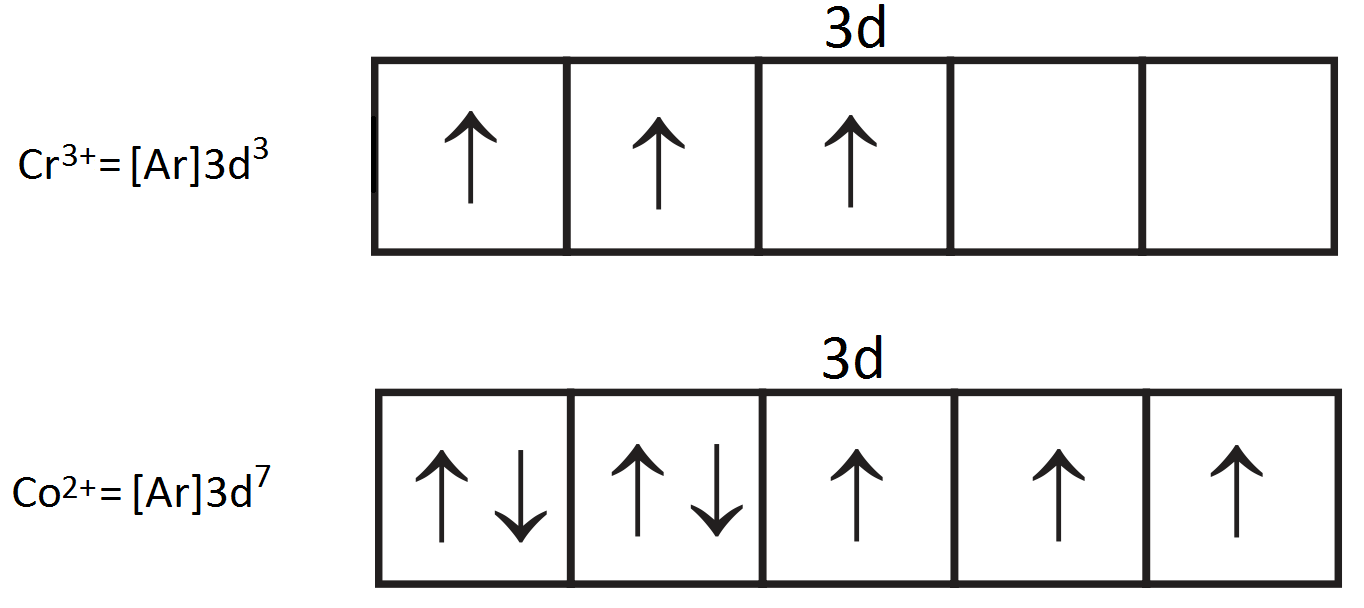
Due to symmetrical electronic configuration, there is no orbital contribution in $Cr^{3+}$ ion. However, appreciable contribution occurs in $CO^{2+}$ ion. View full question & answer→Question 173 Marks
How would you account for the following:
Transition metals sometimes exhibit very low oxidation state such as $+1$ and $0$.
Answer$+1$ oxidation state is shown by element like Cu because after loss of one electron, it acquires stable configuration of $3d^{10}$. Zero oxidation state is shown in forming metal carbonyl, because p-electrons donated by ligands are accepted into the empty d-orbitals.
View full question & answer→Question 183 Marks
A solution of $KMnO_4$ on reduction yields either a colourless solution or a brown precipitate or a green solution depending on pH of the solution. What different stages of the reduction do these represent and how are they carried out?
AnswerOxidising behaviour of $KMnO_4$ depends on pH of the solution.
In acidic medium $\text{(pH<7)}$
$\text{MnO}_4^-+8\text{H}^++5\text{e}^-\xrightarrow{\ \ \ \ \ \ }\text{Mn}^{2+}+4\text{H}_2\text{O}\\ \ \ \ \ \ \ \ \ \ \ \ \ \ \ \ \ \ \ \ \ \ \ \ \ \ \ \ \ \ \ \ \ \ \ \ \ \ \ \ \ \ \ \ ^\text{(Colourless)}$
In alkaline medium $\text{pH<7}$
$\text{MnO}_4^-+\text{e}^-\xrightarrow{\ \ \ \ \ \ }\text{MnO}^{2-}_4\\ \ \ \ \ \ \ \ \ \ \ \ \ \ \ \ \ \ \ \ \ \ \ \ \ \ \ \ \ \ \ ^\text{(Green)}$
In neutral medium $\text{(pH=7)}$
$\text{MnO}_4^-+2\text{H}_2\text{O}+3\text{e}^-\xrightarrow{\ \ \ \ \ \ }\text{MnO}_{2}+4\text{OH}^-\\ \ \ \ \ \ \ \ \ \ \ \ \ \ \ \ \ \ \ \ \ \ \ \ \ \ \ \ \ \ \ \ \ \ \ \ \ \ \ \ \ \ \ \ \ \ \ ^\text{(Brown precipitate)}$
View full question & answer→Question 193 Marks
Colour of $KMnO_4$ disappears when oxalic acid is added to its solution in acidic medium.
Answer$KMnO_4$ acts as oxidising agent. It oxidises oxalic acid to $CO_2$ and itself changes to $Mn^{2+}$ ion which is colourless.
$5\text{C}_2\text{O}^{2-}_4+2\text{MnO}^-_4+16\text{H}\xrightarrow{\ \ \ \ \ \ \ }2\text{Mn}^{2+}+8\text{H}_2\text{O}+10\text{CO}_2\\\ \ \ \ \ \ \ \ \ \ \ \ \ \ (\text{Coulored})\ \ \ \ \ \ \ \ \ \ \ \ \ \ \ \ (\text{Colourless})$
View full question & answer→Question 203 Marks
How would you account for the following:
- The transition elements have high enthalpies of atomisation.
- The transition metals and their compounds are found to be good catalysts in many processes.
Answer
- Because of strong metallic bonds/they have stronger interatomic interaction.
- Because they are capable of exhibiting variables oxidation states and forming complex.
View full question & answer→Question 213 Marks
When a chromite ore (A) is fused with sodium carbonate in free excess of air and the product is dissolved in water, a yellow solution of compound (B) is obtained. After treatment of this yellow solution with sulphuric acid,compound (C) can be crystallised from the solution. When compound (C) is treated with KCl, orange crystals of compound (D) crystallise out. Identify A to D and also explain the reactions.
AnswerThe compounds A, B, C and D are given as under:
| $\text{A}=\text{FeCr}_2\text{O}_4$ |
$\text{B}=\text{Na}_2\text{CrO}_4$ |
$\text{C}=\text{Na}_2\text{Cr}_2\text{O}_7.2\text{H}_2\text{O}$ |
$\text{D}=\text{K}_2\text{Cr}_2\text{O}_7$ |
The reactions are exaplained as under:
$4\text{FeCr}_2\text{O}_7+8\text{NaCO}_3+7\text{O}_2\xrightarrow{\ \ \ \ \ \ \ \ \ }8\text{Na}_2\text{CrO}_4+2\text{Fe}_2\text{O}_3+8\text{CO}_2\\ \ \ \ \ \ \ \ ^\text{(A)}\ \ \ \ \ \ \ \ \ \ \ \ \ \ \ \ \ \ \ \ \ \ \ \ \ \ \ \ \ \ \ \ \ \ \ \ \ \ \ \ \ \ \ \ \ \ \ \ \ \ \ \ \ \ \ \ \ \ ^\text{(B)}$
$2\text{NaCrO}_4+2\text{H}^+\xrightarrow{\ \ \ \ \ \ \ \ \ \ }\text{Na}_2\text{Cr}_2\text{O}_7+2\text{Na}^++\text{H}_2\text{O}$
$\text{Na}_2\text{Cr}_2\text{O}_7+2\text{KCl}\xrightarrow{\ \ \ \ \ \ \ \ \ }\text{K}_2\text{Cr}_2\text{O}_7+2\text{NaCl}\\ \ \ \ \ \ \ \ \ ^\text{(C)} \ \ \ \ \ \ \ \ \ \ \ \ \ \ \ \ \ \ \ \ \ \ \ \ \ \ \ \ \ \ \ \ \ \ \ \ ^\text{(D)}$ View full question & answer→Question 223 Marks
How would you account for the following:
- Many of the transition elements and their compounds can act as good catalysts.
- The metallic radii of the third (5d) series of transition elements are virtually the same as those of the corresponding members of the second series.
- There is a greater range of oxidation states among the actinoids than among the lanthanoids.
Answer
- Due to their ability to show multiple oxidation states.
- Due to lanthanoid contraction.
- Due to comparable energies of 5f, 6d and 7s orbitals in actinoids.
View full question & answer→Question 233 Marks
Giving a suitable example for each, explain the following:
- Crystal field splitting.
- Linkage isomerism.
- Ambidentate ligand.
Answer
- Crystal field splitting: The splitting of d-orbitals under the influence of approaching ligand is known as crystal field splitting eg for $d^4$, configuration is $t_{2g}{}^3e_g{}^1$ in the presence of weak field ligand.
- Linkage isomerism: Linkage isomers are those isomers which have same molecular formula but differ in the linkage of ligand atom to the central atom e.g.
$[Co(NH_3)_5 NO_2]Cl_2, [Co(NH_3)_5 ONO]Cl_2$.
- Ambident ligand: a un identate ligand which can co-ordinate to the central metal atom through more than one co-ordinating bond.e.g. $NO_2{}^–, SCN^–$.
View full question & answer→Question 243 Marks
Answer the following questions:
Compare non transition and transition elements on the basis of their.
- Variability of oxidation states.
- Stability of oxidation states.
Answer
- Oxidation states of transition elements differ from each other by unity. In non-transition elements oxidation states normally differ by a unit of two.
- In transition elements higher oxidation states are favoured by heavier elements whereas in non-transition elements lower oxidation state is favoured by heavier elements.
View full question & answer→Question 253 Marks
How would you account for the following:
The $\mathrm{E}^{\circ}$ value for the $\mathrm{Mn}^{3+} / \mathrm{Mn}^{2+}$ couple is much more positive than that for $\mathrm{Cr}^{3+} / \mathrm{Cr}^{2+}$ couple or $\mathrm{Fe}^{3+} / \mathrm{Fe}^{2+}$ couple.
AnswerThe $\mathrm{E}^{\circ}$ value for the $\mathrm{Mn}^{3+} / \mathrm{Mn}^{2+}$ couple is much more positive than $\mathrm{Cr}^{3+} / \mathrm{Cr}^{2+}$ couple or $\mathrm{Fe}^{3+} / \mathrm{Fe}^{2+}$ couple because $\mathrm{Mn}^{3+}$ ion receiving an electron gets d -subshell half-filled which is highly stable, while in case of $\mathrm{Fe}^{3+}$, $d$-subshell is already half-filled, so it does not receive electron easily.
View full question & answer→Question 263 Marks
Compare the chemistry of actinoids with that of the lanthanoids with special reference to:
Chemical reactivity
AnswerChemical reactivity: The earlier members of the lanthanoids series are quite reactive similar to calcium but, with increase in atomic number, they behave more like aluminium. The metals combine with hydrogen when. gently heated in the gas. Carbides, $\mathrm{Ln}_3 \mathrm{C}, \mathrm{Ln}_2 \mathrm{C}_3$ and $\mathrm{LnC}_2$ are formed when the metals are heated with carbon. They liberate hydrogen from dilute acid and burn in halogens to form halides. They form oxides $\mathrm{M}_2 \mathrm{O}_3$ and hydroxides $\mathrm{M}(\mathrm{OH})_3$. Actinoids are highly reactive metals, especially when finely divided. The action of boiling water on thern gives a mixture of oxide and hydride and combination with most non-metals take place at moderate temperatures. HCl attacks all metals but most are slightly affected by nitric acid owing to the formation of protective oxide layers, alkalis have no action. Actinoids are more reactive than lanthanoids due to bigger atomic size and lower ionisation energy.
View full question & answer→Question 273 Marks
Ionisation enthalpies of Ce, Pr and Nd are higher than Th, Pa and U.
AnswerIt is because in the beginning, when 5f-orbitals begin to be occupied, they will penetrate less into the inner core of electrons. The 5f-electrons will therefore, be more effectively shielded from the nuclear charge than 4f-electrons of the corresponding lanthanoids. Therefore, outer electrons are less firmly held and they are available for bonding in the actinoids.
View full question & answer→Question 283 Marks
$[Ti(H_2O)]^{3+}$ is coloured while $[Sc(H_2O)_6]^{3+}$ is colourless.
AnswerThis is due to d-d transition of electron in $[Ti(H_2O)]^{3+}$ complex $Ti^{3+}$ has one electron in d-orbital $(3d^1)$ which absorb energy corresponding to blue-green region and jumps from $t_{2g}$ to $e_g$ set of d-orbitals $\big(\text{t}^1_{2\text{g}}\text{ e}^0_{\text{g}}\xrightarrow{\ \ \ \ \ }\text{t}^0_{2\text{g}}\text{ e}^1_{\text{g}}\big).$ But $Sc^{3+}$ has no electron in the d-orbital.
View full question & answer→Question 293 Marks
How would you account for the following:
There is a gradual decrease in the atomic sizes of transition elements in a series with increasing atomic numbers.
AnswerThere is a gradual decrease in the atomic sizes of transition elements in a series with increasing atomic numbers due to poor shielding effect of d-electrons, the net electrostatic attraction between the nucleus and the outermost electrons increases.
View full question & answer→Question 303 Marks
Complete the following chemical reaction equations:
$\text{Cr}_2\text{O}^{2-}_7(\text{aq})+\text{Fe}^{2+}(\text{aq})+\text{H}^+(\text{aq})\xrightarrow{\ \ \ \ \ \ \ \ \ }$
Answer$\ \ \ \ \ \ \ \ \ \ \ \ \ \text{Cr}_2\text{O}^2_7+14\text{H}^+6\text{e}^-\xrightarrow{\ \ \ \ \ \ }2\text{Cr}^{3+}+7\text{H}_2\text{O}\\ \ \ \ \ \ \ \ \ \ \ \ \ \ \ \ \ \ \ \ \ \ \ \ \ \ \ \ \ \ \ \ \ \ \ \ \ \text{Fe}^{2+}\xrightarrow{\ \ \ \ \ \ \ }\text{Fe}^{3+}+\text{e}^-\times6\\\underline{\overline{\text{Cr}_2\text{O}^{2-}_7+6\text{Fe}^{2+}+14\text{H}^+\xrightarrow{\ \ \ \ \ \ }2\text{Cr}^{3+}+6\text{Fe}^{3+}+7\text{H}_2\text{O}}}$
View full question & answer→Question 313 Marks
Give reasons:
- Mn shows the highest oxidation state of $+7$ with oxygen but with fluorine it shows the highest oxidation state of $+4$.
- Transition metals show variable oxidation states.
- Actinoids show irregularities in their electronic configurations.
Answer
- Ability of oxygen to form multiple bond/ $p\pi-d\pi$ bond.
- Partially filled d orbitals/due to comparable energies of ns and (n-1) d orbitals.
- Due to relative stabilities of the $f^o,f^7$ and $f^{14}$ occupancies of the 5f orbitals/Comparable energies of 7s,6d,5f orbitals.
View full question & answer→Question 323 Marks
Match the properties given in Column I with the metals given in Column II.
|
|
Column I (Property)
|
|
Column II (Metal)
|
|
(i)
|
An element which can show +8 oxidation state
|
(a)
|
Mn
|
|
(ii)
|
3d block element that can show upto +7 oxidation state
|
(b)
|
Cr
|
|
(iii)
|
3d block element with highest melting point
|
(c)
|
Os
|
| |
|
(d)
|
Fe
|
Answer
|
|
Column I (Property)
|
|
Column II (Metal)
|
|
(i)
|
An element which can show +8 oxidation state
|
(c)
|
Os
|
|
(ii)
|
3d block element that can show upto +7 oxidation state
|
(a)
|
Mn
|
|
(iii)
|
3d block element with highest melting point
|
(b)
|
Cr
|
Explanation:
- Osmium is an element which show +8 oxidation state.
- 3d block element that can show up to +7 oxidation state is manganese.
- 3d block element with highest melting point is chromium.
View full question & answer→Question 333 Marks
Although fluorine is more electronegative than oxygen, but the ability of oxygen to stabilise higher oxidation states exceeds that of fluorine. Why?
AnswerThe electronic configuration of fluorine is $1 s^2 2 s^2 2 p^5$. Thus it can form only one bond as it has only one unpaired electron. Electronic configuration of oxygen is $1 s^2 2 s^2 2 p^6 3 s^2 3 p^6$.
It may be mentioned that oxygen also has vacant d-orbitals along with two 3 p orbitals containing single electron. Thus, oxygen has greater bond formation capacity. In other words, it has greater ability to stabilize higher oxidation states.
View full question & answer→Question 343 Marks
A green solution of potassium manganate turns purple when $CO_2$ gas is passed through the solution.
Answer$CO_2$ reacts with water to from carbonic acid as given below:

In the acidic medium $\text{MnO}^{2-}_4$ undergoes disproportionation to form ions which imparts purple colour to sultion.
$\ \ \ \ \ \ ^{+6}\ \ \ \ \ \ \ \ \ \ \ \ \ \ \ \ \ \ \ \ \ \ \ \ \ \ \ \ \ \ \ \ \ \ ^{+7}\ \ \ \ \ \ \ \ \ \ \ \ ^{+4}\\3\text{MnO}^{2-}_4+4\text{H}^+\xrightarrow{\ \ \ \ \ \ \ \ \ \ \ }2\text{MnO}^-_4+\text{MnO}_2+2\text{H}_2\text{O}\\\text{(Green solution)}\ \ \ \ \ \ \ \ \ \ \ \ \text{(Purple solution)}$ View full question & answer→Question 353 Marks
E° values of Mn, Ni and Zn are more negative than expected.
AnswerNegative $\mathrm{E}^{\circ}$ values for $\mathrm{Mn}^{2+}$ and $\mathrm{Zn}^{2+}$ are related to stabilities of half-filled and fully filled configurations, respectively. But for $\mathrm{Ni}^{2+}, \mathrm{E}^{\circ}$ value is related to the highest negative enthalpy of hydration.
View full question & answer→Question 363 Marks
Identify the metal and justify your answer.
- Carbonyl M $(CO)_5$
- $MO_3F$
AnswerIt is $=0$
$x=+7 M$ is in +7 oxidation state so that the given compound is $\mathrm{MnO}_3 \mathrm{~F}$
i. $\mathrm{Fe}(\mathrm{CO})_5$ by EAN rule
EAN $=x+2 \times 5=36(\mathrm{Kr}$ is the nearest inert gas)
$x=26$ (atomic no. of the metal) so the metal is iron.
ii. $\mathrm{MO}_3 \mathrm{~F}$ is $\mathrm{MnO}_3 \mathrm{~F}$
In $\mathrm{MO}_3 \mathrm{~F}$ let us assume $\mathrm{M}=\mathrm{x}$
$x+3 \times(-2)+(-1)$
$x=+7$
M is in + 7 osidation state so that the given compound is $\mathrm{MnO}_3 \mathrm{~F}$
View full question & answer→Question 373 Marks
Explain the following observations:
There is a close similarity in physical and chemical properties of the 4d and 5d series of the transition elements, much more than expected on the basis of usual family relationship.
AnswerThis is because 5d and 4d-series elements have virtually the same atomic and ionic radii due to lanthanide contraction. Due to equality in size of Zr and Hf, Nb and Ta, Mo and W, etc., the two elements of each pair have the same properties.
View full question & answer→Question 383 Marks
Give reasons for the following:
- Transition elements and their compounds act as catalysts.
- $E^0$ value for $(Mn^{2+}|Mn)$ is negative whereas for $(Cu^{2+}|Cu)$ is positive.
- Actinoids show irregularities in their electronic configuration.
Answer
- Transition elements show catalytic property due to the presence of vacant orbitals that is why they have the tendency to form variable oxidation states. Hence, they can easily form intermediates with suitable reactants.
- $E^0$ value of $Cu^{2+}/ Cu$ is positive that is why copper is least reactive metal among first transition metal this is because copper has the high enthalpy of atomization and enthalpy of ionization in comparison to $Mn^{2+}|Mn$.
- This happens because of less energy difference between 5f, 6d and 7f subshell of actinides and hence electrons can easily be transferred from one subshell to another.
View full question & answer→Question 393 Marks
Complete the following chemical reaction equations:
$\text{MnO}^-_4(\text{aq})+\text{C}_2\text{O}^{2-}_4(\text{aq})+\text{H}^+(\text{aq})\xrightarrow{\ \ \ \ \ \ \ \ \ }$
Answer$\ \ \ \ \ \ \ [\text{MnO}^-_4+8\text{H}^++5\text{e}\xrightarrow{\ \ \ \ \ \ }\text{Mn}^{2+}+4\text{H}_2\text{O}\times2]\\ \ \ \ \ \ \ \ \ \ \ \ \ \ \ \ \ \ \ \ \ \ \ \ \ \ \ \ \ \ \ \ \ \text{[C}_2\text{O}^2_4\xrightarrow{\ \ \ \ \ \ \ \ }2\text{CO}^2_4+2\text{e}^-]\times5\\\underline{\overline{\text{MnO}_4+5\text{C}_2\text{O}^{2-}_{4}+16\text{H}^+\xrightarrow{\ \ \ \ \ \ \ }2\text{Mn}^{2+}+10\text{CO}_2+8\text{H}_2\text{O}}}$
View full question & answer→Question 403 Marks
- $E^0$ value for the $Mn^{3+}/Mn^{2+}$ couple is positive $(+ 1.5V)$ whereas that of $Cr^{3+}/Cr^{2+}$ is negative $(-0.4 V)$. Why?
- Transition metals form coloured compounds. Why?
- Complete the following equation:
$\text{2MnO}^{-}_{4}+\text{16H}^{+}+\text{5C}_{2}\text{O}^{2-}_{4}\xrightarrow{\text{ }\ \ \ \ \ \ \ \ \ \ \ \ }$Answer
- The large positive $\mathrm{E}^0$ value for $\mathrm{Mn}^{3+} / \mathrm{Mn}^{2+}$ shows that $\mathrm{Mn}^{2+}\left(3 \mathrm{~d}^5 /\right.$ half filled d orbital $)$ is much more stable than $\mathrm{Mn}^{3+}$ Whereas $\mathrm{Cr}^{3+}\left(\mathrm{t}_{2 \mathrm{~g}}{ }^3\right)$ is more stable than $\mathrm{Cr}^{2+}$
- Due to d–d transition/due to presence of unpaired electrons in d–orbitals which absorb light in visible region.
- $\text{2MnO}^{-}_{4}+\text{16H}^{+}+\text{5C}_{2}\text{O}^{2-}_{4}\xrightarrow{\text{ }\ \ \ \ \ \ \ \ \ \ \ \ }\text{2Mn}^{2+}+\text{8H}_{2}\text{O}+\text{10CO}_{2}$
View full question & answer→Question 413 Marks
Although $+3$ oxidation states is the characteristic oxidation state of lanthanoids but cerium shows $+4$ oxidation state also. Why?
AnswerThe electronic configuration of Ce is $-4 f^1 5 d^1 6 s^2$. Usually $5 d^{\prime}$ and $6 s^2$ electrons are lost by the lanthanoids in their reactions i.e., they exhibit +3 oxidation states. But Ce exhibit +4 oxidation state also because it gains extra stability by losing $4 f^1$ electron because it will give rise to completely filled orbitals.
View full question & answer→Question 423 Marks
Answer the following questions:
Give reasons:
- Among transition metals, the highest oxidation state is exhibited in oxoanions of a metal.
- $Ce^{4+}$ is used as an oxidising agent in volumetric analysis.
- $Zn^{2+}$ salts are white while $Cu^{2+}$ salts are blue.
Answer
- In these oxoanions the oxygen atoms are directly bonded to the transition metal. Since oxygen is highly electronegative, the oxoanions bring out the highest oxidation state of the metal.
- $Ce^{4+}$ has the tendency to attain $+3$ oxidation state which is more stable and so it is used as an oxidising agent in volumetric analysis.
- $Zn^{2+}$ ion has all its orbitals completely filled whereas in $Cu^{2+}$ ion there is one half-filled $3d$-orbital. Therefore, due to d-d transition $Cu^{2+}$ has a tendency to form coloured salts whereas $Zn^{2+}$ has no such tendency.
View full question & answer→Question 433 Marks
How would you account for the following?
- Many of the transition elements are known to form interstitial compounds.
- The metallic radii of the third (5d) series of transition metals are virtually the same as those of the corresponding group members of the second (4d) series.
- Lanthanoids form primarily +3 ions, while the actinoids usually have higher oxidation states in their compounds, +4 or even +6 being typical.
Answer
- Because small atoms like H, C or N are trapped inside the crystal lattices of transition metals,
- Because of lanthanoid contraction.
- This is due to comparable energies of 5f, 6d and 7s orbitals in actinoids.
View full question & answer→Question 443 Marks
Calculate the magnetic moment of a divalent ion in aqueous solution if its atomic number is $25$.
AnswerThe divalent ion in aqueous solution will have $d^5$ configuration (five unpaired electrons) with atomic number $25$. The magnetic moment, $\mu$ is.
$\mu=\sqrt{5(5+2)}\text{ BM}=5.92\text{ BM}$
View full question & answer→Question 453 Marks
Account for the following:
- $CuCl_2$ is more stable than $Cu_2Cl_2$.
- Atomic radii of 4d and 5d series elements are nearly same.
- Hydrochloric acid is not used in permanganate titrations.
Answeri. ln $\mathrm{CuCl}_2, \mathrm{Cu}$ is in +2 oxidation state which is more stable due to high hydration enthalpy as compared to $\mathrm{Cu}_2 \mathrm{Cl}_2$ in which Cu is in +1 oxidation state.
ii. Due to lanthanoid contraction.
iii. Because HCl is oxidised to chlorine.
View full question & answer→Question 463 Marks
How would you account for the following?
- Transition metals exhibit variable oxidation states.
- Zr(z=40) and Hf (Z=72) have almost identical redii.
- Transition metals and their compounds act as catalyst.
Answer
- Due to incomplete filling of d-orbitals, transition metals show variable oxidation states.
- Because of Lanthanoid Contraction.
- Because of their ability to show multiple/variable oxidation states.
View full question & answer→Question 473 Marks
Answer the following questions:
In the titration of $FeSO_4$ with $KMnO_4$ in the acidic medium, why is dil. $H_2SO_4$ used instead of dil. $HCl$?
AnswerDil. $\mathrm{H}_2 \mathrm{SO}_4$ is an oxidising agent and oxidises $\mathrm{FeSO}_4$ to $\mathrm{Fe}_2\left(\mathrm{SO}_4\right)_3$. Dil. HCl is a reducing agent and liberates chlorine on reacting with $\mathrm{KMnO}_4$ solution.
Hence, the part of the oxygen produced from $\mathrm{KMnO}_4$ is used up by HCl.
View full question & answer→Question 483 Marks
How would you account for the following:
- Among lanthanoids, Ln (III) compounds are predominant. However, occasionally in solutions or in solid compounds, $+2$ and $+4$ ions are also obtained.
- The $E^o_{M^{2+}/M}$ for copper is positive $(0.34V)$. Copper is the only metal in the first series of transition elements showing this behaviour.
- The metallic radii of the third $(5d)$ series of transition metals are nearly the same as those of the corresponding members of the second series.
Answer
- Lanthanoid Metals show $+2$ and $+4$ oxidation states to attain stable $f^0$ and $f^7$ configurations.
- Because of high enthalpy of atomization and ionisation which is not compensated by the enthalpy of hydration of $Cu^{2+}$.
- Due to lanthanoid contraction.
View full question & answer→Question 493 Marks
While filling up of electrons in the atomic orbitals, the 4s orbital is filled before the 3d orbital but reverse happens during the ionisation of the atom. Explain why?
AnswerAccording to n + l rule:
For
3d = n + l = 5
4s = n + l = 4
Therefore, the electron will enter in 4s orbital first and then in 3d orbitals. Ionisation enthalpy is responsible for the ionisation of atom. 4s electrons are loosely held by the nucleus. So electrons are removed from 4s orbital prior to 3d.
View full question & answer→Question 503 Marks
Give reasons for the following:
- Transition metals form alloys.
- $Mn_2O_3$ is basic whereas $Mn_2O_7$ is acidic.
- $Eu^{2+}$ is a strong reducing agent.
Answer
- Due to comparable radii/ comparable size.
- In $Mn_2O_3$, Mn is in +3(lower) oxidation state while in $Mn_2O_7$, Mn is in higher oxidation state (+7).
- Because its stable oxidation state is +3.
View full question & answer→Question 513 Marks
How would you account for the following?
i. The atomic radii of the metals of the third (5d) series of transition elements are virtually the same as those of the corresponding members of the second (4d) series.
ii. The $E ^{\circ}$ value for the $Mn ^{3+} / Mn ^{2+}$ couple is much more positive than that for $Cr ^{3+} / Cr ^{2+}$ couple or $Fe ^{3+} / Fe ^{2+}$ couple.
iii. The highest oxidation state of a metal is exhibited in its oxide or fluoride.
Answeri. Due to Lanthanoid Contraction/or its meaning.
ii. Due to stable half - filled $3 d^5$ configuration of $Mn ^{2+} /$ high 3 rd ionisation enthalpy of Mn .
iii. Becuase Oxygen or Fluorine is highly electronegative and small size element.
View full question & answer→Question 523 Marks
How would you account for the following:
$\mathrm{Cr}^{2+}$ is reducing in nature while with the same d -orbital configuration ( $\mathrm{d}^4$ ) $\mathrm{Mn}^{3+}$ is an oxidising agent.
Answer$\mathrm{Cr}^{2+}$ is reducing as its configuration changes from $\mathrm{d}^4$ to $\mathrm{d}^3$, a more stable half-filled $\mathrm{t}_{2 g}$ configuration while $\mathrm{Mn}^{3+}$ is oxidising as $\mathrm{Mn}^{3+}$ to $\mathrm{Mn}^{2+}$ change results in a more stable half-filled $\mathrm{d}^5$ configuration.
View full question & answer→Question 533 Marks
Assign reasons for the following:
The transition metals and many of their compounds act as good catalysts.
AnswerThe catalytic activity of transition metals is attributed to the following reasons:
- Because of their variable oxidation states, transition metals form unstable intermediate compounds and provide a new path with lower activation energy for the reaction.
- In some cases, the transition metal provides a suitable large surface area with free valencies on which reactants are adsorbed.
View full question & answer→Question 543 Marks
On what basis can you say that scandium $(Z = 21)$ is a transition element but zinc $(Z = 30)$ is not?
AnswerOn the basis of incompletely filled 3d-orbitals in case of scandium atom in its ground state $(3d^1)$, it is regarded as a transition element. On the other hand, zinc atom has completely filled d-orbitals $(3d^{10})$ in its ground state as well as in its oxidised state, hence it is not regarded as a transition element.
View full question & answer→Question 553 Marks
$\text{E}^\ominus$ V of Cu is + $0.34V$ while that of Zn is – $0.76V$. Explain.
AnswerHigh ionisation enthalpy to change Cu(s) to $Cu^{2+}$ is not balanced by hydration enthalpy. Therefore, it exhibits a positive $E°$ value. However, Zn exhibits a lower value of ionization enthalpy because a stable $3d^{10}$ configuration is attained after losing two electrons. The hydration energy for $Zn^{2+}$ is comparable to that of $Cu^{2+}$. Therefore, $E°$ for Zn is negative.
View full question & answer→Question 563 Marks
Complete the following chemical equations:
- $\text{MnO}_{4}^{-}+\text{C}_{2}\text{O}_{4}^{2-}+\text{H}+\rightarrow$
- $\text{KMnO}_{4}\xrightarrow{\text{heated}}$
- $\text{Cr}_{2}\text{O}_{4}^{2-}+\text{H}_{2}\text{S}+\text{H}^{+}+\rightarrow$
Answer
- $\text{5C}_{2}\text{O}_{4}^{2-}+\text{2MnO}_{4}^{-}+\text{16H}^{4+}\xrightarrow{\ \ \ \ \ }\ \text{2Mn}^{2+}+\text{8H}_{2}\text{O}+\text{10CO}_{2}.$
- $\text{KMnO}_{4}\xrightarrow{\text{heat}}\ \text{K}_{2}\text{MnO}_{2}+\text{MnO}_{2}+\text{O}_{2}$
- $\text{Cr}_{2}\text{O}_{7}^{2-}+\text{3H}_{2}\text{S}+\text{8H}^{+}\xrightarrow{\ \ \ \ \ \ }\ \text{2Cr}^{3+}+\text{3S}+\text{7H}_{2}\text{O}$.
View full question & answer→Question 573 Marks
Give reasons:
a. $E ^{\circ}$ value for $Mn ^{3+} / Mn ^{2+}$ couple is much more positive than that for $Fe ^{3+} / Fe ^{2+}$.
b. Iron has higher enthalpy of atomization than that of copper.
c. $Sc ^{3+}$ is colourless in aqueous solution whereas $Ti ^{3+}$ is coloured.
Answera. $E ^{\circ} Mn ^{3+} / Mn ^{2+}=$ more positive
$E ^{\circ} Fe ^{3+} / Fe ^{2+}=$ less positive
$Mn ^{2+}=3 d^5 4 s^{\circ}$
$Mn ^{3+}=3 d^4$
$Mn ^{3+}$ will have a tendency to go in the +2 state because $Mn ^{2+}$ is more stable than $Mn ^{3+}$, whereas in the case of Fe , $Fe ^{3+}$ is more stable than $Fe ^{2+}$.
b. Iron has more number of unpaired electrons. Hence, it will have stronger interatomic interaction than copper.
c. $Sc ^3$ is colourless as it does not have unpaired electrons
$Ti ^{3+}$ has one unpaired electron. Hence, it is coloured.
View full question & answer→Question 583 Marks
- Write the electronic configuration of the element with atomic number $102$.
- What is lanthanoid contraction? What is its effect on the chemistry of the elements which follow the lanthanoids?
Answer
- $[Rn] 5f^{14}7s^2$.
- The steady decrease in atomic size of lanthanoids with increase in atomic number due to filling of electrons in inner orbitals.
Due to lanthanoid contraction the properties of 4d & 5d series elements become nearly same. View full question & answer→Question 593 Marks
A violet compound of manganese (A) decomposes on heating to liberate oxygen and compounds (B) and (C) of manganese are formed. Compound (C) reacts with $KOH$ in the presence of potassium nitrate to give compound (B). On heating compound (C) with conc. $H_2SO_4$ and $NaCl$, chlorine gas is liberated and a compound (D) of manganese along with other products is formed. Identify compounds A to D and also explain the reactions involved.
Answer$A = KMnO_4, B = K_2MnO_4, C = MnO_2, D = MnCl_2$
Explanation:
A violet compound of manganese which is potassium permanganate $(KMnO_4)$, decomposes to liberate potassium manganate$(K_2MnO_4)$ and manganese dioxide$(MnO_2)$ along with oxygen. $KMnO_4(A) \rightarrow K_2MnO_4(B) +MnO_2(C) + O_2$ Manganese dioxide $(MnO_2)$reacts with KOH to give potassium manganate $(K_2MnO_4) MnO_2(C) + KOH + O_2\rightarrow 2K_2MnO_4(B) +2H_2O$ On heating Manganese dioxide $(MnO_2)$ with $NaCl$ and $H_2SO_4$, we get Manganese(II) chloride$(MnCl_2)$, chlorine gas and other products, $MnO_2(C) + 4NaCl + 4H_2SO_4\rightarrow MnCl_2(D) +4NaHSO_4+2H_2O +Cl_2$
View full question & answer→Question 603 Marks
The halides of transition elements become more covalent with increasing oxidation state of the metal.
AnswerAs the oxidation state increases, size of the ion of transition element decreases. As per Fajan's rule, as the size of metal ion decreases, covalent character of the bond formed increases.
View full question & answer→Question 613 Marks
How would you account for the following situations?
- The transition metals generally form coloured compounds.
- With $3d^4$ configuration, $Cr^{2+}$ acts as a reducing agent but $Mn^{3+}$ acts as an oxidising agent. (Atomic Numbers, $Cr = 24, Mn = 25$).
- The actinoids exhibit a larger number of oxidation states than the corresponding lanthanoids.
Answer
- Transition metal contain unpaired electrons and are excited to higher energy levels/d-d transition/absorption in visible region.
- $Cr^{2+}$ is reducing as its configuration changes from $d^4$ to $d^3$, the latter having half filled $t_{2g}$ level whereas $Mn^{3+}$ to $Mn^{2+}$ results in half filled configuration.
- Because $5f, 6d,$ and $7s$ are of comparable energy.
View full question & answer→Question 623 Marks
How do the oxides of transition elements in lower oxidation states differ from those in higher oxidation state in the nature of metal-oxygen bonding and why?
AnswerIn the lower oxidation state the transition metal oxides are basic and they are acidic if the metal is in higher oxidation state. The oxides are amphoteric when the metal is in intermediate oxidation state. For example.
| +3 |
+4 |
+7 |
| $Mn_2O_3$ |
$MnO_2$ |
$Mn_2O_7$ |
| Basic |
Amphoteric |
Acidic |
View full question & answer→