Question 12 Marks
Differentiate the function $\cos \left( {a\cos x + b\sin x} \right)$ w.r.t x for some constant a and b.
AnswerLet $y = \cos \left( {a\cos x + b\sin x} \right)$ for some constants a and b $\therefore \frac{{dy}}{{dx}} = - \sin \left( {a\cos x + b\sin x} \right)\frac{d}{{dx}}\left( {a\cos x + b\sin x} \right)$
$\Rightarrow \frac{{dy}}{{dx}} = - \sin \left( {a\cos x + b\sin x} \right)\left( { - a\sin x + b\cos x} \right)$
$\Rightarrow \frac{{dy}}{{dx}} = - \left( { - a\sin x + b\cos x} \right)\sin \left( {a\cos x + b\sin x} \right)$
$\Rightarrow \frac{{dy}}{{dx}} = \left( {a\sin x - b\cos x} \right)\sin \left( {a\cos x + b\sin x} \right)$
View full question & answer→Question 22 Marks
Differentiate the function $(5x)^{3\ \cos 2x}$ w.r.t to $x$.
AnswerLet $y = (5x)^{3\ \cos\ 2x}$
Then, $\log y = \log (5x)^{3 \cos 2x}$
$\Rightarrow \log y=3 \cos 2 x \times \log 5 x$
Differentiating both sides with respect to $x$, we get
$\frac{1}{y} \frac{d y}{d x}$ = $3\left[\log 5 x \times \frac{d}{d x}(\cos 2 x)+\cos 2 x \times \frac{d}{d x}(\log 5 x)\right]$ ...[$\because$ $\frac{d}{d x}(u v)=u \times \frac{d v}{d x}+v \times \frac{d u}{d x}$]
$\Rightarrow$ $\frac{\mathrm{dy}}{\mathrm{dx}}=3 \mathrm{y}\left[\log 5 \mathrm{x}(-2 \sin 2 \mathrm{x}) \times \frac{\mathrm{d}}{\mathrm{dx}}(2 \mathrm{x})+\cos 2 \mathrm{x} \times \frac{1}{5 \mathrm{x}} \times \frac{\mathrm{d}}{\mathrm{dx}}(5 \mathrm{x})\right]$
$\Rightarrow$ $\frac{d y}{d x}=3 y\left[-2 \sin 2 x \log 5 x+\frac{\cos 2 x}{x}\right]$
$\Rightarrow$ $\frac{d y}{d x}=y\left[\frac{3 \cos 2 x}{x}-6 \sin 2 x \log 5 x\right]$
$\Rightarrow$ $\frac{d y}{d x}=(5 x)^{3} \cos 2 x\left[\frac{3 \cos 2 x}{x}-6 \sin 2 x \log 5 x\right]$
$\therefore$ $\frac{d y}{d x}=(5 x)^{3} \cos 2 x\left[\frac{3 \cos 2 x}{x}-6 \sin 2 x \log 5 x\right]$
View full question & answer→Question 32 Marks
Differentiate the function $\sin^3x + \cos^6 x$, w.r.t to $x$.
AnswerLet $y = \sin^3 x + \cos^6 x$
Differentiating both sides with respect to $x$
$\frac{d y}{d x}=\frac{d}{d x}\left(\sin ^{3} x\right)+\frac{d}{d x}\left(\cos ^{6} x\right)$
$= 3 \sin ^{2} x \times \frac{d}{d x}(\sin x)+6 \cos ^{5} x \times \frac{d}{d x}(\cos x)$
$=3 \sin ^{2} x \times \cos x+6 \cos ^{5} x \times(-\sin x)$ $[ \because~\left.\frac{d}{d x}(\sin x)=\cos x\ \& \frac{d}{d x}(\cos x)=-\sin x\right]$
$= 3 \sin x \cos x\left(\sin x-2 \cos ^{4} x\right)$
$\therefore$ $\frac{d y}{d x}=3 \sin x \cos x\left(\sin x-2 \cos ^{4} x\right)$
View full question & answer→Question 42 Marks
Differentiate the function ${\left( {3{x^2} - 9x + 5} \right)^9}$ w.r.t to x.
AnswerLet $y = {\left( {3{x^2} - 9x + 5} \right)^9}$ $\therefore \frac{{dy}}{{dx}} = 9{\left( {3{x^2} - 9x + 5} \right)^8}\frac{d}{{dx}}\left( {3{x^2} - 9x + 5} \right)$
$\left[ {\because \frac{d}{{dx}}{{\left\{ {f\left( x \right)} \right\}}^4} = n{{\left\{ {f\left( x \right)} \right\}}^{n - 1}}\frac{d}{{dx}}f\left( x \right)} \right]$
$\Rightarrow \frac{{dy}}{{dx}} = 9{\left( {3{x^2} - 9x + 5} \right)^8}\left[ {3\left( {2x} \right) - 9\left( 1 \right) + 0} \right] = 9{\left( {3{x^2} - 9x + 5} \right)^8}\left[ {6x - 9} \right]$
$ \Rightarrow \frac{{dy}}{{dx}} = 27{\left( {3{x^2} - 9x + 5} \right)^8}\left[ {2x - 3} \right]$
View full question & answer→Question 52 Marks
Find the second-order derivative of the function log x
AnswerLet y = log x
Now,
$\frac{d y}{d x}=\frac{d}{d x}(\log x)=\frac{1}{x}$
Therefore,
$\frac{d^{2} y}{d x^{2}}=\frac{d}{d x}\left(\frac{1}{x}\right)=\left(-\frac{1}{x^{2}}\right)$
View full question & answer→Question 62 Marks
Find the second-order derivative of the function x.cos x
AnswerLet y = x.cos x
$\therefore \frac{{dy}}{{dx}} = x\frac{d}{{dx}}\cos x + \cos x\frac{d}{{dx}}x = - x\sin x + \cos x$
$\Rightarrow \frac{{{d^2}y}}{{d{x^2}}} = \frac{d}{{dx}}\left( {\frac{{dy}}{{dx}}} \right) = - \frac{d}{{dx}}\left( {x\sin x} \right) + \frac{d}{{dx}}\cos x$
$= - \left[ {x\frac{d}{{dx}}\sin x + \sin x\frac{d}{{dx}}x} \right] - \sin x$
= -(x cos x + sin x) - sin x
= - x cos x - sin x - sin x
= -x cos x - 2 sin x
= -(x cos x + 2 sin x).
Which is the required solution.
View full question & answer→Question 72 Marks
Find the second-order derivatives of the function $x^{20}$
AnswerLet us take $y = x^{20}$
Now,
$\frac{d y}{d x}=\frac{d}{d x}(x^{20})$
$= 20 x^{19}$
Therefore,
$\frac{d^{2} y}{d x^{2}}=\frac{d}{d x}\left(20 x^{19}\right)=20 \frac{d}{d x}{\left(x^{19}\right)}$ = $20 \times 19 \times x^{18}$
$= 380 x^{18}$
View full question & answer→Question 82 Marks
Find the second-order derivatives of the function $x^2 + 3x + 2$
AnswerLet us take $y = x^2 + 3x + 2$
Now,
$\frac{d y}{d x}=\frac{d\left(x^{2}\right)}{d x}+\frac{d(3 x)}{d x}+\frac{d(2)}{d x}$
$= 2x + 3$
Therefore,
$\frac{d^{2} y}{d x^{2}}=\frac{d(2 x+3)}{d x}=\frac{d(2 x)}{d x}+\frac{d(3)}{d x}$
$= 2 + 0$
$= 2$
View full question & answer→Question 92 Marks
If x and y are connected parametrically by the equation $x = a\sec \theta,$ $y = b\tan \theta $, without eliminating the parameter, find $\frac{{dy}}{{dx}}$.
AnswerGiven: $x = a\sec \theta$ and $y = b\tan \theta $
$\therefore \frac{{dx}}{{d\theta }} = a\sec \theta \tan \theta$ and $\frac{{dy}}{{d\theta }} = b{\sec ^2}\theta$
$\therefore \frac{{dy}}{{dx}} = \frac{{dy/d\theta }}{{dx/d\theta }} = \frac{{b{{\sec }^2}\theta }}{{a\sec \theta \tan \theta }}$
$= \frac{{b\sec \theta }}{{a\tan \theta }}$
$= \frac{{b.\frac{1}{{\cos \theta }}}}{{a.\frac{{\sin \theta }}{{\cos \theta }}}}$
$= \frac{b}{{a\sin \theta }}$
$= \frac{b}{a}\cos ec\theta$
View full question & answer→Question 102 Marks
If x and y are connected parametrically by the equation x = a ($\theta$ – sin $\theta$), y = a (1 + cos $\theta$) without eliminating the parameter. Find $\frac{d y}{d x}$.
AnswerGiven functions are x = $a(\theta - sin \theta)$ and y = a(1 + cos$\theta$)
$\frac{d x}{d \theta}=a \frac{d}{d \theta}(\theta-\sin \theta)$
$\frac{d x}{d \theta}=a\left[\frac{d}{d \theta} \theta-\frac{d}{d \theta} \sin \theta\right]$
$\frac{d x}{d \theta}=a(1-\cos \theta)$
$\frac{d y}{d \theta}=a \frac{d}{d \theta}(1+\cos \theta)$
$\frac{d y}{d \theta}=a\left[\frac{d}{d \theta}(1)+\frac{d}{d \theta} \cos \theta\right]$
$\frac{d \mathrm{y}}{d \theta}=a(0-\sin \theta)$
= -a sin$\theta$
= $\frac{d y}{d x}=\frac{d y / d \theta}{d x / d \theta}$ = $\frac{-a \sin \theta}{a(1-\cos \theta)}=\frac{-\sin \theta}{1-\cos \theta}$
= $-\frac{2 \sin \frac{\theta}{2} \cos \frac{\theta}{2}}{2 \sin ^{2} \frac{\theta}{2}}$
= $-\frac{\cos \frac{\theta}{2}}{\sin \frac{\theta}{2}}$
= $-\cot \frac{\theta}{2}$
View full question & answer→Question 112 Marks
If x and y are connected parametrically by the equation $x = \cos \theta - \cos 2\theta ,y = \sin \theta - \sin 2\theta $, without eliminating the parameter, find $\frac{{dy}}{{dx}}.$
AnswerGiven: $x = \cos \theta - \cos 2\theta $ and $y = \sin \theta - \sin 2\theta$ $\therefore \frac{{dx}}{{d\theta }} = \frac{d}{{d\theta }}\cos \theta - \frac{d}{{d\theta }}\cos 2\theta $ and $\frac{{dy}}{{d\theta }} = \frac{d}{{d\theta }}\sin \theta - \frac{d}{{d\theta }}\sin 2\theta$
$\Rightarrow \frac{{dx}}{{d\theta }} = - \sin \theta - \left( { - \sin 2\theta } \right)\frac{d}{{d\theta }}2\theta$ and $\frac{{dy}}{{d\theta }} = \cos \theta - \cos 2\theta \frac{d}{{d\theta }}2\theta$
$\Rightarrow \frac{{dx}}{{d\theta }} = - \sin \theta + \left( {\sin 2\theta } \right)2$ and $\frac{{dy}}{{d\theta }} = \cos \theta - \cos 2\theta \times 2$
$\Rightarrow \frac{{dx}}{{d\theta }} = 2\sin 2\theta - \sin \theta $ and $\frac{{dy}}{{d\theta }} = \cos \theta - 2\cos 2\theta $
Now $\frac{{dy}}{{dx}} = \frac{{dy/d\theta }}{{dx/d\theta }} = \frac{{\cos \theta - 2\cos 2\theta }}{{2\sin 2\theta - \sin \theta }}$
View full question & answer→Question 122 Marks
If x and y are connected parametrically by the equation x = 4t, $y = \frac{4}{t}$, without eliminating the parameter, find $\frac{{dy}}{{dx}}.$
AnswerGiven: x = 4t and $y = \frac{4}{t}$ $\therefore \frac{{dx}}{{dt}} = \frac{d}{{dt}}\left( {4t} \right) = 4\frac{d}{{dt}}t = 4$
and $\frac{{dy}}{{dt}} = \frac{d}{{dt}}\left( {\frac{4}{t}} \right) = \frac{{t\frac{d}{{dt}}4 - 4\frac{d}{{dt}}t}}{{{t^2}}}$
$\Rightarrow \frac{{dy}}{{dt}} = \frac{{t \times 0 - 4 \times 1}}{{{t^2}}} = - \frac{4}{{{t^2}}}$
Now $\frac{{dy}}{{dx}} = \frac{{dy/dt}}{{dx/dt}} = \frac{{ - \frac{4}{{{t^2}}}}}{4} = \frac{{ - 1}}{{{t^2}}}$
View full question & answer→Question 132 Marks
If x and y are connected parametrically by the equation x = sin t, y = cos 2t, without eliminating the parameter, find $\frac{{dy}}{{dx}}.$
AnswerGiven: x = sin t and y = cos 2t $\therefore \frac{{dx}}{{dt}} = \cos t$ and $\frac{{dy}}{{dt}} = - \sin 2t\frac{d}{{dt}}\left( {2t} \right) = - 2\sin 2t$
Now $\frac{{dy}}{{dt}} = \frac{{dy/dt}}{{dx/dt}} = \frac{{ - 2\sin 2t}}{{\cos t}} $ $= \frac{{ - 2 \times 2\sin t\cos t}}{{\cos t}} = - 4\sin t$
View full question & answer→Question 142 Marks
If x and y are connected parametrically by the equation $x = a\cos \theta ,y = b\cos \theta$, without eliminating the parameter, Find $\frac{{dy}}{{dx}}.$
AnswerGiven: $x = a\cos \theta$ and $y = b\cos \theta$ $\therefore \frac{{dx}}{{d\theta }} = \frac{d}{{d\theta }}\left( {a\cos \theta } \right)$and $\frac{{dy}}{{d\theta }} = \frac{d}{{d\theta }}\left( {b\cos \theta } \right)$
$\Rightarrow \frac{{dx}}{{d\theta }} = a\frac{d}{{d\theta }}\left( {\cos \theta } \right)$ and $\frac{{dy}}{{d\theta }} = b\frac{d}{{d\theta }}\left( {\cos \theta } \right)$
$ \Rightarrow \frac{{dx}}{{d\theta }} = - a\sin \theta $ and $\frac{{dy}}{{d\theta }} = - b\sin \theta$
Now $\frac{{dy}}{{dx}} = \frac{{dy/d\theta }}{{dx/d\theta }} = - \frac{{ - b\sin \theta }}{{ - a\sin \theta }} = \frac{b}{a}$
View full question & answer→Question 152 Marks
If x and y are connected parametrically by the equation $x = 2at^2, y = at^4,$ without eliminating the parameter, Find$\frac{{dy}}{{dx}}.$
AnswerGiven: $x = 2at^2$ and $y = at^4 \therefore \frac{{dx}}{{dt}} = \frac{d}{{dt}}\left( {2a{t^2}} \right)$ and $\frac{{dy}}{{dt}} = \frac{d}{{dt}}\left( {a{t^4}} \right)$
$ \Rightarrow \frac{{dx}}{{dt}} = 2a\frac{d}{{dt}}\left( {{t^2}} \right) = 2a.2t = 4at$ and $\frac{{dy}}{{dt}} = a\frac{d}{{dt}}\left( {{t^4}} \right) = a.4{t^3} = 4a{t^3}$
Now $\frac{{dy}}{{dx}} = \frac{{dy/dt}}{{dx/dt}} = \frac{{4a{t^3}}}{{4at}} = {t^2}$
View full question & answer→Question 162 Marks
Differentiate the function ${\left( {\log x} \right)^{\cos x}}$ w.r.t. x.
AnswerLet $y = {\left( {\log x} \right)^{\cos x}}$ ……….(i) Taking log on both sides, we have
$\Rightarrow \log y = \log {\left( {\log x} \right)^{\cos x}} = \cos x\log \left( {\log x} \right)$
$\Rightarrow \frac{d}{{dx}}\log y = \frac{d}{{dx}}\left[ {\cos x\log \left( {\log x} \right)} \right]$
$\Rightarrow \frac{1}{y}\frac{dy}{{dx}} = \cos x\frac{d}{{dx}}\log \left( {\log x} \right) + \log \left( {\log x} \right)\frac{d}{{dx}}\cos x$ [By Product rule]
$ \Rightarrow \frac{1}{y}.\frac{{dy}}{{dx}} = \cos x\frac{1}{{\log x}}\frac{d}{{dx}}\left( {\log x} \right) + \log \left( {\log x} \right)\left( { - \sin x} \right)$
$\Rightarrow \frac{1}{y}.\frac{{dy}}{{dx}} = \frac{{\cos x}}{{\log x}}.\frac{1}{x} - \sin x\log \left( {\log x} \right)$
$\Rightarrow \frac{{dy}}{{dx}} = y\left[ {\frac{{\cos x}}{{x\log x}} - \sin x\log \left( {\log x} \right)} \right]$
$\Rightarrow \frac{{dy}}{{dx}} = {\left( {\log x} \right)^{\cos x}}\left[ {\frac{{\cos x}}{{x\log x}} - \sin x\log \left( {\log x} \right)} \right]$
View full question & answer→Question 172 Marks
If u, v and w are functions of x, then show that
$\frac{d}{d x}(u . v . w)=\frac{d u}{d x} v . w+u . \frac{d v}{d x} \cdot w+u \cdot v \frac{d w}{d x}$
in two ways - first by repeated application of product rule, second by logarithmic differentiation.
AnswerTo prove: $\frac{\mathrm{d}}{\mathrm{dx}}(\mathrm{u} . \mathrm{v} . \mathrm{w})=\frac{\mathrm{du}}{\mathrm{dx}} \mathrm{v} \cdot \mathrm{w}+\mathrm{u} \cdot \frac{\mathrm{dv}}{\mathrm{dx}} \cdot \mathrm{w}+\mathrm{u.v.} \frac{\mathrm{dw}}{\mathrm{dx}}$
Let y = u.v.w = u.(v.w)
- By applying product rule differentiate both sides with respect to x
$\frac{d y}{d x}=(v \cdot w) \cdot \frac{d u}{d x}+u \cdot \frac{d}{d x}(v \cdot w)$
$\Rightarrow \frac{d y}{d x}=(v \cdot w) \cdot \frac{d u}{d x}+u \cdot\left[v \cdot \frac{d}{d x}(w)+w \cdot \frac{d}{d x}(v)\right]$
$\Rightarrow \frac{d y}{d x}=(v \cdot w) \cdot \frac{d u}{d x}+(u \cdot v) \cdot \frac{d w}{d x}+(u . w) \cdot \frac{d v}{d x}$ - Taking log on both sides, we get
as, y = u.v.w
log y = log (u.v.w)
log y = log u + log v + log w
Now, differentiate both sides with respect to x
$\Rightarrow \frac{d}{d x}(\log y)=\frac{d}{d x} \log u+\frac{d}{d x} \log v+\frac{d}{d x} \log w$
$\Rightarrow \frac{1}{\mathrm{y}} \cdot \frac{\mathrm{d}}{\mathrm{dx}}(\mathrm{y})=\frac{1}{\mathrm{u}} \cdot \frac{\mathrm{d}}{\mathrm{dx}}(\mathrm{u})+\frac{1}{\mathrm{v}} \cdot \frac{\mathrm{d}}{\mathrm{dx}}(\mathrm{v})+\frac{1}{\mathrm{w}} \cdot \frac{\mathrm{d}}{\mathrm{dx}}(\mathrm{w})$
$\Rightarrow \frac{d}{d x}(y)=y\left[\frac{1}{u} \cdot \frac{d u}{d x}+\frac{1}{v} \cdot \frac{d v}{d x}+\frac{1}{w} \cdot \frac{d w}{d x}\right]$
$\Rightarrow \frac{d y}{d x}=u . v . w\left[\frac{1}{u} \cdot \frac{d u}{d x}+\frac{1}{v} \cdot \frac{d v}{d x}+\frac{1}{w} \cdot \frac{d w}{d x}\right]$
$\Rightarrow \frac{\mathrm{dy}}{\mathrm{dx}}=\mathrm{v} \cdot \mathrm{w} \cdot \frac{\mathrm{du}}{\mathrm{dx}}+\mathrm{u.w} \cdot \frac{\mathrm{dv}}{\mathrm{dx}}+\mathrm{u.v.} \frac{\mathrm{dw}}{\mathrm{dx}}$
View full question & answer→Question 182 Marks
Differentiate $(x^2 - 5x + 8) (x^3 + 7x + 9)$ in three ways mentioned below:
- by using product rule
- by expanding the product to obtain a single polynomial
- by logarithmic differentiation.
Do they all give the same answer?
Answer
- Given: $(x^2 – 5x + 8) (x^3 + 7x + 9)$
Let y $= (x^2 – 5x + 8) (x^3 + 7x + 9)$
By applying product rule differentiate both sides with respect to $x$
$\frac{d y}{d x}=\frac{d}{d x} (x^2 − 5x + 8)(x^3 + 7x + 9)$
$\Rightarrow \frac{d y}{d x}=\left(x^{3}+7 x+9\right) \cdot \frac{d}{d x}\left(x^{2}-5 x+8\right)$ + $\left(x^{2}-5 x+8\right) \cdot \frac{d}{d x}\left(x^{3}+7 x+9\right)$
$\Rightarrow \frac{d y}{d x}=\left(x^{3}+7 x+9\right) \cdot(2 x-5)+\left(x^{2}-5 x+8\right) \cdot\left(3 x^{2}+7\right)$ $\Rightarrow \frac{{dy}}{{dx}}=2{x}^{4} +14 {x}^{2}+18 \mathrm{x}-5{x}^{3} - 35 x − 45 + 3 x ^4+ 7 x ^2− 15 x ^3− 35 x + 24 x ^2 + 56$
$\Rightarrow \frac{d y}{d x}= 5x^4− 20x^3+ 45x^2− 52x + 11$
- Given:$ (x^2 – 5x + 8) (x^3 + 7x + 9)$
Let $y = (x^2 – 5x + 8) (x^3 + 7x + 9)$
$\Rightarrow y = (x^2 – 5x + 8) (x^3 + 7x + 9)$
$\Rightarrow y = x^5 + 7x^3 + 9x^2 - 5x^4 – 35x^2 - 45x + 8x^3 + 56x + 72$
$\Rightarrow y = x^5 - 5x^4 + 15x^3 - 26x^2 + 11x + 72$
Now, differentiate both sides with respect to x, we get
$\frac{d y}{d x}=\frac{d}{d x}\left(x^{5}\right)-\frac{d}{d x}\left(5 x^{4}\right)+\frac{d}{d x}\left(15 x^{3}\right)-\frac{d}{d x}\left(26 x^{2}\right)+\frac{d}{d x}(11 x)+\frac{d}{d x}(72)$
$\frac{d y}{d x} = 5x^4 - 20x^3 + 45x^2 - 52x + 11$
- Given: $(x^2 – 5x + 8) (x^3 + 7x + 9)$
Let $y = (x^2 – 5x + 8) (x^3 + 7x + 9)$
Taking log on both sides, we get
$\log y = \log ((x^2 – 5x + 8) (x^3 + 7x + 9))$
$\Rightarrow \log y = \log (x^2 – 5x + 8) + \log (x^3 + 7x + 9)$
Now, differentiate both sides with respect to $x$
$\frac{\mathrm{d}}{\mathrm{dx}}(\log \mathrm{y})=\frac{\mathrm{d}}{\mathrm{dx}} \log \left(\mathrm{x}^{2}-5 \mathrm{x}+8\right)+\frac{\mathrm{d}}{\mathrm{dx}} \log \left(\mathrm{x}^{3}+7 \mathrm{x}+9\right)$
$\Rightarrow \frac{1}{\mathrm{y}} \frac{\mathrm{d}}{\mathrm{dx}}(\mathrm{y})=\left[\frac{1}{\left(\mathrm{x}^{2}-5 \mathrm{x}+8\right)} \cdot \frac{\mathrm{d}}{\mathrm{dx}}\left(\mathrm{x}^{2}-5 \mathrm{x}+8\right)+\frac{1}{\left(\mathrm{x}^{3}+7 \mathrm{x}+9\right)} \cdot \frac{\mathrm{d}}{\mathrm{dx}}\left(\mathrm{x}^{3}+7 \mathrm{x}+9\right)\right]$
$\Rightarrow \frac{1}{y} \frac{d}{d x}(y)=\left[\frac{1}{\left(x^{2}-5 x+8\right)} \cdot(2 x-5)+\frac{1}{\left(x^{3}+7 x+9\right)} \cdot\left(3 x^{2}+7\right)\right]$
$\Rightarrow \frac{d}{d x}(y)=y \cdot\left[\frac{(2 x-5)}{\left(x^{2}-5 x+8\right)}+\frac{\left(3 x^{2}+7\right)}{\left(x^{3}+7 x+9\right)}\right]$
$\Rightarrow \frac{d}{d x}(y)=y \cdot\left[\frac{(2 x-5)\left(x^{3}+7 x+9\right)+\left(3 x^{2}+7\right)\left(x^{2}-5 x+8\right)}{\left(x^{2}-5 x+8\right)\left(x^{3}+7 x+9\right)}\right]$
$\Rightarrow \frac{d}{d x}(y)$$=y \cdot\left[\frac{2 x^{4}+14 x^{2}+18 x-5 x^{3}-35 x-45+3 x^{4}-15 x^{3}+24 x^{2}+7 x^{2}-35 x+56}{\left(x^{2}-5 x+8\right)\left(x^{3}+7 x+9\right)}\right]$
$\Rightarrow \frac{d}{d x}(y)=\left(x^{2}-5 x+8\right)\left(x^{3}+7 x+9\right)$.$\left[\frac{5 x^{4}-20 x^{3}-45 x^{2}-52 x+11}{\left(x^{2}-5 x+8\right)\left(x^{3}+7 x+9\right)}\right]$
$\Rightarrow \frac{d y}{d x} = 5x^4 - 20x^3 + 45x^2 - 52x + 11$
View full question & answer→Question 192 Marks
Find the derivative of the function given by $f(x) = (1 + x) (1 + x^2) (1 + x^4) (1 + x^8)$ and hence find f ′(1).
AnswerGiven: $f(x) = (1 + x)(1 + x^2)(1 + x^4)(1 + x^8)$
Taking log on both sides, we get
log $f(x) = \log (1 + x) + \log(1 + x^2) + \log (1 + x^4) + \log (1 + x^8)$
Now, differentiate both sides with respect to x
$\frac{\mathrm{d}}{\mathrm{dx}} \log \mathrm{f}(\mathrm{x})=\frac{\mathrm{d}}{\mathrm{dx}} \log (1+\mathrm{x})+\frac{\mathrm{d}}{\mathrm{dx}} \log \left(1+\mathrm{x}^{2}\right)+\frac{\mathrm{d}}{\mathrm{dx}} \log \left(1+\mathrm{x}^{4}\right)+\frac{\mathrm{d}}{\mathrm{dx}} \log \left(1+\mathrm{x}^{8}\right)$
$\Rightarrow \frac{1}{f(x)} \cdot \frac{d}{d x}[f(x)]$ = $\frac{1}{1+\mathrm{x}} \cdot \frac{\mathrm{d}}{\mathrm{dx}}(1+\mathrm{x})+\frac{1}{1+\mathrm{x}^{2}} \cdot \frac{\mathrm{d}}{\mathrm{dx}}\left(1+\mathrm{x}^{2}\right)+\frac{1}{1+\mathrm{x}^{4}} \cdot \frac{\mathrm{d}}{\mathrm{dx}}\left(1+\mathrm{x}^{4}\right)$ + $\frac{1}{1+x^{8}} \cdot \frac{d}{d x}\left(1+x^{8}\right)$
$\Rightarrow \mathrm{f}^{\prime}(\mathrm{x})=\mathrm{f}(\mathrm{x})\left[\frac{1}{1+\mathrm{x}}+\frac{1}{1+\mathrm{x}^{2}} \cdot(2 \mathrm{x})+\frac{1}{1+\mathrm{x}^{4}} \cdot\left(4 \mathrm{x}^{3}\right)+\frac{1}{1+\mathrm{x}^{8}} \cdot\left(8 \mathrm{x}^{7}\right)\right]$
$\Rightarrow \mathrm{f}^{\prime}(\mathrm{x})=(1+\mathrm{x})\left(1+\mathrm{x}^{2}\right)\left(1+\mathrm{x}^{4}\right)\left(1+\mathrm{x}^{8}\right)\left[\frac{1}{1+\mathrm{x}}+\frac{2 \mathrm{x}}{1+\mathrm{x}^{2}}+\frac{4 \mathrm{x}^{3}}{1+\mathrm{x}^{4}}+\frac{8 \mathrm{x}^{7}}{1+\mathrm{x}^{8}}\right]$
$\Rightarrow \mathrm{f}^{\prime}(1)=(1+1)\left(1+1^{2}\right)\left(1+1^{4}\right)(1+1^8)$ $\left[\frac{1}{1+1}+\frac{2(1)}{1+1}+\frac{4(1)^{3}}{1+(1)^{4}}+\frac{8(1)^{7}}{1+(1)^{8}}\right]$
$\Rightarrow \mathrm{f}^{\prime}(1)=(2)(2)(2)(2)\left[\frac{1}{2}+\frac{2}{2}+\frac{4}{2}+\frac{8}{2}\right]$
$\Rightarrow \mathrm{f}^{\prime}(1)=16\left(\frac{1+2+4+8}{2}\right)$
$\Rightarrow \mathrm{f}^{\prime}(1)=16\left(\frac{15}{2}\right)$
$\Rightarrow \mathrm{f}^{\prime}(1)=120$
View full question & answer→Question 202 Marks
Find $\frac{d y}{d x}$ of the function $xy = e^{(x – y)}$
AnswerGiven: $xy = e^{(x – y)}$
Taking log on both sides, we get
$\log (x y) = \log (e^{(x – y)})$
$\Rightarrow \log x + \log y = (x - y) \log e$
$\Rightarrow \log x + \log y = (x - y) .1$
$\Rightarrow \log x + \log y = (x - y)$
Now, differentiate both sides with respect to $x$
$\frac{\mathrm{d}}{\mathrm{dx}} \log \mathrm{x}+\frac{\mathrm{d}}{\mathrm{dx}} \log \mathrm{y}=\frac{\mathrm{d}}{\mathrm{dx}} \mathrm{x}-\frac{\mathrm{d}}{\mathrm{dx}} \mathrm{y}$
$\implies$ $\frac{1}{x}+\frac{1}{y} \frac{d y}{d x}=1-\frac{d y}{d x}$
$\implies$$\left(1+\frac{1}{y}\right) \frac{d y}{d x}=1-\frac{1}{x}$
$\implies$$\frac{1+y}{y} \frac{d y}{d x}=\frac{x-1}{x}$
$\implies$$\frac{d y}{d x}=\frac{y(x-1)}{x(1+y)}$
View full question & answer→Question 212 Marks
Find $\frac { d y } { d x }$ of the function $(\cos x)^y = (\cos y)^x.$
AnswerWe have, $(\cos x)^y = (\cos y)^x$ On taking log both sides, we get
$\log(\cos x)^y = \log(\cos y)^x$
$\Rightarrow y \log(\cos x) = x \log(\cos y)$
On differentiating both sides w.r.t x, we get
$y \cdot \frac { d } { d x } \log ( \cos x ) + \log \cos x \cdot \frac { d } { d x } ( y )$
$= x \frac { d } { d x } \log \left( \cos y) + \log ( \cos y ) \frac { d } { d x } ( x )\right.$ [by using product rule of derivative]
$\Rightarrow \quad y \cdot \frac { 1 } { \cos x } \frac { d } { d x } ( \cos x ) + \log ( \cos x ) \frac { d y } { d x }$$= x \cdot \frac { 1 } { \cos y } \frac { d } { d x }$(cos y) + log cos y.1
$\Rightarrow y \cdot \frac { 1 } { \cos x } ( - \sin x ) + \log ( \cos x ) \cdot \frac { d y } { d x }$$= x \cdot \frac { 1 } { \cos y } $(-sin y)$\frac{dy}{dx}$ + log cos y.1
$\Rightarrow$ - y tanx + log(cos x)$\frac { d y } { d x }$ =-x tan y$\frac { d y } { d x }$+ log(cos y)
$\Rightarrow$[ x tan y + log (cos x)]$\frac{dy}{dx}$= log(cos y) + y tan x
$\therefore \quad \frac { d y } { d x } = \frac { \log ( \cos y ) + y \tan x } { x \tan y + \log ( \cos x ) }$
View full question & answer→Question 222 Marks
Find $\frac{{dy}}{{dx}}$, of the function $y^x = x^y$
AnswerGiven: $y^x = x^y$
$\Rightarrow {x^y} = {y^x}$
$\Rightarrow \log {x^y} = \log {y^x}$
$ \Rightarrow y\log x = x\log y$
$\Rightarrow \frac{d}{{dx}}\left( {y\log x} \right) = \frac{d}{{dx}}\left( {x\log y} \right)$
$\Rightarrow y.\frac{1}{x} + \log x.\frac{{dy}}{{dx}} = x.\frac{1}{y}\frac{{dy}}{{dx}} + \log y.1$
$\Rightarrow \left( {\log x - \frac{x}{y}} \right)\frac{{dy}}{{dx}} = \log y - \frac{y}{x}$
$\Rightarrow \left( {\frac{{y\log x - x}}{y}} \right)\frac{{dy}}{{dx}} = \frac{{x\log y - y}}{x}$
$\Rightarrow \frac{{dy}}{{dx}} = \frac{{y\left( {x\log y - y} \right)}}{{x\left( {y\log x - x} \right)}}$
View full question & answer→Question 232 Marks
Find $\frac{dy}{dx}$ of the function $x^y + y^x = 1$
AnswerGiven: $x^y + y^x = 1$
Let $y = x^y + y^x = 1$
Let $u = x^y$ and $v = y^x$
Then, $u + v = 1$
$\Rightarrow \frac{d u}{d x}+\frac{d v}{d x}=0$
For, $u = x^y$
Taking log on both sides, we get
$\log u = \log x^y$
$\Rightarrow \log u=y \cdot \log (x)$
Now, differentiating both sides with respect to $x$
$\frac{\mathrm{d}}{\mathrm{dx}}(\log \mathrm{u})=\frac{\mathrm{d}}{\mathrm{dx}}[\mathrm{y} \cdot \log (\mathrm{x})]$
$\Rightarrow \frac{1}{\mathrm{u}} \frac{\mathrm{du}}{\mathrm{dx}}=\left\{\mathrm{y} \cdot \frac{\mathrm{d}}{\mathrm{dx}}(\log \mathrm{x})+\log \mathrm{x} \cdot \frac{\mathrm{d}}{\mathrm{dx}}(\mathrm{y})\right\}$
$\Rightarrow \frac{d u}{d x}=u\left[y \cdot \frac{1}{x}+\log x \cdot\left(\frac{d y}{d x}\right)\right]$
$\Rightarrow \frac{\mathrm{du}}{\mathrm{dx}}=\mathrm{x}^{\mathrm{y}}\left[\frac{\mathrm{y}}{\mathrm{x}}+\log \mathrm{x} \cdot\left(\frac{\mathrm{dy}}{\mathrm{dx}}\right)\right]$
For $v = y^x$
Taking log on both sides, we get
$\log v = \log y^x$
$\Rightarrow \log v=x \cdot \log (y)$
Now, differentiate both sides with respect to $x$
$\frac{\mathrm{d}}{\mathrm{dx}}(\log \mathrm{v})=\frac{\mathrm{d}}{\mathrm{dx}}[\mathrm{x} \cdot \log (\mathrm{y})]$
$\Rightarrow \frac{1}{\mathrm{v}} \frac{\mathrm{dv}}{\mathrm{dx}}=\left\{\mathrm{x} \cdot \frac{\mathrm{d}}{\mathrm{dx}}(\log \mathrm{y})+\log \mathrm{y} \cdot \frac{\mathrm{d}}{\mathrm{dx}} \mathrm{x}\right\}$
$\Rightarrow \frac{d v}{d x}=v\left[x \cdot \frac{1}{y} \cdot \frac{d y}{d x}+\log y \cdot\left(\frac{d x}{d x}\right)\right]$
$\Rightarrow \frac{d v}{d x}=y^{x}\left[\frac{x}{y} \cdot \frac{d y}{d x}+\log y\right]$
because, $\frac{d u}{d x}+\frac{d v}{d x}=0$
So, $\mathrm{x}^{\mathrm{y}}\left[\frac{\mathrm{y}}{\mathrm{x}}+\log \mathrm{x} \cdot\left(\frac{\mathrm{dy}}{\mathrm{dx}}\right)\right]+\mathrm{y}^{\mathrm{x}}\left[\frac{\mathrm{x}}{\mathrm{y}} \cdot \frac{\mathrm{dy}}{\mathrm{dx}}+\log \mathrm{y}\right]=0$
$\Rightarrow\left(\mathrm{x}^{\mathrm{y}} \log \mathrm{x}+\mathrm{xy}^{\mathrm{x}-1}\right) \cdot \frac{\mathrm{dy}}{\mathrm{dx}}+\left(\mathrm{yx}^{\mathrm{y}-1}+\mathrm{y}^{\mathrm{x}} \log \mathrm{y}\right)=0$
$\Rightarrow\left(\mathrm{x}^{\mathrm{y}} \log \mathrm{x}+\mathrm{xy}^{\mathrm{x}-1}\right) \cdot \frac{\mathrm{dy}}{\mathrm{dx}}=-\left(\mathrm{yx}^{\mathrm{y}-1}+\mathrm{y}^{\mathrm{x}} \log \mathrm{y}\right)$
$\frac{d y}{d x}=-\frac{\left(y x^{y-1}+y^{x} \log y\right)}{\left(x^{y} \log x+x y^{x-1}\right)}$
View full question & answer→Question 242 Marks
Differentiate the function ${\left( {x\cos x} \right)^x} + {\left( {x\sin x} \right)^{\frac{1}{x}}}$ w.r.t. x.
AnswerLet $y = {\left( {x\cos x} \right)^x} + {\left( {x\sin x} \right)^{\frac{1}{x}}}$Putting $u = (x \cos x)^x$ and $v = {\left( {x\sin x} \right)^{\frac{1}{x}}}$
we have y = u + v
$\therefore \frac{{dy}}{{dx}} = \frac{{du}}{{dx}} + \frac{{dv}}{{dx}}$ ....(i)
Now $u = (x \cos x)^x$
$\Rightarrow \log u = \log {\left( {x\cos x} \right)^x} = x\log \left( {x\cos x} \right)$
$\Rightarrow \log u = x\left( {\log x + \log \cos x} \right)$
$\Rightarrow \frac{d}{{dx}}\log u = \frac{d}{{dx}}\left\{ {x\left( {\log x + \log \cos x} \right)} \right\}$
$\Rightarrow \frac{1}{u}\frac{{du}}{{dx}}$ $ = x\left[ {\frac{1}{x} + \frac{1}{{\cos x}}.\left( { - \sin x} \right)} \right] + \left( {\log x + \log \cos x} \right).1$
$\Rightarrow \frac{1}{u}\frac{{du}}{{dx}} $$ = \left[ {1 - x\tan x + \log \left( {x\cos x} \right)} \right]$
$\Rightarrow \frac{{du}}{{dx}} = u\left[ {1 - x\tan x + \log \left( {x\cos x} \right)} \right]$
$\Rightarrow \frac{{du}}{{dx}} = {\left( {x\cos x} \right)^x}\left[ {1 - x\tan x + \log \left( {x\cos x} \right)} \right]$ .....(ii)
Again $v = {\left( {x\sin x} \right)^{\frac{1}{x}}}$
$\Rightarrow \log v = \log {\left( {x\sin x} \right)^{\frac{1}{x}}} = \frac{1}{x}\log \left( {x\sin x} \right)$
$\Rightarrow \log v = \frac{1}{x}\left( {\log x + \log \sin x} \right)$
$\Rightarrow \frac{d}{{dx}}\log v = \frac{d}{{dx}}\left\{ {\frac{1}{x}\left( {\log x + \log \sin x} \right)} \right\}$
$\Rightarrow \frac{1}{v}\frac{dv}{{dx}} $$= \frac{1}{x}\left[ {\frac{1}{x} + \frac{1}{{\ sinx }}.\cos x} \right] + \left( {\log x + \log \sin x} \right)\left( {\frac{{ - 1}}{{{x^2}}}} \right)$
$\Rightarrow \frac{1}{v}\frac{dv}{{dx}} $$= \left[ {\frac{1}{{{x^2}}} + \frac{{\cot x}}{x} - \frac{{\log \left( {x\sin x} \right)}}{{{x^2}}}} \right]$
$\Rightarrow \frac{dv}{{dx}} = v\left[ {\frac{1}{{{x^2}}} + \frac{{\cot x}}{x} - \frac{{\log \left( {x\sin x} \right)}}{{{x^2}}}} \right]$
$\Rightarrow \frac{dv}{{dx}} = {\left( {x\sin x} \right)^{\frac{1}{x}}}\left[ {\frac{1}{{{x^2}}} + \frac{{\cot x}}{x} - \frac{{\log \left( {x\sin x} \right)}}{{{x^2}}}} \right]$ ...(iii)
Putting the values from eq. (ii) and (iii) in eq. (i)
$\frac{d}{{dx}} = {\left( {x\cos x} \right)^{^x}}$$\left[ {1 - x\tan x + \log \left( {x\cos x} \right)} \right] + {\left( {x\sin x} \right)^{\frac{1}{x}}}$$\left[ {\frac{1}{{{x^2}}} + \frac{{\cot x}}{x} - \frac{{\log \left( {x\sin x} \right)}}{{{x^2}}}} \right]$
View full question & answer→Question 252 Marks
Differentiate the $\frac{{\cos x}}{{\log x}},x > 0$ w.r.t. x.
AnswerLet $y = \frac{{\cos x}}{{\log x}}$ $\therefore \frac{{dy}}{{dx}} = \frac{{\log x\frac{d}{{dx}}\left( {\cos x} \right) - \cos x\frac{d}{{dx}}\left( {\log x} \right)}}{{{{\left( {\log x} \right)}^2}}}$ [By quotient rule]
$= \frac{{\log x\left( { - \sin x} \right) - \cos x.\frac{1}{x}}}{{{{\left( {\log x} \right)}^2}}}$
$= \frac{{ - \left( {\sin x\log x + \frac{{\cos x}}{x}} \right)}}{{{{\left( {\log x} \right)}^2}}}$
$= \frac{{ - \left( {x\sin x\log x + \cos x} \right)}}{{x{{\left( {\log x} \right)}^2}}}$
View full question & answer→Question 262 Marks
Differentiate the log (log x), x > 1 w.r.t. x.
AnswerLet y = log(log x)
So, by using chain rule, we get
$\frac{d y}{d x}=\frac{d}{d x}(\log (\log x))$
$=\frac{1}{\log x} \cdot \frac{d}{d x}(\log x)$
$=\frac{1}{\log x} \cdot \frac{1}{x}$
$=\frac{1}{\mathrm{xlogx}}$
View full question & answer→Question 272 Marks
Differentiate the $\sqrt{e^{\sqrt{x}}}, x>0$ w.r.t. x.
AnswerLet $y=\sqrt{e^{\sqrt{x}}}$
Then, $y^{2}=e^{\sqrt{x}}$
Now, differentiating both sides w.r.t x, we get,
$2 y \frac{d y}{d x}=e^{\sqrt{x}} \frac{d}{d x}(\sqrt{x})$
$=e^{\sqrt{x}} \frac{1}{2} \cdot \frac{1}{\sqrt{x}}$
$\Rightarrow \frac{d y}{d x}=\frac{e^{\sqrt{x}}}{4 y \sqrt{x}}$
$\Rightarrow \frac{d y}{d x}=\frac{e^{\sqrt{x}}}{4 \sqrt{e^{\sqrt{x}}} \sqrt{x}}$
$\Rightarrow \frac{d y}{d x}=\frac{e^{\sqrt{x}}}{4 \sqrt{x e^{\sqrt{x}}}}$
View full question & answer→Question 282 Marks
Differentiate the ${e^x} + {e^{{x^2}}} + ... + {e^{{x^5}}}$ w.r.t. x.
AnswerLet $y = {e^x} + {e^{{x^2}}} + ... + {e^{{x^5}}} = {e^x} + {e^{{x^2}}} + {e^{{x^3}}} + {e^{{x^4}}} + {e^{{x^5}}}$ $\therefore \frac{{dy}}{{dx}} = \frac{d}{{dx}}{e^x} + \frac{d}{{dx}}{e^{{x^2}}} + \frac{d}{{dx}}{e^{{x^3}}} + \frac{d}{{dx}}{e^{{x^4}}} + \frac{d}{{dx}}{e^{{x^5}}}$
$= {e^x} + {e^{{x^2}}}\frac{d}{{dx}}{x^2} + {e^{{x^3}}}\frac{d}{{dx}}{x^3} + {e^{{x^4}}} \frac{d}{dx}{x^4}+ {e^{{x^5}}}\frac{d}{{dx}}{x^5}$
$= {e^x} + {e^{{x^2}}}.2x + {e^{{x^3}}}.3{x^2} + {e^{{x^4}}}.4{x^3} + {e^{{x^5}}}.5{x^4}$
$ = {e^x} + 2x.{e^{{x^2}}} + 3{x^2}{e^{{x^3}}} + 4{x^3}.{e^{{x^4}}} + 5{x^4}.{e^{{x^5}}}$
View full question & answer→Question 292 Marks
Differentiate the log$(\cos e^x)$ w.r.t. x.
AnswerLet $y = \log(\cos e^x) \therefore \frac{{dy}}{{dx}} = \frac{1}{{\cos {e^x}}}\frac{d}{{dx}}\left( {\cos {e^x}} \right)\,\,\left[ {\because \frac{d}{{dx}}\log f\left( x \right) = \frac{1}{{f\left( x \right)}}\frac{d}{{dx}}f\left( x \right)} \right]$
$= \frac{1}{{\cos {e^x}}}\left( { - \sin {e^x}} \right)\frac{d}{{dx}}{e^x}\,\,\left[ {\because \frac{d}{{dx}}\cos f\left( x \right) = - \sin f\left( x \right)\frac{d}{{dx}}f\left( x \right)} \right]$
$= - (tane^x)e^x = -e^x (\tan e^x)$
View full question & answer→Question 302 Marks
Differentiate the $\sin \left( {{{\tan }^{ - 1}}{e^{ - x}}} \right)$ w.r.t. x.
AnswerLet $y = \sin \left( {{{\tan }^{ - 1}}{e^{ - x}}} \right)$ $\therefore \frac{{dy}}{{dx}} = \cos \left( {{{\tan }^{ - 1}}{e^{ - x}}} \right)\frac{d}{{dx}}\left( {{{\tan }^{ - 1}}{e^{ - x}}} \right)\,\,\left[ {\because \frac{d}{{dx}}\sin f\left( x \right) = \cos f\left( x \right)\frac{d}{{dx}}f\left( x \right)} \right]$
$= \cos \left( {{{\tan }^{ - 1}}{e^{ - x}}} \right)\frac{1}{{1 + {{\left( {{e^{ - x}}} \right)}^2}}}\frac{d}{{dx}}{e^{ - x}}\,\,\left[ {\because \frac{d}{{dx}}{{\tan }^{ - 1}}f\left( x \right) = \frac{1}{{{{ 1+\left ({f\left( x \right)} \right)}^2}}}\frac{d}{{dx}}f\left( x \right)} \right]$
$= \cos \left( {{{\tan }^{ - 1}}{e^{ - x}}} \right)\frac{1}{{1 + {e^{ - 2x}}}}{e^{ - x}}\frac{d}{{dx}}\left( { - x} \right)$
$= - \frac{{{e^{ - x}}\cos \left( {{{\tan }^{ - 1}}{e^{ - x}}} \right)}}{{1 + {e^{ - 2x}}}}$
View full question & answer→Question 312 Marks
Differentiate $e^{x^{3}}$ w.r.t. x.
AnswerLet y = $e^{x^{3}}$
So, by using the chain rule, we get
$\frac{d y}{d x}=\frac{d}{d x}\left(e^{x^{3}}\right)$
= $e^{x^{3}} \cdot \frac{d}{d x}\left(x^{3}\right)$
= $e^{x^{3}} \cdot 3 x^{2}$
= $3 x^{2} e^{x^{3}}$
View full question & answer→Question 322 Marks
Differentiate $e^{sin^{-1}x}$ w.r.t. x.
AnswerLet $y = e^{sin^{-1}x}$
Now, by using the chain rule, we get,
$\frac{d y}{d x}=\frac{d}{d x}\left(e^{\sin ^{-1} x}\right)$
$\Rightarrow \frac{d y}{d x}=e^{\sin ^{-1} x} \cdot \frac{d}{d x}\left(\sin ^{-1} x\right)$
= $e^{\sin ^{-1} x} \cdot \frac{1}{\sqrt{1-x^{2}}}$
= $\frac{e^{\sin ^{-1} x}}{\sqrt{1-x^{2}}}$
Thus $\frac{d y}{d x}=\frac{e^{\sin ^{-1} x}}{\sqrt{1-x^{2}}}$
View full question & answer→Question 332 Marks
Differentiate the $\cos \left(\log x+e^x\right), x>0$ w.r.t. $x$.
AnswerLet y $= \cos(logx + e^x)$
$\therefore \frac{{dy}}{{dx}} = - \sin \left( {\log x + {e^x}} \right)\frac{d}{{dx}}\left( {\log x + {e^x}} \right)$
$ = - \sin \left( {\log x + {e^x}} \right).\left( {\frac{1}{x} + {e^x}} \right)$
View full question & answer→Question 342 Marks
Differentiate the $\frac{{{e^x}}}{{\sin x}}$ w.r.t x.
AnswerLet $y = \frac{{{e^x}}}{{\sin x}}$ $\therefore \frac{{dy}}{{dx}} = \frac{{\sin x\frac{d}{{dx}}{e^x} - {e^x}\frac{d}{{dx}}\sin x}}{{{{\sin }^2}x}}$ [By quotient rule]
$= \frac{{\sin x.{e^x} - {e^x}\cos x}}{{{{\sin }^2}x}}$
$= {e^x}\frac{{\left( {\sin x - \cos x} \right)}}{{{{\sin }^2}x}}$
View full question & answer→Question 352 Marks
Find $\frac{d y}{d x}$ if $y = \sin^{–1} \left(\frac{2 x}{1+x^{2}}\right)$
AnswerHere, y = $sin^{-1}(\frac{2x}{1+x^2})$
Let $x = tan A$
then, $A = \tan^{-1}x$
$\Rightarrow \frac{d A}{d x}=\frac{1}{1+x^{2}}$
y = $\sin ^{-1}\left(\frac{2 \tan A}{1+\tan ^{2} A}\right)$
Also, we know $\left[\sin 2 A=\frac{2 \tan A}{1+\tan ^{2} A}\right]$
$\Rightarrow y = sin^{-1} (sin2A)$
$\Rightarrow y = 2A$
$\Rightarrow$ $\frac{d y}{d x}=\frac{dy}{dA} \times\frac{dA}{dx}=2 \frac{d A}{d x}$ ...[By chain rule]
$\Rightarrow$ $\frac{d y}{d x}=\frac{2}{1+x^{2}}$
View full question & answer→Question 362 Marks
Find $\frac{dy}{dx}$ if $\sin^2 x + \cos^2 y = 1$
AnswerIt is given that $\sin^2 x + \cos^2 y = 1$
Differentiating both sides w.r.t. x, we get,
$\frac{d}{d x}\left(\sin ^{2} x+\cos ^{2} y\right)=\frac{d}{d x}(1)$
$\Rightarrow \frac{d}{d x}\left(\sin ^{2} x\right)+\frac{d}{d x}\left(\cos ^{2} y\right)=0$
$\Rightarrow 2 \sin x \cdot \frac{d}{d x}(\sin x)+2 \cos y \cdot \frac{d}{d x}(\cos y)=0$
$\Rightarrow 2 \sin x \cos x+2 \cos y(-\sin y) \cdot \frac{d y}{d x}=0$
$\Rightarrow \sin 2 x-\sin 2 y \frac{d y}{d x}=0$
$\Rightarrow \frac{d y}{d x}=\frac{\sin 2 x}{\sin 2 y}$
View full question & answer→Question 372 Marks
Find $\frac{d y}{d x}$ if $\sin^2 y + \cos xy$ = $\kappa$
AnswerIt is given that $\sin^2 y + \cos xy$ = $\kappa$
Differentiating both sides w.r.t. $x$, we get,
$\frac{d}{d x}\left(\sin ^{2} y+\cos x y\right)=\frac{d}{d x}(\kappa)$
$\Rightarrow 2 \sin y \cos y \frac{d y}{d x}-\sin x y\left[y \frac{d}{d x}(x)+x \frac{d y}{d x}\right]=0$
$\Rightarrow 2 \sin y \cos y \frac{d y}{d x}-\sin x y\left[y \cdot 1+x \frac{d y}{d x}\right]=0$
$\Rightarrow 2 \sin y \cos y \frac{d y}{d x}-y \sin x y-x \sin x y \frac{d y}{d x}=0$
$\Rightarrow(2 \sin y \cos y-x \sin x y) \frac{d y}{d x}=y \sin x y$
$\Rightarrow(\sin 2 y-x \sin x y) \frac{d y}{d x}=y \sin x y$
$\Rightarrow \frac{d y}{d x}=\frac{\text { y sin xy }}{(\sin 2 y-x \sin x y)}$
View full question & answer→Question 382 Marks
Find $\frac{{dy}}{{dx}}$ if $x^3 + x^2y + xy^2 + y^3 = 81$.
Answerwe have,$x^3 + x^2y + xy^2 + y^3 = 81$
Differentiating both sides w.r.t to x,we get,
$3{x^2} + {x^2}.\frac{{dy}}{{dx}} + y.2x + x.2y\frac{{dy}}{{dx}} + {y^2}.1 + 3{y^2}\frac{{dy}}{{dx}} = 0$
$\left( {{x^2} + 2xy + 3{y^2}} \right)\frac{{dy}}{{dx}} = - 3{x^2} - 2xy - {y^2}$
$\frac{{dy}}{{dx}} = \frac{{ - \left( {3{x^2} + 2xy + {y^2}} \right)}}{{{x^2} + 2xy + 3{y^2}}}$
View full question & answer→Question 392 Marks
Find $\frac{{dy}}{{dx}}$ if ${x^2} + xy + {y^2} = 100$
AnswerGiven: ${x^2} + xy + {y^2} = 100$ $\Rightarrow \frac{d}{{dx}}{x^2} + \frac{d}{{dx}}xy + \frac{d}{{dx}}{y^2} = \frac{d}{{dx}}100$
$\Rightarrow 2x + \left( {x\frac{d}{{dx}}y + y\frac{d}{{dx}}x} \right) + 2y\frac{{dy}}{{dx}} = 0$
$ \Rightarrow 2x + x\frac{{dy}}{{dx}} + y + 2y\frac{{dy}}{{dx}} = 0$
$\Rightarrow \left( {x + 2y} \right)\frac{{dy}}{{dx}} = - 2x - y$
$ \Rightarrow \frac{{dy}}{{dx}} = \frac{{ - \left( {2x + y} \right)}}{{x + 2y}}$
View full question & answer→Question 402 Marks
Find $\frac{{dy}}{{dx}}$ if $xy + {y^2} = \tan x + y$
AnswerGiven: $xy + {y^2} = \tan x + y$ $\Rightarrow \frac{d}{{dx}}\left( {xy} \right) + \frac{d}{{dx}}\left( {{y^2}} \right) = \frac{d}{{dx}}\tan x + \frac{d}{{dx}}y$
$\Rightarrow x\frac{dy}{{dx}} + y.1 + 2y\frac{dy}{{dx}} = {\sec ^2}x + \frac{dy}{{dx}}$ [By Product Rule]
$\Rightarrow x\frac{dy}{{dx}} + 2y\frac{{dy}}{{dx}} - \frac{{dy}}{{dx}} = {\sec ^2}x - y$
$$$\Rightarrow \left( {x + 2y - 1} \right)\frac{{dy}}{{dx}} = {\sec ^2}x - y$
$$$\Rightarrow \frac{{dy}}{{dx}} = \frac{{{{\sec }^2}x - y}}{{x + 2y - 1}}$
View full question & answer→Question 412 Marks
Find $\frac{d y}{d x}$ if $ax + by^2 = \cos y$
AnswerIt is given that $ax + by^2 = \cos y$
Differentiating both sides w.r.t. x, we get,
$\frac{\mathrm{d}}{\mathrm{dx}}\left(\mathrm{ax}+\mathrm{by}^{2}\right)=\frac{\mathrm{d}}{\mathrm{dx}}(\mathrm{cosy})$
$\Rightarrow \frac{d}{d x}(a x)+\frac{d}{d x}\left(b y^{2}\right)=\frac{d}{d x}(\cos y)$
$\Rightarrow a+b \frac{d}{d x}\left(y^{2}\right)=\frac{d}{d x}(\cos y)$
$\Rightarrow a+b \times 2 y \frac{d y}{d x}=-\sin y \frac{d y}{d x}$
$\Rightarrow(2 b y+\sin y) \frac{d y}{d x}=-a$
$\Rightarrow \frac{d y}{d x}=\frac{-a}{(2 b y+\sin y)}$
View full question & answer→Question 422 Marks
Find $\frac{{dy}}{{dx}}$ if $2x + 3y = \sin y$
AnswerGiven: $2x + 3y = \sin y$ $\Rightarrow \frac{d}{{dx}}\left( {2x} \right) + \frac{d}{{dx}}\left( {3y} \right) = \frac{d}{{dx}}\sin y$
$\Rightarrow 2 + 3\frac{{dy}}{{dx}} = \cos y\frac{{dy}}{{dx}}$
$\Rightarrow - \cos y\frac{{dy}}{{dx}} + 3\frac{{dy}}{{dx}} = - 2$
$\Rightarrow - \frac{{dy}}{{dx}}\left( {\cos y - 3} \right) = - 2$
$\Rightarrow \frac{{dy}}{{dx}} = \frac{2}{{\cos y - 3}}$
View full question & answer→Question 432 Marks
Find $\frac{dy}{dx}$ if $y=\sec ^{-1}\left(\frac{1}{2 x^{2}-1}\right), 0$
AnswerIt is given that $y=\sec ^{-1}\left(\frac{1}{2 x^{2}+1}\right)$
$\Rightarrow \sec y=\frac{1}{2 x^{2}+1}$
$\Rightarrow \cos y = 2x^2 + 1$
$\Rightarrow 2x^2 = 1 + \cos y$
$\Rightarrow 2x^2 = 2cos^2 \frac{y}{2}$
$\Rightarrow$ x = cos $\frac{y}{2}$
Differentiating w.r.t x, we get
$\frac{d}{d x}(x)=\frac{d}{d x}\left(\cos \frac{y}{2}\right)$
$\Rightarrow 1=-\sin \frac{\mathrm{y}}{2} \cdot \frac{\mathrm{d}}{\mathrm{dx}}\left(\frac{\mathrm{y}}{2}\right)$
$\Rightarrow \frac{-1}{\sin \frac{y}{2}}=\frac{1}{2} \frac{d y}{d x}$
$\Rightarrow \frac{d y}{d x}=\frac{-2}{\sin \frac{y}{2}}=\frac{-2}{\sqrt{1-\cos ^{2} \frac{y}{2}}}$
$\Rightarrow \frac{d y}{d x}=\frac{-2}{\sqrt{1-x^{2}}}$
View full question & answer→Question 442 Marks
Find $\frac{{dy}}{{dx}},$ if $y = {\sin ^{ - 1}}\left( {2x\sqrt {1 - {x^2}} } \right),-\frac{{ 1}}{{\sqrt 2 }} < x < \frac{1}{{\sqrt 2 }}$
AnswerGiven: $y = {\sin ^{ - 1}}\left( {2x\sqrt {1 - {x^2}} } \right),-\frac{{ 1}}{{\sqrt 2 }} < x < \frac{1}{{\sqrt 2 }}$
Putting $x = \sin \theta$
$y = {\sin ^{ - 1}}\left( {2\sin \theta \sqrt {1 - {{\sin }^2}\theta } } \right)$
$= {\sin ^{ - 1}}\left( {2\sin \theta \sqrt {{{\cos }^2}\theta } } \right)$
$= {\sin ^{ - 1}}\left( {2\sin \theta \cos \theta } \right)$
$ = {\sin ^{ - 1}}\left( {\sin 2\theta } \right) = 2\theta = 2{\sin ^{ - 1}}x$
$\therefore \frac{{dy}}{{dx}} = 2.\frac{1}{{\sqrt {1 - {x^2}} }} = \frac{2}{{\sqrt {1 - {x^2}} }}$
View full question & answer→Question 452 Marks
Find $\frac{d y}{d x}$ if $y = \cos^{–1} \left(\frac{2 x}{1+x^{2}}\right),-1$
AnswerIt is given that y = $\cos ^{-1}\left(\frac{2 x}{1+x^{2}}\right)$
$\Rightarrow \cos y=\frac{2 x}{1+x^{2}}$
Differentiating both sides w.r.t. x, we get,
$-\sin y \frac{d y}{d x}=\frac{\left(1+x^{2}\right) \cdot \frac{d}{d x}(2 x)-2 x \cdot \frac{d}{d x}\left(1+x^{2}\right)}{\left(1+x^{2}\right)^{2}}$
$\Rightarrow -\sqrt{1-\cos ^{2} y} \frac{d y}{d x}=\frac{\left(1+x^{2}\right) \times 2-2 x \cdot 2 x}{\left(1+x^{2}\right)^{2}}$
$\Rightarrow \sqrt{1-\left(\frac{2 \mathrm{x}}{1+\mathrm{x}^{2}}\right)^{2}} \frac{\mathrm{dy}}{\mathrm{dx}}=\left[\frac{-2\left(1-\mathrm{x}^{2}\right)}{~~~~~~\left(1+\mathrm{x}^{2}\right)^{2}}\right]$
$\Rightarrow \sqrt{\frac{\left(1+x^{2}\right)^{2}-4 x^{2}}{\left(1+x^{2}\right)^{2}}} \frac{d y}{d x}=\frac{-2\left(1-x^{2}\right)}{\left(1+x^{2}\right)^{2}}$
$\Rightarrow \sqrt{\frac{\left(1-x^{2}\right)^{2}}{\left(1+x^{2}\right)^{2}}} \frac{d y}{d x}=\frac{-2\left(1-x^{2}\right)}{\left(1+x^{2}\right)^{2}}$
$\Rightarrow \frac{1-x^{2}}{1+x^{2}} \frac{d y}{d x}=\frac{-2\left(1-x^{2}\right)}{\left(1+x^{2}\right)^{2}}$
$\Rightarrow \frac{d y}{d x}=\frac{-2}{1+x^{2}}$
View full question & answer→Question 462 Marks
Find $\frac{{dy}}{{dx}},$ $y = {\sin ^{ - 1}}\left( {\frac{{1 - {x^2}}}{{1 + {x^2}}}} \right),0 < x < 1$
AnswerGiven: $y = {\sin ^{ - 1}}\left( {\frac{{1 - {x^2}}}{{1 + {x^2}}}} \right),0 < x < 1$
Putting $x = \tan \theta $
$y = {\sin ^{ - 1}}\left( {\frac{{1 - {{\tan }^2}\theta }}{{1 + {{\tan }^2}\theta }}} \right)$
$= {\sin ^{ - 1}}\left( {\cos 2\theta } \right)$
$= {\sin ^{ - 1}}\sin \left( {\frac{\pi }{2} - 2\theta } \right) = \frac{\pi }{2} - 2\theta$
$= \frac{\pi }{2} - 2{\tan ^{ - 1}}x$
$\therefore \frac{{dy}}{{dx}} = 0 - 2.\frac{1}{{1 + {x^2}}} = \frac{{ - 2}}{{1 + {x^2}}}$
View full question & answer→Question 472 Marks
Find $\frac{d y}{d x}$, If $y = \cos^{–1} \left(\frac{1-x^{2}}{1+x^{2}}\right), 0 < x < 1$
AnswerIt is given that,
$y = \cos^{-1} \left(\frac{1-x^{2}}{1+x^{2}}\right)$
$\Rightarrow \cos y=\frac{1-x^{2}}{1+x^{2}}$
$\Rightarrow \frac{1-\tan ^{2} \frac{y}{2}}{1+\tan ^{2} \frac{y}{2}}=\frac{1-x^{2}}{1+x^{2}}$
On comparing both sides, we get
tan $\frac{y}{2}$ = x
Now, differentiating both sides, we get,
$\sec ^{2}\left(\frac{y}{2}\right) \cdot \frac{d}{d x}\left(\frac{y}{2}\right)=\frac{d}{d x}(x)$
$\Rightarrow \sec ^{2} \frac{y}{2} \times \frac{1}{2} \frac{d y}{d x}=1$
$\Rightarrow \frac{d y}{d x}=\frac{2}{\sec ^{2} \frac{y}{2}}$
$\Rightarrow \frac{d y}{d x}=\frac{2}{1+\tan ^{2} \frac{y}{2}}$
$\Rightarrow \frac{d y}{d x}=\frac{2}{1+x^{2}}$
View full question & answer→Question 482 Marks
Find $\frac{{dy}}{{dx}},$ if $y = {\tan ^{ - 1}}\left( {\frac{{3x - {x^3}}}{{1 - 3{x^2}}}} \right), - \frac{1}{{\sqrt 3 }} < x < \frac{1}{{\sqrt 3 }}$
AnswerPut $x = \tan \theta $, where $\frac{{ - \pi }}{6} < \theta < \frac{\pi }{6}$ Therefore, $y = {\tan ^{ - 1}}\left( {\frac{{3\tan \theta - {{\tan }^3}\theta }}{{1 - 3{{\tan }^2}\theta }}} \right)$
$ = {\tan ^{ - 1}}\left( {\tan 3\theta } \right)$
$= 3\theta \left( {\because \frac{{ - \pi }}{2} < 3\theta < \frac{\pi }{2}} \right)$
$ = 3{\tan ^{ - 1}}x$
Hence, $\frac{{dy}}{{dx}} = \frac{3}{{1 + {x^2}}}$
View full question & answer→Question 492 Marks
Find $\frac{d y}{d x}$ if 2x + 3y = sin x
AnswerIt is given that 2x + 3y = sin x
Differentiating both sides w.r.t. x, we get,
$\frac{d}{d x}(2 x)+\frac{d}{d x}(3 y)=\frac{d}{d x}(\sin x)$
$\Rightarrow 2+3 \frac{d y}{d x}$ = cos x
$\Rightarrow$ $3 \frac{d y}{d x}=\cos x-2$
$\Rightarrow \frac{d y}{d x}=\frac{\cos x-2}{3}$
View full question & answer→Question 502 Marks
Differentiate the function with respect to x : $\cos \left( {\sqrt x } \right)$
AnswerLet $y = \cos \left( {\sqrt x } \right)$ $\therefore \frac{{dy}}{{dx}} = - \sin \sqrt x. \frac{d}{{dx}}\sqrt x $
$ = - \sin \sqrt x .\frac{1}{2}{\left( x \right)^{\frac{{ - 1}}{2}}}$
$= \frac{{ - \sin \sqrt x }}{{2\sqrt x }}$
View full question & answer→Question 512 Marks
Differentiate the function with respect to x : $\sec \left( {\tan \sqrt x } \right)$
AnswerLet $y = \sec \left( {\tan \sqrt x } \right)$ $\therefore \frac{{dy}}{{dx}} = \sec \left( {\tan \sqrt x } \right)\tan \left( {\tan \sqrt x } \right)\frac{d}{{dx}}\left( {\tan \sqrt x } \right)$
$= \sec \left( {\tan \sqrt x } \right)\tan \left( {\tan \sqrt x } \right){\sec ^2}\sqrt x \frac{d}{{dx}}\sqrt x $
$= \sec \left( {\tan \sqrt x } \right)\tan \left( {\tan \sqrt x } \right){\sec ^2}\sqrt {x.} \frac{1}{2}{x^{\frac{1}{2} - 1}}$
$= \sec \left( {\tan \sqrt x } \right)\tan \left( {\tan \sqrt x } \right){\sec ^2}\sqrt x .\frac{1}{{2\sqrt x }}$
$= \frac{{\sec \left( {\tan \sqrt x } \right).\tan \left( {\tan \sqrt x } \right).{{\sec }^2}\sqrt x }}{{2\sqrt x }}$
View full question & answer→Question 522 Marks
Differentiate the function with respect to x : $\sin \left( {ax + b} \right)$
AnswerLet $y = \sin \left( {ax + b} \right)$ $\therefore \frac{{dy}}{{dx}} = \cos \left( {ax + b} \right)\frac{d}{{dx}}\left( {ax + b} \right)$
$= \cos \left( {ax + b} \right)\left( {a + 0} \right)$
$ = a\cos \left( {ax + b} \right)$
View full question & answer→Question 532 Marks
Differentiate the function with respect to x : $\cos \left( {\sin x} \right)$.
AnswerLet $y = \cos \left( {\sin x} \right)$ $\therefore \frac{{dy}}{{dx}} = - \sin \left( {\sin x} \right)\frac{d}{{dx}}\sin x$
$= - \sin \left( {\sin x} \right)\cos x$
$= - \cos x.\sin \left( {\sin x} \right)$
View full question & answer→Question 542 Marks
Differentiate the function with respect to x : $\sin \left( {{x^2} + 5} \right)$
AnswerLet $y = \sin \left( {{x^2} + 5} \right)$ $\therefore \frac{{dy}}{{dx}} = \cos \left( {{x^2} + 5} \right)\frac{d}{{dx}}\left( {{x^2} + 5} \right)$
$ = \cos \left( {{x^2} + 5} \right)\left( {2x + 0} \right)$
$= 2x\cos \left( {{x^2} + 5} \right)$
View full question & answer→Question 552 Marks
Discuss the continuity of the function f defined by f (x) = $\frac{1}{x}, x \neq 0$
AnswerFix any non zero real number c, we have
$\,\mathop {\lim }\limits_{x \to c} f(x) = \mathop {\lim }\limits_{x \to c} \frac{1}{x} = \frac{1}{c}$
Also, since for c $\neq$ 0, f (c) = $\frac{1}{c}$, we have $\mathop {\lim }\limits_{x \to c} f(x)$ = f (c) and hence, f is continuous at every point in the domain of f. Thus f is a continuous function.
View full question & answer→Question 562 Marks
Discuss the continuity of the function 'f ' given by $f (x) = x^3 + x^2 – 1$.
AnswerClearly, f is defined at every real number c and $f(c) = c^3 + c^2 – 1$.
Now,
$\mathop {\lim }\limits_{x \to c} f(x) = \mathop {\lim }\limits_{x \to c} (x^3+ x^2− 1) = c^3+ c^2− 1 = f(c)$
Thus, $\mathop {\lim }\limits_{x \to c} f(x)$ = f(c), and hence f is continuous at every real number.
This means f is a continuous function.
View full question & answer→Question 572 Marks
Is the function defined by f(x) = | x |, a continuous function?
AnswerWe can write f as
$f(x)=\left\{\begin{array}{ll} {-x,} & {\text { if } x<0} \\ {~~~x,} & {\text { if } x \geq 0} \end{array}\right.$
we know that f is continuous at x = 0.
Suppose c be a real number such that c < 0. Then f(c) = – c. Also
$\mathop {\lim }\limits_{x \to c} f(x) = \mathop {\lim }\limits_{x \to c} $ (-x) = -c
Since $\mathop {\lim }\limits_{x \to c} f(x) $ = f(c), f is continuous at all negative real numbers.
Now, suppose c be a real number such that c > 0. Then f(c) = c. Also
$\mathop {\lim }\limits_{x \to c} f(x) = \mathop {\lim }\limits_{x \to c} $x = c
Since $\mathop {\lim }\limits_{x \to c} f(x)$ = f(c), f is continuous at all positive real numbers. Therefore, f is continuous at all points.
View full question & answer→Question 582 Marks
Prove that the identity function on real numbers given by f(x) = x is continuous at every real number.
AnswerThe function is clearly defined at every point and f(c) = c for every real number c. Also,
$\mathop {\lim }\limits_{x \to c} f(x) = \mathop {\lim }\limits_{x \to c} $ x = c
Thus $\mathop {\lim }\limits_{x \to c} f(x)$ = c = f(c)
and hence the function is continuous at every real number c $\in $ R.
View full question & answer→Question 592 Marks
Check the points where the constant function f(x) = k is continuous.
AnswerThe function is defined at all real numbers and by definition, its value at any real number equals k.
Let c be any real number. Then
$\mathop {\lim }\limits_{x \to c} f(x) = \mathop {\lim }\limits_{x \to c} $ k = k
Since f(c) = k = $\mathop {\lim }\limits_{x \to c} f(x)$ for any real number c, the function f is continuous at every real number.
View full question & answer→Question 602 Marks
Differentiate $\sin^2$ x w.r.t. $e^{\cos x}$.
AnswerLet $u (x) = \sin^2 x$ and $v (x) = e^{\cos x}$ . We want to find $\frac{d u}{d v}=\frac{d u / d x}{d v / d x}$.
Clearly $\frac{d u}{d x} $ = 2 sin x cos x
and $\frac{d v}{d x}$ = $e^{\cos x} (– \sin x) = – (\sin x) e^{\cos x}$
$\therefore$ $\frac{d u}{d v}=\frac{2 \sin x \cos x}{-\sin x e^{\cos x}}=-\frac{2 \cos x}{e^{\cos x}}$
View full question & answer→Question 612 Marks
For a positive constant a find $\frac{{dy}}{{dx}}$, wherer $y = {a^{\left( {t + \frac{1}{t}} \right)}}$ and $x = {\left( {t + \frac{1}{t}} \right)^a}$.
Answer$y = {a^{t + \frac{1}{t}}}$ $\frac{{dy}}{{dt}} = {a^{t + \frac{1}{t}}}.\log a.\left( {1 - \frac{1}{{{t^2}}}} \right)$
$x = {\left( {t + \frac{1}{{{t}}}} \right)^a}$
$\frac{{dx}}{{dt}} = a{\left( {t + \frac{1}{t}} \right)^{a - 1}}.\left( {1 - \frac{1}{{{t^2}}}} \right)$
$\frac{{dy}}{{dx}} = \frac{{{a^{t + \frac{1}{t}}}.\log a\left( {1 - \frac{1}{{{t^2}}}} \right)}}{{a{{\left( {t + \frac{1}{t}} \right)}^{a - 1}}\left( {1 - \frac{1}{{{t^2}}}} \right)}}$
$= \frac{{{a^{t + \frac{1}{t}}}.\log a}}{{a{{\left( {t + \frac{1}{t}} \right)}^{a - 1}}}}$
View full question & answer→Question 622 Marks
Find $f ′(x)$ if $f(x) = (\sin x)^{\sin x}$ for all $0 < x < \pi$.
AnswerClearly, the function, $y = (\sin x)^{\sin x}$ is defined for all positive real numbers.
Taking logarithms, we have
$\log y = \log (\sin x)^{\sin x} = \sin x \log (\sin x)$
$\Rightarrow \frac{1}{y} \frac{d y}{d x}=\frac{d}{d x} (\sin x \log (\sin x))$
$= \cos x \log (\sin x) + \sin x. \frac{1}{\sin x} \cdot \frac{d}{d x} (\sin x)$
$= \cos x \log (\sin x) + \cos x$
$= (1 + \log (\sin x)) \cos x$
Thus, $\frac{d y}{d x} = y((1 + \log (\sin x)) \cos x)$
i.e, $\frac{dy}{dx} = (1 + \log (\sin x)) ( \sin x)^{\sin x} \cos x$
View full question & answer→Question 632 Marks
Differentiate the $sin^{–1}\left(\frac{2^{x+1}}{1+4^{x}}\right)$ w.r.t. x.
AnswerLet $f(x) = \sin^{–1}\left(\frac{2^{x+1}}{1+4^{x}}\right)$. To find the domain of this function we need to find all x such that $-1 \leq \frac{2^{x+1}}{1+4^{x}} \leq 1$. Since the quantity in the middle is always positive,
We need to find all x such that $\frac{2^{x+1}}{1+4^{x}} \leq$ 1, i.e., all x such that $2^{x + 1} \leq 1 + 4x$. We may rewrite this as 2 $\leq \frac{1}{2^{x}}$ + $2^x$ which is true for all x. Hence the function is defined at every real number. By putting 2x = tan $\theta$, this function may be rewritten as
$f(x)=\sin ^{-1}\left[\frac{2^{x+1}}{1+4^{x}}\right]$
= $\sin ^{-1}\left[\frac{2^{x} \cdot 2}{1+\left(2^{x}\right)^{2}}\right]$
= $\sin ^{-1}\left[\frac{2 \tan \theta}{1+\tan ^{2} \theta}\right]$
= $\sin^{–1} [sin 2\theta$]
= $2\theta = 2 \tan^{–1} (2^x)$
Thus $f^{\prime}(x)=2 \cdot \frac{1}{1+\left(2^{x}\right)^{2}} \cdot \frac{d}{d x}\left(2^{x}\right)$
= $\frac{2}{1+4^{x}} \cdot\left(2^{x}\right) \log 2$
= $\frac{2^{x+1} \log 2}{1+4^{x}}$
View full question & answer→Question 642 Marks
Differentiate the $\tan ^{-1}\left(\frac{\sin x}{1+\cos x}\right)$ w.r.t. x.
AnswerLet $f(x) = \tan^{–1} \left(\frac{\sin x}{1+\cos x}\right)$. Observe that this function is defined for all real numbers, where cos x $\neq$ – 1; i.e., at all odd multiples of $\pi$. We may rewrite this function as
$f(x) = \tan^{-1} \left(\frac{\sin x}{1+\cos x}\right)$
$= \tan^{-1}\left[\frac{2 \sin \left(\frac{x}{2}\right) \cos \left(\frac{x}{2}\right)}{2 \cos ^{2} \frac{x}{2}}\right]$
$f(x) = \tan^{-1} \left[\tan \left(\frac{x}{2}\right)\right]=\frac{x}{2}$
$\Rightarrow$ $f^\prime(x)= \frac12$
View full question & answer→Question 652 Marks
Differentiate the $\cos^{–1} (\sin x)$ w.r.t. x.
AnswerLet $\mathrm{f}(\mathrm{x})=\cos ^{-1}(\sin \mathrm{x})$. Observe that this function is defined for all real numbers. We may rewrite this function as
$\left.f(x)=\cos ^{-1}(\sin x)\right\}$
$=\cos ^{-1}\left[\cos \left(\frac{\pi}{2}-x\right)\right]$
$=\frac{\pi}{2}-x$
$\text { Thus } f^{\prime}(x)=-1$
View full question & answer→Question 662 Marks
Show that the function f given by $f(x)=\left\{\begin{array}{ll} {x^{3}+3,} & {\text { if } x \neq 0} \\ {1,} & {\text { if } x=0} \end{array}\right.$ is not continuous at $x = 0.$
AnswerThe function is defined at $x = 0$ and $f(0) =1.$
When $x \neq 0,$ the function is given by a polynomial. Hence,
$\mathop {\lim }\limits_{x \to 0} f(x) = \mathop {\lim }\limits_{x \to 0} (x^3 + 3) = 0^3 + 3 = 3$
Since , the limit of f at $x = 0$ does not coincide with $f(0),$ the function is not continuous at $x = 0.$ It may be noted that
$x = 0$ is the only point of discontinuity for this function.
View full question & answer→Question 672 Marks
Differentiate w.r.t. x, the function, $log_7 (\log x)$
AnswerLet $y = log_7 (\log x)$ = $\frac{\log (\log x)}{\log 7}$ ...(by change of base formula)
The function is defined for all real numbers x > 1. Therefore
$\frac{d y}{d x}=\frac{1}{\log 7} \frac{d}{d x}$ (log (log x))
$\frac{d y}{d x}$ = $\frac{1}{\log 7} \frac{1}{\log x} \cdot \frac{d}{d x}(\log x)$
$\frac{d y}{d x}$ = $\frac{1}{x \log 7 \log x}$
View full question & answer→Question 682 Marks
Differentiate w.r.t. x, the function,$\sqrt{3 x+2}+\frac{1}{\sqrt{2 x^{2}+4}}$
AnswerLet y = $\sqrt{3 x+2}+\frac{1}{\sqrt{2 x^{2}+4}}$
or y = $(3x+2)^\frac12+(2x^2+4)^{-\frac12}$
Note that this function is defined at all real numbers x > -$\frac{2}{3}$. Therefore
$\frac{d y}{d x}=\frac{1}{2}(3 x+2)^{\frac{1}{2}-1}$.$\frac{d}{d x}(3 x+2)+\left(-\frac{1}{2}\right)\left(2 x^{2}+4\right)^{-\frac{1}{2}-1} \cdot \frac{d}{d x}\left(2 x^{2}+4\right)$
= $\frac{1}{2}(3 x+2)^{-\frac{1}{2}} \cdot(3)-\left(\frac{1}{2}\right)\left(2 x^{2}+4\right)^{-\frac{3}{2}} \cdot 4 x$
= $\frac{3}{2 \sqrt{3 x+2}}-\frac{2 x}{\left(2 x^{2}+4\right)^{\frac{3}{2}}}$
This is defined for all real numbers x > -$\frac{2}{3}$.
View full question & answer→Question 692 Marks
If $y = \sin^{–1} x$, show that $(1 – x^2) \frac{d^{2} y}{d x^{2}}-x \frac{d y}{d x}=0$.
AnswerWe have $y = \sin^{–1}x$. Then
$\frac{d y}{d x}=\frac{1}{\sqrt{\left(1-x^{2}\right)}}$
or $\sqrt{\left(1-x^{2}\right)} \frac{d y}{d x}=1$
So, $\frac{d}{d x}\left(\sqrt{\left(1-x^{2}\right)} \cdot \frac{d y}{d x}\right)=0$
or $\sqrt{\left(1-x^{2}\right)} \cdot \frac{d^{2} y}{d x^{2}}+\frac{d y}{d x} \cdot \frac{d}{d x}(\sqrt{\left(1-x^{2}\right)})=0$
or $\sqrt{\left(1-x^{2}\right)} \cdot \frac{d^{2} y}{d x^{2}}-\frac{d y}{d x} \cdot \frac{2 x}{2 \sqrt{1-x^{2}}}=0$
Hence $\left(1-x^{2}\right) \frac{d^{2} y}{d x^{2}}-x \frac{d y}{d x}=0$
View full question & answer→Question 702 Marks
Find $\frac{d^{2} y}{d x^{2}}$, if $y = x^3$ + tan x.
AnswerGiven that $y = x^3 + \tan x$. Then
$\frac{d y}{d x}=3x^2 + \sec^2 x$
$\therefore$ $\frac{d^{2} y}{d x^{2}}=\frac{d}{d x}\left(3 x^{2}+\sec ^{2} x\right)$
$= 6x + 2 sec x. sec\ x\ tan\ x$
$= 6x + 2 \sec^2 x \tan x$
View full question & answer→Question 712 Marks
Find $\frac{d y}{d x}$, if $x^{\frac{2}{3}}+y^{\frac{2}{3}}=a^{\frac{2}{3}}$.
AnswerLet $x = a \cos^3 \theta, y = a\ Sin^3 \theta$
Then $\frac{d x}{d \theta} = -3a \cos^2 \theta$ sin $\theta$
and $\frac{d y}{d \theta} = 3a \sin^2 \theta$ cos $\theta$
Therefore, $\frac{d y}{d x}=\frac{\frac{d y}{d x}}{\frac{d x}{d \theta}}=\frac{3 a \sin ^{2} \theta \cos \theta}{-3 a \cos ^{2} \theta \sin \theta}=-\tan \theta=-\sqrt[3]{\frac{y}{x}}$
View full question & answer→Question 722 Marks
Find $\frac{d y}{d x}$, if x = a ($\theta$ + sin $\theta$), y = a (1 – cos $\theta$).
AnswerHere, $x=a(\theta+sin\theta),~~y=a(1-cos\theta)$
$\therefore$ $\frac{d x}{d \theta}$ = a(1 + cos $\theta$), and $\frac{d y}{d \theta}$ = a sin $\theta$
Hence, $\frac{d y}{d x}=\frac{\frac{d y}{d \theta}}{\frac{d x}{d \theta}}=\frac{a \sin \theta}{a(1+\cos \theta)}=\tan \frac{\theta}{2}$
View full question & answer→Question 732 Marks
Find $\frac{d y}{d x}$, if x = a cos $\theta$, y = a sin $\theta$.
AnswerGiven that
x = a cos $\theta$, y = a sin $\theta$
Therefore $\frac{d x}{d \theta}=-a \sin \theta, \frac{d y}{d \theta}=a \cos \theta$
Hence, $\frac{d y}{d x} $ = $\frac{\frac{d y}{d \theta}}{\frac{d x}{d \theta}}=\frac{a \cos \theta}{-a \sin \theta}=-\cot \theta$
View full question & answer→Question 742 Marks
Find $\frac{{dy}}{{dx}}$ if $y^x + x^y + x^x = a^b$
AnswerLet $u = {y^x},v = {x^y},w = {x^x}$, then$u + v + w = {a^b}$
Therefore, $\frac{{du}}{{dx}} + \frac{{dw}}{{dx}} + \frac{{dv}}{{dx}} = 0$ ...(1)
$u = {y^x}$
Taking log both sides, we get
$\log u = \log {y^x}$
$\log u = x.\log y$
Differentiate both sides w.r.t. to x
$\frac{1}{u}.\frac{{du}}{{dx}} = x.\frac{1}{y}.\frac{{dy}}{{dx}} + \log y.1$
$\frac{{du}}{{dx}} = u\left[ {\frac{x}{y}.\frac{{dy}}{{dx}} + \log y} \right]$
$\frac{{du}}{{dx}} = {y^x}\left( {\frac{x}{y}.\frac{{dy}}{{dx}} + \log y} \right)$...(2)
$v = {x^y}$
Taking log both sides, we get
$\log v = \log {x^y}$
$\log v = y.\log x$
$\frac{1}{v}.\frac{{dv}}{{dx}} = y.\frac{1}{x} + \log x.\frac{{dy}}{{dx}}$
$\frac{{dv}}{{dx}} = v\left[ {\frac{y}{x} + \log x.\frac{{dy}}{{dx}}} \right]$
$\frac{{dv}}{{dx}} = {x^y}\left[ {\frac{y}{x} + \log x.\frac{{dy}}{{dx}}} \right]$...(3)
$w = {x^x}$
Taking log both sides, we get
$\log w = \log {x^x}$
$\log w = x\log x$
$\frac{1}{w}.\frac{{dw}}{{dx}} = x.\frac{1}{x} + \log x.1$
$\frac{1}{w}.\frac{{dw}}{{dx}} = 1 + \log x$
$\frac{{dw}}{{dx}} = w\left( {1 + \log x} \right)$
$\frac{{dw}}{{dx}} = {x^x}\left( {1 + \log x} \right)$... (4)
$\frac{{dy}}{{dx}} = \frac{{ - {x^x}\left( {1 + \log x} \right) - y.{x^{y - 1}} - {y^x}\log y}}{{x.{y^{x - 1}} + {x^y}\log x}}$ (by putting(2), (3) and (4) in (1))
View full question & answer→Question 752 Marks
Discuss the continuity of the function $f$ given by $f(x) = | x |$ at $x = 0.$
AnswerBy definition $f(x) = \left\{\begin{array}{l} {-x, \text { if } x<0} \\ {~~~x, \text { if } x \geq 0} \end{array}\right.$
Clearly the function is defined at $0$ and $f(0) = 0$.
Left $-$ hand limit of $f$ at $0$ is
$\mathop {\lim }\limits_{x \to 0^-} f(x) = \mathop {\lim }\limits_{x \to 0^-} (-x) = 0$
Similarly, the right $-$ hand limit of $f$ at $0$ is
$\mathop {\lim }\limits_{x \to 0^+} f(x) = \mathop {\lim }\limits_{x \to 0^+} (x) = 0$
Thus, the left $-$ hand limit, right $-$ hand limit and the value of the function coincide at $x = 0$.
Hence $,f$ is continuous at $x = 0$.
View full question & answer→Question 762 Marks
Differentiate $x^{\sin x}, x > 0 w.r.t. x$.
AnswerLet $y = x^{\sin x}$.
Taking logarithm on both sides, we have
log y = $sinx\times logx$
Therefore $\frac{1}{y} \cdot \frac{d y}{d x}=\sin x \frac{d}{d x}(\log x)+\log x \frac{d}{d x}(\sin x)$
or $\frac{1}{y} \frac{d y}{d x}=(\sin x) \frac{1}{x}$ + log x cos x
or $\frac{d y}{d x}=y\left[\frac{\sin x}{x}+\cos x \log x\right]$
or $\frac{d y}{d x}$ = $x^{\sin x}\left[\frac{\sin x}{x}+\cos x \log x\right]$
or $\frac{d y}{d x}$ =$ x ^{sinx-1}$ sin $x + x^{\sin x}. cos\ x\ log\ x$
View full question & answer→Question 772 Marks
Differentiate $a^x$ w.r.t. x, where a is a positive constant.
AnswerLet $y = a^x$ . Then
log y = x log a
Differentiating both sides w.r.t. x, we have
$\frac{1}{y} \frac{d y}{d x}$ = log a
or $\frac{d y}{d x}$ = y log a
Thus $\frac{d}{d x}(a^x) = a^x \log a$
View full question & answer→Question 782 Marks
Is it true that $x = e^{\log x}$ for all real $x?$
AnswerFirst, observe that the domain of log function is a set of all positive real numbers. So the above equation is not true for non-positive real numbers.
Now, let $y = e^{\log x}.$
If $y > 0,$ we may take logarithm which gives us
$\log y = \log (e^{\log x}) = \log x . \log e = \log x.$
Thus $y = x.$
Hence $x = e^{\log x}$ is true only for positive values of $x.$
View full question & answer→Question 792 Marks
Find the derivative of $f$ given by $f(x) = \sin^{–1} x$ assuming it exists.
AnswerLet $y = \sin^{–1} x.$ Then, $x = \sin y$
Differentiating both sides w.r.t. x, we get
$1 = \cos y \frac{d y}{d x}$
which implies that $\frac{d y}{d x}=\frac{1}{\cos y}=\frac{1}{\cos \left(\sin ^{-1} x\right)}$
Observe that this is defined only for cos y $\neq$ 0,
i.e.,$ \sin^{–1} x \neq -\frac{\pi}{2}, \frac{\pi}{2}$, i.e., $x \neq - 1, 1,$
i.e., $x \in (– 1, 1).$
To make this result a bit more attractive, we carry out the following manipulation.
Recall , that for $x ∈ (– 1, 1), \sin (\sin^{–1} x) = x$ and
hence
$\cos^2 y = 1 – (\sin y)^2 = 1 – (\sin (\sin^{–1} x))^2 = 1 – x^2$
$\implies \cos y = \sqrt{1-x^2}$
Also, since $y \in \left(-\frac{\pi}{2}, \frac{\pi}{2}\right), \cos y$ is positive and hence $\cos y = \sqrt{1-x^{2}}$
Thus, for $x ∈ (– 1, 1)$
$\frac{d y}{d x}=\frac{1}{\cos y}=\frac{1}{\sqrt{1-x^{2}}}$
View full question & answer→Question 802 Marks
Find $\frac{d y}{d x}$, if y + sin y = cos x.
AnswerWe differentiate the relationship directly with respect to x, i.e.,
$\frac{d y}{d x}+\frac{d}{d x}$(sin y) = $\frac{d}{dx}$ (cos x)
which implies using the chain rule
$\frac{d y}{d x}+\cos y \cdot \frac{d y}{d x}$= - sin x
This gives $\frac{d y}{d x}=-\frac{\sin x}{1+\cos y}$
where $y \neq(2 n+1) \pi$
View full question & answer→Question 812 Marks
Find the derivative of the function given by $f(x) = \sin (x^2).$
AnswerObserve that the given function is a composite of two functions. Indeed, if $t = u(x) = x^2$ and $v(t) = \sin t,$ then
$f(x) = (v\ o\ u) (x) = v(u(x)) = v(x^2) = \sin x^2$
Put $t = u(x) = x^2.$ Observe that $\frac{d v}{d t}$ = cost and $\frac{d t}{d x} = 2x$ exist.
Hence, by chain rule
$\frac{d f}{d x}=\frac{d v}{d t} \cdot \frac{d t}{d x} = \cos t.2x$
It is normal practice to express the final result only in terms of $x$. Thus
$\frac{d f}{d x} = \cos t. 2x = 2x \cos x^2$
View full question & answer→Question 822 Marks
Show that the function f defined by f(x) = |1 – x + | x | |, where x is any real number, is a continuous function.
AnswerDefine g by g (x) = 1 – x + | x| and h by h (x) = | x| for all real x. Then
(h o g) (x) = h (g (x))
= h (1– x + | x |)
= | 1– x + | x | | = f(x)
h is a continuous function. Hence g being a sum of a polynomial function and the modulus function is continuous. But then f being a composition of two continuous functions is continuous.
View full question & answer→Question 832 Marks
Show that the function defined by $f(x) = \sin (x^2)$ is a continuous function.
AnswerObserve that the function is defined for every real number. The function $f$ may be thought of as a composition g o h of the two functions g and h , where $\mathrm{g}(\mathrm{x})=\sin \mathrm{x}$ and $\mathrm{h}(\mathrm{x})=\mathrm{x}^2$. Since both g and h are continuous functions, Suppose $f$ and $g$ are real valued functions such that $(f \circ g)$ is defined at $c$. If $g$ is continuous at $c$ and if $f$ is continuous at $\mathrm{g}(\mathrm{c})$, then $(\mathrm{f} \circ \mathrm{g})$ is continuous at c .
View full question & answer→Question 842 Marks
Prove that the function defined by f(x) = tan x is a continuous function.
AnswerThe function f (x) = tan x = $\frac{\sin x}{\cos x}$. This is defined for all real numbers such that cos x $\neq$ 0, i.e., x $\neq$ (2n +1) $\frac{\pi}{2}$. We know that both sine and cosine functions are continuous. Thus tan x being a quotient of two continuous functions is continuous wherever it is defined i.e, in its domain of definition.
View full question & answer→Question 852 Marks
Discuss the continuity of sine function.
AnswerTo see this we use the following facts
$\mathop {\lim }\limits_{x \to 0} $ sin x = 0 = sin 0. So, sin x is continuous at x = 0.
Now, observe that f(x) = sin x is defined for every real number. Let c be a real number. Put x = c + h. If x $\rightarrow$ c then, h $\rightarrow$ 0. Therefore,
$\mathop {\lim }\limits_{x \to c} f(x) = \mathop {\lim }\limits_{x \to c} $ sin x
= $\mathop {\lim }\limits_{h \to 0} $ sin (c + h)
= $\mathop {\lim }\limits_{h \to 0} $ [sin c cos h + cos c sin h]
= $\mathop {\lim }\limits_{h \to 0} $ [sin c cos h] + $\mathop {\lim }\limits_{h \to 0} $[cos c sin h]
= sin c + 0 = sin c = f (c)
Thus $\mathop {\lim }\limits_{x \to c} f(x)$ = f(c) and hence f is a continuous function.
View full question & answer→Question 862 Marks
Prove that every rational function is continuous.
AnswerRecall that every rational function f is given by
$f(x)=\frac{p(x)}{q(x)}, q(x) \neq 0$
where p and q are polynomial functions. The domain of f is all real numbers except points at which q is zero. Since polynomial functions are continuous, f is continuous
View full question & answer→Question 872 Marks
Find all the points of discontinuity of the greatest integer function defined by f(x) = [x], where [x] denotes the greatest integer less than or equal to x.
AnswerFirst, observe that f is defined for all real numbers. The graph of the function is given in the figure. From the graph, it looks like that f is discontinuous at every integral point. Below we explore if this is true.
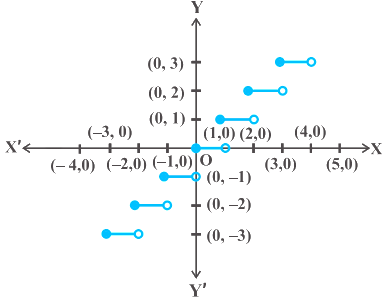
Case 1: Let c be a real number which is not equal to any integer. It is evident from the graph that for all real numbers close to c the value of the function is equal to [c]; i.e., $\mathop {\lim }\limits_{x \to c} f(x) = \mathop {\lim }\limits_{x \to c} \,[x] = [c]$. Also f(c) = [c] and hence the function is continuous at all real numbers not equal to integers.
Case 2: Let c be an integer. Then we can find a sufficiently small real number r > 0 such that [c – r] = c – 1 whereas [c + r] = c.
This, in terms of limits mean that
$\mathop {\lim }\limits_{x \to {c^ - }} f(x) = c - 1,\mathop {\lim }\limits_{x \to {c^ + }} f(x) = c$
Since these limits cannot be equal to each other for any c, the function is discontinuous at every integral point.
View full question & answer→Question 882 Marks
Show that every polynomial function is continuous.
AnswerRecall that a function p is a polynomial function if it is defined by $p(x) = a_0 + a_1 x + ... + a_n x^n$ for some natural number $n, a_n \neq 0$ and $a_i \in R$. Clearly this function is defined for every real number. For a fixed real number c, we have
$\mathop {\lim }\limits_{x \to c} p(x)= p (c)$
By definition,$p$ is continuous at $c$. Since $c$ is any real number, $p$ is continuous at every real number and hence $p$ is a continuous function.
View full question & answer→Question 892 Marks
Discuss the continuity of the function f given by
$f(x)=\left\{\begin{array}{ll} {x,} & {\text { if } x \geq 0} \\ {x^{2},} & {\text { if } x<0} \end{array}\right.$
AnswerClearly, the function is defined at every real number. The graph of the function is given in figure. By inspection, it seems prudent to partition the domain of definition of f into three disjoint subsets of the real line.
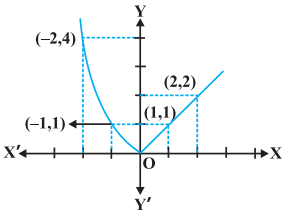
Let $D_1 =\{x \in R : x < 0\}, D_2 = \{0\}$ and $D_3 = \{x \in R : x > 0\}$
Case 1: At any point in $D_1$ , we have $f(x) = x^2$ and it is easy to see that it is continuous there
Case 2: At any point in $D_3$ , we have $f(x) = x$ and it is easy to see that it is continuous there
Case 3: Now we analyse the function at $x = 0.$ The value of the function at $0$ is $f(0) = 0.$ The left hand limit of $f$ at $0$ is
$\mathop {\lim }\limits_{x \to {0^ - }} f(x) = \mathop {\lim }\limits_{x \to {0^ - }} {x^2} = {0^2} = 0$
The right-hand limit of $f$ at $0$ is
$\mathop {\lim }\limits_{x \to {0^ + }} f(x) = \mathop {\lim }\limits_{x \to {0^ + }} x = 0$
Thus $\mathop {\lim }\limits_{x \to {0^ + }} f(x)$ = 0 = f(0) and hence f is continuous at 0. This means that f is continuous at every point in its domain and hence, f is a continuous function. View full question & answer→Question 902 Marks
Discuss the continuity of the function defined by $f(x)=\left\{\begin{array}{c} {x+2, \text { if } x<0} \\ {-x+2, \text { if } x>0} \end{array}\right.$
AnswerObserve that the function is defined at all real numbers except at $0$ .
The domain of definition of this function is $D_1 \cup D_2$
where $D_1 = \{x \in R : x < 0\}$ and $D_2 = \{x \in R : x > 0\}$
Case $1$: If $c \in D_1$, then $\mathop {\lim }\limits_{x \to c} f(x) = \mathop {\lim }\limits_{x \to c} \ (x + 2)
= c + 2 = f (c)$ and hence $f$ is continuous in $D_1.$
Case $2$ : If $c \in D_2,$ then $\mathop {\lim }\limits_{x \to c} f(x) = \mathop {\lim }\limits_{x \to c} \,\,$(-x + 2)
= – c + 2 = f (c)$
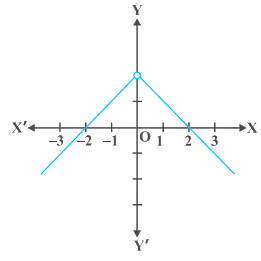
and hence f is continuous in $D_2.$
Since f is continuous at all points in the domain of $f,$ we deduce that f is continuous.
The graph of this function is given in the figure.
Note that to graph this function we need to lift the pen from the plane of the paper, but we need to do that only for those points where the function is not defined. View full question & answer→Question 912 Marks
Find all the points of discontinuity of the function f defined by $f(x)=\left\{\begin{array}{cc} {x+2,} & {\text { if } x<1} \\ {0,} & {\text { if } x=1} \\ {x-2,} & {\text { if } x>1} \end{array}\right.$
Answerf is continuous at all real numbers such that x $\neq$ 1. The left-hand limit of f at x = 1 is
$\mathop {\lim }\limits_{x \to {1^ - }} f(x) = \mathop {\lim }\limits_{x \to {1^ - }} $(x + 2) = 1 + 2 = 3
The right hand limit of f at x = 1 is
$\mathop {\lim }\limits_{x \to {1^ + }} f(x) = \mathop {\lim }\limits_{x \to {1^ + }} $(x - 2) = 1 - 2 = -1
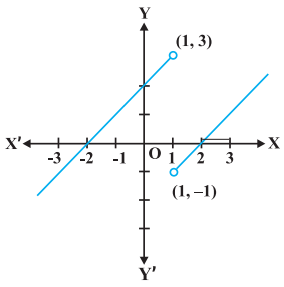
Since the left and right-hand limits of f at x = 1 do not coincide, f is not continuous at x = 1. Hence x = 1 is the only point of discontinuity of f.
View full question & answer→Question 922 Marks
Discuss the continuity of the function $f$ defined by $f(x)=\left\{\begin{array}{l} {x+2, \text { if } x \leq 1} \\ {x-2, \text { if } x>1} \end{array}\right.$
AnswerThe function $f$ is defined at all points of the real line.
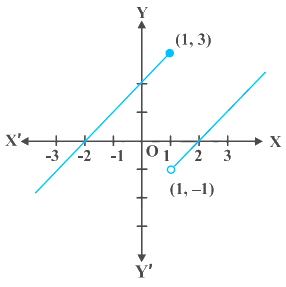
Case $1$: If $c < 1,$ then $f(c) = c + 2$.
Now, $\mathop {\lim }\limits_{x \to c} f(x) = \mathop {\lim }\limits_{x \to c} (x + 2) = c + 2$
Thus $,f$ is continuous at all real numbers less than $1$.
Case $2$: If $c > 1,$ then $f(c) = c - 2$ .
Now, $\mathop {\lim }\limits_{x \to c} f(x) = \mathop {\lim }\limits_{x \to c} (x - 2) = c - 2 = f (c)$
Thus $, f$ is continuous at all points $x > 1.$
Case $3$ : If $c = 1,$ then the left $-$ hand limit of $f$ at $x = 1$ is
$\mathop {\lim }\limits_{x \to 1^-} f(x) = \mathop {\lim }\limits_{x \to 1^-} (x + 2) = 1 + 2 = 3$
The right hand limit of $f$ at $x = 1$ is
$\mathop {\lim }\limits_{x \to 1^+} f(x) = \mathop {\lim }\limits_{x \to c^+} (x - 2) = 1 - 2 = -1$
Since the left and right hand limits of $f$ at $x = 1$ do not coincide $,f$ is not continuous at $x = 1$.
Hence $x = 1$ is the only point of discontinuity of $f.$ View full question & answer→