MCQ 11 Mark
The corner points of the feasible region determined by the system of linear inequalities are $(0, 0), (4, 0), (2, 4)$ and $(0, 5).$ If the maximum value of $z = ax + by,$ where $a, b > 0$ occurs at both $(2, 4)$ and $(4, 0),$ then:
- ✓
$a = 2b$
- B
$2a = b$
- C
$a = b$
- D
$3a = b$
AnswerCorrect option: A. $a = 2b$
$4a + 0b = 2a + 4b$
$4a = 2a + 4b$
$4a - 2a = 4b$
$2a = 4b$
$a = 2b$
View full question & answer→MCQ 21 Mark
Maximize $Z = 11x + 8y,$ subject to $\text{x}\leq4,\text{y}\leq6,\text{x}\geq0,\text{y}\geq0.$
- A
$44$ at $(4, 2)$
- ✓
$60$ at $(4, 2)$
- C
$62$ at $(4, 0)$
- D
AnswerCorrect option: B. $60$ at $(4, 2)$
View full question & answer→MCQ 31 Mark
The corner point of the feasible region determined by the system of linear constraints are $(0, 0), (0, 40), (20, 40), (60, 20), (60, 0).$ The objective function is $Z = 4x + 3y.$ Compare the quantity in Column $A$ and Column $B.$
|
Column $A$
|
Column $B$
|
|
Maximum of $Z$
|
$325$
|
AnswerCorrect option: B. The quantity in column $B$ is greater.
View full question & answer→MCQ 41 Mark
The value of $\frac{0.76\times0.76\times0.76+0.24\times0.24\times0.24}{0.76\times0.76-0.76\times0.24+ 0.24+0.24}$ is:
AnswerFormula used:
$a^3 + b^3= (a + b)(a^2 - ab + b^2)$
$=\frac{0.76\times0.76\times0.76+0.24\times0.24\times0.24}{0.76\times0.76-0.76\times0.24+ 0.24+0.24}$
$=\frac{(0.76)^{3}+(0.24)^{3}}{0.76\times0.76-0.76\times0.24+0.24+0.24}$
$=\frac{(0.76+0.24)(0.76\times0.76-0.76\times0.24+0.24\times0.24)}{0.76\times0.76-0.76\times0.24+0.24\times0.24}$
$=(0.76+0.24)$
$=1$
View full question & answer→MCQ 51 Mark
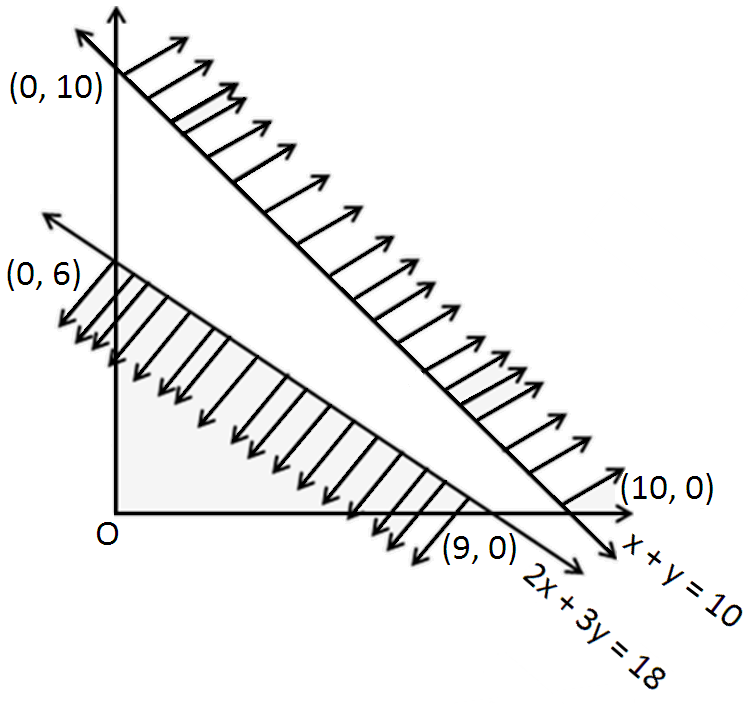
The maximum value of $Z = 4x + 2y$ Subjected to the constraints $2\text{x}+3\text{y}\leq18,\text{x}+\text{y}\geq10,\text{x},\text{y}\geq0$ is:
AnswerConsider$, 2x + 3y = 18$
| $x$ |
$y$ |
$(x, y)$ |
| $0$ |
$6$ |
$(0, 6)$ |
| $9$ |
$0$ |
$(9, 0)$ |
Consider$, x + y = 10$
| $x$ |
$y$ |
$(x, y)$ |
| $0$ |
$10$ |
$(0, 10)$ |
| $10$ |
$0$ |
$(10, 0)$ |
From the graph we conclude that no feasible region exist. View full question & answer→MCQ 61 Mark
In transportation models designed in linear programming, points of demand is classified as:
MCQ 71 Mark
Objective function of a $\text{LPP}$ is:
- A
- ✓
a function to be optimized
- C
a relation between the variables
- D
AnswerCorrect option: B. a function to be optimized
View full question & answer→MCQ 81 Mark
The maximum value of $Z = 4x + 3y$ subjected to the constraints $3x + 2y \geq 160, 5x + 2y \geq 200, x + 2y \geq 80, x, y \geq 0$ is :
AnswerWe need to maximize the function $Z = 4x + 3y$
Converting the given inequations into equations, we obtain
$3x + 2y = 160, 5x + 2y = 200, x + 2y = 80, x = 0$ and $y = 0$
Region represented by $3x + 2y \geq 160:$
The line $3x + 2y = 160$ meets the coordinate axes at $A \ 1603,0$ and $B(0, 80)$ respectively.
By joining these points we obtain the line $3x + 2y = 160.$
Clearly $(0, 0)$ does not satisfies the inequation $3x + 2y \geq 160.$
So, the region in $xy$ plane which does not contain the origin represents the solution set of the inequation $3x + 2y ≥ 160.$
Region represented by $5x +2y ≥ 200:$
The line $5x + 2y = 200$ meets the coordinate axes at $C(40, 0) $ and $D(0, 100)$ respectively.
By joining these points we obtain the line $5x + 2y = 200.$
Clearly $(0, 0)$ does not satisfies the inequation $5x +2y ≥ 200.$
So, the region which does not contain the origin represents the solution set of the inequation $5x +2y ≥ 200.$
Region represented by $x +2y \geq 80:$
The line $x + 2y = 80$ meets the coordinate axes at $E(80, 0)$ and $F(0, 40)$ respectively.
By joining these points we obtain the line $x + 2y = 80.$
Clearly $(0, 0)$ does not satisfies the inequation $x + 2y \geq 80.$
So, the region which does not contain the origin represents the solution set of the inequation $x + 2y ≥ 80.$
Region represented by $x \geq 0$ and $y \geq 0:$
Since, every point in the first quadrant satisfies these inequations.
So, the first quadrant is the region represented by the inequations $x \geq 0,$ and $y \geq 0.$
The feasible region determined by the system of constraints $3x + 2y \geq 160,5x+2y \geq 200, x +2y \geq 80, x \geq 0,$ and $y \geq 0$ are as follows.
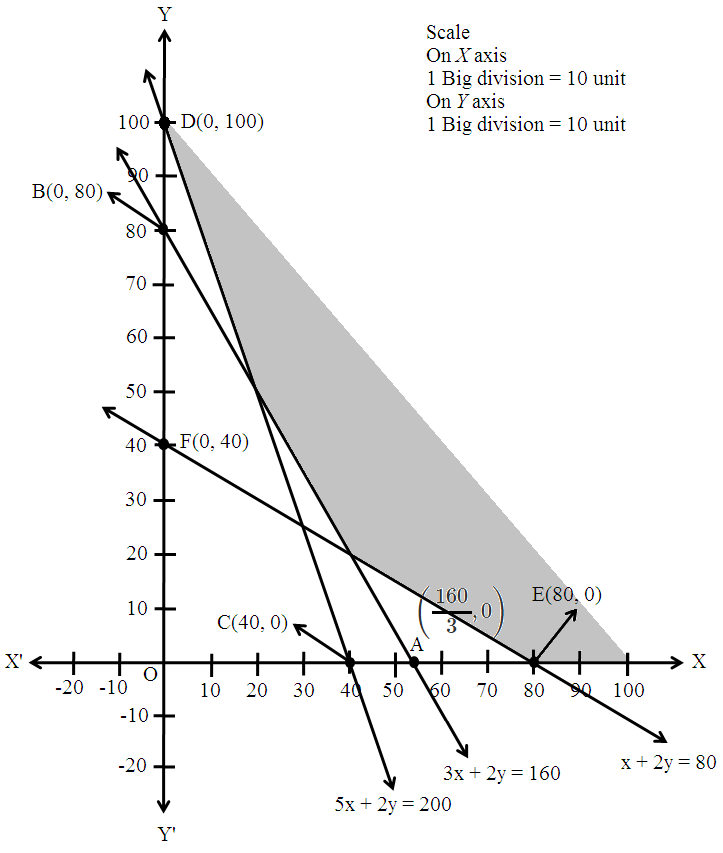
Here, we see that the feasible region is unbounded.
Therefore,maximum value is infinity. View full question & answer→MCQ 91 Mark
Graphical method can be used only when the decision variables is:
- A
More than $3.$
- B
More than $1.$
- ✓
- D
AnswerGraphical method can be used only when the decision variables is two.
View full question & answer→MCQ 101 Mark
A constraint in an $LP$ model becomes redundant because:
View full question & answer→MCQ 111 Mark
Maximize $Z = 3x + 5y,$ subject to constraints: $\text{x}+4\text{y}\leq24,3\text{x}+\text{y}\leq21,\text{x}+\text{y}\geq9,\text{x}\geq0,\text{y}\geq0.$
- A
$20$ at $(1, 0)$
- B
$30$ at $(0, 6)$
- ✓
$37$ at $(4, 5)$
- D
$33$ at $(6, 3)$
AnswerCorrect option: C. $37$ at $(4, 5)$
Find the maximum value of $Z = 3x + 5y$ referring to the explanation of $Q.5.$
View full question & answer→MCQ 121 Mark
An objective function in a linear program can be which of the following?
- ✓
- B
A nonlinear maximization function
- C
A quadratic maximization function
- D
View full question & answer→MCQ 131 Mark
The given table shows the number of cars manufactured in four different colours on a particular day. Study it carefully and answer the question.
|
|
Number of cars manufactured
|
|
Colour
|
Vento
|
Creta
|
Wagonr
|
|
Red
|
$65$ |
$88$ |
$93$ |
|
White
|
$54$ |
$42$ |
$80$ |
|
Black
|
$66$ |
$52$ |
$88$ |
|
Sliver
|
$37$ |
$49$ |
$74$ |
Which car was twice the number of silver Vento? - ✓
Silver Wagon $R$
- B
Red Wagon $R$
- C
- D
AnswerCorrect option: A. Silver Wagon $R$
The number of silver Vento car $= 37 ($from the table$)$
Twice the number of silver Vento cars $= 2 \times 37 = 74$
Now from table we can see that silver Wagon $R$ is only car type having $74$ cars
View full question & answer→MCQ 141 Mark
The corner points of the feasible region determined by the following system of linear inequalities$:2x + y \leq 10, x + 3y \leq 15, x, y \geq 0$ are $(0, 0), (5, 0), (3, 4)$ and $(0, 5).$Let $Z = px + qy,$ where $p.q > 0.$
Condition on $p$ and $q$. so that the maximum of $Z$ occurs at both $(3, 4)$ and $(0, 5)$ is:
- A
$P = q$
- B
$p = 2q$
- C
$p = 3q$
- ✓
$q = 3q$
AnswerCorrect option: D. $q = 3q$
The maximum value of $Z$ is unique.
It is given that the maximum value of $Z$ occurs at two points $(3, 4)$ and $(0,5).$
Value of $Z$ at $(3, 4) =$ Value of $Z$ at $(0,5)$
$= p(3) + q(4) = p(0) + 7(5)$
$= 3p + 4q = 5q$
$= q = 3p$
View full question & answer→MCQ 151 Mark
The objective function $Z = 4x + 3y$ can be maximised subjected to the constraints $3x + 4y \leq 24, 8x + 6y \leq 48, x \leq 5, y \leq 6, x, y \geq 0$
- A
- B
- ✓
at an infinite number of points
- D
AnswerCorrect option: C. at an infinite number of points
We need to maximize $Z = 4x + 3y$
First, we will convert the given inequations into equations, we obtain the following equations: $3x + 4y = 24,$
$8x + 6y = 48, x = 5, y = 6, x = 0$ and $y = 0.$
The line $3x + 4y = 24$ meets the coordinate axis at $A(8, 0) $ and $B(0, 6).$
Join these points to obtain the line $3x + 4y = 24.$
Clearly, $(0, 0)$ satisfies the inequation $3x + 4y \leq 24.$
So, the region in $xy-$ plane that contains the origin represents the solution set of the given equation.
The line $8x + 6y = 48$ meets the coordinate axis at $C(6, 0)$ and $D(0, 8).$
Join these points to obtain the line $8x + 6y = 48.$
Clearly, $(0, 0)$ satisfies the inequation $8x + 6y \leq 48.$
So, the region in $xy $ plane that contains the origin represents the solution set of the given equation.
$x = 5$ is the line passing through $x = 5$ parallel to the $Y$ axis.
$y = 6$ is the line passing through $y = 6$ parallel to the $X$ axis.
Region represented by $x \geq 0$ and $y \geq 0:$
Since, every point in the first quadrant satisfies these inequations.
So, the first quadrant is the region represented by the inequations.
These lines are drawn using a suitable scale.
and $B (0,6).$
The corner points of the feasible region are $O(0, 0), G(5, 0), \text{F}\Big(5,\frac{4}{3}\Big),\text{E}\Big(\frac{24}{7},\frac{24}{7}\Big)$ and $B(0, 6).$
The values of $Z$ at these corner points are as follows.
| $\text{Corner point}$ |
$\text{Z} = 4\text{x} + 3\text{y}$ |
| $\text{O}(0, 0)$ |
$4 \times 0 + 3 \times 0= 0$ |
| $\text{G}(5, 0)$ |
$4 \times 5 + 3 \times 0 = 20$ |
| $\text{F}\Big(5,\frac{4}{3}\Big)$ |
$4\times5+3\times\frac{4}{3}=24$ |
| $\text{E}\Big(\frac{24}{7},\frac{24}{7}\Big)$ |
$4\times\frac{24}{7}+3\times\frac{24}{7}=\frac{196}{7}=24$ |
| $\text{B}(0, 6)$ |
$4\times0+3\times6=18$ |
We see that the maximum value of the objective function $Z$ is $24$ which is at $F(5, 4)$ and $\text{E}\Big(\frac{24}{7},\frac{24}{7}\Big).$
Thus, the optimal value of $Z$ is $24.$
As, we know that if a $\text{LPP}$ has two optimal solution, then there are an infinite number of optimal solutions.
Therefore, the given objective function can be subjected at an infinite number of points. View full question & answer→MCQ 161 Mark
The corner points of the feasible region determined by the following system of linear inequalities$:\ 2\text{x}+\text{y}\le10,\ \text{x}+3\text{y}\le15,\ \text{x},\ \text{y}\ge0$ are $(0, 0), (5, 0), (3, 4)$ and $(0, 5).$ Let $Z = px + qy,$ where $p, q > 0.$ Condition on $p$ and $q$ .so that the maximum of $Z$ occurs at both $(3, 4)$ and $(0, 5)$ is:
- A
$p = q$
- B
$p = 2q$
- C
$p = 3q$
- ✓
$q = 3p.$
AnswerCorrect option: D. $q = 3p.$
The maximum value of $Z$ is unique.
It is given that the maximum value of $Z$ occurs at two points$, (3, 4)$ and $(0, 5).$
$\therefore$ Value of $z$ at $(3, 4) $= Value of $z$ at $(0, 5)$
$\Rightarrow p(3) + q(4) = p(0) + q(5)$
$\Rightarrow 3p + 4q = 5q$
$\Rightarrow q = 3p$
Hence, the correct answer is $D.$
View full question & answer→MCQ 171 Mark
In an $\text{LPP},$ if the objective function $Z = ax + by$ has the same maximum value on two corner points of the feasible region, then the number of points of which $Z$ max occurs is:
View full question & answer→MCQ 181 Mark
A linear programming of linear functions deals with:
MCQ 191 Mark
Maximize $Z = 4x + 6y,$ subject to $3\text{x}+2\text{y}\leq12,\text{x}+\text{y}\geq4,\text{x},\text{y}\geq0.$
- A
$16$ at $(4, 0)$
- B
$24$ at $(0, 4)$
- C
$24$ at $(6, 0)$
- ✓
$36$ at $(0, 6)$
AnswerCorrect option: D. $36$ at $(0, 6)$
View full question & answer→MCQ 201 Mark
The $...........$ is the method available for solving an $\text{L.P.P.}$
AnswerThere are different methods to solve an linear programming problem.
Such as Graphical method, Simplex method, Ellipsoid method, Interior point methods.
View full question & answer→MCQ 211 Mark
Linear programming model which involves funds allocation of limited investment is classified as:
- A
Ordination budgeting model
- ✓
- C
- D
View full question & answer→MCQ 221 Mark
The problem associated with $\text{LPP}$ is:
- ✓
Single objective function
- B
Double objective function
- C
No any objective function
- D
AnswerCorrect option: A. Single objective function
View full question & answer→MCQ 231 Mark
Choose the correct answer from the given four options.
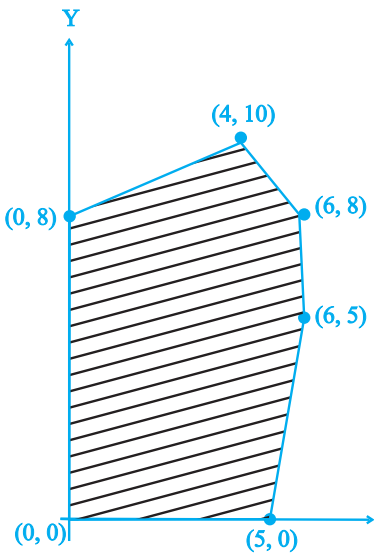
The feasible solution for a $\text{LPP}$ shown in Fig. $12.12.$ Let $z = 3x - 4y$ be objective functio. $($Maximum value of $Z +$ Minimum value of $Z)$ is equal to: - A
$13.$
- B
$1.$
- C
$-13.$
- ✓
$-17.$
AnswerCorrect option: D. $-17.$
|
Corner points
|
Corresponding value of $Z = 3x - 4y$
|
|
$(0, 0)$
$(5, 0)$
$(6, 5)$
$(6, 8)$
$(4, 10)$
$(0, 8)$
|
$0$
$15 ($Maximum$)$
$-2$
$-14$
$-28$
$-32 ($Minimum$)$
|
Here, maximum value of $Z +$ minimum value of $Z = 15 - 32 = -17.$ View full question & answer→MCQ 241 Mark
In order for a linear programming problem to have a unique solution, the solution must exist.
- A
At the intersection of the nonnegativity constraints.
- B
At the intersection of a nonnegativity constraint and a resource constraint.
- C
At the intersection of the objective function and a constraint.
- ✓
At the intersection of two or more constraints.
AnswerCorrect option: D. At the intersection of two or more constraints.
In order for a linear programming problem to have a unique solution, the solution must exist at the intersection of two or more constraints.
Then the problem becomes convex and has a single optimum $($maximum or minimum$).$
View full question & answer→MCQ 251 Mark
The feasible region for an $\text{LPP}$ is shown shaded in the following figure. Minimum of $Z = 4x + 3y$ occurs at the point.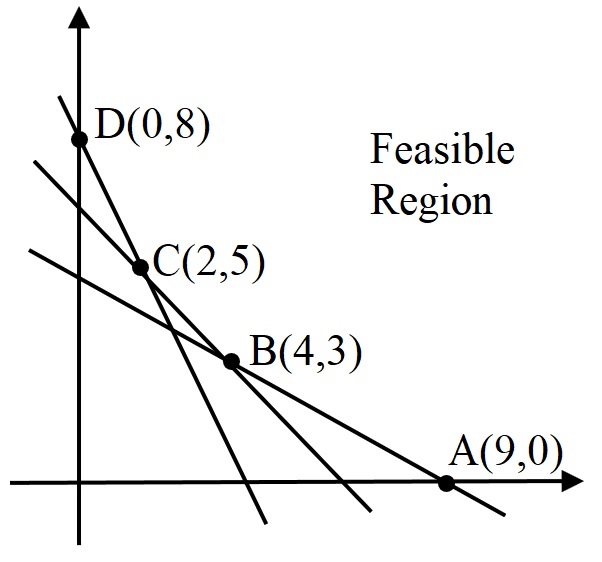
- A
$(0, 8)$
- ✓
$(2, 5)$
- C
$(4, 3)$
- D
$(9, 0)$
AnswerCorrect option: B. $(2, 5)$
View full question & answer→MCQ 261 Mark
The solution set of the inequation $2x + y > 5$ is:
AnswerCorrect option: B. open half plane not containing the origin
On putting $x = 0, y = 0$ in the given inequality, we get $0 > 5,$ which is absurd.
Therefore, the solution set of the given inequality does not include the origin.
Thus, the solution set of the given inequality consists of the open half plane not containing the origin.
View full question & answer→MCQ 271 Mark
Which of the following statements about an $LP$ problem and its dual is false?
- A
If the primal and the dual both have optimal solutions, the objective function values for both problems are equal at the optimum.
- B
If one of the variables in the primal has unrestricted sign, the corresponding constraint in the dual is satisfied with equality.
- C
If the primal has an optimal solution, so has the dual.
- ✓
The dual problem might have an optimal solution, even though the primal has no $($bounded$)$ optimum.
AnswerCorrect option: D. The dual problem might have an optimal solution, even though the primal has no $($bounded$)$ optimum.
If one of the problems $($primal, dual$)$ is infeasible then the other problem is infeasible.
View full question & answer→MCQ 281 Mark
Objective of linear programming for an objective function is to:
- ✓
- B
Subset or proper set modeling.
- C
- D
View full question & answer→MCQ 291 Mark
Minimise $\text{Z}=\sum\limits^{\text{n}}_{\text{j}=1}\sum\limits^{\text{m}}_{\text{i}=1}\text{c}_{\text{ij}}\cdot\text{x}_{\text{ij}}$ Subject to $\sum\limits^{\text{m}}_{\text{i}=1}\text{x}_{\text{ji}}=\text{b}_{\text{j}},\text{j}=1,2,....\text{n}$ $\sum\limits^{\text{n}}_{\text{j}=1}\text{x}_{\text{ji}}=\text{b}_{\text{j}},\text{j}=1,2,.....,\text{m}$ is a $\text{LPP}$ with number of constraints.
AnswerCorrect option: C. $\text{m}+\text{n}$
Constraints will be
$ x_{11}+x_{21}+\ldots \ldots+x_{m _1}=b_1 $
$ x_{12}+x_{22}+\ldots \ldots+x_{m_ 2}=b_2 $
$ x_{1_ n}+x_{2 n}+\ldots \ldots+x_{m_ n}=b_n $
$ x_{11}+x_{12}+\ldots \ldots+x_{1_ n}=b_1 $
$ x_{21}+x_{22}+\ldots \ldots+x_{2_ n}=b_2 $
$ x_{m _1}+x_{m _2}+\ldots \ldots+x_{m_ n}=b_n $
So the total number of constraints $= m + n$
View full question & answer→MCQ 301 Mark
The first step in formulating an LP problem is:
- A
- B
Perform a sensitivity analysis.
- C
Define the decision variables.
- ✓
Understand the managerial problem being faced.
AnswerCorrect option: D. Understand the managerial problem being faced.
d. Understand the managerial problem being faced
.Solution:
The first step in formulating an linear programming problem is to understand the managerial problem being faced i.e., determine the quantities that are needed to solve the problem.
View full question & answer→MCQ 311 Mark
Maximize $Z = 10 x_1 + 25 x_2,$ subject to $0\leq\text{x}_{1}\leq3,0\leq\text{x}_{2}\leq3,\text{x}_{1}+\text{x}_{2}\leq5.$
- A
$\text{80 at (3, 2)}$
- B
$\text{75 at (0, 3)}$
- C
$\text{30 at (3, 0)}$
- ✓
$\text{95 at (2, 3)}$
AnswerCorrect option: D. $\text{95 at (2, 3)}$
View full question & answer→MCQ 321 Mark
The maximum value of $Z = 4x + 2y$ subject to the constraints $2\text{x}+3\text{y}\leq18,\text{x}+\text{y}\geq10,\text{x},\text{y}\leq0$ is:
View full question & answer→MCQ 331 Mark
If the constraints in a linear programming problem are changed
AnswerCorrect option: A. the problem is to be re$-$evaluated
View full question & answer→MCQ 341 Mark
Objective of $\text{LPP}$ is:
- A
- ✓
A function to be optimized
- C
A relation between the variables
- D
AnswerCorrect option: B. A function to be optimized
View full question & answer→MCQ 351 Mark
Which of the termis not used in a linear programming problem:
MCQ 361 Mark
In linear programming, oil companies used to implement resources available is classified as:
MCQ 371 Mark
$Z = 20x_1 + 20x_2$, subject to $\text{x}1\geq0,\text{x}_{2}\geq0,\text{x}_{1}+2\text{x}_{2}\geq8,3\text{x}_{1}+2\text{x}_{2}\geq15,5\text{x}_{1}+2\text{x}_{2}\geq20.$ The minimum value of $Z$ occurs at
- A
$(8, 0)$
- B
$\Big(\frac{5}{2},\frac{15}{4}\Big)$
- ✓
$\Big(\frac{7}{2},\frac{9}{4}\Big)$
- D
$(0, 10)$
AnswerCorrect option: C. $\Big(\frac{7}{2},\frac{9}{4}\Big)$
View full question & answer→MCQ 381 Mark
The corner points of the feasible region determined by the system of linear constraints are $(0, 10),(5, 5),(15, 15),(0, 20).$ Let $z = px + qy$ where $p, q > 0.$ Condition on $p$ and $q$ so that the maximum of $z$ occurs at both the points $(15, 15)$ and $(0, 20)$ is $.......$
- A
$q = 2p$
- B
$p = 2p$
- C
$p = q$
- ✓
$q = 3p$
AnswerCorrect option: D. $q = 3p$
Let $z0$ be the maximum value of $z$ in the feasible region.
Since maximum occurs at both $(15, 15)$ and $(0, 20),$ the value $z0$ is attained at both $(15, 15)$ and $(0, 20).$
$\Longrightarrow z0 = p(15) + q(15)$ and $z0 = p(0) + q(20)$
$\Longrightarrow p(15) + q(15) = p(0) + q(20)$
$\Longrightarrow 15p = 5q$
$\Longrightarrow 3p = q$
View full question & answer→MCQ 391 Mark
The ratio of the rate of flow of water in pipes varies inversely as the square of the radius of the pipes. What is the ratio of the rates of flow in two pipes diameters $2\ cm$ and $4\ cm?$
- A
$1 : 6$
- ✓
$1 : 4$
- C
$1 : 2$
- D
AnswerCorrect option: B. $1 : 4$
Given$:\ d_1= 2\ cm$
$d_2 = 4\ cm$
Since the diameter are $2\ cm$ and $4\ cm.$
The replacement ratio of the two pipes are $1\ cm$ and $2\ cm\ r_1 = 1\ cm$
$r_2 = 2\ cm$
Square of the ratio of the pipes are $1$ and $4$
$\therefore$ The ratio of rates of flow in two pipes $=1:\frac{1}{4}$
$\Rightarrow\frac{1}{4}$
View full question & answer→MCQ 401 Mark
The corner points of the feasible region are $A(0, 0), B(16, 0), C(8, 16)$ and $D(0, 24).$ The minimum value of the objective function $z = 300x + 190y$ is $........$
AnswerWe know that, for a cartesian polygon, the maximum value occurs at the corner points or vertices of the polygon.
Given $z = 300x + 190y$
By substituting $A(0, 0)$ in the equation we get $z = 0$
By substituting $B(16, 0)$ in the equation we get $z = 4800$
By substituting $C(8,16)$ in the equation we get $z = 5440$
By substituting $D(0, 24)$ in the equation we get $z = 4560$
Hence the minimum value of $Z$ occured at $C(0, 0)$ with $z = 0$
View full question & answer→MCQ 411 Mark
If $a = b$ then $ax = ...........$
AnswerGiven, $a = b$ Multiplying both sides by $x.$
$ax = bx.$
View full question & answer→MCQ 421 Mark
What is the solution of $\text{x}\leq4,\text{y}\geq0$ and $\text{x}\leq-4,\text{y}\geq0?$
- A
$\text{x}\geq-4,\text{y}\leq0$
- B
$\text{x}\leq4,\text{y}\geq0$
- ✓
$\text{x}\leq-4,\text{y}=0$
- D
$\text{x}\geq-4,\text{y}=0$
AnswerCorrect option: C. $\text{x}\leq-4,\text{y}=0$
$\text{x}\leq4$ and $\text{x}\leq-4$
$\Rightarrow\text{x}\leq-4$
Also, $\text{y}\geq0$ and $\text{y}\leq0$
$\Rightarrow\text{y}=0$
Hence the solutione is $\text{x}\leq-4,\text{y}=0.$
View full question & answer→MCQ 431 Mark
The corner points of the feasible region determined by the system of linear constraints are $(0, 10), (5, 5), (15, 15), (0, 20).$ Let $Z = px + qy, $ where $p, q > 0.$ Condition on $p$ and $q$ so that the maximum of $Z$ occurs at both the points $(15, 15)$ and $(0, 20)$ is:
- A
$p = q$
- B
$p = 2q$
- C
$q = 2p$
- ✓
$q = 3p$
AnswerCorrect option: D. $q = 3p$
View full question & answer→MCQ 441 Mark
Which of the following statements is correct?
- A
Every $\text{LPP}$ admits an optimal solution
- B
A $\text{LPP}$ admits unique optimal solution
- ✓
If a $\text{LPP}$ admits two optimal solution it has an infinite number of optimal solutions
- D
The set of all feasible solutions of a $\text{LPP}$ is not a converse set
AnswerCorrect option: C. If a $\text{LPP}$ admits two optimal solution it has an infinite number of optimal solutions
Optimal solution of $\text{LPP}$ has three types.
- Unique
- Infinite
- Does not exist.
Hence, it has infinite solution if it admits two optimal solution. View full question & answer→MCQ 451 Mark
In order to maximize the profit of the company, the optimal solution of which of the following equations is required?
- A
$P = x + y - 200$
- ✓
$P = 5y - 2x$
- C
$P = y - 80$
- D
$P = 200 - x$
AnswerCorrect option: B. $P = 5y - 2x$
Let the number of normal calculators produced in a day be $x$ andthe number of scientific calculators produced in a day be $y$ the minimum of total calculators to be produced per day is $200$
$\Rightarrow\text{x}+\text{y}\leq200$
Given, the minimum number of normal calculators to be produced per day is $100$
$\Rightarrow\text{x}\geq100$
andthe minimum number of scientific calculators to be produced per day is $80$
$\Rightarrow\text{y}\geq80$
Also given, the maximum number of normal calculators can be produced per day is $200$
$\Rightarrow\text{x}\leq200$
andthe maximum number of scientific calculators can be produced per day is $170$
$\Rightarrow\text{x}\leq170$
A normal calculator incurred a loss of $Rs. 2$
For $x$ normal calculators, the loss is $Rs. 2x$
A scientific calculator gained a profit of $Rs. 5$
For $xy$ scientific calculators, the gain is $Rs. 5y$
Therefore, profit of the manufacturer $P = 5y - 2x.$
View full question & answer→MCQ 461 Mark
Choose the correct answer from the given four options. Corner points of the feasible region for an $\text{LPP}$ are $\{(0, 2), (3, 0), (6, 0), (6, 8)\}$ and $(0, 5).$ Let $F = 4x + 6y$ be the objective function.
The Minimum value of $F$ occurs at.
- A
$(0, 2) $ only.
- B
$(3, 0)$ only.
- C
The mid point of the line sgment joining the points $(0, 2)$ and $(3, 0)$ only.
- ✓
Any point on the line segment joining the points $(0, 2)$ and $(3, 0).$
AnswerCorrect option: D. Any point on the line segment joining the points $(0, 2)$ and $(3, 0).$
|
Corner points
|
Corresponding value of $F = 4x + 6y$
|
| $(0, 2)$ |
$12 ($Minimum$)$
|
| $(3, 0)$ |
$12 ($Minimum$)$
|
| $(6, 0)$ |
$24$
|
| $(6, 8)$ |
$72 ($Maxmimum$)$
|
| $(0, 5)$ |
$30$
|
View full question & answer→MCQ 471 Mark
Corner points of the bounded feasible region for an $ LP$ problem are $A(0, 5)\ B(0, 3)\ C(1, 0)\ D(6, 0).$ Let $z = -50x + 20y$ be the objective function. Minimum value of $z$ occurs at $.......$ center point.
- A
$(0, 5)$
- B
$(1, 0)$
- ✓
$(6, 0)$
- D
AnswerCorrect option: C. $(6, 0)$
We check the value of the $z$ at each of the corner points.
$A (0, 5) -z = -50x + 20y = -50(0) + 20(5) = 100$
At $B (0, 3) -z = -50x + 20y = -50(0) + 20(3) = 60$
At $C (1, 0) -z = -50x + 20y = -50(1) + 20(0) = -50$
At $D (6, 0) -z = -50x + 20y = -50(6) + 20(0) = -300$
Hence, we see that $z$ is minimum at $D(6, 0)$ and minimum value is $-300.$
View full question & answer→MCQ 481 Mark
Which of the following is an essential condition in a situation for linear programming to be useful?
- ✓
- B
Bottlenecks in the objective function
- C
Non $-$ homogeneity
- D
View full question & answer→MCQ 491 Mark
Corner points of the feasible region determined by the system of linear constraints are $(0, 3), (1, 1)$ and $(3, 0).$ Let $Z = px + qy,$ where $p, q > 0.$ Condition on p and q so that the minimum of $Z$ occurs at $(3, 0)$ and $(1, 1)$ is:
AnswerCorrect option: B. $\text{p}=\frac{\text{q}}{2}$
View full question & answer→MCQ 501 Mark
A set of values of decision variables that satisfies the linear constraints and non $-$ negativity conditions of an $\text{L.P.P.}$ is called its:
View full question & answer→MCQ 511 Mark
If $A = \{1, 2, 3\}; B = \{3, 4, 5\}; C = \{4, 6\},$ then $\text{A}\times(\text{B}\cap\text{C})=?$
- A
$\{(2, 4)(1, 4)\}$
- B
$\{(2, 4)(3, 4)(5, 6)\}$
- ✓
$\{(1, 4)(2, 4)(3, 4)\}$
- D
AnswerCorrect option: C. $\{(1, 4)(2, 4)(3, 4)\}$
Given,
$A = \{1, 2, 3\}$
$B = \{3, 4, 5\}$
$C = \{4, 6\}$
Now, $\text{B}\cap\text{C}=\{{4\}}$
$\therefore\text{A}\times(\text{B}\cap\text{C})=\{(1,4),(2,4),(3,4)\}$
View full question & answer→MCQ 521 Mark
The optimal value of the objective function is attained at the points
AnswerCorrect option: C. given by corner points of the feasible region
View full question & answer→MCQ 531 Mark
The feasible solution of a $\text{LPP}$ belongs to:
- A
First and second quadrants
- B
First and third quadrants.
- C
- ✓
View full question & answer→MCQ 541 Mark
The given table shows the number of cars manufactured in four different colours on a particular day. Study it carefully and answer the question.
|
|
Number of cars manufactured
|
|
Colour
|
Vento
|
Creta
|
Wagonr
|
|
Red
|
$65$ |
$88$ |
$93$ |
|
White
|
$54$ |
$42$ |
$80$ |
|
Black
|
$66$ |
$52$ |
$88$ |
|
Sliver
|
$37$ |
$49$ |
$74$ |
What was the total number of black cars manufactured? AnswerThe number of Black cars manufactured.
$=$ no. of black $V$ ento $+$ no. of black Creta $+$ no. of black $W$ agon $R.$
$= 66 + 52 + 88 = 206$
View full question & answer→MCQ 551 Mark
Minimize $Z = 20x_1+ 9x_2,$ subject to $\text{x}_{1}\geq0,\text{x}_{2}\geq0,2\text{x}_{1}+2\text{x}_{2}\geq36,6\text{x}_{1}+\text{x}_{2}\geq60.$
- A
$\text{360 at (18, 0)}$
- ✓
$\text{336 at (6, 4)}$
- C
$\text{540 at (0, 60)}$
- D
$\text{0 at (0, 0)}$
AnswerCorrect option: B. $\text{336 at (6, 4)}$
View full question & answer→MCQ 561 Mark
The linear inequalities or equations or restrictions on the variables of a linear programming problem are called:
MCQ 571 Mark
While plotting constraints on a graph paper, terminal points on both the axes are connected by a straight line because:
- A
The resources are limited in supply.
- B
The objective function as a linear function.
- ✓
The constraints are linear equations or inequalities.
- D
AnswerCorrect option: C. The constraints are linear equations or inequalities.
The graph of the linear equation is a straight line.
If the terminal points are connected by a straight line then the given constraints are linear equations which may include inequalities.
View full question & answer→MCQ 581 Mark
Choose the correct answer from the given four options.
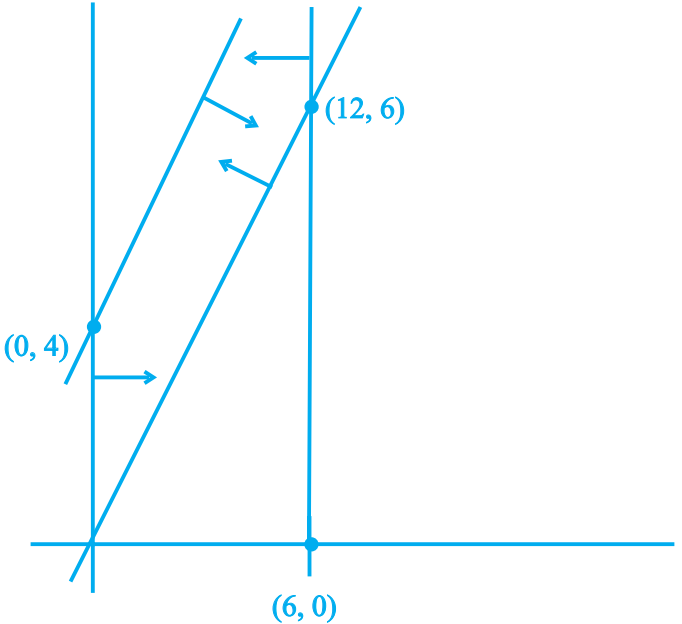
Let $F = 3x - 4y$ be the objective function. Maximum value of $F$ is: AnswerThe feasible region as shown in the figure, has objective function $F = 3x - 4y$
|
Corner points
|
Corresponding value of $Z = 3x - 4y$
|
|
$(0, 0)$
$(12, 6)$
$(0, 4)$
|
$0$
$12 ($maximum$)$
$-16 ($minimum$)$
|
Hence, the maximum value of $F$ is $12.$ View full question & answer→MCQ 591 Mark
Feasible region $($shaded$)$ for a $\text{LPP}$ is shown in the given figure. Minimum of $z = 4x + 3y$ occurs at the point.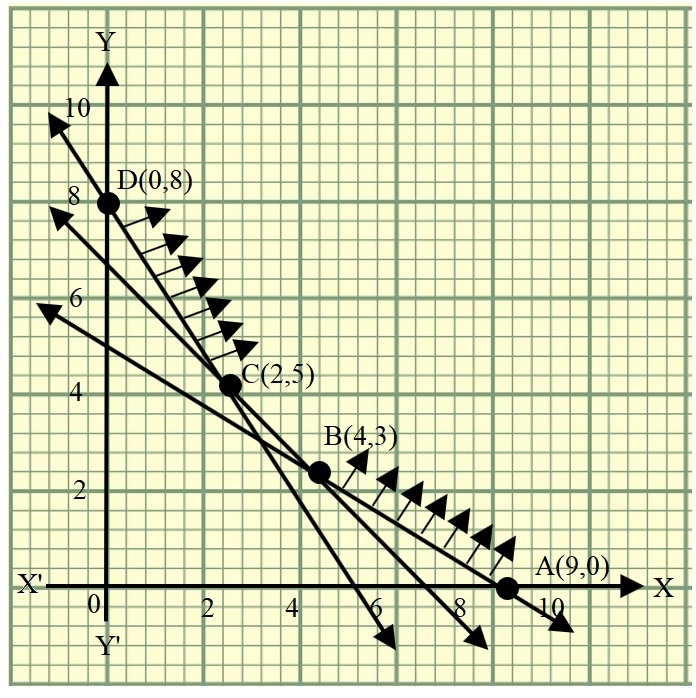
- A
$(0, 8)$
- ✓
$(2, 5)$
- C
$(4, 3)$
- D
$(9, 0)$
AnswerCorrect option: B. $(2, 5)$
View full question & answer→MCQ 601 Mark
The corner points of the feasible region determined by the system of linear constraints are $(0, 10), (5, 5), (25, 20)$ and $(0, 30).$ Let $Z = px + qy,$ where $p, q > 0$. Condition on $p$ and $q $ so that the maximum of $Z$ occurs at both the points $(25, 20)$ and $(0, 30)$ is $ ..........$
- ✓
$5p = 2q$
- B
$2p = 5q$
- C
$p = 2q$
- D
$q = 3p$
AnswerCorrect option: A. $5p = 2q$
Maximum of $Z$ occurs at $(25, 20)$ and at $(0, 30).$
Hence, equating the vales of $Z$ at these points, we get $25p + 20q = 30q$
$\therefore 5p = 2q$
This is the required relation.
Also as $p, q > 0,$ the value of $Z$ is always positive and hence, is greater at $(25, 20)$ and at $(0, 30)$ than at $(0,10)$ and $(5, 5).$
View full question & answer→MCQ 611 Mark
Choose the most correct of the following statements relating to primal$-$dual linear programming problems:
- A
Shadow prices of resources in the primal are optimal values of the dual variables.
- B
The optimal values of the objective functions of primal and dual are the same.
- C
If the primal problem has unbounded solution, the dual problem would have infeasibility.
- ✓
View full question & answer→MCQ 621 Mark
Linear programming used to optimize mathematical procedure and is:
- ✓
Subset of mathematical programming
- B
Dimension of mathematical programming
- C
Linear mathematical programming
- D
AnswerCorrect option: A. Subset of mathematical programming
View full question & answer→MCQ 631 Mark
The maximum value of $Z = 3x + 2y,$ subjected to $\text{x}+2\text{y}\leq2,\text{x}+2\text{y}\geq8;\text{x},\text{y}\geq0 $ is:
View full question & answer→MCQ 641 Mark
If $\text{x}+\text{y}\leq2,$ $\text{x}\leq0,$ $\text{y}\leq0$ the point at which maximum value of $3x + 2y$ attained will be.
AnswerCorrect option: A. $(0,0)$
View full question & answer→MCQ 651 Mark
The region represented by the inequalities $\text{x}\geq6,\text{y}\geq2,2\text{x}+\text{y}\leq0,\text{x}\geq0,\text{y}\geq{0}$ is:
View full question & answer→MCQ 661 Mark
The objective function $Z = 4x + 3y$ can be maximised subjected to the constraints $ 3\text{x}+4\text{y}\leq24,$ $8\text{x}+6\text{y}\leq48,$ $\text{x}\leq5,\text{y}\leq6;\text{x},\text{y}\leq0.$
- A
- B
- ✓
At an infinite number of points.
- D
AnswerCorrect option: C. At an infinite number of points.
View full question & answer→MCQ 671 Mark
The corner points of the feasible region determined by the system of linear constraints are $(0, 10), (5, 5), (15, 15), (0, 20).$ Let $Z = px + qy,$ where $p, q > 0.$ Condition on $p$ and $q$ so that the maximum of $Z$ occurs at both the points $(15, 15)$ and $(0, 20)$ is Maximum of $Z$ occurs at:
- ✓
$(5, 0)$
- B
$(6, 5)$
- C
$(6, 8)$
- D
$(4, 10)$
AnswerCorrect option: A. $(5, 0)$
View full question & answer→MCQ 681 Mark
Which of the following is a type of Linear programming problem?
MCQ 691 Mark
The corner points of the feasible region are $A(0, 0), B(16, 0), C(8, 16)$ and $D(0, 24)$. The minimum value of the objective function $z = 300x + 190y$ is $ .........:$
- A
$5440$
- B
$4800$
- C
$4560$
- ✓
$0$
AnswerWe know that, for a cartesian polygon , the maximum value occurs at the corner points or vertices of the polygon.
Given $z = 300x + 190y$
By substituting $A(0, 0)$ in the equation we get $z = 0$
By substituting $B(16, 0)$ in the equation we get $z = 4800$
By substituting $C(8, 16)$ in the equation we get $z = 5440$
By substituting $D(0, 24)$ in the equation we get $z = 4560$
Hence the minimum value of $Z$ occured at $C(0, 0)$ with $z = 0$
View full question & answer→MCQ 701 Mark
In solving the $\text{LPP} :$ “minimize $f = 6x + 10y$ subect to constraints $\text{x}\geq6,\text{y}\geq2,2\text{x}+\text{y}\geq10,\text{x}\geq0,\text{y}\geq0”$ redundant constraints are :
- A
$\text{x}\geq6,\text{y}\geq2$
- ✓
$2\text{x}+\text{y}\geq10,\text{x}\geq0,\text{y}\geq0$
- C
$\text{x}\geq6$
- D
AnswerCorrect option: B. $2\text{x}+\text{y}\geq10,\text{x}\geq0,\text{y}\geq0$
View full question & answer→MCQ 711 Mark
The optimal value of the objective function is attained at the points:
- A
On $x -$ axis
- B
On $y -$ axis
- ✓
Which are corner points of the feasible region
- D
AnswerCorrect option: C. Which are corner points of the feasible region
View full question & answer→MCQ 721 Mark
Consider the objective function $Z = 40x + 50y$ The minimum number of constraints that are required to maximize $Z$ are :
AnswerSince in the given function $Z = 40x + 50y,$ two variables are used.
So, the two constraints will be $\text{x}\geq0,\text{y}\geq0$ and the third one will be of the type
$\text{ax}+\text{by}\geq\text{c}.$
Hence, at least $3$ constraints are required.
View full question & answer→MCQ 731 Mark
$Z = 7x + y,$ subject to $ 5\text{x}+\text{y}\geq5,\text{x}+\text{y}\geq3,\text{x}\geq0, y\geq0.$ The minimum value of $Z$ occurs at:
AnswerCorrect option: D. $(0,5)$
View full question & answer→MCQ 741 Mark
The optimal value of the objective function is attained at the points:
- A
On $X -$ axis
- B
On $Y -$ axis
- ✓
Corner points of the feasible region
- D
AnswerCorrect option: C. Corner points of the feasible region
Any point in the feasible region that gives the optimal value $($maximum or minimum$)$ of the objective function is called an optimal solution.
View full question & answer→MCQ 751 Mark
An iso$-$profit line represents:
- ✓
An infinite number of solutions all of which yield the same profit.
- B
An infinite number of solution all of which yield the same cost.
- C
An infinite number of optimal solutions.
- D
A boundary of the feasible region.
AnswerCorrect option: A. An infinite number of solutions all of which yield the same profit.
View full question & answer→MCQ 761 Mark
Maximize $Z = 7x + 11y,$ subject to $3\text{x}+5\text{y}\leq26,5\text{x}+3\text{y}\leq30,\text{x}\geq0,\text{y}\geq0.$
- ✓
$\text{59 at}\Big(\frac{9}{2},\frac{5}{2}\Big)$
- B
$\text{42 at (6, 0)}$
- C
$\text{49 at (7, 0)}$
- D
$\text{57.2 at (0, 5.2)}$
AnswerCorrect option: A. $\text{59 at}\Big(\frac{9}{2},\frac{5}{2}\Big)$
View full question & answer→MCQ 771 Mark
Choose the correct answer from the given four options. The corner points of the feasible region determined by the system of linear constraints are $\{(0, 0), (0, 40), (20, 40), (60, 20), (60, 0)\}$. The objective function is $Z = 4x + 3y.$ Compare the quantity in Column $A$ and Column $B.$
|
Column $A$
|
Column $B$
|
|
Maximum of $Z$
|
$325$
|
AnswerCorrect option: B. The quantity in column $B$ is greater.
|
Corner points
|
Corresponding value of $Z = 4x + 3y$
|
| $(0, 0)$ |
$0$ |
| $(0, 40)$ |
$120$ |
| $(20, 40)$ |
$200$ |
| $(60, 20)$ |
$300 ($Maximum$)$
|
| $(60, 0)$ |
$240$
|
Hence, maxmimum value of $Z = 300 < 325$
So, the quantity in column $B$ is greater. View full question & answer→MCQ 781 Mark
The feasible, region for an $\text{LPP}$ is shown shaded in the figure. Let $Z = 3x - 4y$ be the objective function. a minimum of $Z$ occurs at: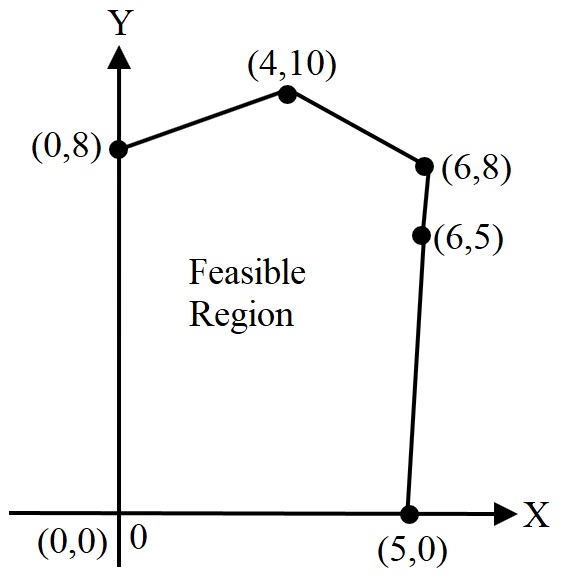
- A
$(0, 0)$
- ✓
$(0, 8)$
- C
$(5, 0)$
- D
$(4, 10)$
AnswerCorrect option: B. $(0, 8)$
View full question & answer→MCQ 791 Mark
The solution set of the inequation $3x + 2y > 3$ is:
AnswerCorrect option: A. Half plane not containing the origin
View full question & answer→MCQ 801 Mark
Consider a $\text{LPP}$ given by Minimum $Z = 6x + 10y$ Subjected to $x \geq 6, y \geq 2, 2x + y \geq 10, x \geq 0, y \geq 0$ Redundant constraints in this $\text{LPP}$ are
- A
$x \geq 0, y \geq 0$
- B
$x \geq 6$
- ✓
$2x + y \geq 10$
- D
AnswerCorrect option: C. $2x + y \geq 10$
Consider, $x = 6$
and $y = 2$
Now $2x + y = 10$
| $x$ |
$y$ |
$(x, y)$ |
| $0$ |
$10$ |
$(0, 10)$ |
| $5$ |
$0$ |
$(5, 0)$ |
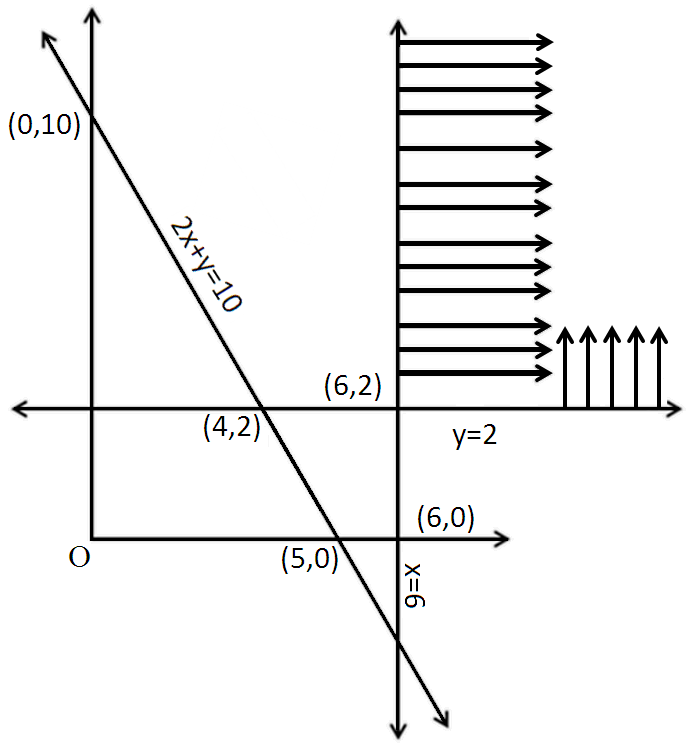
Minimum $Z$ will be at $2x + y \geq 10.$ View full question & answer→MCQ 811 Mark
If $x + y = 3$ and $xy = 2,$ then the value of $x^3 - y^3$ is equal to.
AnswerFormula used:
$\text{x}^3-\text{y}^3=(\text{x}-\text{y})(\text{x}^2+\text{xy}+\text{y}^2)$
$=(\sqrt{(\text{x}+\text{y})^{2}-4\text{xy}})[(\text{x}+\text{y})^{2}-\text{xy}]$
$=(\sqrt{(3)^{2}-4(2})[(3)^{2}-2]$
$=(\sqrt{1})(7)$
$=7$
View full question & answer→MCQ 821 Mark
The maximum value of $Z = 3x + 4y$ subjected to contraints $\text{x}+\text{y}\leq40,\text{x}+2\text{y}\leq60,\text{x}\geq0$ and $\text{y}\geq0$ is:
View full question & answer→MCQ 831 Mark
Conclude from the following : $n^2 > 10,$ and $n$ is a positive integer. $A: n^3 B: 50.$
AnswerCorrect option: A. The quantity $A$ is may be greater or smaller than $B.$
given, $n^2 > 10$ and $n > 0$ multiplying both equations we get $n^3 > 0$
so, it may be greater than or less than $50.$
Hence, quantity $A$ is may be greater or smaller than $B$
View full question & answer→MCQ 841 Mark
Solving an integer programming problem by rounding off answers obtained by solving it as a linear programming problem $($using simplex$),$ we find that.
- A
The values of decision variables obtained by rounding off are always very close to the optimal values.
- ✓
The value of the objective function for a maximization problem will likely be less than that for the simplex solution.
- C
The value of the objective function for a minimization problem will likely be less than that for the simplex solution.
- D
All constraints are satisfied exactly.
AnswerCorrect option: B. The value of the objective function for a maximization problem will likely be less than that for the simplex solution.
View full question & answer→MCQ 851 Mark
Mark the wrong statement:
AnswerCorrect option: A. The primal and dual have equal number of variables.
View full question & answer→MCQ 861 Mark
In linear programming context, sensitivity analysis is a technique to:
- A
Allocate resources optimally.
- B
Minimize cost of operations.
- C
Spell out relation between primal and dual.
- ✓
Determine how optimal solution to $\text{LPP}$ changes in response to problem inputs.
AnswerCorrect option: D. Determine how optimal solution to $\text{LPP}$ changes in response to problem inputs.
A sensitivity analysis is performed to determine the sensitivity of the solution to changes in parameters.
View full question & answer→MCQ 871 Mark
Choose the correct answer from the given four options. The feasible solution for a $\text{LPP}$ is shown in. Let $Z = 3x - 4y$ be the objective function.
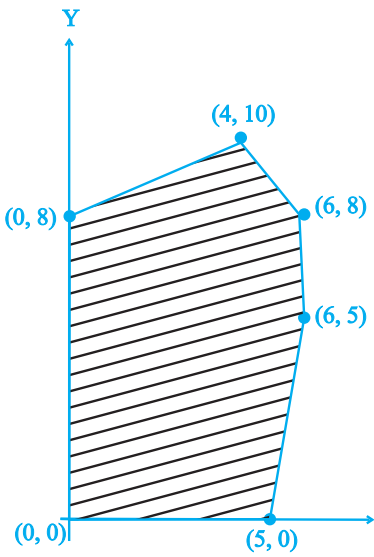
Minimum of $Z$ occurs at : - A
$(0, 0)$
- ✓
$(0, 8)$
- C
$(5, 0)$
- D
$(4, 10)$
AnswerCorrect option: B. $(0, 8)$
|
Corner points
|
Corresponding value of $Z = 3x - 4y$
|
|
$(0, 0)$
$(5, 0)$
$(6, 5)$
$(6, 8)$
$(4, 10)$
$(0, 8)$
|
$0$
$15 - 2$
$-14$
$-28$
$-32 ($Minimum$)$
|
Hence, the minimum of $Z$ occurs at $(0, 8)$ and its minimum value is $(-32).$ View full question & answer→MCQ 881 Mark
An article manufactured by a company consists of two parts $X$ and $Y$. In the process of manufacture of the part $X. 9$ out of $100$ parts may be defective. Similarly $5$ out of $100$ are likely to be defective in part $Y.$ Calculate the probability that the assembled product will not be defective.
- A
$0.86$
- B
$0.864$
- C
$0.8456$
- ✓
$0.8645$
AnswerCorrect option: D. $0.8645$
Let $A =$ Part $X$ is not defective
Probability of $A$ is $\text{P}(\text{A})=\frac{91}{100}$
$B =$ Part $Y$ is not defective.
Probability of $B$ is $\text{P}(\text{B})=\frac{95}{100}$
Required probability
$=\text{P}(\text{A}\cap\text{B})=\text{P}(\text{A})\text{P}(\text{B})$
$=\frac{91}{100}\times\frac{95}{100}=\frac{8645}{10000}$
View full question & answer→MCQ 891 Mark
The maximum value of the object function $Z = 5x + 10y$ subject to the constraints $\text{x}+2\text{y}\leq120,\text{x}+\text{y}\geq60,\text{x}-2\text{y}\geq0,\text{x}\geq0,\text{y}\geq0$ is:
View full question & answer→MCQ 901 Mark
Vikas printing company takes fee of $Rs. 28$ to print a oversized poster and $Rs. 7$ for each colour of ink used. Raaj printing company does the same work and charges poster for $Rs. 34$ and $Rs. 5.50$ for each colour of ink used. If $z$ is the colours of ink used, find the values of $z$ such that Vikas printing company would charge more to print a poster than Raaj printing company.
- A
$\text{z} < 4$
- B
$2\leq\text{z}\leq4$
- C
$4\leq\text{z}\leq7$
- ✓
$\text{z} > 4$
AnswerCorrect option: D. $\text{z} > 4$
$28+7\text{z} > 34+5.50\text{z}$
$\rightarrow1.50\text{z} > 6$
$\rightarrow\text{z} > \frac{6}{1.5}\ \text{z} > 4$
View full question & answer→MCQ 911 Mark
Which of the following statement is correct?
- A
Every $\text{LPP}$ admits an optimal solution.
- ✓
Every $\text{LPP}$ admits unique optimal solution.
- C
If a $\text{LPP}$ gives two optimal solutions it has infinite number of solutions.
- D
AnswerCorrect option: B. Every $\text{LPP}$ admits unique optimal solution.
View full question & answer→MCQ 921 Mark
The corner points of the feasible region determined by the following system of linear inequalities: $2\text{x}+\text{y}\leq10,\text{x}+3\text{y}\leq15, \text{x},\text{y}\geq0$ are $(0, 0), (5, 0), (3, 4)$ and $(0, 5).$ Let $Z = px + qy,$ where $p, q > 0.$ Conditions on $p$ and $q$ so that the maximum of $Z$ occurs at both $(3, 4)$ and $(0, 5)$ is :
- A
$p = 3q$
- B
$p = 2q$
- C
$p = q$
- ✓
$q = 3p$
AnswerCorrect option: D. $q = 3p$
View full question & answer→MCQ 931 Mark
Maximize $Z = 6x + 4y,$ subject to $\text{x}\leq2,\text{x}+\text{y}\leq3,-2\text{x}+\text{y}\leq1,\text{x}\geq0,\text{y}\geq0.$
AnswerCorrect option: C. $\frac{140}{3}$ at $\Big(\frac{2}{3},\frac{1}{3}\Big)$
View full question & answer→MCQ 941 Mark
Region represented by $\text{x}\geq0, \text{y}\geq0$ is:
AnswerAll the positive values of $x$ and $y$ will lie in the first quadrant.
View full question & answer→MCQ 951 Mark
Which of the following is not true about feasibility?
AnswerCorrect option: A. It cannot be determined in a graphical solution of an $\text{LPP}.$
View full question & answer→MCQ 961 Mark
The maximum value of $Z = 4x + 3y$ subjected to the constraints $2\text{x}+3\text{y}\leq18 \text{x}+\text{y}\geq10;\text{x},\text{y}\geq0$ is:
View full question & answer→MCQ 971 Mark
Refer to Question $18 ($Maximum value of $Z+$ Minimum value of $Z)$ is equal to:
View full question & answer→MCQ 981 Mark
$Z = 8x + 10y,$ subject to $2\text{x}+\text{y}\geq1,2\text{x}+3\text{y}\geq15,\text{y}\geq2,\text{x}\geq0,\text{y}\geq0.$ The minimum value of $Z$ occurs at.
- A
$(4.5, 2)$
- ✓
$(1.5, 4)$
- C
$(0, 7)$
- D
$(7, 0)$
AnswerCorrect option: B. $(1.5, 4)$
View full question & answer→MCQ 991 Mark
For a linear programming equations, convex set of equations is included in region of:
MCQ 1001 Mark
Which of the following is a property of all linear programming problems?
- ✓
Alternate courses of action to choose from.
- B
Minimization of some objective.
- C
- D
Usage of graphs in the solution.
AnswerCorrect option: A. Alternate courses of action to choose from.
View full question & answer→MCQ 1011 Mark
The point at which the maximum value of $x + y,$ subject to the constraints $x + 2y \leq 70, 2x + y \leq 95, x, y \geq 0$ isobtained, is :
- A
$(30, 25)$
- B
$(20, 35)$
- C
$(35, 20)$
- ✓
$(40, 15)$
AnswerCorrect option: D. $(40, 15)$
We need to maximize the function
$Z = x + y$
Converting the given inequations into equations, we obtain $x + 2y = 70, 2x + y = 95, x = 0$ and $y = 0$
Region represented by $x + 2y \leq 70 :$
The line $x + 2y = 70$ meets the coordinate axes at $A(70, 0)$ and $B(0, 35)$ respectively.
By joining these points we obtain the line $x + 2y = 70.$
Clearly $(0, 0)$ satisfies the inequation $x + 2y \leq 70.$
So, the region containing the origin represents the solution set of the inequation $x + 2y \leq 70.$
Region represented by $2x + y \leq 95:$
The line $2x + y = 95$ meets the coordinate axes at $\text{C}\Big(\frac{95}{2},0\Big)$ and $D(0, 95)$ respectively.
By joining these points we obtain the line $2x + y = 95.$
Clearly $(0, 0)$ satisfies the inequation $2x + y \leq 95.$
So, the region containing the origin represents the solution set of the inequation $2x + y \leq 95.$
Region represented by $x \geq 0$ and $y \geq 0:$
Since, every point in the first quadrant satisfies these inequations.
So, the first quadrant is the region represented by the inequations $x \geq 0,$ and $y \geq 0.$
The feasible region determined by the system of constraints $x + 2y \leq 70, 2x + y \leq 95, x \geq 0,$ and $y \geq 0$, are as follows.
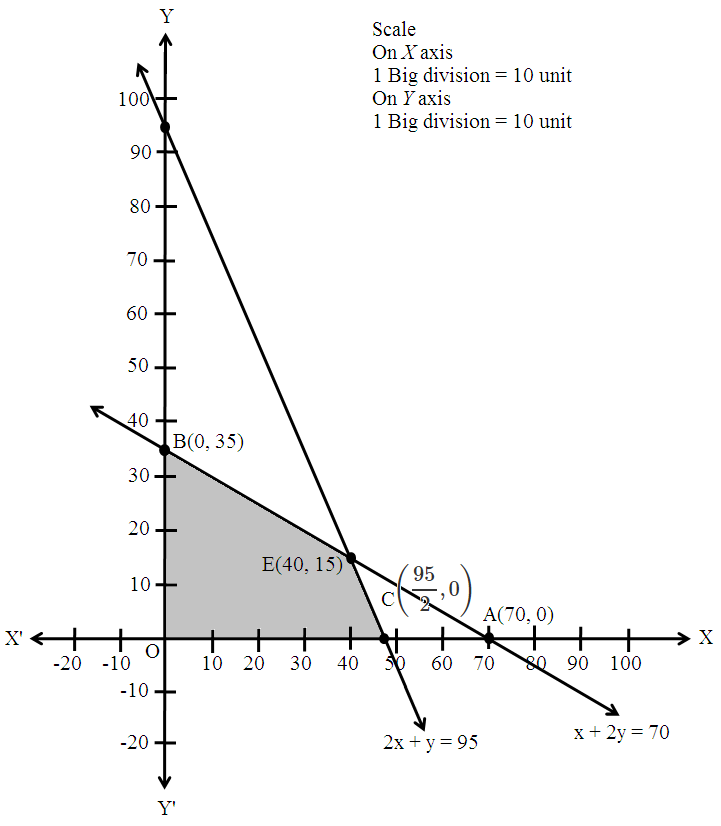
The corner points of the feasible region are $O(0, 0), \text{C}\Big(\frac{95}{2},0\Big), E(40, 15)$ and $B(0, 35).$
The values of $Z$ at these corner points are as follows.
| $\text{Corner point}$ |
$\text{Z} = \text{x} + \text{y}$ |
| $\text{O}(0, 0)$ |
$0 + 0 = 0$ |
| $\text{C}\Big(\frac{95}{2},0\Big)$ |
$\frac{95}{2}+0,2=\frac{95}{2}$ |
| $\text{E}(40, 1)$ |
$40 + 15 = 55$ |
| $\text{B}(0, 35)$ |
$0 + 35 = 35$ |
We see that the maximum value of the objective function $Z$ is $55$ which is at $(40, 15).$ View full question & answer→MCQ 1021 Mark
Maximize $Z = 11 x + 8y$ subject to $\text{x}\leq4,\text{y}\leq6,\text{x}+\text{y}\leq6,\text{x}\geq0,\text{y}\geq0.$
- A
$44$ at $(4, 2)$
- ✓
$60$ at $(4, 2)$
- C
$62$ at $(4, 0)$
- D
$48$ at $(4, 2)$
AnswerCorrect option: B. $60$ at $(4, 2)$
View full question & answer→MCQ 1031 Mark
To write the dual; it should be ensured that
- All the primal variables are non $-$ negative.
- All the bi values are non $-$ negative.
- All the constraints are $\leq$ type if it is maximization problem and $\geq$ type if it is a minimization problem.
- A
$\text{I}$ and $\text{II}$
- B
$\text{II}$ and $\text{III}$
- ✓
$\text{I}$ and $\text{III}$
- D
$\text{I, II}$ and $\text{III}$
AnswerCorrect option: C. $\text{I}$ and $\text{III}$
To write the dual, then all the primal variables must be non $-$ negative.
All the constraints are $\leq$ type if it ia maximization problem and $\geq$ type if it is a minimization problem.
View full question & answer→MCQ 1041 Mark
If two constraints do not intersect in the positive quadrant of the graph, then.
- ✓
The problem is infeasible
- B
The solution is unbounded
- C
One of the constraints is redundant
- D
AnswerCorrect option: A. The problem is infeasible
View full question & answer→MCQ 1051 Mark
The value of objective function is maximum under linear constraints
AnswerCorrect option: C. at any vertex of feasible region
In linear programming problem we substitute the coordinates of vertices of feasible region in the objective function and then we obtain the maximum or minimum value.
Therefore, the value of objective function is maximum under linear constraints at any vertex of feasible region.
View full question & answer→MCQ 1061 Mark
Let $X_1$ and $X_2$ are optimal solutions of a $\text{LPP},$ then:
- A
$\text{X}=\lambda\ \text{X}_1+(1-\lambda)\text{X}_2,\lambda\in$ R is also an optimal solution
- ✓
$\text{X}=\lambda\ \text{X}_1+(1-\lambda)\text{X}_2,0\leq\lambda\leq1$ given an optimal solution
- C
$\text{X}=\lambda\ \text{X}_1+(1+\lambda)\text{X}_2,0\leq\lambda\leq1$ given an optimal solution
- D
$\text{X}=\lambda\ \text{X}_1+(1+\lambda)\text{X}_2,\lambda\in$ R given an optimal solution
AnswerCorrect option: B. $\text{X}=\lambda\ \text{X}_1+(1-\lambda)\text{X}_2,0\leq\lambda\leq1$ given an optimal solution
A set $A$ is convex if, for any two points $X_1, X_2\in\text{A}$ and $\lambda\in0,1$ imply that $\lambda\times1+1-\lambda\times2\in\text{A}$.
Since, here $X_1$ and $X_2$ are optimal solution
Therefore, their convex combination will also be an optimal solution
Thus, $\text{X}=\lambda\ \text{X}_1+(1-\lambda)\text{X}_2,0\leq\lambda\leq1$ gives an optimal solution.
View full question & answer→MCQ 1071 Mark
Apply linear programming to this problem. A firm wants to determine how many units of each of two products (products D and E) they should produce to make the most money. The profit in the manufacture of a unit of product D is 100 and the profit in the manufacture of a unit of product E is100 and the profit in the manufacture of aunit of product E is 87. The firm is limited by its total available labor hours and total available machine hours. The total labor hours per week are 4,000. Product D takes 5 hours per unit of labor and product E takes 7 hours per unit. The total machine hours are 5,000 per week. Product D takes 9 hours per unit of machine time and product E takes 3 hours per unit. Which of the following is one of the constraints for this linear program?
- A
$5\text{D}+7\text{E}\leq5,000$
- B
$9\text{D}+3\text{E}\geq4,000$
- C
$5\text{D}+9\text{E}\leq5,000$
- ✓
$9\text{D}+3\text{E}\leq5,000$
AnswerCorrect option: D. $9\text{D}+3\text{E}\leq5,000$
d. $9\text{D}+3\text{E}\leq5,000$
Solution:
Given, product D takes 5 hours per unit of labour, and product E takes 7 hours per unit of labour.
Therefore, to produce D units of product D takes 5D hours andto produce E units of product E takes 7E hours Given, total labour hours per week are 4000 hours.
Hence, $5\text{D}+7\text{E}\leq4,000$
Given, product D takes 9 hours per unit of machine time, andproduct E takes 3 hours per unit of machine time.
Therefore, to produce D units of product D takes 9D hours andto produce E units of product E takes 3E hours Given, total machine hours per week are 5000 hours.
Hence, $9\text{D}+3\text{E}\leq5,000$
View full question & answer→MCQ 1081 Mark
Unboundedness is usually a sign that the $\text{LP}$ problem.
- A
Has finite multiple solutions.
- B
- C
Contains too many redundant constraints.
- ✓
Has been formulated improperly.
AnswerCorrect option: D. Has been formulated improperly.
View full question & answer→MCQ 1091 Mark
$Z = 4x_1 + 5x_2$, subject to $2\text{x}_{1}+\text{x}_{2}\geq7,2\text{x}_{1}+3\text{x}_2\leq15,\text{x}_{2}\leq3,\text{x}_{1},\text{x}_{2}\geq0.$ The minimum value of $Z$ occurs at :
- ✓
$(3.5, 0)$
- B
$(3, 3)$
- C
$(7.5, 0)$
- D
$(2, 3)$
AnswerCorrect option: A. $(3.5, 0)$
View full question & answer→MCQ 1101 Mark
In equation $3\text{x}-\text{y}\geq3$ and $4x - 4y > 4.$
- ✓
Have solution for positive $x$ and $y.$
- B
Have no solution for positive $x$ and $y.$
- C
Have solution for all $x.$
- D
Have solution for all $y.$
AnswerCorrect option: A. Have solution for positive $x$ and $y.$
View full question & answer→MCQ 1111 Mark
Refer to Question $18$ maximum of $Z$ occurs at:
- ✓
$(5, 0)$
- B
$(6, 5)$
- C
$(6, 8)$
- D
$(4, 10)$
AnswerCorrect option: A. $(5, 0)$
View full question & answer→MCQ 1121 Mark
If the feasible region for a solution of linear inequations is bounded, it is called as:
MCQ 1131 Mark
Choose the correct answer from the given four options.Let $F = 3x - 4y$ be the objective function.
Minimum value of $F$ is:
AnswerCorrect option: B. $-16.$
the feasible region as show in the figure, has objective function $F= 3x - 4y$
|
Corner points
|
Corresponding value of $z = 3x - 4y$
|
| $(0, 0)$ |
$0$
|
| $(12, 6)$ |
$12 ($masimum$)$
|
| $(0, 4)$ |
$-16 ($miminum$)$
|
We have minimum value of $F$ is $\text{-16 at (0, 4)}.$ View full question & answer→MCQ 1141 Mark
$Z = 6x + 21y,$ subject to $ \text{x}+2\text{y}\geq3,\text{x}+4\text{y}\geq4,3\text{x}+\text{y}\geq3,\text{x}\geq0,\text{y}\geq0.$ The minimum value of $Z$ occurs at.
AnswerCorrect option: C. $\Big(2,\frac{7}{2}\Big)$
View full question & answer→MCQ 1151 Mark
The optimal value of the objective function is attained at the points.
AnswerCorrect option: C. Given by corner points of the feasible region.
View full question & answer→MCQ 1161 Mark
In linear programming, lack of points for a solution set is said to:
- ✓
Have no feasible solution
- B
- C
- D
Have infinte point method
AnswerCorrect option: A. Have no feasible solution
View full question & answer→MCQ 1171 Mark
The taxi fare in a city is as follows. For the first $\ km$ the fare is $Rs.10$ and subsequent distance is $Rs.6 \ km.$Taking the distance covered as $x \ km$ and fare as $Rs. y,$ write a linear equation.
- ✓
$y = 4 + 6x$
- B
$y = 4 + 5x$
- C
$y = 3 + 6x$
- D
AnswerCorrect option: A. $y = 4 + 6x$
First $\ km$ fare $= Rs.10$ Subsequent distance fare $= Rs. 6\ km$
Then fare $x \ km$ of distance $y = (x - 1) \times 6 + 10y = 6x - 6 + 10y = 6x + 4$
View full question & answer→MCQ 1181 Mark
In graphical solutions of linear inequalities, solution can be divided into.
MCQ 1191 Mark
The feasible region for a $\text{LPP}$ is shown shaded in the figure. Let $Z = 3x - 4y$ be the objective function. Minimum of $Z$ occurs at.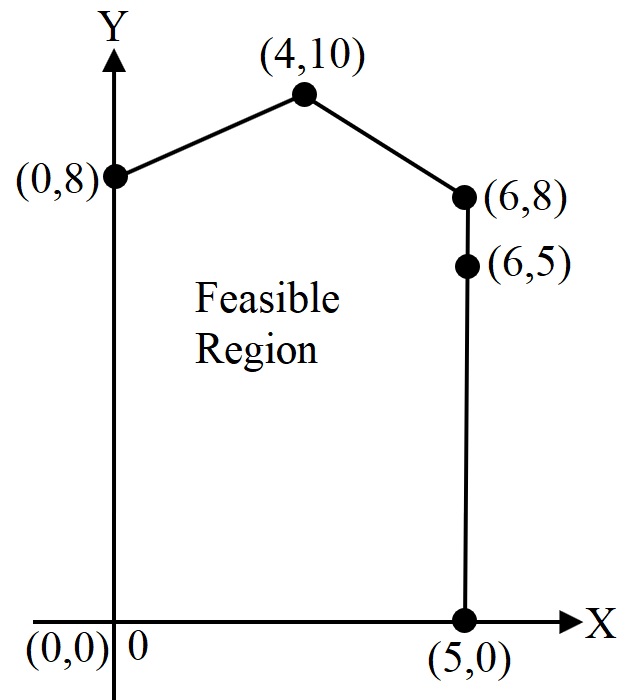
- A
$(0, 0)$
- ✓
$(0, 8)$
- C
$(5, 0)$
- D
$(4, 10)$
AnswerCorrect option: B. $(0, 8)$
View full question & answer→MCQ 1201 Mark
In Graphical solution the feasible solution is any solution to a $\text{LPP}$ which satisfies.
AnswerCorrect option: B. Non $-$ negativity restriction.
The feasible region is the set of all the points that satisfy all the given constraints.
The variables of the linear programs must always take the non $-$ negative values $($i.e., $\text{x}\geq0$ and $\text{y}\geq0).$
These are used because x and y are usually the number of items produced and we cannot produce the negative number of items.
The least possible number of items could be zero.
Therefore, the feasible solution should satisfy the non $-$ negativity restriction.
View full question & answer→MCQ 1211 Mark
If $\text{a},\text{b},\text{c}\in+\text{R}$ such that $\lambda\text{ abc}$ is the minimum value of $a(b^2 + c^2) + b(c^2 + a^2) + c(a^2 + b^2),$ then $\lambda=$
AnswerWe know that $ \text{A}.\text{M}.\geq\text{G}.\text{M}.$
Therefore, $ \frac{{\text{b}^2+\text{c}^2}}{2}\geq\sqrt{\text{b}^2\text{c}^2}$
$\Rightarrow\text{b}^{2}+\text{c}^{2}\geq2\text{bc}$
Multiplying a on both sides doesn’t change the inequality.
Since, given that a is positive.
$\Rightarrow\text{a}(\text{b}^{2}+\text{c}^{2})\geq2\text{abc}\ ...(1)$
Similarly, $\text{b}(\text{a}^{2}+\text{c}^{2})\geq2\text{abc}\ ...(2)$
and $\text{c}(\text{a}^{2}+\text{c}^{2})\geq2\text{abc}\ ...(3)$
adding $(1), (2)$ and $(3)$ we get
$\text{a}(\text{b}^{2}+\text{c}^{2})+\text{b}(\text{a}^{2}+\text{c}^{2})+\text{c}(\text{a}^{2}+\text{b}^{2})\geq2\text{abc}+2\text{abc}+2\text{abc}$
$\Rightarrow\text{a}(\text{b}^{2}+\text{c}^{2})+\text{b}(\text{a}^{2}+\text{b}^{2})+\text{c}(\text{a}^{2}+\text{b}^{2})\geq6\text{abc}$
Therefore $\lambda$ is $6$
View full question & answer→MCQ 1221 Mark
If an iso$-$profit line yielding the optimal solution coincides with a constaint line, then:
- A
The solution is unbounded
- B
The solution is infeasible
- C
The constraint which coincides is redundant
- ✓
View full question & answer→MCQ 1231 Mark
The objective function of a linear programming problem is:
- A
- ✓
- C
A relation between the variables
- D
View full question & answer→MCQ 1241 Mark
The Convex Polygon Theorem states that the optimum $($maximum or minimum$)$ solution of a $\text{LPP}$ is attained at atleastone of the $........$ of the convex set over which the solution is feasible.
AnswerThe fundamental theorem of programming $($i.e., Convex Polygon Theorem$)$ states that the optimum value$($maximum or minimum$)$ of a linear programming problem over a convex region occur at the corner points.
View full question & answer→MCQ 1251 Mark
The solution of the set of constraints of a linear programming problem is a convex $($open or closed$)$ is called $...........$ region.
AnswerOur experts are building a solution for this.
View full question & answer→MCQ 1261 Mark
Given a system of inequatio$n:\ 2\text{y}-\text{x}\leq4$ $-2\text{x}+\text{y}\geq-4$.Find the value of $s,$ which is the greatest possible sum of the $x$ and $y\ co -$ ordinates of the point which satisfies the following inequalities as graphed in the $xy$ plane.
AnswerFirst, rewrite each equation,
so that it is in the slope $-$ intercept form of a line, which is $y = mx + b,$
where mm is the slope and $b$ is the $y -$ intercept of the line.
The first equation becomes $2y < x + 4$ or $\text{y}\leq\frac{1}{2}\text{x}+2.$
The second equation becomes $\text{y}\geq2\text{x}-4.$
The greatest $x + y$ is the point at which the two lines intersect.
Set the equations of the two lines, $\text{y}=\frac{1}{2}\text{x}+2$ and $y = 2x - 4,$ equal to each other and solve for $x.$
The resulting equation is $\text{y}=\frac{1}{2}\text{x}+2$
and $y = 2x - 4.$
Solve for $x$ to get $\text{y}=\frac{3}{-2}\text{x}+2=-4$ or $\frac{3}{-2}\text{x}=-6,$
$\Rightarrow\text{x}=4$
Next, plug $4$ into one of the two equations to solve for $y.$
Therefore,$ y = 2(4) - 4 = 4$ and $x + y = 4 + 4 = 8.$
View full question & answer→MCQ 1271 Mark
The feasible region for an $\text{LPP}$ is shown below:
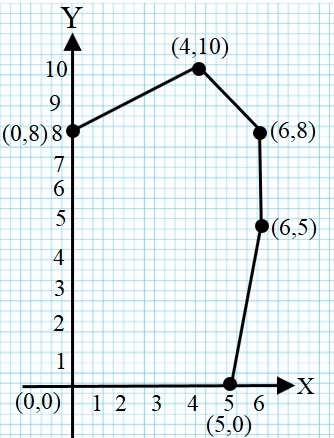
Let $Z = 3x - 4y$ be the objective function. Minimum of $Z$ occurs at - A
$(0, 0)$
- ✓
$(0, 8)$
- C
$(5, 0)$
- D
$(4, 10)$
AnswerCorrect option: B. $(0, 8)$
View full question & answer→MCQ 1281 Mark
Directions: In the following questions, the Assertions $(A)$ and Reason$(s)\ (R)$ have been put forward. Read both the statements carefully and choose the correct alternative from the following:
Assertion $(A):\ $For an objective function $Z= 15x + 20y,$ corner points are $(0, 0), (10, 0), (0, 15)$ and $(5, 5).$Then optimal values are $300$ and $0$ respectively.
Reason $(R):$ The maximum or minimum value of an objective function is known as optimal value of $\text{LPP}.$ These values are obtained at corner points.
- ✓
Both $A$ and $R$ are true and $R$ is the correct explanation of $A$
- B
Both $A$ and $R$ are true but $R$ is not the correct explanation of $A$
- C
$A$ is true but $R$ is false.
- D
$A$ is false but $R$ is true.
AnswerCorrect option: A. Both $A$ and $R$ are true and $R$ is the correct explanation of $A$
View full question & answer→MCQ 1291 Mark
Which of the following is not a convex set?
- ✓
$\{(x, y) ; 2x + 5y ≤ 7\}$
- B
$\{(x, y) : x^2+ y^2 ≤ 4\}$
- C
$\{x : |x| = 5\}$
- D
$\{(x, y) : 3x^2 + 2y^2 ≤ 6\}$
AnswerCorrect option: A. $\{(x, y) ; 2x + 5y ≤ 7\}$
$|x| = 5$ is not a convex set as any two points from negative and positive $x-$axis if are joined will not lie in set.
View full question & answer→MCQ 1301 Mark
If the constraints in a linear programming problem are changed:
MCQ 1311 Mark
The maximum value of $f = 4x + 3y$ subject to constraints $\text{x}\geq0,$ $\text{y}\geq0, 2\text{x}+3\text{y}\leq18;\text{x}+\text{y}\geq10$ is:
View full question & answer→MCQ 1321 Mark
The point which does not lie in the half $-$ plane $2x + 3y -12 < 0$ is:
- A
$(2, 1)$
- B
$(1, 2)$
- C
$(-2, 3)$
- ✓
$(2, 3)$
AnswerCorrect option: D. $(2, 3)$
By putting the value of point $(2, 3)$ in $2x + 3y - 12,$ we get;
$2(2) + 3(3) = -12$
$= 4 + 9 - 12$
$= 13 - 12$
$= 1$ which is greater than $0$
View full question & answer→MCQ 1331 Mark
$z = 10x + 25y$ subject to $0\leq\text{X}\leq3$ and $0\leq\text{X}\leq3,$ $\text{x}+\text{y}\leq5$ then the maximum value of $z$ is:
AnswerThe end points of the figure which forms as per the given condition are $(0, 0), (3, 0), (0, 3), (3, 2), (2, 3)$ We check the value of $z$ at these points.
$\text{At (0, 3), z = 0 + 75 = 75 At (3, 0), z = 30 + 0 = 30 At (0, 0), z = 0 At}$ $\text{(3, 2), z = 30 + 50 = 80 At (2, 3), z = 20 + 75 = 95}$
Therefore, the maximum value of $z$ turns out to be $95.$
View full question & answer→MCQ 1341 Mark
For the $\text{LPP};$ maximise $z = x + 4y$ subject to the constraints $\text{x}+2\text{y}\leq2,$ $\text{x}+2\text{y}\geq8,$ $\text{x},\text{y}\geq0.$
- A
$z_{max} = 4$
- B
$z_{max} = 8$
- C
$z_{max} = 16$
- ✓
Answer$\text{x}+2\text{y}\leq2$
$\text{x}+2\text{y}\geq8$
$\text{x},\text{y}\geq0.$
View full question & answer→MCQ 1351 Mark
In Graphical solution the redundant constraint is:
- A
Which forms the boundary of feasible region.
- B
Which do not optimizes the objective function.
- ✓
Which does not form boundary of feasible region.
- D
Which optimizes the objective function.
AnswerCorrect option: C. Which does not form boundary of feasible region.
View full question & answer→MCQ 1361 Mark
Which of the following sets are convex?
- A
$\{(\text{x},\text{y}):\text{x}^2+\text{y}^2\geq1\}$
- B
$\{(\text{x},\text{y}):\text{y}^2\geq\text{x}\}$
- C
$\{(\text{x},\text{y}):3\text{x}^2+4\text{y}^2\geq5\}$
- ✓
$\{(\text{x},\text{y}):\text{y}\geq2,\text{y}\leq4\}$
AnswerCorrect option: D. $\{(\text{x},\text{y}):\text{y}\geq2,\text{y}\leq4\}$
is the region between two parallel lines, so any line segment joining any two points in it lies in it.
Hence, it is a convex set.
View full question & answer→MCQ 1371 Mark
Choose the correct answer from the given four options.Corner points of the feasible region determined by the system of linear constraints are $(0, 3), (1, 1)$ and $(3, 0).$ Let $Z = px + qy,$ where $p, q > 0.$ Condition on $p$ and $q$ so that the minimum of $Z$ occurs at $(3, 0)$ and $(1, 1)$ is:
AnswerCorrect option: B. $\text{p}=\frac{\text{q}}{2}$
| Corner point |
Corresponding value of $X = px + qy; p,q > 0$ |
| $(0, 3)$ |
$3q$ |
| $(1, 1)$ |
$p + q$ |
| $(3, 0)$ |
$3p$ |
So, condition of $p$ and $q,$
so that the minimum of $Z$ occurs at $(3, 0)$ and $(1, 1)$ is,
$p + q = 3p$
$\Rightarrow 2p = q$
$\therefore\text{p}=\frac{\text{q}}{2}$ View full question & answer→MCQ 1381 Mark
Choose the correct answer from the given four options. Corner points of the feasible region for an $\text{LPP}$ are $(0, 2), (3, 0), (6, 0), (6, 8)$ and $(0, 5)$ Let $F = 4x + 6y$ be the objective function Find the Maximum of $F -$ Minimum of $F =$
Answer
|
Corner points
|
Corresponding value of $F = 4x + 6y$
|
| $(0, 2)$ |
$12 ($Minimum$)$
|
| $(3, 0)$ |
$12 ($minimum$)$
|
| $(6, 0)$ |
$24$
|
| $(6, 8)$ |
$72 ($maxmimum$)$
|
| $(0, 5)$ |
$30$
|
Maximum of $F -$ Minimum of $F = 72 - 12 = 60.$ View full question & answer→MCQ 1391 Mark
If the constraints in linear programming problem are changed.
AnswerCorrect option: A. The problem is to be $\text{re }- $ evaluated
The above question asks for the impact of change in constraints on the Linear programming problem.
In this scenario, when there is a change in constraint, the solution will change definitely.
Whether the solution exists or not, we can only find once the problem is $\text{re} -$ evaluated.
In an $\text{LPP},$ the objective function is related to the main objective of any problem, either we have to maximize or minimize the function based on the situation whereas the constraints is related to physical restrictions in achieving the defined objective function.
In real life problems, there might be situations when the constraints change, but objective function does not changes to accommodate the change in constraints.
Thus, if constraints in linear programming problem is changed, the problem has to be $\text{re} -$ evaluated for the same objective function and after solving we can find whether the solution exists or not.
View full question & answer→MCQ 1401 Mark
The region represented by the inequation system $x, y \geq 0, y \leq 6, x + y \leq 3$ is:
- A
unbounded in first quadrant
- B
unbounded in first and second quadrants
- ✓
bounded in first quadrant
- D
AnswerCorrect option: C. bounded in first quadrant
View full question & answer→MCQ 1411 Mark
The corner points of the feasible region determined by the system of linear constraints are $(0, 10), (5, 5), (15, 15), (0, 20).$ Let $z = px + qy$ where $p, q > 0. $ Condition on $p$ and $q$ so that the maximum of $z$ occurs at both the points $(15, 15)$ and $(0, 20)$ is $ ........$
- A
$q = 2p$
- B
$p = 2p$
- C
$p = q$
- ✓
$q = 3p$
AnswerCorrect option: D. $q = 3p$
Since $Z$ occurs maximum at $(15, 15)$ and $(0, 20)$
Therefore, $15p + 15q = 0.p + 20q$
$\Rightarrow q = 3p.$
View full question & answer→MCQ 1421 Mark
The feasible solution for a $\text{LPP}$ is shown in the following figure. Let $Z = 3x - 4y$ be the objective function.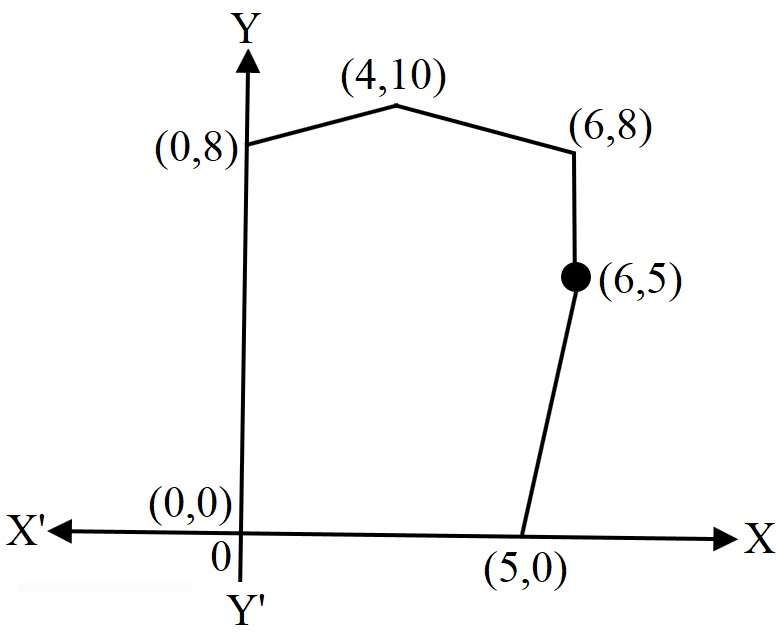
Minimum of $Z$ occurs at: - A
$(0, 0)$
- ✓
$(0, 8)$
- C
$(5, 0)$
- D
$(4, 10)$
AnswerCorrect option: B. $(0, 8)$
View full question & answer→MCQ 1431 Mark
The objective function of $\text{LPP}$ defined over the convex set attains its optimum value at.
- A
Atleast two of the corner points.
- B
- ✓
Atleast one of the corner points.
- D
None of the corner points.
AnswerCorrect option: C. Atleast one of the corner points.
View full question & answer→MCQ 1441 Mark
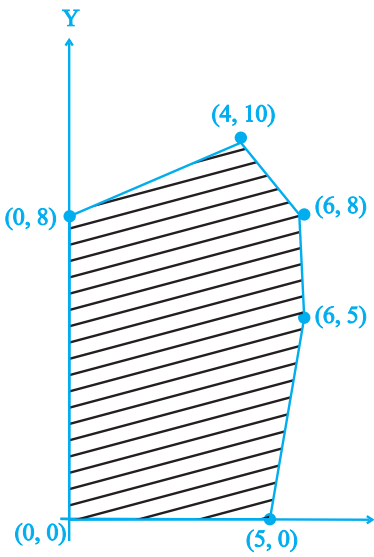
Choose the correct answer from the given four options. The feasible solution for a $\text{LPP}$ is shown in. Let $Z = 3x - 4y$ be the objective function. Maximum of $Z$ occurs at :
- ✓
$(5, 0)$
- B
$(6, 5)$
- C
$(6, 8)$
- D
$(4, 10)$
AnswerCorrect option: A. $(5, 0)$
|
Corner points
|
Corresponding value of $Z = 3x - 4y$
|
|
$(0, 0)$
$(5, 0)$
$(6, 5)$
$(6, 8)$
$(4, 10)$
$(0, 8)$
|
$0$
$15 ($Maxmimum)
$-2$
$-14$
$-28$
$-32$
|
Hence, maximum of $Z$ occurs at $(5, 0)$ and its maximum value is $27.$ View full question & answer→MCQ 1451 Mark
The minimum value of $Z = 3x + 5y$ subjected to constraints $\text{x}+3\text{y}\geq3,\text{x}+\text{y}\geq2,\text{x},\text{y}\geq0$ is :
AnswerThe feasible region determined by the system of constraints $,\text{x}+3\text{y}\geq3,\text{x}+\text{y}\geq2,$ and $\text{x},\text{y}\geq0$ is given below
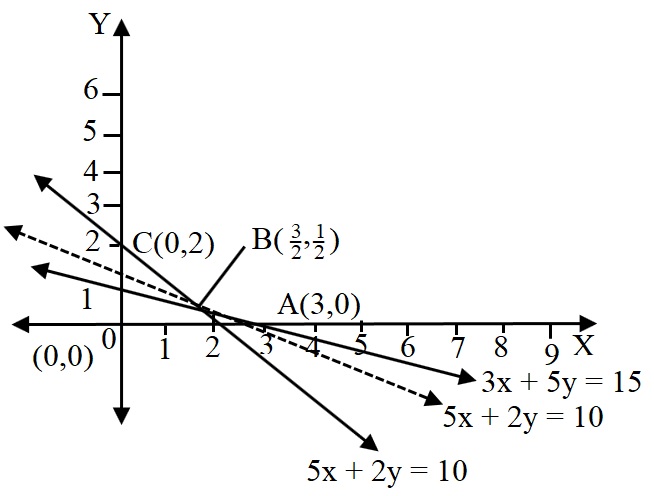
It can be seen that the feasible region is unbounded.
The corner points of the feasible region are $A(3, 0), \text{B}\Big(\frac{3}{2},\frac{1}{2}\Big)$ and $C(0, 2)$
The values of $Z$ at these corner points are given below
|
Corner point
|
$z = 3x + 5y$ |
|
|
$A (3, 0)$
|
$9$ |
|
|
$ \text{B}\Big(\frac{3}{2},\frac{1}{2}\Big)$
|
$7$ |
Smallest
|
|
$C (0, 2)$
|
$10$ |
|
$7$ may or may not be the minimum value of $Z$ because the feasible region is unbounded
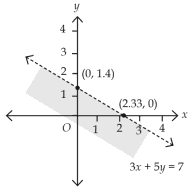
For this purpose, we draw the graph of the inequality, $3x + 5y < 7$ and check the resulting half $-$ plane have common points with the feasible region or not.
Hence, it can be seen that the feasible region has no common point with $3x + 5y < 7.$
Thus, the minimum value of $Z$ is $7$ at point $ \text{B}\Big(\frac{3}{2},\frac{1}{2}\Big).$ View full question & answer→MCQ 1461 Mark
The number of points in $(-\infty,\infty)$ for which $\text{x}^{2}-\text{x}\sin\text{x}-\cos\text{x}=0,$ is :
AnswerBetter approch is with graphs. Considering graphs in eqaution we get
$\text{x}^{2}-\text{x}\sin\text{x}-\cos\text{x}=0$
$\text{x}^{2}=\text{x}\sin\text{x}+\cos\text{x}$
Let $\text{f}(\text{x})=\text{x}^{2},\text{g}(\text{x})=\text{x}\sin\text{x}+\cos\text{x}$
Using graphical methods,we can do the graph of $f(x)$ and $g(x)$
The graph $f(x)$ and $g(x)$ intersects at two points between $(-\infty,\infty)$
View full question & answer→MCQ 1471 Mark
In linear programming, objective function and objective constraints are :
AnswerIn linear programming, objective function and objective constraints are linear.
Any linear programming problem must have the following properties: $-1.$
The relationship between variables and constraints must be linear $2.$
The constraints must be non $-$ negative. $3..$ objective function must be linear.
View full question & answer→MCQ 1481 Mark
The minimum value of $Z = 4x + 3y$ subjected to the constraints $3\text{x}+2\text{y}\geq160,$
$5+2\text{y}\geq200,$$ 2\text{y}\geq80\ ; \text{x},\text{y}\geq0$ is :
View full question & answer→MCQ 1491 Mark
The feasible solution of an $\text{LP}$ problem, is $ .........$
- ✓
Must satisfies all of the problems constraints simultaneously.
- B
Must be a corner point of the feasible region.
- C
Need not satisfy all of the constraints, only some of them.
- D
Must optimize the value of the objective function.
AnswerCorrect option: A. Must satisfies all of the problems constraints simultaneously.
The feasibe solution of a inear programming probem $\text{(LP)}$ is a solution that must satisfy all of the problems constraints simultaniously.
View full question & answer→MCQ 1501 Mark
The number of constraints allowed in a linear program is which of the following?
Answerd. Unlimited
Solution:
There is no limit on constraints allowed in linear programming.
so the number of constraints is unlimited.
View full question & answer→MCQ 1511 Mark
By graphical method, the solution of linear programming problem Maximize $Z=3 x_1+5 x_2$ Subject to $3 x_1+2 x_2 \leq 18\ x_1 \leq 4\ x_2 \leq 6\ x 1 \geq 0, x_2 \geq 0$, is:
- A
$x_1 = 2, x_2 = 0, Z = 6$
- ✓
$x_1 = 2, x_2 = 6, Z = 36$
- C
$x_1 = 4, x_2 = 3, Z = 27$
- D
$x_1 = 4, x_2 = 6, Z = 42$
AnswerCorrect option: B. $x_1 = 2, x_2 = 6, Z = 36$
We need to maximize the function $Z = 3x_4 + 5x_2$
First, we will convert the given inequations into equations, we obtain the following equations:
$3 x_1+2 x_2=18, x_1=4, x_2=6, x_1=0$ and $x_2=0$
Region represented by $3x_1 + 2x_2 ≤ 18:$
The line $3x_1 + 2x_2 = 18$ meets the coordinate axes at $A(6, 0)$ and $B(0, 9)$ respectively.
By joining these points we obtain the line $3X_1 + 2x_2 = 18.$
Clearly $(0, 0)$ satisfies the inequation $3x_1 + 2x_2 = 18.$
So the region in the plane which contain the origin represents the solution set of the inequation $3x_1 + 2x_2 ≤ 18.$
Region represented by $x_1 ≤ 4:$
The line $x_1 = 4$ is the line that passes through $C(4, 0)$ and is parallel to the $Y$ axis.
The region to the left of the line $x_1 = 4$ will satisfy the inequation $x_1 ≤ 4.$
Region represented by $x_2 ≤ 6:$
The line $x_2 = 6$ is the line that passes through $D(0, 6)$ and is parallel to the $X$ axis.
The region below the line $x_2 = 6$ will satisfy the inequation $X_2 ≤ 6$.
Region represented by $x_1 ≥ 0$ and $x_2 ≥ 0:$
Since, every point in the first quadrant satisfies these inequations.
So, the first quadrant is the region represented by the inequations $x_1 ≥ 0$ and $x_2 ≥ 0.$
The feasible region determined by the system of constraints, $3x_1 + 2x_2 ≤ 18, x_1 ≤ 4, x_2 ≤ 6, x_1 ≥ 0$ and $x_2 ≥ 0$ are as follows
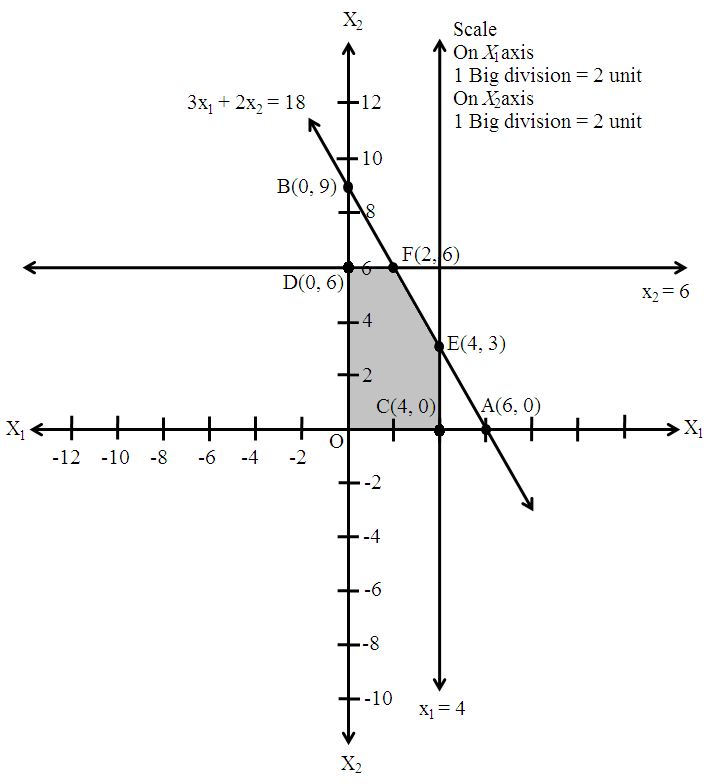
Corner points are $O(0, 0), D(0, 6), F(2, 6), E(4, 3)$ and $C(4, 0).$
The values of the objective function at these points are given in the following table.
|
Points
|
Value of $Z$
|
| $O(0, 0)$ |
$3(0) + 5(0) = 0$ |
| $D(0, 6)$ |
$3(0) + 5(6) = 30$ |
| $F(2, 6)$ |
$3(2) + 5(6) = 36$ |
| $E(4, 3)$ |
$3(4) + 5(3) = 27$ |
| $C(4, 0)$ |
$3(4) + 5(0) = 12$ |
We see that the maximum value of the objective function $Z$ is $36$ which is at $F(2, 6).$ View full question & answer→MCQ 1521 Mark
The maximum value of $Z = 3x + 4y$ subjected to constraints $\text{x}+\text{y}\leq4,\text{x}\geq0$ and $\text{y}\geq0$ is :
AnswerThe feasible region determined by the constraints, $\text{x}+\text{y}\leq4,\text{x}\geq0, \text{y}\geq0,$ is given below
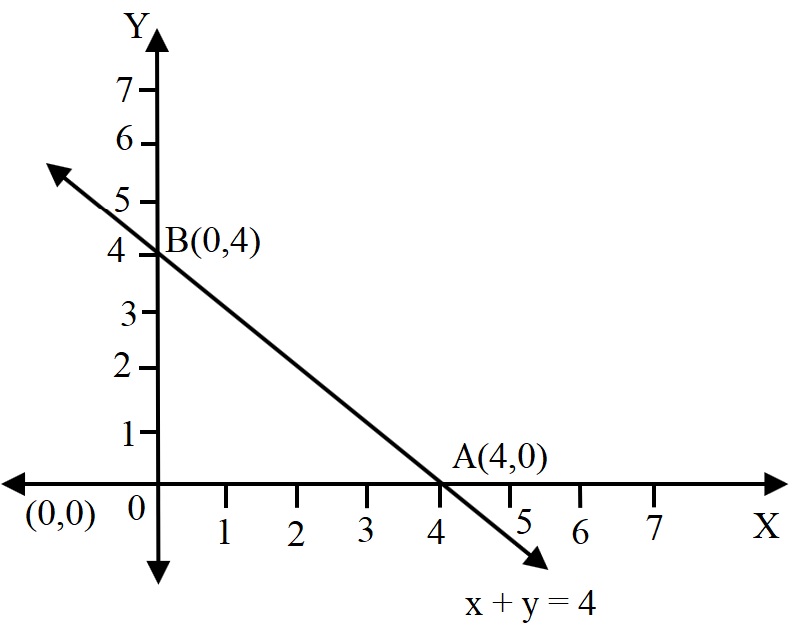
$O (0, 0), A (4, 0),$ and $B (0, 4)$ are the corner points of the feasible region.
The values of $Z$ at these points are given below :
|
Corner Point
|
$z = 3x + 4y$ |
| $O(0, 0)$ |
$0$ |
| $A(4, 0)$ |
$12$ |
| $B(0, 4)$ |
$16$ |
Hence, the maximum value of $Z$ is $16$ at point $B (0, 4)$ View full question & answer→MCQ 1531 Mark
Objective function of a $\text{L.P.P.}$ is:
- A
- ✓
A function to be optimised
- C
A relation between the variables
- D
AnswerCorrect option: B. A function to be optimised
View full question & answer→MCQ 1541 Mark
In a linear programming problem, the constraints on the decision variables $x$ and $y$ are $x-3 y \geq 0, y \geq 0$, $0 \leq x \leq 3$. The feasible region
- A
is not in the first quadrant
- B
is bounded in the first quadrant
- C
is unbounded in the first quadrant
- D
AnswerFrom the graph, we can say that the feasible region is bounded in the first quadrant.
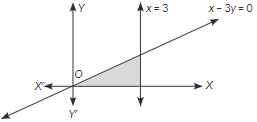
View full question & answer→MCQ 1551 Mark
For an objective function $Z=a x+b y$, where $a, b>0$; the corner points of the feasible region determined by a set of constraints (linear inequalities) are $(0,20),(10,10),(30,30)$ and $(0,40)$. The condition on $a$ and $b$ such that the maximum $Z$ occurs at both the points $(30,30)$ and $(0,40)$ is
- A
$b-3 a=0$
- B
$a=3 b$
- C
$a+2 b=0$
- D
$2 a-b=0$
AnswerAs, $Z$ is maximum at $(30,30)$ and $(0,40)$.
$\Rightarrow \quad 30 a+30 b=40 b \Rightarrow b-3 a=0$
View full question & answer→MCQ 1561 Mark
A linear programming problem is as follows : Minimize $Z=30 x+50 y$ Subject to the constraints, $3 x+5 y \geq 15\ ,\ 2 x+3 y \leq 18 \ ,\ x \geq 0, y \geq 0$ In the feasible region, the minimum value of $Z$ occurs at
AnswerHere, the feasible region is shaded.
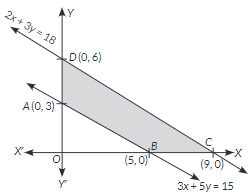
| Corner points |
Value of $Z=30 x+50 y$ |
| $A(0,3)$ |
$30 xx0+50 xx3=150 ($Minimum$)$ |
| $B(5,0)$ |
$30 xx5+50 xx0=150 ($Minimum$)$ |
| $C(9,0)$ |
$30 xx9+50 xx0=270$ |
| $D(0,6)$ |
$30 xx0+50 xx6=300$ |
Since, minimum value of $Z$ occurs at both $A$ and $B$.
So, $Z$ is minimum at every point on the line joining $A B$.
So, minimum value of $Z$ occurs at infinitely many points. View full question & answer→MCQ 1571 Mark
In the given graph, the feasible region for a LPP is shaded. The objective function $Z=2 x-3 y$, will be minimum at
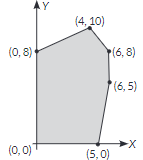
- A
$(4,10)$
- B
$(6,8)$
- C
$(0,8)$
- D
$(6,5)$
AnswerWe have,| Corner points | Value of Z=2x-3y |
| (0,0) | 2xx0-3xx0=0 |
| (0,8) | 2xx0-3xx8=-24 (Minimum) |
| (4,10) | 2xx4-3xx10=-22 |
| (6,8) | 2xx6-3xx8=-12 |
| (6,5) | 2xx6-3xx5=-3 |
| (5,0) | 2xx5-3xx0=10 |
$\therefore \quad$ Value of $Z$ is minimum at $(0,8)$. View full question & answer→MCQ 1581 Mark
Based on the given shaded region as the feasible region in the graph, at which point(s) is the objective function $Z=3 x+9 y$ maximum?
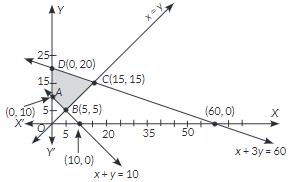
AnswerWe have,| Corner points | Value of Z=3x+9y |
| A(0,10) | 3xx0+9xx10=90 |
| B(5,5) | 3xx5+9xx5=60 |
| C(15,15) | 3xx15+9xx15=180 (Maximum) |
| D(0,20) | 3xx0+9xx20=180 (Maximum) |
$\because \quad Z$ is maximum at $C(15,15)$ and $D(0,20)$.
$\therefore \quad Z$ is maximum at every point on the line joining $C D$. View full question & answer→MCQ 1591 Mark
For the following LPP, maximise $Z=3 x+4 y$ subject to constraints $x-y \geq-1, x \leq 3, x \geq 0, y \geq 0$ the maximum value is
AnswerGiven, $Z=3 x+4 y$
Subject to constraints, $x-y \geq-1, x \leq 3 ; x \geq 0, y \geq 0$
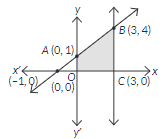
The shaded region $O A B C$ is the feasible region, where corner points are $O(0,0), A(0,1), B(3,4)$ and $C(3,0)$.
At $O(0,0), Z=3(0)+4(0)=0$
At $A(0,1), Z=3(0)+4(1)=4$
At $B(3,4), Z=3(3)+4(4)=25$
At $C(3,0), Z=3(3)+4(0)=9$
$\therefore \quad$ Maximum value of $Z$ is 25 , which occurs at $B(3,4)$. View full question & answer→MCQ 1601 Mark
If the minimum value of an objective function $Z=a x+$ by occurs at two points $(3,4)$ and $(4,3)$ then
- A
$a+b=0$
- B
$a=b$
- C
$3 a=b$
- D
$a=3 b$
AnswerSince, minimum value of $Z=a x+b y$ occurs at two points $(3,4)$ and $(4,3)$.
$\therefore \quad 3 a+4 b=4 a+3 b \Rightarrow a=b$
View full question & answer→MCQ 1611 Mark
The feasible region of an LPP is given in the following figure
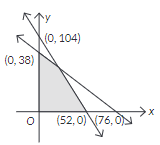
Then, the constraints of the LPP are $x \geq 0, y \geq 0$ and - A
$2 x+y \leq 52$ and $x+2 y \leq 76$
- B
$2 x+y \leq 104$ and $x+2 y \leq 76$
- C
$x+2 y \leq 104$ and $2 x+y \leq 76$
- D
$x+2 y \leq 104$ and $2 x+y \leq 38$
AnswerClearly, the pair of points given in graph, and $(0,104) ;(52,0)$ and $(0,38) ;(76,0)$ satisfy the corresponding equations given in option(b) i.e., $2 x+y \leq 104$ and $x+2 y \leq 76$.
View full question & answer→MCQ 1621 Mark
The maximum value of $Z=3 x+4 y$ subject to the constraints $x \geq 0, y \geq 0$ and $x+y \leq 1$ is
AnswerWe have to maximise $Z=3 x+4 y$
Subject to constraints, $x \geq 0, y \geq 0$ and $x+y \leq 1$
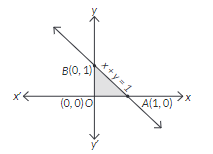
The shaded portion $O A B$ is the feasible region, where $O(0,0), A(1,0)$ and $B(0,1)$ are the corner points.
At $O(0,0), Z=3 \times 0+4 \times 0=0$
At $A(1,0), Z=3 \times 1+4 \times 0=3$
At $B(0,1), Z=3 \times 0+4 \times 1=4$
$\therefore \quad$ Maximum value of $Z$ is 4 , which occurs at $B(0,1)$. View full question & answer→MCQ 1631 Mark
The number of solutions of the system of inequations $x+2 y \leq 3,3 x+4 y \geq 12, x \geq 0, y \geq 1$ is
AnswerGiven,
$x+2 y \leq 3,3 x+4 y \geq 12, x \geq 0, y \geq 1$
The graph of given constraints is shown here.
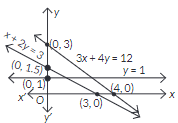
Since, there is no common region, so, no solution exists. View full question & answer→MCQ 1641 Mark
If the corner points of the feasible region of an LPP are $(0,3),(3,2)$ and $(0,5)$, then the minimum value of $z=11 x+7 y$ is
AnswerGiven, $Z=11 x+7 y$
At $(0,3), Z=11 \times 0+7 \times 3=21$
At $(3,2), Z=11 \times 3+7 \times 2=47$
At $(0,5), Z=11 \times 0+7 \times 5=35$
Thus, $Z$ is minimum at $(0,3)$ and minimum value of $Z$ is 21 .
View full question & answer→MCQ 1651 Mark
The feasible region for an LPP is shown below: Let $z=3 x-4 y$ be the objective function. Minimum of $z$ occurs at
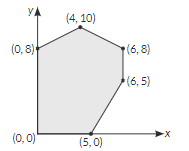
- A
$(0,0)$
- B
$(0,8)$
- C
$(5,0)$
- D
$(4,10)$
AnswerWe know that minimum of objective function occurs at corner points.
| Corner points | Value of z=3x-4y |
| (0,0) | 0 |
| (5,0) | 15 |
| (6,5) | -2 |
| (6,8) | -14 |
| (4,10) | -28 |
| (0,8) | -32 larr Minimum |
View full question & answer→MCQ 1661 Mark
The maximum value of $Z=4 x+y$ for a $\text{L.P.P.}$ whose feasible region is given below is:
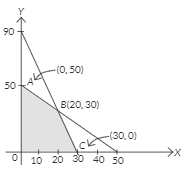
AnswerWe have, Max. $Z=4 x+y$
The corner points of feasible region are $O, A, B$ and $C$. Thus,
$Z_{(0,0\rangle}=0 ;$
$Z_{\langle 0,50\rangle}=50 ;$
$Z_{\langle 20,30\rangle}=20 \times 4+30=110 ;$
$Z_{\{30,0\rangle}=4 \times 30=120$
$\therefore\ M a x\ Z=4 x+y \text { is } 120 .$
View full question & answer→MCQ 1671 Mark
The common region determined by all the constraints of a linear programming problem is called:
MCQ 1681 Mark
The feasible region corresponding to the linear constraints of a Linear Programming Problem is given below
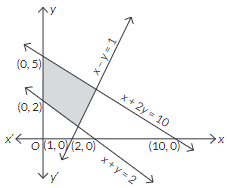
Which of the following is not a constraint to the given Linear Programming Problem?
- A
$x+y \geq 2$
- B
$x+2 y \leq 10$
- C
$x-y \geq 1$
- D
$x-y \leq 1$
AnswerWe observe, $(0,0)$ does not satisfy the inequality
$x-y \geq 1$
So, the half plane represented by the above inequality will not contain origin therefore, it will not contain the shaded feasible region.
View full question & answer→MCQ 1691 Mark
The corner points of the bounded feasible region determined by a system of linear constraints are $(0,3),(1,1)$ and $(3,0)$. Let $Z=p x+q y$, where $p, q>0$,. The condition on $p$ and $q$ so that the minimum of $Z$ occurs at $(3,0)$ and $(1,1)$ is
- A
$p=2 q$
- B
$p=\frac{q}{2}$
- C
$p=3 q$
- D
$p=q$
Answer| Corner point | Value of Z=px+qy;p,q > 0 |
| (0,3) | p xx0+q xx3=3q |
| (1,1) | p xx1+q xx1=p+q |
| (3,0) | p xx3+q xx0=3p |
The minimum of $Z$ occurs at $(3,0)$ and $(1,1)$
$
\therefore p+q=3 p \Rightarrow p=\frac{q}{2}
$ View full question & answer→MCQ 1701 Mark
The feasible region of a linear programming problem is bounded. The corresponding objective function is $Z=6 x-7 y$.
The objective function attains $\qquad$ in the feasible region.
- A
- B
- ✓
- D
either maximum or minimum but not both
View full question & answer→MCQ 1711 Mark
A linear programming problem (LPP) along with the graph of its constraints is shown below. The corresponding objective function is
Minimize: $Z=3 x+2 y$. The minimum value of the objective function is obtained at the corner point ( 2 , 0).
The optimal solution of the above linear programming problem $\qquad$
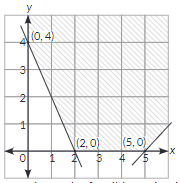
- A
does not exist as the feasible region is unbounded.
- B
does not exist as the inequality $3 x+2 y<6$ does not have any point in common with the feasible region.
- C
exists as the inequality $3 x+2 y>6$ has infinitely many points in common with the feasible region.
- ✓
exists as the inequality $3 x+2 y<6$ does not have any point in common with the feasible region.
AnswerCorrect option: D. exists as the inequality $3 x+2 y<6$ does not have any point in common with the feasible region.
exists as the inequality $3 x+2 y<6$ does not have any point in common with the feasible region.
View full question & answer→MCQ 1721 Mark
The solution set of the inequation $3 x+5 y<7$ is
- A
whole $x y$-plane except the points lying on the line $3 x+5 y=7$.
- B
whole $x y$-plane along with the points lying on the line $3 x+5 y=7$.
- C
open half plane containing the origin except the points of line $3 x+5 y=7$.
- D
open half plane not containing the origin.
View full question & answer→MCQ 1731 Mark
Which of the following points satisfies both the inequations $2 x+y \leq 10$ and $x+2 y \geq 8$ ?
- A
$(-2,4)$
- B
$(3,2)$
- C
$(3,2)$
- D
$(4,2)$
View full question & answer→MCQ 1741 Mark
The number of corner points of the feasible region determined by the constraints $x-y \geq 0,2 y \leq x+2$, $x \geq 0, y \geq 0$ is:
AnswerWe have, $x-y \geq 0,2 y \leq x+2, x \geq 0$ and $y>0$. Let us draw the graph of given constraints, we get $x-y=0$and 2y = x + 2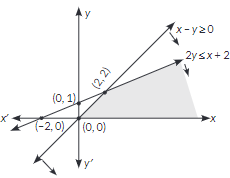
The feasible region is unbounded.
$\therefore \quad$ There are two corner points as $(0,0)$ and $(2,2)$. View full question & answer→MCQ 1751 Mark
The corner points of the feasible region in the graphical representation of a linear programming problem are $(2,72),(15,20)$ and $(40,15)$. If $z=18 x+9 y$ be the objective function, then:
- A
$z$ is maximum at $(2,72)$, minimum at $(15,20)$
- B
$z$ is maximum at $(15,20)$, minimum at $(40,15)$
- C
$z$ is maximum at $(40,15)$, minimum at $(15,20)$
- D
$z$ is maximum at $(40,15)$, minimum at $(2,72)$
AnswerThe objective function is given as $z=18 x+9 y$
The corner points are given as $(2,72),(15,20)$ and $(40,15)$
At $(2,72), z=18 \times 2+9 \times 72=36+648=684$
At $(15,20), z=18 \times 15+9 \times 20=270+180=450$
At $(40,15)=z=18 \times 40+9 \times 15=720+135=855$
$\therefore \quad z$ is maximum at $(40,15)$ and minimum at $(15,20)$.
View full question & answer→MCQ 1761 Mark
The corner points of the bounded feasible region of an LPP are $O(0,0), A(250,0), B(200,50)$ and $C(0,175)$. If the maximum value of the objective function $Z=2 a x+$ by occurs at the points $A(250,0)$ and $B(200,50)$, then the relation between $a$ and $b$ is:
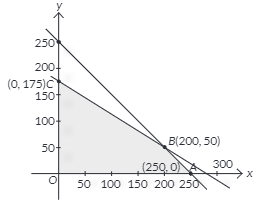
- A
$2 a=b$
- B
$2 a=3 b$
- C
$a=b$
- D
$a=2 b$
AnswerGiven, $Z=2 a x+b y$.........(i)
Putting $x=250$ and $y=0$ in (i), we get
$Z_{\max }=2 a(250)+b(0)=500 a$.........(ii)
Putting $x=200$ and $y=50$ in (i), we get
$Z_{\max }=2 a(200)+b(50)=400 a+50 b$..........(iii)
From (ii) and (iii), we get $500 a=400 a+50 b$
$\Rightarrow \quad 100 a=50 b \Rightarrow 2 a=b$
View full question & answer→MCQ 1771 Mark
The point which lies in the half-plane $2 x+y-4 \leq 0$ is:
- A
$(0,8)$
- B
$(1,1)$
- C
$(5,5)$
- D
$(2,2)$
AnswerSubstitute $x=1$ and $y=1$ in $2 x+y \leq 4$
$\Rightarrow 2(1)+1 \leq 4 \Rightarrow 3 \leq 4$ which is true.
So, $(1,1)$ lies in the half plane $2 x+y-4 \leq 0$
View full question & answer→MCQ 1781 Mark
The corner points of the shaded unbounded feasible region of an LPP are $(0,4),(0.6,1.6)$ and $(3,0)$ as shown in the figure. The minimum value of the objective function $Z=4 x+6 y$ occurs at
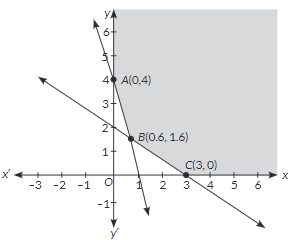
- A
$(0.6,1.6)$ only
- B
$(3,0)$ only
- C
$(0.6,1.6)$ and $(3,0)$ only
- D
at every point of the line-segment joining the points $(0.6,1.6)$ and $(3,0)$
AnswerThe minimum value of the objective function occurs at two adjacent corner points $(0.6,1.6)$ and $(3,0)$ and there is no point in the half plane $4 x+6 y<12$ in common with the feasible region.
So, the minimum value occurs at every point of the linesegment joining the two points.
View full question & answer→MCQ 1791 Mark
The solution set of the inequality $3 x+5 y<4$ is
AnswerThe strict inequality represents an open half plane and it contains the origin, as $(0,0)$ satisfies it.
View full question & answer→MCQ 1801 Mark
The objective function of an LPP is
- A
- B
a linear function to be optimised
- C
- D
AnswerA linear function to be optimized is called an objective function
View full question & answer→MCQ 1811 Mark
The graph of the inequality $2 x+3 y>6$ is
AnswerFrom the graph of inequality $2 x+3 y>6$. It is clear that it does not contain the origin nor the points of the line $2 x+3 y=6$
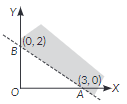
View full question & answer→MCQ 1821 Mark
In an LPP, if the objective function $z=a x+$ by has the same maximum value on two corner points of the feasible region, then the number of points at which $z_{\max }$ occurs is
AnswerIn an LPP, if the objective function $z=a x+b y$ has the same maximum value on two corner points of the feasible region, then the number of points at which $z_{\max }$ occurs is infinite.
View full question & answer→MCQ 1831 Mark
The corner points of the feasible region determined by the system of linear inequalities are $(0,0),(4,0)$, $(2,4)$ and $(0,5)$. If the maximum value of $z=a x+b y$, where $a, b>0$ occurs at both $(2,4)$ and $(4,0)$, then
- A
$a=2 b$
- B
$2 a=b$
- C
$a=b$
- D
$3 a=b$
AnswerSince, maximum value of $z=a x+b y$ occurs at both
$(2,4)$ and $(4,0)$.
$
\therefore \quad 2 a+4 b=4 a+0 \Rightarrow 4 b=2 a \Rightarrow 2 b=a$
View full question & answer→MCQ 1841 Mark
Maximize $Z=7 x+11 y$, subject to $3 x+5 y \leq 26$, $5 x+3 y \leq 30, x \geq 0, y \geq 0$.
AnswerCorrect option: A. 59 at $\left(\frac{9}{2}, \frac{5}{2}\right)$
(a): We have, maximize $Z=7 x+11 y$
Subject to $3 x+5 y \leq 26,5 x+3 y \leq 30, x \geq 0, y \geq 0$
Let $l_1: 3 x+5 y=26, l_2: 5 x+3 y=30, l_3: x=0, l_4: y=0$
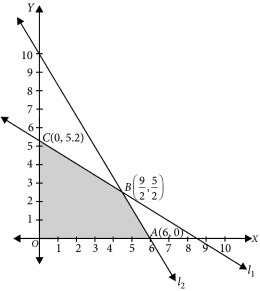
For B : Solving $l_1$ and $l_2$, we get $B\left(\frac{9}{2}, \frac{5}{2}\right)$
Shaded portion $O A B C$ is the feasible region, where $O(0,0), A(6,0), B(9 / 2,5 / 2), C(0,5.2)$.
Now maximize $Z=7 x+11 y$
$Z$ at $O(0,0)=7(0)+11(0)=0$
$Z$ at $A(6,0)=7(6)+11(0)=42$
$Z$ at $B\left(\frac{9}{2}, \frac{5}{2}\right)=7\left(\frac{9}{2}\right)+11\left(\frac{5}{2}\right)=59$
$Z$ at $C(0,5.2)=7(0)+11(5.2)=57.2$
Thus, $Z$ is maximized at $B\left(\frac{9}{2}, \frac{5}{2}\right)$ and its maximum value is 59 . View full question & answer→MCQ 1851 Mark
The graph of the inequality $2 x+3 y>6$ is
AnswerCorrect option: B. half plane that neither contains the origin nor the points of the line $2 x+3 y=6$.
(b) : From the graph of inequality $2 x+3 y>6$. It is clear that it does not contain the origin nor the points of the line $2 x+3 y=6$.
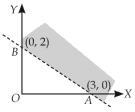
View full question & answer→MCQ 1861 Mark
In an LPP, if the objective function $Z=a x+b y$ has the same maximum value on two corner points of the feasible region, then the number of points at which $Z_{\max }$ occurs is
Answer(d) : In an LPP, if the objective function $Z=a x+b y$ has the same maximum value on two corner points of the feasible region, then the number of points at which $Z_{\max }$ occurs is infinite.
View full question & answer→MCQ 1871 Mark
The corner points of the feasible region determined by the system of linear inequalities are $(0,0),(4,0),(2,4)$ and $(0,5)$. If the maximum value of $Z=a x+b y$, where $a, b>0$ occurs at both $(2,4)$ and $(4,0)$, then
- ✓
$a=2 b$
- B
$2 a=b$
- C
$a=b$
- D
$3 a=b$
AnswerCorrect option: A. $a=2 b$
(a) : Since, maximum value of $Z=a x+b y$ occurs at both $(2,4)$ and $(4,0)$.
$
\therefore \quad 2 a+4 b=4 a+0 \Rightarrow 4 b=2 a \Rightarrow 2 b=a
$
View full question & answer→MCQ 1881 Mark
For the following LPP, maximise $Z=3 x+4 y$ subject to constraints $x-y \geq-1, x \leq 3, x \geq 0, y \geq 0$, the maximum value is
Answer(c) : Given, $Z=3 x+4 y$
Subject to constraints, $x-y \geq-1, x \leq 3 ; x \geq 0, y \geq 0$
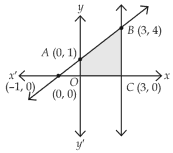
The shaded region $O A B C$ is the feasible region, where corner points are $O(0,0), A(0,1), B(3,4)$ and $C(3,0)$
At $O(0,0), Z=3(0)+4(0)=0$
At $A(0,1), Z=3(0)+4(1)=4$
At $B(3,4), Z=3(3)+4(4)=25$
At $C(3,0), Z=3(3)+4(0)=9$
$\therefore \quad$ Maximum value of $Z$ is 25 , which occurs at $B(3,4)$. View full question & answer→MCQ 1891 Mark
If the minimum value of an objective function $Z=a x+b y$ occurs at two points $(3,4)$ and $(4,3)$ then
- A
$a+b=0$
- ✓
$a=b$
- C
$3 a=b$
- D
$a=3 b$
Answer(b) : Since, minimum value of $Z=a x+b y$ occurs at two points $(3,4)$ and $(4,3)$.
$
\therefore 3 a+4 b=4 a+3 b \Rightarrow a=b
$
View full question & answer→MCQ 1901 Mark
The feasible region of an LPP is given in the following figure
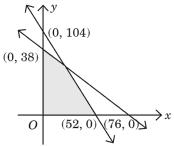
Then, the constraints of the LPP are $x \geq 0, y \geq 0$ and - A
$2 x+y \leq 52$ and $x+2 y \leq 76$
- ✓
$2 x+y \leq 104$ and $x+2 y \leq 76$
- C
$x+2 y \leq 104$ and $2 x+y \leq 76$
- D
$x+2 y \leq 104$ and $2 x+y \leq 38$
AnswerCorrect option: B. $2 x+y \leq 104$ and $x+2 y \leq 76$
(b) : Clearly, the pair of points given in graph, and $(0,104) ;(52,0)$ and $(0,38) ;(76,0)$ satisfy the corresponding equations given in option(b) i.e., $2 x+y \leq 104$ and $x+2 y \leq 76$.
View full question & answer→MCQ 1911 Mark
The maximum value of $Z=3 x+4 y$ subject to the constraints $x \geq 0, y \geq 0$ and $x+y \leq 1$ is
Answer(b) : We have to maximise $Z=3 x+4 y$
Subject to constraints, $x \geq 0, y \geq 0$ and $x+y \leq 1$
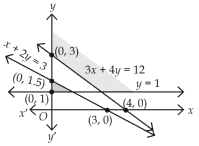
The shaded portion $O A B$ is the feasible region, where $O(0,0), A(1,0)$ and $B(0,1)$ are the corner points.
At $O(0,0), Z=3 \times 0+4 \times 0=0$
At $A(1,0), Z=3 \times 1+4 \times 0=3$
At $B(0,1), Z=3 \times 0+4 \times 1=4$
$\therefore$ Maximum value of $Z$ is 4 , which occurs at $B(0,1)$. View full question & answer→MCQ 1921 Mark
The number of solutions of the system of inequations $x+2 y \leq 3,3 x+4 y \geq 12, x \geq 0$, $y \geq 1$ is
Answer(a) : Given,
$
x+2 y \leq 3,3 x+4 y \geq 12, x \geq 0, y \geq 1
$
The graph of given constraints is shown here.
Since, there is no common region. So, no solution exists. View full question & answer→MCQ 1931 Mark
If the corner points of the feasible region of an LPP are $(0,3),(3,2)$ and $(0,5)$, then the minimum value of $Z=11 x+7 y$ is
Answer(a) : Given, $Z =11 x+7 y$
At $(0,3), Z=11 \times 0+7 \times 3=21$
At $(3,2), Z=11 \times 3+7 \times 2=47$
At $(0,5), Z=11 \times 0+7 \times 5=35$
Thus, $Z$ is minimum at $(0,3)$ and minimum value of $Z$ is 21.
View full question & answer→MCQ 1941 Mark
The solution set of the inequation $3 x+5 y<7$ is
- A
whole $x y$-plane except the points lying on the line $3 x+5 y=7$.
- B
whole $x y$-plane along with the points lying on the line $3 x+5 y=7$.
- C
open half plane containing the origin except the points of line $3 x+5 y=7$.
- D
open half plane not containing the origin.
View full question & answer→MCQ 1951 Mark
Which of the following points satisfies both the inequations $2 x+y \leq 10$ and $x+2 y \geq 8$ ?
- A
$(-2,4)$
- B
$(3,2)$
- C
$(-5,6)$
- ✓
$(4,2)$
AnswerCorrect option: D. $(4,2)$
We have, $2 x+y \leq 10$ and $x+2 y \geq 8$
Let us check which of the given points satisfy the given inequation one by one.
(a) $(-2,4)$
$2 \times(-2)+4=-4+4=0 \leq 10$
and $-2+2 \times 4=-2+8=6 \nsucceq 8$
(b) $(3,2)$
$2 \times 3+2=6+2=8 \leq 10$
$3+2 \times 2=3+4=7 \nsucceq 8$
(c) $(-5,6)$
$2 \times(-5)+6=-10+6=-4 \leq 10$
$-5+2 \times 6=-5+12=7 \nsucceq 8$
(d) $(4,2)$
$2 \times 4+2=10 \leq 10 ; 4+2 \times 2=8 \geq 8$
$\therefore \quad(4,2)$ satisfy both the inequations.
View full question & answer→MCQ 1961 Mark
The maximum value of $Z=5 x+3 y$, if the shaded region represents the feasible region, is
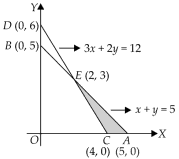
AnswerWe have,
$Z(C)=5 \times 4+3 \times 0=20$
$Z(A)=5 \times 5+3 \times 0=25$
$Z(E)=5 \times 2+3 \times 3=19$
$\therefore \quad$ Maximum value of $Z$ is 25 at point $A(5,0)$
View full question & answer→MCQ 1971 Mark
Maximum value of $Z=3 x+5 y$ subject to $3 x+2 y \leq 18, x \leq 4, y \leq 6, x \geq 0, y \geq 0$ is
AnswerOn plotting the constraints, we get $\text{O C D E F}$ as the feasible region with corner points $\text{O, C, D, E, F}$.
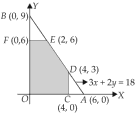
$\therefore Z(O)=0$
$Z(C)=3 \times 4=12$
$Z(D)=3 \times 4+5 \times 3=27$
$Z(E)=3 \times 2+5 \times 6=36$
$Z(F)=5 \times 6=30$
$\therefore \quad$ Maximum value of $Z$ is $36$ at point $E(2,6)$. View full question & answer→MCQ 1981 Mark
Maximise $Z=2 x+3 y$ subject to the constraints : $x+y \leq 5, x \geq 0$, $y \geq 0$. the maximum value of $Z$
AnswerCorrect option: B. is $15$
On plotting the given constraints $x+y=5$, $x=y=0$, we get $O(0,0)$, $A(5,0)$ and $B(0,5)$ as corner points of the feasible region $\text{O A B}$.
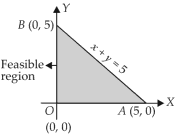
$\therefore Z(O)=2 \times 0+3 \times 0=0,$
$Z(A)=2 \times 5+3 \times 0=10,$
$Z(B)=2 \times 0+3 \times 5=15$
$\therefore \quad$ Maximum value of $Z$ is 15 at point $B(0,5)$. View full question & answer→MCQ 1991 Mark
Consider $Z(x, y)=p x+q y$ subject to $2 x+y \leq 10$, $x+3 y \leq 15, x, y \geq 0$. If $Z$ is maximum at both the points $(3,4)$ and $(0,5)$, then find $q$.
Answer$\because$ Value of $Z$ at $(3,4)=$ Value of $Z$ at $(0,5)$
$\Rightarrow 3 p+4 q=5 q$
$\therefore q=3 p .$
View full question & answer→MCQ 2001 Mark
Consider the linear programming problem Max. $Z=4 x+y$
Subject to $x+y \leq 50 ; x+y \geq 100 ; x, y \geq 0$ The max. value of $Z$
Answer(d) : Let $l_1: x+y=50 ; l_2: x+y=100 ; l_3: x=0$; $l_4: y=0$
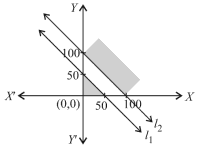
Since, no feasible region determined, hence, no maximum value of $Z$ exists. View full question & answer→MCQ 2011 Mark
In a LPP, if the objective function $Z=a x+b y$ has the same maximum value on two corner points of the feasible region, then every point on the line segment joining these two points give the same ______ value.
View full question & answer→MCQ 2021 Mark
A feasible region of a system of linear inequalities is said to be ______, if it can be enclosed within a circle.
MCQ 2031 Mark
The feasible region for an LPP is always a ______ polygon.
MCQ 2041 Mark
In an LPP, the objective function is always
MCQ 2051 Mark
Corner points of the feasible region determined by the system of linear constraints are $(0,3),(1,1)$ and $(3,0)$. Let $Z=p x+q y$, where $p, q>0$. Condition on $p$ and $q$ so that the minimum of $Z$ occurs at $(3,0)$ and $(1,1)$ is
- A
$p=2 q$
- ✓
$p=\frac{q}{2}$
- C
$p=3 q$
- D
$p=q$
AnswerCorrect option: B. $p=\frac{q}{2}$
(b) : We must have value of $Z$ at $(3,0)=$ value of $Z$ at $(1,1)$
$\Rightarrow \quad 3 p+0 \cdot q=1 p+1 \cdot q \Rightarrow 3 p=p+q \Rightarrow p=\frac{1}{2} q$
View full question & answer→MCQ 2061 Mark
Corner points of the feasible region for an LPP are $(0,2),(3,0)$, $(6,0),(6,8)$ and $(0,5)$.
Let $F=4 x+6 y$ be the objective function.
Maximum of $F$ - Minimum of $F=$
Answer(a): Max. $F-$ Min. $F=72-12=60$.
View full question & answer→MCQ 2071 Mark
Corner points of the feasible region for an LPP are $(0,2),(3,0)$, $(6,0),(6,8)$ and $(0,5)$.
Let $F=4 x+6 y$ be the objective function.
0The minimum value of $F$ occurs at
- A
$(0,2)$ only
- B
$(3,0)$ only
- C
the mid-point of the line segment joining the points $(0,2)$ and $(3,0)$ only
- ✓
any point on the line segment joining the points $(0,2)$ and $(3,0)$
AnswerCorrect option: D. any point on the line segment joining the points $(0,2)$ and $(3,0)$
(d) : Construct the following table of values of objective function :| Corner Point | Value of $F= 4 x+6 y$ |
| (0,2) | $4 \times 0+6 \times 2=12$ (Minimum) |
| (3,0) | $4 \times 3+6 \times 0=-12$ (Minimum) |
| (6,0) | $4 \times 6+6 \times 0=-24$ |
| (6,8) | $4 \times 6+6 \times 8=-72$ (Maximum) |
| (0,5) | $4 \times 0+6 \times 5=-30$ |
Since the minimum value $(F)=12$ occurs at two distinct corner points, it occurs at every point of the segment joining these two points. View full question & answer→MCQ 2081 Mark
The feasible region for an LPP is shown shaded in the figure. Let $F=3 x-4 y$ be the objective function.
Minimum value of $F$ is
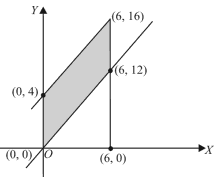
Answer(d) : Minimum of $F=-46$
View full question & answer→MCQ 2091 Mark
The feasible region for an LPP is shown shaded in the figure. Let $F=3 x-4 y$ be the objective function.
Maximum value of $F$ is
Answer(a) : Construct the following table of values of the objective function $F$ :| Corner Point | Value of $F= 3 x-4 y$ |
| (0,0) | $3 \times 0-4 \times 0=0$ (Maximum) |
| (6,12) | $3 \times 6-4 \times 12=-30$ |
| (6,16) | $3 \times 6-4 \times 16=-46$ (Minimum) |
| (0,4) | $3 \times 0-4 \times 4=-16$ |
Hence, maximum of $F=0$ View full question & answer→MCQ 2101 Mark
An owner of a lodge plans an extension which contains not more than 50 rooms. At least 5 must be executive single rooms. The number of executive double rooms should be at least 3 times the number of executive single rooms. He charges ₹ 3000 for executive double room and ₹ 1800 for executive single room per day. Formulate the above problem as L.P.P. to maximize the profit.
- A
Maximize $P=1800 x_1+3000 x_2$ subject to, $x_1+x_2 \geq 50, x_1=5, x_2=3 x_1, x_1 \geq 0, x_2 \geq 0$
- B
Maximize $P=1800 x_1+3000 x_2$ subject to $x_1+x_2 \leq 50, x_1 \geq 5, x_2 \geq 3 x_1, x_1 \leq 0, x_2 \leq 0$
- C
Maximize $P=1800 x_1+3000 x_2$ subject to $x_1+x_2 \geq 50, x_1 \geq 5, x_2 \geq 3 x_1, x_1 \geq 0, x_2 \geq 0$
- ✓
Maximize $P=1800 x_1+3000 x_2$ subject to, $x_1+x_2 \leq 50, x_1 \geq 5, x_2 \geq 3 x_1, x_1 \geq 0, x_2 \geq 0$
AnswerCorrect option: D. Maximize $P=1800 x_1+3000 x_2$ subject to, $x_1+x_2 \leq 50, x_1 \geq 5, x_2 \geq 3 x_1, x_1 \geq 0, x_2 \geq 0$
View full question & answer→MCQ 2111 Mark
The construction company uses concrete blocks made up of cement and sand. The weight of a concrete block has to be at least $5 kg$. Cement costs ₹ 20 per kg, while sand costs ₹ 6 per kg. Strength considerations dictate that the concrete block should contain minimum $4 kg$ of cement and not more than $2 kg$ of sand. Formulate the L.P.P for the cost to be minimum.
- A
Minimize $C=20 x+6 y$ subject to, $x \geq 4, y \leq 2$, $x+y \geq 5, x \geq 0, y \geq 0$
- B
Minimize $C=6 x+20 y$ subject to, $x \leq 4, y \leq 2$, $x+y \leq 5, x \leq 0, y \leq 0$
- C
Minimize $C=20 x+6 y$ subject to, $x \geq 4, y \geq 2$, $x+y \geq 5, x \geq 0, y \geq 0$
- D
Minimize $C=20 x+6 y$ subject to, $x \geq 4, y \leq 2$, $x+y=5, x \geq 0, y 0 \geq 0$
Answer18. (a) : Let the concrete block contains x kg of cement and y kg of sand. As the cost of cement and sand is given to be ₹ 20 and ₹ 6 per kg respectively. Hence, we would like to minimize it. Let us denote the cost by $C$.
$
\therefore \quad C=20 x+6 y
$
The weight of the concrete block has to at least 5 kg.
$
\therefore \quad x+y \geq 5
$
Minimum 4 kg of cement is to be used, $\therefore x \geq 4$
Also sand cannot exceed 2 kg. $\therefore y \leq 2$
Obviously weight of the concrete block cannot be negative. $\therefore x \geq 0, y \geq 0$
Thus the L.P.P. is
Minimize $C=20 x+6 y$
Subject to, $x \geq 4, y \leq 2, x+y \geq 5, x \geq 0, y \geq 0$.
View full question & answer→MCQ 2121 Mark
The corner points of the feasible region determined by the system of linear constraints are $(0,0),(0,40),(20,40),(60,20),(60,0)$. The objective function is $Z=4 x+3 y$.
Compare the quantity in Column A and Column B| Column A | Column B |
| Maximum of Z | 325 |
AnswerCorrect option: A. The quantity in column $A$ is greater
(a) : The objective function is $Z=5 x+3 y$| Corner Point | Value of $Z= 4 x+3 y$ |
| (0,0) | $4 \times 0+3 \times 0=0$ |
| (0,40) | $4 \times 0+3 \times 40=120$ |
| (20,40) | $4 \times 20+3 \times 40=200$ |
| (60,20) | $4 \times 60+3 \times 20=300$ (Maximum) |
| (60,0) | $4 \times 60+3 \times 0=240$ |
View full question & answer→MCQ 2131 Mark
The region represented by the inequalities $x \geq 6, y \geq 2,2 x+y \leq 10, x \geq 0, y \geq 0$ is
View full question & answer→MCQ 2141 Mark
Solution set of the inequality $x \geq 0$ is
- A
half plane on the left of $Y$-axis
- B
half plane on the right of $Y$-axis excluding the points on $Y$-axis
- ✓
half plane on the right of $Y$-axis including the points on $Y$-axis
- D
AnswerCorrect option: C. half plane on the right of $Y$-axis including the points on $Y$-axis
(c) : Solution set of the given inequality is $\{(x, y): x \geq 0\}$ i.e., the set of all points whose abscissae are non-negative. All these points lie either on $Y$-axis or on the right of $Y$-axis.
View full question & answer→MCQ 2151 Mark
Region represented by $x \geq 0, y \geq 0$ is
View full question & answer→MCQ 2161 Mark
The optimal value of the objective function is attained at the points
- A
on $X$-axis
- B
on $Y$-axis
- ✓
which are corner points of the feasible region
- D
AnswerCorrect option: C. which are corner points of the feasible region
(c) : When we solve an L.P.P. graphically, the optimal (or optimum) value of the objective function is attained at corner points of the feasible region.
View full question & answer→MCQ 2171 Mark
Objective function of a L.P.P. is
- A
- ✓
a function to be optimised
- C
a relation between the variables
- D
AnswerCorrect option: B. a function to be optimised
(b) : Objective function is a linear function (involve variable) whose maximum or minimum value is to be found.
View full question & answer→MCQ 2181 Mark
Feasible region for an L.P.P. is shown shaded in the following figure. Minimum of $Z=5 x+3 y$ occurs at the point point
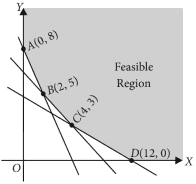
- ✓
$(0,8)$
- B
$(2,5)$
- C
$(4,3)$
- D
$(12,0)$
AnswerCorrect option: A. $(0,8)$
(a) : The objective function is $Z=5 x+3 y$| Corner Point | Value of $Z= 5x+3 y$ |
| A(0,8) | $5 \times 0+3 \times 8=24$ |
| B(2,5) | $5 \times 2+3 \times 5=25$ (minimum) |
| C(4,3) | $5 \times 4+3 \times 3=29$ |
| D(12,0) | $5 \times 12+3 \times 0=60$ |
View full question & answer→MCQ 2191 Mark
The corner points of the feasible region determined by the system of linear constraints are $(0,10),(5,5),(15,15),(0,20)$. Let $Z=p x+q y$, where $p, q>0$. Condition on $p$ and $q$ so that the maximum of $Z$ occurs at both the points $(15,15)$ and $(0,20)$ is
- A
$p=q$
- B
$p=2 q$
- C
$q=2 p$
- ✓
$q=3 p$
AnswerCorrect option: D. $q=3 p$
(d) : Value of $Z=p x+q y$ at $(15,15)$ is $15 p+15 q$ and that at $(0,20)$ is $20 q$. According to given condition, we must have
$
15 p+15 q=20 q \Rightarrow 15 p=5 q \Rightarrow q=3 p
$
View full question & answer→MCQ 2201 Mark
The point which does not lie in the half plane $2 x+3 y-12 \leq 0$ is
- A
$(1,2)$
- B
$(2,1)$
- ✓
$(2,3)$
- D
AnswerCorrect option: C. $(2,3)$
(c) : We have, $2 x+3 y-12 \leq 0$ ...(i)
Putting $(1,2)$ in (i), we get $-4 \leq 0$
Putting $(2,1)$ in (i), we get $-5 \leq 0$
Putting $(2,3)$ in (i), we get $1 \leq 0$, which is not true.
So, $(2,3)$ does not lie in the half plane.
View full question & answer→MCQ 2211 Mark
Feasible region for an L.P.P. is shown shaded in the following figure. Minimum of $Z=4 x+3 y$ occurs at the point
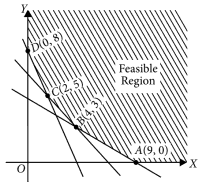
- A
$(0,8)$
- ✓
$(2,5)$
- C
$(4,3)$
- D
$(9,0)$
AnswerCorrect option: B. $(2,5)$
(b) : The objective function is $Z=4 x+3 y$| Corner Point | Value of $Z= 4 x+3 y$ |
| (0,8) | $4 \times 0+3 \times 8=24$ |
| (2,5) | $4 \times 2+3 \times 5=23$ (minimum) |
| (4,3) | $4 \times 4+3 \times 3=25$ |
| (9,0) | $4 \times 9+3 \times 0=36$ |
View full question & answer→MCQ 2221 Mark
Which of the following statement is correct?
- A
Every L.P.P. has atleast one optimal solution.
- B
Every L.P.P. has a unique optimal solution.
- ✓
If an L.P.P. has two optimal solutions, then it has infinitely many solutions.
- D
AnswerCorrect option: C. If an L.P.P. has two optimal solutions, then it has infinitely many solutions.
(c) : If optimal solution is obtained at two distinct points $A$ and $B$ (corners of the feasible region), then optimal solution is obtained at every point of segment $[A B]$.
View full question & answer→MCQ 2231 Mark
Which of the following statements is false?
- ✓
The feasible region is always a concave region.
- B
The maximum (or minimum) solution of the objective function occurs at the vertex of the feasible region.
- C
If two corner points produce the same maximum (or minimum) value of the objective function, then every point on the line segment joining these points will also give the same maximum (or minimum) value.
- D
AnswerCorrect option: A. The feasible region is always a concave region.
(a) : The feasible region is always a convex region.
View full question & answer→MCQ 2241 Mark
A set is said to be convex if
- A
all points except the end points of the line segment inside the set lie inside the set
- B
- ✓
all points on the line segment in the set lie inside the set
- D
AnswerCorrect option: C. all points on the line segment in the set lie inside the set
View full question & answer→MCQ 2251 Mark
Which of the following term is used in a linear programming problem?
MCQ 2261 Mark
Minimize $z=\sum_{j=1}^n \sum_{i=1}^m c_{i j} x_{i j}$, subject to
$
\sum_{j=1}^n x_{i j}=a_i, i=1,2, \ldots, m \text { and } \sum_{i=1}^m x_{i j}=b_j, j=1,2, \ldots, n
$
is an L.P.P. with number of constraints
- ✓
$m+n$
- B
$m-n$
- C
$m n$
- D
$\frac{m}{n}$
View full question & answer→MCQ 2271 Mark
Corner points of the feasible region of inequalities gives
- ✓
Optimal solution of L.P.P.
- B
- C
- D
AnswerCorrect option: A. Optimal solution of L.P.P.
View full question & answer→MCQ 2281 Mark
Optimization of the objective function is a process of
- A
Maximizing the objective function
- ✓
Maximizing or minimizing the objective function
- C
Minimizing the objective function
- D
AnswerCorrect option: B. Maximizing or minimizing the objective function
View full question & answer→