Questions

3 Marks Question

Take a timed test

47 questions · self-marked practice — reveal the answer and mark yourself.

Question 13 Marks
Obtain the first Bohr’s radius and the ground state energy of a muonic hydrogen atom [i.e., an atom in which a negatively charged muon $(\mu)$ of mass about $207m_e$ orbits around a proton].
Answer
Mass of a negatively charged muon, $\text{m}\mu=207\text{ m}_\text{e}$
According to Bohr's model,
Bohr radius, $\text{r}_\text{e}\infty\Big(\frac{1}{\text{m}_\text{c}}\Big)$
And, energy of a ground state electronic hydrogen atom, $\text{E}_\text{e}\infty\text{m}$
We have the value of the first Bohr orbit $r_e = 0.53A = 0.53 \times 10^{-10} m$
Let $\text{r}_\mu$ be the radius of muonic hydrogen atom.
At equilibrium, we can write the relation as:
$\text{m}_\mu\text{r}_\mu=\text{m}_\text{e}\text{r}_\text{e}$
$207\text{m}_\text{e}\times\text{r}\mu=\text{m}_\text{e}\text{r}_\text{e}$
$\therefore\ \text{r}_\mu=\frac{0.53\times10^{-10}}{207}=2.56\times10^{-13}\text{m}$
Hence, the value of the first Bohr radius of a muonic hydrogen atom is
$2.56 \times 10^{-13}\ m$. We have,
$Ee = -13.6\ eV$
Take the ratio of these energies as:
$\frac{\text{E}_\text{e}}{\text{E}_\mu}=\frac{\text{m}_\text{e}}{\text{m}_\mu}=\frac{\text{m}_\text{e}}{207\text{m}_\text{e}}$
$\text{E}_\mu=207\text{E}_\text{e}$
$= 207 × (-13.6) = -2.81keV$
Hence, the ground state energy of a muonic hydrogen atom is -2.81 keV.
View full question & answer
Question 23 Marks
The total energy of an electron in the first excited state of the hydrogen atom is about –3.4 eV.
  1. What is the kinetic energy of the electron in this state?
  2. What is the potential energy of the electron in this state?
  3. Which of the answers above would change if the choice of the zero of potential energy is changed?
Answer
  1. Total energy of the electron E = -3.4 eV
Kinetic energy of the electron is equal to the negative of the total energy.

$\Rightarrow\ \text{K}=-\text{E}$

= -( -3.4) = + 3.4 eV

Hence, the kinetic energy of the electron in the given state is + 3.4 eV.
  1. Potential energy (U) of the electron is equal to the negative of twice of its kinetic energy.
$\Rightarrow\ \text{U}=-2\text{K}$

= -2 × 3.4 = -6.8 eV

Hence, the potential energy of the electron in the given state is - 6.8 eV.
  1. The potential energy of a system depends on the reference point taken. Here, the potential energy of the reference point is taken as zero. If the reference point is changed, then the value of the potential energy of the system also changes. Since total energy is the sum of kinetic and potential energies, total energy of the system will also change
View full question & answer
Question 33 Marks
A difference of 2.3 eV separates two energy levels in an atom. What is the frequency of radiation emitted when the atom make a transition from the upper level to the lower level?
Answer
Separation of two energy levels in an atom,
$E = 2.3\ eV$
$= 2.3 x 1.6 x 10^{-19}$
$= 3.68 x 10^{-19} J$
Let v be the frequency of radiation emitted when the atom transits from the upper level to the lower level.
we have the relation for energy as
$E = hv$
$E = hv$
Where,
h = Planck's constant $= 6.62 \times 10^{-34} Js$
$\therefore\ \text{v}=\frac{\text{E}}{\text{h}}$
$=\frac{3.68\times10^{-19}}{6.62\times10^{-34}}=5.55\times10^{14}\text{ Hz}$
Hence, the frequency of the radiation is $5.6 \times 10^{14}\ Hz.$
View full question & answer
Question 43 Marks
What is the shortest wavelength present in the Paschen series of spectral lines?
Answer
Rydberg's formula is given as:
$\frac{\text{hc}}{\lambda}=21.76\times10^{-19}\Big[\frac{1}{\text{n}^2_1}-\frac{1}{\text{n}^2_2}\Big]$
Where,
$\mathrm{h}=$ Planck's constant $=6.6 \times 10-{ }^{34} \mathrm{Js}$
$c=$ Speed of light $=3 \times 10^8 \mathrm{~m} / \mathrm{s}$
( $\mathrm{n}_1$ and $\mathrm{n}_2$ are integers)
The shortest wavelength present in the Paschen series of the spectral lines is given for values $\mathrm{n}_1=3$ and $\mathrm{n}_2=\infty$.
$\frac{\mathrm{hc}}{\lambda}=21.76 \times 10^{-19}\left[\frac{1}{(3)^2}-\frac{1}{(\infty)^2}\right]$
$ \lambda=\frac{6.6 \times 10^{-34} \times 3 \times 10^8 \times 9}{21.76 \times 10^{-19}} $
$ =8.189 \times 10^{-7} \mathrm{~m} $
$ =818.9 \mathrm{~nm}$
View full question & answer
Question 53 Marks
In accordance with the Bohr’s model, find the quantum number that characterises the earth’s revolution around the sun in an orbit of radius $1.5 \times 10^{11} m$ with orbital speed $3 \times 10^4 m/s.$ (Mass of earth $= 6.0 \times 1024$ kg.)
Answer
Radius of the orbit of the Earth around the Sun, $r = 1.5 \times 10^{11} m$
Orbital speed of the Earth, $v = 3 x 10^4 m/s$
Mass of the Earth, $m = 6.0 x 10^{24} kg$
According to Bohr's model, angular momentum is quantized and given as:
$\text{mvr}=\frac{\text{nh}}{2\pi}$
Where,
h = Planck's constant $= 6.62 x 10^{-34} Js$
n = Quantum number
$\therefore\ \text{n}=\frac{\text{mvr}2\pi}{\text{h}}$
$=\frac{2\pi\times6\times10^{24}\times3\times10^4\times1.5\times10^{11}}{6.62\times10^{-34}}$
$=25.61\times10^{73}=2.6\times10^{74}$
Hence, the quanta number that characterizes the Earth' revolution is $2.6 \times 10^{74}.$
View full question & answer
Question 63 Marks
  1. When an AC source is connected to an ideal capacitor, show that the average power supplied by the source over a complete cycle is zero.
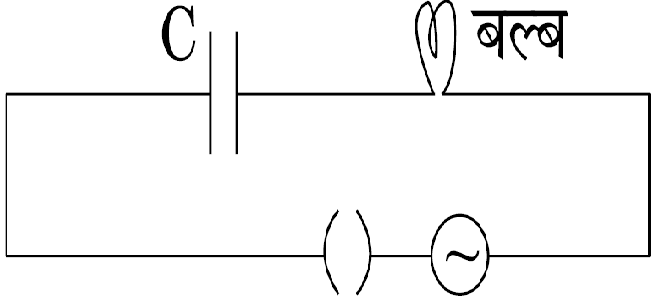
  2. A bulb is connected in series with a variable capacitor and an A.C. source as shown. What happens to the brightness of the bulb when the key is `the capacitor is gradually reduced?
Answer
  1. Let the applied voltage be
$\text{V}= \text{V}_{o}\sin\omega\text{t}$

The current through an ideal capacitor, would then be

$\text{I} = \text{I}_{o}\sin(\omega\text{t} + \frac{\pi}{2}) = \text{I}_{0}\cos\omega\text{t}$

$\therefore\text{P}_{inst} = \text{VI}$

$\therefore\text{P}_{AV} = \frac{1}{\text{T}}\int^{T}_{0}\text{VIdt}$

$\therefore\text{P}_{AV} = \frac{\text{V}_{0}\text{I}_{0}}{2}\langle\sin2\omega\text{t}\rangle$

$=0.$
  1. $\text{X}_{c} = \frac{1}{\omega\text{C}}$
$\therefore\text{X}_{c}$ increases as C decreases.Hence, with decreasing C, the brightness of the bulb would decrease.
View full question & answer
Question 73 Marks
The ground state energy of hydrogen atom is – 13.6 eV. If an electron makes a transition from an energy level – 0.85 eV to – 3.4 eV, calculate the wavelength of the spectral line emitted.To which series of hydrogen spectrum does this wave length belong?
Answer
$\text{hv} = \frac{\text{hc}}{\lambda} = (\text{E}_{2} - \text{E}_{1} ) $
Or $\lambda = \frac{\text{hv}}{(\text{E}_{2} - \text{E}_{1})}$
$\therefore\lambda = \bigg[\frac{6.63\times10^{-34}\times3\times10^{8}}{[-0.85-(-3.4)]\times1.6\times10^{-19}}\bigg]\text{m}$
$ = 4.87\times10^{-7}\text{m}$
Balmer series.
View full question & answer
Question 83 Marks
In a Geiger - Marsden experiment, calculate the distance of closest approach to the nucleus of Z = 80, when an α-particle of 8 MeV nergy impinges on it before it comes momentarily to rest and reverses its direction.
How will the distance of closest approach be affected when the kinetic energy of the α-particle is doubled?
Answer
$\frac{\text{(ze)}\text{(2e})}{4\pi\in_{o}(\text{r}_{o})} =\text{K}$
$\text{r}_{o} = \frac{2\text{ze}^{2}}{4\pi\in_{0}(\text{K})}$
$\text{r}_{o} = \frac{9\times10^{9}\times2\times80\times(1.6\times10^{-19})^{2}}{8\times10^{6}\times(1.6\times10^{-19})}\text{m}$
$ =\frac{18\times1.6\times10^{-10}\times80}{8\times10^{6}}$
$ =2.88\times10^{-14}\text{m}$
$\text{r}_{o}\alpha\frac{1}{\text{KE}}$
If KE becomes twice then $\text{r}_{o}' = \frac{\text{r}_{o}}{2}$
i.e. distance of closest approach becomes half.
View full question & answer
Question 93 Marks
The ground state energy of hydrogen atom is –13.6 eV.
  1. What is the kinetic energy of an electron in the $2^{nd}$ excited state?
  2. If the electron jumps to the ground state from the $2^{nd}$ excited state, calculate the wavelength of the spectral line emitted.
Answer
  1. $\text{En} = \frac{13.6}{\text{n}^{2}}\text{eV}$
$ = \frac{-13.6}{9} = 1.51\text{eV}$
$\text{KE(K)} = +\text{E}_{n} = + 1.51\text{eV}$
  1. $\text{E} = [-1.5-(-13.6)] = 12.1\text{eV}$
Calculation of $\lambda = 1.02\times10^{-7}\text{m}$
Alternate Answer
$\frac{1}{\lambda} = \text{R}\bigg(\frac{1}{\text{n}_{1}^{2}} -\frac{1}{\text{n}_{2}^{2}}\bigg)$
$\lambda = \frac{9}{8\text{R}}\text{ or } 1.02\times10^{-7}\text{m}$
$\frac{\text{hc}}{\lambda}.$
View full question & answer
Question 103 Marks
Using Bohr’s postulates, derive the expression for the orbital period of the electron moving in the $n^{th}$ orbit of hydrogen atom.
Answer
$mvr=\frac{nh}{2\pi}\text{ }\text{ }\text{ }\text{ }\text{ }\dots\text{Bohr postulate}$
Also, $\frac{mv^2}{r}=\frac{1}{4\pi\in_0}\frac{e^2}{r^2}$
$\Leftrightarrow \text{ }mv^2r=\frac{e^2}{4\pi\in_0}$
$\therefore\text{ }v=\frac{e^2}{4\pi\in_0}\times\frac{2\pi}{nh}=\frac{e^2}{2\in_0nh}$
$T=\frac{2\pi r}{v}=\frac{2\pi mvr}{mv^2}$
$=\frac{2\pi\big(\frac{nh}{2\pi}\big)}{m\big(\frac{e^2}{2\in_0nh}\big)^2}$
$=\frac{4n^3h^3\in_{0}^2}{me^4}$
View full question & answer
Question 113 Marks
  1. State Bohr’s quantization condition for defining stationary orbits. How does de Broglie hypothesis explain the stationary orbits?
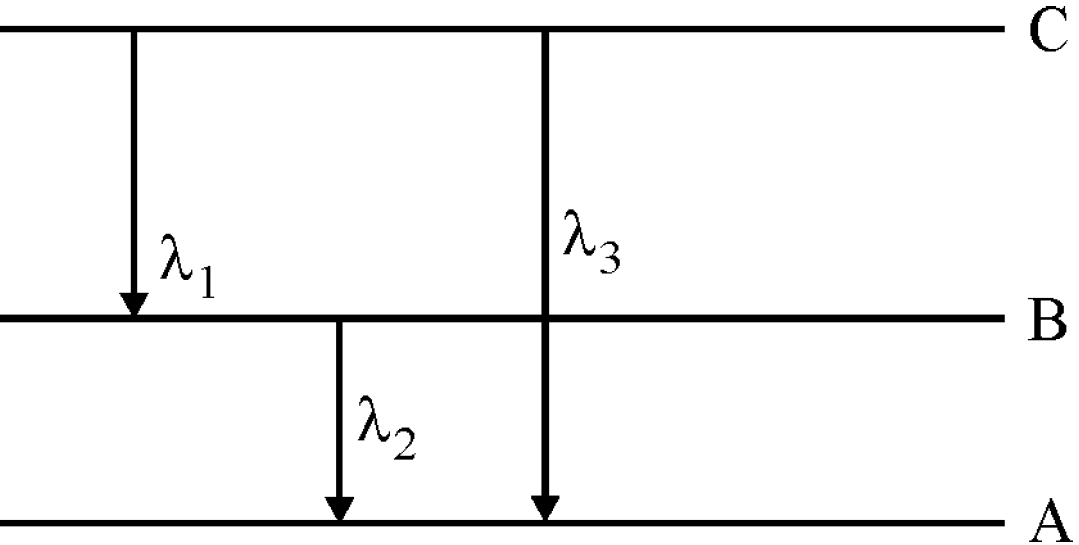
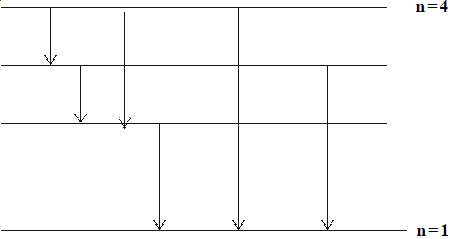
  2. Find the relation between the three wavelengths$\lambda_{1} , \lambda_{2}$ and$\lambda_{3}$ from the energy level diagram shown below.
Answer
Only those orbits are stable for which the angular momentum, of revolving electron, is an integral multiple of $\frac{\text{h}}{2\pi}.$
Alternate Answer
$[\text{L} = \frac{\text{nh}}{2\pi}$ i.e. angular momentum of orbiting electron is quantised.]
According to de Broglie hypothesis
Linear momentum $(\text{P}) = \frac{\text{h}}{\lambda}$
And for circular orbit $\text{L} =\text{r}_{n}\text{p}$ where $' \text{r}_{n} '$ is the radius of quantized orbits.
$ = \frac{\text{rh}}{\lambda}$
Also $\text{L} = \frac{\text{nh}}{2\pi}$
$\therefore\frac{\text{rh}}{\lambda} = \frac{\text{nh}}{2\pi}$
$\Rightarrow2\pi\text{r}_{n} = \text{n}\lambda$
$\therefore$ Circumference of permitted orbits are integral multiples of the wavelength $\lambda$
$\text{E}_{c} - \text{E}_{B} = \frac{\text{hc}}{\lambda}_{1}$ . . . . (i)
$\text{E}_{B} - \text{E}_{A} =\frac{\text{hc}}{\lambda}_{2}$ . . . . (ii)
$\text{E}_{c} - \text{E}_{A} = \frac{\text{hc}}{\lambda}_{a}$ . . . . . (iii)
Adding (i) & (ii)
$\text{E}_{c} - \text{E}_{A} = \frac{\text{hc}}{\lambda}_{1} + \frac{\text{hc}}{\lambda}_{2}$ . . . . . (vi)
Using equation (iii) and (iv)
$\frac{\text{hc}}{\lambda}_{3} = \frac{\text{hc}}{\lambda}_{1} + \frac{\text{hc}}{\lambda}_{2} = > \frac{1}{\lambda}_{3} = \frac{1}{\lambda}_{1} + \frac{1}{\lambda}_{2}$
View full question & answer
Question 123 Marks
Distinguish between nuclear fission and fusion. Show how in both these processes energy is released. Calculate the energy release in MeV in the deuterium-tritium fusion reaction:
$^{2}_{1}\text{H} + ^{3}_{1}\text{H}\rightarrow^{4}_{2}\text{H} +\text{n}$
Using the data:
$\text{m}(^{2}_{1}\text{H}) = 2.014102 \text{u}$
$\text{m}(^{3}_{1}\text{H}) = 3.016049\text{u}$
$\text{m}(^{4}_{2}\text{H}) = 4.002603 \text{u}$
$\text{m}_{n} = 1.008665 \text{n}$
$1\text{u} = 931.5\text{MeV/c}^{2}$.
Answer
The breaking of heavy nucleus into smaller fragments is called nuclear fission; the joining of lighter nuclei to form a heavy nucleus is called nuclear fusion.
Binding energy per nucleon, of the daughter nuclei, in both processes, is more than that of the parent nuclei. The difference in binding energy is released in the form of energy. In both processes some mass gets converted into energy.
Alternate Answer
In both processes, some mass gets converted into energy.
Energy Released
$\text{Q} =[\text{m}(^{2}_{1}\text{H}) +\text{m}((^{3}_{1}\text{H}) = \text{m}((^{4}_{2}\text{He}) - \text{m}(\text{n})]\times931.5\text{MeV}$
$ = [2.014102 +3.016049 - 4.002603 - 1.008665]\times931.5\text{MeV}$
$ = 0.018883\times931.5\text{MeV}$
= 17.59 MeV.
View full question & answer
Question 133 Marks
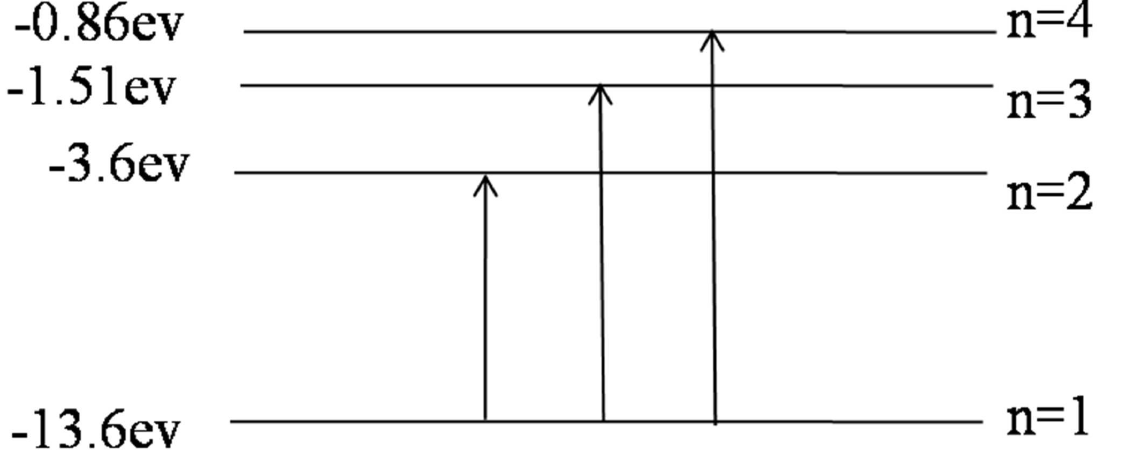
A 12.3 eV electron beam is used to bombard gaseous hydrogen at room temperature. Upto which energy level the hydrogen atoms would be excited?
Calculate the wavelengths of the second member of Lyman series and second member of Balmer series.
Answer
$\text{E}_{n} = \frac{-13.6}{\text{n}^{2}}\text{eV}$ Energy required to excite hydrogen atoms from ground state to the second state $ = \text{E}_{final} - \text{E}_{initial}$ = -1.51 – (-13.6)eV = 12.09 eV i.e. Hydrogen atoms would be excited upto third energy level(i.e. n=3)/ second excited state.Alternate Answer
For Lyman series $\frac{1}{\lambda} = \text{R}\bigg[\frac{1}{\text{n}_{f}^{2}} - \frac{1}{\text{n}_{i}^{2}}\bigg]$ $\frac{1}{\lambda} = 1.097\times10^{7}\bigg[\frac{1}{1} - \frac{1}{9}\bigg]$$\lambda=\frac{9}{8\times1.097\times10^{-7}}$
$=1.025\times10^{-7}$
$=102.5 \text{ nm}$
For Balmer series $\frac{1}{\lambda} = 1.097\times10^{7}\bigg[\frac{1}{4} - \frac{1}{16}\bigg]$ $\lambda=\frac{16}{3\times1.097\times10^{-7}}$ $4.86\times10^{-7}$ = 486 nm
View full question & answer
Question 143 Marks
A 12.9 eV beam of electrons is used to bombard gaseous hydrogen at room temperature. Upto which energy level the hydrogen atoms would be excited? Calculate the wavelength of the first member of Paschen series and first member of Balmer series.
Answer

$\text{E}_{n} = \frac{-13.6}{\text{n}^{2}}\text{eV}$
Energy required to excite hydrogen atoms from ground state to the second excited
state $ = \text{E}_{final} - \text{E}_{initial}$
= +12.75 eV
$=-0.85 -(-13.6)$ eV
hydrogen atoms would be excited upto energy level n=4
Alternate Answer
For Paschen series
$\frac{1}{\lambda} = \text{R}\bigg[\frac{1}{\text{n}_{f}^{2}} - \frac{1}{\text{n}_{i}^{2}}\bigg]$
$\frac{1}{\lambda} = 1.097\times10^{7}\bigg[\frac{1}{9} - \frac{1}{16}\bigg]$
$\frac{1}{\lambda} = 1.097\times10^{7}\times\frac{7}{144}$
$\lambda=\frac{144}{7\times1.097\times10^{7}}=1875\text{nm}$
For Balmer series
$\frac{1}{\lambda} = 1.097\times10^{7}\bigg[\frac{1}{4} - \frac{1}{9}\bigg]$
$\lambda=\frac{36}{5\times1.097\times10^{7}}$
$=656\ \text{nm}$
View full question & answer
Question 153 Marks
A 12.5 eV electron beam is used to bombard gaseous hydrogen at room temperature. Upto which energy level the hydrogen atoms would be excited? Calculate the wavelengths of the first member of Lyman and first member of Balmer series.
Answer
$\text{E}_{n} = \frac{-13.6}{\text{n}^{2}}\text{eV}$
Energy required to excite hydrogen atoms from ground state to the second excited state
$ = \text{E}_{final} - \text{E}_{initial}$
= -1.51 – (-13.6) = 12.09 eV
i.e. hydrogen atoms would be excited upto third energy level(i.e n=3)/second excited state.
Alternate Answer

For Lyman
$\frac{1}{\lambda} = \text{R}\bigg[\frac{1}{\text{n}_{f}^{2}} - \frac{1}{\text{n}_{i}^{2}}\bigg]$
$\frac{1}{\lambda} = 1.097\times10^{7}\bigg[\frac{1}{1^{2}} - \frac{1}{2^{2}}\bigg]$
$\lambda = 122 \text{ nm}$
For Balmer
$\frac{1}{\lambda} = 1.097\times10^{7}\bigg[\frac{1}{2^{2}} - \frac{1}{3^{2}}\bigg]$
$\lambda = 656.3\text{ nm}.$
View full question & answer
Question 163 Marks
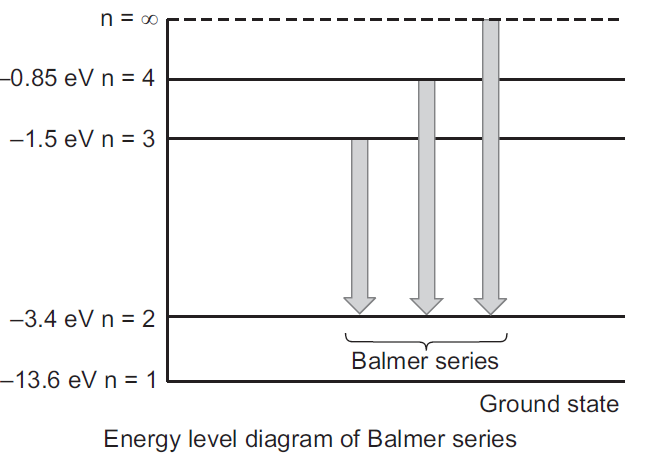
Using Bohr’s postulates, obtain the expression for the total energy of the electron in the stationary states of the hydrogen atom. Hence draw the energy level diagram showing how the line spectra corresponding to Balmer series occur due to transition between energy levels.
Answer

Suppose m be the mass of an electron and v be its speed in nth orbit of radius r. The centripetal force for revolution is produced by electrostatic attraction between electron and nucleus.
$\frac{\text{mv}^{2}}{\text{r}} = \frac{1}{4\pi\varepsilon_{0}}\frac{(\text{Ze})(\text{e})}{\text{r}^{2}}$ - - - - - (i)
or, $\text{mv}^{2} = \frac{1}{4\pi\varepsilon_{0}}\frac{\text{Ze}^{2}}{\text{r}}$
So, Kinetic energy $[\text{K}] = \frac{1}{2}\text{mv}^{2}$
$\text{K} = \frac{1}{4\pi\varepsilon_{0}}\frac{\text{Ze}^{2}}{2\text{r}}$
Potential energy $ = \frac{1}{4\pi\varepsilon_{0}}\frac{(\text{Ze})(\text{-e})}{\text{r}} = -\frac{1}{4\pi\varepsilon_{0}}\frac{\text{Ze}^{2}}{\text{r}}$
Total energy,
$\text{E = KE + PE} = \frac{1}{4\pi\varepsilon_{0}}\frac{\text{Ze}^{2}}{2\text{r}} + \bigg(-\frac{1}{4\pi\varepsilon_{0}}\frac{\text{Z e}^{2}}{\text{r}}\bigg)$
$\text{E} = - \frac{1}{4\pi\varepsilon_{0}}\frac{\text{Z e}^{2}}{2\text{r}}$
For nth orbit, E can be written as $E_n$​​​​​​​
so, $\text{E}_{n} = -\frac{1}{4\pi\varepsilon_{0}}\frac{\text{Z e}^{2}}{2\text{r}_{n}}$ - - - - (ii)
Again from Bohr's postulate for quantization of angular momentum.
$\text{mvr} = \frac{\text{n h }}{2\pi}\Rightarrow\text{v} = \frac{\text{nh}}{2\pi\text{mr}}$
Substituting this value of v in equation (i), we get
$\frac{\text{m}}{\text{r}}\bigg[\frac{\text{n h}}{2\pi\text{mr}}\bigg]^{2} = \frac{1}{4\pi\varepsilon_{0}}\frac{\text{Z e}^{2}}{\text{r}^{2}}$
or,
$\text{r} = \frac{\varepsilon_{0}\text{h}^{2}\text{n}^{2}}{\pi\text{m}\text{Ze}^{2}}$
or,
$\text{r}_{n} = \frac{\varepsilon_{0}\text{h}^{2}\text{n}^{2}}{\pi\text{m}\text{Ze}^{2}}$ - - - - - - (iii)
Substituting value of $r_n$ in equation (ii), we get
$ \text{E}_{n} = - \frac{1}{4\pi\varepsilon_{0}}\frac{\text{Z e}^{2}}{2\bigg(\frac{\varepsilon_{0}\text{h}^{2}\text{n}^{2}}{\pi\text{m}\text{Z e}^{2}}\bigg)} = -\frac{\text{mZ}^{2}\text{e}^{4}}{8\varepsilon_{0}\text{h}^{2}\text{n}^{2}}$
or,
$\text{E}_{n} = - \frac{\text{Z}^{2}\text{Rhc}}{\text{n}^{2}},$ where $\text{R} = \frac{\text{me}^{2}}{8\varepsilon_{0}^{2}\text{ch}^{3}}$
R is called Rydberg constant.
For hydrogen atom Z =1,
$\text{E}_{n} = \frac{ -\text{Rch}}{\text{n}^{2}}$
For Balmer series $n_f = 2$, while $n_i = 3, 4, 5, ................... \infty$
View full question & answer
Question 173 Marks
  1. Using Bohr's second postulate of quantization of orbital angular momentum show that the circumference of the electron in the $n^{th}$ orbital state in hydrogen atom is n times the de Broglie wavelength associated with it.
  2. The electron in hydrogen atom is initially in the third excited state.What is the maximum number of spectral lines which can be emitted when it finally moves to the ground state?
Answer
  1. According to Bohr's second postulate
$\text{mvr}_{n} =\frac{\text{nh}}{2\pi}$
$\Rightarrow2\pi\text{r}_{n} = \frac{\text{nh}}{\text{mv}}$
But $\frac{\text{h}}{\text{mv}} =\frac{\text{h}}{\text{p}} =\lambda$
$\therefore2\pi\text{r}_{n} = \text{n}\lambda$
  1. For third excited state n = 4
for ground state n = 1
Hence possible transitions are
$n_1 = 4$ to $n_1 = 3, 2, 1$
$n_1 = 3$ to $n_1 = 2, 1$
$n_1 = 2$ to $n_1 = 1$
Total number of transitions = 6
Alternate Answer
View full question & answer
Question 183 Marks

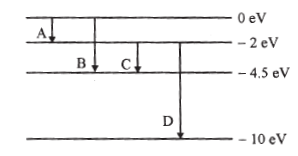
The energy levels of a hypothetical atom are shown below. Which of the shown transitions will result in the emission of a photon of wavelength 275 nm?
Which of these transitions correspond to emission of radiation of (i) maximum and (ii) minimum wavelength?
Answer
If a photon of wave length $\lambda$ = 275nmis to be emitted. then energy of photon is given by $\text{E} = \frac{\text{hc}}{\lambda}$ $ = \frac{6.63\times10^{-34}\times3\times10^{8}}{275\times10^{-9}\times1.6\times10^{-19}}\text{eV}$ $ = 4.5\text{eV}$ Hence transition B would result in the emission of a photon of wavelength 275 nm
  1. Transition A corresponds to maximum wavelength.
  2. Transition D corresponds to minimum wavelength.
View full question & answer
Question 193 Marks
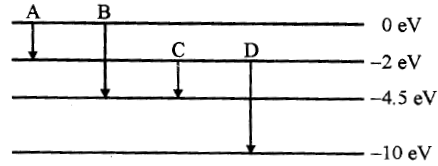
The energy levels of an atom are as shown below:
  1. Which of them will result in the transition of a photon of wavelength 275 nm?
  1. Which transition corresponds to emission of radiation of maximum wavelength?
Answer
  1. For $\lambda = 275 \text{nm} ,$
$\text{E} = \frac{\text{hc}}{\lambda}$

$\text{E} = \frac{6.626\times10^{-34}\times3\times10^{8}}{275\times10^{-9}\times1.6\times10^{-19}}\text{eV} = 4.5\text{eV}$

Also for transition B

$\text{E}=0 - \big( -4.5\text{eV}\big) = 4.5\text{eV}$

Therefore, transition B corresponds to the emission of photon of wavelength 275 nm.
  1. For Transition ‘A’, Energy radiated is minimum. As $\text{E}\propto\frac{1}{\lambda}$ transition A emits radiation of maximum wavelength.
View full question & answer
Question 203 Marks

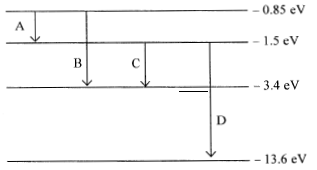
The energy level diagram of an element is given below. Identify, by doing necessary calculations, which transition corresponds to the emission of a spectral line of wavelength 102.7 nm.
Answer
Givan:$\lambda = 102.7\text{nm} = 102.7\times10^{-9}\text{nm}$
$\bigtriangleup\text{E} = \frac{\text{hc}}{\lambda} = \frac{6.626\times10^{-34}\times3\times10^{8}}{102.7\times10^{-9}}$
$ = \frac{6.626\times3}{102.7}\times10^{-17}$
$= 19.3 X 10^{-9} J$
$= \frac{19.3\times10^{-19}}{1.6\times10^{-19}}$
$ = 12.1 \text{eV}$
This change in energy compounds to ‘D’ transition.
Alternate Answer
  1. $\text{hv} = \frac{\text{hv}}{\lambda} = \text{E}_{1}\text{E}_{2}$
$\therefore$ $\lambda = \frac{\text{hv}}{\text{E}_{1}\text{E}_{2}}$
for transition $D,E_1E_2= - 1.5 - ( - 13.6)eV$
$= 12.1\ eV$
$= 12.1 X 1.6 X 10^{-19}J$
$\therefore$ $ = \frac{6.626\times10^{-34}\times3\times10^{8}}{12.1\times1.6\times10^{-19}} = 102.7\text{nm}$
  1. The transition corresponding to λ =102.7 nm, is ‘D.’
Note: The candidate may write:
  1. 102.7 nm belongs to UV part of e.m. spectrum. The UV rays in hydrogen spectrum (Lyman Series) are due to transitions ending at the ground level (= –13.6 eV). Hence the corrected transition is D.
View full question & answer
Question 213 Marks
  1. State Bohr’s postulate to define stable orbits in hydrogen atom. How does de Broglie’s hypothesis explain the stability of these orbits?
  2. A hydrogen atom initially in the ground state absorbs a photon which excites it to the n = 4 level. Estimate the frequency of the photon.
Answer
  1. Quantum condition:
The electrons are permitted to circulate only in those orbits in which the angular momentum of an electron is an integralmultiple of $\frac{\text{h}}{2\pi};$ h being Planck’s constant. Therefore, for any permitted orbit.

$\text{L}=\text{mvr}=\frac{\text{nh}}{2\pi},\ \text{n}=1, 2,3, .....$

where L,m and v are the angular momentum,mass and speed of the electron, r is the radius of the permitted orbit and n is positive integer called principal quantum number, The above equation is Bohr’s famous quantum condition.

Stationary orbits:

While revolving in the permissible orbits, an electron does not radiate energy. These non-radiating orbits are called stationary orbits.

According to de-Broglie, the circumference of $n^{th}$ circular orbit in which electron is revolving is given by:

$2\pi\text{r}_{\text{n}}=\text{n}\lambda\ .....(\text{i})$

where $\lambda=$ wavelength of wave emitted by electron

also, by de-Broglie’s hypothesis

$\lambda=\frac{\text{h}}{\text{mv}}\ ....(\text{ii})$

From (i) and (ii)

$2\pi\text{r}_{\text{n}}=\frac{\text{nh}}{\text{mv}}$

$\therefore\ \text{mvr}_{\text{n}}=\frac{\text{nh}}{2\pi}$
  1. $\frac{1}{\lambda}=\text{R}\Big(\frac{1}{\text{n}^2_1}-\frac{1}{\text{n}^2_2}\Big)$
Here:

$n_1 = 1$

$n_2 = 4$

$\frac{1}{\lambda}=\text{R}\Big(1-\frac{1}{4}\Big)$

$\frac{1}{\lambda}=\frac{3}{4}\text{R}$

$\lambda=\frac{4}{3\text{R}}$

Now, $\text{c}=\text{f}\lambda$

$\text{f}=\frac{\text{c}}{\lambda}=\frac{4\text{c}}{3\text{R}}$

Where c = speed of light in vacuum $= 3 \times 10^8m/ s.$

R = Rhydberg constant $= 1.09 \times 10^7m^{-1}.$

$\text{f}=\frac{4\times3\times10^8}{3\times1.09\times10^7}$

$\text{f}=36.69\text{Hz}$
View full question & answer
Question 223 Marks
Find the temperature at which the average thermal kinetic energy is equal to the energy needed to take a hydrogen atom from its ground state to n = 3 state. Hydrogen can now emit red light of wavelength 653.1nm. Because of Maxwellian distribution of speeds, a hydrogen sample emits red light at temperatures much lower than that obtained from this problem. Assume that hydrogen molecules dissociate into atoms.
Answer
$\text{K}=8.62\times10^{-5}\text{eV}/\text{k}$
K.E. of $H_2$ molecules $=\frac{3}{2}\text{KT}$
Energy released, when atom goes from ground state to no $= 3$
$\Rightarrow13.6\Big(\frac{1}{1}-\frac{1}{9}\Big)$
$\Rightarrow\frac{3}{2}\text{KT}=13.6\Big(\frac{1}{1}-\frac{1}{9}\Big)$
$\Rightarrow\frac{3}{2\ \times\ 8.62\ \times\ 10^{-5}\text{T}}=\frac{13.6\times8}{9}$
$\Rightarrow\text{T}=0.9349\times10^5=9.349\times10^4=9.4\times10^4\text{K}$
View full question & answer
Question 233 Marks

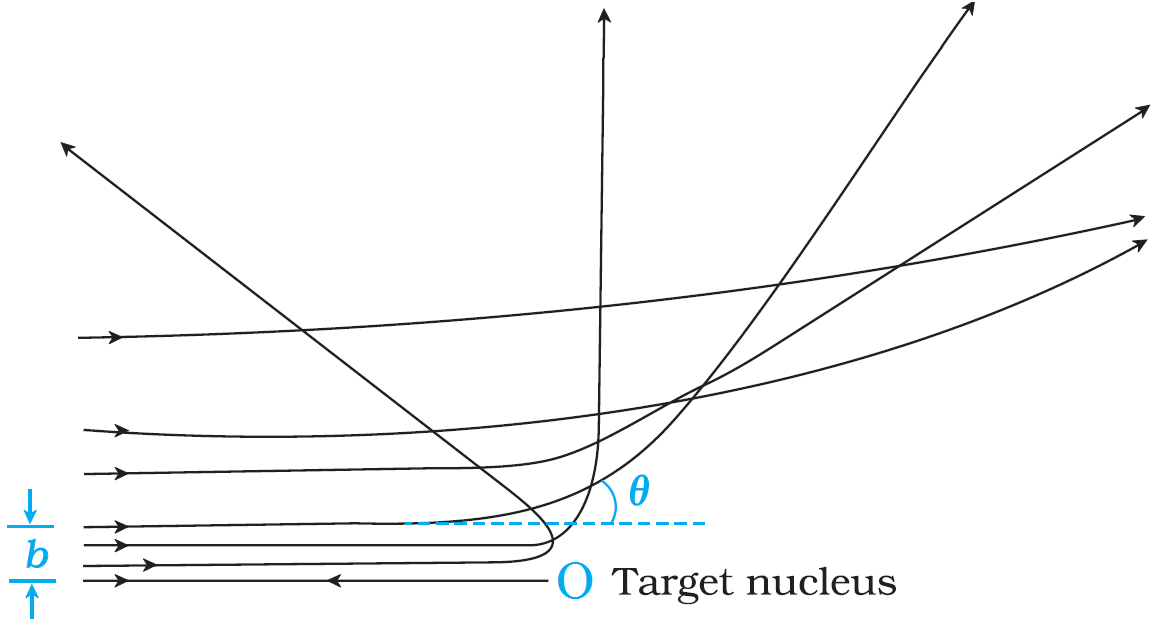
The trajectories, traced by different α-particles, in Geiger-Marsden experiment were observed as shown in the figure.
  1. What names are given to the symbols ‘b’ and $'\theta'$ shown here?
  2. What can we say about the values of b for (i) $\theta=0^{\circ}$ (ii) $\theta=\text{P}$ radians?
Answer
  1. The symbol ‘b’ represents impact parameter and $'\theta'$ represents the scattering angle.
  2. (i) When $\theta=0^{\circ},$ the impact parameter will be maximum and represent the atomic size.
  3. When $\theta=\pi$ radians, the impact parameter ‘b’ will be minimum and represent the nuclear size.
View full question & answer
Question 243 Marks
A hydrogen atom emits ultraviolet radiation of wavelength 102.5nm. What are the quantum numbers of the states involved in the transition?
Answer
As the light emitted lies in ultraviolet range the line lies in hyman series.
$\frac{1}{\lambda}=\text{R}\bigg(\frac{1}{\text{n}^2_1}-\frac{1}{\text{n}^2_2}\bigg)$
$\Rightarrow\frac{1}{102.5\times10^{-9}}=1.1\times10^{7}\bigg(\frac{1}{1^2}-\frac{1}{\text{n}^2_2}\bigg)$
$\Rightarrow\frac{10^9}{102.5}=1.1\times10^7\bigg(1-\frac{1}{\text{n}^2_2}\bigg)$
$\Rightarrow\frac{10^2}{102.5}=1.1\times10^7\bigg(1-\frac{1}{\text{n}^2_2}\bigg)$
$\Rightarrow1-\frac{1}{\text{n}^2_2}=\frac{100}{102.5\times1.1}$
$\Rightarrow\frac{1}{\text{n}^2_2}=\frac{1-100}{102.5\times1.1}$
$\Rightarrow\text{n}_2=2.97=3$
View full question & answer
Question 253 Marks
A hydrogen atom in state n = 6 makes two successive transitions and reaches the ground state. In the first transition a photon of 1.13eV is emitted. (a) Find the energy of the photon emitted in the second transition (b) What is the value of n in the intermediate state?
Answer
  1. Energy at $\text{n}=6,\ \text{E}=\frac{-13.6}{36}=-0.3777777$
Energy in groundstate = -13.6eV

Energy emitted in Second transition = -13.6 - (0.37777 + 1.13)

= -12.09 = 12.1eV
  1. Energy in the intermediate state = 1.13eV + 0.0377777
$=1.507777=\frac{13.6\times\text{z}^2}{\text{n}^2}=\frac{13.6}{\text{n}^2}$

or, $\text{n}=\sqrt{\frac{13.6}{1.507}}=3.03=3=\text{n}$
View full question & answer
Question 263 Marks
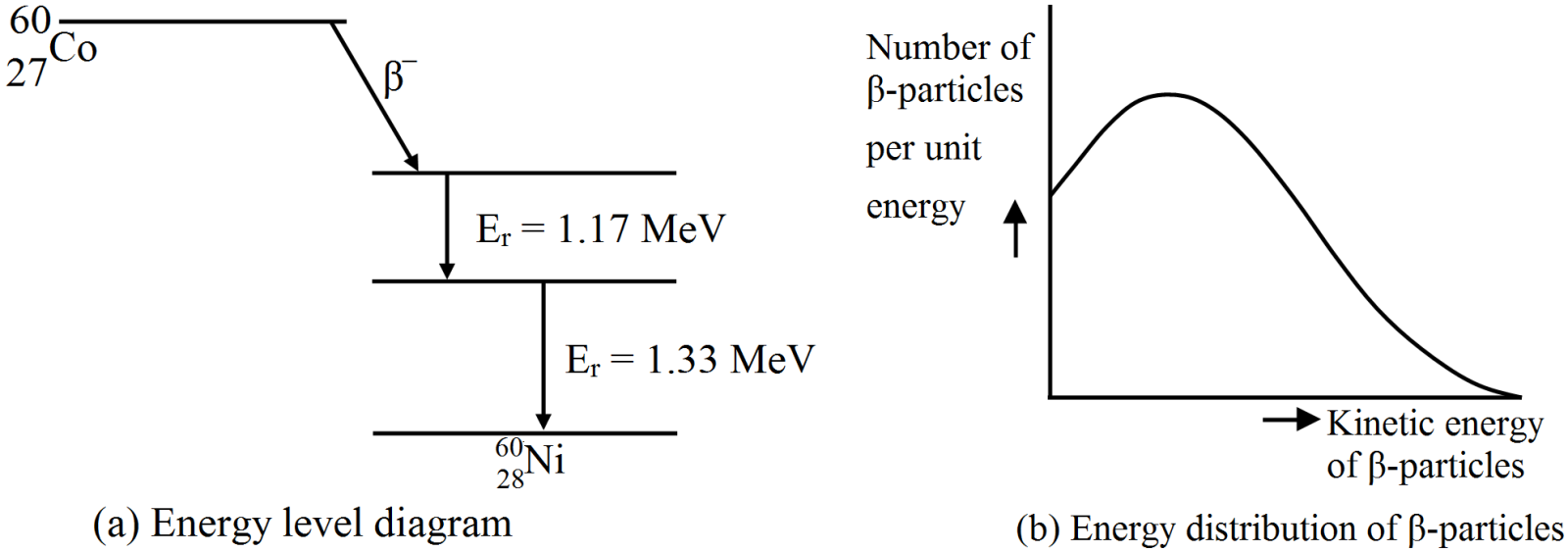
  1. Draw the energy level diagram showing the emission of b-particles followed by γ-rays by a $\text{ }^{60}_{27}\text{Co}$ nucleus.
  2. Plot of distribution of KE of b-particles is shown in fig. (b).
Answer

A

The energy spectrum of b-particles is continuous because an antineutrino is simultaneously emitted in β-decay; the total energy released in b-decay is shared by b-particle and the antineutrino so that momentum of system may remain conserved.
View full question & answer
Question 273 Marks
Which wavelengths will be emitted by a sample of atomic hydrogen gas (in ground state) if electrons of energy 12.2eV collide with the atoms of the gas?
Answer
As the electron collides, it transfers all its energy to the hydrogen atom. The excitation energy to raise the electron from the ground state to the nth state is given by,
$\text{E}=\big(13.6\text{eV}\big)\times\Big(\frac{1}{1^2}-\frac{1}{\text{n}}\Big)$
Substituting n = 2, we get
E = 10.2eV
Substituting n = 3, we get
E' = 12.08eV
Thus, the atom will be raised to the second excited energy level. So, when it comes to the ground state, there is transitions from n = 3 to n = 1.
Therefore, the wavelengths emitted will lie in the Lyman series (infrared region).
View full question & answer
Question 283 Marks
The first excited energy of a $He^+$ ion is the same as the ground state energy of hydrogen. Is it always true that one of the energies of any hydrogen-like ion will be the same as the ground state energy of a hydrogen atom?
Answer
The energy of hydrogen ion is given by,
$\text{E}_\text{n}=\frac{136\text{eV}\text{Z}^2}{\text{n}^2}$
For the first excited state (n = 2), the energy of $He^+$​​​​​​​ ion (with Z = 2) will be -13.6eV. This is same as the ground state energy of a hydrogen atom.
Similarly, for all the hydrogen like ions, the energy of the $(n - 1)^{th}$ excited state will be same as the ground state energy of a hydrogen atom if Z = n.
View full question & answer
Question 293 Marks
Average lifetime of a hydrogen atom excited to n = 2 state is $10^{-8}s$. Find the number of revolutions made by the electron on the average before it jumps to the ground state.
Answer
$\text{n}=2,\text{ T}=10^{-8}\text{s}$
Frequancy $=\frac{\text{me}^4}{4\in^2_0\text{n}^3\text{h}^3}$
So, time period $=\frac{1}{\text{f}}=\frac{4\in_0^2\text{n}^3\text{h}^3}{\text{me}^4}$
$\frac{4\times(8.85)^2\times2^3\times(6.63)^3}{9.1\times(1.6)^4}\times\frac{10^{-24}-10^{-102}}{10^{-76}}$
$=12274.735\times10^{-19}\sec$
No.of revolutions $=\frac{10^{-8}}{12247.735\ \times\ 10^{-19}}=8.16\times10^5$
$=8.2\times10^6$ revolution.
View full question & answer
Question 303 Marks
Calculate the ratio of energies of photons produced due to transition of electron of hydrogen atom from its;
  1. Second permitted energy level to the first level.
  2. Highest permitted energy level to the second permitted level.
Answer
  1. Energy of electron in permitted level $E_n =\frac{\text{Rhc}}{\text{n}^2}$
When an electron jumps from the second to the first permitted energy level,

Energy of photon $=\text{E}_{2-1}=\text{Rhc}\Big(\frac{1}{1}^2-\frac{1}{2^2}\Big)=\frac{3}{4}\text{Rhc}$
  1. When an electron jumps from the highest permitted level $(\text{n}=\infty)$ to the second permitted level (n = 2)
$\text{E}_{\infty-2}=\text{Rhc}\Big(\frac{1}{2^2}-\frac{1}{\infty}\Big)=\frac{\text{Rhc}}4{}$

$\therefore$ Ratio $\frac{\text{E}_{2-1}}{\text{E}_{\infty-2}}=\frac{\frac{3\text{Rhc}}{4}}{\frac{\text{Rhc}}{4}}=\frac{3}{1};$

Ratio $=3:1$
View full question & answer
Question 313 Marks
Would the Bohr formula for the H-atom remain unchanged if proton had a charge (+4/3)e and electron a charge (-3/4)e, where $e = 1.6 \times 10^{-19}C.$ Give reasons for your answer?
Answer
According to Bohr, for an electron around a stationary nucleus the electrostatics force of attraction provides the necessary centripetal force.
i.e., $\frac{1}{4\pi\in_0}\frac{\text{q}_1\text{q}_2}{\text{r}^2}=\frac{\text{mv}^2}{\text{r}}\ .....(\text{i})$
Hence the magnitude of electrostatic force $\text{F}\ \infty\text{ q}_1\times\text{q}_2$
If proton had a charge (+4/3)e and electron a charge (-3/4)e, then the Bohr formula for the H-atom remains same, since the Bohr formula involves only the product of the charges which remain constant for given values of charges.
View full question & answer
Question 323 Marks
Show that the ratio of the magnetic dipole moment to the angular momentum (l = mvr) is a universal constant for hydrogen-like atoms and ions. Find its value.
Answer
Magnetic Dipole moment $=\text{niA}=\frac{\text{e}\times\text{me}^4\times\pi\text{r}^2_\text{n}\text{n}^2}{4\in_0^2\text{h}^3\text{n}^3}$
Angular momentum $=\text{mvr}=\frac{\text{nh}}{2\pi}$
Since the ratio of magnetic dipole moment and angular momentum is independent of Z.
Hence it is an universal constant.
Ratio $=\frac{\text{e}^5\ \times\ \text{m}\ \times\ \pi\text{r}^2_0\text{n}^2}{24\in_0\text{h}^3\text{n}^3}\times\frac{2\pi}{\text{nh}}$
$\Rightarrow\frac{\big(1.6\ \times\ 10^{-19}\big)^5\times\big(9.1\times10^{-31}\big)\times(3.14)^2\times\big(0.53\times10^{-10}\big)^2}{2\times\big(8.85\times10^{-12}\big)^2\times\big(6.63\times10^{-34}\big)^4\times1^2}$
$=8.73\times10^{10}\text{C/kg}$
View full question & answer
Question 333 Marks
When a photon is emitted from an atom, the atom recoils. The kinetic energy of recoil and the energy of the photon come from the difference in energies between the states involved in the transition. Suppose, a hydrogen atom changes its state from n = 3 to n = 2. Calculate the fractional change in the wavelength of light emitted, due to the recoil.
Answer
Difference in energy in the transition from n = 3 to n = 2 is 1.89eV (= E).
If all this energy is used up in emitting a photon (i.e. recoil energy is zero).
Then, $\text{E}=\frac{\text{hc}}{\lambda}$
$\lambda=\frac{\text{hc}}{\text{E}}\ ...(\text{i})$
If difference of energy is used up in emitting a photon and recoil of atom, then let $E_R$ be the recoil energy of atom.
$\text{E}=\frac{\text{hc}}{\lambda'}+\text{E}_\text{R}$
$\lambda'=\frac{\text{hc}}{\text{E}-\text{E}_\text{R}}\ ...(\text{ii})$
Fractional change in the wavelength is given as,
$\frac{\Delta\lambda}{\lambda}=\frac{\lambda'-\lambda}{\lambda}$
$\frac{\Delta\lambda}{\lambda}=\frac{1}{\lambda}\Big(\frac{\text{hc}}{\text{E}-\text{E}_\text{R}}-\frac{\text{hc}}{\text{E}}\Big)$
$\frac{\Delta\lambda}{\lambda}=\frac{\text{E}}{\text{hc}}\Big(\frac{\text{hcE}_\text{R}}{\text{E}(\text{E}-\text{E}_\text{R})}\Big)$ $\Big(\because\ \lambda=\frac{\text{hc}}{\text{E}}\Big)$
$\frac{\Delta\lambda}{\lambda}=\Big(\frac{\text{E}_\text{R}}{\text{E}-\text{E}_\text{R}}\Big)$
View full question & answer
Question 343 Marks
The spectrum of a star in the visible and the ultraviolet region was observed and the wavelength of some of the lines that could be identified were found to be:
$824\mathring{\text{A}},970\mathring{\text{A}},1120\mathring{\text{A}},2504\mathring{\text{A}},5173\mathring{\text{A}},6100\mathring{\text{A}}$
Which of these lines cannot belong to hydrogen atom spectrum? (Given Rydberg constant $\text{R}=1.03\times10^7\text{m}^{-1}$ and $\frac{1}{\text{R}}=970\mathring{\text{A}}$ Support your answer with suitable calculations.
Answer
For hydrogen atom, the wave number (i.e., reciprocal of wavelength) of the emitted radiation is given by
$\bar{\text{v}}=\frac{1}{\lambda}=\text{R}\Big(\frac{1}{\text{n}^2_2}-\frac{1}{\text{n}^2_1}\Big)$
$\therefore\lambda=\frac{\frac{1}{\text{R}}}{\Big(\frac{1}{\text{n}^2_2}-\frac{1}{\text{n}^2_1}\Big)}=\frac{970\mathring{\text{A}}}{\Big(\frac{1}{\text{n}^2_2}-\frac{1}{\text{n}^2_1}\Big)}$
For Lyman series of hydrogen spectrum, we take $n_2 = 1.$ Hence the permitted values of $\lambda$ can be given as:
$\lambda=\frac{970\mathring{\text{A}}}{\frac{3}{4}},\frac{970\mathring{\text{A}}}{\frac{8}{9}},\frac{970\mathring{\text{A}}}{\frac{15}{16}}...\frac{970\mathring{\text{A}}}{1}$ (taking $n_1 = 2, 3, 4, ... \infty$)
$=1293.3\mathring{\text{A}},1091\mathring{\text{A}},1034.6\mathring{\text{A}},... \ 970\mathring{\text{A}}$
For Balmer series of hydrogen spectrum, we take $n_2 = 2.$ Hence the possible values of can be given as:
$\lambda=\frac{970\mathring{\text{A}}}{\frac{5}{36}},\frac{970\mathring{\text{A}}}{\frac{3}{16}},\frac{970\mathring{\text{A}}}{\frac{21}{100}}...\frac{970\mathring{\text{A}}}{\frac{1}{4}}$ (taking $n_1 = 3, 4, 5, ... \infty$)

$=698\mathring{\text{A}},5173.3\mathring{\text{A}},4619\mathring{\text{A}}, ... \ 3880\mathring{\text{A}}$

Hence $\lambda=824\mathring{\text{A}},1120\mathring{\text{A}},2504\mathring{\text{A}},6100\mathring{\text{A}},$ of the given lines, cannot belong to the hydrogen atom spectrum.
View full question & answer
Question 353 Marks
Calculate the magnetic dipole moment corresponding to the motion of the electron in the ground state of a hydrogen atom.
Answer
Dipole moment $(\mu)$
$=\text{niA}=\frac{1\times\text{q}}{\text{tA}}=\text{qfA}$
$=\text{e}\times\frac{\text{me}^4}{4\in_0^2\text{h}^3\text{n}^3}\times\big(\pi\text{r}^2_0\text{n}^2\big)=\frac{\text{me}^5\times\big(\pi\text{r}^2_0\text{n}^2\big)}{4\in_0^2\text{h}^3\text{n}^3}$
$=\frac{\big(9.1\times10^{-31}\big)\big(1.6\times10^{-19}\big)^5\times\pi\times(0.53)^2\times10^{-20}\times1}{4\times\big(8.85\times10^{-12}\big)^2\big(6.64\times10^{-34}\big)^3(1)^3}$
$=0.0009176\times10^{-20}=9176\times10^{-24}\text{Am}^2$
View full question & answer
Question 363 Marks
When a photon is emitted by a hydrogen atom, the photon carries a momentum with it. (a) Calculate the momentum carries by the photon when a hydrogen atom emits light of wavelength 656.3nm. (b) With what speed does the atom recoil during this transition? Take the mass of the hydrogen atom $= 1.67 \times 10^{-27}kg.$ (c) Find the kinetic energy of recoil of the atom.
Answer
  1. $\lambda=656.3\text{nm}$
Momentum $\text{P}=\frac{\text{E}}{\text{C}}=\frac{\text{hc}}{\lambda}\times\frac{1}{\text{c}}=\frac{\text{h}}{\lambda}$

$\text{P}=\frac{6.63\times10^{-34}}{656.3\times10^{-9}}=0.01\times10^{-25}$
  1. $\text{P}=1\times10^{-27}\text{kg-m/s}$
$1\times10^{-27}=1.67\times10^{-27}\times\text{v}$

$\text{v}=\frac{1}{1.67}=0.598=0.6\text{m/s}$
  1. KE of atom $=\frac{1}{2}\times1.67\times10^{-27}\times(0.6)^2$
$=\frac{0.3006\times10^{-27}}{1.6\times10^{-19}}\text{ev}=1.9\times10^{-9}\text{ev}$
View full question & answer
Question 373 Marks
The numerical value of ionization energy in eV equals the ionization potential in volts. Does the equality hold if these quantities are measured in some other units?
Answer
The electron volt is the amount of energy given to an electron in order to move it through the electric potential difference of one volt.
$1eV = 1.6 \times 10^{-19}J$
The numerical value of ionisation energy in eV is equal to the ionisation potential in volts. The equality does not hold if these quantities are measured in some other units.
View full question & answer
Question 383 Marks
Radiation from hydrogen discharge tube falls on a cesium plate. Find the maximum possible kinetic energy of the photoelectrons. Work function of cesium is 1.9eV.
Answer
Wocs = 1.9eV
The radiations coming from the hydrogen discharge tube consist of photons of energy = 13.6eV.
Maximum KE of photoelectrons emitted
= Energy of Photons - Work function of metal.
= 13.6eV - 1.9eV = 11.7eV
View full question & answer
Question 393 Marks
Whenever a photon is emitted by hydrogen in Balmer series, it is followed by another photon in Lyman series. What wavelength does this latter photon correspond to?
Answer
The second wavelength is from Balmer to hyman i.e. from $n = 2$ to $n = 1, n_1 = 2$ to $n_2 = 1$
$\frac{1}{\lambda}=\text{R}\bigg(\frac{1}{\text{n}^2_1}-\frac{1}{\text{n}^2_2}\bigg)$
$\Rightarrow\frac{1}{\lambda}=1.097\times10^7\Big(\frac{1}{2^2}-\frac{1}{1^2}\Big)$
$\Rightarrow1.097\times10^7\Big(\frac{1}{4}-1\Big)$
$\Rightarrow\lambda=\frac{4}{1.097\times3}\times10^{-7}$
$\Rightarrow\lambda=1.215\times10^{-7}$
$\Rightarrow\lambda=121.5\times10^{-9}$
$\Rightarrow\lambda=122\text{nm}$
View full question & answer
Question 403 Marks
What is the energy of a hydrogen atom in the first excited state if the potential energy is taken to be zero in the ground state?
Answer
The potential energy of a hydrogen atom is zero in ground state. An electron is board to the nucleus with energy 13.6ev, Show we have to give energy of 13.6ev. To cancel that energy. Then additional 10.2ev. is required to attain first excited state. Total energy of an atom in the first excited state is = 13.6ev. + 10.2ev. = 23.8ev.
View full question & answer
Question 413 Marks
A hydrogen atom in ground state absorbs a photon of ultraviolet radiation of wavelength 50nm. Assuming that the entire photon energy is taken up by the electron with what kinetic energy will the electron be ejected?
Answer
$\lambda=50\text{nm}$
Work function = Energy required to remove the electron from $\text{n}_1=1\text{ to }\text{n}_2=\infty$
$\text{E}=13.6\Big(\frac{1}{1}-\frac{1}{\infty}\Big)=13.6$
$\frac{\text{hc}}{\lambda}-13.6=\text{KE}$
$\frac{1242}{50}-13.6=\text{KE}$
$\text{KE}=24.84-13.6=11.24\text{eV}$
View full question & answer
Question 423 Marks
A positive ion having just one electron ejects it if a photon of wavelength $288\mathring{\text{A}}$ or less is absorbed by it. Identify the ion.
Answer
$\lambda=228\mathring{\text{A}}$
$\text{E}=\frac{\text{hc}}{\lambda}=\frac{6.63\times10^{-34}\times3\times10^{8}}{228\times10^{-10}}=0.0872\times10^{-16}$
The transition takes place form n = 1 to n = 2
Now, ex. $\frac{13.6\times3}{4\times\text{z}^2}=0.0872\times10^{-16}$
$\Rightarrow\text{z}^2=\frac{0.0872\times10^{-16}}{13.6\times3\times1.6\times10^{-19}=5.3}$
$\Rightarrow\text{z}=\sqrt{5.3}=2.3$
The ion may be Helium.
View full question & answer
Question 433 Marks
Find the radius and energy of a $He^+$ ion in the states (a) n = 1, (b) n = 4 and (c) n = 10.
Answer
  1. $\text{n}=1,\text{ r}=\frac{\in_0\text{h}^2\text{n}^2}{\pi\text{mZe}^2}=\frac{0.53\text{n}^2}{\text{Z}}\mathring{\text{A}}$
$=\frac{0.53\times1}{2}=0.265\mathring{\text{A}}$
$\in=\frac{-13.6\text{z}^2}{\text{n}^2}=\frac{-13.6\times4}{1}=-54.4\text{eV}$
  1. $\text{n}=4,\text{ r}=\frac{0.53\times16}{2}=4.24\mathring{\text{A}}$
$\in=\frac{-13.6\times4}{164}=-3.4\text{eV}$
  1. $\text{n}=10,\text{ r}=\frac{0.53\times100}{2}=26.5\mathring{\text{A}}$
$\in=\frac{-13.6\times4}{100}=-0.544\mathring{\text{A}}$
View full question & answer
Question 443 Marks
A hot gas emits radiation of wavelengths 46.0nm, 82.8nm and 103.5nm only. Assume that the atoms have only two excited states and the difference between consecutive energy levels decreases as energy is increased. Taking the energy of the highest energy state to be zero, find the energies of the ground state and the first excited state.
Answer
Energy in ground state is the energy acquired in the transition of $2^{nd}$ excited state to ground state. As $2^{nd}$ excited state is taken as zero level.
$\text{E}=\frac{\text{hc}}{\lambda_1}=\frac{4.14\times10^{-15}\times3\times10^8}{46\times10^{-9}}=\frac{1242}{46}=27\text{ev}$
Again energy in the first excited state,
$\text{E}=\frac{\text{hc}}{\lambda_1}=\frac{4.14\times10^{-15}\times3\times10^8}{103.5}=12\text{ev}$
View full question & answer
Question 453 Marks
In Bohr’s theory of hydrogen atom, calculate the energy of the photon emitted during a transition of the electron from the first excited state to the ground state. Write in which region of the electromagnetic spectrum this transition lies.
Answer
The energy levels of hydrogen atom are given by
$\text{E}_{\text{n}}\Big(-\frac{\text{Rhc}}{\text{n}^2}\Big)=\frac{13.6}{\text{n}^2}\text{eV}$
For ground state, $n = 1$
$E_1 = -13.6eV$
For frist excited state, n = 2
$\text{E}_2=-\frac{13.6}{4}=-3.4\text{eV}$
$\therefore$ Energy of photon emitted
$hV = E_2 - E_1 = -3.4 - (-13.6)eV = 10.2eV$
As transition from higher state to n = 1 corresponds to Lyman series so the corresponding transition belongs to Lyman series.
View full question & answer
Question 463 Marks
A beam of light having wavelengths distributed uniformly between 450nm to 550nm passes through a sample of hydrogen gas. Which wavelength will have the least intensity in the transmitted beam?
Answer
The energies associated with 450nm radiation $=\frac{1242}{550}=2.258=2.26\text{ev}$
Energy associated with 550nm radiation $=\frac{1242}{550}=2.258=2.26\text{ev}$
The light comes under visible range,
Thus, $\text{n}_1=2,\text{ n}_2=3,4,5,\ .....$
$\text{E}_2-\text{E}_3=13.6\Big(\frac{1}{2^2}-\frac{1}{3^2}\Big)=1.9\text{ev}$
$\text{E}_2-\text{E}_4=13.6\Big(\frac{1}{4}-\frac{1}{16}\Big)=2.55\text{ev}$
$\text{E}_2-\text{E}_6=13.6\Big(\frac{1}{4}-\frac{1}{25}\Big)=2.856\text{ev}$
Only $E_2 - E_4$ comes in the range of energy provided. So the wavelength corresponding to that energy will be absorbed.
$\lambda=\frac{1242}{2.55}=487.05\text{nm}=487\text{nm}$
487 nm wavelength will be absorbed.
View full question & answer
Question 473 Marks
Which is easier to remove: orbital electron from an atom or a nucleon from a nucleus?
Answer
It is easier to remove an orbital electron from an atom. The reason is the binding energy of orbital electron is a few electron-volts while that of nucleon in a nucleus is quite large (nearly 8MeV). This means that the removal of an orbital electron requires few electron volt energy while the removal of a nucleon from a nucleus requires nearly 8MeV energy.
View full question & answer