Questions

2 Marks Questions

Take a timed test

26 questions · self-marked practice — reveal the answer and mark yourself.

Question 12 Marks
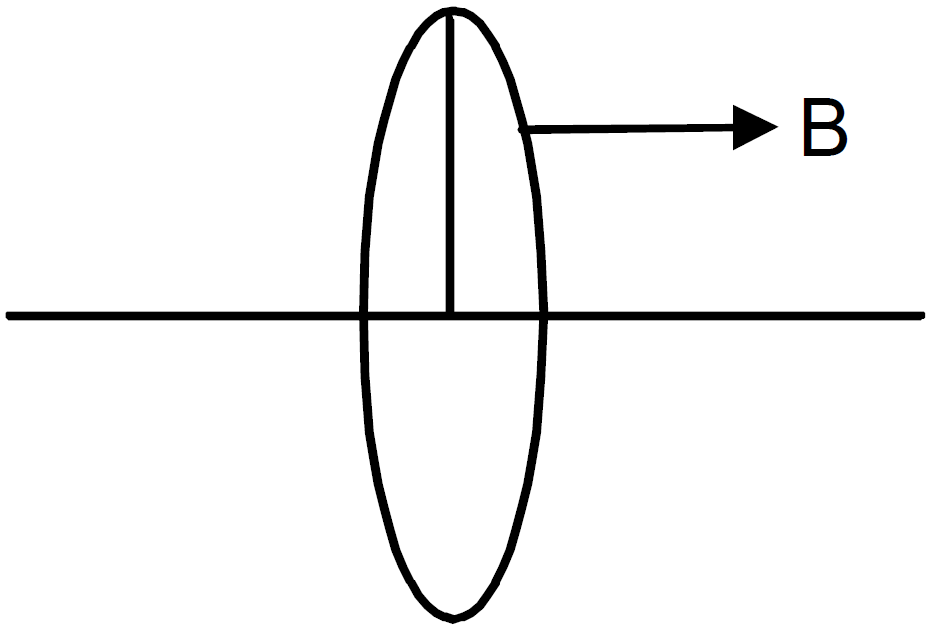
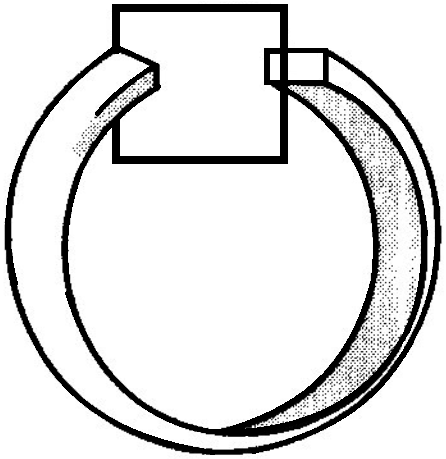
Figure shows a conducting square loop placed parallel to the pole faces of a ring magnet. The Pole-faces have an area of $1cm^2$​​​​​​​ each and the field between the poles is 0.10T. The wires making the loop are all outside the magnetic field. If the magnet is removed in 1.0s, what is the average emf induced in the loop?
Answer
$\text{B}=0.10\text{T}$
$\text{A}=1\text{cm}^2=10^{-4}\text{m}^2$
$\text{T}=1\text{s}$
$\phi=\text{B}.\text{A=}10^{-1}\times10^{-4}=10^{-5}$
$\text{e}=\frac{\text{d}\phi}{\text{dt}}=\frac{10^{-5}}{1}=10^{-5}=10\mu\text{V}$
View full question & answer
Question 22 Marks
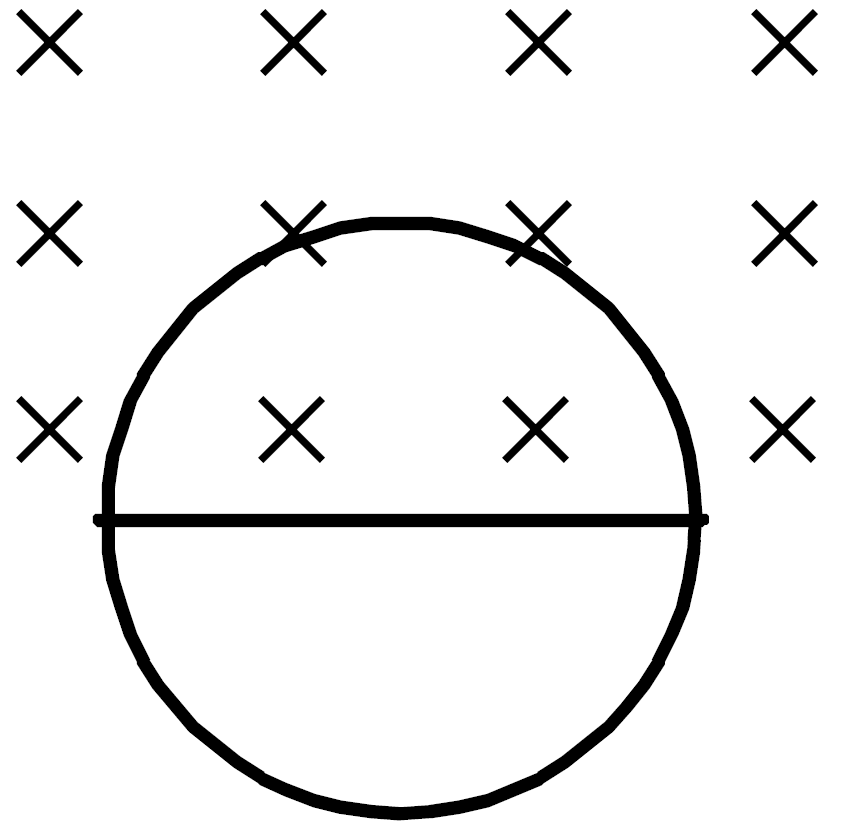
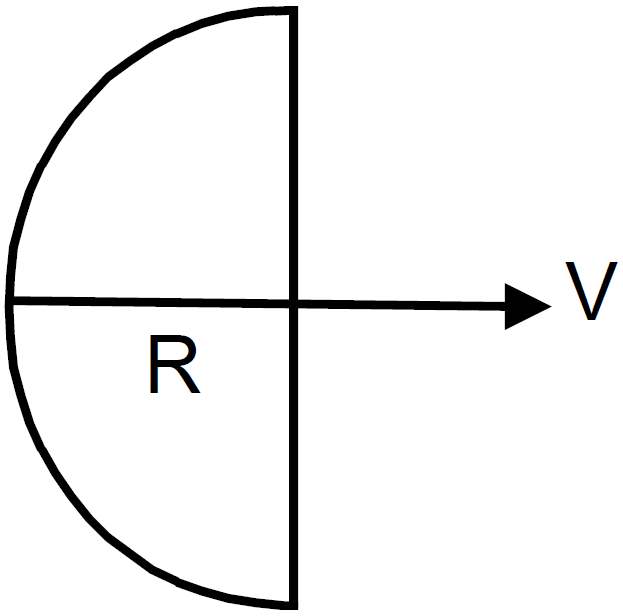
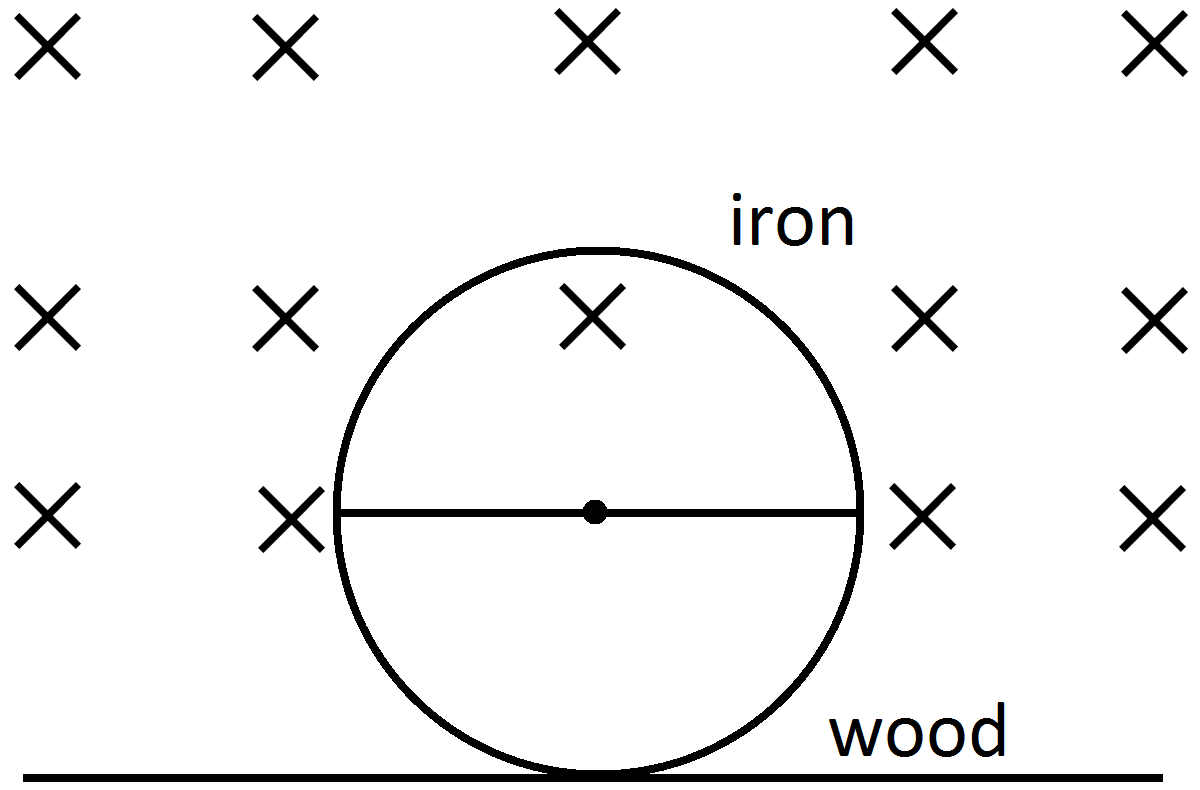
Figure shows a circular wheel of radius 10.0cm whose upper half, shown dark in the figure, is made of iron and the lower half of wood. The two junctions are joined by an iron rod. A uniform magnetic field B of magnitude $2.00 \times 10^{-4}\ T$ exists in the space above the central line as suggested by the figure. The wheel is set into pure rolling on the horizontal surface. If it takes 2.00 seconds for the iron part to come down and the wooden part to go up, find the average emf induced during this period.
Answer

$\phi_{1}=\text{BA},\phi_{2}=0$
$=\frac{2\times10^{-4}\times\pi(0.1)^2}{2}=\pi\times10^{-5}$
$\text{E}=\frac{\text{d}\phi}{\text{dt}}=\frac{\pi\times10^{-6}}{2}=1.57\times10^{-6}\text{V}$
View full question & answer
Question 32 Marks
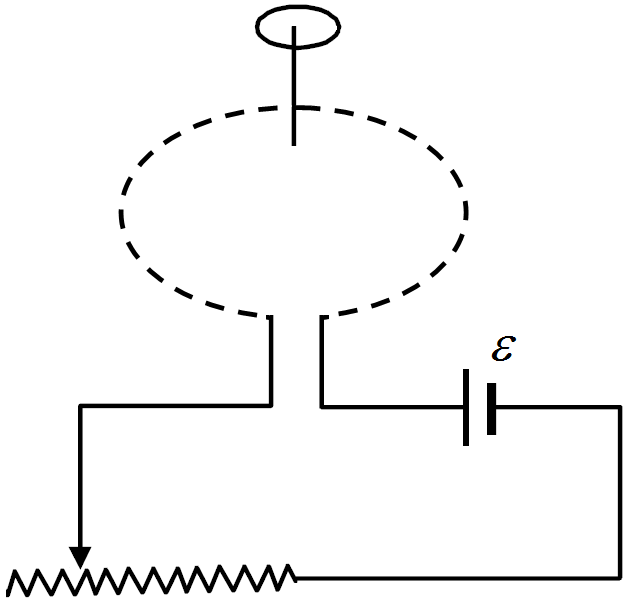
Find the mutual inductance between the circular coil and the loop shown in figure.
Answer
emf induced $=\frac{\pi\mu_0\text{Na}^2\text{a}'^2\text{ERV}}{2\text{L}(\text{a}^2+\text{x}^2)^{\frac{3}{2}}\Big(\frac{\text{R}}{\text{L}\text{x}}+\text{r}\Big)^2}$
$\frac{\text{dl}}{\text{dt}}=\frac{\text{ERV}}{\text{L}\Big(\frac{\text{Rx}}{\text{L}}+\text{r}\Big)^2}$
$\mu=\frac{\text{E}}{\frac{\text{di}}{\text{dt}}}=\frac{\text{N}\mu_0\pi\text{a}^2\text{a}'^2}{2(\text{a}^2+\text{x}^2)^{\frac{3}{2}}}$
View full question & answer
Question 42 Marks
Calculate the dimensions of:
  1. $\int\vec{\text{E}}.\vec{\text{dl}}.$
  2. $\text{vBl}$
  3. $\frac{\text{d}\psi_{\text{B}}}{\text{dt}}$
The symbols have their usual meanings.
Answer
  1. $\int\vec{\text{E}}.\vec{\text{dl}}=\text{ML}\text{T}^{-3}\text{l}^{-1}=\text{ML}^2\text{l}^{-1}\text{T}^{-3}$
  2. $\text{vBl}=\text{LT}^{-1}\times\text{Ml}^{-1}\text{T}^{-2}\times\text{L}=\text{ML}^2\text{l}^{-1}\text{T}^{-3}$
  3. $\frac{\text{d}\phi_{\text{B}}}{\text{dt}}=\text{Ml}^{-1}\text{T}^{-2}\times\text{L}^2=\text{ML}^2\text{l}^{-1}\text{T}^{-2}$
View full question & answer
Question 52 Marks
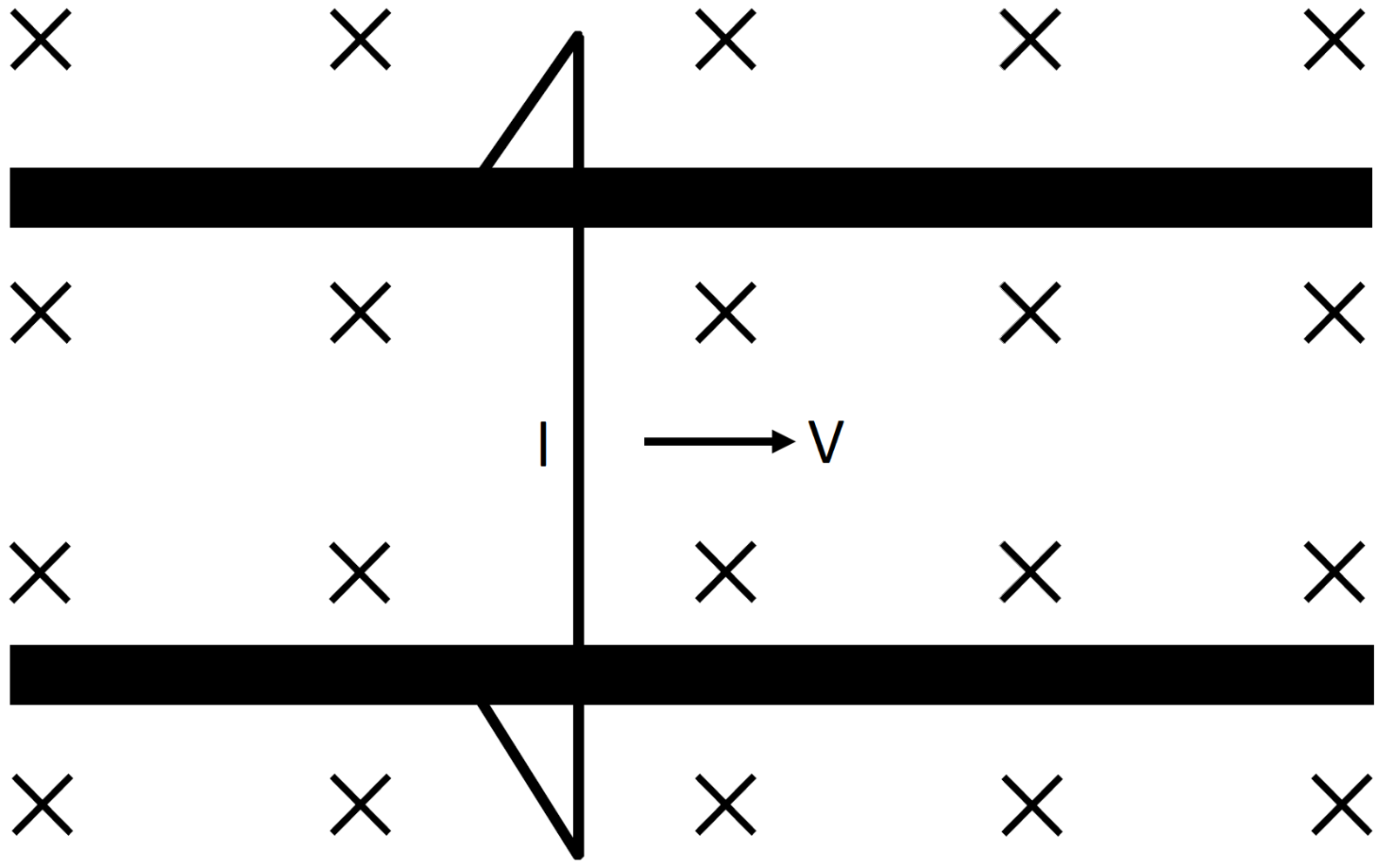
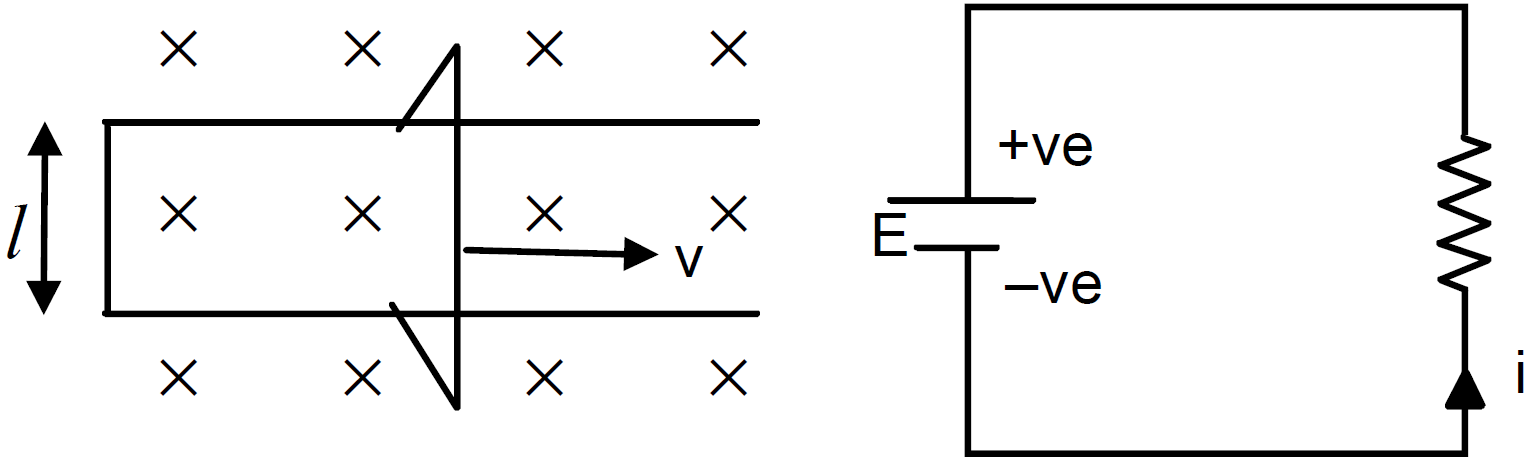
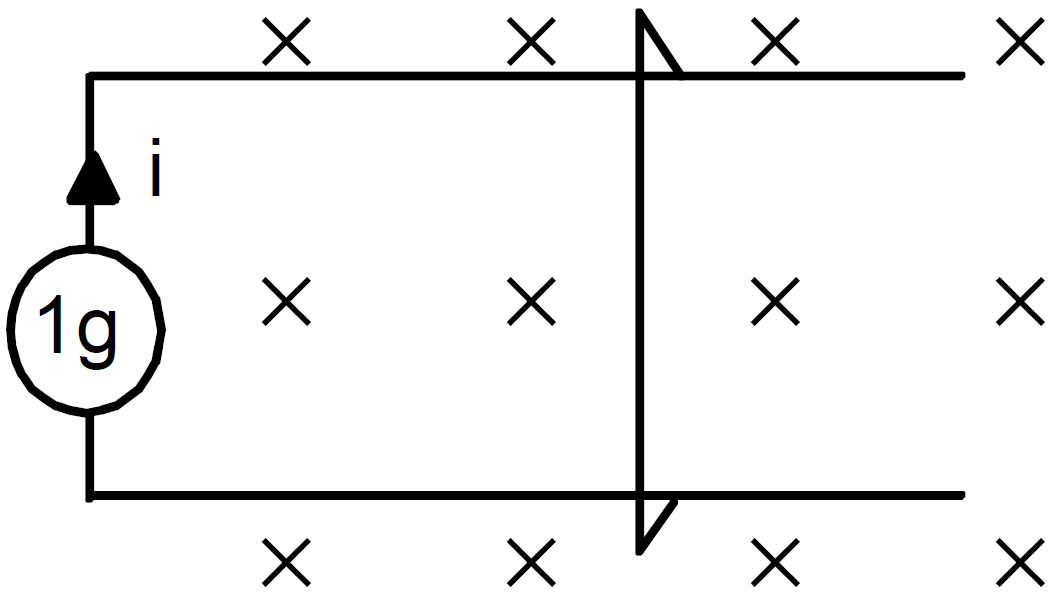
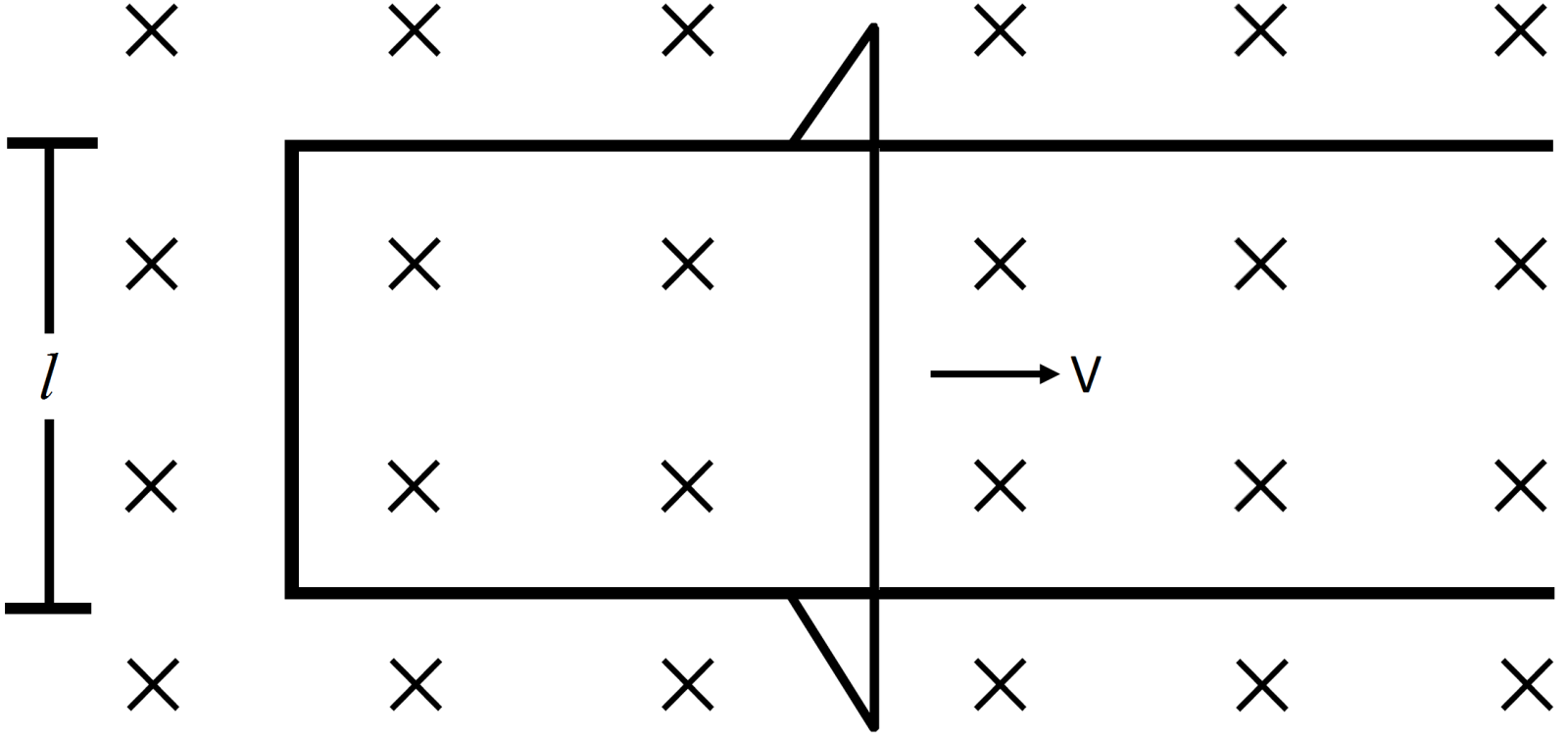
Figure shows a wire sliding on two parallel, conducting rails placed at a separation l. A magnetic field B exists in a direction perpendicular to the plane of the rails. What force is necessary to keep the wire moving at a constant velocity v?
Answer

$\mathrm{F_{magnetic} = ilB}$
This force produces an acceleration of the wire.
But since the velocity is given to be constant.
Hence net force acting on the wire must be zero.
View full question & answer
Question 62 Marks
The battery discussed in the previous question is suddenly disconnected. Is a current induced in the other loop? If yes, when does it start and when does it end? Do the loops attract each other or repel?
Answer
As the battery is disconnected the current starts decreasing in lop 1 and thus now direction of current is in opposite direction as it was earlier and it ends when both loops are in equilibrium.
View full question & answer
Question 72 Marks
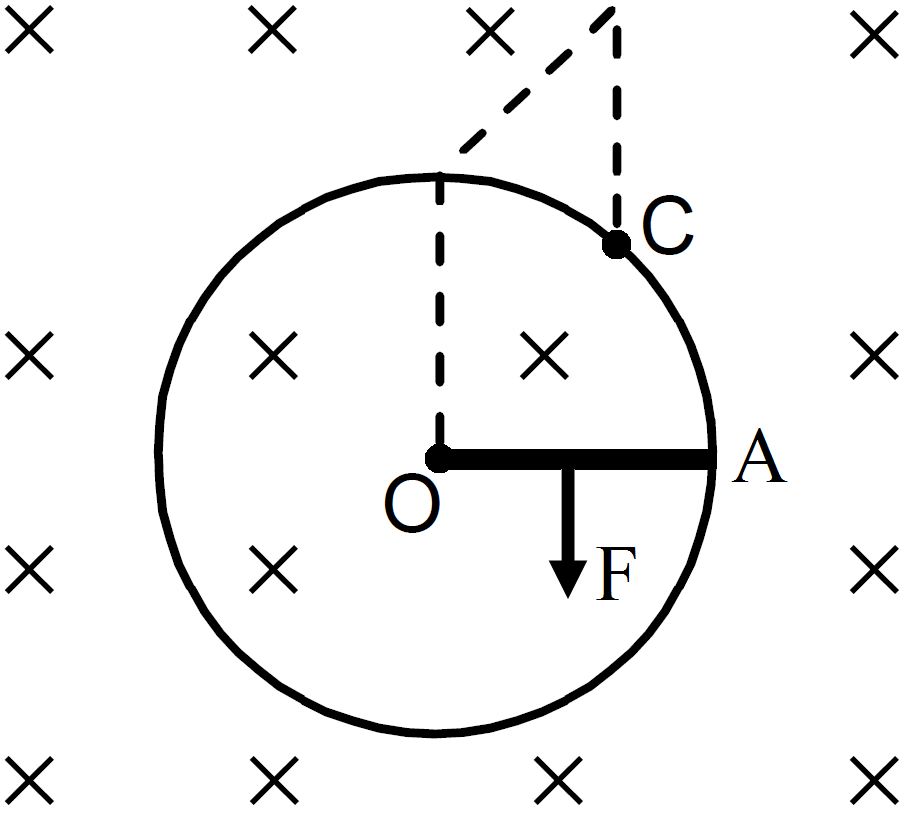
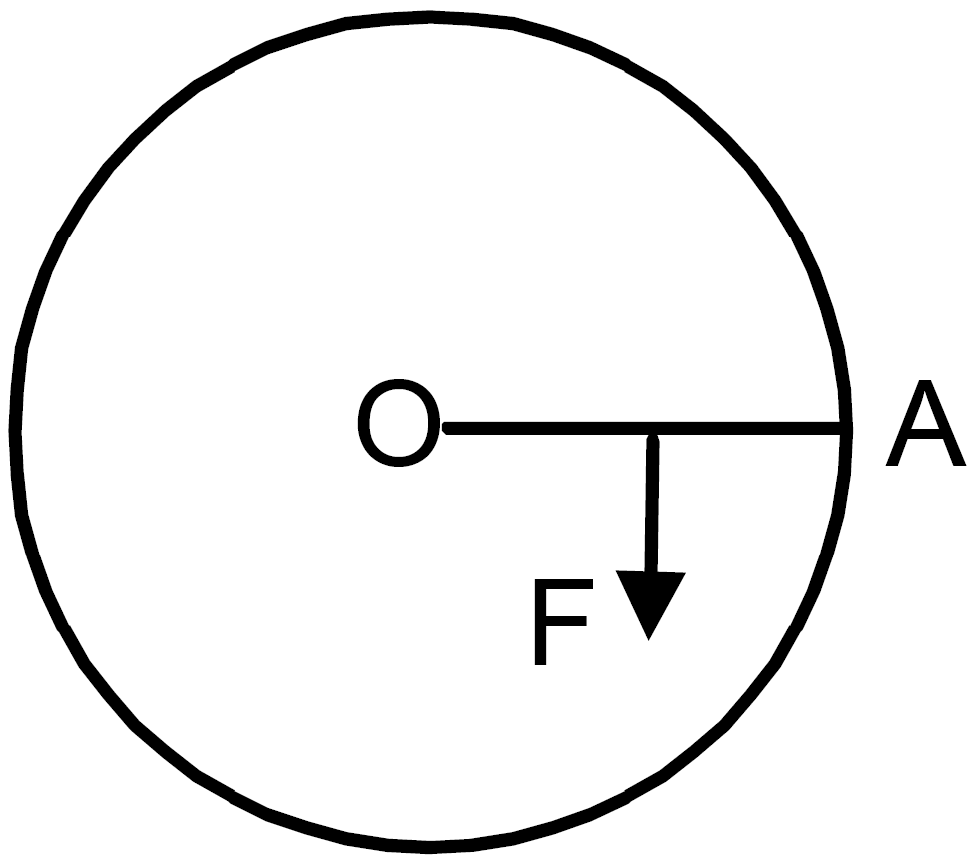
Figure shows a conducting circular loop of radius a placed in a uniform, perpendicular magnetic field B. A thick metal rod OA is pivoted at the centre O. The other end of the rod touches the loop at A. The centre O and a fixed point C on the loop are connected by a wire OC of resistance R. A force is applied at the middle point of the rod OA perpendicularly, so that the rod rotates clockwise at a uniform angular velocity $\omega.$ Find the force.
Answer

$\text{e}=\text{Bvl}=\frac{\text{B}\times\text{a}\times\omega\times\text{a}}{2}$
$\text{i}=\frac{\text{Ba}^2\omega}{2\text{R}}$
$\text{F}=\text{ilB}=\frac{\text{B}\text{a}^2\omega}{2\text{R}}\times\text{a}\times\text{B}=\frac{\text{B}^2\text{a}^2\omega}{2\text{R}}$ towards right of OA.
View full question & answer
Question 82 Marks
Consider a small cube of volume $1mm^3$ at the centre of a circular loop of radius 10cm carrying a current of 4A. Find the magnetic energy stored inside the cube.
Answer
Energy density $=\frac{\text{B}^2}{2\mu_0}$Total energy stored $=\frac{\text{B}^2\text{V}}{2\mu_0}=\frac{\big(\frac{\mu_0\text{i}}{2\text{r}}\big)^2}{2\mu_0}\text{V}=\frac{\mu_0\text{i}^2}{4\text{r}^2\times2}\text{V}$
$=\frac{4\pi\times10^{-7}\times4^2\times1\times10^{-9}}{4\times(10^{-1})^2\times2}=8\pi\times10^{-14} \text{J}.$
View full question & answer
Question 92 Marks
An inductor-coil carries a steady-state current of 2.0A when connected across an ideal battery of emf 4.0V. If its inductance is 1.0H, find the time constant of the circuit.
Answer
$\text{i}=2\text{A},\text{E}=4\text{V},\text{L}=1\text{H}$
$\text{R}=\frac{\text{E}}{\text{i}}=\frac{4}{2}=2$
$\text{i}=\frac{\text{L}}{\text{R}}=\frac{1}{2}=0.5$
View full question & answer
Question 102 Marks
An inductor is connected to a battery through a switch. Explain why the emf induced in the inductor is much larger when the switch is opened as compared to the emf induced when the switch is closed.
Answer
Due to self inductance the emf produced when circuit is open the growth of current in inductor is small but when switch is closed the decay in current is faster thus emf induced is more.
View full question & answer
Question 112 Marks
The two rails of a railway track, insulated from each other and from the ground, are connected to a millivoltmeter. What will be the reading of the millivoltmeter when a train travels on the track at a speed of $180km/h^{-1}?$ The vertical component of earth's magnetic field is $0.2 \times 10^{-4}$ T and the rails are separated by 1m.
Answer
$v = 180km/h = 50m/s$
$B = 0.2 \times 10^{-4}T, L = 1m$
$E = Bvl = 0.2I 10^{-4} \times 50 = 10^{-3}V$
$\therefore$ The voltmeter will record 1mv.
View full question & answer
Question 122 Marks
The coil of a moving-coil galvanometer keeps on oscillating for a long time if it is deflected and released. If the ends of the coil are connected together, the oscillation stops at once. Explain
Answer
When the ends are not connected the coil acts as inductor thus it undergoes inductance and keeps varying the current and keeps oscillating. But when ends are connected the coil is close loop thus there is no inductance.
View full question & answer
Question 132 Marks
A 10m wide spacecraft moves through the interstellar space at a speed $3 \times 10^7m/s^{-1}.$ A magnetic field $B = 3 \times 10^{-10}T$ exists in the space in a direction perpendicular to the plane of motion. Treating the spacecraft as a conductor, calculate the emf induced across its width.
Answer
$l = 10m, v = 3 \times 10^7m/s, B = 3 \times 10^{-10}T$
Motional emf = Bvl
$= 3 \times 10^{-10} \times 3 \times 10^7 \times 10$
$= 9 \times 10^{-3}= 0.09V$
View full question & answer
Question 142 Marks
A wire-loop confined in a plane is rotated in its own plane with some angular velocity. A uniform magnetic field exists in the region. Find the emf induced in the loop.
Answer
$\text{i}=\text{v}(\text{B}\times\text{l})$
$=\text{vBl}\cos\theta$
$\theta$ is angle between normal to plane and $\vec{\text{B}}=90^{\circ}$
$=\text{vBl}\cos90^{\circ}=0.$
View full question & answer
Question 152 Marks
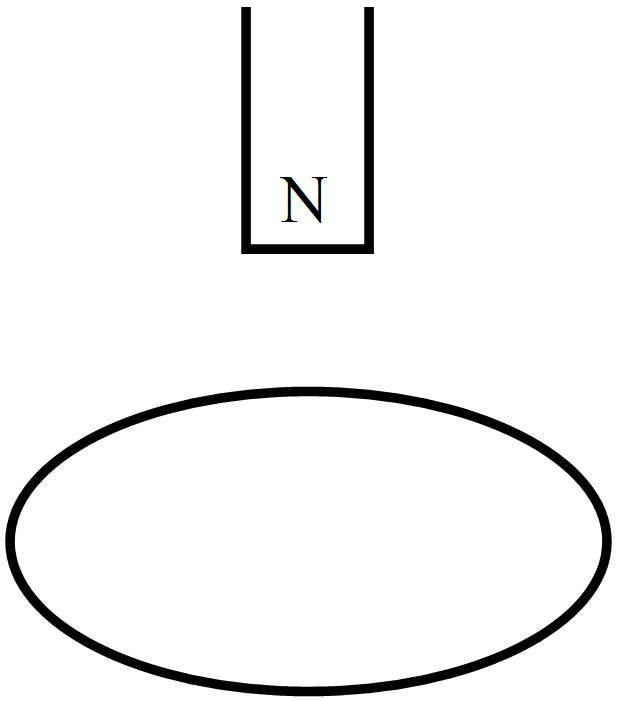
The north pole of a magnet is brought down along the axis of a horizontal circular coil. As a result, the flux through the coil changes from 0.35 weber to 0.86 weber in an interval of half a second. Find the average emf induced during this period. Is the induced current clockwise or anticlockwise as you look into the coil from the side of the magnet?
Answer
$\phi_1=0.35 \ \text{weber}, \ \phi_2=0.85 \ \text{weber}$
$\text{D}\phi=\phi_2=(0.85-0.35) \ \text{weber}=0.5 \ \text{weber}$
$\text{dt}=0.5\text{sec}$
$\text{E}=\frac{\text{d}\phi}{\text{dt}'}=\frac{0.5}{0.5}=1\text{V}$
The induced current is anticlockwise as seen from above.
View full question & answer
Question 162 Marks
Figure shows a long U-shaped wire of width l placed in a perpendicular magnetic field B. A wire of length l is slid on the U-shaped wire with a constant velocity v towards right. The resistance of all the wires is r per unit length. At t = 0, the sliding wire is close to the left edge of the U-shaped wire. Draw an equivalent circuit diagram, showing the induced emf as a battery. Calculate the current in the circuit.
Answer

$\text{E}=\text{Bvl}$
Resistance = r × total length
$=\text{r}\times2(\text{l}+\text{vt})=24(\text{l}+\text{vt})$
$\text{i}=\frac{\text{Bvl}}{2\text{r}(\text{l}+\text{vt})}$
View full question & answer
Question 172 Marks
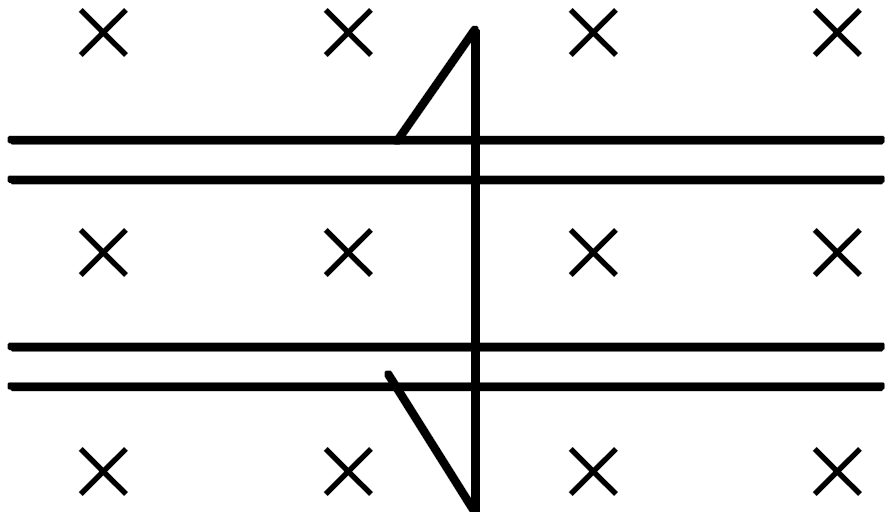
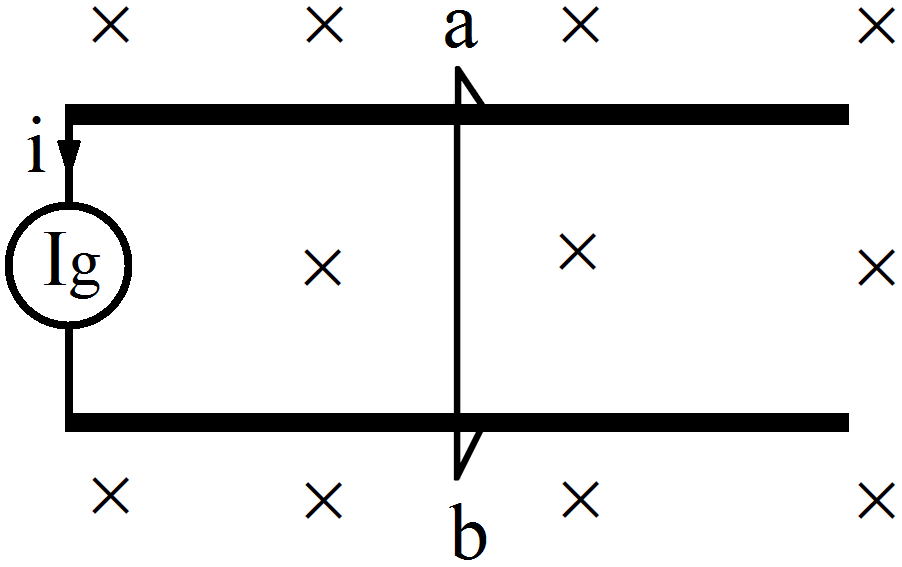
The current generator $I_g$ shown in figure, sends a constant current i through the circuit. The wire ab has a length l and mass m and can slide on the smooth, horizontal rails connected to $I_g.$  The entire system lies in a vertical magnetic field B. Find the velocity of the wire as a function of time.
Answer

Force on the wire $=\text{ilB}$
Acceleration $=\frac{\text{ilB}}{\text{m}}$
Velocity $=\frac{\text{ilBt}}{\text{m}}$
View full question & answer
Question 182 Marks
The mutual inductance between two coils is 2.5H. If the current in one coil is changed at the rate of 1A/s, what will be the emf induced in the other coil?
Answer
$\text{M}=2.5\text{H}$
$\frac{\text{dl}}{\text{dt}}=\frac{\text{lA}}{\text{s}}$
$\text{E}=-\mu\frac{\text{dl}}{\text{dt}}$
$\Rightarrow\text{E}=2.5\times1=2.5\text{V}$
View full question & answer
Question 192 Marks
A conducting loop of face-area A and resistance R is placed perpendicular to a magnetic field B. The loop is withdrawn completely from the field. Find the charge which flows through any cross-section of the wire in the process. Note that it is independent of the shape of the loop as well as the way it is withdrawn.
Answer
Area = A, Resistance = R, B = Magnetic field
$\phi=\text{BA}=\text{Ba}\cos0^{\circ}=\text{BA}$
$\text{e}=\frac{\text{d}\phi}{\text{dt}}=\frac{\text{BA}}{1};\text{i}=\frac {\text{e}}{\text{R}}=\frac{\text{BA}}{\text{R}}$
$\phi=\text{iT}=\frac{\text{BA}}{\text{R}}$
View full question & answer
Question 202 Marks
Metallic (nonferromagnetic) and nonmetallic particles in a solid waste may be separated as follows. The waste is allowed to slide down an incline over permanent magnets. The metallic particles slow down as compared to the norunetallic ones and hence are separated. Discuss the role of eddy currents in the process.
Answer
As the metallic particle slide over permanent magnet they are attracted towards magnet due to formation of eddy current on the metallic body and thus they slow down and are separated from rest of material.
View full question & answer
Question 212 Marks
A conducting circular loop having a radius of 5.0cm, is placed perpendicular to a magnetic field of 0.50T. It is removed from the field in 0.50s. Find the average emf produced in the loop during this time.
Answer
$\phi_1=\text{BA}=0.5\times\pi(5\times10^{-2})^2=5\pi25\times10^{-5}=125\times10^{-5}$
$\phi_2=0$
$\text{E}=\frac{\phi_1-\phi_2}{\text{t}}=\frac{125\pi\times10^{-5}}{5\times10^{-1}}=25\pi\times10^{-4}=7.8\times10^{-3}$
View full question & answer
Question 222 Marks
A conducting disc of radius r rotates with a small but constant angular velocity $\omega$ about its axis. A uniform magnetic field B exists parallel to the axis of rotation. Find the motional emf between the centre and the periphery of the disc.
Answer

V at a distance $\frac{\text{r}}{2}$
From the centre $=\frac{\text{r}\omega}{2}$
$\text{E}=\text{BlV}$
$\Rightarrow\text{E}=\text{B}\times\text{r}\times\frac{\text{r}\omega}{2}=\frac{1}{2}\text{B}\text{r}^2\omega$
View full question & answer
Question 232 Marks
A conducting circular loop of area $1mm^2$ is placed coplanarly with a long, straight wire at a distance of 20cm from it. The straight wire carries an electric current which changes from 10A to zero in 0.1s. Find the average emf induced in the loop in 0.1s.
Answer
$\text{A}=1\text{mm}^2; \ \text{i}=10\text{A}, \ \text{d}=20\text{cm}; \ \text{dt}=0.1\text{s}$
$\text{e}=\frac{\text{d}\phi}{\text{dt}}=\frac{\text{BA}}{\text{dt}}=\frac{\mu_0\text{i}}{2\pi\text{d}}\times\frac{\text{A}}{\text{dt}}$
$=\frac{4\pi\times10^{-7}\times10}{2\pi\times2\times10^{-1}}\times\frac{10^{-6}}{1\times10^{-1}}=1\times10^{-10}\text{V}$
View full question & answer
Question 242 Marks
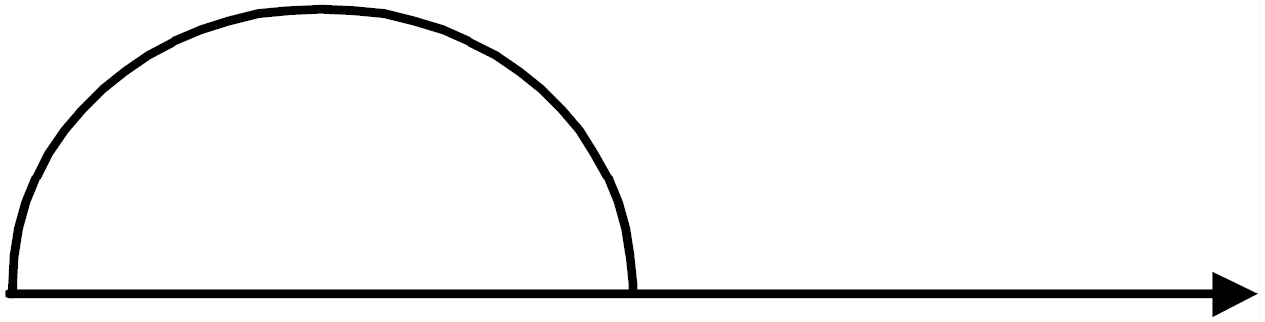
A copper wire bent in the shape of a semicircle of radius r translates in its plane with a constant velocity v. A uniform magnetic field B exists in the direction perpendicular to the plane of the wire. Find the emf induced between the ends of the wire if:
  1. The velocity is perpendicular to the diameter joining free ends.
  2. The velocity is parallel to this diameter.
Answer
  1. Component of length moving perpendicular to V is 2R
$\therefore$ E = Bv2R
  1. Component of length perpendicular to velocity = 0
$\therefore$ E = 0
View full question & answer
Question 252 Marks
An inductor-coil of inductance 17mH is constructed from r wire of length 100m and cross-sectional area a copper wire of length 100m and cross-sectional area $1mm^2$. Calculate the time constant of the circuit if this inductor is joined across an ideal battery. The resistivity of copper $=1.7\times10^{-8}\Omega-\text{m}.$
Answer
$\text{L}=17\text{mH}, \ \text{l}=100\text{m}, \ \text{A}=1\text{mm}^2$
$=1\times10^{-6}\text{m}^2, \ \text{f}_{\text{cu}}=1.7\times10^{-8}\Omega-\text{m}$
$\text{R}=\frac{\text{f}_\text{cu}\text{l}}{\text{A}}=\frac{1.7\times10^{-8}\times100}{1\times10^{-6}}=1.7 \Omega$
$\text{i}=\frac{\text{L}}{\text{R}}=\frac{0.17\times10^{-8}}{1.7}=10^{-2} \text{ sec}=10 \ \text{m} \ \text{sec}.$
View full question & answer
Question 262 Marks
A pivoted aluminium bar falls much more slowly through a small region containing a magnetic field than a similar bar of an insulating material. Explain.
Answer
Aluminum rod while falling will experience magnetic field and thus it will induce some eddy currents in it and thus it will feel some attraction towards magnetic field and thus it will fall slow as compared to insulating material.
View full question & answer