Questions

5 Marks Questions

Take a timed test

25 questions · self-marked practice — reveal the answer and mark yourself.

Question 15 Marks
Answer the following question:
Some scientists have predicted that a global nuclear war on the earth would be followed by a severe ‘nuclear winter’ with a devastating effect on life on earth. What might be the basis of this prediction?
Answer
A global nuclear war on the surface of the Earth would have disastrous consequences. Post - nuclear war, the Earth will experience severe winter as the war will produce clouds of smoke that would cover maximum parts of the sky, thereby preventing solar light form reaching the atmosphere. Also, it will lead to the depletion of the ozone layer.
View full question & answer
Question 25 Marks
In a plane electromagnetic wave, the electric field oscillates sinusoidally at a frequency of $2.0 \times 10^{10} $Hz and amplitude $48\ V\ m^{-1}.$
  1. What is the wavelength of the wave?
  2. What is the amplitude of the oscillating magnetic field?
  3. Show that the average energy density of the E field equals the average energy density of the B field. $[c = 3 \times 10^8\ m\ s^{-1}.]$
Answer
Frequency of the electromagnetic wave, $ν = 2.0 \times 10^{10} Hz$
Electric field amplitude, $E_0 = 48 V m^{-1}$
Speed of light, $c = 3 \times 10^8 m/ s$​​​​​​​
  1. Wavelength of a wave is given as:
$\lambda=\frac{\text{c}}{\text{v}}$
$=\frac{3\times10^8}{2\times10^{10}}=0.015 \ \text{m}$
  1. Magnetic field strength is given as:
$\text{B}_0=\frac{\text{E}_0}{\text{c}}$
$=\frac{48}{3\times10^{8}}=1.6\times10^{-7}\ \text{T}$
  1. Energy density of the electric field is given as:
$\text{U}_E=\frac{1}{2}\in_0\text{E}^2$
And, energy density of the magnetic field is given as:
$\text{U}_\text{B}=\frac{1}{2\mu_0}\text{B}^2$
Where, $\in_0$ = Permittivity of free space
$\mu_0$ = Permeability of free space
We have the relation connecting E and B as:
E = cB … (1)
Where,
$\text{c}=\frac{1}{\sqrt{\in_0 \ \mu_0}}\dots(2)$
Putting equation (2) in equation (1), we get
$\text{E}=\frac{1}{\sqrt{\in_0 \ \mu_0}}\text{B}$
Squaring both sides, we get
$\text{E}^2=\frac{1}{\in_0\ \mu_0}\text{B}^2$
$\in_0\text{E}^2=\frac{\text{B}^2}{\mu_0}$
$\frac{1}{2}\in_0\text{E}^2=\frac{1}{2}\frac{\text{B}^2}{\mu_0}$
$\Rightarrow \ \text{U}_\text{E}=\text{U}_\text{B}$
View full question & answer
Question 35 Marks
The terminology of different parts of the electromagnetic spectrum is given in the text. Use the formula E = hν (for energy of a quantum of radiation: photon) and obtain the photon energy in units of eV for different parts of the electromagnetic spectrum. In what way are the different scales of photon energies that you obtain related to the sources of electromagnetic radiation?
Answer
Energy of a photon is given as:
$\text{E}=\text{hv}=\frac{\text{hc}}{\lambda}$
Where, h = Planck’s constant $= 6.6 \times 10^{-34} Js$
c = Speed of light $= 3 \times 10^8 m/s \lambda =$ Wavelength of radiation
$\therefore=\frac{6.6\times10^{-34}\times3\times10^8}{\lambda}=\frac{19.8\times10^{-26}}{\lambda}\text{J}$
$=\frac{19.8\times10^{-26}}{\lambda\times1.6\times10^{-19}}=\frac{12.375\times10^{-7}}{\lambda}\text{eV}$
The given table lists the photon energies for different parts of an electromagnetic spectrum for different λ.
$\lambda(\text{m})$ $10^3$ 1 $10^{-3}$ $10^{-6}$​​​​​​​ $10^{-8}$​​​​​​​ $10^{-10}$​​​​​​​ $10^{-12}$
E (ev) $12.375 \times 10^{-10}$​​​​​​​ $12.375 \times 10^{-7}$ $12.375 \times 10^{-4}$ $12.375 \times 10^{-1}$ $12.375 \times 10^1$ $12.375 \times 10^3$ $12.375 \times 10^5$​​​​​​​
The photon energies for the different parts of the spectrum of a source indicate the spacing of the relevant energy levels of the source.
View full question & answer
Question 45 Marks
Answer the following question:
If the earth did not have an atmosphere, would its average surface temperature be higher or lower than what it is now?
Answer
In the absence of an atmosphere, there would be no greenhouse effect on the surface of the Earth. As a result, the temperature of the Earth would decrease rapidly, making it chilly and difficult for human survival.
View full question & answer
Question 55 Marks
Suppose that the electric field amplitude of an electromagnetic wave is $E_0 = 120$ N/C and that its frequency is $ν = 50.0 $ MHz. (a) Determine, $B_0, ω, k$, and \lambda . (b) Find expressions for E and B.
Answer
Electric field amplitude, $E_0 = 120$ N/C
Frequency of source, $ν = 50.0$ MHz $= 50 \times 10^6$ Hz
Speed of light, $c = 3 \times 10^8 m/s$​​​​​​​
  1. Magnitude of magnetic field strength is given as:
$\text{B}_0=\frac{\text{E}_0}{\text{c}}$
$=\frac{120}{3\times10^8}$
$=4\times10^{-7}\text{T}=400 \ \text{nT}$
Angular frequency of source is given as:
$\omega=2\text{nv}=2\text{n}\times50\times10^6$
$=3.14\times10^8 \ \text{rad}/ \text{m}$
Propagation constant is given as:
$\text{k}=\frac{\omega}{\text{c}}$
$=\frac{3.14\times10^8}{3\times10^8}=1.05 \ \text{red}/\text{m}$
Wavelength of wave is given as:
$\lambda=\frac{\text{c}}{\text{v}}$
$=\frac{3\times10^8}{50\times10^6}=6.0 \ \text{m}$
  1. Suppose the wave is propagating in the positive x direction. Then, the electric field vector will be in the positive y direction and the magnetic field vector will be in the positive z direction. This is because all three vectors are mutually perpendicular.
Equation of electric field vector is given as:
$\vec{\text{E}}=\text{E}_0\sin(\text{kx}-\omega\text{t})\hat{\text{j}}$
$=120\sin[1.05\text{x}-3.14\times10^8\text{t}]\hat{\text{j}}$
And, magnetic field vector is given as:
$\vec{\text{B}}=\text{B}_0\sin(\text{kx}-\omega\text{t})\hat{\text{k}}$
$\vec{\text{B}}=\Big(4\times10^{-7}\Big)\sin\Big[1.05\text{x}-3.14\times10^8\text{t}\Big]\hat{\text{k}}$
View full question & answer
Question 65 Marks
Answer the following question:
The small ozone layer on top of the stratosphere is crucial for human survival. Why?
Answer
The small ozone layer on the top of the atmosphere is crucial for human survival because it absorbs harmful ultraviolet radiations present in sunlight and prevents it from reaching the Earth's surface.
View full question & answer
Question 75 Marks
Answer the following question:
Optical and radiotelescopes are built on the ground but X - ray astronomy is possible only from satellites orbiting the earth. Why?
Answer
With reference to X - ray astronomy, X - rays are absorbed by the atmosphere. However, visible and radio waves can penetrate it. Hence, optical and radio telescopes are built on the ground, while X - ray astronomy is possible only with the help of satellites orbiting the Earth.
View full question & answer
Question 85 Marks
The amplitude of the magnetic field part of a harmonic electromagnetic wave in vacuum is $B_0 = 510$ nT. What is the amplitude of the electric field part of the wave?
Answer
Amplitude of magnetic field of an electromagnetic wave in a vacuum,
$B_0 = 510 nT = 510 \times 10^{-9} T$
Speed of light in a vacuum, $c = 3 \times 10^8 m/s$
Amplitude of electric field of the electromagnetic wave is given by the relation,
$E = cB_0 = 3 \times 10^8 \times 510 \times 10^{-9} = 153 N/C$
Therefore, the electric field part of the wave is 153 N/C.
View full question & answer
Question 95 Marks
Answer the following question:
It is necessary to use satellites for long distance TV transmission. Why?
Answer
It is necessary to use satellites for long distance TV transmissions because television signals are of high frequencies and high energies. Thus, these signals are not reflected by the ionosphere. Hence, satellites are helpful in reflecting TV signals. Also, they help in long distance TV transmissions.
View full question & answer
Question 105 Marks
A charged particle oscillates about its mean equilibrium position with a frequency of $10^9 $ Hz. What is the frequency of the electromagnetic waves produced by the oscillator?
Answer
The frequency of an electromagnetic wave produced by the oscillator is the same as that of a charged particle oscillating about its mean position i.e., $10^9 $Hz.
View full question & answer
Question 115 Marks
A radio can tune in to any station in the 7.5 MHz to 12 MHz band. What is the corresponding wavelength band?
Answer
A radio can tune to minimum frequency, $ν_1 = 7.5$ MHz $= 7.5 \times 10^6$ Hz
Maximum frequency, $ν_2 = 12$ MHz $= 12 \times 10^6$ Hz
Speed of light,$ c = 3 \times 10^8$ m/s
Corresponding wavelength for $ν_1$ can be calculated as:
$\lambda_1=\frac{\text{c}}{\text{v}_1}$
$=\frac{3\times10^8}{7.5\times10^6}=40 \ \text{m}$
Corresponding wavelength for $ν_2$ can be calculated as:
$\lambda_2=\frac{\text{c}}{\text{v}_2}$
$=\frac{3\times10^8}{12\times10^6}=25 \ \text{m}$
Thus, the wavelength band of the radio is 40 m to 25 m.
View full question & answer
Question 125 Marks
Answer the following question:
Long distance radio broadcasts use short-wave bands. Why?
Answer
Long distance radio broadcasts use shortwave bands because only these bands can be refracted by the ionosphere.
View full question & answer
Question 135 Marks
A plane electromagnetic wave travels in vacuum along z - direction. What can you say about the directions of its electric and magnetic field vectors? If the frequency of the wave is 30 MHz, what is its wavelength?
Answer
The electromagnetic wave travels in a vacuum along the z-direction. The electric field (E) and the magnetic field (H) are in the x - y plane. They are mutually perpendicular. Frequency of the wave, $ν = 30$ $MH_z = 30 \times 10^6 s^{-1}$​​​​​​​
Speed of light in a vacuum, $c = 3 \times 10^8$ m/s Wavelength
of a wave is given as:
$\lambda=\frac{\text{c}}{\text{v}}$
$=\frac{3\times10^8}{30\times10^6}=10 \ \text{m}$
View full question & answer
Question 145 Marks
Given below are some famous numbers associated with electromagnetic radiations in different contexts in physics. State the part of the electromagnetic spectrum to which each belongs.
  1. 21 cm (wavelength emitted by atomic hydrogen in interstellar space).
  2. 1057 MHz (frequency of radiation arising from two close energy levels in hydrogen; known as Lamb shift).
  3. 2.7 K [temperature associated with the isotropic radiation filling all space-thought to be a relic of the ‘big-bang’ origin of the universe].
  4. 5890 Å - 5896 Å [double lines of sodium]
  5. 14.4 keV [energy of a particular transition in $^{57}Fe$ nucleus associated with a famous high resolution spectroscopic method (Mössbauer spectroscopy)].
Answer
  1. Radio waves; it belongs to the short wavelength end of the electromagnetic spectrum.
  2. Radio waves; it belongs to the short wavelength end.
  3. Temperature, T = 2.7 °K
$\lambda_\text{m}$ is given by Planck's law as:
$\lambda_\text{m}=\frac{0.29}{2.7}=0.11 \ \text{cm}$
This wavelength corresponds to microwaves.
  1. This is the yellow light of the visible spectrum.
  2. Transition energy is given by the relation,
E = hv
Where,
h = Planck's constant $= 6.6 \times 10^{-34}$ Js
v = Frequency of radiation
Energy, E = 14.4 K eV
$\therefore \ \text{v}=\frac{\text{E}}{\text{h}}$
$=\frac{14.4\times10^3\times1.6\times10^{-19}}{6.6\times10{-34}}$
$= 3.4 \times 10^{18}$ Hz
This corresponds to X-rays.
View full question & answer
Question 155 Marks
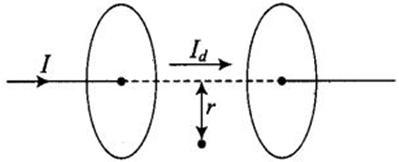
Show that the magnetic field B at a point in between the plates of a parallel-plate capacitor during charging is $\frac{\in_0{\mu}_\text{r}}{2}\frac{\text{dE}}{\text{dt}}$ (symbols having usual meaning).
Answer
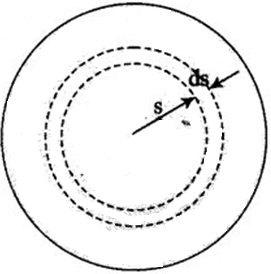
Let us assume $I_d $ be the displacement current in the region between two plates of parallel plate capacitor, in the figure.

The magnetic field at a point between two plates of capacitor at a perpendicular distance r from the axis of paltes is given by
$\text{B}=\frac{\mu_02\text{I}_\text{d}}{4\pi\text{r}}=\frac{\mu_0}{2\pi\text{r}}\text{I}_\text{d}=\frac{\mu_0}{2\pi\text{r}}\in_\text{r}\frac{\text{d}\phi_\text{E}}{\text{dt}} \ \ \bigg[\because \text{I}_\text{d}=\frac{\text{E}_0\text{d}\phi_\text{E}}{\text{dt}}\bigg]$
$\Rightarrow\ \text{B}=\frac{\mu_0\in_\text{r}}{2\pi\text{r}}\frac{\text{d}}{\text{dt}}(\text{E}\pi\text{r}^2)=\frac{\mu_0\in_\text{r}}{2\pi\text{r}}\pi\text{r}^2\frac{\text{dF}}{\text{dt}}$
$\Rightarrow\ \text{B}=\frac{\mu_0\in_\text{r}}{2}\frac{\text{dE}}{\text{dt}} \ \ \big[\because\ \phi_\text{E}=\text{E}\pi\text{r}^2\big]$
View full question & answer
Question 165 Marks
The intensity of the sunlight reaching Earth is $1380$Wm$^{-2}$. Assume this light to be a plane, monochromatic wave. Find the amplitudes of electric and magnetic fields in this wave.
Answer
Intensity of wave $=\frac{1}{2}\in_0\text{E}^2_0\text{C}$
$\in_0=8.85\times10^{-12},\text{ E}_0=?,\text{ C}=3\times10^{8},\text{ I}=1380\text{W/m}^2$
$1380=\frac{1}{2\times8.85\times10^{-12}\times\text{E}^2_0\times3\times10^8}$
$\text{E}^2_0=\frac{2\times1380}{8.85\times3\times10^{-4}}=103.95\times10^4$
$\text{E}_0=10.195\times10^{2}=1.02\times10^3$
$\text{E}_0=\text{B}_0\text{C}$
$\text{B}_0=\frac{\text{E}_0}{\text{C}}$
$\text{B}_0=\frac{1.02\times10^3}{3\times10^8}$
$\text{B}_0=3.398\times10^{-5}$
$\text{B}_0=3.4\times10^{-5}\text{T}$
View full question & answer
Question 175 Marks
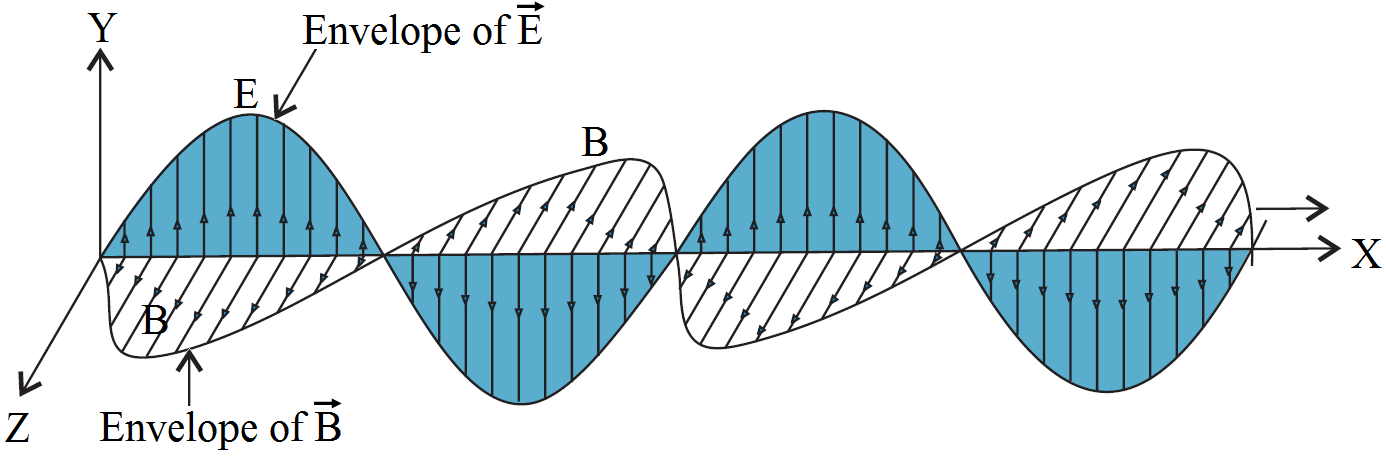
What is meant by the transverse nature of electromagnetic waves? Draw a diagram showing the propagation of an electromagnetic wave along X-direction, indicating clearly the directions of oscillating electric and magnetic fields associated with it.
Answer
Transverse Nature of Electromagnetic Waves: In an electromagnetic wave, the electric and magnetic field vectors oscillate, perpendicular to the direction of propagation of wave. This is called transverse nature of electromagnetic wave. In an electromagnetic wave, the three vectors $\vec{\text{E}},\vec{\text{B}}$ and $\vec{\text{K}}$ form a right handed system. Accordingly if a wave is propagating along X-axis, the electric field vector oscillates along Y-axis and magnetic field vector oscillates along Z-axis. Diagram is shown in figure.
View full question & answer
Question 185 Marks
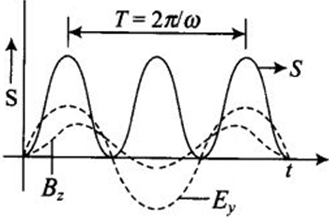
Poynting vectors S is defined as a vector whose magnitude is equal to the wave intensity and whose direction is along the direction of wave propogation. Mathematically, it is given by $\text{S}=\frac{1}{\mu_0}\text{E}\times\text{B}$. Show the nature of S vs t graph.
Answer
In an electromagnetic waves, let $\vec{\text{E}}$ be varying along y-axis, $\vec{\text{B}}$ is along z-axis and propagation of wave be along x-axis. Then $\vec{\text{E}}\times\vec{\text{B}}$ will tell the direction of propagation of energy flow in eletromagnetic wave, along x-axis.
Let $\vec{\text{E}}=\text{E}_0\sin(\omega\text{t}-\text{kx})\hat{\text{j}}$
$\vec{\text{B}}=\text{B}_0\sin(\omega\text{t}-\text{kx})\hat{\text{k}}$
$\text{S}=\frac{1}{\mu_0}(\vec{\text{E}}\times\vec{\text{B}})=\frac{1}{\mu_0}\text{E}_0\text{B}_0\sin(\omega\text{t}-\text{kx})(\hat{\text{j}}\times\hat{\text{k}})$
$\Rightarrow\ \text{S}=\frac{\text{E}_0\text{B}_0}{\mu_0}\sin^2(\omega\text{t}-\text{kx})\hat{\text{i}}\ \ (\text{As}\ \hat{\text{j}}\times\hat{\text{k}}=\hat{\text{i}})$
Since $\sin^2(\omega\text{t}-\text{kx})$ is never negative, $\vec{\text{S}}(\text{x},\text{t})$ always points in the positive X-direction, i.e, in the direction of wave propagation.
The variation of |S| with time T will be as given in the figure below:
View full question & answer
Question 195 Marks
Electromagnetic waves with wavelength:
  1. $\lambda _1$ is used in satellite communication.
  2. $\lambda _2$ is used to kill germs in water purifies.
  3. $\lambda _3$ is used to detect leakage of oil in underground pipelines.
  4. $\lambda _4$ is used to improve visibility in runways during fog and mist conditions.
  1. Identify and name the part of electromagnetic spectrum to which these radiations belong.
  2. Arrange these wavelengths in ascending order of their magnitude.
  3. Write one more application of each.
Answer
  1.  
  1. In satellite communications, microwave is widely used. Hence $\lambda _1$, is the wavelength of microwave.
  2. In water purifier, ultraviolet rays are used to kill germs. So,$ \lambda _2$ is the wavelength of UV rays.
  3. X-rays are used to detect leakage of oil in underground pipelines. So,$ \lambda _3$ is the
  4. wavelength of X-rays.
  5. Infrared rays are used to improve visibility on runways during fog and mist conditions. So, it is the wavelength of infrared waves.
  1. Wavelength of X-rays < wavelength of UV < wavelength of infrared < wavelength of microwave.
$\Rightarrow\ \lambda_3<\lambda_2<\lambda_4<\lambda_1$
  1. Radiation Uses
    $\gamma-\text{rays}$ Givens informations on nuclear structure, medical treatment etc.
    X-rays Medical diagnosis and treatment study of crystal structure, inductrial radiograph.
    UV-rays Preserce food, sterlizing the surgical instruments, detecting the invisible writings, finger prints etc.
    Visible light To see objects.
    Infrated rays To treat, muscular strain for taking photogtaphy during the fog, haze etc.
    Micro wave and radio wave In radar and telecommunication.
View full question & answer
Question 205 Marks
A plane EM wave travelling along z direction is described by $\text{E}=\text{E}_0\sin(\text{kz}-\omega\text{t})\hat{\text{i}}\text{ and }\text{B}=\text{B}_0\sin(\text{kz}-\omega\text{t})\hat{\text{j}}$. Show that,
  1. The average energy density of the wave is given $\text{u}_\text{av}=\frac{1}{4}\in_0\text{E}_0^2+\frac{1}{4}\frac{\text{B}_0^2}{\mu_0}$.
  2. The time averaged intensity of the wave is given $\text{I}_\text{av}=\frac{1}{2}\text{c}\in_0\text{E}_0^2$.
Answer
  1. Total energy carried by electromagnetic wave is due to electric field vector and magnetic field vector. In electromagnetic wave, E and B vary from point to point and from moment to moment.
The energy density due to electric field E is
$\text{u}_\text{E}=\frac{1}{2}\in_0\text{E}^2$
The enerrgy density due to magnetic field B is
$\text{u}_\text{B}=\frac{1}{2}\frac{\text{B}^2}{\mu_0}$
Total energy density of electromagnetic wave
$\text{u}=\text{u}_\text{E}+\text{u}_\text{B}=\frac{1}{2}\in_0\text{E}^2+\frac{1}{2}\frac{\text{B}^2}{\mu_0}$
Let the EM wave be propagatine along z-direction. The electric field moment. Hence, the effective values of $E^2$ and $B^2$ are their time averages over complete cycle.
We know, $\langle\sin^2\theta\rangle=\frac{\int\limits_0^{2\pi}\sin^2\theta\text{d}\theta}{2\pi}=\frac{1}{2}$
and $\langle\cos^2\theta\rangle=\frac{\int\limits_0^{2\pi}\cos^2\theta\text{d}\theta}{2\pi}=\frac{1}{2}$
Hence, the time average value of $E^2$ over complete cycle,
$\langle\text{E}^2\rangle=\frac{\int\limits_0^\text{T}[\text{E}_0\sin(\text{kz}-\omega\text{t})]^2\text{dt}}{\text{T}}=\frac{\text{E}_0^2}{2}$
And, the time average value of $B^2$ over complere cycle,
$\langle\text{B}^2\rangle=\frac{\int\limits_0^\text{T}[\text{B}_0\sin(\text{kz}-\omega\text{t})]^2\text{dt}}{\text{T}}=\frac{\text{B}_0^2}{2}$
The time average of energy density over complere cycle
$\text{u}_\text{av}=\frac{1}{2}\frac{\in_0\text{E}_0^2}{2}+\frac{1}{2}\mu_0\Big(\frac{\text{B}_0^2}{2}\Big)$
$\Rightarrow\ \text{u}_\text{av}=\frac{1}{4}\in_0\text{E}_0^2+\frac{1}{4}\frac{\text{B}_0^2}{\mu_0}$
  1. We know $\text{c}=\frac{1}{\sqrt{\mu_0\in_0}}=\frac{\text{E}_0}{\text{B}_0}$
where $\mu_0$ = Absolute permeability, $\in_0$ = Absolute permittivity, $E_0$ and $B_0 =$ Amplitudes of electric field and magnetic field vectors.
The time average of energy density due to magnetic field B is
$\text{u}_\text{B}=\frac{1}{2}\frac{\text{B}_0^2}{\mu_0}=\frac{1}{2}\frac{\Big(\frac{\text{E}_0^2}{\text{c}^2}\Big)}{\mu_0}$
$=\frac{\text{E}_0^2}{4\mu_0}\times\mu_0\in_0=\frac{1}{4}\in_0\text{E}_0^2$
Hence $u_B = u_E;$ the time average of energy density due to magnetic field is equal to the time average of energy density due to electric field.
$\Rightarrow\ \text{u}_\text{av}=\frac{1}{4}\in_0\text{E}_0^2+\frac{1}{4}\frac{\text{B}_0^2}{\mu_0}$
$=\frac{1}{4}\in_0\text{E}_0^2+=\frac{1}{4}\in_0\text{E}_0^2$
$=\frac{1}{4}\in_0\text{E}_0^2=\frac{1}{2}\frac{\text{B}_0^2}{\mu_0}$
Time average intensity of the wave
$\text{I}_\text{av}=\text{u}_\text{av}\text{c}=\Big(\frac{1}{2}\in_0\text{E}_0^2\Big)\text{c}=\frac{1}{2}\text{c}\in_0\text{E}_0^2$
View full question & answer
Question 215 Marks
Show that average value of radiant flux density ‘S’ over a single period ‘T’ is given by $\text{S}=\frac{1}{2\text{c}\mu_0}\text{E}_0^2$.
Answer
Radiant flux density $\vec{\text{S}}=\frac{1}{\mu_0}(\vec{\text{E}}\times\vec{\text{B}})=\text{c}^2\in_0(\vec{\text{E}}\times\vec{\text{B}})\ \ \bigg[\because\text{c}=\frac{1}{\sqrt{\mu_0\in_0}}\bigg]$ Let electromagnetic waves be propagating along x-axis. If electric field vector of electromagnetic wave be along y-axis, then magnetic field vector be along z-axis. Therefore, $\text{E}=\text{E}_0\cos(\text{kx}-\omega\text{t})$ and $\text{B}=\text{B}_0\cos(\text{kx}-\omega\text{t})$ $\text{E}\times\text{B}=(\text{E}_0\times\text{B}_0)\cos^2(\text{kx}-\omega\text{t})$ $\text{S}=\text{c}^2\in_0(\text{E}\times\text{B})$ $=\text{c}^2\in_0(\text{E}_0\times\text{B}_0)\cos^2(\text{kx}-\omega\text{t})$ Average value of the magnitude of radiant flux density over complete cycle is $\text{S}_\text{av}=\text{c}^2\in_0|\text{E}_0\times\text{B}_0|\frac{1}{\text{T}}\int_0^{\text{T}}\cos^2(\text{kx}-\omega\text{t})\text{dt}$ $\Rightarrow\ \text{S}_\text{av}=\text{c}^2\in_0\text{E}_0\text{B}_0\frac{1}{\text{T}}\times\frac{\text{T}}{2}$ As $\bigg[\int_0^\text{T}\cos^2(\text{kx}-\omega\text{t})\text{dt}=\frac{\text{T}}{2}\bigg]$$\Rightarrow\ \text{S}_\text{av}=\frac{\text{c}^2}{2}\in_0\text{E}_0\Big(\frac{\text{E}_0}{\text{c}}\Big) \ \ \bigg[\text{As c}=\frac{\text{E}_0}{\text{B}_0}\bigg]$
$\Rightarrow\ \text{S}_\text{av}=\frac{\text{c}}{2}\in_0\text{E}_0^2$ $\text{c}=\frac{1}{\sqrt{\mu_0\in_0}}\text{ or }\in_0=\frac{1}{\text{c}^2\mu_0}$ $\Rightarrow\ \text{S}_\text{av}=\frac{\text{E}}{2\mu_0\text{c}}$. Hence proved.
View full question & answer
Question 225 Marks
A plane electromagnetic wave is passing through a region. Consider (a) electric field (b) magnetic field (c) electrical energy in a small volume and (d) magnetic energy in a small volume. Construct the pairs of the quantities that oscillate with equal frequencies.
Answer
Let the electromagnetic wave be propagating in the z-direction. The vibrations of the electric and magnetic fields are given by,
$\text{E}_\text{x}=\text{E}_0\sin(\text{kz}-\omega\text{t})$
$\text{B}_\text{y}=\text{B}_0\sin(\text{kz}-\omega\text{t})$
Let the volume of the region be V.
The angular frequency of the vibrations of the electric and magnetic fields are same and are equal to $\omega$
Therefore, their frequency, $\text{f}=\frac{\omega}{2\pi},$ is same.
The electrical energy in the region,
$\text{U}_\text{E}=\Big(\frac{1}{2}\in_0\text{E}^2\Big)\times\text{V}$
It can be written as,
$\text{U}_\text{E}=\Big(\frac{1}{2}\in_0\big(\text{E}^2_0\sin^2(\text{kz}-\omega\text{t})\big)\Big)\times\text{V}$
$\text{U}_\text{E}=\Bigg(\frac{1}{2}\in_0\text{E}_0^2\times\frac{\big(1-\cos2(\text{kz}-\omega\text{t})\big)}{2}\Bigg)\times\text{V}$
$\text{U}_\text{E}=\Big(\frac{1}{4}\in_0\text{E}_0^2\times(1-\cos2(\text{kz}-\omega\text{t}))\Big)\times\text{V}$
The magnetic energy in the region,
$\text{U}_\text{B}=\Big(\frac{\text{B}^2}{2\mu_0}\Big)\times\text{V}$
$\text{U}_\text{B}=\bigg(\frac{\text{B}^2_0\sin^2(\text{kz}-\omega\text{t})}{2\mu_0}\bigg)\times\text{V}$
$\text{U}_\text{B}=\Bigg(\frac{\text{B}^2_0\big(1-\cos(2\text{kz}-2\omega\text{t})\big)}{4\mu_0}\Bigg)\times\text{V}$
The angular frequency of the electric and magnetic is same and is equal to $2\omega$
Therefore, their frequency,
$\text{f}'=\frac{2\omega}{2\pi}=2\text{f}$
Will be same.
Thus, the electric and magnetic fields have same frequencies and the electrical and magnetic energies will have same frequencies.
View full question & answer
Question 235 Marks
Sea water at frequency $ν = 4 \times 10^8$Hz has permittivity $\in\approx80\in_0$, permeability $\mu \approx\mu_0$ and resistivity $\rho=0.25\Omega-\text{m}$. Imagine a parallel plate capacitor immersed in sea water and driven by an alternating voltage source $\text{V(t)}=\text{V}_0\sin(2\pi\text{vt})$. What fraction of the conduction current density is the displacement current density?
Answer
Let the separation between the plates of capacitor immersed in sea weter plates is d and applied voltage across the plates in $\text{V}(\text{t})=\text{V}_0\sin(2\pi\text{vt})$.
Thus, electric field, $\text{E}=\frac{\text{V}(\text{t})}{\text{d}}$
$\Rightarrow\ \text{E}=\frac{\text{V_0}}{\text{d}}\sin(2\pi\text{vt})$
Now using Ohm's law, the conduction current density $\text{J}^{\text{c}}=\frac{\text{E}}{\rho}=\frac{1}{\rho}\frac{\text{V}_0}{\text{d}}\sin(2\pi\text{vt})$
$\Rightarrow\ \text{J}^\text{c}=\frac{\text{V}_0}{\rho\text{d}}\sin(2\pi\text{vt})=\text{J}_0^\text{c}\sin2\pi\text{vt}$
Here, $\text{J}_0^\text{c}=\frac{\text{V}_0}{\rho\text{d}}$
The displacement current density is given as
$\text{J}^\text{d}=\in\frac{\text{dE}}{\text{dt}}=\in\frac{\text{d}}{\text{dt}}\Big[\frac{\text{V}_0}{\text{d}}\sin(2\pi\text{vt})\Big]$
$=\frac{\in2\pi\text{vV}_0}{\text{d}}\cos(2\pi\text{vt})$
$\Rightarrow\ \text{J}^\text{d}=\text{J}_0^\text{d}\cos(2\pi\text{vt})$
Where, $\text{J}_0^\text{d}=\frac{2\pi\text{v}\in\text{V}_0}{\text{d}}$
$\Rightarrow\ \frac{\text{J}_0^\text{d}}{\text{J}_0^\text{c}}=\frac{\frac{2\pi\text{v}\in\text{V}_0}{\text{d}}}{\frac{\text{V}_0}{\rho\text{d}}}=2\pi\text{v}\in\rho$
$=2\pi\times80\in_0\text{v}\times0.25=4\pi\in_0\text{v}\times10$
$\Rightarrow\ \frac{\text{J}_0^\text{d}}{\text{J}_0^\text{c}}=\frac{10\times4\times10^8}{9\times10^9}=\frac{4}{9}$
View full question & answer
Question 245 Marks
A long straight cable of length l is placed symmetrically along z-axis and has radius a(< < l). The cable consists of a thin wire and a co-axial conducting tube. An alternating current $\text{I}(\text{t})=\text{I}_0\sin(2\pi\text{vt})$ flows down the central thin wire and returns along the co-axial conducting tube. The induced electric field at a distance s from the wire inside the cable is $\text{E}(\text{s},\text{t})=\mu_0\text{I}_0\text{v}\cos(2\pi\text{vt})\text{In}\Big(\frac{\text{s}}{\text{a}}\Big)\hat{\text{k}}$.
  1. Calculate the displacement current density inside the cable.
  2. Integrate the displacement current density across the crosssection of the cable to find the total displacement current $I^d.$
  3. Compare the conduction current $I_0$​​​​​​​ with the dispalcement current $\text{I}_0^\text{d}$.
Answer
  1. We are given, the induced electric field at a distance r from the wire inside the cable.
$\vec{\text{E}}(\text{s},\text{t})=\mu_0\text{I}_0\text{v}\cos(2\pi\text{vt})\text{In}\Big(\frac{\text{s}}{\text{a}}\Big)\hat{\text{k}}$
The displacement current density is given by $\vec{\text{J}}_\text{d}=\in_0\frac{\text{d}\vec{\text{E}}}{\text{dt}}$
$=\in_0\frac{\text{d}}{\text{dt}}\bigg[\mu_0\text{I}_0\text{v}\cos(2\pi\text{vt})\text{In}\Big(\frac{\text{s}}{\text{a}}\Big)\hat{\text{k}}\bigg]$
$=\in_0\mu_0\text{I}_0\text{v}\frac{\text{d}}{\text{dt}}[\cos2\text{vt}]\text{In}\Big(\frac{\text{s}}{\text{a}}\Big)\hat{\text{k}}$
$=\frac{1}{\text{c}}^2\text{I}_0\text{v}^22\pi[-\sin2\pi\text{vt}]\text{In}\Big(\frac{\text{s}}{\text{a}}\Big)\hat{\text{k}}$
$=\frac{\text{v}^2}{\text{c}^2}2\pi\text{I}_0\sin2\pi\text{vt}\text{In}\Big(\frac{\text{a}}{\text{s}}\Big)\hat{\text{k}}$
$=\frac{\text{I}}{\lambda^2}2\pi\text{I}_0\text{In}\Big(\frac{\text{a}}{\text{s}}\Big)\sin2\pi\text{vt}\hat{\text{k}}$
$\Rightarrow\ \vec{\text{J}}_\text{d}=\frac{2\pi\text{I}_0}{\lambda^2}\text{In}\frac{\text{a}}{\text{s}}\sin2\pi\text{vt}\hat{\text{k}}$
  1. Total displacement current, $\text{I}^\text{d}=\int\text{J}_\text{d}2\pi\text{sds}$

$\text{I}^\text{d}=\int\limits_0^\text{a}\bigg(\frac{2\pi\text{I}_0}{\lambda^2}\text{In}\frac{\text{a}}{\text{s}}\sin2\pi\text{vt}\bigg)2\pi\text{sds}$
$=\int\limits_0^\text{a}\bigg[\frac{2\pi}{\lambda^2}\text{I}_0\int^\text{a}_{\text{s}=0}\text{In}\Big(\frac{\text{a}}{\text{s}}\Big)\text{sds}\sin2\pi\text{vt}\bigg]=2\pi$
$=\Big(\frac{2\pi}{\lambda}\Big)^2\text{I}_0\int_0^\text{a}\Big(\frac{\text{a}}{\text{s}}\Big)\frac{1}{2}\text{d}(\text{s}^2)\sin2\pi\text{vt}$
$=\Big(\frac{\text{a}}{2}\Big)^2\Big(\frac{2\pi}{\lambda}\Big)^2\text{I}_0\sin2\pi\text{vt}\int_0^\text{a}\text{In}\Big(\frac{\text{a}}{\text{s}}\Big).\text{d}\Big(\frac{\text{s}}{\text{a}}\Big)^2$
$=\frac{\text{a}^2}{4}\Big(\frac{2\pi}{\lambda}\Big)^2\text{I}_0\sin2\pi\text{vt}\int_0^\text{a}\text{In}\Big(\frac{\text{a}}{\text{s}}\Big)^2.\text{d}\Big(\frac{\text{s}}{\text{a}}\Big)^2$
$=\frac{\text{a}^2}{4}\Big(\frac{2\pi}{\lambda}\Big)^2\text{I}_0\sin2\pi\text{vt}\times(1) \ \ \bigg[\because\ \int_{\text{s}=0}^\text{a}\text{In}\Big(\frac{\text{s}}{\text{a}}\Big)^2\text{d}\Big(\frac{\text{s}}{\text{a}}\Big)^2=1\bigg]$
$\therefore\ \text{I}^\text{d}=\frac{\text{a}^2}{4}\Big(\frac{2\pi}{\lambda}\Big)^2\text{I}_0\sin2\pi\text{vt}$
$\Rightarrow\ \text{I}^\text{d}=\Big(\frac{\pi\text{a}}{\lambda}\Big)^2\text{I}_0\sin2\pi\text{vt}$
  1. The displacement current,
$\text{I}_\text{d}=\Big(\frac{\pi\text{a}}{\lambda}\Big)^2\text{I}_0\sin2\pi\text{vt}=\text{I}_0^\text{d}\sin2\pi\text{vt}$
Here, $\text{I}_0^\text{d}=\Big(\frac{\text{a}\pi}{\lambda}\Big)^2\text{I}_0$
$\Rightarrow\ \frac{\text{I}_0^\text{d}}{\text{I}_0}=\Big(\frac{\text{a}\pi}{\lambda}\Big)^2$
View full question & answer
Question 255 Marks
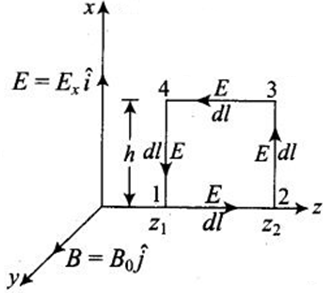
A plane EM wave travelling in vacuum along z direction is given by $\text{E}=\text{E}_0\sin(\text{kz}-\omega\text{t})\hat{\text{i}}\text{ and }\text{B}=\text{B}_0\sin(\text{kz}-\omega\text{t})\hat{\text{j}}$.
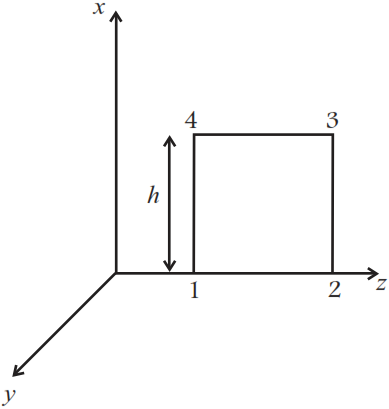
  1. Evaluate $\oint\text{E.dl}$ over the rectangular loop 1234 shown in Fig.
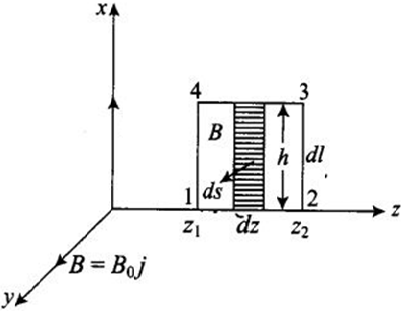
  2. Evaluate $\int\text{B.ds}$ over the surface bounded by loop 1234.
  3. Use equation $\oint\text{E.dl}=\frac{-\text{d}\phi_\text{B}}{\text{dt}}$ to prove $\frac{\text{E}_0}{\text{B}_0}=\text{c}$.
  4. By using similar process and the equation $\oint\text{B.dl}=\mu_0\text{I}+\in_0\frac{\text{d}\phi_\text{E}}{\text{dt}}$, prove that $\text{c}=\frac{1}{\sqrt{\mu_0\in_0}}$.
​​​​​​​
Answer
  1. Let electromagnetic wave is propagating along z-axis, in this case electric field vector $(\vec{\text{E}})$ be along x-axis magnetic field vector $(\vec{\text{B}})$ along y-axis,
i.e., $\vec{\text{E}}=\text{E}_0\hat{\text{i}}\text{ and }\vec{\text{B}}=\text{B}_0\hat{\text{j}}.$


The line integral of $\vec{\text{E}}$ over the closed rectangular path 1234 in x-z plane of the figure is

$\oint\vec{\text{E}}.\text{d}\vec{\text{l}}=\int_1^2\vec{\text{E}}.\text{d}\vec{\text{l}}+\int_2^3\vec{\text{E}}.\text{d}\vec{\text{l}}+\int_3^4\vec{\text{E}}.\text{d}\vec{\text{l}}+\int_4^1\vec{\text{E}}.\text{d}\vec{\text{l}}$

$=\int_1^2{\text{E}}.\text{d}{\text{l}}\cos90^\circ+\int_2^3{\text{E}}.\text{d}{\text{l}}\cos0^\circ+\int_3^4{\text{E}}.\text{d}{\text{l}}\cos90^\circ+\int_4^1{\text{E}}.\text{d}{\text{l}}\cos180^\circ$

$\oint\vec{\text{E}}.\text{d}\vec{\text{l}}=\text{E}_0\text{h}[\sin(\text{kz}_2-\omega\text{t})-\sin(\text{kz}_1-\omega\text{t})\ .....(\text{i})$
  1. Now let us evaluate $\int\vec{\text{B}}.\text{d}\vec{\text{s}}$, let us consider the rectangle 1234 to be made strips of are ds = hdz each.


$\int\vec{\text{B}}.\text{d}\vec{\text{s}}=\int\text{B.ds}\cos0=\int\text{b.ds}$

$=\int_{\text{Z}_1}^{\text{Z}_2}\text{B}_0\sin(\text{kz}-\omega\text{t})\text{hdz}$

$\int\vec{\text{B}}.\text{d}\vec{\text{s}}=\frac{-\text{B}_0\text{h}}{\text{k}}[\cos(\text{kz}_2-\omega\text{t})-\cos(\text{kz}_1-\omega\text{t})\ .....(\text{ii})$
  1. We are given $\oint\text{E.dl}=\frac{-\text{d}\phi_\text{B}}{\text{dt}}=-\frac{\text{d}}{\text{dt}}\oint\text{B.ds}$
Substituting the values from Eqs. (i) and (ii), we get

$\text{E}_0\text{h}[\sin(\text{kz}_2-\omega\text{t})-\sin(\text{kz}_1-\omega\text{t})]$

$=\frac{-\text{d}}{\text{dt}}\bigg[\frac{\text{B}_0\text{h}}{\text{k}}\{\cos(\text{kz}_2-\omega\text{t})-\cos(\text{kz}_1-\omega\text{t})\}\bigg]$

$=\frac{\text{B}_0\text{h}}{\text{k}}\omega[\sin(\text{kz}_2-\omega\text{t})-\sin(\text{kz}_1-\omega\text{t})]$

$\Rightarrow\ \text{E}_0=\frac{\text{B}_0\omega}{\text{k}}=\text{B}_0\text{c} \ \ \Big(\because\ \frac{\omega}{\text{k}}=\text{c}\Big)$

$\Rightarrow\ \frac{\text{E}_0}{\text{B}_0}=\text{c}$
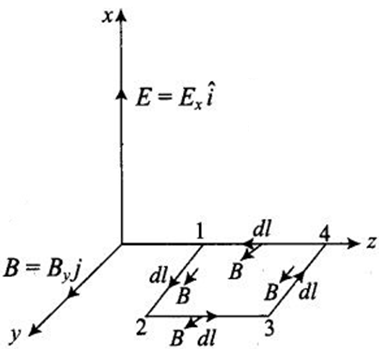
  1. For evaluating $\oint\vec{\text{B}}.\text{d}\vec{\text{l}}$, let us consider a loop 1234 in y-z plane as shown in figure given below.


$\oint\vec{\text{B}}.\text{d}\vec{\text{l}}=\int_1^2\vec{\text{B}}.\text{d}\vec{\text{l}}+\int_2^3\vec{\text{B}}.\text{d}\vec{\text{l}}+\int_3^4\vec{\text{B}}.\text{d}\vec{\text{l}}+\int_4^1\vec{\text{B}}.\text{d}\vec{\text{l}}$

$=\int_1^2{\text{E}}.\text{d}{\text{l}}\cos0^\circ+\int_2^3{\text{E}}.\text{d}{\text{l}}\cos90^\circ+\int_3^4{\text{E}}.\text{d}{\text{l}}\cos180^\circ+\int_4^1{\text{E}}.\text{d}{\text{l}}\cos90^\circ$

$\oint\vec{\text{B}}.\text{d}\vec{\text{l}}=\text{B}_0\text{h}[\sin(\text{kz}_2-\omega\text{t})-\sin(\text{kz}_1-\omega\text{t})\ .....(\text{iii})$

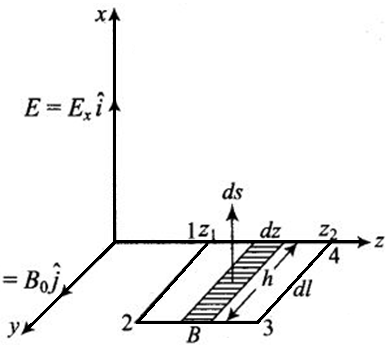
Now to evaluate $\phi_\text{E}=\int\vec{\text{B}}.\text{d}\vec{\text{s}}$, let us consider the rectangle 1234 to be made of strips of area hds reach.


$\phi_\text{E}=\int\vec{\text{E}}.\text{d}\vec{\text{s}}=\int\text{Eds}\cos0=\int\text{Eds}$

$=\int_{\text{z}_1}^\text{z}\text{E}_0\sin(\text{kz}_1-\omega\text{t})\text{hdz}$

$\oint\vec{\text{E}}.\text{d}\vec{\text{s}}=-\frac{\text{E}_0\text{h}}{\text{k}}[\cos(\text{kz}_2-\omega\text{t})-\cos(\text{kz}_2-\omega\text{t})]$

$\therefore\ \frac{\text{d}\phi_\text{E}}{\text{dt}}=-\frac{\text{E}_0\text{h}\omega}{\text{k}}[\sin(\text{kz}_2-\omega\text{t})-\sin(\text{kz}_2-\omega\text{t})] \ .....(\text{iv})$

Let $\oint\text{B.dl}=\mu_0\Big(\text{I}+\frac{\in_0\text{d}\phi_\text{E}}{\text{dt}}\Big)$ where I = conduction current

= 0 in vacuum

$\therefore\ \oint\text{B.dl}=\mu_0\in\frac{\text{d}\phi_\text{E}}{\text{dt}}$

Using relations obtainned in Eqs. (iii) and (iv) and simplifying, we get

$\text{B}_0=\text{E}_0\frac{\omega\mu_0\in_0}{\text{k}}$

$\Rightarrow\ \frac{\text{E}_0}{\text{B}_0}\frac{\omega}{\text{k}}=\frac{1}{\mu_0\in_0}$

But $\frac{\text{E}_0}{\text{B}_0}=\text{c}\text{ and }\omega=\text{ck}\Rightarrow\ \text{c.c}=\frac{1}{\mu_0\in_0}$

therefore $\text{c}=\frac{1}{\sqrt{\mu_0\in_0}}$
View full question & answer
5 Marks Questions - Physics STD 12 Science Questions - Vidyadip