Question types

Wave Optics question types

374 questions across 7 question groups — pick any mix to generate a Physics paper with step-by-step answer keys.

374
Questions
7
Question groups
5
Question types
Sample Questions

Wave Optics questions

One sample from each question group in this chapter. Select any group above to see the full set with answer keys.

The resolving power of a telescope can be increased by increasing:
  • A
    Wavelength of light.
  • Diameter of objective.
  • C
    Length of the tube.
  • D
    Focal length of eyepiece.

Answer: B.

View full solution
According to Maxwell , most of the optical properties of light depend on:
  • A
    Magnetic vector
  • Electric vector
  • C
    Both Electric and Magnetic vectors
  • D
    Can not be decided

Answer: B.

View full solution
The colour of bright fringes nearest to the central achromatic fringe in the interference pattern with white light will be:
  • Violet
  • B
    Red
  • C
    Green
  • D
    Yellow

Answer: A.

View full solution
To increase both the resolving power and magnifying power of a telescope:
  • A
    Both the focal length and aperture of the objective has to be increased.
  • B
    The focal length of the objective has to be increased.
  • C
    The aperture of the objective has to be increased.
  • The wavelength of light has to be decreased.

Answer: D.

View full solution
For question two statements are given$-$one labelled Assertion $(A)$ and the other labelled Reason $(R).$ Select the correct answer to these questions from the codes $(a), (b), (c)$ and $(d)$ as given below.
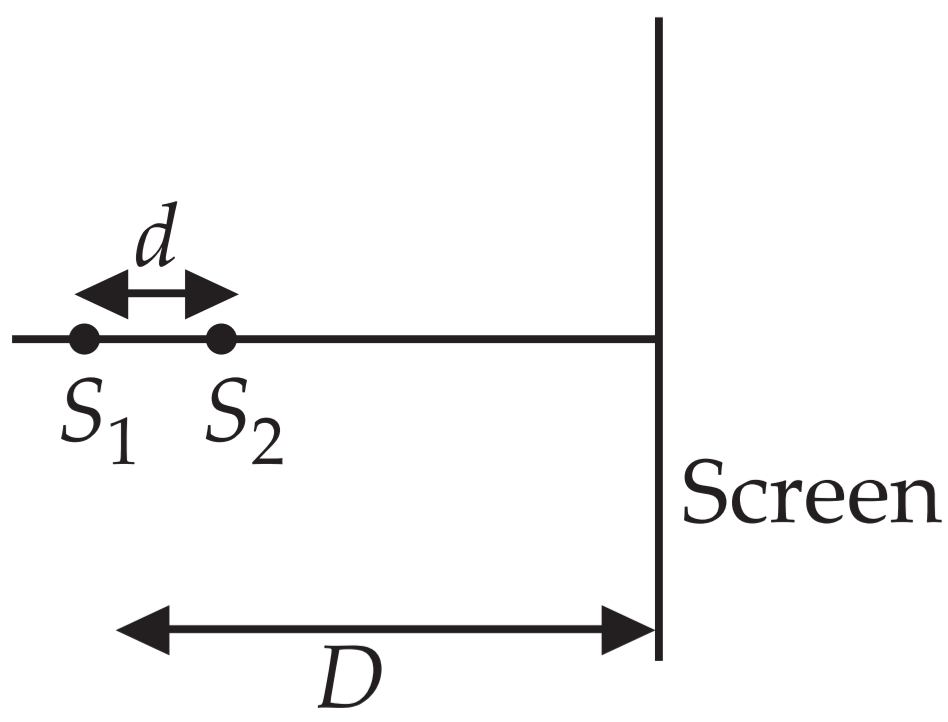
Assertion $(A):$Two point coherent sources of light $S_1$ and $S_2$ are placed on a line as shown. $P$ and $Q$ are two points on that line. If at point $P$ maximum intensity is observed then maximum intensity should also be observed at $Q.$


Reason $(R):$ In the figure of assertion the distance $\left|S_1 P-S_2 P\right|$ is equal to distance $\left|S_2 Q-S_1 Q\right|$.
  • A
    Both $A$ and $R$ are true and $R$ is the correct explanation of $A.$
  • Both $A$ and $R$ are true but $R$ is not the correct explanation of $A.$
  • C
    $A$ is true but $R$ is false.
  • D
    $A$ is false and $R$ is also false.

Answer: B.

View full solution
For question two statements are given-one labelled Assertion (A) and the other labelled Reason (R). Select the correct answer to these questions from the codes (a), (b), (c) and (d) as given below.
  1. Both A and R are true and R is the correct explanation of A.
  2. Both A and R are true but R is NOT the correct explanation of A.
  3. A is true but R is false.
  4. A is false and R is also false.
Assertion (A): When tiny circular obstacle is placed in the path of light from some distance, a bright spot is seen at the centre of the shadow of the obstacle.
Reason (R): Destructive interference occurs at the centre of the shadow.
View full solution
For question two statements are given-one labelled Assertion (A) and the other labelled Reason (R). Select the correct answer to these questions from the codes (a), (b), (c) and (d) as given below.
  1. Both A and R are true and R is the correct explanation of A.
  2. Both A and R are true but R is NOT the correct explanation of A.
  3. A is true but R is false.
  4. A is false and R is also false.
Assertion (A): In interference all the fringes are of same width.
Reason (R): In interference fringe width is independent of position of the fringe.
View full solution
For question two statements are given-one labelled Assertion (A) and the other labelled Reason (R). Select the correct answer to these questions from the codes (a), (b), (c) and (d) as given below.
  1. Both A and R are true and R is the correct explanation of A.
  2. Both A and R are true but R is NOT the correct explanation of A.
  3. A is true but R is false.
  4. A is false and R is also false.
Assertion (A): The film which appears bright in reflected system will appear dark in the transmitted light and vice-versa.
Reason (R): The conditions for film to appear bright or dark in reflected light are just reverse to those in the transmitted light.
View full solution
For question two statements are given-one labelled Assertion (A) and the other labelled Reason (R). Select the correct answer to these questions from the codes (a), (b), (c) and (d) as given below.
  1. Both A and R are true and R is the correct explanation of A.
  2. Both A and R are true but R is NOT the correct explanation of A.
  3. A is true but R is false.
  4. A is false and R is also false.
Assertion (A): In Young's experiment the fringe width is directly proportional to wavelength of the source used.
Reason (R): When a thin transparent sheet is placed in front of both the slits of Young's experiment, the fringe width will increase.
View full solution
Answer the following question:
When a low flying aircraft passes overhead, we sometimes notice a slight shaking of the picture on our TV screen. Suggest a possible explanation.
View full solution
Answer the following question:
When a tiny circular obstacle is placed in the path of light from a distant source, a bright spot is seen at the centre of the shadow of the obstacle. Explain why?
View full solution
A parallel beam of light of wavelength 500 nm falls on a narrow slit and the resulting diffraction pattern is observed on a screen 1 m away. It is observed that the first minimum is at a distance of 2.5 mm from the centre of the screen. Find the width of the slit.
View full solution
Answer the following question:
As you have learnt in the text, the principle of linear superposition of wave displacement is basic to understanding intensity distributions in diffraction and interference patterns. What is the justification of this principle?
View full solution
Answer the following question:
Ray optics is based on the assumption that light travels in a straight line. Diffraction effects (observed when light propagates through small apertures/slits or around small obstacles) disprove this assumption. Yet the ray optics assumption is so commonly used in understanding location and several other properties of images in optical instruments. What is the justification?
View full solution
In double-slit experiment using light of wavelength 600 nm, the angular width of a fringe formed on a distant screen is 0.1º. What is the spacing between the two slits?
View full solution
Q 213 Marks Question3 Marks
Light of wavelength 5000 Å falls on a plane reflecting surface. What are the wavelength and frequency of the reflected light? For what angle of incidence is the reflected ray normal to the incident ray?
View full solution
Q 223 Marks Question3 Marks
  1. The refractive index of glass is 1.5. What is the speed of light in glass? $($Speed of light in vacuum is $3.0 \times 10^8 ms^{–1}).$
  2. Is the speed of light in glass independent of the colour of light? If not, which of the two colours red and violet travels slower in a glass prism?
View full solution
Q 233 Marks Question3 Marks
A beam of light consisting of two wavelengths, 650 nm and 520 nm, is used to obtain interference fringes in a Young’s double-slit experiment.
  1. Find the distance of the third bright fringe on the screen from the central maximum for wavelength 650 nm.
  2. What is the least distance from the central maximum where the bright fringes due to both the wavelengths coincide?
View full solution
Q 243 Marks Question3 Marks
Answer the following question:
Two students are separated by a 7 m partition wall in a room 10 m high. If both light and sound waves can bend around obstacles, how is it that the students are unable to see each other even though they can converse easily.
View full solution
Q 253 Marks Question3 Marks
For sound waves, the Doppler formula for frequency shift differs slightly between the two situations: (i) source at rest; observer moving, and (ii) source moving; observer at rest. The exact Doppler formulas for the case of light waves in vacuum are, however, strictly identical for these situations. Explain why this should be so. Would you expect the formulas to be strictly identical for the two situations in case of light travelling in a medium?
View full solution
In Young’s double-slit experiment using monochromatic light of wavelength λ, the intensity of light at a point on the screen where path difference is λ, is K units. What is the intensity of light at a point where path difference is λ/3?
View full solution
Let us list some of the factors, which could possibly influence the speed of wave propagation:
  1. Nature of the source.
  2. Direction of propagation.
  3. Motion of the source and/or observer.
  4. Wavelength.
  5. Intensity of the wave.
On which of these factors, if any, does
  1. The speed of light in vacuum,
  2. The speed of light in a medium (say, glass or water), depend?
View full solution
Monochromatic light of wavelength 589 nm is incident from air on a water surface. What are the wavelength, frequency and speed of (a) reflected, and (b) refracted light? Refractive index of water is 1.33.
View full solution
A parallel beam of white light is incident normally on a water film $1.0 \times 10^{-4}$cm thick. Find the wavelength in the visible range (400nm - 700nm) which are strongly transmitted by the film. Refractive index of water = 1.33.
View full solution
A thin paper of thickness 0.02mm having a refractive index 1.45 is pasted across one of the slits in a Young's double slit experiment. The paper transmits $\frac{4}{9}$ of the light energy falling on it.
  1. Find the ratio of the maximum intensity to the minimum intensity in the fringe pattern.
  2. How many fringes will cross through the centre if an identical paper piece is pasted on the other slit also? The wavelength of the light used is 600nm.
View full solution
For a single slit of width "a", the first minimum of the interference pattem of a monochromatic light of wavelength$\lambda$. Occurs at an angle of$\frac{\lambda}{\text{a}}$. At the same angle of$\frac{\lambda}{\text{a}},$ we get a maximum for two narrow slits separated by a distance "a". Explain.
View full solution
TV signals broadcast by Delhi studio cannot be directly received at Patna which is about 1000km away. But the same signal goes some 36000km away to a satellite, gets reflected and is then received at Patna. Explain.
View full solution
Why don't we have interference when two candles are placed close to each other and the intensity is seen at a distant screen? What happens if the candles are replaced by laser sources?
View full solution
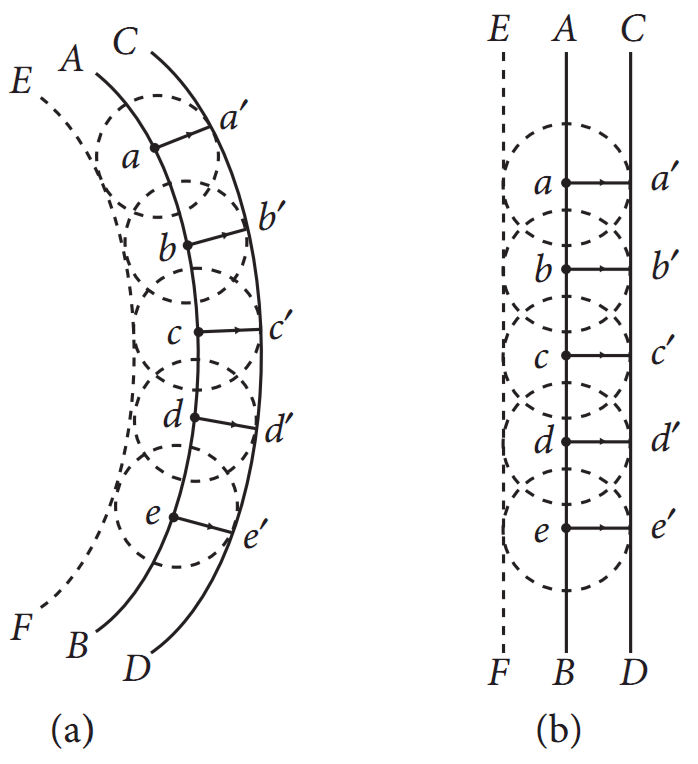
Huygen's principle is the basis of wave theory of light. Each point on a wavefront acts as a fresh source of new disturbance, called secondary waves or wavelets. The secondary wavelets spread out in all directions with the speed light in the given medium. An initially parallel cylindrical beam travels in a medium of refractive index $\mu(\text{I})=\mu_0+\mu_2\text{I}$, where $\mu_0$ and $\mu_2$ are positive constants and I is the intensity of the light beam. The intensity of the beam is decreasing with increasing radius.
  1. The initial shape of the wavefront of the beam is:
  1. Planar.
  2. Convex.
  3. Concave.
  4. Convex near the axis and concave near the periphery.
  1. According to Huygens Principle, the surface of constant phase is:
  1. Called an optical ray.
  2. Called a wave.
  3. Called a wavefront.
  4. Always linear in shape.
  1. As the beam enters the medium, it will:
  1. Travel as a cylindrical beam.
  2. Diverge.
  3. Converge.
  4. Diverge near the axis and converge near the periphery.
  1. Two plane wavefronts oflight, one incident on a thin convex lens and another on the refracting face of a thin prism. After refraction at them, the emerging wavefronts respectively become.
  1. Plane wavefront and plane wavefront.
  2. Plane wavefront and spherical wavefront.
  3. Spherical wavefront and plane wavefront.
  4. Spherical wavefront and spherical wavefront.
  1. Which of the following phenomena support the wave theory of light?
  1. Scattering.
  2. Interference.
  3. Diffraction.
  4. Velocity of light in a denser medium is less than the velocity of light in the rarer medium.
  1. 1, 2, 3
  2. 1, 2, 4
  3. 2, 3, 4
  4. 1, 3, 4
View full solution
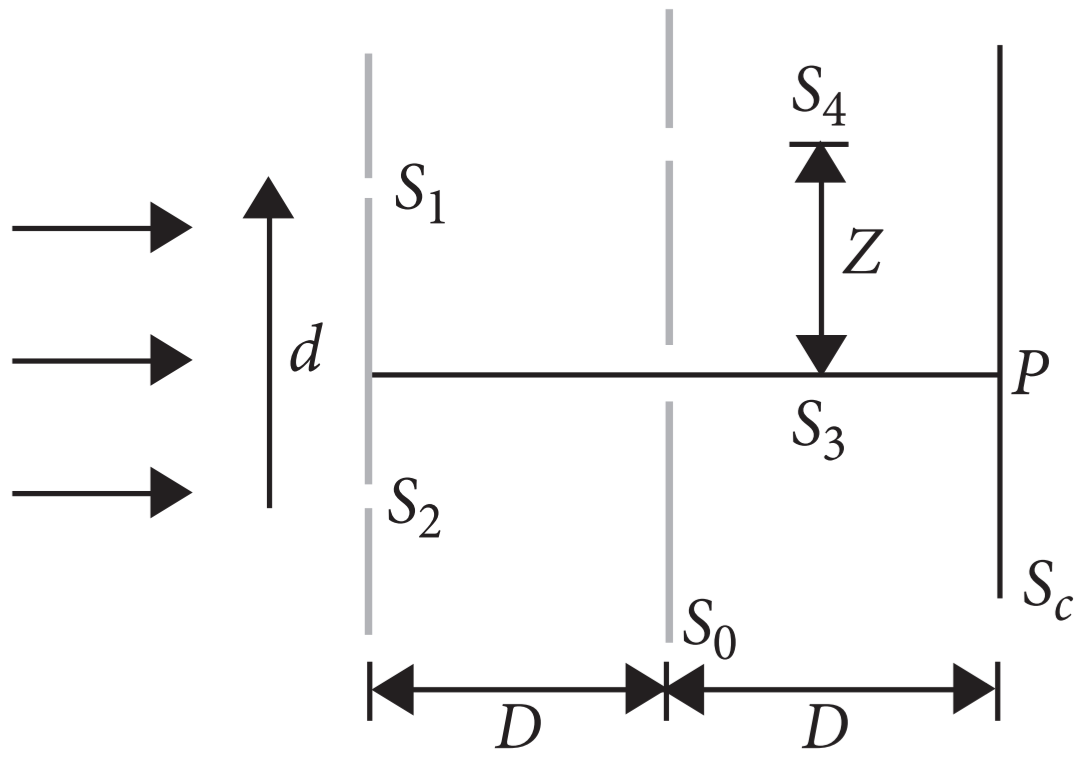
Consider the situation shown in figure. The two slits $S_1$ and $S_1$ placed symmetrically around the central line are illuminated by monochromatic light of wavelength $\lambda$. The separation between the slits is d. The light transmitted by the slits falls on a screen $S_0$ place at a distance D from the slits. The slits $S_3$ is at the central line and the slit $S_4$ is at a distance from $S_3.$ Another screen $S_c$ is placed a further distance D away from $S_c.$
  1. Find the path difference if $\text{z}=\frac{\lambda\text{D}}{2\text{d}}$.
  1. $\lambda$
  2. $\frac{\lambda}{2}$
  3. $\frac{3}{2\lambda}$
  4. $2\lambda$
  1. Find the ratio of the maximum to minimum intensity observed on $S_c$ if $\text{z}=\frac{\lambda\text{D}}{\text{d}}$
  1. 4
  2. 2
  3. $\infty$
  4. 1
  1. Two coherent point sources $S_1$ and $S_2$ are separated by a small distanced as shown in figure. The fringes obtained on the screen will be:
  1. Concentric circles.
  2. Points.
  3. Straight lines.
  4. Semi-circles.
  1. ln the case of light waves from two coherent sources $S_1$ and $S_2$, there will be constructive interference at an arbitrary point P, if the path difference $S_1P - S_2P$ is:
  1. $\Big(\text{n}+\frac{1}{2}\Big)\lambda$
  2. $\text{n}\lambda$
  3. $\Big(\text{n}-\frac{1}{2}\Big)\lambda$
  4. $\frac{\lambda}{2}$
  1. Two monochromatic light waves of amplitudes $3_A$ and $2_A$ interfering at a point have a phase difference of 60º. The intensity at that point will be proportional to:
  1. $5A^2$
  2. $13A^2$
  3. $7A^2$
  4. $19A^2$
View full solution

Generate a Wave Optics paper free

Pick question groups from the list above, set marks and difficulty, and export a branded PDF with step-by-step answer keys. First 3 chapters free — no signup.

Download App