Question 15 Marks
In Young’s double-slit experiment using monochromatic light of wavelength λ, the intensity of light at a point on the screen where path difference is λ, is K units. What is the intensity of light at a point where path difference is λ/3?
Answer
View full question & answer→Let $I_1$ and $I_2$ be the Intensity of the two light waves. Their resultant intensities can be obtained as:
$\text{I}'=\text{I}_1+\text{I}_2+2\sqrt{\text{I}_1{\text{I}_2}}\ \text{cos}\phi$
Where,
$\phi$ = Phase difference between the two waves
For monochromatic light waves,
$\text{I}_1=\text{I}_2$
$\therefore\ \text{I}'=\text{I}_1+\text{I}_1+2\sqrt{\text{I}_1\text{I}_1}\ \text{cos}\phi$
$=2\text{I}_1+2\text{I}_1\text{cos}\phi$
Phase difference $=\frac{2\pi}{\lambda}\times$ Path difference
Since path difference = $\lambda,$
Phase difference, $\phi=2\pi$
$\therefore\ \text{I}'=2\text{I}_1+2\text{I}_1=4\text{I}_1$
Given,
I' = K
$\therefore\ \text{I}_1=\frac{\text{K}}{4}.....(1)$
When path difference $=\frac{\lambda}{3},$
Phase difference, $\phi=\frac{2\pi}{3}$
Hence, resultant intensity, $\text{I}'_R=\text{I}_1+\text{I}_1+2\sqrt{\text{I}_1\text{I}_1}\ \text{cos}\frac{2\pi}{3}$
$=2\text{I}_1+2\text{I}_1\bigg(-\frac{1}{2}\bigg)=\text{I}_1$
Using equation (1), we can write:
$\text{I}_\text{R}=\text{I}_1=\frac{\text{K}}{4}$
Hence, the intensity of light at a point where the path difference is $\frac{\lambda}{3}\ \text{is}\ \frac{\text{K}}{4}$ units.
$\text{I}'=\text{I}_1+\text{I}_2+2\sqrt{\text{I}_1{\text{I}_2}}\ \text{cos}\phi$
Where,
$\phi$ = Phase difference between the two waves
For monochromatic light waves,
$\text{I}_1=\text{I}_2$
$\therefore\ \text{I}'=\text{I}_1+\text{I}_1+2\sqrt{\text{I}_1\text{I}_1}\ \text{cos}\phi$
$=2\text{I}_1+2\text{I}_1\text{cos}\phi$
Phase difference $=\frac{2\pi}{\lambda}\times$ Path difference
Since path difference = $\lambda,$
Phase difference, $\phi=2\pi$
$\therefore\ \text{I}'=2\text{I}_1+2\text{I}_1=4\text{I}_1$
Given,
I' = K
$\therefore\ \text{I}_1=\frac{\text{K}}{4}.....(1)$
When path difference $=\frac{\lambda}{3},$
Phase difference, $\phi=\frac{2\pi}{3}$
Hence, resultant intensity, $\text{I}'_R=\text{I}_1+\text{I}_1+2\sqrt{\text{I}_1\text{I}_1}\ \text{cos}\frac{2\pi}{3}$
$=2\text{I}_1+2\text{I}_1\bigg(-\frac{1}{2}\bigg)=\text{I}_1$
Using equation (1), we can write:
$\text{I}_\text{R}=\text{I}_1=\frac{\text{K}}{4}$
Hence, the intensity of light at a point where the path difference is $\frac{\lambda}{3}\ \text{is}\ \frac{\text{K}}{4}$ units.
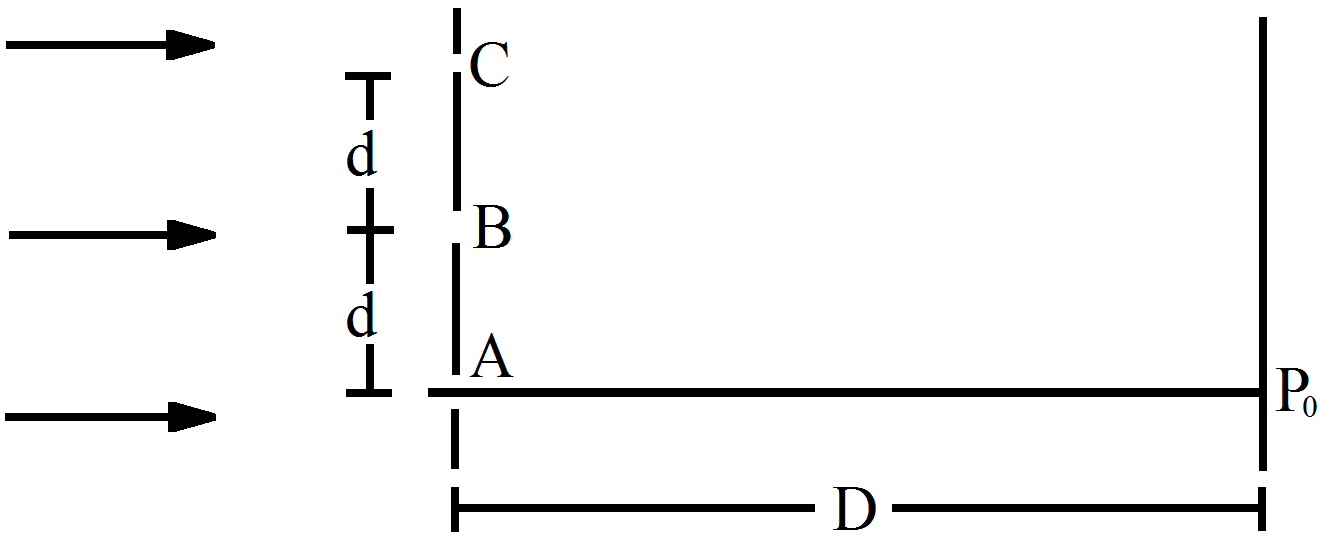
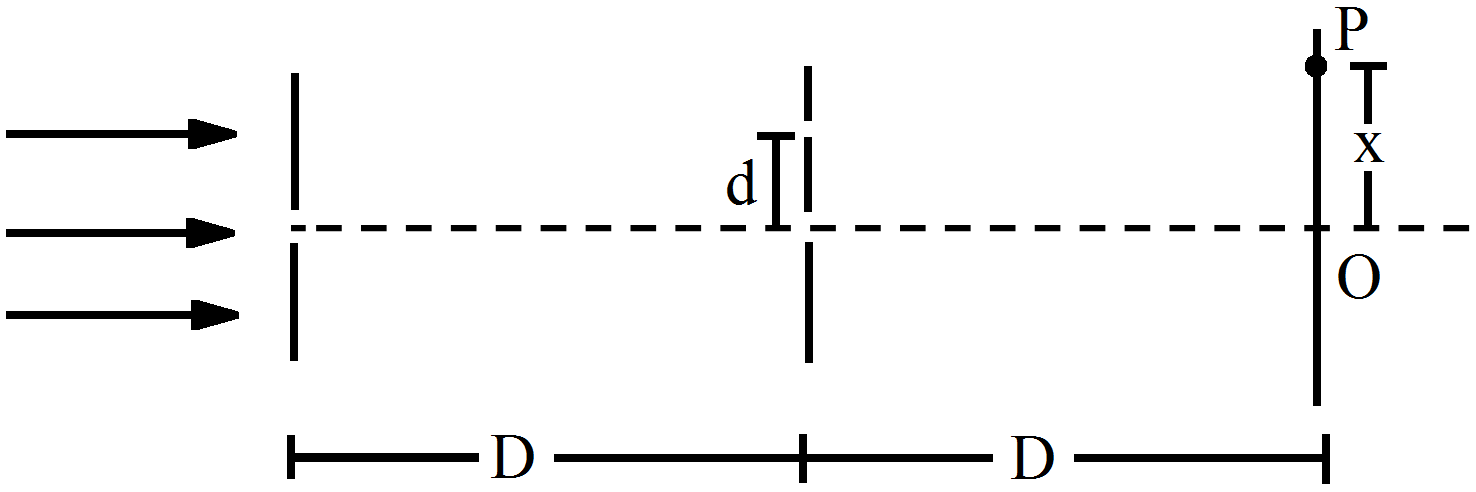
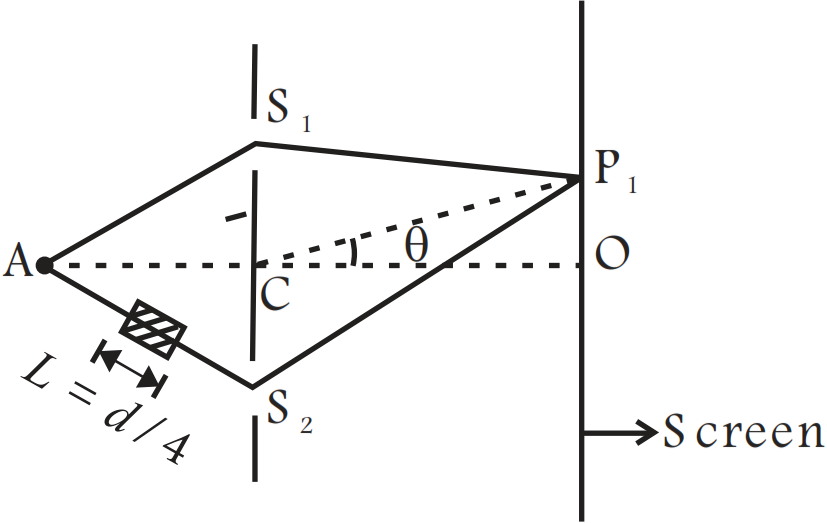
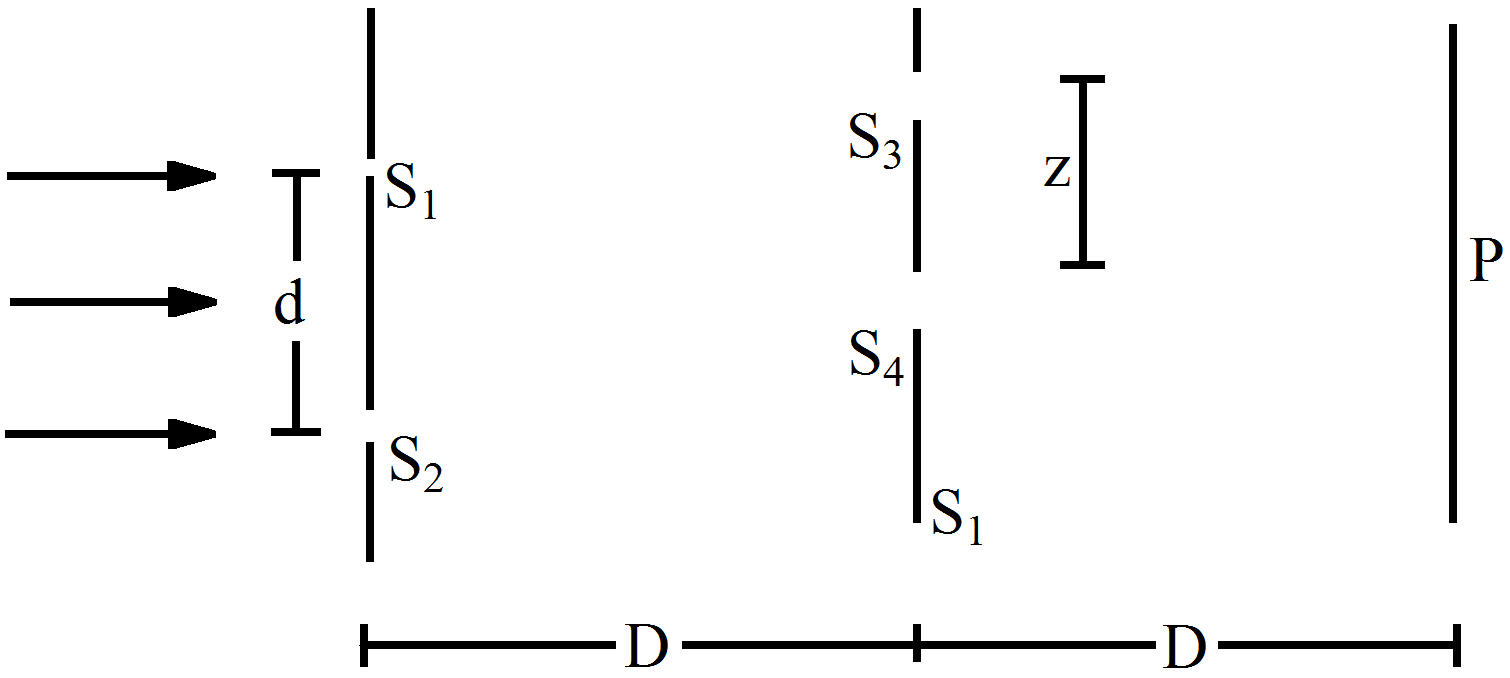
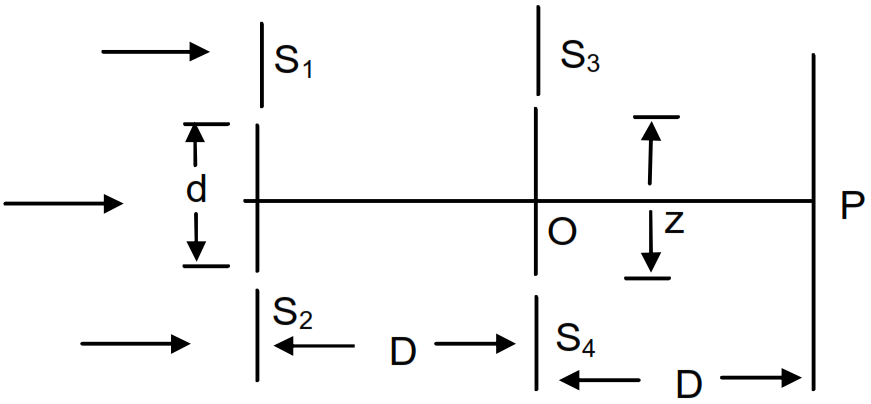
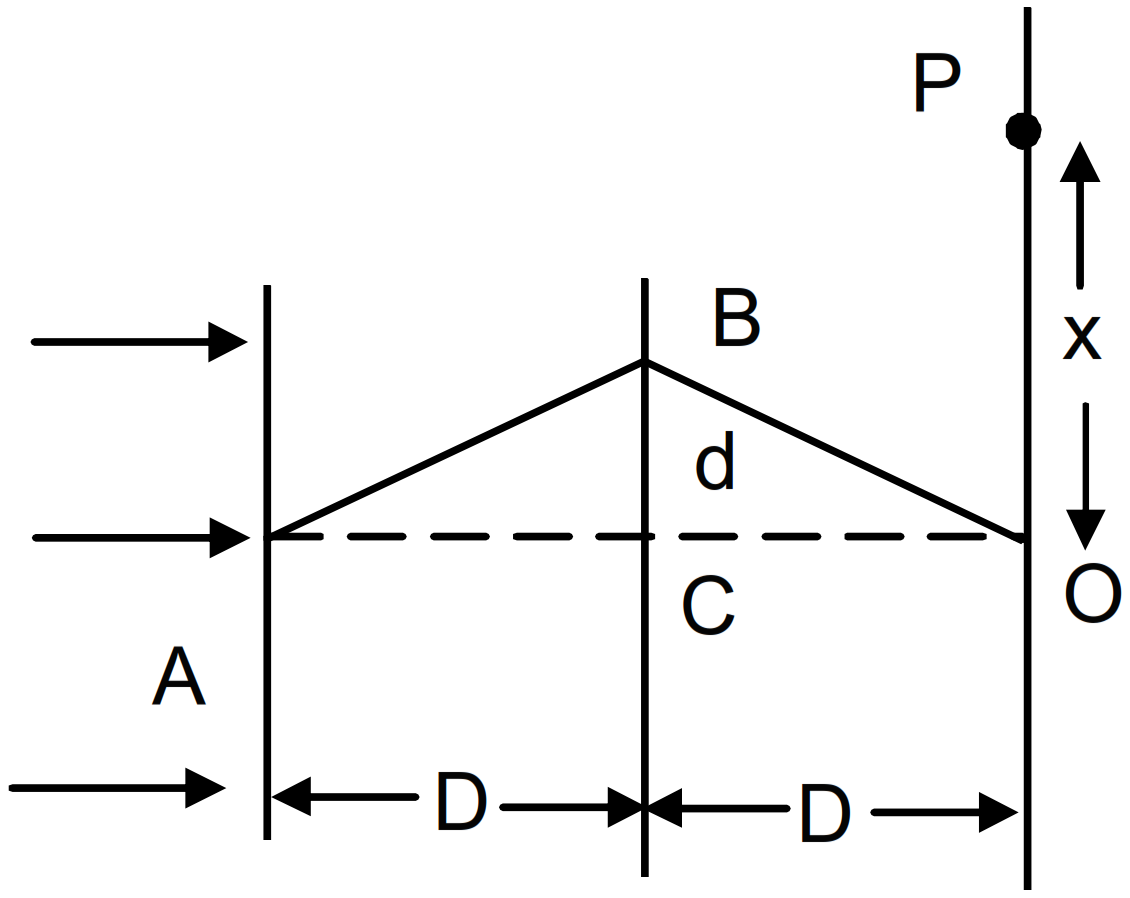 Path difference = (AB + BO) - (AC + CO) = 2(AB - AC) [Since, AB = BO and AC = CO] $=2\Big(\sqrt{\text{d}^2+\text{D}^2}-\text{D}\Big)$ For dark fringe, path difference should be odd multiple of $\frac{\lambda}{2}.$ So, $2\Big(\sqrt{\text{d}^2+\text{D}^2}-\text{D}\Big)=(2\text{n}+1)\Big(\frac{\lambda}{2}\Big)$ $\Rightarrow\sqrt{\text{d}^2+\text{D}^2}=\text{D}+(2\text{n}+1)\Big(\frac{\lambda}{4}\Big)$ $\Rightarrow\text{D}^2+\text{d}^2=\text{D}^2+(2\text{n}+1)^2\frac{\lambda^2}{16}+(2\text{n}+1)\frac{\lambda\text{D}}{2}$ Neglecting, $(2\text{n}+1)^2\frac{\lambda^2}{16},$ as it is very small We get, $\text{d}=\sqrt{(2\text{n}+1)\frac{\lambda\text{D}}{2}}$ For minimum ‘d’, putting $\text{n}=0\Rightarrow\text{d}_\text{min}=\sqrt{\frac{\lambda\text{D}}{2}}.$