MCQ 1511 Mark
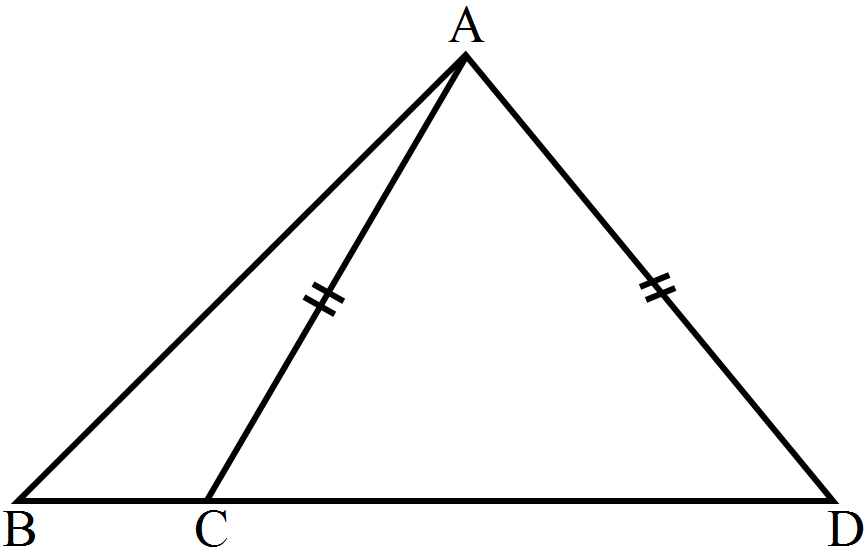
In Fig, if $AC$ is bisector of $\angle\text{BAD}$ such that $AB = 3\ cm$ and $AC = 5\ cm$, then $CD =$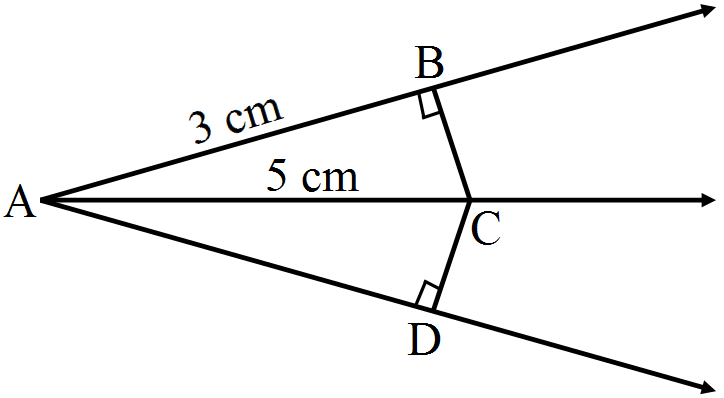
- A
$2\ cm$
- B
$3\ cm$
- ✓
$4\ cm$
- D
$5\ cm$
AnswerCorrect option: C. $4\ cm$
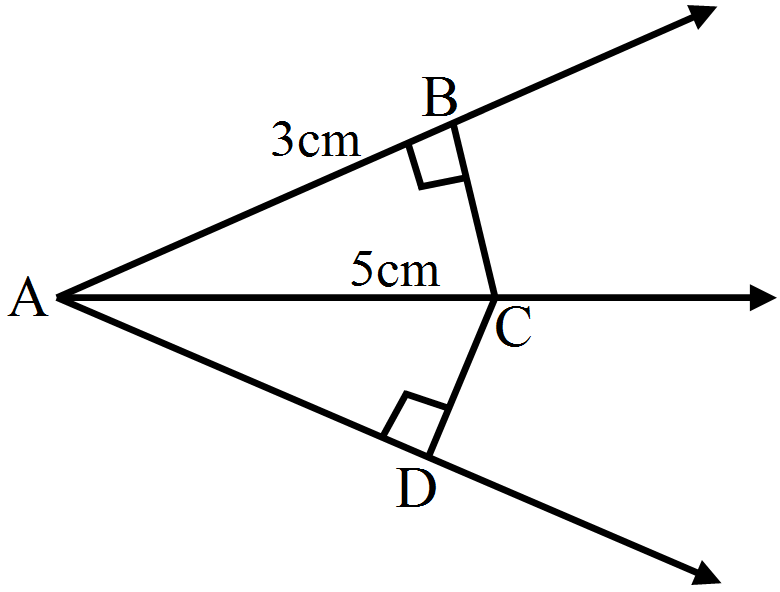
Consider $\triangle\text{ABC}$ and $\triangle\text{ADC}$
$\angle\text{ABC}=\angle\text{ADC}=90^\circ$
$\angle\text{BAC}=\angle\text{CAD}$ $($ AC is bisector of $\angle\text{A})$
Also if two angles are equal, then the third angle will also be equal.
$\Rightarrow\angle\text{BCA}=\angle\text{DCA}$
Now, $\text{AC}=\text{AC}$ (common)
So by ASA property, $\triangle\text{ABC}\cong\triangle\text{ADC}$
$\Rightarrow\text{BC}=\text{CD}$
And, BC $=\sqrt{\text{AC}^2-\text{AB}^2}=\sqrt{25-9}=4\text{cm}$
$\Rightarrow\text{CD}=4\text{cm}$
Hence, correct option is $(c).$ View full question & answer→MCQ 1521 Mark
$ABC$ is an isosceles triangle such that $AB = AC$ and $AD$ is the median to base $BC$. Then, $\angle\text{BAD} =$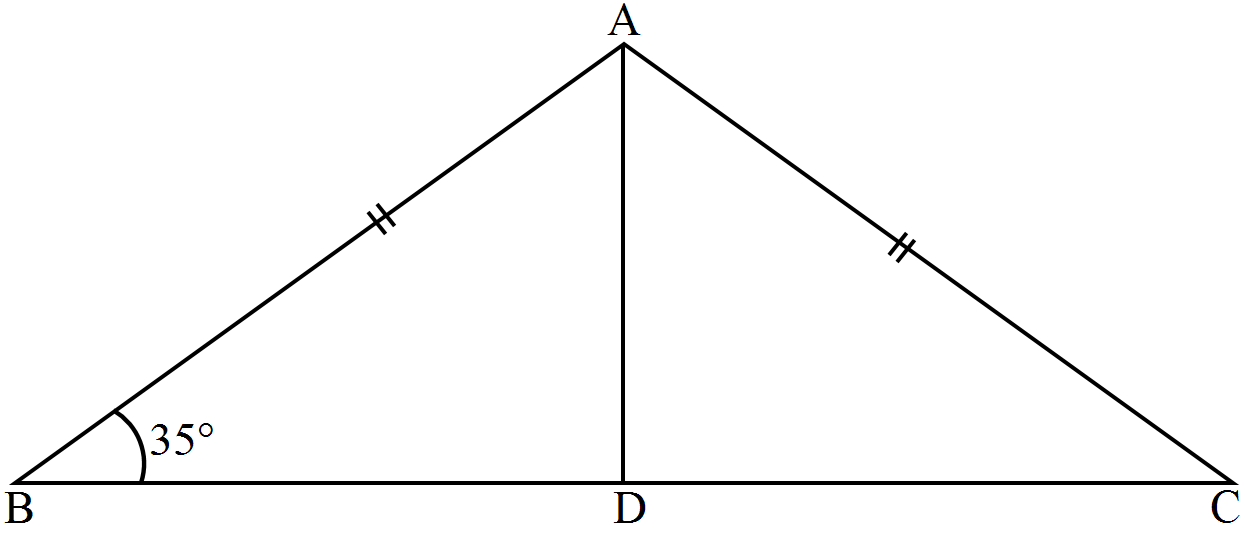
- A
$110^\circ$
- B
$35^\circ$
- C
$70^\circ$
- ✓
$55^\circ$
AnswerCorrect option: D. $55^\circ$
It is given that $\angle\text{B} = 35^\circ, \text{AB} = \text{AC}$ and Ad is the median of $BC$
We know that in isosceles triangle the median from he vertex to the unequal side divides it into two equal part at right angle.
Therefore,
$\angle\text{ADB} = 90^\circ$
$\angle\text{B} = \angle\text{ADB} + \angle\text{A}= 180^\circ$ (Property of triangle)
$35^\circ + 90^\circ + \angle\text{A} = 180^\circ$
$\angle\text{A} = 180^\circ - 125^\circ$
$\angle\text{A} = 55^\circ$
View full question & answer→MCQ 1531 Mark
$\angle\text{x}$ and $\angle\text{y}$ are exterior angles of a triangle $ABC$ at the points $B$ and $C$ respectively, Also, $\angle\text{B} >\angle\text{C},$ then the relation between $\angle\text{x}$ and $\angle\text{y}$ is:
AnswerCorrect option: D. $\angle\text{x} >\angle\text{y},$
Since interior $\angle\text{B} >\angle\text{C},$
Hence $x < y.$
View full question & answer→MCQ 1541 Mark
In the following, write the correct answer. If $AB = QR, BC = PR$ and $CA = PQ$, then:
- A
$\triangle\text{ABC}\cong\triangle\text{QRP}$
- ✓
$\triangle\text{CBA}\cong\triangle\text{PRQ}$
- C
$\triangle\text{BAC}\cong\triangle\text{RQP}$
- D
$\triangle\text{PQR}\cong\triangle\text{BCA}$
AnswerCorrect option: B. $\triangle\text{CBA}\cong\triangle\text{PRQ}$
We know that, if is congruent to, then sides of $\triangle R S T$ fall on corresponding equal sides of angles of fall on corresponding equal angles. Here, given $A B=Q R, B C=P R$ and $C A=P Q$, which shows that $A B$ covers $Q R, B C$ covers $P R$ and $C A$ covers $P Q$ i.e., $A$ correspond to $Q , B$ correspond to R and C correspond to P .
View full question & answer→MCQ 1551 Mark
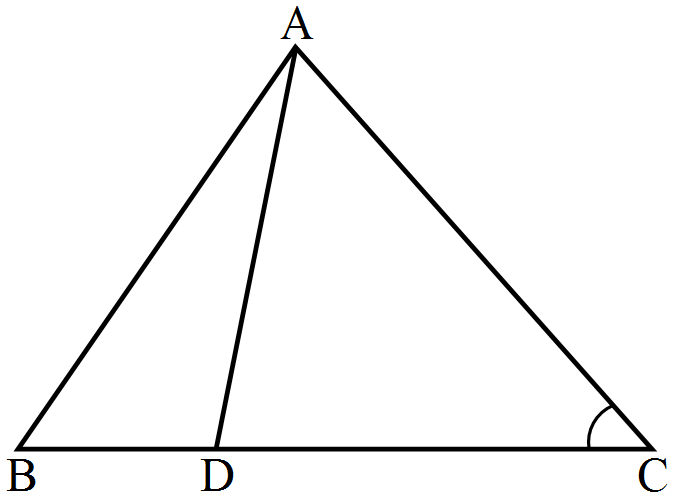
In the given figure, $AB > AC$. Then which of the following is true?
- A
$AB < AD$
- B
$AB = AD$
- ✓
$AB > AD$
- D
AnswerCorrect option: C. $AB > AD$
Given $\text{AB > AC}$
$\therefore\angle\text{ACB}>\angle\text{ABC}$ ...(We know that, if two sides of a triangle unequal, then the longer side has the greater angle opposite to it.)
$\angle\text{ADB}>\angle\text{ACD}$ ...(Exterior angle of a triangle is greater that the interior opposite angles)
$\therefore\angle\text{ADB}>\angle\text{ACB}>\angle\text{ABC}$
$\therefore\angle\text{ADB}>\angle\text{ABD}$
$\therefore\text{AB > AD}$
View full question & answer→MCQ 1561 Mark
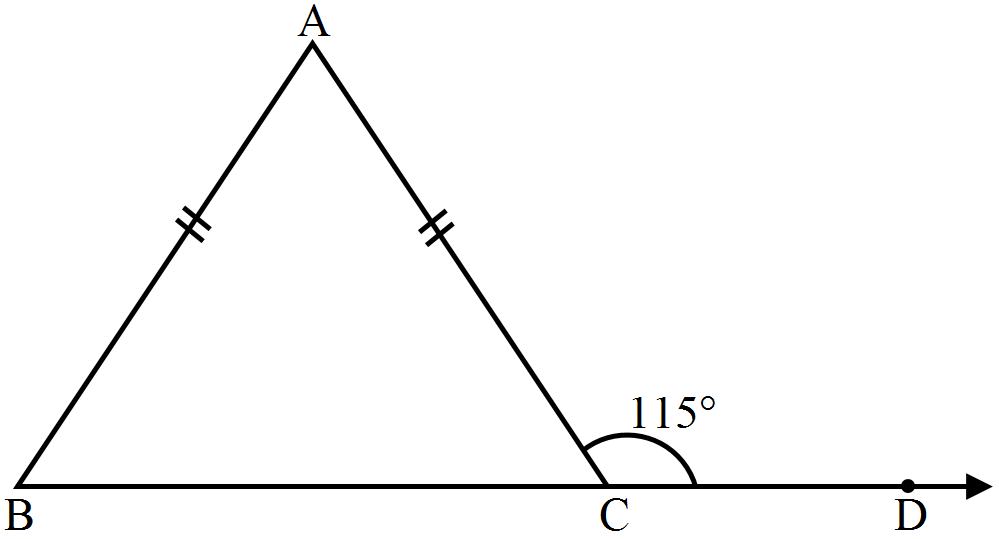
In figure, $AB = AC$ and $\angle\text{ACD} = 115^\circ.$ Find $\angle\text{A}?$
- A
$115^{\circ}$
- ✓
$50^{\circ}$
- C
- D
$60^{\circ}$
AnswerCorrect option: B. $50^{\circ}$
$C =180^{\circ}-115^{\circ}=65^{\circ} AB = AC$ And hence $\angle B =\angle C =65^{\circ}$. Then $A =180^{\circ}-2 \times 65^{\circ}=50^{\circ}$
View full question & answer→MCQ 1571 Mark
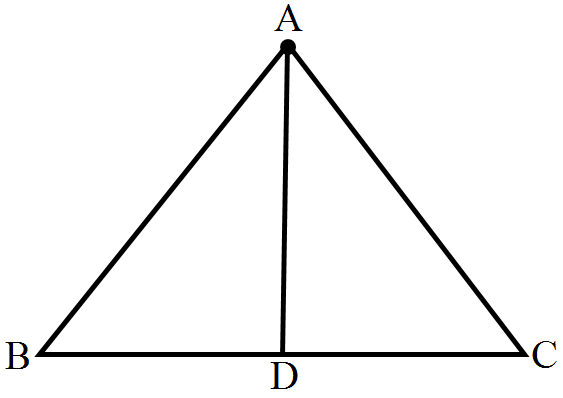
$AD$ is the median of the triangle. Which of the following is true?
- A
$AC + CD < AB$
- B
$AB + BC + AC > AD$
- C
$AB + BD < AC$
- ✓
$AB + BC + AC > 2AD$
AnswerCorrect option: D. $AB + BC + AC > 2AD$
In triangle $ADB$
$AB + BD > AD$
In triangle $ADC$
$AC + DC > AD$
Adding both
$AB + AC + BD + DC > 2AD$
Now $BD + DC = BC$
So, $AB + AC + BC > 2AD$
View full question & answer→MCQ 1581 Mark
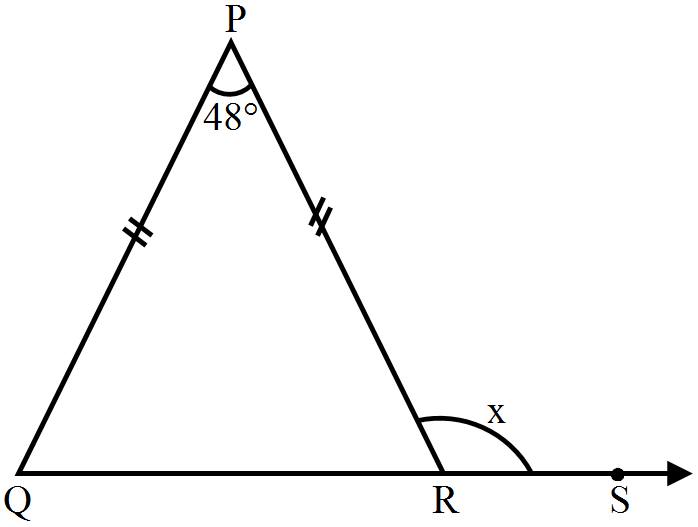
In the adjoining fig, $PQ = PR$. If $\angle\text{QPR} = 48^\circ,$ then value of $x$ is:
- A
$132^{\circ}$
- B
$96^{\circ}$
- C
$104^{\circ}$
- ✓
$114^{\circ}$
AnswerCorrect option: D. $114^{\circ}$
It is an iscosceles triangle and hence angles opposite to equal sides are equal
Angle $PQR$ and $PRQ$ will be equal. Let suppose Angle $PQR$ be $Y$
i.e, $Y + 48 = 180$
$\Rightarrow Y = 66$
$X = 180 - 66 = 114^{\circ}$
View full question & answer→MCQ 1591 Mark
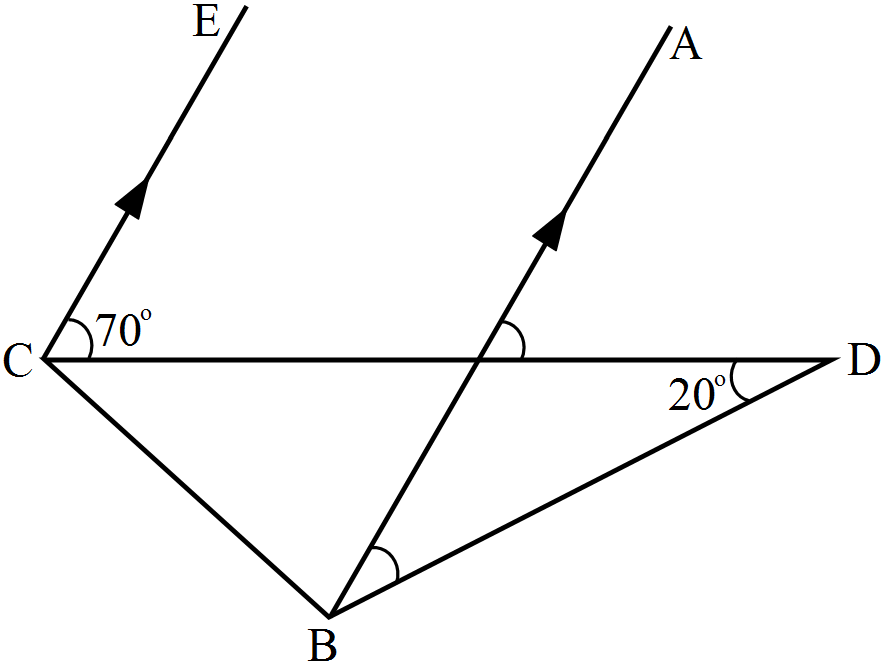
In Fig. if $\text{EC }||\text{ AB},\angle\text{ECD}=70^\circ$ and $\angle\text{ECD}=70^\circ$ and $\angle\text{BDO}=20^\circ,$ then $\angle\text{OBD}$ is:
- A
$20^\circ$
- ✓
$50^\circ$
- C
$60^\circ$
- D
$70^\circ$
AnswerCorrect option: B. $50^\circ$
$EC \| AB$ And, $CD$ is transverse to it.
Now $\angle\text{ECD}=\angle\text{AOD}=70^\circ$ (Corresponding angles)
In $\triangle\text{OBD}$
$\angle\text{OBD}+\angle\text{BOD}+\angle\text{ODB}=180^\circ$
$\angle\text{BOD}=180^\circ-\angle\text{AOD}=180^\circ-70^\circ=110^\circ$
So $\angle\text{OBD}=180^\circ-\angle\text{BOD}-\angle\text{ODB}$
$=180^\circ-110^\circ-20^\circ$
$=50^\circ$
View full question & answer→MCQ 1601 Mark
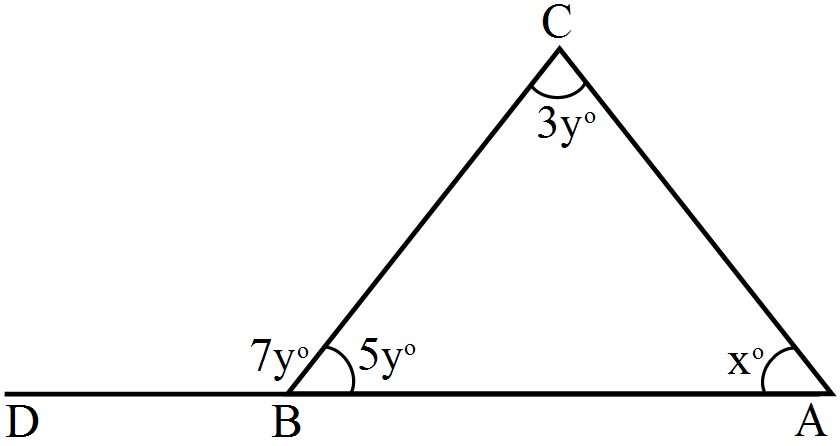
In Fig. what is the value of $x?$
- A
$35^\circ$
- B
$45^\circ$
- C
$50^\circ$
- ✓
$60^\circ$
AnswerCorrect option: D. $60^\circ$
In $\triangle\text{ABC},$
$\angle\text{BCA}+\angle\text{CAB}+\angle\text{ABC}=180^\circ$
$\Rightarrow3\text{y}^\circ+\text{x}^\circ+5\text{y}^\circ=180^\circ$
$\Rightarrow8\text{y}^\circ+\text{x}^\circ=180^\circ\dots(1)$
Also, $5\text{y}^\circ=180^\circ-7\text{y}^\circ$
$\Rightarrow12\text{y}^\circ=180^\circ$
$\Rightarrow\text{y}^\circ=15^\circ$
From (1), $\text{x}^\circ=180^\circ-8\text{y}^\circ$
$\Rightarrow\text{x}^\circ=180^\circ-8\times15^\circ$
$\Rightarrow\text{x}^\circ=60^\circ$
View full question & answer→MCQ 1611 Mark
The side $BC$ of $\triangle\text{ABC}$ is produced to a point $D$. The bisector of $\angle\text{A}$ meets side in $L$. If $\angle\text{ABC} = 30^\circ$ and $\angle\text{ACD} = 115^\circ$ then $\angle\text{ALC} =$
- ✓
$72\frac{1^\circ}{2}$
- B
$85^\circ$
- C
- D
$145^\circ$
AnswerCorrect option: A. $72\frac{1^\circ}{2}$
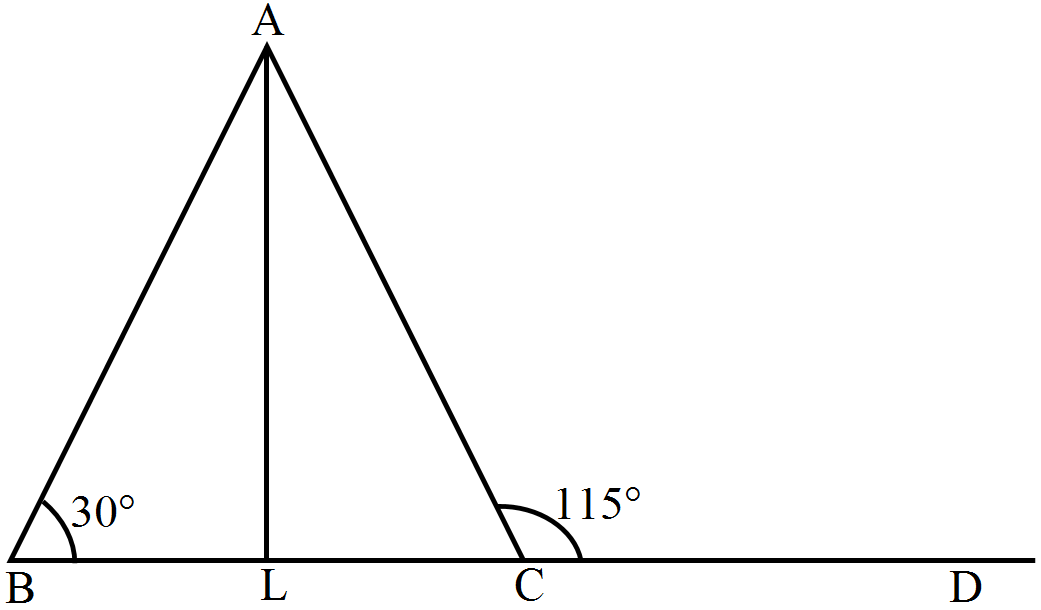
$\angle\text{C} = 180^\circ - \angle\text{ACD} = 180^\circ - 115^\circ = 65^\circ$
In $\triangle\text{ABC}$
$\angle\text{A} + \angle\text{B} + \angle\text{C} = 180^\circ$
$⇒\angle\text{A} = 180^\circ - 30^\circ - 65^\circ$
$⇒\angle\text{A} = 85^\circ$
Now in $\triangle\text{ALC}$
$\angle\text{ALC} + \angle\text{LAC} + \angle\text{C} = 180^\circ$
$⇒\angle\text{ALC} = 180^\circ - \angle\text{LAC} - \angle\text{C}$
$=180^\circ-\frac{\angle\text{C}}{2}-\angle\text{C}$
$=180^\circ-\frac{85^\circ}{2}-65^\circ$
$=\frac{145^\circ}{2}$
$=72\frac{1^\circ}{2}$ View full question & answer→MCQ 1621 Mark
If $\triangle\text{PQR}\cong\triangle\text{EFD},$ then $ED =$
Answer$\triangle\text{PQR}\cong\triangle\text{EFD},$$\Rightarrow\text{ED}=\text{PR}$ (congruent sides of congruent triangles)
Hence, correct option is $(c)$
View full question & answer→MCQ 1631 Mark
In $\angle\text{ABC}$ and $\angle\text{DEF}, AB = DE$ and $\angle\text{A} = \angle\text{D}.$ Then, the two triangles will be congruent by $SAS$ axiom if:
- A
$BC = EF$
- ✓
$AC = DF$
- C
$AC = DE$
- D
$BC = DE$
AnswerCorrect option: B. $AC = DF$
The $SAS$ rule states that:
If two sides and the included angle of one triangle are equal to two sides and included angle of another triangle, then the triangles are congruent.
Here, in $\angle\text{ABC},$ the two sides are $AB$ and $AC$ and the included angle is $\angle\text{A}.$ For $\angle\text{DEF},$ the two corresponding sides are $DE$ and $DF$ and the included angle is $\angle\text{D}.$
Hence, the two triangles will be congruent by $SAS$ axiom if $AC = DF.$
View full question & answer→MCQ 1641 Mark
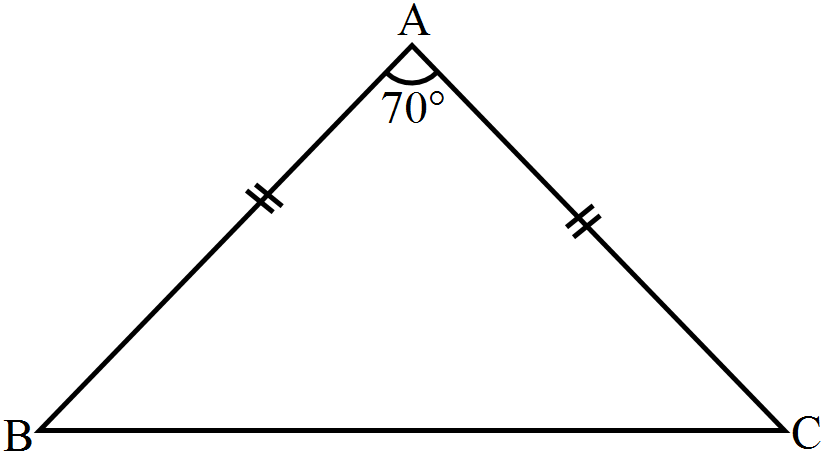
In the adjoining figure, $AB = AC$ and $\angle\text{A} = 70^\circ,$ then $\angle\text{C}$ is:
- A
$40^\circ$
- ✓
$55^\circ$
- C
$110^\circ$
- D
$70^\circ$
AnswerCorrect option: B. $55^\circ$
Since, It is given that $AB = AC,$ then $\angle\text{B}=\angle\text{C}$ (Isosceles triangle property)
Given $\angle\text{A}=70^\circ$ Let angle $B$ and $C$ be $x^\circ .$
Sum of all the three angles of triangle $= 180^\circ $, therefore $\angle\text{A}+\angle\text{B}+\angle\text{C}=180^\circ$
$70 + x + x = 180^\circ$
$x = 55^\circ$
$\angle\text{C}=55^\circ$
View full question & answer→MCQ 1651 Mark
In the adjoining figure, $\text{AB}\bot\text{BE}$ and $\text{FE}\bot\text{BE}.$ If $AB = FE$ and $BC = DE$, then.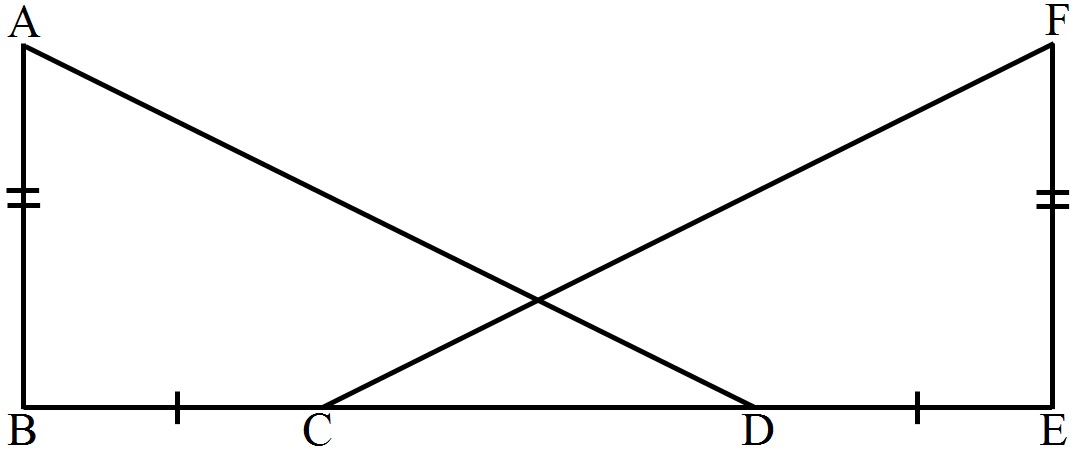
- A
$\triangle\text{ABD}\cong\triangle\text{CEF}$
- B
$\triangle\text{ABD}\cong\triangle\text{ECF}$
- ✓
$\triangle\text{ABD}\cong\triangle\text{FEC}$
- D
$\triangle\text{ABD}\cong\triangle\text{EFC}$
AnswerCorrect option: C. $\triangle\text{ABD}\cong\triangle\text{FEC}$
Given:
$AB = FE, BC = ED,$
$\text{AB}\bot\text{BE}$ and $\text{FE}\bot\text{BE}.$
To Prove: $AD = FC$
Proof: In $\triangle\text{ABD}$ and $\triangle\text{FEC},$
$AB = FE ...(1)$ (Given)
$\triangle\text{ABD}=\triangle\text{FEC} ...(2)$
Each$ = 90^{\circ}$
$BC = ED$ (Given)
$\Rightarrow BC + CD = ED + DC$
$\Rightarrow BD = EC ...(3)$
In view of $(1), (2)$ and $(3),$
$\triangle\text{ABD}\cong\triangle\text{FEC}$ using $SAS$ congruence rule.
View full question & answer→MCQ 1661 Mark
If the bisector of the angle $A$ of a $\triangle\text{ABC}$ is perpendicular to the base $BC$ of the triangle then the triangle $ABC$ is:
AnswerAngle bisector is perpendicular to the opposite side only in equilateral triangle.
View full question & answer→MCQ 1671 Mark
In the adjoining figure, if $AC = AD$, then
- A
$AB = AD$
- B
$AB < AD$
- ✓
$AB > AD$
- D
$AB ≤ AD$
AnswerCorrect option: C. $AB > AD$
$\angle\text{D} = \angle\text{C}$ (As $AC = AD)$
and $\angle\text{C} = \angle\text{B}$ and $\angle\text{D} = \angle\text{B}$
Hence, $AB > AD$
View full question & answer→MCQ 1681 Mark
In Fig. if $\text {DC}\parallel\text{DC}$ and $\text{AB}=\text{AC},$ the value of $\angle\text{ABD}$ is: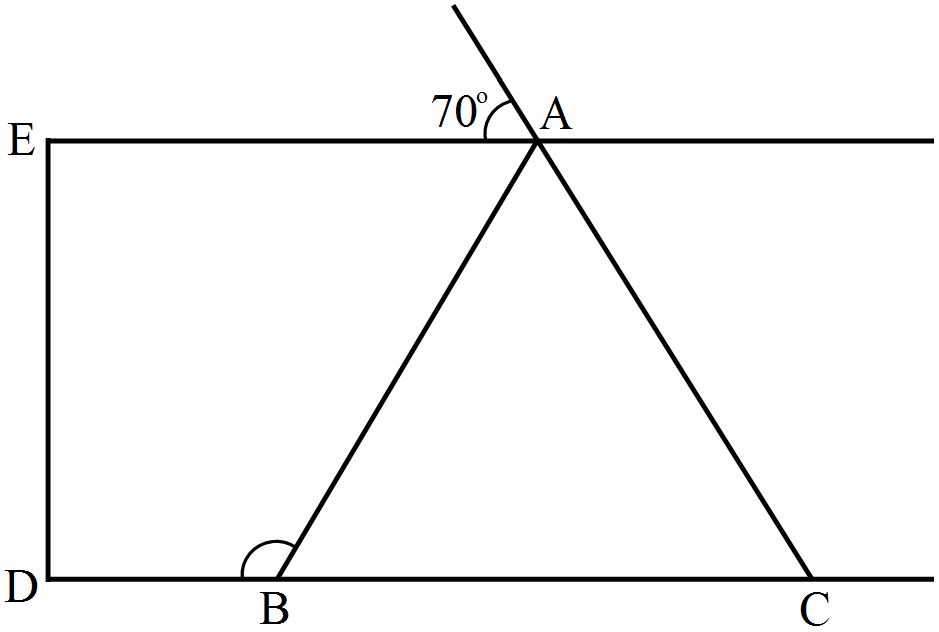
- A
$70^\circ$
- ✓
$110^\circ$
- C
$120^\circ$
- D
$130^\circ$
AnswerCorrect option: B. $110^\circ$
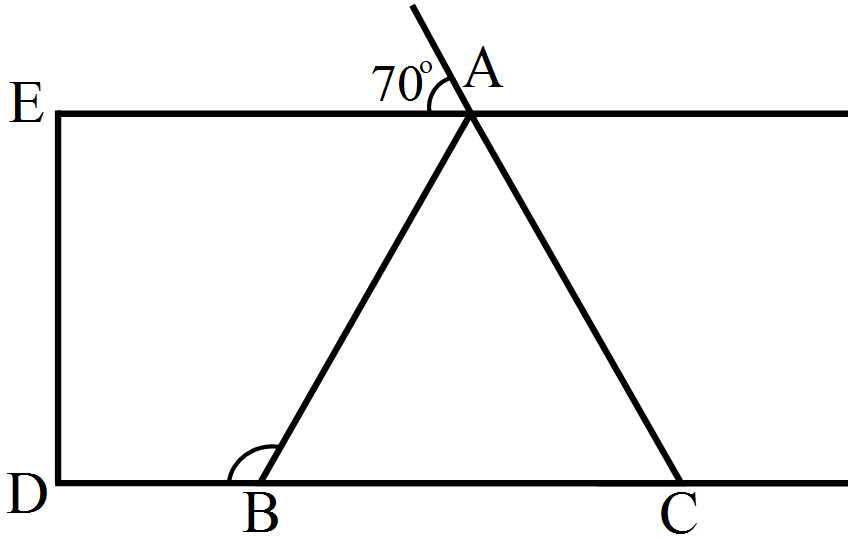
If $\text{AE}\parallel\text{DC}$ and $AC$ is transversal,
then $\angle\text{FAC}=70^\circ$ (opposite angles)
Also $\angle\text{FAC}-=\angle\text{ACB}=70^\circ$ (Alternate angles)
Since $\text{AB}=\text{AC},\triangle\text{ABC}$ is isosceles.
So $\angle\text{ABC}=\angle\text{ACB}$
$\Rightarrow\angle\text{ABC}=70^\circ$
Now $\angle\text{ABD}=180^\circ-\angle\text{ABC}=180^\circ-70^\circ=100^\circ$
Hence, correct option is (b). View full question & answer→MCQ 1691 Mark
In $\triangle\text{ABC},$ if $\angle\text{A}=100^\circ,\text{AD}$ bisects $\angle\text{A}$ and $\text{AD}\perp\text{BC}.$ Then, $\angle\text{B}=$
- A
$50^\circ$
- B
$90^\circ$
- ✓
$40^\circ$
- D
$100^\circ$
AnswerCorrect option: C. $40^\circ$
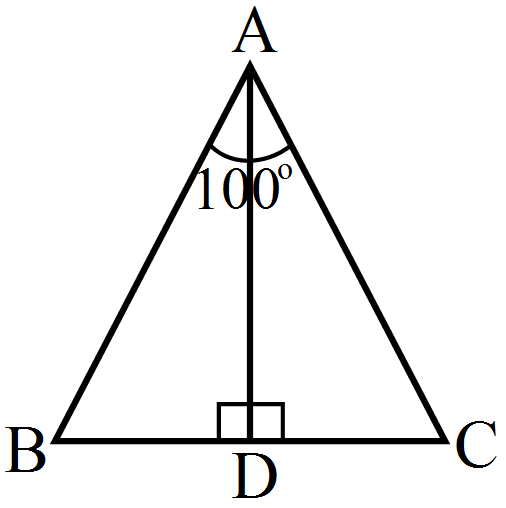
$\text{AD}\perp\text{BC}$ and $AD$ bisects $\angle\text{A}.$
$\Rightarrow\angle\text{BAD}=\angle\text{CAD}=50^\circ$
In Right $\triangle\text{ADB}$
$\angle\text{BAD}=50^\circ,\angle\text{ADB}=90^\circ$
Also sum of all interior angles $= 180^\circ $
$\Rightarrow\angle\text{BAD}+\angle\text{ADB}+\angle\text{B}=180^\circ$
$\Rightarrow\angle\text{B}=180^\circ-50^\circ-90^\circ$
$\Rightarrow\angle\text{B}=40^\circ$ View full question & answer→MCQ 1701 Mark
The length of two sides of a triangle are $7$ units and $10$ units. Which of the following length can be the length of the third side?
- A
$3\ cm$
- B
$19\ cm$
- C
$17\ cm$
- ✓
$13\ cm$
AnswerCorrect option: D. $13\ cm$
As per the rule in a triangle, sum of any $2$ sides should be greater than the third side. So, the lenght of the third side should be $13$, since with $7, 10$ and $13$ we have $7 + 10 > 13, 7 + 13 > 10$ and $13 + 10 > 7.$
View full question & answer→MCQ 1711 Mark
In the adjoining figure, $AB = AC$ and $AD$ is median of $\triangle\text{ABC},$ then $\triangle\text{ADC}$ is equal to: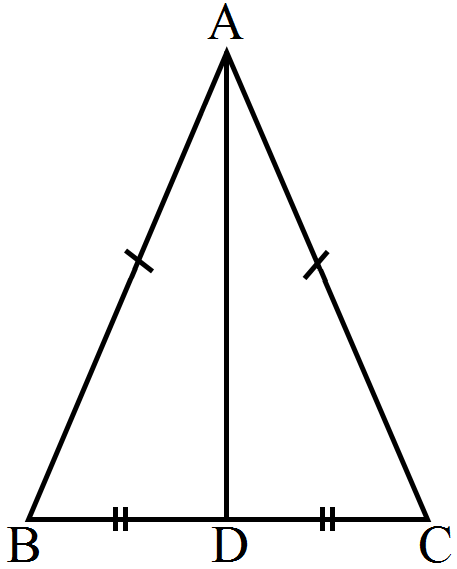
- ✓
$90^\circ$
- B
$60^\circ$
- C
$75^\circ$
- D
$120^\circ$
AnswerCorrect option: A. $90^\circ$
As $AD$ is the perpendicular bisector of $BC$, so $\angle\text{ADC} = \angle\text{ADB} = 90^\circ$
View full question & answer→MCQ 1721 Mark
In triangles $ABC$ and $PQR$, if $\angle\text{A}=\angle\text{R},\ \angle\text{B}=\angle\text{P}$ and $AB = RP$, then which one of the following congruence conditions applies:
AnswerSince, the two adjacent angles and the contained side are shown equal while proving the two triangles congruent. Hence, by $A.S.A.$ theorem the two triangles can be proved congruent.
View full question & answer→MCQ 1731 Mark
In $\triangle\text{ABC}$ and $6PQR, AB = PR $and $\angle\text{A}=\angle\text{P}.$ Then, the two triangles will be congruent by $SAS$ axiom if:
- A
$BC = QR$
- B
$BC = PQ$
- ✓
$AC = PQ$
- D
$AC = QR$
AnswerCorrect option: C. $AC = PQ$
$\angle\text{A}$ is included between $AB$ and $AC$ and $LP$ is included between $PQ$ and $PR$ and corresponding sides must be equal. Since $AB = PR$, hence $AC = PQ$ for the given triangles to be congruent by $SAS$ axiom.
View full question & answer→MCQ 1741 Mark
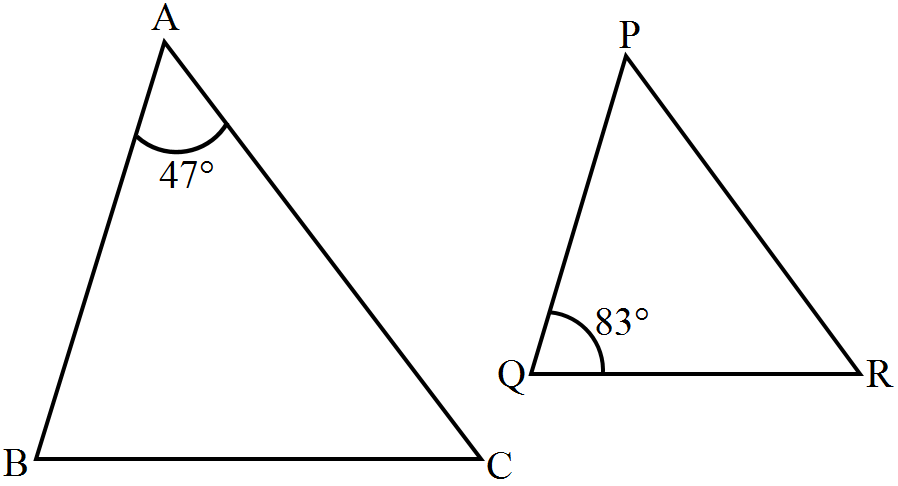
If $ABC$ and $PQR$ are similar triangles where $AB$ corresponds to PQin which $\angle\text{A} = 47^\circ$ and $\angle\text{Q} = 83^\circ,$ then $\angle\text{C}$ is:
- ✓
$50^\circ$
- B
$60^\circ$
- C
$70^\circ$
- D
$80^\circ$
AnswerCorrect option: A. $50^\circ$
Since, $\triangle\text{ABC}$ and $\triangle\text{PQR}$ are similar triangles.
then, $\angle\text{B} = \angle\text{Q} = 83^\circ$
Thus, in $\triangle\text{ABC},$
$\angle\text{C} = 180^\circ - (\angle\text{A} + \angle\text{B})$
or, $\angle\text{C} = 180^\circ - (47^\circ + 83^\circ)$
$\angle\text{C}=50^\circ$
View full question & answer→MCQ 1751 Mark
In the adjoining figure, $AB = AC$. If $\angle\text{ACD} = 115^\circ,$ then the measure of $\angle\text{A}$ is: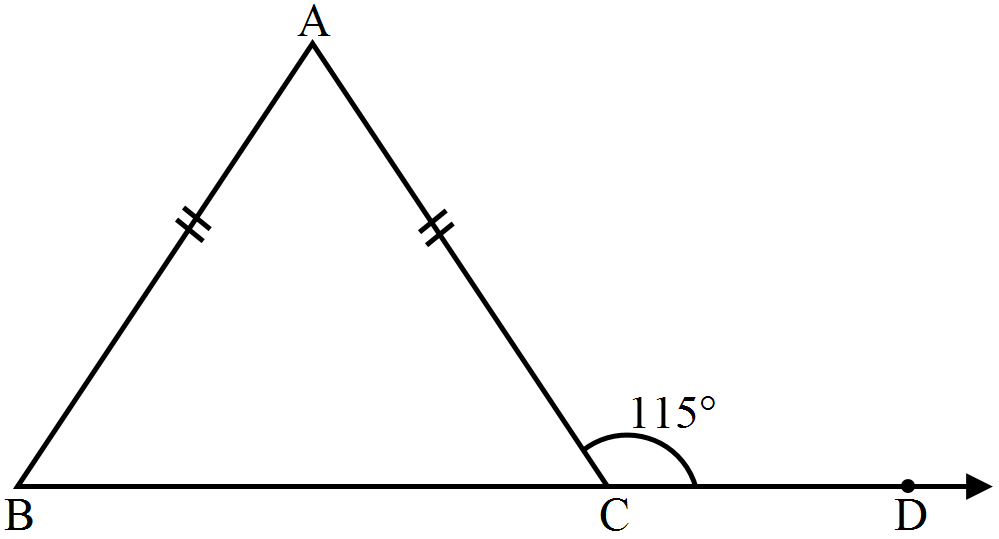
- ✓
$50^{\circ}$
- B
$57.5^{\circ}$
- C
$70^{\circ}$
- D
$65^{\circ}$
AnswerCorrect option: A. $50^{\circ}$
$\angle\text{ACD} = 115^\circ,\ \angle\text{ACB} = 180-115=65^\circ$ (Linear Pair)
Since, It is given that AB = AC, then $\angle\text{ABC} = \angle\text{ACB}$ (Isosceles trangle property)
As $\angle\text{ACB} = 65^\circ,$ therefore $\angle\text{ACB} = 65^\circ$
Sum of all the three angles of triangle $= 180^{\circ}$, therefore $\angle\text{ABC} + \angle\text{ACB} + \angle\text{A} = 180^\circ$
$\angle\text{A} = 180 - 65 - 65 = 50^\circ$
View full question & answer→MCQ 1761 Mark
In the adjoining figure, $BC = AC$. If $\angle\text{ACD} = 115^\circ,$ the $\angle\text{A}$ is: 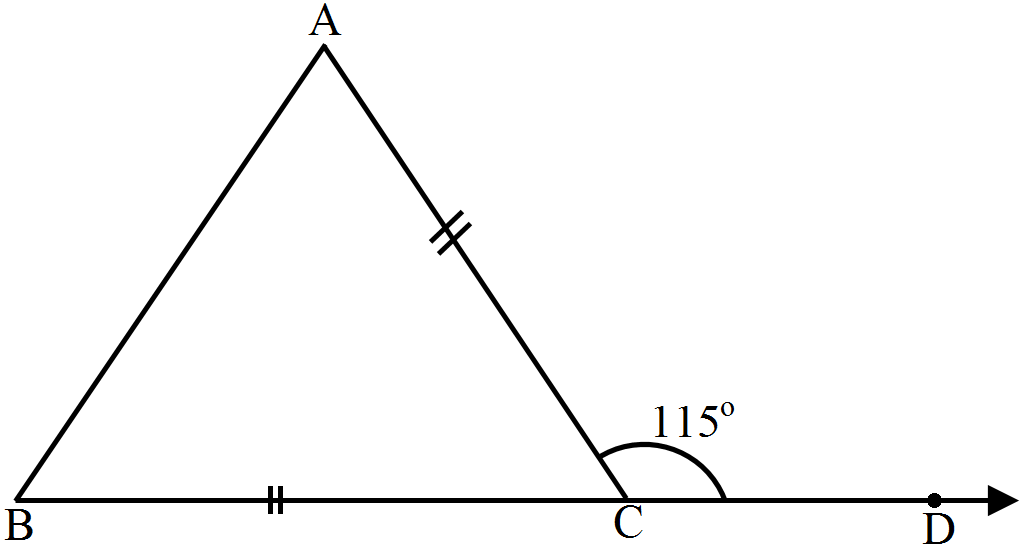
- A
$50^\circ$
- B
$65^\circ$
- ✓
$57.5^\circ$
- D
$70^\circ$
AnswerCorrect option: C. $57.5^\circ$
As $BC = AC$, therefore triangle ABC is an isoscelestriangle.
Given $\angle\text{ACD} = 115^\circ,\ \angle\text{ACB} = 180 - 115 = 65^\circ$ (Linear Pair)
As $AC = BC$, therefore $\angle\text{A} =\angle\text{B}$
As sum of all the three angles of atriangle is $180^\circ $
Therefore. $\angle\text{A}+\angle\text{B} +\angle\text{ACB} = 180^\circ$
$\angle\text{A} =\angle\text{B}=57.5^\circ$
View full question & answer→MCQ 1771 Mark
In the given figure, $\text{EAD}\perp\text{BCD}.$ Ray $FAC$ cuts ray $EAD$ at a point A such that $\angle\text{EAF}=30^\circ.$ Also, in $\triangle\text{BAC},\angle\text{BAC}=\text{x}^\circ$ and $\angle\text{ABC}=(\text{x}+10).$ Then, value of $x$ is: 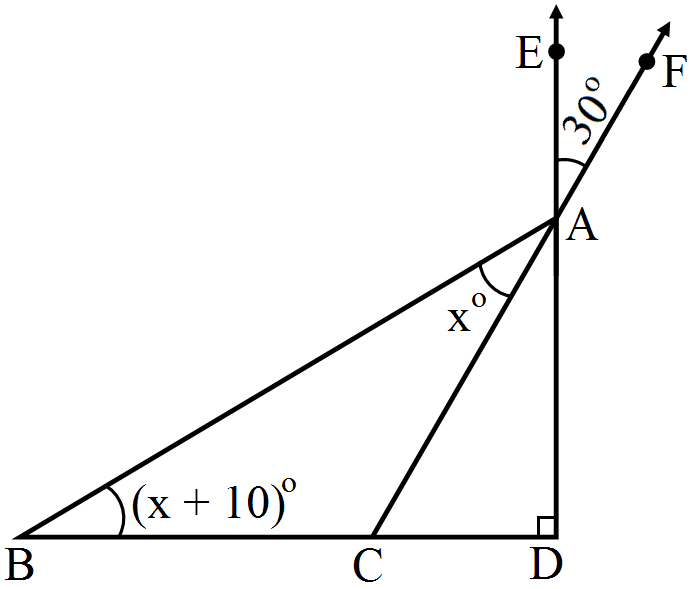
Answer$\angle\text{EAF}=\angle\text{CAD}$ (vertically opposite angles)
$\Rightarrow\angle\text{CAD}=30^\circ$
In $\triangle\text{ABD},$ by angle sum property
$\angle\text{A}+\angle\text{B}+\angle\text{D}=180^\circ$
$\Rightarrow(\text{x}+30)^\circ+(\text{x}+10)^\circ+90^\circ=180^\circ$
$\Rightarrow2\text{x}+130^\circ=180^\circ$
$\Rightarrow2\text{x}=50^\circ$
$\Rightarrow\text{x}=25^\circ$
View full question & answer→MCQ 1781 Mark
In a triangle, an exterior angle at a vertex is $95^\circ $ and its one of the interior opposite angle is $55^\circ ,$ then the measure of the other interior angle is:
- A
$55^\circ$
- B
$85^\circ$
- ✓
$40^\circ$
- D
$9.0^\circ$
AnswerCorrect option: C. $40^\circ$
Let the other interior opposite angle be $x^\circ .$
Then, we have
$x^\circ + 55^\circ = 95^\circ $
$\Rightarrow x^\circ = 95^\circ - 55^\circ = 40^\circ $
View full question & answer→MCQ 1791 Mark
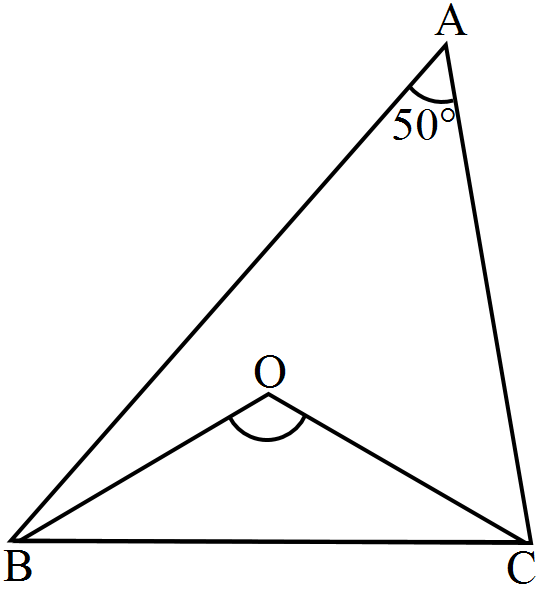
In the given figure, $BO$ and $CO$ are the bisectors of $\angle\text{B}$ and $\angle\text{C}$ respectively. If $\angle\text{A}=50^\circ$ then $\angle\text{BOC} = ?$
- A
$100^\circ$
- ✓
$115^\circ$
- C
$130^\circ$
- D
$120^\circ$
AnswerCorrect option: B. $115^\circ$
In $\triangle\text{ABC}$ we have:
$\angle\text{A}+\angle\text{B}+\angle\text{C}=180^\circ$ [Sum of the angles of a trianlge]
$⇒50^\circ+\angle\text{B}+\angle\text{C}=180^\circ$
$⇒\angle\text{B}+\angle\text{C}=130^\circ$
$\Rightarrow\ \frac{1}{2}\angle\text{B}\ +\ \frac{1}{2}\angle\text{C}=65^\circ\ ...\ (\text{i})$
In $\triangle\text{OBC},$ we have:
$\angle\text{OBC}+\angle\text{OCB}+\angle\text{BOC}=180^\circ$
$\Rightarrow\ \frac{1}{2}\angle\text{B}\ +\ \frac{1}{2}\angle\text{C}\ +\ \angle\text{BOC}=180^\circ$
$⇒65^\circ+\angle\text{BOC}=180^\circ$
$⇒\angle\text{BOC}=115^\circ.$
View full question & answer→MCQ 1801 Mark
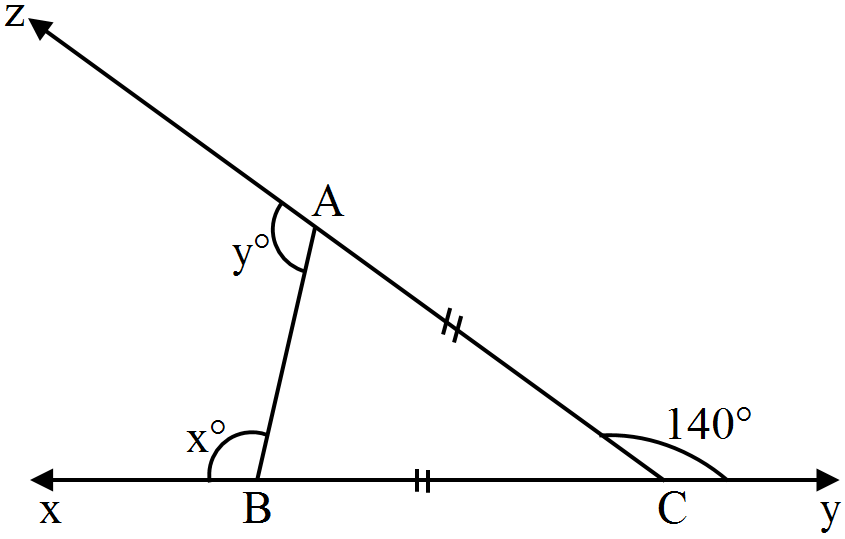
In fig, $AC = BC$ and $\angle\text{ACY} = 140^\circ.$ Find $X$ and $Y:$
- A
$50^{\circ}$ and $120^{\circ}$
- B
$95^{\circ}$ and $105^{\circ}$
- ✓
$110^{\circ}$ and $110^{\circ}$
- D
$80^{\circ}$ and $80^{\circ}$
AnswerCorrect option: C. $110^{\circ}$ and $110^{\circ}$
The two equal angles are $70$ since angle $C = 180 - 140 = 40X = Y = 180 - 70 = 110$
View full question & answer→MCQ 1811 Mark
If $O$ is any point in the interior of $\triangle\text{ABC},$ then, which of the following is true?
- A
$(\text{OA + }\text{OB} + \text{OC})\ >\ (\text{AB + }\text{BC} + \text{CA})$
- ✓
$(\text{OA + }\text{OB} + \text{OC})\ >\ \frac{1}{2}(\text{AB + }\text{BC} + \text{CA})$
- C
$(\text{OA + }\text{OB} + \text{OC})\ <\ \frac{1}{2}(\text{AB + }\text{BC} + \text{CA})$
- D
$\text{None of these}$
AnswerCorrect option: B. $(\text{OA + }\text{OB} + \text{OC})\ >\ \frac{1}{2}(\text{AB + }\text{BC} + \text{CA})$
Sum of any two sides of a triangle is greater than the third side.
Join $O$ with all sides of the triangle, we have
$OA + OB > AB ...(i)$
$OA + OC > AC ...(ii)$
and, $OB + OC > BC ...(iii)$
Adding the three inequalities i.e. $(i) + (ii) + (iii)$, we get
$2(OA + OB + OC) > AB + BC + AC$
i.e. $(\text{OA + }\text{OB} + \text{OC})\ >\ \frac{1}{2}(\text{AB + }\text{BC} + \text{CA})$
View full question & answer→MCQ 1821 Mark
In figure, $ABCD$ is a quadrilateral in which $AB = BC$ and $AD = DC$. The measure of $\angle\text{BCD}$ is: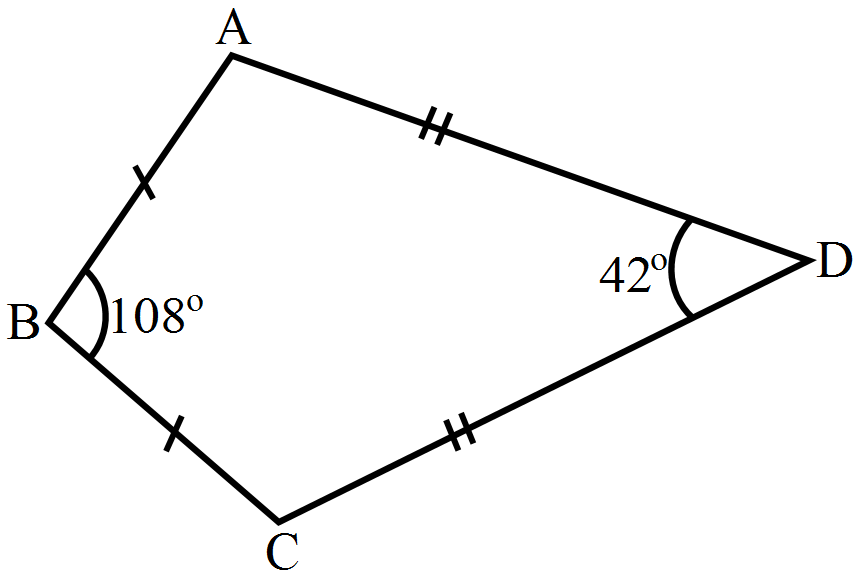
- A
$72^\circ$
- ✓
$105^\circ$
- C
$150^\circ$
- D
$30^\circ$
AnswerCorrect option: B. $105^\circ$
Join $AC$. We get two isosceles triangles, $\triangle\text{ABC}$ and $\triangle\text{ACD}$
In $\triangle\text{ABC},\ \angle\text{ABC}= 108^\circ$
$\therefore\ \angle\text{BAC} = \angle\text{BCA} = \Big(\frac{180^\circ - 108^\circ}{2}\Big) = \frac{72^\circ}{2} = 36^\circ$
In $\triangle\text{ACD},\ \angle\text{ADC}=42^\circ$
$\therefore\ \angle\text{DAC} = \angle\text{DCA} = \Big(\frac{180^\circ - 42^\circ}{2}\Big) = \frac{138^\circ}{2} = 69^\circ$
Now, $\angle\text{BCD} = \angle\text{BCA} + \angle\text{DCA} = 36^\circ + 69^\circ = 105^\circ$
View full question & answer→MCQ 1831 Mark
In Figure, if $\text{AB} \perp \text{BC},$ then $x =$
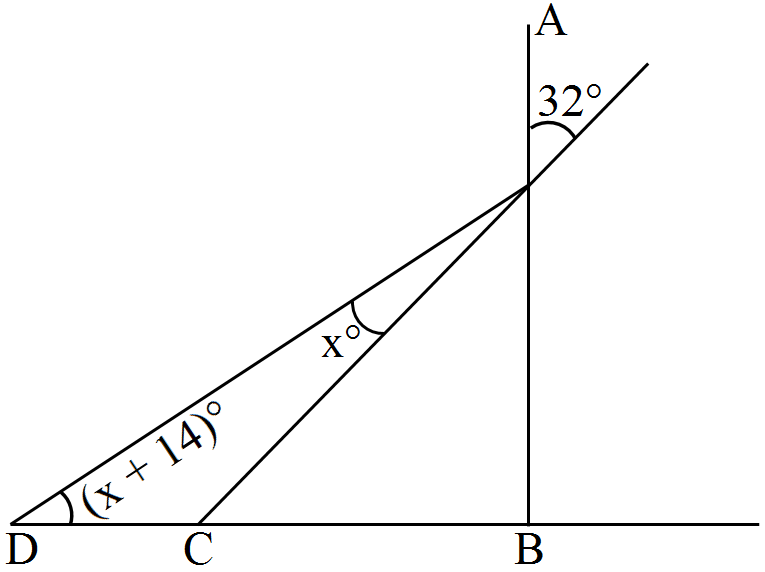
Answer$\text{AB} \perp \text{BC}$
$\Rightarrow \ \angle\text{ABC}=90^\circ$
$\angle\text{CAB}=32^\circ$ (Opposite angles)
Now, in $\triangle\text{ABD}$
$\angle\text{DAB }= \text{x}^\circ+32^\circ$
$\angle\text{ABD}=90^\circ$
$\angle\text{BDA }= \text{x}^\circ+14^\circ$
In a $\triangle,$ sum of all angles = 180^\circ
$\Rightarrow \angle\text{DAB} + \angle\text{ABD} + \angle\text{BDA} = 180^\circ$
$\Rightarrow \text{x}^\circ + ^\circ32^\circ +90^\circ + \text{x}^\circ+14^\circ = 180^\circ$
$\Rightarrow \ 2\text{x}^\circ = 180^\circ - 136^\circ$
$\Rightarrow \ 2\text{x}^\circ = 44$
$\Rightarrow \ \text{x}^\circ= 22$
View full question & answer→MCQ 1841 Mark
If triangle $PQR$ is right angled at $Q$, then
- A
$PR < PQ$
- B
$PR < QR$
- ✓
$PR > PQ$
- D
$PR = PQ$
AnswerCorrect option: C. $PR > PQ$
Then the hypotenuse should be always greater than the remaining two sides.
View full question & answer→MCQ 1851 Mark
$PQR$ is a right-angled triangle in which $\angle\text{P} = 90^\circ$ and $PQ = PR$. What is the value of $\angle\text{Q}$ and $\angle\text{R}.$
- A
$20^\circ , 60^\circ$
- ✓
$45^\circ , 45^\circ$
- C
$40^\circ , 50^\circ$
- D
$30^\circ , 60^\circ$
AnswerCorrect option: B. $45^\circ , 45^\circ$
$\angle\text{P} = 90^\circ$Since,$ PQ = PR$
$\angle\text{Q} = \angle\text{R}$
So, $\angle\text{Q} = \angle\text{R}=\frac{180^\circ\ -\ \angle\text{P}}{2}=\frac{180^\circ-90^\circ}{2}=\frac{90^\circ}{2}=45^\circ$
View full question & answer→MCQ 1861 Mark
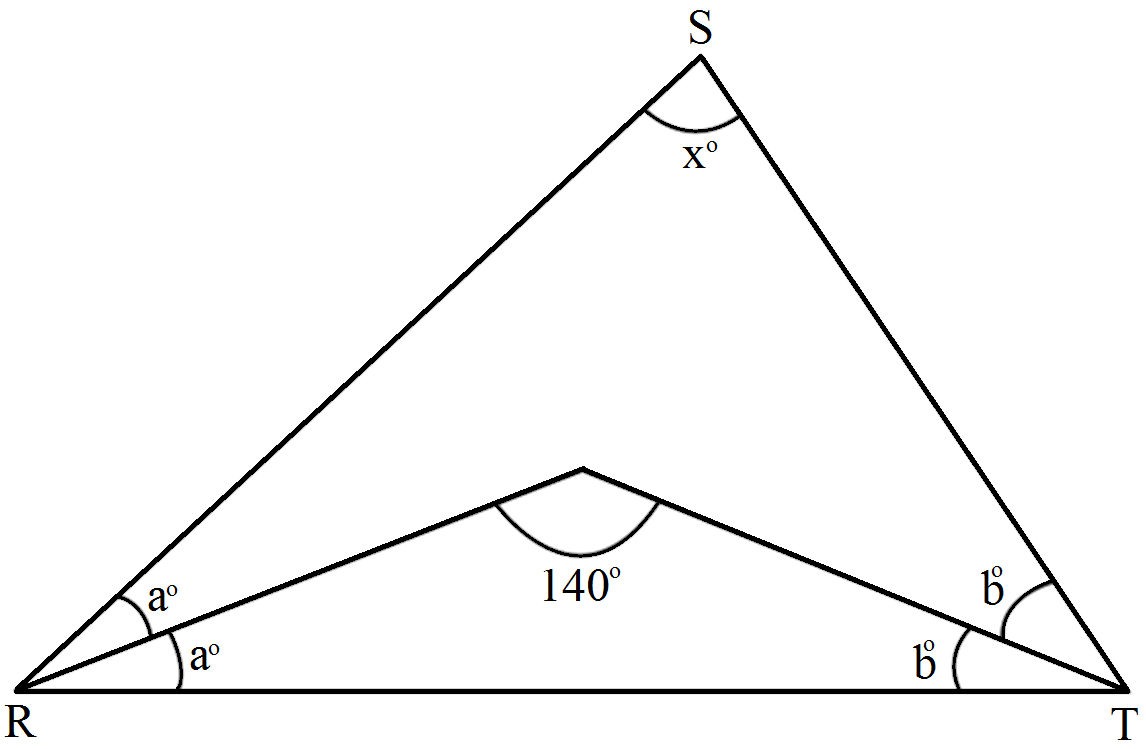
In $\triangle\text{RST}$ what is the value of $x?$
- A
$40^\circ$
- B
$90^\circ$
- C
$80^\circ$
- ✓
$100^\circ$
AnswerCorrect option: D. $100^\circ$
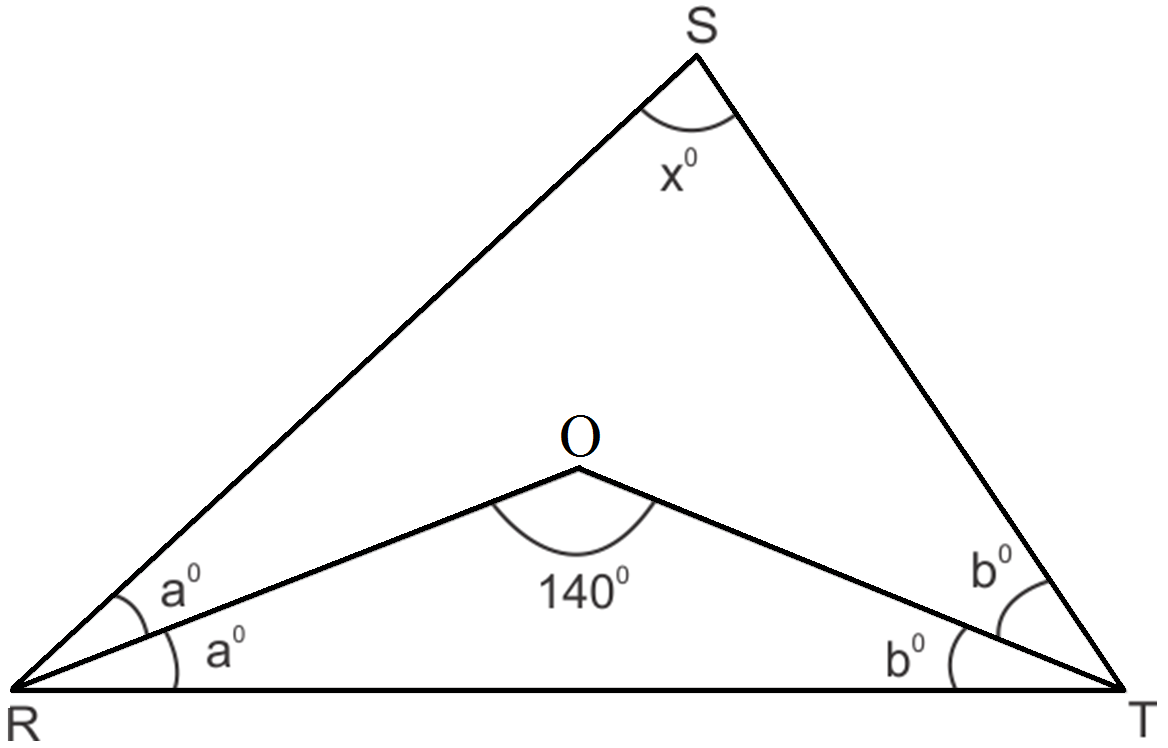
In $\triangle\text{RST}$
$\angle\text{R}+\angle\text{S}+\angle\text{T}=180^\circ$
$\Rightarrow2\text{a}^\circ+\text{x}^\circ+2\text{b}^\circ=180^\circ$
$\Rightarrow\text{x}^\circ=180^\circ-2(\text{a}+\text{b})^\circ\dots(1)$
Now in $\triangle\text{ROT}$
$\angle\text{ORT}+\angle\text{ROT}+\angle\text{OTR}=180^\circ$
$\Rightarrow\text{a}^\circ+140^\circ+\text{b}^\circ=180^\circ$
$\Rightarrow(\text{a}+\text{b})^\circ=180^\circ-140^\circ=40^\circ\dots(2)$
From $(1)$ and $(2)$
$\text{x}^\circ=180^\circ-2(40^\circ)$
$\Rightarrow\text{x}=100^\circ$ View full question & answer→MCQ 1871 Mark
In the adjoining figure, $ABCD$ is a quadrilateral in which $AD = CB$ and $AB = CD$, then $\angle\text{ACB}$ is equal to: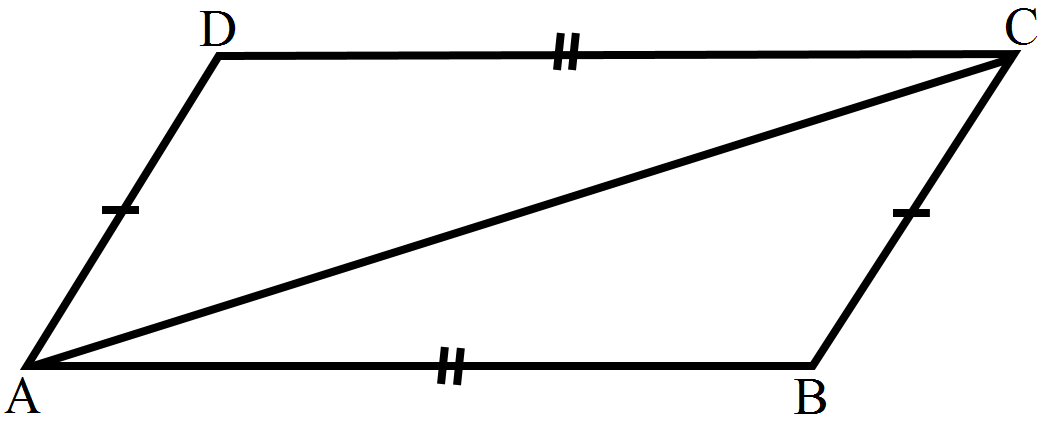
- ✓
$\angle\text{CAD}$
- B
$\angle\text{BAD}$
- C
$\angle\text{BAC}$
- D
$\angle\text{ACD}$
AnswerCorrect option: A. $\angle\text{CAD}$
As $AB = CD,$
so, $\angle\text{ACB}=\angle\text{CAD}$ (alternate angles).
View full question & answer→MCQ 1881 Mark
In the following, write the correct answer.It is given that $\triangle\text{ABC}=\triangle\text{FDE}$ and $AB = 5\ cm$, $\angle \text{B} = 40^\circ $and $\angle \text{A} = 80^\circ $then which of the following is true?
- A
$\text{DF}=5\text{ CM}, \angle\text{F}=60^{\circ}$
- ✓
$\text{DF}=5\text{ CM}, \angle\text{E}=60^{\circ}$
- C
$\text{DE}=5\text{ CM}, \angle\text{E}=60^{\circ}$
- D
$\text{DE}=5\text{ CM}, \angle\text{D}=40^{\circ}$
AnswerCorrect option: B. $\text{DF}=5\text{ CM}, \angle\text{E}=60^{\circ}$
Given $\triangle\text{ABC}=\triangle\text{FDE}$ and $AB = 5\ cm$, $\angle \text{B} = 40^\circ ,\angle\text{A}=80^{\circ}$
Since, $\triangle\text{ABC}=\triangle\text{FDE}$
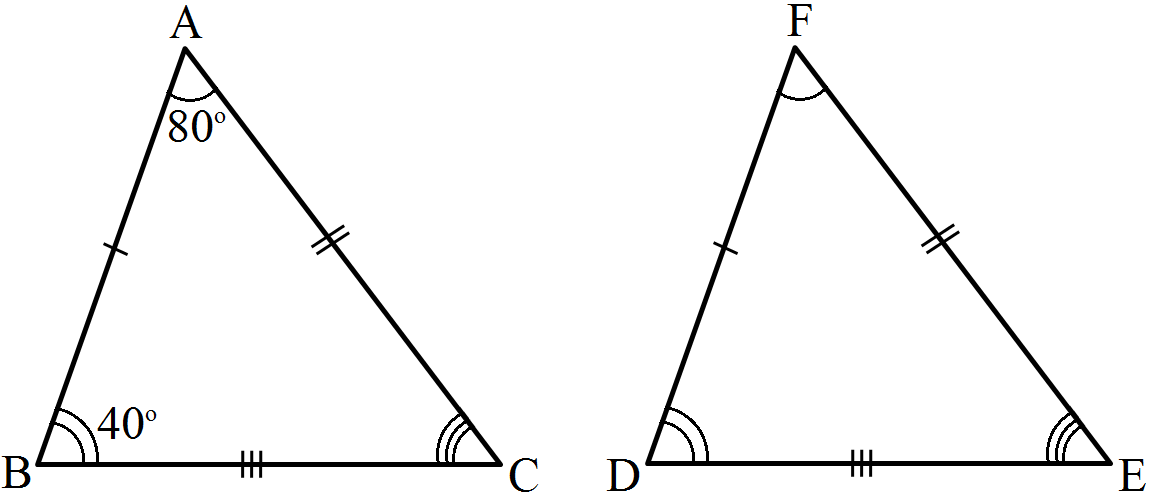
$DF = AB$
$DF = 5\ cm$
$\angle\text{E}=\angle\text{C}$
$\angle\text{E}=\angle\text{C}=180^{\circ}-(\angle\text{A}+\angle\text{B})$
$\angle\text{E}=180^{\circ}-(80^{\circ}+40^{\circ})$
$\angle\text{E}=60^{\circ}$ View full question & answer→MCQ 1891 Mark
If the bisectors of the acute angles of a right triangle meet at $O$, then the angle at $O$ between the two bisectors is:
- A
$45^\circ$
- B
$95^\circ$
- ✓
$135^\circ$
- D
$90^\circ$
AnswerCorrect option: C. $135^\circ$
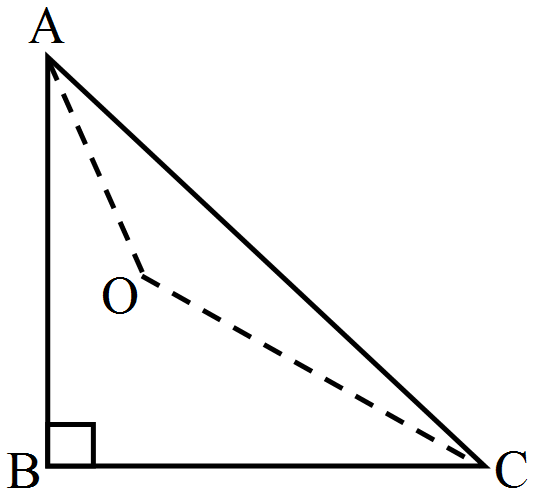
In $\triangle\text{ABC},$
$\angle\text{A}+\angle\text{B}+\angle\text{C}=180^\circ$
$\Rightarrow\angle\text{A}+90^\circ+\angle\text{C}=180^\circ$
$\Rightarrow\angle\text{A}+\angle\text{C}=90^\circ\dots(1)$
Now, in $\triangle\text{AOC},$
$\angle\text{COA}+\angle\text{OAC}+\angle\text{OCA}=180^\circ$
$\Rightarrow\angle\text{COA}+\frac{\angle\text{A}}{2}+\frac{\angle\text{C}}{2}=180^\circ$ {$AO$ and $CO$ bisects angle $\angle\text{A}$ and $\angle\text{C}$}
$\Rightarrow\angle\text{COA}=180-\Big(\frac{\angle\text{A}+\angle\text{C}}{2}\Big)$
$=180^\circ-\Big(\frac{90^\circ}{2}\Big)$ {From (1)}
$=100^\circ-45^\circ$
$=135^\circ$ View full question & answer→MCQ 1901 Mark
If $AB = QR, BC = RP$ and $CA = PQ$, then which of the following holds?
- A
$\triangle\text{ABC}\cong\triangle\text{PQR}$
- B
$\triangle\text{CBA}\cong\triangle\text{PQR}$
- ✓
$\triangle\text{CAB}\cong\triangle\text{PQR}$
- D
$\triangle\text{BCA}\cong\triangle\text{PQR}$
AnswerCorrect option: C. $\triangle\text{CAB}\cong\triangle\text{PQR}$
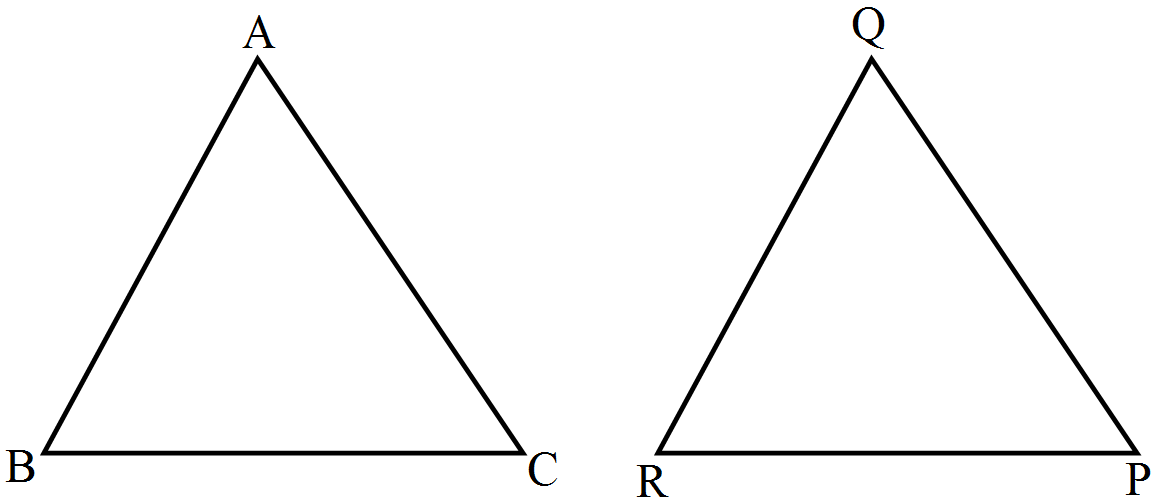
Given that,
$\text{AB = QR, BC = RP}$ and $\text{CA = PQ}$
So, $\text{A}\leftrightarrow\text{Q, B}\leftrightarrow\text{R}$ and $\text{C}\leftrightarrow\text{P}$
$\therefore\triangle{\text{CAB}}\cong\triangle\text{PQR}$ View full question & answer→MCQ 1911 Mark
If $\triangle\text{ABC}$ is an isosceles triangle with A$B = AC$ and $\angle\text{B} = 65^\circ,$ find $\angle\text{A}.$
- A
$70^\circ$
- ✓
$50^\circ$
- C
$60^\circ$
- D
AnswerCorrect option: B. $50^\circ$
In isosceles triangle $ABC$
$AB = AC$ (Given)
Therefore $\angle\text{B} = \angle\text{C} = 65^\circ$ (angles opposite to equal side are equal).
So, by applying angle sum property i.e $\angle\text{A}+\angle\text{B}+\angle\text{C}=180^\circ,$
$\angle\text{A} + 65^\circ + 65^\circ = 180^\circ$
$\angle\text{A} = 180^\circ - 130^\circ$
$\angle\text{A} = 50^\circ$
View full question & answer→MCQ 1921 Mark
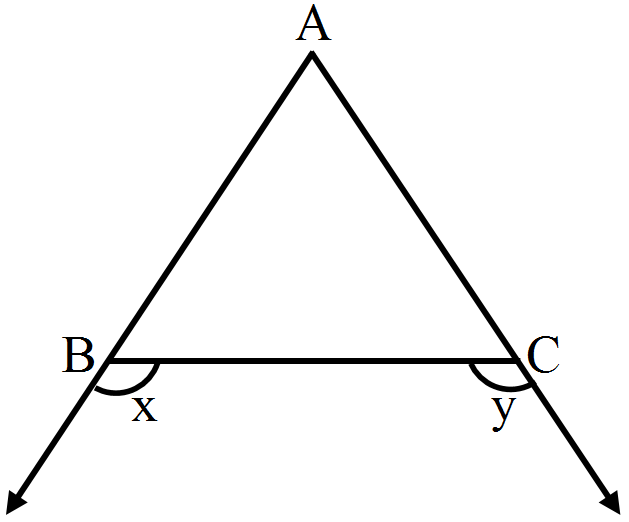
In the given figure, $ABC$ is an equilateral triangle. The value of $x + y$ is:
- A
$200^\circ$
- ✓
$240^\circ$
- C
$120^\circ$
- D
$180^\circ$
AnswerCorrect option: B. $240^\circ$
As triangle $ABC$ is an equilateral traingle, therefore all the three angles are equal, that
Is, $60^\circ $ each
$x = 180 - 60 = 120^\circ $
$y = 180 - 60 = 120^\circ $
$x + y = 120 + 120 = 240^\circ $
View full question & answer→MCQ 1931 Mark
Side $BC$ of $\triangle\text{ABC}$ has been produced to $D$ on left and to $E$ on right-hand side of $BC$ such that $\angle\text{ABD}=125^\circ$ and $\angle\text{ACE}=130^\circ.$ Then $\angle\text{A}=?$ 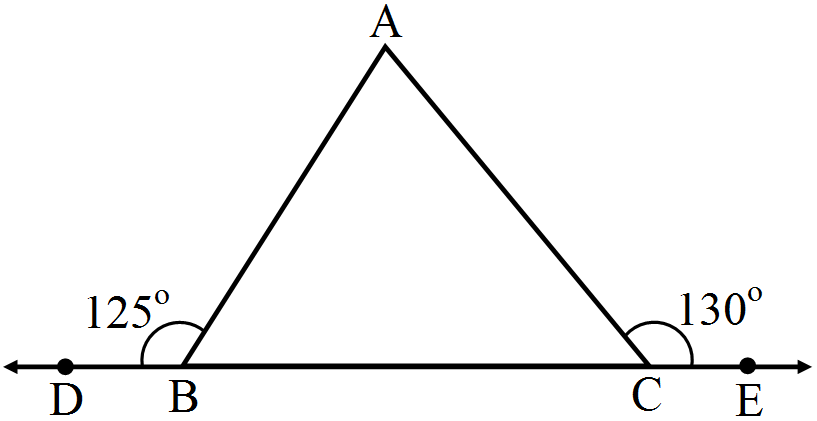
- A
$50^\circ$
- B
$55^\circ$
- C
$65^\circ$
- ✓
$75^\circ$
AnswerCorrect option: D. $75^\circ$
Since $DE$ is a straights line,
$\angle\text{ACB}+\angle\text{ACE}=180^\circ$
$\Rightarrow\angle\text{ACB}+130^\circ=180^\circ$
$\Rightarrow\angle\text{ACB}=50^\circ$
In $\triangle\text{ABC},$
$\angle\text{ABD}=\angle\text{BAC}+\angle\text{ACB}$ ......(Exterior angle is equal to sum of the remote interior angles)
$\Rightarrow125^\circ=\angle\text{BAC}+50^\circ$
$\Rightarrow\angle\text{BAC}=75^\circ$
that is, $\angle\text{A}=75^\circ.$
View full question & answer→MCQ 1941 Mark
If the bisectors of the acute angles of a right triangle meet at $O$, then the angle at $O$ between the two bisectors is:
- A
$95^\circ$
- B
$45^\circ$
- ✓
$135^\circ$
- D
$90^\circ$
AnswerCorrect option: C. $135^\circ$
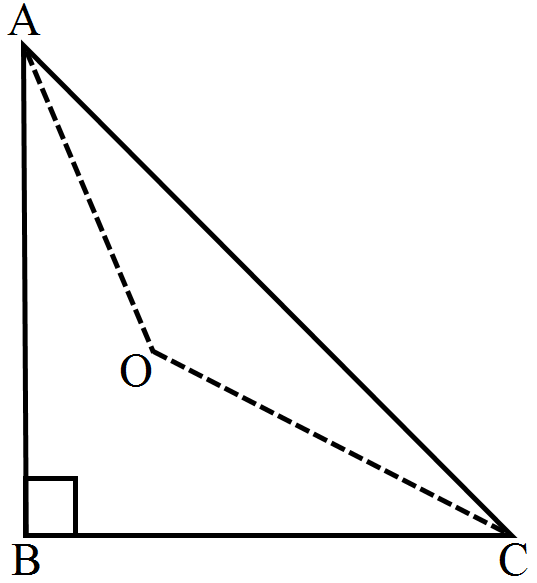
In $\triangle\text{ABC},$
$\angle\text{A}+\angle\text{B}+\angle\text{C}=180^\circ$
$\angle\text{A}+90^\circ+\angle\text{C}=180^\circ$
$\angle\text{A}+\angle\text{C}=90^\circ\ ...\ \text{(i)}$
Now, in $\triangle\text{AOC}$
$\angle\text{COA}+\angle\text{OAC}+\angle\text{OCA}=180^\circ$
$\Rightarrow\ \angle\text{COA}+\frac{\angle\text{A}}{2}+\frac{\angle\text{C}}{2}=180^\circ$
[AO and CO bisects angle $\angle\text{A}$ and $\angle\text{C}$]
$\Rightarrow\ \angle\text{COA}=180-\Big(\frac{\angle\text{A}+\angle\text{C}}{2}\Big)$
$=180^\circ-\Big(\frac{90^\circ}{2}\Big)$
$=180^\circ-45^\circ=135^\circ$ View full question & answer→MCQ 1951 Mark
In the adjoining Figure, $AB = AC$ and $BO = CD$. The ratio $\angle\text{ABO} : \angle\text{ACD}$ is: 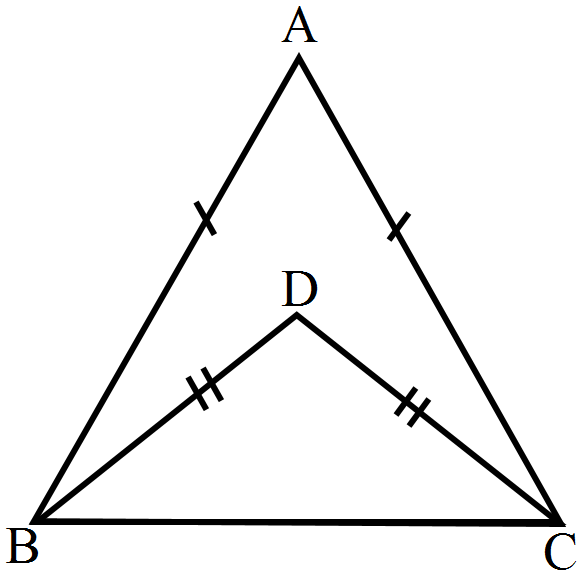
- ✓
It is $1 : 1$
- B
It is $1 : 2$
- C
It is $2 : 3$
- D
It is $2 : 1$
AnswerCorrect option: A. It is $1 : 1$
In $\triangle\text{ABC}$
$\text{AB = AC}$
$\therefore \angle\text{ABC} = \angle\text{ACB}$ (angles opposite to equal sides of a triangle are equal)$ ...(1)$
In $\triangle\text{DBC},$
$\text{DB = DC},$
$\therefore \angle\text{DBC} = \angle\text{DCB}$ (angles opposite to equal sides of a triangle are equal)$ ...(2)$
subtract 2 from 1
$\angle\text{ABC}-\angle\text{DBC} = \angle\text{ACB}-\angle\text{DCB}$ (equals subtracted from equals gives equal)
$= \angle\text{ABD} = \angle\text{ACD}$
Divide both the sides by $\triangle\text{ACD}$
$\Rightarrow\frac{\angle\text{ABD}}{\angle\text{ACD}}=1$
$\therefore \angle\text{ABD} : \angle\text{ACD}=1:1$
View full question & answer→MCQ 1961 Mark
Which of the following is not a criterion for congruence of triangles?
AnswerIf two triangles have two congruent sides and a congruent non-included angle, then $\triangle$ s are not necessarily corgruent. This is why there is no 'side side angle'
i.e. $SSA$ postulate.
Hence, correct option is $(b).$
View full question & answer→MCQ 1971 Mark
Find the measure of each exterior angle of an equilateral triangle.
- A
$110^\circ$
- B
$100^\circ$
- C
$150^\circ$
- ✓
$120^\circ$
AnswerCorrect option: D. $120^\circ$
We know that in equilateral triangle each angle is $60^\circ $
And we know sum of interior angle and exterior angle is $180^\circ $
Let exterior angle be $x$
$60^\circ + x = 180^\circ $
$x = 180^\circ - 60^\circ $
$x = 120^\circ $
View full question & answer→MCQ 1981 Mark
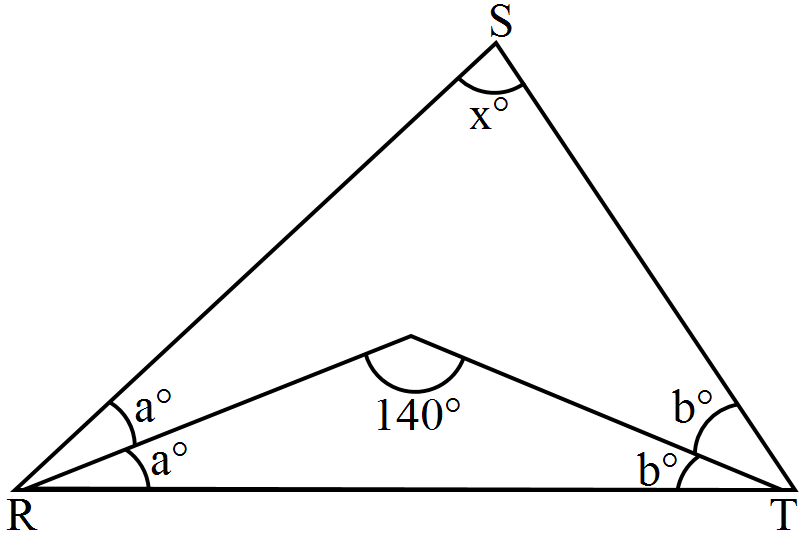
In $\triangle\text{RST}$ (See Figure), what is the value of $x?$
- A
$80^\circ$
- ✓
$100^\circ$
- C
$40^\circ$
- D
$90^\circ$
AnswerCorrect option: B. $100^\circ$
In $\triangle\text{RST}$
$\angle\text{R} + \angle\text{S} + \angle\text{T} = 180^\circ$
$\Rightarrow 2a^\circ + x^\circ + 2b^\circ = 180^\circ $
$\Rightarrow x^\circ = 180^\circ - 2(a + b)^\circ ... (i)$
Now, in $\triangle\text{ROT}$
$\angle\text{ORT} + \angle\text{ROT} + \angle\text{OTR} = 180^\circ$
$\Rightarrow a^\circ + 140^\circ + b^\circ = 180^\circ $
$\Rightarrow (a + b)^\circ = 180^\circ - 140^\circ = 40^\circ ...(ii)$
From eq. $(i)$ and $(ii)$
$x^\circ = 180^\circ − 2(40^\circ )$
$\Rightarrow x = 100^\circ $
View full question & answer→MCQ 1991 Mark
If all the altitudes from the vertices to the opposite sides of a triangle are equal, then the triangle is:
Answerin an equilateral triangle all the altitudes, sides, angles, perpendicular bisectors, medians and angular bisectors are equal.
View full question & answer→MCQ 2001 Mark
For any $\triangle\text{ABC}, AB + BC$ is always:
- A
Less than $AC$
- B
- C
Equal to $AC$
- ✓
Greater than $AC$
AnswerCorrect option: D. Greater than $AC$
Sum of any two sides is greater than third side.
View full question & answer→